Exploring Spectral Singularities in Dirac Semimetals: The Role of Non-Hermitian Physics and Dichroism
In this study, motivated by recent advancements in non-Hermitian physics, we explore new characteristics of Dirac semimetals (DSMs) using the spectral singularities by means of scattering techniques, with the goal of uncovering additional unique prop…
Authors: Mustafa Sarisaman, Murat Taş, Enes Talha Kırca
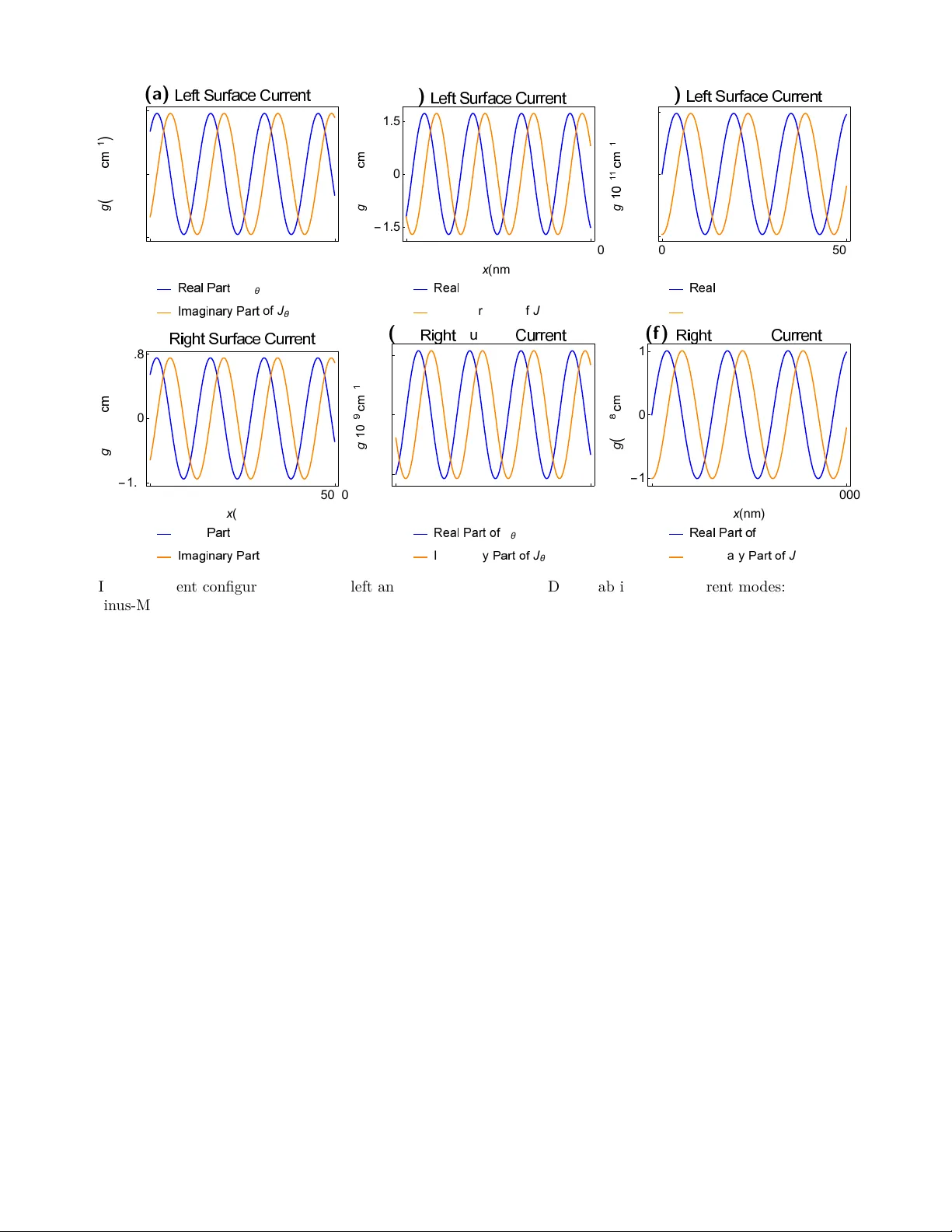
Exploring Sp ectral Singularities in Dirac Semimetals: The Role of Non-Hermitian Ph ysics and Dic hroism Mustafa Sarısaman ∗ National Intel ligenc e A c ademy, Institute of Engine ering and Scienc e, A nkar a, T urkey and Dep artment of Physics, Istanbul University, 34134, V ezne ciler, Istanbul, T urkey Murat T as † Dep artment of Physics, Gebze T e chnic al University, 41400 K o c aeli, T urkey Enes T alha Kırca ‡ Dep artment of Physics, Istanbul University, 34134, V ezne ciler, Istanbul, T urkey In this study , motiv ated by recen t adv ancements in non-Hermitian ph ysics, we explore new c har- acteristics of Dirac semimetals (DSMs) using the spectral singularities by means of scattering tech- niques, with the goal of uncov ering additional unique prop erties. T o ac hieve this, we in v estigate ho w the axion texture of a DSM aects its top ological prop erties by analyzing its interaction with electromagnetic wa ves. W e examine the transverse electric (TE) mo de conguration, where the magneto-electric eect induces a dichroic prop ert y in these materials. This b ehavior is particularly in teresting and commonly seen in p oten tial DSM candidates. Consequently , we rep ort for the rst time that a dichroic DSM generates 12 unique top ological laser types. W e discov er that surface curren ts are generated by topological terms on the surface of the DSM slab. F urthermore, we exam- ine how the θ term asso ciated with axions in top ological materials contributes to these top ological prop erties. Our study reveals distinct top ological role of the θ term more clearly than ever b efore. Our results conrm that the topological prop erties of DSMs with a single Dirac cone remain stable under external inuences and that a top ologically robust DSM laser can b e developed accordingly . P A CS n umbers: 03.50.De, 03.65.−w, 03.65.Nk, 42.25.Bs, 42.25.Gy , 42.55.−f, 71.55.Ak, 78.20.−e, 81.05.Bx INTR ODUCTION It is fascinating to discov er that certain adv anced mathematical concepts, suc h as top ology , hav e direct physical coun terparts with practical applications [ 1 , 2 ]. This realization has opened up new a v enues for researc h, particularly in understanding top ological phases of matter and their integration in to material science, giving rise to nov el application areas [ 3 – 5 ]. Among v arious top ological materials that hav e b een iden tied, some of the most prominent include electronic and photonic top ological insulators, top ological sup erconductors, and Dirac and W eyl semimetals and metals [ 6 – 18]. One class of materials that has garnered signicant attention recently is the top ological Dirac semimetals (DSMs), where the v alence and conduction bands touch at sp ecic p oin ts in momentum space, known as Dirac p oints [19 – 30]. What distinguishes these materials as “top ological” is the unique arrangement of degenerate W eyl nodes that act as an axion term, imparting a top ological nature to the system [31 – 33]. While many prop erties of DSMs hav e already b een explored, there remains a gap in understanding of their optical in teractions and top ological implications of these interactions. This study aims to address this gap and pro vide further insigh ts into the optical and top ological resp onse of DSM systems [34 – 50]. In ever-ev olving landscap e of condensed matter physics, DSMs hav e emerged as a groundbreaking class of materials captiv ating scien tists with their unique electronic properties and p oten tial applications. These materials are c haracter- ized by the presence of Dirac cones in their electronic band structures. This intriguing band structure imparts DSMs with remarkable c haracteristics such as high mobility of charge carriers, low eective mass, exotic top ological states and unusual resp onse to external elds. DSMs stand at the intersection of several fundamen tal concepts in physics. They exhibit linear disp ersion relation near the F ermi lev el, akin to that observed in tw o-dimensional graphene. These three-dimensional (3D) analogs of graphene not only expand our understanding of top ological phases of matter but also op en av en ues for practical applications. Indeed, DSMs exhibit a range of unique prop erties that make them suit- able for v arious cutting-edge applications. Their p oten tial spans multiple adv anced tec hnologies, including quantum computing, electronics, spintronics, thermo electrics, photonics [51, 52]. In this study , we explore the fundamental principles underlying the non-Hermitian asp ects of DSMs, fo cusing on their electronic structure and the role pla yed by the Dirac cones via the non-Hermitian scattering formalism. W e examine DSM lasers b y means of their associated spectral singularities, review recent developmen ts in c haracterization of suc h materials in this con text, discuss their theoretical models, and highlight their p otential impact on future 2 tec hnological innov ations. By in tegrating theoretical insigh ts with exp erimental breakthroughs, this article aims to pro vide an ov erview of DSMs and their place in the cutting-edge eld of materials science within the context of non- Hermitian physics. In the realm of adv anced photonics and materials science, the fusion of DSMs with non-Hermitian ph ysics represents a frontier of unprecedented p otential. This innov ativ e intersection promises not only deep ens our understanding of quantum materials but also pav es the w ay for rev olutionary adv ancemen ts in laser tec hnology . When sub jected to non-Hermitian principles-typically applied to op en systems with gain and/or loss-these materials exhibit no vel b ehaviors that are b oth theoretically intriguing and technologically adv antageous. The non-Hermitian physics explores systems where energy and other observ ables can exhibit non-conserv ativ e dynamics, often due to the presence of gain and/or loss. In such systems, conv entional notions of quantum mechanics are mo died, leading to nov el eects such as exceptional p oin ts, unidirectional light propagation, and enhanced lasing p erformance [54 – 73]. A t exceptional p oin ts, although the system may hav e real eigen v alues, the eigenstates may coalesce. In the case of scattering, the sp ectral singularities of any optical system in this picture corresp ond to states of divergen t reection and transmission amplitudes for the real k v alues of the physical system [74 – 82]. This causes the zero-width resonance and the laser threshold state to o ccur, as it generally pro duces purely outgoing wa ves [75]. This is a natural consequence of non-Hermitian ph ysics, unlik e traditional lasers. In recen t y ears, very essential studies ha ve b een carried out for understanding many unknown asp ects of new phenomena and realities with non-Hermitian ph ysics, and numerous studies hav e recently been devoted to exploring these phenomena[58 – 70]. Non-Hermitian ph ysics thus plays a crucial role in understanding exotic prop erties of top ological materials [83, 85 – 87]. This idea constitutes the main motiv ation of our w ork. Examining top ological systems with non-Hermitian physics is a very in teresting and remarkable approach. By integrating DSMs into these non-Hermitian frameworks, researchers are unco vering pathw a ys to engineer lasers with unprecedented eciency , tunabilit y , and robustness [88, 89]. Giv en the growing in terest in this eld and the fact that our top ological material of fo cus has an optically active structure, we will examine how it interacts with electromagnetic wa v es. Recently , discov ery of dic hroism eects in DSMs has shown how imp ortant it is to study these in teractions. Our goal here is to inv estigate and extract the dic hroism eect in these materials. Just as Kerr and F araday rotations in W eyl semimetals lead to an increase in the system size, dic hroism leads to a similar result in a DSM, suc h that one encounters an additional computational c hallenge in the structure [83, 84]. How ever, this c hallenge also reveals deep er insights into the system. Through our inv estigations, we uncov er previously unknown asp ects of DSMs by exploring these complexities. T o address this task, we designed our system so that the dichroism eect results in a 4 × 4 transfer matrix, leading to 12 distinct lasing congurations, some of which hav e top ologically robust features. W e aim to explore top ological eects in our system by generating wa v es in the TE mo de, which will allow us to study the top ological characteristics of DSMs. It is well-established that top ological prop erties of DSMs are gov erned by so-called the θ term [32, 90], which is in our case is simply π . T o understand how the θ term determines top ological prop erties of DSMs, we analyze scattering b eha vior of them, iden tify their spectral singularities, and inv estigate inuence of θ term on these singularities. Sp ectral singularities are the p oints where contin uous sp ectrum of a system displays exceptional characteristics [74, 91, 92]. Thus, in teraction of a DSM with electromagnetic wa ves can b e viewed as a non-Hermitian scattering problem in electromagnetic theory [83]. Our w ork pro ceeds as follo ws. First, w e calculate the transfer matrix through b oundary conditions b y solving Maxw ell equations with an axion term sp ecic to DSM for the TE mo de conguration. This transfer matrix allows us to calculate the sp ectral singularities. By calculating the sp ectral singularities in this wa y , we determine eect of the θ term on the sp ectral singularities of Na 3 Bi, whic h has b een exp erimentally prov en to b e a DSM [37, 93 – 96]. In our in vestigations, we obtain nov el results, such as dichroism in DSMs is an absolute eect and it gives rise to 12 dierent top ological laser types. Accordingly , presence of the θ term signicantly reduces the gain v alue in the system. It is manifestly shown that the gain is top ologically quantized by degenerating sp ectral singularity p oin ts in the system. This result is very imp ortan t and has b een noticed for the rst time. W e nally nd out that an induced current presen ts on the surfaces of a DSM. Notable results of this study show that 12 dierent top ological laser types can b e created due to the dichroism eect in a DSM, and under what conditions these lasers can exist. PRESENCE OF THE θ TERM AND ELECTROD YNAMICS IN A PLANAR DSM Before pro ceeding with the formal deriv ation, it is useful to briey clarify the theoretical framework adopted in this w ork. Our analysis is based on the eective electromagnetic resp onse of Dirac semimetals rather than a microscopic band-Hamiltonian formulation. A t low energies, the electronic degrees of freedom in top ological semimetals can b e integrated out, leading to an eectiv e eld theory where the electromagnetic resp onse is gov erned b y Maxw ell 3 equations supplemented by an axion term c haracterized by the parameter θ . This approach, commonly referred to as axion electro dynamics, provides a well-established description of the top ological magneto-electric resp onse in Dirac and W eyl semimetals. Within this eective description, the optical prop erties of the system can b e inv estigated through the scattering formalism of electromagnetic wa ves in teracting with the material. In suc h op en systems the presence of gain or loss naturally leads to a non-Hermitian framework, where sp ectral singularities app ear as real-frequency p oles of the scattering amplitudes. These singularities corresp ond to zero-width resonances and are known to represent the laser threshold condition in non-Hermitian optical systems. While exceptional p oints are typically discussed in the context of non-Hermitian Hamiltonians where eigen v alues and eigenv ectors coalesce, sp ectral singularities constitute their scattering-theoretic counterpart. In the present work we therefore fo cus on the emergence of sp ectral singularities within the transfer-matrix formulation of the DSM slab system and analyze their physical consequences for the generation of top ological laser mo des. Understanding wa ve propagation in a DSM environmen t requires grasping the role of θ term arising from material prop erties. The θ term is known as the magneto-electric p olarizabilit y , and is related to the Berry phase and Chern n umber. Its mission in electro dynamic interactions is accoun ted for axion electro dynamics. In T able I , we provide its v alues in dierent materials. T ABLE I: The θ term for v arious material t yp es. Here b µ = ( b 0 , b ) , x µ = ( t, x ) , and the Minko wski metric is assumed to b e η = diag ( − 1 , +1 , +1 , +1) . θ Material Type 0 Ordinary insulators π Time-rev ersal symmetric top ological insulators 2 b µ x µ W eyl semimetals π Dirac semimetals W e consider an optically active linear, homogeneous 3D slab of DSM with thic kness L aligned along the z -axis as sho wn in Fig. 1 . Although temp erature, disorder, and impurities can aect the physical and top ological prop erties of the system, we will simplify our analysis by fo cusing solely on the eect of the θ term. Therefore, we consider a material that is linear, homogeneous, and unaected by temp erature. The θ term, which survives b oth inside and at the b oundaries of the DSM, can b e expressed as a function of z in the form θ ( z ) = π Θ( z ) Θ( L − z ) , where Θ( z ) is the Heaviside step function dened as Θ( z ) := 0 , z < 0 1 , z ≥ 0 . (1) This actually demonstrates the semimetallic nature inherent in these materials. Complex refractive index within the slab is considered uniform across the region z ∈ [0 , L ] b etw een its end faces. Observe that the 3D material extends indenitely in the x and y directions. Interaction of this slab system with electromagnetic wa v es is crucial for under- standing its top ological and magneto-electric prop erties, as w ell as its applications in quantum device technologies. T op ological asp ects arise from the single placement of W eyl no de, which determine the conductive c haracter on the faces of the slab. In our set up, the no des are lo cated along the z -axis and a constant θ term app ears inside the slab. Maxw ell equations incorp orating additional top ological terms asso ciated with the W eyl no de for our slab congu- ration can b e written as [33, 83] ∇ · D ℓ = ρ , (2) ∇ · B ℓ = 0 , (3) ∇ × E ℓ = − ∂ t B ℓ , (4) ∇ × H ℓ = J + ∂ t D ℓ . (5) In these equations, D ℓ , B ℓ , E ℓ and H ℓ denote linear expressions assumed by the electromagnetic elds in the presence of θ term. ρ and J denote, resp ectiv ely , the charge and current densities, which dep end on p osition and time. These expressions are free and axion-induced expressions, and can b e written as: ρ := ρ f + ρ θ and J := J f + J θ . Eqs. ( 2 )-( 5 ) 4 ϕ H E k θ θ π θ z x 0 L 0 π z θ FIG. 1: TE mo de conguration for the interaction of electromagnetic wa v e incident by an angle ϕ measured from the normal to the surface of DSM slab. Left panel displa ys the 3D conguration while middle panel shows the top view. Red dot iden ties the single W eyl no de. θ terms corresp onding to each medium are demonstrated on the right panel. Colored region sp ecies the DSM. are Maxw ell equations in a DSM en vironmen t with a θ term. T wo dierent approac hes can be follow ed to obtain these equations. The rst of these is to nd equations of motion by writing the action expression that sp ecies interaction b et w een the electromagnetic elds and the θ term. The other one is to show interaction of the θ term with relev ant elds by direct reection. These are shown in the App endix. Con tinuit y Equation and Axion-Induced Surface Currents Quan tities ρ and J in Eqs. ( 2 ) and ( 5 ) satisfy the con tinuit y equation as a natural consequence of Maxwell equations: ∇ · J + ∂ t ρ = 0 (6) These quantities may b e decomp osed into free and induced-axion terms, such that tw o distinct contin uity equations are obtained as follo ws: ∇ · J f = 0 (7) ∇ · J θ + ∂ t ρ θ = 0 (8) Note that here the free charge densit y is taken as zero. How ever, due to the semimetallic character of the material, the free current density is dierent from zero. In this case, divergence of the free current density is zero. The free curren t density can b e related to the conductivity tensor of the material. In this case, J f = σ E ℓ ⇒ [ J f ] α = σ αβ E β . (9) Here σ can b e briey represented as σ = σ yy σ yz σ z y σ z z (10) It can b e seen that σ z z comp onen t v anishes due to material prop erties. Scattering Solutions and Dichroism Eect in a Planar Dirac Semimetal Since the material considered here contains an axionic con tent, it is inevitable that exotic surface eects will app ear when exp osed to an external electromagnetic w av e. The axionic contribution of the material is considered along the 5 z -axis only . Th us, if the electromagnetic wa ve incident from outside has a magnetic eld in this direction, a rotation in the p olarization direction of the wa ve is exp ected. A judicious choice should b e made and p olarization direction of the electromagnetic wa ve incident from outside should b e sent in a wa y that it would interact with the axionic term. This corresp onds to the TE mo de conguration in our study . Hence, a wa ve polarized along the y -axis and making an angle of ϕ with the surface normal was sent to the DSM medium from outside, and result of its interaction with the DSM is aimed to b e examined within the scope of scattering theory . This choice ensures that the electromagnetic w a ve couples to the axionic magneto-electric resp onse of the material, which is resp onsible for the emergence of dichroic b eha vior. Propagation of the wa ve in a material is controlled by the solutions of Maxwell equations. Accordingly , by taking the curl (i.e. ∇× ) of Eq. ( 4 ), and then using Eq. ( 5 ), 3D Helmholtz equation is obtained as ∇ 2 E + ε 0 ω 2 n 2 E + iω µ 0 J = 0 . (11) Here, n represents the complex refractive index of the DSM. F or an active material medium with a gain or loss conten t, the refractive index can b e decomp osed into its real and imaginary parts as n = η + iκ . (12) F or v arious materials, including DSMs, it is in general safe to assume that | κ | ≪ η , where the parameter κ essentially dictates whether the medium exhibits gain or loss. Specically , when κ < 0 , the medium functions as a gain medium, while for κ > 0 the medium b ehav es as an absorbing or loss medium. When a w av e is incident to the DSM medium from outside with TE mo de in y -direction, some eects will o ccur when the wa v e hits the surface due to the electric and magnetic prop erties of the material. Boundary conditions of the material indicate that the incident wa ve will not create a (Kerr/F araday) rotation eect in x -direction. In this case, it is understo o d that such types of materials cannot cause a F araday or Kerr t yp e rotations. How ever, since the axionic con tent increases dimension of the electromagnetic wa ve scattered from the material, the only remaining option is that the p olarization direction of the electromagnetic w av e in the material will rotate tow ards the z -axis. This is known as the dichroism eect and indicates rotation of the wa v e along the material direction. This eect has actually b een observed in such materials, but it is a non-generalized eect that is presen ted for the rst time in this study . The results of this study show that the DSM medium is a dichroic medium. Thus, an electromagnetic wa ve p olarized in the y -direction will mov e in the material such a wa y that it will b e p olarized in the y − z plane after the scattering even t. In this case, the electric eld solution after the scattering can b e written as E ( x, z ) = E y ( x, z ) ˆ e y + E z ( x, z ) ˆ e z . (13) This expression is inserted into Eq. (11) to obtain the scattering solutions inside and outside of the DSM. It should b e noted that current J is zero outside the material. T o understand characteristics of these solutions inside the material, v alues of J are imp ortant. As is clearly seen, the free current density that forms J f exists inside the material due to the dichroism eect. How ev er, induced current J θ originating from the axionic term app ears only on the surfaces. The reason for this is the presence of Dirac delta functions in the J θ expression. In this case, free current densities inside the material can b e calculated using Eq. ( 9 ). Another p oint to note is that the dichroism eect only causes existence of the conductivit y comp onen ts σ yz and σ z y . In this case, it can b e seen that the Helmholtz equation ( 11) can b e reduced to the following form, ∇ 2 E α + ε 0 ω 2 n 2 E α + iω µ 0 σ αβ E β = 0 ⇒ ∇ 2 δ αβ + ε 0 ω 2 n 2 δ αβ + iω µ 0 σ αβ E β = 0 . (14) Here the subscripts α and β represent y and z comp onen ts of the electric eld. Describing these equations in terms of comp onen ts yields the following coupled relations: ∇ 2 E y + ε 0 ω 2 n 2 E y + iω µ 0 σ yz E z = 0 (15) ∇ 2 E z + ε 0 ω 2 n 2 E z + iω µ 0 σ z y E y = 0 (16) Note that σ yz = σ z y due to the symmetric nature of σ . One can solve these by multiplying Eq. (15) with i , and then add and subtract it from Eq. (16), yielding the following pair of equations: ∇ 2 + ε 0 ω 2 n 2 Φ ± ∓ ω µ 0 σ Φ ∓ = 0 . (17) Here, Φ ± := E z ± iE y and σ := σ yz = σ z y . W riting this equation explicitly results in coupled new expressions, ∇ 2 + ε 0 ω 2 n 2 Φ + − ω µ 0 σ Φ − = 0 (18) ∇ 2 + ε 0 ω 2 n 2 Φ − + ω µ 0 σ Φ + = 0 (19) 6 T o solv e these coupled relations, Eq. (19) is multiplied by i , then added to and subtracted from Eq. (18). These op erations yield the following decoupled equations, ∇ 2 + ε 0 ω 2 n 2 Ψ ± ± iω µ 0 σ Ψ ± = 0 , (20) where Ψ ± := Φ + ± i Φ − . These solutions in terms of the electric eld comp onents can b e calculated easily as Ψ ± := (1 ± i )( E z ± E y ) . (21) Th us, comp onents E y and E z can b e calculated in terms of new elds Ψ + and Ψ − as E y = 1 4 [(1 − i )Ψ + − (1 + i )Ψ − ] , (22) E z = 1 4 [(1 − i )Ψ + + (1 + i )Ψ − ] . (23) It should b e noted that arguments of these quantities dep end on x and z . As a result, solutions of the decoupled Helmholtz equation (20) can no w b e easily found. F or this purp ose, the arguments can b e separated as Ψ ± ( x, z ) = e ik x x Ψ ± ( z ) . When these expressions are substituted into Eq. (20), the 1D Helmholtz equation with resp ect to z is obtained Ψ ′′ ± ( z ) + k 2 z ˜ n 2 ± Ψ ± ( z ) = 0 . (24) In this equation, the prime( ′ ) symbol indicates the deriv ativ e with resp ect to z , k z = k cos ϕ is the z -comp onent of the w av e-vector k , ˜ n ± is the frequency dep enden t birefringence index, which app ears due to the conductivity of the material, and it is dened as ˜ n ± := ˜ n 2 ± iµ o ω σ k 2 z , ˜ n := n 2 − sin 2 ϕ cos ϕ . (25) Notice that Eq. (24) gives rise to the following Sc hrö dinger equation with a constant complex p otential V ± ( z ) := k 2 z (1 − ˜ n 2 ± ) − Ψ ′′ ± ( z ) + V ± ( z )Ψ ± ( z ) = k 2 z Ψ ± ( z ) . (26) As a natural outcome of this analysis, materials exhibiting a DSM phase hav e tw o distinct refractiv e indices (a birefringence eect), with each refractive index corresp onding to its o wn unique Schrödinger equation. This indicates a non-Hermitian state with real energy v alues, corresponding to the scattering state we describ ed earlier. Here ˜ n represen ts the eective refractive index of the material, and is caused by the w av e arriving at a certain angle. Thus, solution to the Helmholtz equation, as detailed in Eq. (24), is expressed as follows: Ψ ± ( z ) := A 1 ± e ik z z + B 1 ± e − ik z z , z < 0 A 2 ± e ik z ˜ n ± z + B 2 ± e − ik z ˜ n ± z , 0 < z < L A 3 ± e ik z z + B 3 ± e − ik z z , z > L. (27) These results can be substituted in to Eqs. (22) and (23) in order to obtain electric eld components E y and E z . Similarly , to nd magnetic eld B , v alues of E y and E z are substituted into Eq. (61). As a re sult, the eld B ( x, z ) is expressed as: B = − i ω ∇ × E = i ω [ ˆ e x ∂ z E y + ˆ e y ∂ x E z − ˆ e z ∂ x E y ] . (28) But since E y ( x, z ) = e ik x x E y ( z ) , we nd ∂ x E y = ik x E y . As a result, these quantities can b e made indep enden t of x , and B ( z ) is obtained as B ( z ) = i ω [ ∂ z E y ˆ e x + ik x E z ˆ e y − ik x E y ˆ e z ] . (29) 7 It will b e seen that ∂ z E y is found as follo ws ∂ z E y = (1 − i ) 4 ∂ z Ψ + − (1 + i ) 4 ∂ z Ψ − (30) with ∂ z Ψ ± := ik z ˜ N ± F − ± , ˜ N ± := 1 ˜ n ± 1 , F ℓ a ( z ) := A 1 a e ik z z + ℓB 1 a e − ik z z A 2 a e ik z ˜ n a z + ℓB 2 a e − ik z ˜ n a z A 3 a e ik z z + ℓB 3 a e − ik z z , (31) where the subscripts a and ℓ take the signs + / − . Consequently , with these new denitions, the electric and magnetic eld comp onents can b e determined as in T able I I. Likewise, one can obtain the H and D elds using denitions: H = B /µ 0 and D = ε E ; their comp onents are given in T able I I. Symbol N , dened in T able I I, represents refractive index of the en tire space and is given by: N := 1 n 1 (32) Notice that N and ˜ N can be related to eac h other b y ˜ N = N 2 − sin 2 ϕ/ cos ϕ , where ˜ N represents eective refractive index of the en tire space. T ABLE I I: Comp onen ts of the elds Z ∈ E , D , B , H inside and outside of the DSM slab. Here Z ( x, z ) := (1 − i ) e ik x x 4 Z ( z ) and Z ∈ E , D , B , H . Quan tities F ℓ a ( z ) are sp ecied in Eq. 31,and the refractive index of whole space is iden tied in Eq. 32. E ( z ) D ( z ) B ( z ) H ( z ) E x = 0 D x = 0 B x = − cos ϕ c ˜ N + F − + ( z ) − i ˜ N − F − − ( z ) H x = − cos ϕ Z 0 ˜ N + F − + ( z ) − i ˜ N − F − − ( z ) E y = F + + ( z ) − i F + − ( z ) D y = ε 0 N 2 F + + ( z ) − i F + − ( z ) B y = − sin ϕ c F + + ( z ) + i F + − ( z ) H y = − sin ϕ Z 0 F + + ( z ) + i F + − ( z ) E z = F + + ( z ) + i F + − ( z ) D z = ε 0 N 2 F + + ( z ) + i F + − ( z ) B z = sin ϕ c F + + ( z ) − i F + − ( z ) H z = sin ϕ Z 0 F + + ( z ) − i F + − ( z ) After determining the electromagnetic elds at every p oint in space, b oundary conditions at the edges of the DSM can b e established. Standard b oundary conditions for the DSM medium are outlined in T able IV, whic h is presented in Appendix. Hence, the b oundary conditions giv en in T able IV can be written to relate the amplitudes on the left and righ t surfaces. Accordingly , the following notations can b e used for the elds in regions I - I I and I I - I I I, resp ectiv ely: S V 2 = U + V 1 S P 1 V 2 = U − P 2 V 3 (33) Here we employ ed the following denitions. U ± := 1 ± k x ε 0 ω 1 ± k x ε 0 ω i (1 ∓ k x ε 0 ω ) i (1 ∓ k x ε 0 ω ) 1 1 − i − i 1 ∓ Z 0 α cos ϕ − (1 ± Z 0 α cos ϕ ) − i (1 ∓ Z 0 α cos ϕ ) i (1 ± Z 0 α cos ϕ ) 1 ∓ Z 0 σ sin ϕ 1 ∓ Z 0 σ sin ϕ i (1 ∓ Z 0 σ sin ϕ ) i (1 ∓ Z 0 σ sin ϕ ) (34) V i := A i + B i + A i − B i − , S := n 2 n 2 i n 2 i n 2 1 1 − i − i ˜ n + − ˜ n + − i ˜ n − i ˜ n − 1 1 i i (35) P 1 := e ik z ˜ n + L 0 0 0 0 e − ik z ˜ n + L 0 0 0 0 e ik z ˜ n − L 0 0 0 0 e − ik z ˜ n − L , P 2 := e ik z L 0 0 0 0 e − ik z L 0 0 0 0 e ik z L 0 0 0 0 e − ik z L (36) 8 T ransfer Matrix and Sp ectral Singularities T ransfer matrix can b e constructed using the expressions in Eq. (33), whic h describe relations in the boundary regions of the DSM medium following wa ve scattering. The resulting transfer matrix for the DSM system is given by V 3 = M V 1 , M = P − 1 2 U − 1 − S P 1 S − 1 U + (37) T ransfer matrix is a very imp ortant to ol that contains all the basic information in a scattering system, which can b e used to control p ost-scattering b eha vior of the system. All parameters of the system can b e obtained from its transfer matrix. Hence, the exceptional p oin ts of DSM environmen t in the non-Hermitian physics framework can b e obtained again through the transfer matrix. T ransfer matrix given by Eq. (37) contains all information ab out the DSM system; in this section, we obtain its sp ectral singularities using the transfer matrix. Sp ectral Singularities in the case of gain dop ed DSM are asso ciated with exceptional p oin ts or non-Hermitian phases where the system exhibits un usual b eha vior of lasing threshold condition. These correspond to zero-width resonances at real energy eigenstates. As can be understo o d from our analysis, a 1D DSM b ecomes 2D system due to the dic hroism prop erty even if electromagnetic w av es incident in TE mo de in 1D. This prop erty causes the transfer matrix to b e in the form of a 4 × 4 matrix. Thus, exceptional p oin ts in the system can b e detected b y imp osing restrictions on the comp onents of the transfer matrix. As it is known, the exceptional p oints hav e bases formed b y the state vectors that form the Hilb ert space of the system. In a normal Hermitian system, these bases, which should b e orthonormal, b ecome parallel to each other and/or their eigenv alues b ecome coincident, resulting in the exceptional p oin ts. Since there are 4 orthonormal state vectors originating from t wo dierent mo des in our system, v ery dierent exceptional p oin t congurations can b e pro duced. In this study , only a sp ecial case called the sp ectral singularity is examined. After a scattering even t, the sp ectral singularity in the system forms only wa ve congurations going outw ards. F or this, if dierent solution mo des of the system are called plus (+) and minus ( − ) mo de solutions, dierent sp ectral singularity situations can b e obtained. Each distinct case will b e explored separately in the up coming sections, with realistic DSM examples provided. W e dene the gain co ecien t of the DSM system as g := − 2 k κ , (38) where k = 2 π /λ denotes the free-space wa ven umber, and κ is the imaginary part of the refractive index n , i.e. n = η + iκ . T o understand how the physical parameters of our system inuence the sp ectral singularity condition w e inv estigate, as an example, Na 3 Bi in the slab geometry . Na 3 Bi is recognized as one of the rst practical DSMs [37, 93 – 96]. Its characteristics are [51 – 53]: η = 1 . 33 , L = 500 nm , ϕ = 60 ◦ . (39) W e notice that refractive index of DSM changes with F ermi energy , ambien t temp erature, and light frequency [51]. W e also require the conductivit y of Na 3 Bi for our computational analysis. A ccording to the Kubo formalism, its conductivit y in the low temp erature limit can be expressed as σ = σ R + iσ I [51, 52, 97, 98], where the real and imaginary parts are appro ximated as follo ws: σ R = e 2 ℏ g k F 24 π Ω G (Ω − 2) , σ I = e 2 ℏ g k F 24 π 4 Ω − Ω ln 4 ε 2 c | Ω 2 − 4 | , (40) where e is the elementary electric c harge, g indicates the degeneracy factor, and G denotes the Riemann–Siegel theta function. The F ermi momentum is given by k F = E F / ( ℏ v F ) , where ℏ is the reduced Planck constan t and v F is the F ermi velocity of the electrons. Other parameters are dened as Ω = ℏ ω /E F + iv F /E F k F µ , where ω and µ represent the angular frequency of the incident wa ve and the carrier mobility , resp ectively , and ε c = E c /E F , with E c b eing the cuto energy . In our case, g = 40 , F ermi v elo cit y is v F = 10 6 m/s, F ermi energy level is E F = 0 . 9 e V and E c = 3 e V. W e plot the normalized conductivity of Na 3 Bi for these parameters in Fig. 2 . Plus-Mo de Sp ectral Singularity Conguration: Plus-Mo de T opological DSM Laser In this case, there are only outgoing wa v es of the Plus Mo de on the far right and far left sides of the system (see Fig. 3 ). Here, B 1+ and A 3+ are the amplitude of the wa ves. F or this case to happ en A 1+ = A 1 − = B 1 − = B 3+ = 9 10 1000 0 1 ω Thz ) σ R / I σ 0 R / 0 I / 0 FIG. 2: The frequency-dep endent real and imaginary parts of the conductivity for Na 3 Bi. The conductivity at 10 THz frequency is indicated by σ 0 . A 3 − = B 3 − = 0 m ust b e satised, whic h is p ossible if the condition M 22 = M 32 = M 42 = 0 . (41) is satised. Here M ij are the comp onents of matrix M . These are the plus-mo de sp ectral singularity conditions. + + - + + - FIG. 3: The sp ectral singularity congurations and laser output mo des of the Plus-Mo de (left panel), Minus-Mode (middle panel) and Bimo dal case (right panel) in a DSM medium. W av es with amplitudes B 1+ and A 3+ are output from the left and right sides in the Plus-Mo de, amplitudes B 1 − and A 3 − are for the Min us-Mo de, and amplitudes B 1+ , B 1 − , A 3+ , and A 3 − are for the Bimo dal case, resp ectively . Min us-Mo de Sp ectral Singularit y Conguration: Minus-Mode T op ological DSM Laser In this case, the system has only outgoing wa v es of the Min us-Mo de on the far right and far left sides, as shown in Fig. 3 . These wa ves hav e amplitudes B 1 − and A 3 − . F or this case to o ccur, we m ust hav e A 1+ = A 1 − = B 1+ = B 3+ = A 3+ = B 3 − = 0 . This can only happ en if M 14 = M 24 = M 44 = 0 (42) is provided for real k v alues. These are the sp ectral singularity conditions for the Minus-Mode. 10 Bimo dal Sp ectral Singularity Conguration: Bimo dal T opological DSM Laser In this case, the system has only outgoing wa ves of the Bimo dal case on the far right and far left sides, as shown in Fig. 3 . These wa v es hav e amplitudes B 1+ , B 1 − , A 3+ , and A 3 − . F or this to o ccur, conditions A 1+ = A 1 − = B 3+ = B 3 − = 0 m ust b e satised. This is p ossible if M 22 = M 24 = M 42 = M 44 = 0 (43) is provided for real k -v alues. These are the sp ectral singularity conditions for the Bimo dal conguration. Random Sp ectral Singularit y Congurations: Random T op ological DSM Lasers The setup we ha ve analyzed enables us to create random sp ectral singularities, making it p ossible to generate random laser b eam outputs from either side of the DSM, irresp ectiv e of any particular lasing mo de. This approach illustrates eectiveness of a top ological laser conguration for achieving desired outcomes, and demonstrates the p oten tial of our metho d to yield highly diverse results. As shown in T able I I I, 15 dierent lasing conditions can b e achiev ed in a DSM material. Some of these conditions are appropriate for unidirectional lasing, while others are suitable for bidirectional lasing or random lasing. A c hieving a sp ecic lasing conguration requires meeting relev an t sp ectral singularit y condition. Ho wev er, as can b e seen in T able I I I, it is not p ossible to obtain laser states that only exit from the right side for the wa ve congurations emitted from the left side. Similarly , for the wa v es emitted from the righ t side, only laser congurations that emerge from the left side are not p ermitted. In this case, the 15 distinct top ological laser states observed are actually reduced to 12. Figure ( 4 ) shows comp onents of the transfer matrix. It is manifestly seen which comp onents of the transfer matrix pro vide the conditions given in T able I I I, corresp onding to distinct laser congurations. Figure ( 4 ) rev eals that the congurations presen ted in T able I I I originate from diverse combinations of comp onen ts in the second and last columns of the transfer matrix. This highlights that these columns play a pivotal role in determining all distinct laser congurations in a DSM slab. FIG. 4: A diagram of top ological DSM laser t yp es within the comp onen ts of the transfer matrix for a DSM en vironment. It illustrates the laser generation conditions for each top ological DSM laser type listed in T able I I I, with dierent colors represen ting dierent laser types. Notably , only the second and fourth columns of the transfer matrix generate laser b eams. T o understand how a top ological DSM laser is shap ed based on system parameters, we rst need to determine the laser type and apply relev ant conditions. Among the 12 laser types, w e will fo cus on only three key ones: Plus-Mo de, Min us-Mo de, and Bimo dal topological DSM lasers. 0 The DSM slab system is inuenced b y several parameters, suc h as the gain co ecient g , wa velength λ of the incoming wa v e, inciden t angle ϕ , slab thickness L , and material t yp e, characterized by η . Desired conditions are determined by optimal interdependence of these parameters. F or con venience, w e select Na 3 Bi as the DSM material, with its prop erties giv en in Eq. (39), relationship b etw een g and λ for three dierent laser types is shown in Figs. ( 5 ), ( 6 ), and ( 7 ). 11 T ABLE I II: All p otential laser output congurations and conditions from b oth sides of the DSM slab for an electromagnetic wa ve incident from the left side. T yp e of Laser Left Side Righ t Side Sp ectral Singularity Condition Unidirectional Laser from Left (+ Mo de) + None M 12 = M 22 = M 32 = M 42 = 0 Unidirectional Laser from Left ( − Mo de) − None M 14 = M 24 = M 34 = M 44 = 0 M 12 = M 22 = M 32 = M 42 = 0 Unidirectional Laser from Left (Bimo dal) + & − None M 14 = M 24 = M 34 = M 44 = 0 Unidirectional Laser from Right ( + Mo de) None + NOT allow able Unidirectional Laser from Right ( − Mo de) None − NOT allow able Unidirectional Laser from Right (Bimodal) None + & − NOT allow able Bidirectional Laser ( + Mo de) + + M 22 = M 32 = M 42 = 0 Bidirectional Laser ( + from Left, − from Right) + − M 12 = M 22 = M 42 = 0 Bidirectional Laser ( − from Left, + from Right) − + M 24 = M 34 = M 44 = 0 Bidirectional Laser ( − Mo de) − − M 14 = M 24 = M 44 = 0 Bidirectional Laser ( + from Left, + & − from Right) + + & − M 22 = M 42 = 0 Bidirectional Laser ( − from Left, + & − from Right) − + & − M 24 = M 44 = 0 M 22 = M 24 = 0 Bidirectional Laser ( + & − from Left, + from Right) + & − + M 32 = M 34 = 0 M 42 = M 44 = 0 M 12 = M 14 = 0 Bidirectional Laser ( + & − from Left, − from Right) + & − − M 22 = M 24 = 0 M 42 = M 44 = 0 Bidirectional Laser (Bimo dal) + & − + & − M 22 = M 24 = M 42 = M 44 = 0 Figure 5 presents conditions for the Plus Mo de laser t yp e, where only Plus Mo de w av es can exit from b oth the righ t and left sides of the DSM slab. The colored p oints in panels (a), (b), and (c) represen t the sp ectral singularity p oin ts, corresp onding to real zeros of M 22 , M 32 and M 42 , resp ectiv ely . Black sp ectral singularit y points in panel (d) represent the common v alues where these zeros o ccur sim ultaneously . In other w ords, the system will lase in Plus-Mo de from b oth sides of the DSM slab at wa velengths indicated by the black p oints. As shown in panel (d), m ultiple w av elengths can corresp ond to the same gain v alue, or a single wa v elength can corresp ond to m ultiple gain v alues. This is a signicant result highligh ting top ological nature of the top ological DSM laser. Despite the material ha ving a xed θ v alue, the b eha vior of laser remains robust to changes in the system parameters. This demonstrates that the DSM laser is indeed a top ological laser. W e observ e similar b ehavior in the Min us-Mo de DSM laser shown in Fig. ( 6 ). In this case, laser b eams are emitted 12 (a) (b) (c) (d) FIG. 5: The sp ectral singularities are display ed o ver the λ − g parameters of the Plus Mo de conguration. P anels (a), (b) and (c) show the real zero v alues of comp onents of the transfer matrix separately , while intersection p oints of these p oints are sho wn in panel (d). Graphs are plotted using the data obtained from Eq. (39). from b oth sides of the DSM laser. Dierent colors in the upp er part of the gure represent the real zero p oints of the M 14 , M 24 and M 44 comp onen ts of the transfer matrix, resp ectively . In tersections of these p oints are marked in black in the low er panel. A dditionally , a robust top ological laser can b e achiev ed for a wide range of parameter v alues in the Minus Mo de. In this case, the w av elength stability is low er compared to the Plus Mo de. Ho wev er, it is evident that the system can maintain the same gain v alue across dierent w av elengths. (a) (b) (c) (d) FIG. 6: Sp ectral singularities as a function of the λ − g parameters in the Minus Mo de conguration. Panels (a), (b), and (c) sho w the real zero v alues of individual comp onen ts of the transfer matrix, while intersection p oints of these zeros are presen ted in panel (d) b elow. These graphs are generated using the data provided in Eq. (39). The nal type of DSM laser w e will examine is the bimo dal conguration, which outputs b oth Plus and Minus Mo de w av es from b oth sides, as shown in Fig. ( 7 ). The colored p oin ts in the upp er panels represen t the sp ectral 13 singularit y p oints corresp onding to the real zeros of the M 22 , M 24 , M 42 and M 44 comp onen ts of the transfer matrix. T o ac hiev e laser output in both modes from both sides, common in tersection points of these sp ectral singularities m ust b e employ ed. These in tersection p oints are indicated in black in the low er panel (e). As shown, the system main tains robustness of the gain v alue, but the gain decreases at the same wa velength. How ev er, the gain remains robust across dierent wa velengths. W e can thus conclude that robustness of the Plus-Mo de laser is stronger than that of the Minus and Bimo dal congurations. Nevertheless, top ological characteristics can b e observed in all three cases. (a) (b) (c) (d) (e) FIG. 7: The sp ectral singularities as a function of the λ − g parameters for the bimo dal conguration. Panels (a), (b), (c), and (d) display the real zero v alues of individual comp onen ts of the transfer matrix, while the intersection p oin ts of these zeros are shown in panel (e). These graphs are based on the data provided by Eq. (39). Similar analyses can b e conducted for the remaining nine cases to explore interconnected topological characteristics of g and λ . These analyses ma y unv eil in teresting results that hav e not yet b een rep orted. How ever, to av oid going o-topic, we will no w fo cus on the eect of another imp ortan t parameter, inciden t angle ϕ on the gain v alue. (a) (b) (c) FIG. 8: The sp ectral singularity p oints of the Plus Mo de [panel (a)], Minus Mo de [panel (b)] and Bimo dal [panel (c)] cases in the λ − g plane. These p oints are found by the intersections of p oints created by the conditions that generate the relev an t laser t yp es, as we hav e shown in Figs. ( 5 ), ( 6 ) and ( 7 ). These graphs are based on the data pro vided by Eq. (39). Figure ( 8 ) sho ws ho w the gain co ecien t g changes with the inciden t angle ϕ for Plus-Mo de, Min us-Mo de and Bimo dal cases. As can b e clearly seen in the gures, it is observed that the gain v alue and incident angle parameters c hange in accordance with the top ological character of the DSM en vironment. This is not surprising since this material is top ological. The results we found conrm this nding. 14 It is p ossible to make similar analysis for other parameters, but we will not discuss them in order to av oid further distraction and b ecause the most imp ortan t parameters for our system are the gain co ecient, wa velength and incidence angle. All these dierent congurations o ccur b ecause the electromagnetic interaction in the DSM medium is dichroic in nature, which is due to the constan t axion term that such a medium contains. INDUCED SURF A CE CURRENT J θ AND ITS BEHA VIOR A T SPECTRAL SINGULARITIES Before concluding our discussion, one more imp ortan t issue needs to b e addressed: the axion-induced surface curren t(s), denoted as J θ . Main reason for the formation of this surface current is that, unlike in W eyl semimetals, the θ -parameter in DSM undergo es a discontin uous jump at the surface. As demonstrated in App endix B, the axionic surface current is given by J θ = − β µ ∇ θ × E . Using the expression for ∇ θ = π [ δ ( z )Θ( L − z ) + Θ( z ) δ ( L − z )] ˆ e k , which corresp onds to a DSM slab, and the electric eld provided in T able I I, we can deriv e the following expression for the axion-induced surface current: J θ = (1 − i ) β µπ 4 [ δ ( z )Θ( L − z ) + Θ( z ) δ ( L − z )] F + + ( z ) − i F + − ( z ) e ik x x ˆ e x . (44) As is eviden t from this expression, the axion-induced curren t(s) arise at the surfaces z = 0 and z = L , and they o w in the x -direction. T o b etter understand general characteristics of these currents, we will examine three dierent congurations: the Plus-Mo de, Minus-Mode, and Bimo dal Cases. By revisiting the sp ectral singularity condition for the Plus-Mo de, we obtain A 3+ = M 12 B 1+ . Thus, it b ecomes clear that the surface current takes the following simplied form: J θ ( x, z ) := (1 − i ) β µπ e ik x x B 1+ 4 1 , z = 0 , M 12 e ik z L , z = L. (45) Similarly , using the sp ectral singularity condition for the Minus-Mode, one gets the result A 3 − = M 34 B 1 − . Hence, it b ecomes eviden t that the surface current simplies to the following form: J θ ( x, z ) := − (1 + i ) β µπ e ik x x B 1 − 4 1 , z = 0 , M 34 e ik z L , z = L. (46) Finally , by applying the sp ectral singularity condition for the Bimo dal case, we nd the expressions A 3+ = M 12 B 1+ + M 14 B 1 − and A 3 − = M 32 B 1+ + M 34 B 1 − . Therefore, bimo dal surface currents at z = 0 and z = L turn out to b e J θ ( x, z ) := (1 − i ) β µπ e ik x x 4 [ B 1+ − iB 1 − ] , z = 0 , [ B 1+ ( M 12 − i M 32 ) + B 1 − ( M 14 − i M 34 )] e ik z L , z = L. (47) As shown in Fig. ( 9 ), surface current congurations induced on the left and right surfaces of the DSM plate are consisten t with the expressions derived ab o v e. These curren ts are generated at the sp ectral singularity p oin ts (SSP) within the DSM. These sp ectral singularit y points are SSP1 ∈ { g = 47 . 166 cm − 1 , λ = 1261 . 75 nm , ϕ = 60 ◦ , L = 5 µ m } , SSP2 ∈ { g = 4831 . 520 cm − 1 , λ = 1140 . 33 nm , ϕ = 60 ◦ , L = 5 µ m and SSP3 ∈ { g = 32 . 678 cm − 1 , λ = 1345 . 87 nm , ϕ = 60 ◦ , L = 5 µ m } , resp ectively . It should b e noted that, apart from the sp ectral singularity p oints, a clear phase dierence o ccurs b etw een the left and right surface curren ts at a dierent point. Ho wev er, this phase dierence v anishes at the sp ectral singularity p oints, as demonstrated in Fig. ( 9 ). In addition, current on the right surface is greater than that on the left surface in all three mo des. W e kno w that due to its semimetallic nature, a current J f o ws within a DSM material. Ho w ever, we will not discuss the details of this current here. CONCLUDING REMARKS The unique prop erties of semimetallic materials mak e them particularly fascinating, and their electromagnetic in teractions and optical applications hav e sparked considerable in terest. In our study , we aimed to shed light on these intriguing asp ects and achiev ed some very interesting ndings. F undamen tal characteristics of Dirac and W eyl semimetals arise from the presence of the theta term in their structure. Among these, Dirac semimetals (DSMs) stand 15 0 5000 - 1.8 0 1.8 x ( nm ) g 10 - 11 c - 1 R P of J θ I P of J θ (a) 0 5000 - 1.5 0 1.5 x ( nm ) g 10 - 11 c - 1 R Part of J θ Imaginary Part of J θ (c) 0 5000 - 2.5 0 2.5 x ( nm ) g 1 - c - R Part of J θ Imaginary Part of J θ (e) 0 5000 - 1.8 0 1.8 x ( nm ) g 10 - 11 c - 1 Real P of J θ I P of J θ (b) 0 5000 - 8 0 8 x ( nm ) g 1 - 9 c - Surface R P o J θ Imaginary P o J θ (d) 0 5000 - 1 0 1 x ( nm ) g 10 - 8 c - 1 Surface R P o J θ Imaginary P o J θ (f ) FIG. 9: Current congurations on the left and right surfaces of the DSM slab in three dieren t mo des: Plus-Mo de, Min us-Mo de, and Bimo dal Case. Panels (a) and (b) show surface currents in Plus-Mo de, panels (c) and (d) depict surface currents in the Minus-Mode, and panels (e) and (f ) represent surface currents in the Bimo dal Case. out, as the origin of the theta term lies in the single Dirac cone and a xed v alue of the theta parameter. By exploring this distinctive feature from a non-Hermitian p erspective, our research led to surprising results that hav e not b een explicitly rep orted in previous studies. One of the most notable disco veries is that these materials inherently exhibit dic hroism, leading to a multidimensional nature in their interactions with electromagnetic w av es. Through our examination of the TE mo de solutions, we observ ed that the dichroism eect exhibited by DSM materials is consistent with exp erimen tal ndings in the literature, where it has b een noted in certain DSM candidate materials. The dichroism eect, as w e hav e shown, also leads to birefringence in these materials. As a consequence, an electromagnetic w av e incident on the material for scattering b ecomes eectiv ely 2D within the material. This alters the transfer matrix, making it 4 × 4 in dimension, which is counter to what one might initially exp ect. In terestingly , this outcome mirrors a phenomenon we encountered in W eyl semimetals, though it arises from a dieren t cause- F araday rotation. Despite the similarities, it is imp ortant to emphasize that the underlying mec hanisms for these eects are fundamentally distinct. By connecting the scattering solutions of DSMs to non-Hermitian physics and asso ciating them with sp ectral singularities, we op en the do or to the p ossibility of creating a top ological laser from these materials. In this study , w e explored this p otential by inv estigating how DSMs could serve as the foundation for a topological laser. As is w ell known, achieving a laser eect requires the presence of sp ectral singularities, which can b e obtained through the transfer matrix. These singularities corresp ond to the laser threshold conditions that pro duce zero-width resonance states. Notably , we discov ered that DSMs can generate laser output in tw elve distinct wa ys. This phenomenon arises from t wo dierent mo des presen t in DSMs-namely , the Plus and Minus Mo des-which can eac h produce dierent results in a preferred manner. This result, which has not b een observed in literature, provides new insight into the b ehavior of these materials. By examining these dierent laser mo des in detail, we b eliev e we can uncov er previously unknown c haracteristics of DSM materials and op en up new p ossibilities for diverse laser applications. These materials also give rise to axion-induced surface currents, a phenomenon that holds signicant imp ortance for a v ariety of p oten tial applications. Through our analysis of these currents, we demonstrated that they app ear in 16 phase and in the same direction on b oth surfaces of the DSM slab. The results of our study , along with the promising application areas, contribute to a deep er understanding of the unique prop erties of these materials. This insigh t is lik ely to generate increased interest and pav e the wa y for a wide range of inno v ative applications in the near future. App endix A. Deriv ation of Maxwell Equations and Mo died Maxwell Equations in Axion Electro dynamics In a DSM at low energy limits, a spatially v arying axion term plays an imp ortan t role in determining electromagnetic elds. T otal action of the corresp onding DSM plate system is dened as the sum of the con v en tional and axionic terms as follows: S = S 0 + S θ . S 0 = − 1 4 µ 0 F µν F µν + 1 2 F µν P µν − J µ A µ d 3 x dt, (48) S θ = α 8 π µ 0 θ ( r , t ) ε µν αβ F µν F αβ d 3 x dt, (49) Here, P µν represen ts the electric p olarization and magnetization given by P 0 i = cP i and P ij = − ε ij k M k , resp ectiv ely . A µ is the 4-vector potential, and F µν is the completely antisymmetric electromagnetic eld strength tensor. The axion term, whic h depends on space and time, is given b y θ ( r, t ) = π Θ( z ) Θ( L − z ) , where Θ( z ) is the Heaviside step function. F or a DSM, the θ term is time-indep endent and takes a constant v alue of π within a limited region. T aking v ariation of the action with resp ect to A µ , following equations of motion are obtained. − 1 µ 0 ∂ ν F µν + ∂ ν P µν + α 2 π µ 0 ε µν αβ ∂ ν (Θ F αβ ) = J µ (50) W riting this equation yields mo died Maxwell equations giv en in Eqs. ( 2 ), ( 3 ), (4), and ( 5 ) in the presence of the axion eld. B. Mo died Maxw ell Equations in Axion Electro dynamics Similarly , Maxwell equations can also b e deriv ed using a dierent metho d. T o do this, rst note that in classical electromagnetic theory , the elds D and H are written as D = ϵ E + P (51) H = B /µ − M . (52) The expressions for M and P are derived from the Helmholtz free energy: M = − ∂ F /∂ B and P = − ∂ F /∂ E , D = ϵ E − β θ B (53) H = B /µ + β θ E (54) Here, ϵ is the dielectric tensor, µ is the magnetic p ermeabilit y co ecien t, and β := 2 α/π Z 0 , with α := e 2 / 4 π ϵ 0 ℏ c is the ne structure constant, Z 0 := µ 0 /ϵ 0 is the v acuum imp edance, e is the electron charge, and c := 1 / √ ϵ 0 µ 0 is the sp eed of light in v acuum. Hence, Maxwell equations change as follows: ∇ · ϵ E − β θ B = ρ f ⇒ ∇ · ( ϵ E ) = ( ρ f + ρ θ ) (55) Here, ρ θ = β ∇ θ · B is the axionic charge density . F rom Eq. (52), following relations are obtained: ∇ × B /µ + β θ E = J f + ∂ ∂ t ϵ E − β θ B (56) ∇ × B = µ J f + ϵµ ∂ E ∂ t + J θ , (57) 17 where, J θ = − β µ ( ˙ θ B + ∇ θ × E ) is the current densit y due to the axion eld (axion-induced current density). F or a Dirac half-metal with b oundaries at 0 and L , ∇ θ = π [ δ ( z )Θ( L − z ) + Θ( z ) δ ( L − z )] and ˙ θ = 0 . Using H ℓ = B ℓ µ , Eqs. (55) and (56) b ecome: ∇ · D ℓ = ρ f + ρ θ (58) ∇ × H ℓ = ∂ t D ℓ + J f + J θ (59) The other tw o Maxwell equations remain unchanged: ∇ · B ℓ = 0 (60) ∇ × E ℓ + ∂ t B ℓ = 0 (61) These equations are Maxwell equations in the presence of the axion term, which w e hav e b een used in our calculations. In this study , in order to distinguish b etw een the eld v alues with and without the axion term, the subscript ℓ has b een used in the elds when the axion is present. This letter signies a linear eld in the presence of the axion. C. Standard Boundary Conditions for a DSM Medium Once electromagnetic elds at each p oint in space are determined, b oundary conditions at the b oundaries of the DSM medium can also b e found. T o do this, a surface S is imagined that divides space into tw o separate regions. Standard b oundary conditions for this surface are expressed as follows: 1) T angen tial comp onent of the electric eld E at the interface is contin uous: ˆ n × ( E 1 − E 2 ) = 0 . 2) Normal comp onen t of the magnetic eld B p erpendicular to the surface must b e contin uous: ˆ n · ( B 1 − B 2 ) = 0 . 3) Comp onent of the electric ux density vector D normal to the surface exhibits a “discontin uity” that dep ends on the surface c harge density: ˆ n · ( D 1 − D 2 ) = ρ s . 4) T angen tial comp onen t of the H eld to the surface exhibits a “discontin uity” equiv alent to the surface current densit y: ˆ n × ( H 1 − H 2 ) = J s . Denition of ˆ n in the b oundary conditions sp ecied here represents the unit normal vector of the surface S directed from region ‘2’ to region ‘1’ . ρ s and J s denote the surface charge and current densities, resp ectively . Standard b oundary condition s for the DSM medium are obtained as shown in T able IV: A CKNOWLEDGEMENT This work is funded by Scientic Research Pro jects Co ordination Unit (BAP) of Istanbul Universit y Pro ject Number FBA-2020-35018. Comp eting In terests: The authors declare no comp eting interests. Data A v ailabilit y Statement: The authors declare that any data that supp ort the ndings of this study are included within the article. 18 T ABLE IV: Boundary conditions for a DSM of the w av e conguration employ ed in TE mo de, where ˜ n ± ’s are the eectiv e birefringence indices. z = 0 n 2 [( A 2+ + B 2+ ) + i ( A 2 − + B 2 − )] = 1 + k x ε 0 ω ( A 1+ + B 1+ ) + i 1 − k x ε 0 ω ( A 1 − + B 1 − ) 1 − Z 0 α cos θ [ A 1+ − iA 1 − ] − 1 + Z 0 α cos θ [ B 1+ − iB 1 − ] = ˜ n + ( A 2+ − B 2+ ) − i ˜ n − ( A 2 − − B 2 − ) ( A 2+ + B 2+ ) − i ( A 2 − + B 2 − ) = ( A 1+ + B 1+ ) − i ( A 1 − + B 1 − ) ( A 2+ + B 2+ ) + i ( A 2 − + B 2 − ) = 1 − Z 0 σ sin θ [( A 1+ + B 1+ ) + i ( A 1 − + B 1 − )] z = L n 2 A 2+ e ik z ˜ n + L + B 2+ e − ik z ˜ n + L + i A 2 − e ik z ˜ n − L + B 2 − e − ik z ˜ n − L = 1 − k x ε 0 ω A 3+ e ik z L + B 3+ e − ik z L + i 1 + k x ε 0 ω A 3 − e ik z L + B 3 − e − ik z L ˜ n + A 2+ e ik z ˜ n + L − B 2+ e − ik z ˜ n + L − i ˜ n − A 2 − e ik z ˜ n − L − B 2 − e − ik z ˜ n − L = 1 + Z 0 α cos θ [ A 3+ − iA 3 − ] e ik z L − 1 − Z 0 α cos θ [ B 3+ − iB 3 − ] e − ik z L A 2+ e ik z ˜ n + L + B 2+ e − ik z ˜ n + L − i A 2 − e ik z ˜ n − L + B 2 − e − ik z ˜ n − L = ( A 3+ − iA 3 − ) e ik z L + ( B 3+ − iB 3 − ) e − ik z L A 2+ e ik z ˜ n + L + B 2+ e − ik z ˜ n + L + i A 2 − e ik z ˜ n − L − B 2 − e − ik z ˜ n − L = 1 + Z 0 σ sin θ ( A 3+ + iA 3 − ) e ik z L + ( B 3+ + iB 3 − ) e − ik z L ∗ m ustafa.sarisaman@istanbul.edu.tr † m urat.tas@gtu.edu.tr ‡ taleskirca@gmail.com . [1] Nash, C. (1999). T opology and physics—a historical essay . History of top ology , 359-415. [2] Simon, David S. Simon. (2018). T op ology and physics: a historical ov erview, Tying Ligh t in Knots, Morgan and Claypo ol Publishers, 2053-2571, 1-7. [3] Mo essner, Ro derich, and Jo el E. Mo ore. T op ological phases of matter. Cambridge Univ ersity Press, (2021). [4] W en, X. G. (2017). Collo quium: Zo o of quantum-topological phases of matter. Reviews of Mo dern Ph ysics, 89(4), 041004. [5] Witten, E. (2016). Three lectures on top ological phases of matter. La Rivista del Nuov o Cimento, 39, 313-370. [6] Y an, B., and Zhang, S. C. (2012). T op ological materials. Rep orts on Progress in Physics, 75(9), 096501. [7] V ergniory , M. G., Elcoro, L., F elser, C., Regnault, N., Bernevig, B. A., and W ang, Z. (2019). A complete catalogue of high-qualit y top ological materials. Nature, 566(7745), 480-485. [8] Y an, B., and F elser, C. (2017). T op ological materials: W eyl semimetals. Annual Review of Condensed Matter Physics, 8, 337-354. [9] Zhang, T., Jiang, Y., Song, Z., Huang, H., He, Y., F ang, Z., ... and F ang, C. (2019). Catalogue of top ological electronic materials. Nature, 566(7745), 475-479. [10] Wieder, Benjamin J., et al. “T opological materials disco v ery from crystal symmetry . ” Nature Reviews Materials 7.3 (2022): 196-216. [11] Ando, Y. (2013). T opological insulator materials. Journal of the Physical Society of Japan, 82(10), 102001. [12] He, K., W ang, Y., and Xue, Q. K. (2018). T op ological materials: quantum anomalous Hall system. Annual Review of Condensed Matter Physics, 9, 329-344. [13] Hasan, M. Z., and Kane, C. L. (2010). Collo quium: top ological insulators. Reviews of mo dern physics, 82(4), 3045. 19 [14] F ranz, M., and Molenkamp, L. (2013). T opological insulators. Elsevier. [15] Bernevig, Andrei, et al. “Recent progress in the study of topological semimetals. ” Journal of the Physical So ciety of Japan 87.4 (2018): 041001. [16] Gao, H., V enderb os, J. W., Kim, Y., and Rappe, A. M. (2019). T op ological semimetals from rst principles. Ann ual Review of Materials Research, 49, 153-183. [17] W eng, H., Dai, X., and F ang, Z. (2016). T op ological semimetals predicted from rst-principles calculations. Journal of Ph ysics: Condensed Matter, 28(30), 303001. [18] Y ang, Y. B., Qin, T., Deng, D. L., Duan, L. M., and Xu, Y. (2019). T op ological amorphous metals. Ph ysical review letters, 123(7), 076401. [19] Y oung, Steve M., et al. ”Dirac semimetal in three dimensions. ” Ph ysical review letters 108.14 (2012): 140405. [20] Liu, Z. K., et al. ”Discov ery of a three-dimensional top ological Dirac semimetal, Na3Bi. ” Science 343.6173 (2014): 864-867. [21] Borisenko, Sergey , et al. ”Exp erimen tal realization of a three-dimensional Dirac semimetal. ” Physical review letters 113.2 (2014): 027603. [22] Armitage, N. P ., E. J. Mele, and Ashvin Vishw anath. ”W eyl and Dirac semimetals in three-dimensional solids. ” Reviews of Mo dern Physics 90.1 (2018): 015001. [23] Crassee, I., et al. ”3D Dirac semimetal Cd 3 As 2: A review of material prop erties. ” Physical Review Materials 2.12 (2018): 120302. [24] Y oung, Steve M., and Charles L. Kane. ”Dirac semimetals in tw o dimensions. ” Ph ysical review letters 115.12 (2015): 126803. [25] W ang, Zhijun, et al. ”Three-dimensional Dirac semimetal and quantum transp ort in Cd 3 As 2. ” Physical Review B— Condensed Matter and Materials Physics 88.12 (2013): 125427. [26] Liu, Z. K., et al. ”A stable three-dimensional top ological Dirac semimetal Cd 3 As 2. ” Nature materials 13.7 (2014): 677-681. [27] Zheng, Guolin, et al. ”T ransp ort evidence for the three-dimensional Dirac semimetal phase in ZrT e 5. ” Physical Review B 93.11 (2016): 115414. [28] Gibson, Q. D., et al. ”Three-dimensional Dirac semimetals: Design principles and predictions of new materials. ” Physical Review B 91.20 (2015): 205128. [29] Neupane, Madhab, et al. ”Observ ation of a three-dimensional top ological Dirac semimetal phase in high-mobility Cd3As2. ” Nature communications 5.1 (2014): 3786. [30] Yi, Hemian, et al. ”Evidence of top ological surface state in three-dimensional Dirac semimetal Cd3As2. ” Scientic Rep orts 4.1 (2014): 6106. [31] Wilczek, F rank. “T w o applications of axion electro dynamics. ” Physical review letters 58.18 (1987): 1799. [32] Sekine, Akihiko, and Ken taro Nomura. “Axion electro dynamics in top ological materials. ” Journal of Applied Ph ysics 129.14 (2021). [33] M. Kargarian, M. Randeria, and N. T rivedi, Scientic Rep orts 5 , 12683 (2015). [34] Ma, Qiong, et al. “Direct optical detection of W eyl fermion chiralit y in a top ological semimetal. ” Nature Physics 13.9 (2017): 842-847. [35] T ab ert, C. J., J. P . Carb otte, and E. J. Nicol. ”Optical and transp ort prop erties in three-dimensional Dirac and W eyl semimetals. ” Physical Review B 93.8 (2016): 085426. [36] Ooi, Kelvin JA, et al. ”Nonlinear plasmonics of three-dimensional Dirac semimetals. ” Apl Photonics 4.3 (2019). [37] Dadsetani, Mehrdad, and Ali Ebrahimian. ”Optical distinctions b etw een W eyl semimetal T aAs and Dirac semimetal Na 3 Bi: An ab initio inv estigation. ” Journal of Electronic Materials 45 (2016): 5867-5876. [38] Meng, Haiyu, et al. ”T erahertz p olarization conv ersion from optical dichroism in a top ological Dirac semimetal. ” Applied Ph ysics Letters 121.19 (2022). [39] Sharafeev, A., et al. ”Optical phonon dynamics and electronic uctuations in the Dirac semimetal C d 3 A s 2. ” Physical Review B 95.23 (2017): 235148. [40] Bafekry , A., et al. ”A Dirac-semimetal tw o-dimensional BeN4: Thickness-dependent electronic and optical prop erties. ” Applied Physics Letters 118.20 (2021). [41] Neubauer, David, et al. ”Interband optical conductivit y of the [001]-oriented Dirac semimetal Cd 3 As 2. ” Ph ysical Review B 93.12 (2016): 121202. [42] Chen, R. Y., et al. ”Optical spectroscopy study of the three-dimensional Dirac semimetal ZrT e 5. ” Ph ysical Review B 92.7 (2015): 075107. [43] Lim, J., et al. ”Broadband strong optical dichroism in topological Dirac semimetals with F ermi v elocity anisotropy . ” Chinese Ph ysics B 29.7 (2020): 077802. [44] Shi, Li-kun, and Justin CW Song. ”Large optical conductivity of Dirac semimetal F ermi arc surface states. ” Physical Review B 96.8 (2017): 081410. [45] Mosca Conte, Adriano, Olivia Pulci, and F riedhelm Bec hstedt. ”Electronic and optical properties of topological semimetal Cd3As2. ” Scientic Rep orts 7.1 (2017): 45500. [46] Crassee, I., et al. ”3D Dirac semimetal Cd 3 As 2: A review of material prop erties. ” Physical Review Materials 2.12 (2018): 120302. [47] Kup čić, Iv an, and Josip Kordić. ”Optical conductivity of anisotropic Dirac semimetals: The relaxation-time approxima- tion. ” Physical Review B 109.4 (2024): 045426. [48] Duan, W eny e, XiangDong Lu, and Jun-F eng Liu. ”Large optical conductivit y of F ermi arc states in W eyl and Dirac semimetal nanowires. ” Physical Review B 108.19 (2023): 195436. 20 [49] Neubauer, David. ”Optical and magneto-optical inv estigations on 3D Dirac-and W eyl-semimetals. ” (2017). [50] Kup čić, I., and J. Kordić. ”Optical prop erties of anisotropic Dirac semimetals. ” arXiv preprint arXiv:2310.10172 (2023). [51] Y e, Y un yang, et al. “T unable mid-infrared refractive index sensor with high angular sensitivity and ultra-high gure-of- merit based on Dirac semimetal. ” Results in Physics 17 (2020): 103035. [52] Zheng, Qiwen, et al. “Theoretical mo del for a highly sensitive near infrared biosensor based on Blo c h surface wa ve with Dirac semimetal. ” Biosensors 11.10 (2021): 390. [53] W. T. Silfv ast, L aser F undamentals , Cambridge Universit y Press, Cambridge, 1996. [54] C. M. Bender and S. Bo ettc her, Phys. Rev. Lett. 80 , 5243 (1998); K. G. Makris, R. El-Ganainy , D. N. Christo doulides, and Z. H. Musslimani, Phys. Rev. Lett. 100 , 103904 (2008). [55] A. Mostafazadeh, Int. J. Geom. Meth. Mo d. Phys. 7 , 1191 (2010); C. M. Bender, D. C. Bro dy , and H. F. Jones, Am. J. Phys. 71 , 1095 (2003). [56] S. Longhi, Phys. Rev. A 82 , 032111 (2010). [57] S. Longhi, J. Phys. A 44 , 485302 (2011). [58] Ashida, Y uto, Zongping Gong, and Masahito Ueda. “Non-hermitian physics. ” Adv ances in Physics 69.3 (2020): 249-435. [59] Kaw abata, Kohei, et al. “Symmetry and top ology in non-Hermitian physics. ” Physical Review X 9.4 (2019): 041015. [60] El-Ganainy , Ramy , et al. “Non-Hermitian physics and PT symmetry . ” Nature Physics 14.1 (2018): 11-19. [61] Okuma, Nobuyuki, and Masatoshi Sato. “Non-Hermitian topological phenomena: A review. ” Ann ual Review of Condensed Matter Physics 14 (2023): 83-107. [62] W ang, Hongfei, et al. “T op ological ph ysics of non-Hermitian optics and photonics: a review. ” Journal of Optics 23.12 (2021): 123001. [63] Bergholtz, Emil J., Jan Carl Budich, and Flore K. Kunst. “Exceptional top ology of non-Hermitian systems. ” Reviews of Mo dern Ph ysics 93.1 (2021): 015005. [64] Bender, Carl M. “Making sense of non-Hermitian Hamiltonians. ” Rep orts on Progress in Physics 70.6 (2007): 947. [65] Bandres, Miguel A., and Mordechai Segev. “Non-Hermitian top ological systems. ” Physics 11 (2018): 96. [66] Ding, Kun, Chen F ang, and Guancong Ma. “Non-Hermitian top ology and exceptional-p oint geometries. ” Nature Reviews Ph ysics 4.12 (2022): 745-760. [67] Moiseyev, Nimro d. Non-Hermitian quantum mechanics. Cam bridge Universit y Press, 2011. [68] Ghatak, Anan y a, and T anmoy Das. “New topological inv ariants in non-Hermitian systems. ” Journal of Ph ysics: Condensed Matter 31.26 (2019): 263001. [69] Martinez Alv arez, V. M., et al. “T opological states of non-Hermitian systems. ” The Europ ean Physical Journal Sp ecial T opics 227 (2018): 1295-1308. [70] Gong, Zongping, et al. “T op ological phases of non-Hermitian systems. ” Physical Review X 8.3 (2018): 031079. [71] Sarısaman, Mustafa, et al. “Energy Stored in a Slab Cov ered by Graphene Sheets. ” Carb on Related Materials: Commem- oration for Nob el Laureate Professor Suzuki Sp ecial Symp osium at IUMRS-ICAM2017. Springer Singap ore, 2021. [72] Mandal, Ipsita, and Emil J. Bergholtz. ‘Symmetry and higher-order exceptional p oints. ” Physical review letters 127.18 (2021): 186601. [73] Y ang, Kang, and Ipsita Mandal. ‘Enhanced eigenv ector sensitivity and algebraic classication of sublattice-symmetric exceptional p oin ts. ” Physical Review B 107.14 (2023): 144304. [74] A. Mostafazadeh, Geometric Methods in Ph ysics, T rends in Mathematics, edited b y P . Kielanowski, P . Bieliavsky , A. Odz- ijewicz, M. Schlic henmaier, and T. V oronov (Springer, Cham, 2015) pp 145-165; arXiv: 1412.0454. [75] A. Mostafazadeh, Phys. Rev. Lett. 102 , 220402 (2009). [76] A. Mostafazadeh, M. Sarisaman, Phys. Lett. A 375 , 3387 (2011); Pro c. R. So c. Lond. Ser. A Math. Phys. Eng. Sci. 468 , 3224 (2012); Phys. Rev. A 87 , 063834 (2013); Phys. Rev. A 88 , 033810 (2013); Phys. Rev. A 91 , 043804 (2015). [77] A. Mostafazadeh and M. Sarısaman, Ann. Phys. (NY) 375 , 265-287 (2016). [78] A. Mostafazadeh, Phys. Rev. A 83 , 045801 (2011). [79] A. Mostafazadeh, Phys. Rev. A 87 , 012103 (2012). [80] Ramezani, Hamidreza, et al. ”Unidirectional sp ectral singularities. ” Physical review letters 113.26 (2014): 263905. [81] Jin, L., and Z. Song. ”Incident direction indep enden t wa ve propagation and unidirectional lasing. ” Physical Review Letters 121.7 (2018): 073901. [82] Xu, H. S., L. C. Xie, and L. Jin. ”High-order sp ectral singularity . ” Physical Review A 107.6 (2023): 062209. [83] Oktay , Güneş, Mustafa Sarısaman, and Murat T as. “Lasing with top ological W eyl semimetal. ” Scien tic rep orts 10.1 (2020): 3127. [84] Alomeare, Helda, F erhat Nutku, and Mustafa Sarisaman. “Circular dichroism in nonlinear top ological W eyl semimetals. ” Journal of Optics 26.6 (2024): 065502. [85] Ghaemi-Dizicheh, Hamed, Ali Mostafazadeh, and Mustafa Sarısaman. “Sp ectral singularities and tunable slab lasers with 2D material coating. ” JOSA B 37.7 (2020): 2128-2138. [86] Sarısaman, Mustafa, and Murat T as. “Broadband and wide-angle invisibilit y with PT-symmetric 2D-W eyl semimetal. ” Journal of Applied Physics 126.16 (2019). [87] Sarısaman, Mustafa, and Murat T as. “Broadband coherent p erfect absorb er with PT-symmetric 2D-materials. ” Annals of Ph ysics 401 (2019): 139-148. [88] Jin, L., and Z. Song. ”Bulk-b oundary corresp ondence in a non-Hermitian system in one dimension with chiral inv ersion symmetry . ” Physical Review B 99.8 (2019): 081103. [89] Ota, Y asutomo, et al. ”Activ e top ological photonics. ” Nanophotonics 9.3 (2020): 547-567. [90] Planelles, Josep. “Axion electro dynamics in top ological insulators for b eginners. ” arXiv preprint arXiv:2111.07290 (2021). 21 [91] M. A. Naimark, T rudy Moscov. Mat. Obsc. 3 , 181 (1954) in Russian, English translation: Amer. Math. So c. T ransl. (2), 16 , 103 (1960). [92] G. Sh. Guseinov, Pramana J. Phys. 73 , 587 (2009). [93] Xiong, Jun, et al. “Evidence for the chiral anomaly in the Dirac semimetal Na3Bi. ” Science 350.6259 (2015): 413-416. [94] Liu, Z. K., et al. “Discov ery of a three-dimensional top ological Dirac semimetal, Na3Bi. ” Science 343.6173 (2014): 864-867. [95] Desai, Dhruv C., et al. “Dominant T wo-Dimensional Electron–Phonon Interactions in the Bulk Dirac Semimetal Na3Bi. ” Nano Letters 23.9 (2023): 3947-3953. [96] Peng, Bo, et al. “Dirac semimetals in So dium T ernary Comp ounds from Material Design on Na3Bi. ” arXiv preprint arXiv:1807.01434 (2018). [97] Timusk, T., et al. “Three-dimensional Dirac fermions in quasicrystals as seen via optical conductivity . ” Physical Review B—Condensed Matter and Materials Physics 87.23 (2013): 235121. [98] Koto v OV, Lozo vik YE. “Dielectric resp onse and no vel electromagnetic modes in three-dimensional Dirac semimetal lms. ” Ph ys Rev B 2016;93(23).
Original Paper
Loading high-quality paper...
Comments & Academic Discussion
Loading comments...
Leave a Comment