A Top-Down Scale Approach for Multiscale Geographically and Temporally Weighted Regression
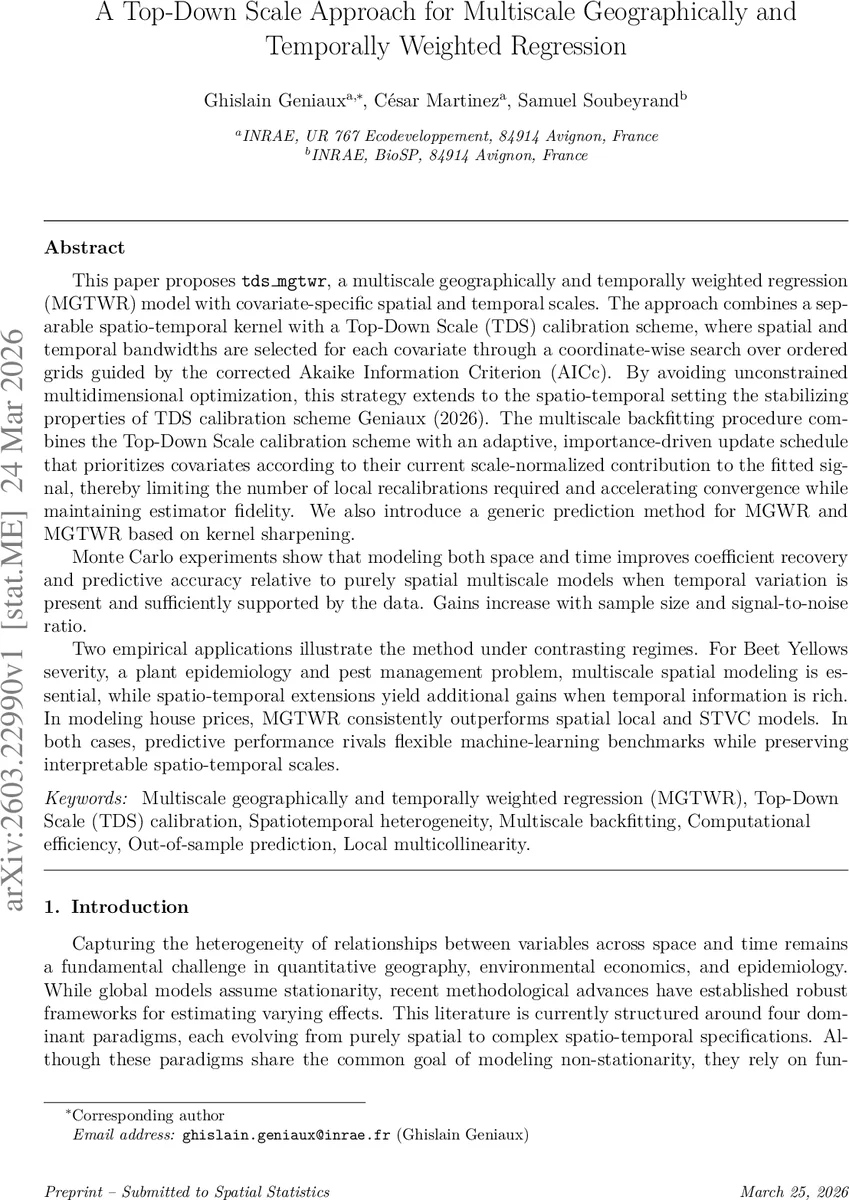
This paper proposes tds mgtwr, a multiscale geographically and temporally weighted regression (MGTWR) model with covariate-specific spatial and temporal scales. The approach combines a separable spatio-temporal kernel with a Top-Down Scale (TDS) calibration scheme, where spatial and temporal bandwidths are selected for each covariate through a coordinate-wise search over ordered grids guided by the corrected Akaike Information Criterion (AICc). By avoiding unconstrained multidimensional optimization, this strategy extends to the spatio-temporal setting the stabilizing properties of TDS calibration scheme Geniaux (2026). The multiscale backfitting procedure combines the Top-Down Scale calibration scheme with an adaptive, importance-driven update schedule that prioritizes covariates according to their current scale-normalized contribution to the fitted signal, thereby limiting the number of local recalibrations required and accelerating convergence while maintaining estimator fidelity. We also introduce a generic prediction method for MGWR and MGTWR based on kernel sharpening. Monte Carlo experiments show that modeling both space and time improves coefficient recovery and predictive accuracy relative to purely spatial multiscale models when temporal variation is present and sufficiently supported by the data. Gains increase with sample size and signal-to-noise ratio. Two empirical applications illustrate the method under contrasting regimes. For Beet Yellows severity, a plant epidemiology and pest management problem, multiscale spatial modeling is essential, while spatio-temporal extensions yield additional gains when temporal information is rich. In modeling house prices, MGTWR consistently outperforms spatial local and STVC models. In both cases, predictive performance rivals flexible machine-learning benchmarks while preserving interpretable spatio-temporal scales.
💡 Research Summary
This paper introduces tds‑mgtwr, a novel multiscale geographically and temporally weighted regression (MGTWR) estimator that assigns a distinct spatial and temporal bandwidth to each covariate. The method builds on the Top‑Down Scale (TDS) calibration originally devised for multiscale GWR and extends it to the spatio‑temporal domain. Instead of a costly unconstrained joint optimization over all bandwidths, the algorithm performs a coordinate‑wise descent on ordered grids of candidate spatial and temporal scales. For each covariate, a small set of neighboring bandwidth values (current, immediate larger and smaller) plus the smallest bandwidth active among the other covariates is examined. The pair that yields the greatest reduction in corrected AIC (AICc) is selected, implementing a “steepest discrete descent”.
A second innovation is an importance‑driven update schedule: at every iteration covariates are reordered according to their current scale‑normalized contribution to the fitted signal, so that variables with larger impact are refined first while those with minor influence retain coarser scales. This reduces unnecessary local recalibrations, mitigates oscillatory behaviour, and improves robustness to multicollinearity.
The kernel is separable: a spatial kernel (Gaussian, bi‑square, etc.) is combined with a temporal kernel either multiplicatively (strict spatio‑temporal proximity) or additively (OR‑type proximity). Temporal kernels can be linear (distance‑based, possibly asymmetric to enforce causality) or cyclic (seasonal) and can operate on raw time or on a periodic phase. Users may choose adaptive (nearest‑neighbor) or non‑adaptive (distance‑based) bandwidths, and the algorithm supports both.
Monte‑Carlo simulations with varying sample sizes, signal‑to‑noise ratios, and degrees of temporal variation demonstrate that tds‑mgtwr recovers true coefficients more accurately and yields lower out‑of‑sample RMSE than conventional MGWR (spatial only) and earlier MGTWR implementations. Gains increase with larger datasets and stronger temporal signals.
Two real‑world applications illustrate practical benefits. In a plant‑epidemiology case (Beet Yellows severity), spatial heterogeneity dominates, yet incorporating temporal information improves predictions when the time series is rich. In a housing‑price study (Vaucluse, France), tds‑mgtwr consistently outperforms spatial local regression and a spatio‑temporal varying‑coefficient (STVC) benchmark, and matches or exceeds machine‑learning models such as XGBoost while retaining interpretable, covariate‑specific space‑time scales.
Overall, tds‑mgtwr offers a computationally efficient, stable, and interpretable framework for multiscale spatio‑temporal regression. Future work should address stronger regularization for highly collinear covariates, extensions to irregular temporal sampling, and scalable parallel implementations for massive datasets.
Comments & Academic Discussion
Loading comments...
Leave a Comment