Cartier integration of infinitesimal 2-braidings via 2-holonomy of the CMKZ 2-connection, II: The pentagonator
This is a continuation of the previous paper (arXiv:2508.01944) in this series. We recontextualise Cirio and Martins' work to motivate our fundamental conjecture that the Drinfeld-Kohno (Lie) 2-algebra has trivial cohomology. It is then shown that th…
Authors: Cameron Kemp
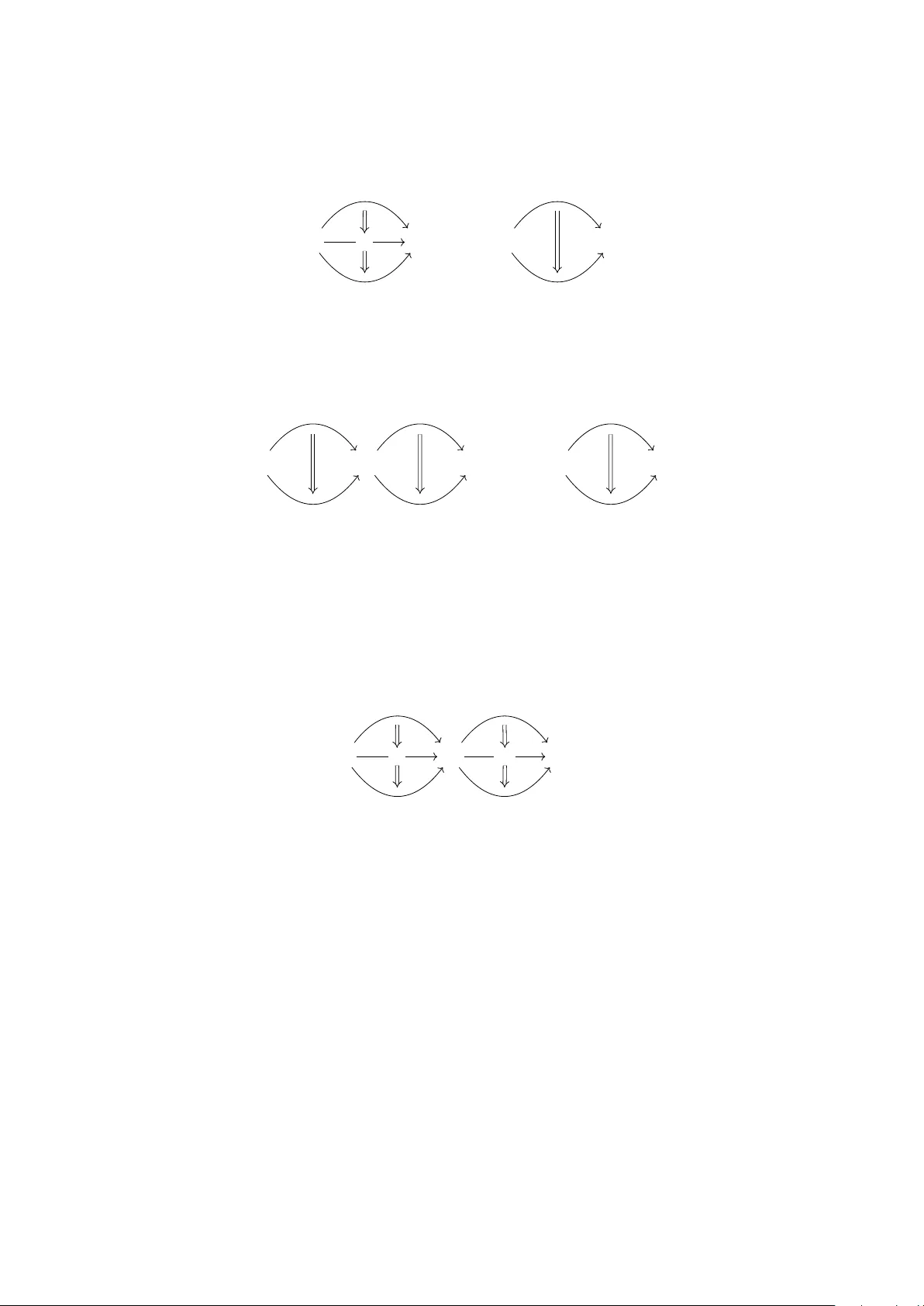
Cartier in tegration of infinitesimal 2-braidings via 2-holonom y of the CMKZ 2-connection, I I: The p en tagonator Cameron Kemp Sc ho ol of Mathematical Sciences, Univ ersity of Nottingham, Univ ersity P ark, Nottingham NG7 2RD, United Kingdom. Email: cameron.kemp@nottingham.ac.uk Marc h 25, 2026 Abstract This is a con tinuation of the previous paper (arXiv:2508.01944) in this series. W e recon tex- tualise Cirio and Martins’ w ork to motiv ate our fundamental conjecture that the Drinfeld- K ohno (Lie) 2-algebra has trivial cohomology . It is then shown that this conjecture implies the follo wing: giv en a coherent totally symmetric infinitesimal 2-braiding t , every mo difi- cation endomorphic on the zero transformation v anishes if it is made up of the four-term relationators and whisk erings b y t . The pow er of such an implication is that, in our context, one need only construct the data of a braided monoidal 2-category and it will automatically satisfy the axioms. W e th us conclude by constructing the p en tagonator via Cirio and Mar- tins’ Knizhnik-Zamolo dchik o v 2-connection ov er the configuration space of 4 distinguishable particles on the complex line, Y 4 . In particular, we mak e use of Bordemann, Rivezzi and W eigel’s p en tagon in Y 4 . Keyw ords: Knizhnik-Zamolo dc hik ov 2-connection, braided monoidal 2-categories, deforma- tion quantisation, infinitesimal 2-braidings, higher gauge theory , mon odromy MSC 2020: 17B37, 18N10, 53D55, 32S40 Contents 1 The fundamen tal conjecture 7 2 Algebraic construction of the hexagonator series 10 3 Construction of the pentagonator series 12 Our 2-ca tegorical quantisa tion pr oblem In order to understand the context of Section 1 and mak e this paper relativ ely self-con tained, w e must first provide a summary of the relev ant material in [ Kem25a ] regarding infinitesimal 2-braidings and braided monoidal 2-categories. Let us b egin by recalling that the category Ch [ − 1 , 0] of co c hain complexes concentrated in de- grees {− 1 , 0 } is symmetric monoidal with the monoidal pro duct given by the truncated tensor pro duct ⊠ and the symmetric braiding given b y the sw ap τ . One can then use this category as a 1 base for enrichmen t (as in [ Rie14 , Chapter 3] or [ Kel82 ]) and study the 2-category dgCat [ − 1 , 0] of Ch [ − 1 , 0] -categories, Ch [ − 1 , 0] -functors and Ch [ − 1 , 0] -natural transformations. As alwa ys in enric hed category theory , the 2-category itself dgCat [ − 1 , 0] is symmetric monoidal with the monoidal pro d- uct giv en by the local truncated tensor pro duct ⊠ . T o b e clear, giv en a pair of Ch [ − 1 , 0] -categories C and D , we define C ⊠ D as having ob jects giv en by juxtap ositions U V where U ∈ C and V ∈ D , and morphisms giv en b y truncations f , g := f ⊠ g where f ∈ C [ U, U ′ ] and g ∈ D [ V , V ′ ]. This sym- metric monoidal 2-category dgCat [ − 1 , 0] allo ws one to pro duce a simple definition of a symmetric strict monoidal Ch [ − 1 , 0] -category ( C , ⊗ , I , γ ). The relev an t infinitesimal deformations of such a symmetric strict monoidal structure are a weak ened v arian t of Ch [ − 1 , 0] -natural transformations. Definition 0.1 . Given Ch [ − 1 , 0] -categories C , D and Ch [ − 1 , 0] -functors F , G : C → D , a pseudo- natural transformation ξ : F ⇒ G : C → D consists of the following tw o pieces of data: (i) F or each ob ject U ∈ C , a degree 0 morphism ξ U ∈ D [ F ( U ) , G ( U )] 0 . (ii) F or each pair of ob jects U, U ′ ∈ C , a homotopy ξ ( · ) : C [ U, U ′ ] → D [ F ( U ) , G ( U ′ )] [ − 1]. These tw o pieces of data are required to satisfy the follo wing t wo axioms: for all f ∈ C [ U, U ′ ] and f ′ ∈ C [ U ′ , U ′′ ], G ( f ) ξ U − ξ U ′ F ( f ) = ∂ ( ξ f ) + ξ ∂ ( f ) , (0.1a) ξ f ′ f = ξ f ′ F ( f ) + G ( f ′ ) ξ f . (0.1b) Definition 0.2 . Giv en a symmetric strict monoidal Ch [ − 1 , 0] -category ( C , ⊗ , I , γ ), w e say a pseudonatural transformation t : ⊗ ⇒ ⊗ : C ⊠ C → C is an infinitesimal 2-braiding if, for f ∈ C [ U, U ′ ], g ∈ C [ V , V ′ ] and h ∈ C [ W, W ′ ], we hav e: t U ( V W ) = t U V ⊗ 1 W + ( γ V U ⊗ 1 W )(1 V ⊗ t U W )( γ U V ⊗ 1 W ) , (0.2a) t f ,g ⊗ h = t f ,g ⊗ h + ( γ V ′ U ′ ⊗ 1 W ′ )( g ⊗ t f ,h )( γ U V ⊗ 1 W ) , (0.2b) and t ( U V ) W = 1 U ⊗ t V W + (1 U ⊗ γ W V )( t U W ⊗ 1 V )(1 U ⊗ γ V W ) , (0.3a) t f ⊗ g ,h = f ⊗ t g ,h + (1 U ′ ⊗ γ W ′ V ′ )( t f ,h ⊗ g )(1 U ⊗ γ V W ) . (0.3b) An infinitesimal 2-braiding is symmetric (or, γ - equiv arian t ) if it in tertwines with the sym- metric braiding γ , i.e.: γ U,V t U,V = t V ,U γ U,V , γ U ′ ,V ′ t f ,g = t g ,f γ U,V . (0.4) W e denote ( 0.2 ) and ( 0.3 ) as, resp ectively , t 1(23) = t 12 + t 13 , t (12)3 = t 13 + t 23 . (0.5) In the ordinary context of 1-category theory , natur ality of an infinitesimal braiding t implies that it satisfies the four-term relations , [ t 12 , t 13 + t 23 ] = 0 = [ t 23 , t 12 + t 13 ] . (0.6) In our con text, pseudonatur ality of an infinitesimal 2-braiding t obstructs the four-term relations in a very sp ecific wa y . Definition 0.3 . Given pseudonatural transformations ξ , ξ ′ : F ⇒ G : C → D , a modification Ξ : ξ ⇛ ξ ′ consists of, for each ob ject U ∈ C , a morphism Ξ U ∈ D [ F ( U ) , G ( U )] − 1 suc h that ∂ (Ξ U ) = ξ U − ξ ′ U (0.7a) and, for every f ∈ C [ U, V ], Ξ V F ( f ) + ξ f = ξ ′ f + G ( f ) Ξ U . (0.7b) 2 The obstruction to the four-term relations is a sp ecial mo dification, one witnessing the lac k of exchange betw een the tw o different comp ositions of pseudonatural transformations. T o be sp ecific, the vertical comp osition C D G F H ξ θ ◦ 7− → C D F H θξ (0.8a) is defined by setting, for f ∈ C [ U, V ] : ( θ ξ ) U := θ U ξ U , ( θ ξ ) f := θ f ξ U + θ V ξ f (0.8b) whereas the horizontal comp osition C D E F G F ′ G ′ ξ υ ∗ 7− → C E F ′ F G ′ G ′ υ ∗ ξ (0.9a) is defined by setting: ( υ ∗ ξ ) U := υ G ( U ) F ′ ( ξ U ) , ( υ ∗ ξ ) f := υ G ( f ) F ′ ( ξ U ) + υ G ( V ) F ′ ( ξ f ) . (0.9b) The vertical comp osition ( 0.8 ) and horizon tal composition ( 0.9 ) are asso ciative and admit the ob vious units Id F and Id id C , resp ectiv ely . A pseudonatural isomorphism ξ : F ⇒ G : C → D is one which admits an in verse ξ − 1 : G ⇒ F : C → D under vertical comp osition ( 0.8 ). Definition 0.4 . Given any comp osable diagram of the form C D E F G H F ′ H ′ G ′ ξ θ υ λ , (0.10a) the exc hanger is the mo dification ∗ 2 λ,θ | υ ,ξ : ( λ ∗ θ )( υ ∗ ξ ) ⇛ λυ ∗ θ ξ , ∗ 2 λ,θ | υ ,ξ U := λ H ( U ) υ θ U F ′ ( ξ U ) . (0.10b) The modifications of Definition 0.3 admit three differen t levels of comp osition though w e only describ e in detail the highest tw o: (i) Giv en ξ Ξ ≡ ⇛ ξ ′ Ξ ′ ≡ ⇛ ξ ′′ : F ⇒ G : C → D , the lateral comp osition Ξ ′ · Ξ : ξ ⇛ ξ ′′ is defined b y setting (Ξ ′ · Ξ) U := Ξ ′ U + Ξ U for all U ∈ C . This comp osition is asso ciativ e, unital with resp ect to the v anishing mo difications 0 : ξ ⇛ ξ , and in vertible with resp ect to the rev erse ← − Ξ : ξ ′ ⇛ ξ defined b y ← − Ξ U := − Ξ U . (ii) Giv en Ξ : ξ ⇛ ξ ′ : F ⇒ G : C → D and Θ : θ ⇛ θ ′ : G ⇒ H : C → D , the v ertical comp osition ΘΞ : θξ ⇛ θ ′ ξ ′ : F ⇒ H is defined b y setting (ΘΞ) U := Θ U ξ ′ U + θ U Ξ U . This comp osition is also associative and unital. W e define the whisk ering of Θ b y ξ as the modification Θ ξ : θ ξ ⇛ θ ′ ξ with comp onen ts (Θ ξ ) U := Θ U ξ U and lik ewise for the whisk ering of Ξ by θ . A mo dification Ξ is inv ertible under the vertical comp osition if and only if b oth ξ and ξ ′ are pseudonatural isomorphisms in which case the inv erse is given by Ξ − 1 := ξ − 1 ← − Ξ ξ ′− 1 : ξ − 1 ⇛ ξ ′− 1 : G ⇒ F . 3 Remark 0.5 . The horizon tal comp osition of mo difications is also asso ciative and unital. F ur- thermore, the vertical comp osition ◦ is functorial and the horizontal comp osition ∗ is a strictly- unitary pseudofunctor hence we hav e a tricategory dgCat [ − 1 , 0] , ps of Ch [ − 1 , 0] -categories, Ch [ − 1 , 0] - functors, pseudonatural transformations and mo difications. The only w eakness of this tricate- gory is given by the nontrivialit y of the exc hanger from Definition 0.4 . △ In order to determine the exc hanger which obstructs the four-term relations, w e still hav e to describ e the monoidal comp osition C C ′ F F ′ ξ D D ′ G G ′ υ ⊠ 7− → C ⊠ D C ′ ⊠ D ′ F ⊠ G F ′ ⊠ G ′ ξ ⊠ υ (0.11a) whic h is defined b y setting, for f ∈ C [ U, U ′ ] and g ∈ D [ V , V ′ ] : ( ξ ⊠ υ ) U V := ξ U ⊠ υ V , ( ξ ⊠ υ ) f ,g := ξ f ⊠ G ′ ( g ) υ V + ξ U ′ F ( f ) ⊠ υ g . (0.11b) Mo difications also admit a monoidal comp osition; altogether, ⊠ is an associative unital 3-functor hence dgCat [ − 1 , 0] , ps is a monoidal tricategory . F urthermore, the symmetric braiding τ on Ch [ − 1 , 0] pro vides a symmetric braiding on dgCat [ − 1 , 0] , ps . Lastly , we mention that dgCat [ − 1 , 0] , ps is actually a close d symmetric monoidal tricategory giv en that pseudonatural transformations and mo di- fications can b e added and scaled, while a mo dification Ξ : ξ ⇛ ξ ′ can b e differen tiated to a pseudonatural transformation ∂ (Ξ) := ξ − ξ ′ . Remark 0.6 . By abuse of notation, we will often denote the lateral comp osition of mo difica- tions as Ξ ′ · Ξ = Ξ ′ + Ξ = Ξ + Ξ ′ and the rev erse as ← − Ξ = − Ξ even though those mo difications ha ve different (co)domains; the con text will mak e it clear whic h is b eing used. △ W e can no w use the linearity of pseudonatural transformations together with the abov e three comp ositions to rewrite ( 0.2 ) as t ∗ Id id C ⊠ ⊗ = Id ⊗ ∗ t ⊠ Id id C + Id ⊗ ∗ γ − 1 ⊠ Id id C (Id id C ⊠ t ) ∗ Id τ C , C ⊠ id C γ ⊠ Id id C (0.12a) and ( 0.3 ) as t ∗ Id ⊗ ⊠ id C = Id ⊗ ∗ Id id C ⊠ t + Id ⊗ ∗ Id id C ⊠ γ − 1 ( t ⊠ Id id C ) ∗ Id id C ⊠ τ C , C Id id C ⊠ γ . (0.12b) In fact, ( 0.12 ) is the precise meaning b ehind the index notation ( 0.5 ). Where p ossible, we mak e use of this muc h simpler index notation, e.g. consider the comp osable diagram C ⊠ C ⊠ C C ⊠ C C ⊗ ⊠ id C ⊗ ⊠ id C ⊗ ⊠ id C ⊗ ⊗ ⊗ Id ⊗ ⊠ id C t t ⊠ Id id C Id ⊗ , (0.13a ) Definition 0.4 tells us that the exchanger ( 0.10 ) takes on the sp ecific form ∗ 2 Id ⊗ , t ⊠ Id id C | t , Id ⊗ ⊠ id C : t 12 t (12)3 ⇛ t (12)3 t 12 . (0.13b) Using the linearit y of mo difications, we can rewrite ( 0.13b ) as the left four-term relationator L : [ t 12 , t 13 + t 23 ] ⇛ 0 (0.13c) 4 whic h has comp onen ts L U V W = t t U V , 1 W . (0.13d) Similarly , we also ha ve a righ t four-term relationator R : [ t 23 , t 12 + t 13 ] ⇛ 0 (0.14a) whic h has comp onen ts R U V W = t 1 U ,t V W . (0.14b) Using ( 0.7a ), w e see the sp ecific wa y these mo difications obstruct the four-term relations: ∂ ( L U V W ) = ( t U V ⊗ 1 W ) t ( U V ) W − t ( U V ) W ( t U V ⊗ 1 W ) , (0.15a) ∂ ( R U V W ) = (1 U ⊗ t V W ) t U ( V W ) − t U ( V W ) (1 U ⊗ t V W ) . (0.15b) Giv en a symmetric infinitesimal 2-braiding t on a symmetric strict monoidal Ch [ − 1 , 0] C -category ( C , ⊗ , I , γ ) and a deformation parameter ℏ , one c ho oses an ansatz braiding as σ = γ e iπ ℏ t and an ansatz asso ciator as α = Φ( t 12 , t 23 ), where Φ is Drinfeld’s KZ series (see [ Kas95 , Prop osition XIX.6.4], [ BR W25 , Theorem 20] or Definition 2.2 b elo w). As shown in [ Kem25a , Section 5], the four-term relationators L and R complicate the usual deformation quantisation story b y obstructing the hexagon axiom already at second order in ℏ . An ticipating these obstructions forced us to go one level higher in category theory thus we introduced the definition [ Kem25a , Definition 2.25] of a braided (strictly-unital) monoidal Ch [ − 1 , 0] -category ( C , ⊗ , I , α, σ, Π , H L , H R ) b y sp ecifying the definition of a braided monoidal bicategory (as in [ Sc h14 , Definition C.2] or [ JY21 , Definition 12.1.6]) to our context pro vided by dgCat [ − 1 , 0] , ps . In p articular, the asso ciator α and braiding σ do not satisfy the usual p en tagon an d hexagon axioms, instead these are obstructed by the p en tagonator Π and hexagonator H L/R mo difications, i.e.: Π : α 234 α 1(23)4 α 123 ≡ ≡ ⇛ α 12(34) α (12)34 , (0.16a) H L : α 231 σ 1(23) α ≡ ≡ ⇛ σ 13 α 213 σ 12 , (0.16b) H R : α − 1 312 σ (12)3 α − 1 ≡ ≡ ⇛ σ 13 α − 1 132 σ 23 . (0.16c) The data ( 0.16 ) is sub ject to fiv e higher coherence conditions, all of which state that their asso ciated expression must v anish: (i) Asso ciahedron , α 345 Π 12(34)5 + α α 345 α (12)(34)5 α (12)34 + α 345 α 2(34)5 α α 234 − Π 2345 α 1((23)4)5 α 1(23)4 α 123 + α 345 α 2(34)5 α 1(2(34))5 Π 1234 + α 23(45) α 1(23)(45) α α 123 − Π 1(23)45 α 123 − Π 123(45) α ((12)3)45 + α 12(3(45)) Π (12)345 . (0.17a) (ii) Left tetrahedron , h α 341 α 2(34)1 σ α 234 − Π 2341 σ 1((23)4) i α 1(23)4 + h σ 14 Π 2314 + α σ 14 α (23)14 i σ 1(23) α 123 − α 23(41) H L 1(23)4 α 123 + σ 14 α 314 α σ 13 + H L 134 α 2(13)4 α 213 σ 12 − σ 14 α 314 α 2(31)4 H L 123 + α 341 H L 12(34) α (12)34 + σ 1(34) h α 21(34) α σ 12 − Π 2134 σ 12 i + α 2(34)1 σ 1(2(34)) Π . (0.17b) (iii) Righ t tetrahedron , h α − 1 412 α − 1 4(12)3 σ α − 1 123 − Π − 1 4123 σ (1(23))4 i α − 1 1(23)4 + h σ 14 Π − 1 1423 + α − 1 σ 14 α − 1 14(23) i σ (23)4 α − 1 234 + α − 1 (41)23 H R 1(23)4 α − 1 234 + σ 14 α − 1 142 α − 1 σ 24 α − 1 243 σ 34 + α − 1 1(42)3 H R 234 + H R 124 α − 1 1(24)3 α − 1 243 σ 34 + α − 1 412 H R (12)34 α − 1 12(34) + σ (12)4 h α − 1 (12)43 α − 1 σ 34 − Π − 1 1243 σ 34 i + α − 1 4(12)3 σ ((12)3)4 Π − 1 1234 . (0.17c) 5 (iv) Hexahedron , σ 14 α − 1 142 σ 24 α 31(24) α σ 13 α − 1 132 σ 23 − α (31)24 H R 123 − α − 1 412 Π 3412 α − 1 (34)12 σ (12)(34) α (12)34 + H L (12)34 α − 1 123 + α 3(41)2 α 341 σ 1(34) α 134 h α − 1 (13)42 α − 1 13(42) H L 234 + Π − 1 1342 α 342 σ 2(34) α 234 i α 1(23)4 + H R 12(34) α 234 α 1(23)4 − α − 1 (34)12 σ (12)(34) α − 1 12(34) Π 1234 α − 1 123 − α − 1 412 σ (12)4 α − 1 124 Π 3124 + H R 124 α 31(24) α (31)24 α − 1 312 σ (12)3 α − 1 123 + h σ 14 α − 1 142 Π 3142 − α σ 14 α 314 i α − 1 (31)42 σ 24 − σ 14 α − 1 142 α σ 24 σ 13 α (13)24 α − 1 132 σ 23 + α 3(41)2 σ 14 α 314 h α − 1 σ 13 σ 24 α − 1 13(24) − σ 13 α − 1 (13)42 α − 1 σ 24 i + H L 134 α − 1 (13)42 α − 1 13(42) σ 24 α 324 σ 23 α 1(23)4 + α 3(41)2 σ 14 α 314 α − 1 (31)42 σ 13 σ 24 α − 1 13(24) Π 1324 α − 1 132 σ 23 + α 324 α σ 23 . (0.17d) (v) Breen polytop e , σ σ 12 + α 321 H R 213 α 213 σ 12 − σ 23 α − 1 231 H L + σ σ 23 α + H L 132 α − 1 132 σ 23 − σ 12 α 312 H R α . (0.17e) As shown in [ Kem25a , Prop osition 5.14], the ansatz asso ciator α = Φ( t 12 , t 23 ) = 1 − 1 6 π 2 ℏ 2 [ t 12 , t 23 ] + O ℏ 3 (0.18) satisfies the p en tagon axiom up to and including order ℏ 2 th us we can choose a v anishing p en tagonator, doing so satisfies the asso ciahedron axiom ( 0.17a ) up to and including order ℏ 2 . Substituting the ansatz asso ciator ( 0.18 ) together with the ansatz braiding σ = γ e iπ ℏ t = γ 1 + iπ ℏ t − 1 2 π 2 ℏ 2 t 2 + O ℏ 3 (0.19) in to ( 0.16 ) giv es, for a symmetric infinitesimal 2-braiding: − 1 6 π 2 ℏ 2 γ 1(23) (2 L + R ) + O ℏ 3 : α 231 σ 1(23) α ≡ ≡ ⇛ σ 13 α 213 σ 12 , (0.20a) − 1 6 π 2 ℏ 2 γ (12)3 ( L + 2 R ) + O ℏ 3 : α − 1 312 σ (12)3 α − 1 ≡ ≡ ⇛ σ 13 α − 1 132 σ 23 . (0.20b) As shown in [ Kem25a , Section 5.2], the mo difications ( 0.20 ) will not necessarily satisfy the four axioms ( 0.17b )-( 0.17e ) but they will if the symmetric infinitesimal 2-braiding t satisfies some extra conditions discov ered b y Cirio and Martins [ CFM15 ]. Definition 0.7 . Given a symmetric strict monoidal Ch [ − 1 , 0] -category ( C , ⊗ , I , γ ), a coherent infinitesimal 2-braiding t satisfies, for all U, V , W ∈ C , − ( γ V U ⊗ 1 W ) R V U W ( γ U V ⊗ 1 W ) = L U V W + R U V W = − (1 U ⊗ γ W V ) L U W V (1 U ⊗ γ V W ) . (0.21) A symmetric infinitesimal 2-braiding t is totally symmetric if, for all U, V , W ∈ C , t γ U V , 1 W = 0 . (0.22) Kno wing that these prop erties are sufficien t to solve the deformation quantisation problem at order ℏ 2 , we assume a coherent totally symmetric infinitesimal 2-braiding t and look for mo difications of the form: Π : Φ( t 23 , t 34 )Φ( t 12 + t 13 , t 24 + t 34 )Φ( t 12 , t 23 ) ≡ ≡ ⇛ Φ( t 12 , t 23 + t 24 )Φ( t 13 + t 23 , t 34 ) (0.23a) and R : Φ( t 12 , t 13 ) e iπ ℏ t (12)3 Φ( t 23 , t 12 ) ≡ ≡ ⇛ e iπ ℏ t 13 Φ( t 23 , t 13 ) e iπ ℏ t 23 . (0.23b) As in [ Kem25a , Remark 5.22], a totally symmetric infinitesimal 2-braiding gives us R 321 : Φ( t 23 , t 13 ) e iπ ℏ t 1(23) Φ( t 12 , t 23 ) ≡ ≡ ⇛ e iπ ℏ t 13 Φ( t 12 , t 13 ) e iπ ℏ t 12 (0.23c) th us we define candidate hexagonators as H R := γ (12)3 R and H L := γ 1(23) L , where L := R 321 . 6 1 The fundament al conjecture This section in tro duces the notion of Drinfeld-Kohno 2-algebras in Definition 1.5 so that we ma y state our fundamen tal conjecture. As explained in Remark 1.7 , should Conjecture 1.6 b e true then the latter t wo sections offer a self-contained solution to the problem of in tegrating infinitesimal 2-braidings to provide a concrete braided monoidal 2-category . In other words, the candidate hexagonator series of Theorem 2.4 and the candidate p en tagonator series of Theorem 3.3 automatically satisfy their axioms ( 0.17 ) if Conjecture 1.6 is true. See [ CG23 , Definition 2.5] for the following definition. Definition 1.1 . An asso ciativ e 2-algebra consists of three pieces of data: (i) A pair of asso ciativ e algebras A and B . (ii) An algebra homomorphism ∂ : B → A . (iii) An A -bimo dule structure on B , i.e. for all a, a ′ ∈ A and b ∈ B , ( a ′ a ) b = a ′ ( ab ) , ( a ′ b ) a = a ′ ( ba ) , ( ba ′ ) a = b ( a ′ a ) . (1.1) These three pieces of data are required to satisfy the follo wing tw o axioms: 1. T w o-sided A -equiv ariance of ∂ , i.e. for all a ∈ A and b ∈ B , ∂ ( ab ) = a∂ ( b ) , ∂ ( ba ) = ∂ ( b ) a . (1.2a) 2. The P eiffer iden tit y , i.e. f or all b, b ′ ∈ B , ∂ ( b ′ ) b = b ′ b = b ′ ∂ ( b ) . (1.2b) Analogous to [ Kem25b , Construction 3.22], giv en a pair of Ch [ − 1 , 0] -categories B and C to- gether with a Ch [ − 1 , 0] -functor F : B → C , w e define an asso ciativ e 2-algebra End F as follows: (i) Consider the asso ciativ e algebras of pseudonatural transformations of the form ξ : F ⇒ F and mo difications of the form Ξ : ξ ⇛ 0 : F ⇒ F with multiplication given by the vertical comp osition. (ii) Giv en Ξ : ξ ⇛ 0 : F ⇒ F , setting ∂ (Ξ) := ξ ob viously defines an algebra homomorphism. (iii) The mo difications form a bimodule o v er the pseudonatural transformations via whisk ering. The ab o ve data evidently satisfies the axioms ( 1.2 ). Example 1.2 . Giv en a natural num ber n ∈ N and a symmetric strict monoidal Ch [ − 1 , 0] - category ( C , ⊗ , I , γ ), we set B = C ⊠ ( n +1) and F = ⊗ n : C ⊠ ( n +1) → C th us the asso ciative 2-algebra End ⊗ n consists of pseudonatural transformations of the form ξ : ⊗ n ⇒ ⊗ n and mo di- fications of the form Ξ : ξ ⇛ 0 : ⊗ n ⇒ ⊗ n . ▽ Let us consider the sp ecial case n = 2 of Example 1.2 and supp ose we are given an infi nites- imal 2-braiding t . Consider the mo dification L 213 − L : [ t 21 , t 23 + t 13 ] − [ t 12 , t 13 + t 23 ] ≡ ≡ ⇛ 0 , (1.3) if our infinitesimal 2-braiding t is symmetric then t 21 = t 12 and the domain of ( 1.3 ) is 0 yet, for U, V , W ∈ C , ( γ V U ⊗ 1 W ) t t V U , 1 W ( γ U V ⊗ 1 W ) = t t U V , 1 W , (1.4) 7 in general. Conv ersely , if t is totally symmetric then [ Kem25a , Lemma 5.21] gives us: L = R 312 = L 213 = R 321 , R = L 231 = R 132 = L 321 , L 132 = R 213 = L 312 = R 231 (1.5) while the mo dification L + R + L 132 : [ t 12 , t 13 + t 23 ] + [ t 23 , t 12 + t 13 ] + [ t 13 , t 12 + t 32 ] ≡ ≡ ⇛ 0 (1.6) also has domain 0 yet do es not v anish unless t is, further, coheren t. Let us now turn our attention to the sp ecial case n = 3 of Example 1.2 . Lemma 1.3 . Given an infinitesimal 2-braiding t on a symmetric strict monoidal Ch [ − 1 , 0] - category ( C , ⊗ , I , γ ), we hav e the following five relations: [ t (123)4 , R 123 ] − [ t 1(23) , L 234 ] + [ t 23 , L 1(23)4 ] = 0 , (1.7a) [ t 1(234) , R 234 ] + [ t 34 , R 12(34) ] − [ t 2(34) , R 134 ] = 0 , (1.7b) [ t (123)4 , L 123 ] + [ t 12 , L (12)34 ] − [ t (12)3 , L 124 ] = 0 , (1.7c) [ t 1(234) , L 234 ] + [ t 23 , R 1(23)4 ] − [ t (23)4 , R 123 ] = 0 , (1.7d) [ t 12 , R (12)34 ] − [ t 34 , L 12(34) ] = 0 . (1.7e) Pr o of. W e first prov e ( 1.7a ), for U, V , W, X ∈ C , ( R U V W ⊗ 1 X ) t ( U V W ) X − t ( U V W ) X ( R U V W ⊗ 1 X ) ( 0.1a ) = ∂ ( t R U V W , 1 X ) + t ∂ ( R U V W ) , 1 X (1.8) but the truncation annihilates t R U V W , 1 X th us we rewrite the RHS of ( 1.8 ) as t ∂ ( R U V W ) , 1 X ( 0.15b ) = t (1 U ⊗ t V W ) t U ( V W ) , 1 X − t t U ( V W ) (1 U ⊗ t V W ) , 1 X ( 0.1b ) = t 1 U ⊗ t V W , 1 X ( t U ( V W ) ⊗ 1 X ) + (1 U ⊗ t V W ⊗ 1 X ) t t U ( V W ) , 1 X − t t U ( V W ) , 1 X (1 U ⊗ t V W ⊗ 1 X ) − ( t U ( V W ) ⊗ 1 X ) t 1 U ⊗ t V W , 1 X ( 0.3b ) , ( 0.13d ) = [1 U ⊗ L V W X , t U ( V W ) ⊗ 1 X ] − [ L U ( V W ) X , 1 U ⊗ t V W ⊗ 1 X ] . (1.9) The pro of of ( 1.7b ) is the same but uses the ( 0.2b ) instead of ( 0.3b ); likewise, the pro ofs of ( 1.7c ) and ( 1.7d ) are the same but mak e use of the deformed left four-term relations ( 0.15a ) instead of the deformed righ t four-term relations ( 0.15b ). Lastly , we prov e ( 1.7e ), t t U V , 1 W X (1 U V ⊗ t W X ) + ( t U V ⊗ 1 W X ) t 1 U V ,t W X ( 0.1b ) = t t U V ,t W X ( 0.1b ) = t 1 U V ,t W X ( t U V ⊗ 1 W X ) + (1 U V ⊗ t W X ) t t U V , 1 W X . (1.10) W e now reprov e Cirio and Martins’ result [ CFM15 , Theorems 21 and 22] that coherent totally symmetric infinitesimal 2-braidings satisfy six categorified relations that replace the four-term relations ( 0.6 ). Cor ollar y 1.4 . If the infinitesimal 2- braiding of Lemma 1.3 is coheren t and totally symmetric then we hav e the follo wing six relations: [ t (123)4 , R 123 ] − [ t 1(23) , L 234 ] + [ t 23 , L 124 + L 134 ] = 0 , (1.11a) [ t 1(234) , R 234 ] + [ t 34 , R 123 + R 124 ] − [ t 2(34) , R 134 ] = 0 , (1.11b) [ t (123)4 , L 123 ] + [ t 12 , L 134 + L 234 ] − [ t (12)3 , L 124 ] = 0 , (1.11c) [ t 1(234) , L 234 ] + [ t 23 , R 124 + R 134 ] − [ t (23)4 , R 123 ] = 0 , (1.11d) [ t 12 , R 134 + R 234 ] − [ t 34 , L 123 + L 124 ] = 0 , (1.11e) [ t 13 , R 124 − L 234 − R 234 ] + [ t 24 , L 123 + R 123 − L 134 ] = 0 . (1.11f ) 8 Pr o of. As in [ Kem25a , Lemma 5.23], a totally symmetric infinitesimal 2-braiding t gives us: L 12(34) = L 123 + L 124 , L 1(23)4 = L 124 + L 134 , L (12)34 = L 134 + L 234 , (1.12) and likewise for R . Th us the first 5 relations in ( 1.11 ) come from the total symmetry of t . The last relation ( 1.11f ) comes from applying the p erm utation (2 ↔ 3) to ( 1.11e ) and using the fact that t is coherent. The abov e (together with ‘disjoin t-commutativit y’, e.g. [ Kem25a , (5.18c)]) motiv ates the follo wing definition. Definition 1.5 . F or n ∈ N , the n th Drinfeld-K ohno 2-algebra is the asso ciativ e 2-algebra generated by n a ij ∈ A , ij k ∈ B , r ij k ∈ B 1 ≤ i < j < k ≤ n + 1 o (1.13) suc h that ∂ ij k = a ij , a ik + a j k , ∂ r ij k = a j k , a ij + a ik (1.14) and sub ject to the relations: (i) F or 1 ≤ i < j < k < l ≤ n + 1, a il + a j l + a kl , r ij k − a ij + a ik , j kl + a j k , ij l + ikl = 0 , (1.15a) a ij + a ik + a il , r j kl + a kl , r ij k + r ij l − a j k + a j l , r ikl = 0 , (1.15b) a il + a j l + a kl , ij k + a ij , ikl + j kl − a ik + a j k , ij l = 0 , (1.15c) a ij + a ik + a il , j kl + a j k , r ij l + r ikl − a j l + a kl , r ij k = 0 , (1.15d) a ij , r ikl + r j kl − a kl , ij k + ij l = 0 , (1.15e) a ik , r ij l − j kl − r j kl + a j l , ij k + r ij k − ikl = 0 . (1.15f ) (ii) If { 1 ≤ i < j ≤ n + 1 } ∩ { 1 ≤ k < l ≤ n + 1 } = ∅ then a ij , a kl = 0 . (1.16) (iii) If { 1 ≤ i < j ≤ n + 1 } ∩ { 1 ≤ k < l < m ≤ n + 1 } = ∅ then, for b kl m ∈ { kl m , r kl m } , a ij , b kl m = 0 . (1.17) W e are no w ready to state our fundamental conjecture in a v ery concise form. Conjecture 1.6 . F or n ∈ N , the n th Drinfeld-K ohno 2-algebra is acyclic, i.e. ker( ∂ ) = 0. In the context of Example 1.2 , if w e are given a coherent totally symmetric infinitesimal 2-braiding t then, by construction of the definition, w e hav e an n th Drinfeld-K ohno 2-algebra as the subalgebra of End ⊗ n generated by: t ij : ⊗ n ⇒ ⊗ n , L ij k : [ t ij , t ik + t j k ] ⇛ 0 , R ij k : [ t j k , t ij + t ik ] ⇛ 0 , (1.18) where 1 ≤ i < j < k ≤ n + 1. In this case, Conjecture 1.6 states that ev ery mo dification in the n th Drinfeld-K ohno 2-algebra of the form Ξ : 0 ⇛ 0 v anishes. This conjecture seems somewhat ob vious for low n ∈ N ; for instance, the 2 nd Drinfeld-K ohno 2-algebra [ Kem25b , Example 3.31] is the subalgebra of End ⊗ 2 generated fr e ely b y t 12 , t 23 , t 13 : ⊗ 2 ⇒ ⊗ 2 together with L : [ t 12 , t 13 + t 23 ] ⇛ 0 and R : [ t 23 , t 12 + t 13 ] ⇛ 0. 9 Remark 1.7 . Let us explain the p o wer of Conjecture 1.6 . Given a coheren t totally symmetric infinitesimal 2-braiding t , w e can strip the four axioms ( 0.17b )-( 0.17e ) of instances of the sym- metric braiding γ to reveal equations in terms of R and t . F or example, [ Kem25b , Construction 5.1] show ed that the Breen p olytop e axiom ( 0.17e ) reduces to e iπ ℏ t e iπ ℏ t 12 + Φ( t 23 , t 12 ) h R 213 Φ( t 12 , t 13 ) e iπ t 12 − e iπ t 23 Φ( t 13 , t 23 ) R 321 + e iπ ℏ t e iπ ℏ t 23 Φ( t 12 , t 23 ) i + h R 231 Φ( t 23 , t 13 ) e iπ t 23 − e iπ t 12 Φ( t 13 , t 12 ) R i Φ( t 12 , t 23 ) = 0 . (1.19) W e say that terms like e iπ ℏ t e iπ ℏ t 12 ( 0.10 ) = ∗ 2 Id ⊗ ,e iπ ℏ t ⊠ Id id C | e iπ ℏ t , Id ⊗ ⊠ id C : e iπ ℏ t 12 e iπ ℏ t (12)3 ⇛ e iπ ℏ t (12)3 e iπ ℏ t 12 (1.20a) are congruences ; their explicit series formula is straightforw ard to deriv e (see [ Kem25b , (5.14)]), e iπ ℏ t e iπ ℏ t 12 = ∞ X j =1 k =1 ( iπ ℏ ) j + k j ! k ! X 1 ≤ l ≤ j 1 ≤ m ≤ k t m − 1 (12)3 t l − 1 12 L t j − l 12 t k − m (12)3 . (1.20b) The LHS of ( 1.19 ) is a mo dification endomorphic on e iπ ℏ t 12 e iπ ℏ t (12)3 but, using the linearity of pseudonatural transformations and mo difications, that is the same thing as a modification endomorphic on 0 thus (given a series form ula for R in terms of L , R and whiskerings by t ) an elemen t of the 2 nd Drinfeld-K ohno 2-algebra of the form Ξ : 0 ⇛ 0. The other axioms ( 0.17a )- ( 0.17d ) likewise demand the v anishing of some endomorphic mo dification made up of L , R and whisk erings by t . △ 2 Algebraic construction of the hexagona tor series This section reproduces our direct algebraic construction [ Kem25b , (4.78)] of the hexagonator series. In contrast to [ Kem25b , Section 4] and Section 3 , Theorem 2.4 do es not mak e use of any higher gauge theoretic methods concerning 2-connections and their 2-holonomy [ BH11 , FMP10 ]. W e must first recall the explicit form ula [ LM96 , Theorem A.9] for Drinfeld’s Knizhnik- Zamolo dc hik ov asso ciator series so we b egin with the notion of a multiple zeta v alue. Definition 2.1 . If k ∈ N \ { 0 } , s 1 ∈ N \ { 0 , 1 } and s 2 , . . . , s k ∈ N \ { 0 } then we call ζ ( s 1 , . . . , s k ) := ∞ X n 1 >n 2 > ··· >n k ≥ 1 1 n s 1 1 · · · n s k k (2.1) a multiple zeta v alue (MZV) or Euler sum . Giv en a finite length non-empt y tuple p of natural num b ers, we denote such length tautolog- ically as ˜ p th us p = ( p 1 , . . . , p ˜ p ). In this case, p > 0 means that every entry is strictly p ositiv e, i.e. p 1 , . . . , p ˜ p ∈ N \ { 0 } . Given another tuple j of natural num b ers, by 0 ≤ j ≤ p we mean that ˜ j = ˜ p and 0 ≤ j i ≤ p i for all 1 ≤ i ≤ ˜ p . W e define | p | := P ˜ p l =1 p l and, for q > 0 suc h that ˜ q = ˜ p , ζ p,q j := ( − 1) | j | + | p | ζ p 1 + 1 , { 1 } q 1 − 1 , . . . , p ˜ p + 1 , { 1 } q ˜ p − 1 ˜ p Y l =1 p l j l ! . (2.2) Definition 2.2 . Given elemen ts A and B of an asso ciative unital C -algebra and a formal deformation parameter ℏ , Drinfeld’s Knizhnik-Zamolo dc hik o v associator series Φ( A, B ) is the following element of C ⟨ A, B ⟩ [[ ℏ ]], 1 + X { p,q > 0 | ˜ p = ˜ q } ℏ | p | + | q | X 0 ≤ j ≤ p 0 ≤ k ≤ q ζ p,q j ˜ p Y l =1 q l k l ! ( − 1) k l B | q |−| k | A j 1 B k 1 · · · A j ˜ p B k ˜ p A | p |−| j | . (2.3) 10 Remark 2.3 . W e can compactify the expression for Drinfeld’s Knizhnik-Zamolo dchik o v asso- ciator series ( 2.3 ) in t wo different wa ys, b oth of whic h we will need: (i) W e set j 0 := 0 , k 0 := | q | − | k | , j ˜ p +1 := | p | − | j | , k ˜ p +1 := 0 and ζ p,q j,k := ζ p,q j ˜ p Y l =1 q l k l ! ( − 1) k l (2.4) so that ( 2.3 ) equals Φ( A, B ) = 1 + X { p,q > 0 | ˜ p = ˜ q } ℏ | p | + | q | X 0 ≤ j ≤ p 0 ≤ k ≤ q ζ p,q j,k ˜ p +1 Y l =0 A j l B k l . (2.5) (ii) Let r A denote right-m ultiplication by A then ( 2.3 ) equals Φ( A, B ) = 1 + X { p,q > 0 | ˜ p = ˜ q } ℏ | p | + | q | X 0 ≤ j ≤ p ζ p,q j ad q ˜ p B r j ˜ p A · · · ad q 1 B r j 1 A (1) A | p |−| j | . (2.6) △ W e recall the BR W iden tit y in C ⟨ A, B ⟩ [ [ ℏ ]] betw een Drinfeld’s KZ associator series and the exp onen tial [ BR W25 , Last equation in the pro of of Theorem 22], i.e. Φ( A, − A − B ) e − iπ ℏ A Φ( B , A ) = e − iπ ℏ ( A + B ) Φ( B , − A − B ) e iπ ℏ B . (2.7) F or an infinitesimal 2-braiding t , w e set Λ := t 12 + t 23 + t 13 and t 13 := t 13 − Λ. W e substitute A = t 12 and B = t 23 in to ( 2.7 ) while absorbing factors of ℏ in to t , Φ( t 12 , t 13 ) e − iπ t 12 Φ( t 23 , t 12 ) = e iπ t 13 Φ( t 23 , t 13 ) e iπ t 23 . (2.8) Theorem 2.4 . W e hav e an explicit formula for the righ t pre-hexagonator series R : Φ( t 12 , t 13 ) e iπ t (12)3 Φ( t 23 , t 12 ) ≡ ≡ ⇛ e iπ ℏ t 13 Φ( t 23 , t 13 ) e iπ ℏ t 23 . (2.9) Pr o of. If we hav e explicit series form ulae for the follo wing mo difications: Z e iπ Λ e − iπt 12 e iπt (12)3 : e iπ t (12)3 ≡ ≡ ⇛ e iπ Λ e − iπ t 12 , (2.10a) Z e iπ Λ Φ( t 12 ,t 13 ) Φ( t 12 ,t 13 ) e iπ Λ : Φ( t 12 , t 13 ) e iπ Λ ≡ ≡ ⇛ e iπ Λ Φ( t 12 , t 13 ) , (2.10b) Z Φ( t 12 ,t 13 ) Φ( t 12 ,t 13 ) : Φ( t 12 , t 13 ) ≡ ≡ ⇛ Φ( t 12 , t 13 ) , (2.10c) Z Φ( t 23 ,t 13 ) Φ( t 23 ,t 13 ) : Φ( t 23 , t 13 ) ≡ ≡ ⇛ Φ( t 23 , t 13 ) , (2.10d) Z e iπt 13 e iπ Λ e iπ t 13 : e iπ Λ e iπ t 13 ≡ ≡ ⇛ e iπ t 13 , (2.10e) then we can use ( 2.8 ) to construct ( 2.9 ) as R := Φ( t 12 , t 13 ) Z e iπ Λ e − iπt 12 e iπt (12)3 + Z e iπ Λ Φ( t 12 ,t 13 ) Φ( t 12 ,t 13 ) e iπ Λ e − iπ t 12 + e iπ Λ Z Φ( t 12 , t 13 ) Φ( t 12 ,t 13 ) e − iπ t 12 ! Φ( t 23 , t 12 ) + e iπ Λ e iπ t 13 Z Φ( t 23 ,t 13 ) Φ( t 23 ,t 13 ) e iπ t 23 + Z e iπt 13 e iπ Λ e iπt 13 Φ( t 23 , t 13 ) e iπ t 23 . (2.11) 11 The mo difications ( 2.10a ) and ( 2.10e ) w ere explicitly determined in [ Kem25b , (4.57b) and (4.73), resp ectiv ely], Z e iπ Λ e − iπt 12 e iπt (12)3 = ∞ X k =2 ( iπ ) k k ! k − 1 X l =1 k − l − 1 X m =0 k − l − m − 1 X n =0 k − l m ! ( − 1) m +1 t l − 1 (12)3 Λ n L Λ k − l − m − n − 1 t m 12 , (2.12) Z e iπt 13 e iπ Λ e iπt 13 = ∞ X k =2 ( iπ ) k k ! k − 1 X l =1 k − l − 1 X m =0 k − l − m − 1 X n =0 k − l m ! t l − 1 13 Λ n ( L + R )Λ k − l − m − n − 1 t 13 m . (2.13) The mo dification R e iπ Λ Φ( t 12 ,t 13 ) Φ( t 12 ,t 13 ) e iπ Λ uses the alternative expression ( 2.5 ) for Drinfeld’s KZ series and w as determined in [ Kem25b , (4.71)], it is giv en as X { p,q > 0 | ˜ p = ˜ q } 1 ≤ m< ∞ X 0 ≤ j ≤ p 0 ≤ k ≤ q X 0 ≤ l ≤ ˜ p +1 1 ≤ n ≤ m ( iπ ) m m ! ζ p,q j,k Λ n − 1 (2.14) × l − 1 Y r =0 t j r 12 t k r 13 ! j l X r =1 t r − 1 12 L t j l − r 12 t k l 13 − t j l 12 k l X r =1 t r − 1 13 ( L + R ) t k l − r 13 ˜ p +1 Y r = l +1 t j r 12 t k r 13 Λ m − n The mo dification R Φ( t 12 ,t 13 ) Φ( t 12 ,t 13 ) uses the other alternative expression ( 2.6 ) for Drinfeld’s KZ series and was determined in [ Kem25b , (4.29e)], X { p,q > 0 | ˜ p = ˜ q } X 0 ≤ j ≤ p 1 ≤ l ≤ ˜ p ζ p,q j ad q ˜ p t 13 r j ˜ p t 12 · · · ad q l +1 t 13 r j l +1 t 12 q l − 1 X m =0 ad q l − m − 1 t 13 q 1 X k 1 =0 ( − 1) k 1 q 1 k 1 ! · · · · · · q l − 1 X k l − 1 =0 ( − 1) k l − 1 q l − 1 k l − 1 ! m X k l =0 ( − 1) k l m k l ! l X n =0 n − 1 Y r =0 t j r 12 t 13 k r ! " t j n 12 k n X r =1 t 13 r − 1 ( L + R ) t 13 k n − r − j n X r =1 t r − 1 12 L t j n − r 12 t 13 k n # t j n +1 12 t 13 k n +1 · · · t j l 12 t 13 k l ! t | p |−| j | 12 (2.15) where j 0 := 0 and k 0 := m − k l + P l − 1 n =1 ( q n − k n ). The mo dification R Φ( t 23 ,t 13 ) Φ( t 23 ,t 13 ) can b e acquired from ( 2.15 ) by multiplying by − 1 and applying the index p erm utation (1 ↔ 3). 3 Constr uction of the pent agona tor series Cho osing n = 3 in [ Kem25b , Definition 3.27], w e express the 2-connection A n =3 KZ , B n =3 CM on Y 4 : A n =3 KZ = dz 1 − dz 2 z 1 − z 2 t 12 + dz 1 − dz 3 z 1 − z 3 t 13 + dz 1 − dz 4 z 1 − z 4 t 14 + dz 2 − dz 3 z 2 − z 3 t 23 + dz 2 − dz 4 z 2 − z 4 t 24 + dz 3 − dz 4 z 3 − z 4 t 34 (3.1a) and B n =3 CM = 2 ( z 3 − z 1 ) R 123 z 2 − z 3 − L 123 z 1 − z 2 ( dz 1 ∧ dz 2 + dz 2 ∧ dz 3 + dz 3 ∧ dz 1 ) + 2 ( z 4 − z 1 ) R 124 z 2 − z 4 − L 124 z 1 − z 2 ( dz 1 ∧ dz 2 + dz 2 ∧ dz 4 + dz 4 ∧ dz 1 ) + 2 ( z 4 − z 1 ) R 134 z 3 − z 4 − L 134 z 1 − z 3 ( dz 1 ∧ dz 3 + dz 3 ∧ dz 4 + dz 4 ∧ dz 1 ) + 2 ( z 4 − z 2 ) R 234 z 3 − z 4 − L 234 z 2 − z 3 ( dz 2 ∧ dz 3 + dz 3 ∧ dz 4 + dz 4 ∧ dz 2 ) . (3.1b) 12 The diagonally-punctured complex plane is defined as C 2 # := ( z , u ) ∈ C 2 | z u ( z − 1)( u − 1)( z − u ) = 0 . (3.2) The map ϕ : C 2 # × C × × C − → Y 4 , ( z , u, v , w ) 7− → ( w, z v + w , uv + w , v + w ) (3.3) is a birational biholomorphism with in verse given by ϕ − 1 : Y 4 − → C 2 # × C × × C , ( z 1 , z 2 , z 3 , z 4 ) 7− → z 2 − z 1 z 4 − z 1 , z 3 − z 1 z 4 − z 1 , z 4 − z 1 , z 1 . (3.4) W e pullback the 2-connection A n =3 KZ , B n =3 CM of ( 3.1 ) along the birational biholomorphism ϕ and define A := ϕ ∗ A n =3 KZ , B := ϕ ∗ B n =3 CM th us: A = t 12 z + t 23 z − u + t 24 z − 1 dz + t 13 u + t 23 u − z + t 34 u − 1 du + t 12 + t 13 + t 14 + t 23 + t 24 + t 34 v dv (3.5a) and B = 2 L 123 z u + R 123 u ( z − u ) + L 234 (1 − z )( u − z ) + R 234 (1 − z )( u − 1) dz ∧ du + 2 v R 123 + L 234 u − z − L 123 + L 124 z + R 124 − L 234 − R 234 1 − z dv ∧ dz + 2 v L 134 − L 123 − R 123 u + L 234 + R 123 u − z + R 134 + R 234 u − 1 du ∧ dv . (3.5b) As in [ Kem25b , Remark 3.28], this 2-connection is automatically fak e flat; Cirio and Martins constructed it such [ CFM12 , CFM15 , CFM17 ]. W e no w recon textualise [ CFM15 , Theorem 23] and demonstrate a sufficient condition for the 2-flatness of ( 3.5 ). Pr oposition 3.1 . If t is coheren t and totally symmetric then ( 3.5 ) is 2-flat. Pr o of. W e define the modification M as A ∧ [ · , · ] B = 2 3 v M dz ∧ du ∧ dv (3.6) th us M := 1 z u t 12 , L 134 − R 123 − t 13 , L 124 + t (13)4 + t 2(34) , L 123 + 1 z ( u − 1) t 12 , R 134 + R 234 − t 34 , L 123 + L 124 + 1 z ( u − z ) t 12 , L 234 + R 123 − t 23 , L 123 + L 124 + 1 u ( u − z ) t 23 , L 123 − L 134 + t 13 , L 234 − t 1(24) + t (23)4 , R 123 + 1 ( u − z )( u − 1) t 34 , R 123 + L 234 − t 23 , R 134 + R 234 + 1 u (1 − z ) t 24 , L 123 + R 123 − L 134 + t 13 , R 124 − L 234 − R 234 + 1 ( u − z )(1 − z ) t 23 , R 124 − R 234 − t 24 , R 123 + t 1(23) + t (13)4 , L 234 + 1 ( u − 1)(1 − z ) t 34 , R 124 − L 234 − t 24 , R 134 + t (12)3 + t 1(24) , R 234 . (3.7) 13 It is straightforw ard to chec k that ( 3.7 ) simplifies to M = 1 z u t 12 , L 134 + L 234 − t (12)3 , L 124 + t (123)4 , L 123 + 1 z ( u − 1) t 12 , R 134 + R 234 − t 34 , L 123 + L 124 + 1 u ( z − u ) t 23 , L 124 + L 134 − t 1(23) , L 234 + t (123)4 , R 123 + 1 u (1 − z ) t 24 , L 123 + R 123 − L 134 + t 13 , R 124 − L 234 − R 234 + 1 ( u − z )(1 − z ) t 23 , R 124 + R 134 − t (23)4 , R 123 + t 1(234) , L 234 + 1 ( u − 1)(1 − z ) t 34 , R 123 + R 124 − t 2(34) , R 134 + t 1(234) , R 234 (3.8) whic h v anishes up on using ( 1.11 ). F ollowing [ BR W25 , Subsection 2.4], we restrict to the following op en triangle in R 2 , U ′ := { w = 0 < x = z < y = u < 1 = v } ⊂ C 2 # → C 2 # × C × × C . (3.9) Remark 3.2 . Restricting to this subspace simplifies the pullback 2-connection ( 3.5 ) as follo ws: A | U ′ = t 12 x + t 23 x − y + t 24 x − 1 dx + t 13 y + t 23 y − x + t 34 y − 1 dy , (3.10) B | U ′ = 2 L 123 xy + R 123 y ( x − y ) + L 234 (1 − x )( y − x ) + R 234 (1 − x )( y − 1) dx ∧ dy . (3.11) Imp ortan tly , this 2-connection is still not flat on the nose but only fake flat hence we will need to construct a 2-path whose 2-holonom y will con tribute to the p en tagonator series. △ W e make us e of Bordemann, Riv ezzi and W eigel’s affine 1-paths [ BR W25 , Figure 2]: c I ( r ) := (1 − r ) ε 2 + r ( ε − ε 2 ) , ε , (3.12a) c II ( r ) := (1 − r ) ε − ε 2 , ε + r 1 − ε, 1 − ε + ε 2 , (3.12b) c II I ( r ) := 1 − ε, (1 − r )(1 − ε + ε 2 ) + r (1 − ε 2 ) , (3.12c) c IV ( r ) := ε 2 , (1 − r ) ε + r (1 − ε 2 ) , (3.12d) c V ( r ) := (1 − r ) ε 2 + r (1 − ε ) , 1 − ε 2 . (3.12e) Setting c s II ( r ) := (1 − r ) c I (1 − s ) + r c II I ( s ) , (3.13) w e define a 2-path c II c I P I = ⇒ ( c II I ◦ ι ) c 1 II as P I ( s, r ) := c I (2 r ) , 0 ≤ r ≤ 1 − s 2 c s II (2 r + s − 1) , 1 − s 2 ≤ r ≤ 1 − s 2 ( c II I ◦ ι )(2 r − 1) , 1 − s 2 ≤ r ≤ 1 . (3.14) As in [ Kem25b , (4.10a)], the 2-holonom y of ( 3.14 ) is giv en as W P I = Z 1 0 Z 1 − s 2 1 − s 2 W P s I 1 r B ∂ P s I ∂ s , ∂ P s I ∂ r W P s I r 0 dr ds . (3.15) 14 F or 1 − s 2 ≤ r ≤ 1 − s 2 , we hav e P s I ( r ) ( 3.14 ) = c s II (2 r + s − 1) ( 3.13 ) = (2 − 2 r − s ) c I (1 − s ) + (2 r + s − 1) c II I ( s ) ( 3.12a ) , ( 3.12c ) = 2 − 2 r − s sε 2 + (1 − s )( ε − ε 2 ) + (2 r + s − 1)(1 − ε ) , (2 − 2 r − s ) ε + 2 r + s − 1 (1 − s )(1 − ε + ε 2 ) + s (1 − ε 2 ) =: x ( s, r ) , y ( s, r ) (3.16) whic h can b e substituted in the expression for B h ∂ P s I ∂ s , ∂ P s I ∂ r i giv en by 2 L 123 xy + R 123 y ( x − y ) + L 234 (1 − x )( y − x ) + R 234 (1 − x )( y − 1) ∂ x ∂ s ∂ y ∂ r − ∂ x ∂ r ∂ y ∂ s . (3.17) Similarly , one has explicit expressions for the parallel transp ort terms W P s I 1 r and W P s I r 0 b y ev alu- ating the path-ordered exp onen tial with resp ect to the connection ( 3.10 ) ov er the 1-path ( 3.16 ). Setting c s V ( r ) := (1 − r ) ε 2 + r (1 − ε ) , (1 − s ) ε + s (1 − ε 2 ) , we define a 2-path c 1 II P II = = ⇒ c V c IV , P II ( s, r ) := c IV (2 r ) , 0 ≤ r ≤ s 2 c s V (2 r − s ) , s 2 ≤ r ≤ s c 1 II ( r ) , s ≤ r ≤ 1 . (3.18) As ab o ve, one has an explicit expression for the 2-holonomy W P II = Z 1 0 Z s s 2 W P s II 1 r B ∂ P s II ∂ s , ∂ P s II ∂ r W P s II r 0 dr ds . (3.19) W e define a 2-path c II I c II c I P = ⇒ c V c IV as c II I c II c I c V c IV c II I ( c II I ◦ ι ) c 1 II c 1 II P c II I P I P T riv P II . (3.20) The 2-functoriality of 2-holonomy [ Kem25b , Definition 3.25] giv es W P = W c II I W P I + W P II (3.21) while the globularity condition imp oses W P : W c II I W c II W c I ≡ ≡ ⇛ W c V W c IV . (3.22) Theorem 3.3 . Denoting Φ ij k := Φ( t ij , t j k ), we ha ve an explicit formula for the p en tagonator series Π : Φ 234 Φ 1(23)4 Φ 123 ⇛ Φ 12(34) Φ (12)34 . (3.23) Pr o of. W e suppress the third argumen t in the LHS of [ BR W25 , (2.55)] given that we are only actually interested in the limit ε → 0 and [ BR W25 , (2.62)] guarantees that suc h harmless terms remain just that. With this p oin t in mind, [ BR W25 , (2.63) and (2.64)] giv es us ε t 34 Φ 234 ε − t 23 ε t (23)4 Φ 1(23)4 ε − t 1(23) ε t 23 Φ 123 ε − t 12 W P ≡ ≡ ⇛ ε t 2(34) Φ 12(34) ε − 2 t 12 ε 2 t 34 Φ (12)34 ε − t (12)3 (3.24) 15 whic h we rearrange as Φ 234 ε − t 23 ε t (23)4 Φ 1(23)4 ε − t 1(23) ε t 23 Φ 123 M 0 ≡ ≡ ⇛ ε − t 34 ε t 2(34) Φ 12(34) ε − 2 t 12 ε 2 t 34 Φ (12)34 ε − t (12)3 ε t 12 , (3.25) where M 0 := ε − t 34 W P ε t 12 . By direct comparison with ( 1.20 ), we hav e: Z ε − t 1(23) ε t 23 ε t 23 ε − t 1(23) = ∞ X j =1 k =1 ( − 1) k (ln ε ) j + k j ! k ! X 1 ≤ l ≤ j 1 ≤ m ≤ k t m − 1 1(23) t l − 1 23 R 123 t j − l 23 t k − m 1(23) : ε t 23 ε − t 1(23) ⇛ ε − t 1(23) ε t 23 , (3.26a) Z ε − t 23 ε t (23)4 ε t (23)4 ε − t 23 = ∞ X j =1 k =1 ( − 1) j +1 (ln ε ) j + k j ! k ! X 1 ≤ l ≤ j 1 ≤ m ≤ k t m − 1 (23)4 t l − 1 23 L 234 t j − l 23 t k − m (23)4 : ε t (23)4 ε − t 23 ⇛ ε − t 23 ε t (23)4 , (3.26b) whic h we can comp ose with ( 3.25 ) to give Φ 234 ε t (23)4 ε − t 23 Φ 1(23)4 ε t 23 ε − t 1(23) Φ 123 M 1 ≡ ≡ ⇛ ε − t 34 ε t 2(34) Φ 12(34) ε − 2 t 12 ε 2 t 34 Φ (12)34 ε − t (12)3 ε t 12 (3.27) where M 1 := Φ 234 Z ε − t 23 ε t (23)4 ε t (23)4 ε − t 23 Φ 1(23)4 ε t 23 ε − t 1(23) + ε − t 23 ε t (23)4 Φ 1(23)4 Z ε − t 1(23) ε t 23 ε t 23 ε − t 1(23) ! Φ 123 + M 0 . (3.28) The mo difications: Z ε t (23)4 ε Λ 234 ε − t 23 : ε Λ 234 ε − t 23 ≡ ≡ ⇛ ε t (23)4 , Z ε − t 1(23) ε t 23 ε − Λ 123 : ε t 23 ε − Λ 123 ≡ ≡ ⇛ ε − t 1(23) (3.29) are analogous to ( 2.12 ) and are given as, resp ectiv ely: ∞ X k =2 (ln ε ) k k ! k − 1 X l =1 k − l − 1 X m =0 k − l − m − 1 X n =0 k − l m ! ( − 1) m t l − 1 (23)4 Λ n 234 L 234 Λ k − l − m − n − 1 234 t m 23 , (3.30a) ∞ X k =2 (ln ε ) k k ! k − 1 X l =1 k − l − 1 X m =0 k − l − m − 1 X n =0 k − l m ! ( − 1) l + m t l − 1 1(23) t n 23 R 123 t k − l − m − n − 1 23 Λ m 123 . (3.30b) Comp osing ( 3.29 ) with ( 3.27 ), w e hav e Φ 234 ε Λ 234 ε − 2 t 23 Φ 1(23)4 ε 2 t 23 ε − Λ 123 Φ 123 M 2 ≡ ≡ ⇛ ε − t 34 ε t 2(34) Φ 12(34) ε − 2 t 12 ε 2 t 34 Φ (12)34 ε − t (12)3 ε t 12 (3.31) where M 2 := Φ 234 ε Λ 234 ε − 2 t 23 Φ 1(23)4 ε t 23 Z ε − t 1(23) ε t 23 ε − Λ 123 + Z ε t (23)4 ε Λ 234 ε − t 23 ε − t 23 Φ 1(23)4 ε t 23 ε − t 1(23) ! Φ 123 + M 1 . (3.32) The mo difications: Z ε − Λ 123 Φ 123 Φ 123 ε − Λ 123 : Φ 123 ε − Λ 123 ≡ ≡ ⇛ ε − Λ 123 Φ 123 , (3.33a) Z Φ 234 ε Λ 234 ε Λ 234 Φ 234 : ε Λ 234 Φ 234 ≡ ≡ ⇛ Φ 234 ε Λ 234 , (3.33b) Z Φ 1(23)4 ε 2 t 23 ε 2 t 23 Φ 1(23)4 : ε 2 t 23 Φ 1(23)4 ≡ ≡ ⇛ Φ 1(23)4 ε 2 t 23 (3.33c) 16 are analogous to ( 2.14 ) th us we directly compute them as, resp ectiv ely: X { p,q > 0 | ˜ p = ˜ q } 1 ≤ m< ∞ X 0 ≤ j ≤ p 0 ≤ k ≤ q X 0 ≤ l ≤ ˜ p +1 1 ≤ n ≤ m ( − ln ε ) m m ! ζ p,q j,k Λ n − 1 123 (3.34a) × l − 1 Y r =0 t j r 12 t k r 23 ! j l X r =1 t r − 1 12 L 123 t j l − r 12 t k l 23 + t j l 12 k l X r =1 t r − 1 23 R 123 t k l − r 23 ˜ p +1 Y r = l +1 t j r 12 t k r 23 Λ m − n 123 , − X { p,q > 0 | ˜ p = ˜ q } 1 ≤ m< ∞ X 0 ≤ j ≤ p 0 ≤ k ≤ q X 0 ≤ l ≤ ˜ p +1 1 ≤ n ≤ m (ln ε ) m m ! ζ p,q j,k Λ n − 1 234 (3.34b) × l − 1 Y r =0 t j r 23 t k r 34 ! j l X r =1 t r − 1 23 L 234 t j l − r 23 t k l 34 + t j l 23 k l X r =1 t r − 1 34 R 234 t k l − r 34 ˜ p +1 Y r = l +1 t j r 23 t k r 34 Λ m − n 234 and X { p,q > 0 | ˜ p = ˜ q } 1 ≤ m< ∞ X 0 ≤ j ≤ p 0 ≤ k ≤ q X 0 ≤ l ≤ ˜ p +1 1 ≤ n ≤ m (2 ln ε ) m m ! ζ p,q j,k t n − 1 23 l − 1 Y r =0 t j r 1(23) t k r (23)4 ! (3.34c) × j l X r =1 t r − 1 1(23) R 123 t j l − r 1(23) t k l (23)4 + t j l 1(23) k l X r =1 t r − 1 (23)4 L 234 t k l − r (23)4 ˜ p +1 Y r = l +1 t j r 1(23) t k r (23)4 t m − n 23 . Comp osing ( 3.33 ) with ( 3.31 ), w e hav e M 3 : ε Λ 234 Φ 234 Φ 1(23)4 Φ 123 ε − Λ 123 ⇛ ε − t 34 ε t 2(34) Φ 12(34) ε − 2 t 12 ε 2 t 34 Φ (12)34 ε − t (12)3 ε t 12 (3.35) where M 3 := ε Λ 234 Φ 234 Φ 1(23)4 Z ε − Λ 123 Φ 123 Φ 123 ε − Λ 123 + Z Φ 234 ε Λ 234 ε Λ 234 Φ 234 Φ 1(23)4 + Φ 234 ε Λ 234 ε − 2 t 23 Z Φ 1(23)4 ε 2 t 23 ε 2 t 23 Φ 1(23)4 ! ε − Λ 123 Φ 123 + M 2 . (3.36) W e rearrange ( 3.35 ) as M 4 : Φ 234 Φ 1(23)4 Φ 123 ⇛ ε − Λ 234 ε − t 34 ε t 2(34) Φ 12(34) ε − 2 t 12 ε 2 t 34 Φ (12)34 ε − t (12)3 ε t 12 ε Λ 123 (3.37) where M 4 := ε − Λ 234 M 3 ε Λ 123 . W e hav e ε − 2 t 12 ε 2 t 34 = ε 2 t 34 ε − 2 t 12 hence we consider Z Φ (12)34 ε − 2 t 12 ε − 2 t 12 Φ (12)34 : ε − 2 t 12 Φ (12)34 ⇛ Φ (12)34 ε − 2 t 12 , Z ε 2 t 34 Φ 12(34) Φ 12(34) ε 2 t 34 : Φ 12(34) ε 2 t 34 ⇛ ε 2 t 34 Φ 12(34) (3.38) whic h are analogous to ( 3.33 ) thus we directly compute them as, resp ectiv ely , X { p,q > 0 | ˜ p = ˜ q } 1 ≤ m< ∞ X 0 ≤ j ≤ p 0 ≤ k ≤ q 0 ≤ l ≤ ˜ p +1 1 ≤ n ≤ m ( − 2 ln ε ) m m ! ζ p,q j,k t n − 1 12 " l − 1 Y r =0 t j r (12)3 t k r 34 # j l X r =1 t r − 1 (12)3 L 123 t j l − r (12)3 t k l 34 ˜ p +1 Y r = l +1 t j r (12)3 t k r 34 t m − n 12 (3.39a) 17 and − X { p,q > 0 | ˜ p = ˜ q } 1 ≤ m< ∞ X 0 ≤ j ≤ p 0 ≤ k ≤ q 0 ≤ l ≤ ˜ p +1 1 ≤ n ≤ m (2 ln ε ) m m ! ζ p,q j,k t n − 1 34 " l − 1 Y r =0 t j r 12 t k r 2(34) # t j l 12 k l X r =1 t r − 1 2(34) R 234 t k l − r 2(34) ˜ p +1 Y r = l +1 t j r 12 t k r 2(34) t m − n 34 (3.39b) whic h we can comp ose with ( 3.37 ) to give M 5 : Φ 234 Φ 1(23)4 Φ 123 ⇛ ε − Λ 234 ε − t 34 ε t 2(34) ε 2 t 34 Φ 12(34) Φ (12)34 ε − 2 t 12 ε − t (12)3 ε t 12 ε Λ 123 (3.40) where M 5 := ε − Λ 234 ε − t 34 ε t 2(34) Φ 12(34) ε 2 t 34 Z Φ (12)34 ε − 2 t 12 ε − 2 t 12 Φ (12)34 + Z ε 2 t 34 Φ 12(34) Φ 12(34) ε 2 t 34 Φ (12)34 ε − 2 t 12 ! ε − t (12)3 ε t 12 ε Λ 123 + M 4 (3.41) P enultimately , we consider Z ε − t (12)3 ε − t 12 ε − t 12 ε − t (12)3 = ∞ X j =1 k =1 ( − ln ε ) j + k j ! k ! X 1 ≤ l ≤ j 1 ≤ m ≤ k t m − 1 (12)3 t l − 1 12 L 123 t j − l 12 t k − m (12)3 : ε − t 12 ε − t (12)3 ⇛ ε − t (12)3 ε − t 12 (3.42a) and Z ε t 2(34) ε − t 34 ε − t 34 ε t 2(34) = ∞ X j =1 k =1 ( − 1) j (ln ε ) j + k j ! k ! X 1 ≤ l ≤ j 1 ≤ m ≤ k t m − 1 2(34) t l − 1 34 R 234 t j − l 34 t k − m 2(34) : ε − t 34 ε t 2(34) ⇛ ε t 2(34) ε − t 34 (3.42b) whic h we comp ose with ( 3.40 ) to give M 6 : Φ 234 Φ 1(23)4 Φ 123 ⇛ ε − Λ 234 ε t 2(34) ε t 34 Φ 12(34) Φ (12)34 ε − t 12 ε − t (12)3 ε Λ 123 (3.43) where M 6 := M 5 + ε − Λ 234 Z ε t 2(34) ε − t 34 ε − t 34 ε t 2(34) ε 2 t 34 Φ 12(34) Φ (12)34 ε − 2 t 12 ε − t (12)3 ε Λ 123 + ε − Λ 234 ε t 2(34) ε t 34 Φ 12(34) Φ (12)34 ε − t 12 Z ε − t (12)3 ε − t 12 ε − t 12 ε − t (12)3 ε t 12 ε Λ 123 . (3.44) Lastly , we consider the mo difications Z ε t (12)3 ε t 12 ε Λ 123 : ε Λ 123 ≡ ≡ ⇛ ε t (12)3 ε t 12 , Z ε − t 34 ε − t 2(34) ε − Λ 234 : ε − Λ 234 ≡ ≡ ⇛ ε − t 34 ε − t 2(34) (3.45) whic h are analogous to ( 3.30 ) and are giv en as, resp ectively , ∞ X k =2 (ln ε ) k k ! k − 1 X l =1 k − l − 1 X m =0 k − l − m − 1 X n =0 k − l m ! Λ l − 1 123 t n (12)3 L 123 t k − l − m − n − 1 (12)3 t m 12 , (3.46a) ∞ X k =2 (ln ε ) k k ! k − 1 X l =1 k − l − 1 X m =0 k − l − m − 1 X n =0 k − l m ! ( − 1) k − 1 Λ l − 1 234 t n 34 R 234 t k − l − m − n − 1 34 t m 2(34) . (3.46b) 18 Finally , we comp ose ( 3.43 ) with ( 3.45 ) to arrive at Π := M 6 + ε − Λ 234 Z ε − t 34 ε − t 2(34) ε − Λ 234 ε t 2(34) ε t 34 Φ 12(34) Φ (12)34 ε − t 12 ε − t (12)3 ε Λ 123 + Φ 12(34) Φ (12)34 ε − t 12 ε − t (12)3 Z ε t (12)3 ε t 12 ε Λ 123 . (3.47) References [BH11] J. C. Baez and J. Huerta, “An invitation to higher gauge theory”, Gen. Relativ. Gravit. 43 , 2335–2392 (2011) [arXiv:1003.4485 [hep-th]]. [BR W25] M. Bordemann, A. Rivezzi and T. W eigel, “A Gen tle In tro duction to Drinfel’d Asso- ciators”, Rev. Math. Phys. 37 , no. 4, (2025) [arXiv:2304.07012v2 [math.QA]]. [CG23] H. Chen and F. Girelli, “Hopf 2-algebras and braided monoidal 2-categories,” to app e ar in T A C [arXiv:2304.07398 [math.QA]]. [CFM12] L. S. Cirio and J. F aria Martins, “Categorifying the Knizhnik-Zamolo dc hiko v connec- tion”, Differential Geom. Appl. 30 , no. 3, 238–261 (2012) [arXiv:1106.0042 [hep-th]]. [CFM15] L. S. Cirio and J. F aria Martins, “Infinitesimal 2-braidings and differential crossed mo dules”, Adv. Math. 277 , 426–491 (2015) [arXiv:1309.4070 [math.CT]]. [CFM17] L. S. Cirio and J. F aria Martins, “Categorifying the sl (2 , C ) Knizhnik-Zamolo dc hiko v connection via an infinitesimal 2-Y ang-Baxter operator in the string Lie-2-algebra”, A dv. Theor. Math. Phys. 21 , 147–229 (2017) [arXiv:1207.1132 [hep-th]]. [FMP10] J. F aria Martins and R. Pick en, “On T wo-Dimensional Holonomy”, T rans. Amer. Math. So c. 362 , 5657–5695 (2010) [arXiv:0710.4310 [math.DG]]. [JY21] N. Johnson and D. Y au, 2 -Dimensional Cate gories , Oxford Univ ersity Press, Oxford (2021) [arXiv:2002.06055 [math.CT]]. [Kas95] C. Kassel, Quantum Gr oups , Grad. T exts in Math. 155 , Springer-V erlag (1995). [Kel82] G. M. Kelly , Basic Conc epts of Enriche d Cate gory The ory, London Math. Soc. Lec- ture Note Ser. 64 , Cam bridge Univ ersity Press, Cambridge-New Y ork (1982). [Reprints in Theory and Applications of Categories 10 , 1–136 (2005).] [Kem25a] C. J. D. Kemp, “Syllepses from 3-shifted P oisson structures and second-order in te- gration of infinitesimal 2-braidings”, arXiv:2505.01949 [math.QA]. [Kem25b] C. J. D. Kemp, “Cartier integration of infinitesimal 2-braidings via 2-holonomy of the CMKZ 2-connection, I: Hexagonators and the Breen p olytop e”, [math.QA]. [LM96] T. T. Q. Le and J. Murakami, “Kon tsevic h’s integral for the Kauffman polynomial”, Nago ya Math. J. 142 , 39–65 (1996). [Rie14] E. Riehl, Cate goric al Homotopy The ory , New Math. Monogr. 24 , Cam bridge Universit y Press, Cambridge (2014). [Sc h14] C. J. Schommer-Pries, “The Classification of T wo-Dimensional Extended T op ological Field Theories”, arXiv:1112.1000 [math.A T]. 19
Original Paper
Loading high-quality paper...
Comments & Academic Discussion
Loading comments...
Leave a Comment