Finding Bugs in Short Proofs: The Metamathematics of Resolution Lower Bounds
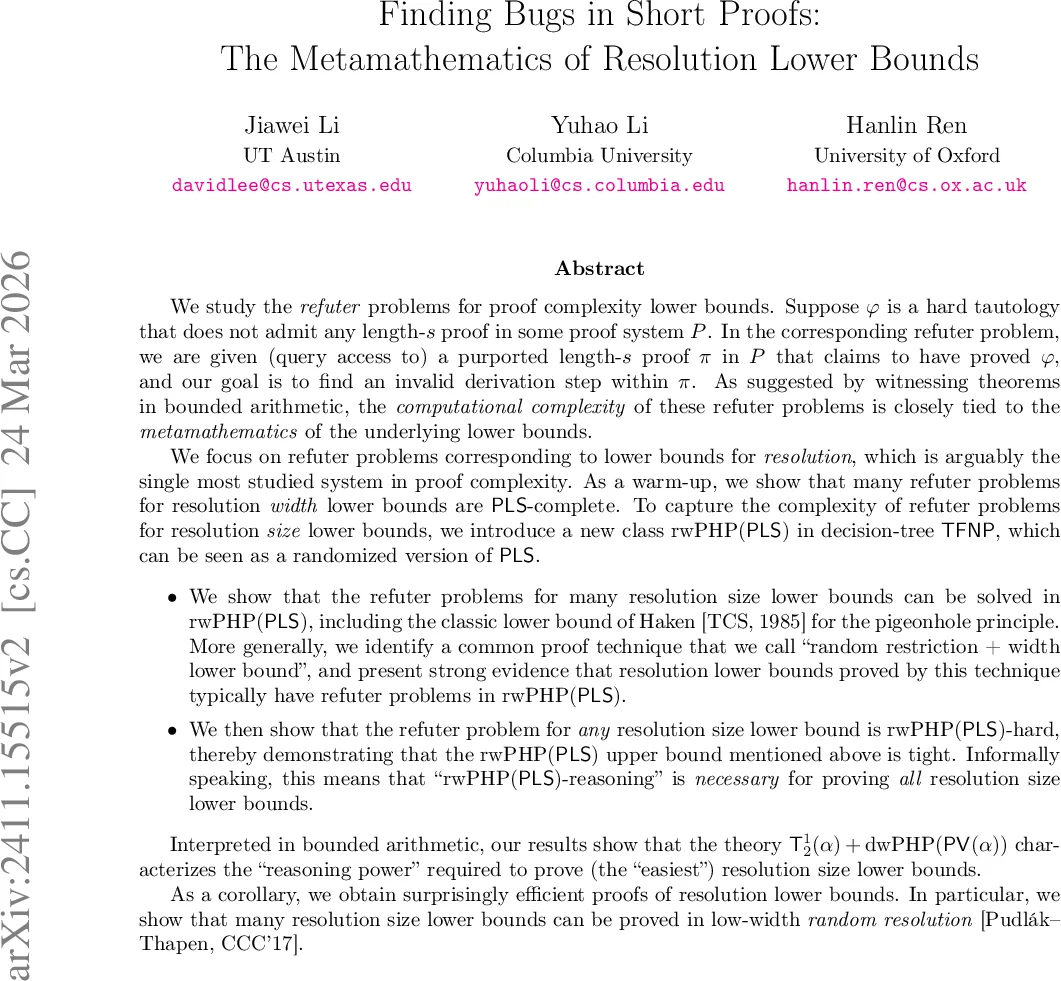
We study the refuter problems for proof complexity lower bounds. Suppose $φ$ is a hard tautology that does not admit any length-$s$ proof in some proof system $P$. In the corresponding refuter problem, we are given (query access to) a purported length-$s$ proof $π$ in $P$ that claims to have proved $φ$, and our goal is to find an invalid derivation step within $π$. As suggested by witnessing theorems in bounded arithmetic, the computational complexity of these refuter problems is closely tied to the metamathematics of the underlying lower bounds. We focus on refuter problems corresponding to lower bounds for resolution, which is arguably the single most studied system in proof complexity. To capture the complexity of refuter problems for resolution size lower bounds, we introduce a new class $\mathrm{rwPHP}(\mathsf{PLS})$ in decision-tree $\mathsf{TFNP}$, which can be seen as a randomized version of $\mathsf{PLS}$. Interpreted in bounded arithmetic, our results show that the theory $\mathsf{T}^1_2(α) + \mathrm{dwPHP}(\mathsf{PV}(α))$ characterizes the “reasoning power” required to prove (the “easiest”) resolution size lower bounds. As a corollary, we obtain surprisingly efficient proofs of resolution lower bounds. In particular, we show that many resolution size lower bounds can be proved in low-width random resolution [Pudlák–Thapen, CCC'17].
💡 Research Summary
The paper introduces a novel computational perspective on the metamathematics of proof‑complexity lower bounds by focusing on “refuter” problems. A refuter problem asks, given query access to a purported proof π of length at most s in a proof system P that claims to prove a tautology φ, to locate an invalid inference step inside π. If the lower bound “φ requires proofs longer than s in P” is true, then every such π must contain an error, making the refuter problem a total search problem. The authors embed these total search problems in the TFNP framework, allowing a fine‑grained complexity classification that mirrors the logical strength needed to prove the original lower bound.
The first major contribution is a complete characterization of refuter problems for resolution width lower bounds. By showing that these problems are PLS‑complete, the authors connect width‑based lower bounds (e.g., for the pigeonhole principle and Tseitin formulas) to polynomial‑local‑search, a well‑studied subclass of TFNP. This reveals that the reasoning required to establish width lower bounds is essentially that of finding a local optimum in a combinatorial landscape.
The second, deeper contribution is the definition of a new decision‑tree TFNP class called rwPHP(PLS). This class can be viewed as a randomized version of PLS that incorporates the weak pigeonhole principle under random restrictions. The authors prove that refuter problems for a broad family of resolution size lower bounds—including Haken’s classic exponential lower bound for the pigeonhole principle, Tseitin tautologies, and random k‑CNF formulas—lie inside rwPHP(PLS). The key technical insight is the “random restriction + width lower bound” paradigm: applying a random restriction shrinks a potentially huge proof to one of small width, after which a PLS‑type search finds a violated clause. This two‑step process precisely matches the algorithmic structure captured by rwPHP(PLS).
Beyond upper bounds, the paper establishes rwPHP(PLS)‑hardness for any resolution size lower bound. In other words, for every family of hard tautologies for resolution, the associated refuter problem is at least as hard as the hardest problems in rwPHP(PLS). This shows that the class is not only sufficient but also necessary: rwPHP(PLS)‑reasoning is the minimal metamathematical machinery required to prove any resolution size lower bound.
The authors translate these complexity results into bounded arithmetic. They identify the theory T¹₂(α) + dwPHP(PV(α))—denoted TRes—as exactly capturing the reasoning power needed for resolution size lower bounds. TRes can formalize all known resolution lower bounds (including Haken’s) while any weaker theory would render resolution p‑bounded, i.e., would prove every tautology with polynomial‑size resolution proofs. Thus TRes is both sufficient and minimal, providing a precise reverse‑mathematics characterization of the proof‑complexity landscape.
Finally, the metamathematical analysis yields concrete proof‑complexity applications. By interpreting the rwPHP(PLS) reasoning in terms of low‑width random resolution (a system introduced by Pudlák and Thapen), the authors give remarkably efficient proofs of many classic resolution size lower bounds. In particular, they show that random resolution of low width suffices to re‑prove Haken’s exponential lower bound for the pigeonhole principle, as well as other bounds that previously required more intricate combinatorial arguments. This demonstrates that the “hardness” of these lower bounds can be captured by very weak logical principles (essentially AC⁰‑level reasoning combined with random restrictions), dramatically simplifying the proof landscape.
In summary, the paper provides a comprehensive framework that (1) formalizes refuter problems for resolution lower bounds, (2) classifies width lower bounds as PLS‑complete and size lower bounds as rwPHP(PLS)‑complete, (3) proves rwPHP(PLS)‑hardness for all resolution size lower bounds, (4) connects these classes to a precise fragment of bounded arithmetic, and (5) leverages the insight to obtain streamlined, low‑complexity proofs of classic lower bounds. This work bridges proof‑complexity, computational search theory, and bounded arithmetic, offering a clear picture of the exact logical strength needed to establish resolution lower bounds.
Comments & Academic Discussion
Loading comments...
Leave a Comment