Drinfeld Center as Quantum State Monodromy over Bloch Hamiltonians around Defects
The Drinfeld center fusion category $\mathcal{Z}(\mathrm{Vec}_G)$ famously models anyons in certain lattice models. Here we demonstrate how its fusion rules may also describe topological order in fractional topological insulator materials, in the vic…
Authors: Hisham Sati, Urs Schreiber
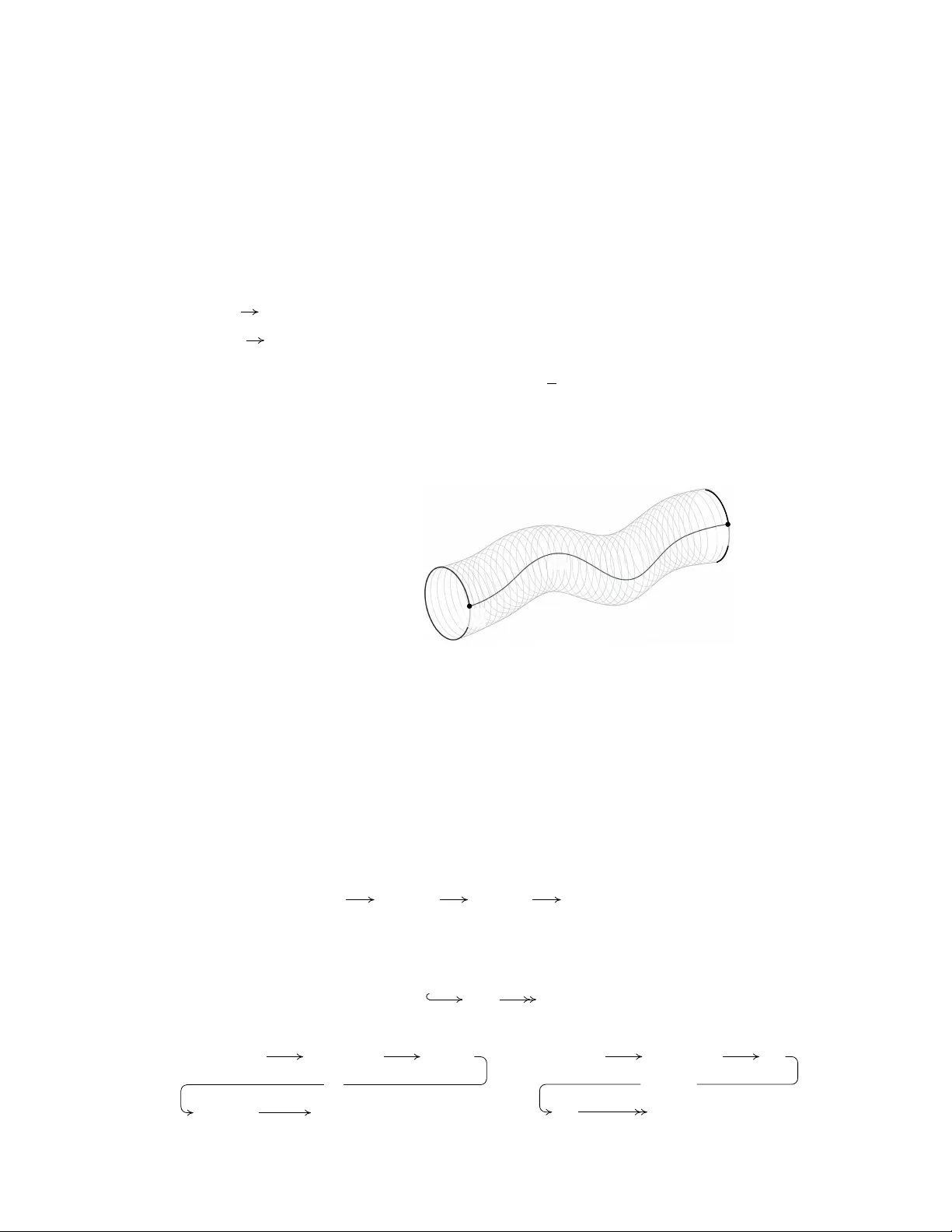
DRINFELD CENTER AS QUANTUM ST A TE MONODR OMY O VER BLOCH HAMIL TONIANS AR OUND DEFECTS HISHAM SA TI AND URS SCHREIBER Abstract. The Drinfeld center fusion category Z ( V ec G ) famously mo dels any ons in certain lattice models. Here we demonstrate ho w its fusion rules ma y also describe topological order in fractional topological insulator materials, in the vicinity of point defects in the Brillouin zone. Concretely , w e prov e that Z ( V ec G ) reflects, lo cally ov er a punctured disk in the Brillouin zone, the mono drom y (top ological order) of gapped quantum states ov er the parameter space of Blo c h Hamiltonians whose classifying space has fundamental group G . Contents 1. In tro duction 2 2. T op ological Order and Parameter Mono drom y 2 2.1. Classifying Spaces of Blo ch Hamiltonians 2 2.2. Homotop y of spaces of Blo c h Hamiltonians 3 2.3. Lo cal Blo c h Hamiltonian Mono drom y 4 3. Lo cal Parameter Monodromy via the Drinfeld Cen ter Z ( G ) 4 3.1. Simple ob jects of Z ( G ) as Lo cal P arameter Mono dromy 4 3.2. F usion in Z ( G ) as F usion of Lo cal Parameter Mono drom y 6 4. Conclusion 9 App endix A. Background 10 A.1. Homotop y 10 A.2. Group oids 12 A.3. Drinfeld Center 14 A ckno wledgmen ts 17 References 17 This research was supported by T amke en UAE under the A bu Dhabi R ese ar ch Institute grant CG008 . 1 2 HISHAM SA TI AND URS SCHREIBER 1. Introduction The Drinfeld c enter Z ( V ec G ) of the category of G -graded v ector spaces (recalled in § A.3 ) is a basic example of a fusion c ate gory (cf. [ ENO05 ]) 1 and as suc h has received muc h attention (originating with [ Kit03 ], cf. [ BV25 ]) as a category of anyon sp ecies (cf. [ Gol23 ]) in lattice models ([ Kit03 , § 4; Kit06 , § E], cf. [ Sim23 , § 29]). Ho wev er, while there are man y the or etic al mo dels for an y ons like this, a single an y on mo del curren tly stands out as b eing consistently observed in actual exp erimen ts, in recent years (starting with [ Bar+20 ; Nak+20 ], review in [ FH21 ], most recent confirmations in [ V ei+24 ; Gho+25 ]): namely quasi-holes in fractional quantum Hall (F QH) liquids (cf. [ Sto99 ; PB24 ]). Y et more recently , the “anomalous” v ersion (FQAH) of the fractional quan tum Hall effect has b een experimentally observ ed in crystalline quantum materials kno wn as fr actional Chern insulators (F CI, cf. [ CLM23 ; Zha+25 ]). This is potentially of great practical relev ance for future applications, notably to topological quantum computing hardw are (cf. [ Na y+08 ; SV25 ]), since the F QAH effect is seen under muc h more practical conditions (requiring less extreme co oling and no extreme magnetic field). Therefore, an acutely relev an t op en question, b oth exp erimen tally and theoretically , is the p oten tial nature of any onic top ological order in such F CI materials (cf. [ SS26b ; SS25d ]). Ho wev er, the topological phases of such crystalline insulators are naturally described not b y lattice mo dels, but by the homotop y of their Blo ch Hamiltonians (cf. [ RS78 , § XI I I.16; Ser23 ]): These are con tinuous maps from the Bril louin zone Σ 2 of electron momenta in the crystal (cf. [ Thi25 , § 2.1]), to a (classifying) space A of admissible Hamiltonians mo deling the internal degrees of freedom of electrons of fixed quasi-momentum. Moreo ver ([ SS25d , § I-II], recalled in § 2 b elow), since the single-electron Bloch Hamiltonian serv es as the external parameter of crystal couplings on whic h the interacting electron quantum ground states m ust adiabatically depend, any top ological order in these systems ough t to manifest as representations of the fundamental groups in the space of Blo ch Hamiltonians H . Our main result here (in § 3 ) is a pro of that, lo c al ly ar ound p oint defe cts in the Brillouin torus (suc h as around band no des), this p ar ameter mono dr omy ov er spaces of Blo ch Hamiltonians is faithfully reflected b y the simple ob jects and their fusion rules in Z ( V ec G ) . 2. Topological Order and P arameter Monodromy T o start with, we recall, with [ SS25d , § I-I I], that top olo gic al or der of quantum materials [ W en91 ; W en95 ], exhibiting an y onic quan tum states, is generally about nontrivial mono dr omy of gapp ed quan tum ground states with resp ect to adiabatic transp ort along paths of external parameters ( lo c al systems of ground state Hilb ert spaces ov er parameter space, cf. [ MSS24 , Lit. 2.22 & § 3; SS26a , § 2.2]). Then we sp ecialize this to the situation of interest here, where the parameter space is that of Blo ch Hamiltonians in the vicinity of a defect in momentum space. 2.1. Classifying Spaces of Blo c h Hamiltonians. W e consider a path-connected top ological space A admitting the structure of a CW-complex, to b e regarded as a classifying space for Blo c h Hamiltonians. Typical examples, classifying fragile top ological phases [ BBS20 ] of sequences of groups of gapp ed electron bands, are flag manifolds of the form (1) A ∼ U ( U 1 × · · · × U k ) , where U ⊂ U( H ) is a subgroup of unitary transformations (of the single electron’s internal quan tum states) preserved b y the material’s quan tum symmetries, and the U i ⊂ U are the disjoint symmetry subgroups under whic h the gapp ed groups of bands transform. 1 By the finiteness condition on the set of simple objects of a fusion category , Z ( V ec G ) is fusion when G is a finite group, as is well-kno wn. While our results all hold in the generality where G m a y b e non-finite, we will generally refer to Z ( V ec G ) as a fusion category , in order not to o verburden the terminology . DRINFELD CENTER AS QUANTUM ST A TE MONODR OMY OVER BLOCH HAMIL TONIANS AROUND DEFECTS 3 Example 2.1. Consider the simple but imp ortant case of 2-band (fractional) Chern insulators (cf. [ CLM23 , § A.1], whic h assumes that a single v alence band and a single conduction band are accessible to the system under deformations, sub ject to no other symmetry constraints). Here w e hav e that the classifying space is homotop y equiv alen t ( 42 ) to the 2-sphere (cf. [ Ser23 , (8.3-4); SS26b , (4)]): (2) A ∼ U(2) ( U(1) × U(1) ) ≃ C P 1 ≃ S 2 . Simplistic as this classifying space ma y app ear, it pla ys a remarkable role in witnessing F QH-type an yons in the momen tum space of FQAH systems, see Ex. 2.3 b elo w. But for the purp oses of the presen t article, we will instead b e fo cused on examples of classifying spaces that ha ve trivial π 2 but interesting π 1 , such as the following: Example 2.2. The classifying space of Blo ch Hamiltonians for a PT-symmetric crystalline system with 3 gapp ed bands (considered in [ WSB19 ; Bou23 , pp. 11]) is: (3) A ∼ O(3) ( O(1) 3 ) ≃ SO(3) D 2 This space has trivial π 2 , and its fundamental group is the quaternion gr oup : (4) π 1 ( A ) ≃ { ± 1 , ± i , ± j , ± k } ⊂ S ( H ) , π 2 ( A ) = 0 . 2.2. Homotop y of spaces of Blo c h Hamiltonians. With a Blo c h Hamiltonian classifying space A given ( § 2.1 ), and denoting b y Σ 2 a domain of crystal momen ta, the space of Blo ch Hamiltonians on the domain with the given properties is homotopy equiv alent ( 42 ) to the following mapping space: (5) Blo c h Hamiltonians on Σ 2 classified by A = Map ( Σ 2 , A ) ≡ Σ 2 A . Since Blo ch Hamiltonians enco de the crystal/p otential structure seen by v alence electrons, this ma y b e regarded as the space of classical external parameters for the multi-electron quan tum system. But this means [ SS25d , § I-II], by the quantum adiab atic the or em (cf. [ R O12 ]), that gapp ed quan tum ground states of interacting electrons form lo c al systems (cf. [ MSS24 , Lit. 2.22; SS26a , § 2.2]) of Hilbert spaces ov er this external parameter space, hence here form represen tations of the fundamen tal groups π 1 of this mapping space (cf. Fig. 1 ): (i) [ p ] ∈ π 0 ( Map ( Σ 2 , A ) ) is a top olo gic al phase , (ii) π 1 ( Map ( Σ 2 , A ) , p ) is the p ar ameter mono dr omy in that phase, signifyin top olo gic al or der (cf. Fig. 2 ). Figure 1. The quantum adiab atic theor em entails that gapp ed ground states H undergo unitary transformations U γ when clas- sical parameters p mo ve along paths γ in parameter space. If these U γ dep end only on the homotopy class of γ (relative end- p oints) then nontrivial suc h transformations signify top olo gic al or der of the quantum phase. Mathematically this means that the Hilb ert spaces H p constitute a lo cal system or flat bund le o ver parameter space, equiv alently a representation of the fun- damental gr oup of closed paths (loops) ℓ at an y base p oint p 0 . H p 2 H p 1 H p 3 H p 0 p 2 p 1 p 3 p 0 U γ 23 U γ 13 U γ 12 U ℓ γ 23 γ 13 γ 12 ℓ Figure 2. F or interacting electrons in crystalline materials, their external parameter is the crystal lattice structure enco ded in the single-electron Blo c h Hamiltonian H , hence the parameter mono dromy of their quan tum ground states (Fig. 2 ) is along lo ops in the space of Bloch Hamiltonians. Σ 2 A H F or global analysis, the momentum domain Σ 2 m ust b e the full Brillouin torus Σ 2 = b T 2 . Example 2.3. In the case of 2-band (fractional) Chern insulators ( 2 ) this yields [ KSS26 ], as pa- rameter mono dromy in the top ological phase with Chern class C ∈ C , the inte ger Heisenb er g gr oup at level 2 and Planck constan t ℏ = 2 C (6) π 1 ( Maps ( b T 2 , C P 1 ) , C ) ≃ Heis 3 ( Z , 2 C ) . 4 HISHAM SA TI AND URS SCHREIBER Remarkably , this is exactly the group whose represen tations giv e fractional quantum Hall any on states on the torus ([ SS26b , Thm. 1; SS25c , § 3], review in [ SS25a ]). 2.3. Lo cal Blo c h Hamiltonian Mono drom y. Ho w ever, in the following w e consider just the lo cal situation, where (as suggested in [ Bou+20 ; SS22 ; Bou23 ]) Σ 2 is tak en to be a punctur e d submanifold of the Brillouin torus, where we think of the punctures as exhibiting (externally fixed) defect lo ci, suc h as a band no des where the gapp ed band structure degenerates. Sp ecifically , we consider (in § 3.1 ) Σ 2 to b e the annulus , hence the once-punctured version (7) Σ 2 := D 2 < 1 − { 0 } of the op en disk in the complex plane D 2
Original Paper
Loading high-quality paper...
Comments & Academic Discussion
Loading comments...
Leave a Comment