Non-Hermiticity induced thermal entanglement phase transition
Theoretical analysis of a prototypical two-qubit effective non-Hermitian system characterized by asymmetric Heisenberg $XY$ interactions in the absence of external magnetic fields demonstrates that maximal bipartite entanglement and quantum phase tra…
Authors: Bikashkali Midya
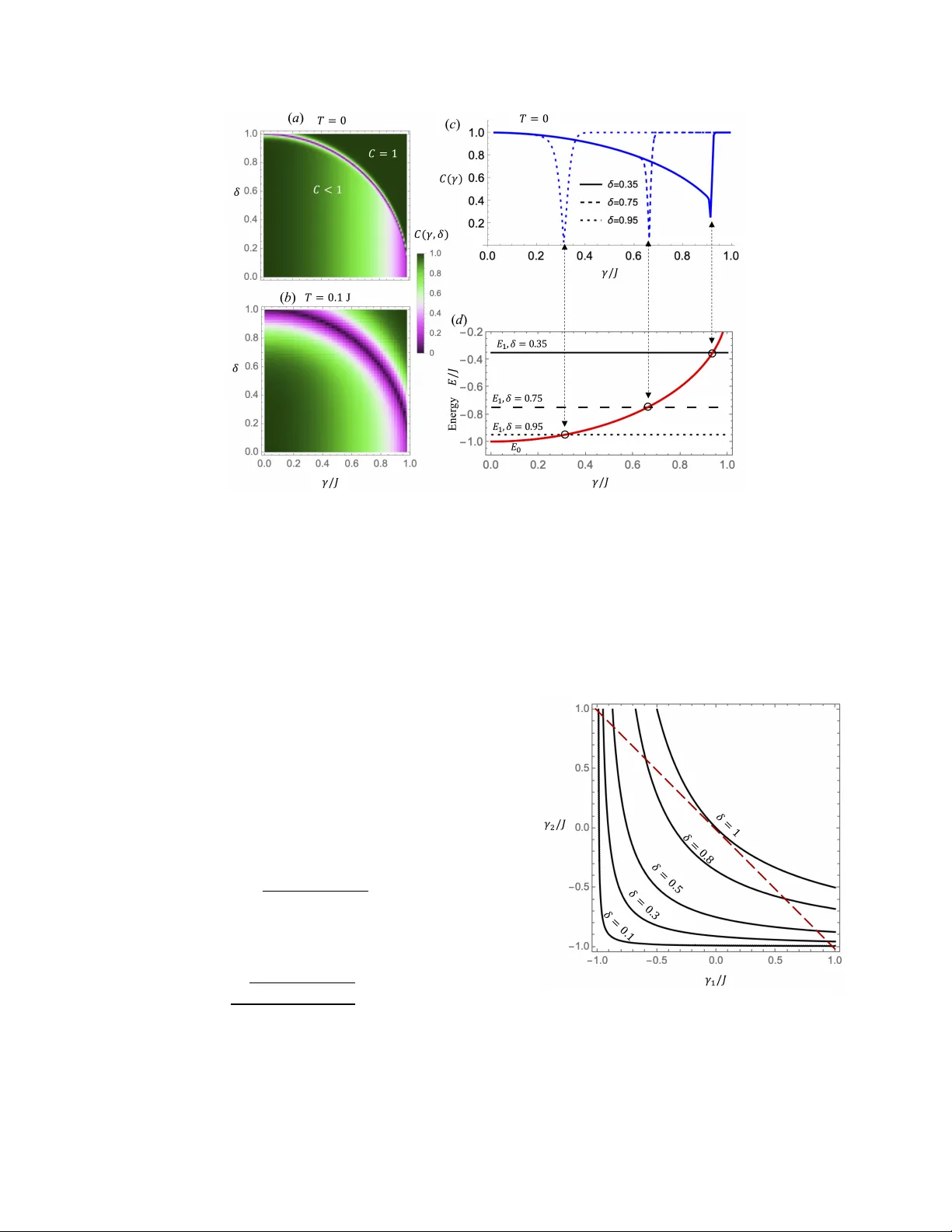
Non-Hermiticit y induced thermal en tanglemen t phase transition Bik ashkali Midy a Indian Institute of Scienc e Educ ation and R ese ar ch Berhampur, Odisha 760003, India Theoretical analysis of a prototypical t wo-qubit effective non-Hermitian system characterized b y asymmetric Heisen b erg 𝑋 𝑌 in teractions in the absence of external magnetic fields demonstrates that maximal bipartite en tanglement and quantum phase transitions can b e induced exclusively through non-Hermiticity . At thermal equilibrium as 𝑇 → 0 , the system atta ins maximal en tanglement 𝐶 = 1 for v alues of the non-Hermiticit y parameter greater than a critical v alue 𝛾 > 𝛾 𝑐 = 𝐽 √ 1 − 𝛿 2 , where 𝐽 denotes the exchange in teraction and 𝛿 represen ts the anisotrop y of the system; con versely , for 𝛾 < 𝛾 𝑐 , entanglemen t is nonmaximal and giv en b y 𝐶 = 1 − ( 𝛾 / 𝐽 ) 2 . The entanglemen t undergo es a discontin uous transition to zero precisely at 𝛾 = 𝛾 𝑐 . This phase transition originates from the closing of the energy gap at a non-Hermiticity-driv en ground state degeneracy , whic h is fundamentally different from an exceptional p oin t. This work suggests the use of singular-v alue-decomposition generalized density matrix for the computation of entanglemen t in bi-orthogonal systems. In tro duction.– Certain non-Hermitian op en quan tum systems exhibit exceptional p oin t (EP) sp ectral singularities, where m ultiple eigenfrequencies coalesce and their corresp onding eigenstates become indistinguishable 1 , 2 . These p oin ts were initially in vestigated in semi-classical systems 3 , leading to phenomena such as EP-induced lasing, non-recipro cal dynamics, and enhanced sensing capabilities (refer to the reviews 4 – 6 and references therein). Subsequently , EPs ha ve b een iden tified as producing nov el quantum effects suc h as univ ersal critical phenomena 7 – 9 , accelerated relaxation pro cess 10 , chiral state transfer 11 , and ha ve b een observ ed in v arious dissipative quantum systems, including solid-state spins 12 – 15 , trapp ed ions 16 – 18 , ultracold gases 19 – 21 , sup erconducting and quantum photonic qubits 22 – 25 . In con temp orary researc h, non-Hermitian interactions and EPs are emerging as k ey resources in the field of quantum information science 26 , and the in vestigation of entanglemen t and its dynamics 27 – 53 . Sp ecifically , in vestigations ha ve rev ealed non trivial quan tum adv an tages such as faster-than-Hermitian en tanglement generation 28 , c hiral exc hange of Bell states 29 , and en tanglement filtering within non-Hermitian coupled qubit systems 27 . These adv ancements naturally lead to an imp ortan t question: Can non-Hermiticity alone induc e maximal thermal entanglement 54 – 56 and trigger phase tr ansitions in otherwise Hermitian qubit system that do not exhibit these fe atur es in the absenc e of external magnetic fields ? Here, w e pro vide an affirmativ e answ er to this important question. By examining a minimal mo del of t wo asymmetrically coupled spin qubits, it is demonstrated that maximal en tanglement can b e attained b y tuning the effective non-Hermitian parameter b ey ond the p oint where the sp ectral energy gap closes. Notably , this gap-closing p oint is shown to differ from an EP , as the corresp onding states remain distinguishable. This finding con trasts with prior inv estigations on analogous Hermitian mo dels 54 , 55 , 57 , 58 , which suggested that external magnetic fields are requisite for attaining thermal entanglemen t transition. F urthermore, this w ork in tro duces singular-v alue-decomp osition (SVD) generalized thermal states, which accurately captures the en tanglement c haracteristics of non-Hermitian systems. Theoretical mo del.– W e consider an effectiv e non-Hermitian systems defined by the Hamiltonian 𝐻 = 𝐻 𝑋𝑌 + 𝐻 𝑁 𝐻 , where the Heisen b erg 𝑋 𝑌 Hamiltonian for t wo qubit systems ha ving nearest-neigh b or in teraction is given by 56 𝐻 XY = 2 𝐽 ( 1 + 𝛿 ) 𝑆 𝑥 1 𝑆 𝑥 2 + ( 1 − 𝛿 ) 𝑆 𝑦 1 𝑆 𝑦 2 . (1) Here, the op erators 𝑆 𝑥 , 𝑦 , 𝑧 𝑛 = 𝜎 𝑥 , 𝑦 , 𝑧 𝑛 / 2 , defined in terms of the P auli matrices, corresp ond to the lo cal spin- 1 2 op erator at qubit 𝑛 , 𝐽 > 0 is the antiferromagnetic exc hange in teraction, and the dimensionless parameter 𝛿 ( 0 ≤ 𝛿 ≤ 1 ) denotes anisotropy of the system; sp ecifically , 𝛿 = 0 characterizes an isotropic interaction, whereas 𝛿 = 1 corresp onds to a fully anisotropic Heisenberg-Ising in teraction. When 𝛿 equals 1 , the Hamiltonian 𝐻 𝑋𝑌 do es not exhibit thermal entanglemen t 55 . Additionally , a quantum phase transition is not observ ed for v alues of 𝛿 < 1 unless an external tunable parameter, suc h as an applied magnetic field, is introduced 54 , 55 , 57 , 58 . The non-Hermitian comp onen t of the Hamiltonian is given b y 𝐻 NH = 𝛾 1 𝑆 − 1 𝑆 + 2 + 𝛾 2 𝑆 + 1 𝑆 − 2 , (2) where 𝑆 ± 𝑛 = 𝑆 𝑥 𝑛 ± 𝑖 𝑆 𝑦 𝑛 are creation and annihilation op erators, and 𝛾 1 ≠ 𝛾 ∗ 2 parameterize the rate of asymmetric exchange b etw een tw o qubits in the subspace { |↑ ↓⟩ , |↓ ↑⟩ } spanned b y single spin excitations. F or analytical tractability , we imp ose an an ti-Hermitian condition 𝐻 † 𝑁 𝐻 = − 𝐻 𝑁 𝐻 satisfied by 𝛾 1 = − 𝛾 2 = 𝛾 . Under this assumption, the total Hamiltonian simplifies to 𝐻 = ( 𝐽 + 𝛾 ) 𝑆 − 1 𝑆 + 2 + ( 𝐽 − 𝛾 ) 𝑆 + 1 𝑆 − 2 + 𝐽 𝛿 ( 𝑆 − 1 𝑆 − 2 + 𝑆 + 1 𝑆 + 2 ) . (3) The Hamiltonian ( 3 ), apart from an o verall dissipativ e term ( − 𝑖 𝛾 ) , represents the effective Hamiltonian of a fully p ostselected Marko vian op en quantum system 59 – 61 . This 2 Hamiltonian can be derived from the Lindblad master equation (with ℏ = 1 ) 62 giv en b y: 𝑑𝜌 ( 𝑡 ) 𝑑 𝑡 = L 𝜌 ( 𝑡 ) = − 𝑖 [ 𝐻 𝑋𝑌 , 𝜌 ] + D [ 𝐿 12 ] 𝜌 + D [ 𝐺 12 ] 𝜌 , (4) Here, 𝜌 is the densit y op erator of the system, and L denotes a h ybrid Liouvillian that includes the coupled spin Hamiltonian 𝐻 𝑋𝑌 , which gov erns the coherent ev olution of the system. The operators 𝐿 12 and 𝐺 12 are pairwise jump operators 63 – 65 defined as: 𝐿 12 = 𝛾 2 ( 𝑆 − 1 − 𝑖 𝑆 − 2 ) , 𝐺 12 = 𝛾 2 ( 𝑆 + 1 + 𝑖 𝑆 + 2 ) , (5) These op erators c haracterize the system’s nonunitary in teraction with its en vironment through a generalized dissipator 61 : D [ 𝑍 ] 𝜌 = 2 𝑞 𝑍 𝜌 𝑍 † − ( 𝑍 † 𝑍 𝜌 + 𝜌 𝑍 † 𝑍 ) . (6) Here, 𝛾 > 0 represents the rate of dissipativ e in teraction, while the parameter 𝑞 ∈ [ 0 , 1 ] controls the degree of p ostselection dynamics: 𝑞 = 0 corresp onds to full p ostselection dynamics, whereas 𝑞 = 1 indicates no p ostselection. The Liouvillian in equation ( 4 ) can b e expressed as L 𝜌 = − 𝑖 ( 𝐻 eff 𝜌 − 𝜌 𝐻 † eff ) + 𝑞 ( 2 𝐿 12 𝜌 𝐿 † 12 + 2 𝐺 12 𝜌 𝐺 † 12 ) , (7) where the effective non-Hermitian Hamiltonian reduces to 𝐻 eff = 𝐻 𝑋𝑌 − 𝑖 𝐿 † 12 𝐿 12 − 𝑖 𝐺 † 12 𝐺 12 = 𝐻 − 𝑖 𝛾 . (8) This final equality is deriv ed using the relations { 𝑆 − 1 , 𝑆 + 1 } = { 𝑆 − 2 , 𝑆 + 2 } = 1 and [ 𝑆 − 1 , 𝑆 + 2 ] = 0 . When p ostselected tra jectories of null quan tum jump is chosen (i.e., 𝑞 = 0 ), equations ( 7 ) and ( 4 ) show that the Lindblad master equation simplifies to the von Neumann equation. In this scenario, the dynamical solution given by 𝜌 ( 𝑡 ) = 𝑒 − 𝑖𝑡 𝐻 eff 𝜌 ( 0 ) 𝑒 𝑖 𝑡 𝐻 † eff is formally equiv alent to a thermal state 𝜌 ( 𝑇 ) through the Wic k rotation 𝑖 𝑡 = 1 𝑘 𝐵 𝑇 . It ma y b e noted that the uniform background loss term ( − 𝑖 𝛾 ) in equation ( 8 ) does not affect the thermal en tanglement discussed later; therefore, it has b een omitted, leading to the approximation 𝐻 ≃ 𝐻 eff . It may b e noted that p ostselected non-Hermitian quan tum systems ha ve b een exp erimen tally realized in sup erconducting qubits 22 , 23 . The effective Hamiltonian describ ed in Eq. ( 3 ) is also significan t in cascaded qubit net works, such as when qubits are coupled to a chiral bath 63 , 66 , 67 . Energy sp ectrum and degeneracy .– The righ t- and left-eigenstates of the Hamiltonian 𝐻 are expressed in the standard tw o qubit basis { |↑↑ ⟩ , |↑↓ ⟩ , | ↓ ↑⟩ , |↓↓ ⟩ } : | 𝑅 0 , 3 ⟩ : 1 √ 2 𝐽 − 𝛾 𝐽 + 𝛾 |↑↓ ⟩ ∓ | ↓ ↑⟩ , | 𝑅 1 , 2 ⟩ : 1 √ 2 ( |↑↑ ⟩ ∓ | ↓ ↓⟩ ) | 𝐿 0 , 3 ⟩ : 1 √ 2 𝐽 + 𝛾 𝐽 − 𝛾 |↑↑ ⟩ ∓ | ↓ ↓⟩ , | 𝐿 1 , 2 ⟩ = | 𝑅 1 , 2 ⟩ , (9) FIG. 1. Non-Hermiticity induc e d Hermitian de gener acy. Energy spectra of 𝐻 for t wo distinct v alues of 𝛿 , illustrate the app earance of a Hermitian degeneracy induced by non-Hermiticit y , whic h differs from an exceptional p oin t (EP). When the parameter 𝛾 is v aried, the ground state and the first excited state interc hange their positions. It is also observed that ground-state-interc hange takes place at smaller v alues of 𝛾 when 𝛿 is larger. This state switching plays a crucial role in the thermal entanglemen t transition describ ed in the main text. Here, 𝐽 = 1 is chosen. whic h satisfy bi-orthonormalit y condition 68 ⟨ 𝐿 𝑗 | 𝑅 𝑗 ′ ⟩ = 𝛿 𝑗 𝑗 ′ , and fulfill completeness relation Í 𝑗 | 𝑅 𝑗 ⟩ ⟨ 𝐿 𝑗 | = 𝐼 aw ay from an exceptional p oint ( 𝛾 = 𝐽 ) . These eigenstates correspond to a purely real energy sp ectrum across all v alues of 𝛿 : 𝐸 0 , 1 , 2 , 3 = { − 𝐽 2 − 𝛾 2 , − 𝐽 𝛿 , 𝐽 𝛿, 𝐽 2 − 𝛾 2 } , (10) pro vided the non-Hermitian parameter satisfies the inequalit y 𝛾 < 𝐽 . It may b e noted that the non-Hermiticit y affects only the states | 𝑅 0 ⟩ and | 𝑅 3 ⟩ corresp onding to the energy lev els 𝐸 0 and 𝐸 3 , resp ectively . As the parameter 𝛾 increases, these tw o energy levels mo ve closer together (see Fig. 1 ). A t 𝛾 = 𝐽 , the system reac hes an exceptional point (EP) where b oth energies 𝐸 0 and 𝐸 3 and their asso ciated eigenstates | 𝑅 0 ⟩ and | 𝑅 3 ⟩ merge. F or v alues of 𝛾 > 𝐽 , a pair of complex conjugate energy lev els emerges. In addition to this kno wn EP degeneracy , a nov el degeneracy o ccurs within the intermediate range 0 ≤ 𝛾 < 𝐽 , where all energies remain real. This new degeneracy is characterized b y t wo distinct real energy lev els b ecoming equal while their corresp onding eigenstates sta y distinct and orthogonal. Sp ecifically , the energy gaps b et ween the pairs ( 𝐸 0 , 𝐸 1 ) and ( 𝐸 2 , 𝐸 3 ) sim ultaneously close when the condition 𝛾 / 𝐽 = √ 1 − 𝛿 2 holds. Figure ( 1 ) presen ts the full energy sp ectrum of 𝐻 for different anisotropy parameters 3 𝛿 , demonstrating how this Hermitian degeneracy arises as the non-Hermiticit y parameter 𝛾 is v aried. This phenomenon, termed ‘non-Hermiticit y assisted Hermitian degeneracy’ and distinct from an EP , pla ys a crucial role in controlling lo w-temp erature thermal entanglemen t and phase transitions, as explained b elow. In this pap er, w e do not discuss en tanglement in the situation of complex sp ectrum 𝐸 𝑅 𝑗 = ( 𝐸 𝐿 𝑗 ) ∗ for 𝛾 > 𝐽 , in order to preclude non-unitary dynamical ev olution. Non-Hermiticit y induced thermal en tanglemen t and phase transition.– T o examine the thermal entanglemen t in the system, we employ the bi-orthogonal density op erator in thermal equilibrium defined as 54 , 68 𝜌 ( 𝑇 ) = 𝑍 − 1 𝑒 − 𝐻 / 𝑘 𝐵 𝑇 , where 𝑒 − 𝐻 / 𝑘 𝐵 𝑇 = 3 𝑗 = 0 𝑒 − 𝐸 𝑗 / 𝑘 𝐵 𝑇 | 𝑅 𝑗 ⟩ ⟨ 𝐿 𝑗 | , (11) and 𝑍 = T r 𝑒 − 𝐻 / 𝑘 𝐵 𝑇 denotes the partition function. W e ha v e used the ab ov e mentioned biorthogonal completeness relation and the trace is defined as T r ( ·) = Í 𝑗 ⟨ 𝐿 𝑗 | · | 𝑅 𝑗 ⟩ . Here, 𝑇 is the temp erature and 𝑘 𝐵 is the Boltzmann constant (whic h is set to unity). The densit y matrix explicitly given by 𝜌 = 1 𝑍 cosh 𝐽 𝛿 𝑇 0 0 − sinh 𝐽 𝛿 𝑇 0 cosh √ 𝐽 2 − 𝛾 2 𝑇 − 𝐽 − 𝛾 𝐽 + 𝛾 sinh √ 𝐽 2 − 𝛾 2 𝑇 0 0 − 𝐽 + 𝛾 𝐽 − 𝛾 sinh √ 𝐽 2 − 𝛾 2 𝑇 cosh √ 𝐽 2 − 𝛾 2 𝑇 0 − sinh 𝐽 𝛿 𝑇 0 0 cosh 𝐽 𝛿 𝑇 , (12) where 𝑍 = 2 ( cosh 𝛿 𝐽 𝑇 + cosh √ 𝐽 2 − 𝛾 2 𝑇 ) , is non-Hermitian 𝜌 † ≠ 𝜌 . T o ensure consistent computation of en tanglement measure (see the detailed discussion in App endix A and the accompanying figure ( 5 )) , here w e in tro duce the SVD generalized densit y matrix 71 𝜌 𝑆 𝑉 𝐷 ( 𝑇 ) = 𝜌 † ( 𝑇 ) 𝜌 ( 𝑇 ) T r 𝜌 † ( 𝑇 ) 𝜌 ( 𝑇 ) = 𝑒 − 𝐻 † / 𝑘 𝐵 𝑇 𝑒 − 𝐻 / 𝑘 𝐵 𝑇 T r 𝑒 − 𝐻 † / 𝑘 𝐵 𝑇 𝑒 − 𝐻 / 𝑘 𝐵 𝑇 . (13) Note that 𝜌 𝑆 𝑉 𝐷 = 𝜌 when 𝐻 is Hermitian. The degree of entanglemen t b et w een tw o qubits is quantified b y the concurrence 72 defined by 𝐶 = max { 𝜆 0 − 𝜆 1 − 𝜆 2 − 𝜆 3 , 0 } , where 𝜆 𝑗 are non-negative eigenv alues, arranged in decreasing order, of the op erator 𝑅 = h 𝜌 𝑆 𝑉 𝐷 ( 𝜎 𝑦 ⊗ 𝜎 𝑦 ) 𝜌 𝑆 𝑉 𝐷 ∗ ( 𝜎 𝑦 ⊗ 𝜎 𝑦 ) i 1 2 . (14) The concurrence ranges from 0 to 1 , with a v alue of zero indicating the absence of en tanglemen t and a v alue of one corresp onding to maximal entanglemen t b et ween t wo qubits. As shown in App endix- A , for (non-degenerate) pure states 𝜌 𝑗 = | 𝑅 𝑗 ⟩ ⟨ 𝐿 𝑗 | , the concurrence 𝐶 ( 𝜌 𝑗 ) = 1 − ( 𝛾 / 𝐽 ) 2 , 𝑗 = 0 , 3 , (15) and 𝐶 ( 𝜌 𝑗 ) = 1 for 𝑗 = 1 , 2 . This indicates that, while the energy eigenstates | 𝑅 1 ⟩ and | 𝑅 2 ⟩ are maximally entangled Bell states, the states | 𝑅 0 ⟩ and | 𝑅 3 ⟩ exhibit non-maximal en tanglement in the presence of non-Hermiticit y; in fact, they b ecome separable at the exceptional p oin t 𝛾 = 𝐽 . The en tanglement characteristics in the thermally mixed state describ ed by equation ( 12 ) exhibit richer complexit y . In general, the concurrence v alid for all temp erature and system parameters can not be studied analytically . Numerically computed results obtained from Eq. ( 12 ) are exemplified in Fig. 2 and Fig. 3 . T o gain analytical insigh t in to the system’s lo w temp erature entanglemen t, here w e approximate the mixed state by considering only low est p opulated ground and first excited states with Boltzmann weigh t 𝑒 − 𝐸 0 / 𝑇 / ( 𝑒 − 𝐸 0 / 𝑇 + 𝑒 − 𝐸 1 / 𝑇 ) and 𝑒 − 𝐸 1 / 𝑇 / ( 𝑒 − 𝐸 0 / 𝑇 + 𝑒 − 𝐸 1 / 𝑇 ) , resp ectiv ely . This appro ximation is v alid within the temp erature range 0 ≤ 𝑇 ≲ | 𝐸 1 − 𝐸 0 | and a w ay from exceptional p oin t (i.e. at 𝛾 = 𝐽 , where 2nd excited state also b ecome relev ant). In this case, eigen v alues 𝜆 0 , 1 , 2 , 3 of 𝑅 are giv en by (detail calculations are provided in App endix- B ) n 𝜆 𝑒 𝐽 𝛿 / 𝑇 , 𝜆 𝑒 √ 𝐽 2 − 𝛾 2 / 𝑇 , 0 , 0 o , (16) when 𝐽 𝛿 > 𝐽 2 − 𝛾 2 , whereas, first tw o eigen v alues switc h their p ositions if 𝐽 𝛿 < 𝐽 2 − 𝛾 2 . Here, 𝜆 = 𝐽 2 − 𝛾 2 / ( 𝐽 𝑒 √ 𝐽 2 − 𝛾 2 / 𝑇 + 𝐽 2 − 𝛾 2 𝑒 𝐽 𝛿 / 𝑇 ) . The concurrence 𝐶 = max { 𝜆 0 − 𝜆 1 , 0 } reduces to 𝐶 ( 𝑇 ) = √ 𝐽 2 − 𝛾 2 𝐽 𝑒 √ 𝐽 2 − 𝛾 2 𝑇 + √ 𝐽 2 − 𝛾 2 𝑒 𝐽 𝛿 𝑇 | 𝑒 √ 𝐽 2 − 𝛾 2 𝑇 − 𝑒 𝐽 𝛿 𝑇 | = 𝑇 → 0 𝐽 2 − 𝛾 2 / 𝐽 , 𝛾 < 𝐽 √ 1 − 𝛿 2 0 , 𝛾 = 𝐽 √ 1 − 𝛿 2 1 , 𝛾 > 𝐽 √ 1 − 𝛿 2 (17) Equation ( 17 ) represen ts a key finding, and is v alid for all v alues of 𝛿 , 0 ≤ 𝛾 < 𝐽 and 𝑇 ∼ 0 . F ollo wing important conclusions are dra wn from this equation. 𝑖 . First, we discuss entanglemen t of thermal states in the Heisen b erg-Ising system ( 𝛿 = 1 ) . Interestingly , the concurrence 𝐶 reaches 1 at absolute zero temp erature ( 𝑇 = 0 ) whenever 𝛾 ≳ 0 . The emergence of maximal en tanglement at zero temp erature in the non-Hermitian Ising mo del can in tuitively be explained b y analyzing the ground state characteristics. F or 𝛾 = 0 , corresp onding to a Hermitian system, the thermal state is separable and consists of an equal mixture of degenerate ground and first excited eigenstates, b oth of which are maximally entangled 55 , 57 . The in tro duction of non-Hermiticit y lifts this degeneracy in a manner distinct from the effect caused by an external magnetic field in Hermitian systems, as illustrated in Figures 2 d and 2 e. Sp ecifically , increasing 𝛾 causes 4 FIG. 2. Thermal entanglement in the non-Hermitian Heisenb er g-Ising mo del ( 𝛿 = 1 ) . (a) The concurrence 𝐶 , calculated from the thermal mixed state 𝜌 as defined in Eq. ( 12 ), is presented as a function of 𝛾 at three distinct temp eratures. A t temp erature near zero, entanglemen t reaches its maxim um for non-zero v alues of 𝛾 , whereas at finite temp eratures, a stronger non-Hermiticity is required to achiev e comparable en tanglement. In panel (b), the concurrence 𝐶 is plotted against temp erature for three different v alues of 𝛾 , illustrating an exp onential deca y of entanglemen t with increasing temp erature. P anel (c) depicts 𝐶 within the entire parameter range 0 ≤ 𝑇 ≤ 𝐽 / 3 and 0 ≤ 𝛾 < 𝐽 . Region below the dashed line represents concurrence 𝐶 > 0 . 9 , follows from the Eq. ( 18 ). Maximal entanglemen t observ ed at 𝑇 = 0 originates from the non-Hermiticity-assisted non-degenerate ground state, whic h corresp onds to a Bell state, as sho wn in panel (d). This b ehavior contrasts sharply with that of the Hermitian system sub jected to an external transv erse field 𝐵 ˆ 𝑧 , described by 𝐻 = 𝐻 𝑋𝑌 + 𝐵 ( 𝑆 𝑧 1 + 𝑆 𝑧 2 ) ; its ground state is non-maximally entangled. Corresp onding energy sp ectrum, {± √ 𝐽 2 + 𝐵 2 , ± 𝐽 } , and zero temp erature concurrence are provided in panel (e) for comparison, where 𝛼 ± = 𝐵 ± √ 𝐽 2 + 𝐵 2 . the first and second excited states within the single spin excitation subspace { |↑↓ ⟩ , |↓↑ ⟩ } to approach an exceptional p oin t. This transition elev ates the maximally en tangled triplet Bell state ( |↑↑ ⟩ − |↓↓ ⟩ ) / √ 2 to b ecome the ground state of the system. This effect is termed non-Hermiticit y-induced maximal thermal entanglemen t and represents a mechanism fundamen tally different from magnetically induced en tanglemen t found in Hermitian Ising mo dels (see, for example, 57 ). 𝑖𝑖 . F or 𝛿 = 1 and a sp ecified 𝛾 , the first equation of Eq. ( 17 ) indicates that the system generates concurrence > 𝐶 , for all temp eratures b ounded by 𝑇 < ( 𝐽 2 − 𝐽 2 − 𝛾 2 ) / ln 𝐶 𝐽 + 𝐽 2 − 𝛾 2 ( 1 − 𝐶 ) 𝐽 2 − 𝛾 2 . (18) The ab ov e inequalit y pro vides the lo w temperature estimation of 𝛾 and 𝑇 for a desirable 𝐶 . Numerical results sho wn in Figs. 2 a and 2 c demonstrate that achieving comparable entanglemen t at finite temp eratures requires stronger non-Hermiticity . 𝑖𝑖 𝑖 . In systems exhibiting anisotropy with 0 < 𝛿 < 1 , the pres ence of non-Hermiticit y leads to a quantum phase transition mark ed by an abrupt b ehaviour c hange from non-maximal to maximal entanglemen t at zero temp erature ( 𝑇 = 0 ). This transition takes place exactly at the critical p oint 𝛾 𝑐 / 𝐽 = √ 1 − 𝛿 2 , as shown in Figures 3 a and 3 c. The underlying mechanism can be understo od by examining the ground state c haracteristics: for v alues of 𝛾 below 𝛾 𝑐 , the ground state is a non-maximally entangled singlet state | 𝑅 0 ⟩ . When 𝛾 surpasses 𝛾 𝑐 , the ground state shifts to | 𝑅 1 ⟩ , whic h is a maximally entangled triplet Bell state. At the critical threshold 𝛾 = 𝛾 𝑐 , where en tanglement drops to zero, this coincides with the spectral degeneracy condition 𝐸 0 = 𝐸 1 (refer to Figures 3 c and 3 d). F urthermore, an increase in the anisotropy parameter 𝛿 corresp onds to a decrease in the critical v alue of 𝛾 𝑐 at which this phase transition o ccurs. Numerical results presented in figure 3 b 5 FIG. 3. Non-Hermiticity induc e d thermal entanglement phase tr ansition. Thermal concurrence at absolute zero temp erature ( 𝑇 = 0 ) and at 𝑇 = 0 . 1 𝐽 is shown in panels (a) and (b), resp ectiv ely , across the full range of the anisotropy parameter 0 ≤ 𝛿 ≤ 1 and non-Hermiticit y 0 ≤ 𝛾 < 𝐽 . The results indicate that entanglemen t exp eriences a discontin uous transition from 𝐶 = 1 when 𝛾 > 𝛾 𝑐 to 𝐶 = 0 exactly at the critical p oin t 𝛾 𝑐 = 𝐽 ( 1 − 𝛿 2 ) 1 / 2 , follo wed b y an asymptotic increase for v alues of 𝛾 < 𝛾 𝑐 . This sharp discontin uity in zero temp erature entanglemen t at the critical non-Hermiticity 𝛾 𝑐 serv es as a hallmark of quan tum phase transition. Panel (c) shows that the discontin uity shifts tow ard low er v alues of 𝛾 as 𝛿 increases. Panel (d) shows that the en tanglement phase transition coincides with the o ccurrence of non-Hermiticity-assisted Hermitian degeneracy where 𝐸 0 = 𝐸 1 (mark ed b y circles), where a change in the ground state from a non-maximally entangled to a maximally en tangled state as a function of 𝛾 o ccurs. also indicate that this b eha vior of en tanglement phase transition remains observ able at finite temp eratures. 𝑖 𝑣 . In the case of isotropic Heisenberg interaction ( 𝛿 = 0 ), the entanglemen t decreases as 𝛾 increases. When 𝛾 reaches the v alue 𝐽 , all four energy levels b ecome degenerate, resulting in the system b eing maximally mixed with the density matrix giv en b y 𝜌 = I / 4 (see Eq. ( 12 )). In general, for arbitrary v alues of 𝛾 1 and 𝛾 2 , the ground state of 𝐻 is the Bell state | 𝑅 1 ⟩ when the condition 𝐸 1 < 𝐸 0 holds, where 𝐸 0 = − ( 𝐽 + 𝛾 1 ) ( 𝐽 + 𝛾 2 ) and 𝐸 1 = − 𝐽 𝛿 . If this condition is not met, the ground state corresp onds to a nonmaximally entangled state characterized b y its concurrence 𝐶 = 2 ( 𝐽 + 𝛾 1 ) ( 𝐽 + 𝛾 2 ) 2 𝐽 + 𝛾 1 + 𝛾 2 . (19) Therefore, the entanglemen t b ehavior at zero temp erature changes along the energy-gap-closing con tours defined b y 𝐸 0 = 𝐸 1 . A phase diagram illustrating this b eha vior of en tanglement transition for v arious v alues of the parameters ( 𝛾 1 , 𝛾 2 , 𝛿 ) is presented in figure ( 4 ), whereas complete eigensolutions of 𝐻 are discussed in Appendix C . FIG. 4. The contour lines defined b y the equation ( 𝐽 + 𝛾 1 ) ( 𝐽 + 𝛾 2 ) = 𝐽 2 𝛿 2 in the ( 𝛾 1 , 𝛾 2 ) parameter plane indicate the transition in ground-state entanglemen t from maximal to nonmaximal v alues for different anisotropy 𝛿 . F or eac h sp ecific 𝛿 , the entanglemen t remains maximal b elow the corresp onding contour line, while ab ov e it, the entanglemen t b ecomes nonmaximal. The special case of 𝛾 1 = − 𝛾 2 is sho wn b y the dashed line. 6 The ground-state entanglemen t transition can also b e induced by considering the following effectiv e non-Hermitian Hamiltonian ¯ 𝐻 = 𝐻 𝑋𝑌 − 𝑖 𝛾 𝑆 + 1 𝑆 − 1 − 𝑖 𝛾 𝑆 − 2 𝑆 + 2 , (20) whic h corresp ond to an op en system with Lindblad jump op erators 𝐿 1 = √ 𝛾 𝑆 − 1 and 𝐿 2 = √ 𝛾 𝑆 + 2 acting lo cally on qubit 1 and qubit 2, resp ectiv ely . The real part of the sp ectrum of ¯ 𝐻 can b e easily confirmed to b e isospectral with that of 𝐻 in Eq. ( 10 ): Sp ec ( ¯ 𝐻 ) = Sp ec ( 𝐻 ) − 𝑖 𝛾 . And the en tanglement prop erties of b oth 𝐻 and ¯ 𝐻 are also comparable. Specifically , the ground state sp ectral and entanglemen t transition o ccurs at 𝛾 / 𝐽 = √ 1 − 𝛿 2 . Bey ond this transition p oint, the ground state b ecomes indep enden t of the non-Hermitian parameter 𝛾 and corresp onds to the Bell state | 𝑅 1 ⟩ . Thermal entanglemen t in mo dels similar to Eq. ( 20 ) has b een examined in the presence of external fields in references 69 , 70 . Conclusion.– Although the exp erimen tal realization of effective non-Hermitian spin mo dels, suc h as that describ ed b y Eq. ( 3 ), remains uncertain, theoretical analysis reveals that non-Hermitian interactions alone are capable of inducing maximal bipartite thermal en tanglement and its associated phase transition in the absence of external magnetic fields. The metho d of p ostselected tra jectories of no quantum jumps is considered essential for observing these phenomena in the steady-state dynamics. This necessity arises b ecause the ground states of effective Ham iltonians studied here do not corresp ond to the dark states of the asso ciated Liouvillian. As a result, sto chastic in teractions with the environmen t significantly alter the en tanglement characteristics of the system compared to those predicted by an effective Hamiltonian. Extending this theoretical framew ork to p ostselected systems comprising a larger n umber of spins and exploring man y-b o dy entanglemen t 56 , 73 merit further researc h. App endix A: Why 𝜌 𝑆 𝑉 𝐷 ? Here we elab orate with a simple example wh y 𝜌 SVD is suitable in the computation of entanglemen t in bi-orthogonal systems. Consider a bi-orthogonal eigenstate, suc h as | 𝑅 0 ⟩ = 1 √ 2 𝐽 − 𝛾 𝐽 + 𝛾 |↑↓ ⟩ − |↓↑ ⟩ . It is eviden t that this state b ecomes separable at the EP 𝛾 = 𝐽 ; otherwise, it remains non-separable and thus en tangled. A dditionally , the degree of entanglemen t is exp ected to decrease as 𝛾 increases. T o quan tify the entanglemen t, w e first consider tw o-qubit bi-orthogonal densit y matrix 𝜌 = | 𝑅 0 ⟩ ⟨ 𝐿 0 | = 1 2 |↑↓ ⟩ ⟨↑ ↓ | − 𝐽 − 𝛾 𝐽 + 𝛾 |↑↓ ⟩ ⟨↓ ↑ | − 𝐽 + 𝛾 𝐽 − 𝛾 |↓↑ ⟩ ⟨↑ ↓ | + | ↓ ↑⟩ ⟨↓ ↑| , (A1) in matrix form 𝜌 = 1 2 © « 0 0 0 0 0 1 − 𝐽 − 𝛾 𝐽 + 𝛾 0 0 − 𝐽 + 𝛾 𝐽 − 𝛾 1 0 0 0 0 0 ª ® ® ® ® ® ¬ , (A2) whic h is non-Hermitian 𝜌 † ≠ 𝜌 . The reduced density matrix 𝜌 1 = T r 2 ( 𝜌 ) = 1 2 ( |↑⟩ ⟨↑| + |↓⟩ ⟨↓| ) , for the first qubit, corresponds to the von-Neumann entrop y 𝑆 = − 𝑥 1 log 2 𝑥 1 − 𝑥 2 log 2 𝑥 2 = 1 , where 𝑥 1 = 𝑥 2 = 1 2 are the eigen v alues of 𝜌 1 . This shows that the system is maximally entangled irresp ectiv e of the strength of non-Hermiticit y defined b y 𝛾 . This is a contradiction with our intuitiv e separabilit y requirement for the state at 𝛾 → 𝐽 . Other measure of entanglemen t 72 e.g. the concurrence 𝐶 = 1 √ 1 − ( 𝛾 / 𝐽 ) 2 obtained from eigenv alues { 𝐽 √ 𝐽 2 − 𝛾 2 , 0 , 0 , 0 } of 𝑅 = [ 𝜌 ( 𝜎 𝑦 ⊗ 𝜎 𝑦 ) 𝜌 ∗ ( 𝜎 𝑦 ⊗ 𝜎 𝑦 ) ] 1 / 2 , and corresponding entanglemen t of formation 𝜉 ( 𝐶 ) = − 1 + √ 1 + 𝐶 2 2 log 2 1 + √ 1 + 𝐶 2 2 − 1 + √ 1 − 𝐶 2 2 log 2 1 − √ 1 + 𝐶 2 2 , not only inconsistent with the entanglemen t en tropy 𝑆 , but also b oth exceed upp er bound of ph ysical en tanglement for all 𝛾 and diverges at 𝛾 → 𝐽 [see Fig. 5 ]. No w, we consider 𝜌 𝑆 𝑉 𝐷 = 𝜌 † 𝜌 / T r 𝜌 † 𝜌 . F or the state | 𝑅 0 ⟩ , we obtain 𝜌 𝑆 𝑉 𝐷 = 1 2 𝐽 © « 0 0 0 0 0 𝐽 + 𝛾 − 𝐽 2 − 𝛾 2 0 0 − 𝐽 2 − 𝛾 2 𝐽 − 𝛾 0 0 0 0 0 ª ® ® ® ¬ . (A3) The reduced densit y matrix for qubit 1 is now 𝜌 SVD , 1 = T r 2 ( 𝜌 SVD ) = 𝐽 + 𝛾 2 𝐽 |↑⟩ ⟨↑| + 𝐽 − 𝛾 2 𝐽 |↓⟩ ⟨↓| , (A4) with entrop y 𝑆 = − 𝐽 + 𝛾 2 𝐽 log 2 𝐽 + 𝛾 2 𝐽 − 𝐽 − 𝛾 2 𝐽 log 2 𝐽 − 𝛾 2 𝐽 (A5) no w dep ends on 𝛾 and decreases monotonically to zero as 𝛾 → 𝐽 (Fig. 5 ). The concurrence, obtained in this case 𝐶 = 1 − ( 𝛾 / 𝐽 ) 2 from the eigenv alues √ 𝐽 2 − 𝛾 2 𝐽 , 0 , 0 , 0 of 𝑅 = [ 𝜌 𝑆 𝑉 𝐷 ( 𝜎 𝑦 ⊗ 𝜎 𝑦 ) 𝜌 𝑆 𝑉 𝐷 ∗ ( 𝜎 𝑦 ⊗ 𝜎 𝑦 ) ] 1 / 2 , and the corresp onding en tanglement of formation 𝜉 ( 𝐶 ) is consisten t with 𝑆 (as p er the requiremen t explained in 72 ). W e hav e therefore considered 𝜌 𝑆 𝑉 𝐷 for concurrence computations whenever bi-orthogonal states are inv olved in the construction of density matrix. Note that, in systems satisfying usual orthogonality one has 𝜌 𝑆 𝑉 𝐷 = 𝜌 . 7 FIG. 5. V arious entanglemen t measures, such as entrop y ( 𝑆 ), concurrence ( 𝐶 ), and en tanglemen t of formation ( 𝜉 ), are presen ted for the bi-orthogonal pure state | 𝑅 0 ⟩ ⟨ 𝐿 0 | . It is observ ed that the con ven tional densit y matrix 𝜌 in Eq. ( A2 ) yields inconsisten t entanglemen t v alues, whereas measures deriv ed from the SVD density matrix 𝜌 𝑆 𝑉 𝐷 in Eq. ( A3 ) provide consisten t results. App endix B: Analytical calculation of concurrence at low temp erature limit 𝑇 → 0 En tanglement properties of the thermal state (given b y Eq. ( 12 )) is to o cumbersome to obtain analytically . T o gain analytical insights on the low temp erature ( 𝑇 ≲ | 𝐸 1 − 𝐸 0 | ) thermal entanglemen t, we approximate the thermal state consisting only ground and first excited state i.e 𝜌 = 𝑒 − 𝐸 0 / 𝑇 | 𝑅 0 ⟩ ⟨ 𝐿 0 | + 𝑒 − 𝐸 1 / 𝑇 | 𝑅 1 ⟩ ⟨ 𝐿 1 | 𝑒 − 𝐸 0 / 𝑇 + 𝑒 − 𝐸 1 / 𝑇 , (B1) whic h is in matrix form given b y 𝜌 = 𝛼 © « 𝑒 𝐽 𝛿 / 𝑇 0 0 − 𝑒 𝐽 𝛿 / 𝑇 0 𝑒 √ 𝐽 2 − 𝛾 2 / 𝑇 − 𝐽 − 𝛾 𝐽 + 𝛾 𝑒 √ 𝐽 2 − 𝛾 2 / 𝑇 0 0 − 𝐽 + 𝛾 𝐽 − 𝛾 𝑒 √ 𝐽 2 − 𝛾 2 / 𝑇 𝑒 √ 𝐽 2 − 𝛾 2 / 𝑇 0 − 𝑒 𝐽 𝛿 / 𝑇 0 0 𝑒 𝐽 𝛿 / 𝑇 ª ® ® ® ® ® ¬ , (B2) where 𝛼 = h 2 ( 𝑒 𝐽 𝛿 / 𝑇 + 𝑒 √ 𝐽 2 − 𝛾 2 / 𝑇 ) i − 1 . In order to compute the concurrence, w e obtain 𝜌 𝑆 𝑉 𝐷 = 𝜆 2 © « 𝑒 𝐽 𝛿 / 𝑇 0 0 − 𝑒 𝐽 𝛿 / 𝑇 0 𝐽 + 𝛾 𝐽 − 𝛾 𝑒 √ 𝐽 2 − 𝛾 2 / 𝑇 − 𝑒 √ 𝐽 2 − 𝛾 2 / 𝑇 0 0 − 𝑒 √ 𝐽 2 − 𝛾 2 / 𝑇 𝐽 − 𝛾 𝐽 + 𝛾 𝑒 √ 𝐽 2 − 𝛾 2 / 𝑇 0 − 𝑒 𝐽 𝛿 / 𝑇 0 0 𝑒 𝐽 𝛿 / 𝑇 ª ® ® ® ® ® ¬ , (B3) and corresp onding 𝑅 = 𝜆 2 © « 𝑒 𝐽 𝛿 / 𝑇 0 0 − 𝑒 𝐽 𝛿 / 𝑇 0 𝑒 √ 𝐽 2 − 𝛾 2 / 𝑇 − 𝐽 + 𝛾 𝐽 − 𝛾 𝑒 √ 𝐽 2 − 𝛾 2 / 𝑇 0 0 − 𝐽 − 𝛾 𝐽 + 𝛾 𝑒 √ 𝐽 2 − 𝛾 2 / 𝑇 𝑒 √ 𝐽 2 − 𝛾 2 / 𝑇 0 − 𝑒 𝐽 𝛿 / 𝑇 0 0 𝑒 𝐽 𝛿 / 𝑇 ª ® ® ® ® ® ¬ , (B4) where 𝜆 = 𝐽 2 − 𝛾 2 h ( 𝐽 2 − 𝛾 2 𝑒 𝐽 𝛿 / 𝑇 + 𝐽 𝑒 √ 𝐽 2 − 𝛾 2 / 𝑇 ) i − 1 . Eigen v alues of 𝑅 and corresp onding concurrence reduces to the Eq. ( 16 ) and first of Eq. ( 17 ) in the main text. T o deriv e the concurrence at 𝑇 = 0 , w e note that 𝐶 can also b e written as 𝐶 = √ 𝐽 2 − 𝛾 2 𝐽 + √ 𝐽 2 − 𝛾 2 𝑒 − ( √ 𝐽 2 − 𝛾 2 𝐽 − 𝛿 ) / 𝑇 | 𝑒 − √ 𝐽 2 − 𝛾 2 − 𝐽 𝛿 / 𝑇 − 1 | , 𝐽 2 − 𝛾 2 − 𝐽 𝛿 > 0 √ 𝐽 2 − 𝛾 2 𝐽 𝑒 − ( 𝐽 𝛿 − √ 𝐽 2 − 𝛾 2 ) / 𝑇 + √ 𝐽 2 − 𝛾 2 | 1 − 𝑒 − 𝐽 𝛿 − √ 𝐽 2 − 𝛾 2 / 𝑇 | , 𝐽 𝛿 − 𝐽 2 − 𝛾 2 > 0 (B5) Hence, the second of Eq. ( 17 ) in the main text readily follo ws. App endix C: General solution of 𝐻 for arbitra ry 𝛾 1 and 𝛾 2 F or generic v alues of 𝛾 1 and 𝛾 2 , the asymmetric non-Hermitian Hamiltonian 𝐻 reduces to 𝐻 = © « 0 0 0 𝐽 𝛿 0 0 𝐽 + 𝛾 2 0 0 𝐽 + 𝛾 1 0 0 𝐽 𝛿 0 0 0 ª ® ® ® ¬ . (C1) The right- and left-eigenv ectors are giv en by | 𝑅 0 , 3 ⟩ : 1 √ 2 𝐽 + 𝛾 2 𝐽 + 𝛾 1 |↑↓ ⟩ ∓ | ↓ ↑⟩ , | 𝑅 1 , 2 ⟩ : 1 √ 2 ( |↑↑ ⟩ ∓ | ↓ ↓⟩ ) | 𝐿 0 , 3 ⟩ : 1 √ 2 𝐽 + 𝛾 1 𝐽 + 𝛾 2 |↑↑ ⟩ ∓ | ↓ ↓⟩ , | 𝐿 1 , 2 ⟩ = | 𝑅 1 , 2 ⟩ , (C2) with corresonding energies 𝐸 0 , 1 , 2 , 3 = n − ( 𝐽 + 𝛾 1 ) ( 𝐽 + 𝛾 2 ) , − 𝐽 𝛿, 𝐽 𝛿 , ( 𝐽 + 𝛾 1 ) ( 𝐽 + 𝛾 2 ) o . The ground state of the system is determined by the minim um v alue b et ween 𝐸 0 and 𝐸 1 , which dep ends on the parameters 𝛾 1 , 2 and 𝛿 . When 𝐸 0 < 𝐸 1 , specifically when ( 𝐽 + 𝛾 1 ) ( 𝐽 + 𝛾 2 ) > 𝐽 2 𝛿 2 , the ground state corresp onds to the non-maximally entangled state | 𝑅 0 ⟩ . Conv ersely , if 𝐸 1 < 𝐸 0 , meaning ( 𝐽 + 𝛾 1 ) ( 𝐽 + 𝛾 2 ) < 𝐽 2 𝛿 2 , the ground state is the Bell state | 𝑅 1 ⟩ . The concurrence for the Bell state satisfies 𝐶 ( | 𝑅 1 ⟩ ⟨ 𝐿 1 | ) = 1 , whereas the concurrence for the non-maximally en tangled state | 𝑅 0 ⟩ is given by Eq. ( 19 ) in the main text which is alwa ys less than one. As a result, b oth the nature of the ground state and its entanglemen t properties at zero temp erature ( 𝑇 = 0 ) undergo changes at parameter v alues where 𝐸 0 = 𝐸 1 , sp ecifically when ( 𝐽 + 𝛾 1 ) ( 𝐽 + 𝛾 2 ) = 𝐽 2 𝛿 2 is satisfied. A cknowledgments The research was supported b y the ANRF Grant (MTR/2023/000249) and a Seed Gran t from I ISER Berhampur, India. 8 1 Y. Ashida, Z. Gong and M. Ueda, A dv. Ph ys. 69 , 249-435 (2021) . 2 I. Rotter, J. Phys. A: Math. Theor. 42 , 153001 (2009) . 3 W. D. Heiss, J. Phys. A: Math. Theor. 45 , 444016 (2012) . 4 S. K. Özdemir, S. Rotter, F. Nori and L. Y ang, Nature Materials 18, 783–798 (2019) . 5 R. El-Ganainy , K. G. Makris, M. Kha javikhan, Z. H. Musslimani, S. Rotter and D. N. Christodoulides, Nature Ph ys. 14 , 11–19 (2018) . 6 L. F eng, R. El-Ganainy and L. Ge, Nature Photon. 11, 752–762 (2017) . 7 K. Kaw abata, Y. Ashida, M. Ueda, Phys. Rev. Lett. 119, 190401 (2017) . 8 L. Xiao, K. W ang, X. Zhan, Z. Bian, K. Kaw abata, M. Ueda, W. Yi, and P . Xue, Phys. Rev. Lett. 123 , 230401 (2019) . 9 B. Dora, M. Heyl, R. Mo essner, Nat. Commun. 10, 2254 (2019) . 10 Y-L. Zhou, X-D. Y u, C-W W u, X-Q Li, J Zhang, W. Li, and P-X. Chen, Phys. Rev. Research 5, 043036 (2023) . 11 K. Sun and W. Yi, AAPPS Bulletin 34 , 22 (2024) . 12 Y. W u, W. Liu, J. Geng, X. Song, X. Y e, C.-K. Duan, X. Rong, and J. Du, Science 364 , 878-880 (2019) . 13 J.-W. Zhang et al., Nat. Commun. 13 , 6225 (2022) . 14 Y. W u, Y. W ang, X. Y e, W. Liu, Z. Niu, C-K Duan, Y W ang, X. Rong and J. Du, Nat. Nanotechnol. 19 , 160–165 (2024). 15 J. W en, G. Qin, C. Zheng, S. W ei, X. Kong, T. Xin, G. Long, np j Quantum Information 6 , 28 (2020) . 16 L. Ding, K. Shi, Q. Zhang et.al., Phys. Rev. Lett. 126 , 083604 (2021) . 17 L. Ding et al., Phys. Rev. A 105 , L010204 (2022) . 18 M-M. Cao, K. Li, W-D. Zhao et al., Phys. Rev. Lett. 130 , 163001 (2023) . 19 E. Zhao et.al., Nature 637 , 565-573 (2025) . 20 Z. Ren et.al., Nature Physics 18 , 385-389 (2022) . 21 J. Li, A. K. Harter, J. Liu, L. de Melo, Y. N. Joglekar, and L. Luo, Nat. Comm. 10 , 855 (2019) . 22 W. Chen, M. Abbasi, Y. N. Joglek ar, and K. W. Murch, Phys. Rev. Lett. 127 , 140504 (2021) . 23 M. Naghilo o, M. Abbasi, Y. N. Joglek ar & K. W. Murch, Nature Physics 15 , 1232–1236 (2019) . 24 H. Gao, K. Sun, D. Qu, K. W ang, L. Xiao, W. Yi, and P . Xue, Phys. Rev. Lett. 134, 146602 (2025) . 25 L. Xiao et al., PRX Quantum 2 , 020313 (2021) . 26 P . M. Harrington, E. J. Mueller, K. W. Murch, Nat. Rev. Phys. 4 , 660-671 (2022) . 27 M. A. Selim et. al., Science 387 1424-1428 (2025) . 28 Z-Z Li, W. Chen, M. Abbasi, K. W. Murch and K. B. Whaley , Phys. Rev. Lett. 131 , 100202 (2023) 29 S. Khandelw al, W. Chen, K. M. Murch, and G. Haack, Ph ys. Rev. Lett. 133 , 070403 (2024) . 30 P-R Han, F. W u, X-J Huang et al., Phys. Rev. Lett. 131 , 260201 (2023) . 31 J. Zou, S. Zhang, and Y. T serko vnyak, Phys. Rev. B 106 , L180406 (2022) . 32 C. G. F eyisa, J-S Y ou, H-Y Ku and H H Jen, Quantum Sci. T ec hnol. 10 , 025021 (2025) 33 S. Longhi, Opt. Lett. 50, 5101-5104 (2025) . 34 Y-B Qian, L T ang, D-G Lai, and B-P Hou, Ph ys. Rev. A 112 , 043548 (2025) 35 A. Kumar, K. W. Murch, and Y. N. Joglek ar, Phys. Rev. A 105 , 012422 (2022) . 36 Y-X Zhang, Z-T. Zhang, X-Z W ei, B-L Liang, F. Mei, and Z-S Y ang, J. Phys. B 57 , 085501 (2024) 37 P . Chang, J. Y ou, X. W en and S. Ryu, Phys. Rev. Researc h 2 , 033069 (2020) . 38 L. S. Lima, Physica E 174 , 116356 (2025). 39 L. S. Lima, Physica E 156 , 115861 (2024) . 40 F. Rottoli, M. F ossati and P . Calabrese, J. Stat. Mec h. 063102 (2024) . 41 C-Y Ju, A. Miranowicz, G-Y Chen, and F. Nori, Phys. Rev. A 100, 062118 (2019) 42 C-Y Liu, C G F eyisa, M. S Hasan, and H H Jen, J. Phys. B 58, 075501 (2025) . 43 T. E. Lee, F. Reiter, and N. Moiseyev, Phys. Rev. Lett. 113 , 250401 (2014) . 44 P . Kumar, K. Snizhko, Y. Gefen, and B. Rosenow, Phys. Rev. A 105, L010203 (2022) . 45 V. L. Duc, M. Now otarski, and J. K.Kalaga, Symmetry 13 , 203 (2021) . 46 Y. L. Gal, X. T urkeshi and M. Sc hiró, SciPost Ph ys. 14, 138 (2023) . 47 D. F. Munoz-Arb oleda, R. Arouca, and C. Morais Smith, Ph ys. Rev. B 110, 115135 (2024) . 48 Y.L. F ang et al., Phys. Rev. Research 4 , 033022 (2022) . 49 X. T urkeshi, and M. Schiró, Phys. Rev. B 107 , L020403 (2023) . 50 C-Z. Lu, X. Deng, S-P . K ou, and G. Sun, Phys. Rev. B 110 , 014441 (2024) . 51 K. Kawabata, T. Numasaw a, and S. Ryu, Phys. Rev. X 13 , 021007 (2023) . 52 S-Z Li, X-J Y u, and Z Li, Ph ys. Rev. B 109, 024306 (2024) ; L. Zhou, Phys. Rev. B 109 , 024204 (2024) . 53 S.-L. Chen, G.-Y. Chen, and Y.-N. Chen, Ph ys. Rev. A 90 , 054301 (2014) . 54 M.C. Arnesen, S. Bose, V. V edral, Phys. Rev. Lett. 87, 017901 (2001) . 55 G. L. Kamta, and A. F. Starace, Phys. Rev. Lett. 88 , 107901 (2002) . 56 L. Amico, R. F azio, A. Osterioh, and V. V edral, Rev. Mo d. Ph ys. 80, 517 (2008) . 57 D. Gunlyck e, V. M. Kendon, and V. V edral, Phys. Rev. A 64 , 042302 (2001) . 58 X. W ang, Phys. Rev. A 64 , 012313 (2001) . 59 F. Reiter and Anders S. Sørensen, Ph ys. Rev. A 85 , 032111 (2012) . 60 F. Minganti, A. Miranowicz, R. W. Chha jlan y , and F. Nori, Physical Review A 100 , 062131 (2019) . 61 F. Minganti, A. Mirano wicz, R. W. Chha jlan y , I. I. Arkhip ov and F. Nori, Phys. Rev. A 101, 062112 (2020) . 62 C. Gardiner and P . Zoller, Quantum Noise (Springer, Berlin, 2004). 63 A. Metelmann and A. A. Clerk, Ph ysical Review X 5 , 021025 (2015) . 64 F. Song, S. Y ao, and Z. W an g, Phys. Rev. Lett. 123 , 170401 (2019) . 65 S T akemori, K. Y amamoto, and A. Koga, Phys. Rev. Lett. 135 , 266002 (2025) . 66 H. Pichler, T. Ramos, A. J. Daley , and P . Zoller, Ph ys. Rev. A 91 , 042116 (2015) . 67 K. Stannigel, P . Rabl and P . Zoller, New J. Ph ys. 14 063014 (2012) . 68 D. C. Bro dy , J. Phys. A 47 , 035305 (2013) . 69 Y. Li, P . P Zhang, L. Z Hu, Y. L Xu and X. M Kong, Quantum Inf. Pro cess. 22 , 277 (2023) . 70 Z. Y unpeng, Y. Sh un, C. Guohao, H. Halimjan and A. Abliz, In t. J. Theor. Phys. 64 , 90 (2025) . 71 A. J. Parzygnat, T. T ak ay anagi, Y. T akic and Z. W eic, JHEP 12 , 123 (2023) . 72 W.K. W o otters, Phys. Rev. Lett. 80 , 2245 (1998) . 73 D. A. Abanin, E. Altman, I. Blo c h, and M. Serbyn, Rev. Mo d. Phys. 91 , 021001 (2019) .
Original Paper
Loading high-quality paper...
Comments & Academic Discussion
Loading comments...
Leave a Comment