A generalized Coulomb problem for a spin-1/2 fermion
We study the Dirac equation in 3+1 dimensions with a general combination of scalar, vector and tensor interactions with arbitrary strengths, all of them described by central Coulomb potentials acting on a particular plane of motion. For the tensor co…
Authors: V. B. Mendrot, A. S. de Castro, P. Alberto
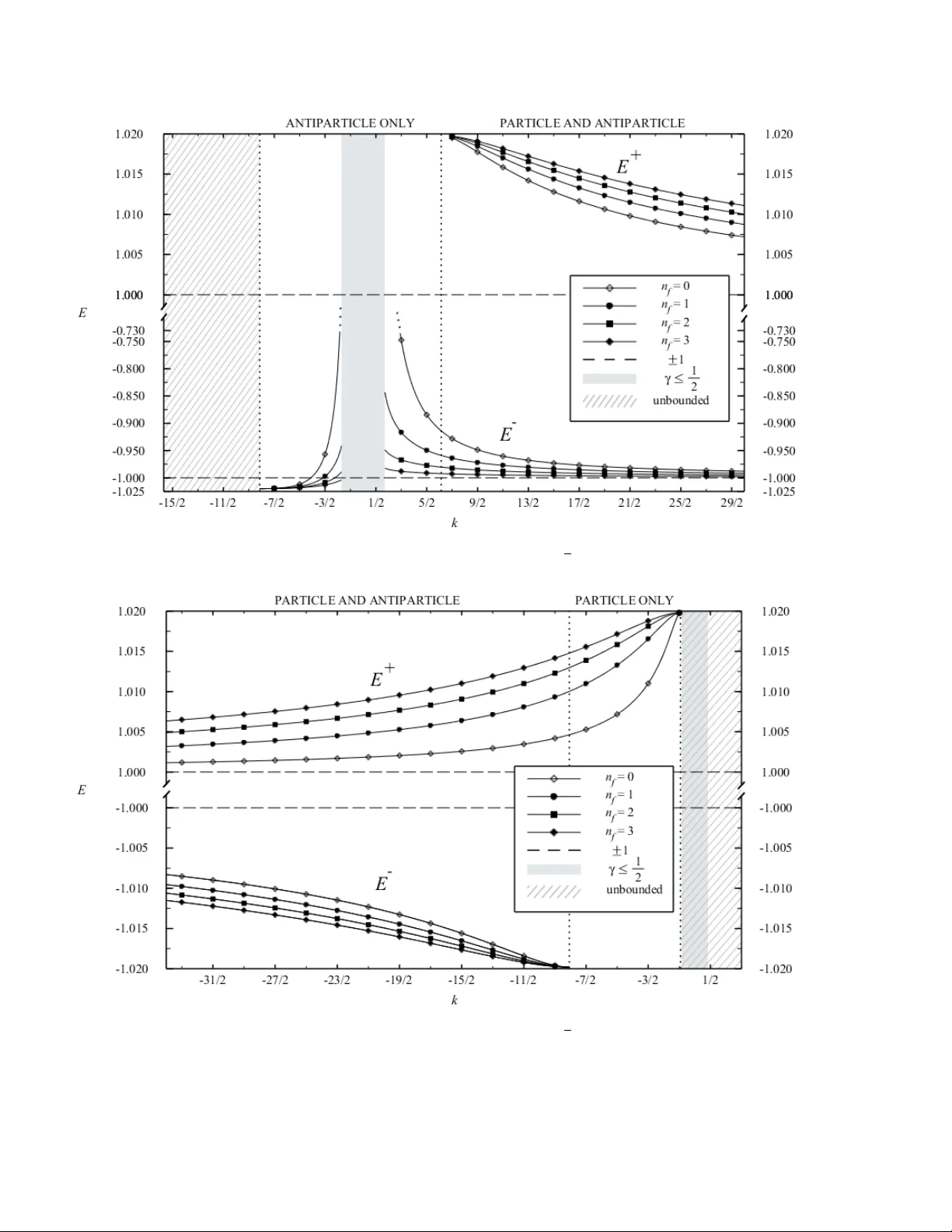
A generalized Coulom b problem for a spin-1/2 fermion V. B. Mendrot and A. S. de Castro DFI, Physics Dep artment, Unesp - S˜ ao Paulo State University, Guar atinguet´ a, Br azil P . Alb erto CFisUC, Physics Dep artment, University of Coimbr a, P-3004-516 Coimbr a, Portugal (Dated: March 24, 2026) 1 Abstract W e study the Dirac equation in 3+1 dimensions with a general combination of scalar, vector and tensor in teractions with arbitrary strengths, all of them describ ed by cen tral Coulom b p otentials acting on a particular plane of motion. F or the tensor coupling a constan t term is also included, since this giv es rise to an effective Coulomb p oten tial, whic h is necessary for the formation of b ound states in a pure tensor coupling configuration. The exact b ound-state solutions for this generalized Coulom b problem are computed b y exploiting the freedom in choosing the co efficien ts of the Ans¨ atze for the radial functions, whic h leads to w av e functions in terms of generalized Laguerre polynomials. F rom the quan tization condition, the exact energy sp ectrum is also determined and its dep endence on the parameters of the p otentials is discussed. W e sho w that similar features of the equations for the problem in the plane and the spherically symmetric problem allow a simple and direct mapping b et ween them, thereb y pro viding the solution to the spherical Coulom b problem. Our results are v alidated by showing that the solutions correctly encompass several previous solutions av ailable in the literature for particular cases of this problem, for which we further develop the analysis of the parameters. W e also deriv e tw o new particular cases not yet reported in the literature: the case of breaking of spin and pseudospin symmetries b y the addition of a Coulom b plus constant tensor p oten tial and the problem of a scalar plus tensor Coulomb p otentials. P ACS n umbers: 03.65.Pm, 03.65.Ge I. INTR ODUCTION The Coulom b p otential is notable throughout ph ysics, present in many ph ysical in teractions and also related to special symmetries of the equations of motion. This is also true in relativistic quan tum mec hanics. As in the original problem of explaining the exact atomic sp ectrum of the hydrogen atom via a Coulom b vector potential in the Dirac Hamiltonian [1], the inclusion of p oten tials with other Lorentz structures is required to explain sev eral different asp ects of quan tum-mechanical phenomena, b oth in fundamental and phenomenological contexts. The ones with a Coulomb shap e in particular, not only app ear frequen tly , but are also of significant in terest due to the fact that they yield analytical expressions for the energy sp ectra and wa v e functions in sev eral cases, whic h allo ws the study 2 of exact prop erties and can also be used as a b enchmark for numerical analysis. Therefore, the m ultiple instances of the “Coulom b problem” are of general interest in physics. The Dirac equation with a mix of time-comp onen t v ector ( V ) and scalar ( S ) Coulomb p oten tials has b een originally solv ed to in vestigate the role of a small scalar coupling in atomic sp ectroscop y [2]. Another coupling of scien tific in terest is the one kno wn as the Dirac oscillator ( p → p − iβ mω r ), whic h turns out to b e a more natural w ay to in tro duce the harmonic oscillator in a relativistic formalism [3]. In terms of Lorentz structures in 3+1 dimensions, the Dirac oscillator is a tensor p oten tial which is related to the spin-orbit prop erties of the Dirac equation [4]. These prop erties, as is well kno wn, play a ma jor role in strong in teraction as w ell as in condensed matter physics. The sc heme of the Dirac oscillator can b e generalized to other p otential shap es b y the coupling p → p − iβ U ( r ), including the Coulomb p oten tial [5], which corresp onds to an inv erse-linear plus constan t p otential. F urthermore, there exists an equiv alence betw een this t ype of tensor coupling and the spatial comp onen t of the four-vector p otential ( A ) under circular symmetry , as shown in another w ork by some of the authors [6]. This latter potential is necessary to describ e magnetic fields. In the search for analytical bound-state solutions for the Dirac equation with a mixture of all these types of p oten tials (scalar, v ector and tensor), n umerous applications of the Coulom b p otential are found in the literature, among which w e highligh t: scalar and v ector harmonic oscillators and Coulomb tensor p otentials [7, 8], Mie-t yp e scalar and v ector potentials (in the fashion of singular Coulom b potentials) and Coulom b tensor p oten tial [9], Hulth ´ en scalar and v ector p otentials plus Coulom b tensor p oten tial with a sc heme of approximating the cen trifugal barrier [10], scalar, v ector and tensor Coulomb p oten tials [11–14], scalar and v ector Ec k art potentials and a Coulom b tensor p otential with an appro ximation for the cen trifugal barrier [15], Ec k art plus Hulth ´ en scalar and v ector p oten tials with the addition of a Coulomb or a Coulomb plus Y uk a wa tensor potential [16]. All these works share in common three restrictive features: the tensor p otential has only a Coulom b shap e, whic h effectiv ely only shifts the cen trifugal barrier term, not adding any new dynamics arising from the tensor coupling to the problem; only the time comp onen t of the v ector p otential is non-v anishing; the v ector and scalar p otentials are suc h that V = ± S . In this latter setup, the radial equations are simplified due to a suppression of the spin-orbit coupling for either the upp er comp onent (when V = S ) or the lo wer comp onen t 3 (when V = − S ) of the Dirac spinor, suc h that obtaining analytical solutions b ecomes easier. This is related to tw o additional relativistic dynamical S U (2) symmetries (when the tensor p oten tial is absent), namely: the spin and pseudospin symmetries [17]. Their p erturbative nature can b e addressed b y in vestigating, for instance, the case of Coulomb p otentials [18]. In this w ork, on the other hand, we compute the analytical expressions for the b ound- states energy sp ectrum and wa v e functions for the most general mixture of scalar, vector (b oth time and spatial comp onen ts) and tensor Coulomb potentials, with no initial restrictions to their parameter strengths or relations. W e add to the tensor Coulomb p oten tial a constan t term, whic h is necessary for an effectiv e Coulom b p oten tial to app ear in the radial equations, otherwise the o verall effect of the original potential is only to shift the cen trifugal barrier [5], suc h that the problem is therefore mathematically equiv alent to the already known scalar plus v ector Coulom b problem. Instead of considering spherically symmetric p otentials, w e consider a setup in whic h the p otentials act only on a sp ecific plane of motion. W e solv e the 3+1-dimensional Dirac equation with the condition that p z Ψ = 0 [6]. This is suitable for scenarios where the motion is restricted to the xy-plane. It is equiv alent to treating a mo dified 3+1-dimensional Dirac Hamiltonian lacking the α z p z term in the Hamiltonian, such as the effective Dirac-lik e Hamiltonian obtained for the low-energy excitations around the Dirac p oints of graphene when there is breaking of the sub-lattice symmetry [19]. Our main in terest is devoted to p otentials which are circularly symmetric, i.e., they dep end only on the radial coordinate. Therefore w e shall write the Hamiltonian in cylindrical co ordinates. In the last decade the study of the Dirac equation in cylindrical co ordinates has b een useful in research suc h as on the feasibilit y of c hanneling spin-1/2 particles through b en t crystals [20], on the effect of the Aharono v-Bohm flux field on graphene quantum dots [21], on the creation of zero-energy bound states to form optimal traps in graphene [22], among others. More recen tly , its use has b een seen in the study of Darb oux transformations for the Dirac equation in the presence of v ector p oten tials and p osition-dep enden t mass [23], in analyzing the role of a lo cal F ermi velocity on c harge carrier prop erties in curv ed Dirac materials [24], and in the application of the paraxial approximation of the Dirac equation [25]. In another work, the authors of the presen t pap er ha ve systematically developed the framew ork for the 3+1 Dirac equation under planar and circular symmetry [26], in which the cylindrical coordinates ha ve b een emplo yed. 4 In this w ork, w e employ the same formalism of Ref. [6]. W e b elieve it is a framework b etter suited to the main goal of this w ork b ecause it main tains a close relationship with the formalism for spherically symmetric Dirac spinors and th us facilitates the comparison b et ween the features of circularly symmetric Hamiltonians and their eigenspinors with the spherically symmetric ones, whic h w e also discuss. W e pro vide a systematic w a y of iden tifying viable b ound states from the solutions found, b y analyzing the conditions for the potential parameters and quan tum n umbers to yield binding. In particular, it will b e sho wn that our solution directly generalizes sev eral particular spherically symmetric cases, namely: the scalar plus v ector Coulomb p otentials [2], the scalar, vector and tensor Coulom b p otentials in the spin or pseudospin symmetry conditions [11–14], and the pure tensor Coulomb plus constan t p otential [5]. Finally , we also derive new particular cases not y et av ailable in the literature: spin and pseudospin symmetries breaking by the addition of a Coulomb plus constan t tensor p otential; and scalar Coulom b and tensor Coulom b plus constan t p oten tials only . Th us, w e obtain analytical solutions of the Dirac equation with a generalized mixture of scalar, v ector, and tensor Coulomb p oten tials in a circularly symmetric system. This form ulation unifies previously studied sectors of the problem within a single framework and allo ws for a systematic deriv ation of the parameter conditions that delimit true b ound-state solutions. The w ork is organized as follo ws. In section I I, we presen t the 3+1 Dirac equation with sev eral Lorentz structures for the potentials, namely , four-v ector, tensor and scalar. Restrictions are then made to planar motion and later to circularly symmetric motion. In section I I I, w e consider all these in teractions with a Coulom b shap e and compute their solutions by c ho osing an adequate pair of Ans¨ atze with a systematic metho d, giving details ab out the constraints on the p oten tial parameters that allow b ound states to b e formed, and of which type, particle or antiparticle. W e also show how to conv ert our solution to the spherically symmetric analog problem. In section IV, we sho w that our general solution yields the solution for all known particular cases of this problem correctly , and also pro vides the solution to other particular cases not yet rep orted, namely , the case of Coulomb spin and pseudospin symmetries breaking by the addition of a Coulom b plus constant tensor p oten tial, and the case of a Coulom b scalar p oten tial with the addition of a Coulom b plus constan t tensor p otential. The latter case is the most general configuration in whic h particle 5 and an tiparticle states are equally (and symmetrically around zero energy) b ound. A t last, in section V we draw the conclusions of our w ork. I I. DIRA C EQUA TION FOR A GENERAL PROBLEM WITH CIRCULAR SYMMETR Y W e set out to determine bound-state solutions for the 3+1 Dirac equation with the most general com bination of circularly symmetric couplings, hereb y represen ted b y a scalar p oten tial, a vector p otential, and a tensor p otential, the latter b eing similar to the Dirac oscillator coupling. The time-indep endent Dirac equation is given b y H Ψ = ε Ψ, such that for b ound states, one must hav e R d 3 x Ψ † Ψ = 1. The Dirac Hamiltonian of the problem is giv en b y ( ℏ = c = 1) H = α · ( p − A ) + iβ α · U + β ( m + S ) + V , (1) in which w e iden tify the scalar p oten tial S , the four-v ector potential V µ = ( V , A ), and the tensor p otential U . The Dirac matrices α and β are written in the standard representation. F or the circularly symmetric scenario, w e take p z Ψ = 0, as in Ref. [6]. Cho osing the Coulom b gauge ∇ · A = 0, w e take the p otenti als to b e suc h that A = A ϕ ( ρ ) ˆ ϕ , U = U ρ ( ρ ) ˆ ρ , V Σ = V Σ ( ρ ), V ∆ = V ∆ ( ρ ), where the last t wo are the sum and difference of the time- comp onen t of the vector p oten tial, V , and the scalar p otential, S , resp ectively . F ollo wing Ref. [6], we take the spinor to b e Ψ km j = 1 √ ρ ig k ( ρ ) h km j ( φ ) f k ( ρ ) h − km j ( φ ) , (2) whic h is a simultaneous eigenstate of the spin-orbit op erator K = β ( L z Σ z + 1 / 2) and the z- comp onen t of the total angular momentum operator J z = L z + Σ z / 2. Both their eigen v alues can only tak e semi-in teger v alues: k , m j = ± 1 / 2 , ± 3 / 2 , ± 5 / 2 , ... , suc h that k = ± m j , due to the fact that K = S z J z , where S z = β Σ z is another m utually comm uting observ able with eigen v alues ± 1 [26]. The angular part of the spinor is contained in the spinorial circular harmonics h km j = Φ l χ s , constructed by comp osing the L z eigenstates Φ l with the eigenstates of the z -comp onen t of the 2 × 2 spin op erator σ z , χ s = δ s, 1 δ s, − 1 T , s = ± 1. 6 These harmonics hav e t wo relev an t properties: R 2 π 0 dϕ h † k ′ m ′ j h km j = δ k ′ k δ m ′ j m j and σ · ˆ ρ h km j = h − km j . The eigenv alues are related b y k = m j s and m j = l + s/ 2. The radial equations are dg dρ − k ρ g + ˜ U g = ( m + ε − V ∆ ) f , (3) d f dρ + k ρ f − ˜ U f = ( m − ε + V Σ ) g , (4) where ˜ U = U ρ + ( k /m j ) A ϕ . Since A ϕ and U ρ act in the same wa y [6], in the follo wing we will consider their combination as the “tensor-vector” p oten tial ˜ U . Equations (3) and (4) are related via c harge conjugation, which yields the following transformations: f ↔ g , k ↔ − k , m j ↔ m j , ε ↔ − ε , ˜ U ↔ − ˜ U and V ∆ ↔ − V Σ . I I I. THE GENERAL CIR CULARL Y SYMMETRIC COULOMB PR OBLEM Let the potentials b e V Σ = α Σ ρ , V ∆ = α ∆ ρ , ˜ U = a ρ + b. (5) The p oten tial ˜ U has an additional constan t term b , since this term is necessary for the p oten tial to effectively con tribute with a Coulomb term in the radial equations. When the tensor p otential is the only non-v anishing p oten tial, the constant b is fundamental for b ound-states to be formed [5]. The radial equations b ecome dg dρ = k ρ g − bg + m + ε − α ∆ ρ f , (6) d f dρ = − k ρ f + bf + m − ε + α Σ ρ g , (7) where we defined k = k − a . The sole con tribution of the Coulomb term in ˜ U is to shift the spin-orbit quan tum n um b er. 7 A. Radial functions W e arrange the c hange of v ariables ˜ ρ = 2 λρ , with λ = q 1 + b 2 − E 2 , in whic h b = b/m and E = ε/m . In this problem, | E | < q 1 + b 2 . The radial equations b ecome dg d ˜ ρ = k ˜ ρ g − b 2 λ g + 1 + E 2 λ − α ∆ ˜ ρ f , (8) d f d ˜ ρ = − k ˜ ρ f + b 2 λ f + 1 − E 2 λ + α Σ ˜ ρ g . (9) W e suggest the following Ans¨ atze for the radial functions g = µ ˜ ρ γ e − ˜ ρ/ 2 ( F + G ) (10) f = η ˜ ρ γ e − ˜ ρ/ 2 ( F − G ) (11) in whic h γ = q k 2 − α Σ α ∆ , such that γ > 1 / 2, and µ and η are constants. In App endix A we describ e the motiv ation for this change of v ariables and for the A ns¨ atze , based on the b eha vior for the radial functions near the origin and asymptotically close to ˜ ρ → ∞ to guaran tee square-integrabilit y . T o preserv e the dominant b ehavior near the origin for g and f , ˜ ρ γ , the functions F and G must b e regular in the limit as ˜ ρ → 0. F or the asymptotic b eha vior to wards infinit y , F and G must b eha ve at most as lim ˜ ρ →∞ F , G → exp(Λ ˜ ρ ϵ ), ϵ < 1. Substituting (10) and (11) in equations (8) and (9), w e get d d ˜ ρ ( F + G ) = − γ − k ˜ ρ ( F + G ) + λ − b 2 λ ( F + G ) + 1 + E 2 λ − α ∆ ˜ ρ η µ ( F − G ) (12) d d ˜ ρ ( F − G ) = − γ + k ˜ ρ ( F − G ) + λ + b 2 λ ( F − G ) + 1 − E 2 λ + α Σ ˜ ρ µ η ( F + G ) (13) Adding and subtracting these equations yield t wo coupled equations for F and G : dF d ˜ ρ + γ − A − ˜ ρ − 1 2 + M − F = k + A + ˜ ρ − b 2 λ + M + G, (14) dG d ˜ ρ + γ + A − ˜ ρ − 1 2 − M − G = k − A + ˜ ρ − b 2 λ − M + F , (15) 8 in whic h w e defined the set of quan tities M ± = 1 2 E + 1 2 λ η µ ± E − 1 2 λ µ η , (16) A ± = 1 2 α Σ µ η ± α ∆ η µ . (17) Under cha rge conjugation, (16) and (17) transform as M ± → ∓ M ± and A ± → ∓ A ± . A p ertinen t iden tity for (17) is ( A + ) 2 − ( A − ) 2 = α Σ α ∆ . F rom Ref. [27], we note that µ and η must b e prop ortional to √ m ± ε to decouple the equations for the case in whic h the tensor interaction is absent. How ever, this is not the case in the general problem an ymore, and we do not hav e a guiding principle motiv ating their functional form. Our strategy then is to not determine them b eforehand, and by lo oking to the second order equations, observ e whic h relationship µ and η m ust obey to ac hieve uncoupled equations. In this sense, the selected relationship amounts to a c hange of basis in the radial equations for whic h one of them is uncoupled. The second order equations are ˜ ρ d 2 F d ˜ ρ 2 + (2 γ + 1 − ˜ ρ ) dF d ˜ ρ − c + 1 2 + M − + L ˜ ρ F = − b 2 λ + M + G, (18) ˜ ρ d 2 G d ˜ ρ 2 + (2 γ + 1 − ˜ ρ ) dG d ˜ ρ − c + 1 2 − M − + L ˜ ρ G = − b 2 λ − M + F , (19) in whic h new quan tities are named: c = γ − k b λ + 2( A + M + + A − M − ) , (20) L = b 2 4 λ 2 − 1 4 + M − 2 − M + 2 . (21) W e ha ve t w o paths to follow: to decouple equation (18) or (19). W e c ho ose to do so for the former, although the other c hoice would lead to the same conclusions, but in terms of other principal quantum n umber, which can easily b e related to the one we get from the c hoice made. The condition for decoupling then is b 2 λ + M + = 0 . (22) 9 As M + , giv en in (16), is dep endent on the ratio b etw een µ and η , we find that the decoupling condition constraining this ratio is η µ = − b ± λ 1 + E . (23) The uncoupling condition yields c hanges in other quan tities of the problem. W e ha v e M − = ± 1 2 , (24) 2( A + M + + A − M − ) = α Σ ( E + 1) + α ∆ ( E − 1) 2 λ , (25) L = 0 . (26) Th us, the radial equation reduces to ˜ ρ d 2 F d ˜ ρ 2 + (2 γ + 1 − ˜ ρ ) dF d ˜ ρ − c + 1 2 + M − F = 0 , (27) with c = γ − k b λ + α Σ ( E + 1) + α ∆ ( E − 1) 2 λ . (28) Equation (27) is recognized as the Kummer equation [28]. The solution which is regular in the origin, as needed, is given b y M ( c + 1 2 + M − , 2 γ + 1 , ˜ ρ ). Its asymptotic b ehavior as ˜ ρ → ∞ is M ( c + 1 2 + M − , 2 γ + 1 , ˜ ρ ) ≃ Γ(2 γ + 1) Γ(2 γ + 1 / 2 − c − M − ) e iπ δ ˜ ρ − ( c +1 / 2+ M − ) + Γ(2 γ + 1) Γ( c + 1 / 2 + M − ) ˜ ρ c − 1 / 2+ M − − 2 γ e ˜ ρ . (29) F or F to be a square-in tegrable function, the exponentially gro wing term in the asymptotic expansion of the confluet hypergeometric function M m ust v anish. This implies that the second term in (29) m ust b e zero, which can only b e ac hieved b y the condition 1 / Γ( c + 1 / 2 + M − ) = 0, determining therefore the quantization of the eigenenergies, giv en b y 10 c + 1 2 + M − = − n f , n f = 0 , 1 , 2 , 3 , ... (30) Ho wev er, this condition do es not uniquely determine a quan tization condition, since in (24) w e obtained tw o viable branc hes for M − . The choice is made b y the observ ation that the quan tization condition obtained if we take M − = +1 / 2 is completely contain ed in the other c hoice, M − = − 1 / 2, as can be v erified by direct substitution in (30), yielding the same equation up to a unit y shift of n f . F urthermore, the only additional p ossibility con tained in this c hoice is, as w e will demonstrate later, the solutions (A3) and (A4) in App endix A, whic h m ust b e accounted in the final solution. If w e were to calculate the radial function b y decoupling equation (19), the appropriate c hoice — for the corresp onding quan tum n umber n g — w ould b e to tak e M − = +1 / 2, which w ould yield the same ph ysical results, in terms of other quan tities. Th us, the ratio (23), for the c hoice tak en, m ust b e η µ = − b + λ 1 + E , (31) and the radial equation (27) is reduced to ˜ ρ d 2 F d ˜ ρ 2 + (2 γ + 1 − ˜ ρ ) dF d ˜ ρ − cF = 0 , (32) with c giv en by (28), and the quan tization condition (30) being γ − k b λ + α Σ ( E + 1) + α ∆ ( E − 1) 2 λ = − n f . (33) Therefore, (32) is solved by the generalized Laguerre polynomial [28] F = C n f k M ( − n f , 2 γ + 1 , ˜ ρ ) = C n f k n f !Γ(2 γ + 1) Γ( n f + 2 γ + 1) L (2 γ ) n f ( ˜ ρ ) , n f = 0 , 1 , 2 , 3 , ... (34) By means of equation (14), w e can obtain G . T aking in to accoun t the c hoice M − = − 1 / 2, it becomes dF d ˜ ρ + γ − A − ˜ ρ F = k + A + ˜ ρ G. (35) 11 If k + A + = 0, then A − = ± γ . How ever, in this scenario, the solutions are either non- normalizable or trivial, hence we conclude that, to ha ve b ound-state solutions, k + A + = 0. Hence, isolating G in (35) and substituting (34) in it, w e find G = C n f k n f !Γ(2 γ + 1) ( k + A + )Γ( n f + 2 γ + 1) h ( n f + γ − A − ) L (2 γ ) n f ( ˜ ρ ) − ( n f + 2 γ ) L (2 γ ) n f − 1 ( ˜ ρ ) i . (36) In this notation, we consider L (2 γ ) − 1 = 0 to allo w a single expression for all the solutions. Finally , w e explicitly write the radial functions (10) and (11) g n f k = ¯ µ k + A + n f !Γ(2 γ + 1) Γ( n f + 2 γ + 1) ˜ ρ γ e − ˜ ρ/ 2 × h n f + γ + k + A + − A − L (2 γ ) n f ( ˜ ρ ) − ( n f + 2 γ ) L (2 γ ) n f − 1 ( ˜ ρ ) i (37) f n f k = ¯ η k + A + n f !Γ(2 γ + 1) Γ( n f + 2 γ + 1) ρ γ e − ˜ ρ/ 2 , × h n f + γ − k − A + − A − L (2 γ ) n f ( ˜ ρ ) − ( n f + 2 γ ) L (2 γ ) n f − 1 ( ˜ ρ ) i , (38) for k 2 > 1 / 4 + α Σ α ∆ and k + A + = 0. W e defined ¯ µ = C n f k µ and ¯ η = C n f k η . The quan tities A ± are giv en b y A ± = − 1 2 α Σ λ − b 1 − E ± α ∆ λ + b 1 + E . (39) B. Eigenenergy sp ectrum Before proceeding in to the calculation of the energy sp ectrum, relation (31) requires a more careful analysis, since it seems to forbid solutions with E = − 1, in apparen t con tradiction with solution (A3) in App endix A. Ho wev er, if we calculate the limit as E → − 1, w e find that the ratio remains finite only if b < 0, confirming the condition found for (A3). Let us m ultiply and divide (31) b y b − λ , which shall pro vide the relation µ η = b − λ 1 − E . (40) 12 By the same type of analysis p erformed for (31), we find that the solution with E = 1 exists only if b > 0, as in solution (A4). In summary , this general Coulomb problem is sub ject to the condition E = ± 1 is p ossible only if b ≷ 0 . (41) Finally , the general sp ectrum will b e given by solving the quantization condition (33), whic h can explicitly be written as the irrational equation 2 ξ q 1 + b 2 − E 2 = 2 k b + α ∆ − α Σ − ( α ∆ + α Σ ) E , (42) where w e defined ξ = n f + γ . Squaring it, we get E ± n f k = 1 ( α ∆ + α Σ ) 2 + 4 ξ 2 " ( α ∆ + α Σ )(2 k b + α ∆ − α Σ ) ± 2 ξ r h ( α ∆ + α Σ ) 2 + 4 ξ 2 i (1 + b 2 ) − (2 k b + α ∆ − α Σ ) 2 # . (43) This solution has the same restrictions giv en for the radial functions: k 2 > 1 / 4 + α Σ α ∆ and k + A + = 0. W e observ e that E + n f k and E − n f k are related to each other by a c harge conjugation transformation. If we ev aluate how each sector b ehav es close to the contin uum: lim n f →∞ E ± n f k = ± q 1 + b 2 , w e conclude that E + n f k is the sector of particle states while E − n f k is the sector of an tiparticle states. Finally , we m ust determine if there are spurious solutions in (43), whic h w e detail in App endix C. The conclusions are sho wn in Figures 1 and 2. In Figure 3 we presen t tw o differen t configurations of p oten tial strengths, sho wing the regions in which b oth sectors are p ossible, only one is p ossible, and none are p ossible, according to the diagrams. C. Solutions with n f = 0 With the analytical solutions at hands, let us go back and analyze in detail the conditions under whic h solutions (A3) and (A4) in Appendix A appear. As we shall sho w, these states 13 Antip ar ticle 2 k b + α ∆ − α Σ α ∆ + α Σ − q 1 + b 2 0 q 1 + b 2 I c P ar ticle and Antip ar ticle 2 k b + α ∆ − α Σ α ∆ + α Σ − q 1 + b 2 0 q 1 + b 2 I c No binding 2 k b + α ∆ − α Σ α ∆ + α Σ − q 1 + b 2 0 q 1 + b 2 I c FIG. 1: Diagram illustrating whic h sectors are bound for eac h v alue of 2 k b + α ∆ − α Σ α ∆ + α Σ for α ∆ + α Σ > 0, based on the energy equation (42). The solid lines and dots delimit the allo wed v alues in eac h sector, while the dashed lines and holes corresp ond to the forbidden v alues. I c is the critical v alue derived in App endix A. P ar ticle 2 k b + α ∆ − α Σ α ∆ + α Σ − I c − q 1 + b 2 0 q 1 + b 2 P ar ticle and Antip ar ticle 2 k b + α ∆ − α Σ α ∆ + α Σ − I c − q 1 + b 2 0 q 1 + b 2 No binding 2 k b + α ∆ − α Σ α ∆ + α Σ − I c − q 1 + b 2 0 q 1 + b 2 FIG. 2: Diagram illustrating whic h sectors are bound for eac h v alue of 2 k b + α ∆ − α Σ α ∆ + α Σ for α ∆ + α Σ < 0, based on the energy equation (42). The solid lines and dots delimit the allo wed v alues in eac h sector, while the dashed lines and holes corresp ond to the forbidden v alues. I c is the critical v alue derived in App endix A. corresp ond to the solutions with n f = 0 when α ∆ = 0 and α Σ for the general problem, resp ectiv ely . F or this configuration, as concluded in App endix A, the interv al 0 ≤ k ≤ 1 / 2 is prohibited. F or α ∆ = 0, they yield g 0 k = µ | k | + k k + A + ˜ ρ | k | e − ˜ ρ/ 2 , (44) f 0 k = η | k | − A + k + A + − 1 ˜ ρ | k | e − ˜ ρ/ 2 . (45) By in v estigating the solutions in the in terv al k < − 1 / 2, we find the radial functions to b e g 0 k = 0 and f 0 k = − 2 η ˜ ρ − k e − ˜ ρ/ 2 . The corresp onding energy v alue is ε = − m . F urthermore, condition (41) imposes that b < 0. This is precisely the solution (A3). 14 (a) α ∆ = 0 . 8, α Σ = 0 . 6, a = 0, b = 0 . 2 (b) α ∆ = − 0 . 8, α Σ = 0 . 1, a = 0, b = − 0 . 2 FIG. 3: Sp ectra for t wo sets of p oten tials strengths for the general Coulom b problem. 15 W e no w turn to the solutions in whic h α Σ = 0: g 0 k = µ | k | − A − k + A + + 1 ˜ ρ | k | e − ˜ ρ/ 2 , (46) f 0 k = η | k | − k k + A + ˜ ρ | k | e − ˜ ρ/ 2 . (47) W e ev aluate the solution in the in terv al k > 1 / 2. The radial functions reduce to g 0 k = 2 µ ˜ ρ k e − ˜ ρ/ 2 and f 0 k = 0, with ε = m ( b > 0). So we ha v e also found solution (A4). Therefore, indeed b oth solutions (A3) and (A4) are predicted by the general solutions (37) and (38), and do not need to b e treated separately . Moreo ver, these solutions agree with the restriction (41) found from the decoupling ratio µ/η . D. Normalization of the spinor The normalization in tegral resulting from R d 3 x Ψ † Ψ = 1 is Z ∞ 0 d ˜ ρ ( g km j ( ˜ ρ ) 2 + f km j ( ˜ ρ ) 2 ) = 2 λ (48) whic h allows one to determine, emplo ying identities for the generalized Laguerre p olynomial [28], that | µ | 2 = 2 λ k + A + Γ(2 γ + 1) 2 Γ( n f + 2 γ + 1) n f ! n f + ( n f + γ + k + A + − A − ) 2 + λ + b ε + m 2 ( n f + γ − k − A + − A − ) 2 + n f ( n f + 2 γ ) ) − 1 . (49) E. Relation to the spherically symmetric analog problem In the spherical symmetry setup, the spinor is Ψ k s m = 1 r ig k s ( r )Ω k s m j ( ˆ r ) − f k s ( r )Ω − k s m j ( ˆ r ) , (50) 16 in whic h Ω k s m j ( ˆ r ) are the spinor spherical harmonics [27]. The spinor is built to b e an eigen vector of the spherical spin-orbit op erator K s = β ( L · Σ + 1) and J z with eigen v alues k s = ± 1 , ± 2 , ... and m j = ± 1 / 2 , ± 3 / 2 , ... , respectively . The radial equations are [29] dg dr + k s r g + ˜ U g = ( m + ε − V ∆ ) f , (51) d f dr − k s r f − ˜ U f = ( m − ε + V Σ ) g . (52) Comparison to the original spinor (2) and radial equations (3) and (4) shows that the problem solved in this pap er can b e directly mapp ed to the spherical coun terpart by taking k → − k s and h km j → Ω k s m j in the solutions. IV. P AR TICULAR CASES OF THE PROBLEM W e now pro ceed to sho w that all kno wn particular cases are directly obtainable from the solutions of the general problem, corrob orating that they are indeed correct. W e also establish in more detail conditions on the quan tum n umbers that are not sho wn in the presen tation of these solutions av ailable in the literature. By the end, we will also presen t the solution of tw o particular cases not av ailable in the literature: the case of spin and pseudospin symmetries breaking by the addition of a Coulom b plus constant tensor potential and the case of a scalar plus a tensor Coulomb p oten tial with the addition of a constant tensor potential. A. Scalar and v ector Coulom b problem By taking ˜ U = 0 ( a, b = 0), we find that no w the energy must b e restricted to | E | < 1. The radial functions reduce to g n f k ( ˜ ρ ) = µ n f ! Γ(2 γ + 1) Γ( n f + 2 γ + 1) ˜ ρ γ e − ˜ ρ/ 2 − n f + 2 γ k + A + L (2 γ ) n f − 1 ( ˜ ρ ) + L (2 γ ) n f ( ˜ ρ ) , (53) f n f k ( ˜ ρ ) = η n f ! Γ(2 γ + 1) Γ( n f + 2 γ + 1) ˜ ρ γ e − ˜ ρ/ 2 − n f + 2 γ k + A + L (2 γ ) n f − 1 ( ˜ ρ ) − L (2 γ ) n f ( ˜ ρ ) . (54) 17 in whic h A + = − α Σ (1 + E ) + α ∆ (1 − E ) 2 λ . (55) The spectrum is E ± n f k = α 2 ∆ − α 2 Σ ± 4 ξ p α ∆ α Σ + ξ 2 ( α ∆ + α Σ ) 2 + 4 ξ 2 (56) where ξ = n f + γ and n f = 0 , 1 , 2 , 3 , ... . The restrictions are: k = ± 1 / 2, k 2 > 1 / 4 + α Σ α ∆ , and k + A + = 0. The solution presen ted here is in agreemen t with the known solution of the spherical scalar plus vector Coulom b problem in the Dirac equation [2, 27]. The use of relation (31) to write the radial functions in terms of only one normalization constant mak es them more similar to the ones shown in [27]. W e present also the detailed constrain t on the p oten tials parameters, giv en b y Figure 4, which is lacking in the cited references. The pure v ector and pure scalar interaction scenarios are correctly included as w ell within our solution for the general problem. It follows that the solution also holds in the limiting cases of pure vector and pure scalar in teractions. B. Pure tensor Coulom b problem In Ref. [5], the authors solv ed the spherically symmetric pure tensor Coulomb problem. Here w e see that our solution also contemplates this case. By turning off the scalar and v ector in teractions: α Σ = α ∆ = 0, the energy is restricted such that | E | < q 1 + b 2 , in accordance with the cited reference. F rom the quan tization condition, w e determine that k b > 0 as w ell — note that, in accordance with the mapping sho wn in section I I I E, w e get a differen t inequalit y , but with an equiv alent physical meaning. T reating the uncoupled second order equations, the authors find the solutions for g and f with eac h one having its o wn principal quan tum n um b er n g and n f , resp ectively . By matc hing them, they find the restriction on k . F rom our considerations on the general problem w e had already determined the same restriction: 0 ≤ k ≤ 1 / 2 is prohibited. T o presen t the solutions of this problem, it is conv enient to lo ok for k > 1 / 2 and k < − 1 / 2 separately: 18 Antip ar ticle α ∆ − α Σ α ∆ + α Σ − 1 0 1 I c P ar ticle and Antip ar ticle α ∆ − α Σ α ∆ + α Σ − 1 0 1 I c No binding α ∆ − α Σ α ∆ + α Σ − 1 0 1 I c (a) α ∆ + α Σ > 0 P ar ticle α ∆ − α Σ α ∆ + α Σ − I c − 1 0 1 P ar ticle and Antip ar ticle α ∆ − α Σ α ∆ + α Σ − I c − 1 0 1 No binding α ∆ − α Σ α ∆ + α Σ − I c − 1 0 1 (b) α ∆ + α Σ < 0 FIG. 4: Diagram illustrating whic h sectors are bound for eac h v alue of α ∆ − α Σ α ∆ + α Σ , based on the energy equation (42). The solid lines and dots delimit the allow ed v alues in eac h sector, while the dashed lines and holes corresp ond to the forbidden v alues. I c is the critical v alue derived in App endix A. g n f k = µ k n f !Γ(2 k + 1) Γ( n f + 2 k ) ˜ ρ k e − ˜ ρ/ 2 L (2 k − 1) n f ( ˜ ρ ) , (57) f n f k = − η k n f !Γ(2 k + 1) Γ( n f + 2 k + 1) ˜ ρ k +1 e − ˜ ρ/ 2 L (2 k +1) n f − 1 ( ˜ ρ ) , (58) if k > 1 / 2, and g n f k = − µ k n f !Γ( − 2 k + 1) Γ( n f − 2 k + 1) ˜ ρ − k +1 e − ˜ ρ/ 2 L ( − 2 k +1) n f − 1 ( ˜ ρ ) , (59) f n f k = η k n f !Γ( − 2 k + 1) Γ( n f − 2 k ) ˜ ρ − k e − ˜ ρ/ 2 L ( − 2 k − 1) n f ( ˜ ρ ) , (60) if k < − 1 / 2. The corresponding sp ectrum will be 19 E ± n f k = ± v u u u t 1 + b 2 1 − k n f + k ! 2 . (61) In this case, b oth particle and an tiparticle states are symmetrically disposed ab out E = 0. W e note that in our solution, the restriction (41) app ears naturally as a consequence of the decoupling condition (31), thus making the analysis made in [5] for the ground states unnecessary . C. Breaking of spin and pseudospin symmetries by the addition of a tensor p oten tial It is known that the tensor coupling breaks the spin and pseudospin symmetries [4]. Our results allow one to analyze exactly the role of the tensor interaction in this sp ecific case, whic h has not y et been presen ted in the literature with the addition of a constan t tensor p oten tial, which generates an effective Coulomb p otential. F or this, w e recall that the in terv al 0 ≤ k ≤ 1 / 2 is prohibited in this case. When α ∆ = 0, one has g n f k = µ k + A n f !Γ(2 γ + 1) Γ( n f + 2 γ ) ˜ ρ k e − ˜ ρ/ 2 L (2 k − 1) n f ( ˜ ρ ) , (62) f n f k = η k + A n f !Γ(2 γ + 1) Γ( n f + 2 γ + 1) ρ k e − ˜ ρ/ 2 h ( n f − 2 A ) L (2 k ) n f ( ˜ ρ ) − ( n f + 2 k ) L (2 k ) n f − 1 ( ˜ ρ ) i , (63) for k > 1 / 2, and g n f k = − µ k + A n f !Γ(2 γ + 1) Γ( n f + 2 γ + 1) ˜ ρ − k +1 e − ˜ ρ/ 2 L ( − 2 k +1) n f − 1 ( ˜ ρ ) , (64) f n f k = η k + A n f !Γ(2 γ + 1) Γ( n f + 2 γ + 1) ρ − k e − ˜ ρ/ 2 h ( n f − 2 k ) L ( − 2 k − 1) n f ( ˜ ρ ) − 2 AL ( − 2 k ) n f ( ˜ ρ ) i , (65) for k < − 1 / 2, where A = − α Σ 2 λ − b 1 − E . (66) 20 The energy spectrum is E ± n f k = 1 α 2 Σ + 4 ξ 2 " α Σ 2 k b − α Σ ± 2 ξ q α 2 Σ + 4 ξ 2 (1 + b 2 ) − 2 k b − α Σ 2 # . (67) in whic h ξ = n f + k . The constraint on the parameters is giv en by Figure 5, in whic h we excluded the case where α Σ = 0, which leads to pure tensor scenario, discussed in subsection IV B. Antip ar ticle 2 k b − α Σ α Σ − q 1 + b 2 0 q 1 + b 2 I c P ar ticle and Antip ar ticle 2 k b − α Σ α Σ − q 1 + b 2 0 q 1 + b 2 I c No binding 2 k b − α Σ α Σ − q 1 + b 2 0 q 1 + b 2 I c (a) α Σ > 0 P ar ticle 2 k b − α Σ α Σ − I c − q 1 + b 2 0 q 1 + b 2 P ar ticle and Antip ar ticle 2 k b − α Σ α Σ − I c − q 1 + b 2 0 q 1 + b 2 No binding 2 k b − α Σ α Σ − I c − q 1 + b 2 0 q 1 + b 2 (b) α Σ < 0 FIG. 5: Diagrams illustrating whic h sectors are bound for eac h v alue of 2 k b − α Σ α Σ with α ∆ = 0 and α Σ = 0, based on the energy equation (42). The solid lines and dots delimit the allo w ed v alues in eac h sector, while the dashed lines and holes corresp ond to the forbidden v alues. I c is the critical v alue derived in App endix A. With α Σ = 0, one gets 21 g n f k = µ k + ˜ A n f !Γ(2 γ + 1) Γ( n f + 2 γ + 1) ρ k e − ˜ ρ/ 2 h ( n f + 2 k ) L (2 k − 1) n f ( ˜ ρ ) + 2 ˜ AL (2 k ) n f ( ˜ ρ ) i , (68) f n f k = − η k + ˜ A n f !Γ(2 γ + 1) Γ( n f + 2 γ + 1) ˜ ρ k +1 e − ˜ ρ/ 2 L (2 k +1) n f − 1 ( ˜ ρ ) , (69) for k > 1 / 2, and g n f k = µ k + ˜ A n f !Γ(2 γ + 1) Γ( n f + 2 γ + 1) ρ − k e − ˜ ρ/ 2 h ( n f + 2 ˜ A ) L ( − 2 k ) n f ( ˜ ρ ) − ( n f − 2 k ) L ( − 2 k ) n f − 1 ( ˜ ρ ) i , (70) f n f k = η k + ˜ A n f !Γ(2 γ + 1) Γ( n f + 2 γ ) ˜ ρ − k e − ˜ ρ/ 2 L ( − 2 k − 1) n f ( ˜ ρ ) , (71) for k < − 1 / 2. The energy sp ectrum is E ± n f k = 1 α 2 ∆ + 4 ξ 2 " α ∆ 2 k b + α ∆ ± 2 ξ q α 2 ∆ + 4 ξ 2 (1 + b 2 ) − 2 k b + α ∆ 2 # . (72) in whic h ξ = n f + k . F or this case, the constraint on the parameters is given by Figure 6, with α ∆ = 0, otherwise the problem falls within the pure tensor case, already considered in subsection IV B. In Refs. [11–14], we find a particular case of this result, in whic h the tensor in teraction lac ks the constan t term b . In fact, the problem solved in these references is equiv alen t to the scalar plus vector case with the spin-orbit quantum n um b er shifted. In the former reference, the solutions are obtained via sup ersymmetry quantum mechanics, while the latter employs the asymptotic iteration metho d. In b oth w orks the solutions are only v alid for p ositiv e k (in their notation), which is not addressed in their w ork. Our results, on the other hand, extend the analysis to all k and includes the constan t tensor p oten tial whic h accoun ts for a Coulom b term in the effective p oten tial, th us it is more general, and qualitativ ely different from the scalar plus vector case. Our analysis also reveals the prohibited interv al 0 ≤ k ≤ 1 / 2, whic h those references do not men tion. Regarding [11] in particular, it should b e noted that it has an inconsistency: b y lo oking at the equations that the radial functions ob ey in their work, it is clear that in equation 22 Antip ar ticle 2 k b + α ∆ α ∆ − q 1 + b 2 0 q 1 + b 2 I c P ar ticle and Antip ar ticle 2 k b + α ∆ α ∆ − q 1 + b 2 0 q 1 + b 2 I c No binding 2 k b + α ∆ α ∆ − q 1 + b 2 0 q 1 + b 2 I c (a) α ∆ > 0 P ar ticle 2 k b + α ∆ α ∆ − I c − q 1 + b 2 0 q 1 + b 2 P ar ticle and Antip ar ticle 2 k b + α ∆ α ∆ − I c − q 1 + b 2 0 q 1 + b 2 No binding 2 k b + α ∆ α ∆ − I c − q 1 + b 2 0 q 1 + b 2 (b) α ∆ < 0 FIG. 6: Diagrams illustrating whic h sectors are bound for eac h v alue of 2 k b + α ∆ α ∆ with α Σ = 0 and α ∆ = 0, based on the energy equation (42). The solid lines and dots delimit the allo w ed v alues in eac h sector, while the dashed lines and holes corresp ond to the forbidden v alues. I c is the critical v alue derived in App endix A. (2) of their work g should b e the upper radial function and f the low er one, lik e in our notation. With that consideration addressed, the w av e functions calculated matc h the ones found from our general problem results for that particular case. In our w ork we also find the same sp ectrum shown in their erratum [12]. T o determine which energy v alue expression shall b e excluded for this particular case, the diagrams in Figure 5 show that E − is not v alid when α ∆ = 0 (therefore only particles are b ound), and the diagrams in Figure 6 show that E + is not v alid when α Σ = 0 (only an tiparticles are b ound), just like in the cited reference erratum. How ev er, the authors do not s p ecify that, in the α ∆ case only V Σ < 0 binds particles, and in the α Σ case only V ∆ > 0 binds an tiparticles, as rev ealed b y our diagrams. 23 D. Scalar and tensor problem Finally , w e presen t a particular problem which is not a v ailable in the literature, the case where there is only scalar and tensor p oten tials inv olved. This is the most general case within the sector of p otentials discussed here in which there will b e b oth particle and antiparticle states when binding is p ossible. There are no sp ecial simplifications for the radial functions. The energy spectrum, on the other hand, b ecomes, for α Σ = − α ∆ = α S E ± n f k = ± s 1 + b 2 − k b − α S ξ 2 , (73) in which ξ = n f + k . F rom the energy equation (42), we get the constraint k b > α S in order to ha ve b ound states. V. CONCLUSION In the analysis presented in this pap er, w e hav e computed analytically the eigenstates and the energy eigen v alues of a v ery general circularly symmetric Coulomb problem for a one-particle b ound state of a spin-1/2 fermion, inv olving scalar, v ector and tensor Coulom b p oten tials. F or the last p oten tial, a constan t term is added, whic h effectiv ely con tributes with a Coulom b p otential whose strength is giv en b y the constan t term parameter. By con venien tly selecting m ultiplicative factors for the radial functions Ans¨ atze , it is p ossible to decouple one of the second order radial equations, leading, using the quantization condition, to analytical solutions written in terms of generalized Laguerre p olynomials. W e describ e in a general w ay the pro cedure of iden tifying what the m ultiplicative factors must b e for the equations to decouple, which is essential for the problem to b e solv ed. The need for such factors is already present in the solution of scalar plus v ector Coulomb problem, but the metho d for systematically deriving the factor in this case is not present. W e b eliev e that suc h metho d could b e useful to solve the equations for other types of p otentials, thereby allo wing new generalizations to b e found. The solution presen ted here encompasses all previous known solutions to the Coulomb problem a v ailable in the literature, and also furnishes other particular solutions not y et kno wn, namely , the case of the spin and pseudospin symmetries breaking by the addition of 24 a Coulomb plus constan t tensor p oten tial, and the case of a scalar Coulom b p oten tial and a Coulom b plus a constant tensor p otential. The simple and concise general solution not only generalizes the case of circularly symmetric p otentials, but can also b e directly mapp ed to the spherically symmetric p otential case as w ell. F urthermore, the possibility of having simple analytical solutions for b oth the eigenstates and energy sp ectrum when all of the p oten tials are presen t at the same time with arbitrary strengths allow a more general and realistic modeling framework. Moreo ver, a thorough systematic analysis of all the p ossibilities of p oten tial strengths that yield b ound-state solutions is accomplished, in which w e determine the conditions for particle, an tiparticle or b oth types of physical states to exist. W e accomplished this in a simple and in tuitiv e manner, whic h relies on elemen tary algebra and real analysis. The metho d presen ted here for such analysis is of fundamental imp ortance, giv en that most of the works cited in this pap er that solv e particular cases of this problem do not discuss adequately if there are spurious solutions in their results or whic h v alues of the parameters are forbidden, which is necessary to determine the true p ossible solutions of the problem. The pro duct of this general analysis also yields the corresp onding condition for the parameters of the particular cases. A CKNO WLEDGMENTS The study was financed in part by the Co ordena¸ c˜ ao de Ap erfei¸ coamento de Pessoal de N ´ ıv el Sup erior - Brasil (Cap es) - Finance Co de 001, F unda¸ c˜ ao de Amparo ` a P esquisa do Estado de S˜ ao P aulo (F APESP) gran t n º 2024/16575-7, and b y FCT - F unda¸ c˜ ao para a Ciˆ encia e T ecnologia, I.P . in the framew ork of the pro jects UIDB/04564/2020 and UIDP/04564/2020, with DOI iden tifiers 10.54499/UIDB/04564/2020 and 10.54499/UIDP/04564/2020, resp ectiv ely . P A w ould like to thank the S˜ ao P aulo State Univ ersity (Unesp), Guaratinguet´ a Campus, for supp orting his stays at its Physics Department. AC and VM would like to thank Univ ersidade de Coim bra for supp orting their sta ys at its Ph ysics Departmen t. [1] P . A. M. Dirac. The quan tum theory of the electron. Pr o c e e dings of the R oyal So ciety A , 117(778):610–624, 1928. 25 [2] G. Soff, B. M ¨ uller, J. Rafelski, and W. Greiner. Solution of the Dirac equation for scalar p oten tials and its implications in atomic physics. Zeitschrift f ¨ ur Naturforschung A , 28(9):1389– 1396, 1973. [3] M. Moshinsky and A. Szczepaniak. The Dirac oscillator. Journal of Physics A: Mathematic al and Gener al , 22(17):L817–L819, 1989. [4] P . Alb erto, R. Lisb oa, M. Malheiro, and A. S. de Castro. T ensor coupling and pseudospin symmetry in nuclei. Physic al R eview C , 71(3):034313, 2005. [5] M. G. Garcia, S. Pratapsi, P . Alb erto, and A. S. de Castro. Pure Coulomb tensor interaction in the Dirac equation. Physic al R eview A , 99(6):062102, 2019. [6] A. S. de Castro and P . Alb erto. Spin in a planar relativistic fermion problem. Physics L etters A , 404:127412, 2021. [7] H. Akca y . Dirac equation with scalar and v ector quadratic p oten tials and Coulomb-lik e tensor p oten tial. Physics L etters A , 373(6):616–620, 2009. [8] H. Ak cay and C. T ezcan. Exact solutions of the Dirac equation with harmonic oscillator p oten tial including a Coulomb-lik e tensor p otential. International Journal of Mo dern Physics C , 20(6):931–940, 2009. [9] M. Hamza vi, A. A. Ra jabi, and H. Hassanabadi. Exact spin and pseudospin symmetry solutions of the Dirac equation for Mie-t yp e p otential including a Coulomb-lik e tensor p oten tial. F ew-Bo dy Systems , 48(2):171–182, 2010. [10] S. M. Ikhdair and R. Sever. Appro ximate b ound state solutions of Dirac equation with Hulth ´ en p oten tial including Coulomb-lik e tensor p otential. Applie d Mathematics and Computation , 216(3):911–923, 2010. [11] S. Zarrink amar, H. Hassanabadi, and A. A. Ra jabi. Dirac equation for a Coulom b scalar, v ector and tensor interaction . International Journal of Mo dern Physics A , 26(6):1011–1018, 2011. [12] S. Zarrink amar, H. Hassanabadi, and A. A. Ra jabi. Erratum: Dirac equation for a Coulom b scalar, v ector and tensor in teraction. International Journal of Mo dern Physics A , 27(6):1292001, 2012. [13] O. Mustafa. On Dirac equation for a Coulom b scalar, vector, and tensor interaction, 2011. [14] M. Hamz a vi and S. M. Ikhdair. Relativistic study of the energy-dep endent Coulom b p otential including Coulomb-lik e tensor interaction. Canadian Journal of Physics , 90(7):655–660, 2012. 26 [15] S. M. Ikhdair and B. J. F alay e. Bound states of spatially dep endent mass Dirac equation with the Ec k art p otential including Coulomb tensor interaction. Eur op e an Physic al Journal Plus , 129(1):1, 2014. [16] M. R. Sho jaei and M. Mousavi. The effect of tensor in teraction in splitting the energy levels of relativistic systems. A dvanc es in High Ener gy Physics , 2016:8314784, 2016. [17] J. N. Gino cchio. Relativistic symmetries in nuclei and hadrons. Physics R ep orts , 414(4):165– 261, 2005. [18] A. S. de Castro and P . Alberto. Spin and pseudospin symmetries in the Dirac equation with cen tral Coulomb p oten tials. Phys. R ev. A , 86:032122, Sep 2012. [19] R. Jackiw and S.-Y. Pi. Chiral gauge theory for graphene. Physic al R eview L etters , 98(26):266402, 2007. [20] A. J. Silenk o. Quantum-mec hanical description of spin-1/2 particles and n uclei c hanneled in b en t crystals. Physics of Particles and Nuclei L etters , 12(2):272–279, 2015. [21] F. A. S. Orozco, J. G. A. Ochoa, X. C. Riv as, J. L. C. Figueroa, and H. M. M. Carrada. Enhancing the energy sp ectrum of graphene quantum dot with external magnetic and Aharono v-Bohm flux fields. Heliyon , 5(8):e02224, 2019. [22] C. A. Do wning, A. R. Pearce, R. J. Ch urchill, and M. E. Portnoi. Optimal traps in graphene. Physic al R eview B , 92(16):165401, 2015. [23] A. Sch ulze-Halb erg. Darboux transformations for Dirac equations in p olar co ordinates with v ector p otential and p osition-dependent mass. Eur op e an Physic al Journal Plus , 137(7):832, 2022. [24] B. Bagchi, A. Gallerati, and R. Ghosh. Dirac equation in curved spacetime: The role of lo cal Fermi velocity . Eur op e an Physic al Journal Plus , 138(11):1037, 2023. [25] T. Rado ˙ zyc ki. P araxial Dirac equation. Pr o c e e dings of the R oyal So ciety A , 479(2280):20230493, 2023. [26] V. B. Mendrot, A. S. de Castro, and P . Alb erto. Symmetry generators and quan tum num b ers for fermionic circularly symmetric systems. Annals of Physics , 482:170178, 2025. [27] W. Greiner. R elativistic Quantum Me chanics: Wave Equations . Springer, 2013. [28] G. B. Arfken, H. J. W eb er, and F. E. Harris. Mathematic al Metho ds for Physicists: A Compr ehensive Guide . Academic Press, 2011. [29] M. G. Garcia, A. S. de Castro, P . Alberto, and L. B. Castro. Solutions of the three-dimensional 27 radial Dirac equation from the Sc hr¨ odinger equation with one-dimensional Morse p otential. Physics L etters A , 381(25):2050–2054, 2017. App endix A: A ns¨ atze for the radial functions In the asymptotic limit as the radial functions g and f go to infinit y , one sees from equations (6) and (7) that they must ha ve the exp onential forms g = Ae δ ρ and f = B e σ ρ , where δ and σ are real negative num b ers. If the exp onen ts are to b e the same, then δ = σ = − √ m 2 − ε 2 + b 2 . If the exp onents are differen t, the equation they must satisfy is δ σ − ( δ − σ ) b = m 2 − ε 2 + b 2 , whic h can b e shown to be violated if the right-hand side is greater than or equal to zero. Therefore | ε | < √ m 2 + b 2 . This motiv ates the change of v ariables ˜ ρ = 2 λρ , in which λ = q 1 + b 2 − E 2 , b = b/m and E = ε/m . This simplifies the asymptotic b ehavior to wards infinit y to b e g = Ae − ˜ ρ/ 2 and f = B e − ˜ ρ/ 2 . Since the cases in whic h the exp onen ts are differen t are suc h that at least one of the radial functions is null, they are automatically considered b y the Ans¨ atze in whic h the exp onents are taken to b e the same. W e no w turn to the more subtle analysis of the b ehavior infinitesimally close to the origin ( ˜ ρ → 0). The equations take the form of dg d ˜ ρ = k ˜ ρ g − α ∆ ˜ ρ f , (A1) d f d ˜ ρ = − k ˜ ρ f + α Σ ˜ ρ g . (A2) W e set the Ans¨ atze g = A ˜ ρ γ 1 and f = B ˜ ρ γ 2 . If w e c ho ose the exp onen ts to b e equal, w e find γ = q k 2 − α Σ α ∆ . F urthermore, γ is constrained b y the condition γ > 1 / 2 for the exp ectation v alues of the quan tities (B8)-(B13), in App endix C, to be finite. F or the other cases, we ha ve γ 2 ≷ γ 1 . How ev er, eac h case is the charge conjugated v ersion of the other, such that we can inv estigate one of them, and the solutions found automatically supply the other case. Let us tak e γ 2 > γ 1 . The limit as ˜ ρ → 0 yields the relations A ( γ 1 − ¯ k ) = 0 and α Σ A = 0. W e must analyze four p ossibilities, based on conditions for the external p otentials parameters: I) If α ∆ = α Σ = 0, there are t wo paths: first to take A = 0 or first to tak e γ 1 = k . W e readily see that the first option is already included as a 28 p ossibilit y on the latter one, whic h is solv ed b y g = A ˜ ρ k and f = B ˜ ρ − k ; I I) If α ∆ = 0 and α Σ = 0, A m ust v anish, which implies g = 0, and from (A2), one finds f = B ˜ ρ − k ; I I I) If α ∆ = 0 and α Σ = 0, w e may explore tw o paths: first consider A = 0 or first consider γ 1 = k . In the former scenario, equation (A1) can only b e solv ed by a trivial solution, which do es not in terest us. In the latter one, on the other hand, the solution is g = A ˜ ρ k and f = 0; IV) If α ∆ = 0 and α Σ = 0, A m ust v anish, whic h sets g = 0, such that equation (A1) is satisfied only if f = 0, leading to a trivial solution. F or the v alid cases presen ted ab o ve, w e already dra w the conclusion that k cannot assume v alues within 0 ≤ k ≤ 1 / 2 (b ecause γ > 1 / 2). This is also noted in [5] for the pure tensor case by considering that the principal quantum n umber m ust b e a non-negative in teger. F or the other known particular solutions of this problem which include tensor p otentials, [11– 13], this restriction is not stated. F or the spherically symmetric problem, when the tensor p oten tial is absen t, this restriction is irrelev ant, since | k s | ≥ 1 (see section I I I E). F or the solutions found, the complete radial equations (8) and (9) fix the sign of b and the energy v alue. In practice, w e hav e only tw o types of p ertinen t solutions: the α ∆ = 0 case, for whic h the complete solution is g = 0 , , f = B ˜ ρ − k e − ˜ ρ/ 2 , , E = − 1 , (A3) for k < − 1 / 2 and b < 0; and the α Σ = 0 case, with solution given by g = A ˜ ρ k e − ˜ ρ/ 2 , , f = 0 , , E = 1 , (A4) for k > 1 / 2 and b > 0. W e get these conditions for the sign of b as a natural consequence of the decoupling of the radial equation in (41). The t wo solutions presen ted also app ear in the general solution, as discussed in subsection I I I C, and are therefore not isolated. Eviden tly , if w e analyzed the case in whic h γ 2 < γ 1 , the same solutions w ould b e obtained. Since all possible solutions with differen t p ow ers of ˜ ρ are suc h that either one of the radial functions is null, they are equiv alently represen ted b y a solution with b oth g and f ha ving the same p ow er in ˜ ρ (namely , γ = q k 2 − α Σ α ∆ ), but one of them v anishing. Henceforth, w e k eep our study by considering the behavior of g and f infinitesimally close to the origin as ˜ ρ γ , γ > 1 2 . 29 After finding the prop er b eha vior for the radial functions, one can now determine a con venien t pair of Ans¨ atze for them. Inspired by the kno wn particular cases of this general problem (see Refs. [2, 27]), we build (10) and (11), in whic h µ and η are undetermined non-zero constants, and F and G are functions of ˜ ρ . Note that the constants µ and η should not b e confused with the constan t obtained from the linearity of the solutions of the original equation, whic h is giv en b y C n f k in (34). T o preserve the conditions near the origin for g and f , F and G must be regular functions in the limit as ˜ ρ → 0. F or the asymptotic b eha vior to wards infinity , F and G m ust ob ey lim ˜ ρ →∞ F , G → exp(Λ ˜ ρ ϵ ), ϵ < 1. App endix B: Energy decomp osition One can pro ject the Dirac spinor to select its upp er or low er comp onen t with the pro jection operator P ± = (1 ± β ) / 2: Ψ + = P + ψ = φ 0 , Ψ − = P − ψ = 0 χ , (B1) whic h can b e used to rewrite the eigen v alue equation H Ψ = ε Ψ — in terms of the unscaled energy , ε = mE —, as tw o coupled equations α · ( p − A − i U )Ψ + = ( ε + m − V ∆ )Ψ − , (B2) α · ( p − A + i U )Ψ − = ( ε − m − V Σ )Ψ + . (B3) F rom them, one can deriv e second order decoupled equations for eac h pro jection [26] p 2 + (Σ z A ϕ + U ˜ ρ ) 2 − 2 Σ z A ϕ + U ˜ ρ ˜ ρ L z Σ z − 1 ˜ ρ ∂ ∂ ˜ ρ [ ˜ ρ (Σ z A ϕ + U ˜ ρ )] + 1 ε + m − V ∆ ∂ V ∆ ∂ ˜ ρ L z Σ z ˜ ρ − ∂ ∂ ˜ ρ − (Σ z A ϕ + U ˜ ρ ) Ψ + = ( ε − m − V Σ ) ( ε + m − V ∆ ) Ψ + , (B4) and 30 p 2 + (Σ z A ϕ − U ˜ ρ ) 2 + 2 Σ z A ϕ − U ˜ ρ ˜ ρ L z Σ z + 1 ˜ ρ ∂ ∂ ˜ ρ [ ˜ ρ (Σ z A ϕ − U ˜ ρ )] + 1 ε − m − V Σ ∂ V Σ ∂ ˜ ρ L z Σ z ˜ ρ − ∂ ∂ ˜ ρ − (Σ z A ϕ − U ˜ ρ ) Ψ − = ( ε − m − V Σ ) ( ε + m − V ∆ ) Ψ − . (B5) F rom these equations w e can determine the energy decomp osition in terms of the exp ectation v alues equation ⟨ p 2 ⟩ + ⟨ V A + U ⟩ + ⟨ V ∆Σ ⟩ + ⟨ V ∆ AU ⟩ + ⟨ V ∆ Darwin ⟩ + ⟨ V S O ⟩ = ε 2 − m 2 , (B6) ⟨ p 2 ⟩ + ⟨ V A − U ⟩ + ⟨ V ∆Σ ⟩ + ⟨ V Σ AU ⟩ + ⟨ V Σ Darwin ⟩ + ⟨ V P S O ⟩ = ε 2 − m 2 , (B7) where V A ± U = (Σ z A ϕ ± U ˜ ρ ) 2 − Σ z A ϕ ± U ˜ ρ ˜ ρ − d d ˜ ρ (Σ z A ϕ ± U ˜ ρ ) , (B8) V ∆Σ = V ∆ V Σ − ε ( V ∆ + V Σ ) + m ( V ∆ − V Σ ) , (B9) V ∆ AU = − Σ z A ϕ + U ˜ ρ ε + m − V ∆ ∂ V ∆ ∂ ˜ ρ , V Σ AU = − Σ z A ϕ − U ˜ ρ ε − m − V Σ ∂ V Σ ∂ ˜ ρ , (B10) V ∆ Darwin = − 1 ε + m − V ∆ ∂ V ∆ ∂ ˜ ρ ∂ ∂ ˜ ρ , V Σ Darwin = − 1 ε − m − V Σ ∂ V Σ ∂ ˜ ρ ∂ ∂ ˜ ρ , (B11) V S O = − 2(Σ z A ϕ + U ˜ ρ ) + 1 ε + m − V ∆ ∂ V ∆ ∂ ˜ ρ L z Σ z ˜ ρ , (B12) V P S O = − 2(Σ z A ϕ − U ˜ ρ ) + 1 ε − m − V Σ ∂ V Σ ∂ ˜ ρ L z Σ z ˜ ρ . (B13) Throughout the calculations, w e require that these exp ectation v alues are finite, whic h shall lead to restrictions on the solutions parameters. App endix C: Existence of spurious solutions for the eigenenergies T o disregard p ossible spurious solutions of the energy equation (43), w e rely on the fact that if an irrational equation has real solutions, they m ust also b e solutions to the squared 31 equation. Given that the left-hand side of (42) is p ositive b y construction, when the righ t hand side is also p ositiv e, there can b e real solutions, and if so, they are included in (43). W e shall find that there is either zero, one or tw o real solutions that satisfy the original equation (42) for different constrain ts. In the cases which there are none or tw o true real solutions, w e kno w that, resp ectiv ely , they are forbidden cases or there are both particle and an tiparticle b ound-states (suc h that E + n f k ≥ E − n f k ). If there is only one real solution, though, w e can determine whic h sector is the true solution b y simply lo oking if α ∆ + α Σ is p ositiv e or negativ e for suc h case. This is true b ecause alone, b oth the tensor p otential [5] and the negativ e scalar p otential [2] bind particles and antiparticles indistinctly , forming an effectiv e binding p oten tial. If the scalar potential is p ositiv e, it do es not bind either particles or an tiparticles, since it only elev ates the effective mass of the fermion. On the other hand, the time-comp onent of the Coulomb vector p otential binds particles if it is negativ e and an tiparticles if it is p ositiv e [27]. Therefore, for the general problem, the cases where there is only one real solution that satisfy (42) can b e classified by the sign of the v ector p otential, whic h is prop ortional to α ∆ + α Σ , indicating which sector is going to b e b ound: particles ( α ∆ + α Σ < 0 and energies giv en b y E + n f k ) or antiparticles ( α ∆ + α Σ > 0 and energies giv en b y E − n f k ). Finally , w e now need to determine what are the constrain ts for which there is binding in b oth sectors, in only one sector or no binding at all. W e can analyze the graphical represen tation of b oth sides of equation (42), as sho wn in Figure 7, and deduce what are the constraints on the external p oten tials strength parameters b , α ∆ and α Σ suc h that the curv es intersect, and coun t ho w man y in tersections there are. W e m ust pro ceed in that w ay b ecause not only there are more than tw o parameters, but also the constant tensor p oten tial b couples to the spin-orbit quan tum num b er k , so it must also b e taken in to account for analyzing the possible restrictions. Let us c ho ose α ∆ + α Σ > 0 (p ositive vector p oten tial). If we consider graphically all the p ossible conditions for the curv es of the left and right hand sides of equation (42) to in tersect, we find that there are tw o regions where b ound-states are formed, which can b e traced by follo wing the in tercept of the right hand side with the energy axis, I E (see Figure 7b): (i) − q 1 + b 2 < I E ≤ q 1 + b 2 and (ii) q 1 + b 2 < I E ≤ I c , where I c is the maximum v alue of I E for whic h there are bound solutions. If I E ≤ − q 1 + b 2 , it can be prov ed that the 32 E − q 1 + b 2 q 1 + b 2 2 ξ q 1 + b 2 (a) 2 ξ q 1 + b 2 − E 2 E 2 k b + α ∆ − α Σ I E = 2 k b + α ∆ − α Σ α ∆ + α Σ (b) 2 k b + α ∆ − α Σ − ( α ∆ + α Σ ) E FIG. 7: Graphical representation of the left (a) and right (b) sides of equation (42). I E indicates the energy v alue for whic h the righ t-hand side is zero. Real solutions that satisfy (42) correspond to the E v alues where b oth curv es in tersect. righ t hand side of (42) cannot b e non-negativ e without violating | E | < q 1 + b 2 , henceforth b ound states cannot b e formed there. If I E > I c , no real v alue of the energy solves (42), therefore there are no b ound states in this region either. In region (i), there is only one real solution that satisfy (42), therefore only antiparticle states are bound ( E − n f k ), while in region (ii) b oth v alues of (43) satisfy (42), so b oth particles and antiparticles are b ound ( E ± n f k ). F or the critical case I E = I c , it can b e shown that the term under the square ro ot in (43) is exactly zero, such that E + n f k = E − n f k . That is why it is coun ted as b eing t wo solutions, i.e. , it binds b oth particles and antiparticles, but b oth ha ving the same total energy v alue. The critical case only happ ens for I c = r ( α ∆ + α Σ ) 2 + 4 ξ 2 1 + b 2 α ∆ + α Σ . (C1) This thorough analysis can be summarized b y the diagram in Figure 1. F or the case α ∆ + α Σ < 0 (negativ e v ector p otential) the analysis follows in the same wa y , and is summarized in Figure 2. Therefore the complete problem of determining the bound states for this general Coulom b setup is solv ed. 33
Original Paper
Loading high-quality paper...
Comments & Academic Discussion
Loading comments...
Leave a Comment