Geometric QCD II: The Confining Twistor String and Meson Spectrum
We present a local, asymptotically free solution of the planar Makeenko--Migdal loop equations in the continuum limit with full Lorentz invariance. The solution is constructed by quantizing internal Majorana fermions (referred to here as ``elves'') o…
Authors: Alex, er Migdal
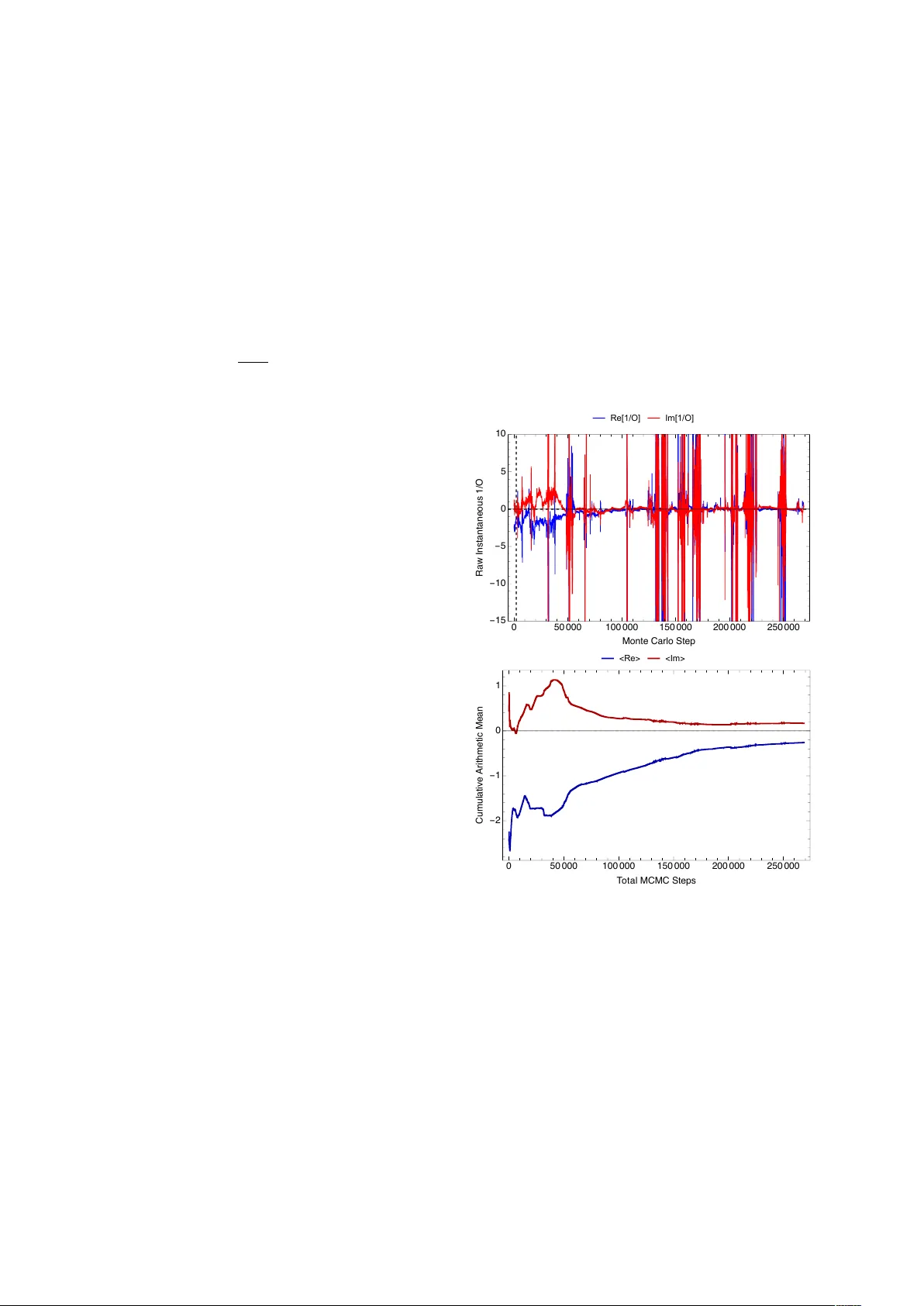
Geometric QCD I I: The Confining T wistor String and Meson Sp ectrum Alexander Migdal Institute for A dvanc e d Study, Princ eton, NJ 08540, USA Abstract W e develop a contin uum framework for confining planar QCD ( N c → ∞ ) by quantizing the F ermi-string (1981) degrees of freedom on the rigid Ho dge-dual minimal surface constructed in Geometric QCD I. The internal Ma jorana fermions on the worldsheet provide the algebraic mec hanism required by the Mak eenko–Migdal lo op equations: b y the Pauli principle, they enforce cancellations of non-planar self- in tersection con tributions, leaving the planar factorization structure. The Liouville instability of the original random-surface form ulation is a v oided b ecause the bulk geometry is rigid and fixed holographically b y the b oundary lo op, with no summation ov er fluctuating worldsheet metrics. A k ey outcome is a form ulation in momen tum lo op space, where coordinate-space cusp/con tact singularities are integrated out, and the relev an t quark-lo op amplitudes admit a finite lo cal limit. A cen tral technical step is an explicit change of v ariables in the quark-lo op phase-space path integral: after gauge fixing the reparametrization symmetry (Virasoro constraint), the reduced lo op-space measure is parametrized by b oundary twistors and an induced Jacobian, yielding a concrete twistor-string functional in tegral derived directly from the planar QCD amplitude rather than p ostulated as an abstract string mo del. In the lo cal limit, the theory b ecomes a confining (analytic) twistor string: a b oundary sigma mo del S 1 → ( S 3 × S 3 ) /S 1 coupled to a holographically determined Liouville field ρ ( z , ¯ z ) = log | λ ( z ) || µ ( z ) | obtained b y analytic contin uation of the b oundary twistor data (Hilb ert/Plemelj reconstruction). The meson sp ectrum is enco ded in a one-dimensional functional integral ov er the b oundary twistor tra jectory λ ( z ) , µ ( z ) , | z | = 1 . While we ev aluate this in tegral numerically using a reweigh ted Complex Langevin approach—successfully extracting approximately linear Regge tra jectories as a pro of of con- cept—our ultimate finding is analytical. By analyzing the mono dromies of complexified effective action, w e reveal that the discrete mass sp ectrum is exactly gov erned by Catastrophe Theory and classified by the top ological num b er of twistor p oles inside the unit circle. The simplest sector with just one p ole has the sp ectrum m 2 = π σ n + 1 12 . 1. In tro duction The identification of the string description of large- N c QCD has b een a central challenge of strong-in teraction theory since the adven t of the lo op equations. A t leading order in the 1 / N c expan- sion, the Mak eenko–Migdal hierarch y exhibits the c haracteristic factorization prop erties of a string theory , yet a concrete, mathematically con trolled con tinuum realization has remained elusive. Historically , the main obstruction is the ultra vio- let singular nature of the co ordinate-space Wilson lo op functional W [ C ] . Even after renormalization, W [ C ] exhibits cusp and p erimeter div ergences, and the lo op equation contains a contact term δ (4) ( x − y ) at self-intersections. In the standard co ordinate represen tation, this mak es the lo cal limit techni- cally delicate and conceptually opaque: the lo op Email addr ess: amigdal@ias.edu (Alexander Migdal) equation is lo cal, while the p erturbativ e solution is nonlo cal and develops logarithmic singularities tied to cusp geometry . In this pap er, w e adopt a differen t viewp oint: rather than attempting to “repair” the co ordinate- space Wilson lo op as an observ able ob ject, we for- m ulate the dynamics directly in momentum lo op sp ac e . The momentum lo op functional W [ P ] was in tro duced in earlier work as the functional F ourier transform of W [ C ] . Its decisiv e adv antage is struc- tural: the planar lo op equation in momen tum space b ecomes an exact algebraic-differen tial functional equation with no co ordinate-space delta functions. In this representation, the geometric cusp singulari- ties of W [ C ] are integrated out, and the contin uum equations admit a lo cal form ulation that is finite in the sense relev an t for physical quark-lo op ampli- tudes. The goal of this second pap er in the Ge ometric QCD series is to provide the dynamics that com- plemen t the kinematics established in Part I [ 1 ]. P art I constructs the rigid v acuum geometry: the Ho dge-dual additive minimal surface S χ [ C ] whose (an ti)self-dual area deriv ative yields a zero mo de of the lo op op erator, pro ducing the confining dressing factor exp ( − κS [ C ]) . Here, we attac h dynamical w orldsheet degrees of freedom to this rigid bac k- ground without summing o ver fluctuating metrics and show how the (regularized) planar lo op equa- tions are satisfied b y this Ansatz for W [ C ] . Our framew ork synthesizes three ingredients: 1. F ermi string (“Elfin theory”). W e revisit the fermionic construction in which internal Ma jorana degrees of freedom on the world- sheet implement the required sign structure at in tersections. In particular, the Pauli princi- ple enforces cancellations b et ween nonplanar in tersection configurations, leaving the planar factorization pattern. 2. Rigid Ho dge-dual minimal surface. The fermions are not placed on a random surface. Instead, they live on the rigid Ho dge-dual min- imal surface determined holographically by the b oundary lo op. This remo ves the dynamical Liouville instabilit y that afflicted the origi- nal random-surface formulation: there is no summation ov er w orldsheet metrics, and the geometry is fixed b y the lo op data. 3. Momen tum lo op dynamics and the t wistor resolution. In momen tum lo op space, the lo op equation b ecomes an ex- act algebraic-differential equation, stripp ed of co ordinate-space contact singularities. W e rig- orously demonstrate that while this equation admits a functional T aylor-Magn us expansion at low orders, a purely one-dimensional alge- braic Master Field solution violently breaks do wn at the eighth order ( W (8) ). This math- ematical catastrophe prov es that a 1D top o- logical string fundamentally lacks the internal degrees of freedom to absorb the macroscopic spatial stress of Planar QCD. T o resolve this geometric anomaly , the reduced loop-space measure must b e parametrized b y 4D contin u- ous b oundary twistor v ariables. This leads to an effective “analytic twistor string” descrip- tion: a b oundary sigma-mo del (a coset built from t wo S 3 spinors mo dulo a lo cal U (1) ) cou- pled to a holo gr aphic Liouville field whose bulk v alues are determined by the unique holomor- phic extension of the b oundary twistors. Remark 1.1 (Equation solving vs. mo del build- ing) . The starting p oint of this work is not a pr op ose d “string mo del of QCD,” but the pla- nar Make enko–Migdal lo op e quations, tr e ate d as the nonp erturb ative defining e quations of lar ge- N c Y ang–Mil ls/QCD. The aim is c onstructive: to ex- hibit explicit variables and an explicit functional me asur e in which the lo op e quations admit a finite c ontinuum solution and yield physic al observables. The princip al ingr e dients of the pr esent c onstruc- tion ar e not adjustable assumptions. The rigid Ho dge-dual minimal surfac e enters b e c ause strict additivity and an (anti)self-dual ar e a derivative ar e algebr aic al ly r e quir e d for c omp atibility with the lo op hier ar chy, while the Major ana determinant enters b e c ause its Pauli-principle sign structur e enfor c es planar factorization. The main technical discov ery of this work is the t wistorization of the reduced lo op-space measure: starting from the quark-lo op phase-space integral, w e fix Diff ( S 1 ) b y the Virasoro condition and p er- form a change of v ariables to holomorphic twistors that parametrize the rigid minimal-surface mo d- uli. With the bulk fields reconstructed by analytic con tinuation from b oundary data, this provides a direct, computable bridge from planar QCD ampli- tudes in D = 4 to a confining analytic t wistor-string represen tation. The culminating result of this pap er is the exact reduction of the meson sp ectroscop y problem to a one-dimensional functional integral ov er b ound- ary twistor data ( λ ( z ) , µ ( z ) , | z | = 1) . While w e initially ev aluate this integral n umerically via a rew eighted Complex Langevin (CLE) approach— successfully extracting approximately linear Regge tra jectories as a computational pro of of concept— our ultimate finding is analytical. By ev aluating the mono dromies of the complexified effective ac- tion, w e rev eal that the discrete mass spectrum is deterministically go verned by Catastrophe The- ory . The path integral exactly lo calizes at critical resonance energies where the Lefschetz thimbles b e- come degenerate. Because the integration v ariables are coupled holomorphic twistors, this degeneracy in trinsically p ossesses a corank of 2, mathemati- cally upgrading generic semiclassical branch cuts in to the exact simple p oles of hadronic states. Pla- nar QCD thus ceases to b e a theory of sto c hastic quan tum fluctuations; the extraction of the exact sp ectrum reduces to a deterministic, classical gen- eralized eigenv alue problem. While w e initially ev aluate the one-dimensional functional integral o ver the b oundary twistor tra jectory numerically using a reweigh ted Complex Langevin approach— successfully extracting approximately linear Regge tra jectories as a pro of of concept—our ultimate finding in this pap er is analytical. By analyzing the mono dromies of the complex- ified effectiv e action, w e reveal that the discrete mass sp ectrum is deterministically go verned by Catastrophe Theory . The S -matrix p oles are gener- ated b y non-compact flat v alleys in the effective ac- tion, which lead to the divergence of the steep est de- 2 scen t integral. W e demonstrate that these flat v al- leys are dynamically pro duced b y the multi-v alued mono drom y of the holomorphic twistor fields; along these winding tra jectories, higher-order functional corrections to the action are strictly absent. F ur- thermore, the discrete sp ectrum is classified by the top ological num b er of twistor p oles inside the unit circle. This topological sector is rigorously pro- tected: the crossing of the unit circle by a twistor p ole leads to a div ergent action, creating an imp en- etrable top ological barrier, b ecause the conjugate p oles z 0 and 1 / ¯ z 0 inevitably pinch the physical in tegration lo op | z | = 1 . By analytically con tinu- ing the action to the b oundary and summing ov er the exact mono dromy phases, we obtain an exact Bohr-Sommerfeld quan tization condition. F or the simplest sector with just one p ole, this yields the sp ectrum: m 2 = π σ n + 1 12 (1.1) Remarkably , the universally correct Lüscher op en- string in tercept ( +1 / 12 ) emerges directly and purely algebraically from the 2D Liouville kinetic anomaly interacting with the t wistor pole mon- o drom y , without any ad ho c assumptions of string vibrations. Or ganization of the p ap er and navigation p oints.. T o assist the reader in navigating the conceptual shifts and technical machinery of this framework, w e hav e integrated our structural outline with four sp ecific navigation p oints that address anticipated ph ysical and computational questions. Section 2 summarizes the loop-equation zero mo des and recalls why the Ho dge-dual minimal sur- face provides the appropriate rigid geometric back- ground. F or readers concerned ab out (i) the physi- c al me aning of lo op-e quation zer o mo des , Sec. 2.3 explicitly details the underlying m ulti-instan ton and v acuum am biguity in lo op space. Sections 3 to 9 then develop the fermionic determinant on this rigid surface and derive the corresp onding lo op equation, including its lo cal limit. Sections 10 to 12 in tro duce momentum loop space and the twistor string framework. T o clar- ify (ii) the status of Wilson-lo op “r enormalization,” Sec. 10.1 sharply outlines our p erspective: W [ C ] is kept regularized at a finite Elf mass, ph ysical observ ables are constructed natively in momentum lo op space W [ P ] (where co ordinate-space singu- larities are in tegrated out), and only then is the lo cal limit taken. F ollowing this, Sections 11 to 12 execute the central c hange of v ariables. Addressing (iii) the p ar ametrization of the quark lo op in phase sp ac e by b oundary values of holomorphic twistors , Sec. 11 details how the linear phase-space measure is transformed into twistor v ariables by factoring out the volume of the diffeomorphism group using the Virasoro constrain t. Section 13 discusses the semiclassical (WKB) limit and the emergence of linear Regge b ehav- ior. Section 14.1 presen ts the twistor-holographic (“gauge holograph y”) interpretation and clarifies the relation of the resulting analytic confining t wistor string to standard holography and to top o- logical t wistor strings. Then, we address (iv) the discr ete appr oximation and numeric al implementation of the p ath inte gr al . Section 15 summarizes the CLE ev aluation, while App endix E pro vides exhaustiv e details on the CLE implemen tation and top ological analysis. Sec- tion 16 details the unsup ervised phase-information clustering used to isolate the sp ectral branches. Finally , we highligh t (v) the exact analytic extr ac- tion of the mass sp e ctrum . Section 17.1 reformu- lates the whole problem of the QCD mass sp ectrum as a complex saddle p oin t equation with a degener- ate Hessian, corresp onding to the collision of tw o saddle p oints in the spirit of Catastrophe theory . This last observ ation reveals the true geometric na- ture of Planar QCD: the main theoretical result of this w ork . Section 17.6 discusses the geometric origin of QCD, and Section 18 concludes. The re- maining app endices collect vital technical material, including the exact algebraic demonstration of the W (8) Master Field breakdo wn in App endix C . 2. Zero mo des of Lo op equation Let us summarize the theory of Ho dge-dual min- imal surfaces and its relev ance to the MM loop equation. F or a detailed discussion and pro ofs of relev an t theorems, the reader may lo ok into the latest pap er [ 1 ], and the details of the new lo op calculus without divergences can b e found in [ 2 , 3 ]. 2.1. Self-dual ar e a derivative and lo op e quation Let us recall why we are lo oking for the self-dual minimal surface, as suggested in [ 2 ]. In this section, w e follow the arguments of our recent pap er [ 1 ], but our goal is not to presen t the Ho dge-dual surface p er se, but rather to view it as a hologram of the QCD string, with F ermi degrees of freedom attac hed. The area deriv ative for a general functional W [ C ] w as defined in that pap er as a discontin uit y of the second v ariation of the area δ W δ σ µν ( θ ) = δ 2 W δ ˙ C µ ( θ − 0) δ ˙ C ν ( θ + 0) − µ ↔ ν (2.1) This definition implements the geometric definition of [ 4 , 5 ] and is formally equiv alen t to the functional deriv ativ e implementation by Poly ako v [ 6 ]. The crucial difference is the lack of divergences in this new definition and its unbrok en parametric inv ari- ance. In the old, singular implementations, the zero 3 mo des were obscured by kinematic divergencies, in- terfering with p oten tial small-distance singularities of p erturbativ e QCD. The new lo op equation for the Y ang–Mills gra- dien t flow was shown in [ 2 ] to reduce to the lo op space diffusion equation, which allows the solution W = exp ( − κS [ C ]) pro vided that S [ C ] is a zero mo de of this equation L ν ( S ) = 0; (2.2) L ν = δ δ ˙ C µ ( θ + 0) − δ δ ˙ C µ ( θ − 0) δ δ σ µν ( θ ) (2.3) The basic observ ation made in that pap er w as that there is a Ho dge-dual solution similar to the Y ang–Mills multi-instan ton. The lo op space diffu- sion equation ( 2.3 ) is identically satisfied for any functional S [ C ] with self-dual (SD) or an ti-dual (ASD) area deriv ativ e δ S ± δ σ µν ( θ ) = ± ∗ δ S ± δ σ µν ( θ ) ; (2.4) e αµν λ δ δ ˙ C α ( θ + 0) − δ δ ˙ C α ( θ − 0) δ S ± δ σ µν ( θ ) ≡ 0; (2.5) The last equation (Bianchi iden tity) is v alid at the kinematical level as a Jacobi identit y for a triple comm utator (see [ 2 ] for a pro of ). The matrix in the Dirichlet b oundary conditions (BC) for X ∼ QC should b e c hosen so that the area deriv ativ e represen ts the SD or ASD tensor. This choice w ould mak e the exp onen tial of the Ho dge-dual minimal area an exact solution to the lo op equation. The existence of this zero mo de is based on the so-called Leibniz prop ert y of the lo op op erator and similar singular lo op op erators in lo op calculus. L ν f (Φ[ C ]) = f ′ (Φ[ C ]) L ν Φ[ C ]; (2.6) L ν ( A [ C ] B [ C ]) = L ν ( A [ C ]) B [ C ] + A [ C ] L ν ( B [ C ]) (2.7) It was heuristically claimed in the original MM pap ers [ 7 , 5 ], and rigorously pro ven in the lo op calculus [ 2 ], section 3, eqs (39), (40). Due to the Leibnitz prop ert y , L ν (exp ( − κS [ C ]) W 0 [ C ]) = − κ L ν ( S [ C ]) exp ( − κS [ C ]) W 0 [ C ] + exp ( − κS [ C ]) L ν ( W 0 [ C ]) = exp ( − κS [ C ]) L ν ( W 0 [ C ]) (2.8) W e are lo oking for such a self-dual minimal surface whic h is additive at the self-in tersecting lo ops. This condition will b e discussed in detail b elow. It is critical for the whole theory—due to this additivity , the confining factor exp ( − κS [ C ]) is compatible with the whole c hain of the lo op equations. 2.2. Comp atibility with the MM lo op e quations. The full chain of lo op equations for the Wilson lo ops with a finite num b er of colors N c [ 7 , 5 ] has Figure 1: The MM equation, with the lo op diffusion op erator on the left side, and the integral term on the right side. The double line on the righ t stands for the delta function δ 4 ( x − y ) enforcing self-intersection. the same loop op erator ( 2.3 ) as the Y ang–Mills gradien t flow, except there is no time deriv ativ e. In this pap er, we are only considering the leading order of the 1 / N c expansion. W e use the loop calculus developed in the pap er [ 2 ], as it applies to the lo op diffusion op erator ( 2.3 ) , whic h is the same in the multiloop MM chain and in the Y ang–Mills gradien t flow equation. The MM lo op equation has the structure (see Fig. 1 ) W [ C ] = 1 / N c tr ˆ P exp I C dx µ A µ ( x ) ; (2.9) L ν ( W [ C ]) = λ Z C dy ν δ 4 ( x − y ) W [ C xy ] W [ C yx ] (2.10) Here λ = N c g 2 0 is the ’t Ho oft’s coupling constant in the limit of N c → ∞ . This equation is singular at self-intersections, so it must b e understo o d in the sense of distributions in lo op space. It is mani- festly parameterization-inv ariant, and the confining factor exp ( − κS [ C ]) factors out from the righ t side b y additivity of S [ C ] and cancels with the same factor on the left side. Let us stress that this factorization takes place indep endently of the splitting p oints x, y ∈ C . F or ev ery self-in tersection x, y ∈ C suc h that C ( x ) = C ( y ) , the pro duct of t wo factors exp ( − κS [ C xy ]) and exp ( − κS [ C y x ]) exactly equals the factor exp ( − κS [ C ]) on the left side of the MM equa- tion; Thus, it can b e taken out of the integral, after whic h it cancels on b oth sides of the MM equation. The physic al hyp othesis of that pap er was that the actual gluonic v acuum of QCD is described b y this dressed solution, choosing the "fluctuative" factor W fluct as the seed. While the symmetry is exact, the separation in to a fluctuativ e factor and a purely geometric area law is ambiguous. It is physically most distinct in the lar ge-lo op limit , where the area term dominates ov er W fluct , which is assumed only to con tribute the term prop ortional to a p erimeter of the lo op. In the presen t pap er, we construct an explicit so- lution for this factor W fluct , adapting the fermionic determinan t from the ’81 pap er [ 8 ] to the Ho dge- dual minimal surface instead of a random surface, assumed in that w ork. The confining factor b e- comes the v acuum energy of that rigid F ermionic 4 string, and planar graphs emerge as a strong cou- pling expansion of that 2D fermi system in terms of a sum ov er fermionic lo ops on a Ho dge-dual minimal surface. The Pauli principle leads to re- pulsion of these lo ops, making them top ologically equiv alen t to planar graphs of QCD. The comparison of the contour equation for these fermionic determinan ts from the ’81 w ork with the MM equation establishes the corresp ondence b et ween the ’t Ho oft coupling constant λ and the parameters of the Elfin theory (the bare fermionic mass and the v acuum energy). 2.3. The Physic al V acuum and Multi-Instanton R esummation Before we formulate the dynamics of the F ermi string on the minimal surface, we must clarify the ph ysical origin of this rigid geometric bac kground. The Makeenk o-Migdal (MM) lo op equations serve as the exact quantum equations of motion for Pla- nar QCD. Like any equations of motion, they p os- sess an inherent ambiguit y corresp onding to the c hoice of the physical v acuum. The mathematical freedom to m ultiply the p erturbativ e lo op func- tional by a zero mo de exactly reflects this physical v acuum ambiguit y . In the traditional gauge-field picture, the nonp er- turbativ e QCD v acuum is a highly complex mixed state, often mo deled as a nontrivial distribution in the multi-instan ton space. Because any single m ulti-instanton solution explicitly breaks transla- tion inv ariance by lo calizing top ological charge at sp ecific spacetime p oin ts, restoring Poincaré sym- metry requires an exceedingly complicated integra- tion ov er the entire m ulti-instanton mo duli space (p ositions, sizes, and color orientations). The lo op-space form ulation achiev es this summa- tion geometrically . Just as instantons are c haracter- ized b y the self-duality of the gauge field strength ( F µν = ± ∗ F µν ), our exact zero mo de is charac- terized b y the self-duality of the lo op-space area deriv ativ e. Th us, the complex mixed state of multi- instan tons in co ordinate space simplifies to a single, fully translation-inv ariant, exact geometric ob ject in lo op space: the Ho dge-dual minimal surface. Note that the mere Ho dge duality condition lea ves the freedom of an arbitrary top ological c harge and arbitrary mo duli of the multi-instan ton solution. Therefore, our Ho dge-dual minimal sur- face, by satisfying this requirement, represen ts a general statistical mixture of multi-instan ton solu- tions, implicitly summed ov er top ological charges and integrated ov er mo duli with some unkno wn measure. This implicit integration is precisely what pro vides the exact translation inv ariance and spa- tial isotrop y of the minimal area solution. The profound adv an tage of the lo op-space approach is Figure 2: The unit disk Σ i s mapp ed to R 3 ⊗ R 4 and then projected to C 4 by a holomorphic map, minimizing the area functional. that w e do not need to know the explicit details of this distribution of top ological charge and multi- instan ton mo duli: the lo op equations can b e solved directly without ev er sp ecifying this measure. Therefore, the rigid background up on which our w orldsheet fermions propagate is not merely a mathematical ansatz. It is the exact holographic represen tation of the translation-in v arian t, nonp er- turbativ e QCD v acuum, naturally incorp orating the sum ov er topological sectors that is analyti- cally prohibitive in the standard gauge-field path in tegral. 3. Ho dge-dual minimal surface No w, we are going to define the solv able func- tional S [ C ] satisfying b oth the duality and additiv- it y . W e are following the definitions and deriv ations from [ 1 ], adapting them for the present purp ose of a base for the fermions living on that minimal surface. 3.1. The external and internal ge ometry W e defin e the surface coordinates X i µ ( ξ ) (for ξ = ( ξ 1 , ξ 2 ) , i = 1 , 2 , 3 . 1 The field X i µ ( ξ ) maps the disk Σ (Fig 2 ) to R 3 ⊗ R 4 . Our surface area is defined as S χ [ C ] = min X Z Σ d 2 ξ p Σ 2 µν / 2; (3.1) 1 This surface was first prop osed in [ 2 ] as a zero-mode of the lo op op erator in the context of the Y ang–Mills gradien t flow, but unfortunately , the wrong num b er of components (four instead of three) was chosen for the X A µ , A = 1 , 2 , 3 , 4 . The rest of the theory in that pap er was v alidated by our recent work [ 1 ], including the lo op calculus and the Ho dge- duality of the minimal surface. 5 The area elemen t is defined as Σ µν = ϵ ab ∂ a X i µ ∂ b X i ν ; (3.2) The Ho dge chiralit y χ = ± 1 enters through the b oundary conditions X i µ ( ∂ Σ) = η χ,i µν C ν ; (3.3) Here η χ,i µν are ’t Ho oft’s matrices corresp onding to Ho dge duality χ = ± 1 η χ,i µν = δ iµ δ ν 4 − δ iν δ µ 4 + χe iµν 4 ; (3.4) The coordinate functions X a µ ( ξ ) satisfy the general Euler-Lagrange equations for the area density L = p Σ 2 / 2 : [ E-L Equations ] a µ = ϵ lm ∂ l Σ µν ∂ m X a ν √ Σ 2 = 0 . (3.5) Assuming the bulk v ariation v anishes by the Euler- Lagrange equations, w e use Stokes theorem and get the b oundary term δ S = 2 Z dθ δ X i µ Σ µν ∂ θ X i ν √ Σ 2 (3.6) Substituting the b oundary conditions ( 3.3 ) for δ X, ∂ θ X and summing ov er a = 1 , 2 , 3 we find δ S = − 2 Z dθ δ C µ Σ µν ∂ θ C ν √ Σ 2 ; (3.7) δ S δ σ µν = − 2 T µν ; (3.8) T µν = Σ µν √ Σ 2 (3.9) Note the c hange of sign, compared with the ordi- nary area deriv ativ e of the minimal surface in four Euclidean dimensions. Regardless of this sign change, the Hodge du- alit y of the area element Σ with these b oundary conditions for a generic field X a µ ( z , ¯ z ) leads to the same Ho dge duality of the area deriv ativ e. This self-duality of the area deriv ativ e makes our Ho dge-dual minimal area a zero mo de of the lo op diffusion op erator, leading to the solution of the MM lo op equations [ 7 , 5 ], as we argue in the next section. Note that this area functional is inv ariant un- der the reparametrizations of the boundary lo op δ param C µ ( θ ) = ϵ ( θ ) ∂ θ C µ ( θ ) δ param S = − 2 Z dθ ϵ ( θ ) ∂ θ C µ Σ µν ∂ θ C ν √ Σ 2 = 0 (3.10) b y the skew symmetry of Σ µν . The Ho dge-dual area is defined as a minimum of this functional under an extra dualit y constraint ∗ Σ µν ≡ 1 2 ϵ µν αβ Σ αβ = χ Σ µν (3.11) In the previous pap ers [ 2 , 1 ], we found a complete solution for the Ho dge-dual surface in terms of holomorphic map. 3.2. The Holomorphic Map W e resolve the duality constraint using the fol- lo wing holomorphic Ansatz: X i µ = η χ,i µν Y ν (3.12) Y µ = f µ ( z ) + ¯ f µ ( ¯ z ); (3.13) z = ξ 1 + i ξ 2 ; (3.14) Geometrically , this is a pro jection from R 3 ⊗ R 4 to C 4 . The b oundary conditions for the Ho dge-dual surface b ecome a con ven tional b oundary condition for the Diric hlet problem 2 Re f µ ( e iθ ) = C µ ( θ ) (3.15) So, we hav e a line in four dimensional complex space f ∈ C 4 . Our surface area ( 3.1 ) reduces to the induced metric in this space Σ µν = 2( F µν + χ ∗ F µν ); (3.16) F µν = i( f ′ µ ¯ f ′ ν − ¯ f ′ µ f ′ ν ); (3.17) p Σ 2 µν / 2 = 2 √ 2 p − det g ; (3.18) g ab = ∂ z a Y µ ∂ z b Y µ ; z a , z b = ( z , ¯ z ) (3.19) This area elemen t is Ho dge-dual ∗ Σ µν = χ Σ µν (3.20) for arbitrary functions f µ ( z ) . This duality condition, as argued ab o ve, together with the ab o ve b oundary conditions, provides the self-dualit y of the area deriv ativ e of the minimal area. The self-duality of the area deriv ative fol- lo ws from the general formula for v ariation of the surface X a µ ( ξ ) with area ( 3.1 ) , projected on the holomorphic Ansatz. 3.3. The Vir asor o Constr aint and Uniformization W e further imp ose a Virasoro constraint on the holomorphic maps deriv ativ es f ′ µ ( z ) 2 = 0 (3.21) The imp osition of the null constraint ( f ′ ) 2 = 0 is not an approximation but a rigorous gauge fixing pro cedure ro oted in the geometric symmetries of the problem. The physical starting p oin t is the geometric Area functional, S = R √ − det g d 2 z , which p ossesses full reparametrization inv ariance under general dif- feomorphisms z → w ( z , ¯ z ) . This infinite symmetry group allows us to choose a sp ecific co ordinate sys- tem on the w orld-sheet without altering physical results. W e choose to work in isothermal (conformal) co ordinates , where the induced metric is diago- nal: ds 2 = ρ ( z , ¯ z ) dz d ¯ z = ⇒ g zz = ∂ z Y · ∂ z Y = 0 (3.22) 6 F or our sp ecific ansatz ( 3.12 ) , the metric comp o- nen t g z z is explicitly prop ortional to the square of the holomorphic deriv ativ e: g zz = ( f ′ µ ) 2 = 0 (3.23) Th us, the geometric condition of conformal gauge fixing g z z = 0 is algebraically equiv alen t to the n ull constrain t ( f ′ ) 2 = 0 . The existence of such a co ordinate system for an y surface top ology is guaranteed b y the Uni- formization Theorem [ 9 ]. This theorem ensures that we are alwa ys free to set ( f ′ ) 2 = 0 by a suit- able diffeomorphism. In this gauge, the non-linear geometric area densit y simplifies exactly to the quadratic Lagrangian: L = p − det g = p ( g z ¯ z ) 2 − | g zz | 2 ( f ′ ) 2 =0 − − − − − → g z ¯ z ∝ | f ′ | 2 (3.24) This reduction allows us to describ e the Minimal Surface using the linear Laplace equation for f µ , sub ject to the Virasoro constraint. T o summarize, w e hav e found that S χ [ C ] = 2 √ 2 Z D | f ′ ( z ) | 2 d 2 z ; (3.25) δ S χ [ C ] δ σ µν = − 2 Σ µν p Σ 2 µν (3.26) The solution of the linear b oundary problem ( 3.15 ) for a holomorphic vector function is given by the Hilb ert transform f µ = 1 2 (1 + i H ) C µ ; (3.27) H [ u ]( θ ) = 1 2 π P . V . Z 2 π 0 dθ ′ cot θ − θ ′ 2 u ( θ ′ ) (3.28) Z D | f ′ ( z ) | 2 d 2 z = Z 2 π 0 dθ C ′ µ ( θ ) H [ C µ ]( θ ); (3.29) In terms of the T a ylor co efficients f µ ( z ) = X n> 0 z n C µ,n ; (3.30) C µ ( θ ) = ∞ X n = −∞ e i nθ C µ,n (3.31) In the presence of the Virasoro constraint ( 3.21 ) , the problem b ecomes a c hallenging one and has b een inv estigated ov er the last t wo centuries by great mathematicians, starting with Riemann and Hilb ert. W e give a brief summary of mo dern state of this theory in App endix App endix B . In Part I [ 1 ], we compared the ordinary minimal surface in four dimensions with the Ho dge-dual one. This comparison reveals some hidden v ari- ables presen t in the area deriv atives of the Ho dge dual surface, but not in the extremal v alue of this area. This minimal v alue up to a normalization fac- tor 2 √ 2 equals that of the so called Goldsc hmidt solution [ 10 , 12 , 13 ] for the Plateau problem. This additiv e solution represen ts a lo cal minim um of the Dirichlet functional, with the simplest top ology (collection of disks one for eac h closed part of C ). The area deriv atives for the Goldschmidt mini- mal area and Ho dge dual minimal area are differen t (the second one b eing SD or ASD comp onen t of the first). The apparent paradox is resolved b y the ob vious fact that the area deriv ative of a functional equals the skew-symmetric part of its se c ond func- tional deriv ativ e, but only the extremal v alue and its first deriv ativ e ( = 0 ) coincide for the functional and its minimal v alue. Also, the Ho dge-dual surface is not parit y- symmetric, but its minimal v alue (minimal area) is. The chiralit y χ manifests itself in the external geom- etry of this minimal surface X i µ ∈ R 3 ⊗ R 4 , includ- ing its area deriv ative, but its internal geometry is determined by the induced metric ( 3.22 ) , ( 3.23 ) , whic h is the only lo cal function related to surface em b edding. Moreov er, this metric in the holomor- phic map that minimizes the area dep ends only on the b ounding lo op C , through the holomorphic v ector function f µ ( z ) , which solves the Riemann- Hilb ert problem ( 9.4 ) , ( 3.30 ) . This dep endence is identic al for the Ho dge-dual surface and the Gold- sc hmidt solution for the Plateau problem in 4D, b ounded by C . The last prop erty (the iden tity of the internal geometry in the Ho dge-dual surface in relation to that of the 4D Euclidean problem) will play an imp ortan t role in proving the MM equation for the fermionic determinant. The only remnants of the Ho dge-dualit y are the ov erall negative sign and the χ -term in the area deriv ativ e ( 3.26 ) pro jecting it on the Ho dge-dual sector of skew-symmetric tensors in 4D. 4. The Elfin theory on a flat surface In this section, we deal with the Elfin theory by itself, without any reference to the gauge theory . The equiv alence of these theories will b e established in the next sections. Let us consider the flat surface b ounded by some con tour C . Later, we generalize this to the Ho dge- dual minimal surface. All the functionals on the surface will dep end on the conformal factor in the mass term e = ∂ + X i µ ∂ − X i µ . (4.1) On the minimal surface, w e ha ve a conformal map ( 3.12 ) , reducing the conformal metric to e = 2 √ 2 | f ′ µ | 2 . This reduction is not needed for the general theory of fermions on the minimal surface, but it will be used in the forthcoming sections 7 when we establish a relation b et ween the fermionic determinan ts and the MM lo op equation. Remark 4.1 (Holes, p oles, and global signs) . Mul- tiply c onne cte d worldshe ets (holes/hand les) may r e quir e multivalue d primitives f µ ( z ) = R z f ′ µ ( ζ ) dζ (lo garithms/p erio ds), even when the tangents f ′ µ ar e single-value d mer omorphic. In the applic ations to the QCD sp e ctrum, we al low such mer omorphic f ′ µ with p oles in the unit disk; the induc e d c onformal factor e ( z , ¯ z ) ∝ | f ′ µ ( z ) | 2 is single-value d but may diver ge at these p oles. This do es not invalidate the analysis of the Elfin determinant in the flat gauge: close d fermion p aths ar e weighte d by exp ( ) − m R Γ √ e | dz | = exp (() − m ℓ Γ ) , henc e any p ath appr o aching a p ole (wher e √ e ∼ | z − w | − 1 for a simple p ole of f ′ ) has ℓ Γ → ∞ and is exp onential ly suppr esse d. Sinc e ℓ Γ is a lo c al additive functional, the length weights of the lo c al ly p air e d c onfigur ations (touching vs. in- terse cting) c oincide, while their mo d- 2 interse ction signs ar e opp osite, yielding the same c anc elation me chanism. Final ly, while hand les do not affe ct the lo c al turning-angle c ontribution to the lo op sign, they c an affe ct glob al signs of the fermion pr op aga- tor/determinant (spin-structur e/holonomy) and c omplic ate the top olo gic al analysis of the c orr e- sp onding minimal-surfac e emb e ddings. Let us now return to the flat surface and intro- duce the Elfin field as a bispinor ψ = ψ α λ ( ξ ) , α = 1 , 2 , λ = ± 1 . (4.2) There are v arious equiv alen t forms of the action. The simplest form reads A 0 = Z d 2 ξ ( ¯ ψ λ σ k ∂ k ψ λ + ¯ ψ λ ψ λ m √ e ) , (4.3) where σ 1 , σ 2 are the Pauli matrices. W e shall also use the complex comp onen ts σ ± = 1 2 ( σ 1 ± i σ 2 ); (4.4) ∂ ± = ∂ 1 ± i ∂ 2 ; (4.5) ψ ± λ = 1 2 (1 ± σ 3 ) ψ λ . (4.6) ¯ ψ ± λ = ψ † λ 1 2 (1 ± σ 3 ) . (4.7) This action is co v ariant with resp ect to conformal transformations e ( ξ + , ξ − ) → f ′ + ( ξ + ) f ′ − ( ξ − ) e ( f + , f − ) , (4.8) ψ ± λ ( ξ ) → p f ′ ± ψ ± λ ( f ) , (4.9) ¯ ψ ± λ ( ξ ) → p f ′ ∓ ¯ ψ λ ( f ); (4.10) A t the b oundary ˙ Σ , we require that the spin σ 3 tak es definite v alues, namely: σ 3 ψ λ = λψ λ , at ∂ Σ , (4.11) ¯ ψ λ σ 3 = λ ¯ ψ λ , at ∂ Σ . (4.12) In other w ords, at the b oundary ψ − + = ψ + − = ¯ ψ − + = ¯ ψ + − = 0 . (4.13) Suc h "chiral bag" b oundary conditions were studied in the mathematical literature [ 14 ] in the context of the A tiyah-Singer Index Theorem. F or our pur- p oses, it is sufficient to note that these b oundary conditions are consisten t with the top ology of the Dirac path in tegral b elow. The remaining half of the comp onen ts is not restricted at the boundary . In the Schrödinger picture in Mink owski space this implies that the states with σ 3 = ± 1 at b oth ends of the string are o ccupied. Suc h p eculiar b oundary conditions are necessary to obtain the closed lo op equations (see b elo w). Note that these b oundary conditions are conformally inv ariant and do not dep end on the form of the b oundary . A t the "time" reflection ξ 2 → − ξ 2 or ξ + ↔ ξ − (4.14) the spin σ 3 c hanges the sign. A ccording to our b oundary conditions, this should b e accompanied b y a change of sign of λ : ψ λ → ψ − λ σ 3 . (4.15) One ma y introduce the oriented states ψ R,L λ = ψ ± λ λ , (4.16) ¯ ψ R,L λ = ¯ ψ ∓ λ λ . (4.17) The left-hand states are o ccupied at the b oundary . As we shall see, the orientation λσ 3 is related to the orien tation of the lo op C . The righ t-hand and left-hand states interc hange when the lo op is reorien ted. The action can b e rewritten in the Left-Right (c hiral) form. Based on the transformation prop er- ties in equations ( 4.16 ) and ( 4.17 ) , and using the iden tity σ k ∂ k = σ + ∂ + + σ − ∂ − , the action b ecomes: A 0 = Z d 2 ξ ¯ ψ R ∂ + ψ L + ¯ ψ L ∂ − ψ R + m √ e ¯ ψ R ψ R + ¯ ψ L ψ L . (4.18) In this form, the conformal prop erties are manifest. Under the transformations ξ + → f + ( ξ + ) and ξ − → f − ( ξ − ) the kinetic term transforms as: p f ′ − ¯ ψ R f ′ + ∂ + p f ′ − ψ L = f ′ − f ′ + ¯ ψ R ∂ + ψ L ; (4.19) p f ′ + ¯ ψ L f ′ − ∂ − p f ′ + ψ R = f ′ − f ′ + ¯ ψ L ∂ − ψ R . (4.20) 8 The mass term transforms as: p f ′ + f ′ − √ e p f ′ − ¯ ψ R p f ′ + ψ R = ( f ′ + f ′ − ) √ e ¯ ψ R ψ R ; p f ′ + f ′ − √ e p f ′ + ¯ ψ L p f ′ − ψ L = ( f ′ + f ′ − ) √ e ¯ ψ L ψ L . (4.21) This factor of ( f ′ + f ′ − ) exactly cancels the Jacobian from the measure d 2 ξ , making the kinetic energy as w ell as the mass term conformally inv ariant. Note that the Lagrangian density is in v ariant with resp ect to internal U (1) × S U (2) transforma- tions: ψ λ → S λλ ′ ψ λ ′ e i α , (4.22) ¯ ψ λ → ¯ ψ λ ′ ( S − 1 ) λ ′ λ e − i α . (4.23) Ho wev er, the boundary conditions lo w er this symmetry do wn to U + (1) × U − (1) : ψ ± → ψ ± e i α ± , (4.24) ¯ ψ ± → ¯ ψ ± e − i α ± . (4.25) Both U (1) currents v anish at the b oundary: j k = ¯ ψ ± σ k ψ ± = 0 at ˙ Σ; k = 1 , 2 . (4.26) So, there is no flo w outside. The deriv ative ∂ k in (2.11) can b e replaced by D k , since the b oundary terms v anish. A t v anishing mass m the theory p ossesses chiral σ 3 in v ariance, whic h is not violated by any anomaly . Let us no w discuss the symmetry of the physical x -space. As usual in string theory , the transforma- tions of the internal co ordinates ξ ha ve nothing to do with the physical rotations in x -space. F rom the viewp oin t of tw o-dimensional field theory in ξ -space, the rotations in x -space represent internal O (4) symmetry transformations of the C µ field, δ C µ = ω µν C ν . (4.27) The Elf do es not transform: δ ψ λ = δ ¯ ψ λ = 0 . (4.28) This follows from the b oundary conditions. The full target surface field X i µ transforms as one of the S O (3) ± subgroups of S O (4) X i µ ⇒ Ω ± ij X j ν W ν µ ; Ω ± ∈ S O (3) , W ∈ S O (4) (4.29) Consider now lo cal v ariations of the lo op C . The area deriv ative of e can b e found from the known v ariation of the scalar area | S | = Z S d 2 ξ e = Z S dσ µν ( ξ 1 ) dσ µν ( ξ 2 ) δ inv ( ξ 1 − ξ 2 ); (4.30) δ | S | δ σ µν ( ξ 1 ) = Z d 2 ξ 2 δ e δ σ µν ( ξ 2 ) = 2 Z S t µν ( ξ 2 ) d 2 ξ 2 δ ( ξ 1 − ξ 2 ) (4.31) Using the exact area deriv ativ es of the Ho dge-dual minimal area established in the previous section, w e find for the area deriv ative of δ e ( ξ ) δ σ µν ( ξ 0 ) = − 2 T µν δ 2 ( ξ − ξ 0 ); (4.32) T = F + χ ∗ F √ 2 F 2 (4.33) δ ⟨ exp ( A 0 ) ⟩ δ σ µν = − 2 m T µν ¯ ψ ψ √ e ∂ Σ (4.34) where F is giv en b y ( 3.26 ) . A ccording to our b oundary conditions, only the right-hand comp o- nen ts are present in ( 4.34 ): ¯ ψ ψ = ¯ ψ R ψ R at ˙ Σ . (4.35) 5. Conformal metric as a lo cal gauge param- eter W e b egin by defining the effective action for the elf (Ma jorana fermion) field on a tw o-dimensional surface S with metric g ab = exp (2 ρ ) δ ab , including the mass term and the dep endence on the conformal factor ρ . W e are repro ducing here the construction in Eqs. (2.57)–(2.63) of [ 8 ]. The action of the general theory is giv en by A ρ = Z d 2 ξ e 2 ρ ¯ ψ λ σ k e − ρ ∇ k ψ λ + m √ ee ρ ¯ ψ λ ψ λ − ∂ + ρ∂ − ρ 3 π ; (5.1) with the spinor connection ω k : ∇ k = ∂ k + i 2 ω k σ 3 , (5.2) vierb ein E a k = δ a k e ρ , (5.3) and curv ature ˆ R kl = [ ∇ k , ∇ l ] = i σ 3 e kl R det E ; (5.4) R = − 8 e − 2 ρ ∂ + ∂ − ρ. (5.5) A t ρ = 0 this is the old action A 0 , whereas at ρ = ln √ e this is the action of the Dirac particle with constan t mass at the surface S with the induced metric g ab . Theorem 5.1 (Conformal Inv ariance of the Elf Determinan t) . The functional inte gr al Z [ S | e, ρ ] = Z D ¯ ψ D ψ exp ( A ρ ) (5.6) is invariant under lo c al variations of the c onformal metric field ρ . That is, the the ory dep ends only on the c onformal class (mo duli) of the surfac e, and the induc e d metric e ( ξ ) but not on the lo c al gauge p ar ameter ρ ( ξ ) . 9 Pr o of. The main p oin t here is the cov ariant regu- larization of the Dirac theory at the surface. W e ha ve to define the divergen t trace in the v acuum amplitude Z D ¯ ψ D ψ exp ( A ρ ) = exp − Z d 2 ξ ( ∂ ρ ) 2 3 π + tr + log i ˆ D ρ + m √ ee − ρ + tr log i ˆ D ρ + m √ ee − ρ . (5.7) Here ˆ D ρ = σ k e − ρ ( − i ∂ k ω k ) , (5.8) is the cov ariant Dirac op erator, and the subscript + conditions σ 3 = +1 . W e employ the Pauli-Villars regularization in the follo wing form: tr ln i ˆ D ρ + m √ ee − ρ reg = tr " ln i ˆ D ρ + m √ ee − ρ − 1 2 X i c i ln ˆ D ρ 2 + M 2 i # , X i c i = 1 . (5.9) The shift of the ρ field ρ → ρ + δ ρ (5.10) results in the multiplicativ e transformation of the Dirac op erator ˆ D ρ ⇒ e − 3 2 δρ ˆ D ρ e − 1 2 δρ . (5.11) Therefore, the v ariation of the regularized deter- minan t reads tr " − δ ρ + 2 X i c i δ ρ M 2 i M 2 i + ˆ D ρ 2 !# = − tr δ ρ X i c i M 2 i M 2 i + ˆ D ρ 2 ! . (5.12) The WKB calculations of [ 8 ] (repro duced here in the App endix) yield Z d 2 ξ e 2 ρ δ ρ R 24 π = δ Z d 2 ξ ∂ + ρ∂ − ρ 6 π . (5.13) Therefore, the v ariations of terms in the exp onen- tial cancel eac h other, as claimed. Corollary 5.1. A s a c onse quenc e of this the or em, the the ory of massive Major ana fermions on a min- imal surfac e with induc e d metric g ab = δ ab e ( ξ ) , and extr a c onformal term − ( ∂ ρ ) 2 3 π in L agr angian is e quivalent to the the ory of Major ana fermions on a flat surfac e with variable mass m p e ( ξ ) . The first the ory c orr esp onds to taking ρ = log √ e in A ρ , and the se c ond the ory c orr esp onds to taking ρ = 0 . By the pr oven gauge invarianc e these the ories ar e e quivalent. Remark 5.1 (Mo duli and T op ology) . The the or em establishes lo c al indep endenc e fr om ρ ( ξ ) . F or a disk, al l metrics ar e c onformal ly e quivalent to the flat metric, so the determinant is a a unique functional of external lo op via the c onformal metric e = | f ′ µ | 2 . F or surfac es with hand les or holes, the metric c an b e written as g ab = exp (2 ρ ) ˆ g ab ( τ ) , wher e τ ar e the T eichmül ler p ar ameters (mo d- uli). The determinant then dep ends on τ , i.e., Z elf [ C ] = Z [ C | τ ] . In the pr esent ge ometric the ory, the minimal surfac e is rigid: the b oundary lo op C uniquely determines the solution to the Plate au pr oblem and thus fixes the mo duli τ = τ [ C ] . Ther e- for e, the Dir ac determinant is a wel l-define d func- tional of C , enc o ding the "gluon cloud" effe cts for the sp e cific minimal surfac e sp anne d by C . In the de gener ation limit (e.g., infinitesimal bridges), the mo duli appr o ach a b oundary value, but the lo c ality of the lo op e quation is pr eserve d. 6. The fermion determinan ts and the planar top ology Let us consider the v acuum functional Z of the Elfin theory with the b oundary conditions dis- cussed in the previous sections. By virtue of con- formal inv ariance, we can choose the lo cal gauge ρ ( ξ ) = log p e ( ξ ) or r ho ( ξ ) = 0 The follo wing analysis of the v acuum lo ops in this theory simpli- fies in the gauge ρ = 0 , where it is similar to the top ological solution of the 2D Ising mo del. As a functional of the lo op C , the v acuum func- tional satisfies a certain non-linear path integral equation. This equation will be derived in this section and in vestigated in the following sections. 6.1. Mathematic al justific ation of the signe d sum over lo ops The path integral represen tation of the Dirac determinan t on a finite surface with b oundary con- ditions, as employ ed in this work, is rigorously jus- tified by several mathematical results and earlier ph ysical constructions. In particular, Ichinose [ 15 ] and Gav eau [ 16 ] provide theorems establishing the equiv alence b et ween the determinant of the Dirac op erator and path integrals o ver spinor-v alued paths with appropriate b oundary conditions on finite domains. These constructions carefully in- corp orate the spinor connection and holonomies of spin rotations along geo desic segmen ts, ensuring the correct treatment of spinor phases and curv a- ture effects. Our representation of the determinant as a sum o ver oriented closed lo ops weigh ted by factors of 10 the form Q exp − m dl + i σ 3 δ θ 2 , where dl is an in- finitesimal geodesic step and δ θ the correspond- ing tra jectory rotation angle, follo ws directly from these rigorous path integral form ulations. This approac h generalizes the com binatorial and top o- logical metho ds pioneered b y V dovic henko [ 17 ] in the exact solution of the 2D Ising mo del, where the fermionic nature and spinor holonomies enforce cancelations of non-planar in tersections, leaving only planar lo op configurations that con tribute to the determinan t. F urthermore, the Gauss-Bonnet theorem relates the total tangent rotation angle around a lo op to its self-in tersection num ber, providing a top ological in v ariant that gov erns the sign factors in the lo op expansion. This ensures that the fermionic statis- tics and b oundary conditions are correctly enco ded in the lo op amplitudes. Th us, the path integral representation emplo yed here is not only physically intuitiv e but also math- ematically sound, grounded in well-established re- sults in spin geometry , sp ectral theory of Dirac op erators, and rigorous path integral constructions on manifolds with b oundary . This justifies its use as the foundation for deriving lo op equations and analyzing the planar top ology of the fermion deter- minan ts in the Elfin theory . 6.2. R andom lo ops at the surfac e The form of the surface S is fixed as a Ho dge- dual minimal surface in a conformal metric. Let us p erform the functional integration ov er the Elfin fields ψ . W e use the gauge ρ = 0 , where the induced metric is simply e = | f ′ | 2 , the internal curv ature R ab and spinor connection ω k are absent, making the theory lo cally equiv alen t to a spinor on a flat surface. This pro duces tw o determinants of the Dirac op erators with the b oundary conditions λσ 3 = ± 1 : I [ S ] = Z D ψe A 0 = ∆ + ∆ − ; (6.1) ∆ ± = det D + m √ e ± (6.2) On an infinite flat surface, such a determinant w ould be calculable using the trace of the logarithm of a resolv en t in F ourier represen tation. On a finite surface S b ounded by an arbitrary curve C , there are nontrivial b oundary conditions for a Dirac resolv ent, complicating the analytic computation. Instead, we can represent the Dirac determinant as a sum ov er v acuum lo ops at the surface. The similar representation in the context of the 2D Ising mo del w as discussed in my earlier work [ 18 ], in- spired by studies of the Ising mo del by V dovic henko [ 17 ]. That pioneering pap er laid a framew ork for a top ological solution of the Ising mo del in terms of self-a voiding paths. The next step of our pap er [ 18 ] w as to generalize this method to a con tinuum Dirac op erator on a Riemann surface using the Gauss-Bonnet theorem to relate the rotation an- gle to the intersection index. There are also some theorems in the mathematical literature [ 15 , 16 ] establishing the Dirac and Heat kernel path in- tegral representations in a finite domain. In this pap er, we follow the technology describ ed in [ 8 ], with prop er adjustments from a random surface to a Ho dge-dual minimal surface. W e base our study on the sup erp osition princi- ple. The v acuum amplitude for the Dirac particle represen ts the sum ov er all configurations of the lo op Γ ∈ S of the corresp onding amplitude for the giv en lo op. The amplitude of the given lo op repre- sen ts the pro duct of the amplitudes of individual ev ents. The individual even ts can b e regarded as a sequence of classical propagations along little geo desic steps alternating with instant rotations. T ec hnically , we use the logarithm of a Dirac de- terminan t and represent it as a trace of a resolven t in tegrated ov er prop er time ∆ ± = exp κ | S [ C ]] − Z ∞ ϵ d T T exp − T ( D + m √ e ) ; (6.3) κ ∝ log ϵ ; (6.4) The logarithmically divergen t term log ϵ in the ex- p onen tial is prop ortional to the area of the surface b y virtue of the lo calit y of this divergen t contribu- tion to the trace. The terms in the exp onen tial, prop ortional to the area of the additive Ho dge-dual surface, pass through the lo op equation, as we al- ready established. The role of these terms is to regularize the effective string tension (or v acuum energy densit y) of the F ermi mo del on the surface. The path integral representation emerges when this exp onential is replaced by a limit of a pro duct (see [ 19 ]) exp − T ( D + m √ e ) → Y exp − dT ( D + m √ e ; (6.5) dT = dl / √ e (6.6) The mathematical literature replaces this pro d- uct with a sto chastic pro cess that is equiv alent to F eynman’s sum ov er paths, with the path ampli- tude b eing a pro duct of WKB amplitudes for these propagations/rotations [ 16 ]. The amplitude for the rotation is giv en b y the rotation matrix A (∆ θ ) = exp (i σ 3 ∆ θ / 2) . (6.7) The WKB amplitude for the geo desic step reads A ( step ) = exp ( − m d l ) (6.8) 11 6.3. The Gauss-Bonnet the or em and self- interse ctions The total pro duct of the factors (3.5) and (3.6) along the lo op can b e calculated by means of the Gauss-Bonnet formula which in our notation reads X ∆ θ = 2 π (1 − ν ) mo d 2 π . (6.9) Here ν is the algebraic num b er of self-intersections of the lo op Γ at the surface. The Gauss-Bonnet theorem ensures that the relation is top ologically in v ariant. Remark 6.1. Mathematic al the or ems . F or an oriente d r e gular simple close d curve γ ⊂ R 2 , the r otation (turning) index satisfies rot ( γ ) = 1 2 π R γ κ ds ∈ Z and e quals +1 for the p ositively oriente d b oundary of a disk [ 20 ]. In the planar c ase, this is exactly the Gauss–Bonnet the or em for the enclose d r e gion (sinc e K ≡ 0 ), yielding R γ κ ds = 2 π χ = 2 π (henc e e quality mo dulo 2 π is automatic) [ 21 ]. Mor e over, sinc e rot ( γ ) is the de gr e e of the unit-tangent map T : S 1 → S 1 , it de- p ends only on the immerse d curve itself and ther e- for e is unchange d if the ambient plane is r eplac e d by a disk with finitely many holes (and the same mo d- 2 interse ction sign ( − 1) ν fol lows fr om Whit- ney’s r e gular-homotopy classific ation of immerse d plane curves) [ 20 ]. The amplitude for the lo op reads: A [Γ] = ( − 1) ν exp ( − ml Γ ) ; l Γ = Z Γ √ e | dz | (6.10) The extra negative sign comes from F ermi statis- tics. This amplitude is a scalar, indep enden t of the quantum num bers, so we should multiply it b y the num b er of allow ed states. Each tw o-comp onen t Dirac particle has only one allow ed state which is pro jected by the op erator P = 1 2 (1 + σ a v a ) (6.11) where v a is the normalized 2-velocity of the rest frame. In the rest frame, there should b e only one comp onent (in 4 dimensions, there were tw o comp onen ts). So w e are left with the factor of 2 from the sum o ver the orientations σ 3 = ± 1 . Y et it will b e conv enien t to distinguish the terms with tw o orien tations, i.e. to sum ov er oriented lo ops Γ . W e mark the lo op by an (anti)clockwise arro w for (left) righ t orientation σ 3 = − 1 , +1 . The p oin t is that the lo ops that touch the exter- nal b oundary at least once are orien ted in the righ t direction according to our b oundary conditions. The reflection amplitude R = 1 2 (1 + λσ 3 ) (6.12) corresp onds to the repulsion of the left-hand side comp onen ts from the wall (see the previous sec- tion). As discussed ab ov e, one ma y o ccup y the w all with the left-hand side states so that this repulsion w ould come ab out automatically due to the Pauli principle. So, the sum o v er lo ops inv olves the sum o v er orien tations only for the inner lo ops. 6.4. F r om exp onential of fr e e elfin lo ops to sum over multiple cr ossing p aths Consider a given orien ted lo op consisting of N equal geo desic steps d l . The degrees of freedom are given by the angles ∆ θ and by the num b er N of steps. The phase v olume can b e written in a co v ariant form D Γ = N − 1 Y d(∆ θ ) = d lD x ( l ) δ ( ˙ x 2 − 1) e − m 0 l (6.13) The δ -functions remov e the integrations ov er the lengths | d x i | of the geo desic steps, lea ving us with the normalized 2-v elo cities as ph ysical v ariables. The mass renormalization term m 0 is a matter of con ven tion. The factor N − 1 = 1 /l in ( 6.13 ) accoun ts for N equiv alen t choices for the origin of the parametriza- tion of the loop. These factors will cancel the com binatorial factors that arise at the in tersections (see b elo w). W e write the integral ov er lo ops with the ab ov e prescription at the reflections as follo ws: ∆ = ∆ + ∆ − ∝ exp X − Z D Γ( − 1) ν exp ( − ml Γ ) . (6.14) W e ignore the (singular) normalization factor in the fermionic determinan t. This factor on a fi- nite surface amounts to an exp onen tial of the area exp ( − c onst | S | ) , whic h we include in the confin- ing factor that is already present in our solution for the Wilson lo op, according to the previous section. The − R denotes the lack of a sum ov er orien tation for the lo op touc hing the b oundary due to our b oundary conditions. Note that b oth determinants con tain lo ops that touch the b oundary . These lo ops en ter with a weigh t of 1/2 in each determinan t ∆ ± , or, equiv alen tly , they coun t as oriented lo ops, unlike the remaining lo ops, which in volv e a sum of tw o orien tations. In what follo ws, it will b e conv enien t to consider the pro duct ∆ rather than the separate factors ∆ ± . Let us expand ( 6.14 ) in a series of multiple in te- grals o ver lo ops: ∆ = X 1 n ! − Z D Γ 1 ... − Z D Γ n ( − 1) P ν i exp − m X l i . (6.15) 12 These lo ops are indep enden t by construction, but w e are going to rearrange the sum in suc h a wa y that they will start to rep el. This miraculous trans- formation, first conjectured in [ 18 ] is p ossible due to the follo wing top ological and combinatorial ob- serv ations. 6.5. Canc el lation of interse ctions: step towar ds planar gr aphs This section repro duces (with some simplifica- tions and improv ements) the most imp ortant re- sults of our ‘81 paper: the top ological and geo- metrical analysis of the path in tegrals of the Dirac particle on a disk-lik e surface. The arguments of this section were inspired by a geometric solution of the 2D Ising model b y Natasha V dovic henko [ 17 ]. The crucial observ a- tion made in that pioneering work was that the sum of planar loops splitting the plane in to do- mains of up and down spin in the Ising model is equiv alen t to the sum ov er freely intersecting in- dep enden t lo ops, with phase factors reflecting the rotation of a spin 1/2 particle. The signs arising for in tersecting paths lead to cancelation b et ween such paths, leaving only planar lo ops. The computation in that pap er relied on the geometry of the paths on a square lattice and other sp ecifics of the Ising mo del. Below, the same top ological observ ations will b e stripp ed of the lattice artifacts and applied to a tw o-fermion system with oriented lo ops on a Ho dge-dual minimal surface. Consider the given configuration of lo ops at the surface as a graph consisting of sev eral disconnected parts. Connected subgraphs contain intersecting and touching lines. The total length in exp onential factors exp ( − ml ) can b e redistributed among the lines of the graph: l tot = X l loops = X l lines . (6.16) This statement is not as trivial as it seems. The length of the line is not just a geometric length of this line drawn on a planar disk; rather, it is an in tegral l line = Z | dz ( t ) | p e ( z ( t ) , ¯ z ( t )) (6.17) Ho wev er, the metric e ( z , ¯ z ) in this integral b eing lo c al , this length is additive across the pieces made b y intersections of these lines on a planar domain. The factorization also applies the sign factor since the n umber of mutual intersections is alwa ys even in the absence of handles at the surface. ν tot = X ν loops = X ν gr aph (mo d 2) . (6.18) The phase volume of the connected subgraph G can also b e rearranged in such a wa y that the old Figure 3: Types of line collision: tw o planar (upp er drawing) and one planar, another non-planar (low er drawing) lo ops lose their individuality: D G = Y line d W ( step ) , (6.19) d W ( step ) = d lD x ( l ) δ ( ˙ x 2 − 1) . (6.20) The factors 1 /l in front of the old lo ops are com- p ensated by the same factors that arise from the sums ov er the num bers of geo desic steps b etw een the in tersections of lines. It is imp ortant that there are no other factors in front of the lo op. W ere there, sa y , k in ternal degrees of freedom, the corresp onding factor Y loops k (6.21) could not p ossibly b e distributed among the lines of the graph. In the case of k = 1 one could return to the non-oriented lines, then the phase volume would b e distributed again. This is the case of the Ising mo del, whic h w as considered in the preliminary v ersion [ 18 ] of the Elfin theory . This possibility is ruled out b y the b oundary conditions. As we shall see so on, the p eculiar b oundary conditions pla y a central role in the construction of the lo op equations. Let us pro ceed with the sum ov er graphs. Each in ternal line of our graph can b e oriented in b oth directions, but orien tation is conserved in the ver- tices. W e neglect multiple collisions as a viola- tion of the P auli Principle (Grassmann algebra ( ¯ ψ R ψ R ) n = 0 , ( ¯ ψ L ψ L ) n = 0 for n > 1 , so w e deal with the tw o pairs of vertices depicted at Fig. 3 : Naturally , one could treat these tw o v ertices as a single vertex dep ending on the angles b et ween the lines; how ever, in this case, there will b e step functions of the angles. When the lines cross eac h other in co ordinate space, the term in the vertex c hanges sign. The non-planar vertex (the second one on the lo wer drawing in Fig. 3 ) cancels the first one, so this configuration of lines drops from the sum. This is the heart of the matter. The lines may touc h eac h other with opp osite orientations according to Fig. 3 , but the terms with in tersecting lines are alw ays canceled by those with parallel touching lines in the graph with the same configuration of lines. Note that in the general case, this is a cancelation of terms with a differen t num b er of lo ops, so there 13 is no ro om for extra degrees of freedom. This is the P auli principle reformulated in terms of the path in tegrals. W e ma y now return to our old lo ops but disre- gard all the non-planar configurations. W e obtain a hierarc hy of trapp ed lo ops that mov e in the free space left b y the others. With one-component fermions, we would obtain the sum o ver all decom- p ositions of the whole surface into t wo different phases, whic h is equiv alent to an Ising mo del. The ab ov e representation of the Ma jorana deter- minan t would amount to the Onsager solution of the Ising mo del in terms of free Ma jorana fermions. In our case, w e hav e twice the num b er of com- p onen ts, pro viding for the oriented planar lo ops instead of just b oundaries of the spin domains. The time slice ( ξ 2 = c onst ) of this picture describ es a string with particles moving b etw een neigh b ors. P airs of ψ and ¯ ψ particles can b e cre- ated or annihilated. Only ψ ¯ ψ neigh b ors can touch eac h other. The touching of ψ ψ or ¯ ψ ¯ ψ neigh b ors is forbidden by the Pauli principle. One ψ , ¯ ψ pair is placed at the t wo ends of the string. 2 This resembles the ’t Ho oft string mo del for pla- nar graphs [ 22 ]. Our string has the same top ology but takes into account the gauge inv ariance of the planar graph expansion. This will b e demonstrated in the next sections. 6.6. L o op e quation for fermion determinants Let us no w find the v ariation of ∆ with resp ect to the b oundary v alue of e . The basic relation reads δ e − ml Γ δ e ( x 0 ) = − m Z Γ d l 2 e δ 2 ( ξ − ξ 0 ) e − ml Γ , d l = | d ξ | √ e (6.22) The in v ariant δ -function e − 1 δ 2 ( ξ − ξ 0 ) = δ inv ( x, x 0 ) , x, x 0 ∈ S, (6.23) remo ves one of the d 2 x ∥ in tegrations in the sum o ver lo ops. The additional d l in tegration that arises is required by our rules since a new line at the graph is created. The v ariation selects the graph that touches the b oundary at x 0 . The touching line is oriented to the righ t according to our b oundary conditions. The amplitude of touching equals − m ; the re- maining factors contribute to the phase volume of the graph. 2 This interpretation of the time slice dynamics can b e used for a rigorous pro of of the equiva lence of the free Dirac v acuum loops and the planar lo ops made of non- intersecting closed paths on a surface. Suc h a pro of would use the Hamiltonian representation of a F ermionic system with conv entional creation/annihilation operators and chiral boundary conditions. Let us follow the lo op that touches the b oundary . This is the correct lo op; therefore, each lo op that touc hes it from the outside is also correct. W e observ e that the outside domain S out b et we en this lo op Γ and the external b oundary C is completely equiv alen t to the original surface S . The loops trapp ed in this domain reflect from Γ in the same w ay as they do from the external b oundary (this is wh y we need the sp ecial b oundary conditions). The sum ov er configurations and orientations of the lo ops in S out pro duces precisely the same Dirac determinan t. ∆ out = ∆ out + ∆ out − (6.24) The lo ops that are trapp ed inside Γ reflect from in- side, so they are orien ted to the left at the b oundary Γ − 1 . The sum ov er configurations and orientations of these lo ops pro duces the Dirac determinant for the in ternal domain, ∆ in = ∆ in + ∆ in − , (6.25) with the opp osite b oundary conditions, ψ R = ¯ ψ R = 0 , at Γ − 1 . (6.26) The numerical v alue of this determinan t is the same as that for the old b oundary conditions. W e see, how ever, that the orientation λσ 3 is re- lated to the orientation of the b oundary in space. This will b e imp ortan t in higher order 1 / N ex- pansion of QCD where the multiloop propagators dep end up on the relativ e orientation of lo ops. Note that the lo op Γ ma y touch itself as w ell as the external lo op C (at the surface). In this case, one or b oth of the domains S in , S out reduce to a set of windo ws touching at the corners. The corresp onding functional should b e understo od as ∆ = Y ∆( window s ) . (6.27) This is clear from the original representation of ∆ as an exp onen tial of the sum ov er configurations of indep enden t lo ops. This planar hierarc hical set of lo ops is shown in Fig. 4 . 7. The Minimal Surface and the Lo op Equa- tion In the 1981 theory , the next step was to integrate o ver all em b eddings X µ ( ξ ) . This led to the Liou- ville instability . In the present theory , w e replace this integration with the Rigid Ho dge-Dual Surfac e S min [ C ] defined in [ 1 ] and describ ed in the section 3 of this pap er. This surface is the unique additiv e solution to the minimal area problem with the constraint that the area deriv ativ e is self-dual. It is fixed by the b oundary lo op C . Therefore, we do not integrate o ver embeddings. The functional Z [ C ] is simply the fermion determinan t on this sp ecific manifold: Z [ C ] ≡ Z [ S χ [ C ]] . (7.1) 14 Figure 4: The hierarchical set of lo ops, some touching, but never intersecting each other nor self-intersecting Figure 5: The first area deriv ative of Dirac determinant. There is one in ternal path Γ which cut the surface S into tw o pieces S in = S 1 , S out = S 2 F or the time b eing, we fix the Ho dge duality χ of this surface; later, we will discuss the restoration of parit y symmetry in the lo op equation. 7.1. L o op e quations W e now demonstrate that this Z [ C ] satisfies the lo op equation of the same structure as ( 2.10 ). Using the ab o ve planar lo op equations for Dirac determinan ts and area deriv atives of the HD mini- mal surface, we may write the following lo op equa- tion for the functional Z [ S ] : δ Z [ S ] /δ σ µν ( x 1 ) = − m Z D Γ 11 δ I , 0 T µν (1) Z [ S in ] Z [ S out ] e − ml 11 . (7.2) This equation is illustrated in Fig. 5 Here, the ten- sor T w as defined in ( 10.8 ) . The lo op Γ 11 touc hes C 11 at x 1 . The integer index factor I = Z Γ dl 1 Z Γ dl 2 θ ( l 1 − l 2 ) e ab ˙ ξ a ( l 1 ) ˙ ξ b ( l 2 ) δ 2 ( ξ ( l 1 ) − ξ ( l 2 )) (7.3) is the absolute num ber of self-in tersections of the lo op Γ 11 at the surface. The Kroneck er delta δ I , 0 in the integral in ( 7.2 ) enforces the self-av oiding lo op Γ 11 . In the following, w e denote path in tegrals o ver self-av oiding lo ops as R ≍ D Γ The measure of the op en path is defined as fol- lo ws: Z D Γ 11 = Z d l Z x ( l )= x 1 x (0)= x 1 D x ( l ) δ ( ˙ x 2 − 1) . (7.4) Eq. ( 7.2 ) w as p ostulated in the first version of the F ermi String theory [ 18 ] from heuristic arguments. A t that time, it seemed that the equation applied to the Ising mo del at the surface, i.e., for the 2- comp onen t spinors. How ever, as we see now, one should introduce tw o spinors with sp ecial b oundary conditions in order to obtain this equation for the propagator of the F ermi string. Note that our theory is constructed in such a w ay that it is equiv alent to the flat theory with a v ariable fermion mass. In the next section, w e shall use the second area deriv ativ e of Z [ C ] , whic h reads δ 2 Z δ σ µν ( l ) δ σ αβ ( r ) = A µν αβ + B µν αβ ; (7.5) A µν αβ = ( m/ 2) 2 T µν ( l ) T αβ ( r ) Z Z ≍ D Γ l D Γ r Z [ S l ] Z [ S mid ] Z [ S r ] exp ( − m ( l l + l r )) ; (7.6) B µν αβ = ( m/ 2) 2 T µν ( l ) T αβ ( r ) Z Z ≍ D Γ up D Γ dn × Z [ S up ] Z [ S mid ] Z [ S dn ] exp ( − m ( l up + l dn )) . (7.7) This equation is illustrated in Fig. 6 , 7 . The first term arose due to the v ariation of the last factor in ( 7.2 ) . The second term arose due to the v ariation of the factor exp ( − ml ) as has b een discussed ab o ve. In this case, there are tw o paths Γ up , Γ dn whic h cut the surface S in to three pieces S up , S mid , S down with the b oundaries ∂ S up = Γ up C rl , (7.8) ∂ S mid = Γ − 1 dn Γ − 1 up , (7.9) ∂ S dn = Γ dn C lr . (7.10) The v ariation of the factor Z [ S in ] in ( 7.2 ) w ould require one of the internal lo ops inside S in to touch the external boundary C . This implies that Γ touc hes C at the same p oin t, so this is the triple collision that w e rule out as a violation of the P auli Principle (and Grassmann algebra) ( ¯ ψ R ψ R ) 3 = ( ¯ ψ L ψ L ) 3 = 0 . As for the remaining factors in ( 7.2 ) they do not dep end up on e . 15 Figure 6: The first term in the second area deriva tive of Dirac determinant. There are t wo closed lo ops Γ l , Γ r which cut the surface S into three pieces S 1 = S l , S 2 = S mid , S 3 = S r . Figure 7: The second term in the second area deriv ative of Dirac determinant. There is one closed loop Γ = Γ up Γ dn , touching the lo op C at the left and the right p oin ts and cutting the surface S into three pieces S 1 = S mid , S 2 = S up , S 3 = S dn . The op erator L ν in volv es the gradient of the first area deriv ative. Using the translation inv ariance iden tity [ 5 ] ∂ µ F [ C xx ] = − Z C xx d y α δ F [ C xx ] δ σ αµ ( y ) (7.11) w e can rewrite L ν ( Z [ C ]) as a similar double inte- gral with the second area deriv ativ e L ν ( l ) Z [ C ] = − Z C ll d x α r δ 2 Z [ C ] δ σ µν ( l ) δ σ αµ ( r ) (7.12) Substituting the lo op equation ( 7.5 ) for Z [ C ] here, we find tw o terms corresp onding to the tw o dra wings in Fig. 6 and 7 . 7.2. L ar ge fermion mass and induc e d QCD W e assume that the fermion mass m is muc h larger than the ph ysical scale Λ QC D , along the lines of the induced QCD scenario [ 23 ]. As w e shall see, in this limit, the mass of the fermion m serv es as a UV cutoff, and the A -term reduces to the same lo op op erator applied to the area of the Ho dge-dual minimal surface. This term v anishes by the Bianchi identit y , as w e hav e established in our previous work and summarized in the b eginning of this pap er. The second term reduces, in this limit, to the right side of the MM equation m ultiplied by a co efficien t determined b y the lo cal prop erties of the Dirac determinant on a flat minimal surface in the vicinit y of the self-intersection of the lo op. These conclusions will b e based on a well-kno wn prop ert y of geo desic paths on Riemann surfaces, whic h we formulate as a Lemma. Lemma 7.1 (Geo desic Inequality) . F or any min- imal surfac e emb e dde d in Euclide an sp ac e, the ge o desic distanc e L g eo ( x, y ) is strictly b ounde d by the Euclide an distanc e: L geo ( x, y ) ≥ | x − y | R 4 . (7.13) Pr o of. The geo desic distance b et ween tw o p oints x, y along the surface embedded in Euclidean space is a constrained minimum of the length of paths connecting these p oin ts in Euclidean space. The constrain t is that every p oin t of this path b elongs to the surface. The set of such paths is a subset of all Euclidean paths, and the line element dl = | dξ | √ e in the induced metric e = | f ′ | 2 coincides with the Euclidean line element ds = p | d f | 2 ; therefore, the minimal length of the subset path is greater or equal to the target space distance R ds = | x − y | R 4 . Remark 7.1. Note that we use d the induc e d met- ric e = | f ′ | 2 , the same as for the Euclide an mini- mal surfac e (Goldschmidt solution to the Plate au pr oblem), r ather than the ful l induc e d metric on a gener al surfac e in R 3 ⊗ R 4 . The metrics c oincide on a holomorphic minimizer, but for the ar e a deriva- tives, we ne e d the ful l external ge ometry in the 12 16 dimensional sp ac e R 3 ⊗ R 4 . Onc e the ar e a deriva- tives ar e taken (as they ar e in our lo op e quations, r esulting in Ho dge-dual tensors T µν ) we c ould use a holomorphic minimizer for the induc e d metric in p ath inte gr als. W e are going to use this theorem for the terms arising in the lo op equation for the Dirac determi- nan ts. 7.3. The A -term The first term (see Fig. 6 ) in the limit of large fermion mass (muc h larger than the external cur- v ature Q ab = diag {− ρ, ρ } of the minimal surface at its b oundary C ) effectively inv olv es infinitesimal flat lo ops Γ l , Γ r . The factor Z [ S mid ] reduces to the constan t Z [ S [ C ]] , which we take out of the path in tegrals R R ≍ D Γ l D Γ r . These integrals can b e com- puted on an infinite flat semiplane, and they reduce to constants indep endent of the p oints x l , x r . W e find A µν αβ → T µν ( l ) T αβ ( r ) Z [ C ] a 2 ; (7.14) a = m/ 2 Z ≍ D Γ Z [Γ] exp ( − ml [Γ]) ; (7.15) No w, we recall that the area deriv ativ e of the minimal surface is also prop ortional to the tangent tensor T µν , and let us factor out of Z [ C ] the v acuum energy factor (with S [ C ] b eing the Hodge-dual minimal area) Z [ C ] = G [ C ] Z 1 [ C ]; (7.16) G [ C ] = exp ( − κS [ C ]) (7.17) W e can rewrite the factor T T as a second area deriv ativ e A µν αβ → − a 2 Z 1 [ C ] 4 κ 2 δ 2 G [ C ] δ σ µν ( l ) δ σ αβ ( r ) ; (7.18) whic h is v alid for arbitrary κ and x ( l ) , x ( r ) . No w, w e use the translational identit y ( 7.11 ) bac kwards Z C ll d x α r A µν αµ = − a 2 Z 1 [ C ] 4 κ 2 Z C ll d x α r δ 2 G [ C ] δ σ µν ( l ) δ σ αµ ( r ) = a 2 Z 1 [ C ] 4 κ 2 ∂ µ δ G [ C ] δ σ µν ( l ) (7.19) The last integral, as we already established, v an- ishes for the Ho dge dual minimal surface by the Bianc hi identit y . Thus, the (unw anted) A − term in the lo op equation v anishes in the lo cal limit. 7.4. The B − term The B − term in the Dirac determinant lo op equation has a completely different structure, and it is singular in the lo cal limit. B µν αβ = ( m/ 2) 2 T µν ( l ) T αβ ( r ) Z Z ≍ D Γ up D Γ dn × Z [ S up ] Z [ S mid ] Z [ S dn ] exp ( − m ( l up + l dn )) . (7.20) Figure 8: Self-intersecting loop. The B − term in the lo op equation Z C ll d x α r B µν αµ (7.21) in volv es the matrix pro duct of tw o T tensors T T αν = T αµ ( r ) T µν ( l ) (7.22) whic h can b e reduced further using the algebra of the η tensors (v alid for b oth Hodge-chiralities χ = ± 1 ) η i,χ αµ η j,χ µν = − δ ij δ αν − e ij k η k,χ αν (7.23) Both tensors T , b eing Ho dge-dual, can b e repre- sen ted as T µν ( x ) = 1 2 τ ( x ) · η χ µν (7.24) with some unit vector τ ( x ) 2 = 1 , dep ending on the p oint x ∈ C . This tangent tensor was defined as a limit of the normalized area element Σ µν on the surface when a p oin t x ∈ S [ C ] approac hes the b oundary C . Afterw ard, the matrix pro duct b ecomes T T αν = − 1 4 (( τ ( r ) · τ ( l )) δ αν + ( τ ( r ) × τ ( l )) · η αν ) (7.25) No w, we explore the consequences of the geo desic inequalit y . In the local limit, the points l, r b e- long to the self-in tersection of the loop C . The Goldsc hmidt minimal surface (additiv e in the limit when C = C lr · C rl ) breaks into t wo surfaces cov er- ing closed lo ops connected at the self-intersection p oin t, as shown in Fig 8 . The zo om into the vicin- it y of the self-in tersection is sho wn in three di- mensions in Fig. 9 . The minimal surface is, in general, curv ed, though the arithmetic mean curv a- ture v anishes everywhere. In the vicinity of the self- in tersection, for our Goldschmidt solution, there is an infinitesimal narrow bridge connecting tw o parts b ounded b y lo ops C lr , C rl . This is pro ven in White’s bridge theorem [ 24 ]. This prop ert y places the tensors T ( l ) , T ( r ) in the infinitesimal vicinity of each other on this bridge. In the lo cal limit, w e ha ve τ ( l ) → τ ( r ) , so that the matrix pro duct T αµ ( r ) T µν ( l ) → − 1 4 δ αν (7.26) As for the rest of the factors, the sum o ver the short paths Γ up , Γ dn is dominated by the geo desic dis- tance, which is b ounded by the Euclidean distance. This precise alignment relies on the isotropic scaling 17 Figure 9: The additive minimal surface in the vicinity of the self-intersection. There is a narrow twisted strip (White’s bridge) connecting the minimal surfaces b ounded by two parts of the self-intersecting lo op. Figure 10: T w o arks Γ l , Γ r connecting self-intersection points, b ounding the crescent-shaped area S mid . of White’s bridge in the v arifold limit ϵ → 0 . In the strict limit of the top ology change, the contin uit y of the area Hessian demands that the tangent planes p erfectly align, yielding the required Fierz-like iden- tit y for the MM lo op equation without generating anomalous contact terms. A rigorous geometric measure-theory proof of the Hessian’s contin uit y across this top ology c hange is left for future math- ematical study , but is physically mandated by the O (4) symmetry of the lo cal lo op diffusion. W e find: B µν αµ → − bδ αν Z [ C lr ] Z [ C rl ] δ 4 ( C ( l ) − C ( r )); (7.27) bδ 4 m ( C ( l ) − C ( r )) = m 2 16 Z Z ≍ D Γ l D Γ r Z [ S mid ] exp ( − m ( l l + l r )) . (7.28) This path integral ov er small surface paths Γ l , Γ r is illustrated in fig. 10 , where these paths are tw o arcs b ounding the crescent-shaped S mid . W e use an appro ximation of the delta-function δ 4 m ( x − y ) = 4 m 4 exp ( − 2 m | x − y | ) (7.29) Putting the pieces together, w e find the lo op equa- tion ( 2.10 ) with W [ C ] = Z [ C ] Z [ 1 ] ; (7.30) λδ 4 m ( C ( l ) − C ( r )) = m 2 Z [ 1 ] 2 16 Z Z ≍ D Γ up D Γ dn exp ( − m ( l up + l dn )) W [ C up · C dn ] . (7.31) The chiralit y of the Ho dge dual minimal surface dropp ed from this equation, as it dropped from the whole in ternal geometry , including the minimal area and the Dirac determinant. Therefore, there is no necessit y to symmetrize our solution o ver Ho dge chiralit y to restore the parity of QCD: the parit y is preserved by the Dirac determinant on a Ho dge-dual minimal surface. The sign is p ositiv e, as it should b e for QCD with a p ositive ’t Ho oft coupling constant λ . As for the v alue of this coupling constant, it is deter- mined by normalization Z [ 1 ] . The string tension normalization factor G [ C ] = exp ( − κS [ C ]) cancels on b oth sides of the lo op equation, so it do es not influence λ , but the normalization factor Z [ 1 ] at v anishing lo op m ultiplies this constant twice. The asymptotically free QCD w e are lo oking for corresp onds to the limit when this factor go es to zero. In that limit, the standard R G computations based on planar graphs w ould produce the QCD mass scale Λ QC D = mλ − 51 121 exp − 24 π 2 11 λ ; (7.32) Therefore, all we need is the limit of the Elfin theory suc h that this factor v anishes λ ∝ Z [ 1 ] 2 → 0; (7.33) The rest of perturbative QCD will follo w from the lo op equation by iterations in λ starting with W [ 1 ] = 1 . Let us now outline this p erturbative QCD deriv ation. 8. Asymptotically free planar QCD from the lo op equation The Elfin theory induces QCD in the limit of large fermion mass, serving as a short-distance cut- off. There are no singularities at finite mass, which eliminates the messy discussion ab out cusp and p erimeter singularities of the Wilson loop. The Wilson lo op is defined in the Elfin theory as a regu- larized solution of the lo op equation, with the delta function smeared by a finite fermion mass. This definition of the lo op equation makes mathematical sense, in our opinion: regularize this equation by smearing the delta function on the right side while preserving the gauge inv ariance by k eeping all lo ops closed. The Elfin theory falls in to the category of regularized solutions of the lo op equation. As it satisfies the MM equation together with the initial condition Z [ 1 ] = c onst , it repro duces all the planar graphs of asymptotically free QCD. All we know ab out cusp singularities, p erimeter corrections, and the dimensional transm utation of 18 the QCD mass scale comes from that p erturbation expansion. F urthermore, the Elfin theory offers a globally regularized definition of planar QCD as a system of free fermions living on a minimal surface: a well defined and solv able tw o-dimensional mo del. This mo del will b e discussed in detail in the next section; in the rest of this section, w e shall derive the planar graph from the loop equation in the con text of Elfin theory . 8.1. Bo otstr ap e quation and planar gr aphs with glasse d windows The planar graphs in F eynman gauge, including the ghost lo ops, w ere repro duced from the lo op equation in the original MM pap er [ 7 ] using the so-called Bo otstrap equation (section 6 in that pa- p er). This equation w as based on the inv ersion of the p oint deriv ativ e op erator ∂ µ in the equations of motion, using the Bianc hi identit y . The area deriv ativ e was split in to linear B α and quadratic B µν terms δ W [ C ] δ σ µν ( x ) = ∂ x ν δ µα − ∂ x µ δ ν α B α [ C xx ] + B µν [ C xx ]; (8.1) The linear terms were related to the quadratic terms and the source term J ν [ C xx ] on the righ t side of the MM equation B ν = − ∂ 2 δ + [ ∂ , ∂ ] − 1 ( J λ − ∂ µ B µλ ) ; (8.2) J ν [ C xx ] = λ Z dy ν δ 4 ( x − y ) W [ C xy ] W [ C yx ] (8.3) The next step was to expand the inv ersion op erator in p o wers of the comm utator − ∂ 2 1 + [ ∂ , ∂ ] − 1 = − ∂ − 2 1 − ∂ − 2 [ ∂ , ∂ ] ∂ − 2 − ∂ − 2 [ ∂ , ∂ ] ∂ − 2 [ ∂ , ∂ ] ∂ − 2 + . . . (8.4) and use the iden tity [ ∂ α , ∂ β ] F [ C xx ] = δ F [ C xx ] δ σ α β ( y ) y = x − 0 y = x +0 (8.5) The last step w as to represent the in v ersion of the p oin t deriv ativ e op erator ∂ − 2 as a sum ov er the Bro wnian path Γ in 4D space of the func- tional J [ C xx ] transp orted along this path by adding "wires" to the lo op − ∂ − 2 J ν [ C xx ] = λ Z d 4 z Z D Γ xz I Γ zx · C xy · C yx · Γ xz dy ν δ 4 ( z − y ) W [Γ zx · C xy ] W [ C yx · Γ xz ] (8.6) The important prop erty of this bo otstrap equation is that it inv olv es the path integral ov er Brownian paths Γ xz in Euclide an 4D sp ac e , which is the basis for the further reconstruction of the gluon propa- gators . This integral representation is depicted on Fig. 11 . Figure 11: The path integral in ( 8.6 ) with delta function represented by a straight double line, and Brownian paths Γ xz , Γ zx by a crescent. 8.2. Gluon gr aphs by iter ations of Bo otstr ap e qua- tion In the old MM pap ers [ 7 , 25 ], the bo otstrap equation was iterated in the coupling constant λ , starting with W [ 1 ] = 1 . The deriv ation was rather tedious, but it faith- fully reproduced con ven tional planar graphs, in- cluding F addeev-Popov ghost lo ops. The first order planar graph follows immediately from the ( 8.6 ) , as shown on Fig. 11 , by replacing W b y 1 in the path integral, after which this path integral yields the gluon propagator 1 / ( x − y ) 2 . The second order graphs are already non trivial (see [ 7 ], Appendix B). This is where the F addeev-Popov ghost lo ops emerge directly from iterations of the bo otstrap lo op equation; this is also where the b eta function app ears, leading to asymptotic freedom with its running coupling constant. P erturbativ e QCD is repro duced by the b o otstrap equation to all orders, as it w as further inv estigated in [ 25 ]. Let us summarize this section as follo ws. • The planar MM equation ( 2.10 ) can b e trans- formed into an equiv alent path in tegral equa- tion by inv erting the non-commutativ e op er- ator ∂ . The new equation expresses the area v ariation as a non-linear functional of W [ C ] , whic h can b e represented as a series of frame diagrams, lik e the one in Fig. 11 . • F rame diagrams can b e constructed b y means of a certain op erator technique. The frame di- agram of an arbitrary order lo oks like a planar 19 tree with windows glassed with W functionals. In tegration ov er internal paths is implied. • P erturbatively , when W [ C ab ] ⇒ 1 in a framed graph, the sums o ver Brownian paths pro duce the gluon propagators, and the commutators [ ∂ , ∂ ] generate prop er tensor numerators in the gluon graphs. • The analytical expression for the frame dia- gram is manifestly gauge in v arian t. It con- tains only gauge-inv arian t (and parametric- in v ariant) quantities: W functionals of closed lo ops and line elements, d θ ˙ C µ ( θ ) . The lo op in- tegration go es along the external lo op, C xx , as w ell as along in ternal paths (with appropriate co efficien ts). • The b ootstrap equation is equiv alen t to the system including the Bianchi identit y and the planar equation accompanied b y euclidean b oundary conditions. F or this reason, itera- tiv e solution of the b ootstrap equation reco vers uniquely F addeev-P op o v p erturbation theory (see app endices of [ 7 ] and [ 25 ]). • V arious parts of the lo op integral corresp ond to v arious graphs of ordinary p erturbation theory including ghost loops. Being gauge v arian t separately , these graphs combine into a manifestly gauge-inv arian t diagram in the lo op space. 9. Effectiv e action, its geometry and its sin- gularities The formal pro of that the Elfin determinant Z [ C ] in the limit of large Elf mass and v anishing normal- ization Z [ 1 ] satisfies the MM lo op equation with an asymptotically free coupling constant λ → 0 raises man y questions. The lo op equation is lo cal, due to the delta function on the right side. Ho wev er, as w e all know, the p erturbative expansion of W [ C ] in p o wers of the ’t Ho oft coupling constant λ pro- duces the planar graphs inside the lo op C , which are nonlo cal functionals of the lo op b ecause of the massless gluon propagator δ µν / ( x − y ) 2 in co ordi- nate space. W e get a sequence of logarithmically div ergent integrals like I C dx µ I C xx dy µ / ( x − y ) 2 , leading to logarithmic singularities at the cusps of the lo op C . Where is this non-locality hiding in the Elfin theory , and how will these logarithms emerge? In this section, we dig deeper in to the formal solu- tion we hav e found, searc hing for the p erturbativ e singularities of planar QCD. 9.1. L o c al exp ansion of the he avy fermion determi- nant The physical interpretation of our confining fac- tor arises from the effective action of a heavy Dirac fermion propagating on the minimal surface Σ . In the limit of large mass m , the fermion determi- nan t W eff = − log det / D + m admits a lo cal heat- k ernel expansion, as we ha ve found in previous sections: W eff [ C ] ≈ Z Σ d 2 z σ e 2 ρ + | ∂ z ρ | 2 3 π + O ( m − 2 ); (9.1) ρ ( z , ¯ z ) = log ¯ λ ( ¯ z ) λ ( z ) + log( ¯ µ ( ¯ z ) µ ( z )) 2 ; (9.2) The leading term is the Area La w, where the ten- sion σ ∼ m 2 pro vides the confining p oten tial. The subleading term is the conformal anomaly (Liou- ville action). There is alwa ys another zero mo de confining factor G [ C ] = exp ( − δ σ S [ C ]) , renormal- izing the string tension σ , as we found in the previ- ous w ork [ 1 ]. Equiv alen tly , the area term generated in the heavy-mass expansion of the determinant pro vides an additive renormalization of the v acuum- energy/string tension sector, already parametrized b y the zero-mo de dressing exp (() − κS [ C ]) ; only the sum defines the single physical string tension σ phy s = 2 √ 2 κ phy s in the contin uum theory , while M acts strictly as a regulator scale remov ed in the lo cal limit. In our framework, we do not integrate ov er fluc- tuating metrics (which would lead to the Poly ako v- Liouville anomaly). Instead, the surface Σ is the rigid solution to the Plateau problem b ounded by the lo op C . Consequently , the anomaly term b e- comes a functional of the b oundary lo op itself: S shape [ C ] = 1 12 π Z D ∂ z log ¯ λλ + log ¯ µµ 2 d 2 z (9.3) This functional is non-lo cal with resp ect to the lo op co ordinates C µ ( θ ) , as it requires solving the bulk Laplace equation to determine λ ( z ) , µ ( z ) . It represen ts the "Lo ewner Energy" [ 26 ] of the lo op, acting as a geometric stiffness that p enalizes devia- tions of the flux tub e cross-section from circularity . 9.2. Cusp singularities and the Hilb ert tr ansform The analytic structure of the minimal surface pro vides a natural regularization of the ultraviolet div ergences asso ciated with the Wilson lo op, while correctly repro ducing the universal singularities of Gauge Theory . The holomorphic tangent v ector is reconstructed from the b oundary lo op velocity ˙ C µ via the Hilb ert transform H : 2i e i θ f ′ µ ( e i θ ) = ˙ C µ ( θ ) + i H [ ˙ C µ ]( θ ) , (9.4) H [ u ]( θ ) = 1 2 π P .V. Z dθ ′ cot θ − θ ′ 2 u ( θ ′ ) (9.5) F or smo oth lo ops (such as the circle or helicoid), H [ ˙ C ] is smo oth, and the area density is finite ev- erywhere. How ev er, for p olygonal lo ops used in 20 scattering amplitudes, the tangent vector ˙ C µ has discon tinuities (cusps). A t a cusp, the Hilbert transform of the step function generates a logarithmic singularit y: H [ ˙ C µ ]( θ ) ∼ log | θ − θ cusp | (9.6) This propagates into the area tensor F µν = Re f ′ [ µ Im f ′ ν ] , causing the area deriv atives of the minimal surface to diverge logarithmically at the corners of a p olygonal lo op. This div ergence is the geometric origin of the Cusp Anomalous Dimension ( Γ cusp log Λ U V ) and the Sudak ov double logarithms found in p erturbativ e QCD. Th us, the Ho dge-dual minimal surface captures (or at least imitates) the collinear singularities of the gauge theory through the p oles of the Hilb ert k ernel. 9.3. New view at the cusp singularity The logarithmic singularit y at the cusps, de- riv ed in p erturbative QCD b y Korc hemsky and Radyushkin [ 27 ], finds a natural interpretation in our framework. In standard p erturbation theory , the Wilson lo op with a cusp of angle γ (in Euclidean space) exhibits a div ergence: log W ∼ − Γ cusp ( γ ) log(Λ U V L ) ∼ − λ 8 π 2 ( γ cot γ − 1) log(Λ U V L ) (9.7) In the standard renormalization group approach, this divergence is absorb ed into a m ultiplicativ e renormalization constant. Ho wev er, in our geomet- ric framework, the logarithmic divergence arises ph ysically from the energy density of the minimal surface near the corner, generated by the p ole in the Hilb ert transform. Rather than removing this term, w e observe that the theory p ossesses an intrinsic ultraviolet cutoff Λ determined by the mass scale of the heavy Elf particles, whic h is equiv alent to the regularization of the fermion determinant. In the contin uum limit Λ → ∞ , the bare ’t Ho oft coupling λ (Λ) must v anish according to the law of asymptotic freedom: λ (Λ) ≈ 24 π 2 11 log (Λ / Λ QC D ) (9.8) Consequen tly , the "div ergent" cusp energy b ecomes the product of a v anishing coupling and a diverging geometric factor. This pro duct tends to a finite, univ ersal limit: E cusp ∼ lim Λ →∞ λ (Λ) log (Λ L ) × ( Geometric F actor ) = finite (9.9) Sp ecifically , using the one-lo op b eta function co ef- ficien t, the cusp con tribution to the effective action b ecomes a scale-inv ariant geometric p oten tial: S cusp = 3 11 ( γ cot γ − 1) (9.10) This mec hanism is strictly analogous to the con tin- uum limit in Lattice Gauge Theory , where the bare coupling g 0 → 0 as the lattice spacing a → 0 to k eep physical masses finite. In our induced QCD, the cutoff has a physical and mathematical origin in the regularization of the minimal surface, so the limit m → ∞ (where λ → 1 / ( β 0 log m ) ) has a precise mathematical meaning, replacing the for- mal subtraction of infinities with a finite limiting pro cess. 9.4. Spinor factorization and the ge ometry of Gauss maps The twistor factorization [ 28 ] of the null tangent v ector f ′ a ˙ b = λ a µ ˙ b leads to a factorization of the induced metric on the worldsheet, as summarized in our App endix B . Using the isomorphism S O (4) S L (2) L × S L (2) R , the metric density factorizes into the pro duct of inv ariant norms of the left and right spinors: e ( z , ¯ z ) = 2 √ 2 f ′ µ ¯ f ′ µ = √ 2 ¯ λλ ¯ µµ (9.11) The area deriv ativ e ( 3.8 ) in the spinor representa- tion simplifies as follo ws δ S ± δ σ αβ = − n ± i η i ± αβ ; (9.12) n ± i = ¯ λσ i λ ¯ λλ , ¯ µσ i µ ¯ µµ (9.13) The Liouville field ρ = 1 2 log f ′ µ ¯ f ′ µ splits into a sum of p oten tials: ρ ( z , ¯ z ) = Φ L ( z , ¯ z ) + Φ R ( z , ¯ z ) , where Φ L,R = n 1 2 log ¯ λλ, 1 2 log ¯ µµ o ; (9.14) Geometrically , Φ L and Φ R are the Kähler p oten- tials for the maps from the worldsheet to the pro- jectiv e spinor spaces CP 1 L and CP 1 R . These maps n ± i are identified with the Left and Right Gauss maps of the minimal surface [ 29 ]. In our particular case of the Hodge-dual minimal surface S χ , the area element reduces to a single Gauss map for a giv en Ho dge chiralit y χ = ± 1 . Σ µν ∝ n ± i η i ± αβ H ∓ ( z , ¯ z ); (9.15) H ± ( z , ¯ z ) = ¯ λλ, ¯ µµ ; (9.16) The area element still dep ends on b oth left and righ t spinors, but it transforms under S O (4) as a single Gauss map, corresp onding to its c hirality . The anomalous part of the effective action, I ∝ R ( ∇ ρ ) 2 , therefore expands in to: I = I L [ λ ] + I R [ µ ] + 2 Z D ∇ Φ L · ∇ Φ R d 2 z (9.17) The first tw o terms are the actions for the Sigma mo dels on CP 1 , which are top ological inv ariants (prop ortional to the winding num b ers of the Gauss 21 map). The third term represents a non-trivial in- teraction b etw een the left and right sectors. Unlike the metric, the action do es not decouple; this in- teraction term measures the integrated correlation b et ween the curv atures of the left and righ t spinor bundles. It represents the geometric energy cost of the relative orientation of the left and right Gauss maps required to satisfy the b oundary conditions. 10. Momen tum lo ops and contin uum limit 10.1. R e gularization, r enormalizability, and the mi- cr osc opic definition of Planar QCD Since the inception of QCD half a century ago, the understanding of its regularization and renor- malizabilit y has ev olv ed significantly . Currently , Lattice QCD serves as the standard microscopic definition of the theory . In this framework, renor- malizabilit y reduces to the mathematical statemen t that, in the limit of a v anishing bare coupling con- stan t, the physical mass scale Λ QC D (measured in units of in v erse lattice spacing) exponentially approac hes zero. Consequently , the lattice spac- ing v anishes when measured in observ able physical units suc h as the proton radius. Ho wev er, the lattice definition comes at a cost: it explicitly breaks the con tinuous symmetries of four- dimensional Euclidean space, from the rotation group O (4) to subtle top ological structures like the Ho dge dualit y of the area tensor. F or instance, exact instanton solutions or Ho dge-dual minimal surfaces do not exist on a discrete grid; they only emerge in the con tinuum limit. These disadv an tages are comp ensated by the univ ersality of the Renormalization Group (RG) flo w. It is well-established (though unprov en) that asymptotically free theories reach a universal fixed p oin t at large scales, regardless of the sp ecific mi- croscopic regularization, provided the symmetries are restored in the infrared. This universalit y al- lo ws for v arious microscopic definitions of QCD, pro vided they land in the correct phase (the basin of attraction of the asymptotically free fixed p oin t). History offers cautionary tales. The large- N reduced Eguc hi-Kaw ai mo del, for example, encoun- tered unphysical fixed p oints. Similarly , the origi- nal Induced QCD prop osal [ 23 ]—whic h attempted to induce gauge dynamics via heavy free fermions with v anishing color currents on a lattice—failed b ecause the theory collapsed in to the wrong phase rather than asymptotically free QCD. Our Elfin theory is a v ariation on this theme: hea vy free fermions inducing QCD. Ho wev er, the critical dis- tinction is that our fermions liv e on a rigid minimal surfac e rather than a four-dimensional lattice. This geometric constraint keeps the theory non-trivial in the lo cal limit, making it a viable regulator for Planar QCD. A central question arises regarding the r enor- malization of the Wilson lo op itself. Standard p er- turbation theory dictates that W [ C ] requires mul- tiplicativ e renormalization to remov e divergences asso ciated with cusps and self-intersections. Are w e obliged to redefine the lo op equation to make the co ordinate-space Wilson lo op finite in the lo cal limit? W e argue that this is a misguided requirement that obscures the underlying dynamics. Physical renormalizabilit y demands only the existence of a univ ersal mass scale Λ QC D and the finiteness of observable sc attering amplitudes . The Wilson lo op W [ C ] is an intermediate, off-shell quantit y . Phys- ical observ ables in volv e path integrals ov er quark tra jectories, which are gov erned by a Bro wnian measure. A Brownian tra jectory is no where differ- en tiable; it consists of an infinite density of cusps. A ttempting to renormalize the Wilson lo op for a smo oth con tour C is physically artificial b ecause the dominant contributions to the path integral come from fractal paths where the concept of a "cusp angle" is ill-defined. Therefore, instead of forcing the non- renormalizable co ordinate Wilson lo op to b e finite, w e adopt a radically different strategy: 1. W e keep the theory regularized at the lev el of the Wilson lo op W [ C ] by the finite Elf mass m (whic h acts as the UV cutoff ). 2. W e p erform the summation ov er quark paths to construct the momentum lo op amplitude W [ P ] . 3. Only after transitioning to Momentum Loop Space do w e take the lo cal limit ( m → ∞ ). As demonstrated in this pap er, the transition to momen tum space integrates out the geometric sin- gularities. The momen tum amplitude W [ P ] re- mains finite and satisfies an algebraic-differential equation. By taking the bare coupling to zero as m → ∞ in accordance with the R G beta func- tion, we recov er the finite, universal observ ables of Planar QCD without ev er needing to define a "renormalized" Wilson lo op in co ordinate space. 10.2. Momentum lo op p ath inte gr al As we discussed in the previous section, the or- dinary Wilson lo op is not directly observ able, and its notorious singularities are merely intermediate results that will ev entually disapp ear (cancel or in tegrate out) in observ ables. Unlik e the standard F eynman-Sch winger world- line representation in co ordinate space, whic h is inheren tly plagued by the UV cusp singularities of W [ C ] , we utilize the phase-space path integral represen tation introduced by the author in [ 30 ]. In this formulation, the exact planar quark amplitude factorizes strictly into a universal kinematic Dirac 22 phase-space trace K [ P ] and the dynamical gluonic momen tum-lo op functional W [ P + Q ] . The amplitude for the propagation of a free Dirac particle in the phase-space lo op (the Dirac lo op) is: K [ P ] = tr ˆ P exp − Z ∞ 0 d τ (i γ µ P µ ( τ ) + m q ) ; (10.1) The full amplitude for the quark lo op in the Pla- nar QCD v acuum, with some external momen ta q 1 , . . . q n injected into these amplitudes,is a pro d- uct of the Dirac lo op and Wilson lo op times the v ertex factor for the injection of external momenta: A [ q 1 . . . q n ] ∝ Z ordered τ k Y d τ k Z D P W [ P + Q ] K [ P ] Q µ ( τ ) = X k q k Θ( τ − τ k ); X k q k = 0 (10.2) W [ P ] = λ Z D C W [ C ] exp i Z dτ P µ ( τ ) ˙ C µ ( τ ) (10.3) F or these amplitudes, the fundamental domain D for the minimal surface is used as the upp er semi- plane Im z > 0 , with the lo op C ( x ) corresp onding to the real axis x = Re z . This form ula for the quark current amplitude in Planar QCD is illus- trated in Figure 12 . The momentum lo op amplitude W [ P ] was intro- duced in our pap ers [ 31 , 30 , 32 ] and was recently used in the solution of the Navier-Stok es turbulence problem [ 33 , 3 ]. The adv antage of the momentum lo op space is that the lo op equation for W [ P ] is purely algebraic/differential. There are no delta functions; just p olynomial functionals of the lo cal momen tum P ( τ ) and some non-singular functional deriv ativ es of W [ P ] . The coordinate delta func- tion, which leads to all p erturbative singularities suc h as logarithmic divergences at the cusps, dis- app ears in momentum space in the same wa y that it disapp ears from the Klein-Gordon equation ( − ∂ 2 + M 2 ) G = δ ( x − x 0 ) ⇒ ( p 2 + M 2 ) ˜ G = 1 10.3. The Momentum lo op e quation The MM equation ( 2.10 ) , when transformed into the momen tum lo op equation (MLE) by functional F ourier transform, also has a simple algebraic struc- ture ( expanded in so-called Magnus inv ariant forms [ 34 ]) W [ P ] = X n W ( n ) α 1 ,...α n Ω n α 1 ...α n [ P ]; (10.4) Ω n α 1 ...α n [ P ] = ˆ T Z Y d θ k P ′ α k ( θ k ) (10.5) W ( P ) q 1 q 2 q n ( P ) P Figure 12: The momentum lo op amplitude, A ( q 1 , . . . q n ) with the inside part of the wheel corresp onding to Momen- tum lo op W [ P ] , and the outer rim corresp onding to Dirac path amplitude K [ P ] . The paths P ( t ) are random, interact- ing with inner geometry of the string surface represented by amplitude W [ P ] . where ˆ T R stands for the ordering of the integra- tion angles on the circle. The MLE b ecomes an algebraic differential equation in terms of Magnus forms (a.k.a iterated path in tegrals): Q ν [ P ] W [ P ] = Z 2 π 0 d θ δ δ P ν ( θ ) ( W [ P 0 ,θ ] W [ P θ, 2 π ]) ; (10.6) Q ν [ P ] = T αβ γ ν Ω 3 αβ γ [ P ]; (10.7) T αβ γ ν = δ αβ δ γ ν + δ γ β δ αν − 2 δ αγ δ β ν ; (10.8) The algebraic expression on the left side emerged as a F ourier transformation δ δ ˙ C ⇒ i P of the op era- tor ˆ L ν (0) = ∂ µ δ δ σ µν (0) = T αβ γ ν δ 3 δ ˙ C α ( θ − 0) δ ˙ C β ( θ ) δ ˙ C γ ( θ + 0) (10.9) The notorious delta function on the right (which caused all the p erturbative singularities in W [ C ] ) disapp eared in the F ourier in tegral (see original pap ers [ 31 , 30 , 32 ] for details). Here is how this happens in our new framework, with the closed lo op describ ed by the p osition field C ν ( θ ) sub ject to the closure constraint C (2 π ) = C (0) . The linear functional measure in lo op space can b e written in one of tw o equiv alent forms ( with v ( θ ) = C ′ ( θ ) ) D C ∝ δ 4 ( C (2 π ) − C (0)) 2 π Y θ =0 d 4 C ( θ ) ∝ δ 4 I v ( θ ) dθ 2 π Y θ =0 d 4 v ( θ ) (10.10) It is factorizable at self-intersections, which leads to the factorization in the momen tum lo op equa- 23 tion, with the delta function absorb ed by a measure δ 4 ( C (2 π ) − C (0)) δ 4 ( C ( θ 1 ) − C ( θ 2 )) 2 π Y θ =0 d 4 C ( θ ) = δ 4 ( C ( θ 1 ) − C ( θ 2 )) θ 2 Y θ ′ = θ 1 d 4 C ( θ ′ ) δ 4 ( C ( θ 2 ) − C ( θ 1 + 2 π )) θ 1 +2 π Y θ ′′ = θ 2 d 4 C ( θ ′′ ) = ⇒ D C δ 4 ( C ( θ 2 ) − C ( θ 1 )) = D C 12 D C 21 = ⇒ Z D C ˆ L ν ( θ 1 ) W [ C ] exp i I P · C ′ = Z D C 12 Z dθ 2 ← → C ′ ν ( θ 2 ) exp i Z θ 2 θ 1 P · C ′ W [ C 12 ] Z D C 21 exp i Z θ 1 +2 π θ 2 P · C ′ W [ C 21 ] = ⇒ L ν W [ P 11 ] = Z dθ 2 ← → δ δ P ν ( θ 2 ) W [ P 12 ] W [ P 21 ] (10.11) Here ← → f ( x )= f ( x + 0) + f ( x − 0) 2 After conformal transformation mapping the unit disk to the upper semiplane, w e map the circle origin θ = ± π by x = tan( θ / 2) to x = ±∞ . F or our final lo cal solution, ho wev er, we shall use a different gauge condition for diffeomorphisms, whic h is more adequate for string theory . The gauge am biguity of the parametrization of the lin- ear measure ( 10.10 ) leads to the ov ercoun ting of ev ery lo op b y an infinite volume of the gauge orbit. This volume must b e factored out of the measure to a void ov ercounting. This refactoring seems in- compatible with the ab o ve factorization of the lo op measure o ver the self-intersecting lo ops, but up on closer insp ection, the paradox disapp ears. The measure m ust b e factored b y the total v olume of its isometries, which, in the case of a simple lo op, reduces to the volume of diffeomorphisms of a unit circle V ol ( Diff ( S 1 )) ; how ever, in the case of a self-intersecting lo op, there are tw o p erio dic parts; therefore, such a loop maps twic e the unit circle to R 4 . The volume of these isometries is V ol ( Diff ( S 1 )) 2 , which matches the product of linear measures on the righ t side of the factoriza- tion iden tity . So, the ph ysical measure, with single coun ting of each lo op, factorizes in the MM equa- tion in momen tum lo op space. 10.4. Equivalenc e of lo op diffusion op er ator to the thir d Magnus form In momentum lo op space, the lo op diffusion op er- ator L ν from ( 10.9 ) is recast as a trilinear pro duct of the momen tum field P ( θ ) : T αβ γ ν i 3 P α ( θ 1 ) P β ( θ 2 ) P γ ( θ 3 ); (10.12) θ 1 = 2 π − ϵ, θ 2 = 0 , θ 3 = + ϵ ; ϵ → +0; (10.13) By utilizing the in tegral representation P ( θ ) = I dτ P ′ ( τ )Θ( θ − τ ) (10.14) where Θ( θ − τ ) denotes the p eriodic theta function on the circle, the trilinear pro duct is transformed in to a general triple integral of the momentum deriv ativ e P ′ . The rigorous mathematical founda- tion for expanding lo op functionals in suc h iterated in tegrals is provided by Chen’s theorem [ 35 ]. Chen established that the algebra of iterated path inte- grals separates p oin ts in lo op space, meaning that the infinite hierarch y of these integrals forms a strictly complete functional basis. This guaranties that our formal expansion in terms of Magnus forms is exhaustiv e. Through direct tensor contraction, the kinematic tensor T αβ γ ν implemen ts the exact Dynkin pro- jector [ 36 ] onto the nested double commutator [ ˆ D α , [ ˆ D α , ˆ D ν ]] . Here, ˆ D = ∂ + A represen ts the co v arian t deriv ativ e op erator within the gauge field represen tation of the Wilson lo op. This mapping iden tifies the asso ciativ e word structure of the inte- grated momentum field with its unique Lie algebra represen tation. Consequen tly , by Ree’s Theorem [ 37 ] for F ree Lie Algebras [ 38 ], this op erator identically annihi- lates the symmetric shuffle ideal asso ciated with the triple integral. As the p oin t-split co ordinates θ i collapse to the origin, the p erio dic step-functions define a strictly cyclically ordered simplex. This unique parametric-inv ariant Lie pro jection ensures that the functional con verges exactly to the third- order Magnus form Ω (3) . Direct ev aluation of this triple in tegral, mediated by the T pro jector, con- firms this algebraic corresp ondence and yields the canonical normalization co efficien t 1 / 6 . 10.5. A lgebr aic r e curr enc e for the Momentum L o op Equation The Momentum Lo op Equation (MLE) exhibits a profound simplification when the momen tum functional is represented as a Magn us-ordered ex- p onen tial: W [ P ] = tr ˆ T exp Z dθ ˆ X µ P ′ µ ( θ ) (10.15) where ˆ X µ represen ts the op erator p osition of the string endp oint in spacetime. Expanding this trace in Magnus forms Ω n , we obtain universal tensor co efficien ts W ( n ) α 1 ...α n = tr { ˆ X α 1 . . . ˆ X α n } . The func- tional deriv ative acts algebraically on this structure, 24 Figure 13: The recurrent equation for the co efficien t ten- sor parameters W n in the Magn us expansion ( 10.4 ) . The external circle represents the unit circle where the angu- lar parameter b elong. The inner round blobs with wa vy legs landing on a unit circle represent the W n tensors, the rhombus with four wa vy legs represents the 4-tensor T in ( 10.8 ) . T wo arrows on the righ t side correspond to func- tional deriv atives δ δP ν bringing commutators by momentum area deriv atives ( 10.16 ) . These equations relate the higher W n tensors to the lo wer ones, whic h allo ws the solution depending on some gauge parameters, undetermined by the recurrent relations. bringing do wn exact commutator insertions: δ δ P µ ( θ ) tr ˆ T exp Z dθ ′ ˆ X α P ′ α = P ′ ν ( θ )tr [ ˆ X µ , ˆ X ν ] ˆ T exp Z θ +2 π θ ˆ X α P ′ α (10.16) By applying this exact deriv ativ e formula, the Mak eenk o–Migdal loop equation sheds its co ordinate-space singularities and collapses in to a finite, recursiv e combinatorial algebra. On the left-hand side, the kinematic op erator Q ν acts via a shuffle pro duct b et ween the 3-index T αβ γ ν tensor and the low er-order W ( n − 3) co efficien ts. On the righ t-hand side, the integration ov er θ seamlessly sews the split traces back together, yielding an algebraic sum ov er commutator insertions without requiring cyclic sums or residual functional calculus. These relations are depicted in Fig. 13 Because the ph ysical momentum lo op is closed ( H P ′ dθ = 0 ), the first-order form iden tically v anishes: Ω 1 α = 0 . This top ological constrain t generates a formal “shuf- fle ideal” that relates higher-order Magnus forms. W e must therefore equate the left and right sides of the MLE mo dulo this ideal. The null space of this ideal nativ ely gives rise to symmetric gauge am- biguities that dynamically decouple from physical observ ables. 10.6. Exact solution up to O ( P ′ 7 ) and non- analyticity of the T aylor exp ansion T o construct the exact solution to the Momen- tum Lo op Equation (MLE) in the p erturbativ e regime of small lo op momen ta, we employ the func- tional T aylor–Magn us expansion of W [ P ] . Because the MLE ev aluates the functional deriv ativ e on closed lo ops, the geometric ansatz must natively reflect this exact top ological closure. When the functional area deriv ative acts, it splits the integration domain into tw o subloops on the righ t-hand side of the equation. T o analytically enforce the closure of these sublo ops within the con tinuous path integral, we introduce a mo dified momen tum deriv ativ e containing a b oundary Dirac delta function: P ′ closed ( θ ′ ) = P ′ ( θ ′ ) + ∆ P δ ( θ ′ − θ 0 ) (10.17) where ∆ P = R P ′ dθ is the boundary gap of the sublo op, and θ 0 is the p osition of the gap ( θ 0 = θ and 2 π for the resp ectiv e righ t-hand side sublo ops). When substituted into the iterated integrals of the Magn us expansion, the δ -function explicitly inserts the macroscopic gap v ector ∆ P µ ≡ Ω (1) µ pre- cisely at the b oundaries of the integration domain. Because ∆ P corresp onds to the first-order Magnus form, this top ological closure mo difies the n -th or- der form by subtracting the pro duct Ω (1) Ω ( n − 1) . By the integration-b y-parts identit y of the Mag- n us expansion (the shuffle relations), this pro duct translates exactly to the sum of all interlea ved op- erator p ositions. The lo op-closing transformation th us yields the mo dified Magnus form: e Ω ( n ) = Ω ( n ) − n − 1 X k =1 Ω ( n ) ( in terleav ed ) (10.18) This subtraction mathematically enforces the closed-lo op Shuffle Ideal, identically restoring the cyclic symmetry of the inv ariant tensors W ( n ) . Op- erating in the pure closed-lo op v acuum, all odd- parit y traces iden tically v anish ( W (2 k − 1) = 0 ). The functional W [ P ] is therefore expanded in a basis of cyclic symmetric, inv ariant tensor p olynomials constructed en tirely from the Kronec ker metric δ µν . Substituting this closed-lo op basis into the MLE, w e dynamically equate the left-hand side kinematic sh uffle pro ducts against the right-hand side discrete comm utator series. Starting from the p erturbative v acuum W (0) = 1 , the algebraic system successfully yields finite, exact solutions for the lo w est-order tensors. The fundamental string tension enters at W (2) , and the kinematic stress generated by the lo op deriv ativ e exactly constrains the cyclic sym- metric pairings of W (4) and W (6) . (The explicit analytic formulas for these in v arian t tensors are pro vided in App endix C for small n . Crucially , Ap- p endix C also contains the exact finite-dimensional linear algebra diagnostics (T able C.1 ) and the ex- plicit F redholm inconsistency pro of demonstrating the absolute lack of solutions at W (8) . The general algorithmic implemen tation is provided in [ 39 ].) 10.7. The R e asons for the F ailur e of the Magnus Exp ansion for W [ P ] The general reason for the breakdown of the ex- pansion at this order is that the linear space of W (8) in v ariant tensors—whic h is strictly constrained by 25 the Shuffle Ideal and cyclic symmetry—p ossesses a significan tly smaller matrix rank than the highly sp ecific m ultilinear stress generated b y the crossing Kronec ker deltas of W (4) × W (4) . This is not a heuristic observ ation, but a rig- orously quantified algebraic contradiction. As de- tailed in App endix C (and summarized in T able C.1 ), extracting the exact linear system at the 8th order yields 379 geometric constrain ts but only 212 a v ailable parameters (which exhaustiv ely includes the full W (8) basis, all residual lo wer-order free parameters, and all gauge/ideal freedoms). The resulting system explicitly violates the F redholm alternativ e condition, yielding a strictly p ositiv e rank deficiency ( ∆ rank = 1 ) and a non-zero pro jec- tion of the inhomogeneous stress onto the left-null space of the kinematic matrix. Consequen tly , it is mathematically imp ossible for an y choice of linear co efficients, or the remain- ing low er-order terms, to absorb and cancel this rigid cross-term stress. This yields an irreducible algebraic con tradiction in the tensor matching. The ph ysical meaning of this failing T aylor– Magn us expansion is of paramoun t imp ortance. It demonstrates that the MLE is finite, free of UV div ergences, and expandable in a functional T ay- lor series up to O ( P ′ 6 ) . Ho w ever, the geometric con tradiction at the 8th order rigorously pro v es that the exact solution W [ P ] is not an analytic functional of the b ounding lo op P ( θ ) . It cannot b e indefinitely expanded in a contin uous T aylor– Magn us series. Remark 10.1 (The V ector vs. Scalar Dimensional- it y Mismatch) . The fundamental r o ot of this non- analyticity is that the lo op e quation is inher ently a ve ctor e quation, ˆ L ν W = Z δ δ P ν ( W × W ) , (10.19) governing a sc alar functional W [ P ] . The numb er of indep endent tensor structur es available for a sc alar functional gr ows strictly slower than those r e quir e d for a fr e e-index ve ctor e quation (gr owing appr oximately four times slower in d = 4 ). This is why, at some critic al level of the Magnus exp ansion, ther e wil l inevitably b e mor e ve ctor e quations than available sc alar p ar ameters. This is a foundational fe atur e of the lo op e qua- tion: it desc ends dir e ctly fr om the ve ctor Y ang– Mil ls e quations of motion, which dictate that a lo c al ve ctor lo op e quation (evaluate d at a fixe d p oint on the c ontour) must b e satisfie d. R esolving this over determine d system demands a de ep mathemat- ic al “c onspir acy” among the internal de gr e es of fr e e dom within W [ P ] . The generic T aylor–Magnus exp ansion simply lacks the internal ge ometric struc- tur e to or chestr ate this c onspir acy. (Inter estingly, this exact same ve ctor-versus- sc alar mismatch is fatal to al l naive bosonic string the ories of QCD: the lo op e quations ar e strictly ve ctor e quations, but the Nambu–Goto string L aplac e oper ator is a sc alar, me aning a sc alar ar e a-derivative c onstr aint fundamental ly c an- not c aptur e the ful l ve ctor lo op e quation without an anomaly.) Ho wev er, our theory natively provides this required conspiracy! In the previous sections, w e deriv ed exact v ector equations for the Elfin determinan t on the Ho dge-dual minimal surface, and these vector equations are satisfied across all v ector comp onen ts. This mathematical miracle is made possible b y Hodge dualit y and the planar factorization of the Ma jorana determinant on this Ho dge dual surface. The profound physical reasons for this non- analyticit y will b ecome fully apparent in later sec- tions, when w e construct the contin uum solution and reduce it to the exact twistor string path in- tegral. In that formulation, the formal T aylor ex- pansion in P ( θ ) corresp onds to the p erturbative expansion of the exact exp onen tial phase factor: exp 2i Z dθ P α ( θ ) Im( z λσ α µ ) z = e iθ . (10.20) F or suc h a functional T a ylor series to con verge, the b oundary twistors λ ( z ) and µ ( z ) w ould need to b e strictly bounded. The algebraic con tradiction at the 8th order rigorously prov es this is not the case; the path integral is not conv ergen t in a p erturbative T a ylor expansion. As w e will discuss in detail when deriving the twistor string path in tegral, the integration o ver the momen tum lo ops is not dominated by smo oth, small P v ariations at all. When in- tegrated alongside the Dirac target-space prod- uct tr ˆ T exp − i R dθ γ µ P µ ( θ ) + m 0 , we encounter strictly ultra-lo cal integrals. A t every angle θ , we in tegrate out the lo cal v alue P ( θ ) . Because there are no worldline kinetic deriv atives ∂ θ P in the ac- tion, the path integral completely factorizes p oint- b y-p oint. As a result, the dominant tra jectories are neither contin uous nor dominated by small P v ariations. W e therefore conclude that the MLE is completely finite and anomaly-free, but its true con tinuum solution is inherently non-p erturbative and cannot b e T aylor-expanded b ey ond the 6th order. 10.8. The Gener al Master Field ˆ X and the W or d Sp ac e T o fully grasp the ph ysical and mathematical implications of the geometric breakdown at W (8) , it is instructive to re-examine the lo op expansion through the lens of the Master Field construction. A natural mathematical ob jection arises when considering the breakdown of the T a ylor-Magnus 26 expansion: Do es the representation of the momen- tum lo op functional as the trace of a path-ordered exp onen tial, W [ P ] = tr ˆ T exp i Z dP µ ˆ X µ (10.21) restrict the generality of the solution? If ˆ X µ w ere assumed to b e finite N × N matrices, the Cayley- Hamilton theorem and finite p olynomial trace iden- tities would artificially constrain the higher-order Magn us tensors W ( n ) , destroying the generality of the expansion. Ho wev er, in the planar limit ( N c → ∞ ), the Mas- ter Field op erates in a strictly infinite-dimensional Hilb ert space. As established by the Master Field The or em pro v en b y the author in 1994 [ 30 , 32 ], an y generic parametric-inv ariant lo op functional ex- pandable in iterated path integrals (guaran teed to b e top ologically complete by Chen’s theorem [ 35 ]) can b e mapp ed exactly on to the non-commutativ e momen t space of F ree Probability and represented exactly as a Magnus-ordered exp onential path in- tegral o ver a non-commutativ e word space. The true non-perturbative F o c k space of the string endp oin t is the discrete space of “w ords” generated b y d = 4 Cuntz algebra op erators: a µ a † ν = δ µν , a µ | 0 ⟩ = 0 (10.22) In this space, the p osition op erator ˆ X µ is uniquely constructed as an infinite, cascading sum of cre- ation op erators (the V oiculescu expansion [ 40 ]): ˆ X µ = a µ + ∞ X k =1 Q µ,µ 1 ...µ k a † µ 1 . . . a † µ k (10.23) By the F ree Moment-Cum ulant Theorem [ 41 ], this single, order-indep endent op erator contains an in- finite tow er of algebraically unconstrained param- eters (the free planar cum ulants Q ). Because the free Cuntz algebra con tains no finite trace iden- tities, our Master Field Theorem guaran ties that the trace of the path-ordered exp onen tial is math- ematically unrestricted. It exhaustively spans the con tinuous functional space of an y closed loop with- out truncation. These Q tensors are related to the inv ariant W tensors by a free cum ulant expansion, uniquely solv able term by term for Q ( W ) , assuming the W tensors are finite. Therefore, the breakdown at the eighth order is definitively not an artifact of a restrictive algebraic ansatz. Rather, this lack of a solution for W (8) rigorously implies that the as- sumption of an analytic functional W [ P ] is violated b ey ond the sixth order of the Magnus expansion. The ph ysical resolution is that the true solution m ust b e a singular functional p ossessing a non-lo cal dep endence on the momentum lo op P . The theory of minimal surfaces provides a pre- cise geometric preceden t for this b ehavior: the Douglas functional for the area of a minimal sur- face b ounded by a lo op C [ 12 ]. As established by Douglas, the area b ecomes a singular functional of the lo op only after it is minimized ov er all p ossible b oundary parametrizations. Before this minimization, the area is simply a quadratic Dirichlet-Hilbert functional 3.28 gov- erned by the singular principal-v alue kernel H . Ho wev er, the strict minimization ov er parametriza- tions transforms it in to a fundamentally singu- lar functional because the optimal (isothermal) parametrization b ecomes implicitly and non-lo cally tied to the geometric shap e of the lo op. Any lo cal c hange to the shap e of the lo op (for instance, track- ing the normalized momentum ˜ P ′ = P ′ / R | P ′ | dθ ) forces a global readjustment of this parametrization. This contin uous global geometric shift mo difies the analytic structure (though not the p osition) of the p ole at θ = θ ′ of the Hilb ert kernel on the unit cir- cle. Such shap e-dependent, non-lo cal singularities are fundamentally incompatible with a contin u- ous, analytic T aylor-Magn us expansion in terms of iterated path in tegrals. Our exact contin uum solution—the fermion determinan t ev aluated on the rigid Hodge-dual minimal surface—b elongs precisely to this class of singular geometric functionals. The required reparametrization inv ariance is dynamically en- forced by the null-t wistor (Virasoro) constraint, whic h acts as the exact algebraic mechanism implemen ting the Douglas minimization ov er parametrizations. The algebraic catastrophe at W (8) is thus the mathematical signature of the string geometry asserting its non-lo cal rigidity and justifying the transition from a 1D algebraic Master Field to the 4D contin uous geometry of the rigid t wistor string. 11. The t wistor parametrization of the lo op space measure The construction of the momentum lo op path in tegral ( 10.3 ) in planar QCD b egins with a lin- ear measure ( 10.10 ) o ver the space of closed lo ops. Ho wev er, after gauge fixing the reparametrization symmetry ( Diff ( S 1 ) ) via the Virasoro constraint, the correct measure on the reduced phase space b ecomes nonlinear. In this section, we derive the Jacobian J = √ det Q arising from the t wistor parametrization of the metric in loop space. In addition to this determinant, there is a F addeev- P op ov Jacobian arising from the gauge condition that fixes the residual lo cal rescaling in v ariance of the t wistor parametrization. 11.1. Gauge Symmetry and the Ne e d for Gauge Fixing The linear integration measure D C ( 10.10 ) is re- dundan t due to the reparametrization inv ariance of 27 the Wilson lo op W [ C ] . T o define the path integral rigorously , we must fix this gauge freedom and fac- tor the measure by the volume of diffeomorphisms of the unit circle. F or the computation of the momentum loop W [ P ] , we choose the conformal gauge , where the lo op parametrization is identified with the b ound- ary v alue of a holomorphic null curve f µ ( z ) in the bulk. The tangent vector of this complex curve factorizes into spinors (referred to as twistors in this con text): f ′ µ ( z ) σ µ = λ ( z ) ⊗ µ ( z ) (11.1) The physical lo op C µ ( θ ) is recov ered as the real part of the b oundary v alue of 2 f µ ( e i θ ) . The Vira- soro constraint ( f ′ ) 2 = 0 imp osed by this ansatz do es not restrict the shap e of the lo op in R 4 ; rather, it fixes the parametrization to b e isothermal (where | ˙ C | = | H [ ˙ C ] | ). The original measure D C is inv ariant under the infinite-dimensional diffeomorphism group Diff ( S 1 ) . Ph ysically , this is a redundancy: differen t parametrizations describ e the same geometric lo op. T o obtain a w ell-defined path in tegral, we must factor out this gauge v olume: D C = D C phys V ol ( Diff ( S 1 )) (11.2) where D C phys is the measure on the space of un- parametrized lo ops. Imp osing the Virasoro con- strain t is equiv alen t to choosing a sp ecific gauge slice. In the t wistor language, the physical degrees of freedom are enco ded in the fields ( λ ( z ) , µ ( z )) , mo dulo residual gauge symmetries. Remark 11.1. The sc alar pr o ducts b etwe en tilde spinors and spinors ar e define d as ˜ λλ = ˜ λ 1 λ 1 + ˜ λ 2 λ 2 ; (11.3) ˜ µµ = ˜ µ 1 µ 1 + ˜ µ 2 µ 2 ; (11.4) These pr o ducts ar e O (4) -invariant, unlike pr o ducts v α = λσ α µ = X a, ˙ b λ a σ a ˙ b α µ ˙ b (11.5) which ar e normal matrix-spinor pr o ducts and tr ans- form as four- ve ctors. By design, these ar e nul l- ve ctors ( v α ) 2 = 0 (11.6) 11.2. The r esidual U (1) gauge symmetry and nor- malize d twistors A residual symmetry remains in the general t wistor parametrization of the solution to the Vi- rasoro constraint. The parametrization ( 11.1 ) is in v ariant under the gauge transformation with a complex function u ( z ) : δ λ ( z ) = u ( z ) λ ( z ); δµ ( z ) = − u ( z ) µ ( z ) (11.7) This transformation leav es the pro duct λ ⊗ µ (and th us the velocity v ) inv ariant. T o fix this redun- dancy , we imp ose the normalization constraint at the b oundary : ¯ λλ − ¯ µµ | z | =1 = 0 (11.8) This constraint fixes the real part of the local rescaling (where u ( z ) is real). Considering a v aria- tion δ r ( z ) corresp onding to this real scaling: δ λ ( z ) = δ r ( z ) λ ( z ); δ µ ( z ) = − δ r ( z ) µ ( z ); (11.9) δ ¯ λλ − ¯ µµ = 2 δ r ( z ) ¯ λλ + ¯ µµ (11.10) This gauge constraint requires a F addeev-Popov Jacobian. Since the transformation is lo cal, the Jacobian is diagonal in the p osition basis, leading to an extra lo cal factor in the measure: d Ω F P ( λ, µ ) = D λ D µ δ ¯ λλ − ¯ µµ det ¯ λλ + ¯ µµ = Y | z | =1 dλdµ δ ¯ λλ − ¯ µµ ¯ λλ + ¯ µµ (11.11) Remark 11.2. It is imp ortant to distinguish b e- twe en the bulk variables on the disk and their b oundary values. Our holomorphic twistor fields λ ( z ) , µ ( z ) ar e define d on the whole disk, dep end- ing on c omplex variable z , | z | ≤ 1 . The c onjugate twistors ¯ λ ( z ) , ¯ µ ( z ) dep end on ¯ z . The lo op velo city v = C ′ is the b oundary value v = 2 Re ∂ θ f ( e i θ ) . Thus, the inte gr ation me asur e c overs the b oundary data of the twistors, which lo c al ly p ar ametrize the lo op velo city. The bulk values ar e r e c onstructe d via analyticity (Hilb ert tr ansform), so the p ath inte gr al is define d strictly over the b oundary me asur e. 11.3. Twistor-induc e d metric in lo op sp ac e W e treat the linear measure in lo op space ( 10.10 ) as a measure in the space of v elo cities v µ = C ′ µ , sub ject to the p erio dicit y constraint: D C = δ 4 I dθ v ( θ ) 2 π Y θ =0 d 4 v ( θ ) (11.12) The b oundary condition provides a lo cal relation b et ween the lo op velocity and twistor b oundary v alues v α ( θ ) = 2 Re (i z λ ( z ) σ α µ ( z )) z = e i θ (11.13) This pro jection induces a metric on the tangen t space of the twistors. The norm of a v ariation in lo op space is: ∥ δ v ∥ 2 = I dθ ( δv α ) 2 ∝ I dθ | z δ λσ α µ + z λσ α δ µ − c.c. | 2 (11.14) 28 Expanding the square and using Fierz identities, this norm can b e written in a quadratic form acting on the spinor v ariations δ Λ = ( δ λ, δ µ ) T : ∥ δ v ∥ 2 ∝ I dθ δ Λ † · ˆ Q · δ Λ (11.15) The kernel is the 4 × 4 blo c k matrix (in spinor indices): ˆ Q = ( ¯ µµ ) 1 2 λ ¯ µ µ ¯ λ ( ¯ λλ ) 1 2 (11.16) where λ ¯ µ denotes the dyadic pro duct (rank-1 ma- trix). T o determine the measure, w e analyze the eigen v alues of ˆ Q . Let Λ = ¯ λλ = ¯ µµ on the con- strain t surface. The eigenv alues are: 1. ω 1 = 0 : The zero mo de , corresp onding to the gauge symmetry δ λ = λ, δ µ = − µ . 2. ω 2 = 2Λ : The dilatation mo de δ λ = λ, δ µ = µ . 3. ω 3 , 4 = Λ : Rotation mo des orthogonal to the spinors. The determinant of ˆ Q v anishes due to the zero mo de, which reflects the redundancy fixed b y the constrain t ( 11.8 ) . F ollowing the F addeev-P op o v pro cedure, the correct Jacobian is the square ro ot of the determinant restricted to the ph ysical subspace (orthogonal to the gauge orbit). This is giv en b y the pro duct of the non-zero eigenv alues: D v = p det {} ′ Q d Ω F P ( λ, µ ) (11.17) Ev aluating the determinant on the physical sub- space yields the factor: p det {} ′ Q = √ 2Λ 3 (11.18) 11.4. Normalization of the Zer o Mo de and the F ul l Me asur e The Jacobian computed in ( 11.18 ) , q det {} ′ Q = √ 2 Λ 3 / 2 , represents the volume element of the ph ys- ical configuration space (the subspace orthogonal to the gauge orbits). T o obtain the correct mea- sure for the full spinor space b efore dividing b y the gauge volume, we must include the normalization of the zero mo de itself. The zero mo de corresp onds to the generator of the real rescaling symmetry . The v ariation along this gauge orbit is giv en by: δ λ = δ rλ, δ µ = − δ r µ (11.19) where δ r is the infinitesimal parameter of the transformation. The norm of this tangent vector in the flat spinor space is: ∥ δ gauge ∥ 2 = | δ λ | 2 + | δ µ | 2 = ( δ r ) 2 ¯ λλ + ( δ r ) 2 ¯ µµ (11.20) Imp osing the constraint ¯ λλ = ¯ µµ = Λ , this simpli- fies to: ∥ δ gauge ∥ 2 = 2Λ( δ r ) 2 (11.21) Th us, the metric factor (or "length") asso ciated with the gauge direction is: p det G ∥ = √ 2Λ (11.22) The total measure on the spinor space is the pro d- uct of the measure on the physical subspace and the measure along the gauge orbit. Combining the ph ysical Jacobian ( 11.18 ) with the gauge normal- ization ( 11.22 ), we recov er the full scaling factor: J total = p det {} ′ Q × p det G ∥ = √ 2Λ 3 / 2 × √ 2Λ = 2Λ 2 (11.23) This confirms that the effective measure element on the twistor space, prior to the F addeev-Popov division of the gauge group volume, scales as 2Λ 2 . This factor will later cancel with another lo cal scale factor coming from the momen tum lo op measure. 11.5. Summary and Physic al Interpr etation T o summarize: • The original linear measure D C is ov erparam- eterized due to reparameterization inv ariance. • Gauge fixing via the Virasoro constrain t and t wistor parametrization reduces the integra- tion to the ph ysical mo duli space. • The physically correct path in tegral measure is defined by the F addeev-Popov Jacobian for the null twistor constraint ( 11.8 ) . This ensures a unique coun ting of twistor states. • A dditionally , the change of v ariables from ve- lo cit y C ′ ( x ) to twistors introduces the Jaco- bian ( 11.23 ) , representing the volume of the ph ysical tangent space. • While this measure cov ers the mo duli space uniformly , there remains a lo cal U (1) gauge in v ariance: ( λ, µ ) ⇒ ( e i ϕ λ, e − i ϕ µ ) . The corre- sp onding volume | U (1) | = 2 π will be simply factored out of the measure for the normal- ized spinors ξ , η , ¯ ξ ξ = ¯ η η = 1 . These spinors v ary on S 3 × S 3 , therefore, the space b ecomes S 3 × S 3 /S 1 after this final factorization. 11.6. L o c al limit of W [ P ] using effe ctive action of Elfin the ory With the non-singular functional W [ P ] , we can utilize the lo cal limit of our contin uum solution. P arametrizing the lo op C b y twistors λ, µ , we com- pute the F ourier integral for W [ ˆ P ] (with ˆ P = P α σ † α ): W [ P ] = Z D λ D µ 2Λ 3 δ ¯ λλ − ¯ µµ exp − Z d 2 z L ( z , ¯ z ) × Z d 4 k exp − 2i I d θ Im z λ ( ˆ P + ˆ k ) µ z = e i θ (11.24) 29 where the com bined measure factor 2Λ 2 · Λ ∼ Λ 3 (dep ending on normalization conv en tions) is absorb ed into the effective Lagrangian: L ( z , ¯ z ) = σ 2 Λ 2 + 1 12 π | ∂ z (log Λ) | 2 (11.25) The extra in tegration ov er the "zero mo de" k µ repro duces the delta function δ ( H v dθ ) for the p eri- o dicit y of the lo op ( C ( ∞ ) = C ( −∞ ) in the upp er plane map). This results in a nonlinear theory in- v olving spinor fields λ ( z ) , µ ( z ) holomorphic inside the unit circle. 12. F rom null t wistor to Liouville coupled to S 1 7→ ( S 3 ⊗ S 3 ) sigma mo del 12.1. Polar Co or dinate Par ametrization of the Nul l Twistor Me asur e Consider the twistor v ariables ( λ α , µ ˙ α ) on a unit circle | z | = 1 , sub ject to the null constraint: ¯ λ α λ α = ¯ µ ˙ α µ ˙ α (12.1) W e parametrize the spinors in p olar co ordinates as: λ α = u ξ α , µ ˙ α = v η ˙ α (12.2) where u, v ∈ R + are p ositive real scales, and ξ , η are normalized spinors: ¯ ξ α ξ α = ¯ η ˙ α η ˙ α = 1 (12.3) The constraint implies u = v . The measure on the n ull twistor space in these co ordinates transforms as: D λ D µ δ ( ¯ λλ − ¯ µµ ) ∝ u 5 du d Ω ξ d Ω η (12.4) where d Ω ξ and d Ω η are the Haar measures on S 3 . There is one subtle issue left to settle. The lo cal gauge U (1) transformation ( 11.7 ) lea ves the phys- ical v ariables inv ariant. This U (1) subgroup acts diagonally on the spinors and should b e factored out, defining the angular manifold as the coset space: ξ , η ∈ S 3 × S 3 U (1) ; (12.5) d Ω ξη = d Ω ξ d Ω η 2 π (12.6) 12.2. R e duction to u , ξ , η V ariables The path in tegral ov er null twistors reduces to: Z D λ D µ δ ( ¯ λλ − ¯ µµ ) F ( λ, µ ) = Z ∞ 0 u 5 du Z ( S 3 × S 3 ) /U (1) d Ω ξη F ( uξ , uη ) (12.7) This makes explicit the separation b et ween the radial scale u and the angular geometry . 12.3. T r ansformation to Liouvil le Field W e define the Liouville field ρ b y the logarithmic map: ρ = 2 log u ⇒ u = e ρ/ 2 (12.8) The radial measure transforms as: u 5 du = e 5 ρ/ 2 ( e ρ/ 2 dρ ) = e 3 ρ dρ (12.9) Consequen tly , the path integral measure b ecomes: Z D λ D µ · · · = Z ∞ −∞ dρ e 3 ρ Z d Ω ξη . . . (12.10) 12.4. Phase sp ac e p ath inte gr al for quark lo op am- plitudes The physical amplitudes in ( 10.2 ) require one final functional integration: the path integral ov er the momen tum field P µ ( θ ) (defined on the b ound- ary). The parametric inv ariance θ → ϕθ ) applies to the complete phase space in tegral. This inv ariance is brok en only by the trace of the ordered path exp onen tial of the Dirac op erator. T o restore it fully in the effectiv e theory , we introduce an einbein e ( θ ) > 0 multiplying the Dirac op erator: D e D P tr T exp − I d θ e ( θ )(i γ µ P µ ( θ ) + m q ) = Z Y θ d 4 P ( θ ) de ( θ ) exp − I d θ e ( θ )(i γ P ( θ ) + m q ) (12.11) While the conv entional gauge choice is e ( θ ) = const , we hav e already fixed the reparametrization gauge via the Virasoro constrain t on the holomor- phic vector f µ ( z ) . Since the reparametrization acts sim ultaneously on P and C , and we hav e factored out the volume of Diff ( S 1 ) , there are no more gauge fixing to b e done. W e are left with integration ov er the arbitrary p ositiv e lo cal einbein field e ( θ ) . This in tegration yields the inv erse matrix struc- ture. Z ∞ 0 de exp ( − edθ (i γ µ P µ + m q )) ∝ 1 (i γ µ P µ ( θ ) + m q ) (12.12) T aking the limit of zero quark mass and fo cusing on the lo cal factor dep enden t on P , we compute the in tegral ov er the lo cal momen tum v ariable q µ ( θ ) = P µ ( θ ) dθ : I ( τ ) = Z d 4 q exp (i q α τ α ) i γ · q (12.13) where the source term is giv en by the twistor bilinear: τ α = Re (i z ξ σ α η ) e ρ (12.14) 30 This F ourier in tegral is calculable. Up to normal- ization, w e obtain: I ( τ ) ∝ i γ µ τ µ ( τ 2 ) 2 (12.15) Using the normalization of the spinors ξ , η , and the Fiertz identit y , the square of the source vector simplifies: τ 2 = (Re (i z ξ σ α η )) 2 e 2 ρ = − 1 4 z ξ σ η − ¯ z ξ σ η 2 e 2 ρ = 1 4 (4) e 2 ρ = e 2 ρ (12.16) Substituting this bac k into the result: I ( τ ) ∝ i γ α Re ( ξ σ α η ) e ρ ( e 2 ρ ) 2 = exp ( − 3 ρ ) [i γ α Im ( z ξ σ α η )] (12.17) Remarkably , the factor e − 3 ρ from the momentum in tegration exactly cancels the measure factor e 3 ρ deriv ed from the t wistor transformation, rendering the effectiv e lo cal volume elemen t scale-inv ariant. Remark 12.1 (Scale Inv ariance of the Phase Space Measure) . The exact c anc elation of the Liouvil le factors, e 3 ρ · e − 3 ρ = 1 , is a ne c essary c onse quenc e of the symple ctic ge ometry of the lo op phase sp ac e. The c anonic al p ath inte gr al me asur e D P D C is in- variant under c anonic al tr ansformations, including the sc aling dilatation C µ → sC µ and P µ → s − 1 P µ . In our c onstruction, the twistor tr ansformation in- tr o duc es a sp e cific sc aling of the c o or dinate velo city v ∼ e ρ . The Jac obian of this tr ansformation ( e 3 ρ ) r epr esents the c ompr ession of the c o or dinate me a- sur e. However, the inte gr ation over the c onjugate momentum P µ acts as an inverse sc aling op er a- tor (a F ourier tr ansform), gener ating the c ounter- factor e − 3 ρ . The r esulting sc ale invarianc e of the effe ctive volume element ensur es that the the ory r emains c onformal at the classic al level, c onsistent with the dimensionless natur e of the phase sp ac e volume element dP ∧ dC ∼ ℏ . 12.5. The Holo gr aphic Liouvil le The ory The effective action now reduces to a Liouville- t yp e term for the field ρ : S Liouville = Z d 2 z 1 3 π | ∂ z ρ | 2 + σ e 2 ρ ; (12.18) ρ ( z , ¯ z ) = log ¯ λ ( ¯ z ) λ ( z ) + log( ¯ µ ( ¯ z ) µ ( z )) 2 ; (12.19) and the amplitude is prop ortional to D Ω F P [ λ, µ ] exp ( − S Liouville ) exp − 2i X k q α k Im I d θ ˆ Q k ( θ ) zλσ α µ ! ; (12.20) Q k ( θ ) = (Θ( θ − α k ) − Θ( θ − α k +1 )) (12.21) The closure of the lo op: H dθ v µ = 0 is satisfied iden tically in our parametrization I d θ zλσ α µ = Im I d z λσ α µ = 0 (12.22) This contour integral ov er a unit circle of a holo- morphic function v anishes b y the Cauc hy theorem (no singularities inside the circle). It is imp ortant to distinguish this construction from the conv en tional Liouville field theory encoun- tered in 2D quantum gra vity . Here, the Liouville field ρ ( z , ¯ z ) in the bulk is not an indep enden t fluctu- ating quan tum field; rather, it is rigidly determined b y the b oundary data via the analytic contin uation of the underlying holomorphic twistors λ ( z ) , µ ( z ) . Th us, this is not the standard dynamical Liou- ville theory . Instead, it represents a hidden one- dimensional theory of t wistors on the b oundary , disguised as a 2D Liouville theory—a simpler, al- b eit less familiar, mathematical ob ject. In our framew ork, the path integral measure o ver lo op space is rigorously constructed through a systematic pro cedure: we b egin with a linear mea- sure, impose the Virasoro constrain t via t wistor parametrization, and fix the residual lo cal scaling symmetry . The resulting measure is manifestly real and p ositiv e. Crucially , this measure do es not con- tain an exp onen tial of the KKS symplectic form—a hallmark of conv entional string quantization and Conformal Field Theory (CFT). W e emphasize that our approach do es not inv olve quantizing a fundamen tal string in the Nambu-Goto sense, but rather constitutes a faithful implementation of the solution to the Makeenk o–Migdal lo op equations in momen tum lo op space. 12.6. Blo ck Matrix Structur e and Diagonalization via Stagger e d Spinors The effective action in v olves the path-ordered pro duct of the matrix-v alued velocity op erator along the loop. The fundamen tal link v ariable is the matrix M ( x ) = i v ( x ) = iγ α v α ( x ) . In the c hiral (W eyl) representation, the Dirac matrices ha ve the off-diagonal structure: γ α = 0 σ α ¯ σ α 0 (12.23) where σ α = (1 , σ ) and ¯ σ α = (1 , − σ ) in Euclidean signature (or σ α are the standard Pauli matrices). The v elo city vector is given explicitly by the pro jec- tion of the lo op momentum on to the spinor dyadics: v α = iz ( ξ σ α η ) − i ¯ z ( η † σ α ξ ) (12.24) Substituting this into the link matrix M and using the Fierz completeness relation ( ψ † σ α χ ) σ α = 2 χψ † , the op erator takes the sp ecific blo c k form: M = i 0 P P 0 (12.25) 31 where P is the Hermitian op erator on the 2- comp onen t spinor space, explicitly dep enden t on the lo op co ordinate z = e iθ : P ( θ ) = 2i z η ξ † − ¯ z ξ η † z = e i θ (12.26) This off-diagonal structure implies a “chiralit y hopping” mec hanism: the op erator maps a left- handed spinor at p oin t θ to a right-handed spinor at θ + dθ , and vice versa. T o compute the trace of the ordered product efficien tly , we employ a staggered spinor transformation (analogous to the Ka wamoto-Smit transformation in lattice gauge theory). W e discretize the lo op into 2 N p oin ts and de- fine a transformed spinor basis Ψ ′ n related to the original basis Ψ n b y a site-dep endent rotation Ω n : Ψ n = Ω n Ψ ′ n , Ω n = 1 4 for even n γ 0 for o dd n (12.27) where γ 0 = 0 1 2 1 2 0 is the c hiralit y-flipping matrix. The effective link matrix b et ween sites n and n + 1 transforms as ˜ M n = Ω † n +1 M n Ω n . Due to the bipartite nature of the 1D lo op, there are t wo alternating cases: 1. Ev en to Odd ( n → n + 1 ): ˜ M = γ † 0 ( i v ) 1 = 0 1 1 0 i 0 P P 0 = i P 0 0 P (12.28) 2. Odd to Even ( n → n + 1 ): ˜ M = 1 † ( i v ) γ 0 = i 0 P P 0 0 1 1 0 = i P 0 0 P (12.29) The transformation completely diagonalizes the op erator in the Dirac space, decoupling the 4- comp onen t spinor in to tw o iden tical 2-comp onent sectors. The trace of the path-ordered pro duct along the closed lo op splits into tw o equal 2 × 2 traces: T = tr 4 Y θ (i v ( θ )) = 2 tr 2 Y θ ( i P ( θ )) (12.30) This reduction from 4 × 4 to 2 × 2 matrices signif- ican tly reduces the computational complexity for n umerical ev aluation. The trace of the remaining pro duct of our pro jection op erators is real (by the c harge conjugation symmetry of Dirac traces), but it is not p ositiv e definite, and in general, it oscil- lates. Therefore, the Complex Langevin metho d [ 42 ] required to compute this path in tegral. 13. The Linear Regge tra jectories in the WKB limit 13.1. The Helic oid Sadd le Point In the semiclassical limit (large momentum or large tension σ ), the path integral is dominated b y the saddle p oint of the effectiv e action. W e lo ok for a solution corresp onding to a meson with large angular momen tum J , whic h corresp onds to a rotating momen tum configuration. Consider a momentum distribution rotating in the (1 , 2) plane with frequency ω : P 1 ( τ ) + i P 2 ( τ ) = P 0 e i ωτ , P 3 = P 4 = 0 . (13.1) This source term in the action ( 11.24 ) driv es the spinor fields. W e search for a solution that resp ects this rotational symmetry . The natural ansatz corre- sp onds to the helicoid minimal surface describ ed in App endix B.4. In the spinor formalism, with rescaling w ( z ) = z − 1 / 2 the Helicoid is generated b y: λ ( z ) = e i π/ 4 z − 1 1 , µ ( z ) = e i π/ 4 1 − z (13.2) Substituting this into the null vector definition f ′ µ σ µ = λ ⊗ µ , w e find: f ′ 1 + i f ′ 2 ∼ 1 z , f ′ 3 = f ′ 4 = 0 . (13.3) In tegrating this yields the logarithmic cut f ( z ) ∼ log z , which maps the complex plane to the infinite strip of the helicoid. The b oundary v alue on the real axis z = e τ giv es a rotating coordinate v ector, consisten t with the rotating momentum source. 13.2. The Minkowski Helic oid The Minko wski Helicoid is parameterized by time τ ∈ [0 , T ] and radius r ∈ [ − R, R ] , see [ 43 ]. The time T tends to infinity in the end. X ( τ , r ) = ( r cos ω τ , r sin ω τ , 0 , τ ) (13.4) The induced Minko wski metric is g ab = diag (1 − ω 2 r 2 , 1) . In Minko wski space we are not seeking to mini- mize the area in the geometric sense, as the area functional is not p ositiv e definite and the mini- mization problem is distinct. Instead, our criterion is algebraic: w e require a solution to the Loop Equations for the Wilson lo op. This demands the self-dualit y of the area deriv ativ e and the additivity of the area functional. W e utilize the fact that the Euclidean Helicoid is a minimal surface for arbi- trary angular v elo city ω . W e obtain the Minko wski Helicoid via a double Wic k rotation: x 4 → i t, ω E → − i ω . (13.5) Under this transformation, the argument of the trigonometric functions in the co ordinate parametrization b ecomes real ( ω E x 4 → ω t ), map- ping the Euclidean Helicoid to a real surface in Mink owski space. Crucially , the condition that S [ C ] is a zero mode of the Loop Equation de- p ends on algebraic identities (self-dualit y of the area deriv ativ e and additivity). By the Iden tit y 32 Theorem, these analytic relations, established for the Euclidean minimal surface, m ust hold for its analytic contin uation into Mink owski space. Th us, the Minko wski Helicoid remains a v alid solution to the QCD Lo op Equation, bypassing the ill-p osed v ariational problem of minimizing area in a space with an indefinite metric. Another imp ortant p oint Figure 14: The helicoid spanned by rotating ¯ q q pair con- nected by a rigid stick (string). This minimal surface bounded by a double helix, was discov ered by Meusnier in 1785. is that the Helicoid b oundary lo op (double helix) is infinitely smo oth , lacking any cusps or self- in tersections. This means that no UV divergen t renormalization factors could p otentially affect our computation of the meson Regge tra jectory . 13.3. Semiclassic al Motivation: Twiste d Boundary Conditions Before solving the sp ectral equation, we justify the choice of the Helicoid geometry from the p er- sp ectiv e of the semiclassical quark path integral. Consider the Green’s function for a meson com- p osed of scalar quarks with mass m q . In the quenc hed approximation, the effective Mink owski action inv olves a sum o ver quark tra jectories C , w eighted by the quark mass term and the area of the confining minimal surface Σ bounded b y C , neglecting the p erturbativ e factor 3 This is relev an t to our WKB approximation in the Wilson lo op at large lo ops: Z ∼ Z D C exp − i m q I C ds − i σ S Mink [Σ C ] (13.6) T o extract the spectrum of states with angular mo- men tum J , we imp ose twiste d b oundary c onditions . W e require the quark p ositions at time t = T to b e a rotation of their p ositions at t = 0 b y an angle Θ = ω T in the rotation plane xy : ( x + i y )( T ) = e i ωT ( x + i y )(0) (13.7) 3 the p erimeter renormalization terms in that factor are included in the physical quark mass. The angular momentum J arises as the thermo dy- namic conjugate to the t wist frequency ω . The ground state of this system is determined b y the saddle p oint of the effective action. This re- quires the simultaneous minimization of the b ound- ary length (quark term) and the surface area (gluon term). • The minimization of the b oundary length for a rotating particle yields a helical tra jectory in Mink owski spacetime. • The minimal surface spanning tw o twisted he- lical b oundaries is the helicoid . Th us, the Helicoid is not merely an ansatz; it is the unique geometric solution mandated by the kinematics of angular momentum in the semiclassi- cal limit. The balance b et ween the surface tension σ (pulling the quarks inw ard) and the centrifugal barrier (pushing the twisted tra jectories outw ard) determines the ph ysical radius of the meson. 13.4. Effe ctive L agr ange an W e construct the effective Lagrangian L b y com- bining the bulk con tribution from the Helicoid area (coming from our confining factor) with the world- line terms for the massive quarks. The confining factor introduces an effectiv e Minko wski area term. W e interpret the phase factor for quark propaga- tion as an effective action, adding the worldline terms 2 m R ds . The total Lagrangian is: L = L helicoid + L quarks (13.8) The Helicoid contribution, calculated as the area in tegral in Mink owski space for a ruled surface with angular v elo city ω and radius R = v /ω , is: L helicoid = − σ Z R − R dr p 1 − ω 2 r 2 = − σ ω v p 1 − v 2 + arcsin v (13.9) Here σ is the ph ysical string tension, related to the parameter κ in the confining factor exp ( − κS [ C ]) b y the relation σ = 2 √ 2 κ , whic h accounts for the normalization of the Ho dge-dual area functional. A dding the particle term − 2 m √ 1 − v 2 as speci- fied for the massive endp oin ts, the total effectiv e Lagrangian b ecomes: L ( v , ω ) = − σ ω v p 1 − v 2 + arcsin v − 2 m q p 1 − v 2 (13.10) It is worth noting that this mass term is prop or- tional to the perimeter of the lo op in Minko wski space. Therefore, the p oten tial p erturbativ e terms prop ortional to the lo op p erimeter are included in this ph ysical quark mass m q . W e are assuming that this physical mass (the bare quark mass plus 33 p erturbativ e corrections) adds up to a finite renor- malized mass m q , which , as the exp eriment tells us, is muc h smaller than the QCD mass scale, so that m 2 q ≪ κ . W e pro ceed to compute the conserved quantities via the Legendre transform. The angular momen- tum J is the conjugate momentum to the rotation frequency: J = ∂ L ∂ ω (13.11) T aking into account that v dep ends on ω via the fixed radial extent ( v = ω R ), the differen tiation yields: J = σ ω 2 (arcsin v − v p 1 − v 2 ) + 2 mv 2 ω √ 1 − v 2 (13.12) The Energy E is defined by the Hamiltonian E = ω J − L . Substituting the expressions for J and L and simplifying the algebra, w e obtain: E = 2 σ ω arcsin v + 2 m q √ 1 − v 2 (13.13) 13.5. Balanc e of quark for c es and b oundary c ondi- tion The relationship b etw een the endp oin t velocity v and the string length R is not arbitrary; it is determined by the balance of forces at the string endp oin t, which dep ends on the quark mass m q . W e deriv e this b oundary condition by minimizing the action with resp ect to the geometric radius R of the lo op, keeping the angular velocity ω fixed. Recall that the total Lagrangian L is comp osed of the bulk integral for the helicoid and the b oundary terms for the quarks: L = − 2 σ Z R 0 dr p 1 − ω 2 r 2 − 2 m q p 1 − ω 2 R 2 (13.14) The equation of motion for the endp oint radius R is given by the stationarity condition ∂ L ∂ R = 0 . Differen tiating the integral using the Leibniz rule yields the tension force, while differentiating the b oundary term yields the centrifugal force: ∂ L ∂ R = − 2 σ p 1 − ω 2 R 2 − 2 m q d dR p 1 − ω 2 R 2 = 0 (13.15) Substituting v = ω R and computing the deriv ative of the mass term: − 2 σ p 1 − v 2 − 2 m q − ω 2 R √ 1 − ω 2 R 2 = 0 (13.16) Simplifying the expression, we obtain the exact force balance equation for finite mass: σ p 1 − v 2 = m q v 2 R √ 1 − v 2 = ⇒ v 2 = σ R σ R + m q (13.17) This equation balances the confining string tension (LHS) against the relativistic centrifugal inertia of the quark (RHS). W e now consider the limit m q → 0 , and we find the b oundary condition v 2 → 1 (13.18) Th us, as the quark mass tends to zero, the endp oin t v elo city v m ust approach the sp eed of light ( v → 1 ). These equations provide the exact parametric equation for the energy of the classic al pair of particles with a given angular momentum and a giv en radius R . T o recov er the Regge tra jectories, w e consider the limit of massless quarks ( m q → 0 ), where the endp oint velocity approaches the sp eed of ligh t ( v → 1 ). In this limit, the mass terms v anish, and the system is gov erned purely by the confining geometry: E ≈ 2 σ ω π 2 , J ≈ σ ω 2 π 2 (13.19) Eliminating ω b et ween these tw o relations: J = σ ( π/ 2) ( π σ/E ) 2 · π 2 = ⇒ J = E 2 2 π σ (13.20) W e th us recov er the linear Regge tra jectory: E 2 = 2 π σJ (13.21) This result confirms that the linear confinement arises directly from the kinematics of the Ho dge- dual minimal surface in Minko wski space, without in voking indep enden t string vibrations or ad-ho c constan ts. 14. T wistor Holography and the Rigid T wistor String 14.1. Twistor Holo gr aphy (Gauge Holo gr aphy) In our framework, twistor holography refers to the geometric duality in which the solution to the Makeenk o–Migdal lo op equation is realized as a rigid, Ho dge-dual minimal surface em b edded in flat R 3 × R 4 (or, more generally , a flat 12-dimensional space). This surface is uniquely determined by the b oundary Wilson lo op and do es not fluctuate quan tum mechanically . The holographic principle here pro jects the internal geometry of the 12D tar- get space onto the observ able b oundary , with the ph ysical Wilson lo op acting as the gauge-inv ariant observ able. Unlik e AdS/CFT gravit y holography , this construction is entirely geometric and do es not in volv e a gravitational bulk or fluctuating world- sheet metrics. 14.2. A nalytic Twistor String vs. T op olo gic al Twistor String The use of spinor v ariables and null twistors in this framew ork is closely related to the Penrose 34 transform, which enco des solutions to spacetime field equations in terms of cohomological data on t wistor space. By imp osing the sp ecific gauge con- dition on b oundary v alues of twistor map: ¯ λλ = ¯ µµ , w e reduce the theory to a Liouville field interacting with a one-dimensional sigma mo del on S 3 × S 3 /S 1 on the b oundary . The bulk v alues of the Liouville field dep end on the twistor map. This parametriza- tion makes the structure transparent: the minimal surface in the bulk is en tirely enco ded by the holo- morphic data (the t wistors), while the physical observ ables are determined by the b oundary curve. A crucial distinction must b e made regarding the nature of the resulting bulk action. In the context of Witten’s celebrated T wistor String theory (and related formulations such as the Berko vits mo del), the extension of b oundary fields into the bulk typically generates a W ess-Zumino-Witten (WZW) term. The WZW functional is top ological: it measures a winding n umber and is in v ariant under smo oth deformations of the extension inside the disk. In con trast, our bulk functional is not top ologi- cal. While it is determined by the b oundary data, its v alue dep ends explicitly on the unique analytic con tinuation of the holomorphic twistors into the disk. In this sense, our framew ork is closer in spirit to P enrose’s Non-Linear Gra viton con- struction than to topological string theory . In the Non-Linear Graviton, the curved geometry of the bulk spacetime is enco ded by the global com- plex structure of t wistor space, whic h arises as the unique holomorphic extension compatible with b oundary (patching) data. Similarly , our action represen ts the geometric energy (akin to a Kähler p oten tial) of the sp ecific holomorphic disk filling the b oundary lo op. This non-top ological dep en- dence is essen tial: it enco des the geometric rigidity of the minimal surface, leading to the emergence of the area law and confinement in the rigid twistor string. The general issues of the discretization of our theory and its direct numerical sim ulation (DNS) are discussed in Appendix D , where we presen t form ulas and algorithms for the analytic extension of holomorphic twistor fields from a discrete set of b oundary v alues. W e attempted the direct numeri- cal simulation of this path integral with oscillating w eight using the Complex Langevin equation (CLE) on App endix E . The results are encouraging but not convincing; p erhaps some additional numerical algorithms are needed to ov ercome the instabilities of the CLE and obtain reliable results. 15. Numerical Sim ulation of Confining String sp ectrum The analytic t wistor-string formulation of the previous sections reduces the meson sp ectroscop y problem to the analytic structure of the quark t wo- p oin t amplitude Π( E ) (after analytic contin uation to Mink owski energy E ). Since the corresp onding b oundary-t wistor path in tegral is not lo calized, the ev aluation of the sp ectrum b ecomes primarily computational. In this section, we summarize the n umerical strategy and present preliminary pro of- of-concept results. F ull implemen tation details, discretization formulas, drift terms, and n umerical diagnostics are giv en in App endix E . Sp ectral observ ables and mass extraction The physical quark tw o-point amplitude Π( E ) is a meromorphic function of the energy , charac- terized by physical p oles at the b ound-state meson masses. Ho wev er, directly searching for v ertical asymptotes (p oles) in a stochastic Mon te Carlo sim ulation is a n umerical trap: statistical v ariance near a singularit y diverges uncontrollably , pro duc- ing massiv e fat-tail excursions and destroying the Complex Langevin ev olution. T o completely bypass this fatal instability , we apply an analytic transformation that conv erts the dangerous meromorphic observ able into a p erfectly b ounded, smo oth entire function. Rather than ev al- uating Π( E ) directly , we consider the logarithmic deriv ativ e R ( E ) = Π ′ ( E ) Π( E ) , (15.1) and reconstruct the sp ectrum from the zero- crossings of its exact in verse, 1 /R ( E ) . This in v ersion maps v ertical asymptotes in to w ell-b ehav ed ro ots. Near a physical mass pole, Π( E ) ∼ ( E − m n ) − 1 , the in verse resolven t b ecomes 1 /R ( E ) ∼ m n − E . The singularity is mathemati- cally flattened into a smo oth zero-crossing with a strictly negativ e slop e. Conv ersely , near an artifact zero of the v acuum p olarization ( Π( E ) ∼ E − E 0 ), one obtains 1 /R ( E ) ∼ E − E 0 , yielding a zero- crossing with a strictly p ositiv e slop e. Because 1 /R ( E ) is an entire function with no singularities an ywhere in the complex plane (as detailed in App endix D.7), the Complex Langevin pro cess can sample it safely . Therefore, the ¯ q q masses are unambiguously identified as the zero- crossings of Re [1 /R ( E )] possessing a negativ e slope. F urthermore, b ecause the true physical signal is b ounded, we kno w a priori that any massive spikes in our simulation data are purely statistical fat-tail excursions, rigorously justifying aggressive outlier filtering (such as median p ooling) without fear of clipping ph ysical resonances. 35 R eweighte d Complex L angevin str ate gy (summary) The effective twistor-string functional integral has an oscillatory w eigh t; at presen t, Complex Langevin ev olution (CLE) provides a practical route to ev aluating it. A key technical p oin t is that p ole-finding is numerically unstable in a sto c hastic computation. W e conv ert the problem into a robust zer o-finding problem by a reweigh ted form ulation, summarized here and deriv ed in App endix D. Let S eff denote the effective action for the dis- cretized b oundary-t wistor v ariables at fixed E , and define the energy-deriv ativ e observ able O ≡ ∂ S eff ∂ E . (15.2) Then one has the exact iden tity 1 R ( E ) = Π( E ) Π ′ ( E ) = R exp ( S eff ) R O exp ( S eff ) . (15.3) In tro ducing the mo dified (reweigh ted) action e S = S eff + log O , (15.4) this b ecomes 1 R ( E ) = D 1 O E e S . (15.5) Th us, the numerical pipeline is: scan E , ev olve CLE with drift derived from e S , measure Re 1 O e S , and lo cate its zero-crossings, selecting those with negativ e slop e. In practice, the same reweigh ting also improv es the dynamical stability of the CLE ev olution by adding a logarithmic drift term; the explicit drift equations and constraint implementa- tion are giv en in App endix E . T op olo gic al stabilization and non-c omp act excur- sions There is a deep geometric reason for this sta- bilization, naturally understo o d through the lens of Picard-Lefsc hetz theory , introduced in QFT by Witten [ 44 ], and successfully used in recen t QCD sim ulations [ 45 , 46 ]. In the complexified phase space, the exact path integral is formally defined on a middle-dimensional integration contour com- p osed of steep est descent manifolds (Lefschetz thim- bles). While the deterministic drift of the Complex Langevin Equation naturally targets these thim- bles, sto c hastic noise inevitably kicks the tra jectory off these stable manifolds and into adjacent “Stokes w edges,” where the action diverges and the Marko v c hain suffers runaw ay excursions. T o counteract this, mo dern lattice sim ulations t ypically rely on computationally exp ensive algo- rithmic interv en tions. As detailed in the review [ 46 ], standard approaches inv olve explicitly deforming the integration contour via holomorphic gradient flo w (which incurs a prohibitiv e O ( V 3 ) Jacobian cost), utilizing mac hine-learning-optimized man- ifolds, or applying ad-hoc dynamic stabilization and gauge co oling to actively force the system to remain near the thim bles. Our logarithmic reweigh ting, ho wev er, achiev es this stabilization natively for the observ able. By shifting the effective action ( ˜ S = S ef f + log O ), we fundamen tally alter the top ology of the complexi- fied phase space. The asso ciated CLE drift force acquires essen tial meromorphic p oles exactly at the zero-lo cus of the observ able ( O = 0 ): −∇ ˜ S = −∇ S ef f − ∇O O (15.6) Crucially , in the Picard-Lefschetz framework, steep est descent flows cannot cross meromorphic p oles. By explicitly injecting these p oles into the drift dynamics, we puncture the complex manifold. The singular repulsive force acts as an absolute top ological obstacle that dynamically corrals the sto c hastic Marko v c hain. It safely traps the tra- jectory within the basin of the ph ysical thimbles and mathematically forbids it from escaping into the runaw a y regions of the complex plane asso ci- ated with the zeros of O . This organically enforces dynamic stabilization without the need for compu- tationally dev astating Jacobian ev aluations. The in termittent excursions that do occur in our simulation are not numerical instabilities, but rather the exact analytic consequence of the com- plexified noise exploring the vicinity of this mero- morphic p ole. As shown in the smo oth histogram of the micro-states (see Figure E.18 ), the proba- bilit y density perfectly matches the analytically predicted 1 / | u | 3 p o wer-la w fat tails (deriv ed in de- tail in App endix D). This exact geometric matc hing confirms that the finite-sample Cauch y Principal V alue is p erfectly stable, and that the CLE is gen- uinely exploring the correct complexified geometry dictated b y the top ological barrier. Ho wev er, it is vital to recognize that this barrier only protects against excursions tow ards O = 0 . The complexified phase space p ossesses other p o- ten tially dangerous directions, most notably the non-compact flat directions corresp onding to the large-v olume limit of the minimal surface. Sp ecif- ically , if the real part of the Liouville field grows large ( Re ρ → ∞ ), the induced worldsheet metric e 2 ρ div erges. In the complexified dynamics, the restoring force from the area term can acquire an imaginary phase, conv erting the confining p oten tial in to a runaw ay channel. T o preven t the system from exploring these un- ph ysical infinite-volume regimes, we currently im- p ose explicit numerical clipping (hard b ounding w alls) on the twistor v ariables. While this prag- matic regularization successfully b ounds the metric, there is no a priori mathematical guarant y that the CLE tra jectory will not systematically drift 36 out ward and contin uously collide with these arti- ficial walls, which would artificially truncate the sampled distribution. Remark 15.1. It should b e note d that the use of explicit numeric al clipping (har d b ounding wal ls) to tame the non-c omp act Liouvil le dir e ctions te chni- c al ly violates the strict holomorphy r e quir e d for the formal pr o of of c orr e ctness of the Complex L angevin Equation, as it intr o duc es non-analytic b oundaries into the F okker–Planck evolution. A the or etic al l y cle aner appr o ach would involve intr o ducing a glob- al ly holomorphic c onfining p otential to the effe c- tive action that gener ates a smo oth r estoring for c e. F or example, one c ould augment the action to pr o- duc e a holomorphic drift for c e such as K wal l ∝ − tanh( c ( ρ − ρ max )) . Be c ause the hyp erb olic tan- gent is a mer omorphic function of the c omplex variable ρ , this for c e smo othly pushes the tr aje ctory b ack towar d the physic al r e gion Re ( ρ ) < ρ max at lar ge distanc es without br e aking the analyticity of the L angevin evolution. Implementing such holo- morphic b arriers r epr esents a natur al analytic al r efinement for futur e high-pr e cision simulations, safely taming the infinite-volume runaway channels while pr eserving the exact ge ometric justific ation of the CLE. T o explicitly defend our simulation against acci- den tal discrete jumps ov er the top ological barriers, w e replaced the naiv e Euler in tegration with a second-order Sto c hastic Heun (predictor-corrector) SDE solver. F urthermore, we implemented an adap- tiv e time-step algorithm designed to dynamically brak e the CLE evolution up on approaching singu- lar regions. T ogether, these algorithmic safeguards yield highly stable tra jectories that remain pre- dominan tly confined to the ph ysical integration cycles (Lefschetz thimbles), consistently pro ducing finite exp ectation v alues with rigorously controlled absolute errors. F ortunately , we p ossess a direct empirical diag- nostic to monitor whether fatal non-compact ex- cursions o ccur. Because the b oundary observ able O is comp osed of twistor bilinears ( λ ⊗ µ ∼ e ρ ), a runa wa y excursion tow ards infinite Liouville vol- ume ( e 2 ρ → ∞ ) w ould corresp ond to the twistor v ariables growing unbounded. This w ould drive O → ∞ , and consequently force our measured in- v erse resolven t Re [1 /R ( E )] = Re ⟨ 1 / O ⟩ ˜ S to contin u- ously plunge to zero. As illustrated in the ra w CLE history (see Figure E.16 ), this catastrophic collapse explicitly do es not happ en. F ollowing the initial thermalization (burn-in) phase, the tra jectory do es not plunge to zero, nor do es it b ecome p ermanently pinned against the artificial clipping b oundaries. Instead, it exhibits stable, b ounded macroscopic oscillations around a finite, non-zero physical mean. This empirical b eha vior strongly confirms that the sim ulation has successfully conv erged to the basin of a stable Lefschetz thimble, guided by the physi- cal gradients rather than b eing p ermanently pinned against the artificial walls. F ully taming these non- compact Liouville directions analytically—p erhaps through exact co ordinate transformations mapping the mo duli to a compact domain—remains an im- p ortan t open c hallenge for future high-precision extensions of this framew ork. Discr etization and p ar al lel ensemble W e discretize the b oundary circle b y a sp ectral grid (angular no des) and ev aluate the bulk (holo- graphic) Liouville contribution b y Gauss–Legendre radial quadrature, leading to a finite-dimensional holomorphic system for the complexified b oundary v ariables ev olv ed by CLE. T o reduce sensitivity to non-Gaussian (fat-tailed) fluctuations and to monitor repro ducibilit y , we run an ensemble of in- dep enden t replicas on the Typhon cluster. In the curren t pro duction setting, we use 64 no des (in- dep enden t seeds) p er energy v alue and p o ol the results across no des using robust estimators (me- dian central v alue and absolute-deviation-based error estimates). The precise implementation and diagnostics are do cumen ted in App endix D. 16. T op ological Decomp osition of the Meson Sp ectrum via Information Clustering 16.1. L efschetz Thimbles and Multiple Sp e ctr al Br anches In the planar limit, the exact solution of the Mak eenko–Migdal lo op equation inv olves ev aluat- ing a path integral ov er a highly complex configu- ration space. The effectiv e action landscap e of this theory is not dominated b y a single, featureless ground state, but rather b y a m ultitude of complex saddle p oin ts, or Lefsc hetz thim bles. Physically , these distinct top ological sectors corresp ond to the m ultiple branches of the meson sp ectrum. In our n umerical approach, we explore this landscap e us- ing sto chastic Langevin dynamics. Because each indep enden t simulation is initialized from a com- pletely random configuration, the system naturally falls into the basin of attraction of one of these sp ecific thimbles as it relaxes. 16.2. T op olo gic al T r apping and the F ailur e of Naive Po oling Due to the presence of immense top ological (or simply numerical) action barriers in the complex- ified space, a giv en simulation history generally remains confined to its resp ectiv e thimble for the duration of the run. This dynamical trapping has profound implications for data analysis. If one were to follo w standard numerical practice and naively 37 p ool all indep endent sto c hastic histories at a given energy E to compute a global ensemble av erage, the pro cedure would physically mix distinct top o- logical sectors. Consequently , this blind av eraging do es not yield a single, smooth resolv ent curve for 1 / R ( E ) ; rather, it pro duces a chaotic, smeared su- p erposition of states. The ra w numerical data are actually a collection of distinct histories confined to v arious thimbles, each tracing out its o wn unbrok en 1 / R ( E ) curve separated by top ological barriers. 16.3. Phase-Information as a T op olo gic al Finger- print T o extract the true physical sp ectrum, we must mathematically untangle these mixed histories and group them by the sp ecific saddle p oint they o c- cup y . As established in our analysis of the Complex Langevin dynamics in App endix E , the Cartesian observ ables Re [1 / O ] and Im [1 / O ] suffer from se- v ere infinite-v ariance Cauch y tails ( 1 / | u | 3 ), which generate massive radial excursions. Consequen tly , attempting to compare the Cartesian co ordinates forces one to arbitrarily trim and shift the central momen ts to preven t the v ariance from dominating the signal. W e can completely bypass this pathological ra- dial v ariance by pro jecting the data onto the com- plex phase angle α = arg ( O ) . This maps the entire complexified phase space onto a finite, compact sup- p ort [ − π , π ] , safely absorbing infinite radial fluctu- ations without discarding a single data p oin t. The probabilit y density function of this phase angle is in trinsically scale-inv ariant and serves as an exact, b ounded top ological fingerprint of the underlying Lefsc hetz thimble. T o compare these fingerprints, w e compute the symmetric Kullbac k–Leibler (KL) div ergence (the Jensen–Shannon distance) b et ween their finite-supp ort phase distributions. This strict information-theoretic metric allo ws us to rigorously iden tify pairs of histories with identical quantum ge- ometries, entirely indep enden t of their macroscopic radial drift. 16.4. Isolating T rue Mass Poles This phase-matching provides a precise, unsu- p ervised mec hanism for identifying true meson masses. A physical mass corresp onds to a strictly do wnw ard zero-crossing of the resolv en t, where the sequence transitions from Re [1 / R ( E i )] > 0 to Re [1 / R ( E i +1 )] < 0 . By examining pairs of runs at neighboring energy p oin ts that brac ket the zero axis and demanding that they p ossess the absolute minim um symmetric KL distance b etw een their phase distributions, we effectively filter out ran- dom top ological jumps and n umerical noise. This strict requirement of phase-geometry in v ariance unequiv o cally identifies the true crossing of the 1 / R ( E ) curve for a particular top ological branch. 16.5. R e c onstructing the Sp e ctrum via Minimax Clustering Ha ving isolated a p o ol of high-confidence zero- crossings, we reconstruct the global sp ectrum of the differen t branches. T o ac hieve this, we cluster the crossing even ts based on a strict minimax distance criterion. The topological distance b etw een any t wo distinct crossing even ts—sa y , a pair ( A, B ) and a pair ( C, D ) —is defined as the maximum of all four cross-comparisons: ∆ = max ( d J S ( A, C ) , d J S ( A, D ) , d J S ( B , C ) , d J S ( B , D )) (16.1) where d J S is the symmetric Kullback–Leibler dis- tance (Jensen–Shannon divergence) b etw een the phase distributions. This mathematically merci- less constraint guaranties that a p ole is only clus- tered into a sp ecific sequence if the quantum phase geometry , b oth b efore and after the crossing, is practically iden tical to the rest of the cluster. 16.6. First r esults of numeric al solution of CLE The CLE was co ded into a Mathematic a ® pac kage, tested on the laptop and desktop computers, and then run on the T yphon IAS cluster for 48 hours on 64 no des in parallel, with 24 kernels working in parallel on each no de. The co de and the results are published on W olfram cloud, and results are stored on the authors’ Go ogle Drive with op en access (see references in the Data section in the end of this pap er). Using these Mathematic a ® files, one can v erify and repro duce our results at a larger scale with higher precision. Here is the summary of the results (all tec hnical details are describ ed in App endix E ). This unsupervised information-clustering na- tiv ely reconstructs the sp ectrum into distinct branc hes, mapping out differen t Regge tra jecto- ries. Crucially , these tra jectories are strictly la- b eled by an internal quantum num b er inherent to the T wistor String path integral complex saddle p oin ts, serving as a replacement for the “daugh ter tra jectories” of string mo dels. Remark 16.1. Note that al l the usual quantum numb ers ar e identic al for these two br anches: this is a sc alar ¯ q q channel, no spin, no flavor quan- tum numb ers sp e cifie d. In the futur e, mor e detaile d simulations, spin, p arity, and flavor S U (3) r epr e- sentation wil l b e sp e cifie d, but this internal quantum numb er wil l exist on top of other quantum numb ers, in the same way as internal excitations of the string (vibr ational mo des) le ad to daughter tr aje ctories af- ter quantization. Applying this algorithm to our unv arnished sto c hastic phase data successfully isolated t wo con- tin uous principal Regge tra jectories spanning 14 and 15 consecutiv e negative crossings. The nega- tiv e crossing of zero b et ween tw o consecutive p oin ts 38 4 5 6 7 8 9 0 5 10 15 Squared Mass ( M 2 ) Excitation Number ( n ) Physical Regge T r a j e c t o r i e s ( Phase - Information Clustering ) Figure 15: Plot of n vs m 2 n (in units of the string tension σ ) as a result of Complex Langevin Simulation of quark tw o point function in the Geometric QCD Theory . These tw o Regge tra jectories were identified by information clustering of phase distributions of 1 /O for 240 different energy p oin ts between 2 . and 3 . on 64 indep endent CLE simulations with different initial v alues. The optimal clustering identified a pair of Regge tra jectories in this interv al of m 2 of energy on a grid was identified with accuracy ∆ E = ± 1 / 480 ≈ ± 0 . 002 . Both branches exhibit non-linearit y at low energies—reflecting the com- plex b oundary dynamics and mass gaps of the true ph ysical ground state—b efore transitioning into linear Regge tra jectories at higher mass squared. By relying purely on the phase-information geome- try , this top ological extraction is designed to reveal the true sp ectrum of Planar QCD. Figure 15 shows preliminary cluster-scale results for the extracted tra jectory n vs. m 2 n . These plots are intended as a proof of concept: the crossings of zero were selected b y information clustering of the phase distributions we describ ed ab o ve. The precision of higher excitations and the control of systematic effects (step size, resolution, and CLE correctness diagnostics) will b e improv ed in larger- scale runs; the presen t computation establishes feasibilit y and provides a concrete computational pip eline for contin uum planar-QCD sp ectroscop y in this framew ork. 17. The Catastrophe Theory and the Geo- metric Mass Sp ectrum 17.1. Ge ometric Quantization via De gener ate L ef- schetz Thimbles While the Complex Langevin Equation provides a robust numerical metho d to ev aluate the twistor- string path integral, the holomorphic nature of the effectiv e action reveals a profound mathematical path wa y to compute the exact meson sp ectrum an- alytically , entirely bypassing sto c hastic simulation. This approac h relies on the asymptotic ev aluation of m ultiple complex integrals via Picard-Lefschetz theory and the singularity theory of differentiable maps. Consider the original, un-reweigh ted path inte- gral for the quark tw o-p oin t amplitude Π( E ) as a function of the Mink owski energy parameter E : Π( E ) = Z Γ D Φ | z | =1 exp ( E O (Φ) − S ef f (Φ)) (17.1) where Φ | z | =1 = z 2 , ρ, ξ , η , ¯ ξ , ¯ η , γ , ¯ γ k encom- passes the b oundary t wistor v ariables extended analytically into the complexified phase space Φ = ( λ ( z ) , µ ( z )) , and Γ is the middle-dimensional in tegration cycle (the principal Lefschetz thimble) b ounding the physical v acuum. In the semiclassical (WKB) limit, this inte gral is dominated by the saddle p oin ts Φ ⋆ ( E ) satisfying the classical b oundary equations of motion: ∇ S ef f (Φ ⋆ ) − E ∇O (Φ ⋆ ) = 0 (17.2) (whic h, as shown in Section 13, yields the rigid Helicoid geometry in the sp ecial case of twisted b oundary conditions with large angular momen tum J ). The Gaussian fluctuations around this saddle p oin t yield an amplitude prop ortional to the inv erse square ro ot of the complex Hessian determinant: Π( E ) ∝ exp ( E O (Φ ⋆ ) − S ef f (Φ ⋆ )) p det H ( E ) (17.3) where the fluctuation op erator is H ( E ) = ∇ 2 S ef f (Φ ⋆ ) − E ∇ 2 O (Φ ⋆ ) . As the contin uous energy parameter E is v aried, the saddle p oin ts drift through the complexified phase space. Physical b ound states (mesons) corre- sp ond to macroscopic divergences in this amplitude. Mathematically , these occur at critical energies E = E n where the saddle p oin t b ecomes strictly shal low or de gener ate (a non-Morse critical p oin t). A t these bifurcation p oin ts, the classical stability matrix develops a null space, and the determinan t of the Hessian exactly v anishes: det H ( E n ) = 0 . A t this p oint, the WKB approximation b ecomes exact, as it dominates the div ergent term in the path integral. A ccording to the classification of singular integrals in Catastrophe Theory [ 47 ], the nature of the resulting divergence dep ends strictly on the c or ank of the singularit y (the n umber of sim ultaneously v anishing eigenv alues). If only a single real eigenv alue v anishes (corank 1), the lo cal action along the flat direction scales as ϵx 2 (with ϵ ∝ E n − E ). The in tegration ov er this 1D v alley yields: Z dx e − ϵx 2 ∝ 1 √ ϵ ∝ 1 √ E n − E (17.4) Ph ysically , a square-ro ot singularity corresp onds to a branch cut, generating a multi-particle contin uum threshold, not a b ound state. Ho wev er, our twistor-string geometry orches- trates a remarkable mathematical conspiracy . Be- cause the integration v ariables Φ are coupled c om- plex holomorphic twistors, H ( E ) is a complex op er- ator. The v anishing of a single complex eigenv alue 39 in trinsically mandates the simultaneous flattening of exactly two real directions on the Lefschetz thim- ble (a strict corank-2 degeneracy). This alters the lo cal top ology of the steep est descen t path. The Gaussian integral ov er this 2D flat v alley yields: Z Z dxdy exp − ϵ ( x 2 + y 2 ) ∝ 1 ϵ ∝ 1 E n − E (17.5) Ho wev er, the existenc e of a p ole in Π( E ) requires more than det H ( E n ) = 0 : the in tegration cy- cle must b ecome non-compact (or b e pinched) at E = E n so that the Gaussian v alley is not capp ed b y higher-order terms of Re A . Equiv alently , E n m ust lie on a Stokes/Landau lo cus where the Lef- sc hetz decomp osition c hanges and the relev ant thim ble develops an infinitely long end. In our framew ork, this pinch/non-compactness is supplied dynamically by the Liouville zero-mo de stretching of the worldsheet (cylinder degeneration), so that the corank-2 degeneracy is promoted to an actual simple p ole of the physical amplitude. Remark 17.1. Cor ank-2 fr om a single c om- plex zer o mo de, and the pinch c ondition. L et Φ ∈ C N denote the c omplexifie d b oundary- twistor variables and A (Φ; E ) := S eff (Φ) − E O (Φ) the holomorphic phase. Ne ar a critic al p oint Φ ⋆ ( E ) satisfying ( 17.2 ) , the quadr atic fluctuation form is governe d by the c omplex symmetric Hessian H ( E ) = ∇ 2 A (Φ; E ) . If a single complex eigen- value λ ( E ) of H ( E ) vanishes at E = E n , then lo c al ly the c orr esp onding fluctuation c o or dinate is a complex mo de z = x + iy with ( x, y ) ∈ R 2 on the r e al midd le-dimensional thimble. On the ste ep est- desc ent cycle (c onstant Im A ), the quadr atic form r e duc es, after an S O (2) r otation in the ( x, y ) plane, to a p ositive Gaussian weight Re δ 2 A ≃ ε ( x 2 + y 2 ) + · · · , ε ∝ ( E n − E ) , (17.6) so that the vanishing of one c omplex eigenvalue generic al ly flattens tw o real dir e ctions on the thim- ble (c or ank = 2 ) and pr o duc es the p ole-like lo c al sc aling ( 17.5 ) . In this sense, a “single c omplex zer o mo de” is alr e ady a c or ank-2 de gener acy of the r e al thimble ge ometry. Th us, the complex holomorphic geometry na- tiv ely upgrades the standard square-ro ot branch cut into a strictly simple p ole. This rigorously explains how the degenerate saddle p oin ts of the T wistor String path in tegral explicitly generate the discrete mass poles of the meson sp ectrum. (F or this p ole to manifest macroscopically without b eing capp ed by higher-order terms, the steep est descen t con tour m ust b ecome infinitely long. In the framew ork of Landau pinch singularities [ 48 ], this infinite integration volume is provided dynamically b y the Liouville zero-mo de stretching the string w orldsheet into an infinite cylinder). Consequen tly , the extraction of the exact Pla- nar QCD meson sp ectrum is formally reduced from a sto c hastic path integral to a determinis- tic Generalized Eigenv alue Problem (akin to the Gutzwiller trace formula [ 49 ] and the Dashen- Hasslac her-Neveu soliton quantization [ 50 ]). The ph ysical masses E n are precisely the discrete v alues for which the classical stability matrix develops a complex n ull space: det C h ∇ 2 S ef f (Φ ⋆ ) − E n ∇ 2 O (Φ ⋆ ) i = 0 (17.7) Solving this b oundary-t wistor F redholm equation in general case provides a direct analytical roadmap for the exact, noise-free computation of the geo- metric sp ectrum in future work. 17.2. Catastr ophes, flat val leys, and top olo gic al b arriers In the general theory of functional integration, hadronic resonances emerge when complex saddle p oin ts of the effective action b ecome degenerate. A v anishing Hessian matrix indicates a lo cal flat v alley in the functional landscape, whic h is the hallmark of Catastrophe Theory . Ho wev er, a lo- cal flat v alley alone is fundamentally insufficient to pro duce a true S -matrix b ound state p ole. A generic T a ylor expansion of the action around a degenerate saddle p oin t will even tually b e capp ed b y higher-order terms (e.g., cubic or quartic cor- rections). These terms force the steep est descent con tour to curve up wards, trapping the integral and yielding finite fractional p o wers or branch cuts rather than macroscopic div ergences. T o dynamically generate an exact simple mass p ole ∝ 1 / ( E n − E ) , the steep est descen t trajec- tory must corresp ond to a non-compact flat zero- mo de that extends infinitely far in configuration space without ev er curving upw ards. All higher- order corrections along this sp ecific tra jectory must iden tically v anish, which is a known lo calization phenomenon in the WKB appro ximation for path in tegrals [ 11 ]. In our twistor string framework, this exact infi- nite flat v alley is provided dynamically b y the multi- v alued mono drom y of the holomorphic twistor fields. The zero-mo de tra jectory in functional space corresponds to the topological winding of the b oundary parameter as it wraps around the en- closed twistor p oles. Because each winding around the complex p ole maps holographically to a uniform translation in target-space Minko wski time, the ef- fectiv e action accumulates strictly additively . The total action is exactly linear in the winding num b er N , whic h serves as the non-compact integration v ariable along the steep est descen t path. Conse- quen tly , all higher-order nonlinear corrections for this particular field are strictly absent. The contour along this mono dromy direction remains p erfectly 40 flat as N → ∞ , allowing the integral to diverge in to the exact geometric series that analytically generates the simple meson p ole. F urthermore, this geometric mechanism rev eals that the num ber of t wistor p oles enclosed within the unit circle ( | z k | < 1 ) serves as a strict top ologi- cal quantum num b er that classifies the resonance states. The in tegrity of this integer quantum num b er is rigorously protected by an infinite top ological action barrier. One might intuitiv ely ask whether con tinuous fluctuations could cause twistor poles to smo othly drift across the unit circle b oundary ( | z | = 1 ), thereby changing the top ological sector. Ho wev er, the holomorphic b oundary geometry ex- plicitly forbids this. If a p ole z 0 attempts to cross the unit circle from the inside ( | z 0 | → 1 ), its con- jugate mirror lo cated at 1 / ¯ z 0 m ust simultaneously approac h the b oundary from the outside. Exactly at the moment of crossing, these tw o singularities inevitably collide directly on the physical integra- tion con tour | z | = 1 . This collision creates a classic pinch singularity . The integration lo op b ecomes trapp ed b etw een the colliding p oles z 0 and 1 / ¯ z 0 and cannot b e deformed to av oid them. Consequently , the action strictly div erges at the b oundary , creating an imp enetrable top ological barrier. The t wistor path integral is therefore dynamically lo c ked into a fixed top ologi- cal sector, mathematically guaranteeing that the n umber of enclosed p oles is a rigorously conserv ed top ological quantum num b er. 17.3. Poles inside the disk and the mono dr omies W e are lo oking for a saddle p oin t with a single p ole lo cated at a complex co ordinate z 0 strictly in- side the unit disk ( | z 0 | < 1 ). Why inside? Because in this case, there is a non-trivial winding num b er. As the target space surface X winds up in the time direction, it means the quark go es around the lo op infinitely man y times, creating a b ound state of a rotating string. This infinite motion is precisely the saddle p oint we are lo oking for—it will create the resonance p ole through a geometric series o ver the m ultiple windings. The total effective action ev aluated ov er these m ultiple windings consists of t wo parts. First, the Liouville bulk action is simply additive b ecause its Lagrangian density is a single-v alued, explicitly p e- rio dic function of the angle on the b oundary circle. Therefore, for k windings, its contribution simply duplicates: S ( k ) bulk = k S (1) bulk . Second, the b oundary energy term in the effective action inv olv es a loga- rithmic primitiv e. Because the p ole z 0 is enclosed b y the contour, analytic contin uation around the lo op causes this term to pick up a strict top olog- ical phase shift at every extra cycle. This is the non trivial mono dromy of the effectiv e action. T ogether, these terms lead to an infinite sum ov er the winding num b er k of the form P exp (i k ∆ S eff ) . This infinite geometric series is a direct manifes- tation of the flat v alley near the degenerate fixed p oin t. The v alley is flat near the energy p ole b e- cause the mono drom y of the effective action ∆ S eff approac hes 2 π n . This makes exp (i∆ S eff ) = 1 , whic h leav es the amplitude inv ariant under wind- ing, so that the sum ov er windings macroscopically div erges as ∼ 1 / (1 − exp (i∆ S eff )) ∼ 1 / ( E − E n ) . 17.4. One p ole and its symmetries T o construct the exact saddle p oin t in the one- p ole sector, we lev erage the unbrok en symmetries of the system. First, we fix the external kinematics b y mo ving to the rest frame of the meson, ori- en ting the injected momentum as q = (0 , 0 , 0 , i E ) . While this sp ecific frame choice explicitly breaks the full Lorentz group, the O (3) spatial rotational symmetry remains in tact. W e may utilize this unbrok en space rotation to align the t wistor dynamics. Sp ecifically , w e can alw ays choose a spatial frame such that the sym- metric bilinear com bination v anishes: λ T σ 1 µ = 0 (17.8) Because the spatial tangent vectors of the minimal surface are constructed via f ′ k ∝ λ T σ k µ , this strict algebraic constraint forces one comp onent of the tangen t vector to b e zero everywhere on the world- sheet. This dimensionally reduces the ph ysical minimal surface from a generic 4-dimensional em- b edding into a 3-dimensional hyperplane, exactly matc hing the geometric prerequisite for a canonical Helicoid. F urthermore, we p ossess a global U (1) symmetry on the worldsheet in tegration domain (the unit disk). The extremum equation for the effective action with resp ect to the p ole p osition z 0 m ust reflect this. Because of this U (1) symmetry , we ma y claim that there is alwa ys a symmetric solution where the p ole is centered at the origin: z 0 = 0 (17.9) The string dynamically centers itself to restore the U (1) symmetry . By lo cking the p ole to the origin, the minimal surface reduces exactly to the canoni- cal, maximally symmetric Helicoid. The remaining computations then pro ceed in the exact same wa y as for the canonical Helicoid in Minko wski space. As we derive in a new section in the App endix, the w orldsheet metric following from these canonical t wistors λ, µ transforms precisely into the canonical Nam bu-Goto rotating string metric. In the text b elo w, we simply use this metric. 17.5. The exact sp e ctrum in the one p ole se ctor With the t wistor saddle p oint lo c ked to z 0 = 0 and the surface constrained to the 3D Helicoid, 41 w e rep eat the action computation. In this one- p ole sector, there are no other terms; the entire w orldsheet dynamics are gov erned by exactly t wo terms within the Liouville action: the classical area term ( σ ) and the kinetic anomaly ( |∇ ρ | 2 ). Because the conformal density is strictly prop or- tional to 1 / | z | 2 , the kinetic term acts as a rigid, lo cal shift to the effective Helicoid string tension. Ev aluating the 1-cycle Minko wski bulk action, we obtain the effective Helicoid energy , complete with the anomalous Lüsc her term: S (1) bulk = − 2 π 2 σ + 1 12 π R 2 R 2 = − 2 π 2 σ R 2 − π 6 (17.10) Sim ultaneously , the b oundary term coupling the string to the external energy E in tegrates to yield the exact phase mono drom y p er winding: ∆ S E = 4 π E R (17.11) Summing these to form the total phase of one ph ysical cycle, we enforce the geometric series res- onance condition ( ∆ S eff = 2 π n ): 4 π E R − 2 π 2 σ R 2 − π 6 = 2 π n = ⇒ 2 E R − π σ R 2 − 1 12 = n (17.12) T o lo cate the physical v acuum, we minimize this effectiv e base action with resp ect to the spatial radius R to balance the string tension against the injected energy: ∂ ∂ R 2 E R − π σ R 2 = 2 E − 2 π σ R = 0 = ⇒ R = E π σ (17.13) Substituting this exact saddle-p oin t radius back in to the quantization condition, w e obtain the exact algebraic sp ectral equation: 2 E E π σ − π σ E π σ 2 − 1 12 = n (17.14) Simplifying the squares yields: E 2 π σ = n + 1 12 = ⇒ E 2 = π σ n + 1 12 (17.15) Since we are in the rest frame, the inv ariant mass squared is m 2 = E 2 , resulting in the final string sp ectrum: m 2 = π σ n + 1 12 (17.16) W e got the famous Lüsher term, without any string mo dels or assumptions. W e obtained this term from the conformal anomaly left from the Elfin determinan t, whic h we used to induce MM lo op equations. This remarkable coincidence tells us that our solution for planar QCD matches accepted phenomenology as well as the results of the real and n umerical exp eriments. QED! (or rather QCD!). 17.6. QCD as a Ge ometric The ory The deriv ation of the exact sp ectral equation in the previous section represents a significant shift in our understanding of the large- N c meson sp ec- trum. W e ha ve mo ved from a sto c hastic description (random surfaces) to a deterministic geometric prin- ciple. Let us summarize the key ph ysical insights that ha ve emerged from this analysis. Our approac h av oids the usual “graviton prob- lem” of gravit y holography: since our bulk is not dynamical, there are no propagating bulk gra vi- ton mo des (or other unw an ted massless bulk fields) that would hav e no coun terpart in confining QCD. More precisely , the propagating degrees of free- dom in the present formulation are confined to the b oundary: (i) the quark lo op degrees of free- dom, represented by the matrix trace of the Dirac propagator around the b oundary lo op, and (ii) the holomorphic moduli (t wistors) that parametrize the rigid minimal surface. The t wistor moduli are sp ecified b y their b oundary data and extended uniquely in to the disk b y analytic contin uation (Plemelj/Hilb ert reconstruction in the spirit of the P enrose transform). Accordingly , bulk quantities suc h as the Liouville field are not in tegrated ov er as indep enden t quantum fields; they are determined functionally by the analytically contin ued twistor data. It is also imp ortant not to conflate this construc- tion with Witten/Berko vits twistor strings or other top ological twistor-string mo dels. In those theories the extension of b oundary data into the bulk typ- ically contributes a top ological functional (e.g. a WZW term) whose v alue dep ends only on the ho- motop y class of the extension. In contrast, our bulk functional is not top ological: its v alue dep ends on the sp ecific holomorphic disk selected b y the b ound- ary lo op, and this non-topological dep endence is essen tial for confinement and for the existence of a mass scale. In this sense, our “rigid t wistor string” is b est viewed as gauge holo gr aphy (bulk as a rigid enco ding of b oundary dynamics), rather than gr av- ity holo gr aphy or a top ological string. Finally , the observ ation relating the QCD mass sp ectrum to the degenerate saddle points of the complexified twistor-string action introduces the concept of lo calization of the string path integral, but on an entirely different lev el. Our sp ectral equation is exactly lo calized, m uch like the compu- tation of path integrals in geometric quantization [ 51 ], but this is not a familiar fixed p oin t in the mo duli space. Instead, the path in tegral lo calizes exclusiv ely on degenerate saddle p oin ts gov erned b y catastrophe theory . W e th us hav e uncov ered a nov el, purely geometric mechanism of lo caliza- tion that deterministically dictates the QCD mass sp ectrum. 42 17.7. F utur e Dir e ctions: Glueb al ls, Baryons and Sc attering The form ulation of Planar QCD as an Analytic T wistor String op ens sev eral av en ues for future researc h: • Glueballs: the whole construction, start- ing with the loop equations to the fermion determinan t at the minimal surface, to the rigid twistor string and the lo calization of the twistor path integral for quark amplitudes at the b oundary of the mo duli space, natu- rally generalizes to the higher 1 / N c corrections. There are some imp ortant mathematical issues to b e resolved for that program to materialize. This is a natural next step for this Geometric QCD theory . • Bary ons: In the large- N c limit, baryons ap- p ear as hea vy states comp osed of N c quarks. Geometrically , this corresp onds to a minimal surface with a sp ecific topology (e.g., a "Y- junction" or a surface with multiple bound- aries) [ 5 ]. Extending the twistor ansatz to surfaces with higher connectivit y is a natural next step. • Scattering Amplitudes: W e hav e fo cused here on the t wo-point function (spectrum). The four-p oin t function (meson-meson scatter- ing) inv olv es a minimal surface b ounded by four segments. The crossing symmetry and Regge behavior of these amplitudes should emerge from the analytic contin uation of the t wistor data, p oten tially connecting this frame- w ork to the mo dern "Amplituhedron" meth- o ds. 18. Conclusion In this pap er, we developed the dynamical part of the Ge ometric QCD program. Building on [ 1 ], where the confining dressing factor exp ( − κS [ C ]) arises from the rigid Ho dge-dual additive minimal surface, we formulated a concrete large- N c frame- w ork in which the remaining degrees of freedom can b e treated without summing ov er fluctuating w orldsheet metrics. The first main outcome is conceptual and struc- tural: by working in momen tum loop space, we b ypass the co ordinate-space contact singularities and cusp pathologies that obscure the lo cal con- tin uum in terpretation of the loop equations. In this representation, the planar lo op equation b e- comes an algebraic–differential equation. F ur- thermore, by mapping the Master Field to the infinite-dimensional Cuntz-algebra “word space” (Section 10.8 ), w e rigorously establish that a purely one-dimensional analytic T aylor–Magnus (finite- moment) solution of the exact ve ctor momen tum- lo op equation cannot exist: the expansion is con- sisten t through O ( P ′ 6 ) but b ecomes algebraically inconsisten t at W (8) ( App endix C , T able C.1 ). This violent breakdown is a theorem-level obstruc- tion showing that a 1D closed-lo op scalar T a ylor– Magn us framework lacks sufficient in ternal degrees of freedom to absorb the macroscopic spatial stress generated by planar QCD. This breakdown pr ompts the introduction of additional contin uous degrees of freedom; in our construction these are the 4D b oundary-t wistor v ariables that parametrize the rigid Ho dge-dual minimal surface and yield the confining t wistor-string representation. The second main outcome is dynamical: we sho wed that the fermionic (Ma jorana) worldsheet degrees of freedom of the F ermi string pro vide the correct algebraic mec hanism for planar factor- ization at in tersections, while the rigidity of the Ho dge-dual minimal surface remov es the Liouville instabilit y of the original random-surface formu- lation. The resulting theory ma y be view ed as an analytic (c onfining) twistor-string description in which the reduced lo op-space measure is most naturally written in twistor v ariables, leading to an effective holographic Liouville functional deter- mined by holomorphic extension of b oundary data. The third main outcome concerns sp ectroscopy and the profound realization that the quantum path in tegral geometrically lo calizes. W e initially demon- strated the computability of the b oundary-t wistor functional integral by ev aluating it on the IAS Ty- phon sup ercluster via Complex Langevin (CLE) ev olution with logarithmic reweigh ting. T o ov er- come the severe top ological trapping and infinite- v ariance 1 / | u | 3 Cauc hy tails inherent to the com- plexified phase space, we introduced an unsup er- vised phase-information clustering algorithm. Ap- plying this to our massive sto c hastic histories suc- cessfully isolated tw o distinct, approximately lin- ear Regge tra jectories. This numerical exploration serv ed a crucial purp ose: it prov ed that the Con- fining T wistor String nativ ely p ossesses internal quan tum num b ers (analogous to string “daughter tra jectories”) emerging directly from the multiple complex saddle p oints (Lefschetz thim bles) of the path in tegral. Ho wev er, the ultimate realization of this work go es far b eyond numerical sto c hasticity . By ana- lyzing the analytic structure of the T wistor String, w e discov ered that the physical mass sp ectrum is deterministically gov erned by Catastrophe Theory . The meson p oles corresp ond exactly to degenerate Lefsc hetz thimbles—bifurcation p oin ts where the complex stabilit y matrix of the classical t wistor tra jectory develops a null space. Because the inte- gration v ariables are coupled holomorphic twistors, 43 this degeneracy inherently p ossesses a corank of 2. As dictated by the singularity theory of multiple in tegrals, this complex degeneracy mathematically upgrades standard semiclassical square-ro ot branch cuts in to the exact simple p oles of the meson states. Summary T o summarize, what started as a rigorous contin- uum form ulation of planar QCD via the Mak eenko– Migdal lo op equations culminated in an exact an- alytical solution for the fundamental meson sp ec- trum. Although our n umerical inv estigations using the Complex Langevin approach successfully pro- vided pro of-of-concept evidence for linear Regge tra jectories, the true predictive p o wer of this frame- w ork lies in its analytical semiclassical limit, which pro vides exact equations for the mass sp ectrum b ey ond the WKB appro ximation at the non- p erturbativ e lev el . It is a known phenomenon that some WKB sp ectral equations are v alid b e- y ond the WKB approximation, b ecause they reflect deep er hidden symmetries leading to infinite flat v alleys for the steep est descent path, making the WKB estimate an exact lo calization of the path in- tegral [ 11 ]. W e hav e shown that the S -matrix mass p oles of the theory are naturally captured by Catas- trophe Theory , corresp onding to non-compact flat v alleys in the complexified effective action. These flat v alleys, where the steep est descent integral di- v erges without higher-order corrections, are driven en tirely by the top ological mono dromies of t wistor p oles enclosed within the unit disk. The num ber of suc h p oles serves as a rigorously conserv ed top ological quantum num b er, protected b y an absolute pinch-singularit y barrier at the con- formal b oundary . The crossing of the unit circle b y a t wistor p ole leads to a divergen t action, b e- cause the conjugate p oles z 0 and 1 / ¯ z 0 inevitably pinc h the ph ysical integration lo op. By analytically con tinuing the Euclidean area action to the b ound- ary and summing ov er the exact purely imaginary mono drom y phases, w e obtain a Bohr–Sommerfeld quan tization condition. F or the fundamental one- p ole tra jectory , this yields the exact simple mass p oles and the linear Regge sp ectrum: m 2 = π σ n + 1 12 (18.1) This analytical result not only confirms the p er- fectly linear Regge slop e but uniquely deriv es the exact op en-string Lüsc her in tercept (+1 / 12) di- rectly from the 2D anomaly of the Elfin determi- nan t on rigid minimal surface. Thus, by mapping the momentum lo op-space dynamics to b oundary t wistors, the theory do es not merely approximate the confining dynamics of planar QCD; it provides its exact algebraic geometric solution. The exact analytical classification of higher top ological sectors (m ulti-p ole configurations) and their corresp ond- ing daughter tra jectories is now a fully accessible problem. Consequently , Planar QCD ceases to b e a theory of sto c hastic quantum fluctuations; it be- comes a theory of pure classical complex geometry . The extraction of the mass spectrum is reduced from a fluctuating path integral to a deterministic Generalized Eigenv alue Problem for the degenerate saddle p oin ts of the effective action. A ckno wledgemen ts I am grateful to Nima Arkani-Hamed for the in- vitation to present this work as a series of lectures at the IAS Particle Physics (Pizza) Seminar, which pro vided a stimulating environmen t for discussing these results. I also thank Edward Witten for v alu- able discussions regarding the distinction b etw een this confining geometry and the holographic duali- ties of conformal field theories. Declaration of generativ e AI and AI-assisted tec hnologies in the writing pro cess During the preparation of this work, the author used Google Gemini to fix t yp ographical errors, iden tify relev ant mathematical terminology , clarify the notations, and improv e the ov erall language and st yle. After using this to ol, the author reviewed and edited the conten t as needed and tak es full resp onsibilit y for the conten t of the publication. Data A v ailabilit y . The sp ectral data reported in this paper are generated by numerical simulation of the Com- plex Langevin equation (CLE) for the discretized Confining T wistor String sp ectral observ able, in- cluding the reweigh ted estimator for 1 /R ( E ) = Π( E ) / Π ′ ( E ) . T o enable repro duction and exten- sion of these calculations, I hav e made the full Mathematic a ® w orkflow publicly av ailable on the W olfram Cloud, including (i) the CLE simulator and effective-action implementation, (ii) SLURM submission scripts for running indep enden t replicas on an HPC cluster, and (iii) the analysis to ols used to po ol indep enden t runs and extract the sp ectrum: • TwistorString.wl , [ 52 ] (main CLE simula- tor): • run_node.m (SLURM/cluster driv er) [ 53 ] • VerifyTwistorHistory.nb [ 54 ] (fat tail anal- ysis of distributions for a CLE history): • TwistorInformationClustering.nb [ 55 ] (sp ectrum extraction and plots) • GeometricQCD CLE results [ 56 ] (the full set of histories of the evolution of R ( E ) for 240 v alues of energy E ∈ (2 ., 3 . ) ran on 64 no des of Typhon cluster, with random initial states) 44 The raw per-replica output consists of no de- indexed binary arrays (e.g. TwistorHistory*.mx ) storing, for each sampled energy v alue, the whole sto c hastic tra jectory of observ able re- solv ent R ( E ) . These files are v erified b y VerifyTwistorHistory.nb , testing fat tails of dis- tribution against theoretical prediction. Then TwistorInformationClustering.nb p erforms ro- bust p ooling across independent replicas, analyzes the history of the phase of the resolv ent, builds the statistical distribution, clusters the data by information distance b et ween these phase distribu- tions and pro duces the final sp ectral curves and extracted mass tables. This public release is in- tended to provide a practical basis for future large- scale runs (larger ensembles, finer discretization, and improv ed CLE diagnostics and stabilization metho ds). References [1] A. Migdal, Geometric qcd i: The ho dge-dual surface and quark con- finemen t , arXiv:2511.13688v7 (2026). arXiv:2511.13688 . URL 13688v7 [2] A. Migdal, Sp on taneous quantization of the y ang–mills gradient flow , Nuclear Ph ysics B 1020 (2025) 117129. doi:https://doi.org/ 10.1016/j.nuclphysb.2025.117129 . URL https://www.sciencedirect.com/ science/article/pii/S0550321325003384 [3] A. Migdal, Geometric solution of turbulence as diffusion in lo op space, to app ear in Philosoph- ical T ransactions A (2026). arXiv:https:// doi.org/10.48550/arXiv.2511.02165 , doi: 10.1098/rsta.2025.0032 . [4] Y. Mak eenko, A. Migdal, Exact equa- tion for the lo op a verage in multicolor qcd , Physics Letters B 88 (1) (1979) 135– 137. doi:url{https://doi.org/10.1016/ 0370- 2693(79)90131- X} . URL url{https://www.sciencedirect. com/science/\article/pii/ 037026937990131X} [5] A. A. Migdal, Lo op equations and 1 /n expan- sion, Physics Rep orts 102 (4) (1983) 199–290. doi:10.1016/0370- 1573(83)90076- 5 . [6] A. M. Poly ako v, V. S. R ychk ov, Gauge fields – strings dualit y and the lo op equa- tion, Nuclear Physics B 581 (2000) 116– 134. arXiv:hep- th/0002106 , doi:10.1016/ S0550- 3213(00)00177- 9 . [7] Y. M. Makeenk o, A. A. Migdal, Quantum c hromo dynamics as dynamics of lo ops, Nu- clear Ph ysics B 188 (1981) 269–316. doi: 10.1016/0550- 3213(81)90105- 2 . [8] A. Migdal, Qcd=fermi string theory , Nuclear Physics B 189 (2) (1981) 253– 294. doi:https://doi.org/10.1016/ 0550- 3213(81)90381- 3 . URL https://www.sciencedirect.com/ science/article/pii/0550321381903813 [9] H. Poincaré, Sur l’uniformisation des fonctions analytiques, Acta Mathematica 31 (1) (1907) 1–63. doi:10.1007/BF02415442 . [10] T. Radó, On Plateau’s problem, Annals of Mathematics 31 (3) (1930) 457–469. doi:10. 2307/1968237 . [11] J. J. Duistermaat and G. J. Hec kman, “On the V ariation in the Cohomology of the Sym- plectic F orm of the Reduced Phase Space,” In ven tiones mathematicae 69 (1982) 259–268. [12] J. Douglas, Solution of the problem of plateau , T ransactions of the American Mathematical So ciet y 33 (1) (1931) 263–321. doi:10.2307/ 1989631 . URL https://doi.org/10.2307/1989631 [13] R. Gulliver, Regularity of minimizing sur- faces of prescrib ed mean curv ature, Annals of Mathematics 97 (2) (1973) 275–305. doi: 10.2307/1970845 . [14] P . B. Gilkey , Inv ariance Theory , the Heat Equation, and the Atiy ah-Singer Index Theo- rem, 2nd Edition, CR C Press, 1995. [15] T. Ichinose, H. T amura, Propagation of a Dirac particle: A path integral approach, J. Math. Phys. 25 (6) (1984) 1810–1819. doi: 10.1063/1.526366 . [16] B. Gav eau, T. Jacobson, M. Kac, L. S. Sch ul- man, Relativistic Extension of the Analogy b et ween Quantum Mechanics and Brownian Motion, Phys. Rev. Lett. 53 (1984) 419–422. doi:10.1103/PhysRevLett.53.419 . [17] N. V. V do vichenk o, A Calculation of the Parti- tion F unction for a Plane Dip ole Lattice, Sov. Ph ys. JETP 20 (2) (1965) 477–488, [Zh. Eksp. T eor. Fiz. 47, 715 (1964)]. [18] A. A. Migdal, QCD = F ermi String Theory, Ph ys. Lett. B 96 (3-4) (1980) 333–336. doi: 10.1016/0370- 2693(80)90779- 7 . [19] A. M. Poly ak ov, Gauge Fields and Strings, T a ylor & F rancis, 1987. [20] H. Whitney , On regular closed curves in the plane, Comp ositio Mathematica 4 (1937) 276– 284. [21] S.-S. Chern, A simple intrinsic pro of of the Gauss-Bonnet formula for closed Riemannian manifolds, Annals of Mathematics 45 (4) (1944) 747–752. [22] G. . t’Ho oft, A planar diagram the- ory for strong in teractions, Nucl. Phys. B 72 (1974) 461–473. doi:10.1016/ 0550- 3213(74)90154- 0 . [23] V. A. Kazako v, A. A. Migdal, Induced QCD 45 at large N, Nucl. Phys. B 397 (1-2) (1993) 214– 238. arXiv:hep- th/9206015 , doi:10.1016/ 0550- 3213(93)90342- 4 . [24] B. White, The bridge principle for stable min- imal surfaces, Calculus of V ariations and P ar- tial Differential Equations 4 (5) (1996) 411– 425. [25] Y. M. Makeenk o, On the Equiv alence of the Con tour Equation and the Sch winger-Dyson Equation, Y ad. Fiz. 33 (1981) 526, [So v. J. Nucl. Ph ys. 33, 274 (1981)]; Preprint ITEP- 141 (1979). [26] Y. W ang, Equiv alent descriptions of the Lo ewner energy , Inv en tiones mathematicae 218 (2) (2019) 573–621. doi:10.1007/ s00222- 019- 00887- 2 . [27] G. P . Korc hemsky , A. V. Radyushkin, Renor- malization of the wilson loops b eyon d the lead- ing order, Nuclear Ph ysics B 283 (1987) 342– 364. doi:10.1016/0550- 3213(87)90277- X . [28] R. Penrose, W. Rindler, Spinors and Space- Time: V olume 1, T w o-Spinor Calculus and Relativistic Fields, V ol. 1, Cambridge Univer- sit y Press, Cambridge, 1984. [29] D. A. Hoffman, R. Osserman, The geometry of the generalized Gauss map, Mem. Amer. Math. So c. 28 (236) (1980). [30] A. Migdal, Second quantization of the wilson lo op , Nuclear Physics B - Pro ceedings Supple- men ts 41 (1) (1995) 151–183. doi:https:// doi.org/10.1016/0920- 5632(95)00433- A . URL https://www.sciencedirect.com/ science/article/pii/092056329500433A [31] A. Migdal, Momen tum loop dynamics and random surfaces in qcd , Nuclear Ph ysics B 265 (4) (1986) 594–614. doi:https://doi. org/10.1016/0550- 3213(86)90331- 7 . URL https://www.sciencedirect.com/ science/article/pii/0550321386903317 [32] A. A. Migdal, Hidden symmetries of large N QCD, Prog. Theor. Ph ys. Suppl. 131 (1998) 269–307. arXiv:hep- th/9610126 , doi:10. 1143/PTPS.131.269 . [33] A. Migdal, Quantum solution of classical tur- bulence: Deca ying energy sp ectrum, Physics of Fluids 36 (9) (2024) 095161. doi:10.1063/ 5.0228660 . [34] W. Magnus, On the exp onential solution of dif- feren tial equations for a linear op erator, Com- m unications on Pure and Applied Mathemat- ics 7 (4) (1954) 649–673. doi:10.1002/cpa. 3160070404 . [35] K.-T. Chen, Iterated path integrals, Bul- letin of the American Mathematical So ci- et y 83 (5) (1977) 831–879. doi:10.1090/ S0002- 9904- 1977- 14339- 5 . [36] E. B. Dynkin, Calculation of the co efficien ts in the campb ell-hausdorff formula, Doklady Akademii Nauk SSSR 57 (1947) 323–326. [37] R. Ree, Lie elements and an algebra asso ciated with shuffles, Annals of Mathematics 68 (2) (1958) 210–220. [38] C. Reutenauer, F ree Lie Algebras, V ol. 7 of London Mathematical So ciety Monographs, Oxford Univ ersity Press, 1993. [39] A. Migdal, "mle algebraic", https: //www.wolframcloud.com/obj/sasha. migdal/Published/MLEAlgebraic.nb (02 2026). [40] D.-V. V oiculescu, K. J. Dykema, A. Nica, F ree Random V ariables, V ol. 1 of CRM Monograph Series, American Mathematical So ciet y , Prov- idence, RI, 1992. [41] R. Sp eic her, Multiplicative functions on the lattice of noncrossing partitions and free prob- abilit y , Mathematisc he Annalen 298 (1) (1994) 611–628. [42] G. Parisi, On complex probabilities, Physics Letters B 131 (2) (1983) 393–395. doi:10. 1016/0370- 2693(83)90525- 7 . [43] M. P . do Carmo, Differential Geometry of Curv es and Surfaces, Prentice-Hall, 1976, see Section 2.5 for the Helicoid metric calculation. [44] E. Witten, A New Lo ok At The Path Integral Of Quan tum Mec hanics, Pure Appl. Math. Q. 7 (2011) 473–534. , doi: 10.4310/PAMQ.2011.v7.n2.a15 . [45] M. Cristoforetti, F. Di Renzo, L. Scorzato, New approach to the sign problem in quan- tum field theories: High densit y QCD on a Lefsc hetz thim ble, Phys. Rev. D 86 (2012) 074506. , doi:10.1103/ PhysRevD.86.074506 . [46] Alexandru, Andrei and Başar, Gökçe and Bedaque, Paulo F. and W arrington, Gre- gory W., Complex paths around the sign problem, Rev. Mo d. Phys. 94 (1) (2022) 015006. , doi:10.1103/ RevModPhys.94.015006 . [47] V. I. Arnold, S. M. Gusein-Zade, A. N. V archenk o, Singularities of Differentiable Maps, V olume I I: Mono drom y and Asymp- totics of Integrals , Monographs in Mathemat- ics, Birkhäuser Boston, 1988. [48] R. J. Eden, P . V. Landshoff, D. I. Olive, J. C. P olkinghorne, The Analytic S-Matrix, Cam- bridge Univ ersity Press, 1966. [49] M. C. Gutzwiller, Periodic orbits and classical quan tization conditions, Journal of Mathemat- ical Ph ysics 12 (3) (1971) 343–358. [50] R. F. Dashen, B. Hasslacher, A. Neveu, Non- p erturbativ e methods and extended-hadron mo dels in field theory . ii. tw o-dimensional mo d- els and extended hadrons, Physical Review D 10 (12) (1974) 4130–4142. [51] N. M. J. W o odhouse, Geometric Quantization, 46 2nd Edition, Oxford Universit y Press, Oxford, 1997. [52] A. Migdal, "qcd twistor string", https: //www.wolframcloud.com/obj/sasha. migdal/Published/TwistorString.wl.nb (02 2026). [53] A. Migdal, "qcd t wistor string run", https://www.wolframcloud.com/obj/ sasha.migdal/Published/run_node.m.nb (02 2026). [54] A. Migdal, "qcd v erify twistor his- tory", https://www.wolframcloud. com/obj/sasha.migdal/Published/ VerifyTwistorHistory.nb (02 2026). [55] A. Migdal, "qcd t wistor information clustering", https://www.wolframcloud. com/obj/sasha.migdal/Published/ TwistorInformationClustering.nb (02 2026). [56] S. Migdal, Geometric qcd cle results, https: //drive.google.com/drive/folders/ 1vgJd7A4sW- TC98Wayqz27- FjnUR29uXS? usp=sharing , accessed: 19-F ebruary-2026 (2026). [57] A. Enneper, Analytisc h-geometrische unter- suc hungen, Zeitsc hrift für Mathematik und Ph ysik 9 (1864) 96–125. [58] L. Euler, Metho dus inv eniendi lineas curv as maximi minimive proprietate gaudentes, Marc- Mic hel Bousquet, Lausanne & Genev a, 1744, c hapter 5. [59] L. Henneberg, Üb er solc he minimalfläc hen, w elche eine vorgesc hrieb ene eb ene kurve zur geo dätisc hen linie hab en, Ph.D. thesis, Ei- dgenössisc he T echnisc he Ho c hsch ule Züric h (1875). [60] C. E. Berger, L. Rammelm üller, A. C. Lo- heac, F. Ev ey , J. Braun, J. E. Drut, A. N. Nic holson, Complex Langevin and other ap- proac hes to the sign problem in quantum man y-b o dy ph ysics, Ph ys. Rept. 892 (2021) 1–54. , doi:10.1016/j. physrep.2020.09.002 . App endix A. Conformal anomaly in deter- minan ts A pp endix A.1. L aplac e op er ator Let us consider the logarithm of the determinant of the scalar Laplace op erator: ln det ˆ L = tr ln ˆ L. (A.1) W e apply the standard Pauli-Villars regularization (ln ˆ L ) reg = ln ˆ L − X c i ln ˆ L + M 2 i . (A.2) No w, at finite regulator masses M i the trace con- v erges provided the constants c i satisfy the sum rules X c i M 2 k i = δ k 0 , k = 0 , 1 , ... (A.3) Consider no w the conformal v ariation δ ˆ L = − δ ee − 1 ˆ L, (A.4) δ ln ˆ L = δ ˆ L ˆ L − 1 = − δ ee − 1 ; (A.5) δ ln ˆ L + M 2 = − δ ee − 1 (1 − M 2 ( ˆ L + M 2 ) − 1 ) . (A.6) The v ariation of the regularized trace (A.2) reads- δ tr ln ˆ L reg = − X c i tr δ ee − 1 M 2 i ( ˆ L + M 2 i ) − 1 . (A.7) No w only the regulator terms contribute, so that w e may apply the WKB expansion ˆ L = − 1 e ( ∂ ξ ) 2 → − 1 e 0 1 + e 0 R 0 4 ( ξ − ξ 0 ) 2 ( ∂ ξ ) 2 (A.8) where R 0 is the lo cal curv ature. Here ξ 0 is the running p oin t in the integral tr δ ee − 1 M 2 ( ˆ L + M 2 ) − 1 = Z d 2 ξ 0 δ e 0 e − 1 0 M 2 ξ 0 | ( ˆ L + M 2 ) − 1 | ξ 0 . (A.9) Using the F ourier expansion at the tangent plane, ξ 0 | ( ˆ L + M 2 ) − 1 | ξ 0 → e 0 Z d 2 p (2 π ) 2 ( M 2 + p 2 − R 0 / 4( ∂ p ) 2 ) − 1 → e 0 Z d 2 p (2 π ) 2 ( M 2 + p 2 ) − 1 1 + R 0 / 4( ∂ p ) 2 p 2 M 2 + p 2 (A.10) and calculating the F ourier in tegral, we find [b y virtue of ( A.3 )] δ tr ln ˆ L reg = Z d 2 ξ 0 4 π δ e 0 ( X c i M 2 i ln M 2 i − 1 / 6 R ) . (A.11) This equation can b e easily integrated backw ards: tr ln ˆ L reg = a 0 + Z d 2 ξ a 1 e − ( ∂ a ln e ) 2 48 π , (A.12) with a 1 = 1 4 π X c i M 2 i ln M 2 i , (A.13) and arbitrary constan t a 0 . 47 A pp endix A.2. Dir ac op er ator In case of the square of the Dirac op erator D 2 the WKB expansion starts as follo ws: D 2 ≈ 1 ( ˆ L + R / 4) + i σ 3 4 Rϵ ab ξ a ∂ ξ b . (A.14) The definition of the Dirac op erator was given in the text. The same line of argument as with the Laplace op erator yields X α =1 , 2 αξ 0 | ( D 2 + M 2 ) − 1 | αξ 0 → 2 e 0 Z d 2 p (2 π ) 2 ( M 2 + p 2 ) − 1 1 + 1 / 4 R 0 ( − 1 + ( ∂ p ) 2 p 2 )( M 2 + p 2 ) − 1 ) , (A.15) δ tr ln D 2 reg = − 2 Z d 2 ξ 0 4 π δ e 0 [ X c i M 2 i ln M 2 i − R/ 12] , (A.16) tr ln D 2 reg = b 0 + Z d 2 ξ [ b 1 e + ∂ ln e ) 2 12 π ] . (A.17) The additional factor of 2 in these relations comes from tw o spin states a = 1 , 2 . The term with the σ 3 matrix in (A.14) did not con tribute. Note the remarkable relation det D 2 det ˆ L = const · exp ( c onst Ar ea ) (A.18) whic h follows from the ab o ve formulas. App endix B. Spinor F actorization and An- alytical Structure of Minimal surface The mathematical problem of minimization of the Dirichlet functional with Virasoro constraint in four dimensions is a well known problem in mo dern mathematics. Let us briefly summarize the existing theory . A pp endix B.1. Twistor F r amework and the Klein Quadric The fundamental constraint of the theory is the n ull condition on the holomorphic tangent v ector of the minimal surface, ( f ′ ) 2 = P 4 µ =1 ( f ′ µ ) 2 = 0 . Geometrically , this defines the Klein Quadric in the complexified tangent space CP 3 . Using the isomor- phism S O (4 , C ) S L (2 , C ) L × S L (2 , C ) R , we map the vector f ′ µ to a 2 × 2 matrix f ′ a ˙ b = f ′ µ ( σ µ ) a ˙ b . The n ull condition corresp onds to det( f ′ ) = 0 , ensuring the matrix has rank 1. Thus, the tangent vector factorizes globally in to a pro duct of tw o spinors: f ′ a ˙ b ( z ) = λ a ( z ) µ ˙ b ( z ) (B.1) where λ a and µ ˙ b are meromorphic sections of spinor bundles ov er the worldsheet. This factoriza- tion linearizes the quadratic Virasoro constraint, replacing it with the problem of determining the analytic prop erties of the spinors. A pp endix B.2. Gauge Invarianc e and Birkhoff F ac- torization The physical vector f ′ is inv ariant under the lo cal complex gauge transformation: λ a ( z ) → w ( z ) λ a ( z ) , µ ˙ b ( z ) → w − 1 ( z ) µ ˙ b ( z ) (B.2) where w ( z ) is a meromorphic function. This re- dundancy is gov erned b y the Birkhoff-Grothendiec k theorem on the splitting of vector bundles ov er P 1 . The gauge function w ( z ) allows us to distribute the zero es and p oles b et ween λ and µ , classifying solutions b y integer top ological indices (partial in- dices) related to the winding num b er of the gauge field required to regularize the spinors at infinit y . A pp endix B.3. A nalytic Structur e via Plemelj Pr o- je ction The connection to the physical lo op C ( σ ) (where σ = e i θ ) is achiev ed via the Plemelj-Sokhotski de- comp osition. W e expand the lo op co ordinates in to p ositiv e and negative frequency mo des: C ( σ ) = C + ( σ ) + C − ( σ ) = X n ≥ 0 c n σ n + X n< 0 c n σ n (B.3) If the lo op is algebraic, C − ( σ ) extends to a rational function C − ( z ) in the complex plane | z | > 1 . The p oles of the spinor solution f ′ ( z ) are dictated by the singularities of C − ( z ) . Analytically , the problem is to find the "closest" null vector f ′ to the deriv ativ e ∂ z C + . This is equiv alen t to finding a subspace W in the Sato Grassmannian that satisfies the isotropic condition and matc hes the b oundary data. A pp endix B.4. Explicit Algebr aic Solutions The general theory of the spinor factorization pre- dicts that rational choices for the sections λ a ( z ) and µ ˙ b ( z ) generate algebraic minimal surfaces. These corresp ond to "Finite Gap" solutions where the al- gebraic curve has a finite genus. The distribution of p oles b etw een the spinors determines the top ology and b oundary b eha vior of the surface. W e illustrate this with four classical examples, rein terpreted in our spinor language: 1. The Ennep er Surface (P olynomial Solution). This is the simplest solution with trivial top ology (genus zero, one b oundary at infinity), corresp onding to p olynomial spinors with a single p ole at z = ∞ . λ ( z ) = 1 z , µ ( z ) = 1 − z (B.4) The resulting null v ector f ′ ( z ) ∼ (1 − z 2 , i(1 + z 2 ) , 2 z , 0) in tegrates to a cubic p olynomial map. This surface, discov ered by Ennep er in 1864 [ 57 ], represen ts the fundamental "ground state" of the algebraic solutions. 2. The Catenoid (Rational Solution with Poles). T o generate a surface with the top ology of an annulus (the only minimal 48 surface of revolution), one m ust introduce simple p oles into the spinors. λ ( z ) = z − 1 / 2 z 1 / 2 , µ ( z ) = z − 1 / 2 − z 1 / 2 (B.5) Using the gauge freedom λ → wλ, µ → w − 1 µ with w = z − 1 / 2 , w e can redistribute the p oles to find the standard rational form. Euler [ 58 ] originally prov ed the minimalit y of this surface, which corresp onds to the physical shap e of a soap film stretched b et ween t wo rings. 3. The Henneb erg Surface (Non- Orien table). A more complex rational ansatz generates the Henneb erg surface [ 59 ], whic h is a non-orien table minimal surface (a realization of the pro jectiv e plane in 3D space). It arises from a rational map of degree 4: λ ( z ) = 1 − z − 2 z − z − 1 , µ ( z ) = 1 − 1 (B.6) 4. The Helicoid (T ranscendental Solution). The Helicoid is the lo cally isometric conjugate sur- face to the Catenoid. In the spinor formalism, it arises from the same meromorphic data but with a phase shift that exp oses the p erio d of the complex logarithm. λ ( z ) = e i π/ 4 z − 1 / 2 z 1 / 2 , µ ( z ) = e i π/ 4 z − 1 / 2 − z 1 / 2 (B.7) The resulting null v ector possesses a pole with purely imaginary residue, f ′ ( z ) ∼ i /z . Integration yields a logarithmic branch cut f ( z ) ∼ i ln z , cor- resp onding to the multi-v alued height function of the double helix ( X 3 ∝ Im(ln z ) = θ ). App endix C. Explicit inv ariant tensor solu- tions for the MLE In this app endix, we provide the explicit p oly- nomial solutions for the finite functional T a ylor– Magn us expansion of the Momentum Lo op Equa- tion, v alid up to the non-analytic b oundary at W (8) . A pp endix C.1. Solving for the lowest terms W ( n< 8) The v acuum is normalized to W (0) = 1 . With the top ological closure of the b oundary gaps enforced via the subtraction of interlea ved p ermutations, all o dd traces identically v anish, W (2 k − 1) = 0 . The fully symmetric even-parit y inv ariant tensors are constructed from all p ossible pair-wise contrac- tions of the Kroneck er delta δ µν . The low est-order non-trivial tensors, parameterized by the uncon- strained fundamen tal mass scales, ev aluate to: W (2) µ 1 µ 2 = δ µ 1 µ 2 W (4) µ 1 µ 2 µ 3 µ 4 = 1 6 δ µ 1 µ 3 δ µ 2 µ 4 + c 4 , 1 ( δ µ 1 µ 2 δ µ 3 µ 4 + δ µ 1 µ 4 δ µ 2 µ 3 ) (C.1) The tensor W (6) µ 1 ...µ 6 is completely determined by the geometric stress cascading from the left-hand side lo op deriv ativ e acting on the low er-order terms, successfully absorbing the kinematic constraints without con tradiction. Its explicit expansion in terms of the 15 independent 6-p oin t Kronec ker pairings is uniquely fixed b y the lo wer-order pa- rameters c 2 , 1 ≡ 1 , c 4 , 1 , and c 4 , 2 . A t W (8) , this linear absorption fails. The ex- pansion truncates due to the irreducible non-linear W (4) × W (4) stress, which exceeds the tensor rank of the pure cyclic Shuffle Ideal basis, rigorously pro ving the non-analyticity of the functional W [ P ] . W e compute these terms in [ 39 ], where we prov e lac k of solution for W (8) . A pp endix C.2. Counting of unknowns/e quations and F r e dholm inc onsistency at W (8) T o rigorously demonstrate the breakdown of the T a ylor-Magnus expansion at the 8th order ( W (8) ), w e cast the Momen tum Lo op Equation at each or- der n in to a finite linear system. After imp osing the closed-lo op shuffle-ideal reduction (lo op-closing pre- scription), cyclic symmetry , and parity constraints (all o dd orders v anish), the exact functional match- ing reduces to: A n x n = b n (C.2) where the vector of unkno wns x n is explicitly decomp osed as: x n = ( c ( n ) ; α ( 0 , rigorously prov es the system is mathematically inconsistent. This establishes a decisive mathematical con tra- diction. T wo critical robustness statemen ts follow directly from this matrix represen tation: • Because the vector of unknowns x 8 explicitly includes all residual lo wer-order parameters α ( < 8) , this inconsistency prov es that no p ossi- ble choic e of low er-order free parameters can restore solv abilit y . • Setting the ph ysical scale parameter to zero do es not alleviate the structural rank defi- ciency . The full basis construction, shuffle-ideal reduction, and exact linear-algebra verification—including the generation of the matrices A n and the explicit null- v ector pro jections—are provided in the executable Mathematica noteb o ok [ 39 ] (see Data A v ailability). App endix D. Algorithm for F ast Sp ectral- Gaussian Integration T o ev aluate the Liouville action in the bulk, we emplo y a sp ectral-product quadrature rule that com bines the sp ectral accuracy of the b oundary discretization with high-precision Gaussian integra- tion in the radial direction. This metho d av oids co ordinate singularities at the origin and preserv es the holomorphicit y of the extension. The integral of the Liouville Lagrangian densit y o ver the unit disk is computed in p olar coordinates: S Liouville = Z 1 0 r dr Z 2 π 0 dθ L ρ ( r , θ ) , | ∂ z ρ ( r , θ ) | 2 (D.1) W e discretize this domain using a pro duct grid defined by the N ro ots of unity in the angular di- rection and M Gauss-Legendre no des in the radial direction. 1. The Radial Grid (Gauss-Legendre): W e map the standard Legendre nodes x m ∈ [ − 1 , 1] (ro ots of the Legendre p olynomial P M ( x ) ) to the radial in terv al r ∈ (0 , 1] : r m = 1 + x m 2 , w ′ m = w m 2 (D.2) where w m are the standard weigh ts. This quadra- ture is exact for p olynomials of degree 2 M − 1 . Since the origin r = 0 is not a no de, the co ordinate singularit y is naturally av oided. 2. The Angular Grid (Ro ots of Unity): F or the angular integration, we use the trap ezoidal rule on the N v ertices of the p olygon, θ k = 2 π k / N , ω k = e i θ k . F or p eriodic functions (suc h as our fields on circles of constan t radius), this rule exhibits exp onen tial conv ergence (sp ectral accuracy). 3. Bulk Field Ev aluation: The v alues of the (an ti)holomorphic null-v ector fields W ( z ) = V ( z ) , ˜ V ( ¯ z ) at a grid p oin t z mk = r m ω k are computed using the analytic extension formula ( E.3 ) . Crucially , the term ( z mk /ω j ) N reduces to r N m , which is indep enden t of the angular indices. This simplifies the k ernel significantly: V ( r m ω k ) = 1 − r N m N N − 1 X j =0 V ( ω j ) 1 − r m ω k /ω j ; (D.3) ˜ V ( r m ¯ ω k ) = 1 − r N m N N − 1 X j =0 ˜ V ( ω j ) 1 − r m ¯ ω k /ω j (D.4) This summation tak es the form of a discrete con- v olution. By choosing N to b e a p o wer of 2 (e.g., N = 128 ), this con volution can b e accelerated via F ast F ourier T ransform (FFT) to O ( N log N ) op er- ations p er radial ring, providing a massive sp eedup o ver the naive O ( N 2 ) summation. 4. Hybrid Algorithm for Analytic Deriv a- tiv e: The kinetic term in the Liouville action re- quires the holomorphic deriv ativ e ∂ z Λ . T o main- tain precision, w e differen tiate the interpolating p olynomial analytically . Differen tiating ( E.3 ) with resp ect to z yields: ∂ z V ( z ) z mk = 1 N N − 1 X j =0 V ( ω j ) /ω j K ′ ( z mk /ω j ) (D.5) where K ′ ( w ) is the deriv ative of the geometric se- ries kernel. T o optimize computational complexity without sacrificing stability near the b oundary , we emplo y a hybrid algorithm: a) The F r actional F orm (Bulk): F or the ma jorit y of grid p oin ts in the bulk ( 1 − r m > ϵ ∼ 0 . 1 ), we use the closed fractional form: K ′ ( w ) = (1 − w N ) + N w N − 1 (1 − w ) (1 − w ) 2 (D.6) This form is algebraically equiv alen t to the stan- dard deriv ative but is n umerically rearranged to a void cancellations. Its ev aluation is O (1) , ensuring the total deriv ativ e calculation remains efficient. 50 b) The Ge ometric Doubling A lgorithm (Bound- ary L ayer): F or the outermost radial no des where r m > 1 − ϵ , the fractional form suffers from n umeri- cal instability due to the denominator (1 − w ) 2 . In this "skin" lay er, w e switch to the exact p olynomial sum K ′ ( w ) = P N − 1 n =1 nw n − 1 . Crucially , for N = 2 k , this sum can b e ev aluated in O ( log N ) op erations using the recursive doubling identit y for geometric series: S 2 N ( w ) = (1 + P N ( w )) S N ( w ); (D.7) P 2 N ( w ) = P 2 N ( w ); (D.8) S 1 ( w ) = 1; P 1 ( w ) = w ; (D.9) and its deriv ativ e b y w . Here is the iterative algorithm: Algorithm 1 F ast Geometric Doubling Algorithm ( O (log N ) ) Require: Complex argument w , Iterations k (where N = 2 k ) Ensure: Kernel v alues K = P N − 1 n =0 w n and K ′ = P N − 1 n =1 nw n − 1 1: Initialize: 2: P ← w {Current Po w er w 2 i } 3: K ← 1 {Current Sum} 4: P ′ ← 1 {Deriv ative of Po w er} 5: K ′ ← 0 {Deriv ative of Sum} 6: for i = 1 to k do 7: K ′ ← (1 + P ) K ′ + P ′ K {Up date Deriv ative of Sum (Pro duct Rule)} 8: K ← (1 + P ) K {Up date Sum ( S 2 M = (1 + w M ) S M )} 9: P ′ ← 2 · P · P ′ {Up date Deriv ative of Po w er} 10: P ← P · P {Up date Po w er ( w 2 M = ( w M ) 2 )} 11: end for 12: return K , K ′ This iterativ e algorithm computes b oth the ker- nel and its deriv ativ e with logarithmic complexity O ( log N ) , av oiding the O ( N ) cost of the direct sum while using O (1) memory and maintaining p erfect n umerical stability near the b oundary . The n u- merical stability of this algorithm is verified in our Mathematic a ® co de [ 52 ]. 5. Summation: The total action is obtained b y summing the weigh ted contributions: S ≈ 2 π N M X m =1 w ′ m r m N − 1 X k =0 L Liouville ( r m , θ k ) (D.10) This algorithm ensures that the bulk integration error is on the same order as the b oundary dis- cretization error, providing a stable and consistent n umerical definition of the rigid twistor string. In our implemen tation (using Mathematica), the ker- nel data is precomputed in to parallel tables, further accelerating the sim ulation. App endix E. Numerical Implementation of CLE T o resolve the severe sign problem inherent in the T wistor String path integral, we employ Sto chastic Quantization via the Complex Langevin Equation (CLE) [ 42 , 60 ]. A pp endix E.1. Complexific ation of the p ar ameter sp ac e T o ensure the strict analyticity of the sto chas- tic ev olution required by the Parisi condition [ 42 ], w e must eliminate all non-holomorphic op erations from the Langevin equations. W e achiev e this by complexifying the target manifold and analytically con tinuing the action integral itself. This ensures that the drift forces are partial deriv atives of a globally holomorphic function. W e replace the original real and Hermitian v ari- ables with a set of indep enden t holomorphic v ari- ables. The angular co ordinates α k are mapp ed to the complex plane via z 1 = e iα 1 , , z 2 = e iα 2 . The spinor fields and their conjugates are treated as indep enden t complex vectors. The full set of dynamical v ariables for the discretized lo op is: V = {{ z 1 , z 2 } , { ρ k , ξ k , η k , ˜ ξ k , ˜ η k , γ 1 ,k , γ 2 ,k } N k =1 } . (E.1) Here, ˜ ξ and ˜ η replace ¯ ξ and ¯ η as indep endent v ariables. The geometric constraints are enforced b y the complex Lagrange multipliers γ 1 ,k and γ 2 ,k , leading to the holomorphic constraint terms in the effectiv e action: S constr = i X k γ 1 ,k ( ˜ ξ k ξ k − 1) + γ 2 ,k ( ˜ η k η k − 1) . (E.2) A pp endix E.2. Sp e ctr al Interp olation of Fields T o ev aluate the action integrals analytically , we construct global holomorphic p olynomials that in- terp olate the v alues at the verti ces z k . A pp endix E.2.1. Spinor Fields Let Λ ( k ) = e ρ k / 2 ( ξ k , η k ) denote the spinor data Λ( z ) = { λ ( z ) , µ ( z ) } at v ertex k . The Lagrange in terp olation p olynomial on the sp ectral unit circle is: Λ( z ) = 1 N N − 1 X k =0 Λ ( k ) K z e − i θ k ; (E.3) K ( z ) = 1 − z N 1 − z ; (E.4) Using the F ast F ourier T ransform (FFT), we ex- tract the sp ectral co efficien ts L n , M n (and ˜ L n , ˜ M n from the indep enden t ˜ ξ , ˜ η v ariables) such that: λ ( z ) = N − 1 X n =0 L n z n , ˜ λ ( z ) = N − 1 X n =0 ˜ L n z n . (E.5) { L n , M n } = 1 N N − 1 X k =0 Λ ( k ) e − i θ k (E.6) 51 A pp endix E.2.2. Liouvil le Field The Liouville field ρ ( z , ¯ z ) is extended inside the unit circle via an exact form ula ρ ( z , ¯ z ) = log ˜ λ ( ¯ z ) λ ( z ) + log ˜ µ ( ¯ z ) µ ( z ) 2 (E.7) where λ ( z ) , µ ( z ) is extended by interpolation ( E.3 ) . The deriv ativ es of the ab o ve kernel K ′ ( z ) inv olv ed in the Liouville Lagrangian with this ρ w ere com- puted in the previous sections. These expressions pro vide the v alues of the fields and deriv atives at any complex z , not just at the v ertices. These expressions also dep end up on com- plex parameters in V through the F ourier co effi- cien ts Λ( k ) , ˜ Λ ( k ) . This dep endence is exp onen tial for ρ k and p olynomial for the rest of v ariables in V , whic h allows for required analytic contin uation of the CLE. A pp endix E.3. The Boundary T erms in the action The boundary part of the action inv olv es inte- grals of the form Im R ( λ × µ ) e iθ dθ . Substituting the sp ectral expansions, the integrand b ecomes a sum of monomials z n z m · z = z n + m +1 . W e define the elemen tary holomorphic integral function: G p ( z 1 , z 2 ) ≡ Z z 2 z 1 z p dz iz = z p 2 − z p 1 ip . (E.8) With the restored measure factor, the p o wer is p = n + m + 1 . Since n, m ≥ 0 , the denominator n + m + 1 ≥ 1 is strictly p ositiv e, ensuring there are no singularities in the complex plane. The contribution to the action of external mo- men tum q injected into the quark lo op from the arc b et ween z 1 and z 2 is: S q = − i q α N − 1 X n =0 N − 1 X m =0 ( L n σ α M m ) − ( ˜ L n σ † α ˜ M m ) G n + m +1 ( z 1 , z 2 ) . (E.9) Then, there are terms related to the constraints on the ξ , η v ariables. These terms are just discrete sums S γ = i N − 1 X k =0 γ 1 ,k ˜ ξ k ξ k − 1 + γ 2 ,k ( ˜ η k η k − 1) (E.10) In addition, there are terms related to the trace ( 12.30 ) . Our complexification reduces this trace to S T = − log T ( ξ , η , ˜ ξ , ˜ η ); (E.11) T ( ξ , η , ˜ ξ , ˜ η ) = tr N − 1 Y k =0 i P ( θ k ); (E.12) P ( θ ) = 2i z η ˜ ξ T − ¯ z ξ η T z = e i θ (E.13) Finally , our reweigh ting adds one more complex term to the action, S O = log O ; (E.14) O = ∂ S q ∂ q 4 = N − 1 X n =0 N − 1 X m =0 ( L n M m ) − ( ˜ L n ˜ M m ) G n + m +1 ( z 1 , z 2 ) . (E.15) All the ab o ve expressions are purely holomorphic functions of all the v ariables in V . A pp endix E.4. The Bulk A ction (Gauss-L e gendr e Inte gr ation) The bulk action S ρ in volv es the kinetic and p o- ten tial terms for the Liouville field of the form: R d 2 z [ ∂ z ρ∂ ¯ z ρ + V ( ρ )] . Unlike the b oundary term, this cannot b e integrated in closed form due to the nonlinear dep endence of b oth v ariables z , ¯ z . W e ev aluate this integral using M -p oin t Gauss- Legendre quadrature coupled with sp ectral (FFT) summation ov er the ro ots of unity for the angular in tegration. The integration domain is divided into N ra ys R : (0 , z k ); z k = e i θ k . Then, M quadrature no des z q ∈ (0 , 1) are placed on each ray: z k,q = z q e i θ k . The bulk action is appro ximated as: S ρ → 1 N N − 1 X k =0 M X q =1 w ′ q L bulk ρ ( z k,q ) , ρ ′ ( z k,q ) . (E.16) Here, the v alues of the field ρ ( z , ¯ z ) and its deriv a- tiv e ρ ′ ( z , ¯ z ) at the quadrature p oints z k,q are com- puted exactly using the sp ectral Lagrange interpo- lation form ula (Eq. E.3 ) derived in the previous section. This combination ensures exact integra- tion of the p olynomials in z , ¯ z of degree up to 2 M and exp onential accuracy of angular integrations. F or practical purp oses, this means that the integra- tion errors will b e negligible or N , M = 64 . This, of course, do es not imply the exp onen tial conv er- sion of the CLE to the path integral at large N , M . The CLE introduces errors of its own, and statisti- cal errors O (1 / √ T ) related to the cancelation of oscillating terms are the dominan t. A pp endix E.5. Holomorphic L angevin Equations The time ev olution is go verned b y the Com- plex Langevin Equation (CLE) with holomorphic drift forces derived from the total sp ectral action S total = S α + S γ + S T + S ρ + S O . 1. Co ordinate Evolution ( z k ): The force on z k arises from the b oundary terms of the G functions in S int and the in tegration limits in S bulk . ∂ τ z k = − z 2 k ∂ S total ∂ z k + iz k ν z k . (E.17) 52 (The factor z 2 k arises from the metric of the map α = − i log z ). 2. Spinor Ev olution ( ξ k , ˜ ξ k , etc.): The forces are computed via the chain rule through the sp ectral co efficien ts L n . F or example: ∂ τ ξ k = − ∂ S total ∂ ξ k − iγ 1 ,k ˜ ξ k + ν ξ k . (E.18) Crucially , the noise terms ν ξ and ν ˜ ξ are inde- p enden t complex Gaussian v ariables. 3. Liouville Evolution ( ρ k ): The force on ρ k is nonlo cal, mediated by the interpolation ker- nel K k ( z ) app earing in b oth the bulk quadra- ture p oin ts and the sp ectral co efficien ts of the b oundary term. ∂ τ ρ k = − ∂ S total ∂ ρ k + ν ρ k . (E.19) 4. Constrain t Evolution ( γ k ): The multipliers ev olve to enforce the constraints: ∂ τ γ 1 ,k = − i ( ˜ ξ k ξ k − 1) + ν γ . (E.20) By utilizing this sp ectral action, we ensure that the drift terms are analytic functions of all v ariables V throughout the complex plane. This preven ts the "excursion" problem common in standard CLE, where non-analytic pro jections on to the real axis lead to incorrect con vergence. A pp endix E.6. R eweighte d Sp e ctr al Se ar ch for Me- son Masses The poles of Π( E ) corresp ond to the b ound state masses (the meson sp ectrum), and these p oles also b ecome p oles of its log deriv ativ e R ( E ) . As discussed in Section 15, directly searc hing for these p oles in a sto chastic sim ulation is numeri- cally disastrous, as the infinite v ariance near the singularit y destroys the Mark ov c hain. Instead, w e employ a rew eighting metho d to compute the in verse ratio 1 /R ( E ) and search for its zeros. This in version mathematically transforms the meromor- phic amplitude into an entire function, effectively neutralizing the singularities. W e define the ob- serv able as the deriv ativ e of the action with resp ect to energy: O = ∂ S eff ∂ E = − i N − 1 X n =0 N − 1 X m =0 ( L n M m ) − ( ˜ L n ˜ M m ) G n + m +1 ( z 1 , z 2 ) (E.21) Then, w e hav e an identit y Π ′ ( E ) / Π( E ) = R O e S eff R e S eff (E.22) W e then in tro duce a Mo difie d A ction ˜ S b y shifting the probabilit y measure: ˜ S = S eff + ln O (E.23) Using this mo dified action, the in verse ratio can b e expressed as a statistical av erage: 1 R ( E ) = Π( E ) Π ′ ( E ) = R e S eff R O e S eff = R 1 O e ˜ S R e ˜ S = D 1 O E ˜ S (E.24) Th us, the algorithm pro ceeds as follows: 1. W e sim ulate the Complex Langevin evolution go verned by the mo dified action ˜ S . This in- tro duces an additional "logarithmic force" to the drift: −∇ ˜ S = −∇ S eff − 1 O ∇O . 2. A t each time step, w e measure the quantit y 1 / O . 3. W e compute the time av erage ⟨ 1 / O ⟩ ˜ S . 4. W e scan the energy E and iden tify the me- son masses as the p oints where this av erage v anishes (crosses zero). This metho d transforms the search for p oles in to a searc h for zeros, whic h is numerically stable and precise. A pp endix E.7. Sp e ctr al Extr action and the Sign of the Slop e A crucial subtlety arises in interpreting the zeros of the measured observ able. The simulation com- putes the exp ectation v alue of the in verse resolven t op erator, ⟨O − 1 ⟩ ∼ Re [1 /R ( E )] . T o distinguish ph ysical mass states from artifacts, we must ana- lyze the p ole structure of the resolven t. The resolven t is related to the logarithmic deriv a- tiv e of the v acuum p olarization Π( E ) : R ( E ) ∼ Π ′ ( E ) Π( E ) = d dE ln Π( E ) (E.25) This function has singularities of t wo types: 1. Ph ysical P oles: At a particle mass E ≈ m , the p olarization b eha ves as Π( E ) ∼ A E − m . Consequen tly , the resolven t b eha ves as a sim- ple p ole with residue − 1 : R ( E ) ≈ − 1 E − m = ⇒ 1 R ( E ) ≈ m − E (E.26) 2. P olarization Zeros: Betw een tw o physical p oles, Π( E ) must cross zero. Near such a zero E ≈ E 0 , Π( E ) ∼ C ( E − E 0 ) . The resolv ent b eha ves as a simple p ole with residue +1 : R ( E ) ≈ 1 E − E 0 = ⇒ 1 R ( E ) ≈ E − E 0 (E.27) Therefore, when plotting the real part of the in verse resolven t Re [1 /R ( E )] against energy , b oth ph ysical masses and p olarization zeros app ear as zero-crossings. How ever, they are distinguished b y the sign of the slop e : • Negativ e Slop e ( d dE < 0 ): Corresp onds to a ph ysical particle mass (Pole of Π ). 53 • P ositive Slop e ( d dE > 0 ): Corresp onds to a zero of the p olarization op erator (Artifact). Consequen tly , the meson mass sp ectrum is iden- tified exclusively by the zero-crossings of 1 /R ( E ) p ossessing a negative gradient. Let us note in passing that this function Π( E ) in the confined planar QCD we are solving is a meromorphic function of q 2 = − E 2 with p oles on the negativ e axis with p ositive residues: Π( E ) = X n Z n m 2 n − E 2 (E.28) W e also know that asymptotically , the residues tend to Z n ∝ ∂ n ( m 2 n ) which leads to logarithmic asymptotic b eha vior in the deep Euclidean limit (Asymptotic freedom): Π( E ) → Z dn Z n m 2 n + q 2 ∝ Z ∞ Λ 2 QC D dσ 1 q 2 + σ ∝ c onst + log q 2 Λ 2 QC D (E.29) F or our resolv ent, these analytic prop erties mean that 1 /R ( E ) is an odd entir e function , with ze- ros along the real axis and no singularities in the complex plane. A pp endix E.8. Stabilizing CLE by R eweighting The application of the Complex Langevin Equa- tion (CLE) to theories with severe sign problems is often describ ed as more art than science. Un- lik e the real Langevin equation, where the drift is derived from a real, growing at infinity action and con vergence to the Boltzmann distribution is guaran teed by rigorous theorems, the CLE op er- ates in a complexified phase space. There is no a priori guaran tee that the sto c hastic pro cess will con verge to a finite limit, nor that it will sample the correct distribution. A common failure mo de is the “excursion problem,” where the holomorphic v ariables wander into non-physical regions of the complex plane where the action is not holomor- phic or simply div erges, causing the simulation to explo de. W e observed precisely this instability when at- tempting a direct simulation of the standard ef- fectiv e action S eff . As shown in our control tests, without mo dification, the magnitude of the observ- able O div erges exp onen tially (reac hing magnitudes of 10 40 ), rendering the extraction of physical data imp ossible. The drift forces derived solely from S eff are insufficient to confine the system to the relev an t integration domain. The rew eighting metho d, in tro duced primarily to con vert the searc h for poles in to a searc h for zeros, pro vides a crucial secondary b enefit: dynamical stabilization . By simulating the mo dified action ˜ S = S eff + ln O , the drift force receives an additional con tribution: K drift = −∇ S eff − 1 O ∇O . (E.30) This “logarithmic force” acts as a dynamical p oten- tial barrier. When the system approaches a region where O v anishes (a zero of the in verse ratio), the force b ecomes singular and repulsive, prev enting the tra jectory from crossing the zero but allowing it to explore the vicinit y . Conv ersely , the mo di- fication of the measure appears to suppress the runa wa y excursions seen in the unmo dified theory . A pp endix E.9. Numeric al Inte gr ation: Se c ond- Or der SDE and A daptive Br aking While the logarithmic reweigh ting ( ˜ S = S ef f + log O ) provides a con tinuous top ological barrier against runa wa y tra jectories, the discrete nature of n umerical integration introduces a severe algorith- mic vulnerability . In contin uous Langevin time τ , steep est descent flo ws cannot cross the meromor- phic p oles at O = 0 . Ho wev er, in a discrete simu- lation, the holomorphic drift force K ( V ) = −∇ ˜ S strictly div erges near the zero-locus. A naive first- order Euler-Maruy ama discretization with a fixed time step ∆ τ w ould generate a massive co ordinate displacemen t ∆ V = K ( V )∆ τ in the vicinity of the p ole. This would cause the discrete tra jectory to violen tly “jump o ver” the top ological barrier, cata- pulting the system directly into the runaw ay Stokes w edges or triggering arithmetic ov erflow. T o rigorously preserve the integrit y of the com- plexified geometry and enforce the topological bar- riers during discrete evolution, our numerical im- plemen tation relies on tw o synergistic stabilization algorithms: a second-order Sto c hastic Differential Equation (SDE) integrator and an adaptive drift clipping mec hanism. First, we upgrade the integration scheme from the standard Euler method to the second-order Sto c hastic Heun (predictor-corrector) algorithm. F or a generic complex state vector V , the discrete up date pro ceeds in t wo stages: V pred = V ( τ ) + ∆ V 1 + η ( τ ) √ ∆ τ (Predictor) (E.31) V ( τ + ∆ τ ) = V ( τ ) + 1 2 ∆ V 1 + ∆ V 2 + η ( τ ) √ ∆ τ (Corrector) (E.32) where ∆ V 1 = K ( V ( τ ))∆ τ and ∆ V 2 = K ( V pred )∆ τ . The complexified Gaussian noise η ( τ ) is identical in b oth steps. By sampling the drift at b oth the curren t state and the pro jected future state, the predictor-corrector av eraging intrinsically accoun ts for the sev ere lo cal curv ature of the ef- fectiv e action, providing v astly superior stabilit y 54 when na vigating the highly non-linear v alleys of the Lefsc hetz thimbles. Second, to absolutely forbid discrete ov ershoots near the meromorphic p oles and the bounding w alls of the non-compact Liouville directions, w e imple- men t dynamic “braking” via adaptiv e drift clip- ping. At both the predictor and corrector stages, w e compute the maximum prop osed deterministic displacemen t, δ max = max | ∆ V i | , across all degrees of freedom. If this prop osed step exceeds a strict geometric safety threshold ϵ (in our pro duction runs, ϵ = 0 . 05 ), we isotropically rescale the en tire drift v ector: ∆ V i → ∆ V i ϵ δ max for δ max > ϵ (E.33) This op eration is mathematically equiv alen t to an adaptiv e, lo calized reduction of the Langevin time step ( ∆ τ → ∆ τ ef f ) during violen t excursions. Ph ysically , this acts as an automatic braking system. In the flat, safe regions of the bulk phase space, the simulation explores efficiently with the full time step ∆ τ . But the moment the complexi- fied noise kicks the tra jectory tow ard a singularity , the repulsive drift spik es, and the adaptiv e clipping safely throttles the velocity . The tra jectory slo ws to a crawl, taking infinitesimally fine in tegration steps that smo othly trace the repulsive contours of the meromorphic p ole. This ensures that the discrete tra jectory gently reflects off the 1 / O top o- logical barriers rather than n umerically tearing through them, preserving the structural integrit y of the complexified path integral ov er billions of consecutiv e up dates. A pp endix E.10. A nalyzing intermittent histories of the Complex L angevin Equation The n umerical ev aluation of the twistor-string path in tegral via the Complex Langevin Equation (CLE) introduces profound statistical challenges. The physical observ able required for the sp ectrum extraction, 1 / O , is meromorphic. Consequently , during the sto chastic evolution, the complexified tra jectory o ccasionally wanders near the singularity at O = 0 . These close encounters generate violen t, in termittent numerical spikes—or excursions—in the micro-state history . Extracting the pristine ph ysical signal from this complexified noise requires a rigorous pip eline of burn-in truncation, dynamic symmetry restoration, and Cauc hy Principal V alue error b ounding. Thermalization and the Me asur ement Criterion Because the CLE simulation is initialized from an arbitrary complex configuration, the early micro- state history is dominated by a massive co ordinate drift as the system relaxes to ward the true v acuum. Including this non-equilibrium initial phase would sev erely p ollute the physical a verages. T o rigorously determine the exact step N cut where this “burn-in” phase ends, w e utilize the ra w imaginary tra jectory , Im [1 / O ] , as an exact equilibrium thermometer. The exact, uncomplex- ified path in tegral resp ects a global Z ↔ Z ∗ par- it y . Consequen tly , the steady-state F okker-Planc k distribution of the CLE must ev entually b ecome symmetric with resp ect to the real axis. The strict criterion for thermalization is therefore the cessa- tion of macroscopic secular drift in the imaginary comp onen t. As illustrated in the full raw history (Fig. E.16 , left), the measurement phase is initiated only after this tra jectory stabilizes into a horizontal sto c hastic oscillation. W e discard all data prior to this threshold (e.g., N cut = 100000 ). Re [ 1 / O ] Im [ 1 / O ] 0 50 000 100 000 150 000 200 000 250 000 - 15 - 10 - 5 0 5 10 Monte Carlo Step Raw Instantaneous 1 / O < Re > < Im > 0 50 000 100 000 150 000 200 000 250 000 - 2 - 1 0 1 T o t a l MCMC Steps Cumulative Arithmetic Mean Figure E.16: Left: The raw intermitten t history of the CLE trajectory . The vertical dashed line marks the strict measurement criterion ( N cut ) where macroscopic secular drift ceases. All prior data is discarded. Right: The naive cumulativ e arithmetic mean. P ost-thermalization excursions permanently offset the mean, demonstrating the fragility of unw eigh ted av eraging. Dynamic Symmetry R estor ation A t finite Langevin times, the sto c hastic tra jec- tory can b ecome temp orarily trapp ed in one com- plex half-plane, leading to a delay ed restoration of the Z ↔ Z ∗ parit y . W e bypass this top ological tun- neling lag through Dynamic Symmetry R estor ation . Because the theoretical ensemble is inv ariant under 55 complex conjugation, we explicitly symmetrize the p ost-burn-in history . By adding the complex conju- gate of every generated micro-state to the dataset, w e artificially and instantly enforce the parity sym- metry , projecting the sto c hastic fluctuations en- tirely on to the real physical slice (Fig. E.17 ). - 2 - 1 0 1 2 0.0 0.5 1.0 1.5 Im [ 1 / O ] Probability Density Figure E.17: Kernel Density Estimation of Im [1 / O ] during the v alid measurement phase. The b ounded p eak near zero confirms statistical equilibrium. An y residual skewness is instantly annihilated by the Z ↔ Z ∗ double-history sym- metrization. The 1 / | u | 3 Singularity and the Princip al V alue The ph ysical core of the real distribution, Re [1 / O ] , is highly m ultimo dal (Fig. E.18 , left), reflecting instanton-lik e tunneling b et ween discrete top ological sectors (Lefschetz thimbles). Ho wev er, the excursions generate a severe statistical pathol- ogy . Assuming the probability densit y of the com- plexified micro-states is finite and approximately uniform near the origin, P ( Re [ O ] , Im [ O ]) ≈ p 0 , w e can analytically determine the asymptotic dis- tribution of the in v erse observ able u = Re [1 / O ] . T ransforming to p olar co ordinates and integrating o ver the complex plane yields an exact p o wer-la w: P ( u ) ≈ Z p 0 δ u − cos θ r r dr dθ = π p 0 2 | u | 3 (E.34) This exact 1 / | u | 3 p o wer-la w b ehavior dictates that while the theoretical mean is finite, the v ariance div erges logarithmically ( R u 2 / | u | 3 du → ∞ ). Con- sequen tly , the standard empirical arithmetic mean is formally ill-defined in finite samples; it is contin- uously hijack ed by infinite-v ariance sample noise (Fig. E.16 , righ t). Because the leading asymptotic tail is exactly symmetric ( P ( u ) = P ( − u ) ), the divergen t v ari- ance contributions from the extreme left and right excursions mathematically cancel. Therefore, the ph ysical exp ectation v alue of the amplitude must b e rigorously defined via the Cauch y Principal V alue (PV). T o extract this regularized observ able, we utilize a Symmetric T rimmed Mean (clipping the extreme q = 5% of p ositiv e and negative outliers). By symmetrically shearing off the infinite-v ariance tails, it acts as the exact numerical implemen tation of the Principal V alue, isolating the finite thermo- dynamic center of mass ov er the central 90% of the ph ysical bulk. - 4 - 2 0 2 4 0.0 0.2 0.4 0.6 0.8 1.0 Re [ 1 / O ] Probability Density CLE Data Analytic 1 /| u | ^3 Bounds - 15 - 10 - 5 0 5 10 15 - 20 - 15 - 10 - 5 0 Re [ 1 / O ] Log [ Probability Density ] Figure E.18: Upp er: The multimodal physical core of Re [1 / O ] . The robust trimmed mean (red dashed line) iso- lates the true Principal V alue. Low er: Log-scaled probability density demonstrating the severe asymptotic 1 / | u | 3 power- law tails (black dashed lines), which cause infinite v ariance and necessitate Cauch y Principal V alue regularization. Exact A nalytic Err or Bounding and R e gr ession W eights T o rigorously b ound the systematic statistical error in tro duced by discarding these numerical ex- cursions, we exploit the analytic form of the asymp- totic tails P ( u ) = C / | u | 3 . F or the righ t tail (v alues exceeding the 1 − q quan tile threshold u R ), the normalization constant is fixed by the trim fraction q : Z ∞ u R C R u 3 du = C R 2 u 2 R = q = ⇒ C R = 2 q u 2 R (E.35) The exact thermo dynamic con tribution of this in- finite right tail ev aluates to R ∞ u R u 2 q u 2 R /u 3 du = 2 q u R . By identical logic, the left tail contribution ev aluates to 2 q u L . Thus, the exact reconstructed 56 Principal V alue mean is a parameter-free sum of the trimmed core ( µ core ) and the analytic tail b ound- aries: ⟨ Re[1 / O ] ⟩ total = (1 − 2 q ) µ core + 2 q ( u R + u L ) (E.36) The difference b et ween the symmetric trimmed mean and this full analytic reconstruction, ∆ tail = 2 q | u R + u L − µ core | , provides a strict mathemat- ical measure of the finite-sample Principal V alue asymmetry (T able E.2 ). Bey ond b ounding the mean, the exact 1 / | u | 3 ge- ometry strictly determines the statistical v ariance of the Marko v chain. This v ariance is required for the optimal inv erse-v ariance p ooling of indep en- den t cluster no des and for weigh ting the p olynomial regression used to extract the mass sp ectrum. Be- cause the probability density decays as 1 / | u | 3 , the formal v ariance diverges logarithmically with the maxim um Langevin excursion cutoff L . Ev aluating the second momen t for the right tail yields: σ 2 R = Z L u R u 2 2 q u 2 R u 3 du = 2 q u 2 R log L u R → 2 q u 2 R log L (E.37) Com bining the identically regulated contribution from the left tail, the total empirical v ariance of the n umerical history diverges logarithmically as: σ 2 ≃ 2 q ( u 2 R + u 2 L ) log L (E.38) Crucially , b ecause the maximum Langevin excur- sion extent L acts as a universal scale factor across the parallel Monte Carlo ensemble, the formally div ergent log L completely cancels out when con- structing the normalized inv erse-v ariance weigh ts ( w i ∝ 1 /σ 2 i ) for the p olynomial regression. There- fore, the optimal statistical weigh t for each inde- p enden t energy point is gov erned entirely by the parameter-free relative v ariance of its ph ysical core: σ 2 rel = q ( u 2 R + u 2 L ) (E.39) By replacing heuristic error estimation with this exact geometric v ariance, the fitting pro cedure b e- comes statistically bulletpro of. Any no de that suf- fers a violent, parit y-violating top ological excur- sion will exhibit drastically widened boundaries ( u 2 R + u 2 L → ∞ ), naturally driving its statistical w eight to exactly zero. This rigorously guarantees that the final extracted Regge tra jectory is deter- mined strictly by the thermalized, parity-preserving v acuum configurations of the Complex Langevin dynamics. A pp endix E.11. First c omputations of the meson sp e ctrum Empirically , we find that this reweigh ted CLE is n umerically stable ov er extremely long integration times. In production runs extending to 10 6 time steps p er node p er energy v alue (corresp onding P arameter Sym. V alue T rimmed Core µ core − 0 . 210137 Left Cut ( 5% ) u L − 2 . 103169 Righ t Cut ( 95% ) u R 1 . 230750 Analytic PV Mean µ tot − 0 . 276365 Asym. PV Error ∆ tail ± 0 . 066228 T able E.2: Analytic bounds on finite-sample Cauchy Prin- cipal V alue (PV) asymmetry , deriv ed from exact 1 / | u | 3 Langevin excursions. to a Langevin time of τ ∼ 10 4 ), the observ able 1 / O remains finite and oscillates within a b ounded range (typically ∈ [ − 20 , 20] ), with no sign of the di- v ergences characterizing the un weigh ted dynamics. While there is no general theorem proving that log- arithmic reweigh ting stabilizes all complex actions, in the sp ecific context of the T wistor String, it effec- tiv ely regularizes the sto c hastic ev olution, allowing for high-precision sp ectroscopy . Our cumulativ e statistics on all no des for all 480 energy p oints p er energy v alue is ab out one billion data p oin ts. The lac k of instabilities in such a large dataset sp eaks for some form of statistical equilibrium. The co de implementing the ab o ve algorithm was written in Mathematic a ® [ 52 ] and simulated on the IAS supercluster Typhon using a high-precision grid: 64 angular no des and 32 radial no des in the Gauss-Legendre computation of the Liouville en- ergy integral. W e employ ed a Langevin time step dt = 0 . 0005 and a v eraged the in verse resolven t 1 /R ( m ) ov er 48 physical hours, follo wing a ther- malization p erio d of 2 . 4 hours. The num ber of time steps was approximately T tot = 17 M , and the total Langevin time sp en t was τ = T tot ∗ dt ≈ 8500 . The computation w as parallelized across 64 no des of the Typhon cluster. Eac h no de, equipp ed with 24 cores, ran an indep endent Langevin evo- lution initialized with a unique random seed. The energy sp ectrum was sampled ov er N E = 10 × N cores = 240 v alues equally spaced b etw een 2 . and 3 . 0 in units of string tension σ . The calculation w as computationally intensiv e, requiring t wo days of w all-clo ck time on each of the 64 no des to achiev e the necessary con vergence. The results of this simulation are presen ted in Figures E.16 , E.18 and 15 . The first plot displa ys the full history of real part of the inv erse resol- v ent, Re [1 /R ( m )] , for a particular energy parame- ter E = 2 . 27197 . The second plot is the distribu- tion of this real part ov er the measurement p erio d (after first 100 K steps). The third plot displays the ro ots of 1 /R ( E ) with a negative slop e in a form of the Regge trajectory n vs m 2 n . As derived in Section App endix E.7 , the physical meson mass sp ectrum is identified by the zero-crossings of this function that p ossess a negative slop e . There are 57 t wo different branches of Regge tra jectory , b oth close to linear (note that n represen ts the internal excitation num b er, not the angular momentum). The lab el distinguishing these tw o branches cor- resp onds to the internal quantum n umber of the ¯ q q states in our Confining T wistor theory . W e iden tified these tw o branc hes by the information clustering metho d describ ed in Section 16 . The sim ulation demonstrates certain stability: • Robustness: The process remained b ounded without "runaw a ys" or n umerical explosions, confirming the efficacy of the holographic bulk forces in stabilizing the non-compact gauge v ariables. • Precision: The histograms are smo oth and ha ve symmetric p o wer tails, matching theoret- ical prediction 1 / | u | 3 • Sp ectrum: Information clustering of nega- tiv e crossings by information produced tw o Regge tra jectories, approximately linear with the same slop e. While the current sim ulation parameters are sufficien t to establish a pro of of concept, we ac- kno wledge that a detailed sp ectroscopic analy- sis—particularly to resolve the fine structure of high-mass resonances—requires higher resolution and significan tly larger statistics. Ho wev er, the existing co de [ 52 ] is fully capable of addressing this c hallenge without mo dification. The implementa- tion is highly efficient and parallelized, maintaining n umerical stability even at the high grid densities required for Gauss-Legendre integration, angular FFT s, and Lagrange in terp olation. App endix F. Canonical T wistors and the Mink owski Helicoid Metric In this app endix, we explicitly deriv e the macro- scopic worldsheet metric of the rotating string di- rectly from the microscopic t wistor fields. W e demonstrate how the canonical twistor parame- terization enforces a dimensional reduction to a 3D hyperplane, and how the double Wick rotation analytically contin ues the Euclidean twistor metric in to the physical Minko wski Nambu-Goto metric. W e then p edan tically ev aluate the resulting bulk action in tegral. A pp endix F.1. Canonic al Twistors and Dimen- sional R e duction The canonical Helicoid is generated by twistors endo wed with fractional p o wers of the worldsheet co ordinate z . This fractional scaling is a spin- structure gauge choice that explicitly enforces the Nev eu-Sch warz an ti-p erio dic b oundary conditions for the worldsheet fermions as they complete a full rotation around the string center. W e define the left and righ t twistors as: λ ( z ) = e i π/ 4 z − 1 / 2 1 /z 1 , µ ( z ) = i e − i π/ 4 z 1 / 2 1 − z (F.1) Because λ ∝ z − 1 / 2 and µ ∝ z 1 / 2 , their pro duct has no ov erall fractional branching. The resulting b osonic physical observ ables are strictly rational, making this configuration geometrically equiv alen t to a rational single-p ole state. The defining geometric characteristic of this canonical configuration is its b ehavior under the symmetric Pauli matrices. The spatial tangent v ectors of the minimal surface are constructed via f ′ k ∝ λ T σ k µ . Ev aluating the symmetric bilinear for the first spatial comp onen t: f ′ 1 ∝ λ T σ 1 µ = λ 1 µ 2 + λ 2 µ 1 = i h 1 z ( − z ) + (1)(1) i = i( − 1 + 1) = 0 (F.2) Because the tangent v ector comp onent f ′ 1 v anishes iden tically everywhere on the w orldsheet, the tar- get space co ordinate X 1 is strictly constant. This exact algebraic constraint dynamically crushes the generic 4-dimensional minimal surface into a 3- dimensional hyperplane, forming the exact top o- logical sk eleton of the macroscopic 3D Helicoid. A pp endix F.2. The Euclide an Metric and Double Wick R otation T o extract the physical string metric, we compute the induced conformal factor exp (2 ρ ) = | λ | 2 | µ | 2 . Restoring the dimensionful scale parameter R , the squared norms are: | λ | 2 = R | z | 1 | z | 2 + 1 = R 1 + | z | 2 | z | 3 , | µ | 2 = R | z | 1 + | z | 2 (F.3) When multiplied, the fractional | z | w eights cancel p erfectly: exp (2 ρ ) = R 2 (1 + | z | 2 ) 2 | z | 2 = R 2 | z | + 1 | z | 2 (F.4) T o map this conformal geometry to the natural co ordinates of the string worldsheet, we transition from the complex plane to the Euclidean cylin- der via z = exp ( σ E + i τ E ) . The flat in tegration measure transforms as dz d ¯ z / | z | 2 = dσ 2 E + dτ 2 E . Sub- stituting | z | = exp ( σ E ) , the conformal factor b e- comes: exp (2 ρ ) = R 2 e σ E + e − σ E 2 = 4 R 2 cosh 2 ( σ E ) (F.5) Th us, the induced Euclidean worldsheet metric is exactly: ds 2 E = exp (2 ρ ) dz d ¯ z | z | 2 = 4 R 2 cosh 2 ( σ E ) dσ 2 E + dτ 2 E (F.6) 58 T o ev aluate the physical states, we analytically con tinue this metric into Mink owski spacetime via a double Wic k rotation. The angular parameter τ E serv es as the target space time. W e p erform a Wic k rotation on the spatial w orldsheet co ordinate in to the physical light-cone regime: σ E = i σ M = ⇒ dσ 2 E = − dσ 2 M (F.7) Under this transformation, the hyperb olic co- sine strictly rotates into the trigonometric cosine: cosh(i σ M ) = cos( σ M ) . Extracting an ov erall mi- n us sign to reflect the intrinsic Lorentzian ( − , +) w orldsheet signature, the exact Minko wski metric is: ds 2 M = 4 R 2 cos 2 ( σ M ) dτ 2 E − dσ 2 M (F.8) T o explicitly verify that this describ es the canon- ical rotating string, we change from the conformal spatial co ordinate σ M to the physical target space radial co ordinate r . F or a rigidly rotating string, the fractional radius is r = sin( σ M ) . The differen- tials transform as: dr = cos( σ M ) dσ M = ⇒ dr 2 = cos 2 ( σ M ) dσ 2 M (F.9) Sim ultaneously , the time comp onen t of the metric incorp orates the trigonometric identit y cos 2 ( σ M ) = 1 − sin 2 ( σ M ) = 1 − r 2 . Substituting these directly in to the Minko wski metric, we obtain: ds 2 M = 4 R 2 (1 − r 2 ) dτ 2 E − dr 2 (F.10) This flawlessly repro duces the canonical Nambu- Goto metric ∝ (1 − r 2 ) dt 2 − dr 2 for a macroscopic string rotating at the sp eed of light. A pp endix F.3. A ction Evaluation and the Lüscher Shift Finally , we p edan tically ev aluate the total effec- tiv e action o v er the fundamental domain of this Mink owski metric. The determinan t of the confor- mal Minko wski metric ds 2 M = 4 R 2 cos 2 ( σ M )( dτ 2 E − dσ 2 M ) is − g = 16 R 4 cos 4 ( σ M ) , yielding the exact prop er area measure: √ − g = 4 R 2 cos 2 ( σ M ) (F.11) The cen ter of the rotating string lies at r = 0 ( σ M = 0 ), and the physical sp eed-of-ligh t b oundary is at r = 1 ( σ M = π / 2 ). F or one full spatial p eriod of the meson, the time co ordinate wraps exactly one cycle: τ E ∈ [0 , 2 π ] . The exact classical Minko wski area in tegral is therefore: Area = Z 2 π 0 dτ E Z π/ 2 0 4 R 2 cos 2 ( σ M ) dσ M = (2 π )(4 R 2 ) π 4 = 2 π 2 R 2 (F.12) Sim ultaneously , the Liouville action dictates that the worldsheet carries the kinetic anomaly 1 12 π |∇ ρ | 2 . Because the kinetic anomaly densit y shares the exact same spatial singularit y as the conformal area density at the twistor p ole, it math- ematically merges into the classical area term. As established in the main text, it acts strictly as a rigid, lo cal shift to the effective string tension: σ eff = σ + 1 12 π R 2 (F.13) Multiplying the classical Minko wski area by this effectiv e tension, we obtain the complete 1-cycle bulk action: S (1) bulk = − σ eff × Area = − σ + 1 12 π R 2 2 π 2 R 2 = − 2 π 2 σ R 2 − π 6 (F.14) This rigorous deriv ation explicitly demonstrates that the univ ersally mandated − π / 6 Lüsc her phase is identically generated by the exact geometric map- ping of the twistor string to the Minko wski cylinder. 59
Original Paper
Loading high-quality paper...
Comments & Academic Discussion
Loading comments...
Leave a Comment