FRIREN: Beyond Trajectories -- A Spectral Lens on Time
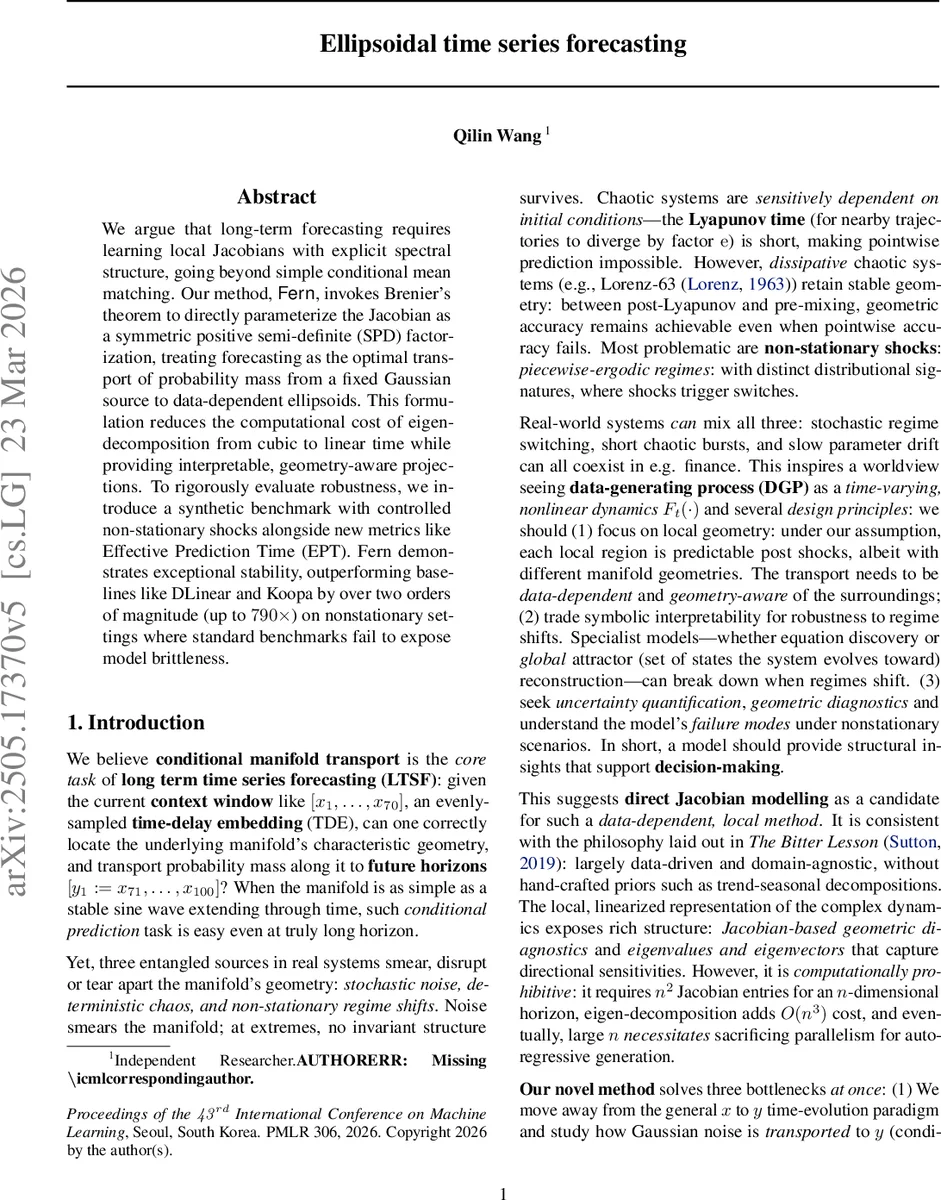
Long-term time-series forecasting (LTSF) models are often presented as general-purpose solutions that can be applied across domains, implicitly assuming that all data is pointwise predictable. Using chaotic systems such as Lorenz-63 as a case study, we argue that geometric structure - not pointwise prediction - is the right abstraction for a dynamic-agnostic foundational model. Minimizing the Wasserstein-2 distance (W2), which captures geometric changes, and providing a spectral view of dynamics are essential for long-horizon forecasting. Our model, FRIREN (Flow-inspired Representations via Interpretable Eigen-networks), implements an augmented normalizing-flow block that embeds data into a normally distributed latent representation. It then generates a W2-efficient optimal path that can be decomposed into rotation, scaling, inverse rotation, and translation. This architecture yields locally generated, geometry-preserving predictions that are independent of the underlying dynamics, and a global spectral representation that functions as a finite Koopman operator with a small modification. This enables practitioners to identify which modes grow, decay, or oscillate, both locally and system-wide. FRIREN achieves an MSE of 11.4, MAE of 1.6, and SWD of 0.96 on Lorenz-63 in a 336-in, 336-out, dt=0.01 setting, surpassing TimeMixer (MSE 27.3, MAE 2.8, SWD 2.1). The model maintains effective prediction for 274 out of 336 steps, approximately 2.5 Lyapunov times. On Rossler (96-in, 336-out), FRIREN achieves an MSE of 0.0349, MAE of 0.0953, and SWD of 0.0170, outperforming TimeMixer’s MSE of 4.3988, MAE of 0.886, and SWD of 3.2065. FRIREN is also competitive on standard LTSF datasets such as ETT and Weather. By connecting modern generative flows with classical spectral analysis, FRIREN makes long-term forecasting both accurate and interpretable, setting a new benchmark for LTSF model design.
💡 Research Summary
The paper argues that long‑term time‑series forecasting (LTSF) should focus on preserving the geometric structure of the data rather than on pointwise prediction. To this end the authors introduce FRIREN (Flow‑inspired Representations via Interpretable Eigen‑networks), a model that leverages Brenier’s theorem and the Wasserstein‑2 (W2) optimal transport framework. By treating the conditional distribution of future values as a Gaussian N(μ,Σ) and the source distribution as a fixed standard normal N(0,I), the optimal transport map is known to be affine with a symmetric positive‑definite (SPD) Jacobian. FRIREN directly parameterizes this Jacobian through its spectral decomposition (eigenvalues Λ and eigenvectors U), thereby avoiding costly O(n³) eigen‑decompositions and reducing the computational burden to O(R·n), where R is the number of Householder reflections used to construct U.
The model processes high‑dimensional series by splitting them into patches (e.g., 24‑dim blocks). Each patch undergoes an independent SPD transformation, which can be performed in parallel, turning the curse of dimensionality into a computational advantage. The transformation follows a translate‑rotate‑scale‑rotate‑back sequence, which is both mathematically grounded (it is the exact W2‑optimal map between two Gaussians) and physically interpretable (translation, rotation, scaling). The encoder first builds a bidirectional coupling between the observed context and a latent isotropic Gaussian; the decoder then maps a fresh latent sample through the learned spectral parameters to produce a Gaussian ellipsoid that represents the forecast.
Training uses only mean‑squared error (MSE). Under the Gaussian assumption, minimizing MSE is equivalent to maximum‑likelihood estimation of the conditional mean μ; the covariance Σ becomes an internal belief state that the model learns to minimize the loss. Consequently FRIREN can produce point forecasts while also providing a latent covariance useful for uncertainty quantification (future work).
Empirically, FRIREN dramatically outperforms recent LTSF baselines such as TimeMixer, DLinear, and Koopa on chaotic benchmarks. On the Lorenz‑63 system (336‑step horizon, dt = 0.01) it achieves MSE = 11.4, MAE = 1.6, SWD = 0.96, compared with TimeMixer’s MSE = 27.3, MAE = 2.8, SWD = 2.1, and maintains meaningful predictions for 274 steps (≈2.5 Lyapunov times). On the Rossler system it records MSE = 0.0349, MAE = 0.0953, SWD = 0.0170, again far surpassing baselines. The model also remains competitive on standard datasets such as ETT and Weather.
Beyond performance, FRIREN offers interpretability. The local spectral radius (largest eigenvalue) highlights regions of rapid state change, as shown by spikes in high‑speed zones of the Lorenz attractor. Globally, the set of eigenvalues constitutes a finite‑dimensional approximation of a Koopman operator, allowing practitioners to identify growing, decaying, or oscillatory modes across the entire system.
In summary, FRIREN unifies modern normalizing‑flow generative techniques with classical optimal‑transport and spectral analysis, delivering a geometry‑preserving, computationally efficient, and interpretable framework for long‑term forecasting. This work sets a new benchmark for LTSF model design and opens avenues for robust, explainable forecasting in chaotic and non‑stationary domains.
Comments & Academic Discussion
Loading comments...
Leave a Comment