Homogenization and corrector results for the stochastic non-homogeneous incompressible Navier-Stokes equations with rapid oscillation
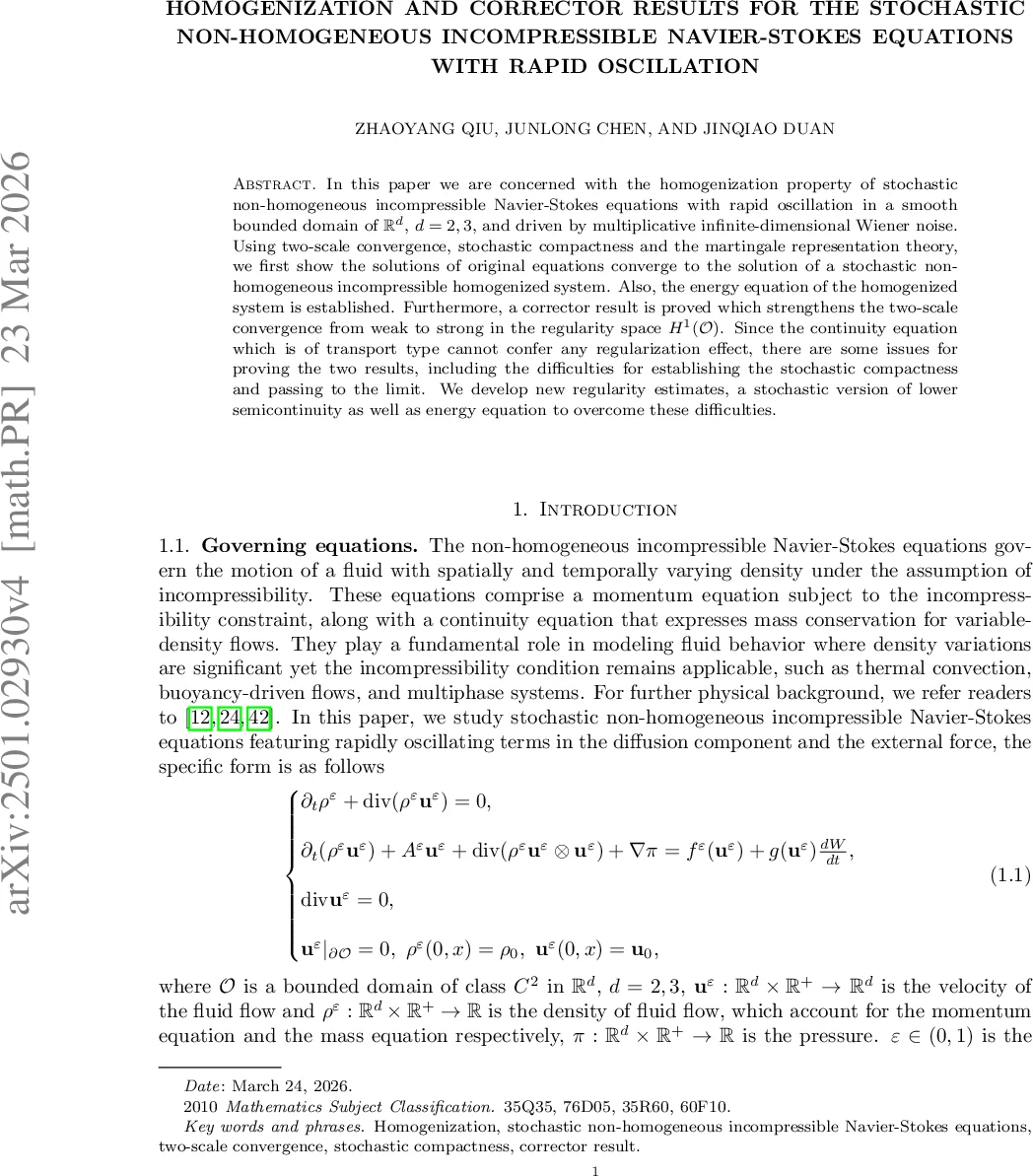
In this paper we are concerned with the homogenization property of stochastic non-homogeneous incompressible Navier-Stokes equations with rapid oscillation in a smooth bounded domain of $\mathbb{R}^d$, $d=2,3$, and driven by multiplicative infinite-dimensional Wiener noise. Using two-scale convergence, stochastic compactness and the martingale representation theory, we first show the solutions of original equations converge to the solution of a stochastic non-homogeneous incompressible homogenized system. Also, the energy equation of the homogenized system is established. Furthermore, a corrector result is proved which strengthens the two-scale convergence from weak to strong in the regularity space $H^1(\mathcal{O})$. Since the continuity equation which is of transport type cannot confer any regularization effect, there are some issues for proving the two results, including the difficulties for establishing the stochastic compactness and passing to the limit. We develop new regularity estimates, a stochastic version of lower semicontinuity as well as energy equation to overcome these difficulties.
💡 Research Summary
This paper addresses the homogenization problem for stochastic, non‑homogeneous, incompressible Navier‑Stokes equations posed on a smooth bounded domain ( \mathcal O\subset\mathbb R^{d}) ( (d=2,3) ). The system features a rapidly oscillating diffusion tensor (A_{\varepsilon}) with periodic coefficients (a_{ij}(x/\varepsilon,t)), a periodic external force (f_{\varepsilon}(x/\varepsilon,t,u)), and is driven by an infinite‑dimensional (Q)-Wiener process. The density (\rho_{\varepsilon}) is variable (non‑vacuum) and satisfies a transport‑type continuity equation, while the velocity field (u_{\varepsilon}) satisfies the momentum balance together with the incompressibility constraint.
Main difficulties.
- The continuity equation provides no regularizing effect, making it hard to obtain time‑regularity estimates for (\rho_{\varepsilon}u_{\varepsilon}).
- The presence of infinite‑dimensional noise prevents the direct use of the classical Burkholder‑Davis‑Gundy inequality for stochastic convolutions, especially when estimating temporal increments as in (1.5).
- Existing stochastic two‑scale convergence results are formulated in expectation; they are insufficient for a path‑wise homogenization that the authors aim to achieve.
Innovative tools.
- The authors introduce a random Hölder constant
\
Comments & Academic Discussion
Loading comments...
Leave a Comment