Isometric Incompatibility in Growing Elastic Sheets
Geometric incompatibility, the inability of a material's rest state to be realized in Euclidean space, underlies shape formation in natural and synthetic thin sheets. Classical Gauss and Mainardi-Codazzi-Peterson (MCP) incompatibilities explain many …
Authors: Yafei Zhang, Michael Moshe, Eran Sharon
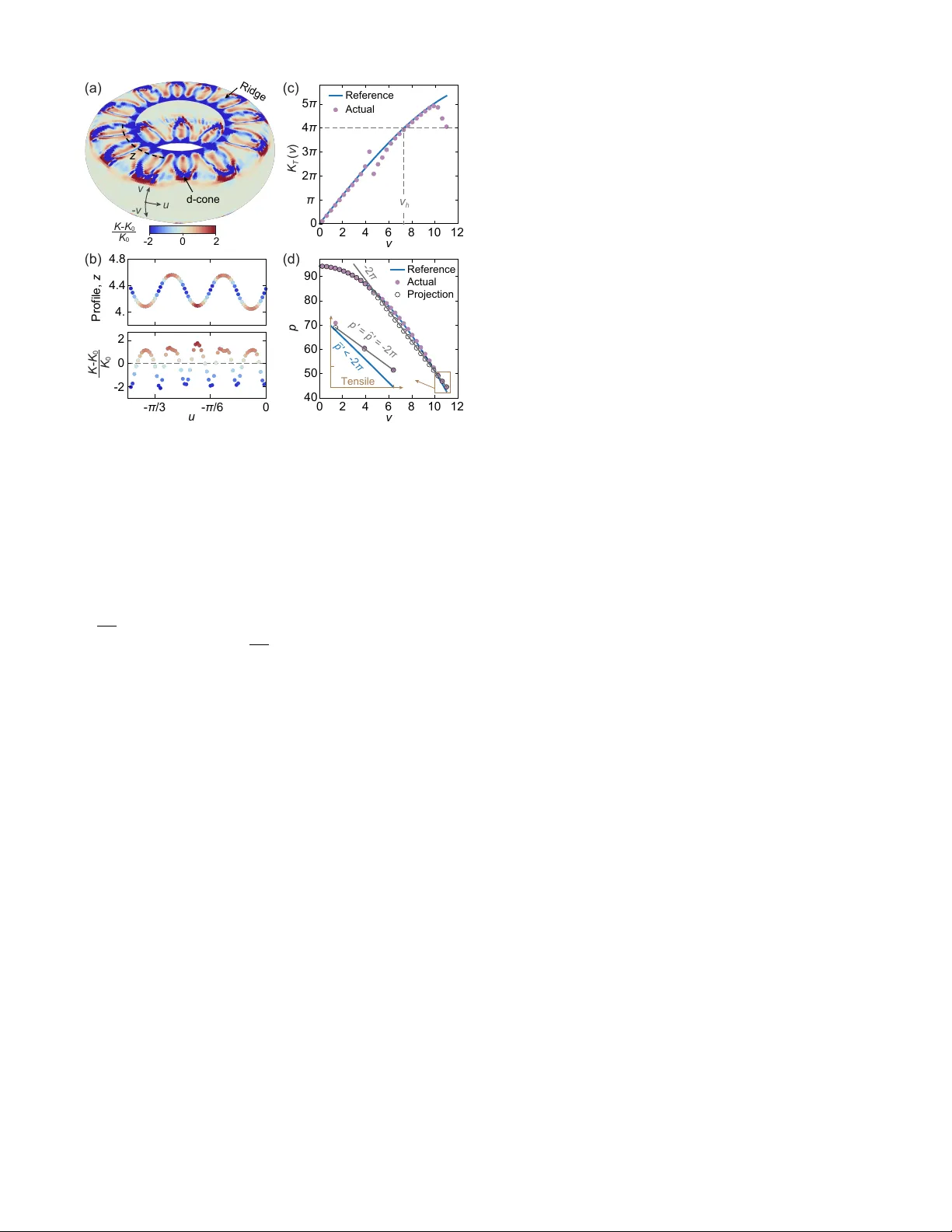
Isometric Incompatibilit y in Gro wing Elastic Sheets Y afei Zhang, Mic hael Moshe, ∗ and Eran Sharon † R ac ah Institute of Physics, The Hebr ew University of Jerusalem, Jerusalem, 9190401, Isr ael. Geometric incompatibilit y , the inability of a material’s rest state to b e realized in Euclidean space, underlies shap e formation in natural and synthetic thin sheets. Classical Gauss and Mainardi–Co dazzi–P eterson (MCP) incompatibilities explain man y patterns in nature, but they do not exhaust the mec hanisms that frustrate thin elastic sheets. W e identify a new incompatibilit y that forbids an y stretc hing-free configuration, even when the rest state of the elastic sheet lo cally satisfies the Gauss and MCP compatibility conditions. W e demonstrate this principle in a mo del of surface growth with p ositive Gaussian curv ature, where a geometric horizon forms, leading to the onset of frustration. Exp eriments, sim ulations, and theory sho w that the sheet responds by n ucle- ating perio dic d-cone-like dimples. W e show that this obstruction to stretching-free configurations is top ological, and we p oin t to op en questions concerning the origin of frustration. Intr o duction– Geometric frustration in thin sheets is ubiquitous across nature and synthetic systems, gov ern- ing morphogenesis in living tissues [ 1 – 6 ], defect organi- zation in crystalline and amorphous solids [ 7 – 9 ], and me- c hanical resp onse of arc hitectured and adaptiv e materi- als [ 10 – 12 ]. A c haracteristic expression of frustration is the generation of residual stresses, whic h in turn initi- ate instabilities resulting with intricate patterns [ 13 – 20 ]. Ov er the past t wo decades, t wo sources of geometric frus- tration hav e been iden tified for thin sheets: the Gauss frustration and the Mainardi–Co dazzi–P eterson (MCP) frustration [ 21 , 22 ]. Both originate from the Gauss or MCP compatibility conditions, whic h must b e satisfied b y the metric and curv ature tensors a and b of an y actual configuration, but may be violated by the reference fields ¯ a and ¯ b defining the target geometry [ 23 ]. In cases where ¯ a and ¯ b are ge ometric al ly inc omp atible , every material elemen t is intrinsically frustrated: it cannot b e embed- ded in Euclidean space without residual stress, as follo ws from the fundamental theorem of surfaces [ 24 ]. An imp ortant property of geometrically incompatible ¯ a and ¯ b is that at equilibrium the actual forms a and b deviate from their rest v alues. F or non-Euclidean plates, i.e., when ¯ b = 0 and ¯ a is non-Euclidean, it was rigorously pro ven that if and only if there exists an isometric em- b edding with finite b ending energy [ 25 ], then the limit of v anishing thic kness t drives the sheet to w ard a configura- tion that minimizes bending energy am ong all isometric em b eddings with a = ¯ a [ 21 , 26 ], and the elastic energy scales as t 3 (b ending energy). This mechanism underlies shap e selection and shap e transitions in a wide range of soft matter systems [ 1 , 2 , 13 , 22 , 27 ]. Another origin of frustration is topological: Closed sheets, suc h as vesicles, fruits and p ollen grains, can b ecome frustrated due to top ological constrain ts ev en if they are lo cally compatible [ 3 , 28 – 31 ]. F or such surfaces, Gauss-Bonnet theorem determines a rigid connection b e- t ween the top ology of the surface and the in tegral of the Gaussian curv ature o v er it [ 24 ]. Suc h top ological con- strain ts do not exist in op en surfaces. In this w ork, w e iden tify a new form of incompatibilit y in op en gro wing surfaces. W e sho w that integrating more than 4 π p ositive Gaussian curv ature on a circular disc, or an ann ulus leads to geometric frustration. W e show that regular configu- rations satisfying a = ¯ a with in tegrated curv ature less than 4 π , cannot be extended be y ond this limit, irresp ec- tiv e of ¯ b , even if ¯ a and ¯ b are locally Gauss and MCP compatible. The inability to extend the isometric configurations, whic h violates the smo oth embedding h yp othesis in [ 26 ], in tro duces a fundamentally new mec hanism of shap e se- lection: it forces the sheet in to complex configurations with diverging energy densit y as the thickness decreases. Similarly to Gauss and MCP incompatibilities, this new incompatibilit y has the potential to accoun t for an en- tirely new class of pattern-forming phenomena in natural and synthetic slender solids. T o clarify the con text of our results, it is imp ortan t to note that a situation where a significantly deviates from ¯ a in a thin sheet, regardless of ¯ b , is not unprecedented. The canonical example arises in the growth of a surface with constant negative curv ature with the topology of a cylinder. It is w ell kno wn that this geometry possesses a horizon b eyond whic h the symmetry breaks, and the emerging perio dic pattern b ecomes increasingly refined as the thic kness decreases [ 32 ]. This b eha vior has b een observ ed in syn thetic sheets and inv ok ed to explain mor- phogenetic patterns in natural tissues [ 5 , 32 – 34 ]. Imp or- tan tly , this geometrically frustrated state do es not re- flect Gauss or MCP incompatibility . Whether or not it reflects an approach tow ards a non-regular isometric em b edding, when thic kness decreases, remains an op en question [ 32 , 35 ]. The geometric origin of this phenomena w as hypothesized to b e related to Hilb ert’s theorem [ 24 ], whic h rules out an y complete surface of constan t nega- tiv e Gaussian curv ature in R 3 . It therefore has long b een view ed as an exclusiv e feature of a surface with negative curv ature. Our work o verturns this in terpretation. By consid- ering growth with p ositive Gaussian curv ature w e sho w that horizons may emerge in p ositiv ely curved geome- tries, where no classical obstruction applies. This ob- 2 serv ation expands the landscape of geometric-frustration to top ological-frustration in op en thin sheets beyond its traditionally understo od b oundaries. ? b uu b vv 0 4 π 2 π K T b αβ 0 4 8 v h /2 v h 0 i ii iii K T iii ii ϕ ψ v u transport Paralell X ( u,v ) i (c) (a) (b) (d) Axisymmetric growth ≡ v 0 Frustration FIG. 1. Emergen t frustration in an axisymmetric gro wing disc with p ositiv e Gaussian curv ature. (a) Growth of a disc domain endo w ed with a positive reference Gaussian curv ature field ¯ K ( v ) = K 0 v /v l . The total reference curv ature ¯ K T = 2 π . (b) Onset of a geometric horizon at ¯ K T = 4 π , where the b oundary normals (arro ws) collapse into a common direction, obstructing further smooth isometric extension. (c) F or ¯ K T > 4 π , symmetry breaking o ccurs. (d) A t the horizon v 0 = v h , the principal curv ature b vv b ecomes singular. First observation: Disc top olo gy– W e start b y n umer- ically computing the energy-minimizing shapes of a cir- cular disc endow ed with a reference metric of radially- increasing p ositive Gaussian curv ature, while growing the system so that the total reference curv ature ¯ K T ≡ R ¯ K d ¯ S crosses 4 π (Fig. 1 ; see SM [ 36 ]). F or ¯ K T < 4 π , the shap es are smo oth and axisymmetric. As ¯ K T → 4 π , the b oundary normals collapse tow ard a common direc- tion and the b oundary curv ature gro ws sharply . F or ¯ K T > 4 π , the minimizing shap es break the axial sym- metry , suggesting a geometric horizon at ¯ K T = 4 π . This observ ation raises a central question: why do es an op en surface, despite its free boundary , develop a geometric horizon once ¯ K T reac hes 4 π , and what are the geomet- ric and mechanical consequences of gro wth beyond this horizon? Gr owth mo del and ge ometry– T o address this ques- tion and gain analytical insigh t, we turn to a tractable mo del in whic h a surface grows from a closed ring in an axisymmetric manner while main taining c onstant Gaus- sian curv ature. The domain, with cylindrical top ology , is then defined b y the co ordinates ( u, v ) with u be- ing 2 π -p erio dic, and v along the growth direction, thus M = [0 , 2 π ) × [ − v 0 , v 0 ] (see Fig. 2 and End Matter). The symmetry allo ws us to define v to measure the distance from the equator, thus the target metric induced b y this gro wth proto col is ¯ a = Φ 2 ( v ) 0 0 1 . (1) The Gaussian curv ature is ¯ K = − Φ ′′ / Φ, and the con- stan t curv ature growth protocol with K 0 = 1 /R 2 0 leads to Φ( v ) = A √ K 0 cos( √ K 0 v ), with A = P / (2 π R 0 ) and P the equator’s p erimeter. The case A < 1 resembles a North-American fo otball, while A = 1 yields a South- American football (see SM [ 36 ]). W e are in terested in A > 1, as sho wn in Fig. 2 . The first hin t of a horizon app ears in the isometric em bedding of this sheet as a sur- face of rev olution. Up on searc hing for a configuration in the form X ( u, v ) = ϕ ( v ) cos u, ϕ ( v ) sin u, ψ ( v ) , with a = ¯ a we find ϕ ( v ) = A √ K 0 cos( p K 0 v ) , ψ ( v ) = E( √ K 0 v | A 2 ) √ K 0 , (2) where E( ·|· ) is the elliptic integral of the second kind. This solution applies equally for p ositive or negative curv ature K 0 . An immediate observ ation is that while for A ≤ 1 the elliptic integral is w ell defined ov er the whole in terv al v ∈ ( − π / 2 , π / 2), for 1 < A it div erges at v h = arcsin( A − 1 ) / √ K 0 , defined by ψ ′ ( v h ) = 0. This de- fine a horizon along which the unit normal ˆ n is constant, and the surface terminates (Fig. 2 (a), as in Fig. 1 (b)). On this edge, the principal curv atures exhibit a singular b eha vior, with b uu → 0 while b v v → ∞ (see End Mat- ter). W e note that this horizon emerges in the configura- tion, not in the metric, and therefore is not sufficient to exclude the p ossibility of an asymmetric stretc hing-free configuration. Isometric inc omp atibility– A strong indication for the inabilit y to extend the axisymmetric isometric em bed- ding b ey ond v h comes from the notion of rigidifying curv es [ 37 , 38 ] and nonlinear isometries dev elop ed in [ 39 ]. In their work it w as demonstrated that growth b eyond the horizon in the negativ ely curved pseudo-sphere is im- p ossible. Suppose, to ward con tradiction, that a smo oth isometric embedding of the full domain exists even when the growth extends past v h . Then any sub domain of this em b edding must also be isometrically embedded. In par- ticular, the restriction to the region v ∈ [ − v h , v h ] m ust coincide with the surface-of-rev olution isometry obtained ab o v e, since the isometry equations admit a unique solu- tion for this metric with the prescrib ed symmetry . Crucially , the uniqueness of the solution reflects the fact that the curv e v = v h is a rigidifying curv e. Its nor- mal curv ature v anishes, eliminating all regular infinitesi- mal isometries across it. More severely , along this curve one principal curv ature div erges in the v -direction for the surface-of-rev olution solution. This div ergence drives a singularit y in the nonlinear isometry equation as w ell. Th us, similarly to the generic parab olic curves treated 3 in [ 39 ], here the blow-up of the principal curv ature pre- v ents finite-amplitude nonlinear isometries from crossing the curv e. Consequen tly , an y attempt to contin ue the isometric embedding from the surface of revolution b e- y ond v h w ould require solving the W eingarten equations for a surface [ 24 ], whose first and second fundamental forms match those of the surface of revolution on v ≤ v h . Y et these equations inherit the same curv ature singular- it y: the co efficien t matrix loses ellipticity at v h , and the con tinuation problem b ecomes ill-p osed. Therefore, the sheet cannot b e gro wn b ey ond the horizon while preserv- ing the metric. This establishes the isometric incompat- ibilit y of the gro wth proto col. It is imp ortan t to note that this line of reasoning is relev an t only for p erturba- tions relative to the surface of revolution. The argument presen ted here does not exclude the existence of a non- symmetric isometry and therefore do es not form a com- plete pro of. While this argumen t, based on the extrinsic geometry , supp orts the existence of what w e call an isometric in- compatibilit y , it do es not exp ose the in trinsic geometric principle b ehind its onset. Using Gauss-Bonnet theo- rem, w e note that regardless of the functional form of ¯ K , the maximally axisymmetric gro wn surface reac hes a geometric horizon when the accum ulated total reference Gaussian curv ature satisfies ¯ K T = 4 π (see SM [ 36 ]). Beyond the horizon– T o study the mechanical resp onse of the isometrically incompatible spherical-like surfaces, w e com bine numerical sim ulations, table-top exp eriments and analytical metho ds. The horizon is located at v h = arcsin( A − 1 ) / √ K 0 , which suggests that crossing the hori- zon can be ac hiev ed either by fixing the maximal coordi- nate v 0 and increasing A , or by fixing A and increasing v 0 . The n umerical study is performed within the frame- w ork of non-Euclidean elasticity , wherein the elastic en- ergy p enalizes for metric and curv ature discrepancies [ 21 ] E = Z M t 2 ∥ a − ¯ a ∥ 2 + t 3 6 b − ¯ b 2 dS . (3) Here ∥·∥ encodes Y oungs mo dulus and Poisson ratio (see SM [ 36 ]), and we focus on the thin limit where a ≈ ¯ a [ 40 ]. In the numerical pro cedure, w e prescribe ¯ a and ¯ b and minimize the energy with respect to the surface shap e. ¯ a is taken from Eq. ( 1 ), and w e run simulations with tw o t yp es of ¯ b . One that is fully Gauss and MCP compatible (i.e., spherical curv ature), and one that violates them, ¯ b = 0. As shown b elo w and in the SM [ 36 ], the results are insensitive to this c hoice. In Fig. 2 (a) we sho w equilibrium configurations as v 0 increases. F or v 0 ≤ v h solutions are isometric ( a = ¯ a , i - ii ), whereas for v h < v 0 symmetry breaks and perio dic d-cones patterns emerge [ 27 , 41 ], indicating the absence of a stretching-free state ( iii - iv ). In terestingly , we find that when a cut is introduced along the v -direction, the elastic surface o verturns and v i u ii (d) iii III T opological surgery Recovery of isometric embeddability Grow along v (a) iii iv Symmetry breaking 4 π K T Isometric embedding I IV II 1cm III Grow along u (b) (c) 0.6 0.8 1.0 1.2 1.4 0.5 1.0 1.5 2.0 A K 0 v 0 Theory Sim. Exper. Overlap Overlap I II III IV ii iii iv i 2cm FIG. 2. Pattern formation induced b y the isometric frustra- tion, and recov ery of isometric em b eddabilit y . (a,b) Sym- metry breaking during the increase of accumulated Gaus- sian curv ature in (a) Sim ulations and (b) Exp erimen ts. Near ¯ K T = 4 π , the edge reac hes a geometric horizon; F or ¯ K T > 4 π , isometric em b eddings break and perio dic dimples with P ogorelov-lik e ridge and d-cone emerge. (c) Phase diagram sho wing the theoretical boundary v 0 = v h (solid curv e). Sym- b ols denote sim ulations (op en) and exp erimen ts (filled); cir- cles and square indicate isometric and frustrated configura- tions, respectively . (d) T op ological surgery restores smo oth isometric embeddability . Cutting iii (a) and III (b) along v remo ves the incompatibility and yields ov erlapped spherical em b eddings. adopts a m ultilay ered configuration, thereby releasing its residual stresses and restoring the surface-of-revolution solution (Fig. 2 (d)). This observ ation suggests that the geometric effect of the prescrib ed growth profile is equiv- alen t to inserting an additional azim uthal sector, muc h lik e in the classical V olterra construction. In turn, this p oin ts to a possible top ological character of the resulting frustrated state. In the experimental study we increase A , with a fixed v alue of v 0 , via a V olterra-type construction (see SM [ 36 ]). W e start from casting a spherical shell which corresp onds to A = 1 (Fig. 2 (b), I ), then cut it along a meridian and insert an additional w edge with matc hing geometry to increase A . In Fig. 2 (b), II we sho w a case with v 0 < v h , while in III-IV we observe the frustrated states b ey ond the horizon with v h < v 0 . In both simulations and exp erimen ts, we analyze the equilibrium configurations preserving or breaking the u - symmetry , and identify the transition b et ween isomet- ric em b eddings ( a = ¯ a ) and frustrated ones. This yields the phase diagram in Fig. 2 (c), parameterized b y the dimensionless equator perimeter A and domain size 4 0 -2 2 0 2 4 6 8 10 12 40 50 60 70 80 90 v p Reference Actual Projection -2 π Tensile p' = p' = -2 π p' < -2 π › 0 2 4 6 8 10 12 0 5 π v 4 π 3 π 2 π π Reference Actual v h K T ( v ) (a) (b) (c) (d) 4. 4.4 4.8 Profile, z -2 0 2 - π /6 - π /3 0 u Ridge u v - v K - K 0 K 0 K - K 0 K 0 d-cone z FIG. 3. P ost-horizon analysis. (a) Gaussian curv ature map sho wing a nearly flat inner edge preceded by curv ature undu- lations. (b) Cross-section profile and curv ature discrepancy , rev ealing a narro w band of Pogorelo v ridges. (c) Accum ulated Gaussian curv ature along v : initially following ¯ K T ( v ) in the in terior, but collapses to 4 π at the edge. (d) Perimeter v ersus v : deviations b et ween actual ( p ), reference ( ¯ p ), and pro jected ( ˆ p ) perimeters reflect symmetry breaking, and highligh t the tensile nature of the inner edge by p ( v 0 ) = ˆ p ( v 0 ) > ¯ p ( v 0 ). √ K 0 v 0 . The transition is cleanly separated by the hori- zon v h = arcsin( A − 1 ) / √ K 0 . Curvatur e diagnostics– Next, we visualize the Gaus- sian curv ature discrepancy ( K − K 0 ) /K 0 on the actual configuration (Fig. 3 (a)). While regions close to the equa- tor satisfy K = K 0 , there is an extended frustrated region with spatially oscillating curv ature discrepancy . Close to the b oundary separating the isometric and frustrated regions, positive and negative p eaks lo calize in a form strongly reminiscent of d-cone structures [ 41 ]. Cross- sectional profiles tak en along the azim uthal direction (dashed line in Fig. 3 (a)) reveal in tense curv ature oscil- lations of the order of K 0 . This is indicative of P ogorelo v ridges that are characterized by lo calized regions with negativ e curv ature [ 42 ]. Both d-cones and P ogorelov ridges are canonical examples of stress-fo cusing struc- tures in confined thin sheets [ 27 ]. They indicate a qualitativ e departure from the wrinkle patterns observed along the edges of hyperb olic surfaces (Fig. 4 (a)). The in tegrated Gaussian curv ature K T ( v ) accumu- lated along the meridional direction v is plotted in Fig. 3 (c). W e see that K T ( v ) closely follo ws the refer- ence v alue ¯ K T ( v ), un til it reaches a critical point where the configuration collapses into a plateau. Interestingly , this critical p oin t precedes the horizon v h and in trudes bac k in to the isometrically compatible regime, produc- ing a sudden burst in K T ( v ). Beyond this p oint, K T ( v ) again trac ks ¯ K T ( v ) and ov ersho ot 4 π . How ev er, as the rim is circular and flat K T ( v ) relaxes bac k to the global v alue of 4 π . A complemen tary persp ective comes from the p erime- ter evolution along v (Fig. 3 (d)). F or axisymmetric top ologies, critical growth corresponds to a limiting p erimeter slope | p ′ | c = 2 π . When the reference p erime- ter exceeds this rate ( | ¯ p ′ | > 2 π ), the radius–height slop e div erges ( dϕ/dψ → ∞ ), precluding any smo oth axisym- metric em b edding and thereby leading to frustration. In practice, the actual perimeter p closely follo ws the refer- ence ¯ p ov er most of the domain, showing that ev en the dimpled regions globally conserv e lengths. Lo cally , ho w- ev er, p ′ o vershoots the 2 π b ound, accommodated b y sym- metry breaking and dimple formation where p deviates from its pro jec tion ˆ p . Zo oming near the inner plateau rev eals p = ˆ p > ¯ p and p ′ = ˆ p ′ = − 2 π < ¯ p ′ , showing a flat rim sustained by tensile azim uthal stresses, consis- ten t with a lo w-order elastic estimate: Azim uthal stress switc hes from compression in the dimples to tension near the rim (see SM [ 36 ]). T ak en together, these diagnostics establish that ellip- tic surfaces relieve the isometric-incompatibilit y not b y distributed wrinkling as in h yp erbolic sheets, but via lo- calized dimples bounded b y stress-focusing ridges and d- cones. Despite lo cal excursions and unlike the case of h yp erb olic sheets, the total Gaussian curv ature K T ( v 0 ) nev er exceeds the global b ound 4 π . Discussion– In summary , we ha ve studied equilibrium configurations of thin circular and ann ular elastic sheets with p ositiv e reference Gaussian curv ature. W e unco v- ered a new form of isometric inc omp atibility - A geomet- ric frustration that emerges in open (finite size) sheets ev en when they are locally compatible. Specifically , we suggest that when the amoun t of Gaussian curv ature, in tegrated on a disc/annulus equals 4 π , the edges of ax- isymmetric configurations b ecome rigidifying curv es. As a result, it is imp ossible to further isometrically extend the domain in a w a y that it con tains more than 4 π Gaus- sian curv ature. The mechanical outcome of this geomet- rical constraint is the developmen t of Pogorelo v ridges and d-cones that localize stretc hing energy . The observ ed equilibrium configurations are residually stressed even if ¯ a and ¯ b are Gauss and MCP compatible. This b ehav- ior p ersists ev en when the thickness is three orders of magnitude smaller than all other length scales in the system. As suc h, it deviates from the Lewick a-Pakzad scenario, suggesting that there is no accessible W 2 , 2 iso- metric em b edding in this regime [ 26 ]. In light of the w ork of Ref. [ 43 ], which considers finite h yp erb olic do- mains and iden tifies non trivial isometric em b eddings, w e emphasize that, since our analysis also concerns finite do- mains, we cannot rule out the existence of complicated isometric em b eddings in the presen t case as well. Suc h configurations are not observ ed experimentally or in sim- ulations. W e note that if exist, they are not accessible 5 p erturbativ ely from the surfaces of revolution, esp ecially in the presence of rigidifying edges. W e hav e also shown that this frustration has top olog- ical characteristics, as it can be remo v ed by inserting meridional/radial cuts (see Fig. 2 (d)). Suc h cuts in tro- duce new, non-rigidifying edges, allo wing the system to relax. While our analysis clarifies its mec hanical manifes- tations, the geometric origin of the asso ciated 4 π bound and the onset of rigidifying curves remains to be fully understo od. The relaxation via cutting resem bles mechanisms kno wn in negatively curv ed surfaces [ 43 ] suc h as Dini- t yp e surfaces that cannot exist on cylindrical top ologies. These observ ations suggest that, when reconstructing the 3D reference metric in the spirit of [ 21 , 44 ], the cor- resp onding mono dromy , whic h accoun ts for top ological c harges in 3D solids, ma y serv e as a top ological measure of incompatibility [ 45 ]. What remains unclear is how the relev an t top ological charge relates to global proper- ties of ¯ a and ¯ b , and in particular to the horizon and the maximal in tegrated curv ature b ey ond whic h rigidit y , and consequen tly incompatibility , emerge. Our w ork also demonstrate the interpla y b etw een the in trinsic and extrinsic nature of the isometric incompat- ibilit y . W e ha v e sho wn that the horizon not only reflects a limiting total curv ature, but also corresp onds to a di- v ergence in the perimeter–height relation: as v → v h , the rate of perimeter growth relativ e to heigh t, dp/dψ , div erges and the breakdown of axial symmetry is in- evitable. Gauss-Bonnet theorem shows that suc h diver- gence m ust emerge if more than 4 π Gaussian curv ature is in tegrated on an axisymmetric configuration (SM [ 36 ]). It is imp ortant to note that 4 π is an upper bound. In ann ular domains, the divergence of dp/dψ and conse- quen tly , the symmetry breaking, can o ccur at lo wer v al- ues (SM [ 36 ]). Hyp erb olic surfaces can accommodate this divergence through large-amplitude wrinkles and to accoun t for the excess integrated Gaussian curv ature, b y generating geo desic curv ature along the free edge (Fig. 4 ). In contrast, growth in elliptic surfaces form lo calized dim- ples indicative of stretc hing and diverging b ending energy densit y . In addition, the flat circular boundary of such surfaces, for whic h the in tegrated geo desic curv ature is − 2 π , cannot comp ensate for the excess Gaussian curv a- ture beyond 4 π . It therefore pro vides a clear manifes- tation of the violation of the Gauss–Bonnet theorem for the reference metric (Fig. 3 (a)). The identification of this isometric-incompatibility es- tablishes a new organizing principle for the mec hanics of thin sheets. It reveals that top ological constrain ts can lead to frustration, ev en in fully Gauss- and MCP- compatible geometries, thereb y forcing shape selection through lo calized stress-fo cusing structures rather than distributed wrinkling. This mechanism extends the clas- sical landscap e of geometric frustration, and w e exp ect it to guide future theoretical and exp erimen tal explo- ration of topology driv en shaping in living tissue and self-morphing systems. A cknow le dge- ES ac knowledges the supp ort of the USA-Israel Binational Science F oundation, gran t num- b er 2020739 and b y the Israel Science F oundation, gran t n umber 2437/20. MM ac kno wledges support from the Is- rael Science F oundation (Grant No. 1441/19), and from the Kavli Institute for Theoretical Physics, where part of this work was carried out, under NSF Grant PHY- 2309135. ∗ mic hael.moshe@mail.huji.ac.il † erans@mail.h uji.ac.il [1] S. Armon, E. Efrati, R. Kupferman, and E. Sharon, Ge- ometry and mec hanics in the opening of c hiral seed po ds, Science 333 , 1726 (2011). [2] Y. Zhang, O. Y. Cohen, M. Moshe, and E. Sharon, Geo- metrically frustrated rose p etals, Science 388 , 520 (2025). [3] E. Katifori, S. Alben, E. Cerda, D. R. Nelson, and J. Du- mais, F oldable structures and the natural design of p ollen grains, Proceedings of the National Academy of Sciences 107 , 7635 (2010). [4] J. Derv aux and M. Ben Amar, Morphogenesis of gro wing soft tissues, Physica l review letters 101 , 068101 (2008). [5] M. Arro y o and A. DeSimone, Shap e con trol of activ e sur- faces inspired b y the mo vemen t of euglenids, Journal of the Mechanics and Ph ysics of Solids 62 , 99 (2014). [6] E. Latorre, S. Kale, L. Casares, M. G´ omez-Gonz´ alez, M. Uroz, L. V alon, R. V. Nair, E. Garreta, N. Montser- rat, A. Del Campo, et al. , Activ e superelasticity in three- dimensional epithelia of con trolled shape, Nature 563 , 203 (2018). [7] W. T. Irvine, V. Vitelli, and P . M. Chaikin, Pleats in crystals on curved surfaces, Nature 468 , 947 (2010). [8] M. Moshe, I. Levin, H. Aharoni, R. Kupferman, and E. Sharon, Geometry and mechanics of tw o-dimensional defects in amorphous materials, Pro ceedings of the Na- tional Academy of Sciences 112 , 10873 (2015). [9] G. Meng, J. Paulose, D. R. Nelson, and V. N. Manoha- ran, Elastic instability of a crystal gro wing on a curv ed surface, Science 343 , 634 (2014). [10] M. W ang, S. Ro y , C. San tangelo, and G. Grason, Ge- ometrically frustrated, mechanical metamaterial mem- branes: Large-scale stress accumulation and size-selective assem bly , Ph ysical Review Letters 134 , 078201 (2025). [11] F. Serafin, J. Lu, N. Koto v, K. Sun, and X. Mao, F rus- trated self-assembly of non-euclidean crystals of nanopar- ticles, Nature Comm unications 12 , 4925 (2021). [12] I. Levin, R. Deegan, and E. Sharon, Self-oscillating mem- branes: Chemomechanical sheets sho w autonomous p eri- o dic shape transformation, Ph ysical Review Letters 125 , 178001 (2020). [13] Y. Klein, E. Efrati, and E. Sharon, Shaping of elastic sheets b y prescription of non-euclidean metrics, Science 315 , 1116 (2007). [14] B. Davido vitch, Y. Sun, and G. M. Grason, Geometri- cally incompatible confinement of solids, Proceedings of the National Academ y of Sciences 116 , 1483 (2019). [15] K. Sun and X. Mao, F ractional excitations in non- 6 euclidean elastic plates, Physical Review Letters 127 , 098001 (2021). [16] I. T obasco, Y. Timounay , D. T odorov a, G. C. Leggat, J. D. Paulsen, and E. Katifori, Exact solutions for the wrinkle patterns of confined elastic shells, Nature Ph ysics 18 , 1099 (2022). [17] Y. Timouna y , R. De, J. L. Stelzel, Z. S. Sc hrecengost, M. M. Ripp, and J. D. Paulsen, Crumples as a generic stress-fo cusing instabilit y in confined sheets, Ph ysical Re- view X 10 , 021008 (2020). [18] D. Bartolo and D. Carp entier, T op ological elasticit y of nonorien table ribbons, Ph ysical Review X 9 , 041058 (2019). [19] J. Hure, B. Roman, and J. Bico, W rapping an adhesive sphere with an elastic sheet, Physical review letters 106 , 174301 (2011). [20] C. E. Moguel-Lehmer and C. D. San tangelo, T opologi- cal rigidity in twisted, elastic ribbons, Ph ysical Review Letters 135 , 128201 (2025). [21] E. Efrati, E. Sharon, and R. Kupferman, Elastic theory of unconstrained non-euclidean plates, Journal of the Me- c hanics and Physics of Solids 57 , 762 (2009). [22] E. Si´ efert, I. Levin, and E. Sharon, Euclidean frustrated ribb ons, Physical Review X 11 , 011062 (2021). [23] The actual metric and curv ature tensors a and b en- co de the length of line-element and v ariation of surface- normal in the realized configuration. In contrast, the ref- erence tensors ¯ a and ¯ b sp ecify the preferred length of line- elemen t and v ariation of surface-normal in a stress-free geometry . [24] M. P . Do Carmo, Differ ential ge ometry of curves and sur- fac es: r evise d and up date d se c ond e dition (Courier Dov er Publications, 2016). [25] A W 2 , 2 em b edding [ 26 ]. [26] M. Lewick a and M. R. Pakzad, Scaling laws for non- euclidean plates and the w 2,2 isometric immersions of riemannian metrics, ESAIM: Control, Optimisation and Calculus of V ariations 17 , 1158 (2011). [27] T. A. Witten, Stress fo cusing in elastic sheets, Reviews of Mo dern Ph ysics 79 , 643 (2007). [28] J. A. Jackson, N. Romeo, A. Mietk e, K. J. Burns, J. F. T otz, A. C. Martin, J. Dunkel, and J. Imran Alsous, Scal- ing b ehaviour and con trol of nuclear wrinkling, Nature ph ysics 19 , 1927 (2023). [29] B. C. V ellutini, M. B. Cuenca, A. Krishna, A. Sza lapak, C. D. Mo des, and P . T omancak, P atterned inv agination prev ents mec hanical instability during gastrulation, Na- ture , 1 (2025). [30] B. He, K. Doubrovinski, O. Poly ak ov, and E. Wieschaus, Apical constriction drives tissue-scale h ydro dynamic flow to mediate cell elongation, Nature 508 , 392 (2014). [31] T. W ang, Z. Dai, M. P otier-F erry , and F. Xu, Curv ature- regulated multiphase patterns in tori, Ph ysical Review Letters 130 , 048201 (2023). [32] E. Sharon and E. Efrati, The mechanics of non-euclidean plates, Soft Matter 6 , 5693 (2010). [33] M. B. Amar, M. M. M¨ uller, and M. T rejo, P etal shapes of symp etalous flo wers: the in terpla y b etw een gro wth, ge- ometry and elasticit y , New Journal of Ph ysics 14 , 085014 (2012). [34] M. Marder and N. Papanicolaou, Geometry and elasticity of strips and flow ers, Journal of statistical physics 125 , 1065 (2006). [35] M. Marder, R. D. Deegan, and E. Sharon, Crumpling, buc kling, and crac king: elasticit y of thin sheets, Ph ysics T o da y 60 , 33 (2007). [36] See supplemen tal material at [publisher will insert url] for detailed description of experiments, simulations, the- ories, and the cooresp onding extended results, whic h in- cludes refs. [37] B. Audoly , Courbes rigidifian t les surfaces, Comptes Rendus de l’Acad´ emie des Sciences-Series I-Mathematics 328 , 313 (1999). [38] B. Audoly and Y. P omeau, The elastic torus: anoma- lous stiffness of shells with mixed t yp e, Comptes Rendus M ´ ecanique 330 , 425 (2002). [39] S. Al Mosleh and C. San tangelo, Nonlinear mechanics of rigidifying curves, Physical Review E 96 , 013003 (2017). [40] Here, the thin limit is defined b y t b eing muc h smaller than other c haracteristic system dimensions, e.g., t ≪ √ ¯ K R 2 0 . [41] E. Cerda and L. Mahadev an, Conical surfaces and cres- cen t singularities in crumpled sheets, Ph ysical Review Letters 80 , 2358 (1998). [42] A. V. P ogorelov, Bendings of surfac es and stability of shel ls , T ranslations of Mathematical Monographs, V ol. 72 (American Mathematical Society , Pro vidence, RI, 1988). [43] E. G. P ozny ak and E. V. Shikin, Small parameter in the theory of isometric im b eddings for tw o-dimensional riemannian manifolds into euclidean spaces, Journal of Mathematical Sciences 74 , 1078 (1995). [44] R. Kupferman and J. P . Solomon, A riemannian approach to reduced plate, shell, and ro d theories, Journal of F unc- tional Analysis 266 , 2989 (2014). [45] R. Kupferman, M. Moshe, and J. P . Solomon, Met- ric description of singular defects in isotropic materials, Arc hive for Rational Mechanics and Analysis 216 , 1009 (2015). 7 END MA TTER Isometric obstruction b eyond 4 π . Let M be a t w o- dimensional Riemannian manifold defined on the domain ( u, v ) ∈ [0 , 2 π ) × [ − v 0 , v 0 ], equipp ed with the metric: ds 2 = Φ( v ) 2 du 2 + dv 2 = a µν d x µ d x ν (4) where Φ( v ) is a smo oth, p ositiv e function and a = Φ( v ) 2 0 0 1 . (5) W e consider the sp ecific case: Φ( v ) = A √ K 0 cos( p K 0 v ) , (6) whic h corresp onds to a surface of constant Gaussian cur- v ature K = K 0 . The total Gaussian curv ature associated with this surface is K T ≡ Z M K √ det a d u d v = 4 πA sin( p K 0 v 0 ) . (7) (a) K 0 >0 K 0 <0 W rinkle ? Paralell transport (b) Collapse u v ϕ ψ u v FIG. 4. Embedding limitations and singularities in surfaces of constan t Gaussian curv ature K 0 . (a) W rinkling b ey ond the horizon in a h yp erbolic surface ( K 0 < 0) [ 32 , 34 ]. (b) Onset of a horizon in an elliptic surface ( K 0 > 0). F or b oth hyperb olic and elliptic surfaces, the horizon forms a rigidifying curv e with the normal (indicated b y red arrows) constant on the edge. Note that at the horizon v 0 = v h , the total Gaussian curv ature reaches | ¯ K T | = 4 π , while the principal curv atures are singular with b uu → 0 and b vv → ∞ . An isometric embedding of this manifold into R 3 can b e constructed as a surface of revolution (cf. Fig. 4 (b)): X ( u, v ) = ϕ ( v ) cos u, ϕ ( v ) sin u, ψ ( v ) (8) with ϕ ( v ) = A √ K 0 cos p K 0 v (9) ψ ( v ) = 1 √ K 0 E p K 0 v A 2 (10) where E is the incomplete elliptic integral of the second kind. The corresp onding shape op erator is: s = a − 1 b = κ 1 0 0 κ 2 = p K 0 f ( v ) − 1 0 0 f ( v ) , (11) with f ( v ) = A cos( √ K 0 v ) q 1 − A 2 sin 2 ( √ K 0 v ) . (12) This form of the second fundamen tal form reveals tw o singularities of the configuration. First, regardless of the v alue of A , f ( v ) → 0 when v → v s ≡ π / (2 √ K 0 ), with principal curv atures: κ 1 = p K 0 f ( v 0 ) − 1 → ∞ , (13) κ 2 = p K 0 f ( v 0 ) → 0 . (14) Ho wev er, when 1 < A , which is the case we are in ter- ested in, the denominator of f v anishes when v → v h ≡ sin − 1 ( A − 1 ) / √ K 0 . In this case κ 1 = p K 0 f ( v h ) − 1 → 0 , (15) κ 2 = p K 0 f ( v h ) → ∞ , (16) b uu v h → 0 , b v v v h → ∞ . (17) W e note that v s forms a singularit y not only of the em- b edding, but also of the metric itself. Con trary to that, v h is a singularity of the em b edding, but not of the met- ric, thus susp ected as a horizon (horizons are not true singularit y as they can be mov ed [ 32 , 43 ]). T o demon- strate that no smooth isometric em b edding can be gener- ated b y extending the surface to v h < v 0 , w e pro ceed by con tradiction. Assume such an embedding exists. Then its restriction to the sub domain v ∈ [ − v h , v h ] m ust co- incide (up to rigid motion) with the known embedding describ ed abov e. Ho wev er, according to Ref. [ 39 ]: • The b oundaries at v = ± v h form rigidifying curves since the normal curv ature κ N = κ 1 = 0, so linear isometries do not exist. • The second fundamental form div erges: κ 2 → ∞ , th us excluding nonlinear isometries as w ell. • The W eingarten equations b ecome singular and cannot be integrated across v = v h , th us excluding the p ossibilit y of an isometry b eyond the horizon. It is imp ortan t to note that this argumen t lack a rig- orous pro of for one step: Based on the absence of non- linear isometries we hypothesize that higher order non- linear isometries do not exist, and therefore the surface is rigid. In that case, from the singularity of W eingarten equations the normal field cannot b e extended and the surface cannot b e con tinued beyond v = v h .
Original Paper
Loading high-quality paper...
Comments & Academic Discussion
Loading comments...
Leave a Comment