Ergodic behaviors in reversible 3-state cellular automata
Classical cellular automata represent a class of explicit discrete spacetime lattice models in which complex large-scale phenomena emerge from simple deterministic rules. With the goal to uncover different physically distinct classes of ergodic behavior, we perform a systematic study of three-state cellular automata (with a stable vacuum' state and particles’ with $\pm$ charges). The classification is aided by the automata’s different transformation properties under discrete symmetries: charge conjugation, spatial parity and time reversal. In particular, we propose a simple classification that distinguishes between types and levels of ergodic behavior in such system as quantified by the following observables: the mean return time, the number of conserved quantities, and the scaling of correlation functions. In each of the physically distinct classes, we present examples and discuss some of their phenomenology. This includes chaotic or ergodic dynamics, phase-space fragmentation, Ruelle-Pollicott resonances, existence of quasilocal charges, and anomalous transport with a variety of dynamical exponents.
💡 Research Summary
The paper investigates the full landscape of one‑dimensional reversible cellular automata (RCA) with three local states – a vacuum (∅) and two charged particles (+ and –). By imposing the vacuum‑preserving condition U(∅,∅) = (∅,∅) on the two‑site block update rule, the total number of possible reversible rules reduces to 8! = 40320. The authors further restrict attention to rules that respect various combinations of three discrete symmetries: charge conjugation (C), spatial parity (P), and time reversal (T). This symmetry classification shrinks the set to a few hundred distinct rules, which can be grouped into four broad dynamical classes.
Three empirical diagnostics are used to characterize each rule: (i) the mean return time ⟨τ(L)⟩ – the average number of time steps required for a random initial configuration on a lattice of size L to reappear; (ii) the decay of the longest‑lived two‑point correlation function C(t), typically associated with densities of conserved quantities; and (iii) the scaling of the number of independent local (or translationally invariant) conserved charges as a function of their maximal support r. Return times either grow exponentially (∼e^{κL}) or as a power law (∼L^{p}, p ≤ 4). Correlation functions decay either exponentially (∼e^{−αt}) or algebraically (∼t^{−1/z}), the latter indicating diffusive or anomalous transport. The number of conserved charges can be zero, constant, linear in r, or exponential in r, the latter signaling the presence of quasi‑local or super‑integrable structures.
Based on the combination of these three observables the authors propose the following classification:
-
Class I – Exponential return time, exponential correlation decay, and no local conserved quantities. These rules display the strongest form of deterministic chaos; the authors identify Ruelle‑Pollicott resonances, providing the first explicit observation of such resonances in a discrete‑state deterministic system.
-
Class II – Exponential return time but algebraic correlation decay. This class is subdivided according to the growth of conserved charges: (IIa) none, (IIb) constant, (IIc) linear, (IId) exponential. Many of these models possess quasi‑local charges, leading to a rich variety of transport exponents (diffusive, sub‑diffusive, super‑diffusive). The class therefore includes non‑integrable, integrable, and super‑integrable dynamics.
-
Class III – Exponential return time together with a correlation function that saturates to a non‑zero constant. The dynamics support stable domain walls; the number of conserved charges is either constant (IIIa) or grows exponentially with support (IIIb). This class bridges chaotic and (super‑)integrable behavior, with domain structures persisting indefinitely.
-
Class IV – Power‑law return time (L^{p} with p ≤ 4), constant correlation function, and an exponential increase of conserved charges with support. These are the simplest, “free” or “trivial” automata, where particles move essentially without interaction, yet the system still hosts an extensive set of conserved quantities.
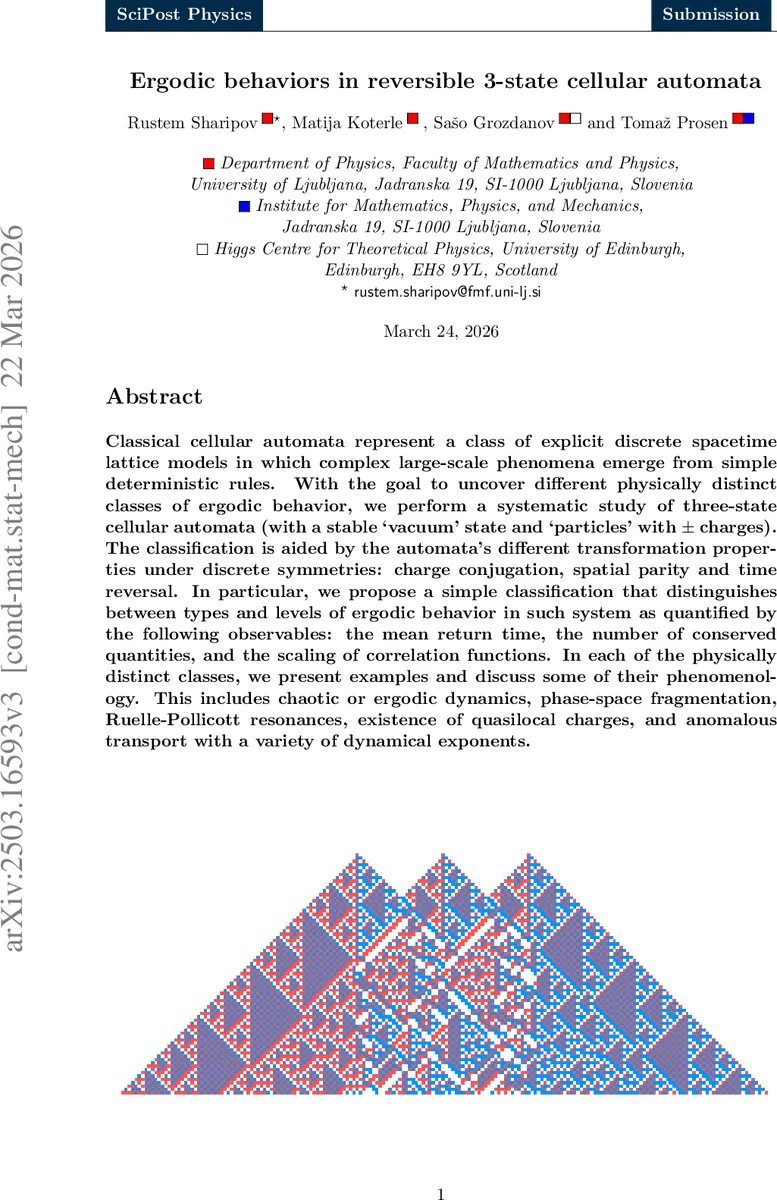
Representative rules for each class (e.g., 56231487 for Class I, 43162578 for Class II, 45321687 for Class III, 21354678 for Class IV) are illustrated with space‑time plots, confirming the distinct phenomenology. The authors also note a small subset of 35 rules that defy clear classification within the finite computational window, suggesting possible number‑theoretic irregularities in return‑time scaling.
Beyond the classification itself, the paper makes several conceptual contributions. First, it demonstrates that deterministic chaos can be quantified in purely discrete systems via Ruelle‑Pollicott resonances, offering a bridge between classical ergodic theory and cellular automata. Second, the emergence of quasi‑local conserved charges mirrors recent findings in quantum spin chains, hinting at a deeper algebraic structure common to both classical and quantum lattice models. Third, the variety of transport exponents observed (including anomalous diffusion) shows that even minimal reversible automata can reproduce complex non‑equilibrium phenomena typically associated with many‑body quantum dynamics.
Methodologically, the study combines exhaustive enumeration of symmetric rules, large‑scale Monte‑Carlo sampling for return‑time statistics, and spectral analysis of a transfer matrix built from translationally invariant observables to extract conserved charges and resonances. An appendix provides the algorithm for constructing conserved quantities and a complete table of all examined rules.
In conclusion, the work establishes three‑state reversible cellular automata as a fertile testing ground for ergodic theory, integrability, and chaotic dynamics in discrete settings. It opens several avenues for future research: extending the analysis to larger blocks (e.g., three‑site updates), exploring quantum analogues (unitary cellular automata), and developing analytic techniques (Bethe‑Ansatz‑like constructions) to explain the observed quasi‑local charges. The paper thus bridges a gap between abstract ergodic theory and concrete, computationally tractable lattice models, offering a new paradigm for studying emergent dynamics from simple deterministic rules.
Comments & Academic Discussion
Loading comments...
Leave a Comment