OpenDC-STEAM: Realistic Modeling and Systematic Exploration of Composable Techniques for Sustainable Datacenters
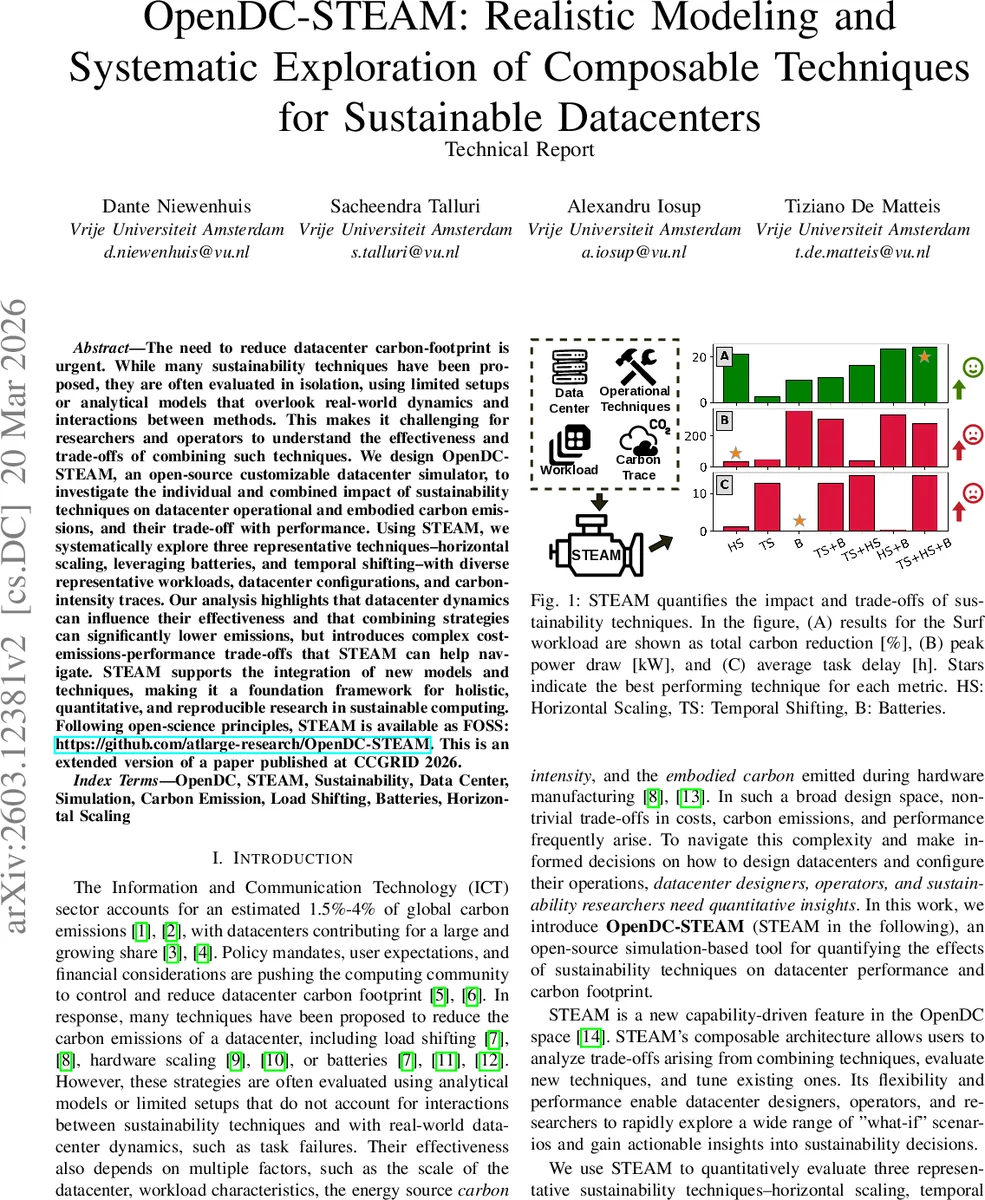
The need to reduce datacenter carbon footprint is urgent. While many sustainability techniques have been proposed, they are often evaluated in isolation, using limited setups or analytical models that overlook real-world dynamics and interactions between methods. This makes it challenging for researchers and operators to understand the effectiveness and trade-offs of combining such techniques. We design OpenDC-STEAM, an open-source customizable datacenter simulator, to investigate the individual and combined impact of sustainability techniques on datacenter operational and embodied carbon emissions, and their trade-off with performance. Using STEAM, we systematically explore three representative techniques - horizontal scaling, leveraging batteries, and temporal shifting - with diverse representative workloads, datacenter configurations, and carbon-intensity traces. Our analysis highlights that datacenter dynamics can influence their effectiveness and that combining strategies can significantly lower emissions, but introduces complex cost-emissions-performance trade-offs that STEAM can help navigate. STEAM supports the integration of new models and techniques, making it a foundation framework for holistic, quantitative, and reproducible research in sustainable computing. Following open-science principles, STEAM is available as FOSS: https://github.com/atlarge-research/OpenDC-STEAM.
💡 Research Summary
The paper presents OpenDC‑STEAM, an open‑source, extensible datacenter simulator designed to evaluate the carbon‑footprint and performance impact of sustainability techniques in a realistic, dynamic environment. Recognizing that prior work often assesses each technique in isolation using analytical models that ignore operational dynamics (e.g., failures, resource contention) and interactions among techniques, the authors build a discrete‑event simulation framework that integrates both operational and embodied carbon accounting, workload traces, carbon‑intensity time series, and failure models.
Design Overview
OpenDC‑STEAM extends the OpenDC framework with a composable component‑graph architecture. Each element—servers, power supplies, batteries, schedulers, carbon models—is represented as a component that emits and consumes events. This design enables plug‑and‑play addition of new power models, fault injectors, or sustainability policies without altering the core engine. Users provide (i) a datacenter topology (CPU, GPU, memory specifications, number of hosts), (ii) workload traces in a “bag‑of‑tasks” format (arrival time, resource demand, duration, deadline), (iii) carbon‑intensity traces (e.g., from ElectricityMaps or WattTime), and (iv) configuration parameters such as random seeds for reproducibility. The simulator then assembles a component graph, runs the event loop, and periodically collects metrics (power draw, operational carbon, embodied carbon, task latency, battery cycles, etc.).
Sustainability Techniques Studied
The authors focus on three representative techniques:
- Horizontal Scaling (HS) – Reducing the number of active machines to the minimum required for the workload, thereby cutting idle power and associated embodied carbon.
- Battery Utilization (B) – Storing low‑carbon electricity when the grid is green and discharging during high‑carbon periods. Batteries introduce embodied carbon from manufacturing and can cause charging spikes.
- Temporal Shifting (TS) – Delaying or pausing tasks during high‑carbon intervals and resuming them when the grid is cleaner. This requires tasks to be interruptible and delay‑tolerant; large‑scale shifting can create workload spikes.
Experimental Methodology
The authors evaluate each technique across a matrix of (a) diverse workloads (web services, batch jobs, AI training), (b) multiple datacenter configurations (varying CPU/GPU ratios, scale), and (c) real carbon‑intensity traces from different geographic regions. They also model realistic operational phenomena such as server failures, task retries, and power‑draw spikes.
Key Findings – Individual Techniques
- Horizontal Scaling can achieve up to 35 % reduction in total carbon (operational + embodied) when the datacenter is heavily over‑provisioned. However, when failure events or sudden demand spikes are considered, the realized savings drop to around 20 %, because spare capacity is needed for resilience.
- Battery Utilization yields up to 28 % carbon reduction when the charging policy aligns with periods of low‑carbon electricity and the battery’s state‑of‑charge is managed efficiently. Mis‑aligned charging, oversized batteries, or low‑efficiency storage can instead increase total carbon due to the high embodied carbon of batteries and charging spikes.
- Temporal Shifting shows a modest ≈ 7 % reduction, considerably lower than prior analytical estimates (often 10‑15 %). The simulation reveals that shifting many tasks to the same low‑carbon window creates server overload, leading to additional idle power consumption and, in some cases, higher operational carbon. Moreover, tasks that are not fully delay‑tolerant suffer increased latency, affecting service quality.
Key Findings – Combined Techniques
The composable nature of STEAM allows the authors to explore technique combinations:
- HS + B: Reducing the number of active servers while using batteries smooths power peaks and can push total carbon reduction to ≈ 45 %. Yet, battery charging spikes may reactivate otherwise idle servers, partially offsetting the benefit.
- HS + TS: Minimal server count amplifies the effect of shifting tasks to low‑carbon periods, but the concentration of tasks can cause temporary overload, necessitating additional servers and eroding the carbon gains.
- B + TS: Aligning battery discharge with shifted tasks can improve battery utilization, but if many tasks are shifted to the same interval, the combined load may exceed capacity, again causing spikes.
These results demonstrate that naïve additive reasoning (e.g., “35 % + 28 % = 63 %”) dramatically overstates achievable savings; interactions introduce new trade‑offs in power‑draw spikes, latency, and even cost.
Contribution to the Research Community
OpenDC‑STEAM provides:
- A realistic, reproducible simulation platform that captures both operational and embodied carbon, workload dynamics, and failure events.
- A composable architecture enabling rapid prototyping of new sustainability policies, power models, or fault scenarios.
- Empirical evidence that many previously reported carbon‑saving figures are optimistic when realistic datacenter dynamics are considered.
- Guidance for operators on how to select and combine techniques based on workload characteristics, regional carbon profiles, and performance constraints.
All code, configuration files, and trace datasets are released under an open‑source license on GitHub, adhering to open‑science principles and facilitating community‑driven extensions (e.g., integration with renewable‑energy forecasts, AI‑driven policy optimization).
Conclusion and Future Work
The study establishes that realistic simulation is essential for understanding the true impact of sustainability techniques in modern datacenters. OpenDC‑STEAM’s modular design makes it a foundational tool for future investigations into (i) renewable‑energy‑aware scheduling, (ii) multi‑objective optimization (cost, carbon, latency), and (iii) policy evaluation under diverse regulatory regimes. By exposing the complex trade‑offs that emerge when techniques are combined, STEAM empowers researchers, designers, and operators to make evidence‑based decisions toward greener, more efficient computing infrastructures.
Comments & Academic Discussion
Loading comments...
Leave a Comment