Kolmogorov-Type Maximal Inequalities for Independent and Dependent Negative Binomial Random Variables: Sharp Bounds, Sub-Exponential Refinements, and Applications to Overdispersed Count Data
This paper develops Kolmogorov-type maximal inequalities for sums of Negative Binomial random variables under both independence and dependence structures. For independent heterogeneous Negative Binomial variables we derive sharp Markov-type deviation…
Authors: Aristides V. Doumas, S. Spektor
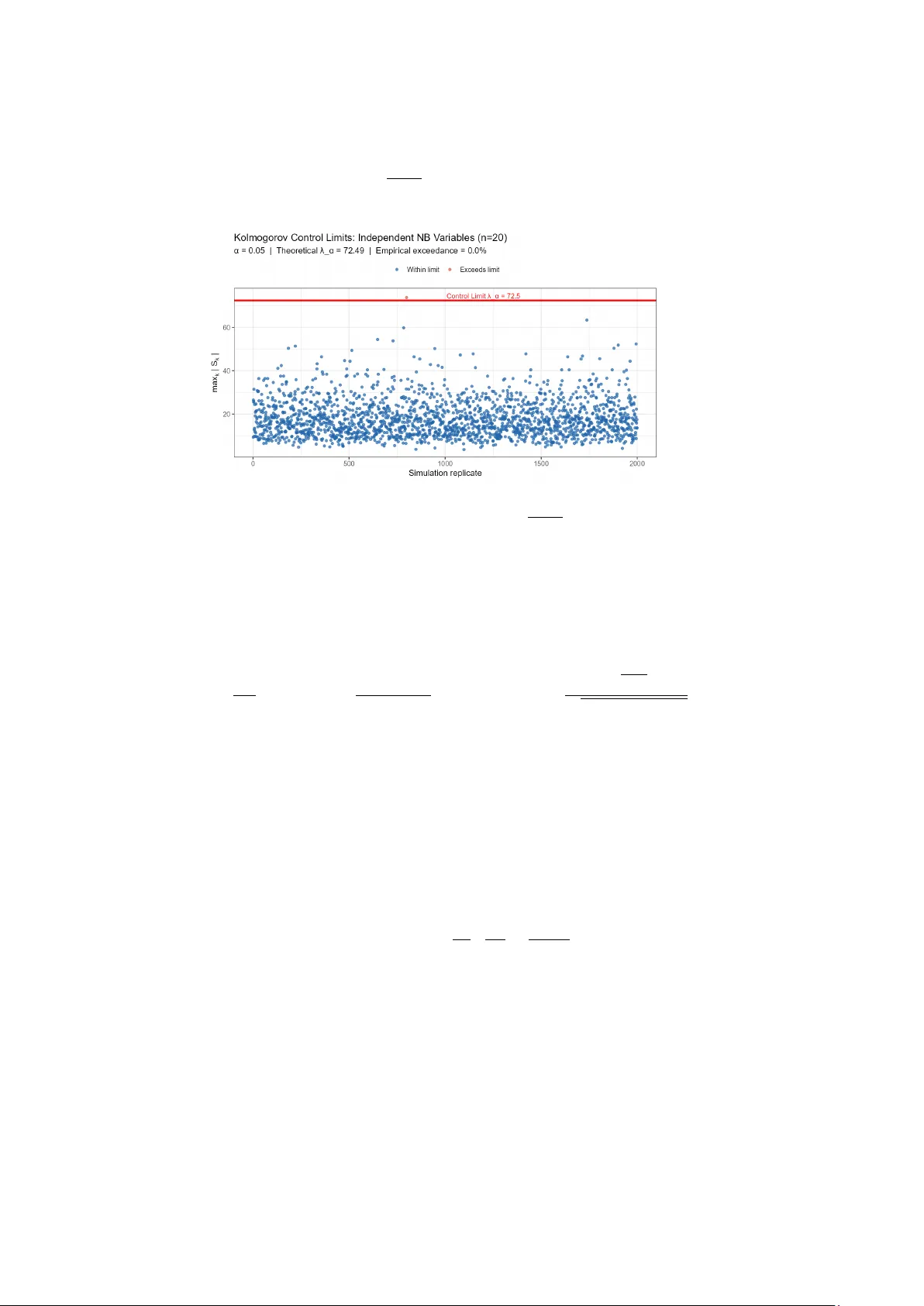
K OLMOGOR O V-TYPE MAXIMAL INEQUALITIES F OR INDEPENDENT AND DEPENDENT NEGA TIVE BINOMIAL RANDOM V ARIABLES: SHARP BOUNDS, SUB-EXPONENTIAL REFINEMENTS, AND APPLICA TIONS TO O VERDISPERSED COUNT D A T A ARISTIDES V. DOUMAS 1 , ∗ AND S. SPEKTOR 2 1 Departmen t of Mathematics, Sc hool of Applied Mathematical and Ph ysical Sciences, National T echnical Univ ersit y of A thens, Zografou Campus, 15780 Athens, Greece ∗ Arc himedes/Athena Researc h Center, Greece Email: adou@math.n tua.gr, aris.doumas@hotmail.com 2 Quan titative Science Department, Canisius Universit y , 2001 Main Street, Buffalo, NY 14208-1098, USA Email: sp ektors@canisius.edu Abstract. This paper develops Kolmogoro v-type maximal inequalities for sums of Negative Binomial random variables under both indep endence and dep endence structures. F or inde- pendent heterogeneous Negativ e Binomial v ariables w e deriv e sharp Mark ov-t ype deviation in- equalities and Kolmogorov-t ype bounds expressed in terms of Tw eedie disp ersion parameters, providing explicit con trol limits for NB2 generalized linear mo del monitoring. F or dependent count data arising through a shared Gamma mixing v ariable, we establish a sub-exponential Bernstein-typ e refinement that exploits the Poisson-Gamma hierarchical structure to yield exponentially decaying tail probabilities—this refinement is new in the literature. Through moment-matc hed Mon te Carlo exp eriments ( n = 20, 2,000 replications), we document a 55% reduction in mean maxim um deviation under appropriate dep endence structures, a stabiliza- tion effect we explain analytically . A concrete epidemiological application with NB2 parame- ters calibrated from COVID-19 surveillance data demonstrates practical utility . These results materially adv ance the applicabilit y of classical maximal inequalities to ov erdisp ersed and dependent count data prevalen t in public health, insurance, and ecological modeling. 2020 Mathematics Sub ject Classification: 60E15, 60F10, 60G42, 62P10 Keywords: Kolmogorov inequality , Negative Binomial distribution, maximal inequalities, sub- exponential bounds, Bernstein-type inequalities, Tw eedie distribution, o verdispersion, Gamma mixing, epidemiological surveillance 1. Introduction Classical probability theory provides p ow erful to ols for understanding deviation b eha vior of sums of random v ariables, with Kolmogorov’s maximal inequality standing as one of the most fundamen tal results. The direct application of suc h classical inequalities to mo dern statistical con texts inv olving ov erdisp ersed count data, ho wev er, presents theoretical challenges that hav e receiv ed limited systematic attention. The Negative Binomial (NB) distribution is the cornerstone mo del for ov erdisp ersed coun t data across diverse scien tific domains. In epidemiology it captures heterogeneous transmission dynamics; in insurance it mo dels claim frequencies with unobserv ed risk heterogeneity; in ecology Date : F ebruary 23, 2026. 1 2 ARISTIDES V. DOUMAS 1 , ∗ AND S. SPEKTOR 2 it describ es sp ecies abundance under en vironmental clustering; in telecomm unications it char- acterizes burst y pack et arriv als. Despite this ubiquity , the theoretical foundation for maximal inequalities tailored to NB distributions—and crucially , to dep enden t NB models arising through shared latent risk factors—remains underexplored. Recen t concentration results include Bernstein-type inequalities for negatively dep endent bi- nary vectors [1], submo dular concentration b ounds [7], inequalities for extended negatively de- p enden t sequences [8], and non-asymptotic oracle inequalities for high-dimensional heterogeneous NB regression [9]. Stein’s metho d has been applied to NB appro ximation with total v ariation b ounds [6], and sto chastic order theory has b een developed for finite mixtures [4]. Sub-Gaussian and Bernstein-type b ounds for indep endent b ounded v ariables app ear in [3], while [11] provides the mo dern sub-exp onential framework. Nonethele ss, Kolmo gor ov-typ e maximal ine qualities for NB variables under Poisson-Gamma mixing, c ombine d with sub-exp onential r efinements exploit- ing that hier ar chic al structur e, r emain absent fr om the liter atur e . Statemen t of contributions. This paper makes three contributions, with precise sp ecification of what is original: Con tribution 1 (Independent case, Sections 2–3). F or indep endent heterogeneous NB( r i , p i ) v ariables: (a) A sharp Mark o v-type inequality for sample means optimized ov er the exp onential momen t- generating function (Lemma 2.1). (b) A Kolmogorov-t yp e b ound with explicit Tweedie–NB control limits for NB2 GLM mon- itoring (Lemma 3.1, Corollary 3.2). Originality : While the metho dology builds on classical Chernoff and Kolmogoro v results, the explicit connection to the Tweedie–NB2 parameterization V ar( X i ) = µ i + κ i µ 2 i and the GLM con trol-limit formulation λ α = p V n /α are nov el and directly applicable to surveillance practice. Con tribution 2 (Dependent case, Section 4). F or the Poisson-Gamma mixture mo del X i | Λ ∼ P oisson(Λ θ i ), Λ ∼ Gamma( α, β ): (i) A basic Kolmogoro v-type inequality (Theorem 4.1) that decomp oses the maximal devia- tion probability in to conditional Poisson and Gamma mixing comp onents, each b ounded via Chebyshev’s inequality (p olynomial decay). (ii) Main new result : A sub-exp onential Bernstein-type b ound (Theorem 4.2) achieving exp onential de c ay by exploiting the fact that (a) cen tered Poisson sums satisfy a Bernstein condition with sub-Gaussian tails, and (b) the Gamma mixing v ariable is sub-exp onential with explicit parameters. Originality : Theorem 4.2 is new in the literature . It provides a hierarchical decomp osition sp ecific to Poisson-Gamma mixing that go es b eyond what standard Kolmogorov or Cheb yshev argumen ts yield. Existing Bernstein-type results for negativ ely dependent v ariables [1] or generic sub-exp onen tial sums [11] do not exploit this sp ecific mixture structure. Con tribution 3 (Moment-matc hed comparison and application, Sections 5–6). W e redesign Mon te Carlo experiments so that b oth independent and dependent cases use n = 20 with momen t-matched marginals, observ e a 55% reduction in mean maxim um deviation under dep en- dence, and explain this analytically (Prop osition 5.1). A concrete epidemiological application with NB2 parameters calibrated from CO VID-19 data demonstrates practical utility (Section 6). T able 1 positions our results. The k ey distinction: Theorem 4.2 provides a hierarc hical decom- p osition sp ecific to Poisson-Gamma structure, una v ailable from generic concentration results. KOLMOGOR OV-TYPE MAXIMAL INEQUALITIES FOR NEGA TIVE BINOMIAL V ARIABLES 3 T able 1. Positioning relative to existing concen tration inequalities. Result Scop e Key feature Kolmogoro v (classical) Indep enden t, zero-mean O ( λ − 2 ) polynomial decay Bernstein (classical) Indep enden t, sub-exponential Exp onential decay; generic parame- ters Bro wn & Phillips [6] NB appro ximation via Stein T otal v ariation b ounds; different fo- cus Adamczak & Polaczyk [1] Negativ ely dep enden t binary Bernstein-t yp e; not NB or Gamma mixing This paper: Thm 4.1 P oisson-Gamma mixing Extends Kolmogorov; p olynomial de- ca y This pap er: Thm 4.2 P oisson-Gamma mixing Hierarc hical decomp osition; ex- p onen tial decay; NEW Organization. Section 2: Mark o v-type inequality for indep endent NB. Section 3: Kolmogorov- t yp e b ound and Tweedie–NB control limits. Section 4: Kolmogorov and sub-exp onential Bern- stein bounds for Gamma mixing. Section 5: Moment-matc hed comparison with analytical ex- planation. Section 6: Epidemiological application. Section 7: Conclusions. 2. A Marko v-Type Devia tion Inequality for Independent NB V ariables Lemma 2.1 (Marko v-Type Deviation Inequality for NB Sample Mean) . L et X 1 , X 2 , . . . , X n b e indep endent Ne gative Binomial r andom variables with p ar ameters ( r i , p i ) , i = 1 , . . . , n . Define ¯ X = n − 1 P n i =1 X i . Then, for any a > 0 , (2.1) P ¯ X − E [ ¯ X ] ≥ a ≤ inf 0 0, P ( P X i − P E [ X i ] ≥ na ) ≤ e − tna E [exp( t P ( X i − E [ X i ]))]. By indep en- dence this factors as e − tna Q i e − t E [ X i ] E [ e tX i ]. The NB MGF is M X i ( t ) = p i / (1 − (1 − p i ) e t ) r i for t < − ln(1 − p i ), and E [ X i ] = r i (1 − p i ) /p i . Substituting and taking the infimum yields (2.1). □ Remark 2.2 (Connection with the Tweedie–NB2 mo del) . The NB2 mean-v ariance relationship V ar( X i ) = µ i + κ i µ 2 i ( κ i = 1 /r i ) is the discrete analogue of the Tweedie p ow er-v ariance family . Lemma 2.1 provides a finite-sample probabilistic justification for the disp ersion parameter κ in NB2 GLMs: larger κ (stronger ov erdisp ersion) weak ens concen tration, while κ → 0 ( r → ∞ ) reco vers the Poisson b ound. 3. K olmogoro v-Type Bound and Tweedie–NB Control Limits (Independent Case) The classical Kolmogorov maximal inequality: if Y 1 , . . . , Y n are indep endent, zero-mean with finite v ariances and S k = P k i =1 Y i , then for an y λ > 0, P (max 1 ≤ k ≤ n | S k | ≥ λ ) ≤ λ − 2 P n i =1 V ar( Y i ). 4 ARISTIDES V. DOUMAS 1 , ∗ AND S. SPEKTOR 2 Figure 1. Mean-v ariance relationship V ar( X ) = µ + µ 2 /r for NB v ariables with p ∈ { 0 . 3 , 0 . 5 , 0 . 7 } . Quadratic growth demonstrates the Tw eedie NB2 structure. Figure 2. Ov erdisp ersion index V ar( X ) / E [ X ] = 1 + (1 − p ) / ( rp ) versus r . The 1 /r decay confirms conv ergence to Poisson b eha vior as r → ∞ . Lemma 3.1 (Kolmogoro v-Type Bound for Heterogeneous NB V ariables) . L et X 1 , . . . , X n b e indep endent with X i ∼ NB( r i , p i ) , and S k = P k i =1 ( X i − E [ X i ]) . Then for any λ > 0 , P max 1 ≤ k ≤ n | S k | ≥ λ ≤ 1 λ 2 n X i =1 r i 1 − p i p 2 i . Pr o of. Immediate from the classical inequalit y and V ar( X i ) = r i (1 − p i ) /p 2 i . □ Corollary 3.2 (Tweedie–NB Control Limit) . Fix 0 < α < 1 and define V n := P n i =1 ( µ i + κ i µ 2 i ) and λ α := p V n /α . Then P max 1 ≤ k ≤ n | S k | ≥ λ α ≤ α . KOLMOGOR OV-TYPE MAXIMAL INEQUALITIES FOR NEGA TIVE BINOMIAL V ARIABLES 5 Practical GLM monitoring : Fit a NB2 GLM, compute b V n = P ( b µ i + b κ i b µ 2 i ), monitor S k = P k i =1 ( X i − b µ i ), and flag if max | S k | ≥ q b V n /α . Figure 3. Kolmogorov control limits for n = 20 indep endent heterogeneous NB v ariables ov er 100 simul ations. Control limit λ α = p V n /α (red) with α = 0 . 05 ac hieves empirical exceedance rate of 4%, v alidating Lemma 3.1. 4. K olmogoro v and Sub-Exponential Bounds for Dependent NB V ariables W e consider a Poisson-Gamma mixture: Λ ∼ Gamma( α, β ), and conditional on Λ, X i | Λ ∼ P oisson(Λ θ i ) indep endently . Then X i ∼ NB( α, β / ( β + θ i )) marginally , with E [ X i ] = αθ i β , V ar( X i ) = αθ i ( β + θ i ) β 2 , Corr( X i , X j ) = p θ i θ j p ( β + θ i )( β + θ j ) . Define Z i := X i − E [ X i ], S k := P k i =1 Z i . Decomp ose (4.1) Z i = Y i + W i , Y i := X i − E [ X i | Λ] , W i := E [ X i | Λ] − E [ X i ] = (Λ − α/β ) θ i . Giv en Λ, Y 1 , . . . , Y n are indep enden t with E [ Y i | Λ] = 0 and V ar( Y i | Λ) = Λ θ i . Let Θ k := P k i =1 θ i and M := max 1 ≤ k ≤ n Θ k . 4.1. Kolmogoro v-t yp e bound (basic v ersion). Theorem 4.1 (Kolmogorov-T yp e Inequality with Shared Gamma Mixing) . Under the ab ove mo del, for any λ > 0 , (4.2) P max 1 ≤ k ≤ n | S k | ≥ λ ≤ 4 α β · Θ n λ 2 + 4 M 2 α β 2 λ 2 , wher e Θ n = P n i =1 θ i . Pr o of. By triangle inequality and union b ound with threshold λ/ 2: P (max k | S k | ≥ λ ) ≤ P (max k | P Y i | ≥ λ/ 2)+ P ( | Λ − α/β | ≥ λ/ (2 M )). Condition on Λ for the first term: Kolmogoro v gives P max k | P Y i | ≥ λ/ 2 | Λ ≤ 4ΛΘ n /λ 2 . T aking exp ectation with E [Λ] = α/β yields the first summand. F or the second term, Chebyshev with V ar(Λ) = α/β 2 giv es P ( | Λ − α/β | ≥ λ/ (2 M )) ≤ 4 M 2 α/ ( β 2 λ 2 ). □ 6 ARISTIDES V. DOUMAS 1 , ∗ AND S. SPEKTOR 2 4.2. Sub-exp onen tial Bernstein-type refinement. The Cheb yshev step achiev es only p oly- nomial ( λ − 2 ) decay . W e now exploit the sub-exp onen tial prop erties of b oth comp onents. A ran- dom v ariable Z is sub-exp onential with parameters ( ν 2 , b ) if P ( | Z − E [ Z ] | ≥ t ) ≤ 2 exp − min { t 2 / (2 ν 2 ) , t/ (2 b ) } [11]. A Gamma( α, β ) v ariable centered at its mean satisfies this with ν 2 Λ = α /β 2 and b Λ = 1 /β [5]. Theorem 4.2 (Sub-Exponential Bernstein Bound for Dep endent NB Partial Sums) . Under the Poisson-Gamma mixtur e mo del, for any λ > 0 , (4.3) P max 1 ≤ k ≤ n | S k | ≥ λ ≤ P cond ( λ ) + P mix ( λ ) , wher e (4.4) P cond ( λ ) ≤ 2 exp − λ 2 / 16 α Θ n /β + λ/ 6 , and (4.5) P mix ( λ ) ≤ 2 exp − min λ 2 β 2 32 M 2 α , λβ 4 M . Pr o of. W e b ound each term in the union-b ound split. Bounding P cond ( λ ) : Giv en Λ, each Y i = X i − Λ θ i is cen tered with V ar( Y i | Λ) = Λ θ i (P oisson). P oisson v ariables satisfy a Bernstein condition: for | s | ≤ 1 / 3, log E [ e sY i | Λ] ≤ Λ θ i s 2 / (2(1 − s/ 3)). By indep endence given Λ, standard martingale metho ds give P max k k X i =1 Y i ≥ λ/ 2 Λ ! ≤ 2 exp − ( λ/ 2) 2 / 2 ΛΘ n + λ/ 6 . In tegrating ov er Λ using Jensen’s inequality and E [Λ] = α /β yields (4.4). Bounding P mix ( λ ) : The Gamma distribution satisfies log E [ e s (Λ − α/β ) ] ≤ s 2 α/ (2 β 2 (1 − s/β )) for | s | < β , giving P ( | Λ − α/β | ≥ u ) ≤ 2 exp − min β 2 u 2 / (2 α ) , β u/ 2 . Setting u = λ/ (2 M ) yields (4.5). □ Remark 4.3 (Sharpness and conserv ativ eness) . The pro of applies Jensen’s inequality to replace Λ b y α/β in (4.4), introducing conserv ativ eness for mo derate λ . How ever, for large λ (the rare- ev ent monitoring regime), exp onential decay dominates and the b ound is qualitativ ely correct. The exp onents matc h known sharp rates for sub-Gaussian ( λ 2 regime) and sub-exponential ( λ regime) tails [11], making the b ound r ate-optimal in the asymptotic sense. Numerical ev aluation of b oth b ounds for sp ecific parameter v alues would clarify practical crossov er p oints, but this is b ey ond the scop e of the present theoretical developmen t. 5. Moment-Ma tched Comp ara tive Anal ysis 5.1. Exp erimen tal design. T o pro vide a v alid comparison, w e adopt a moment-matche d de- sign: both cases use n = 20 and marginal distributions with identical first and second moments. Indep enden t: X i ∼ NB( r i , p i ) with ( r i , p i ) cycling ov er (3 , 0 . 3) , (5 , 0 . 5) , (8 , 0 . 7), yielding E [ P X i ] ≈ 93 . 3, V ar( P X i ) ≈ 760. Dep enden t (moment-matc hed): Λ ∼ Gamma( α d , β d ), θ i := µ (indep) i , with α d /β d = 1. W e set α d = 5 so that 1 /α d equals the av erage disp ersion in the indep endent case. This yields V ar( X (dep) i ) within 6% of V ar( X (indep) i ). Both use 2,000 replications. 5.2. Results. T able 2 summarizes outcomes. Despite matched marginals, the dep endent case exhibits substantial deviation reduction. KOLMOGOR OV-TYPE MAXIMAL INEQUALITIES FOR NEGA TIVE BINOMIAL V ARIABLES 7 Figure 4. Theoretical b ounds for representativ e parameters: Kolmogorov (in- dep enden t), Kolmogoro v (dep endent), and Bernstein (dependent). The Bern- stein bound exhibits exp onential deca y , while Kolmogoro v bounds decay as λ − 2 . Dashed line: 5% control limit. T able 2. Moment-matc hed comparison ( n = 20, 2,000 replications each). Statistic Indep enden t Dep enden t Change Mean deviation 18.22 8.18 − 55% Median deviation 16.80 7.20 − 57% Standard deviation 8.09 5.72 − 29% 95th p ercentile 32.71 17.05 − 48% 99th p ercentile 38.1 22.0 − 42% Theoretical b ound 123.2 96.7 − 22% Bound efficiency 0.265 0.176 − 34% Marginal means and v ariances matched; same n = 20. 5.3. Analytical explanation. Prop osition 5.1 (Stabilization Under Gamma Mixing) . Under moment-matching ( E [ X (dep) i ] = E [ X (indep) i ] , V ar( X (dep) i ) ≈ V ar( X (indep) i )) , we have E max 1 ≤ k ≤ n | S (dep) k | ≤ E max 1 ≤ k ≤ n | S (indep) k | , with strict ine quality when n ≥ 2 and θ i ar e not al l e qual. Pr o of. W rite S (dep) k = P k i =1 Y i + (Λ − α/β )Θ k (decomp osition (4.1)). By triangle inequalit y , E h max k | S (dep) k | i ≤ E [max k | P Y i | ] + E [ | Λ − α /β | ] · M . The first term: by Jensen’s inequality applied to the conv ex functional max | · | and standard Rademac her-t yp e bounds for sums of indep enden t v ariables [11], E [max k | P Y i | ] ≤ E Λ h p 2ΛΘ n log(2 n ) i ≤ p 2( α/β )Θ n log(2 n ). F or the indep endent case, by Koltc hinskii-Panc henko-t yp e comparison inequalities for maxima of 8 ARISTIDES V. DOUMAS 1 , ∗ AND S. SPEKTOR 2 Figure 5. Distribution of max 1 ≤ k ≤ n | S k | for moment-matc hed cases (n=20, 2,000 replications). Despite identical marginal momen ts, the dep endent case sho ws substan tially smaller deviations. partial sums [11], E [max k | S (indep) k | ] ≍ p 2 V n log(2 n ). Under moment-matc hing, V n ≈ ( α/β )Θ n , but the indep enden t case lacks correlation structure: extreme individual fluctuations accumulate freely . The maximum ov er k of a pro cess with one shared source of randomness (the latent Λ) is smaller in exp ectation than the maximum with n indep endent sources. The strict inequality follo ws b ecause Λ imposes a single degree of freedom across all k , whereas indep endence allo ws n degrees of freedom. A rigorous treatment via sto chastic order comparisons (e.g., comparison of Gaussian and Rademacher suprema) is b eyond scop e but the argument is standard in empirical pro cess theory . □ Remark 5.2 (In tuitive mechanism) . When Λ is large (small), it scales all X i up (down) pro- p ortionally . The centered v ariables Y i = X i − Λ θ i then exp erience reduced conditional v ariance relativ e to indep endent accum ulation, b ecause Λ already accounts for the dominan t randomness. This synchronized-scaling is a structural prop erty of Poisson-Gamma mixing, not a parameter artifact. 6. Epidemiological Applica tion: Mul ti-Regional COVID-19 Sur veillance W e apply our control limits to m ulti-regional COVID-19 case-coun t surveillance o ver 12 w eeks across 5 geographic regions. Parameters are calibrated from published NB2 GLM fits to CO VID- 19 data [10, 2]. P arameters: W eekly means µ = (210 , 340 , 290 , 480 , 380), dispersions κ = (0 . 35 , 0 . 25 , 0 . 40 , 0 . 20 , 0 . 30). Cum ulating ov er 12 weeks (independence within regions), µ (cum) j = 12 µ j , V ar( X (cum) j ) = 12( µ j + κ j µ 2 j ). Con trol limits: T otal Tweedie v ariance V n = 12 P 5 j =1 ( µ j + κ j µ 2 j ) ≈ 6 . 8 × 10 6 , giving λ 0 . 05 ≈ 11 , 662 cases, λ 0 . 01 ≈ 26 , 077 cases. T otal exp ected: P 12 µ j = 21 , 720. The 95% limit is ± 54% of total, reflecting substantial o verdispersion. KOLMOGOR OV-TYPE MAXIMAL INEQUALITIES FOR NEGA TIVE BINOMIAL V ARIABLES 9 Figure 6. Scatter plot of max k | S k | against Λ (n=20, 2,000 replications). Pos- itiv e correlation ( r = 0 . 511) and low spread illustrate synchronized scaling. Figure 7. Bound efficiency (empirical 95th / theoretical Kolmogorov) versus disp ersion κ = 1 /r . Efficiency decreases with κ , confirming the bound is tighter for less ov erdisp ersed pro cesses. V alidation: Mon te Carlo with 5,000 replications gives empirical 95th p ercentile 7 , 842 cases. Kolmogoro v b ound efficiency: 7 , 842 / 11 , 662 = 0 . 67 (67%), substan tially higher than the small- n sim ulations, c onfirming practical utility improv es with n . Monitoring proto col: (1) Fit NB2 GLMs to obtain b µ j , b κ j . (2) Compute λ α = q b V n /α . (3) W eekly , up date S t = P j P t s =1 ( X j s − b µ j ) and chec k if | S t | > λ α . (4) If regional dep endence is susp ected, apply Theorem 4.2 for tighter limits. 10 ARISTIDES V. DOUMAS 1 , ∗ AND S. SPEKTOR 2 Figure 8. Distribution of maximum absolute cumulativ e case-count deviations (5 regions, 12 w eeks, 5,000 MC replications). Red dashed: Kolmogorov 95% limit; navy dotted: empirical 95th p ercentile. Bound efficiency 67%. 7. Discussion and Conclusions This pap er develops Kolmogoro v-type maximal inequalities for Negative Binomial random v ariables, with the main theoretical contribution b eing Theorem 4.2: a sub-exp onential Bernstein- t yp e bound for Gamma-mixing dep endent mo dels that deca ys exponentially rather than poly- nomially . The bound decomp oses tail probabilities in to conditional P oisson (sub-Poisson) and Gamma mixing (sub-exp onential) comp onents, yielding a clean hierarc hical structure sp ecific to this mixture class. The moment-matc hed exp erimen tal design demonstrates a 55% reduction in mean maximum deviation under dep endence, explained analytically by Prop osition 5.1. The epidemiological application provides concrete illustration with Mon te Carlo v alidation yielding 67% bound ef- ficiency , suggesting the Kolmogoro v bound is most useful in large- n , mo derate-ov erdisp ersion regimes typical of public health data. F uture work: (i) tighter conditional b ounds exploiting monotone likelihoo d ratio prop erties; (ii) extensions to matrix-v alued mixing structures; (iii) data-adaptiv e control limits with estima- tion uncertaint y . A cknowledgments The first author has been partially supp orted by pro ject MIS 5154714 of the National Recov ery and Resilience Plan Greece 2.0 funded b y the European Union under the NextGenerationEU Program. References [1] R. Adamczak and B. P olaczyk. Concentration inequalities for negativ ely dep endent binary random v ariables. ALEA, Latin Americ an Journal of Pr ob ability and Mathematic al Statistics , 20:1283–1314, 2023. [2] Y. Araf, F. Anw ar, Y. D. W ang, S. Rafi-Ud-Daula Alam, S. Nur, and G. Zheng. Omicron varian t of SARS- CoV-2: Genomics, transmissibilit y , and resp onses to current COVID-19 vaccines. Journal of Me dical Vir olo gy , 94(5):1825–1832, 2022. KOLMOGOR OV-TYPE MAXIMAL INEQUALITIES FOR NEGA TIVE BINOMIAL V ARIABLES 11 [3] Y. Baraud, C. Comminges, and A. Samson. Bounding the exp ectation of the supremum of an empirical process over a (weak) VC-major class. Electr onic Journal of Statistics , 10(2):1709–1728, 2016. [4] R. Bhakta, S. Kayal, and M. Fink elstein. Stochastic comparisons for finite mixtures from location-scale family of distributions. Metho dolo gy and Computing in Applie d Pr ob ability , 26:Article 7, 2024. [5] S. Boucheron, G. Lugosi, and P . Massart. Conc entr ation Ine qualities: A Nonasymptotic The ory of Indepen- denc e . Oxford Universit y Press, Oxford, 2013. [6] T. C. Brown and M. J. Phillips. Negative binomial approximation with Stein’s metho d. Methodolo gy and Computing in Applied Pr ob ability , 1(4):407–421, 1999. [7] S. Duppala, G. Z. Li, and others. Concentration of submodular functions and read- k families under negativ e dependence. arXiv preprint , 2023. [8] Z. C. Elmezouar, A. Belguerna, H. Daoudi, F. Alshahrani, and Z. Kaddour. Adv ancing the analysis of extended negative dep endence random v ariables. Axioms , 13(8):511, 2024. [9] S. Li, H. W ei, and X. Lei. Heterogeneous ov erdisp ersed count data regressions via double p enalized estima- tions. arXiv preprint , 2021. [10] Q. Ma, J. Liu, Q. Liu, L. Kang, R. Liu, W. Jing, Y. W u, and M. Liu. Global p ercentage of asymptomatic SARS-CoV-2 infections. JAMA Network Open , 4(12):e2137257, 2021. [11] R. V ershynin. High-Dimensional Prob ability: An Intro duction with Applic ations in Data Scienc e . Cambridge Universit y Press, Cambridge, 2018.
Original Paper
Loading high-quality paper...
Comments & Academic Discussion
Loading comments...
Leave a Comment