Phase Transitions in a Modified Ising Spin Glass Model: A Tensor-Network-based Sampling Approach
Phase transitions in a modified Nishimori model, including the model considered by Kitatani, on a two-dimensional square lattice are investigated using a tensor-network-based sampling scheme. In this model, generating bond configurations is computationally demanding because of the correlated random interactions. The employed sampling method enables hierarchical and independent sampling of both bonds and spins. This approach allows high-precision calculations for system sizes up to $L=256$. The results provide clear numerical evidence that the spin-glass and ferromagnetic transitions are separated on the Nishimori line, supporting the existence of an intermediate Mattis-like spin-glass phase. This finding is consistent with the reentrant transition numerically observed in the two-dimensional Edwards-Anderson (EA) model. Furthermore, critical exponents estimated via finite-size-scaling analysis indicate that the universality class of the transitions differs from that of the standard independent and identically distributed EA model.
💡 Research Summary
The paper investigates phase transitions in a modified Nishimori Ising spin‑glass model on a two‑dimensional square lattice, employing a tensor‑network‑based hierarchical sampling scheme that can handle the model’s intrinsically correlated bond disorder. In the standard Edwards‑Anderson (EA) spin glass, bonds are independent identically distributed (i.i.d.) random variables. By contrast, the modified Nishimori model defines the bond distribution through a ratio of partition functions, P(τ;γ,β_p) ∝ Z_τ(γ) e^{β_p∑τ_ij}/Z_τ(β_p), which introduces non‑trivial correlations among τ_ij. Direct sampling from this distribution is computationally prohibitive.
The authors resolve this difficulty by exploiting the gauge symmetry of the Ising Hamiltonian. They rewrite the correlated bond distribution as a two‑step process: (i) generate an i.i.d. set of auxiliary bonds J_ij from the standard EA distribution with parameter γ; (ii) sample a gauge spin configuration σ_i from the Boltzmann distribution of the EA model at inverse temperature β_p. The physical bonds are then obtained via the gauge transformation τ_ij = J_ij σ_i σ_j, which reproduces the target distribution exactly. This decomposition separates the source of frustration (encoded in J) from the specific bond realization (encoded in σ), allowing independent sampling of both.
To achieve high precision for large systems (up to L = 256), the authors adopt a tensor‑network (TN) based sampler. For any target distribution P(S) ∝ e^{−βH(S)} the TN contracts to produce an approximate proposal distribution Q(S). Each generated spin configuration S receives a reweighting factor w = e^{−βH(S)}/Q(S). The effective sample size (ESS) is shown to be essentially equal to the number of generated samples, confirming that Q(S) is an excellent approximation and that the samples are statistically independent. This TN approach circumvents the slow thermalisation and autocorrelation problems typical of conventional Markov‑chain Monte Carlo (MCMC) methods.
Using the hierarchical scheme, the authors generate many independent gauge configurations σ for each J realization and, for each σ, many independent physical spin configurations S. Thermal averages ⟨O⟩_τ are computed by averaging over the S samples, while disorder averages are obtained by further averaging over σ and J with appropriate weights. The observables of interest are the magnetization m = (1/N)∑_i S_i and the spin‑glass order parameter q = (1/N)∑_i S_i^{(1)}S_i^{(2)}. Under the gauge transformation, the magnetization becomes a correlation between spins at two different temperatures, ⟨σ_i S_i⟩, directly probing temperature chaos. The Binder ratio of m and the second moment of q are used for finite‑size scaling (FSS).
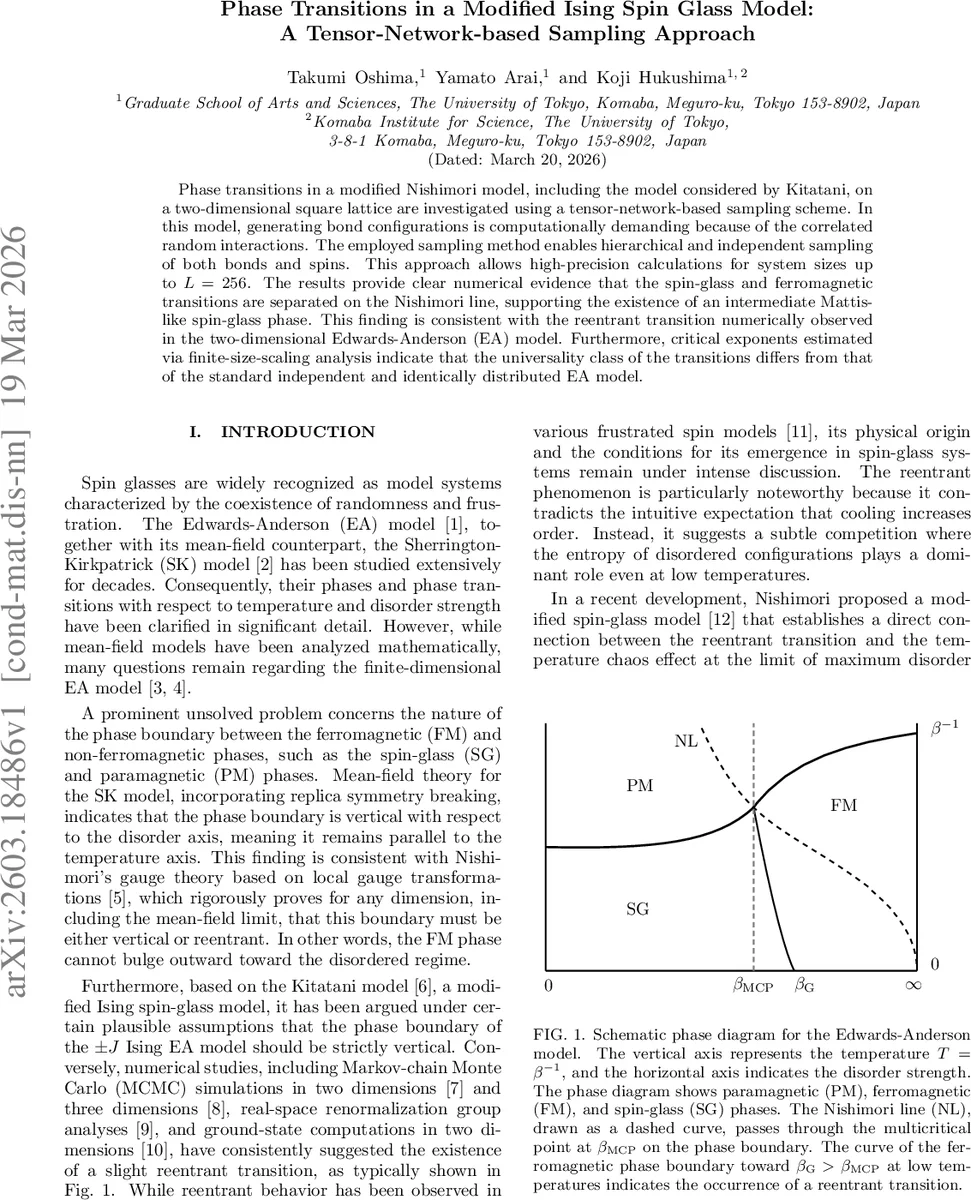
The numerical results reveal that, on the Nishimori line (β = γ), the ferromagnetic (FM) and spin‑glass (SG) transitions are distinct rather than coincident. Specifically, the authors locate a multicritical point β_MCP ≈ 1.042 and a higher temperature β_X ≈ 1.066–1.082, defining a narrow interval β_MCP < β < β_X where an intermediate Mattis‑like spin‑glass (M‑SG) phase exists. This provides clear numerical evidence for the separation of FM and SG transitions and supports the existence of the M‑SG phase, consistent with the re‑entrant behavior previously observed in the standard 2D EA model.
Finite‑size scaling of the Binder ratio and the SG susceptibility yields critical exponents that differ from those of the i.i.d. EA model. The estimated correlation‑length exponent ν≈2.8–2.9 and anomalous dimension η≈0.12–0.15 are significantly lower than the EA values (ν≈3.5, η≈0). This indicates that the correlated bond disorder places the system in a different universality class.
In conclusion, the paper demonstrates that the correlated bond distribution inherent to the modified Nishimori model naturally gives rise to a re‑entrant ferromagnetic boundary and an intermediate Mattis‑like spin‑glass phase. The tensor‑network‑based sampling framework proves to be a powerful tool for studying spin‑glass systems with non‑trivial disorder correlations, enabling high‑precision simulations of large lattices that were previously inaccessible. The methodology and findings open avenues for exploring similar correlated‑disorder models in higher dimensions and for investigating the broader implications of disorder correlations on universality and phase‑transition behavior.
Comments & Academic Discussion
Loading comments...
Leave a Comment