Ambidextrous global spectra and tempered cohomology
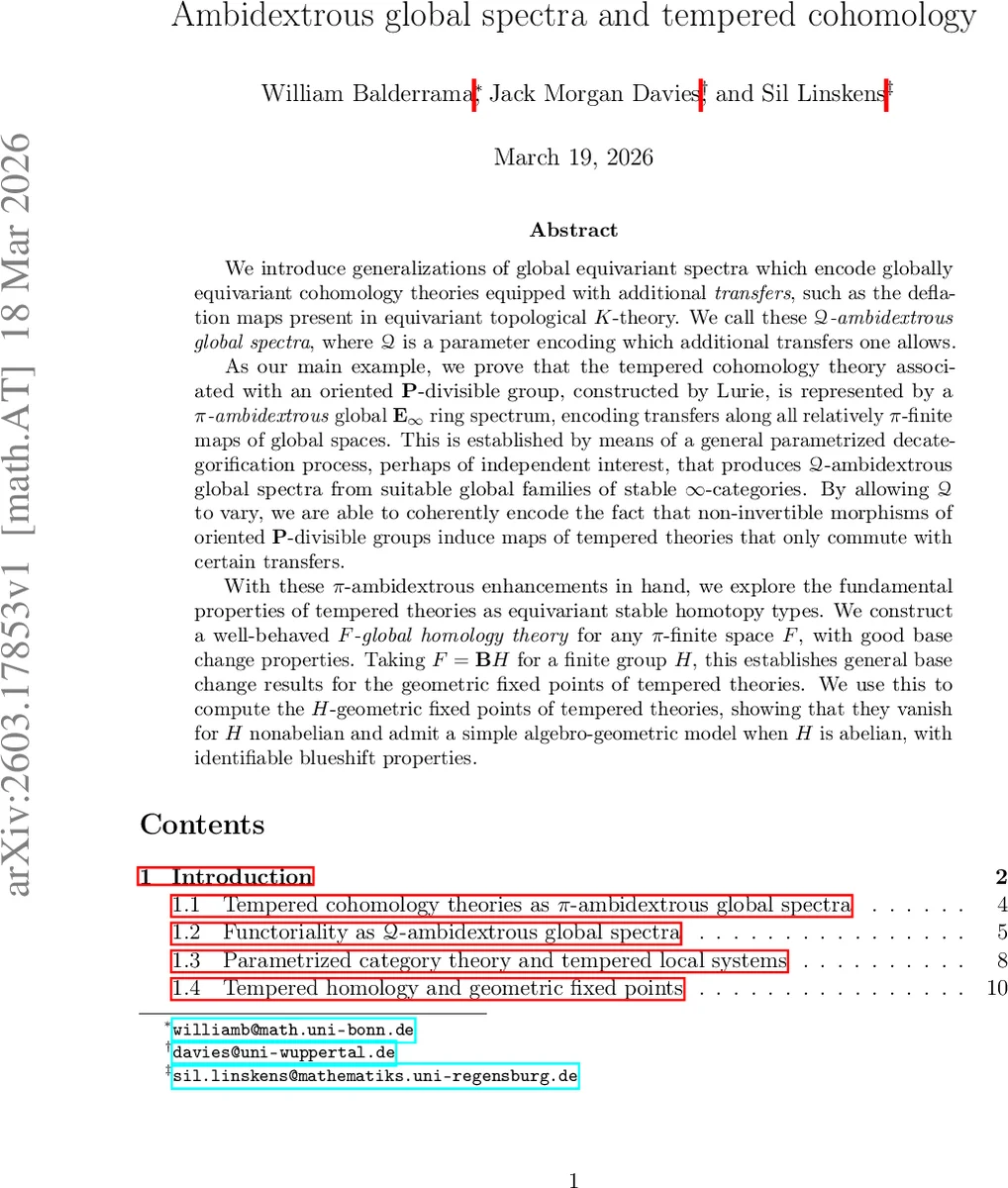
We introduce generalizations of global equivariant spectra which encode globally equivariant cohomology theories equipped with additional transfers, such as the deflation maps present in equivariant topological $K$-theory. We call these $\mathcal{Q}$-ambidextrous global spectra, where $\mathcal{Q}$ is a parameter encoding which additional transfers one allows. As our main example, we prove that the tempered cohomology theory associated with an oriented $\mathbf{P}$-divisible group, constructed by Lurie, is represented by a $π$-ambidextrous global $\mathbf{E}_\infty$ ring spectrum, encoding transfers along all relatively $π$-finite maps of global spaces. This is established by means of a general parametrized decategorification process, perhaps of independent interest, that produces $\mathcal{Q}$-ambidextrous global spectra from suitable global families of stable $\infty$-categories. By allowing $\mathcal{Q}$ to vary, we are able to coherently encode the fact that non-invertible morphisms of oriented $\mathbf{P}$-divisible groups induce maps of tempered theories that only commute with certain transfers. With these $π$-ambidextrous enhancements in hand, we explore the fundamental properties of tempered theories as equivariant stable homotopy types. We construct a well-behaved $F$-global homology theory for any $π$-finite space $F$, with good base change properties. Taking $F = \mathbf{B} H$ for a finite group $H$, this establishes general base change results for the geometric fixed points of tempered theories. We use this to compute the $H$-geometric fixed points of tempered theories, showing that they vanish for $H$ nonabelian and admit a simple algebro-geometric model when $H$ is abelian, with identifiable blueshift properties.
💡 Research Summary
The paper introduces a broad generalization of global equivariant spectra designed to capture additional transfer structures that appear in tempered cohomology theories, such as the deflation maps familiar from equivariant complex K‑theory. The authors define a family of “Q‑ambidextrous global spectra” Sp^{gl}Q, where Q is an inductive subcategory of the global orbit category of finite abelian groups. A Q‑ambidextrous spectrum is a functor from the span category Span_Q(S^{gl}{ab}) to spectra, allowing arbitrary backward maps and forward maps restricted to Q. This framework interpolates between ordinary global cohomology theories (Q = isomorphisms) and Schwede’s global spectra (Q = faithful maps), and it adds a new layer when Q consists of all maps, thereby encoding deflations (transfers along arbitrary group homomorphisms).
A central case is Q = S_π, the subcategory of π‑finite spaces, yielding the category Sp^{gl}_π of π‑ambidextrous global spectra. Objects in this category possess coherent restriction and transfer maps for every relatively π‑finite morphism of global spaces. This matches Lurie’s ambidexterity theorem for tempered cohomology, which guarantees transfers along all such maps.
To construct concrete examples, the authors develop a parametrized decategorification procedure. Starting from a parametrized family of stable ∞‑categories equipped with Q‑semiadditivity and Q‑stability, they define global sections Γ(𝒞) that inherit the desired transfer structure. Applying this to Lurie’s tempered local systems 𝒪_G attached to an oriented P‑divisible group G over an E_∞‑ring A, they obtain a π‑ambidextrous E_∞‑ring spectrum A_G = Γ(𝒪_G). This spectrum refines Lurie’s tempered cohomology A(–)_G and carries transfers for all relatively π‑finite maps. The construction is natural in the base stack, so it works for families of P‑divisible groups over arbitrary (possibly non‑connective) spectral Deligne–Mumford stacks.
The paper further refines the theory by introducing, for any set of primes S, a wide subcategory S⊥π ⊂ S_π consisting of morphisms that are “away from S” (they do not interact with p‑primary information for p∈S). Correspondingly, they define Sp^{gl}{S⊥π}, the category of π‑ambidextrous spectra away from S. They also consider the wide subcategory PDiv{or}^{∤S} of oriented P‑divisible groups whose morphisms are isomorphisms on p‑local components for all p∉S. Theorem A (Theorem 5.1.2) asserts a functor (PDiv_{or}^{∤S})^{op} → CAlg(Sp^{gl}_{S⊥π}), G ↦ Γ(𝒪_G), thereby encoding the precise way non‑invertible morphisms of P‑divisible groups respect only a subset of transfers.
Concrete examples illustrate the power of this framework. The torsion subgroup μ_{p^∞} ⊂ 𝔾_m over KU yields a π‑ambidextrous equivariant complex K‑theory spectrum KU with all deflations. Adams operations ψ_ℓ act as maps of π‑ambidextrous spectra only when ℓ is coprime to the relevant primes, recovering classical results of Hirata–Kono. Similar phenomena appear for real K‑theory (KO) and topological modular forms (TMF) via the universal oriented elliptic curve.
The authors also develop an F‑global homology theory for any π‑finite space F, establishing good base‑change properties. Specializing to F = BH for a finite group H, they obtain general base‑change formulas for geometric fixed points of tempered theories. They compute these fixed points: they vanish for non‑abelian H, while for abelian H they admit an explicit algebro‑geometric description exhibiting a “blueshift” phenomenon.
Overall, the paper provides a robust categorical infrastructure—Q‑ambidextrous global spectra and parametrized decategorification—that systematically incorporates additional transfers into global equivariant homotopy theory. It lifts Lurie’s tempered cohomology to genuine π‑ambidextrous E_∞‑ring spectra, clarifies the functorial behavior of such theories under morphisms of P‑divisible groups, and yields concrete computational tools for geometric fixed points and base‑change. This work opens new avenues for studying higher chromatic analogues of equivariant K‑theory, refined transfer structures, and their interactions with global stable homotopy theory.
Comments & Academic Discussion
Loading comments...
Leave a Comment