The inverse problem for the Steiner--Wiener index via additive number theory
We show that, for any given $k \ge 2$, every sufficiently large number appears as the Steiner--Wiener $k$ index of a graph.
Authors: Christian Bernert, Joshua Shaw
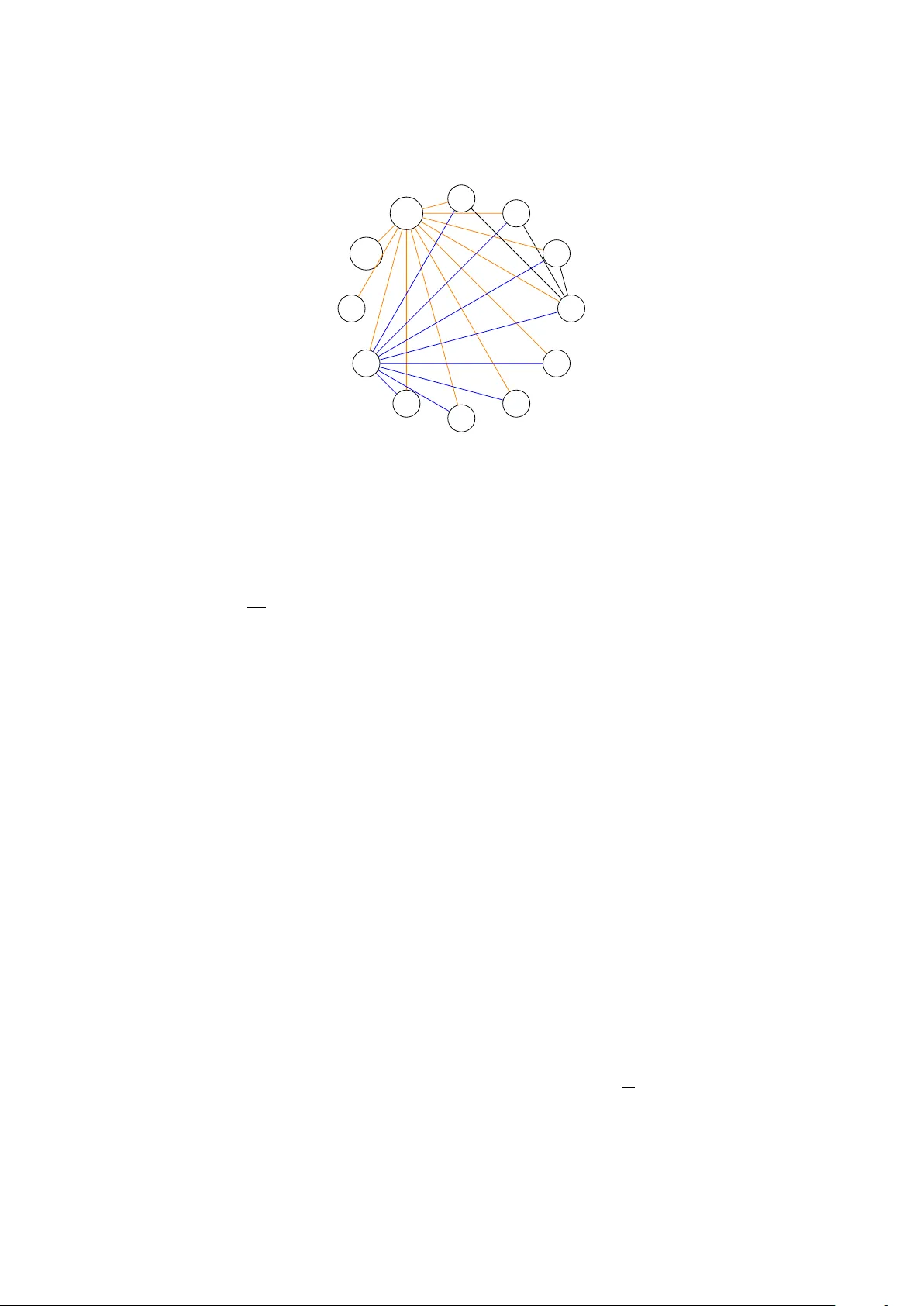
THE INVERSE PR OBLEM F OR THE STEINER–WIENER INDEX VIA ADDITIVE NUMBER THEOR Y CHRISTIAN BERNER T AND JOSHUA SHA W Abstract. W e show that, for any giv en k ≥ 2, ev ery sufficien tly large n um ber appears as the Steiner–Wiener k index of a graph. 1. Introduction Recall that for a connected graph G and a subset S ⊂ V ( G ) of its vertices, the Steiner distanc e d ( S ) is defined as the smallest n um b er of edges in a subgraph of G whose v ertex set con tains S . Note that for | S | = 2, the Steiner distance d ( S ) is just the ordinary distance in G betw een the tw o vertices in S . F or a p ositive in teger k ≥ 2, the Steiner–Wiener k index of G was defined in [3] (but essentially already discov ered earlier in [1]) as SW k ( G ) = X S ⊂ V ( G ) , | S | = k d ( S ) . Note that SW 2 ( G ) is more classically known as the Wiener index of G . Motiv ated by questions in chemical graph theory , a lot of research has been dev oted to studying SW k ( G ) for sp ecial classes of graphs, see [4] for a survey . The inverse pr oblem asks for the possible v alues of SW k ( G ) for a fixed k , where G ranges through all graphs. In [2], it w as sho wn that for k = 2, all p ositiv e in tegers except for 2 and 5 app ear as the Wiener index of a graph. In [8], this was extended to the cases k ∈ { 3 , 4 , 5 } , where it w as shown that all but finitely many v alues app ear as SW k ( G ) for some G . In fact, for k = 3 b y computer searc h an explicit list of the 34 exceptions was given. Our main result resolv es the inv erse problem for all k . Theorem 1. L et k ≥ 2 b e a p ositive inte ger. Then for al l but finitely many p ositive inte gers n , ther e is a gr aph G with SW k ( G ) = n . Note that our metho d do es not giv e particularly go o d b ounds on the size of the exceptional set, it seems that different techniques are required to improv e on this. W e also remark that from the p oint of view of applications in chemistry , it is more natural to restrict to sp ecial classes of graphs, suc h as trees. The inv erse problem then b ecomes m uc h harder. It was resolved for k = 2 indep endently in [6] and [7] but remains op en for an y k ≥ 3. W e will deduce Theorem 1 from the follo wing tw o results: Prop osition 2. F or every se quenc e a 1 < · · · < a r < n − 1 ther e is a gr aph G with SW k ( G ) = SW k ( S n ) − a 1 k − 1 − · · · − a r k − 1 . Here S n is the star graph on n vertices and n − 1 edges. Note that SW k ( S n ) = k · n k − n − 1 k − 1 = ( n − 1) n − 1 k − 1 . Date : March 19, 2026. 2020 Mathematics Subject Classific ation. 05C12 (11P05, 11P55). 1 2 CHRISTIAN BERNER T AND JOSHUA SHA W Star graphs w ere already used in [8]. Our new observ ation is that one can construct neste d stars to allo w for more flexibilit y in the resulting v alues of SW k . This naturally shifts our attention to the num b er-theoretic question of which v alues can b e obtained as such a sum of binomial coefficients. Prop osition 3. F or every p ositive inte ger d ther e ar e p ositive inte gers s = s ( d ) and m 0 = m 0 ( d ) such that for al l p ositive inte gers n and m with m 0 ≤ m ≤ n d ther e ar e distinct p ositive inte gers x 1 < · · · < x s < n − 1 with x 1 d + · · · + x s d = m. Here, the exact shap e of the upper b ound on m is not imp ortant, but note that w e can certainly never represent n umbers m > s · n d , so some restriction is clearly necessary . W e conclude this section by deducing the main result from these tw o prop osi- tions. Pr o of of The or em 1. W e apply Prop osition 3 with d = k − 1 to find the existence of s and m 0 suc h that all num b ers m with m 0 ≤ m ≤ n d ha ve a representation of the form m = a 1 k − 1 + · · · + a s k − 1 with distinct 0 < a 1 < · · · < a s < n − 1. In view of Proposition 2, this implies that all num b ers in the in terv al ( n − 1) n − 1 k − 1 − n k − 1 , ( n − 1) n − 1 k − 1 − m 0 app ear as the Steiner–Wiener index of a graph. W e conclude by noting that these in terv als o v erlap for all sufficien tly large n , b y a simple computation. □ Ac kno wledgemen ts. W e w ould lik e to thank Hua W ang and Xueliang Li for useful feedback on an earlier version. 2. The graph-theoretic construction In this section, w e prov e Prop osition 2. Figure 1 gives an illustration of our construction. Pr o of of Pr op osition 2. F or giv en p ositive integers a 1 < · · · < a r < n − 1, we construct the graph G as follo ws: As the vertex set we choose { 0 , 1 , . . . , n − 1 } . F or 0 ≤ i < j ≤ n − 1, we include an edge ( i, j ) in G iff j ∈ { a 1 , . . . , a r , n − 1 } . W e no w sho w that G has the desired property . Indeed, let us note that since the v ertex with lab el n − 1 is connected to all other vertices, G is a star graph. In particular, for any S ⊂ V ( G ) of size k , we hav e d ( S ) ∈ { k − 1 , k } . T o compute SW( S n ) − SW( G ), we therefore need to compute the n umber of suc h S not con taining the v ertex n − 1 which hav e d ( S ) = k − 1 (those that contain the vertex n − 1 are already taken in to account in SW k ( S n )). But this clearly happ ens iff max( S ) ∈ { a 1 , . . . , a r } . How ev er, there are exactly a i k − 1 sets S with max( S ) = a i . □ R emark. Note that ev en though all our constructed graphs are star graphs of di- ameter 2, one can adapt the construction to solv e the in verse problem for graphs of an y giv en diameter using a bro om graph instead of a star as the initial template. THE INVERSE PROBLEM FOR THE STEINER–WIENER INDEX 3 0 1 2 3 4 5 6 7 8 9 10 11 Figure 1. The nested star construction for n = 12 , r = 2 with a 1 = 3 , a 2 = 8 3. Counting solutions to diophantine equa tions In this section, we prov e Prop osition 3. The k ey technical input is the follo wing asymptotic counting result for the n um b er of represen tations of a n umber m as a sum of binomial coefficients. T o this end, for positive in tegers m, n, d, s, λ 1 , . . . , λ s , let B = ⌈ 1 100 m 1 /d ⌉ and consider the counting function N ( m ) := # { ( x 1 , . . . , x s ) ∈ N s : x 1 , . . . , x s ≤ B : s X i =1 λ i x i d = m } . Prop osition 4. F or fixe d s and d with s ≥ d ! · 1000 d we have N ( m ) = (1 + o (1)) c m · m s/d − 1 as m → ∞ , pr ovide d that mor e than d · d ! of the variables λ i ar e e qual to 1 . Her e, c m = c m,λ 1 ,...,λ s is a c onstant dep ending on m, λ 1 , . . . , λ s , which satisfies c m ∈ [ c, c ′ ] for some p ositive c onstants c, c ′ dep ending only on s and d . Note that the b ounds on s and the λ i arise from a rather crude treatment of the lo cal densities, but certainly some condition has to b e imp osed as a consequence of our v arious size restrictions. Since we are only aiming for an asymptotic result in our main theorem, w e hav e made no attempt to optimize the constants. Pr o of of Pr op osition 3. Let N ∗ ( m ) b e defined similarly to N ( m ) but with the x i required to b e distinct. Note that the difference N ( m ) − N ∗ ( m ) coun ts solutions where at least tw o of the v ariables are the same. But this amounts to finitely many equations of the same shap e as b efore, with tw o λ i replaced by their sum, and with s replaced b y s − 1. Applying this with λ 1 = · · · = λ s = 1, b y Prop osition 4 w e therefore hav e N ( m ) − N ∗ ( m ) ≪ m ( s − 1) /d − 1 = o ( m s/d − 1 ) and hence N ∗ ( m ) = (1 + o (1)) c m · m s/d − 1 as m → ∞ . In particular, if m is sufficiently large, w e will hav e N ∗ ( m ) > 0, hence an y m ≤ n d has a representation of the desired shap e with x i ≤ 1 50 m 1 /d ≤ n/ 50 < n − 1. □ Finally , w e are left to establish our counting result, Prop osition 4. This is done b y an application of the Hardy-Littlew o o d circle method, familiar from the resolution 4 CHRISTIAN BERNER T AND JOSHUA SHA W of W aring’s problem. Most of the steps are relativ ely standard, so we will b e brief and refer the reader to [5] for more details on the method. Ho w ev er, the fact that x d is an inte ger-value d but not an inte ger c o efficient p olynomial accounts for some complications in the treatmen t of the local densities. Pr o of of Pr op osition 4. F or α ∈ R , let us consider the exp onential sum S ( α ) = B X x =1 e α x d where e ( α ) = e 2 π iα . W e then hav e N ( m ) = Z 1 0 S ( λ 1 α ) · . . . · S ( λ s α ) e ( − mα ) d α b y the F ourier orthogonalit y relations. The next step is to split the interv al of inte- gration in the major ar cs M , consisting of small interv als around rational num b ers with small denominators, and its complement m , the minor ar cs ; the idea being that the contribution coming from M should give the main term, while on m the exp onen tial sum S ( α ) is small due to oscillation, leading to a negligible contribu- tion. More precisely , we let the ma jor arcs M to consist of num bers of the form α = a q + β for some coprime in tegers a and q with q ≤ B 1 / 100 and a real n um b er β with | β | ≤ B 1 / 100 − d . W eyl’s inequalit y as in [5, Lemma 2.4, Theorem 2.1] then sho ws that sup α ∈ m | S ( λ i α ) | ≪ B 1 − 1 100 · 2 d − 1 + ε for any ε > 0. Thus, for s > 100 d · 2 d − 1 , we hav e N ( m ) = Z M S ( λ 1 α ) · . . . · S ( λ s α ) e ( − mα ) d α + o ( m s/d − 1 ) . As in [5, Section 2.4], we can pro ceed to ev aluate the ma jor arc con tribution to obtain N ( m ) = S ( m, B 1 / 100 ) · I ( m, B 1 / 100 ) · B s − d + o ( B s − d ) with the truncated singular series S ( m, Q ) := X q ≤ Q X ( a ; q )=1 e S ( q , λ 1 a ) · . . . · e S ( q , λ s a ) e − am q defined using the exponential sum e S ( q , a ) = 1 q · d ! X b (mo d q · d !) e a · b d q ! and the truncated singular inte gr al I ( m, Q ) = Z Q − Q v ( λ 1 β ) · . . . · v ( λ s β ) e ( − mβ /B d ) d β defined using the exponential integral v ( β ) = Z 1 0 e β · t d /d ! d t. Note that the only essential change compared to the discussion in [5, Section 2.4] is that the v alue of x d mo dulo q dep ends on the v alue of x mo dulo q · d !, leading to the somewhat un usual definition of e S ( q , a ). F or the singular integral, w e ha ve THE INVERSE PROBLEM FOR THE STEINER–WIENER INDEX 5 already rescaled the v ariables leading to the factor B s − d and noted that the lo w er order terms in t d giv e a negligible con tribution. In particular, up to the factor of d !, the singular integral is no w the same as in W aring’s problem and therefore the discussion in [5, Section 2.5] shows that I ( m, Q ) is uniformly bounded from ab ov e and b elow by p ositive constan ts, whenev er s > d ! · 1000 d . Note that the rather large num b er of v ariables is required to ensure the existence of real solutions to our equations. It remains to show that S ( m, B 1 / 100 ) is uniformly b ounded from ab ov e and b elo w by p ositive constan ts. The first step is to note that for ( a 1 ; q 1 ) = ( a 2 ; q 2 ) = ( q 1 ; q 2 ) = 1, as in [5, Lemma 2.10] w e still hav e e S ( q 1 q 2 , a 1 q 2 + a 2 q 1 ) = e S ( q 1 , a 1 ) · e S ( q 2 , a 2 ) . Indeed, the k ey observ ation here is that even though ab o ve w e noted that the v alue of x d mo dulo q a priori depends on the residue of x mo dulo q · d !, it really only dep ends on the residue of x mo dulo q · ( d !; q ), allowing for the abov e decomp osition. Completing the singular series as in [5, Section 2.4] w e therefore find that S ( m, B 1 / 100 ) = S ( m ) + o (1) with the factors of the Euler product S ( m ) = Q p χ p defined via χ p = ∞ X k =0 X ( a ; p k )=1 e S ( p k , λ 1 a ) · . . . · e S ( p k , λ s a ) e − am p k . As in [5, Theorem 2.4], b y W eyl’s inequalit y the Euler product is absolutely con- v ergent for s > 2 d and the contribution of p > p 0 ( d ) is b etw een 1 / 2 and 3 / 2, so that it remains to consider the finitely many small primes p ≤ p 0 ( d ). F or those, writing v p ( d !) = t , we still hav e χ p = lim k →∞ p k ( p k + t ) s · M m ( p k ) as in [5, Lemma 2.12] where M m ( p k ) is the n um b er of solutions of λ 1 x 1 d + · · · + λ s x s d ≡ m (mo d p k ) with x 1 , . . . , x s running through residue classes mo dulo p k + t . W e claim that M m ( p 1+ t ) > 0, i.e. w e can find a solution modulo p 1+ t . Indeed, b y setting some v ariables to zero, it suffices to consider the case s = d · d ! where all λ i are equal to 1. W riting B d for the set of residues of binomial coefficients x d mo dulo p 1+ t as x runs through all in tegers, we w an t to pro ve that s · B d = Z /p 1+ t Z . If p > d , note that t = 0 so that d ! is coprime to p and the size of B d is the same as the num ber of v alues the integer polynomial x ( x − 1) . . . ( x − d + 1) takes mo dulo p . But since ev ery v alue occurs at most d times, we find that | B d | ≥ p d , which by the Cauch y-Da v enp ort theorem is more than enough to deduce that s · B d = Z /p Z . On the other hand, if p < d , we alw a ys hav e { 0 , 1 } ⊂ B d so that certainly s · B d = Z /p 1+ t Z as long as s ≥ p 1+ t whic h is satisfied since p 1+ t ≤ d · d !. Note that the previous argument shows that when s > d · d ! we can even ensure the existence of a solution with x 1 = 0. W e can now use this solution to lift our solution modulo p 1+ t to a solution mo dulo p k for k > t : F or any of the p ( k − t − 1)( s − 1) v alues of x 2 , . . . , x n mo dulo p k + t congruen t to our initial solution mo dulo p 1+2 t , we claim that w e can find x 1 solving our congruence mo dulo p k . Indeed, it suffices to sho w that the v alues of x 1 d co ver all residues ≡ 0 (mod p 1+ t ) or equiv alently , the v alues of f ( x 1 ) = x 1 ( x 1 − 1) . . . ( x 1 − d + 1) cov er all residues 6 CHRISTIAN BERNER T AND JOSHUA SHA W ≡ 0 (mod p 1+2 t ). But since v p ( f ′ (0)) ≤ t , this is the consequence of an application of Hensel’s lemma. W e ha ve th us established M m ( p k ) ≥ p ( k − t − 1)( s − 1) M m ( p 1+ t ) ≥ p ( k − t − 1)( s − 1) and hence χ p ≥ p − ts − ( t +1)( s − 1) ≫ d,s 1 , finishing our pro of. □ References [1] Peter Dank elmann, Ortrud R. Oellermann, and Henda C. Swart. The av erage Steiner distance of a graph. J. Graph The ory , 22(1):15–22, 1996. [2] Iv an Gutman, Y eong Nan Y eh, and Jiann Cherng Chen. On the sum of all distances in graphs. T amkang J. Math. , 25(1):83–86, 1994. [3] Xueliang Li, Y aping Mao, and Iv an Gutman. The Steiner Wiener index of a graph. Discuss. Math. Graph The ory , 36(2):455–465, 2016. [4] Y aping Mao and Boris F urtula. Steiner distance in chemical graph theory . MA TCH Commun. Math. Comput. Chem. , 86(2):211–287, 2021. [5] R. C. V aughan. The Hardy-Littlewo o d metho d , volume 125 of Cambridge T racts in Mathemat- ics . Cambridge University Press, Cambridge, second edition, 1997. [6] Stephan G. W agner. A class of trees and its Wiener index. A cta Appl. Math. , 91(2):119–132, 2006. [7] Hua W ang and Guang Y u. All but 49 num bers are Wiener indices of trees. A cta Appl. Math. , 92(1):15–20, 2006. [8] Jie Zhang, Matthew Gentry , Hua W ang, Y a-Lei Jin, and Xiao-Dong Zhang. On the inv erse Steiner Wiener problem. MA TCH Commun. Math. Comput. Chem. , 82(3):743–754, 2019. Institute for Science and Technology Austria, Am Campus 1, 3400 Klosterneuburg, Austria Email address : christian.bernert@ist.ac.at Preston, United Kingdom Email address : shawjoshua265@gmail.com
Original Paper
Loading high-quality paper...
Comments & Academic Discussion
Loading comments...
Leave a Comment