Forest webs and pattern avoidance
In a recent preprint, Mike Cummings showed that the smooth components of suitably parametrized Springer fibers are in bijection with contracted, fully reduced Plücker degree-two $\mathfrak{sl}_r$-webs of standard type and that are forests. He showed …
Authors: Jessica Striker, Bridget Eileen Tenner
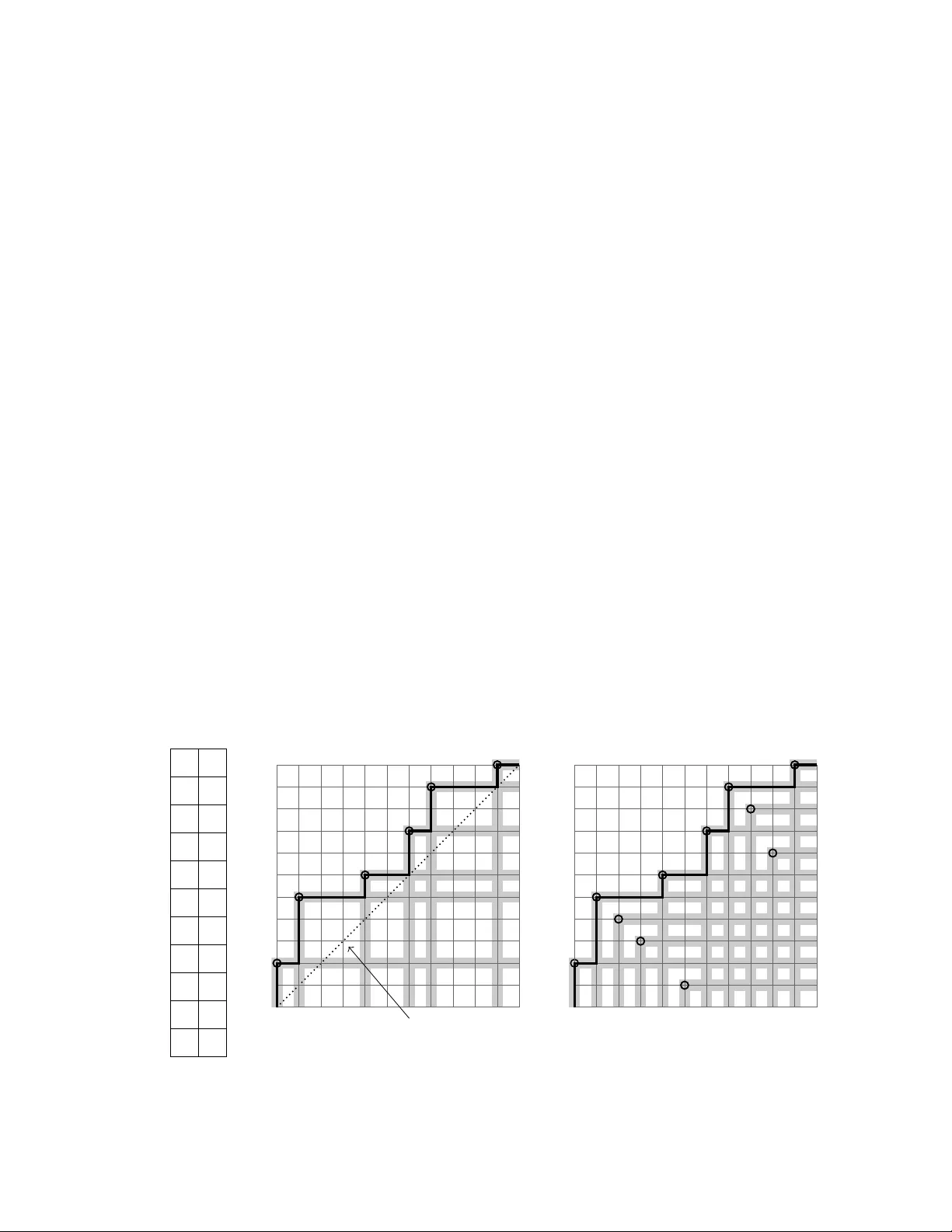
F OREST WEBS AND P A TTERN A V OID ANCE JESSICA STRIKER ∗ AND BRIDGET EILEEN TENNER † Abstract. In a recen t preprin t, Mik e Cummings sho w ed that the smooth components of suitably parametrized Springer fibers are in bijection with contracted, fully reduced Pl¨ uc ker degree-t wo sl r -w ebs of standard t ype and that are forests. He show ed these are enumerated b y sequence A116731 in the OEIS, which is equin umerous with p erm utations a v oiding the patterns { 321 , 2143 , 3124 } . Cummings posed the problem of strengthening this enumerativ e result by finding a bijection b et w een these webs and a collection of pattern-a voiding p erm u- tations. Here we solv e this problem, although notably not with the collection of patterns that Cummings had prop osed. Rather, we giv e a bijection b et ween this class of w ebs and p erm utations a voiding the patterns { 132 , 4321 , 3214 } . 1. Introduction A t the Enumer ative Combinatorics w orkshop at the Mathematisc hes F orsc h ungsinstitut Ob erw olfac h in Jan uary 2026, the first author ga v e a talk making an (admittedly contro- v ersial) claim that the b est ob jects in en umerativ e com binatorics are webs . She argued that the follo wing imp ortan t com binatorial ob jects are all w ebs in disguise: tableaux [7, 11, 13], noncrossing partitions [3, 12], Catalan ob jects [6], alternating sign matrices [7], and plane partitions [7]. The second author p oin ted out a serious omission in the list of imp ortan t com binatorial ob jects: p erm utations. While p erm utation matrices are a subset of alternat- ing sign matrices and may thus b e in terpreted as w ebs, this is not a very satisfying patc h for the omission. In this note, we give a more substan tial connection b et w een w ebs and p er- m utations by pro ducing a bijection b et w een webs whose associated Springer fib ers hav e nice geometric properties, and a class of pattern-a v oiding p erm utations. In addition to addressing the second author’s ob jection, this answ ers a recen t question of Mik e Cummings [1]. Cummings was studying the geometry of Springer fib ers , whic h are fib ers of resolutions of certain v arieties indexed by partitions. (See [1, Sec. 2.2-2.3] for background on Springer fib ers.) It w as kno wn that sl 2 -w ebs (better known as noncrossing matc hings) go v ern the ge- ometry and top ology of the Springer fibers of tw o-ro w partitions [5]. Cummings inv estigated the relation b et w een Springer fib ers of t w o-column partitions and the Pl¨ ucker de gr e e-two sl r - webs studied in w ork of the first author with Gaetz, Pec henik, Pfannerer, and Swanson [6], building on work of F raser [2]. These papers giv e a bijection b et w een mo v e equiv alence classes of these webs and t w o-column rectangular standard Y oung tableaux. These tableaux also index comp onen ts of the Springer fib er, and F resse and Melnik ov gav e a tableau crite- rion that determines when the asso ciated component of the Springer fib er has the app ealing geometric prop ert y of b eing smo oth [4]. One of Cummings’s main theorems [1, Theorem 3.2] nicely reinterprets this tableau condition in terms of webs, sho wing that the Springer fib er ∗ Researc h partially supp orted by NSF Gran t DMS-2247089 and Simons F oundation Gift MP-TSM- 00002802. † Researc h partially supported by NSF Grant DMS-2054436 and b y a Universit y Researc h Council Com- p etitiv e Researc h Leav e from DePaul Universit y . 1 2 JESSICA STRIKER AND BRIDGET EILEEN TENNER comp onen t is smo oth if and only if the corresp onding web is a for est (i.e., a graph with no cycles). He also ga v e an explicit en umeration of the smo oth components of the Springer fib er using these forest webs [1, Corollary 3.4], finding that his form ula matc hed the enumeration of p erm utations a v oiding the patterns { 321 , 2143 , 3124 } given in [10, A116731]. Cummings then asked for a bijectiv e pro of of this equin umerosit y . Our main result gives suc h a bijection, but instead of using Cummings’s proposed pattern av oidance class, w e use the equin umerous class of p ermutations a v oiding the patterns { 132 , 4321 , 3214 } . In Section 2, w e review the map of [2, 6] from degree-tw o w ebs to tw o-column standard Y oung tableaux. These tableaux are Catalan ob jects, and one could giv e bijectiv e maps b et w een them and p -a v oiding p erm utations for an y p ∈ S 3 . The main result of this w ork relies on an imp ortant com binatorial structure connected to the corresp ondence with 132-av oiding p erm utations, in particular, and w e giv e the desired bijection in Section 3. Cummings’s w ork sho ws that the subset of such webs that are forests is c haracterized b y ha ving at most 3 white v ertices (see Lemma 2.2). The most basic degree-tw o sl r w ebs with 4 white v ertices corresp ond to the p erm utations 4321 and 3214, and w e sho w in Section 4 that those smallest cases, in fact, c haracterize the entire prop ert y of b eing a forest, thus pro ving our desired bijection. W e conclude in Section 5 b y using our result to reco v er the enumeration of [1]. 2. From degree-two webs to two-column t ableaux W ebs are diagrams that represent p olynomial in v ariants of certain spaces with algebraic structure, and they reduce complicated algebraic computations to diagrammatic manipula- tions. The w ebs of in terest in this pap er are sl r -w ebs, which represen t p olynomials suc h as the determinan t that are inv arian t under the action of a matrix from the sp ecial linear group on the v ariables. See [1, Sec. 1 and 2.4], for example, for more bac kground on webs. W e refer to the particular webs that app ear in this pap er using the following, more sp ecific, terminology of [6]. W e say an r -hour glass plabic gr aph of standar d typ e and Pl¨ ucker de gr e e d is a planar prop erly bicolored graph G em b edded in a disk with: • dr b oundary v ertices all colored blac k and of degree one, • edges that each ha v e a p ositiv e m ultiplicit y , dra wn (when greater than 1) as a multiple edge with an hourglass t wist , and • the sum of the m ultiplicities of all the edges around any in terior vertex equal to r . W e consider G up to planar isotop y fixing the b oundary circle. The sp ecific w ebs of interest are c ontr acte d, ful ly r e duc e d r -hour glass plabic gr aphs of standar d typ e and Pl¨ ucker de gr e e-two , which we refer to as de gr e e-two sl r -webs or de gr e e-two webs for short. W e will not need the definitions of c ontr acte d or ful ly r e duc e d , as the lemma b elo w is sufficient for our purp oses, and instead refer the interested reader to [6, Sec. 2.2]. Lemma 2.1 ([6, Lemmas 6.2–6.5]) . A de gr e e-two sl r -web has the fol lowing pr op erties: • e ach white interior vertex is adjac ent to a b oundary vertex, • e ach black interior vertex has 3 incident hour glasses, and • the numb er of interior white vertic es exc e e ds the numb er of interior black vertic es by exactly 2 . Cummings ga v e the follo wing c haracterization of degree-t wo webs that are forests. (He stated this in terms of claws ; the statement b elo w is trivially equiv alen t.) Lemma 2.2 ([1, Lemma 3.1]) . A de gr e e-two sl r -web is a for est if and only if it has at most 3 white vertic es. F OREST WEBS AND P A TTERN A VOID ANCE 3 Note that by Lemma 2.1, since the num b er of white vertices min us the num ber of blac k in terior v ertices is 2, a degree-tw o forest w eb has either 3 white vertices and 1 in terior blac k v ertex or 2 white vertices and no in terior blac k vertices. See Figure 1 for examples of forest w ebs and Example 4.1 for examples of non-forest webs. W e no w review the map ω from a degree-tw o sl r -w eb G to an r × 2 standard Y oung tableau T = ω ( G ), follo wing [2, 6]. (An a × b standar d Y oung table au is a bijective filling of the partition shap e a b with the num bers { 1 , . . . , ab } that is increasing across ro ws and down columns.) F or clarit y , w e restrict our discussion to the case in which G is a forest. (1) Replace eac h hourglass of G b y a single w eigh ted edge, with weigh t equal to the m ultiplicit y . (2) Draw a p olygon with the white v ertices as the corners. • If there are three white vertices, the p olygon is a triangle with the unique interior blac k v ertex and adjacen t hourglasses inside. W eight eac h edge of the triangle b y the m ultiplicit y of the hourglass that is not inciden t to the edge. Then delete the interior blac k v ertex and incident hourglasses. • If there are t w o white v ertices, connect them by an edge of weigh t r , and consider this as the (degenerate) p olygon. (3) Construct a noncrossing matching b y first turning all p olygon edges with weigh t m in to m multiple (non-t wisted) edges. Then delete the p olygon vertices and connect eac h b oundary edge to the corresp onding edge on the other side of the white vertex to make the edges noncrossing. (4) Finally , use the standard Catalan bijection to construct an r × 2 standard Y oung tableau from this noncrossing matc hing. That is, for all connected pairs i < j , put i in column 1 and j in column 2 (and order the en tries in eac h column to b e increasing). Since it will b e used later, we denote the noncrossing matching corresp onding to a r × 2 tableau T as µ ( T ). Figure 1 gives t wo examples of this construction. Additional examples, and further details of the construction, can b e found in [1, Sec. 2.5] or [6, Sec. 2.4]. 8 7 6 5 4 3 2 1 1 2 3 4 5 7 6 8 8 7 6 5 4 3 2 1 1 2 3 6 4 7 5 8 Figure 1. Examples of the t w o t yp es of forest webs and their corresp onding tableaux. W e sho w in the next section that the t wo-column tableaux pro duced by this map are in bijection with the set of 132-av oiding p erm utations. 4 JESSICA STRIKER AND BRIDGET EILEEN TENNER 3. From two-column t ablea ux to 132 -a v oiding permut a tions Giv en p erm utations w and p written in one-line notation, we sa y that w avoids the p attern p if there is no subsequence of w that is in the same relativ e order as p . A permutation av oids a set of patterns if it a v oids every pattern in that set. Rectangular standard Y oung tableaux with 2 columns are a Catalan ob ject, and are th us in bijection with p -av oiding p erm utations for any p ∈ S 3 [16]. There are numerous bijective maps b et w een these tableaux and such p erm utations. In this note, we iden tify a particular bijection with 132-a v oiding permutations, whic h will preserve the combinatorial structure w e are most in terested in. W e say a Dyck p ath from (1 , 0) to ( r + 1 , r ) is a path consisting of north and east steps that never passes b elo w the line y = x − 1. This v arian t is shifted one unit to the righ t from the more customary definition, so that the p ermutation w e are defining can app ear as a subset of [1 , r ] 2 , rather than as a subset of [0 , r − 1] × [1 , r ]. Define a map π : { r × 2 standard Y oung tableaux } → { 132-av oiding p erm utations in S r } b y first sending a tableau T to a Dyc k path path ( T ), where the i th step is north if and only if i is in the first column of T , and then using path ( T ) to define a 132-a v oiding p erm utation as follows, and demonstrated in Example 3.1 and Figure 2. W e follo w the construction of [14], which is equiv alent to the map of [9]. (1) Put a marker at eac h northw est corner of path ( T ). (2) Draw a ray east w ard and a ray south w ard from eac h marker. (3) Put a mark er at any northw est-most point of [1 , r ] 2 that lies under path ( T ) and that has not yet been marked b y a marker or a ra y; extend rays east w ard and southw ard from this newly mark ed p oint. Rep eat this pro cess iteratively with the remaining unmark ed p oin ts of [1 , r ] 2 that lie under path ( T ). (4) This pro cess terminates after r mark ers are placed, and those r points determine a p erm utation w . Read the permutation from the top do wn w ard (“matrix co ordinate”- st yle): a mark er at ( x, y ) means that w ( r + 1 − y ) = x . T = 1 3 2 7 4 8 5 9 6 11 10 12 13 15 14 18 16 19 17 20 21 22 path ( T ) y = x − 1 y = x − 1 Figure 2. A t wo-column tableau, its corresp onding Dyck path, and the re- sulting p erm utation that is constructed by π . F OREST WEBS AND P A TTERN A VOID ANCE 5 (5) Let π ( T ) b e this p erm utation w . That π is a bijection follows from [9], and this construction ensures that w is 132-av oiding. Example 3.1. The tableau T in Figure 2 pro duces the path path ( T ) indicated, with north- w est corners circled and eastw ard and southw ard ra ys drawn from those circled p oin ts. The righ tmost figure has all such p oin ts and ra ys indicated, from whic h we see that π ( T ) = 11 8 9 7 10 5 2 3 4 1 6. This p ermutation is 132-a v oiding, as predicted. 4. From forest webs to { 132 , 4321 , 3214 } -a v oiding permut a tions Let Φ b e the comp osition of maps π ◦ ω , so Φ is a map from degree-tw o w ebs to 132-av oiding p erm utations. Our main result is that when we restrict the domain to b e webs that are forests, this Φ is a bijection b etw een that set and { 132 , 4321 , 3214 } -a v oiding p ermutations. As sho wn by Cummings (see Lemma 2.2 ab ov e), the web will b e a forest if and only if there are fewer than four white v ertices [1]. T o get a sense of what this means for the map Φ, consider the simplest examples of webs that fail to meet this criterion. Example 4.1. The tw o 4 × 2 tableaux whose webs ha v e four white v ertices are giv en b elo w, along with their corresp onding w ebs. 8 7 6 5 4 3 2 1 1 2 3 4 5 6 7 8 8 7 6 5 4 3 2 1 1 3 2 5 4 7 6 8 Under the map π , these tableaux corresp ond to the p erm utations 4321 and 3214, respectively . Example 4.1 foreshado ws our main result. W e preface that theorem with t w o helpful lemmas, with the first in volving the shap e of a Dyck path. Lemma 4.2. A noncr ossing matching with 2 r vertic es has an ar c b etwe en 2 r and 1 if and only if al l but the first and last step of its c orr esp onding Dyck p ath (what we wil l c al l its “interior”) lives we akly ab ove the line y = x . Pr o of. Let T b e an r × 2 tableau with noncrossing matc hing µ ( T ). Let q ∈ [2 , 2 r ] be connected to 1 by an arc in µ ( T ), and separate the arcs of the matching in to those inv olving v ertices [1 , q ] and those inv olving v ertices [ q + 1 , 2 r ]. This fails to b e 2-part partition of the arcs if and only if q = 2 r . This is equiv alent to every topmost m × 2 subtableau of T con taining at least one v alue larger than 2 m , for all m < 2 r , whic h is equiv alen t to the interior of path ( T ) lying weakly abov e y = x . □ The second preliminary lemma refers to the construction of the p erm utation π ( T ). Lemma 4.3. L et T b e a two-c olumn table au. Any two p oints of π ( T ) lying southe ast of a given marker on path ( T ) must b e such that one is southe ast of the other. 6 JESSICA STRIKER AND BRIDGET EILEEN TENNER Pr o of. Supp ose, for the purp ose of obtaining a con tradiction, that this is not the case. Then, as sho wn below, there is a marke r on path ( T ) with t w o mark ers to its southeast, one of whic h is southw est of the other. path ( T ) These three p oints iden tify a 132-pattern in π ( T ), whic h is a con tradiction. □ W e are no w ready to pro v e our main result. Theorem 4.4. The map Φ is a bije ction b etwe en for est de gr e e-two sl r -webs and the set of { 132 , 4321 , 3214 } -avoiding p ermutations in S r . Pr o of. W e will show that the image of the set of forest degree-t w o sl r -w ebs under the bijection Φ is exactly the set of { 132 , 4321 , 3214 } -av oiding p ermutations in S r . The 132-a voidance is guaran teed by π , so we need only consider 4321- and 3214-patterns. F or the first direction, supp ose that w e hav e a w eb that is not a forest and T its corre- sp onding t w o-column tableau via the map ω . The forest condition means, by Lemma 2.2, that the web has at least four white vertices, whic h can arise from t w o scenarios. In the first case, those white v ertices corresp ond to short arcs { a, a + 1 } , { b, b + 1 } , { c, c + 1 } , and { d, d + 1 } , where 1 ≤ a , a + 1 < b , b + 1 < c , and c + 1 < d in the noncrossing matching µ ( T ). Then the web corresp onds, via ω , to a tableau and a Dyck path as shown in Figure 3. Therefore the corresp onding p ermutation, via π , has a 4321-pattern. 1 n a a +1 b b +1 c c +1 d d +1 . . . . . . . . . . . . . . . . . . . . . . . . . . . . . . step a step b step c step d y = x − 1 Figure 3. A tableau and path corresp onding to a w eb having four short arcs of the form { i, i + 1 } . If this is not the case, then there are exactly four short arcs in µ ( T ), and they hav e the form { 2 r , 1 } , { b, b + 1 } , { c, c + 1 } , and { d, d + 1 } , for 1 < b , b + 1 < c , c + 1 < d , and d + 1 < 2 r . Then the corresp onding path path ( T ) has the form sho wn in Figure 4, where the interior of path ( T ) liv es w eakly ab ov e y = x , b y Lemma 4.2. F OREST WEBS AND P A TTERN A VOID ANCE 7 step b step c step d × × y = x Figure 4. A tableau and path corresp onding to a w eb ha ving four short arcs, one of which is { 2 r , 1 } . If a marker (i.e., a p oin t of π ( T )) lies in the shaded region of Figure 4, then π ( T ) has a 3214-pattern. Supp ose, for the purp ose of obtaining a contradiction, that there is no such mark er. Because b ≥ 2, there is at least one p oin t of π ( T ) b elo w step b . Thus this m ust app ear to the left of the shaded region, and, b ecause the in terior of path ( T ) lies w eakly ab o v e y = x , there is suc h a p oin t to the righ t of step c . Let the leftmost red × indicate this p oin t in the diagram. This, then, implies that there is a p oint to the righ t of step d that is b elo w step c (necessarily ab ov e the shaded region), indicated by the righ tmost red × in the diagram. Those t w o p oints and the marker after step c w ould form a 132-pattern in π ( T ), whic h is imp ossible. Th us a p oin t of π ( T ) lies in the shaded region of the figure, and hence π ( T ) has a 3214-pattern. T o show the conv erse statemen t, supp ose that w is a 132-a v oiding p ermutation that con- tains at least one of the patterns { 4321 , 3214 } . Let T = π − 1 ( w ) b e the corresp onding t w o-column tableau. In order to av oid 132 and yet ha v e one of these patterns, it follows from Lemma 4.3 that there m ust b e at least three markers along path ( T ). If there are four mark ers along path ( T ) then the corresp onding web Φ − 1 ( w ) has at least four white vertices and hence is not a forest [1]. Consider, now, that there are only three such markers, as shown in Figure 5. By Lemma 4.3, there are no 4321-patterns in w , so w m ust ha v e a 3214-pattern. This and Lemma 4.3 force a p oint of the p erm utation to lie east of p oint D and south of p oin t B , as indicated b y E in Figure 5. The existence of the p oint E forces the interior of path ( T ) to lie weakly ab ov e the line y = x , b ecause otherwise the eastw ard and south ward ra ys from the p oin ts of π ( T ) w ould not co v er the region b elo w path ( T ). By Lemma 4.2, this means that the web has an arc b etw een 2 r and 1, which indicates a fourth white v ertex in the web, meaning that w e had not started with a forest web. □ This result app ears as en try [17, P0072]. 5. Enumera tion F rom Theorem 4.4, we can reco v er Cummings’s enumeration result. Corollary 5.1 (cf. [1]) . Ther e ar e r + 2 r 3 for est de gr e e-two sl r -webs. Pr o of. By Theorem 4.4, it suffices to enumerate { 132 , 4321 , 3214 } -av oiding p erm utations in S r . Let w b e suc h a p erm utation, and set m := w − 1 ( r ). 8 JESSICA STRIKER AND BRIDGET EILEEN TENNER B C D E Figure 5. A path with three northw est corners whose corresp onding permu- tation has a 3214-pattern. T o a void 132, ev ery element of { w (1) , . . . , w ( m − 1) } must b e larger than ev ery elemen t of { w ( m + 1) , . . . , w ( r ) } . Let u ∈ S m − 1 b e the p ermutation that is order isomorphic to w (1) · · · w ( m − 1), and let v ∈ S r − m b e order isomorphic to w ( m + 1) · · · w ( r ). Both u and v must av oid 132. They must also av oid 321: u to a v oid 3214 in w , and v to a v oid 4321 in w . Finally , at most one of { u, v } can hav e a descen t, to a v oid 4321 in w . This characterizes w completely , and w e can en umerate such permutations using the following sc heme. 132- and 321-av. + 132- and 321-av. − There are k 2 + 1 p ermutations in S k that a v oid b oth 321 and 132. Therefore the num ber of p erm utations in S r that av oid { 132 , 4321 , 3214 } is r X m =1 m − 1 2 + 1 + r − m 2 + 1 − 1 = r 3 + r + r 3 = r + 2 r 3 , b y the ho ck ey stic k identit y . 1 □ A cknow ledgments The authors thank Oliv er Pec henik for helpful commen ts and Mik e Cummings for p osing suc h a lo v ely problem relating w ebs and p ermutations. They also thank the dev elop ers of SageMath [15], which w as useful in this researc h. 1 The result is known b y man y names [8]. W e use this one in honor of winter in Canada, the home of Mik e Cummings whose pap er [1] inspired this note, and North Dakota, which was the setting of a lov ely and pro ductiv e research visit for the authors, including a frigid hike, great k araok e, and the work b ehind this note. F OREST WEBS AND P A TTERN A VOID ANCE 9 References [1] M. Cummings, W ebs and smo oth comp onen ts of tw o-column Springer fib ers, arXiv preprint (2026), https://arxiv.org/abs/2602.16910 . [2] C. F raser, W ebs and canonical bases in degree-tw o, Comb. The ory 3 (2023), Paper No. 11, 26pp. [3] C. F raser, R. Patrias, O. Pec henik, and J. Striker, W eb in v arian ts for flamingo Sp ec h t mo dules, Algebr. Comb. 8 (2025), no.1, 235–266. [4] L. F resse and A. Melniko v, Some characterizations of singular comp onents of Springer fib ers in the t wo-column case, Algebr. R epr esent. The ory 14 (2011), no.6, 1063–1086. [5] F.Y.C. F ung, On the top ology of comp onen ts of some Springer fib ers and their relation to Kazhdan- Lusztig theory , A dv. Math. 178 (2003), no.2, 244–276. [6] C. Gaetz, O. P ec henik, S. Pfannerer, J. Stri ker, and J. Sw anson, W eb bases in degree-tw o from hourglass plabic graphs, Int. Math. R es. Not. 2025 (2025), no. 13, 23 pp. [7] C. Gaetz, O. P echenik, S. Pfannerer, J. Striker, and J. Swanson, Rotation–inv arian t web bases from hourglass plabic graphs, Invent. Math. 243 (2026), no. 2, 703–804. [8] Ho ck ey-stic k iden tity , Wikip edia: The F ree Encyclop edia, Wikimedia F oundation, en.wikipedia.org/ wiki/Hockey- stick_identity . Accessed 12 Mar 2026. [9] C. Kratten thaler, P ermutations with restricted patterns and Dyc k paths, A dv. in Appl. Math. 27 (2001), no. 2-3, 510–530. [10] OEIS F oundation Inc., The On-Line Encyclop e dia of Inte ger Se quenc es (2026), https://oeis.org . [11] R. P atrias, Promotion on generalized oscillating tableaux and web rotation, J. Comb. The ory Ser. A 161 (2019), 1–28. [12] R. P atrias, O. Pec henik, and J. Striker, A web basis of inv ariant p olynomials from noncrossing partitions, A dv. Math. 408 (2022), 33pp. [13] T.K. Petersen, P . Pyly avskyy , and B. Rhoades, Promotion and cyclic sieving via webs, J. A lgebr. Comb. 30 (2009), 19–41. [14] A. Reifegerste, On the diagram of 132-av oiding permutations, Eur op e an J. Combin. 24 (2003), no. 6, 759–776. [15] SageMath, the Sage Mathematics Softw are System (V ersion 10.3), The Sage Developers, 2024, https: //www.sagemath.org . [16] R. P . Stanley , Catalan Numb ers , Cambridge Univ ersity Press, 2015. [17] B. E. T enner, Datab ase of Permutation Pattern Avoidanc e , http://math.depaul.edu/bridget/ patterns.html . Dep ar tment of Ma thema tics, Nor th D akot a St a te University, F argo, ND, USA Email addr ess : jessica.striker@ndsu.edu Dep ar tment of Ma thema tical Sciences, DeP aul University, Chicago, IL, USA Email addr ess : bridget@math.depaul.edu
Original Paper
Loading high-quality paper...
Comments & Academic Discussion
Loading comments...
Leave a Comment