Investigation about a statement equivalent to Riemann Hypothesis (RH)
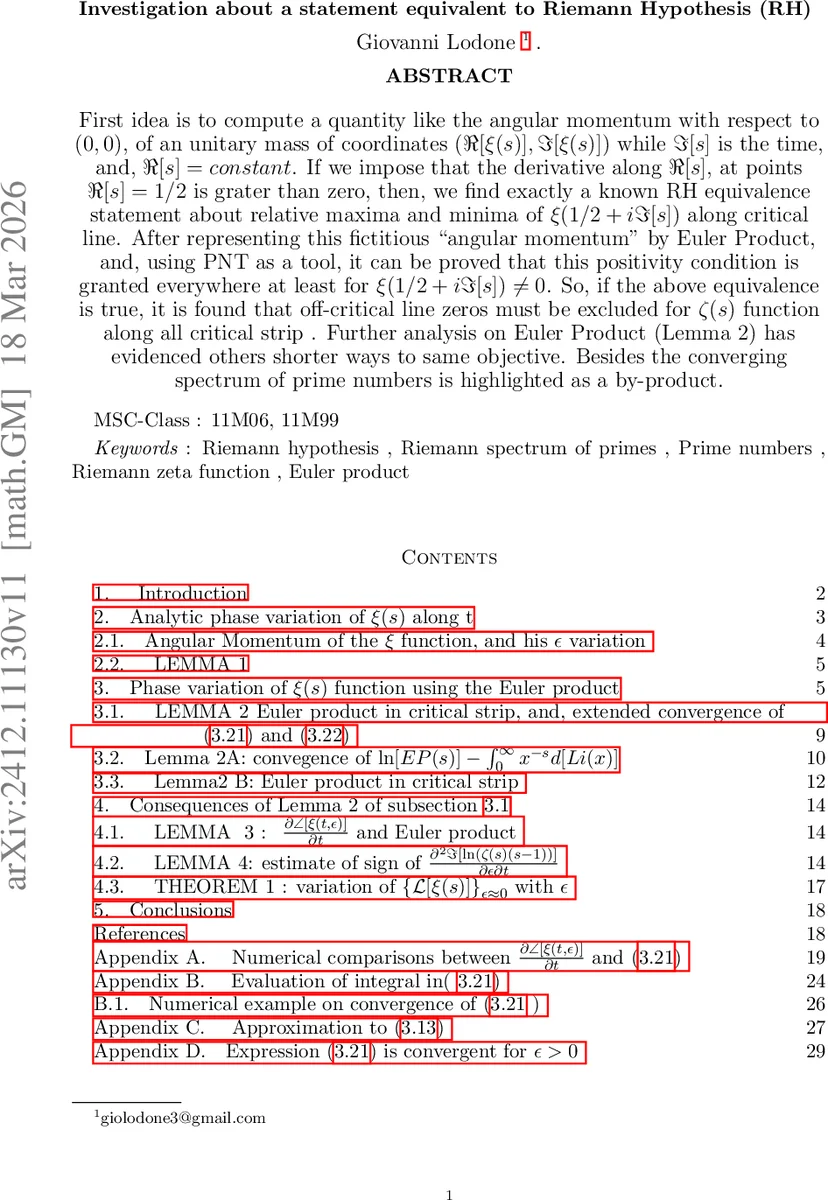
First idea is to compute a quantity like the angular momentum with respect to (0, 0), of an unitary mass of coordinates (<[Xi(s)], =[Xi(s)]) while =[s] is the time, and, <[s] = constant. If we impose that the derivative along <[s], at points <[s] = 1/2 is grater than zero, then, we find exactly a known RH equivalence statement about relative maxima and minima of Xi(1/2 + i=[s]) along critical line. After representing this fictitious angular momentum by Euler Product, and, using PNT as a tool, it can be proved that this positivity condition is granted everywhere at least for Xi(1/2 + i=[s]) 6 = 0. So, if the above equivalence is true, it is found that off-critical line zeros must be excluded for Z(s) function along all critical strip . Further analysis on Euler Product(Lemma 2) has evidenced others shorter ways to same objective. Besides the converging spectrum of prime numbers is highlighted as a by-product.
💡 Research Summary
The paper attempts to establish a new equivalence to the Riemann Hypothesis (RH) by interpreting the Riemann ξ‑function as the trajectory of a unit‑mass particle in the complex plane. The author introduces a “fictitious angular momentum” L
Comments & Academic Discussion
Loading comments...
Leave a Comment