From Geometric Mimicry to Comprehensive Generation: A Context-Informed Multimodal Diffusion Model for Urban Morphology Synthesis
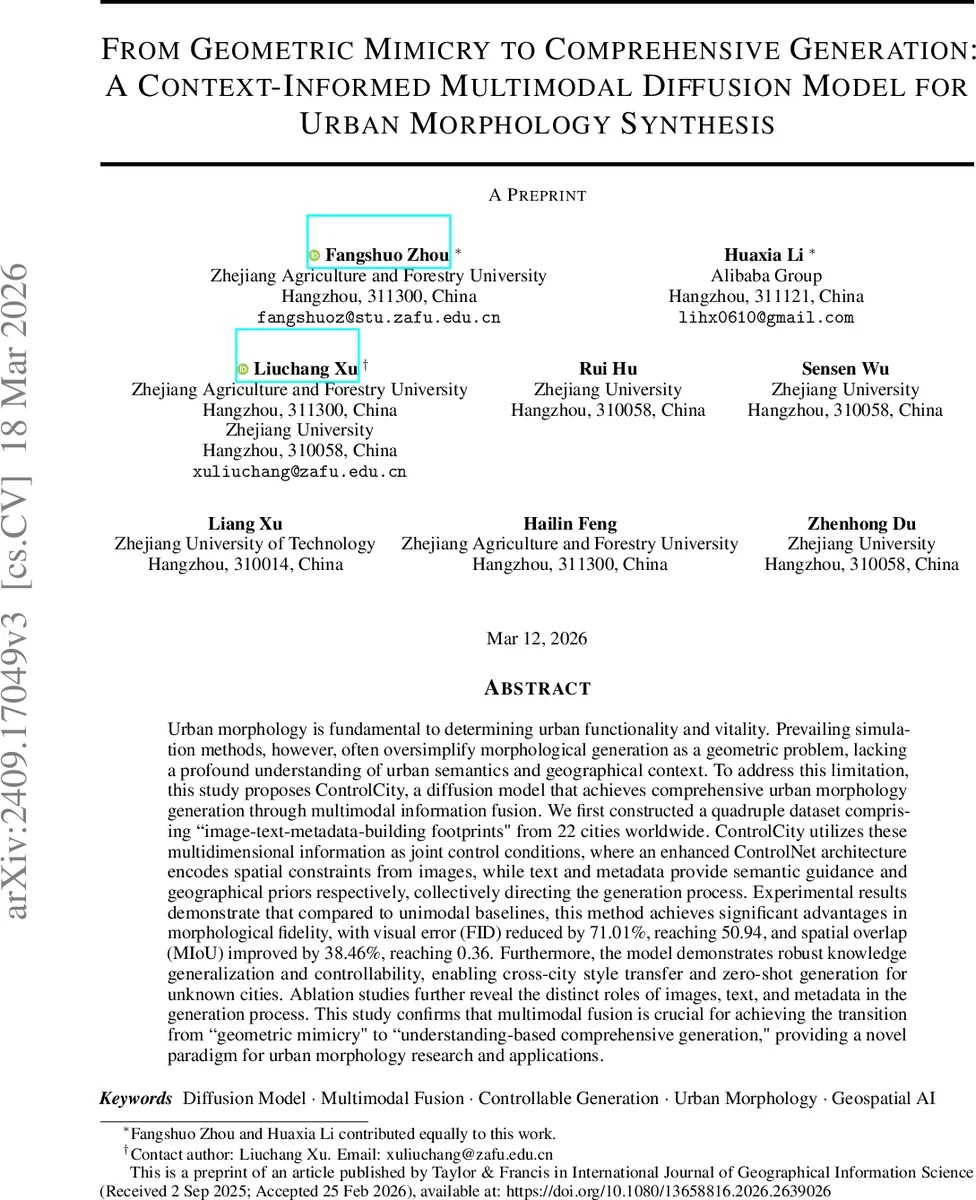
Urban morphology is fundamental to determining urban functionality and vitality. Prevailing simulation methods, however, often oversimplify morphological generation as a geometric problem, lacking a profound understanding of urban semantics and geographical context. To address this limitation, this study proposes ControlCity, a diffusion model that achieves comprehensive urban morphology generation through multimodal information fusion. We first constructed a quadruple dataset comprising image-text-metadata-building footprints" from 22 cities worldwide. ControlCity utilizes these multidimensional information as joint control conditions, where an enhanced ControlNet architecture encodes spatial constraints from images, while text and metadata provide semantic guidance and geographical priors respectively, collectively directing the generation process. Experimental results demonstrate that compared to unimodal baselines, this method achieves significant advantages in morphological fidelity, with visual error (FID) reduced by 71.01%, reaching 50.94, and spatial overlap (MIoU) improved by 38.46%, reaching 0.36. Furthermore, the model demonstrates robust knowledge generalization and controllability, enabling cross-city style transfer and zero-shot generation for unknown cities. Ablation studies further reveal the distinct roles of images, text, and metadata in the generation process. This study confirms that multimodal fusion is crucial for achieving the transition from geometric mimicry" to ``understanding-based comprehensive generation," providing a novel paradigm for urban morphology research and applications.
💡 Research Summary
The paper introduces ControlCity, a multimodal diffusion‑based framework for generating urban morphology that moves beyond the traditional “geometric mimicry” paradigm toward an “understanding‑based comprehensive generation” approach. Recognizing that existing urban layout synthesis methods—whether procedural rule‑based systems or recent AI models such as GANmapper and InstantCITY—rely almost exclusively on a single modality (typically road‑network images), the authors argue that such approaches inevitably ignore two essential dimensions of urban form: semantic function (e.g., residential vs. commercial) and geographic context (regional cultural, historical, and climatic influences).
To address this gap, the authors first construct a large‑scale, quadruple dataset covering 22 global cities. For each spatial tile they extract (1) a raster image of road networks and land‑use patterns, (2) a textual description derived from OpenStreetMap tags and Wikipedia articles, (3) metadata consisting of latitude‑longitude coordinates, and (4) the target building footprint vector data. These four modalities are precisely aligned so that each training sample contains a complete representation of the same urban block.
ControlCity builds on the Stable Diffusion XL (SDXL) backbone but augments it with three dedicated control streams:
-
Image Control via Enhanced ControlNet – A duplicated UNet encoder processes the raster image, producing spatial “skeleton” features that are injected into the main diffusion UNet through zero‑convolution layers. This enforces hard geometric constraints (road layout, parcel boundaries).
-
Semantic Guidance via CLIP Text Encoder – Natural‑language prompts are encoded into high‑dimensional embeddings and fused through cross‑attention at each denoising step, steering the model toward specific functional styles (e.g., “high‑rise commercial district”, “low‑density residential”).
-
Geographic Prior via Sinusoidal Metadata Embedding – Latitude and longitude are transformed into sinusoidal positional encodings that act as global context tokens, allowing the model to adapt its output to regional architectural vocabularies and climate‑driven typologies.
During diffusion, the three streams are concatenated with the noisy latent representation, enabling the model to simultaneously respect physical layout, semantic intent, and macro‑scale context while progressively denoising toward a realistic building‑footprint map.
Experimental Evaluation
The authors compare ControlCity against three unimodal baselines (image‑only, text‑only, metadata‑only) and against state‑of‑the‑art urban layout generators (GANmapper, InstantCITY). Quantitative metrics include Fréchet Inception Distance (FID) for visual fidelity, Mean Intersection‑over‑Union (MIoU) for spatial overlap, and Δ Site Cover error for land‑cover accuracy. ControlCity achieves a 71.01 % reduction in FID (average 50.94), a 38.46 % increase in MIoU (average 0.36), and reduces Δ Site Cover error from 8.51 % to 3.82 %.
Ablation studies systematically remove each modality, confirming that images provide the rigid spatial scaffold, text supplies the semantic core, and metadata supplies the global calibration needed for zero‑shot generalization.
Zero‑Shot and Style Transfer experiments demonstrate that the model can generate plausible layouts for cities never seen during training simply by providing their coordinates, and can transfer learned stylistic cues across cities by altering the textual prompt (e.g., “Paris‑style boulevards” applied to a Shanghai block).
Contributions and Implications
- A novel paradigm that treats urban morphology synthesis as a multimodal translation problem rather than a pure shape generation task.
- The ControlCity architecture, which integrates image, text, and geographic metadata within a diffusion framework, delivering superior fidelity, controllability, and generalization.
- A publicly described pipeline for constructing aligned multimodal urban datasets, offering a reusable resource for future geospatial AI research.
Overall, the study convincingly shows that fusing visual, semantic, and contextual signals enables a diffusion model to “understand” urban environments, opening pathways for more intelligent city planning tools, automated design assistants, and large‑scale GIS simulations.
Comments & Academic Discussion
Loading comments...
Leave a Comment