Age-dependent random connection models with arc reciprocity: clustering and connectivity
We introduce a model for directed spatial networks. Starting from an age-based preferential attachment model in which all arcs point from younger to older vertices, we add \emph{reciprocal} connections whose probabilities depend on the age difference…
Authors: Lukas Lüchtrath, Christian Mönch
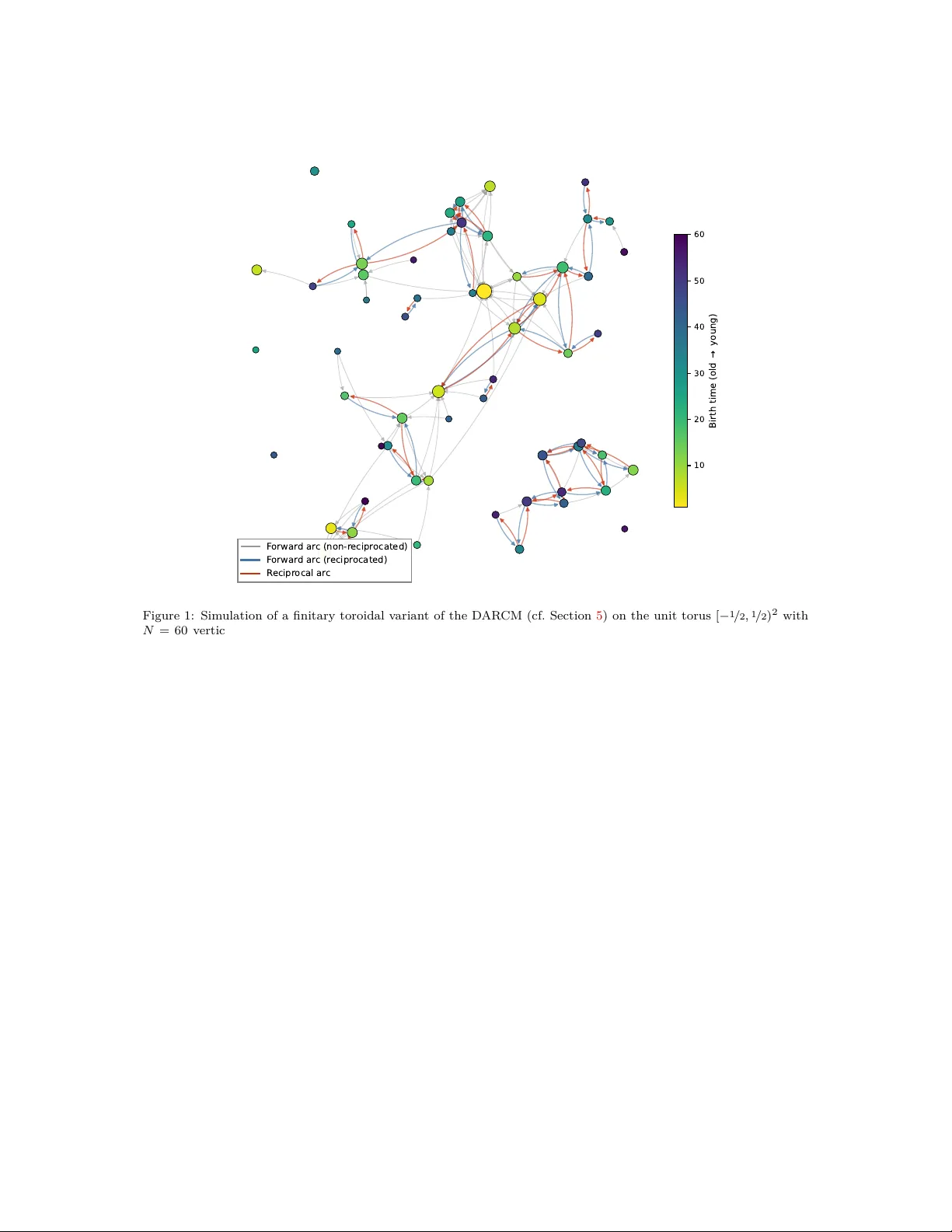
A ge-dependent random connection models with ar c reciprocity: clustering and connectivity 1 Lukas Lüc htrath 2 lukas.luec htrath@wias-berlin.de Christian Mönc h cmo enc h25@gmail.com Marc h 17, 2026 Abstract W e in tro duce a mo del for directed spatial netw orks. Starting from an age-based preferential attac hment mo del in whic h all arcs point from y ounger to older vertices, we add r e cipr o c al connections whose probabilities dep end on the age dierence b et ween their end-v ertices. This yields a directed graph with reciprocal correlations, a pow er-law indegree distribution, and a tunable outdegree distribution. W e consider tw o v ersions of the mo del: an innite v ersion em b edded in R d , which can b e constructed as a w eight-dependent random connection mo del with a non-symmetric kernel, and a growing sequence of graphs on the unit torus that con- v erges locally to the innite model. Besides establishing the lo cal limit result linking the t wo mo dels, we inv estigate degree distributions, v arious directed clustering metrics, and directed p ercolation. AMS-MSC 2020 : 05C80 (primary), 60K35, 05C82 (secondary) Key W ords : Directed complex netw orks, recipro cal correlations, directed percolation, preferential attachmen t, weak local limit, weigh t-dep enden t random connection mo del 1 In tro duction and o v erview of results Directed netw orks in data science often arise from asymmetric in teractions in whic h the probabilit y of forming a link in one direction is shap ed b y how attractive the corresp onding reverse interaction w ould hav e been. A canonical example is provided b y social media platforms suc h as X (formerly Twitter ), Instagr am , or Y ouT ub e , whose follow er and subscription graphs exhibit pronounced di- rectionalit y , strong heterogeneity , and substantial but highly non-uniform recipro cation [ 29 , 33 , 38 ]. Users follow accounts of interest, but recipro cal connections o ccur in a mark edly inuence- dep enden t wa y: high-prole accounts attract man y follow ers yet follow back only rarely , and the c hance of recipro cation dep ends not only on global p opularity but also on topical similarity , geo- graphical proximit y , and lo cal patterns of engagement. Suc h dynamics generate lo cal clustering, 1 A preliminary version of this w ork appeared in the proceedings of the 19th W orkshop on Model ling and Mining Networks (W A W 2024) [ 31 ] 2 W eierstrass Institute for Applied Analysis and Stochastics, Anton-Wilhelm-Amo-Str. 39, 10117 Berlin, Germany 1 correlated reciprocation, and hea vy-tailed indegree distributions, features widely observed in em- pirical directed data and closely tied to inuence and atten tion eects [ 10 , 29 ]. More broadly , recipro cit y in real directed netw orks is consistently and signican tly non-random across domains ranging from biological to social and economic net works [ 17 ]. Capturing these eects in a mathematically transparent and analytically tractable manner remains a challenge. Classical spatial mo dels and age-based preferential attachmen t mechanisms repro- duce heterogeneity and geometry , but they t ypically do not mo del directed arc formation b eyond the temp oral ordering. As a consequence, they miss structural phenomena driven by recipro cal in teraction, such as asymmetric but correlated neighbourho o ds, elev ated motif frequencies, and non-v anishing directed clustering. These are precisely the features that matter in applications to inuence estimation, link prediction, recommendation systems, and the analysis of communit y and motif structure in directed graphs, where reciprocity is a central mo delling primitive rather than a negligible correction [ 14 , 40 ]. Our con tribution W e analyse a spatial directed generativ e mo del that incorp orates an explicit r e cipr o city me chanism whic h w as prop osed by us in [ 31 ]. Eac h vertex is marked with a spatial p osition and a birth time, and attempts to connect to earlier v ertices according to an age-dependent k ernel. The distinctive feature of our model is that the probability of forming an arc x → y b et ween t wo v ertices x and y depends not only on the conv entional spatial and temp oral structure, but also on how attractive x w ould hav e b een to y had the interaction o ccurred in the opposite direction. This recipro cal coupling induces correlation b etw een incoming and outgoing pro cesses while retaining full analytical tractabilit y through a P oisson spatial em b edding. F rom a data-science p ersp ective, this mo del serves as an interpretable generativ e mechanism for directed netw orks with realistic reciprocity eects. The parameters gov erning spatial decay , pref- erence, and recipro cal attractiv eness directly control lo cal and global structure, making the model a promising candidate for simulation studies, syn thetic data generation, and principled statistical inference for net works in whic h asymmetric but mutually inuenced in teractions are prominent. Summary of results. Our analysis addresses three structural asp ects essential for mo delling real-w orld directed netw orks: 1. L o c al c onne ctivity and de gr e e structur e. W e deriv e explicit form ulae and asymptotics for the indegree and outdegree distributions. The indegree exhibits a p ow er-law tail arising from temp oral eects, while the outdegree may b e either light-tailed or heavy-tailed, dep ending on the strength of the recipro city . These results allow for the prediction of inuen tial no des and h ub formation. 2. R e cipr o city-induc e d clustering. Motiv ated by common data-science metrics, w e in vestigate t wo directed clustering quan tities: a friend clustering co ecien t and an in terest clustering co ecien t. Using Palm calculus for the underlying P oisson pro cess, we sho w under which conditions they remain strictly p ositive in the sparse limit. This b ehaviour matc hes empirical observ ations in follow er net works but sharply contrasts with classical preferen tial attachmen t and with the standard age-dep endent r andom c onne ction mo del [ 19 ], for whic h directed clus- tering typically v anishes. 3. Glob al ge ometry and r e achability. W e further study directed percolation-type phenomena 2 F orwar d ar c (non-r ecipr ocated) F orwar d ar c (r ecipr ocated) R ecipr ocal ar c 10 20 30 40 50 60 B i r t h t i m e ( o l d y o u n g ) Figure 1: Simulation of a nitary toroidal varian t of the DAR CM (cf. Section 5 ) on the unit torus [ − 1 / 2 , 1 / 2 ) 2 with N = 60 vertices, β = 0 . 4 , γ = 0 . 35 , δ = 2 . 5 , and Γ = 1 . V ertex size is prop ortional to indegree; colour indicates birth time (dark = old, light = young). Gray arcs are non-recipro cated forward arcs (younger → older); blue arcs are forward arcs that were reciprocated; red arcs are the corresp onding recipro cal arcs. T orus-wrapping arcs are suppressed for clarity . and accessibility properties, demonstrating how reciprocal interaction shap es the emergence of large weakly connected comp onents and inuences global na vigation in the netw ork. In particular, for suciently heavy-tailed degree distributions the critical edge in tensity → β c v an- ishes, meaning that information cascades and viral spreading can o ccur globally even under high lo cal failure rates whenev er degree heterogeneity is strong enough. Relev ance to netw ork and data science. Recipro cal eects are among the most imp ortan t structural driv ers in directed netw ork data, yet few analytically tractable mo dels incorp orate them explicitly . Our model oers: • a principled generative mec hanism for directed graphs with tunable recipro cit y , • interpretable parameters that connect naturally to inuence, locality , and user similarit y , • mathematical foundations that can inform inference pro cedures, simulation b enchmarks, or structural analyses for machine learning on graphs. 3 Organisation of the pap er. W e dene the mo del and its parameters in Section 2 . Sections 3 and 4 analyse lo cal degree structure and out-p ercolation, respectively . In Section 5 , we relate the innite Poissonian mo del to a gro wing directed preferential attachmen t construction via w eak lo cal limits, and we deduce sparsity and empirical degree asymptotics. Section 6 studies recipro city- driv en clustering through friend and interest clustering co ecients. W e conclude in Section 7 with a discussion of op en problems and future directions, including graph distances, strong p ercolation phenomena, statistical tting to real net work data, and the analysis of ranking measures such as P ageRank under tunable reciprocity . Pro ofs are collected in Section 8 . 2 Mo del description W e b egin with a description of the directed age-dep endent random connection mo del (DAR CM) as an innite geometric digraph, whic h is the central sub ject studied in this w ork. W e elab orate in Sections 8.2 how this digraph app ears as the w eak lo cal limit [ 5 ] of a preferential-attac hmen t-type sequence of growing net works that w e introduce in Section 5 ; see Figure 1 for a simulation of the nite v ersion. Throughout, a digr aph D is a countable collection of vertices V ( D ) together with a set E ( D ) ⊂ ( u, v ) ∈ V ( D ) 2 : u 6 = v , indicating the arcs in D . A ge ometric digr aph is formally dened as a digraph D together with a lo cation map loc : V ( D ) → M , where M is some metric space. The location map enco des information of the spatial p osition of the vertices in the space M . In this pap er, M is alwa ys either R d or a d -dimensional torus of nite diameter, equipp ed with the Euclidean metric or the torus metric, resp ectively . The v ertex set of the dir e cte d age-dep endent r andom c onne ction mo del (D ARCM) is a unit in tensity P oisson pro cess X on R d × (0 , 1) . W e usually view X as a marked P oisson p oin t pro cess [ 30 ] on R d in which eac h p oint is assigned an indep endent mark uniformly distributed on (0 , 1) . W e denote the vertices b y x = ( x, t x ) ∈ X and call x ∈ R d the vertex’ lo c ation and t x ∈ (0 , 1) the vertex’ birth time . Hence, the map loc ( · ) of the previous paragraph simply pro jects X to the spatial co ordinate in the case of the DAR CM. F or tw o vertices x = ( x, t x ) and y = ( y , t y ) with t y < t x , we refer to y b eing older than x and x b eing y ounger than y , resp ectively . Almost surely , no vertices are b orn at the same time. Our choice of identifying the marks as birth times is ro oted in the lo cal limit construction of Section 5 . T o dene the distribution of directed edges or ar cs in the graph we in tro duce the following parameters: (i) A sp atial pr ole ρ : (0 , ∞ ) → [0 , 1] , which is non-increasing, satises R ∞ 0 ρ ( z ) d z < ∞ and con trols the spatial deca y of connection probabilities; (ii) a parameter γ ∈ (0 , 1) to adjust the p ow er-law exp onent of the indegree distribution; (iii) an edge intensit y β > 0 ; (iv) and a r e cipr o city pr ole π : [1 , ∞ ) → [0 , 1] , whic h is non-increasing, satises π (1) = 1 , and parametrises the lik eliho o d of mutual linkage. The directed graph D = D ( β , γ , ρ, π ) is built using these parameters via the follo wing procedure: 4 (A) Given X , each v ertex x = ( x, t x ) forms an arc to each older vertex y = ( y , t y ) (i.e. t y < t x ) indep enden tly of all other p otential arcs with probabilit y ρ β − 1 t γ y t 1 − γ x | x − y | d . (1) If a corresponding arc is formed, we denote this by x → y or y ← x . (B) Given X and all arcs created in (A), each vertex y = ( y , t y ) sends a r everse ar c to each x = ( x, t x ) with x → y independently of all other potential reverse arcs with probabilit y π t x / t y . (2) If such a reciprocal connection is made, we denote this ev ent by x ↔ y . F or the choice of π ≡ 1 eac h arc alwa ys p oints in b oth directions. Therefore, the c hoice of π ≡ 1 corresp onds to constructing an undirected graph, which we denote b y G = D ( β , γ , ρ, 1) . The graph G thus dened is kno wn as age-dep endent r andom c onne ction mo del [ 19 ]. Clearly , D can b e constructed from G by rst pointing all edges in G from younger end-v ertex to older end-v ertex and then adding rev erse arcs b y wa y of ( 2 ). Alternativ ely , we can also identify the mo del D ( β , γ , ρ, 0) with a v ariant G of the age-dep endent random connection mo del in whic h all edges are directed from the y ounger to the older vertex. Let us quic kly explain the motiv ation b ehind our construction. The lo cation of a v ertex describes some intrinsic parameters; tw o vertices hav e a close anity if they are spatially close to each other. The age of a v ertex mo dels directly its attractiveness in the graph, the older a vertex the more arcs it attracts. This is a simplied pr efer ential attachment mechanism, based on the observ ation that in true preferential attachmen t netw orks it is the old vertices that tend to accum ulate a lot of arcs [ 28 ]. In so cial net works, users tend to ‘follo w’ a friend, i.e. someone with intrinsic anit y to them, or famous users who hav e already accumulated a lot of follow ers. This is built in to our mo del: spatial closeness makes arcs likely and arcs to old and thus very attractiv e vertices are fa voured. Both eects are reected in the monotonicit y of ρ . The in tegrability condition, together with γ < 1 , ensures that the exp ected n umber of arcs inciden t to an y vertex remains nite. F urther, it is easy to see that β controls the o verall in tensity of arcs. Once the arcs from younger to older v ertices are formed, the latter may form an arc back to the younger v ertex. In terms of so cial net works, the established user with many follo w ers decides whether to follow some of their follo wers in return. This happens with probabilit y π . Since π (1) = 1 and π is monotone, if the t w o vertices are approximately of the same age, the occurrence of a rev erse arc is quite probable. How ever, the older the old vertex is compared to the y ounger one the less lik ely the presence of the reverse arc b ecomes. Commonly used types of spatial proles for the generation of spatial netw orks are either long-r ange pr oles of p olynomial decay , whic h w e parametrise as ρ ( x ) := ρ δ ( x ) = 1 ∧ x − δ , for some δ > 1 , or short-r ange pr oles which we iden tify with the indicator function 1 [0 , 1] . Using the short-range prole in ( 1 ), the younger v ertex x only sends an arc to the older vertex y if t γ y t 1 − γ x | x − y | d ≤ β . Hence, an arc is formed with probability one if the ‘age-scaled distance’ t γ y t 1 − γ x | x − y | d b et ween them is at most β . F or long-range proles arcs to v ertices at arbitrarily large ‘age-scaled distance’ 5 are presen t with p ositive probability . The polynomial tail softens the geometric restrictions of the mo del: the smaller δ > 1 , the softer these restrictions are. In this article, we mostly work in the long-range regime. Results for the short-range prole can then often b e deriv ed by taking the limit δ → ∞ . W e therefore also include the short-range prole into our standard parametrisation of ρ b y setting ρ ∞ = 1 [0 , 1] . Similarly , we shall assume that the recipro city prole is of the form π ( t ) = t − Γ for Γ ≥ 0 . Note that for Γ = 0 , we hav e π ≡ 1 yielding the original age-dep endent random connection mo del as outlined ab ov e. With the proles xed, w e ha ve a parametrisation D = D [ β , γ , δ, Γ] in terms of the four real n umbers β > 0 , γ ∈ (0 , 1) , δ > 1 , and Γ ≥ 0 . W e presen t our main results for the DAR CM in the following section in terms of this parametrisation. This particularly includes the distribution of in and out-neigh b ourho o ds as well as its weak p ercolation b eha viour. Notation. Throughout the manuscript, w e use standard Landau notation. F or tw o non-negative functions f , g , w e additionally use f g to indicate f = Θ( g ) (where w e make use of the latter notation still). T o keep notation concise, w e may write x ∈ D for a vertex x ∈ V ( D ) . F urthermore, when summing o ver pairs of vertices of the graph, i.e. P x , y ∈ D , the v ertices are alwa ys to be understo od as distinct . Ho wev er note, that our mo del do es not include any self-lo ops so that, t ypically , diagonal pairs ( x , x ) cannot con tribute to the sum. 3 Degree distributions of the D AR CM In this section, w e give the degree distributions for in- and outdegree in the digraph D = D [ β , γ , δ, Γ] . T o prop erly formulate our results, w e hav e to w ork in the Palm version of the mo del [ 30 ]. That is, we assign to the origin o an indep enden t and uniformly distributed birth time U o and add the v ertex o = ( o, U o ) to D b y wa y of the ab ov e pro cedure described in ( 1 ) and ( 2 ). W e denote the resulting graph b y D o and the underlying probabilit y measure b y P o . As the distinguished v ertex o can b e seen as a t ypical v ertex that has been shifted to the origin, w e also refer to o as the root v ertex of D o . F or a giv en v ertex x , let us denote by N in ( x ) := { y ∈ X : y → x } the fan in of x in D and by ♯ N in ( x ) its indegree. If x = o is the origin, we simply write N in . F or the fan out and the outdegree, w e use the analogous notations N out ( x ) or N out , and ♯ N out ( x ) or ♯ N out , resp ectively . Let the vertex x = ( x, u ) be given. Then b y the same arguments as in [ 19 , Prop. 4.1], the in- and out-neigh b ourho o d of x form P oisson processes on R d × (0 , 1) with resp ective in tensity measures λ in x ( d ( y , s )) = 1 { u ≥ s } s u Γ ρ ( β − 1 u 1 − γ s γ | y − x | d ) + 1 { u 0 , γ ∈ (0 , 1) , δ > 1 , and Γ ≥ 0 . A lmost sur ely, the r o ot o in D o has nite de gr e e. Mor e pr e cisely, for k ∈ N 0 , we have (i) for the inde gr e e P o ♯ N in = k k − 1 − 1 / γ . (ii) F or the outde gr e e, we have, (a) if Γ > γ , then ♯ N out is Poisson distribute d with p ar ameter λ ω d δ β δ − 1 ( 1 (Γ − γ ) + 1 γ ) , wher e ω d denotes the volume of the d -dimensional unit b al l. (b) If Γ = γ , then P o ♯ N out = k Z 1 0 u log (1/ u ) k k ! d u = 2 − ( k +1) . (c) If Γ < γ , then P o ♯ N out = k k − 1 − 1 / ( γ − Γ) . By the rened Campb ell formula [ 30 , Theorem 9.1], an immediate consequence of the ab o ve theorem is that the graph D is lo cally nite. That is, each vertex has almost surely nite in- and outdegree, whic h are distributed according to the ab ov e distributions. W e infer from the theorem that the indegree alwa ys follo ws a p o wer law. This coincides with our understanding of social media netw orks where there are a few but noticeably many ‘inuencers’ with far more follow ers than the av erage. Whether the outdegree is heavy-tailed as w ell on the other hand dep ends on the strength of the recipro cit y parameter Γ . Note, how ever, that Part (ii) implies that the n umber of original out- neigh b ours (i.e. older out-neighbours) is only Poisson distributed. As the additional out-neighbours are all also in-neighbours, the ov erall degree distribution of the underlying graph has pow er-law exp onen t 1 + 1 / γ , as shown in [ 19 ]. This property is often referred to as sc ale-fr e e [ 2 , 4 ] to emphasise that there is no fast concentration of degrees around a ‘standard v alue’ (the scale). Ho wev er, as the notion of scale is quite misleading in a spatial setting, we shall simply refer to heavy-tailed or p o wer-la w degree distributions. F or a more in volv ed discussion of ho w the notion of scale may be in terpreted in the degree context, we refer the reader to [ 11 ]. 4 Out-p ercolation in the D AR CM Originally introduced by Broadb ent and Hammersley in 1957 [ 9 ], p ercolation has drawn a lot of attention from the mathematical communit y and is widely studied until to day . Percolation mo dels use connectivit y in random graph as a simple approximation for spreading or permeation dynamics. The original and most studied p ercolation mo del is Bernoul li b ond p er c olation on the Euclidean lattice Z d . In this mo del, every edge of the nearest-neighbour graph on Z d is present with probabilit y p ∈ (0 , 1] , indep enden tly of all other edges, and absent with probability 1 − p . The result of interest is then the existence of a critical parameter p c ∈ (0 , 1) suc h that there is no innite connected component for p < p c but an innite connected comp onent exists almost surely for p > p c . Similarly , in Bernoul li site p er c olation eac h v ertex is presen t with probability p or remo ved with all its adjacen t edges with probability 1 − p . W e refer to the b o ok of Grimmet [ 22 ] for an o verview on imp ortant results. As an equiv alen t in contin uum space, Gilb ert introduced in 1961 a model where the vertices are given through a Poisson pro cess and each pair of vertices is 7 connected if their distance is smaller than some threshold β [ 18 ]. In this situation, one is interested in the existence of a critical threshold β c ∈ (0 , ∞ ) abov e which an innite connected comp onent is presen t and b elow whic h the graph decomp oses in to nite comp onents. By the thinning prop erty of the Poisson pro cess, it is either p ossible to rst construct the graph and then remov e each v ertex indep enden tly with probability p , or to v ary the Poisson intensit y b efore constructing the graph to obtain the same mo del. In particular, β in Poissonian based Gilb ert graphs and in the DAR CM can b e interpreted either as scaling distances, as v arying the Poisson intensit y , or as parametrising site-p ercolation on the resulting graph [ 30 ]. F or an ov erview on con tinuum p ercolation, w e refer to the b o ok of Meester and Roy [ 32 ]. Many more percolation mo dels ha ve b een studied since, b oth on lattices [ 12 , 35 , 41 ], and in the con tinuum [ 8 , 13 , 19 , 21 ]. In the con text of netw orks, p ercolation ma y serv e to mo del global breakdown if each vertex has an indep enden t lo cal failure probability 1 − p . Here, a netw ork breakdo wn is to b e understo o d as a decomp osition from a basically connected netw ork to only nite comp onents, eectiv ely pre- v enting non-lo cal communication. Therefore, p ercolation concepts pla y an imp ortan t role in our understanding of netw ork eects. Another interpretation is the follo wing: consider, for example, an innite social media net work in which a message is shared. Each v ertex that receiv es the message shares it with all its neighbours with probability p . If p > p c , then the message may spread through the net work for eternity , while for p < p c the message is guaranteed to only reach a nite num b er of vertices. In particular, if p c = 0 or equiv alently β c = 0 , then a message ma y spread through the net work forever, even if lo cal random defects are very lik ely . In our directed setting, there are now three types of connectedness. Let us denote by x ⇝ y the ev ent that there exists a path from x to y using only outgoing arcs. Then, y is said to be in the out-fan of x if x ⇝ y and y is said to b e in the in-fan of x if y ⇝ x . F urthermore, x and y b elong to a str ongly c onne cte d c omp onent if b oth x ⇝ y and y ⇝ x hold, which we denote from here on on wards as x ↭ y . Since, w e w ork in the con tinuum, the natural parameter for our p ercolation question is the edge in tensity β as outlined abov e. W e dene t wo critical in tensities → β c := → β c ( γ , δ, Γ) = sup β > 0 : P { o ⇝ ∞} = 0 , where o ⇝ ∞ denotes the ev ent that the origin starts an innite long directed (self-av oiding) path of outgoing arcs. Similarly , w e dene ↔ β c := ↔ β c ( γ , δ, Γ) = sup β > 0 : P { o ↭ ∞} = 0 , where o ↭ ∞ denotes that o starts tw o innite paths, one consisting of outgoing and one of ingoing arcs. W e are interested in whether the directed graph D p ossesses a sub critical out-p ercolation phase, i.e. for whic h parameters is ↔ β c ≥ → β c > 0 , suc h that for small enough β there is no undirected path to innit y . W e fo cus on out-percolation, since the D ARCM is mainly in tended as a toy mo del for so cial netw ork formation, where information w ould naturally spread in opp osite arc direction and a directed connection to ∞ w ould corresp ond to the spread of global ‘viral’ trends. Denoting → θ ( β ) = P o ( o ⇝ ∞ in D ) , 8 w e obtain the follo wing result: Theorem 4.1 (Existence vs. non existence of an out-p ercolation phase) . (i) If γ < ( δ +Γ) / ( δ +1) , then → θ ( β ) = 0 for al l suciently smal l β and c onse quently → β c > 0 . (ii) If γ > ( δ +Γ) / ( δ +1) , then for al l β > 0 , we have → θ ( β ) > 0 and c onse quently → β c = 0 . It would b e interesting to deriv e a more complete picture of the p ercolation regimes by also con- sidering in-p ercolation, strong percolation, and the regime b oundary . W e lea ve this for future w ork. 5 Directed age-based preferen tial attac hmen t W e now discuss a directed v ersion of the age-based preferential attachmen t model [ 19 ] from whic h the DAR CM arises naturally as lo cal limit; recall Figure 1 for a sim ulation. Cho ose β > 0 , γ ∈ (0 , 1) , δ > 1 , and Γ ≥ 0 to build a growing sequence of directed graphs ( D t : t ≥ 0) as follows: At time t = 0 , the graph D 0 is the empt y graph consisting of neither v ertices nor arcs. Then • vertices arriv e successiv ely after indep enden t exponential waiting times with mean 1 and are placed uniformly on the unit torus [ 1 / 2 , 1 / 2 ) d . • Given the graph D t − , a vertex x = ( x, t ) newly born at time t and placed at x forms an arc to each already existing vertex y = ( y , s ) , b orn at an earlier time s < t and located at y , indep enden tly with probability ρ δ t d 1 ( x, y ) d β ( t / s ) γ , where d 1 ( x, y ) := min | x − y + u | : u ∈ {− 1 , 0 , 1 } × d denotes the torus metric. If the arc x → y has been formed, the older vertex y forms an arc to x independently with probabilit y ( s / t ) Γ . The idea of preferential attac hment goes back to Barabási and Alb ert [ 4 ], spatial versions of prefer- en tial attac hment were introduced in [ 1 , 28 ]. The age-dep endent random connection mo del of [ 19 ] aims at approximating the mo del of [ 28 ] whilst keeping as m uch indep endence in the connection mec hanism as p ossible. The same approac h motiv ates our directed v ersion. W e next explain how the pro cess ( D t : t ≥ 0) of nite digraphs has the random graph D as its lo cal limit. The notion of weak local limit was in tro duced indep endently b y Benjamini und Schramm [ 5 ], and by Aldous and Steele [ 3 ] to study lo cal characteristic of growing graph sequences. Here, we use the version of lo c al limit in pr ob ability [ 25 ], whic h is more suitable in the con text of random graphs. Lo osely sp eaking, the lo cal limit, which is alw ays a ro oted graph, approximates the lo cal neigh b ourho o d of a uniform chosen v ertex in the sense that the subgraph induced by all v ertices within xed nite graph distance k looks with high probabilit y lik e the subgraph up to graph distance k of the ro ot in the limiting graph. While this concept is w ell-established in the undirected graph setting [ 25 ], the undirected graph setting is often more in volv ed. This is due to the fact that the exploration pro cess inducing the subgraph of b ounded graph distance is less clear b ecause of the arcs’ orientations [ 27 , Remark 1.1]. How ever, unlike in the general situation, w e can mak e use 9 of the structure pro vided b y the underlying Poisson pro cess. As we shall see in Section 8.1 , our construction allo ws us to enco de all randomness of D t and D in terms of mark ed ergo dic p oint pro cesses. That is, the according point process contains all relev ant information required to build the digraphs D t and D . This enables us to apply law of large num b ers for p oin t pro cesses [ 34 ], whic h ultimately give rise to even slightly stronger limit results in the same vein as in [ 28 ], see Prop osition 8.2 below. Particularly , our lo cal limit is stronger than the one established in [ 16 , 27 ] Let us call an y digraph with a distinguished root v ertex as a ro oted digraph. Recall D o , the D ARCM with a root v ertex added at the origin. Theorem 5.1 (DAR CM as lo cal limit) . L et H b e a non-ne gative functional that acts on r o ote d digr aphs and their r o ot and that only dep ends on a b ounde d gr aph neighb ourho o d of the r o ot in the undir e cte d sense. A ssume further that the family 1 ♯ V ( D t ) X x ∈ D t H ( x , D t ) t ≥ 0 is uniformly inte gr able. Then, we have in pr ob ability and in L 1 , 1 ♯ V ( D t ) X x ∈ D t H ( x , D t ) − → E o [ H ( o , D o )] , (3) as t → ∞ . Remark 5.2. (i) It is imp ortan t to note that H solely dep ends on the digraph structure but do es not on the v ertices’ embedding or birth times. In fact, the law of large n umbers, Prop osition 8.2 b elow, will allow for additional dep endences on these things. (ii) F unctionals in this settings are typically not allow ed to dep end on the lab elling of the digraph and m ust remain unchanged under isomorphisms. More precisely , they act on the residue class of the digraph mo dulo graph isomorphism. How ever, as the underlying spatial embedding pro vides a unique lab elling of the vertices via their lo cation, this problem do es not o ccur in our setting. 5.1 Empirical degree distribution As an immediate consequence of the lo cal limit theorem and the results of Section 3 , w e obtain b ounds for the empirical in- and outdegree distributions. Theorem 5.3. Consider the family of digr aphs ( D t : t > 0) . (i) A s t → ∞ , we have in pr ob ability, for e ach k ∈ N 0 , ♯ { x ∈ V ( D t ) : ♯ N in t ( x ) = k } ♯ V ( D t ) − → P o { ♯ N in = k } k − 1 − 1 / γ , wher e ♯ N in t ( x ) = k denotes the inde gr e e of vertex x in D t . 10 x (a) F riendship clustering x y (b) Interest clustering Figure 2: Depiction of the tw o clustering metrics. The lab eled vertices x and y refer to the lo cal versions. (ii) Similarly, as t → ∞ , we have for the empiric al outde gr e e, in pr ob ability for e ach k ∈ N 0 , ♯ { x ∈ D t : ♯ N out t ( x ) = k } ♯ V ( D t ) − → P o { ♯ N out = k } e − β /(Γ − γ ) ( β /(Γ − γ )) k k ! , if Γ > γ , 2 − k − 1 , if Γ = γ , k − 1 − 1/( γ − Γ) , if Γ < γ . Another consequence of Theorem 5.1 is the sparsit y of the digraph family ( D t ) t , that is, the n umber of arcs is prop ortional to the n umber of v ertices. Theorem 5.4. The family ( D t : t > 0) is sp arse, i.e. ♯ { ar cs in D t } ♯ V ( D t ) − → E o ♯ N out ∈ (0 , ∞ ) , in pr ob ability, as t → ∞ . 6 Clustering in the D AR CM and the directed age-based P A mo del Evidence suggests that vertices in so cial media netw orks tend to form rather dense lo cal subgraphs, often referred to as lter bubbles . These bubbles are typically either cen tred around a common group of friends or based on similar interests. A to ol often used to measure the tendency tow ards these lter bubbles within the netw orks are clustering c o ecients . In this section, we discuss t wo such co ecien ts, one based on friendship and one based on shared in terests. Essen tially one measures ho w lik ely tw o vertices with a common friend are friends themselves, and ho w lik ely it is that t wo users that hav e one common interest share another. Here, ‘friendship’ denotes a recipro cal connection and an ‘interest’ is an outgoing arc, see Figure 2 . Let us start with the friendship clustering as it is closely related to the standard triangle count in undirected netw orks. F riendship clustering. Let us call tw o giv en vertices x and y friends if x ↔ y . In a n utshell, friendship clustering measures ho w lik ely nodes with a common ‘friend’ are friends themselv es. This can b e done from a lo cal or a global p ersp ective. In the local p ersp ective, tw o vertices are sampled from the friend neighbourho o d of a t ypical vertex and one asks whether these v ertices are friends 11 themselv es. In the global p ersp ective one considers the probability that a uniformly c hosen op en triangle, formed by bidirectional arcs, is closed, see Figure 2a . Since this co ecient is build on triangles, it is closely related to the standard clustering co ecient in undirected graphs and our case is essen tially a straightforw ard adaption of the setting in [ 19 ]. Let us start with the lo cal viewp oint and let V (2) t the set of all v ertices ha ving at least tw o friends in D t . F or x ∈ V (2) t , we dene the lo c al friend clustering c o ecient of x in D t as c fc ( x , D t ) = P y , z ∈ D t : t y >t z 1 { x ↔ y } 1 { x ↔ z } 1 { y ↔ z } ♯ ( N out ( x ) ∩ N in ( x )) 2 . If x 6∈ V (2) t , we simply set its friend clustering co ecient to b e zero. T o make use of the lo cal limit structure and make certain that the considered vertices are sampled from a typical friend neigh b ourho o d, typically the aver age friend clustering c o ecient is considered, which is dened as c fc av ( D t ) = 1 V (2) t X x ∈ D t c fc ( x , D t ) . Theorem 6.1 (A v erage friend clustering) . F or al l β > 0 , γ ∈ (0 , 1) , δ > 1 , and Γ ≥ 0 , we have, in pr ob ability as t → ∞ , c fc av ( D t ) − → E o c fc ( o , D o ) , wher e E o c fc ( o , D o ) = Z 1 0 P ( Y ( u ) ↔ X ( u ) ) µ f 2 ( d u ) , and X ( u ) and Y ( u ) ar e two indep endent r andom variables distribute d ac c or ding to the normalise d me asur e λ f u / λ f u ( R d × (0 , 1)) with λ f u ( d ( x, s )) = ( s u ) Γ ρ β − 1 s γ u 1 − γ | x | d 1 { s 0 , γ ∈ (0 , 1) , δ > 1 , and Γ ≥ 0 , ther e exists a c onstant c ≥ 0 such that, in pr ob ability as t → ∞ , c fc glob ( D t ) − → c, wher e c > 0 if and only if γ − Γ < 1/2 . 12 Remark 6.3. (i) The distribution µ f 2 app earing in the represen tation of the limiting av erage clustering co e- cien t can b e in terpreted as the distribution that chooses a t ypical vertex among all vertices with at least tw o friends. Note that the av erage clustering co ecient is alwa ys positive. (ii) The global friend clustering coecient may b e p ositive or zero since it is not lo calised at t ypical vertices but considers all closed and open triangles. This ma y put considerably more mass on old vertices with high degrees. If γ − Γ ≥ 1/2 , then old vertices collect so man y arcs and r e c onne ct to so many of these that they pro duce extraordinary many op en triangles, most of whic h are not closed. Note that, if Γ ≥ γ , we alw ays ha v e γ − Γ ≤ 0 < 1/2 and the co ecien t is positive. In that case, it do es not matter how many in-neigh b ours the old vertices collect as they only form few recipro cal arcs and only those double arcs are considered by the co ecien t. In terest clustering. While the friendship clustering co ecient is build on triangles made of double arcs, the interest clustering co ecient is based on directed ‘b ow-ties’, see Figure 2b , and basically measures ho w likely it is that tw o vertices with a common interest also share another. In graph theory notion, a b ow-tie is the directed bipartite subgraph K 2 , 2 and we are again in terested in the ration of closed vs. op en b ow-ties, i.e. the subgraph K 2 , 2 with at most one arc missing. This co ecien t was studied under the name diclique clustering c o ecient in [ 7 ] for a directed random graph that is build from a bipartite graph of no des and attributes. The notion of inter est clustering c o ecient go es back to [ 37 ]. In their work, the authors apply v arious clustering co ecients to the T witter netw ork and nd that the interest clustering co ecient is particularly accurate in the directed so cial netw ork setting as it combines the social with the informational aspect of lter bubbles. Again, we prop ose a lo cal and a global viewp oint on the interest clustering co ecient and start with the local persp ective. The co ecient can b e describ ed as the probability that tw o no des that follo w a common in terest also share another no de that they follo w. While w e formulated the lo cal friendship coecient by point of view of a single vertex, the interest clustering co ecient is form ulated in terms of pairs of vertices. Let I t b e the set of all pairs of v ertices in D t in whic h the rst v ertex has outdegree at least t wo and shares at least one out-neighbour with the second vertex. That is, I t = n ( x , y ) ∈ D t × D t : x 6 = y , ♯ N out t ( x ) ≥ 2 , ♯ N out t ( x ) ∩ N out t ( y ) ≥ 1 , o . F or ( x , y ) ∈ I t , we dene the lo c al inter est clustering c o ecient of ( x , y ) in D t as c ic (( x , y ) , D t ) = 2 P u , v ∈ D t 1 { y → u , y → v } 1 { x → u , x → v } P u , v ∈ D t 1 { y → u or y → v } 1 { x → u , x → v } , while for ( x , y ) 6∈ I t , w e simply set c ic (( x , y ) , D t ) = 0 . The corresp onding aver age inter est clus- tering c o ecient is then dened as c ic av ( D t ) = 1 ♯ I t X ( x , y ) ∈ I t c ic (( x , y ) , D t ) . 13 Theorem 6.4 (A verage interest clustering) . F or al l β > 0 , δ > 1 , and Γ ≥ 0 , we have, in pr ob ability as t → ∞ , (i) for γ < 1/2 that c ic av ( D t ) − → E o P y ∈ D o c ic (( o , y ) , D o ) 1 { N out ∩ N out ( y ) = ∅} N out ≥ 2 E o ♯ { y : N out ∩ N out ( y ) 6 = ∅} N out ≥ 2 , (ii) and for γ ≥ 1/2 , that c ic av ( D t ) → 0 . Remark 6.5 (Size-biasing in second-order normalisations) . The interest clustering co ecient is normalised by coun ts of length-t wo congurations (pairs of out-neigh b ours and shared out- neigh b ours). In sparse heavy-tailed net works, such second-order normalisations t ypically induce a size-biasing eect: sampling along t wo-step structures disprop ortionately fa vours vertices with un usually large (out- or in-)neighbourho o ds. This is analogous to the friendship paradox [ 15 , 23 ] and implies that the asymptotic b ehaviour of in terest-type clustering statistics is gov erned not only b y local motif probabilities but also b y the niteness of suitable second momen ts of degree counts. In our setting this mec hanism leads to the threshold γ = 1/2 that app ears in Theorem 6.4 . A similar eect can b e observ ed b y local triangle counts, e.g. the a verage friendship clustering, when the open triangles are not considered from their tip but from a b oundary v ertex. That is, instead of pairs of neigh b ours, the denominator counts the n umber of paths of length tw o. This metric is then also referred to as closur e c o ecient [ 26 , 36 , 39 ]. As in the case of friendship clustering, we also provide a global v ariant of the interest clustering co ecien t. W e dene the glob al inter est clustering c o ecient as c ic glob ( D t ) = 2 P x , y , u , v ∈ D t 1 { y → u , y → v } 1 { x → u , x → v } P x , y , u , v ∈ D t 1 { y → u or y → v } 1 { x → u , x → v } . Theorem 6.6 (Global in terest clustering) . F or al l β > 0 , γ ∈ (0 , 1) , δ > 1 , and Γ ≥ 0 , ther e exists a c onstant c ≥ 0 such that, in pr ob ability as t → ∞ , c ic glob ( D t ) − → c, wher e c > 0 if and only if γ < 1/2 . 7 Conclusion and future w ork W e introduced and analysed a directed spatial netw ork mo del that augmen ts the age-dep endent random connection model by an explicit recipro city mechanism. The model remains analytically tractable through its P oissonian em b edding while capturing empirically prominen t directed features suc h as heterogeneous recipro cation and non-trivial directed clustering. Our main results identify sharp regimes for in- and outdegree b ehaviour, provide la ws of large n umbers for empirical net work statistics through a marked-point-process represen tation, and establish conditions under whic h local and global clustering co ecien ts remain strictly p ositiv e in the sparse limit. In addition, we pro ved a dichotom y for out-p ercolation, separating parameter regions with a non-trivial critical intensit y from regimes in which out-p ercolation occurs for arbitrarily small in tensities. 14 Sev eral natural extensions remain op en. First, it would b e of interest to quantify gr aph distanc es and the distribution of e dge lengths (in b oth the Euclidean and age-scaled metrics) and to relate these to navigation and reachabilit y prop erties. Secondly , beyond out-percolation, one ma y study in- p ercolation, strong p ercolation, and the structure and robustness of large weakly/strongly connected comp onen ts, including p oten tial “weak gian t” phenomena in the sense of directed lo cal exploration. Thirdly , the la w of large n umbers for vertex-edge markings allows in principle for more global functionals than those treated here, and it w ould b e w orthwhile to develop a systematic to olbox for suc h applications in directed settings. Finally , from a data-science viewp oin t, the mo del suggests concrete directions for statistic al tting (e.g. via degree and motif statistics) and for the analysis of ranking measures suc h as PageR ank in the presence of tunable recipro cit y . 8 Pro ofs of main theorems In this section we provide proofs for our results. W e start with a graphical construction of the mo del via indep endent vertex-e dge markings for b oth the innite mo del D as w ell as the family ( D t : t ≥ 0) . 8.1 Construction from an v ertex-edge-marked p oin t pro cess W e now construct the DAR CM as a deterministic map of a Poisson p oint pro cess together with v ertex and edge marks. T o this end, let η b e a unit intensit y P oisson p oint pro cess on R d . W e ma y en umerate η = ( X 1 , X 2 , . . . ) , cf. [ 30 ], and call the elements of η the vertex lo c ations . Let further T = ( T i : i ∈ N ) be an i.i.d. sequence of random v ariables distributed uniformly on (0 , 1) whic h is indep enden t of η . The mark ed P oisson pro cess X can then b e represen ted as X = X i = ( X i , T i ) ∈ η × T : i ∈ N . A dditionally , let ( U i,j : i < j ∈ N ) b e another i.i.d. sequence of Uniform (0 , 1) random v ariables indep enden t of X . W e dene U = ( U i,j : i, j ∈ N ) whose elements w e call e dge marks by setting U j,i = U i,j for i < j and U i,i = 0 . W e then set ξ = (( X i , X j ) , U i,j ) ∈ X 2 × U : i, j ∈ N and call ξ an indep endent vertex-e dge marking of X in accordance with the construction in [ 24 ]. Observ e that the precise construction of ξ may depend on the ordering of η but its law do es not. Clearly , X , η , and T can be reco vered from ξ . W e now x parameters β > 0 , γ ∈ (0 , 1) , δ > 1 , and Γ ≥ 0 and construct a digraph D β ,γ ,δ, Γ ( ξ ) with v ertex set X and arc set n ( X i , X j ) : U i,j < 1 { T i T the in- and out-neighb ourho o ds of x in D t x and D x c oincide. The lemma further implies that the same is true for all k -neighbourho o ds of x in the undirected sense. Put dierently , for large enough t the digraphs D t and D coincide in any nite graph- neigh b ourho o d of x . That is, all edges and their orientation coincide up to xed graph distance. 16 Graphical construction of directed age-based preferential attac hment. W e may con- struct, for each t > 0 , the graph D t of Section 5 in the same wa y . Indeed, if we denote by ξ t a v ertex-edge marking with underlying Poisson process on ( − 1/2 , 1/2] d × (0 , t ] (that is all vertices are lo cated in the unit in terv al and are marked with a birth time in (0 , t ] and all p oten tially arcs are mark ed with an indep endent uniform random v ariable), then D t = D 1 ( ξ t ) . Let us note here that w e may hav e double used indices of ξ to indicate b oth, the addition of vertices and the vertex-edge marking just describ ed. How ever, as additional vertices are alwa ys in b old, there is no danger of confusion. In fact, one ma y couple all digraphs thus constructed b y rst taking a larger vertex-edge marking ξ based on a unit-intensit y P oisson pro cess on R d × (0 , ∞ ) and let ξ , ξ t , and ξ t b e the resp ectiv e restrictions of ξ . W e may therefore still use the common probability measure P and exp ectation op erator E . F or a xed t > 0 , there is a nice connection b etw een the digraphs D t , and D t . T o see this, we dene for any t > 0 the rescaling map h t : − 1 2 , 1 2 d × (0 , t ) − → − t 1/ d 2 , t 1/ d 2 d × (0 , 1) ( y , s ) 7− → t 1/ d y , s t . The rescaling map acts canonically on p oint sets as well as on edge marks by dening h t ( U x , y ) = U h t ( x ) ,h t ( y ) and therefore to vertex-edge markings as well. By the Poisson mapping theorem [ 30 ], h t ( ξ t ) and ξ t follo w the same la w. Moreov er, for eac h t y < t x < t , ρ t x / t d t ( t 1/ d x, t 1/ d y ) d β t x / t t y / t γ = ρ t x d 1 ( x, y ) d β ( t x / t y ) γ as well as t x / t t y / t Γ = t x t y Γ , and, consequently , the graphs h t ( D t ) = D t ( h t ( ξ t )) and D t ha ve the same law. As a result, the graph families ( D t : t ≥ 0) and ( D t : t ≥ 0) hav e the same one-dimensional marginals. Ho wev er as a whole, b oth pro cesses b ehav e dierently . Indeed, while the indegree of an y xed vertex x stabilises in D t b y Lemma 8.1 and Theorem 3.1 , the indegree of a xed vertex in D t div erges to innity , cf. [ 19 ]. Still, the fact that b oth sequences hav e the same one-dimensional marginals is crucial in our pro of of Theorem 5.1 , i.e. D ARCM app ears as the local limit of the sequence ( D t : t ≥ 0) . 8.2 A la w of large n umbers for indep enden t v ertex-edge markings In this section, we presen t a weak law of large num b ers for vertex-edge markings that ultimately implies Theorem 5.1 . It is based on a law of large num b ers for p oin t pro cesses of Penrose and Y ukic h [ 34 , Thm 2.1] and its application of Jacob and Mörters to the sp atial pr efer ential attachment mo del [ 28 , Thm. 7]. Although their pro of essentially applies to our setting as w ell, we still giv e a pro of for self-con tainment. Denote the torus of v olume t b y T d t = ( − t 1/ d /2 , t 1/ d /2] d , endo wed with the torus metric d t . F or con venience, we identify R d with T d ∞ . W e consider non-negative functionals F t ( x , ξ t ) acting on indep enden t vertex-edge markings on T d t × (0 , 1) , t ∈ (0 , ∞ ] and a distinguished ro ot vertex x ∈ ξ t . W e iden tify F t ( x , ξ t ) = F t ( x , ξ t x ) whenever x is no element of ξ t . That is, x is added to ξ t as describ ed ab ov e. Suc h a functional F t is called translation inv ariant, if F t ( x , ξ t x ) = F t ◦ θ x ( x , ξ ) for an y x ∈ T d t , 17 where the point-shift op erator θ x : T d t → T d t is given by θ x ( z ) = z − x, z ∈ T d t and acts on vertex-edge markings by shifting only the locations of the underlying vertex lo cations but leaving the vertex and edge marks unc hanged. Let us additionally write, in a slight abuse of notation, x ∈ ξ t for a v ertex that is part of the underlying mark ed Poisson pro cess, on which ξ t is built. Prop osition 8.2 (Law of large num b ers [ 28 ]) . L et ( F t : t > 0) b e a a family of non-ne gative functionals, wher e F t acts tr anslational ly invariant on r o ote d vertex-e dge markings on T d t × (0 , 1) and let F ∞ b e a tr anslation invariant functional for a r o ote d vertex-e dge marking on R d × (0 , 1) . L et us assume that (i) F t ( o , ξ t o ) → F ∞ ( o , ξ o ) in pr ob ability, as t → ∞ and that (ii) the family ( F t ( o , ξ t o ) : t ≥ 0) is uniformly inte gr able. Then, we have, in pr ob ability and in the L 1 sense, that 1 t X x ∈ ξ t F t ( θ x ( x ) , θ x ( ξ )) − → E o [ F ∞ ( o , ξ o )] , as t → ∞ . Pr o of. Let us denote F t := 1 t X x ∈ ξ t F t ( θ x ( x ) , θ x ( ξ )) . By Prop erties (i) and (ii), we hav e F t ( o , ξ t o ) → F ∞ ( o , ξ o ) in L 1 , and using Campb ell’s form ula [ 30 , Prop. 2.7] together with translation inv ariance, w e further ha ve E F t = E o [ F t ( o , ξ t 0 )] . Hence, lim t →∞ E F t = E o [ F ∞ ( o , ξ 0 )] < ∞ . Let us next assume that the F t form a uniformly b ounded sequence, which particularly implies that the F t are uniformly in tegrable in L p for any p > 2 . W e ha ve for the second moment E F 2 t = 1 t 2 E h X x ∈ ξ t F t ( θ x ( x ) , θ x ( ξ )) 2 i + 1 t 2 E h X x = y ∈ ξ t F t ( θ x ( x ) , θ x ( ξ )) F t ( θ y ( y ) , θ y ( ξ )) i . As all second momen ts exist (under our b oundedness assumption), the rst term on the right-hand side conv erges to zero b y the same calculation performed for the rst momen t, while the second term reads Z T d t d x t Z 1 0 d s Z T d t d y t Z 1 0 d t E x , y [ F t (( o, s ) , θ x ( ξ x , y )) F t (( o, t ) , θ y ( ξ x , y ))] = E F t (( o, S ) , θ X ( ξ X , Y )) F t (( o, T ) , θ Y ( ξ X , Y )) , where X = ( X , S ) and Y = ( Y , T ) are indep endently c hosen uniformly from T d t × (0 , 1) . Observe that θ X ( ξ X , Y )) is the same as θ X ( ξ X )) ∪ { ( Y − X , T ) } , where the latter denotes the vertex-edge marking where the v ertex { ( Y − X , T ) } has been added. Consider the even t E t = { d t ( X, Y ) > 2 d √ t } , whic h holds with probability arbitrarily close to one for suciently large t . By b oundedness of sup t F t , we hence ha ve E F t (( o, S ) , θ X ( ξ X , Y )) F t (( o, T ) , θ Y ( ξ X , Y )) 1 E c t − → 0 , 18 as t → ∞ and we work conditionally on the even t E t in the following. W e in tro duce further the ev ent G t = {∃ z ∈ ξ t : d t ( o, z ) > 2 d √ t } , which holds with probabilit y arbitrarily close to one for large enough t , as w ell. Let us write F ′ 2 d √ t ( S, θ X ( ξ Y )) for the restriction of the functional F t ( S, θ X ( ξ Y )) to the v ertices in T d 2 d √ t × (0 , 1) . W e make the follo wing important observ ations: • Conditioned on E t , the restriction of θ X ( ξ X , Y ) to T d 2 d √ t × (0 , 1) coincides with the same restriction of θ X ( ξ X ) . • The la w of θ X ( ξ X , Y ) , given E t , equals the law of θ X ( ξ X ) , given G t . Com bined w e observ e E | F t (( o, S ) , θ X ( ξ X , Y )) − F ′ 2 d √ t (( o, S ) , θ X ( ξ X )) | E t = E | F t (( o, S ) , θ X ( ξ X , Y )) − F ′ 2 d √ t (( o, S ) , θ X ( ξ X , Y )) | E t = E | F t (( o, S ) , θ X ( ξ X )) − F ′ 2 d √ t (( o, S ) , θ X ( ξ X )) | G t − → 0 , as t → ∞ , b y Property (i) and bounded con vergence. In the same w ay , we obtain E | F t (( o, T ) , θ Y ( ξ X , Y )) − F ′ 2 d √ t (( o, T ) , θ Y ( ξ Y )) | E t − → 0 . Hence, using the b oundedness of sup t F t once more, w e obtain E F t (( o, S ) , θ X ( ξ X , Y )) F t (( o, T ) , θ Y ( ξ X , Y )) E t = E F ′ 2 d √ t (( o, S ) , θ Y ( ξ X )) F ′ 2 d √ t (( o, T ) , θ Y ( ξ Y )) E t + o (1) = E F ′ 2 d √ t (( o, S ) , θ Y ( ξ X )) E t E F ′ 2 d √ t (( o, T ) , θ Y ( ξ Y )) E t + o (1) , − → E o [ F ∞ ( o , ξ 0 )] 2 as the tw o F ′ 2 d √ t functionals are conditionally indep endent, given E t , and b oth con verge in probabilit y to F ∞ ( o , ξ ) by Property (i). Hence, the conv ergence in the last line is a consequence of b ounded con vergence. This then prov es conv ergence of F t to E o [ F ∞ ( o , ξ 0 )] in L 2 for uniformly b ounded functionals F t that satisfy Property (i). Finally , for arbitrary functionals F t satisfying all assumptions, we in tro duce the uniformly b ounded functionals F k t := F t ∧ k . Clearly , F k t fulls Prop erty (i) and therefore F k t → E o F k ∞ ( o , ξ o ) in L 2 . F urther, 0 ≤ E h 1 t X x ∈X t F t ( θ x ( x ) , θ x ( ξ )) − F k t ( θ x ( x ) , θ x ( ξ )) i = E o F t ( o , ξ t o ) − F k t ( o , ξ t o ) − → 0 , uniformly as k → ∞ b y uniform integrabilit y . Hence, F t con verges in L 1 to lim k →∞ E o F k ∞ ( o , ξ o ) = E o F ∞ ( o , ξ o ) , whic h concludes the proof. 19 The LLN immediately implies that DAR CM is the lo cal limit of the directed age-based preferential attac hment sequence. Pr o of of The or em 5.1 . Note rst, that ♯ V ( D t ) ∼ t , almost surely , by the la w of large n umbers for P oisson pro cesses. W e therefore may replace the denominator ♯ V ( D t ) in the statement of Theorem 5.1 by t . Let H b e a non-negativ e functional acting on a bounded graph neigh b ourho o d of the ro ot of a rooted digraph that fulls the uniform integrabilit y condition of Theorem 5.1 . Since D t and D t = D t ( ξ t ) hav e the same law, it suces to show ( 3 ) for D t . T o this end, choose F t ( x , ξ t x ) = H ( x , D t ( ξ t x )) . Prop erty (i) of Prop osition 8.2 is a direct consequence of Lemma 8.1 and the fact that H only depends on a nite graph neighbourho o d of the root, while Prop erty (ii) is satised due to the uniform in tegrability assumption on H . The proof concludes b y applying Prop osition 8.2 . Remark 8.3. While Theorem 5.1 is formulated in the classical notion of uniformly integrable , its pro of uses the LLN for vertex-edge markings, which allows for stronger statemen ts. Sp ecically , one may apply functionals that dep end on the whole graph and still apply the limit as long as the conv ergence assumption in (i) is satised. Moreo ver, Prop osition 8.2 allows that F t dep ends on the lengths of edges or vertex marks in the graph D t , so one may infer results for rescaled edge lengths or rescaled birth times in D t . The reason why we ac hieve stronger limit results than t ypically possible in random graph theory lies in the fact that the underlying geometry provides more structure than the usual lo cal top ology of sparse random graphs. In the following, we mainly w ork with the la w of large num b ers rather than the local limit theorem. The reason is simply that form ulating the assumptions via a P alm measure keeps notation more concise. How ever, we do not apply it to any situation where the stronger form ulation is required and all proofs can be performed, mutatis mutandis , using Theorem 5.1 . Situations where the stronger law of large num b ers actually is of importance are discussed in Section 7 . 8.3 Degree distribution and sparsit y In this section, we give the pro ofs for the degree distribution stated in Section 3 and show sparsity of the digraph family ( D t ) t . Pr o of of The or em 3.1 . The incoming arcs of o are all edges to y ounger neigh b ours of o in G = D β ,γ ,δ, 1 ( ξ o ) plus the edges to older neighbours where a conv ersely oriented edge has b een added. F rom [ 19 , Lemma 4.4], the num b er of y ounger neighbours in G from ( o, u ) (i.e. the root’s mark is giv en U o = u ) is heavy-tailed with p ow er-law exp onen t 1 + 1/ γ . The older incoming neigh b ours of ( o, u ) form a P oisson pro cess on R d × (0 , u ) with intensit y π ( u / s ) ρ ( β − 1 s γ u 1 − γ | x | d ) d x d s. Since π ( u / s ) ≤ 1 , the n umber of suc h neighbours is at most Poisson distributed with parameter β ω d δ / (1 − γ )( δ − 1) [ 19 , Proposition 4.1(c)]. Hence, the indegree of o in D is b ounded from b elo w by the num b er of younger neighbours of o in G and from ab ov e by the num b er of younger neighbours of o in G plus an indep endent P oisson distributed random v ariable. Therefore, the hea vy-tailed distributed num b er of young neigh b ours in G dominates, proving (a). Similarly , the outgoing neigh b ours of o in D are the older neigh b ours of o in G plus the younger ones where an additional con versely oriented edge has b een added. The num b er of the rst t yp e 20 is again Poisson distributed with parameter β ω d δ / (1 − γ )( δ − 1) , indep endent of the ro ot’s mark. F or xed mark U 0 = u , the latter form a P oisson process on R d × ( u, 1) with intensit y π ( s / u ) ρ β − 1 u γ s 1 − γ | x | d d x d s. The exp ected n umber of such v ertices is hence Z 1 u d s π ( u / s ) Z R d d x ρ ( β − 1 u γ s 1 − γ | x | d ) = β u Γ − γ Z 1 u s γ − Γ − 1 d s Z R d (1 ∧ | x | − dδ ) d x ω d δ δ − 1 · β | γ − Γ | u Γ − γ (1 ∨ u γ − Γ ) = ω d δ δ − 1 · β | γ − Γ | (1 ∨ u − γ +Γ ) , (5) where we assume for now that γ 6 = Γ . Hence, if Γ > γ , this gives a Poisson distribution with parameter Θ( ω d δ δ − 1 β | γ − Γ | ) . Since the P oisson points with birth time smaller than u are independent of those with birth time greater than u , the claim follo ws by the conv olution property of the Poisson distribution. If Γ < γ , then the outdegree is mixed P oisson distributed and, writing c = ω d δ δ − 1 · β γ − Γ , w e ha ve P o { ♯ N out = k } 1 Z 0 exp cu Γ − γ ( cu Γ − γ ) k k ! d u 1 Γ( k + 1) Z ∞ 0 e − λ λ k − 1 / ( γ − Γ) − 1 d λ k − 1 − 1/( γ − Γ) , as k ↑ ∞ , using Stirling’s form ula in the last step. Finally , if γ = Γ , then the in tegral ( 5 ) instead calculates to ω d δ δ − 1 β log (1/ u ) . (6) Therefore, the outdegree is again mixed P oisson distributed and P o { ♯ N out = k } Z 1 0 u log (1/ u ) k k ! d u. In tegration b y parts yields Z 1 0 u log (1/ u ) k k ! d u = 1 2 Z 1 0 u log (1/ u ) k − 1 ( k − 1)! d u The pro of concludes by rep eating this step k − 1 times. W e conclude this section b y pro ving sparsity for ( D t ) t . Pr o of of The or em 5.4 . Note that it suces to show the result for the family ( D t ) t . Let F ( x , ξ t ) b e the outdegree of vertex x in D t ( ξ x ) = D t x . Then, b y Theorem 3.1 and Lemma 8.1 , w e ha ve sup t E o [ F ( o , ξ o ) p ] < ∞ 21 for some small enough p > 1 , implying uniform in tegrability . Therefore the LLN, Proposition 8.2 , applies and w e infer 1 ♯ V ( D t ) X x ∈ D t F ( θ x x , θ x ξ t ) − → E o [ F ( o , ξ o )] = E o ♯ N out , in probability , as t → ∞ , where w e used that ♯ V ( D t ) ∼ t , almost surely . 8.4 Pro of of clustering results In this section, we mainly fo cus on the results ab out in terest clustering. The av erage friend clus- tering results can b e obtained in the same w ay as the av erage triangle count in [ 19 , Thm. 5.1] with the probability of existence of an edge b eing replaced by the existence of a double-arc. In the same v ein, the pro of for the global friend clustering co ecient applies. How ev er, as it is more dep endent on the new degree distributions, we give the pro of for completeness. Pr o of of The or em 6.2 . Let us coun t the num b er of op en and closed triangles separately (triangles are alwa ys considered to b e bidirectional during the pro of ) and w e may work in the rescaled graph D t = D t ( ξ t ) . Let F ( x , ξ t ) b e the num b er of triangles in D t x that hav e their y oungest vertex in x . This n umber is b ounded b y the square of the num b er of all outgoing arcs that hav e b een formed when x w as born. The num b er of suc h arcs (without b eing squared) is P oisson distributed b y [ 19 , Prop. 4.1] and the pro of of Theorem 3.1 , resp ectively . Therefore, the la w of large num bers, Prop osition 8.2 applies and yields t − 1 P F ( θ x ( x ) , θ x ( ξ t ))) → E o [ F ( o, D o )] , in probabilit y . Similarly , let G ( x , ξ t ) b e the num b er of open triangles in D t , in which both double-arcs are incident to x . Let N out > ( x ) b e the n umber of out-neighbours older than x (which are all out-arcs formed at the birth of x ), and let N out < ( x ) the n umber of out-neighbours older than x (which are all reciprocal arcs formed). There are now three p ossibilities: either x is the y oungest vertex, the middle vertex, or the oldest vertex in the op en triangle. Therefore, 1 2 N out < ( x )( N out < − 1) ≤ G ( x , ξ t ) ≤ N out > ( x ) 2 + N out > ( x ) N out < ( x ) + N out < ( x ) 2 . By Theorem 3.1 and its proof, N out > ( x ) 2 as w ell as N out > ( x ) N out < ( x ) are uniformly in tegrable, while N out < ( x ) 2 is uniformly integrable if and only if 1/2 > γ − Γ . In that case, we ma y again apply the la w of large n umbers and infer t − 1 P G ( θ x ( x ) , θ x ( ξ t ))) → E o [ G ( o, D o )] , in probability . Com bined, we deduce that the global clustering co ecient conv erges in probabilit y tow ards a p ositive constant. In the other case, 1/2 ≤ γ − Γ , w e apply the law of large num b ers to the b ounded functionals G ∧ k and infer t − 1 P G ( θ x ( x ) , θ x ( ξ t ))) → ∞ by sending k → ∞ . This yields c fc glob ( D t ) → 0 , in probabilit y as t → ∞ . Let us turn to the more inv olved proofs for the interest clustering co ecients. W e start with the pro of for the global v ersion, i.e. Theorem 6.6 . Pr o of of The or em 6.6 . As the k ey ingredient of our pro of, w e derive orders for the expected num b er of open and closed b ow-ties containing the origin o = ( o, t o ) (recall Figure 2b ) at time t in the rescaled graph D t o on T d t × (0 , 1) . Let us write µ o t ( t o ) and µ c t ( t o ) for the exp ected num b er of open 22 and closed bow-ties con taining o . Let us additionally dene the truncated expected num b er of open b o w-ties S ( t o ) := E o X u , v , w ∈ D t t u ,t v ,t w > 1/( t log t ) 1 o → v in D t 1 o → u in D t 1 w → v in D t , (7) where we discard v ertices with marks low er than 1/( t log t ) . Using the three-fold Meck e equation and the facts that T d t has volume t and that all indicators are b ounded by 1 , w e obtain µ o t ( t o ) S ( t o ) = Z ( T d t × ( 1 / t log t , 1)) 3 P o , u ( o → u ) P o , v ( o → v ) P w , v ( w → v ) d u d v d w , where d u = d u d t u etc. Similarly , w e dene S c ( t o ) := E o X u , v , w ∈ X t t u ,t v ,t w ≥ 1/( t log t ) 1 { o → u } 1 { o → v } 1 { w → u } 1 { w → v } , (8) and obtain µ c t Z ( T d t × ( 1 / t log t , 1)) 3 P o , u ( o → u ) P o , v ( o → v ) P w , u ( w → u ) P w , v ( w → v ) d u d v d w . In particular, the asymptotic behaviour of the expected n umber of b oth, op en and closed bow-ties are driven by those vertices b orn after 1/( t log t ) (in fact with high probability no vertex was b orn b efore) and it suces to consider S ( t o ) and S c ( t o ) , respectively , whic h is done in the Lemmas A.1 and A.2 , respectively . Let us rst assume γ < 1/2 . Then, by Lemma A.1 , we ha ve that the exp ected num b er of op en b o w-ties µ o t := R 1 0 µ o t ( t o ) d t o , incident to o in the rescaled graph D t o , is uniformly b ounded (in t ) and the same is true for µ c t := R 1 0 µ c t ( t o ) d t o . Let us consider the functionals F o ( x , D t ) = X u , v ∈ D t 1 { x → u , x → v } X y ∈ D t 1 { y → u or y → v } , and F c ( x , D t ) = X u , v ∈ D t 1 { x → u , x → v } X y ∈ D t 1 { y → u , y → v } . W e aim to showing the positivity of the limiting global interest co ecien t by using the simple expansion P x F c t ( x , D t ) P x F o t ( x , D t ) = P x F c t ( x , D t ) ♯ V ( D t ) ♯ V ( D t ) P x F o t ( x , D t ) . Consider F ∗ ( o , D t o ) for ∗ ∈ { o, c } . As this quantit y only dep ends on a bounded graph-neighbourho o d of the ro ot, w e hav e F ∗ ( o , D t o ) → F ∗ ( o , D o ) , almost surely by Lemma 8.1 . The corresp onding L 1 - con vergence, or equiv alently uniform integrabilit y , can then simply be chec ked by con vergence of the rst moments, whic h in turn can be c heck ed by uniform boundedness of the rst moments as 23 w ell as the existence of the limiting expectation. On the rst condition, w e ha v e already commen ted ab o ve while the second condition follo ws from the same calculation. Hence, P x F c ( x , D t ) P x F o ( x , D t ) − → E o F c ( o , D o ) E o F o ( o , D o ) > 0 , in probability and L 1 , as t → ∞ , b y Proposition 8.2 . Consider no w the case γ ≥ 1/2 . In that case, w e alw ays hav e µ o t → ∞ . How ever, the Lemmas A.1 and A.2 imply that µ c t / µ o t → 0 ev en in the cases where µ c t → ∞ , as well. Recall that we w ork in the rescaled graph D t and observe that a simple P oisson calculation yields that the even t E t := { the oldest vertex in D t w as born after 1/( t log ( t )) } holds with high probability , i.e. with probability con verging to one as t → ∞ . W e therefore work on E t in the follo wing. Let us dene Y t := X x , u , v , w ∈D t t x ,t u ,t v ,t w > 1/( t log t ) 1 { x → u } 1 { x → v } 1 { w → v } , (9) and X t := X x , u , v , w ∈D t t x ,t u ,t v ,t w > 1/( t log t ) 1 { x → u } 1 { x → v } 1 { w → u } 1 { w → v } . Put dieren tly , Y t coun ts op en b o w-ties and X t coun ts close d bow-ties under the birth-time trun- cation. Clearly , 0 ≤ X t ≤ Y t p oin twise. Moreov er, the denominator in the denition of the global in terest clustering coecient dominates Y t (since 1 { w → u or w → v } ≥ 1 { w → v } ), and hence (on E t ) 0 ≤ c ic glob ( D t ) ≤ X t Y t , with the con ven tion X t Y t := 0 on { Y t = 0 } . Using Meck e’s equation, E Y t = t Z 1 1/( t log t ) S ( t o ) d t 0 , E X t = t Z 1 1/( t log t ) S c ( t o ) d t 0 , and therefore our previous observ ations imply ( E X t )/( E Y t ) → 0 . Fix ε ∈ (0 , 1) . Splitting according to the even t { Y t ≥ ε E Y t } that o ccurs with high prob ability by Lemma A.3 and using X t / Y t ≤ 1 yields E h X t Y t i ≤ E X t ε E Y t + P Y t < ε E Y t = o (1) , b y Lemma A.3 and the previous observ ations. Consequently , for any ε > 0 , P c ic glob ( D t ) > ε ≤ P ( E c t ) + P ( X t / Y t > ε ) − → 0 , as t → ∞ . This concludes the pro of. W e close this clustering-proof section with the results ab out the av erage interest clustering coe- cien t. Pr o of of The or em 6.4 . W e treat the cases γ < 1/2 and γ ≥ 1/2 separately . 24 Case γ < 1/2 . W e make use of our lo cal limit structure. Consider a representation of c ic av ( D t ) from the viewpoint of a typical vertex. W rite ♯ I t = X x ∈ D t X y ∈ D t 1 { ( x , y ) ∈ I t } =: X x ∈ D t f I ( x , D t ) , where f I ( x , D t ) := X y ∈ D t 1 {{ x , y }∈ I t } . W e may further write X ( x , y ) ∈ I t c ic (( x , y ) , D t ) = X x ∈ D t f c ( x , D t ) , where f c ( x , D t ) := X y ∈ D t c ic (( x , y ) , D t ) , since c ic (( x , y ) , D t ) = 0 , if ( x , y ) 6∈ I t . W e ha ve f c ( x , D t ) ≤ f I ( x , D t ) ≤ D (2) ( x , D t ) , where the latter random v ariable counts all v ertices at distance tw o of x if edge orientation is disregarded. If γ < 1/2 , then the D (2) ( x , D t ) are uniformly in tegrable by [ 19 , Prop. 4.1 & Lem. 4.4]. Consequen tly , w e ha ve b y Theorem 5.1 , ♯ D t ♯ I t − → 1 E o 1 { ♯ N out ≥ 2 } ♯ y : N out ∩ N out ( y ) 6 = ∅ and 1 ♯ D t X x ∈ D t f c ( x , D t ) − → E o h 1 { ♯ N out ≥ 2 } X y ∈ D c ic (( o , y ) , D o ) 1 N out ∩ N out ( y ) 6 = ∅ i , in probabilit y as t → ∞ , where we used that c ic (( o , y ) , D o ) > 0 implies N out ∩ N out ( y ) 6 = ∅ as w ell as ♯ N out ≥ 2 . Combining b oth result nishes the pro of for γ < 1/2 . Case γ ≥ 1/2 . Throughout this part of the pro of, the sums ov er pairs of vertices are understo o d to run ov er or der e d p airs of distinct vertic es . W e may still w ork in the rescaled graph D t under the birth-time truncation at 1/( t log t ) . W rite M t := X x ∈ D t f I ( x , D t ) , N t := X x ∈ D t f c ( x , D t ) , (10) so that c ic av ( D t ) = N t / M t on the even t { M t > 0 } . Note that E [ M t ] → ∞ since γ ≥ 1/2 by Lemma A.4 . Thus, P ( M t = 0) → 0 and w e ma y work exclusiv ely on the complement. W e no w argue as in the pro of of Theorem 6.6 . First, by Lemma A.4 , we hav e E N t / E M t = o (1) . Secondly , a second-momen t argument, analogous to Lemma A.3 (expanding M 2 t and applying the second-order Mec ke formula, with o verlap congurations b ounded using the same op en/closed bow-tie estimates), yields V ar ( M t ) = o E [ M t ] 2 and hence, in probability , M t / E [ M t ] → 1 . Therefore, for every ε > 0 , P ( N t / M t > ε ) ≤ P ( M t ≤ E [ M t ]/2) + 2 E [ N t ] ε E [ M t ] − → 0 , as t → ∞ , th us c ic av ( D t ) → 0 in probability , for γ ≥ 1/2 . This concludes the pro of. 25 8.5 P ercolation pro ofs In this section, w e give the proofs of Section 4 . The main ideas are largely inspired b y [ 21 ]. There, it is shown that a promising strategy to build an (undirected) innite path in G (i.e. Γ = 0 ) for all p ositiv e intensities is to connect p o werful or old v ertices via y oung connectors whenever γ > δ / ( δ +1) . This strategy gets harder in our directed setting b ecause it is harder to reac h a y oung connector from an old v ertex with an arc than it has b een in the undirected setting. Our rst result therefore concerns the probabilit y , that tw o relatively old v ertices are connected via a young connector. In accordance with [ 21 ], we write x 2 ⇝ x , y y for the even t that x is connected to y b y a directed path of length 2 where the intermediate vertex is younger than both x and y . Lemma 8.4 (T wo-connection-lemma) . L et D b e the dir e cte d age-dep endent r andom c onne ction mo del with p ar ameter β > 0 , δ > 1 , γ ∈ (0 , 1) and Γ ≥ 0 . (a) A ssume γ < ( δ +Γ) / ( δ +1) . L et x = ( x, t ) and y = ( y , s ) b e two given vertic es with s < t that further satisfy | x − y | d ≥ β s − γ t γ − 1 . Then we have P x , y n x 2 ⇝ x , y y o ≤ E x , y ♯ { z = ( z , u ) : u > t and x ⇝ z ⇝ y } ≤ β C P x , y { x ⇝ y } (11) as wel l as P x , y n y 2 ⇝ x , y x o ≤ E x , y ♯ { z = ( z , u ) : u > t and y ⇝ z ⇝ x } ≤ β C P x , y { y ⇝ x } , (12) wher e in b oth c ases C = 2 dδ +1 ω d δ d ( δ − 1)( δ (1 − γ )+ γ − Γ) . (b) If γ > ( δ +Γ) / ( δ +1) , we cho ose the two c onstants α 1 ∈ 1 , γ − Γ δ (1 − γ ) and then α 2 ∈ α 1 , α 1 ( γ δ − 1)+ γ − Γ δ − 1 . L et x = ( x, t ) b e a given vertex with t < 1 / 2 and dene the event E ( x ) = n ∃ y = ( y , s ) : s < t α 1 , | x − y | d < t − α 2 and x 2 ⇝ x , y y o . F or al l β > 0 ther e exists some a > 0 such that P x E ( x ) ≥ 1 − exp ( − t − a ) . Pr o of. W e start b y pro ving (a). Observe that the rst inequalit y in ( 11 ) is simply a momen t b ound, and we hence fo cus on the second inequality . By our assumptions on the distance of x and y w e ha ve E x , y ♯ { z = ( z , u ) : u > t and x ⇝ z ⇝ y } = Z R d d z Z 1 t d u t u Γ ρ 1 β t γ u 1 − γ | x − z | d ρ 1 β s γ u 1 − γ | y − z | d ≤ Z R d d z Z 1 t d u t u Γ ρ 1 β t γ u 1 − γ | x − z | d ρ 1 2 d β s γ u 1 − γ | x − y | d 1 {| y − z | > | x − y | / 2 } + Z R d d z Z 1 t d u t u Γ ρ 1 2 d β t γ u 1 − γ | x − y | d ρ 1 β s γ u 1 − γ | y − z | d 1 {| x − z |≥ | x − y | / 2 } (13) 26 W e bound the indicator function in the rst in tegral of ( 13 ) by 1 and infer b y a simple change of v ariables 2 dδ β δ +1 t Γ − γ s − γ δ | x − y | − dδ Z 1 t u − Γ − 1+ γ − δ (1 − γ ) d u Z R d ρ ( | z | d ) d z ≤ β C 1 β s γ t 1 − γ | x − y | d − δ = β C ρ 1 β s γ t 1 − γ | x − y | d . Here, w e hav e used that γ < ( δ +Γ) / ( δ +1) in the rst inequalit y and our distance assumption in the last equation. Moreo ver, C is deriv ed b y the integration constan ts and reads C = 2 dδ ω d δ d ( δ − 1)( δ (1 − γ )+ γ − Γ) . F or the second integral of ( 13 ) we calculate similarly 2 dδ ω d δ d ( δ − 1) β δ +1 t Γ − γ s − γ | x − y | − dδ Z 1 t u − Γ − δ (1 − γ )+ γ − 1 d u ≤ β C 1 β s γ / δ t 1 − γ δ | x − y | d − δ ≤ β C ρ 1 β s γ t 1 − γ | x − y | d , as γ > γ / δ and with C as ab ov e. This prov es ( 11 ). The proof of ( 12 ) w orks analogously . W e also start the pro of of (b) b y calculating the exp ected n umber of vertices y b eing part of the ev ent E ( x ) . That is Z | x − y | d 0 . The pro of nishes with the observ ation that, due to our c hoices of α 1 and α 2 , we hav e Γ − γ + α 2 ( δ − 1) − α 1 ( γ δ − 1) < 0 and therefore P x ( E ( x )) ≥ 1 − exp ( − c ( β ) t Γ − γ + α 2 ( δ − 1) − α 1 ( γ δ − 1) ) ≥ 1 − exp ( − t − a ) , for an appropriately adapted a . 27 The previous lemma tells us that there is a c hange in b ehaviour in the connection strategy when γ = (Γ+ δ ) / ( δ +1) . In the next paragraph, we sho w that there exists a path to innity for all β . Let us commen t b efore that Γ > γ implies γ < ( γ +Γ) / ( δ +1) . Hence, there alwa ys exists a subcritical phase when the outdegree distribution is P oisson. In that situation there are simply to o few recipro cal connections to mak e use of y oung connectors. Absence of a sub critical w eak p ercolation phase Pr o of of The or em 4.1 (ii). W e use Lemma 8.4 (b) to sho w that there exists a sequence ( x k = ( x k , s k ) : k ∈ N ) of v ertices such that s k < s α 1 k − 1 and | x k − x k − 1 | d < s − α 2 k − 1 suc h that x k − 1 2 ⇝ x k. 1 , x k x k with a positive probability . The almost sure existence of a directed paths to innit y then follows b y ergodicity . Indeed, starting from a vertex x 1 = ( x 1 , s 1 ) with sucien tly small birth time s 1 , we ha ve P x 1 { there is no such sequence in D } ≤ P x 1 ( E ( x 1 ) c ) + X k ≥ 2 P E ( x k ) c k − 1 \ j =1 E ( x j ) ≤ X k ≥ 1 exp ( − ( s − a 1 ) k ) < 1 . This concludes the pro of. Existence of a sub critical w eak p ercolation phase T o derive the existence of a weak p er- colation phase transition in β , w e replicate some arguemtns of [ 21 ]. There, the authors bound the probabilit y existence of a shortcut-fr e e path of length n starting in the root in the undirected model. T ransferred to our setting, a path P = ( x 0 , . . . , x n ) is called shortcut-fr e e , if N in ( x j ) ∩ P = x j − 1 and N out ( x j ) ∩ P = x j +1 for all j = 1 , . . . , n − 1 . Note that there exists a directed shortcut-free path to innit y whenev er there exists a directed path to innit y . W e shortly recap the main argu- men ts of [ 21 ] and explain how they are applicable to our setting. Throughout the paragraph, w e assume that γ < ( δ +Γ) / ( δ +1) . T o make use of the shortcut-free prop erty , w e work in the following with the underlying undirected graph G = D [ β , γ , δ, 1] , and recall the prole function ρ ( x ) = 1 ∧ x − δ . F rom this underlying graph, w e construct the directed graph e D as ab ov e but with the recipro cit y prole π , replaced with e π ( s, t, | x − y | d ) = 1 {| x − y | d ≤ β s − γ t γ − 1 } + s t Γ 1 {| x − y | d >β s − γ t γ − 1 } , for s < t. That is, in e D , all v ertices x = ( x, t ) and y = ( y , s ) with | x − y | d ≤ β ( s ∧ t ) − γ ( s ∨ t ) γ − 1 , are connected b y a double-arc almost surely . As a result P o { o → ∞ in D } ≤ P o { o → ∞ in e D } . and we work in the follo wing explicitly on the digraph e D . F or a path P we call the collection of v ertices with running minim um birth time from b oth sides the skeleton of P . That is, we start from the ro ot vertex ( x 0 , t 0 ) and search for the rst vertex ( x j 1 , t j 1 ) that has mark t j 1 < t 0 . Restarting from this v ertex, we search for the next vertex with 28 1 t 2 t 3 t 4 t Figure 3: A directed path where a vertex’s birth time is denoted on the t -axis. The vertices of the skeleton with running minimum birth time are in black. W e successively remov e all lo cal maxima, starting with the youngest, and replace them by directed edges until the directed path, only containing the skeleton vertices, is left. smaller birth time until we reac h the vertex with smallest birth time of the path. Afterwards we do the same but starting from the last v ertex of the path ( x n , t n ) and going backw ards across the indices. Another p ossibility to iden tify the path’s skeleton is the following: W e call a vertex x j ∈ P \ { x 0 , x n } lo cal maximum if t j > t j − 1 and t j > t j +1 . Put dierently , x j is younger than its preceding and subsequent v ertex. W e now successively remo ve all lo cal maxima from P as follo ws: First, take the local maximum in P with the greatest birth time, remo ve it from P and connect its former neigh b ours b y a directed edge orien ted from preceding to subsequen t vertex. In the resulting path, w e take the lo cal maxim um of greatest birth time and remo ve it, rep eating un til there is no lo cal maximum left, see Figure 3 . The idea is no w the following: T o b ound the probability that the ro ot o starts a directed shortcut- free paths of length n in e D , we rst condition on the skeleton of the paths. Afterw ards, w e remov e step by step the lo cal maxima of P and replace them with directed edges. Since γ < ( δ +Γ) / ( δ +1) , w e hav e by Lemma 8.4 (a) that the probability of the new arc is up to a β dep endent constant larger than the probability of the previous connection via the intermediate vertex. Here, it is imp ortan t to note that all vertices x and y within distance | x − y | d < β ( t x ∧ t y ) − γ ( t y ∨ t y ) γ − 1 are already connected by a double-arc in e D . Hence, in this situation we never use connectors due to the shortcut-free prop erty . This allows us to argue as in the pro of of [ 21 , Lemma 2.3] to infer for all k ≥ 1 P x , y n x k ⇝ x , y y in e D o ≤ (4 β C ) k − 1 P x , y { x → y in e D } , where x k ⇝ x , y y denotes the ev ent that x is connected to y by a directed path of length k , in whic h all in termediate connectors are younger than x and y themselves. Note that no assumption whether x or y is the older vertex has been made. Let no w S = ( x 0 , x 1 , . . . , x k ) be a giv en sk eleton and let us write x n ⇝ S y for the ev ent that there is a directed path of length n from x 0 = x to x k = y with sk eleton S . W e can then use the 29 BK-inequalit y [ 6 ] in a version of [ 24 ] as outlined in [ 21 , Eq. (11)] to deduce P x 0 , x 1 ,..., x k x n ⇝ S y in e D ≤ X n 1 ,...,n k ∈ N n 1 + ··· + n k = n k Y j =1 P x j − 1 , x j { x j − 1 n j ⇝ x j − 1 , x j x j in e D } ≤ (4 β C ) n − k n − 1 k − 1 k Y j =1 P x j − 1 , x j { x j − 1 → x j in e D } . (15) F rom here, the proof nishes b y applying the last term of ( 15 ) to paths with decreasing skeleton and p erforming a exp ectation bound. Pr o of of The or em 4.1 (i). First observ e that, on the even t { o ⇝ ∞} , w e ha ve inf { t x : o ⇝ x } = 0 since, b y ergo dicit y and monotonicit y of { o ⇝ ∞} under decreasing birth times, the innite w eak comp onen t cannot av oid entire birth time interv als that hav e p ositive mass. Consequen tly , there m ust exists a directed path P from o that contains innitely man y subpaths that start in o and end in their oldest v ertex. By construction such a subpaths has a sk eleton that is decreasing in its vertices birth times. Denote by S k = { x 0 = o , x 1 , . . . , x k } such a sk eleton of length k with t 0 > t 1 > · · · > t k , then b y ( 15 ) and Mec ke’s equation, we hav e ∞ X n =1 P o {∃ directed outgoing path with decreasing sk eleton of length n starting in o } ≤ ∞ X n =1 n X k =1 P o ∃ S k : o n ⇝ S k x k ≤ ∞ X n =1 n X k =1 (4 β C ) n − k n − 1 k − 1 Z ( R d ) k d x 1 · · · d x k Z 1 >t 0 > ··· >t k > 0 d t 0 · · · d t k k Y j =1 ρ β − 1 t 1 − γ j − 1 t γ j | x j − x j − 1 | d . Note that we hav e used the assumption γ < ( δ +Γ) / ( δ +1) here, as ( 15 ) builds on Lemma 8.4 (a). No w, starting with j = k and and going bac kwards across the indices, we successively p erform the c hange of v ariables z j = ( β − 1 t 1 − γ j − 1 t γ j ) 1/ d ( x j − x j − 1 ) and obtain Z ( R d ) k d x 1 · · · d x k Z 1 >t 0 > ··· >t k > 0 d t 0 · · · d t k k Y j =1 ρ β − 1 t 1 − γ j − 1 t γ j | x j − x j − 1 | d = β Z R d d z ρ ( | z | d ) k 1 Z 0 d t 0 t 0 Z 0 d t 1 · · · t k − 1 Z 0 d t k t γ − 1 0 k − 1 Y j =1 t − 1 j t − γ k ≤ β ω d δ δ − 1 1 1 − γ k . Plugging this back in the previous calculation, we infer the existence of a constant C ′ > 4 suc h that X n ∈ N P o {∃ directed path with decreasing skeleton of length n starting in o } ≤ X n ∈ N ( β C ′ ) n . Cho osing β < 1/ C ′ , the Borel-Can telli Lemma yields that only nitely many paths starting in the origin that end in their oldest vertex exist, almost surely . Therefore, inf { t x : o ⇝ x } > 0 , which ultimately implies P o ( o ⇝ ∞ ) = 0 , as required. 30 A ckno wledgemen t. LL received supp ort by the Leibniz Asso ciation within the Leibniz Junior Researc h Group on Pr ob abilistic Metho ds for Dynamic Communic ation Networks as part of the Leibniz Comp etition (grant no. J105/2020) and b y the Deutsc he F orsc hungsgemeinsc haft (DF G, German Research F oundation) under Germany’s Excellence Strategy - The Berlin Mathematics Researc h Cen ter MA TH+ (EX C-2046/1, EXC-2046/2, pro ject ID: 390685689) through the pro ject Information ow & emer gent b ehavior in c omplex networks . CM’s research w as partly funded b y Deutsc he F orsch ungsgemeinschaft (DFG, German Research F oundation) – SPP 2265 443916008. References [1] W. Aiello, A. Bonato, C. Co op er, J. Janssen, and P . Prałat. “A spatial web graph mo del with local inuence regions” . Internet Math. 5:1-2 (2008), pages 175–196. [2] R. Albert and A.-L. Barabási. “Statistical mechanics of complex netw orks” . Rev. Mo d. Phys. 74 (1 2002), pages 47–97. doi : 10.1103/RevModPhys.74.47 . [3] D. Aldous and J. M. Steele. “The ob jectiv e method: probabilistic combinatorial optimization and lo cal weak conv ergence” . In: Pr ob ability on Discr ete Structur es . Berlin, Heidelb erg: Springer Berlin Heidelb erg, 2004, pages 1–72. doi : 10.1007/978- 3- 662- 09444- 0_1 . [4] A.-L. Barabási and R. Albert. “Emergence of Scaling in Random Netw orks” . Scienc e 286:5439 (1999), pages 509–512. doi : 10.1126/science.286.5439.509 . [5] I. Benjamini and O. Sc hramm. “Recurrence of Distributional Limits of Finite Planar Graphs” . Ele ctron. J. Pr ob ab. 6 (2001), pages 1–13. doi : 10.1214/EJP.v6- 96 . [6] J. v an den Berg and H. Kesten. “Inequalities with applications to p ercolation and reliability” . J. A ppl. Prob ab. 22:3 (1985), pages 556–569. doi : 10.1017/s0021900200029326 . [7] M. Bloznelis and L. Leskelä. “Diclique clustering in a directed random graph” . In: A lgorithms and Mo dels for the W eb Graph . Edited by A. Bonato, F. C. Graham, and P . Prałat. Cham: Springer International Publishing, 2016, pages 22–33. doi : 10.1007/978- 3- 319- 49787- 7_3 . [8] M. Bode, N. F ountoulakis, and T. Müller. “On the largest comp onen t of a hyperb olic mo del of complex netw orks” . Electr on. J. Combin. 22:3 (2015), Paper 3.24, 46. doi : 10.37236/4958 . [9] S. R. Broadb ent and J. M. Hammersley . “P ercolation pro cesses: I. Crystals and mazes” . Math. Pr oc. Camb. Philos. Soc. 53:3 (1957), pages 629–641. doi : 10.1017/S0305004100032680 . [10] M. Cha, H. Haddadi, F. Beneven uto, and P . K. Gummadi. “Measuring User Inuence in T witter: The Million F ollow er F allacy” . In: Pr o c e edings of the F ourth International AAAI Conferenc e on W eblo gs and So cial Media (ICWSM 2010) . 2010, pages 10–17. doi : 10.1609/icwsm.v4i1.14033 . [11] F. Chung and L. Lu. Complex gr aphs and networks . V olume 107. CBMS Regional Conference Series in Mathematics. Published for the Conference Board of the Mathematical Sciences, W ashington, DC; by the American Mathematical Society , Providence, RI, 2006. doi : 10.1090/cbms/107 . [12] M. Deijfen, R. v an der Hofstad, and G. Hooghiemstra. “Scale-free percolation” . A nn. Inst. Henri Poincar é Pr ob ab. Stat. 49:3 (2013), pages 817–838. doi : 10.1214/12- AIHP480 . [13] P . Deprez and M. V. Wüthric h. “Scale-free p ercolation in contin uum space” . Commun. Math. Stat. 7:3 (2019), pages 269–308. doi : 10.1007/s40304- 018- 0142- 0 . [14] N. Durak, T. G. Kolda, A. Pinar, and C. Seshadhri. “A scalable null mo del for directed graphs matching all degree distributions: In, out, and reciprocal” . In: 2013 IEEE 2nd Network Scienc e W orkshop (NSW) . 2013, pages 23–30. doi : 10.1109/NSW.2013.6609190 . [15] S. L. F eld. “Why Y our F riends Ha ve More F riends Than Y ou Do” . A m. J. So ciol. 96:6 (1991), pages 1464–1477. doi : 10.1086/229693 . [16] A. Garav aglia, R. v an der Hofstad, and N. Litv ak. “Local weak con vergence for PageRank” . A nn. Appl. Pr ob ab. 30:1 (2020), pages 40–79. doi : 10.1214/19- AAP1494 . [17] D. Garlaschelli and M. I. Loredo. “P atterns of Link Recipro city in Directed Netw orks” . Physic al R eview L etters 93:26 (2004), page 268701. doi : 10.1103/PhysRevLett.93.268701 . [18] E. N. Gilb ert. “Random plane netw orks” . J. So c. Indust. Appl. Math. 9 (1961), pages 533–543. doi : 10.1137/ 0109045 . [19] P . Gracar, A. Grauer, L. Lüc htrath, and P . Mörters. “The age-dep endent random connection model” . Queueing Syst. 93:3-4 (2019), pages 309–331. doi : 10.1007/s11134- 019- 09625- y . [20] P . Gracar, M. Heydenreic h, C. Mönc h, and P . Mörters. “Recurrence versus transience for weigh t-dep endent random connection models” . Ele ctron. J. Pr ob ab. 27:none (2022), pages 1–31. doi : 10.1214/22- EJP748 . 31 [21] P . Gracar, L. Lüc htrath, and P . Mörters. “P ercolation phase transition in weigh t-dep endent random connection models” . A dv. in Appl. Pr ob ab. 53:4 (2021), pages 1090–1114. doi : 10.1017/apr.2021.13 . [22] G. Grimmett. Per c olation . 2nd Edition. V olume 321. Grundlehren der mathematischen Wissensc haften [F un- damental Principles of Mathematical Sciences]. Springer-V erlag, Berlin, 1999. doi : 10 . 1007 / 978 - 3 - 662 - 03981- 6 . [23] R. S. Hazra, F. den Hollander, and A. Parv aneh. “The friendship paradox for sparse random graphs” . Pr ob ab. The ory R elat. Fields (2025). doi : 10.1007/s00440- 025- 01365- w . [24] M. Heydenreich, R. v an der Hofstad, G. Last, and K. Matzke. “Lace expansion and mean-eld b ehavior for the random connection mo del” . A nn. Inst. H. Poincar é Pr ob ab. Statist. 62:1 (2026), pages 1–67. doi : 10.1214/24- AIHP1490 . [25] R. v an der Hofstad. R andom Graphs and Complex Networks. V ol. 2 . Cambridge Series in Statistical and Probabilistic Mathematics. Cambridge Universit y Press, Cambridge, 2024. doi : 10.1017/9781316795552 . [26] R. v an der Hofstad, J. S. H. van Leeuw aarden, and C. Stegeh uis. “T riadic Closure in Conguration Models with Un b ounded Degree Fluctuations” . J. Stat. Phys. 173:3 (2018), pages 746–774. doi : 10 . 1007 / s10955 - 018- 1952- x . [27] R. v an der Hofstad and M. Pandey . “Are giants in random digraphs ‘almost’ local?” Ele ctron. Commun. Pr ob ab. 30 (2025). doi : 10.1214/25- ECP694 . [28] E. Jacob and P . Mörters. “Spatial preferential attachmen t netw orks: p ow er laws and clustering co ecients” . A nn. A ppl. Pr ob ab. 25:2 (2015), pages 632–662. doi : 10.1214/14- AAP1006 . [29] H. Kw ak, C. Lee, H. Park, and S. B. Moon. “What is T witter, a So cial Netw ork or a News Media?” In: Pr o c e e dings of the 19th International Conferenc e on W orld Wide W eb (WWW 2010) . 2010, pages 591–600. doi : 10.1145/1772690.1772751 . [30] G. Last and M. Penrose. L e ctur es on the Poisson Pr o c ess . Cambridge Universit y Press, 2017. doi : 10. 1017/ 9781316104477 . [31] L. Lüch trath and C. Mönch. “The directed Age-dep endent Random Connection Mo del with arc recipro city” . In: Mo del ling and Mining Networks . Edited by M. Dewar, B. Kaminski, D. Kaszynski, Ł. Krainski, P . Prałat, P . Szufel, F. Théb erge, and M. W rzosek. Springer, 2024, pages 97–114. doi : 10.1007/978- 3- 031- 59205- 8 . [32] R. Meester and R. Roy . Continuum p erc olation . V olume 119. Cambridge T racts in Mathematics. Cambridge Universit y Press, Cambridge, 1996. doi : 10.1017/CBO9780511895357 . [33] S. A. Myers, A. Sharma, P . Gupta, and J. Lin. “Information netw ork or so cial netw ork? The structure of the T witter follow graph” . In: Pro c e e dings of the 23r d International Confer ence on W orld Wide W eb, Comp anion V olume (WWW 2014 Comp anion) . 2014, pages 493–498. doi : 10.1145/2567948.2576939 . [34] M. D. Penrose and J. E. Y ukich. “W eak laws of large num bers in geometric probability” . A nn. Appl. Pr ob ab. 13:1 (2003), pages 277–303. doi : 10.1214/aoap/1042765669 . [35] L. S. Sch ulman. “Long range p ercolation in one dimension” . J. Phys. A 16:17 (1983), pages L639–L641. doi : 10.1088/0305- 4470/16/17/001 . [36] C. Stegeh uis. “Closure coecients in scale-free complex netw orks” . J. Complex Netw. 8:3 (2020). doi : 10 . 1093/comnet/cnaa020 . [37] T. T rolliet, N. Cohen, F. Giroire, L. Hogie, and S. Pérennes. “Interest clustering co ecient: a new metric for directed netw orks like T witter” . J. Complex Netw. 10:1 (2022). doi : 10.1093/comnet/cnab030 . [38] M. W attenhofer, R. W attenhofer, and Z. Zhu. “The Y ouT ube Social Net work” . In: Pr o ce e dings of the Sixth International AAAI Confer ence on W eblo gs and So cial Me dia (ICWSM 2012) . 2012. doi : 10 . 1609 / icwsm . v6i1.14243 . [39] H. Yin, A. R. Benson, and J. Lesko vec. “The Local Closure Co ecient: A New Perspective On Net work Clustering” . In: Pr o ce e dings of the Twelfth A CM International Confer enc e on W eb Se ar ch and Data Mining . WSDM ’19. Melb ourne VIC, A ustralia: Association for Computing Machinery , 2019, pages 303–311. doi : 10.1145/3289600.3290991 . [40] M. Y u, K. Zhao, J. Y en, and D. Kreager. “Recommendation in Recipro cal and Bipartite Social Netw orks— A Case Study of Online Dating” . In: Social Computing, Behavior al-Cultur al Mo deling and Pr e diction (SBP 2013) . V olume 7812. Lecture Notes in Computer Science. Springer, 2013, pages 231–239. doi : 10. 1007/ 978- 3- 642- 37210- 0_25 . [41] J. E. Y ukich. “Ultra-small scale-free geometric networks” . J. A ppl. Pr ob ab. 43:3 (2006), pages 665–677. doi : 10.1239/jap/1158784937 . 32 A Exp ected n um b er of bow-ties Lemma A.1. Consider S ( t o ) as dene d in ( 7 ) . Then, Z 1 1/( t log t ) S ( t o ) d t o 1 if γ < 1 2 , ( log t ) 1+ 1 { Γ=0 } if γ = 1 2 , ( t log t ) 2 γ − 1 ( log t ) 1 { Γ=0 } if γ > 1 2 . (16) In p articular, if γ < 1/2 , then R 1 1/( t log t ) S ( t o ) d t o is uniformly b ounde d in t . Pr o of. Using Meck e’s equation, we can write S ( t o ) = Z ( T d t × ( 1 / t log t , 1)) 3 P o , u ( o → u ) P o , v ( o → v ) P w , v ( w → v ) d u d v d w , (17) where d u = d u d t u etc. The three arc indicators are conditionally indep enden t given all p ositions and birth times, b ecause we nev er simultaneously require b oth x → y and y → x for any pair. The o ccupation probability for a generic arc x = ( x, t x ) → y = ( y , t y ) can be written as P x , y ( x → y ) = ρ β − 1 a ( t x , t y ) d t ( x, y ) d Π( t x , t y ) , where a ( t x , t y ) = ( t γ y t 1 − γ x , t x > t y , t γ x t 1 − γ y , t x < t y , Π( t x , t y ) = ( 1 , t x > t y ( forw ard ) , ( t x / t y ) Γ , t x < t y ( recipro cal ) . Note d t ( o, u ) = | u | so that a c hange of v ariables yields, for any a > 0 , Z T d t ρ ( β − 1 a d t ( o, x ) d ) d x = Z − t 1/ d 2 , t 1/ d 2 d ρ ( β − 1 a | x | d ) d x = β a Z − ( at / β ) 1/ d 2 , ( atβ ) 1/ d 2 d ρ ( | x | d ) d x a − 1 , (18) b y the integrabilit y assumption on ρ , that is 1 ≤ sup t Z [ − t 1/ d /2 ,t 1/ d /2] d ρ ( | x | d ) d x = Z R d ρ ( | x | d ) d x =: c ρ < ∞ . Dene the sp atial ly inte gr ate d c onne ction kernel κ t ( t x , t y ) := Z T d t P o , z (0 , t x ) → ( z , t y ) d z and obtain κ t ( t x , t y ) Π( t x , t y ) a ( t x , t y ) 1 { t y γ } , noting that the truncation at 1/( t log t ) only aects lo wer order terms. T o obtain the order of B ( t o ) , note that the tw o spatial in tegrals decouple as the w -integral o v er space dep ends on d t ( w , v ) , but after in tegration o ver w ∈ T d t the result is independent of the position v by translation inv ariance. Th us, w e ma y write B ( t o ) = Z 1 1/( t log t ) κ t ( t o , t v ) h t ( t v ) d t v , h t ( t v ) := Z 1 1/( t log t ) κ t ( t w , t v ) d t w . (20) Splitting according to whether w is y ounger or older than v and using ( 19 ), h t ( t v ) Z 1 t v t − γ v t γ − 1 w d t w + Z t v 1/( t log t ) t Γ − γ w t − (1 − γ +Γ) v d t w t − γ v , implying B ( t o ) Z 1 1/( t log t ) κ t ( t o , t v ) t − γ v d t v = I 1 ( t o ) + I 2 ( t o ) , where I 1 ( t o ) = t o Z 1/( t log t ) Θ t − γ v t γ − 1 o t − γ v d t v t γ − 1 o t o Z 1/( t log t ) t − 2 γ v d t v ( forw ard: t v < t o ) , I 2 ( t o ) = Z 1 t o Θ t Γ − γ o t − (1 − γ +Γ) v t − γ v d t v t Γ − γ o Z 1 t o t − (1+Γ) v d t v ( recipro cal: t v > t o ) . Straigh t-forward integration yields I 1 ( t o ) t − γ o , if γ < 1/2 , t − 1/2 o log ( t o t ) , if γ = 1/2 , t γ − 1 o ( t log t ) 2 γ − 1 , if γ > 1/2 . Similarly , I 2 ( t o ) ( t − γ o log (1/ t o ) , if Γ = 0 , t − γ o , if Γ > 0 . 34 Consequen tly , B ( t o ) = Θ( t − γ o ( log (1/ t o )) 1 { Γ=0 } ) , if γ < 1/2 , Θ( t − 1/2 o log ( t o t ))) + Θ( t − 1/2 o ( log (1/ t o )) 1 { Γ=0 } ) , if γ = 1/2 , Θ( t γ − 1 o ( t log t ) 2 γ − 1 ) + Θ( t − γ o ( log (1/ t o )) 1 { Γ=0 } ) , if γ > 1/2 . t − γ o ( log (1/ t o )) 1 { Γ=0 } , if γ < 1/2 , t − 1/2 o log ( t o t ) , if γ = 1/2 , t γ − 1 o ( t log t ) 2 γ − 1 , if γ > 1/2 . (21) T o nish the pro of, it remains to com bine the derived asymptotics to obtain the main order of Z 1 1/( t log t ) S ( t o ) d t o Z 1 1/( t log t ) B ( t o ) A ( t o ) d t o . Case γ < 1/2 . The pro duct B ( t o ) A ( t o ) is integrable near zero for every Γ ≥ 0 . F or Γ > γ , the in tegrand is t − γ o . F or Γ = γ , it is t − γ o log (1/ t o ) , and for 0 ≤ Γ < γ , it is t Γ − 2 γ o ( log (1/ t o )) 1 { Γ=0 } , whic h is integrable since Γ − 2 γ ≥ − 2 γ > − 1 . Therefore, integrating with resp ect to t o yields R 1 1/( t log t ) B ( t o ) A ( t o ) d t o = Θ(1) . Case γ = 1/2 . F or Γ > 1/2 , the product is of order Θ( t − 1/2 o log t ) , which integrates (with resp ect to t o to Θ( log t ) . The same applies for Γ = γ = 1/2 as the additional log (1/ t o ) term do es not aect integrabilit y . F or 0 < Γ < 1/2 , we get log ( t ) R 1 1/( t log t ) t Γ − 1 o d t o = Θ( log t ) . F or Γ = 0 , the integral is log ( t ) R 1 1/( t log t ) t − 1 o d t o = Θ( log ( t ) 2 ) . Case γ > 1/2 . F or Γ ≥ γ , the integral b ecomes Θ(( t log t ) 2 γ − 1 ) , since t γ − 1 o log (1/ t o ) is integrable. F or 0 ≤ Γ < γ , w e get t 2 γ − 1 R 1 1/( t log t ) t Γ − 1 o d t o = Θ( t 2 γ − 1 ( log t ) 1 { Γ=0 } ) . Summarising the abov e calculations yields ( 16 ). The uniform boundedness in t in case γ < 1/2 is a result of ( 16 ) together with the observ ation that the spatial integration terms absorb ed in the Θ notation are uniformly b ounded b y c ρ . Lemma A.2. A ssume γ ∈ [1/2 , 1) and c onsider S c ( t o ) as dene d in ( 8 ) . (i) If Γ > 0 , we have 1 Z 1/( t log t ) S c ( t o ) d t o = O (1) , γ < 2/3 , O ( log t ) , γ = 2/3 , O (( t log t ) 3 γ − 2 ) , 2/3 < γ < 1 . (ii) If Γ = 0 , we have inste ad 1 Z 1/( t log t ) S c ( t o ) d t o = O (1) , γ < 2/3 , O ( log t ) , γ = 2/3 O (( t log t ) 3 − 2/ γ ) , γ > 2/3 . In p articular, for al l γ > 2/3 , we have R 1 1/( t log t ) S c ( t o ) d t o = o (( t log t ) 2 γ − 1 ) . Pr o of. W e separately treat the cases Γ = 0 and Γ > 0 . 35 The case Γ > 0 . Recall the spatial integration kernel κ t and its asymptotics ( 19 ) from the previous pro of. F urther recall that, during the course of the pro of, all birth times are larger than 1/( t log t ) and recall the quantit y under consideration S c ( t o ) = Z ( T d t × (1/ t, 1)) 3 P o , u ( o → u ) P o , v ( o → v ) P w , u ( w → u ) P w , v ( w → v ) d u d v d w . T o keep notation concise, we abbreviate ¯ t = 1/( t log t ) in the following. W rite, for xed lo cations ( u, v ) and birth times ( t u , t v , t w ) , K t ( u, v ; t u , t v , t w ) := Z T d t P w , u ( w → u ) P w , v ( w → v ) d w . Clearly , P w , u ( w → u ) P w , v ( w → v ) ≤ P w , u ( w → u ) as well as P w , u ( w → u ) P w , v ( w → v ) ≤ P w , v ( w → v ) , hence K t ( u, v ; t u , t v , t w ) ≤ min n Z T d t P w , u ( w → u ) d w , Z T d t P w , v ( w → v ) d w o = min κ t ( t w , t u ) , κ t ( t w , t v ) . (22) Moreo ver, for eac h xed t w , the map s 7→ κ t ( t w , s ) is non-increasing on ( ¯ t, 1) (this is immediate from ( 19 )), so after symmetrising ov er t u , t v , we may assume t u ≤ t v and obtain min κ t ( t w , t u ) , κ t ( t w , t v ) = κ t ( t w , t v ) . Using translation in v ariance just like in the previous pro of (so that the spatial in tegrals factorise), w e therefore get the b ound S c ( t o ) ≤ 2 1 Z ¯ t d t v t v Z ¯ t d t u 1 Z ¯ t d t w h Z T d t d v P o , v ( o → v ) Z T d t d w P w , v ( w → v ) Z T d t d u P o , u ( o → u ) i = 2 1 Z ¯ t d t v κ t ( t o , t v ) U t ( t o , t v ) h t ( t v ) , (23) where U t ( t o , s ) := s Z ¯ t κ t ( t o , r ) d r and h t ( s ) := 1 Z ¯ t κ t ( t w , s ) d t w . W e no w deriv e the orders of the quantities that build S c ( t o ) . First, one c hecks, just like in the op en b o w-tie case, from ( 19 ) that h t ( s ) = Θ( s − γ ) , uniformly for s ∈ [ ¯ t, 1] , (24) since the forward part t w > s contributes Θ( s − γ ) and the recipro cal part t w < s is Θ(1) . T o obtain a bound on U t , w e start with the case s ≤ t o , and observ e that o → ( · , r ) is forw ard for all r ≤ s so that ( 19 ) gives U t ( t o , s ) t γ − 1 o s Z 1/( t log t ) r − γ d r t γ − 1 o s 1 − γ , s ≤ t o . (25) 36 If s > t o , then splitting at t o yields the basic b ound U t ( t o , s ) = O (1) since Γ > 0 , (26) uniformly o ver s ∈ [ t o , 1] (the case Γ = γ only inserts an extra log ( s / t o ) , which do es not aect in tegrability). No w, split the integral ( 23 ) at t v = t o . F or the forward region t v < t o w e get, using ( 19 ) (forw ard), ( 24 ), and ( 25 ), κ t ( t o , t v ) U t ( t o , t v ) h t ( t v ) t − γ v t γ − 1 o · t γ − 1 o t 1 − γ v · t − γ v t − 2(1 − γ ) o t 1 − 3 γ v . Hence, recalling γ ≥ 1/2 and ¯ t = 1/( t log t ) , S c ( t o ) forward ≤ C t − 2(1 − γ ) o t o Z ¯ t t 1 − 3 γ v d t v = O ( t − γ o ) , γ < 2/3 , O t − 2/3 o log t , γ = 2/3 , O t − 2(1 − γ ) o ( t log t ) 3 γ − 2 , γ > 2/3 . (27) F or the reciprocal region t v ≥ t o , we similarly obtain, using ( 19 ) (recipro cal), ( 24 ), and ( 26 ), κ t ( t o , t v ) U t ( t o , t v ) h t ( t v ) = O t Γ − γ o t − (1 − γ +Γ) v · t − γ v = O t Γ − γ o t − (1+Γ) v . In tegrating t v ∈ [ t o , 1] yields O ( t − γ o ) , hence this part is never of larger order than ( 27 ). The desired b ound of P art (i) is then obtained by integrating ( 27 ) o ver t o ∈ [ ¯ t, 1] . The case Γ = 0 . W e ha ve to argue dierently in this case. Since all arcs point in b oth directions, the graph is eectiv ely undirected so that the Bound ( 22 ) is not precise enough. Instead, w e make use of the facts that γ ≥ 1/2 and that the model is undirected so that we can write and dominate the connection probabilit y as P u , v ( u ↔ v ) = ρ β − 1 ( t u ∧ t v ) γ ( t u ∨ t v ) 1 − γ d t ( u, v ) d ≤ ρ β − 1 t γ u t γ v d t ( u, v ) d =: ˜ φ ( u , v ) , where we use the explicit form ρ ( x ) = 1 ∧ x d in the following. The pro of is now p erformed b y calculating the order of closed b ow-ties in the mo del ˜ φ under the birth-time truncation ¯ t = 1/( t log t ) . Using Mec ke’s equation and the product structure of the birth-times in the dominating connection probability and translation-in v ariance, we infer 1 Z ¯ t S c ( t o ) d t o ≤ 1 Z ¯ t d t o Z ( T d t × ( ¯ t, 1)) 3 d y d u d v ˜ φ ( o , u ) ˜ φ ( o , v ) ˜ φ ( y , u ) ˜ φ ( y , v ) ≤ C 1 Z ¯ t d t o Z T d t × ( ¯ t, 1) d y Z T d t × ( ¯ t, 1) d u ρ β − 1 t γ o t γ u | u | d ρ β − 1 t γ u t γ y | y | d 2 ≤ C 1 Z ¯ t d t o t − γ o Z R d × ( ¯ t, 1) d y 1 Z ¯ t d t u t − γ u 1 ∧ ( t γ y t γ u | y | d ) − δ 2 ≤ C Z R d × ( ¯ t, 1) d y 1 Z ¯ t d t u t − γ u 1 ∧ ( t γ y t γ u | y | d ) − δ 2 , 37 where C > 1 do es not depend on t and ma y hav e changed from line to line. F or the integral under the square, w e split the in tegration domain according to the minimum and get 1 Z ¯ t d t u t − γ u 1 ∧ ( t γ y t γ u | y | d ) − δ 2 ≤ C 1 {| y | d 2 3 , as claimed. The nal statemen t follows from the simple observ ation that 2 γ − 1 > 3 − 2/ γ for γ < 1 . This concludes the pro of. Lemma A.3. A ssume γ ≥ 1 2 and r e c al l Y t , intr o duc e d in ( 9 ) including the birth-time trunc ation at 1/( t log t ) . Then, Y t / E Y t → 1 , in pr ob ability, as t → ∞ . In p articular, for every xe d ε ∈ (0 , 1) , lim t →∞ P Y t < ε E Y t = 0 . Pr o of. W e work with or der e d open b ow-ties and keep the birth-time truncation at ¯ t = 1/( t log t ) . Here, ordered means that the quadruple ( x , u , v , w ) forms an op en bow-tie if x → u , x → v , and w → v . Recall S ( t o ) introduced in ( 7 ) and the relation E Y t = t Z 1 ¯ t S ( t o ) d t o =: t G t . (28) F or γ ≥ 1 2 , we hav e G t → ∞ b y Lemma A.1 . In order to prov e the lemma it suces to prov e V ar ( Y t ) = o (( E Y t ) 2 ) as Y t is non-negative. The proof no w consists of four steps. Step 1: v ariance reduction. W rite Y 2 t = X b X b ′ 1 { b forms open b o w-tie } 1 { b ′ forms op en bow-tie } , where b, b ′ range ov er ordered quadruples ( x , u , v , w ) and ( x ′ , u ′ , v ′ , w ′ ) (where all v ertices that b elong to the same quadruple are distinct). Split pairs ( b, b ′ ) into (D) disjoint p airs: the tw o bow-ties use 8 distinct v ertices; (O) overlap p airs: the tw o bow-ties share at least one v ertex (no further restriction). 38 The disjoint contribution equals ( E Y t ) 2 b y the multiv ariate Mec ke form ula, hence V ar ( Y t ) = E [ Y 2 t ] − ( E Y t ) 2 ≤ E Y t + E R t , (29) where R t is the total ov erlap-pair coun t. Step 2: o verlap pairs with the same cen tre ( x = x ′ ). Let R ( c ) t b e the ov erlap con tribution coming from pairs with x = x ′ . Applying Mec ke with one distinguished centre vertex gives E R ( c ) t ≤ C t 1 Z ¯ t E o h X u , v , w 1 { o → u } 1 { o → v } 1 { w → v } 2 i d t o , for a constan t C accoun ting for the nite n umber of ordered w ays in which t wo bow-ties can o verlap while sharing the same cen tre 1 . Expanding the square and using 1 {·} 2 = 1 {·} and 1 {·} ≤ 1 yields E o h X u , v , w 1 { o → u } 1 { o → v } 1 { w → v } 2 i ≤ C S ( t o ) 2 + S ( t o ) , and hence E R ( c ) t ≤ C t 1 Z ¯ t S ( t o ) 2 + S ( t o ) d t o (30) where C ma y ha ve changed. Step 3: o verlap pairs with dierent centres ( x = x ′ ). Let R ( d ) t b e the ov erlap contribution from pairs with x 6 = x ′ . In any such ov erlap pair there exists at least one shared vertex among { u , v , w } ∩ { u ′ , v ′ , w ′ } or { u , v , w } ∩ { x ′ } or { u ′ , v ′ , w ′ } ∩ { x } . Fix one suc h shared role pattern. W rite down its Mec ke in tegral ov er the distinct space–time p oints app earing in the union. In the in tegrand w e ha ve a product of (at most) six arc indicators. Whenever tw o indicators inv olv e arcs into the same shar e d vertex (e.g. x → z and x ′ → z for the shared z ), w e use the p oint wise b ound P x , z ( x → z ) P x ′ , z ( x ′ → z ) ≤ P x , z ( x → z ) to drop one factor. Doing this once per pattern ensures that, after integrating spatial v ariables, the ov erlap integral is b ounded by a constant times a pro duct of t wo op en-b ow-tie rst-moment inte gr als (one rooted at x , one rooted at x ′ ), with no squared spatially-in tegrated kernels appearing. Concretely , we obtain for eac h xed o verlap pattern (pattern contribution) ≤ C t 1 Z ¯ t 1 Z ¯ t S ( t x ) S ( t x ′ ) d t x d t x ′ = C t G 2 t , where the prefactor t is the single free spatial translation (the union is connected through the shared vertex) and the remaining spatial integrals are bounded using the same estimate as in ( 18 ). Summing ov er the nitely man y ordered o verlap patterns yields E R ( d ) t ≤ C t G 2 t . (31) 1 Here we use that w e do not exclude any o verlaps across the tw o b o w-ties; the factor C depends only on the (nite) set of role-identication patterns. 39 W e infer com bining ( 30 ) and ( 31 ) E R t ≤ C t G 2 t + C t 1 Z ¯ t S ( t o ) 2 + S ( t o ) d t o . (32) Step 4: V ar ( Y t ) = o (( E Y t ) 2 ) . By ( 29 ), ( 28 ), and ( 32 ), V ar ( Y t ) ( E Y t ) 2 ≤ E Y t ( E Y t ) 2 + C t G 2 t t 2 G 2 t + C t R S ( t o ) 2 d t o t 2 G 2 t + C t R S ( t o ) d t o t 2 G 2 t . The rst and last terms are O (1/ E Y t ) and O (1/( tG t )) , hence o (1) since G t → ∞ . The second term equals C / t = o (1) . It therefore remains to b ound R S 2 . Let S max := sup t o ∈ [ ¯ t, 1] S ( t o ) . Then 1 Z ¯ t S ( t o ) 2 d t o ≤ S max 1 Z ¯ t S ( t o ) d t 0 = S max G t , implying t R S ( t o ) 2 d t o t 2 G 2 t ≤ S max tG t = S max E Y t . Finally , for γ ≥ 1 2 , one has S max = o ( E Y t ) since ( 21 ) in the proof of Lemma A.1 yields S ( t o ) = O ( t 2 γ − 1 t γ − 1 o ( log t ) 2 ) , hence S max = O ( t γ ( log t ) 1+ γ ) , whereas E Y t = tG t t ( log t ) 1+ 1 { Γ=0 } if γ = 1/2 , and or is of order Θ( t 2 γ ( log t ) 2 γ + 1 { Γ=0 } if γ > 1/2 . Thus S max / E Y t → 0 and particularly V ar ( Y t )/( E Y t ) 2 → 0 . Hence, b y Chebyshev, Y t /( E Y t ) → 1 in probabilit y , concluding the proof. Lemma A.4. L et γ ≥ 1/2 and c onsider the quantities M t and N t , dene d in ( 10 ) . W e have E [ M t ] ( t log ( t ) , if γ = 1/2 , t 2 γ ( log t ) 2 γ − 1 , if γ > 1/2 . Mor e over, E N t = o ( E M t ) . Pr o of. Recall that all sums ov er pairs alwa ys relate to or der e d pairs and further recall the birth-time truncation at ¯ t = 1/( t log t ) . F or ( x , y ) ∈ D t × D t , we dene C t ( x , y ) := ♯ N out t ( x ) ∩ N out t ( y ) , and n t ( x ) := ♯ N out t ( x ) . A direct coun t of ordered pairs shows that, for a giv en v ertex x ∈ D t with { n t ( x ) ≥ 2 } and y ∈ N out t ( x ) , X u , v ∈ D t 1 { y → u , y → v } 1 { x → u , x → v } = C t ( x , y ) C t ( x , y ) − 1 , and X u , v ∈ D t 1 { y → u or y → v } 1 { x → u , x → v } = 2 n t ( x ) − C t ( x , y ) − 1 C t ( x , y ) . 40 Consequen tly , whenev er ( x , y ) ∈ I t c ic (( x , y ) , D t ) = 2 C t ( x , y ) − 1 2 n t ( x ) − C t ( x , y ) − 1 ≤ 2 1 { C t ( x , y ) ≥ 2 } . (33) Dene the (ordered) closed bow–tie count Z t := X x , y ∈ D t C t ( x , y ) C t ( x , y ) − 1 , so that N t ≤ 2 Z t b y ( 33 ). Now, recall the birth-time truncation and obtain b y Mec ke’s formula, E [ M t ] = t Z 1 ¯ t J ( t o ) d t o , where J ( t o ) := E ( o,t o ) X y ∈ D t 1 { y ∈ I t } . Giv en y , the common out-neighbours of ( o, t o ) and y form a Poisson process with mean η t ( o, t o ) , y = Z P y , v ( y → v ) λ out ( o,t o ) ( d v ) , and the remaining out–neighbours of ( o, t o ) are indep enden t b y the Poisson thinning property . Here, we recall the denition of the intensit y measure λ out ( o,t o ) from Section 3 . In particular, for µ ( t o ) := R λ out ( o,t o ) ( d v ) = E ( o,t o ) [ n t (( o, t o ))] and η t := η t (( o, t o ) , y ) ≤ µ ( t o ) , we hav e P ( o,t o ) , y ( y ∈ I t ) = P o , y n t (( o, t o )) ≥ 2 , C t (( o, t o ) , y ) ≥ 1) = 1 − e − η t − η t e − µ ( t o ) . Using that µ ( t o ) is bounded a wa y from 0 on t o ∈ [ ¯ t, 1] and that 0 ≤ η t ≤ µ ( t o ) , one obtains 1 − e − η t − η t e − µ ( t o ) η t for all t o ∈ [ ¯ t, 1] and all y ∈ D t . Recalling the quantit y B ( t o ) from ( 20 ) and its asymptotic b ehaviour ( 21 ) and integrating with resp ect to y therefore yields J ( t o ) B ( t o ) and hence E [ M t ] t 1 Z ¯ t B ( t o ) d t o ( t log t, if γ = 1/2 , t 2 γ ( log t ) 2 γ − 1 , if γ > 1/2 , as claimed. F or the second claim, we use that, given ( x , y ) , the v ariable C t ( x , y ) is Poisson with mean η t ( x , y ) as ab ov e, so E x , y [ C t ( x , y )( C t ( x , y ) − 1)] = η t ( x , y ) 2 . Therefore, E [ Z t ] = t 1 Z ¯ t S c ( t o ) d t o , where S c ( t o ) is given in ( 8 ). The estimates on S c of Lemma A.2 imply that E [ Z t ] = o E [ M t ] . As N t ≤ 2 Z t , this concludes the proof. 41
Original Paper
Loading high-quality paper...
Comments & Academic Discussion
Loading comments...
Leave a Comment