Tree-like is not a transitive relation on paths
The notions of tree-like loop and Lipschitz tree-like loop were introduced by Hambly and Lyons in their 2010 Annals of Mathematics paper. They showed that the Lipschitz tree-like property determines an equivalence relation on the set of paths of boun…
Authors: Jeremy Brazas, Gregory R. Conner, Paul Fabel
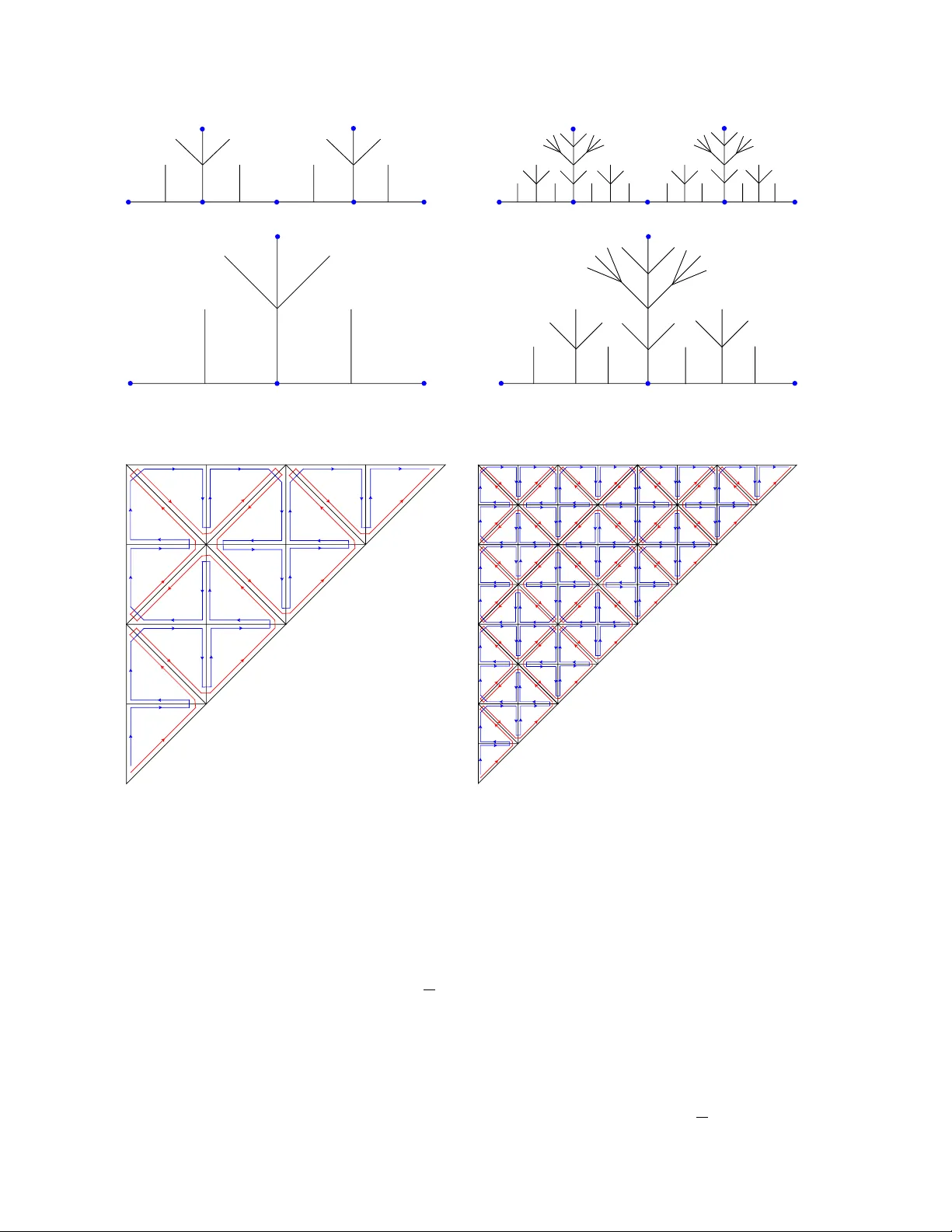
T ree-lik e is not a transitiv e relation on paths Jerem y Brazas, Gregory R. Conner, Paul F ab el, and Curtis Ken t Abstract. The notions of tr e e-like lo op and Lipschitz tr e e-like lo op were introduced by Ham bly and Lyons in their 2010 Annals of Mathematics paper. They show ed that the Lip- sc hitz tree-lik e prop erty determines an equiv alence relation on the set of paths of b ounded v ariation in a given metric space and then asked if this notion could b e extended to paths without the Lipsc hitz requirement. W e show that after eliminating the Lipschitz require- men t, the resulting relation is no longer transitive and thus is not an equiv alence relation. The counterexample is obtained by analyzing an explicit fractal construction in the plane. 1. Introduction In their 2010 Annals of Mathematics pap er, Ham bly and Lyons considered a notion of a path with b ounded v ariation b eing tr e e-like [5]. Their definition enco ded R -trees using p ositiv e contin uous functions to the real line, called height functions. Definition 1.1 ([5]) . A con tinuous function α : r 0 , 1 s Ñ X in a metric space p X, d q is tr e e-like if there exists a p ositiv e real-v alued contin uous function h : r 0 , 1 s Ñ R suc h that, for all s ď t , d ` α p t q , α p s q ˘ ď h p t q ` h p s q ´ 2 inf u Pr s,t s h p u q . The function h is a height function for α . Tw o paths α , β : r 0 , 1 s Ñ X are tr e e-like e quivalent , if α ˚ β is tree-lik e. W e sa y α is a Lipschitz tr e e-like path if α has a heigh t function with b ounded v ariation. Two paths α, β : r 0 , 1 s Ñ X are Lipschitz tr e e-like e quivalent , if α ˚ β is Lipschitz tree-lik e. Ham bly and Lyons sho wed that Lipschitz tr e e-like is an equiv alence relation on the set of paths with b ounded v ariation and that eac h equiv alence class has a unique (up to reparam- eterization) representativ e of shortest length. They then sho w ed that, for paths of b ounded v ariation in R d , the signature of a path is trivial if and only if the path is Lipsc hitz tree-like [5, Theorem 4]. Ham bly and Lyons ask ed ho w imp ortant w as the finite length condition and p osed the following t w o questions. Question 1.2. [5, Problem 1.8] Do es tree -lik e equiv alen t (without requiring the height function to b e Lipschitz) define an equiv alence relation on the set of contin uous paths? Question 1.3. [5, Problem 1.9] Is there a unique tree reduced path asso ciated to an y con tin uous path? The main result of this pap er, Theorem 6.1, gives a negative answer to b oth of these questions. T o prov e this theorem, we require an alternativ e definition of “tree-like” that w as introduced b y Boedihardjo, Geng, Ly ons, and Y ang in [1] and whic h applies to paths that do not hav e b ounded v ariation. The same definition w as considered indep enden tly in [2] where it w as called “ R -tree nullhomotopic.” T o clarify the distinction for general Date : March 18, 2026. 2010 Mathematics Subje ct Classification. 54F50, 55R65, 57M10 . Key wor ds and phrases. R -tree, geo desic R -tree reduction, path-homotopy , dendrite, unique path lifting, co vering map. 1 2 J. BRAZAS, G.R. CONNER, P . F ABEL, AND C. KENT paths, we will use this latter term (see Definition 1.4). Bo edihardjo et al. were able to show that w eakly geometric rough paths ha v e trivial signature if and only if the path is R -tree n ullhomotopic. Definition 1.4 ([1, 2]) . W e say that α : r 0 , 1 s Ñ X is R -tr e e nul lhomotopic , if α factors through a lo op in an R -tree, that is, if there exists an R -tree E , a lo op π : r 0 , 1 s Ñ E and a map g : E Ñ X such that g ˝ π “ α . W e sa y that paths α, β : r 0 , 1 s Ñ X are R -tr e e homotopic , and we write α » R β , if α ˚ β is R -tree nullhomotopic. A principle result of [2] (Theorem 1.4) is that » R is not an equiv alence relation on the space of paths, sp ecifically » R do es not satisfy transitivit y . Ho w ever, this in and of itself do es not answ er the questions of Ham bly and Lyons, as it w as not demonstrated that the paths causing non-transitivit y admit a heigh t function. While it is possible to work through the construction there to show that constructed paths admit heigh t functions, here we will presen t an alternative geometric construction where it is immediate that the constructed lo ops admit heigh t functions. This will also provide an indep endent pro of of Theorem 1.4 of [2]. The rest of the pap er is structured as follows. In Section 2, we sho w that every tree-lik e lo op is R -tree nullh omotopic and that the con verse holds when the factorization through the R -tree E can b e achiev ed with a Lipsc hitz map g : E Ñ X . In Section 3, we sho w how to mo dify certain piecewise-linear paths that factor through a simplicial tree. In Section 4, we inductiv ely apply the construction from Section 3 to build tw o sequences of paths, g n ˝ π n and ˜ g n ˝ ˜ π n that factor through successively larger simplicial trees. In Section 5, we sho w that these t wo sequences of paths limit on the same path γ , whic h is space-filling in the con v ex hull of a right triangle 1 . W e also iden tify general metric conditions ensuring that constructions suc h as that giv en in Section 4 result in R -tree homotopic paths. In Section 6, w e giv e a negative answer to Ham bly and Lyons’ first question b y showing that α “ g 1 ˝ π 1 is tree-like equiv alent to γ , β “ ˜ g 1 ˝ ˜ π 1 is tree-like equiv alent to γ , but that α is not tree-like equiv alent to β . Since the paths α and β are rectifiable arcs which only intersect at their ends, they will b e reduced and hence giv e a negative answ er to Hambly and Ly ons’ second question. 2. Rela tion between types of tree-like W e will first giv e a short proof that tree-like implies R -tree nullhomotopic. The in terested reader can also see [3, 4, 6] for additional pro ofs. Recall that a top ological space underlying a compact R -tree is called a dendrite . Equiv alen tly , a dendrite is a uniquely arcwise connected P eano contin uum. Definition 2.1 (Dendrites from height functions) . F or any con tin uous function h : r 0 , 1 s Ñ R , w e can define an equiv alence relation „ h on r 0 , 1 s b y s „ h t , if h p s q “ h p t q “ a and s, t are con tained in a single comp onen t of h ´ 1 ` r a, 8q ˘ . Note, for s ă t , this is equiv alent to a “ h p s q “ h p t q “ inf u Pr s,t s h p u q . Then, for any t P r 0 , 1 s , the equiv alence class of t is r t s h “ C X h ´ 1 ` h p t q ˘ where C is the comp onent of h ´ 1 ` r h p t q , 8q ˘ con taining t . Let π : r 0 , 1 s Ñ E b e the decomp osition map where E “ r 0 , 1 s{ „ h . The following t w o prop erties are an immediate consequence of the definition. (*) A comp onent C of h ´ 1 ` r a, 8q ˘ is closed and π -saturated. Th us r 0 , 1 sz C is op en and π -saturated. 1 After constructing γ indep endently , the authors recognized that γ is a parameterization of the Sierpsi´ nski Curv e and that our appro ximation of it is essen tially Knopp’s representation [8, Section 4.2] T ree-lik e 3 (**) F or ev ery comp onent C of h ´ 1 ` r a, 8q ˘ , the comp onents of C z h ´ 1 p a q are op en and π -saturated. Lemma 2.2. The e quivalenc e r elation „ h induc es an upp er semi-c ontinuous de c omp osition of r 0 , 1 s such that the quotient π : r 0 , 1 s Ñ E “ r 0 , 1 s{ „ h is a dendrite. Pr o of. By Theorem 10.2 in [7], we need only show that E is a con tin uum and that for an y t w o p oints in E there is a third p oint separating them in E . If E is Hausdorff, then π is an upper semi-con tinuous decomp osition and E is a con tinuum. F or an y t P r 0 , 1 s , r t s h “ C X h ´ 1 ` h p t q ˘ is the in tersection of closed sets where C is the comp onent of h ´ 1 ` r h p t q , 8q ˘ con taining t . Thus equiv alence classes are closed. Therefore, we need only show that for ev ery tw o p oints in E there is a third p oint separating them. Supp ose that e “ r r s h and e 1 “ r s s h are distinct p oint s of E . W e will pro v e that their exists a t P r 0 , 1 s suc h that e and e 1 lie in distinct op en comp onents of E z ␣ π p t q ( . W e will no w consider t w o cases. Case 1: The c omp onent C r of h ´ 1 ` r h p r q , 8q ˘ c ontaining r and the c omp onent C s of h ´ 1 ` r h p s q , 8q ˘ c ontaining s ar e disjoint. Let r a, b s b e the in terv al with endpoints in C r Y C s and with p a, b q X p C r Y C s q “ H . Fix t P r a, b s suc h that h p t q “ inf h ` r a, b s ˘ . Notice h p t q ă min ␣ h p r q , h p s q ( . Then the comp onen t C t of h ´ 1 ` r h p t q , 8q ˘ con taining t contains C r Y C s and r r s h , r s s h are contained in distinct components of C t zr t s h . Then r 0 , 1 szr t s h “ r 0 , 1 sz C t Y ´ Ť C P Λ t C ¯ where Λ t is the set of comp onents of C t zr t s h . Th us ! π ` r 0 , 1 szr t s h ˘ , π p C q | C P Λ t ) is a collection of disjoint op en subsets of E z π p t q and π p r q and π p s q are con tained in distinct elemen ts of this set. Th us e and e 1 are con tained in distinct op en comp onen ts of E z π p t q . Case 2: The c omp onent C r of h ´ 1 ` r h p r q , 8q ˘ c ontaining r and the c omp onent C s of h ´ 1 ` r h p s q , 8q ˘ c ontaining s ar e not disjoint. W e may , without loss of generality , assume that h p r q ď h p s q . Then, since C r X C s ‰ H , we hav e that C s Ă C r and h p r q ă h p s q . Then r r s h X C s “ H . Fix r a, b s Ă C r suc h that r a, b s X r r s h “ t a u and r a, b s X C s “ t b u . Let t P r a ` b 2 , b s such that h p t q “ inf h ` r a ` b 2 , b s ˘ . Then h p r q ă h p t q ă h p s q . Th us, for C t the comp onen t of h ´ 1 ` r h p t q , 8q ˘ con taining t , w e hav e that C s Ă C t and r r s h Ă r 0 , 1 sz C t . Th us π ` r 0 , 1 sz C t ˘ and π ` C t zr t s h ˘ giv e an op en separation of E zt π p t qu and con tain the elemen ts π p r q and π p s q resp ectively . □ Lemma 2.3. If α : r 0 , 1 s Ñ X is tr e e-like, then α is R -tr e e nul lhomotopic. Pr o of. Since α is tree-like, there exists a positive real-v alued con tinuous function h : r 0 , 1 s Ñ R such that, for all s ď t , d ` α p t q , α p s q ˘ ď h p t q ` h p s q ´ 2 inf u Pr s,t s h p u q . By Lemma 2.2, we ha v e a contin uous function π : r 0 , 1 s Ñ E to a dendrite induced b y „ h . Notice that if s „ h t and s ď t , then d ` α p t q , α p s q ˘ ď h p t q ` h p s q ´ 2 inf u Pr s,t s h p u q “ 0. Thus, b y the universal prop erty of quotient maps, there exists a contin uous map g : E Ñ X such that g ˝ π “ α . □ Lemma 2.4 (Heigh t functions from dendrites) . L et p X , d q b e a metric sp ac e and p E , d 1 q b e a dendrite with a ge o desic metric d 1 . Supp ose that ther e exists a lo op π : r 0 , 1 s Ñ E and a Lipschitz map g : E Ñ X , then g ˝ π is tr e e-like. In p articular, h : r 0 , 1 s Ñ R given by h p t q “ Ld ` π p 0 q , π p t q ˘ , wher e L is the Lipschitz c onstant for g , is a height function for g ˝ π . Pr o of. Let π , g , and h b e as stated in the lemma. Fix s, t P r 0 , 1 s and supp ose that s ď t . Let A s , A t b e the arc in E from π p 0 q to π p s q , π p t q , resp ectively . Let x b e the unique p oint on A s X A t that separates π p s q and π p t q . Since x separates π p s q and π p t q , w e hav e that 4 J. BRAZAS, G.R. CONNER, P . F ABEL, AND C. KENT inf u Pr s,t s h p u q ď Ld ` π p 0 q , x ˘ . Since x P A s X A t , d 1 ` π p 0 q , π p u q ˘ “ d 1 ` π p 0 q , x ˘ ` d 1 ` x, π p u q ˘ for u P t s, t u . Then h p t q ` h p s q ´ 2 inf u Pr s,t s h p u q ě h p t q ` h p s q ´ 2 Ld 1 ` π p 0 q , x ˘ “ Ld 1 ` π p 0 q , π p t q ˘ ` Ld 1 ` π p 0 q , π p s q ˘ ´ 2 Ld 1 ` π p 0 q , x ˘ “ Ld 1 ` x, π p t q ˘ ` Ld 1 ` x, π p s q ˘ ě d ` g p x q , g ˝ π p t q ˘ ` d ` g p x q , g ˝ π p s q ˘ ě d ` g ˝ π p t q , g ˝ π p s q ˘ Th us h is a height function for g ˝ π . □ Remark 2.5. Since we did not require π to be Lipsc hitz, Lemma 2.4 do es not imply g ˝ π is Lipschitz tree-lik e. 3. Building dendrites and maps A metric simplicial tr e e is a simplicial tree endow ed with an edge metric giv en by an assignmen t of length to each edge. Let E b e a metric simplicial tree with v ertex set E p 0 q . A contin uous map π : r 0 , 1 s Ñ E is simplicial if all p oint preimages are finite and π is linear on the closure of eac h comp onent of r 0 , 1 sz π ´ 1 p E p 0 q q . A con tin uous map g : E Ñ R 2 is simplicial if all p oin t preimages are finite and g is linear on each edge of E . 3.1. P arameterizing edges of a triangle. Let T b e an isosceles right triangle in the Euclidean plane with v ertices ␣ a, b, c ( , where the righ t angle is at b , and with giv en ordering of vertices a, b, c . W e write △ abc for T when we wish to refer to this vertex ordering. Supp ose that we hav e simplicial trees E and ˜ E , an interv al r r, s s , simplicial maps π : r 0 , 1 s Ñ E , ˜ π : r 0 , 1 s Ñ ˜ E , g : E Ñ R 2 , and ˜ g : ˜ E Ñ R 2 suc h that (1) π | r r,s s , ˜ π | r r,s s are injective with π ` t r , r ` 2 2 , s u ˘ Ă E p 0 q , ˜ π ` t r , s u ˘ Ă ˜ E p 0 q (2) g ˝ π p r q “ ˜ g ˝ ˜ π p r q “ a , g ˝ π p r ` s 2 q “ b , and g ˝ π p s q “ ˜ g ˝ ˜ π p s q “ c ; and (3) g ˝ π | r r, r ` s 2 s , g ˝ π | r r ` s 2 ,s s , and ˜ g ˝ ˜ π | r r,s s are linear maps. In this situation, we will say p π , ˜ π , g , ˜ g q p ar ametrizes △ abc on r r, s s ; see Figure 1. Note that the paths π , ˜ π match the ordering of △ abc . Additionally , note that it is p ossible that arcs π ` r r , s s ˘ , ˜ π ` r r , s s ˘ con tain vertices in addition to those sp ecified b y Condition (1). E ˜ E π p r q π p r ` s 2 q π p s q π p r q ˜ π p s q a b c 0 1 ˜ π ˜ g π g Figure 1. P arameterizing △ abc on r r , s s T ree-lik e 5 3.2. The sub division step. If p π , ˜ π, g , ˜ g q parametrizes T “ △ abc on r r , s s , then we can construct a new simplicial tree E 1 b y making π p 3 r ` s 4 q and π p r ` 3 s 4 q v ertices, if they weren’t already . W e will endow the sub divided edges with lengths suc h that the metric remains unc hanged on E . W e will then add t wo new edges at these p oin ts with length half the length of the arc from π p r q to π p r ` s 2 q ; see Figure 2. W e construct ˜ E 1 similarly by making ˜ π p r ` s 2 q a vertex (if it wasn’t already) and attaching a new edge at this (p ossibly new) vertex. W e will endow the subdivided edges with lengths such that the metric on ˜ E remains unchanged and the new edge will ha ve length half the length of the arc from ˜ π p r q to ˜ π p s q . Then w e can naturally iden tify E , ˜ E as a metric subspace of E 1 , ˜ E 1 , resp ectively , and define retractions ρ 1 : E 1 Ñ E , ˜ ρ 1 : ˜ E 1 Ñ ˜ E whic h collapse the added edges to their vertex in E or ˜ E , resp ectiv ely . Notice that ρ, ˜ ρ are monotone retracts and the sup-metric distances d sup p ρ 1 , id E 1 q and d sup p ˜ ρ 1 , id ˜ E 1 q are equal to the diameter of the added edges. E ˜ E π p r q π p r ` s 2 q π p s q π p r q ˜ π p s q E 1 ˜ E 1 π 1 p r q π 1 p r ` s 2 q π 1 p s q ˜ π 1 p r q ˜ π 1 p s 2 q “ ˜ π 1 p s 6 q ˜ π 1 p r ` s 2 q ˜ π 1 p s q π 1 p s 1 q “ π 1 p s 3 q π 1 p s 5 q “ π 1 p s 7 q π 1 p s 2 q π 1 p s 6 q Figure 2. Adding and sub dividing edges W e can then define maps π 1 : r 0 , 1 s Ñ E 1 and ˜ π 1 : r 0 , 1 s Ñ ˜ E 1 b y π 1 | r 0 , 1 szp r,s q “ π | r 0 , 1 szp r,s q , ˜ π 1 | r 0 , 1 szp r,s q “ ˜ π | r 0 , 1 szp r,s q , and π 1 , ˜ π 1 are linear maps as illustrated in Figure 3 on r r, s s where s i “ p 8 ´ i q r ` i ¨ s 8 . Let d “ a ` b 2 , e “ b ` c 2 , and f “ a ` c 2 denote the midpoints of the sides of T . W e define g 1 : E 1 Ñ R 2 and ˜ g 1 : ˜ E 1 Ñ R 2 b y g 1 | E “ g , ˜ g 1 | ˜ E “ ˜ g , g 1 ˝ π 1 p s 2 q “ g 1 ˝ π 1 p s 6 q “ f , and ˜ g 1 ˝ ˜ π 1 p r ` s 2 q “ b and then extend linearly . Notice that p π 1 , ˜ π 1 , g 1 , ˜ g 1 q parametrizes △ ad f on r r , 3 r ` s 4 s , △ f db on r 3 r ` s 4 , r ` s 2 s , △ bef on r r ` s 2 , r ` 3 s 4 s , and △ f ec on r r ` 3 s 4 , s s where △ ad f , △ f db , △ bef , and △ f ec are v ertex-ordered isosceles righ t triangles eac h with diameter a half that of T . The order that π trav erses the legs of these righ t triangles will i nduce an ordering on t △ ad f , △ f db, △ bef , △ f ec u , whic h we will refer to as the natur al or dering inherite d fr om π . 4. The constr uction Let A “ t T 1 , . . . , T n u b e an ordered collection of isosceles righ t triangles with given vertex orderings. W e will say that p π , ˜ π , g , ˜ g q is a p ar ametrization of A (r elative to S “ t 0 “ s 0 ă s 1 ă ¨ ¨ ¨ ă s n “ 1 u ) if p π , ˜ π, g , ˜ g q parametrizes T i on r s i ´ 1 , s i s . In the remainder of the pap er, w e let T denote the v ertex-ordered triangle △ abc with v ertices a “ p 0 , 0 q , b “ p 0 , 1 q , and c “ p 1 , 1 q . Set A 1 “ t T u . Let E 1 b e the simplicial tree with three vertices t v 0 , v 1 2 , v 1 u and tw o edges ␣ p v 0 , v 1 2 q , p v 1 2 , v 1 q ( and ˜ E 1 b e the simplicial 6 J. BRAZAS, G.R. CONNER, P . F ABEL, AND C. KENT E 1 π 1 p r q π 1 p r ` s 2 q π 1 p s q ˜ E 1 ˜ π 1 p r q ˜ π 1 p s 2 q “ ˜ π 1 p s 6 q ˜ π 1 p r ` s 2 q ˜ π 1 p s q π 1 p s 1 q “ π 1 p s 3 q π 1 p s 5 q “ π 1 p s 7 q π 1 p s 2 q π 1 p s 6 q a b c e d f 0 1 ˜ π ˜ g 1 π g 1 Figure 3. The maps tree with t wo v ertices t ˜ v 0 , ˜ v 1 u and one edge ␣ p ˜ v 0 , ˜ v 1 q ( . W e will endow E 1 with the edge metric where b oth edges hav e length 1 and ˜ E 1 with the edge metric where its unique edge has length ? 2. Define π 1 : r 0 , 1 s Ñ E 1 , ˜ π 1 : r 0 , 1 s Ñ ˜ E 1 b y π 1 p i q “ v i for i P t 0 , 1 2 , 1 u , ˜ π 1 p i q “ ˜ v i for i P t 0 , 1 u . Define g 1 : E 1 Ñ R 2 , ˜ g 1 : ˜ E 1 Ñ R 2 b y g 1 p v 0 q “ ˜ g 1 p ˜ v 0 q “ a , g 1 p v 1 2 q “ b , and g 1 p v 1 q “ ˜ g 1 p ˜ v 1 q “ c and extending linearly . Then p π 1 , ˜ π 1 , g 1 , ˜ g 1 q parametrizes A 1 on r 0 , 1 s . Supp ose that we hav e inductiv ely constructed maps π n : r 0 , 1 s Ñ E n , ˜ π n : r 0 , 1 s Ñ ˜ E n and g n : E n Ñ R 2 , ˜ g n : ˜ E n Ñ R 2 suc h that the following hold: (1) E n , ˜ E n are simplicial trees with edge metrics where all edges hav e length 1 2 n ´ 1 , ? 2 2 n ´ 1 , resp ectiv ely . (2) E n , ˜ E n are monotone retracts of E n ´ 1 , ˜ E n ´ 1 , resp ectively . (3) F or n ą 1, ρ n : E n Ñ E n ´ 1 , ˜ ρ n : ˜ E n Ñ ˜ E n ´ 1 are monotone retractions suc h that d sup p ρ n , id E n q “ 1 2 n ´ 1 and d sup p ˜ ρ n , id ˜ E n q “ ? 2 2 n ´ 1 . (4) g n : E n Ñ R 2 and ˜ g n : ˜ E n Ñ R 2 are 1-Lipschitz. (5) F or n ą 1, g n | E n ´ 1 “ g n ´ 1 and ˜ g n | ˜ E n ´ 1 “ ˜ g n ´ 1 . (6) A n is an ordered collection of 4 n ´ 1 v ertex-ordered isosceles right triangles with leg lengths 1 2 n ´ 1 . (7) p π n , ˜ π n , g n , ˜ g n q is a parametrization of A n relativ e to S “ t 0 , 1 4 n ´ 1 , 2 4 n ´ 1 , . . . , 1 u W e are now ready to define A n ` 1 , E n ` 1 , ˜ E n ` 1 , π n ` 1 : r 0 , 1 s Ñ E n ` 1 , ˜ π n ` 1 : r 0 , 1 s Ñ ˜ E n ` 1 and g n ` 1 : E n ` 1 Ñ R 2 , ˜ g n ` 1 : ˜ E n ` 1 Ñ R 2 that satisfy the inductive hypotheses. W rite A n “ t T 1 , . . . , T 4 n ´ 1 u . Since p π n , ˜ π n , g n , ˜ g n q parameterizes T i on r i ´ 1 4 n ´ 1 , i 4 n ´ 1 s , we can apply the sub division pro cess of Section 3.2 for eac h i to define A n ` 1 , E n ` 1 , ˜ E n ` 1 , π n ` 1 : r 0 , 1 s Ñ E n ` 1 , ˜ π n ` 1 : r 0 , 1 s Ñ ˜ E n ` 1 and g n ` 1 : E n ` 1 Ñ R 2 , ˜ g n ` 1 : ˜ E n ` 1 Ñ R 2 . In this pro cess, ev ery edge of E n (and ˜ E n ) is sub divided in half and at each new vertex one or t wo new edges of length 1 2 n are added. It is then an exercise to see this satisfy the inductiv e hypothesis. Note that the ordered set A n ` 1 “ t T 1 1 , ¨ ¨ ¨ , T 1 4 n u is obtained from A n b y replacing eac h T i with the sequence T 1 4 p i ´ 1 q` 1 , T 1 4 p i ´ 1 q` 2 , T 1 4 p i ´ 1 q` 3 , T 1 4 p i ´ 1 q` 4 consisting of the four v ertex-ordered triangles from the subdivision process and ordered with the natural ordering inherited from π n . T ree-lik e 7 ˜ E 2 E 2 E 3 ˜ E 3 Figure 4. On the left are E 2 and ˜ E 2 . On the righ t are E 3 and ˜ E 3 . Figure 5. On the left is a schematic for g 2 ˝ π 2 (in blue) and ˜ g 2 ˝ ˜ π 2 (in red). On the righ t is a schematic for g 3 ˝ π 3 (in blue) and ˜ g 3 ˝ ˜ π 3 (in red). 5. Limiting ar guments Lemma 5.1. Supp ose that E i is a neste d se quenc e of dendrites with ge o desic metrics d i such that d i | E i ´ 1 ˆ E i ´ 1 “ d i ´ 1 and supp ose a ą 0 . If, for al l i ą 1 , ρ i : E i Ñ E i ´ 1 is a monotone r etr act and sup e P E i d i ` ρ i p e q , e ˘ ď a 2 i , then E “ lim Ð Ý p E i , ρ i q is a dendrite and E admits a metric d such that d | E i ˆ E i “ d i (wher e we identify E i with its natur al emb e dding into E ) and the pr oje ctions ϱ i : E Ñ E i c onver ge uniformly to the identity map on E . Pr o of. It follows from Theorem 10.36 in [7] that E is a dendrite. W e need only sho w that E admits a metric satisfying the tw o conditions of the lemma. F or p e i q , p f i q P E , let d ` p e i q , p f i q ˘ “ sup i d i p e i , f i q . Since sup e P E i d i ` ρ i p e q , e ˘ ď a 2 i , 8 J. BRAZAS, G.R. CONNER, P . F ABEL, AND C. KENT d i p e i , f i q ď i ÿ j “ 2 d j p e j , e j ´ 1 q ` d p e 1 , f 1 q ` i ÿ j “ 2 ` d j p f j , f j ´ 1 q ď 8 ÿ j “ 1 a 2 j ` diam p E 1 q ` 8 ÿ j “ 1 a 2 j “ diam p E 1 q ` 2 a, whic h implies that d (the uniform metric on E as a subset of ś i E i ) is well-defined. The uniform top ology on a pro duct of metric spaces is alw ays finer than the pro duct top ology so it suffices to show that the inv erse limit top ology is finer than the top ology induced by d . Let p e n q P E and ϵ ą 0 and consider the op en d -ball B d pp e n q , ϵ q in the metric space p E , d q . Find m P N suc h that ř 8 j “ m ` 1 a 2 j ă ϵ 4 . Let U n “ B d n p e n , ϵ { 4 q for n P t 1 , 2 , . . . , m u and let U n “ E n for n ą m . W e claim that E X ś n P N U n Ď B d pp e n q , ϵ q . Giv en p f n q P E X ś n P N U n , we ha v e d n p e n , f n q ă ϵ 4 for all n P t 1 , 2 , . . . , m u . Fix n ą m . Then d n p e n , f n q ď d n p e n , e m q ` d n p e m , f m q ` d n p f m , f n q ď n ÿ j “ m ` 1 a 2 j ` d m p e m , f m q ` n ÿ j “ m ` 1 a 2 j ă ϵ 4 ` ϵ 4 ` ϵ 4 ď 3 ϵ 4 Since sup t d n p e n , f n q | n P N u ă ϵ , we hav e p f n q P B d pp e n q , ϵ q . Thus the desired inclusion is prov ed and d is a metric compatible with the inv erse limit top ology on E . The monotone retraction of E i on to E i ´ 1 simply collapses the closure of eac h comp onent C of E i z E i ´ 1 to the p oint C X E i ´ 1 , i.e., ρ i is the closest p oint pro jection map from E i to E i ´ 1 . Th us an arc in E i is mapp ed by ρ i to an arc (p ossibly degenerate) in E i ´ 1 b y collapsing some initial and some terminal part of the arc. Th us ρ i is 1-Lipschitz. Notice that if p e i q , p f i q P E j for some j , then e i “ e j and f i “ f j for all i ě j whic h implies d ` p e i q , p f i q ˘ “ d j p e j , f j q . Hence, d | E i ˆ E i “ d i . Fix n P N . Then, for p e i q P E , d ` ϱ n ` p e i q ˘ , p e i q ˘ “ sup i ą n d i p e n , e i q ď i ÿ j “ n ` 1 d j p e j , e j ´ 1 q ď i ÿ j “ n ` 1 a 2 n ď a 2 n . Th us ϱ n con v erges uniformly to the iden tity map. □ Lemma 5.2. L et E i b e a neste d se quenc e of dendrites with ge o desic metrics d j such that d i | E i ´ 1 ˆ E i ´ 1 “ d i ´ 1 and supp ose a ą 0 . Supp ose that we have maps π i : r 0 , 1 s Ñ E i and g i : E i Ñ R 2 for i ě 1 and maps ρ i : E i Ñ E i ´ 1 for i ě 2 with the fol lowing pr op erties. (1) ρ i : E i Ñ E i ´ 1 is a monotone r etr act of dendrites (2) sup e P E i d i ` ρ i p e q , e ˘ ď a 2 i (3) π i p r q “ π j p r q for al l i, j and r P t 0 , 1 u (4) sup t d i ` π i ´ 1 p t q , π i p t q ˘ ď a 2 i ´ 1 . (5) g i : E i Ñ R 2 is L -Lipschitz. (6) g i | E i ´ 1 “ g i ´ 1 F or E “ lim Ð Ý p E i , ρ i q , the maps π i c onver ge uniformly to a map π : r 0 , 1 s Ñ E such that π p r q “ π 1 p r q for r P t 0 , 1 u . The maps g i ˝ ϱ i c onver ge uniformly to an L -Lipschitz map g : E Ñ R 2 such that g | E i “ g i . In p articular, g ˝ π is R -tr e e homotopic to g 1 ˝ π 1 T ree-lik e 9 Pr o of. By Lemma 5.1, E “ lim Ð Ý p E i , ρ i q admits a metric d suc h that d | E i ˆ E i “ d i (where w e iden tify E i with its natural embedding in E ) and the pro jections ϱ i : E Ñ E i con v erge uniformly to the iden tity map on E . By (4), the maps π i form a Cauch y sequence (in the sup metric) of contin uous maps r 0 , 1 s Ñ E . Thus they con verge uniformly to a map π : r 0 , 1 s Ñ E and (3) implies that π p r q “ π 1 p r q for r P t 0 , 1 u . Let e “ p e i q P E . Then for k ą j , we ha v e d ` g k ˝ ϱ k p e q , g j ˝ ϱ j p e q ˘ “ d ` g k p e k q , g j p e j q ˘ “ d ` g k p e k q , g k p e j q ˘ ď k ÿ i “ j ` 1 d ` g k p e i q , g k p e i ´ 1 q ˘ ď k ÿ i “ j ` 1 L ¨ d k ` e i , e i ´ 1 q ď k ÿ i “ j ` 1 L a 2 i ď L a 2 j . Th us g k ˝ ϱ k is a Cauc h y sequence of maps E Ñ R 2 (in the sup metric) and therefore con v erge to a map g : E Ñ R 2 . Notice that g k ˝ ϱ k | E k “ g k for all k . Hence for all ℓ ě k , g ℓ ˝ ϱ ℓ | E k “ g k . Thus g | E k “ g k whic h implies that g ˝ π 1 “ g 1 ˝ π 1 . Since E is a dendrite, π 1 p 0 q “ π p 0 q , and π 1 p 1 q “ π p 1 q , the path g ˝ π 1 is R -tree homotopic to g ˝ π . Hence g 1 ˝ π 1 is R -tree homotopic to g ˝ π . Since ϱ i is 1-Lipsc hitz and g i is L -Lipsc hitz, g i ˝ ϱ i is L -Lipsc hitz which implies that g is L -Lipsc hitz. □ 6. Non-transitivity of tree-like equiv alent Theorem 6.1. Ther e exists p aths α , β , and γ in R 2 such that α is tr e e-like e quivalent to γ , β is tr e e-like e quivalent to γ , but α is not tr e e-like e quivalent to β . In addition, α and β c an b e chosen to b e tr e e-like r e duc e d p aths. Pr o of. Let π n : r 0 , 1 s Ñ E n , ˜ π n : r 0 , 1 s Ñ ˜ E n , g n : E n Ñ R 2 , and ˜ g n : ˜ E n Ñ R 2 b e the maps and simplicial trees constructed in Section 4. Notice that g 1 ˝ π 1 parametrizes the tw o legs of the triangle T “ △ abc and ˜ g 1 ˝ ˜ π 1 parameterizes the hypotenuse. Condition (3) of the inductive h yp othesis guarantees that sup e P E i d i ` ρ i p e q , e ˘ ď 1 2 i ´ 1 and sup e P ˜ E i d i ` ˜ ρ i p e q , e ˘ ď ? 2 2 i ´ 1 . Lemma 5.1 gives us tw o dendrites E “ lim Ð Ý p E i , ρ i q and ˜ E “ lim Ð Ý p ˜ E i , ˜ ρ i q with metrics d and ˜ d such that d | E i ˆ E i “ d i , d | ˜ E i ˆ ˜ E i “ ˜ d i , suc h that the pro jections ϱ i : E Ñ E i , ˜ ϱ i : ˜ E Ñ ˜ E i con v erge uniformly to the resp ective iden tit y map. Then Lemma 5.2 giv es us maps π : r 0 , 1 s Ñ E , ˜ π : r 0 , 1 s Ñ ˜ E , g : E Ñ R 2 , and ˜ g : ˜ E Ñ R 2 suc h that g ˝ π is R -tree homotopic to g 1 ˝ π 1 and ˜ g ˝ ˜ π is R -tree homotopic to ˜ g 1 ˝ ˜ π 1 . Let d sup denote the uniform metric on paths in R 2 . Since p π n , ˜ π n , g n , ˜ g n q is a parametriza- tion of A n relativ e to S “ t 0 , 1 4 n ´ 1 , 2 4 n ´ 1 , . . . , 1 u and the triangles of A n ha v e diameter ? 2 2 n ´ 1 , w e hav e that d sup ` g n ˝ π n , ˜ g n ˝ ˜ π n ˘ ď ? 2 2 n ´ 1 . Then g k ˝ π k “ g ˝ π k , since g | E k “ g k . So d sup p g k ˝ π k , g ˝ π q “ d sup p g ˝ π k , g ˝ π q . Since π k con v erges uniformly to π and g is 1-Lipsc hitz, g k ˝ π k con v erges uniformly to g ˝ π . Similarly , ˜ g k ˝ ˜ π k con v erges uniformly to ˜ g ˝ ˜ π . Since d sup ` g n ˝ π n , ˜ g n ˝ ˜ π n ˘ ď ? 2 2 n ´ 1 , w e hav e that g ˝ π “ ˜ g ˝ ˜ π . Let α “ g 1 ˝ π 1 “ g ˝ π 1 , β “ ˜ g 1 ˝ ˜ π 1 “ ˜ g ˝ ˜ π 1 , and γ “ g ˝ π “ ˜ g ˝ ˜ π . Then we can consider π 1 ˚ π : r 0 , 1 s Ñ E , ˜ π 1 ˚ ˜ π : r 0 , 1 s Ñ ˜ E , g : E Ñ R 2 , and ˜ g : ˜ E Ñ R 2 . Since g and ˜ g are 10 J. BRAZAS, G.R. CONNER, P . F ABEL, AND C. KENT 1-Lipsc hitz, w e ha v e that α ˚ γ “ g ˝ p π 1 ˚ π q and β ˚ γ “ ˜ g ˝ p ˜ π 1 ˚ ˜ π q are b oth tree-like by Lemma 2.4. Since α ˚ β is a simply closed curve it is not R -tree nullhomotopic and, hence, b y Lemma 2.3, it is not tree-like. Note that α and β parameterize arcs, so they are reduced paths. This completes the pro of. □ Corollary 6.2 (Theorem 1.4 of [2]) . If X is an arbitr ary top olo gic al sp ac e and ϕ : r 0 , 1 s Ñ X and θ : r 0 , 1 s Ñ X ar e p ath-homotopic, then ther e exists a p ath ψ : r 0 , 1 s Ñ X such that ϕ is R -tr e e homotopic to ψ and θ is R -tr e e homotopic to ψ . Pr o of. The construction in the pro of of Theorem 6.1 giv es path α : r 0 , 1 s Ñ T parame- terizing the legs of T , path β : r 0 , 1 s Ñ T parameterizing the hypotenuse of T , and path γ : r 0 , 1 s Ñ conv p T q in the conv ex h ull of T suc h that α » R γ and β » R γ in conv p T q . Since ϕ is path-homotopic to θ , there exists a map h : conv p T q Ñ X such that h ˝ α “ ϕ and h ˝ β “ θ . Setting ψ “ h ˝ γ , we ha v e ϕ » R ψ and θ » R ψ . □ References [1] Horatio Boedihardjo, Xi Geng, T erry Ly ons, and Danyu Y ang. The signature of a rough path: uniqueness. A dv. Math. , 293:720–737, 2016. [2] Jeremey Brazas, Gregory R. Conner, Paul F ab el, and Curtis Kent. On r-trees, homotopies, and cov ering maps. Pr eprint . [3] Thomas Duquesne. The co ding of compact real trees by real v alued functions, 2006. [4] Ben Hambly and T erry Ly ons. Some notes on trees and paths. Pr eprint . [5] Ben Hambly and T erry Ly ons. Uniqueness for the signature of a path of bounded v ariation and the reduced path group. Ann. of Math. (2) , 171(1):109–167, 2010. [6] Jean-F ran ¸ cois Le Gall. Brownian excursions, trees and measure-v alued branc hing pro cesses. Ann. Pr ob ab. , 19(4):1399–1439, 1991. [7] Sam B. Nadler, Jr. Continuum the ory , volume 158 of Mono gr aphs and T extb o oks in Pur e and Applie d Mathematics . Marcel Dekker, Inc., New Y ork, 1992. An in tro duction. [8] Hans Sagan. Sp ac e-Fil ling Curves . Universitext. Springer, New Y ork, NY, 1994. West Chester University, Dep ar tment of Ma thema tics, West Chester, P A 19383, USA Email addr ess : jbrazas@wcupa.edu Brigham Young University, Dep ar tment of Ma thema tics, Prov o, UT 84602, USA Email addr ess : conner@math.byu.edu Mississippi St a te University, Dep ar tment of Ma thema tics and St a tistics, Mississippi St a te, MS 39762, USA Email addr ess : fabel@math.msstate.edu Brigham Young University, Dep ar tment of Ma thema tics, Prov o, UT 84602, USA Email addr ess : curtkent@mathematics.byu.edu
Original Paper
Loading high-quality paper...
Comments & Academic Discussion
Loading comments...
Leave a Comment