General multi-Novikov algebras, multi-differential algebras and their free constructions
Motivated by the recent development of noncommutative Novikov algebras and multi-Novikov algebras from the study of regularity structures of stochastic PDEs, this paper gives a general approach to study various multi-Novikov algebras and multi-differ…
Authors: Xiaoyan Wang, Li Guo, Huhu Zhang
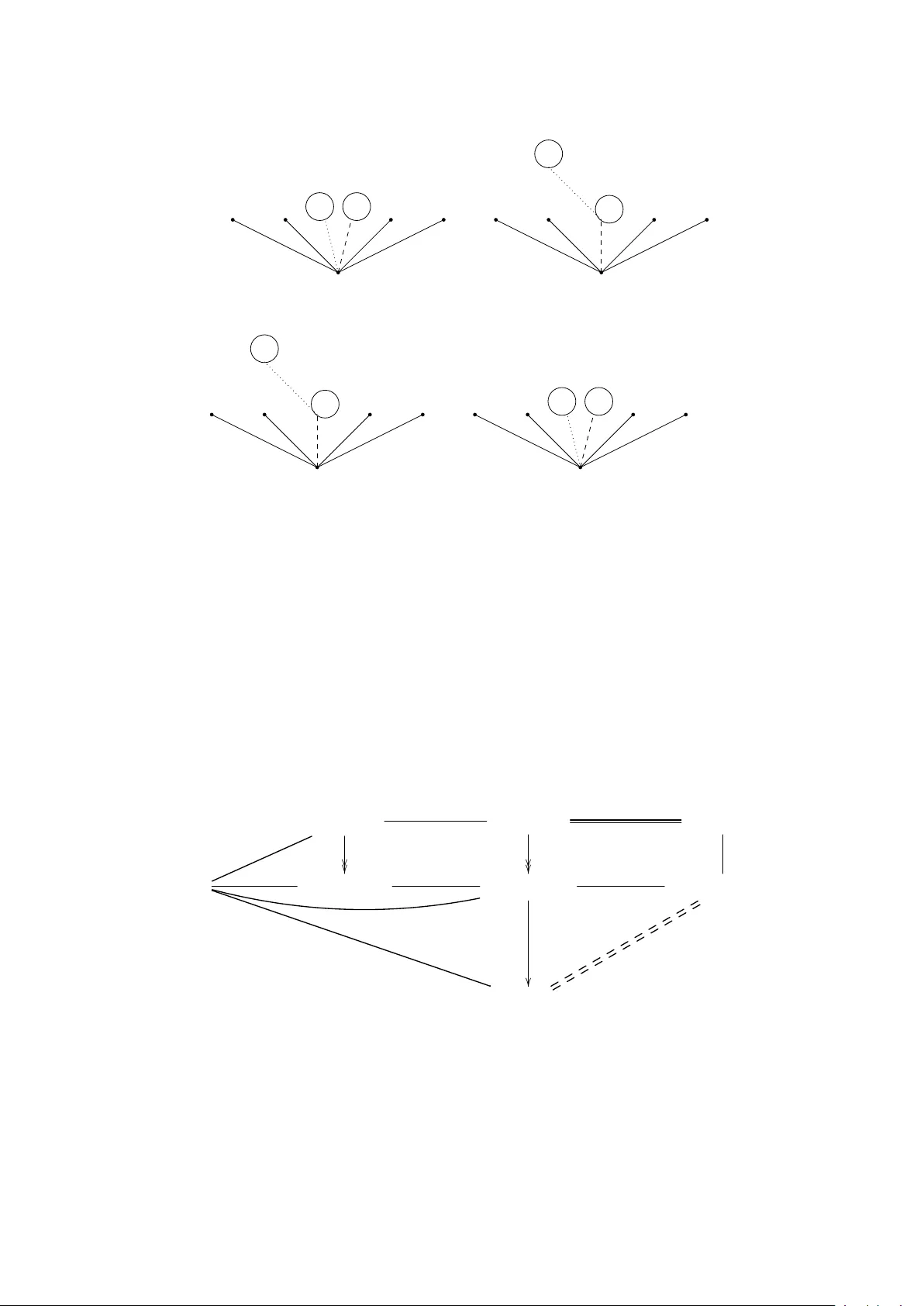
GENERAL MUL TI-NO VIK O V ALGEBRAS, MUL TI-DIFFERENTIAL ALGEBRAS AND THEIR FREE CONSTR UCTIONS XIA O Y AN W ANG, LI GUO, AND HUHU ZHANG A bstra ct . Motiv ated by the recent de velopment of noncommutativ e Novik ov algebras and multi- Noviko v algebras from the study of regularity structures of stochastic PDEs, this paper gi ves a general approach to study various multi-Noviko v algebras and multi-di ff erential algebras, with close connection with Poisson algebras. The construction of S. Gelfand of Novik ov algebras from di ff erential commutativ e algebras is generalized to this context. Free noncommuting multi- Noviko v algebras are constructed from typed decorated rooted trees and from noncommuting multi-di ff erential polynomials with populated conditions. C ontents 1. Introduction 1 1.1. Novik ov algebras and di ff erential algebras 1 1.2. Ne w notions related to Novik ov algebras and di ff erential algebras 3 1.3. Layout of the paper 3 2. Multi-di ff erential algebras and their free objects 4 2.1. Notions and examples of multi-di ff erential algebras 4 2.2. Free multi-di ff erential algebras 6 3. V ariations of multi-No vikov algebras and their deri vations from v ariations of multi-di ff erential algebras 8 4. Constructions of free noncommuting multi-Novik ov algebras 11 4.1. Free noncommuting multi-Novik ov algebras from typed decorated rooted trees 11 4.2. Statement of the main theorem 15 4.3. Preparations 18 4.4. The proof of Theorem 4.8 24 References 25 1. I ntr oduction This paper studies v ariations of multi-Novik ov algebras and their inductions from multi-di ff erential algebras with not necessarily commuting deriv ations. Free noncommuting multi-Novik ov alge- bras are constructed by typed decorated rooted trees and multi-indices. 1.1. Novik ov algebras and di ff er ential algebras. 1.1.1. Noviko v algebr as. The structure of Novik ov algebras first appeared in the study of Hamil- tonian operators in connection with formal calculus of v ariations [ 21 ] and then independently discov ered in the context of classification of linear Poisson brackets of hydrodynamical type [ 6 ]. The term Novik ov algebras w as coined by Osborn in 1992 [ 33 ]. A Novikov algebra is a nonassociativ e algebra ( A , ◦ ) where the multiplication ◦ satisfies the follo wing left-symmetric and right-commutative identities: Date : March 18, 2026. 2020 Mathematics Subject Classification. 17A30, 17A50, 12H05, 17D25, 17B63, 17A36, 16W25 . K ey wor ds and phrases. Noviko v algebra, di ff erential algebra, multi-Novik ov algebra, multi-di ff erential algebra, Poisson algebra, free object, multi-index. 1 2 ( x ◦ y ) ◦ z − x ◦ ( y ◦ z ) = ( y ◦ x ) ◦ z − y ◦ ( x ◦ z ) , (1) ( x ◦ y ) ◦ z = ( x ◦ z ) ◦ y , x , y , z ∈ A . (2) Denoting ( x , y , z ) : = ( x ◦ y ) ◦ z − x ◦ ( y ◦ z ), then the left-symmetric identity means ( x , y , z ) = ( y , x , z ). If only the left-symmetric property Eq. ( 1 ) is satisfied, then the algebra is called the pre-Lie algebra (or the left-symmetric algebra ). Geometrically , a No vikov algebra corresponds to a left-in variant torsion-free flat connection of the Lie group whose Lie algebra is isomorphic to the commutator Lie algebra of the Novik ov algebra [ 27 ]. Novik ov algebras arose in man y areas of mathematics and physics, especially in the recent study of stochastic PDEs and numerical methods [ 8 , 9 , 11 ]. Lately , No vikov algebras ha ve been studied on the lev el of operads [ 31 ], and Hopf algebra of decorated multi-indices [ 15 , 19 , 49 ]. Classification and construction problems on No viko v algebras ha ve been studied for sev eral decades. Zelmanov [ 44 ] prov ed that any finite-dimensional simple Noviko v algebra over an al- gebraically closed field with characteristic 0 is one dimensional. Hence he answered Novik ov’ s question that there are no nontri vial simple finite dimensional Noviko v algebras ov er an alge- braically closed field of characteristic 0 [ 32 ]. Osborn classified simple Noviko v algebras with an idempotent element and some modules over such algebras [ 34 ]. In 1992, he classified infi- nite dimensional simple Noviko v algebras with nilpotent elements over a field of characteristic zero and finite dimensional simple No vikov algebras with nilpotent elements over a field of char- acteristic p > 0 [ 35 ]. Later , a series of classification were gi ven by Xu, including a complete classification of finite-dimensional simple Noviko v algebras and their irreducible modules ov er an algebraically closed field with prime characteristic and the classification of simple Noviko v algebras ov er an algebraically closed field of characteristic zero [ 41 , 43 ]. He also introduced the Noviko v-Poisson algebra in order to study the tensor theory of Novik ov algebras and prov ed that any known simple Noviko v algebra can be vie wed as the Noviko v algebraic structure of a Novik ov-Poisson algebra [ 42 ]. Bai and Meng carried out a series of research on lo w dimensional Novik ov algebras, such as the structure and classification [ 3 , 4 , 5 ]. In 2011, Burde and Graaf gav e a systematic method to classify Novik ov algebras with a gi ven associated Lie algebra [ 12 ]. 1.1.2. Noviko v algebras fr om di ff er ential algebr as. A classical construction of a Novik ov algebra is giv en by S. Gelfand [ 21 ]. Let ( A , · ) be a commutativ e associativ e algebra equipped with a deri v ation D , that is ( A , · , D ) is a di ff erential commutati ve algebra [ 28 , 36 ]. Define (3) a ◦ b : = a · D ( b ) , a , b ∈ A . Then ( A , ◦ ) is a Novik ov algebra. Gelfand’ s construction is of fundamental importance in the theory of Noviko v algebras. All complex Noviko v algebras in dimensions no more than three and many important infinite-dimensional simple No viko v algebras can be realized by this construction or its linear deformations [ 2 , 3 , 43 ]. It is eventually shown that e very No vikov algebra is isomorphic to a subalgebra of some No viko v algebra obtained this way [ 7 , 16 ]. Moreov er, Gelfand’ s construction provides a natural right Novik ov algebra structure on the vector space of Laurent polynomials [ 26 ], which is closely related with Novik ov algebra a ffi nization [ 6 ]. 1.1.3. F r ee No vikov algebras. Due to the importance of free objects, free Noviko v algebras were studied. In 2002, Dzhumadil’ daev and Löfwall obtained a basis for the free Noviko v algebra using trees and the free di ff erential commutati ve algebra [ 16 ]. In 2018, T uniyaz, Bokut, Xiryazidin and Obul have found a magmatic Gröbner-Shirsho v basis of a free No viko v algebra o ver any field 3 (or commutati ve ring) such that the corresponding irreducible words are the Dzhumadil’ daev- Löfwall words [ 40 ]. In 2019, Zhang, Chen and Bokut obtained bases for Novik ov superalgebras ov er a field of characteristic zero [ 46 ]. Free Noviko v algebras hav e been applied to the study of stochastic PDEs [ 8 , 49 ]. 1.2. New notions r elated to Novik ov algebras and di ff erential algebras. In addition to all the de velopments on Noviko v algebras, there hav e been generalizations of Novik ov algebras in recent years. One of the generalizations was giv en in 2023. Extending S. Gelfand’ s construction of Noviko v algebras from di ff erential commutati ve algebras, Sartaye v and K olesniko v introduced the notion of noncommutativ e No vikov algebras and showed that they can be induced from di ff erential alge- bras in which the multiplication is not commutati ve [ 39 ]. Free noncommutativ e No viko v algebras were constructed [ 13 ]. Some recent studies on other structures related to Noviko v algebras can be found in [ 1 , 14 , 20 , 29 , 30 , 45 , 48 ] Another generalization was also gi ven in 2023. Motiv ated by the landmark work of M. Hairer and coauthors on regularity structures in stochastic PDEs [ 10 , 25 ], Bruned and Dotsenko intro- duced (commutativ e) multi-Novikov algebras, a generalization of Noviko v algebras with multiple binary operations indexed by a giv en set [ 8 ]. They showed that the multi-indices introduced in the conte xt of singular stochastic PDEs can be interpreted as free multi-Novik ov algebras. Here a critical role is played by generalizing the classical construction of S. Gelfand to commutativ e alge- bras with multiple commuting deriv ations. The induced multi-No vikov algebras are used to study stochastic PDEs [ 8 ] follo wing the theory of regularity structures in vented by M. Hairer [ 25 , 10 ]. 1.3. Lay out of the paper . Inspired by these recent de velopments on Noviko v algebras and their generalizations, it is desirable to organize them in a uniform framework. F or this purpose, we gi ve a systematic study on the variations of multi-Novikov algebras that can be induced from multi-di ff erential algebras, without assuming that the deri vations are commuting, or that the mul- tiplications are commutativ e. These v ariations of multi-Novikov algebras are sho wn to be induced from these more general multi-di ff erential algebras. Properties and examples of these algebras are giv en. The commonly studied Poisson algebras are special cases of the new kinds of multi- di ff erential algebras and multi-Novik ov algebras. Free objects in the corresponding categories are constructed, generalizing the pre vious con- structions of free Novik ov algebras and multi-No vikov algebras. Furthermore, by working in the conte xt of operads and as applications of free multi-di ff erential algebras, we sho w that these ne wly introduced variations of Noviko v algebras, as well as the multi-Noviko v algebras, in partic- ular No vikov algebras, are the e xact induced structures of multi-di ff erential algebras with v arious commutati vity conditions relaxed. The ov erall layout of the paper is as follows. In Section 2 , we first define v arious multi-di ff erential algebras, where the deriv ations might be commuting or noncommuting, and the algebra can be commutativ e or noncommutati ve. These conditions lead to four types of multi-di ff erential algebras: commuting multi-di ff erential commu- tati ve algebras, commuting multi-di ff erential noncommutati ve algebras, noncommuting multi- di ff erential commutati ve algebras, and noncommuting multi-di ff erential noncommutati ve alge- bras. Natural examples from calculus and algebra are provided. Especially , the notion of Poisson algebras can be interpreted in terms of noncommuting multi-di ff erential algebras. The free ob- jects in the corresponding four categories are constructed. 4 In Section 3 , we introduce the notions of multi-noncommutati ve Noviko v algebras, noncom- muting multi-Noviko v algebras, and noncommuting multi-noncommutativ e Novik ov algebras. They are shown to be induced from the four types of multi-di ff erential algebras studied in Sec- tion 2 , as depicted in the diagram (4) commuting multi-di ff erential commutativ e algebras noncommuting multi-di ff erential commutativ e algebras commuting multi-di ff erential noncommutativ e algebras noncommuting multi-di ff erential noncommutativ e algebras multi-Noviko v algebras noncommuting multi-Noviko v algebras multi-noncommutativ e Noviko v algebras noncommuting multi-noncommutativ e Noviko v algebras In Section 4 , we gi ve two explicit constructions of free noncommuting multi-No viko v algebras from free noncommuting multi-di ff erential commutati ve algebras and from rooted trees, general- izing or expanding the constructions of Dzhumadil’ dae v-Löfwall [ 16 ] and Bruned-Dotsenko [ 8 ]. The main theorem is Theorem 4.8 . Notations. In this paper , we let N be the set of natural numbers (including 0), N + be the set of positi ve natural numbers. Let k be a gi ven ground field for all the vector spaces, algebras, linear maps and tensor products. By a (commutati ve) algebra we mean an associati ve (commutativ e) algebra. 2. M ul ti - differential algebras and their free objects In this section, we introduce the notions of di ff erential commutative or noncommutati ve alge- bras with multiple deri v ations which are commuting or noncommuting, leading to the notions of commuting multi-di ff erential noncommutati ve algebras, noncommuting multi-di ff erential com- mutati ve algebras and noncommuting multi-di ff erential noncommutati ve algebras. W e then con- struct the free objects in the corresponding categories. 2.1. Notions and examples of multi-di ff erential algebras. W e begin with recalling the notion of di ff erential algebras. A derivation on a not necessarily associati ve algebra ( R , · ) is a linear map d : R → R that satisfies the Leibniz rule : (5) d ( x · y ) = d ( x ) · y + x · d ( y ) , x , y ∈ R . The classical notion of a di ff erential algebra [ 28 , 36 , 38 ] is an algebra ( R , · ) equipped with a deri v ation d : R → R . Often the algebra is assumed to be a commutativ e algebra or a field. A di ff erential algebra might also hav e multiple commuting deriv ations. W e now introduce a frame work to include se veral structures with multiple deri vations. Definition 2.1. Let Ω be a set. Denote ∂ Ω : = { ∂ ω | ω ∈ Ω } . (a) [ 8 ] A commuting multi-di ff erential commutativ e algebra indexed by Ω is a commuta- ti ve algebra R equipped with deri vations ∂ Ω which are pairwise commuting. (b) A commuting multi-di ff erential noncommutative algebra index ed by Ω is a noncom- mutati ve algebra R equipped with deri vations ∂ Ω which are pairwise commuting. (c) A noncommuting multi-di ff erential commutati ve algebra index ed by Ω is a commuta- ti ve algebra R equipped with deriv ations ∂ Ω which are not necessarily pairwise commuting. 5 (d) A noncommuting multi-di ff erential noncommutative algebra indexed by Ω is a non- commutati ve algebra R equipped with deriv ations ∂ Ω which are not necessarily pairwise commuting. These structures can be org anized in the follo wing table. multiplication deri vations commuting noncommuting commutati ve commuting multi-di ff erential commutati ve algebras (CMDCAs) noncommuting multi-di ff erential commutati ve algebras (NCMDCAs) noncommutati ve commuting multi-di ff erential noncommutati ve algebras (CMDNCAs) noncommuting multi-di ff erential noncommutati ve algebras (NCMDNCAs) Definition 2.2. Let ( R , ∂ Ω ) and ( S , δ Ω ) be commuting multi-di ff erential commutati ve algebras. A homomorphim from ( R , ∂ Ω ) to ( S , δ Ω ) is an algebra homomorphism f : R → S such that f ◦ ∂ ω = δ ω ◦ f for all ω ∈ Ω . Let CMDCA denote the category of commuting multi-di ff erential commutati ve algebras. The same notion can be defined for the other types of multi-di ff erential algebras in Definition 2.1 . W e let CMDNCA, NCMDCA and NCMDNCA denote the corresponding categories. W e giv e some examples of multi-di ff erential algebras. Example 2.3. (a) Let k [ X ] be a polynomial and let ∂ X : = { ∂ x : = ∂ ∂ x | x ∈ X } be the set of par - tial deriv ativ es. Then ( k [ X ] , ∂ X ) is a commuting multi-di ff erential commutativ e algebra. Like wise, ( k ⟨ X ⟩ , ∂ X ) is a commuting multi-di ff erential noncommutati ve algebra. (b) Let k [ x ] be the polynomial algebra in variable x . As is well-known, the set D : = f ( x ) d d x f ( x ) ∈ k [ x ] is a family of deriv ations on k [ x ] that might not be pairwise commuting. For a nonempty set Ω and a set map ∂ : Ω → D , denote ∂ Ω : = n ∂ ω : = ∂ ( ω ) ω ∈ Ω o . Then we obtain a noncommuting multi-di ff erential algebra ( k [ x ] , ∂ Ω ). (c) More generally , for a commutativ e algebra A , let Der( A ) ⊆ End( A ) be the set of deri vations on A . Then Der( A ) is a Lie algebra with respect to the bilinear product [ , ] : Der( A ) ⊗ Der( A ) → Der( A ) , [ d 1 , d 2 ] = d 1 ◦ d 2 − d 2 ◦ d 1 , d 1 , d 2 ∈ Der( A ) . For a gi ven set Ω and a map ∂ : Ω → Der( A ). Define ∂ Ω : = { ∂ ω : = ∂ ( ω ) | ω ∈ Ω } . Then ( A , ∂ Ω ) is a noncommuting multi-di ff erential commutati ve algebra. In fact, e very noncommuting multi-di ff erential commutati ve algebra can be realized this w ay . W e next show that a Poisson algebra can be naturally interpreted as a noncommuting multi- di ff erential algebra. Recall that a Poisson algebra is a k -module equipped with bilinear products · and [ , ], such that ( P , · ) is a commutati ve algebra, ( P , [ , ]) is a Lie algebra, and (6) [ x , y · z ] = [ x , y ] · z + y · [ x , z ] , x , y , z ∈ P . 6 Proposition 2.4. Let ( A , · ) be a commutative algebra equipped with a Lie brack et [ , ] . Consider the adjoint action ad : A → End( A ) , ad( x )( y ) : = ad x ( y ) = [ x , y ] , x , y ∈ A . Then the triple ( A , · , [ , ]) is a P oisson algebra if and only if the triple ( A , · , ad( A )) is a noncom- muting multi-di ff er ential algebra. Pr oof. If ( A , · , [ , ]) is a Poisson algebra. Then ad A = { ad x | x ∈ A } is a family of deri vations on the commutative algebra A . This means that ( A , ad( A )) is a noncommuting multi-di ff erential commutati ve algebra. Con versely , suppose that ( A , · , ad( A )) is a noncommuting multi-di ff erential algebra. Then the subset ad( A ) ⊆ End( A ) is in the subspace Der( A ) of End( A ). Therefore, Eq. ( 6 ) holds and ( A , · , [ , ] A ) is a Poisson algebra. □ 2.2. Free multi-di ff erential algebras. T o fix notations and provide a unified conte xt, we first recall the constructions of free commuting multi-di ff erential commutativ e and noncommutativ e algebras. W e then gi ve the constructions of free noncommuting multi-di ff erential commutativ e and noncommutati ve algebras. For a set Y , let M ( Y ) denote the free commutativ e monoid generated by Y , realized as the set of maps with finite supports: (7) M ( Y ) : = α : Y → N | supp( α ) | < ∞ . Here the support of α is supp( α ) : = { y ∈ Y | α ( y ) , 0 } . The multiplication in M ( Y ) is giv en by ( α · β )( y ) : = α ( y ) + β ( y ) , y ∈ Y . Identifying α ∈ M ( Y ) with Y y ∈ supp( α ) y α ( y ) = y α ( y 1 ) 1 · · · y α ( y k ) k when supp( α ) = { y 1 , . . . , y k } , we obtain the usual construction of the free commutati ve monoid: (8) M ( Y ) : = { y α 1 1 · · · y α m m | y i ∈ Y , α i ≥ 1 , m ≥ 1 } ∪ { 1 } . No w for nonempty sets Ω and X , define the set ∂ Ω : = { ∂ ω | ω ∈ Ω } and define the set of variables fr om commuting multi-deriv ations to be (9) ∆ Ω ( X ) : = M ( ∂ Ω ) × X = Y ω ∈ supp( α ) ∂ α ( ω ) ω , x α ∈ M ( ∂ Ω ) , x ∈ X . W e also use the functional notation Y ω ∈ supp( α ) ∂ α ( ω ) ω ( x ) : = Y ω ∈ supp( α ) ∂ α ( ω ) ω ( x ) : = Y ω ∈ supp( α ) ∂ α ( ω ) ω , x . For ω ∈ Ω , define D ω : ∆ Ω ( X ) → ∆ Ω ( X ) , D ω Y τ ∈ supp( α ) ∂ α ( τ ) τ ( x ) : = ∂ ω Y τ ∈ supp( α ) ∂ α ( τ ) τ ( x ) = ∂ α ( ω ) + 1 ω Y τ ∈ supp( α ) ,τ , ω ∂ α ( τ ) τ ( x ) . T ake the polynomial algebra (10) k Ω { X } : = k [ ∆ Ω ( X )] = k M ( M ( ∂ Ω ) × X ) . Extend D ω to D ω : k Ω { X } → k Ω { X } by the Leibniz rule and the linearity . Let i : X → k Ω { X } , x 7→ (1 , x ) , 7 be the natural injection. Then a fundamental result on di ff erential algebra is the following con- struction of free objects. Theorem 2.5. [ 28 , 36 ] The triple ( k Ω { X } , D Ω , i ) , wher e D Ω = { D ω | ω ∈ Ω } , is the fr ee commuting multi-di ff er ential commutative algebra on X with commuting derivation set D Ω . Like wise, take noncommutativ e polynomial algebra in variables M ( ∂ Ω ) × X : (11) k NC Ω { X } : = k ⟨ M ( ∂ Ω ) × X ⟩ . Again extend D ω by the Leibniz rule and linearity to k NC Ω { X } . Let i : X → k NC Ω { X } be the injection. Theorem 2.6. [ 23 ] The triple ( k NC Ω { X } , D Ω , i ) , wher e D Ω = { D ω | ω ∈ Ω } , is the fr ee commuting multi-di ff er ential noncommutative algebra on X with commuting derivation set D Ω . Remark 2.7. W e will use the con vention that a superscript NC indicates noncommuati ve v ari- ables and a subscript NC indicates noncommuting deri v ations. W e now consider the case when the deri vations are not necesarily commuting. First for a nonempty set Y , let M NC ( Y ) be the free monoid on Y realized as words: (12) M NC ( Y ) : = { y 1 · · · y k | y i ∈ Y , 1 ≤ i ≤ k , k ≥ 1 } ∪ { 1 } with the concatenation multiplication. Next let Ω and X be nonempty sets. Let (13) ∂ Ω : = { ∂ ω | ω ∈ Ω } be a set of symbols parameterized by Ω that will play the role of multi-deriv ations on the free noncommuting multi-di ff erential commutati ve algebra. Define the set of variables fr om non- commuting multi-derivations to be (14) ∆ NC , Ω ( X ) : = M NC ( ∂ Ω ) × X . For ω ∈ Ω , define (15) D ω : ∆ NC , Ω ( X ) → ∆ NC , Ω ( X ) , D ω ( ∂ ω 1 · · · ∂ ω k )( x ) : = ( ∂ ω ∂ ω 1 · · · ∂ ω k )( x ) . T ake the commutati ve polynomial algebra k NC , Ω { X } : = k [ ∆ NC , Ω ( X )] : = k M ( ∆ NC , Ω ( X )) like in Theorem 2.5 . Extend D ω for ω ∈ Ω by the Leibniz rule to a linear operator on k NC , Ω { X } . Let i : X → k NC , Ω { X } , x 7→ (1 , x ) be the natural injection. Theorem 2.8. The pair ( k NC , Ω { X } , D Ω ) with i : X → k NC , Ω { X } is the fr ee noncommuting multi- di ff er ential commutative algebra on X with its noncommuting derivation set D Ω . Pr oof. Let a noncommuting multi-di ff erential commutativ e algebra ( A , δ Ω ) and a set map f : X → A be gi ven. Define ¯ f : k NC , Ω { X } → A by ¯ f ( ∂ ω 1 , 1 · · · ∂ ω 1 , k 1 )( x 1 ) · · · ( ∂ ω n , 1 · · · ∂ ω n , k n )( x n ) : = ( δ ω 1 , 1 · · · δ ω 1 , k 1 ) f ( x 1 ) · · · ( δ ω n , 1 · · · δ ω n , k n ) f ( x n ) . Then ¯ f is an algebra homomorphism. Also, for x ∈ X , we have ¯ f ( i ( x )) = ¯ f ( x ) = f ( x ). Hence ¯ f ◦ i = f . W e next verify ¯ f ◦ D τ = δ τ ◦ f for τ ∈ Ω . In fact, ( ¯ f ◦ D τ )(( ∂ ω 1 , 1 · · · ∂ ω 1 , k 1 )( x 1 ) · · · ( ∂ ω n , 1 · · · ∂ ω n , k n )( x n )) 8 = ¯ f n X i = 1 (( ∂ ω 1 , 1 · · · ∂ ω 1 , k 1 )( x 1 ) · · · ( ∂ τ ∂ ω i , 1 · · · ∂ ω i , k i ( x i )) · · · ( ∂ ω n , 1 · · · ∂ ω n , k n )( x n ) = n X i = 1 (( δ ω 1 , 1 · · · δ ω 1 , k 1 )( f ( x 1 )) · · · ( δ τ δ ω i , 1 · · · δ ω i , k i ( f ( x i ))) · · · ( δ ω n , 1 · · · δ ω n , k n )( f ( x n )) = δ τ (( δ ω 1 , 1 · · · δ ω 1 , k 1 )( f ( x 1 )) · · · ( δ ω n , 1 · · · δ ω n , k n )( f ( x n ))) = ( δ τ ◦ ¯ f )(( ∂ ω 1 , 1 · · · ∂ ω 1 , k 1 )( x 1 ) · · · ( ∂ ω n , 1 · · · ∂ ω n , k n )( x n )) . Therefore, ¯ f is a homomorphism of noncommuting multi-di ff erential commutativ e algebras. Finally , by construction, the only way to get a noncommuting multi-di ff erential commutativ e algebra homomorphism from f is ¯ f , which guarantees the uniqueness. □ As in the pre vious case, take the noncommutati ve polynomial algebra k NC NC , Ω { X } : = k ⟨ ∆ NC , Ω ( X ) ⟩ : = k M NC ( ∆ NC , Ω ( X )) as in Theorem 2.6 . Extend D ω , ω ∈ Ω , to k NC NC , Ω { X } by the Leibniz rule. Theorem 2.9. The pair ( k NC NC , Ω { X } , D Ω ) with the natural injection i : X → k NC NC , Ω { X } is the fr ee noncommuting multi-di ff er ential noncommutative algebra on X with noncommuting derivation set D Ω . Pr oof. The proof is similar to the one for Theorem 2.8 . □ 3. V aria tions of mul ti -N o viko v algebras and their deriv a tions fr om v aria tions of mul ti - differential algebras In this section, we introduce variations of multi-Novik ov algebras. W e then show that varia- tions of multi-di ff erential algebras gi ve rise to v ariations of multi-Novik ov algebras as sho wn in Diagram ( 4 ). Definition 3.1. (a) [ 8 ] A multi-Noviko v algebra is a vector space N equipped with bilinear products ▷ ω index ed by a set Ω , which satisfy the following identities. ( x ▷ ω y ) ▷ τ z − x ▷ ω ( y ▷ τ z ) = ( y ▷ ω x ) ▷ τ z − y ▷ ω ( x ▷ τ z ) , (16) ( x ▷ ω y ) ▷ τ z − x ▷ ω ( y ▷ τ z ) = ( x ▷ τ y ) ▷ ω z − x ▷ τ ( y ▷ ω z ) , (17) ( x ▷ ω y ) ▷ τ z = ( x ▷ τ z ) ▷ ω y , x , y , z ∈ N , ω, τ ∈ Ω . (18) (b) A noncommuting multi-Novikov algebra is a vector space N equipped with bilinear products ▷ ω index ed by a set Ω , which satisfy the following identities. ( x ▷ ω y ) ▷ τ z − x ▷ ω ( y ▷ τ z ) = ( y ▷ ω x ) ▷ τ z − y ▷ ω ( x ▷ τ z ) , (19) ( x ▷ ω y ) ▷ τ z = ( x ▷ τ z ) ▷ ω y , x , y , z ∈ N , ω, τ ∈ Ω . (20) (c) A multi-noncommutativ e Novik ov algebra is a v ector space N equipped with two f ami- lies of bilinear products ▷ Ω : = { ▷ ω | ω ∈ Ω } , ◁ Ω : = { ◁ ω | ω ∈ Ω } , which satisfy the follo wing identities. ( x ◁ ω y ) ▷ τ z = x ◁ ω ( y ▷ τ z ) , (21) ( x ▷ ω y ) ▷ τ z − x ◁ τ ( y ◁ ω z ) = x ▷ τ ( y ◁ ω z ) − ( x ▷ ω y ) ◁ τ z , (22) 9 x ▷ ω ( y ▷ τ z ) − x ▷ τ ( y ▷ ω z ) = x ▷ τ ( y ◁ ω z ) − x ▷ ω ( y ◁ τ z ) , (23) ( x ▷ τ y ) ▷ ω z − x ◁ τ ( y ◁ ω z ) = x ▷ ω ( y ◁ τ z ) − ( x ▷ ω y ) ◁ τ z , (24) ( x ◁ ω y ) ◁ τ z − ( x ◁ τ y ) ◁ ω z = ( x ▷ τ y ) ◁ ω z − ( x ▷ ω y ) ◁ τ z , (25) x ◁ ω ( y ◁ τ z ) − x ◁ τ ( y ◁ ω z ) = ( x ▷ τ y ) ◁ ω z − ( x ▷ ω y ) ◁ τ z , x , y , z ∈ N , ω, τ ∈ Ω . (26) (d) A noncommuting multi-noncommutative Noviko v algebra is a vector space N equipped with two families of bilinear products ▷ Ω : = { ▷ ω | ω ∈ Ω } , ◁ Ω : = { ◁ ω | ω ∈ Ω } , which satisfy the follo wing identities. ( x ◁ ω y ) ▷ τ z = x ◁ ω ( y ▷ τ z ) , (27) ( x ▷ ω y ) ▷ τ z − x ◁ τ ( y ◁ ω z ) = x ▷ τ ( y ◁ ω z ) − ( x ▷ ω y ) ◁ τ z , x , y , z ∈ N , ω, τ ∈ Ω . (28) As in the case of Noviko v algebras, the various Noviko v algebras are induced by various multi- di ff erential algebras as sho wn belo w . W e include the case of multi-Noviko v algebras for com- pleteness. General studies of induces structures can be found in [ 24 , 47 ] Theorem 3.2. Let Ω be a nonempty set. (a) [ 8 ] Let ( A , ∂ Ω ) be a commuting multi-di ff er ential commutative algebra. Define binary operations ▷ Ω : = { ▷ ω , ω ∈ Ω } on A by x ▷ ω y : = x ∂ ω ( y ) , x , y ∈ A , ω ∈ Ω . Then ( A , ▷ Ω ) is a multi-Noviko v algebra. (b) Let ( A , ∂ Ω ) be a noncommuting multi-di ff er ential commutative algebra. Define binary operations ▷ Ω : = { ▷ ω | ω ∈ Ω } on A by x ▷ ω y = x ∂ ω ( y ) , x , y ∈ A , ω ∈ Ω . Then ( A , ▷ Ω ) is a noncommuting multi-Noviko v algebra. (c) Let ( A , ∂ Ω ) be a commuting multi-di ff er ential noncommutative algebra. Define binary operations ▷ Ω : = { ▷ ω | ω ∈ Ω } , ◁ Ω : = { ◁ ω | ω ∈ Ω } on A by (29) x ▷ ω y = x ∂ ω ( y ) , x ◁ ω y = ∂ ω ( x ) y x , y ∈ A , ω ∈ Ω . Then ( A , ▷ Ω , ◁ Ω ) is a multi-noncommutative Noviko v algebra. (d) Let ( A , ∂ Ω ) be a noncommuting multi-di ff er ential noncommutative algebra. Define binary operations ▷ Ω : = { ▷ ω | ω ∈ Ω } , ◁ Ω : = { ◁ ω | ω ∈ Ω } on A by (30) x ▷ ω y : = x ∂ ω ( y ) , x ◁ ω y : = ∂ ω ( x ) y x , y ∈ A , ω ∈ Ω . Then ( A , ▷ Ω , ◁ Ω ) is a noncommuting multi-noncommutative Noviko v algebra. Pr oof. (a) This is obtained in [ 8 ]. (b) W e just need to show that the identities ( 19 ) and ( 20 ) in Definition 3.1 . (b) hold. Indeed, for any x , y , z ∈ A and ω, τ ∈ Ω , we ha ve ( x ▷ ω y ) ▷ τ z − x ▷ ω ( y ▷ τ z ) = x ∂ ω ( y ) ∂ τ ( z ) − x ∂ ω ( y ) ∂ τ ( z ) − xy ( ∂ ω ∂ τ z ) 10 = − xy ( ∂ ω ∂ τ z ) = y ∂ ω ( x ) ∂ τ ( z ) − y ∂ ω ( x ) ∂ τ ( z ) − y x ( ∂ ω ∂ τ )( z ) = ( y ▷ ω x ) ▷ τ z − y ▷ ω ( x ▷ τ z ) , and ( x ▷ ω y ) ▷ τ z = x ∂ ω ( y ) ∂ τ ( z ) = ( x ▷ τ z ) ▷ ω y . (c) W e verify identities ( 21 ) – ( 26 ) in Definition 3.1 . (c) as follo ws. ( x ◁ ω y ) ▷ τ z = ∂ ω ( x ) y ∂ τ ( z ) = x ◁ ω ( y ▷ τ z ) . ( x ▷ ω y ) ▷ τ z − x ◁ τ ( y ◁ ω z ) = x ∂ ω ( y ) ∂ τ ( z ) − ∂ τ ( x ) ∂ ω ( y ) z = x ∂ τ ∂ ω ( y ) z + x ∂ ω ( y ) ∂ τ ( z ) − ∂ τ ( x ) ∂ ω ( y ) z − x ∂ τ ∂ ω ( y ) z = x ▷ τ ( y ◁ ω z ) − ( x ▷ ω y ) ◁ τ z . x ▷ ω ( y ▷ τ z ) − x ▷ τ ( y ▷ ω z ) = x ∂ ω ( y ) ∂ τ ( z ) + xy ∂ ω ∂ τ ( z ) − x ∂ τ ( y ) ∂ ω ( z ) − xy ∂ τ ∂ ω ( z ) = x ∂ τ ∂ ω ( y ) z + x ∂ ω ( y ) ∂ τ ( z ) − x ∂ ω ∂ τ ( y ) z − x ∂ τ ( y ) ∂ ω ( z ) = x ▷ τ ( y ◁ ω z ) − x ▷ ω ( y ◁ τ z ) . ( x ▷ τ y ) ▷ ω z − x ◁ τ ( y ◁ ω z ) = x ∂ τ ( y ) ∂ ω ( z ) − ∂ τ ( x ) ∂ ω ( y ) z = x ∂ ω ∂ τ ( y ) z + x ∂ τ ( y ) ∂ ω ( z ) − ∂ τ ( x ) ∂ ω ( y ) z − x ∂ τ ∂ ω ( y ) z = x ▷ ω ( y ◁ τ z ) − ( x ▷ ω y ) ◁ τ z . ( x ◁ ω y ) ◁ τ z − ( x ◁ τ y ) ◁ ω z = ∂ τ ∂ ω ( x ) yz + ∂ ω ( x ) ∂ τ ( y ) z − ∂ ω ∂ τ ( x ) yz − ∂ τ ( x ) ∂ ω ( y ) z = x ∂ ω ∂ τ ( y ) z + ∂ ω ( x ) ∂ τ ( y ) z − x ∂ τ ∂ ω ( y ) z − ∂ τ ( x ) ∂ ω ( y ) z = ( x ▷ τ y ) ◁ ω z − ( x ▷ ω y ) ◁ τ z . x ◁ ω ( y ◁ τ z ) − x ◁ τ ( y ◁ ω z ) = ∂ ω ( x ) ∂ τ ( y ) z − ∂ τ ( x ) ∂ ω ( y ) z = x ∂ ω ∂ τ ( y ) z + ∂ ω ( x ) ∂ τ ( y ) z − x ∂ τ ∂ ω ( y ) z − ∂ τ ( x ) ∂ ω ( y ) z = ( x ▷ τ y ) ◁ ω z − ( x ▷ ω y ) ◁ τ z . (d) W e verify identities ( 27 ) and ( 28 ) in Definition 3.1 . (d) as follo ws. ( x ◁ ω y ) ▷ τ z = ∂ ω ( x ) y ∂ τ ( z ) = x ◁ ω ( y ▷ τ z ) . ( x ▷ ω y ) ▷ τ z − x ◁ τ ( y ◁ ω z ) = x ∂ ω ( y ) ∂ τ ( z ) − ∂ τ ( x ) ∂ ω ( y ) z = x ∂ τ ∂ ω ( y ) z + x ∂ ω ( y ) ∂ τ ( z ) − ∂ τ ( x ) ∂ ω ( y ) z − x ∂ τ ∂ ω ( y ) z = x ▷ τ ( y ◁ ω z ) − ( x ▷ ω y ) ◁ τ z . □ Example 3.3. Let ( k [ x ] , · ) be the polynomial algebra in variable x . Let ( f ( x ) d d x f ( x ) ∈ k [ x ] ) be the family of deriv ations on k [ x ] as in Example 2.3 . (b) . Define a family of binary operations ▷ k [ x ] = { ▷ f ( x ) | f ( x ) ∈ k [ x ] } on k [ x ] by taking g ( x ) ▷ f ( x ) h ( x ) : = g ( x ) f ( x ) d d x ( h ( x )) , g ( x ) , h ( x ) ∈ k [ x ] . Then ( k [ x ] , ▷ k [ x ] ) is a noncommuting multi-Novik ov algebra. 11 Example 3.4. Let ( A , · , [ , ] A ) be a Poisson algebra. Then we hav e a noncommuting multi-di ff erential commutati ve algebra ( A , ad( A )) as in Proposition 2.4 . Define a family of binary operations ▷ ad( A ) = { ▷ ∂ | ∂ = ad z ∈ ad( A ) , z ∈ A } on A , by x ▷ ∂ y : = x ∂ ( y ) = x ad z ( y ) = x [ z , y ] . Then ( A , ▷ ad( A ) ) is a noncommuting multi-Noviko v algebra. This realizes ev ery Poisson algebra as a noncommuting multi-Novik ov algebra. Example 3.5. Let M 2 × 2 be the linear space of 2 × 2 matrices with the matrix multiplication. T ake a family of pairwisely commutativ e matrices Ω = { x n | x n ∈ M 2 × 2 } . Define a family of deriv ations ad Ω : = { ad x i | x i ∈ Ω } on M 2 × 2 by ad x i ( y ) = [ x i , y ] = x i y − y x i , x i ∈ Ω , y ∈ M 2 × 2 . Then we get a family of pairwise commuting deri vations, since for an y 2 × 2 matrix z , we have ad x 1 ad x 2 ( z ) = x 1 ( x 2 z ) − x 1 ( z x 2 ) − ( x 2 z ) x 1 + ( z x 2 ) x 1 = x 2 ( x 1 z ) − x 2 ( z x 1 ) − ( x 1 z ) x 2 + ( z x 1 ) x 2 = ad x 2 ad x 1 ( z ) . Define a family of binary operations ▷ Ω : = { ▷ x i | x i ∈ Ω } on M 2 × 2 by y ▷ x i z : = y ad x i ( z ) . Then ( M 2 × 2 , ▷ Ω ) is a multi-noncommutati ve No viko v algebra. 4. C onstr uctions of free noncommuting mul ti -N o viko v algebras The purpose of this section is to construct the free objects in the category of noncommuting multi-Novik ov algebras defined in Definition 3.1 . (b) . In fact, we will give two explicit construc- tions of these free objects. W e first introduce enough notations to state the main result: Theo- rem 4.8 . The proof will comprise the rest of the paper , adapting the notations and construction of free Novik ov algebras and multi-No viko v algebras [ 8 , 16 ]. 4.1. Free noncommuting multi-Noviko v algebras from typed decorated rooted trees. Recall that an ( Ω -)multi-magmatic algebra is a vector space M equipped with multiplications ▷ ω in- dex ed by ω in a set Ω . A standard construction of the free ( Ω )-multi-magmatic algebra on X is the vector space Mag Ω ( X ) : = k T Ω ( X ) with the basis T Ω ( X ) of planar binary trees whose internal v ertices are decorated by Ω and whose the leafs are decorated by X . The binary operation ▶ ω on Mag Ω ( X ) is the grafting of two trees with the ne w root decorated by ω [ 8 ]. Let I be the two-sided ideal of Mag Ω ( X ) generated by all elements of the forms ( x ▶ ω y ) ▶ τ z − x ▶ ω ( y ▶ τ z ) − ( y ▶ ω x ) ▶ τ z + y ▶ ω ( x ▶ τ z ) , (31) ( x ▶ ω y ) ▶ τ z − ( x ▶ τ z ) ▶ ω y , x , y , z ∈ Mag Ω ( X ) , ω, τ ∈ Ω . (32) Then by construction, Mag Ω ( X ) / I is the free noncommuting multi-No vikov algebra on X . Let π : Mag Ω ( X ) → Mag Ω ( X ) / I denote the natural quotient map, and let i : X → Mag Ω ( X ) π − → Mag Ω ( X ) / I . 12 Let u be an element in the basis T Ω ( X ). Then either u = z ∈ X or u = y 1 ▶ ω 1 z 1 is the grafting of the left branch y 1 and right branch z 1 with root ω 1 . In turn, unless z 1 is in X , it also has a grafting z 1 = y 2 ▶ ω 2 z 2 , yielding u = y 1 ▶ ω 1 ( y 2 ▶ ω 2 z 2 ). Iterating this process yields the unique e xpression (33) u = y 1 ▶ ω 1 ( y 2 ▶ ω 2 ( · · · ( y n ▶ ω n z ) · · · )) , where z ∈ X , y i ∈ T and ω i ∈ Ω , i = 1 , · · · , n . An element of X can also be regarded as a u in Eq. ( 33 ) with n = 0. For our purpose of explicitly constructing free noncommuting multi-Noviko v algebras, we gi ve another construction of the free objects by quotients. Let MT Ω ( X ) denote the set of all typed decorated rooted trees, defined to be the rooted trees whose vertices are decorated by elements of X and edges are decorated by elements of Ω [ 18 ]. See [ 22 ] for such trees, called vertex-edge decorated trees, in the algebraic study of V olterra integral equations. As an algebraic interpretation of the typed decorated rooted trees, we gi ve the follo wing notion [ 16 ]. Definition 4.1. An r-expression is recursi vely gi ven by r ( z ) for z ∈ X and by (34) r ( y 1 , ω 1 , · · · , y n , ω n ; z ) , where z ∈ X , ω i ∈ Ω , and each y i ∈ MT Ω ( X ) itself is an r -expression, i = 1 , · · · , n . In the following, the set of typed decorated trees are encoded as the set of r -expressions by encoding • z as z for z ∈ X , and encoding ω 1 ω 2 ω n y 1 y 2 z y n · · · as the r -expression r ( y 1 , ω 1 , · · · , y n , ω n ; z ). The total degree tdeg( T ) of a typed decorated tree T is the total number of times (counting multiplicity) that elements of X ⊔ Ω appearing in the tree. In terms of an r -expression r , the total degree tdeg( r ) it is the total number of times that elements of X ⊔ Ω appearing in the expression. W e recursiv ely define a linear map h : k MT Ω ( X ) → Mag Ω ( X ) , r ( z ) 7→ z , r ( y 1 , ω 1 , · · · , y n , ω n ; z ) 7→ h ( y 1 ) ▶ ω 1 h r ( y 2 , ω 2 , · · · , y n , ω n ; z )) , (35) for z ∈ X , ω i ∈ Ω with i = 1 , · · · , n . Lemma 4.2. The linear map h : k MT Ω ( X ) → Mag Ω ( X ) in Eq. ( 35 ) is bijective. Pr oof. T o gi ve the proof, we recursi vely construct another linear map t : Mag Ω ( X ) → k MT Ω ( X ) , z 7→ r ( z ) , for z ∈ X , u = y 1 ▶ ω 1 y 2 ▶ ω 2 ( · · · ( y n ▶ ω n z ) · · · ) 7→ r t ( y 1 ) , ω 1 , t ( y 2 ) , ω 2 , · · · , t ( y n ) , ω n ; z , (36) for a planar binary tree u ∈ T Ω ( X ) with the unique factorization in Eq. ( 33 ). 13 W e next verify ht ( u ) = id Mag Ω ( X ) ( u ) by induction on the total degree tde g( u ) of u ∈ T Ω ( X ). First ht ( z ) = h ( r ( z )) = z , for z ∈ X . Inducti vely , for y 1 ▶ ω 1 u 1 ∈ T with u 1 = y 2 ▶ ω 2 ( · · · ( y n ▶ ω n z ) · · · ) ∈ T , we have ht ( y 1 ▶ ω 1 u 1 ) = h r t ( y 1 ) , ω 1 , t ( y 2 ) , · · · , t ( y n ) , ω n ; z = ht ( y 1 ) ▶ ω 1 ht ( u 1 ) = y 1 ▶ ω 1 u 1 . Similarly , th = id k MT Ω ( X ) . □ Through the linear bijection h , the free Ω -multi-magmatic algebra structure on Mag Ω ( X ) de- fines a free Ω -multi-magmatic algebra structure on k MT Ω ( X ) by transporting of structures, so that there is an Ω -multi-magmatic algebra isomorphism t : (Mag Ω ( X ) , { ▶ ω } ω ∈ Ω ) → ( k MT Ω ( X ) , { ▷ ω } ω ∈ Ω ) . Here for u , v ∈ MT Ω ( X ) and ω ∈ Ω , define u ▷ ω v : = t ( h ( u ) ▶ ω h ( v )) . So if v = r ( y 1 , ω 1 , · · · , y n , ω n ; z ), then by Eqs. ( 35 )– ( 36 ), we hav e u ▷ ω v : = t ( h ( u ) ▶ ω h ( v )) = t h ( u ) ▶ ω h ( y 1 ) ▶ ω 1 h ( y 2 ) ▶ ω 2 ( · · · ( h ( y n ) ▶ ω n z )) = r ( u , ω, y 1 , ω 1 , · · · , y n , ω n ; z ) . (37) In other words, u is grafted on the root of v (with edge decoration ω ) from the left [ 17 ]. For example, ω 1 ω 2 ω m x 1 x 2 z x m · · · ▷ ω τ 1 τ 2 τ n y 1 y 2 w y n · · · = ω τ 1 · · · τ n ω 1 ω 2 · · · ω m w z y 1 y n x 1 x 2 x m . Furthermore, the image J : = t ( I ) of the multi-Noviko v two-sided ideal I is a multi-Noviko v two-sided ideal of k MT Ω ( X ), and there is the following isomorphism of multi-No vikov algebras (38) e h : k MT Ω ( X ) / J → Mag Ω ( X ) / I , u + J 7→ h ( u ) + I . Hence (39) Nov NC , Ω ( X ) : = k MT Ω ( X ) / J Mag Ω ( X ) / I is also the free Ω -noncommuting multi-Novik ov algebra on X . Remark 4.3. For later applications, we interpret the two generators Eq. ( 31 )– ( 32 ) of the ideal I for the quotient algebra Mag Ω ( X ) / I in terms of generators of the ideal J for the quotient Nov NC , Ω ( X ) = k MT Ω ( X ) / J . (a) W e begin with the simpler case, for the generator Eq. ( 32 ) of I , its corresponding generator in J via the isomorphism t in Eq. 36 is τ ω z y x − ω τ y z x . 14 When x , y , z are in X , (modulo) this relation means that the two segments of the tree with roots y and z can be exchanges, while the leaf x is fixed. More generally , when we take x = x 1 , y = x 2 ▷ τ 2 ( x 3 ▷ τ 3 ( · · · ( x m ▷ τ m z ′ )) · · · ), z = y 2 ▷ ω 2 ( y 3 ▷ ω 3 ( · · · ( y n ▷ ω n z )) · · · ), ω = τ 1 and τ = ω 1 . Then for the r -expression r ( y 1 , ω 1 , · · · , y n , ω n ; z ) with y 1 = r ( x 1 , τ 1 , · · · , x m , τ m ; z ′ ), we hav e r r ( x 1 , τ 1 , · · · , x m , τ m ; z ′ ) , ω 1 , y 2 , · · · , y n , ω n ; z ≡ r r ( x 1 , ω 1 , y 2 , · · · , y n , ω n ; z ) , τ 1 , · · · , x m , τ m ; z ′ mod J (40) In terms of typed trees, we hav e ω 1 ω 2 · · · ω n τ 1 τ 2 · · · τ m z z ′ y 2 y n x 1 x 2 x m ≡ τ 1 τ 2 · · · τ m ω 1 ω 2 · · · ω n z ′ z x 2 x m x 1 y 2 y n (mod J ) indicating that the two adjacent segments with roots z and z ′ can be exchanged, while the left-most leaf is fixed. (b) Under the isomorphism t , the generator Eq. ( 31 ) of I corresponds to the following gener- ator of J τ ω z y x − τ ω z y x − τ ω z x y + τ ω z x y Regard it as a reduction rule: τ ω z y x ≡ τ ω z y x − τ ω z x y + τ ω z x y (mod J ) The intuiti ve meaning is that the two branches of the left tree can be exchanges at the cost of introducing two e xtra trees with fe wer branches. More generally , for a fixed i ≥ 1, apply the congruence to x = y i , y = y i + 1 , z = y i + 2 ▷ ω i + 2 ( y i + 3 ▷ ω i + 3 ( · · · ( y n ▷ ω n z )) · · · ), ω = ω i and τ = ω i + 1 with 1 ≤ i ≤ n − 1. Then multiply both sides of the resulting congruence on the left by the element y i − 1 via the multiplication ▷ ω i − 1 . Then multiply both sides of the new resulting congruence on the left by y i − 2 via ▷ ω i − 2 . Then continue this process repeatedly until multiplying both sides on the left by y 1 via ▷ ω 1 . W e finally obtain the congruence r ( y 1 , ω 1 , · · · , y i , ω i , y i + 1 , ω i + 1 , · · · , y n , ω n ; z ) ≡ r y 1 , ω 1 , · · · y i − 1 , ω i − 1 , y i ▷ ω i y i + 1 , ω i + 1 , · · · , y n , ω n ; z − r y 1 , ω 1 , · · · y i − 1 , ω i − 1 , y i + 1 ▷ ω i y i , ω i + 1 , · · · , y n , ω n ; z + r ( y 1 , ω 1 , · · · , y i − 1 , ω i − 1 , y i + 1 , ω i , y i , ω i + 1 , · · · , y n , ω n ; z ) mod J . (41) 15 In terms of typed decorated trees, we hav e ω 1 · · · ω i − 1 ω i ω i + 1 ω i + 2 · · · ω n z y 1 y i − 1 y i y i + 1 y i + 2 y n ≡ ω 1 · · · ω i − 1 ω i + 1 ω i ω i + 2 · · · ω n z y 1 y i − 1 y i + 1 y i y i + 2 y n − ω 1 · · · ω i − 1 ω i + 1 ω i ω i + 2 · · · ω n z y 1 y i − 1 y i y i + 1 y i + 2 y n + ω 1 · · · ω i − 1 ω i ω i + 1 ω i + 2 · · · ω n z y 1 y i − 1 y i + 1 y i y i + 2 y n (mod J ) This again has the combinatorial interpretation that the two branches for y i and y i + 1 can be ex- changed at the cost of introducing two ne w trees with newer branches. In summary , we gi ve the following construction and relations for the free Ω -multi-Novik ov algebra on X for later application. Proposition 4.4. (a) The quotient No v NC , Ω ( X ) : = k MT Ω ( X ) / J equipped with multiplications ▷ ω , ω ∈ Ω , is the fr ee Ω -multi-Noviko v algebr a on X . (b) Eqs. ( 40 ) – ( 41 ) hold in Nov NC , Ω ( X ) = k MT Ω ( X ) / J . 4.2. Statement of the main theorem. F or giv en sets X and Ω , we first state Theorem 4.8 that gi ves tw o explicit constructions of the free Ω -noncommuting multi-No viko v algebras on X . The readers are in vited to use the following diagram to keep track of the notions and maps in the constructions. Mag Ω ( X ) k MT Ω ( X ) h (Eq . ( 35 )) o o π k MT Ω ( X ) X ) 6 6 / / f * * i 2 2 Mag Ω ( X ) / I Nov NC , Ω ( X ) ˜ h (Eq . ( 38 )) o o ¯ f (Eq . ( 44 )) k MNE NC , Ω ( X ) η (Eq . ( 45 )) o o ? O O g (Eq . ( 48 )) x x φ (Eq . ( 49 )) x x PCD NC , Ω ( X ) (42) The dashed arro ws φ and g are only needed in the proof of Theorem 4.8 . For the first construction of the free Ω -multi-Noviko v algebra on X , we identify a special class of r -expressions. Definition 4.5. Let u = r ( y 1 , ω 1 , · · · , y n , ω n ; z ) be an r -expression in MT Ω ( X ). 16 n ≥ 0 (i). n = 0 n > 0 (ii). y 1 ∈ X y 1 < X write y 1 = r ( y ′ 1 , ω ′ 1 , · · · , y ′ m , ω ′ m ; z ′ ) (iii). m > n m = n (i v). z ′ > z z ′ = z (v). ( ω ′ 1 , · · · , ω ′ n ) ≥ ( ω 1 , · · · , ω n ) ( ω ′ 1 , · · · , ω ′ n ) < ( ω 1 , · · · , ω n ) z ′ < z m < n F igure 1. (a) u is called a nest if u ∈ X or y i ∈ X , i ≥ 2 and the r -expression y 1 itself is a nest. (b) Let X and Ω be two sets with total orders. A nest u is called ordered if u satisfies one of the follo wing conditions (i) n = 0, in which case u ∈ X , (ii) n > 0 and y 1 ∈ X , (iii) n > 0 , y 1 = r ( y ′ 1 , ω ′ 1 , · · · , y ′ m , ω ′ m ; z ′ ) and m > n , (i v) n > 0 , y 1 = r ( y ′ 1 , ω ′ 1 , · · · , y ′ m , ω ′ m ; z ′ ) , m = n and z ′ > z , (v) n > 0 , y 1 = r ( y ′ 1 , ω ′ 1 , · · · , y ′ m , ω ′ m ; z ′ ) , m = n , z ′ = z and ( ω ′ 1 , · · · , ω ′ n ) ≥ ( ω 1 , · · · , ω n ) with respect to the lexicographical order . (c) An ordered nest u = r ( y 1 , ω 1 , · · · , y n , ω n ; z ) ∈ MT Ω ( X ) is called a noncommuting multi- Novik ov element if the sequence of all of its leav es, reading from the right is in increasing order with respect to the order of X . Denote the set of noncommuting multi-Noviko v elements by MNE NC , Ω ( X ) . Remark 4.6. The fiv e cases in Definition 4.5(b) are depicted in the left-hand side of the flow diagram in Figure 1 , while the three dashed boxes on the right-hand side indicate that u = r ( y 1 , ω 1 , · · · , y n , ω n ; z ) is not ordered. Therefore, if u is not ordered, then u is gov erned by one of the three dashed boxes. Example 4.7. W e give the following examples to illustrate each of the cases in Definition 4.5 . Let a < b < c < d in X , and α < β < γ ∈ Ω . (a) r ( r ( d , α, a , γ, a , α ; b ) , α, c , β, a , α ; d ) is a nest. α γ α β α α b c a d a a d (b) (i) x ∈ X is an ordered nest; 17 (ii) r ( a , α, c , β, a , β, d , γ ; c ) is an ordered nest; α β β γ c a c a d (iii) r ( r ( a , γ, d , α, c , β, a , β ; d ) , γ , a , α ; c ) is an ordered nest; γ α β β γ α d a d c a a c (i v) r ( r ( d , α, b , β, a , γ ; d ) , γ , a , β, c , α ; b ) is an ordered nest; α β γ γ β α d d b a a c b (v) r ( r ( d , α, b , β, a , γ ; b ) , α, a , β, c , α ; b ) is an ordered nest. α β γ α β α b d b a a c b (c) r ( r ( r ( d , β, d , α, c , γ , c , β ; c ) , β, c , β, b , α ; d ) , γ, a , β ; a ) is a noncommuting multi-Noviko v el- ement. β α β β γ α β β γ d c b a a c c c d d In prepare for the second construction of the free Ω -multi-Novik ov algebra on X , recall from Theorem 2.8 that the free Ω -noncommuting multi-di ff erential commutative algebra k NC , Ω { X } generated by X is the commutativ e polynomial algebra on the set of di ff erential monomials ( ∂ ω 1 · · · ∂ ω n )( x ), where ω 1 , . . . , ω n ∈ Ω , n ∈ N , x ∈ X . By Theorem 3.2 . (b) , k NC , Ω { X } is a non- commuting multi-Noviko v algebra with the multiplications (here we will use ∗ ω instead of ▷ ω to av oid conflict of notations) (43) x ∗ ω y : = x ∂ ω ( y ) , ω ∈ Ω . 18 Let PCD NC , Ω ( X ) denote the noncommuting multi-Novik ov subalgebra of k NC , Ω { X } generated by X . Since No v NC , Ω ( X ) is the free noncommuting multi-No vkov algebra generated by X , the natural inclusion f : X → PCD NC , Ω ( X ) extends to a unique surjection of noncommuting multi-Novko v algebras (44) ¯ f : Nov NC , Ω ( X ) → PCD NC , Ω ( X ) , which will be sho wn to be bijecti ve. Define a linear map η : k MNE NC , Ω ( X ) → k MT Ω ( X ) ↠ No v NC , Ω ( X ) = k MT Ω ( X ) / J r ( z ) 7→ r ( z ) + J ≡ r ( z ) mod J , r ( y 1 , ω 1 , · · · , y n , ω n ; z ) 7→ r ( y 1 , ω 1 , · · · , y n , ω n ; z ) + J ≡ y 1 ▷ ω 1 r ( y 2 , ω 2 , · · · , y n , ω n ; z ) mod J ≡ η ( y 1 ) ▷ ω 1 η r ( y 2 , ω 2 , · · · , y n , ω n ; z )) (45) for z , y i ∈ X , i = 2 , · · · , n , ω i ∈ Ω , where ▷ ω 1 is the multi-Novik ov product on No v NC , Ω ( X ). Theorem 4.8. ( Main theorem ) (a) The linear map η : k MNE NC , Ω ( X ) → Nov NC , Ω ( X ) is bijective. (b) The cosets modulo J of the noncommuting multi-Noviko v elements in MNE NC , Ω ( X ) form a linear basis for the fr ee noncommuting multi-Novikov alg ebra No v NC , Ω ( X ) . (c) The noncommuting multi-Noviko v algebr a homomorphism ¯ f : Nov NC , Ω ( X ) → PCD NC , Ω ( X ) in Eq. ( 44 ) is an isomorphism. (d) The space PCD NC , Ω ( X ) , together with operations ∗ ω in Eq. ( 43 ) for ω ∈ Ω , is a fr ee noncommuting multi-Noviko v algebra on X . The proof of the theorem is gi ven in Section 4.4 after preparational results in Section 4.3 , again referring to Diagram 42 for the related notions. In a nutshell, the proof (of Item (a) ) consists of the follo wing steps. (a) W e first pro ve that η is surjecti ve (Proposition 4.9 ). Then together with the surjectivity of ¯ f , the composition ¯ f η : k MNE NC , Ω ( X ) → PCD NC , Ω ( X ) is surjectiv e. (b) T o prove that η is injectiv e, we show that the composition ¯ f η is injecti ve. For this pur- pose, we giv e an independent description of ¯ f η as the map g defined in Eq. ( 48 ). See Proposition 4.12 . (c) T o prove the injecti vity of g , we use a pigeonhole principle argument. More precisely , we sho w that the surjectivity of g as the composition ¯ f η is preserved on the finite-dimensional homogeneous components. W e then introduce another graded linear map φ : k MNE NC , Ω ( X ) → PCD NC , Ω ( X ) which is bijectiv e (Proposition 4.14 ). Thus the surjection g on homogeneous components is between vector spaces of the same dimension and hence must be injecti ve. 4.3. Preparations. W e present the preliminary results as outlined abo ve. 4.3.1. The surjectivity of η . For a giv en r -expression u = r ( y 1 , ω 1 , · · · , y n , ω n ; z ), define its length to be n , its degree to be its total number of v ertices and leaves, and its weight to be the triple | u | : = ( d , n , n + m ) , where d is the degree of u , n is the length of u , and m is the length of y 1 . 19 Proposition 4.9. The map η : k MNE NC , Ω ( X ) → Nov NC , Ω ( X ) in Eq. ( 45 ) is surjective. Pr oof. Since k MNE NC , Ω ( X ) is a subspace of k MT Ω ( X ) and Nov NC , Ω ( X ) = k MT Ω ( X ) / J , we just need to prov e k MT Ω ( X ) = k MNE NC , Ω ( X ) + J . F or this purpose, we just need to prove (46) u ≡ 0 mod k MNE NC , Ω ( X ) + J , ∀ u ∈ MT Ω ( X ) . W e will verify this by induction on the weight | u | of u (with respect to the lexicographical order). For | u | = (1 , 0 , 0) it is immediate since u is already in MNE NC , Ω ( X ). For the inducti ve step, suppose that the result holds for u with (1 , 0 , 0) < | u | < ( d , n , n + m ), for d , n , m ∈ Z + . Consider u = r ( y 1 , ω 1 , · · · , y n , ω n ; z ) ∈ MT Ω ( X ) with | u | = ( d , n , n + m ). As a preliminary step, we first show that y 1 , . . . , y n can be arranged in decreasing order of degrees when read from left to right. Explicitly , if the de gree of y i + 1 is greater than the degree of y i , for some i = 1 , · · · , n − 1, then we prov e that y i + 1 can be exchanged with y i . Applying Eq. ( 41 ) (see Proposition 4.4 ), we hav e u = r ( y 1 , ω 1 , · · · , y i , ω i , y i + 1 , ω i + 1 , · · · , y n , ω n ; z ) ≡ r y 1 , ω 1 , · · · y i − 1 , ω i − 1 , y i ▷ ω i y i + 1 , ω i + 1 , · · · , y n , ω n ; z − r y 1 , ω 1 , · · · y i − 1 , ω i − 1 , y i + 1 ▷ ω i y i , ω i + 1 , · · · , y n , ω n ; z + r ( y 1 , ω 1 , · · · , y i − 1 , ω i − 1 , y i + 1 , ω i , y i , ω i + 1 , · · · , y n , ω n ; z ) mod J ≡ r ( y 1 , ω 1 , · · · , y i − 1 , ω i − 1 , y i + 1 , ω i , y i , ω i + 1 , · · · , y n , ω n ; z ) mod k MNE NC , Ω ( X ) + J . (47) Here, the weights of the first two monomials on the right-hand-side are gi ven by r y 1 , ω 1 , · · · y i − 1 , ω i − 1 , y i ▷ ω i y i + 1 , ω i + 1 , · · · , y n , ω n ; z = ( d , n − 1 , n − 1 + m ) < | w | , r y 1 , ω 1 , · · · y i − 1 , ω i − 1 , y i + 1 ▷ ω i y i , ω i + 1 , · · · , y n , ω n ; z = ( d , n − 1 , n − 1 + m ) < | w | . So the induction hypothesis applies to these monomials. Repeating this process if necessary , we may assume that the degrees of y 1 , . . . , y n are in the decreasing order reading from left to right. W e ne xt take three steps in follo wing the three stages of Definition 4.5 to sho w that the element u can be reduced to a noncommuting multi-Noviko v element. Specifically , the first step fulfills the condition in Definition 4.5 . (a) , which makes u into a nest. The second step fulfills the conditions in Definition 4.5 . (b) , which makes u into an ordered nest. The third step fulfills the condition in Definition 4.5 . (c) , reducing u to a noncommuting multi-Novik ov element. Step 1 (making u a nest). If u is a nest, then we mo ve to Step 2. If u is not a nest, by the induction hypothesis, each y i is a nest for 1 ≤ i ≤ n . Thus the elements x 2 , · · · , x m in y 1 = r ( x 1 , τ 1 , · · · , x m , τ m ; z ′ ) belong to X . Applying Eq. ( 40 ), we have u ≡ r r ( x 1 , τ 1 , · · · , x m , τ m ; z ′ ) , ω 1 , y 2 , · · · , y n , ω n ; z ≡ r r ( x 1 , ω 1 , y 2 , · · · , y n , ω n ; z ) , τ 1 , · · · , x m , τ m ; z ′ mod J . Since the degree of r ( x 1 , ω 1 , y 2 , · · · , y n , ω n ; z ) is less than u , by the induction hypothesis again, r ( x 1 , ω 1 , y 2 , · · · , y n , ω n ; z ) ≡ v mod J for some nest v . Hence u ≡ r r ( x 1 , ω 1 , y 2 , · · · , y n , ω n ; z ) , τ 1 , · · · , x m , τ m ; z ′ ≡ r v , τ 1 , · · · , x m , τ m ; z ′ , mod J . Then we proceed to step 2 for the nest r v , τ 1 , · · · , x m , τ m ; z ′ . Step 2 (making u order ed). If u is ordered, we proceed directly to Step 3. So suppose that u is not ordered. By Remark 4.6 , u satisfies a condition in one of the three dashed boxes in Figure 1 . W e further combine the three conditions into two cases: Case 1 corresponds to the first dashed box, and Case 2 corresponds to the second and third dashed boxes, for n > 0 , y 1 = r ( x 1 , τ 1 , · · · , x m , τ m ; z ′ ). 20 Case 1. If m < n , applying Eq. ( 40 ) (thanks to Proposition 4.4 ) yields the follo wing congruence of nests r r ( x 1 , τ 1 , · · · , x m , τ m ; z ′ ) , ω 1 , y 2 , · · · , y n , ω n ; z ≡ r r ( x 1 , ω 1 , y 2 , · · · , y n , ω n ; z ) , τ 1 , · · · , x m , τ m ; z ′ mod J . Then the length n of r ( x 1 , ω 1 , y 2 , · · · , y n , ω n ; z ) is strictly greater than the length m of r r ( x 1 , ω 1 , y 2 , · · · , y n , ω n ; z ) , τ 1 , · · · , x m , τ m ; z ′ . Hence the latter is ordered. Case 2. If either m = n and z ′ < z , or z ′ = z and ( τ 1 , · · · , τ m ) < ( ω 1 , · · · , ω n ), then applying Eq. ( 40 ) gi ves the follo wing congruence of nests r r ( x 1 , τ 1 , · · · , x m , τ m ; z ′ ) , ω 1 , y 2 , · · · , y n , ω n ; z ≡ r r ( x 1 , ω 1 , y 2 , · · · , y n , ω n ; z ) , τ 1 , · · · , x m , τ m ; z ′ mod J . The right-hand side is ordered. W e then proceed to Step 3 with the resulting ordered nest obtained in both cases. Step 3 (adjust the leaf decorations such that they are in the increasing order reading fr om right to left). Let u = r ( y 1 , ω 1 , · · · , y n , ω n ; z ) be an ordered nest for | u | = ( d , n , n + m ) and y 1 = r ( x 1 , τ 1 , · · · , x m , τ m ; z ′ ). If u is a noncommuting multi-Noviko v element, then u ≡ 0 mod k MNE NC , Ω ( X ) + J . No w suppose that u is not a noncommuting multi-Novik ov element. By Eq. ( 47 ), we may in- terchange the decorations of the lea ves attached to the same root. W ithout loss of generality , consider the ordered nest r r ( x 1 , τ 1 , · · · , x m , τ m ; z ′ ) , ω 1 , y 2 , · · · , y n , ω n ; z , where x 2 ≥ · · · ≥ x m ∈ X and y 2 ≥ y 3 ≥ · · · ≥ y n ∈ X . Since the decorations of the lea ves attached to the same root commute modulo J , it su ffi ces to sho w that the decorations of the leav es associated with distinct roots are also commutati ve. W e no w show that x m and y 2 can be interchanged. T o this end, we proceed as follows. By repeatedly applying Eqs. ( 40 ) and ( 47 ), we obtain r r ( x 1 , τ 1 , · · · , x m , τ m ; z ′ ) , ω 1 , y 2 , · · · , y n , ω n ; z ( 47 ) ≡ r r ( x m , τ 1 , x 1 , · · · , x m − 1 , τ m ; z ′ ) , ω 1 , y 2 , · · · , y n , ω n ; z mod k MNE NC , Ω ( X ) + J ( 40 ) ≡ r r ( x m , ω 1 , y 2 , · · · , y n , ω n ; z ) , τ 1 , x 1 , · · · , x m − 1 , τ m ; z ′ mod k MNE NC , Ω ( X ) + J ( 47 ) ≡ r r ( y 2 , ω 1 , x m , · · · , y n , ω n ; z ) , τ 1 , x 1 , · · · , x m − 1 , τ m ; z ′ mod k MNE NC , Ω ( X ) + J ( 40 ) ≡ r r ( y 2 , τ 1 , x 1 , · · · , x m − 1 , τ m ; z ′ ) , ω 1 , x m , · · · , y n , ω n ; z mod k MNE NC , Ω ( X ) + J ( 47 ) ≡ r r ( x 1 , τ 1 , · · · , x m − 1 , τ m − 1 , y 2 , τ m ; z ′ ) , ω 1 , x m , ω 2 , y 3 · · · , y n , ω n ; z mod k MNE NC , Ω ( X ) + J . Thus u ≡ 0 mod k MNE NC , Ω ( X ) + J . Therefore, for any u ∈ MT Ω ( X ), by performing Steps 1–3, we obtain u ≡ 0 mod k MNE NC , Ω ( X ) + J , as desired. □ 21 4.3.2. Composition of ¯ f and η . F or a di ff erential monomial u ∈ k NC , Ω { X } , defined to be a product of generators ( ∂ ω 1 · · · ∂ ω n )( x ), define p ( u ) : = number of times that partial deri v ati ves appear in u − that of v ariables . The follo wing notion is the noncommuting analog of the one gi ven in [ 8 ]. Definition 4.10. A di ff erential monomial in k NC , Ω { X } is said to satisfy the populated condition if p ( u ) = − 1. Lemma 4.11. The noncommuting multi-Novikov subalgebr a PCD NC , Ω ( X ) is linearly spanned by all di ff er ential monomials in k NC , Ω { X } that satisfy the populated condition. Pr oof. It is obvious that the populated condition holds for each generator x ∈ X and hence X ⊂ PCD NC , Ω ( X ). T o prove that PCD NC , Ω ( X ) is a noncommuting multi-Novik ov subalgebra of k NC , Ω { X } , we just need to check that, for any two di ff erential monomials u , v for which the popu- lated condition holds, the product u ∗ ω v = u ∂ ω ( v ) , ω ∈ Ω , is a sum of di ff erential monomials for which the populated condition holds. This is because from p ( u ) = p ( v ) = − 1 we obtain p ( u ∗ ω v ) = p ( u ∂ ω ( v )) = p ( u ) + p ( ∂ ω ( v )) = p ( u ) + p ( v ) + 1 = − 1 . No w we prove that this subalgebra is generated by X by sho wing that all di ff erential monomials satisfying the populated condition are generated by X . W e ar gue by induction on the total number n of partial deri v ati ves appearing in such a di ff erential monomial u . If n = 0 for u , then u is already in X . For the inducti ve step, let k ≥ 1. Assume that all u satisfying the populated condition with n = k are generated by X . Consider a di ff erential monomial u with n = k + 1 deri vations. Singling out a highest order di ff erential v ariable as the right-most factor , one can write u = u 1 ( ∂ ω 1 · · · ∂ ω d )( x ) , x ∈ X , d ≥ 1 , for another di ff erential monomial u 1 . Then there are two cases to consider: Case 1. If d = 1, then u = u 1 ∂ ω ( x ) = u 1 ∗ ω x . Since the total number of all partial deri v ati ves of u 1 is k and p ( u 1 ) = p ( u ) − p ( ∂ ω ( x )) = − 1, by the induction hypothesis, u 1 can be generated by X . Thus u can be generated by X . Case 2. If d ≥ 2, then since the total number of partial deri vati ves in u is one less than the total number of all v ariables, u can be written as u = u 2 x i 1 x i 2 · · · x i d − 1 ( ∂ ω 1 · · · ∂ ω d )( x ) , where x i j ∈ X , j = 1 , · · · , d − 1 and u 2 satisfies the populated condition. Then, we hav e u 2 ∗ ω 1 x i 1 x i 2 · · · x i d − 1 ( ∂ ω 2 · · · ∂ ω d )( x ) = u 2 ∂ ω 1 x i 1 x i 2 · · · x i d − 1 ( ∂ ω 2 · · · ∂ ω d )( x ) = u 2 x i 1 x i 2 · · · x i d − 1 ( ∂ ω 1 · · · ∂ ω d )( x ) + d − 1 X j = 1 u 2 x i 1 · · · b x i j · · · x i d − 1 ( ∂ ω 2 · · · ∂ ω d )( x ) ∗ ω 1 x i j and hence u = u 2 ∗ ω 1 x i 1 x i 2 · · · x i d − 1 ( ∂ ω 2 · · · ∂ ω d )( x ) − d − 1 X j = 1 u 2 x i 1 · · · b x i j · · · x i d − 1 ( ∂ ω 2 · · · ∂ ω d )( x ) ∗ ω 1 x i j . 22 Note that each of u 2 , x i 1 x i 2 · · · x i d − 1 ( ∂ ω 2 · · · ∂ ω d )( x ) and u 2 x i 1 · · · b x i j · · · x i d − 1 ( ∂ ω 2 · · · ∂ ω d )( x ), j = 1 , · · · , d − 1 satisfies the populated condition and has k or fewer deriv ations. Hence by the induction hy- pothesis, they can be generated by X . Therefore, u can also be generated by X . This completes the inducti ve proof. □ W e define a linear map by a recursion on the number of edges as follows. g : k MNE NC , Ω ( X ) → PCD NC , Ω ( X ) r ( z ) 7→ z , for z ∈ X , r ( y 1 , ω 1 , · · · , y n , ω n ; z ) 7→ g ( y 1 ) ∗ ω 1 g r ( y 2 , ω 2 , · · · , y n , ω n ; z )) = g ( y 1 ) ∂ ω 1 g r ( y 2 , ω 2 , · · · , y n , ω n ; z )) , (48) for z , y i ∈ X , i = 2 , · · · , n , ω i ∈ Ω , where ∗ ω 1 is the noncommuting multi-Noviko v product on PCD NC , Ω ( X ). Here the f act that the image of g is in PCD NC , Ω ( X ) can be checked recursiv ely using Lemma 4.11 since from p ( g ( y 1 )) = − 1 and p g r ( y 2 , ω 2 , · · · , y n , ω n ; z ) = − 1, we obtain p g ( y 1 ) ∂ ω 1 g r ( y 2 , ω 2 , · · · , y n , ω n ; z ) = − 1 + 1 + ( − 1) = − 1 . Proposition 4.12. W ith the map η defined in Eq. ( 45 ) , we have ¯ f η = g, that is, the following diagr am commutes. Nov NC , Ω ( X ) ¯ f k MNE NC , Ω ( X ) η o o PCD NC , Ω ( X ) t t g Pr oof. W e pro ve ¯ f η = g by induction on the degree k ≥ 1 of noncommuting multi-No viko v elements. For k = 1 and hence x ∈ X , we ha ve ¯ f η ( x ) = ¯ f ( x ) = f ( x ) = x = g ( x ) . Suppose that the diagram commutes for all elements with degree ≤ k . For r ( y 1 , ω 1 , · · · , y n , ω n ; z ) in k MNE NC , Ω ( X ) with degree k + 1, where y 1 ∈ k MNE NC , Ω ( X ) and y i ∈ X , i = 2 , · · · , n , by the induction hypothesis, we ha ve ¯ f η r ( y 1 , ω 1 , · · · , y n , ω n ; z ) = ¯ f η ( y 1 ) ▷ ω 1 η ( r ( y 2 , ω 2 , · · · , y n , ω n ; z )) = ¯ f η ( y 1 ) ∗ ω 1 ¯ f η ( r ( y 2 , ω 2 , · · · , y n , ω n ; z )) = g ( y 1 ) ∗ ω 1 g ( r ( y 2 , ω 2 , · · · , y n , ω n ; z )) = g r ( y 1 , ω 1 , · · · , y n , ω n ; z ) , as required. □ 4.3.3. An auxiliary bijection. W e define another linear map φ : k MNE NC , Ω ( X ) → PCD NC , Ω ( X ) by a recursion on the total number of times that elements in X ⊔ Ω appear in r ∈ MNE NC , Ω ( X ): φ ( r ( z )) = z , for z ∈ X , φ r ( y 1 , ω 1 , y 2 , · · · , y n , ω n ; z ) = φ ( y 1 ) y 2 · · · y n ∂ ω 1 · · · ∂ ω n ( z ) . (49) 23 Here, p ( φ ( y 1 )) = − 1 due to the induction hypothesis and Lemma 4.11 . So p ( φ ( y 1 ) y 2 · · · y n ∂ ω 1 · · · ∂ ω n ( z )) = p ( φ ( y 1 )) + p ( y 2 · · · y n ∂ ω 1 · · · ∂ ω n ( z )) = − 1 + 0 = − 1 . Hence by Lemma 4.11 again, φ ( r ( y 1 , ω 1 , y 2 , · · · , y n , ω n ; z )) is in PCD NC , Ω ( X ). Example 4.13. Assume a < b < c < d in X . Then the noncommuting multi-Noviko v element r ( r ( r ( d , β, d , α, c , γ , c , β ; c ) , β, c , β, b , α ; d ) , γ, a , β ; a ) in Example 4.7 corresponds to φ ( r ( r ( r ( d , β, d , α, c , γ , c , β ; c ) , β, c , β, b , α ; d ) , γ, a , β ; a )) = d 2 c 3 ba ( ∂ β ∂ α ∂ γ ∂ β ( c ))( ∂ β ∂ β ∂ α ( d ))( ∂ γ ∂ β ( a )) in PCD NC , Ω ( X ). Moreov er, PCD NC , Ω ( X ) is an N -graded vector space with respect to the number of occurrences of all deriv ations; while k MNE NC , Ω ( X ) is also an N -graded space, where the grading is giv en by the total number of edges. By the construction of φ : k MNE NC , Ω ( X ) → PCD NC , Ω ( X ), it is an N -graded map. Proposition 4.14. The N -graded linear map φ : k MNE NC , Ω ( X ) → PCD NC , Ω ( X ) is bijective. Pr oof. W e prov e the bijectivity by constructing a linear map ψ : PCD NC , Ω ( X ) → k MNE NC , Ω ( X ) which will serve as the in verse map. The construction is gi ven by induction on the total number k ≥ 0 of partial deri vati ves appearing in a basis element in PCD NC , Ω ( X ). Before constructing the map ψ , we first re write the element in PCD NC , Ω ( X ) as follows, making use of the commutativity of the multiplication on the multi-di ff erential algebra. • For k = 0 , u = x , x ∈ X . • For k ≥ 1, mirroring the conditions in Definition 4.5 , u can be written uniquely as u = x 0 x 1 , 1 · · · x 1 , n 1 − 1 ∂ ω 1 , 1 · · · ∂ ω 1 , n 1 ( x 1 , n 1 ) x 2 , 1 · · · x 2 , n 2 − 1 ∂ ω 2 , 1 · · · ∂ ω 2 , n 2 ( x 2 , n 2 ) · · · x s , 1 · · · x s , n s − 1 ∂ ω s , 1 · · · ∂ ω s , n s ( x s , n s ) , where the elements are listed according to the follo wing rules. x 0 ≥ x 1 , 1 ≥ x 1 , 2 ≥ · · · ≥ x 1 , n 1 − 1 ≥ x 2 , 1 ≥ x 2 , 2 ≥ · · · ≥ x 2 , n 2 − 1 ≥ · · · ≥ x s , 1 ≥ · · · ≥ x s , n s − 1 ∈ X , and n 1 ≥ n 2 ≥ · · · ≥ n s , P s i = 1 n i = k . If n j = n j + 1 for some 1 ≤ j < s − 1, then require either x j , n j > x j + 1 , n j + 1 , or x j , n j = x j + 1 , n j + 1 and ( ω j , 1 , · · · , ω j , n j ) ≥ ( ω j + 1 , 1 , · · · , ω j + 1 , n j + 1 ) under the lexicographical order . For notational con venience, we denote u = u 1 x s , 1 · · · x s , n s − 1 ∂ ω s , 1 · · · ∂ ω s , n s ( x s , n s ), where u 1 = x 0 x 1 , 1 · · · x 1 , n 1 − 1 ∂ ω 1 , 1 · · · ∂ ω 1 , n 1 ( x 1 , n 1 ) · · · x s − 1 , 1 · · · x s − 1 , n s − 1 − 1 ∂ ω s − 1 , 1 · · · ∂ ω s − 1 , n s − 1 ( x s − 1 , n s − 1 ) is another element in PCD NC , Ω ( X ). No w we construct the map ψ as follows based on the form of the elements in PCD NC , Ω ( X ) as abov e. ψ : PCD NC , Ω ( X ) → k MNE NC , Ω ( X ) , z 7→ r ( z ) , for z ∈ X , u 1 x s , 1 · · · x s , n s − 1 ∂ ω s , 1 · · · ∂ ω s , n s ( x s , n s ) 7→ r ( ψ ( u 1 ) , ω s , 1 , x s , 1 , ω s , 2 , · · · , x s , n s − 1 , ω s , n s ; x s , n s ) . (50) For e xample, let x 1 x 2 ∂ ω 1 ∂ ω 2 ( x 3 ) ∂ ω 3 ( x 4 ) with x 1 ≥ x 2 and x 3 ≥ x 4 . Then ψ ( x 1 x 2 ∂ ω 1 ∂ ω 2 ( x 3 ) ∂ ω 3 ( x 4 )) = r ( r ( x 1 , ω 1 , x 2 , ω 2 ; x 3 ) , ω 3 ; x 4 ) . From the choice of the above form of elements in PCD NC , Ω ( X ), the image of ψ is in k MNE NC , Ω ( X ). 24 W e verify ψφ = id k MNE NC , Ω ( X ) by induction on the total number ≥ 1 of times that the elements in Ω ⊔ X appearing in an element u in k MNE NC , Ω ( X ). If = 1, then u = r ( z ) , z ∈ X , so we ha ve ψφ ( r ( z )) = ψ ( z ) = r ( z ). For the inducti ve step, suppose that ψφ ( u ) = u for all u ∈ MNE NC , Ω ( X ) with total number . Then for u = r ( y 1 , ω 1 , y 2 , · · · , y n , ω n ; z ) ∈ MNE NC , Ω ( X ) with total number + 1, we ha ve ψφ ( r ( y 1 , ω 1 , y 2 , · · · , y n , ω n ; z )) = ψ ( φ ( y 1 ) y 2 · · · y n ∂ ω 1 · · · ∂ ω n ( z )) = r ( ψφ ( y 1 ) , ω 1 , y 2 , · · · , y n , ω n ; z ) = r ( y 1 , ω 1 , y 2 , · · · , y n , ω n ; z ) . One can similarly prov e φψ = id PCD NC , Ω ( X ) . □ 4.4. The proof of Theorem 4.8 . W ith the preparations in Section 4.3 , we now giv e the proof of Theorem 4.8 . (a) . Proposition 4.9 states that η is surjectiv e. It remains to sho w that η is injectiv e. Since ¯ f η = g by Proposition 4.12 , we just need to sho w that g is injecti ve. For the N -graded spaces k MNE NC , Ω ( X ) and PCD NC , Ω ( X ) in Proposition 4.14 , denote k MNE NC , Ω ( X ) = M k ≥ 0 k MNE NC , Ω ( X ) k , PCD NC , Ω ( X ) = M k ≥ 0 PCD NC , Ω ( X ) k , k ∈ N , where k MNE NC , Ω ( X ) k denotes the subspace of k MNE NC , Ω ( X ) spanned by all typed decorated trees with k edges, and PCD NC , Ω ( X ) k denotes the subspace of PCD NC , Ω ( X ) spanned by all monomials with k deriv ations. W e show that g is an N -graded linear map by checking g (MNE NC , Ω ( X ) k ) ⊆ PCD NC , Ω ( X ) k inducti vely on k ≥ 0. For k = 0, then u ∈ X = k MNE NC , Ω ( X ) 0 , and we hav e g ( u ) = u ∈ X ⊆ PCD NC , Ω ( X ) 0 . For the inducti ve step, consider r ( y 1 , ω 1 , · · · , y n , ω n ; z ) ∈ k MNE NC , Ω ( X ) k + 1 for a gi ven k ≥ 0. Thus n ≥ 1. By the definition of g , we hav e g ( r ( y 1 , ω 1 , · · · , y n , ω n ; z )) = g ( y 1 ) ∗ ω 1 g r ( y 2 , ω 2 , · · · , y n , ω n ; z )) = g ( y 1 ) ∂ ω 1 g r ( y 2 , ω 2 , · · · , y n , ω n ; z )) . Notice that the number of edges of the typed decorated trees y 1 and r ( y 2 , ω 2 , · · · , y n , ω n ; z ) are k + 1 − n and n − 1, respectiv ely . Thus by the induction hypothesis, we get g ( y 1 ) ∈ PCD NC , Ω ( X ) k + 1 − n and g ( r ( y 2 , ω 2 , · · · , y n , ω n ; z )) ∈ PCD NC , Ω ( X ) n − 1 . Further by the Leibniz rule, the number of deri v ations in each term of the expansion of ∂ ω 1 g r ( y 2 , ω 2 , · · · , y n , ω n ; z )) is n . Consequently , the number of partial deri v ativ es in a monomial of g ( y 1 ) ∂ ω 1 g r ( y 2 , ω 2 , · · · , y n , ω n ; z )) is ( k + 1 − n ) + n = k + 1, sho wing g ( r ( y 1 , ω 1 , · · · , y n , ω n ; z )) ∈ PCD NC , Ω ( X ) k + 1 . Therefore, g is an N -graded linear map. Moreover , since both Nov NC , Ω ( X ) and PCD NC , Ω ( X ) are noncommuting multi-Novik ov algebras generated by X, ¯ f is surjectiv e. By Proposition 4.9 , η is surjective. Therefore, g = ¯ f η is also surjectiv e. So the map g | k MNE NC , Ω ( X ) n : k MNE NC , Ω ( X ) n → PCD NC , Ω ( X ) n is also surjecti ve, for each n ∈ N . No w we prov e the injectivity of g by showing that ker g = 0. Let u ∈ ker( g ) be giv en. Let X 0 ⊂ X and Ω 0 ⊂ Ω be the finite subsets appearing in u . Then u is contained in k MNE NC , Ω 0 ( X 0 ) ⊂ k MNE NC , Ω ( X ). Furthermore, the surjectiv e N -graded linear map g : k MNE NC , Ω ( X ) → Nov NC , Ω ( X ) restricts to a surjecti ve N -graded linear map g : k MNE NC , Ω 0 ( X 0 ) → PCD NC , Ω 0 ( X 0 ) , 25 and hence a surjecti ve linear map (51) g : k MNE NC , Ω 0 ( X 0 ) n → PCD NC , Ω 0 ( X 0 ) n , n ∈ N . No w note that the N -graded linear bijection φ : k MNE NC , Ω ( X ) → PCD NC , Ω ( X ) in Proposi- tion 4.14 restricts to an N -graded linear bijection φ : k MNE NC , Ω 0 ( X 0 ) → PCD NC , Ω 0 ( X 0 ) , and hence a linear bijection φ : k MNE NC , Ω 0 ( X 0 ) n → PCD NC , Ω 0 ( X 0 ) n , n ∈ N . Since the last two spaces are finite-dimensional, we ha ve dim k MNE NC , Ω 0 ( X 0 ) n = dim(PCD NC , Ω 0 ( X 0 ) n ) , n ∈ N . This equality of dimensions implies that the surjecti ve linear map g : k MNE NC , Ω 0 ( X 0 ) n → PCD NC , Ω 0 ( X 0 ) n in Eq. ( 51 ) must be injecti ve for all n ≥ 0. Hence g is injectiv e on k MNE NC , Ω 0 ( X 0 ). Therefore, the gi ven element u ∈ ker g ∩ k MNE NC , Ω 0 ( X 0 ) must be zero, showing that the linear map g : k MNE NC , Ω ( X ) → PCD NC , Ω ( X ) is injectiv e, as desired. (b) . This is a direct consequence of Item (a) . (c) . The proof of Item (a) gi ves the bijectivity of g . Thus ¯ f = g η − 1 is also bijecti ve and hence an isomorphism of noncommuting multi-Novik ov algebras. (d) . It follo ws directly from Item (c) , since Nov NC , Ω ( X ) is a free noncommuting multi-Noviko v algebra on X . This completes the proof of Theorem 4.8 . Acknowledgments. Xiaoyan W ang is supported by the National K ey R&D Program of China (2024YF A1013803) and by Shanghai K ey Laboratory of PMMP (22DZ2229014). Huhu Zhang is supported by the Scientific Research Foundation of High Le vel T alents of Y ulin University (2025GK12), Y oung T alent Fund of Association for Science and T echnology in Shaanxi, China (20250530) and Y oung T alent Fund of Association for Science and T echnology in Y ulin (20250711). Declaration of interests. The authors ha ve no conflicts of interest to disclose. Data a vailability . Data sharing is not applicable as no data were created or analyzed in this study . R eferences [1] K. Abdukhaliko v and B. Sartayev , On the free metabelian transposed Poisson and F-manifold algebras, Asian- Eur op. J. Math 18 (2025), p.2550007. 3 [2] C. Bai and D. Meng, On the realization of transitiv e Novik ov algebras, J . Phys. A 34 (2001), 3363-3372. 2 [3] C. Bai and D. Meng, On the realization of non-transitiv e Novikov algebras, J. Phys. A 34 (2001), 6435-6442. 2 [4] C. Bai and D. Meng, A Lie algebraic approach to Novikov algebras, J. Geometry and Phys. 1-2 (2003), 218- 230. 2 [5] C. Bai and D. Meng, On the Novik ov algebra structures adapted to the automorphism structure of a Lie group, J. Geometry and Phys. 1-2 (2003), 105–115. 2 [6] A. A. Balinskii and S. P . Noviko v , Poisson brackets of hydrodynamics type, Frobenius algebras and Lie alge- bras, Soviet Math. Dokl. 32(1) (1985), 228-231. 1 , 2 [7] L. Bokut, Y . Chen and Z. Zhang, Gröbner -Shirshov bases method for Gelf and-Dorfman-Noviko v algebras, J. Algebra Appl. 16 (2017), 1750001, 22pp. 2 [8] Y . Bruned and V . Dotsenko, Novikov algebras and multi-indices in regularity structures, arXi v:2311.09091. 2 , 3 , 4 , 8 , 9 , 11 , 21 26 [9] Y . Bruned, K. Ebrahimi-Fard and Y . Hou, Multi-indice B-series, J. London Math. Soc. 111 (2025), e70049. 2 [10] Y . Bruned, M. Hairer and L. Zambotti, Algebraic renormalisation of regularity structures, Invent. Math. 215 (2019), 1039-1156. 3 [11] Y . Bruned and Y . Hou, Multi-indices coproducts from ODEs to singular SPDEs, T rans. Amer . Math. Soc. 378 (2025), 4903-4928. 2 [12] D. Burde and W . de Graaf, Classification of Novikov algebras, AAECC 24 (2013), 1-15. 2 [13] A. Dauletiyarov a and B. Sartaye v , Basis of the free noncommutative Novikov algebra, J. Alg ebra Appl. 24 (2025), 2550292. 3 [14] A. Dauletiyarov a and B. Sartaye v , Di ff erential Noviko v algebras, arXiv:2503.00457, 2025. 3 [15] V . Dotsenko, N. Ismailov and U. Umirbaev , Polynomial identities in Noviko v algebras, Math. Zeitschrift 303 (2023), 60. 2 [16] A. Dzhumadil’ daev and C. Löfwall, Trees, free right-symmetric algebras, free Novikov algebras and identities, Homology Homotopy Appl. 4 (2002), 165-190. 2 , 4 , 11 , 12 [17] L. Foissy , The infinitesimal Hopf algebra and the operads of planar forests, Int. Math. Res. Notices , 2010 (2010), 395-435. 13 [18] L. Foissy , Algebraic structures on typed decorated rooted trees, SIGMA 17 (2021), 086, 28 pages. 12 [19] L. Foissy , Operads and bialgebras of multi-indices, and No vikov algebras, arXi v:2510.18432v1. (2025). 2 [20] X. Gao, L. Guo, Z. Han and Y . Zhang, Rota-Baxter operators, di ff erential operators, pre-and No viko v struc- tures on groups and Lie algebras, J. Alg ebra 684 (2025), 109-148. 3 [21] I. Gelfand and I. Dorfman, Hamiltonian operators and algebraic structures related to them, Funct. Anal. Appl. 13 (1979), 248-262. 1 , 2 [22] L. Guo, R. Gustavson and Y . Li, An algebraic study of V olterra integral equations and their operator linearity , J. Alg ebra 595 (2022), 398-433. 12 [23] L. Guo and W . Keigher , On di ff erential Rota-Baxter algebras, J. Pur e Appl. Algebra 212 (2008), 522-540. 7 [24] L. Guo, X. W ang and H. Zhang, Induced structures of operated algebras with applications to multi-No viko v algebras, preprint, 2026. 9 [25] M. Hairer , A theory of regularity structures, In vent. Math 198(2) (2014), 269-504. 3 [26] Y . Hong, C. Bai and L. Guo, Infinite-dimensional Lie bialgebras via a ffi nization of Noviko v bialgebras and K oszul duality , Comm. Math. Phys. 401 (2023), 2011-2049. 2 [27] H. Kim, Complete left-inv ariant a ffi ne structures on nilpotent Lie groups, J. Di ff erential Geom. 24 (1986), 373-394. 2 [28] E. R. K olchin, Di ff erential Algebras and Algebraic Groups, Academic Press, 1973. 2 , 4 , 7 [29] P . K olesnikov , F . Mashurov and B. Sartaye v , On pre-Novikov algebras and deri ved Zinbiel variety , SIGMA 24 (2024) p.017. 3 [30] P . Kolesniko v and A. Nesterenko, Di ff erential en velopes of Noviko v conformal algebras, Internal. J. Algebra Comput. 35 (2025), 909-926. 3 [31] P . K olesnikov , B. Sartaye v and A. Orazgalie v , Gelfand-Dorfman algebras, derived identities, and the Manin product of operads, J. Alg ebra 539 (2019), 260-284. 2 [32] S.P . No viko v , Geometry of conservati ve systems of hydrodynamic type. The a veraging method for field- theoretic systems, Russian Math. Surve ys 40 (1985), 85-98. 2 [33] J. M. Osborn, Field algebras, Nova J . Algebra and Geom. 1 (1992), 1-14. 1 [34] J. M. Osborn, Simple Noviko v algebras with an idempotent, Comm. Algebr a 9 (1992), 2729-2753. 2 [35] J. M. Osborn, Infinite-dimensional Noviko v algebras of characteristic 0, J . Algebra 1 (1994), 146-167. 2 [36] M. van der Put and M. F . Singer , Galois Theory of Linear Di ff erential Equations, Springer , 2003. 2 , 4 , 7 [37] J. F . Ritt, Di ff erential Equations from the Algebraic Standpoint, Amer . Math. Soc., 1932. [38] J. F . Ritt, Di ff erential Algebra, Amer . Math. Soc., 1950. 4 [39] B. Sartayev and P . Kolesnik ov , Noncommutati ve Noviko v algebras, European J . Math. 9 (2023), # 35. 3 [40] R. T uniyaz, L.A. Bokut, M. Xiryazidin and A. Obul, Gröbner-Shirsho v bases for free Gelfand-Dorfman- Nov okov algebras and for right ideals of free right Leibniz algebras, Comm. Algebra 46 (2018), 4392-4402. 3 [41] X. Xu, J. Hamiltonian operators and algebras with a deriv ation, Lett. Math. Phys. 1 (1995), 1-6. 2 [42] X. Xu, Noviko v-Poisson algebras, J . Algebra 190 (1997), 253-279. 2 [43] X. Xu, Classification of simple Novikov algebras and their irreducible modules of characteristic 0, J. Algebra 246 (2001), 673-707. 2 27 [44] E. I. Zelmanov , On a class of local translation in variant Lie algebras, Sov . Math., Dokl. 35 (1987), 216-218. 2 [45] Y . Zhang, H. Zhang, T . W u and X. Gao, W eighted di ff erential (q-tri) dendriform algebras, J . Algebra Its Applications 25 (2026), p.2550304. 3 [46] Z. Zhang, Y . Chen and L. A. Bokut, Free Gelfand-Dorfman-Novik ov superalgebras and a Poincaré-Birkho ff - W itt type theorem, Internat. J. Algebr a Comput. 29 (2019), 481-505. 3 [47] S. Zheng, S. Huang and L. Guo, Extended (tri)dendriform algebras, pre-Lie algebras and post-Lie algebras as complete-induced structures of e xtended Rota-Baxter algebras, Comm. Alg ebra , to appear; arXi v:2412.08001, 2024. 9 [48] F . Zhu and Z. Chen, Novikov algebras with associativ e bilinear forms, J. Phys. A: Math. Theor . 40 (2007), 14243-14251. 3 [49] Z. Zhu, X. Gao and D. Manchon, Free Novik ov algebras and the Hopf algebra of decorated multi-indices, J. Math. Soc. J apan 78 (2026), 297-321. 2 , 3 D ep ar tment of S chool of M a thema tical S ciences , E ast C hina N ormal U niversity , S hanghai 200241, C hina Email addr ess : wangxy@math.ecnu.edu.cn D ep ar tment of M a thema tics and C omputer S cience , R utgers U niversity , N ew ark , NJ 07102, U nited S t a tes Email addr ess : liguo@rutgers.edu S chool of M a thema tics and S t a tistics Y ulin U niversity , Y ulin , S haanxi 719000, C hina Email addr ess : huhuzhang@yulinu.edu.cn
Original Paper
Loading high-quality paper...
Comments & Academic Discussion
Loading comments...
Leave a Comment