Relation between Hitting Times and Probabilities for Imprecise Markov Chains
In the present paper, we investigate the relationship between hitting times and hitting probabilities in discrete-time imprecise Markov chains (IMCs). We define lower and upper hitting times and probabilities for IMCs whose set of transition matrices…
Authors: Marco Sangalli, Erik Quaeghebeur, Thomas Krak
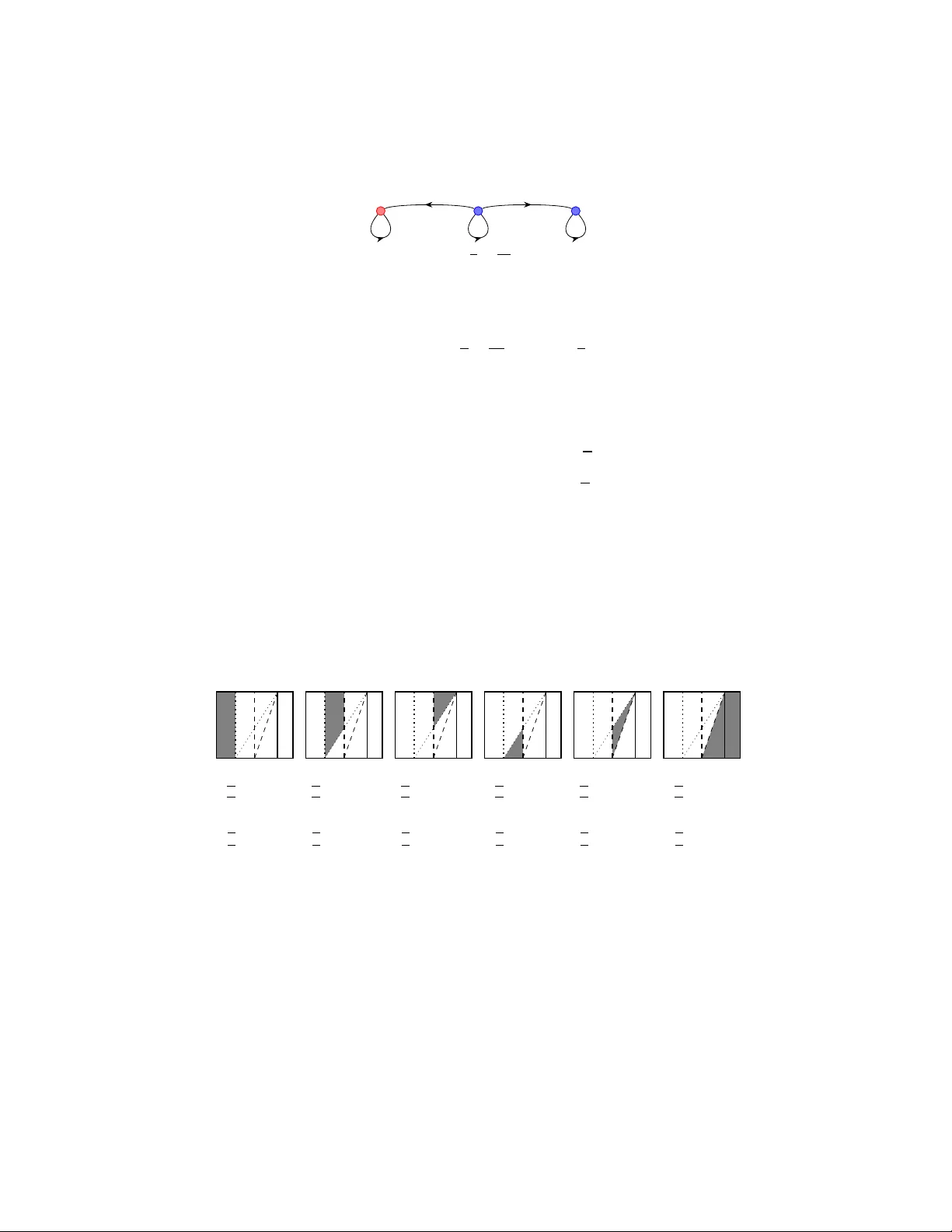
Relation b et w een Hitting Times and Probabilities for Imprecise Mark o v Chains Marco Sangalli, Erik Quaegheb eur, and Thomas Krak Eindho ven Univ ersity of T ec hnology , Eindhov en, m.sangalli@tue.nl Abstract. In the presen t pap er, w e inv estigate the relationship betw een hitting times and hitting probabilities in discrete-time imprecise Mark ov c hains (IMCs). W e define lo w er and upper hitting times and probabilities for IMCs whose set of transition matrices T is compact, con vex, and has separately sp ecified rows. Building on reac hability-based partitions of the state space, we pro ve t w o key implications: (i) finiteness of the upp er exp ected hitting time entails the low er hitting probability equals one, and (ii) finiteness of the low er expected hitting time en tails the upp er hitting probabilit y equals one. W e further sho w an equiv alence: the upper exp ected hitting time is finite if and only if the lo wer hitting probability is one. Finally , by presenting a coun terexample, w e sho w that the con verse of the second implication can fail. Keyw ords: Mark o v c hain, Imprecise Mark ov chain, Imprecise proba- bilit y , Hitting time, Hitting probability 1 In tro duction Hitting times and hitting probabilities are t wo complementary lenses through whic h one studies reachabilit y in sto c hastic systems. The former captures how long it takes a pro cess to reach a designated target set, while the latter cap- tures the chance that the process ev er do es so. In the classical, precise theory of homogeneous Mark o v c hains on a finite state space these tw o notions are tigh tly linked: finiteness of the exp ected hitting time is equiv alen t to the hitting probabilit y b eing one [5, 6]. When uncertain t y is present and dynamics are describ ed not b y a single transition matrix but by a set of transition matrices T , the relationship b etw een hitting times and probabilities is substan tially more subtle. Replacing (precise) exp ectations and probabilities with low er and upp er exp ectations and proba- bilities naturally pro duces four distinct ob jects for each initial state: lo wer and upp er exp ected hitting times, and low er and upp er hitting probabilities [4, 3]. Ev en though some one-wa y implications survive, the neat equiv alences from the precise case need not hold in the imprecise framework. Understanding whic h im- plications p ersist and which fail is b oth theoretically interesting and practically imp ortan t for robust reac hability analysis under mo del uncertaint y . 2 Marco Sangalli et al. A fruitful approach to understanding these phenomena in discrete-time im- precise Mark ov chains (IMCs) is to partition the state space according to reach- abilit y prop erties relative to T . F ollo wing the w ork of Sangalli et al. [8, 7], one distinguishes states that never low er reach the target, 𝒜 T , states that never upp er reach it, 𝒲 T , and further classes 𝒰 T and 𝒱 T that capture intermediate b eha viours. These reac hability-based classes allo w a clean characterisation of when low er and upp er hitting times are finite and when low er and upp er hitting probabilities are strictly p ositiv e. This pap er completes and sharpens this line of inv estigation pro ving that the upp er exp ected hitting time is finite if and only if the low er hitting probability equals one. W e then show a counterexample demonstrating that the equiv alence is lost if “lo wer” and “upp er” are swapped. The remainder of the pap er is structured as follows: Section 2.1 and 2.2 recall basic notation and classical results on hitting times and hitting probabilities for homogeneous Mark ov chains. Section 2.3 introduces imprecise Mark o v chains and low er and upp er hitting times and probabilities. Section 3 discusses the relation b et ween hitting times and hitting probabilities in this imprecise setting. 2 Preliminaries In this section, w e presen t all the preliminary concepts needed to study expected hitting times and hitting probabilities for IMCs. 2.1 Sto c hastic Pro cesses and Marko v Chains Let N denote the p ositiv e in tegers and set N 0 : = N ∪ { 0 } . A discrete-time sto c hastic pro cess taking v alues in X is a sequence of X -v alued random v ari- ables ( 𝑋 𝑛 ) 𝑛 ∈ N 0 ; its probability law will b e denoted b y P 𝑋 . The pro cess ( 𝑋 𝑛 ) 𝑛 ∈ N 0 is called a Markov chain if it satisfies P 𝑋 ( 𝑋 𝑛 + 1 = 𝑥 𝑛 + 1 | 𝑋 0: 𝑛 = 𝑥 0: 𝑛 ) = P 𝑋 ( 𝑋 𝑛 + 1 = 𝑥 𝑛 + 1 | 𝑋 𝑛 = 𝑥 𝑛 ) (1) for all 𝑥 0 , . . . , 𝑥 𝑛 , 𝑥 𝑛 + 1 ∈ X and all 𝑛 ∈ N 0 . A Marko v chain is said to b e (time-) homo gene ous if transition probabilities do not dep end on 𝑛 ; that is, if P 𝑋 ( 𝑋 𝑛 + 1 = 𝑦 | 𝑋 𝑛 = 𝑥 ) = P 𝑋 ( 𝑋 1 = 𝑦 | 𝑋 0 = 𝑥 ) for all 𝑥 , 𝑦 ∈ X and all 𝑛 ∈ N 0 . The sto c hastic matrix 𝑇 ∈ R 𝑁 × 𝑁 defined as 𝑇 ( 𝑥 , 𝑦 ) : = P 𝑋 ( 𝑋 1 = 𝑦 | 𝑋 0 = 𝑥 ) is the tr ansition matrix of the homogeneous Mark ov c hain ( 𝑋 𝑛 ) 𝑛 ∈ N 0 and determines the b eha viour of the pro cess up to its initial distribution. 2.2 Exp ected hitting times and hitting probabilities Fix a nonempty target set 𝐴 ⊂ X . The hitting time of a homogeneous Marko v c hain is the random v ariable 𝜏 𝐴 : = inf { 𝑛 ≥ 0 : 𝑋 𝑛 ∈ 𝐴 } ∈ N 0 ∪ { +∞ } . (2) Relation b et ween Hitting Times and Probabilities for IMCs 3 Conditioned on the c hain starting at 𝑥 ∈ X , the exp e cte d hitting time is ℎ 𝑇 ( 𝑥 ) : = E P 𝑇 𝜏 𝐴 | 𝑋 0 = 𝑥 , (3) where w e write P 𝑇 : = P 𝑋 . In tuitiv ely , ℎ 𝑇 ( 𝑥 ) is the av erage n umber of steps needed to reach 𝐴 when the pro cess starts from 𝑥 . Moreov er, the vector of exp ected hitting times ℎ 𝑇 is the minimal nonnegative solution of a system of equations [6]: ℎ 𝑇 ( 𝑥 ) = 0 if 𝑥 ∈ 𝐴 , ℎ 𝑇 ( 𝑥 ) = 1 + Í 𝑦 ∈ X 𝑇 ( 𝑥 , 𝑦 ) ℎ 𝑇 ( 𝑦 ) if 𝑥 ∉ 𝐴 . W e define the hitting pr ob ability of the homogeneous Marko v chain ( 𝑋 𝑛 ) 𝑛 ∈ N 0 as 𝑝 𝑇 ( 𝑥 ) = P 𝑇 ( 𝜏 𝐴 < +∞ | 𝑋 0 = 𝑥 ) . (4) Hitting probabilities are the minimal nonnegativ e solution of 𝑝 𝑇 ( 𝑥 ) = 1 if 𝑥 ∈ 𝐴 , 𝑝 𝑇 ( 𝑥 ) = Í 𝑦 ∈ X 𝑇 ( 𝑥 , 𝑦 ) 𝑝 𝑇 ( 𝑦 ) if 𝑥 ∉ 𝐴 . There exists a well-kno wn relation b et ween exp ected hitting times and hitting probabilities [5, 6]: the exp ected hitting time is finite if and only if the hitting probabilit y is one. F or completeness, w e provide the whole argument b elo w and w e split it into its tw o implications for later reference. Prop osition 1. L et X b e a finite state sp ac e and 𝑇 b e a tr ansition matrix. Then ℎ 𝑇 ( 𝑥 ) < +∞ ⇒ 𝑝 𝑇 ( 𝑥 ) = 1 . (5) Pr o of. Recall that ℎ 𝑇 ( 𝑥 ) = E P 𝑇 𝜏 𝐴 | 𝑋 0 = 𝑥 < +∞ . Since the p ositiv e random v ariable 𝜏 𝐴 has finite exp ected v alue, its probability of b eing infinite is zero and 𝑝 𝑇 ( 𝑥 ) = P 𝑇 ( 𝜏 𝐴 < +∞ | 𝑋 0 = 𝑥 ) = 1. ⊓ ⊔ Prop osition 2. L et X b e a finite state sp ac e and 𝑇 b e a tr ansition matrix. Then ℎ 𝑇 ( 𝑥 ) < +∞ ⇐ 𝑝 𝑇 ( 𝑥 ) = 1 . (6) Pr o of. Let 𝑅 ( 𝑥 ) : = 𝑥 ∪ { 𝑦 ∈ X : ∃ 𝑛 ∈ N , P 𝑇 ( 𝑋 𝑛 = 𝑦 | 𝑋 0 = 𝑥 ) > 0 } . Fix 𝑛 ∈ N . Then 1 = 𝑝 𝑇 ( 𝑥 ) = P 𝑇 ( 𝜏 𝐴 < +∞ | 𝑋 0 = 𝑥 ) = E P 𝑇 [ P 𝑇 ( 𝜏 𝐴 < +∞ | 𝑋 𝑛 ) | 𝑋 0 = 𝑥 ] = 𝑦 ∈ X P 𝑇 ( 𝑋 𝑛 = 𝑦 | 𝑋 0 = 𝑥 ) P 𝑇 ( 𝜏 𝐴 < +∞ | 𝑋 0 = 𝑦 ) , (7) where w e used the la w of total exp ectation and Marko v’s property . It follows that, for all 𝑦 ∈ X with P 𝑇 ( 𝑋 𝑛 = 𝑦 | 𝑋 0 = 𝑥 ) > 0 it m ust hold that P 𝑇 ( 𝜏 𝐴 < +∞ | 𝑋 0 = 𝑦 ) = 𝑝 𝑇 ( 𝑦 ) = 1. F or the arbitrariness of 𝑛 , w e get 𝑝 𝑇 ( 𝑦 ) = 1 for all 𝑦 ∈ 𝑅 ( 𝑥 ) . 4 Marco Sangalli et al. Fix 𝑦 ∈ 𝑅 ( 𝑥 ) . Since 𝑝 𝑇 ( 𝑦 ) = P 𝑇 ( 𝜏 𝐴 < +∞ | 𝑋 0 = 𝑦 ) = 1, for all 𝜀 > 0, there exists 𝑚 𝑦 , 𝜀 ∈ N suc h that for all 𝑛 ≥ 𝑚 𝑦 , 𝜀 w e hav e P 𝑇 ( 𝜏 𝐴 ≤ 𝑛 | 𝑋 0 = 𝑦 ) ≥ 1 − 𝜀 or, equiv alen tly , P 𝑇 ( 𝜏 𝐴 > 𝑛 | 𝑋 0 = 𝑦 ) ≤ 𝜀 . Fix 0 < 𝜀 < 1 and set 𝑀 = max 𝑦 ∈ 𝑅 ( 𝑥 ) 𝑚 𝑦 , 𝜀 . Then, b y picking 𝑛 = 𝑀 , we hav e P 𝑇 ( 𝜏 𝐴 > 𝑀 | 𝑋 0 = 𝑦 ) ≤ 𝜀, for all 𝑦 ∈ 𝑅 ( 𝑥 ) . Let 𝑘 ∈ N 0 . Then, using Mark ov’s prop erty , we hav e P 𝑇 ( 𝜏 𝐴 > 𝑘 𝑀 | 𝑋 0 = 𝑥 ) ≤ 𝜀 𝑘 . W e can b ound the exp ected v alue of 𝜏 𝐴 using these tail b ounds: ℎ 𝑇 ( 𝑥 ) = E P 𝑇 [ 𝜏 𝐴 | 𝑋 0 = 𝑥 ] = 𝑛 ∈ N 0 P 𝑇 ( 𝜏 𝐴 > 𝑛 | 𝑋 0 = 𝑥 ) = 𝑘 ∈ N 0 ( 𝑘 + 1 ) 𝑀 − 1 𝑛 = 𝑘 𝑀 P 𝑇 ( 𝜏 𝐴 > 𝑛 | 𝑋 0 = 𝑥 ) ≤ 𝑘 ∈ N 0 𝑀 P 𝑇 ( 𝜏 𝐴 > 𝑘 𝑀 | 𝑋 0 = 𝑥 ) ≤ 𝑀 𝑘 ∈ N 0 𝜀 𝑘 = 𝑀 1 − 𝜀 < +∞ . ⊓ ⊔ W e seek to explore whether this, or a similar, relation holds true in the imprecise framew ork, when instead of a single (precise) pro cess we are dealing with a set of homogeneous Mark ov chains. 2.3 Imprecise Marko v chains Rather than a single homogeneous Mark ov chain ( 𝑋 𝑛 ) 𝑛 ∈ N 0 go verned by a tran- sition matrix 𝑇 , we now consider a family of these pro cesses. Given a set T ⊂ R 𝑁 × 𝑁 , w e consider the set P made of all homogeneous Marko v chains with tran- sition matrix contained in the set T . The set P is said to be an impr e cise Markov chain (IMC). This c hoice of P is justified by Krak et al. [4, Theorem 18] sho wing that lo w er and upper hitting times and probabilities remain unchanged when the set P is enlarged to include all (time-)inhomogeneous Marko v pro cesses that are compatible with T . In the following, w e assume that the set T is nonempty , compact, con vex, and with separately sp ecified rows (SSR) [2, 4]. F or an imprecise Mark ov chain P , we define low er and upp er exp ectations: E P [ · | · ] : = inf P ∈ P E P [ · | · ] and E P [ · | · ] : = sup P ∈ P E P [ · | · ] . These op erators pro vide conserv ativ e, tight b ounds for an y quantit y of interest. Relation b et ween Hitting Times and Probabilities for IMCs 5 F or a fixed nonempty target set 𝐴 ⊂ X , we define the lower and upp er exp e cte d hitting times for the imprecise Marko v chain parametrised by T as ℎ T ( 𝑥 ) : = E P [ 𝜏 𝐴 | 𝑋 0 = 𝑥 ] = inf 𝑇 ∈ T ℎ 𝑇 ( 𝑥 ) ; ℎ T ( 𝑥 ) : = E P [ 𝜏 𝐴 | 𝑋 0 = 𝑥 ] = sup 𝑇 ∈ T ℎ 𝑇 ( 𝑥 ) . Analogously , w e define lower and upp er hitting pr ob abilities as 𝑝 T ( 𝑥 ) : = E P [ 1 { 𝜏 𝐴 < +∞ } | 𝑋 0 = 𝑥 ] = inf 𝑇 ∈ T 𝑝 𝑇 ( 𝑥 ) ; 𝑝 T ( 𝑥 ) : = E P [ 1 { 𝜏 𝐴 < +∞ } | 𝑋 0 = 𝑥 ] = sup 𝑇 ∈ T 𝑝 𝑇 ( 𝑥 ) . 3 Relation b et w een Hitting Times and Hitting Probabilities for IMCs W e can partition the state space X into sets of states that hav e infinite low er or upp er hitting time and states with low er or upp er hitting probability equal to zero. T o do so, w e introduce the concept of reachabilit y for IMCs [8, 1]: – 𝑥 lower r e aches 𝐴 , denoted b y 𝑥 ⇁ 𝐴 , if for all 𝑇 ∈ T there exists 𝑛 ∈ N 0 suc h that [ 𝑇 𝑛 1 𝐴 ] ( 𝑥 ) > 0; – 𝑥 upp er r e aches 𝐴 , denoted by 𝑥 ⇀ 𝐴 , if there exist 𝑇 ∈ T and 𝑛 ∈ N 0 suc h that [ 𝑇 𝑛 1 𝐴 ] ( 𝑥 ) > 0. W e can define the follo wing sets of states: 𝒜 T : = { 𝑥 ∈ 𝐴 𝑐 | 𝑥 ⇁ 𝐴 } , 𝒰 T : = { 𝑥 ∈ 𝐴 𝑐 \ 𝒜 T | 𝑥 ⇀ 𝒜 T } , 𝒲 T : = { 𝑥 ∈ 𝐴 𝑐 | 𝑥 ⇀ 𝐴 } , 𝒱 T : = { 𝑥 ∈ 𝐴 𝑐 \ 𝒲 T | 𝑥 ⇁ 𝒲 T } . X 𝐴 𝒜 T 𝒰 T 𝒲 T 𝒱 T Fig. 1: Illustration of k ey sets of states and their reachabilit y characteristics. 6 Marco Sangalli et al. Sangalli et al. [7] sho wed that ℎ T ( 𝑥 ) is infinite if and only if 𝑥 ∈ 𝒜 T ∪ 𝒰 T and that ℎ T ( 𝑥 ) is infinite if and only if 𝑥 ∈ 𝒲 T ∪ 𝒱 T . This implies 𝒲 T ∪ 𝒱 T ⊆ 𝒜 T ∪ 𝒰 T . W e also know from Sangalli et. al. [8] that 𝑝 T ( 𝑥 ) = 0 if and only if 𝑥 ∈ 𝒜 T and that 𝑝 T ( 𝑥 ) = 0 if and only if 𝑥 ∈ 𝒲 T . This implies 𝒲 T ⊆ 𝒜 T . The relations b et w een the sets 𝒜 T , 𝒰 T , 𝒲 T and 𝒱 T are illustrated in Fig. 1. F rom these relations, w e also deduce ℎ T ( 𝑥 ) < +∞ ⇒ 𝑝 T ( 𝑥 ) > 0 , ℎ T ( 𝑥 ) < +∞ ⇒ 𝑝 T ( 𝑥 ) > 0 . The follo wing result strengthens these implications. Theorem 1. Under the pr evious assumptions, it holds that 1) ℎ T ( 𝑥 ) < +∞ ⇒ 𝑝 T ( 𝑥 ) = 1 ; 2) ℎ T ( 𝑥 ) < +∞ ⇒ 𝑝 T ( 𝑥 ) = 1 . Pr o of. Fix any 𝑥 ∈ X . If the upper hitting time is finite, then, for all 𝑇 ∈ T , w e hav e that ℎ 𝑇 ( 𝑥 ) < +∞ . By Prop osition 1, we ha ve 𝑝 𝑇 ( 𝑥 ) = 1 for all 𝑇 ∈ T , therefore 𝑝 T ( 𝑥 ) = inf 𝑇 ∈ T 𝑝 𝑇 ( 𝑥 ) = 1. Similarly , if the low er hitting time is finite, there exists 𝑇 ∈ T such that ℎ 𝑇 ( 𝑥 ) < +∞ . By Prop osition 1, we hav e 𝑝 𝑇 ( 𝑥 ) = 1 therefore 𝑝 T ( 𝑥 ) = 1. ⊓ ⊔ W e now inv ert implications 1) and 2) in Theorem 1 and either prov e their cor- rectness or find a counterexample in which they fail. The following result states that the con verse of implication 1) holds true. Theorem 2. The upp er exp e cte d hitting time ℎ T is finite if and only if the lower hitting pr ob ability 𝑝 T is one, i.e. ℎ T ( 𝑥 ) < +∞ ⇔ 𝑝 T ( 𝑥 ) = 1 (8) Pr o of. W e need to prov e that 𝑝 T ( 𝑥 ) = 1 ⇒ ℎ T ( 𝑥 ) < +∞ since w e already know the con verse. By h yp othesis, w e hav e 𝑝 𝑇 ( 𝑥 ) = 1, for all 𝑇 ∈ 𝑇 . Therefore, by Prop osition 2, ℎ 𝑇 ( 𝑥 ) < +∞ for all 𝑇 ∈ T . By Krak et al. [4, Theorem 12], there exists a transition matrix 𝑇 ∗ ∈ T suc h that ℎ 𝑇 ∗ = sup 𝑇 ∈ T ℎ 𝑇 = ℎ T . Th us, w e conclude that ℎ T ( 𝑥 ) = ℎ 𝑇 ∗ ( 𝑥 ) < +∞ . ⊓ ⊔ The con verse of implication 2) fails: the counterexample b elo w shows that, de- spite the upp er hitting probability b eing one, the low er hitting time is infinite. Example 1. Let X = { 1 , 2 , 3 } b e the state space, and let { 2 } b e the target set. Let the set of transition matrices on X b e T = co 𝐼 , 𝑇 𝑛 = 1 − 1 𝑛 − 1 𝑛 2 1 𝑛 1 𝑛 2 0 1 0 0 0 1 : 𝑛 ≥ 2 , where by “co” we denote the conv ex hull and b y 𝐼 the identit y matrix. The transition b eha viour of 𝑇 𝑛 is represen ted by the following graph: Relation b et ween Hitting Times and Probabilities for IMCs 7 1 2 3 1 / 𝑛 1 / 𝑛 2 1 − 1 𝑛 − 1 𝑛 2 1 1 When starting from state 1 and evolving under the transition matrix 𝑇 𝑛 , the exp ected hitting probability satisfies 𝑝 𝑇 𝑛 ( 1 ) = 1 − 1 𝑛 − 1 𝑛 2 𝑝 𝑇 𝑛 ( 1 ) + 1 𝑛 , Therefore, 𝑝 𝑇 𝑛 ( 1 ) = 𝑛 / 𝑛 + 1 → 1 which is then the upp er hitting probability . W e observ e that every transition matrix in T either disconnects states 1 and 2 or lea ves a p ositiv e probabilit y of never hitting the target. Therefore, the expected hitting time for ev ery matrix in T is infinite, implying ℎ T = +∞ . ⋄ This counterexample arises b ecause, as observed by Krak et al. [4], there need not exist a transition matrix 𝑇 ∗ in T such that 𝑝 𝑇 ∗ = 𝑝 T . In particular, in the presen t example lim 𝑛 →+∞ 𝑝 𝑇 𝑛 ( 1 ) = 1 ≠ 0 = 𝑝 𝐼 ( 1 ) = 𝑝 lim 𝑛 →+∞ 𝑇 𝑛 ( 1 ) , and no other 𝑇 ∈ T satisfies 𝑝 𝑇 ( 1 ) = 1. W e conclude the pap er with Fig. 2, which summarises the relationships be- t ween low er and upp er hitting times and probabilities discussed and established in this w ork. It uses the partitioning induced by the sets 𝒜 𝑇 , 𝒰 T , 𝒲 T , and 𝒱 T , as illustrated in Fig. 1. 𝑝 T = 0 𝑝 T = 0 ℎ T = +∞ ℎ T = +∞ 𝑝 T = 0 𝑝 T ∈ ( 0 , 1 ] ℎ T = +∞ ℎ T = +∞ 𝑝 T = 0 𝑝 T = 1 ℎ T < +∞ ℎ T = +∞ 𝑝 T ∈ ( 0 , 1 ) 𝑝 T ∈ ( 0 , 1 ] ℎ T = +∞ ℎ T = +∞ 𝑝 T ∈ ( 0 , 1 ) 𝑝 T = 1 ℎ T < +∞ ℎ T = +∞ 𝑝 T = 1 𝑝 T = 1 ℎ T < +∞ ℎ T < +∞ Fig. 2: Overview of the relationships b et ween low er and upper hitting times and hitting probabilities. Ac knowledgemen ts This work has b een partly supp orted by the P ersOn pro ject (P21-03), which has receiv ed funding from Nederlandse Organisatie v o or W etensc happ elijk Onderzo ek (NWO). Bibliograph y [1] De Bo c k J, Erreygers A, Persiau F (2025) A conv enient characterisation of con vergen t upper transition operators. In: Proceedings of the 14th In ter- national Symp osium on Imprecise Probabilities: Theories and Applications (ISIPT A), Pro ceedings of Machine Learning Research, v ol 290, pp 115–125, DOI 10.48550/arXiv.2502.04509 [2] Hermans F, ˇ Skulj D (2014) Sto chastic processes. In: Augustin T, Co olen FP , de Co oman G, T roffaes MC (eds) Introduction to Imprecise Probabilities, Wiley , c hap 11, pp 258–278, DOI 10.1002/9781118763117.ch11 [3] Krak T (2021) Computing exp ected hitting times for imprecise Mark ov chains. Space T ec hnology Pro ceedings 8:185–205, DOI 10.1007/ 978- 3- 030- 80542- 5 \ 12 [4] Krak T, T’Joens N, De Bock J (2019) Hitting Times and Probabilities for Im- precise Mark o v Chains. In: Pro ceedings of the 14th In ternational Symposium on Imprecise Probabilities: Theories and Applications (ISIPT A), Proceedings of Mac hine Learning Research, vol 103, pp 265–275, 1905.08781 [5] Levin DA, Peres Y, Wilmer EL (2009) Mark ov Chains and Mixing Times. American Mathematical So ciet y , DOI 10.1090/m bk/107 [6] Norris JR (1997) Marko v Chains. Cambridge Series in Statistical and Prob- abilistic Mathematics, Cambridge Univ ersity Press, Cam bridge, UK, DOI 10.1017/CBO9780511810633 [7] Sangalli M, Quaegheb eur E, Krak T (2025) Upp er Exp ected Meeting Times for In terdependent Stochastic Agents. In: Symbolic and Quan tita- tiv e Approac hes to Reasoning with Uncertaint y , Springer, Lecture Notes in Artificial Intelligence (LNAI), vol 16099, pp 238–252, DOI 10.1007/ 978- 3- 032- 05134- 9 \ 17 [8] Sangalli M, Quaegheb eur E, Krak T (2026) Computing Low er and Upp er Hitting Probabilities for Imprecise Marko v Chains. International Journal of Appro ximate Inference (IJAR) DOI 10.48550/arXiv.2512.16696, under sub- mission
Original Paper
Loading high-quality paper...
Comments & Academic Discussion
Loading comments...
Leave a Comment