A characterization of terminal planar networks by forbidden structures
The class of terminal planar networks was recently introduced from a biological perspective in relation to the visualization of phylogenetic networks, and its connection to upward planar networks has been established. We provide a Kuratowski-type the…
Authors: Haruki Miyaji, Yuki Noguchi, Hexuan Liu
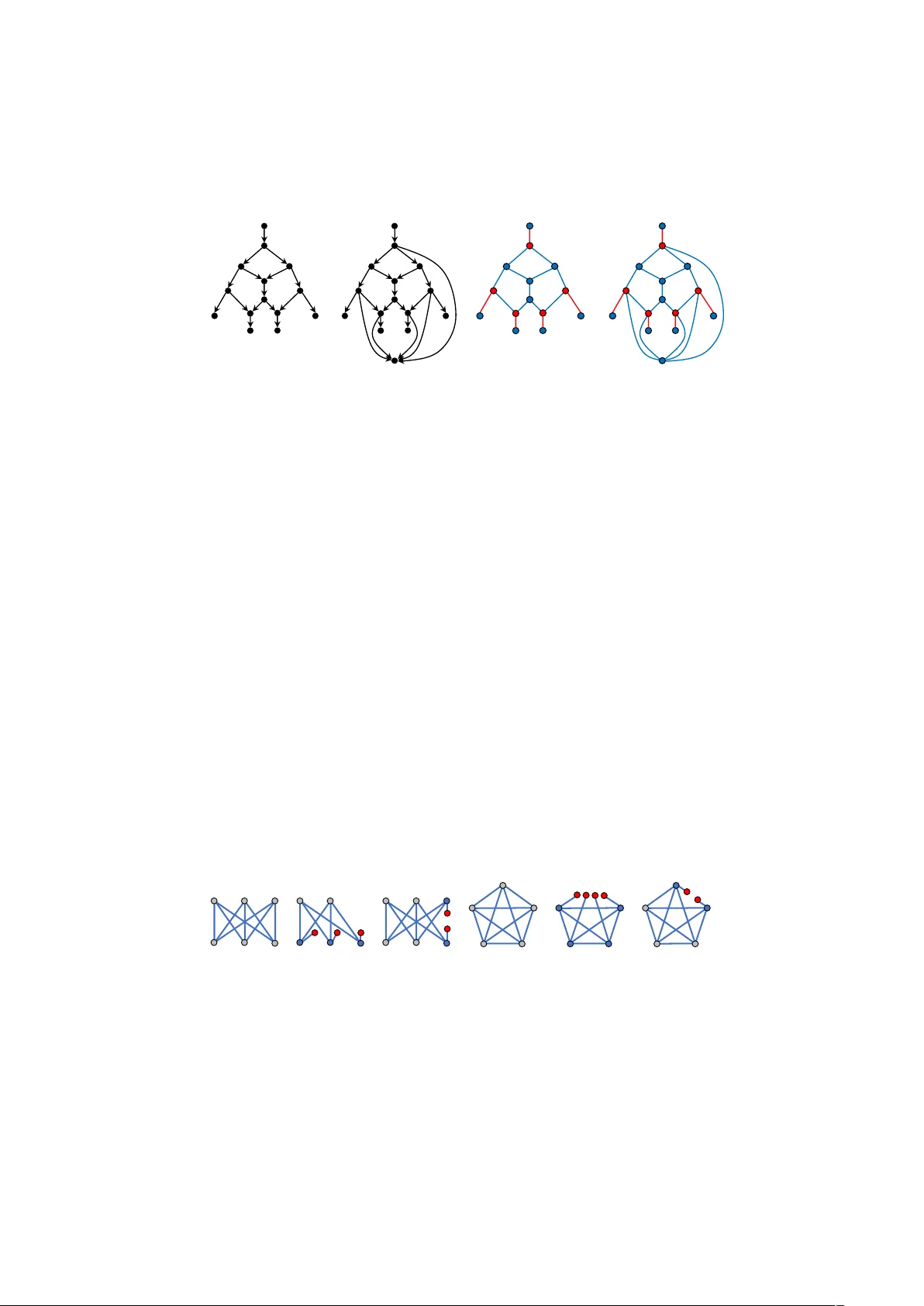
A c haracterization of terminal planar net w orks b y forbidden structures ∗ Haruki Miy a ji 1 , Y uki Noguc hi 2 , Hexuan Liu 1 , T ak atora Suzuki 1 , Keita W atanab e 1 , T ao yang W u 3 , and Momok o Hay amizu † 4 1 Dep artment of Pur e and Applie d Mathematics, Gr aduate Scho ol of F undamental Scienc e and Engine ering, W ase da University, T okyo, Jap an 2 Dep artment of Applie d Mathematics, Scho ol of F undamental Scienc e and Engine ering, W ase da University, T okyo, Jap an 3 Scho ol of Computing Scienc e, University of East Anglia, Norwich, UK 4 Dep artment of Applie d Mathematics, F aculty of Science and Engine ering, W aseda University, T okyo, Jap an Abstract The class of terminal planar net works w as recently in tro duced from a biological p ersp ectiv e in relation to the visualization of phylogenetic net works, and its connection to up ward planar netw orks has been es- tablished. W e provide a Kurato wski-type theorem that characterizes terminal planar net works b y a finite set of forbidden structures, de- fined via six families of 0/1-labeled graphs. Another c haracterization based on planarit y of sup ergraphs yields linear-time algorithms for test- ing terminal planarit y and for computing such planar drawings. W e describ e an application that is p oten tially relev ant in broader, non- ph ylogenetic settings. W e also discuss a connection of our main result to an open problem on the forbidden structures of single-source upw ard planar netw orks. 1 In tro duction Finding the set of forbidden structures that charact erizes a graph class is a fundamen tal topic in graph theory . The w ell-known Kuratowski’s theo- rem [1] states that a graph is planar if and only if it contains no subgraph homeomorphic to K 5 or K 3 , 3 . This type of characterization is kno wn for dif- feren t graph classes (e.g., [2, 3, 4]; see Chapter 7 of [5] for details). How ever, suc h forbidden structures are unknown for several important graph classes, including upw ard planar net w orks and terminal planar net works. ∗ This work is based on the Master’s and Bachelor’s theses of Haruki Miya ji and Y uki Noguc hi, resp ectively , supervised by Momok o Hay amizu. † Corresp onding author: hayamizu@waseda.jp 1 Up ward planar digraphs are a classical and w ell-studied class in graph dra wing (e.g., [6, 7, 8, 9]). A digraph is up ward planar if it admits a planar dra wing in which all edges are monotone up ward with resp ect to the v ertical direction. F or em b edded digraphs with a single source, upw ard planarity has b een characterized b y Thomassen [10] in terms of certain forbidden patterns, and this characterization is used in the algorithms in [6] (see Theorem 6.13 in Section 6.7 of [11] for details). Despite this understanding of the em b edded case, neither forbidden subgraphs nor forbidden minors are curren tly known for upw ard planar digraphs. T erminal planar netw orks were more recen tly introduced b y Moulton– W u [12] as a sub class of directed phylogenetic net works motiv ated by the visualization of ev olutionary relationships among organisms. A directed ph y- logenetic net work is an acyclic digraph with a unique ro ot and one or more lea ves, and it is terminal planar if it admits a planar embedding suc h that all terminals (the root and leav es) lie on the outer face. In [12], it w as sho wn that a directed ph ylogenetic net work is terminal planar if and only if a cer- tain single-source sup ergraph of it—whic h we call the t -completion in this pap er—is up ward planar, and linear-time algorithms for terminal planarit y testing and dra wing w ere describ ed. How ever, the characterization based on up ward planarit y of t -completion do es not easily yield a Kuratowski-t yp e c haracterization of terminal planar netw orks, since the forbidden structures of up ward planar net works are not fully understo o d, as men tioned ab ov e. Another limitation of this approach is that it do es not apply to undirected graphs, b ecause of the inherently directed nature of upw ard planarit y . In this pap er, w e pro vide a characterization of terminal planar net w orks in terms of a finite set of forbidden structures, called H 1 , . . . , H 6 structures (Theorem 5.14), whic h is v alid for undirected graphs as w ell (Corollary 5.15). This is indeed a Kuratowski-t yp e theorem b ecause H 1 and H 4 structures are nothing but sub divisions of K 3 , 3 and K 5 , resp ectively . When we only consider binary ph ylogenetic netw orks, H 1 , H 2 , and H 3 structures are the only p ossible obstructions (Corollaries 5.16 and 5.17). T o prov e the main theorem, w e first sho w the equiv alence among the terminal planarity of directed phylogenetic netw orks and the planarity of their supergraphs called the st -completion and the terminal cut-completion (Theorem 4.2). This characterization plays an imp ortant role in pro ving the main theorem and also furnishes new linear-time algorithms for testing terminal planarit y and for dra wing such netw orks since it links terminal planarit y with planarit y , not with up w ard planarit y . The remainder of the pap er is organized as follows. Section 2 introduces the basic definitions and notation of graph theory , and Section 3 reviews the concepts and known results on graph planarit y , including up ward pla- narit y and terminal planarit y of phylogenetic netw orks. In Section 4, in addition to pro ving Theorem 4.2, w e also briefly mention the relationship b et ween terminal planar directed ph ylogenetic netw orks and bar-visibilit y 2 digraphs. In Section 5, after setting up the necessary terminology , w e prov e Theorem 5.14 and also describ e linear-time algorithms for terminal planarit y testing and for dra wing such netw orks. In Section 6, we demonstrate an ap- plication of the main result in more general, non-phylogenetic settings b y pro viding a c haracterization of planar graphs with an embedding such that sp ecified v ertices lie on the outer face (Theorem 6.2). Finally , in Section 7, w e give a conclusion and briefly discuss how our results may b e relev an t to the op en problem of determining the forbidden structures for up ward planar net works. 2 Basic definitions and notation 2.1 Undirected graphs An undir e cte d gr aph is defined b y an ordered pair ( V , E ) consisting of a set V of vertices and a set E of undirected edges. Giv en an undirected graph G , V ( G ) and E ( G ) denote the v ertex set and edge set of G , resp ectively . A graph G is finite if b oth V ( G ) and E ( G ) are finite sets. Given an edge { u, v } of an undirected graph, the v ertices u and v are called the endp oints of the edge. An edge { u, v } with u = v is called a lo op . T wo or more edges b et ween the same pair of v ertices are called multiple e dges . An undirected graph is simple if it contains neither lo ops nor multiple edges. In this pap er, w e only consider finite simple undirected graphs. F or a v ertex v and an edge e of a graph, if v is an endp oint of e , w e sa y that e is incident t o v . F or t wo distinct v ertices u and v of a graph G , if { u, v } ∈ E ( G ) , then u and v are said to b e adjac ent . F or an y vertex v of a graph G , Adj G ( v ) denotes the set of all v ertices adjacen t to v . The v alue | Adj G ( v ) | is called the de gr e e of v in G and is denoted by deg G ( v ) . A v ertex of G with degree 1 is called a le af or terminal vertex of G , and an edge inciden t to a leaf is called a p endant e dge of G . A graph P with V ( P ) = { v 1 , v 2 , . . . , v k } and E ( P ) = {{ v 1 , v 2 } , { v 2 , v 3 } , . . . , { v k − 1 , v k }} is called a p ath . In this case, the v ertices v 1 and v k are called the endp oints of P , and the other vertices are called the internal vertic es of P . The v alue k − 1 is the length of P (where k ≥ 2 ). A path can b e represen ted as an alter- nating sequence of v ertices and edges v 1 , { v 1 , v 2 } , v 2 , . . . , v k − 1 , { v k − 1 , v k } , v k , but when the con text is clear, w e often write v 1 − v 2 − · · · − v k . A path with the endp oin ts u and v is called a u - v p ath and may b e denoted by [ u, v ] . A graph C with V ( C ) = { v 1 , v 2 , . . . , v k } and E ( C ) = {{ v 1 , v 2 } , { v 2 , v 3 } , . . . , { v k − 1 , v k } , { v k , v 1 }} suc h that all vertices are distinct is called a cycle ( k ≥ 3 ). T wo graphs G and H are isomorphic , denoted by G ≃ H , if there exists a bijection ϕ : V ( G ) → V ( H ) such that for an y u, v ∈ V ( G ) , w e ha ve { u, v } ∈ E ( G ) if and only if { ϕ ( u ) , ϕ ( v ) } ∈ E ( H ) . If V ( G ) ⊆ V ( H ) and E ( G ) ⊆ E ( H ) , then G is a sub gr aph of H , and w e say H c ontains G , or H is a sup er gr aph of G . This relationship is denoted b y G ⊆ H . In particular, if 3 G ⊆ H and V ( G ) = V ( H ) , then G is a sp anning subgraph of H . If G ⊆ H and G ≃ H , then w e write G ⊊ H . In this case, w e call G a pr op er subgraph of H and H a pr op er sup ergraph of G . The union of t wo graphs G and H , denoted b y G ∪ H , is the graph with vertex set V ( G ) ∪ V ( H ) and edge set E ( G ) ∪ E ( H ) . Similarly , the interse ction G ∩ H is the graph with vertex set V ( G ) ∩ V ( H ) and edge set E ( G ) ∩ E ( H ) . A graph G is c onne cte d if there exists a u - v path for any u, v ∈ V ( G ) . W e write [ u, v ] G to mean a u - v path in a graph G . F or t wo v ertices u and v of a graph G , the distanc e b et ween u and v in G is defined b y the length of a shortest u - v path in G . A c onne cte d c omp onent of G is a connected subgraph of G that is not a prop er subgraph of any other connected subgraph of G . Giv en a graph G , the graph obtained by removing an edge e from G is denoted b y G − e , and this op eration is called the deletion of e . F or an y E ′ ⊂ E ( G ) , the graph G − E ′ denotes the graph that is obtained by deleting all edges in E ′ from G . Similarly , the graph obtained b y remo ving a v ertex v together with all edges incident to v from G is denoted b y G − v , and this op eration is called the deletion of v . F or any V ′ ⊆ V ( G ) , the graph G − V ′ denotes the graph that is obtained by deleting all v ertices in V ′ . F or a graph G , e ∈ E ( G ) is called a cut e dge of G if G − e is disconnected. Also, v ∈ V ( G ) is called a cut vertex of G if G − v is disconnected. An edge e of an undirected graph G is a cut edge of G if and only if e is not con tained in an y cycle of G (e.g., [13, Theorem 2.3]). A graph G is bic onne cte d if it con tains no cut vertices. This implies that a biconnected graph do es not con tain an y cut edges. A biconnected subgraph of G that is not a prop er subgraph of an y other biconnected subgraph is called a blo ck of G . F or an edge { u, v } of a graph G , the sub division of { u, v } is the op eration of replacing { u, v } with a u - v path of length at least 1 . A graph obtained b y a finite sequence of edge subdivisions is called a sub division of G . F or a v ertex v of a graph G with deg G ( v ) = 2 , and its inciden t edges e 1 = { u 1 , v } and e 2 = { u 2 , v } , the smo othing of v is the op eration whereb y v , e 1 , and e 2 are deleted, and a new edge { u 1 , u 2 } is added instead. Note that since w e only consider simple graphs in this pap er, if smo othing results in m ultiple edges, they are alwa ys replaced b y a single edge. The simple graph obtained b y smo othing all p ossible v ertices of a graph G is called the smo othe d gr aph of G . T w o graphs G and H are home omorphic , denoted by G ≈ H , if there exist sub divisions G ′ of G and H ′ of H such that G ′ ≃ H ′ holds. F or an edge e = { u, v } in a graph G , the c ontr action of e is the op eration that merges u and v in to a single new v ertex, replaces e by this vertex, and connects it to all neighbors of u or v while all other vertices and edges are k ept unchanged. The resulting graph is denoted by G/e . As in smo othing, if con traction creates multiple edges, they are replaced by a single edge. More generally , for a set of edges E ′ ⊆ E ( G ) , the graph obtained b y contracting all edges in E ′ is denoted by G/E ′ . A graph G ′ is called a minor of a graph G if G ′ can b e obtained from G by a sequence of vertex deletions, edge deletions, 4 and edge con tractions. In this case, w e sa y that G c ontains G ′ as a minor. A graph with n v ertices in which ev ery pair of distinct v ertices is adjacent is called a c omplete gr aph and is denoted b y K n . A graph G is bip artite if V ( G ) can b e partitioned into t wo non-empt y subsets X and Y suc h that ev ery edge of G has one endpoint in X and the other in Y . The sets X and Y are called the p artite sets of G . A bipartite graph G with partite sets X and Y with | X | = p and | Y | = q is called a c omplete bipartite graph, denoted by K p,q , if ev ery vertex in X is adjacent to every vertex in Y . 2.2 Directed graphs A dir e cte d gr aph , or digr aph , is an ordered pair D = ( V , A ) , where V is a set of vertices and A is a set of directed edges called ar cs . F or a digraph D , its vertex set and arc set are denoted by V ( D ) and by A ( D ) , resp ectively . A digraph D is finite if b oth V ( D ) and A ( D ) are finite sets. An arc is an ordered pair of vertices ( u, v ) ; u is called the tail and v the he ad of the arc. A simple digraph has no lo ops or parallel arcs. In this paper, all digraphs are assumed to b e finite and simple. T wo digraphs D and H are isomorphic , denoted by D ≃ H , if there exists a bijection ϕ : V ( D ) → V ( H ) suc h that ( u, v ) ∈ A ( D ) if and only if ( ϕ ( u ) , ϕ ( v )) ∈ A ( H ) for all u, v ∈ V ( D ) . The concepts of subgraphs, prop er subgraphs, spanning subgraphs, sup ergraphs, and prop er sup ergraphs are defined similarly to the undirected case. The underlying gr aph of a digraph D , denoted D u , is the (simple) undi- rected graph obtained from D by replacing eac h arc ( u, v ) ∈ A ( D ) with an undirected edge { u, v } and remo ving duplicate edges if necessary . A digraph D is we akly c onne cte d if its underlying graph D u is connected. V ertex and arc deletion are defined analogously to the undirected case. Cut arcs, cut vertices, and biconnectivit y for digraphs are defined according to whether weak connectivit y is preserved after deletion. The in-de gr e e indeg D ( v ) and out-de gr e e outdeg D ( v ) of a vertex v are the n umber of arcs with head v and with tail v , respectively . A v ertex s with indeg D ( s ) = 0 is called a sour c e (or the r o ot when it is the only source of D ), and a v ertex t with outdeg D ( t ) = 0 is called a sink . A dir e cte d p ath is a digraph P with V ( P ) = { v 1 , v 2 , . . . , v k } and A ( P ) = { ( v 1 , v 2 ) , ( v 2 , v 3 ) , . . . , ( v k − 1 , v k ) } , where the v ertices are all distinct. The v ertices v 1 and v k are the first and last v ertices of P , resp ectiv ely . The length and in ternal vertices of P are defined as in the undirected case. A dir e cte d cycle is digraph C with V ( C ) = { v 1 , v 2 , . . . , v k } and A ( C ) = { ( v 1 , v 2 ) , ( v 2 , v 3 ) , . . . , ( v k − 1 , v k ) , ( v k , v 1 ) } where the v ertices are all distinct. A digraph is acyclic if it has no directed cycle as a subgraph. F or an arc ( u, v ) of an acyclic digraph, u is sometimes called a p ar ent of v , and v a child of u . 5 3 Kno wn Results on Planarit y 3.1 Planarit y of Undirected Graphs The study of planarity in undirected graphs is a classical topic in graph theory . A dr awing of an undirected graph G is an em b edding of each vertex v of G to a point in the plane, and eac h edge { u, v } to a simple curv e connecting u and v without self-intersections. If G can be dra wn in the plane so that each edge crosses only at its endp oin ts, G is said to be planar , and such a drawing is called a planar dr awing or plane gr aph of G . Giv en a planar dra wing of a planar graph G , a fac e is a region of a planar dra wing. The un b ounded region is called the external fac e while the others are interior fac es . A planar graph G is outerplanar if there exists a planar dra wing of G such that all v ertices of G are placed on the exterior face. Planar graphs are characterized by forbidden structures, notably b y the results of Kurato wski [1] and W agner [3]. Theorem 3.1 ([1]) . An undirected graph G is planar if and only if it contains no subgraph that is homeomorphic to K 3 , 3 or K 5 . Since K 3 , 3 and K 5 con tain no vertices of degree tw o or less, Theorem 3.1 can be rephrased as follo ws: An undirected graph G is planar if and only if it contains no subgraph that is isomorphic to a subdivision of K 3 , 3 or K 5 . Theorem 3.2 ([3]) . An undirected graph G is planar if and only if it contains neither K 3 , 3 nor K 5 as a minor. Analogous to Kuratowski’s theorem, the forbidden subgraphs of outer- planar graphs are also known well. Theorem 3.3 ([2]) . An undirected graph G is outerplanar if and only if it con tains no subgraph that is homeomorphic to K 2 , 3 or K 4 . 3.2 Planarit y for Directed Graphs A digraph D is said to b e planar (resp. outerplanar ) if its underlying graph D u is planar (resp. outerplanar). The concept of “up ward planarit y” has long b een studied in graph theory as a notion of planarit y sp ecific to digraphs (e.g., [6, 7, 8, 9]). A digraph is upwar d planar if it admits a planar upw ard dra wing, where an upwar d dr awing of a digraph is such that all the edges are represen ted b y directed curves increasing monotonically in the v ertical direction [7]. It is kno wn that a digraph has an up ward drawing if and only if it is acyclic [7]. Theorem 3.5 c haracterizes upw ard planar digraphs using planar st -digraphs (see Definition 3.4). W e will use this result in Section 4. 6 Definition 3.4. An st -digr aph is any directed graph that has a unique source s , a unique sink t , and a unique arc ( s, t ) . In particular, an acyclic and planar st -digraph is called an acyclic planar st -digraph. Theorem 3.5 ([8, 14]; see also Theorem 1 in [9]) . A directed graph G is up ward planar if and only if there exists a planar st -digraph containing G as a spanning subgraph. 𝐺 𝑠 𝑡 Figure 1: An illustration of Theorem 3.5. Left: an upw ard planar digraph G . Righ t: an acyclic planar st -digraph that contains G as a spanning subgraph. 3.3 T erminal Planar Ph ylogenetic Net works Ph ylogenetic net w orks are classes of graphs, directed or undirected, that generalize phylogenetic trees and ha ve b een widely used to describ e com- plex ev olutionary histories and relationships among sp ecies. Typically , in a directed phylogenetic netw ork, the lea ves represent extan t sp ecies, and the ro ot represents their common ev olutionary ancestor. Planar dra wings (or nearly planar dra wings) of phylogenetic netw orks can facilitate the in terpretation of evolutionary data. In particular, when there exists a planar drawing in whic h all terminal v ertices, i.e., the ro ot and the lea ves, are placed on the external face, ev en in tricate reticulate ev olution can b e visually represented in a clear manner. Motiv ated b y this, Moulton– W u [12] introduced the notion of terminal planar net works. The terminal planar prop ert y is defined analogously for undirected and directed graphs, but in this subsection, w e review the characterization of directed terminal planar netw orks as giv en in [12]. Definition 3.6. Let S = { t 1 , . . . , t n } b e a nonempt y finite set ( n ≥ 1 ). An undir e cte d phylo genetic network (with terminal set S ) is defined to b e a connected undirected graph N such that S can b e iden tified with the set { v ∈ V ( N ) | deg N ( v ) = 1 } . In this case, each elemen t of S ∩ V ( N ) is called a le af of N . A dir e cte d phylo genetic network (with source s and sink set S ) is defined to b e a connected acyclic digraph N that satisfies the follo wing conditions: 7 1. N has a unique source s with (indeg N ( s ) , outdeg N ( s )) = (0 , 1) . 2. S can b e iden tified with the set of sinks of N , and eac h sink t i of N satisfies (indeg N ( t i ) , outdeg N ( t i )) = (1 , 0) . In a directed phylogenetic netw ork N , the source s and eac h sink t i are also called the r o ot and the le af of N , resp ectively . Remark 3.7. Any directed phylogenetic netw ork N with a source s and sinks t 1 , . . . , t k ( k ≥ 1 ) can b e conv erted into an undirected phylogenetic net work N u with terminal set { s, t 1 , . . . , t k } by simply ignoring all edge ori- en tations. Ho w ever, for an undirected ph ylogenetic netw ork with terminal set S , it ma y not b e possible to assign edge directions so that the resulting directed phylogenetic net work has one v ertex in S designated as the ro ot and the remaining v ertices in S as leav es. This is illustrated b y the undirected ph ylogenetic netw orks G 1 and G 2 in Figure 2. While G 2 can b e orien ted to obtain a directed ph ylogenetic netw ork such that { t 1 , t 2 , t 3 , t 4 } consists of a unique source and three sinks, G 1 cannot be oriented into a directed ph ylogenetic net w ork with { t 1 , t 2 } b eing a pair of the source and sink. T o see the difference b etw een G 1 and G 2 , consider the blo c k induced b y { a, b, c } of eac h graph. In G 1 , regardless of which of t 1 and t 2 is the source and the other is the sink, there is no pair { v in , v out } of distinct v ertices in { a, b, c } such that the flow from the source comes into the blo ck through v in and go es out from v out to arriv e at the sink in the end. More precisely , the flow from the source inevitably enters and exits a b efore arriving at the sink, implying that the blo ck must contain a directed cycle on { a, b, c } . By con trast, in G 2 , when either t 1 or t 2 is the source and thus t 3 is a sink, the flo w enters a and lea v es through b to arrive at t 3 . Similarly , when t 3 is the source, the flo w enters b and leav es through a to arrive at the sinks t 1 and t 2 . In either case, one can easily construct a flow on G 2 that av oids directed cycles. 𝑡 ! 𝑡 " 𝑡 # 𝑎 𝐺 ! 𝑏 𝑐 𝑡 ! 𝑡 " 𝐺 " 𝑎 𝑏 𝑐 Figure 2: The undirected phylogenetic netw orks G 1 and G 2 men tioned in Remark 3.7: G 2 can be orien ted in to a directed ph ylogenetic net work while G 1 cannot. Definition 3.8. An undirected ph ylogenetic netw ork N is terminal planar if there exists a planar dra wing of N in whic h all lea ves are on the external face. Similarly , a directed ph ylogenetic net work N is terminal planar if there 8 is a planar drawing in whic h b oth the ro ot and all lea ves of N are on the external face. By Definition 3.8, if a directed ph ylogenetic net work N is terminal planar, then its underlying graph N u is also terminal planar. F or an undirected ph ylogenetic netw ork N with terminal set S , supp ose there exists a acyclic digraph N with a unique source s ∈ S and a sink set S \ { s } , meaning that N is a directed phylogenetic netw ork. Then, if N is terminal planar, so is N . Moulton–W u [12] obtained Theorem 3.10 that characterizes when a di- rected ph ylogenetic net work N is terminal planar using a sup ergraph N + of N , whic h is defined in Definition 3.9 (see Figure 3 for an illustration). Definition 3.9 ([12]) . Given a directed ph ylogenetic netw ork N = ( V , A ) with source s and sink set { t 1 , . . . , t n } , let V ( N + ) := V ∪ { t } and A ( N + ) := A ∪ { ( t 1 , t ) , . . . , ( t n , t ) } . The digraph N + is called the t -c ompletion of N . Note that N + w as called a “completion” in [12], but in this pap er, w e will use the term “ t -completion” to distinguish it from other completions to b e defined later. Theorem 3.10 ([12]) . F or a directed phylogenetic net work N , N is terminal planar if and only if its t -completion N + is upw ard planar. Moulton–W u [12, Theorem 3.2] prov ed the following strict inclusion re- lations among v arious classes of planar ph ylogenetic net w orks: P outer ( S ) ⊊ P terminal ( S ) ⊊ P upw ard ( S ) ⊊ P ( S ) . (1) Here, for any set S with | S | ≥ 2 , eac h of the sets P ( S ) , P upw ard ( S ) , P terminal ( S ) , and P outer ( S ) denotes the collection of all planar, upw ard planar, terminal planar, and outerplanar directed ph ylogenetic net works with sink set S , re- sp ectiv ely . See Figure 4 for explicit examples illustrating that eac h inclusion in (1) is strict. The first inclusion in (1) follo ws from the fact that if a directed (or undirected) ph ylogenetic net work N is outerplanar, then there exists a planar dra wing in whic h all v ertices of N are placed on the external face, namely , N is terminal planar. The second inclusion in (1) follows from Theorem 3.10 since N is a subgraph of N + . 4 Characterization of T erminal Planar Net wo rks Using Sup ergraphs Theorem 3.10 pro vides a c haracterization of terminal planar directed ph ylo- genetic net works b y fo cusing on the upw ard planarity of the t -completion. 9 𝑠 𝑡 ! 𝑡 " 𝑡 # 𝑡 $ 𝑁 𝑁 ! 𝑠 𝑡 Figure 3: A directed ph ylogenetic netw ork N with source s and sink set { t 1 , t 2 , t 3 , t 4 } (left) and the t -completion N + of N (right). 𝑡 ! 𝑡 " 𝑁 ! 𝑡 ! 𝑡 " 𝑁 " 𝑁 # 𝑡 ! 𝑡 " 𝑁 $ 𝑡 " 𝑡 ! 𝑁 % 𝑡 " 𝑡 ! 𝑠 𝑠 𝑠 𝑠 𝑠 Figure 4: Examples demonstrating the strict inclusions expressed in (1). N 1 ∈ P outer ( S ) , N 2 ∈ P terminal ( S ) \ P outer ( S ) , N 3 ∈ P upw ard ( S ) \ P terminal ( S ) , N 4 ∈ P ( S ) \ P upw ard ( S ) , N 5 ∈ P ( S ) (all examples except N 1 are repro duced from Fig. 2 of [12]). 10 Ho wev er, since the forbidden structures for up ward planar netw orks remain unresolv ed, Theorem 3.10 do es not directly lead to a characterization of the forbidden structures for terminal planar net works. In this section, w e in tro duce new supergraphs differen t from the t -completion and pro vide a new characterization of terminal planar directed ph ylogenetic net works b y focusing on the planarity of suc h sup ergraphs (Theorem 4.2). Definition 4.1. Let N = ( V , A ) b e a directed phylogenetic net work with source s and sink set { t 1 , . . . , t n } . Let t b e a new vertex not con tained in V . T wo supergraphs of N , denoted by N ∗ and N x , are defined as follows: 1. N ∗ is the acyclic st -digraph with V ( N ∗ ) := V ∪ { t } and A ( N ∗ ) := A ∪ { ( t 1 , t ) , . . . , ( t n , t ) } ∪ { ( s, t ) } . W e call N ∗ the st -c ompletion of N . 2. N x is the acyclic digraph (without multiple edges) with V ( N x ) := V ∪ { t } and A ( N x ) := A ∪ { ( ˜ t 1 , t ) , . . . , ( ˜ t n , t ) } ∪ { ( ˜ s, t ) } , where ˜ s denotes the unique child of s in N , and for each i ∈ [1 , n ] , ˜ t i denotes the unique paren t of t i in N . W e call N x the terminal cut-c ompletion of N . Theorem 4.2. F or an y directed ph ylogenetic net w ork N , the following state- men ts are equiv alent. 1. N is terminal planar. 2. The st -completion N ∗ of N is planar. 3. The terminal cut-completion N x of N is planar. Pr o of . First, we pro ve the equiv alence of 1 and 2. Supp ose N is terminal planar. By Theorem 3.10, its t -completion N + is up ward planar. Theo- rem 3.5 then ensures the existence of an acyclic planar st -digraph D for whic h N + is a spanning subgraph. T o see that N ∗ is a subgraph of D , consider the following. By Definition 4.1, V ( N ∗ ) = V ( N + ) = V ( D ) and A ( N ∗ ) = A ( N + ) ∪ { ( s, t ) } hold. Since ( s, t ) ∈ A ( D ) by Definition 3.4, to- gether with A ( N + ) ⊆ A ( D ) , it follo ws that A ( N ∗ ) ⊆ A ( D ) . Therefore, N ∗ is a subgraph of D , and thus N ∗ is planar. Con versely , if N ∗ is planar, it is a spanning subgraph of itself, so b y Theorem 3.5, N ∗ is upw ard planar. Since b y definition N + ⊆ N ∗ , N + is also up ward planar, and b y Theorem 3.10, N is terminal planar. Next, we sho w the equiv alence of 2 and 3. By Theorem 3.1, it suffices to show that the underlying graph N ∗ u of N ∗ con tains a subgraph homeo- morphic to K 5 or K 3 , 3 if and only if N x u do es as w ell. Note that in N ∗ u , the source s and eac h sink t i ha ve degree-2. Let sm( N ∗ u ) denote the simple graph obtained by smo othing all terminal v ertices s, t 1 , . . . , t n of N ∗ u . Then, w e can see that N x u − { s, t 1 , . . . , t n } is isomorphic to sm( N ∗ u ) . Th us, if N ∗ u has a subgraph homeomorphic to K 5 , then N x u also has the same property . Con versely , if N x u con tains a subgraph G that is homeomorphic to K 5 , then 11 G ⊆ N x u − { s, t 1 , . . . , t n } since K 5 has no vertex of degree one. Thus, sm( N ∗ u ) also contains G as a subgraph, which implies that N ∗ u con tains a subgraph homeomorphic to K 5 . The same argumen t applies for K 3 , 3 . Th us, the equiv- alence of 2 and 3 is established. W e note that the notion of terminal planarity is related to bar-visibilit y graphs and digraphs [15], whic h is sometimes called ϵ -visibility [16] or left- visibilit y [17]. It is known that a (p ossibly m ulti-source and m ulti-sink) digraph D is a bar-visibility digraph if and only if D ′ is an acyclic planar st -digraph [16, 17, 18], where D ′ is a supergraph obtained from D by intro- ducing a unique source s , a unique sink t and the arc ( s, t ) . In our setting, if D is a directed ph ylogenetic netw ork N , then D ′ can b e seen as essen tially the same as the st -completion N ∗ , except for the difference that N ∗ has an arc ( s, ˜ s ) while D ′ has a directed path of length 2 from s to ˜ s . Then, by Theorem 4.2, we can see that a directed phylogenetic net work N is terminal planar if and only if N is a bar-visibility digraph. The in terested reader is referred to [17]. 5 Characterization of T erminal Planar Net wo rks b y F orbidden Subgraphs In Sections 3.3 and 4, w e discussed the necessary and sufficient conditions for a directed ph ylogenetic netw ork to b e terminal planar, fo cusing on the up ward planarit y or planarity of their supergraphs. Hereafter, we will con- sider the forbidden subgraphs that c haracterize terminal planarit y in directed and undirected ph ylogenetic net works. The main result of this paper, The- orem 5.14 is an analogue of Theorem 3.1. T o state Theorem 5.14, w e first in tro duce the concepts of 0 / 1 -lab ele d gr aphs and cut-lab ele d gr aphs , along with basic graph op erations defined on such graphs. 5.1 0 / 1 -Lab eled Graphs A 0 / 1 -lab ele d gr aph is a pair ( G, g ) , where G = ( V , E ) is a connected undi- rected graph and g : V ∪ E → { 0 , 1 } is a function. In this setting, ( G, g ) is called a 0 / 1 -lab ele d gr aph of G determine d by g , and g is referred to as the lab eling function of G . Each v ertex v ∈ V and eac h edge e ∈ E are called a vertex and an e dge of ( G, g ) , resp ectively . F or eac h element x ∈ V ∪ E , we sa y x has lab el 1 if g ( x ) = 1 , and lab el 0 otherwise. F or t wo 0 / 1 -lab eled graphs ( F , f ) and ( G, g ) , we say that ( F, f ) and ( G, g ) are lab el-pr eserving isomorphic if F ≃ G and each vertex (resp. edge) of F has the same lab el of its corresp onding vertex (resp. edge) of G . If F ⊆ G and f is the restriction of g to V ( F ) ∪ E ( F ) , then ( F , f ) is called a lab el-pr eserving sub gr aph of ( G, g ) , in whic h case w e write ( F , f ) ⫅ ( G, g ) and often represen t ( F, f ) b y ( F , g | F ) . If G ⊆ F and f is an extension of g 12 to V ( F ) ∪ E ( F ) , then ( F , f ) is called a lab el-pr eserving sup er gr aph of ( G, g ) , denoted by ( G, g ) ⫅ ( F, f ) . Definition 5.1. A v ertex v of a 0 / 1 -lab eled graph ( G, g ) is called lab el- pr eserving smo othable if deg G ( v ) = 2 and the tw o edges inciden t to v , e 1 = { u 1 , v } and e 2 = { u 2 , v } , satisfy g ( e 1 ) = g ( e 2 ) . F or a lab el-preserving smo othable vertex v of ( G, g ) , lab el-pr eserving smo othing of vertex v is de- fined as obtaining a 0 / 1 -lab eled graph ( H , h ) from ( G, g ) as follo ws: • V ( H ) := V ( G ) \ { v } , E ( H ) := ( E ( G ) \ { e 1 , e 2 } ) ∪ {{ u 1 , u 2 }} • F or eac h x ∈ V ( H ) ∪ E ( H ) , define h ( x ) := ( g ( e 1 ) if x = { u 1 , u 2 } , g ( x ) otherwise . Moreo ver, the 0 / 1 -lab eled graph obtained by lab el-preserving smo othing all p ossible vertices of ( G, g ) is called the lab el-pr eserving smo othe d gr aph of ( G, g ) . Definition 5.2. F or an edge { u, v } of a 0 / 1 -labeled graph ( G, g ) , lab el- pr eserving sub division of the edge { u, v } is defined as obtaining a 0 / 1 -lab eled graph ( H , h ) from ( G, g ) . The graph H is obtained by replacing the edge { u, v } of G with a path [ u, v ] of length at least one. The lab eling function h of H is defined as follows: • F or each edge or internal vertex x (with x = u, v ) on the path [ u, v ] in H corresponding to the edge { u, v } , set h ( x ) := g ( { u, v } ) . • F or eac h x ∈ V ( G ) ∪ E ( G ) , set h ( x ) := g ( x ) . Giv en t wo 0 / 1 -labeled graphs ( G, g ) and ( H , h ) , if ( H , h ) can b e obtained from ( G, g ) b y applying a finite sequence of label-preserving edge sub divi- sions, then ( H, h ) is called a lab el-pr eserving sub division of ( G, g ) . Definition 5.3. Given t wo 0 / 1 -lab eled graphs ( G, g ) and ( H , h ) , let ( G ′ , g ′ ) and ( H ′ , h ′ ) be 0 / 1 -labeled graphs obtained from ( G, g ) and ( H , h ) , respec- tiv ely , b y finite sequences of lab el-preserving edge sub divisions and lab el- preserving vertex smo othings. If ( G ′ , g ′ ) ∼ = ( H ′ , h ′ ) , then ( G, g ) and ( H , h ) are said to b e lab el-pr eserving home omorphic . W e write ( G, g ) ≊ ( H, h ) . V ertex deletion and edge deletion in 0 / 1 -lab eled graphs are defined anal- ogously to those in unlab eled graphs. F or an edge { u, v } of a 0 / 1 -lab eled graph ( G, g ) , the lab el-pr eserving c ontr action of the edge { u, v } is defined as obtaining a 0 / 1 -labeled graph ( F , f ) from ( G, g ) as follo ws: F is the graph ob- tained b y con tracting the edge { u, v } in G . The lab el of the v ertex w ∈ V ( F ) , created by iden tifying u and v , is given by f ( w ) := max { g ( u ) , g ( v ) } , while the lab els of all other vertices and edges in F , except for w , are the same as those of their corresp onding elements in G . 13 5.2 Cut-Lab eled Graphs F or a connected undirected graph G = ( V , E ) , the 0 / 1 -labeled graph ( G, ℓ ) with the lab eling function ℓ : V ∪ E → { 0 , 1 } defined in equation (2) is called the cut-lab ele d gr aph of G and is written as L ( G ) . ℓ ( x ) := ( 1 if x ∈ V ∪ E is a cut v ertex or cut edge of G, 0 otherwise. (2) Definition 5.4. Let N = ( V , A ) b e a directed phylogenetic net work with a source s and a sink set { t 1 , . . . , t n } . The cut-c ompletion of N , denoted b y N c , is the acyclic digraph defined b y V ( N c ) := V ∪ { t } , A ( N c ) := A ∪ { ( v 1 , t ) , . . . , ( v k , t ) } , where { v 1 , . . . , v k } is the set of all cut v ertices of the underlying graph N u of N . Let L ( N u ) denote the cut-labeled graph of the underlying graph N u = ( V , E ) of N . Let N c u = ( V c , E c ) b e the underlying graph of the cut-completion N c . The 0 / 1 -labeled graph L c ( N u ) := ( N c u , ℓ c ) is called the lab el-pr eserving cut-c ompletion of L ( N u ) , where ℓ c is a function on V c ∪ E c defined by ℓ c ( x ) := ( ℓ ( x ) if x ∈ V ∪ E , 0 otherwise. (3) In Prop osition 5.5, recall that the st -completion N ∗ is defined in Defini- tion 4.1 and the terminal cut-completion N x in Definition 5.4. Prop osition 5.5. F or any directed ph ylogenetic netw ork N , if the cut- completion N c is planar, then b oth N x and N ∗ are planar. Pr o of . Since N x ⊆ N c , the planarit y of N c immediately implies that of N x . F urthermore, if N x is planar, then b y Theorem 4.2, the graph N ∗ is also planar. This completes the pro of. 5.3 H i Structures Let K − 3 , 3 denote the graph obtained b y removing an arbitrary edge from K 3 , 3 . Let K ( − e ) 3 , 3 denote the graph obtained by sub dividing an arbitrary edge of K 3 , 3 exactly t wice and then remo ving the edge betw een the t w o vertices created b y this sub division. Let K ( − v ) 3 , 3 denote the graph obtained by sub dividing eac h edge of K 3 , 3 at least once, removing an arbitrary vertex of K 3 , 3 , and then smo othing all smo othable v ertices. The graphs K − 5 , K ( − e ) 5 , and K ( − v ) 5 are defined analogously by replacing K 3 , 3 with K 5 in the abov e definitions. Definition 5.6. F or eac h i ∈ [1 , 6] , we define the undirected graph H i b y H 1 ≃ K 3 , 3 , H 2 ≃ K ( − v ) 3 , 3 , H 3 ≃ K ( − e ) 3 , 3 , H 4 ≃ K 5 , H 5 ≃ K ( − v ) 5 , H 6 ≃ K ( − e ) 5 . An H i gr aph is any 0 / 1 -lab eled graph obtained from a 0 / 1 -lab eled graph 14 𝑠 𝑡 ! 𝑡 " 𝑡 # 𝑡 $ 𝑠 𝑡 ! 𝑡 " 𝑡 # 𝑡 $ 𝑡 𝑠 𝑡 ! 𝑡 " 𝑡 # 𝑡 $ 𝑠 𝑡 ! 𝑡 " 𝑡 # 𝑡 $ 𝑡 i) ii) iii) iv) Figure 5: Illustration of cut-lab eled graphs and Definition 5.4. i) A directed ph ylogenetic netw ork N with source s and sink set { t 1 , t 2 , t 3 , t 4 } . ii) The cut-completion N c of N . iii) The cut-labeled graph L ( N u ) of N . iv) The lab el-preserving cut-completion L c ( N u ) of L ( N u ) . ( H i , h i ) satisfying the follo wing conditions b y lab el-preserving con traction of zero or more p endan t edges: 1. ∀ v ∈ V ( H i ) , h i ( v ) := ( 1 if deg H i ( v ) = 1 0 if ∃ x ∈ Adj H i ( v ) with deg H i ( x ) = 1 2. ∀ e ∈ E ( H i ) , h i ( e ) := 0 . The num b er of H i graphs in Definition 5.6 is easily determined. F or example, the num b er of H 5 graphs equals 5 , since by symmetry it equals the n umber of distinct w a ys in whic h p endan t edges can be contracted. Similarly , it is easy to verify that there are 12 H 2 graphs. W e also note that it is p ossible that a 0/1-lab eled graph has an H i graph and an H j graph ( i = j ) as its lab el-preserving subgraphs. F or example, if a graph contains an H 1 graph where all vertices ha ve lab el 1 , then it con tains an H 2 graph that is obtained by the label-preserving contraction of the three p endan t edges of ( H 2 , h 2 ) in Figure 6. 𝑖 = 1 𝑖 = 2 𝑖 = 3 𝑖 = 4 𝑖 = 5 𝑖 = 6 Figure 6: Illustration of the family of ( H i , h i ) satisfying the conditions in Definition 5.6. V ertices lab eled 1 are sho wn in red; vertices with unsp ecified lab els are sho wn in gra y . All edges are lab eled 0 and shown in blue. Definition 5.7. Let ( G, g ) b e a 0 / 1 -lab eled graph. Supp ose there exist i ∈ [1 , 6] and a lab el-preserving subgraph ( F , g | F ) of ( G, g ) such that ( F, g | F ) 15 is lab el-preserving homeomorphic to an H i graph. Then ( G, g ) is said to c ontain an H i structure, and ( F , g | F ) is called an H i structur e of ( G, g ) . If no such structure exists, ( G, g ) is said to not c ontain an H i structure. An H i structure ( F , g | F ) of ( G, g ) is called minimal if there exists no prop er lab el-preserving subgraph ( F ′ , g | F ′ ) of ( G, g ) with F ′ ⊊ F that is also an H i structure of ( G, g ) . Prop osition 5.8. Let ( G, g ) b e a 0 / 1 -lab eled graph, let i ∈ [1 , 6] b e ar- bitrary , and let ( H , h ) b e an H i graph. Supp ose that ( G, g ) contains an H i structure ( F , g | F ) that is label-preserving homeomorphic to ( H , h ) . Then there exists an injection ψ : V ( H ) → V ( F ) suc h that ( H, h ) is lab el-preserving isomorphic to the graph obtained from ( F , g | F ) b y smo othing all v ertices out- side the image { ψ ( v ) | v ∈ V ( H ) } . Pr o of . The proposition states that ( F, g | F ) can b e transformed in to ( H, h ) b y lab el-preserving smo othing of finitely man y vertices in ( F , g | F ) , without sub dividing any edges. If ( H, h ) con tains no v ertex v with deg H ( v ) = 2 , then there is no need to create new degree-2 v ertices when transforming ( F , g | F ) in to ( H , h ) , so indeed no edge sub division is required, and ( F , g | F ) can b e transformed into ( H , h ) using only lab el-preserving smo othings. Let S ⊆ V ( F ) denote the set of vertices that are not smoothed in the transformation from ( F , g | F ) to ( H, h ) . Then there exists a bijection τ from S to V ( H ) , and ψ := τ − 1 giv es the desired injection. Indeed, the image of ψ coincides with S , and all v ertices outside S are smo othed, so the conditions of the prop osition are satisfied. Next, supp ose ( H , h ) has a v ertex v with deg H ( v ) = 2 . In this case, i ∈ { 2 , 3 } and ( H, h ) is an H i graph obtained by lab el-preserving contraction of one or more p endant edges of ( H i , h i ) (as in Definition 5.6), where v is the con tracted vertex where the ends of a pendant edge hav e b een iden tified. By Definition 5.6, each edge of ( H, h ) has lab el 0 , and b y assumption, ( F , g | F ) ≊ ( H , h ) . Note that by Definitions 5.1 and 5.2, if a 0 / 1 -lab eled graph has an edge lab eled 1 , then any graph lab el-preserving homeomorphic to it also has an edge labeled 1 . Thus, every edge of ( F , g | F ) has label 0 , and applying an y sequence of label-preserving sub divisions or smoothings to ( F , g | F ) yields graphs in which every edge also has lab el 0 . Moreov er, by Definition 5.2, ev ery degree-2 vertex obtained b y lab el-preserving sub division of an edge lab eled 0 also has lab el 0 . Supp ose for con tradiction that for some v with deg H ( v ) = 2 , there is no corresp onding v ertex in ( F , g | F ) . This means that v arises as a result of a lab el-preserving sub division of ( F , g | F ) during the pro cess of transforming from ( F , g | F ) to ( H , h ) . Then h ( v ) = 0 m ust hold. Ho wev er, by the construction in Definition 5.6, suc h a v ertex v is obtained b y lab el-preserving contraction of a p endant edge in ( H i , h i ) , whic h implies h ( v ) = 1 . This is a con tradiction. Therefore, for every vertex v of ( H, h ) with deg H ( v ) = 2 , there exists a vertex of ( F , g | F ) that corresp onds to v . Consequen tly , as in the previous case, if S ⊆ V ( F ) is the set of v ertices 16 not smo othed in the transformation from ( F , g | F ) to ( H , h ) , then the inv erse ψ := τ − 1 of the bijection τ : S → V ( H ) provides the desired injection. The injection ψ constructed in Proposition 5.8 is called an H i structur e mapping . In general, ψ is not unique. F or example, since an H 1 graph has no v ertices with sp ecified 0 / 1 lab els and all edges are labeled 0 , the mapping from v ertices of the H 1 graph to v ertices of the H i structure is not uniquely determined. 5.4 F orbidden Structures for T erminal Planar Net works: Pro of of Necessity Prop osition 5.9. Let G b e an undirected graph containing a path P = u, { u, v } , v , { v , w } , w of length 2. If v is not a cut v ertex of G and neither { u, v } nor { v , w } is a cut edge of G , then G contains a cycle that includes P . Pr o of . Since v is not a cut v ertex of G , G − v is connected. Therefore, in G , there exists a u - w path P ′ that do es not contain v nor the edges { u, v } and { v , w } . Thus, G contains the cycle formed by P ∪ P ′ . Prop osition 5.10. Let i ∈ [1 , 6] , ( H , h ) b e an y H i graph, and supp ose that the cut-lab eled graph ( N u , ℓ ) of a directed ph ylogenetic netw ork N contains a minimal H i structure ( F, ℓ | F ) ≊ ( H , h ) . Let ψ : V ( H ) → V ( F ) be the H i structure mapping as defined in Proposition 5.8. Then the following hold: 1. F or any vertex v of ( H , h ) , h ( v ) = 1 if and only if ψ ( v ) is a cut v ertex of N u . 2. F is contained in a single blo ck of N u . Pr o of . By Prop osition 5.8, the corresp onding v ertex ψ ( v ) of ( F, ℓ | F ) for eac h v in ( H , h ) satisfies ℓ | F ( ψ ( v )) = h ( v ) . Since ℓ | F is the restriction of ℓ to V ( F ) ∪ E ( F ) , w e hav e ℓ | F ( ψ ( v )) = ℓ ( ψ ( v )) . Thus, ℓ ( ψ ( v )) = 1 if and only if h ( v ) = 1 . Noting that ℓ ( ψ ( v )) = 1 exactly when ψ ( v ) is a cut v ertex of N u . Recall that ( H, h ) is obtained b y label-preserving con traction of at least zero pendant edges of ( H i , h i ) in Definition 5.6, so it ma y not con tain any v ertex v with deg H ( v ) = 1 . In this case, for an y v ∈ V ( H ) , H − v is connected, i.e., H is 2-connected b y Definition 5.6. Since F ≈ H , F is also 2-connected. Next, suppose ( H , h ) has exactly one vertex v with deg H ( v ) = 1 . Let u denote the neigh b or of v in ( H, h ) . Then H is the union of the 2-connected graph H − v and the p endan t edge { u, v } . Thus, F consists of a 2-connected graph F 0 homeomorphic to H − v , and a path [ ψ ( u ) , ψ ( v )] F homeomorphic to { u, v } . Since an y 2-connected subgraph of an undirected graph G is con tained in a single blo c k of G , it suffices to sho w that F is contained 17 in some 2-connected subgraph of N u . F or the path [ ψ ( u ) , ψ ( v )] F of length k ≥ 1 , set w 1 := ψ ( u ) , w k +1 := ψ ( v ) , so [ ψ ( u ) , ψ ( v )] F can b e written as w 1 − w 2 − · · · − w k − w k +1 . Adding the edge { w 0 , w 1 } ∈ E ( F 0 ) , the path w 0 − w 1 − w 2 − · · · − w k − w k +1 is denoted P k . As discussed in the pro of of Prop osition 5.8, since every edge of a H i graph is lab eled 0 , every edge of a H i structure is also lab eled 0 . Thus, no edge of P k is a cut edge of N u . Similarly , no in ternal v ertex of P k is a cut v ertex of N u . This follows b ecause, b y Definition 5.6, h ( u ) = 0 , so b y the claim pro v ed ab o ve, the corresp onding vertex ψ ( u ) = w 1 in ( F , ℓ | F ) is not a cut v ertex of N u , and b y minimalit y of ( F , ℓ | F ) , eac h w j for j ∈ [2 , k ] is not a cut vertex of N u . By Prop osition 5.9, for eac h j ∈ [1 , k ] , there exists a cycle C j ⊆ N u con taining w j − 1 − w j − w j +1 . Since F 0 is 2-connected and C 1 shares the edge { w 0 , w 1 } with F 0 , it is clear that, for an y t wo v ertices x, y in F 0 ∪ C 1 , there exist tw o x - y paths with no common in ternal vertices. Hence, F 0 ∪ C 1 is 2-connected. By induction, F 0 ∪ C 1 ∪ · · · ∪ C k is also 2-connected. Since P k ⊆ C 1 ∪ · · · ∪ C k , F ⊆ F 0 ∪ C 1 ∪ · · · ∪ C k ⊆ N u , so there exists a blo c k of N u con taining F . The same conclusion holds when ( H , h ) has more than one vertex v with deg H ( v ) = 1 by a similar argumen t. Lemma 5.11. Let N u b e the underlying graph of a directed phylogenetic net work N with source s and sink set { t 1 , . . . , t n } and assume that N has at least tw o edges. Let G b e a subgraph of N u that con tains a cut v er- tex of N u and is con tained within a block B of N u . F or any subset V 1 = { v 1 , . . . , v k } ( k ≥ 1) of the set of cut vertices of N u con tained in V ( G ) , let N x and its sink t b e defined as in Definition 4.1. Then, the underlying graph N x u of N x con tains a collection { P 1 , . . . , P k } of undirected paths satisfying the following conditions: 1. F or ev ery i ∈ [1 , k ] , P i is a path in N x u connecting v i ∈ V 1 to the sink t . 2. F or an y distinct i, j ∈ [1 , k ] , V ( P i ) ∩ V ( P j ) = { t } . 3. F or ev ery i ∈ [1 , k ] , V ( P i ) ∩ V ( B ) = { v i } . Pr o of . F or any connected graph H , the graph T H defined as follo ws is a tree [19, Theorem 1]: V ( T H ) is the union of the set A of cut vertices of H and the set B of blo cks of H , and { a, b } ∈ E ( T H ) if and only if a ∈ V ( b ) for a ∈ A and b ∈ B . Then, by the assumption that N u can be oriented in to N , there is a one-to-one corresp ondence b etw een the set of leav es of the tree T N u and the set of p endant edges {{ t 1 , ˜ t 1 } , . . . , { t n , ˜ t n } , { s, ˜ s }} of N u , where w e used the argument in Remark 3.7. F or eac h cut vertex v i of N u in V ( G ) , let a i denote the corresp onding vertex of T N u , let b denote the vertex of T N u corresp onding to the blo ck of N u con taining G , and let Z b e the set of vertices of T N u corresp onding to the set { ˜ t 1 , . . . , ˜ t n , ˜ s } , that is cut vertices of N u inciden t to p endant edges. Then, for any i ∈ [1 , k ] , in the component 18 C ( a i ) of T N u − { a i , b } con taining a i , there exists a path π i from a i to some z i ∈ Z . Let P i b e the path in N x u from v i to z i corresp onding to each π i , with the edge { z i , t } app ended. It follows that each P i is a path in N x u from v i to t , and the fact that eac h π i do es not include b ensures that each P i do es not include an y edge of B , so V ( P i ) ∩ V ( B ) = { v i } . Moreov er, since C ( a i ) and C ( a j ) are disjoin t for i = j , V ( P i ) ∩ V ( P j ) = { t } . Hence, { P 1 , . . . , P k } satisfies conditions 1–3. 𝑠 𝑡 𝑡 ! 𝑡 " 𝑡 # 𝑡 $ 𝑡 % 𝑡 & 𝑡 # ! 𝑡 # " 𝑡 # # 𝑡 # $ 𝑡 # % 𝑡 # & 𝒗 𝟏 𝑠 # 𝒗 𝟐 𝒗 𝟑 𝑡 ' 𝑡 # ( = 𝑡 # ' 𝑡 ( Figure 7: The line segmen ts represen t E ( N u ) , the curves represent E ( N x u ) \ E ( N u ) . The filled vertices denote V ( G ) , in particular, V 1 = { v 1 , v 2 , v 3 } is sho wn in red. The thic k black segments represen t E ( G ) . In this situation, the collection of three green paths [ v 1 , t ] , [ v 2 , t ] , [ v 3 , t ] is one example that satisfies the conditions of Lemma 5.11. Prop osition 5.12. Let N b e a directed ph ylogenetic netw ork. If N is terminal planar, then for an y i ∈ [1 , 6] , the cut-lab eled graph L ( N u ) of N do es not con tain an H i structure. Pr o of . Let N be a terminal planar directed phylogenetic netw ork with source s and sink set { t 1 , . . . , t n } . Supp ose for contradiction, that L ( N u ) = ( N u , ℓ ) contains some minimal H i structure ( F , ℓ | F ) for some i ∈ [1 , 6] . It suffices to only consider i ∈ { 2 , 3 , 5 , 6 } . This is b ecause N u is planar, by Theorem 3.1, N u do es not contain any subgraph that is a subdivision of K 5 or K 3 , 3 . Ho wev er, if i = 1 , then F ⊆ N u is a subdivision of K 3 , 3 , and if i = 4 , then F ⊆ N u is a sub division of K 5 . Therefore, it is sufficient to deriv e a con tradiction for each of the following four cases: i) i = 2 , ii) i = 3 , iii) i = 5 , and iv) i = 6 . Recall from Theorem 4.2 that N is terminal planar if and only if the underlying graph N x u of the terminal cut-completion N x of N is planar. W e shall sho w that, in eac h case i)–iv), N x u con tains a sub division of K 5 or K 3 , 3 . 19 i) In the case i = 2 , ( F , ℓ | F ) is lab el-preserving homeomorphic to some H 2 graph ( H , h ) , and b y Prop osition 5.8, F is isomorphic to a sub di- vision of H . Since F ⊆ N u ⊆ N x u , N x u also contains F . H has three v ertices v 1 , v 2 , v 3 with deg H ( v j ) ∈ { 1 , 2 } . Recall that H is obtained by lab el-preserving contraction of zero or more pendant edges of ( H 2 , h 2 ) in Figure 6, and thus h ( v j ) = 1 for j ∈ [1 , 3] . By Prop osition 5.10, each ψ ( v j ) ∈ V ( F ) is a cut vertex of N u . Also b y Prop osition 5.10, F is con- tained in a block of N u . Therefore, regarding { ψ ( v 1 ) , ψ ( v 2 ) , ψ ( v 3 ) } as V 1 in Lemma 5.11, N x u con tains a set { P 1 , P 2 , P 3 } of undirected paths sat- isfying the conditions 1–3 of Lemma 5.11. Since F , P 1 , P 2 , P 3 ⊆ N x u , F ∪ P 1 ∪ P 2 ∪ P 3 is a subgraph of N x u . By conditions 1 and 3 of Lemma 5.11, each P j is a path connecting ψ ( v j ) ∈ V 1 to the sink t ∈ V ( N x u ) of N x , with V ( P j ) ∩ V ( F ) = { ψ ( v j ) } . By condition 2, V ( P j ) ∩ V ( P k ) = { t } for j = k . Therefore, as shown in Figure 8(i), F ∪ P 1 ∪ P 2 ∪ P 3 is a subdivision of K 3 , 3 . ii) In the case i = 3 , ( F , ℓ | F ) is lab el-preserving homeomorphic to some H 3 graph ( H, h ) , and by Prop osition 5.8, F is isomorphic to a sub division of H . By the same reasoning as in case i), N x u also con tains F . H has t wo v ertices v 1 , v 2 with deg H ( v j ) ∈ { 1 , 2 } . Recall that H is obtained by lab el-preserving contraction of zero or more pendant edges of ( H 3 , h 3 ) in Figure 6, and thus h ( v j ) = 1 for j ∈ [1 , 2] . By Prop osition 5.10, each ψ ( v j ) ∈ V ( F ) is a cut v ertex of N u . Also by Prop osition 5.10, F is con tained in a blo c k of N u . Therefore, regarding { ψ ( v 1 ) , ψ ( v 2 ) } as V 1 in Lemma 5.11, N x u con tains a set { P 1 , P 2 } of undirected paths satisfying the conditions 1–3 of Lemma 5.11. Since F, P 1 , P 2 ⊆ N x u , F ∪ P 1 ∪ P 2 is a subgraph of N x u . By the same reasoning as in case i), as sho wn in Figure 8(ii), F ∪ P 1 ∪ P 2 is a subdivision of K 3 , 3 . iii) In the case i = 5 , ( F , ℓ | F ) is lab el-preserving homeomorphic to some H 5 graph ( H , h ) , and b y Prop osition 5.8, F is isomorphic to a sub di- vision of H . By the same reasoning as in case i), N x u also contains F . H has four vertices v 1 , v 2 , v 3 , v 4 with deg H ( v j ) ∈ { 1 , 3 } . Recall that H is obtained by label-preserving con traction of zero or more p endan t edges of ( H 5 , h 5 ) in Figure 6, and thus h ( v j ) = 1 for j ∈ [1 , 4] . By Prop osition 5.10, each ψ ( v j ) ∈ V ( F ) is a cut vertex of N u . Also by Prop osition 5.10, F is contained in a block of N u . Therefore, regard- ing { ψ ( v 1 ) , ψ ( v 2 ) , ψ ( v 3 ) , ψ ( v 4 ) } as V 1 in Lemma 5.11, N x u con tains a set { P 1 , P 2 , P 3 , P 4 } of undirected paths satisfying the conditions 1–3 of Lemma 5.11. Since F , P 1 , P 2 , P 3 , P 4 ⊆ N x u , F ∪ P 1 ∪ P 2 ∪ P 3 ∪ P 4 is a subgraph of N x u . By the same reasoning as in case i), as shown in Figure 8(iii), F ∪ P 1 ∪ P 2 ∪ P 3 ∪ P 4 is a subdivision of K 5 . iv) In the case i = 6 , ( F , ℓ | F ) is lab el-preserving homeomorphic to some H 6 graph ( H , h ) , and b y Prop osition 5.8, F is isomorrphic to a sub division 20 of H . By the same reasoning as in case i), N x u also con tains F . H has t wo v ertices v 1 , v 2 with deg H ( v j ) ∈ { 1 , 3 } . Recall that H is obtained by lab el-preserving contraction of zero or more pendant edges of ( H 6 , h 6 ) in Figure 6, and thus h ( v j ) = 1 for j ∈ [1 , 2] . By Prop osition 5.10, each ψ ( v j ) ∈ V ( F ) is a cut v ertex of N u . Also by Prop osition 5.10, F is con tained in a blo c k of N u . Therefore, regarding { ψ ( v 1 ) , ψ ( v 2 ) } as V 1 in Lemma 5.11, N x u con tains a set { P 1 , P 2 } of undirected paths satisfying the conditions 1–3 of Lemma 5.11. Since F, P 1 , P 2 ⊆ N x u , F ∪ P 1 ∪ P 2 is a subgraph of N x u . By the same reasoning as in case i), as sho wn in Figure 8(iv), F ∪ P 1 ∪ P 2 is a subdivision of K 5 . Therefore, in each of the cases i)–iv), b y Theorem 3.1, N x u is not planar. Ho wev er, b y Theorem 4.2, if N is terminal planar, then N x is planar, and hence N x u is also planar. This is a contradiction. Thus, if N is terminal planar, then L ( N u ) do es not con tain an y of the structures H 1 , . . . , H 6 . i) 𝑡 ii) 𝑡 iii) 𝑡 iv) 𝑡 Figure 8: An example of a subgraph ( F , ℓ | F ) of N x u discussed in the pro of of Prop ositionon 5.12 in Cases i)–iv) (note that only the cases where eac h v j satisfies deg H ( v j ) = 1 are illustrated here). In this figure, every line connecting t wo v ertices represents a path in N x u , and E ( F ) denotes the union of all edges con tained in the black paths. The cut v ertices ψ ( v j ) of N u con tained in V ( F ) are shown in red, and for each ψ ( v j ) , a path P j satisfying Conditions 1–3 of Lemma 5.11 is depicted as a green line. 5.5 F orbidden Structures for T erminal Planar Net works: Pro of of Sufficiency Prop osition 5.13. Let N b e a directed ph ylogenetic net work. If N is not terminal planar, then there exists i ∈ [1 , 6] suc h that the cut-lab eled graph L ( N u ) of N contains an H i structure. Pr o of . If N is not planar, then b y Theorem 3.1, N u ≈ K 3 , 3 or N u ≈ K 5 , so L ( N u ) con tains either an H 1 or H 4 structure. Assume N is planar but not terminal planar. W e sho w that L ( N u ) con tains an H i structure for some i ∈ { 2 , 3 , 5 , 6 } . By Theorem 4.2, the ab o ve assumption is equiv alent to N being planar while N x is not planar. By Prop osition 5.5, if N x is not planar, then N c is also not planar. Th us, N u is planar, but the supergraph 21 N c u is not. Therefore, b y Theor em 3.1, there exists a subgraph G of N c u that is homeomorphic to K 5 or K 3 , 3 , with G ⊆ N u . Let t denote the sink of N c . By Definition 5.4, V ( N c u ) = V ( N u ) ∪ { t } and E ( N c u ) = E ( N u ) ∪ {{ v 1 , t } , . . . , { v k , t }} , so G ⊆ N u and G ⊆ N c u implies t ∈ V ( G ) . Since G ≈ K 3 , 3 or G ≈ K 5 , and deg G ( t ) = 2 or deg G ( t ) = 2 , we consider the follo wing four cases. Let L ( N u ) = ( N u , ℓ ) . • Case 1: G ≈ K 3 , 3 and deg G ( t ) = 2 . Since G ≈ K 3 , 3 and deg G ( t ) = 3 , G − t is homeomorphic to a graph obtained from K ( − v ) 3 , 3 ( ≃ H 2 ) by con- tracting zero or more p endant edges. By Definition 5.4, any subgraph of N c u that excludes t and its incident edges is a subgraph of N u , so G − t ⊆ N u . F urthermore, G − t contains three distinct cut v ertices v 1 , v 2 , v 3 of N u , and b y the definition of L ( N u ) , w e hav e ℓ ( v i ) = 1 for all i ∈ [1 , 3] . Let { t, w 1 , w 2 } ⊔ { u 1 , u 2 , u 3 } = { v ∈ V ( G ) | deg G ( v ) = 3 } . Then G is the union of a graph G ′ homeomorphic to K 2 , 3 and three in- ternally vertex-disjoin t u i - t paths [ u 1 , t ] G , [ u 2 , t ] G , [ u 3 , t ] G , where each v i satisfies [ v i , t ] G ⊆ [ u i , t ] G . Since K 2 , 3 is 2-connected, G ′ con tains no cut edge of N u , th us ℓ ( e ) = 0 for every edge e of G ′ . If u i = v i for all i , then ( G ′ , ℓ | G ′ ) is an H 2 structure in ( N u , ℓ ) . Next, if u 1 = v 1 , since G con tains no degree-1 v ertex, [ u 1 , v 1 ] G con tains no p endant edge of N u . Without loss of generality , w e may assume that [ u 1 , v 1 ] G con tains no cut edge of N u , by choosing v 1 to b e the cut vertex of N u closest to u 1 along the path [ u 1 , t ] G . By redefining G ′ ∪ [ u 1 , v 1 ] G as G ′ , ( G ′ , ℓ | G ′ ) is an H 2 structure.This reasoning applies for any n umber of indices i suc h that u i = v i . Therefore, ( N u , ℓ ) contains an H 2 structure. • Case 2: G ≈ K 3 , 3 and deg G ( t ) = 2 . Since G ≈ K 3 , 3 and deg G ( t ) = 2 , G − t is homeomor phic to a graph obtained from K ( − e ) 3 , 3 ( ≃ H 3 ) b y con tracting zero or more pendant edges. As in Case 1, G − t ⊆ N u , and G − t contains tw o distinct cut v ertices v 1 , v 2 of N u , with ℓ ( v i ) = 1 for i ∈ [1 , 2] . Let { u 1 , w 1 , w 2 } ⊔ { u 2 , w 3 , w 4 } = { v ∈ V ( G ) | deg G ( v ) = 3 } . Then G is the union of a graph G ′ homeomorphic to K − 3 , 3 and t wo internally vertex-disjoin t u i - t paths [ u 1 , t ] G , [ u 2 , t ] G , with each v i satisfying [ v i , t ] G ⊆ [ u i , t ] G . Since K − 3 , 3 is 2-connected, G ′ con tains no cut edge of N u , thus ℓ ( e ) = 0 for any edge e of G ′ . If u i = v i for b oth i , then ( G ′ , ℓ | G ′ ) is an H 3 structure. If u 1 = v 1 , using the same reasoning as in Case 1, [ u 1 , v 1 ] G can b e assumed to contain no cut edge. By redefining G ′ ∪ [ u 1 , v 1 ] G as G ′ , ( G ′ , ℓ | G ′ ) is an H 3 structure. This applies for any num b er of u i = v i . Therefore, ( N u , ℓ ) contains an H 3 structure. • Case 3: G ≈ K 5 and deg G ( t ) = 2 . F or G ≈ K 5 and deg G ( t ) = 4 , G − t is homeomorphic to a graph obtained from K ( − v ) 5 ( ≃ H 5 ) b y con tracting zero or more p endant edges. By similar logic, G − t ⊆ N u and G − t 22 con tains four distinct cut vertices v 1 , v 2 , v 3 , v 4 of N u with ℓ ( v i ) = 1 for all i ∈ [1 , 4] . Let { t, u 1 , u 2 , u 3 , u 4 } = { v ∈ V ( G ) | deg G ( v ) = 4 } . Then G is the union of a graph G ′ homeomorphic to K 4 and four in ternally v ertex-disjoint u i - t paths [ u 1 , t ] G , [ u 2 , t ] G , [ u 3 , t ] G , [ u 4 , t ] G with eac h v i satisfying [ v i , t ] G ⊆ [ u i , t ] G . Since K 4 is 2-connected, G ′ con tains no cut edge of N u , th us ℓ ( e ) = 0 for every edge e of G ′ . If u i = v i for all i , ( G ′ , ℓ | G ′ ) is an H 5 structure. If u 1 = v 1 , b y the same reasoning as in Case 1, [ u 1 , v 1 ] G can b e c hosen to con tain no cut edge. By redefining G ′ ∪ [ u 1 , v 1 ] G as G ′ , ( G ′ , ℓ | G ′ ) is an H 5 structure. This applies for any n umber of u i = v i . Therefore, ( N u , ℓ ) contains an H 5 structure. • Case 4: G ≈ K 5 and deg G ( t ) = 2 . F or G ≈ K 5 and deg G ( t ) = 2 , G − t is homeomorphic to a graph obtained from K ( − e ) 5 ( ≃ H 6 ) b y con tracting zero or more p endan t edges. Similarly , G − t ⊆ N u , and G − t contains t wo distinct cut v ertices v 1 , v 2 of N u with ℓ ( v i ) = 1 for i ∈ [1 , 2] . Let { u 1 , u 2 , w 1 , w 2 , w 3 } = { v ∈ V ( G ) | deg G ( v ) = 4 } . Then G is the union of a graph G ′ homeomorphic to K − 4 and tw o in ternally v ertex-disjoint u i - t paths [ u 1 , t ] G , [ u 2 , t ] G , with each v i satisfying [ v i , t ] G ⊆ [ u i , t ] G . Since K − 4 is 2-connected, G ′ con tains no cut edge of N u , th us ℓ ( e ) = 0 for any edge e of G ′ . If u i = v i , ( G ′ , ℓ | G ′ ) is an H 6 structure. If u 1 = v 1 ,b y the same reasoning as in Case 1, [ u 1 , v 1 ] G can be assumed to contain no cut edge. By redefining G ′ ∪ [ u 1 , v 1 ] G as G ′ , ( G ′ , ℓ | G ′ ) is an H 6 structure. This applies for an y n umber of u i = v i . Therefore, ( N u , ℓ ) contains an H 6 structure. Therefore, if N is not terminal planar, then in an y of Cases 1–4, L ( N u ) con tains some H i structure ( i ∈ [1 , 6] ). 5.6 Main Results Com bining Prop ositions 5.12 and 5.13, w e obtain the following result, which is illustrated in Figure 9. Theorem 5.14. Let N b e a directed phylogenetic netw ork. Then, N is terminal planar if and only if, for any i ∈ [1 , 6] , the cut-lab eled graph L ( N u ) of N contains no H i structure. Note that although Theorem 5.14 concerns a directed ph ylogenetic net- w ork N , b oth Prop osition 5.12 and Prop osition 5.13 focus only on the cut- lab eled graph of the underlying graph N u of N . Therefore, if an undirected ph ylogenetic netw ork G is isomorphic to the underlying graph N u of a di- rected ph ylogenetic netw ork N , then Theorem 5.14 applies equally to the cut-lab eled graph of G as w ell. This yields Corollary 5.15. Corollary 5.15. Let G b e an undirected graph that is isomorphic to the underlying graph of a directed ph ylogenetic netw ork. Then, G is terminal 23 𝑠 𝑡 ! 𝑡 " 𝑡 # 𝑡 $ 𝑡 % Figure 9: An example of non-terminal planar netw orks. In this case, the net work con tains an H 2 structure. planar if and only if, for any i ∈ [1 , 6] , the cut-labeled graph L ( G ) contains no H i structure. An undirected ph ylogenetic netw ork G is called binary if ev ery non-leaf v ertex v of G satisfies deg G ( v ) ∈ { 2 , 3 } . Similarly , a directed phylogenetic net work N is called binary if ev ery v ertex v of N that is neither a root nor a leaf satisfies (indeg N ( v ) , outdeg N ( v )) ∈ { (1 , 1) , (2 , 1) , (1 , 2) } . By definition, the degree of each v ertex in a binary phylogenetic net work is at most 3 . On the other hand, for an y i ∈ [4 , 6] , an y graph that con tains an H i structure must ha ve a v ertex of degree at least 4 , so a cut-lab eled graph of a binary ph ylogenetic netw ork cannot con tain an H 4 , H 5 , or H 6 structure. It then follo ws from Theorem 5.14 that we obtain Corollary 5.16 and Corollary 5.17. Corollary 5.16. Let N b e a binary directed phylogenetic net w ork. Then, N is terminal planar if and only if the cut-lab eled graph L ( N u ) of N con tains no H 1 , H 2 , or H 3 structure. Corollary 5.17. Let G b e an undirected graph that is isomorphic to the underlying graph of a binary directed phylogenetic netw ork. Then, G is terminal planar if and only if the cut-lab eled graph L ( G ) con tains no H 1 , H 2 , or H 3 structure. Although we ha ve obtained the forbidden subgraphs for terminal planar net works, w e can describ e more efficient, linear-time algorithms for termi- nal planarity testing and drawing without c hecking the existence of these obstructions. Giv en a directed phylogenetic net work N —or its underlying undirected graph N u —one can test its terminal planarit y in linear time sim- ply b y c hecking the planarity of its st -completion N ∗ b y Theorem 4.2 (for linear-time planarit y testing, see [20, 21, 22]). Moreov er, a terminal planar dra wing of N can b e obtained in linear time b y computing a planar embed- ding of this st -digraph N ∗ (using e.g. [8, 23]) and then removing the unique sink t and its incident edges from the embedding. Our algorithms provide a distinct approac h from the linear-time algorithms in [12] that rely on testing 24 the upw ard planarity after t -completion N + . Upw ard planarit y can b e de- termined in linear time for single-source digraphs ([7] and [9, Theorem 15]) while b eing NP-complete for multi-source digraphs [24]. 6 Application So far, we hav e obtained the forbidden subgraphs of terminal planar ph y- logenetic netw orks in b oth directed and undirected settings (Theorem 5.14 and Corollary 5.15). In this section, w e will show a quick application of Corollary 5.15. T o be more sp ecific, we will presen t Theorem 6.2 whic h giv es a c haracterization of undirected graphs admitting a planar dra wing in which all sp ecified vertices lie on the outer face (e.g. Figure 10). The key idea b ehind this result is the op eration of transforming undirected planar graphs in to undirected planar phylogenetic netw orks, as is illustrated in Figure 10. ii) i) 𝑥 ! 𝑥 " 𝑥 # 𝑥 $ 𝑥 % 𝑡 ! 𝑡 " 𝑡 # 𝑡 $ 𝑡 % 𝑥 ! 𝑥 " 𝑥 # 𝑥 $ 𝑥 % 𝑡 ! 𝑡 " 𝑡 # 𝑡 $ 𝑡 % Figure 10: i) An undirected graph G with V o ⊆ V ( G ) such that there ex- ists a planar drawing of G where all vertices in the prescrib ed subset V o (highligh ted in yello w) lie on the outer face. ii) An undirected ph ylogenetic net work ˜ G constructed from G by adding a p endan t edge ( x, t ) for eac h x ∈ V o , and a terminal planar dra wing of ˜ G . F rom now on, let G b e a planar connected undirected graph, and let V o ⊆ V ( G ) be the set of vertices that we wish to place on the outer face in a planar dra wing of G . Without loss of generalit y , we ma y assume that for ev ery cut v ertex v of G , eac h connected component of G − v contains at least one element of V o . Indeed, when a connected component C of G − v has no elemen t of V o , we may c ho ose any planar drawing of C in finding a desirable planar drawing of G . In the pro of of Theorem 6.2, we will use Theorem 6.1, which is a restate- men t of classic results in [25] (Theorem a.1 and Lemma a.1 in [25]; see also Theorem 4.1 in [26]). Briefly , Lempel et al. [25] sho w ed that there exists such an acyclic orien tation of G that is describ ed in Theorem 6.1 if and only if there exists a function called an st -n umbering of G . F or details, see [25, 26]. Theorem 6.1. Let G b e a connected undirected graph, and let { s, t } b e an edge of G . Then G can b e orien ted to an acyclic digraph with a unique 25 source s and a unique sink t if and only if G is biconnected. Theorem 6.2. Let G b e a planar connected undirected graph and let V o ⊆ V ( G ) such that for every cut v ertex v of G , each connected component of G − v contains at least one v ertex in V o . Let ω : V ( G ) ∪ E ( G ) → { 0 , 1 } b e the lab eling function defined by equation (4): ω ( x ) := ( 1 if x is a cut v ertex or cut edge of G , or x ∈ V o , 0 otherwise. (4) Then, G admits a planar dra wing in which all vertices in V o lie on the outer face if and only if the 0 / 1 -labeled graph ( G, ω ) contains no H i structure for an y i ∈ [1 , 6] . Pr o of . F or each v ertex x i ∈ V o of G , let ˜ G b e the graph obtained by adding a new vertex t i with deg ˜ G ( t i ) = 1 and an edge { x i , t i } . Let T denote the set of added vertices { t i } . By construction, ˜ G is an undirected ph ylogenetic net work with terminal set T . Moreov er, G admits a planar dra wing in whic h all elements of V o lie on the outer face if and only if ˜ G is terminal planar. T o apply Corollary 5.15 to ˜ G , we sho w that ˜ G is isomorphic to the un- derlying graph of some directed ph ylogenetic net work. Let s b e an arbitrary v ertex in T . Let ˆ G b e the graph obtained from ˜ G by adding a new vertex t and edges { s i , t } for each s i ∈ T \ { s } . Although ˆ G need not b e biconnected, the graph G ⋆ obtained by adding the edge { s, t } to ˆ G is biconnected. By Theorem 6.1, there exists an acyclic orientation of G ⋆ with s as the unique source and t as the unique sink. Under such an orientation, the subgraph ˜ G of G ⋆ is also acyclic. Clearly , ˜ G has a unique ro ot s and lea ves connected to t . Therefore, ˜ G is the underlying graph of some directed ph ylogenetic net work. Hence, by Corollary 5.15, ˜ G is terminal planar if and only if L ( ˜ G ) con tains no H i structure for an y i ∈ [1 , 6] . It remains to sho w that the cut-labeled graph L ( ˜ G ) con tains no H i structure if and only if ( G, ω ) contains no H i structure. W e claim that ( G, ω ) ⊆ L ( ˜ G ) . Indeed, b y construction of ˜ G , each x ∈ V o is a cut vertex of ˜ G , so the lab el ω ( x ) of each element x ∈ V ( G ) ∪ E ( G ) is unc hanged in L ( ˜ G ) . In addition, eac h p endant edge { x i , t i } in L ( ˜ G ) has lab el 1 since it is a cut edge of ˜ G ; ho wev er, for any i ∈ [1 , 6] , no H i structure contains an edge with lab el 1 , so L ( ˜ G ) con tains an H i structure if and only if ( G, ω ) con tains an H i structure. 7 Conclusion and Op en Problem W e obtained tw o characterizations of terminal planar net works. The first one, whic h concerns directed netw orks, is based on the planarit y of cer- tain sup ergraphs (Theorem 4.2). This characterization furnishes new linear- time algorithms for terminal planarit y testing and dra wing as describ ed in 26 Section 5.6. It also plays an imp ortan t role in proving our main result, a Kurato wski-type c haracterization that is v alid for b oth directed and undi- rected netw orks (Theorem 5.14 and Corollary 5.15). Building on the concept of cut-lab eled graphs, we iden tified a finite family of forbidden subgraphs, denoted by the H i structures, which are defined using the six graphs sho wn in Figure 6. As discussed in Section 6, our main result readily applies to the more general problem of determining whether an undirected graph G admits a planar dra wing in whic h a sp ecified set of vertices V o ⊆ V ( G ) all lie on the outer face. It remains op en whether one can obtain a Kurato wski-type theorem for up ward planar netw orks, ev en in the single-source case. It would b e there- fore interesting to try to reveal their forbidden subgraphs b y w eak ening some of the H i structures ( i ∈ [1 , 6] ) discussed in this pap er. Since H 1 and H 4 ( K 3 , 3 and K 5 , resp ectiv ely) are the forbidden structures of planar graphs, they are clearly forbidden subgraphs of upw ard planar netw orks. In con- trast, it app ears that H 2 and H 5 are not forbidden subgraphs of upw ard planar net works, as sho wn by the examples in Figure 11. W e note that H 3 and H 6 ma y require more careful treatmen t; among single-source acyclic di- graphs containing H 3 or H 6 , some are up ward planar while others are not, as illustrated in Figure 12. ii) i) Figure 11: Single-source upw ard planar netw orks that con tain i) an H 2 struc- ture and ii) an H 5 structure. i) ii) iii) iv) Figure 12: i) A non-up ward planar netw ork containing an H 3 structure, ii) an up ward planar netw ork containing an H 3 structure, iii) a non-upw ard planar netw ork containing an H 6 structure, iv) an up ward planar net work con taining an H 6 structure. 27 References [1] Casimir Kuratowski. Sur le problème des courb es gauches en top ologie. F undamenta Mathematic ae , 15(1):271–283, 1930. [2] Gary Chartrand and F rank Harary . Planar p ermutation graphs. A n- nales de l’institut Henri Poinc ar é. Se ction B. Calcul des pr ob abilités et statistiques , 3(4):433–438, 1967. [3] Klaus W agner. Über eine eigensc haft der eb enen k omplexe. Mathema- tische A nnalen , 114(1):570–590, 1937. [4] Maria Ch udnovsky , Neil Rob ertson, Paul Seymour, and Robin Thomas. The strong perfect graph theorem. Annals of Mathematics , 164(1):51– 229, 2006. [5] Andreas Brandstädt, V an Bang Le, and Jerem y P . Spinrad. Gr aph Classes: A Survey . So ciety for Industrial and Applied Mathematics, 1999. [6] Mic hael D. Hutton and Anna Lubiw. Upw ard planar drawing of single- source acyclic digraphs. SIAM Journal on Computing , 25(2):291–311, 1996. [7] P aola Bertolazzi, Giusepp e Di Battista, Carlo Mannino, and Rob erto T amassia. Optimal upw ard planarity testing of single-source digraphs. SIAM Journal on Computing , 27(1):132–169, 1998. [8] Giusepp e Di Battista and Roberto T amassia. Algorithms for plane represen tations of acyclic digraphs. The or etic al Computer Scienc e , 61(2):175–198, 1988. [9] Ashim Garg and Roberto T amassia. Upw ard planarity testing. Or der , 12(2):109–133, 1995. [10] Carsten Thomassen. Planar acyclic oriented graphs. Or der , 5(4):349– 361, 1989. [11] Giusepp e Di Battista, Peter Eades, Roberto T amassia, and Ioannis G. T ollis. Gr aph Dr awing: Algorithms for the Visualization of Gr aphs . Pren tice-Hall, Upper Saddle Riv er, 1999. [12] Vincen t Moulton and T aoy ang W u. Planar ro oted phylogenetic net- w orks. IEEE/A CM T r ansactions on Computational Biolo gy and Bioin- formatics , 20(2):1289–1297, 2023. [13] John A. Bondy and Uppaluri S. R. Murt y . Gr aph The ory with Applic a- tions . Elsevier, New Y ork, 1976. 28 [14] Da vid Kelly . F undamen tals of planar ordered sets. Discr ete Mathemat- ics , 63(2):197–216, 1987. [15] Y uanrui F eng, Jun Ge, Douglas B. W est, and Y an Y ang. Some new results on bar visibility of digraphs. Discr ete Applie d Mathematics , 360:342–352, 2025. [16] Rob erto T amassia and Ioannis G. T ollis. A unified approac h to visibilit y represen tations of planar graphs. Discr ete & Computational Ge ometry , 1(4):321–341, 1986. [17] Stephen K. Wismath. Characterizing bar line-of-sight graphs. In Pr o- c e e dings of the First Annual Symp osium on Computational Ge ometry , SCG ’85, pages 147–152, 1985. [18] Stephen K. Wismath. Bar-r epr esentable visibility gr aphs and a r elate d network flow pr oblem . PhD thesis, Universit y of British Columbia, 1989. [19] F rank Harary and Geert Prins. The blo ck-cutpoint-tree of a graph. Public ationes Mathematic ae Debr e c en , 13:103–107, 1966. [20] Kellogg S. Bo oth and George S. Luek er. T esting for the consecutive ones prop ert y , interv al graphs, and graph planarity using PQ-tree algorithms. Journal of Computer and System Scienc es , 13(3):335–379, 1976. [21] John M. Boy er and W endy J. Myrvold. On the cutting edge: Simplified O ( n ) planarity b y edge addition. Journal of Gr aph A lgorithms and Applic ations , 8(3):241–273, 2004. [22] John Hop croft and Rob ert T arjan. Efficient planarit y testing. Journal of the A CM , 21(4):549–568, 1974. [23] Giusepp e Di Battista, Rob erto T amassia, and Ioannis G. T ollis. Area requiremen t and symmetry display of planar up w ard dra wings. Discr ete & Computational Ge ometry , 7(4):381–401, 1992. [24] Ashim Garg and Rob erto T amassia. On the computational complexit y of up ward and rectilinear planarity testing. SIAM Journal on Comput- ing , 31(2):601–625, 2001. [25] Abraham Lempel, Shimon Ev en, and Israel Cederbaum. An algorithm for planarit y testing of graphs. In The ory of Gr aphs: International Symp osium , pages 215–232. Gordon and Breach, 1967. [26] Hub ert de F raysseix, P atrice Ossona de Mendez, and Pierre Rosenstiehl. Bip olar orientations revisited. Discr ete Applie d Mathematics , 56(2):157– 179, 1995. 29
Original Paper
Loading high-quality paper...
Comments & Academic Discussion
Loading comments...
Leave a Comment