Connectivity notions on compatible digraphs in equational classes
A digraph $\mathbb G$ is called weakly connected, strongly connected, and extremely connected if any two vertices of $\mathbb G$ are connected respectively by an oriented, a directed, and a symmetric path in $\mathbb G$. We investigate the algebraic …
Authors: Gergő Gyenizse, Miklós Maróti, László Zádori
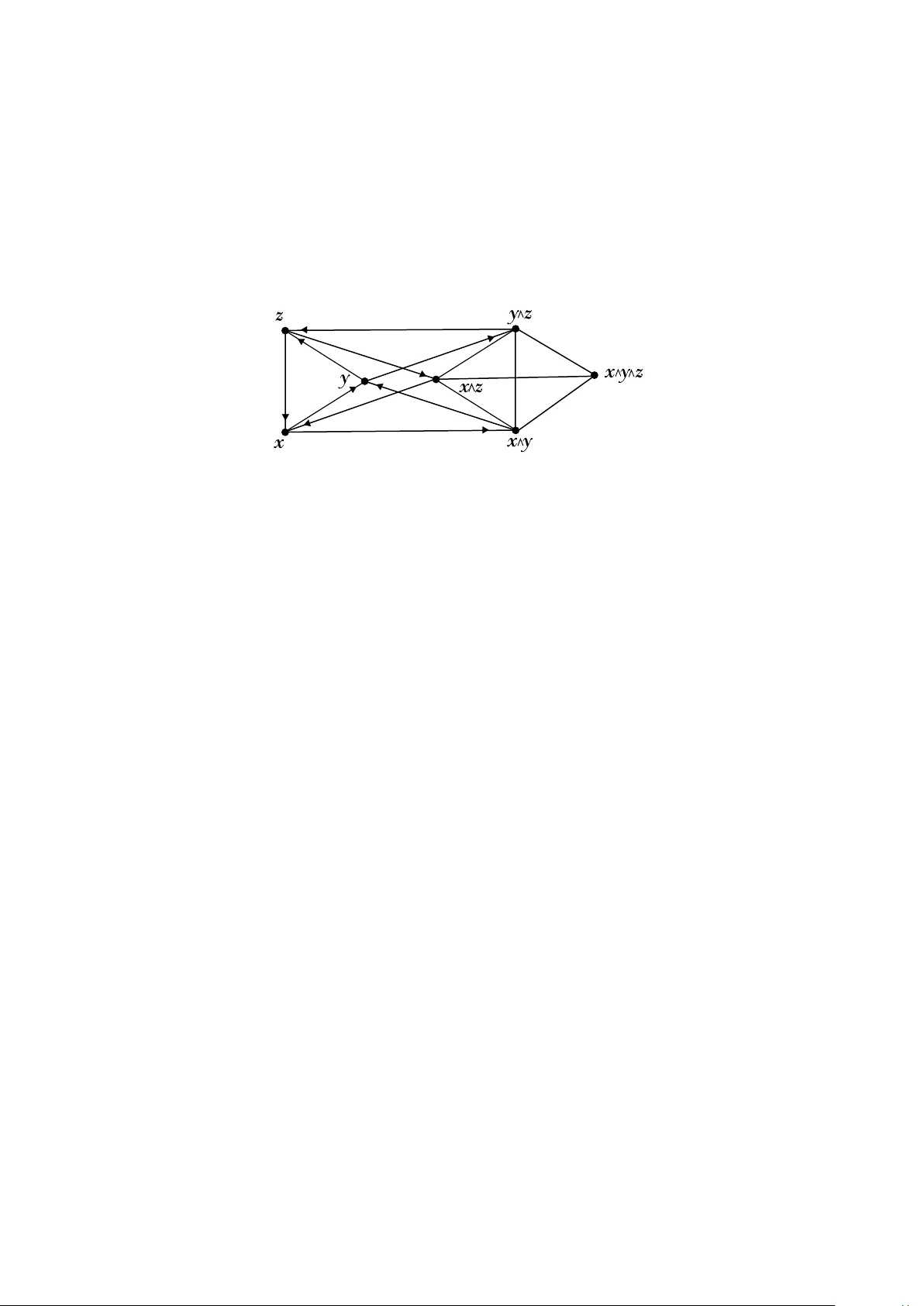
CONNECTIVITY NOTIONS ON COMP A TIBLE DIGRAPHS IN EQUA TIONAL CLASSES GER G ˝ O GYENIZSE, MIKL ´ OS MAR ´ OTI, AND L ´ ASZL ´ O Z ´ ADORI Abstract. A digraph G is called w eakly connected, strongly con- nected, and extremely connected if an y tw o v ertices of G are con- nected resp ectiv ely b y an orien ted, a directed, and a symmetric path in G . W e inv estigate the algebraic prop erties of digraphs that force some of these connectivit y notions to coincide. W e prov e that for digraphs with a Hobby-McKenzie p olymor- phism, the strong and the extreme comp onen ts coincide. Con- v ersely , if the strong and the extreme comp onen ts of any com- patible digraph in an equational class of algebras coincide, then the class m ust hav e a Hobb y-McKenzie term. As a consequence, w e obtain that an equational class V is n -permutable for some n if and only if the w eak comp onents of any compatible reflexive digraph in V are extremely connected. 1. Intr oduction In this article, we inv estigate the shap e of compatible digraphs in v arious equational classes of algebras. Before we giv e motiv ation, we clarify some basic concepts that are used in our in v estigations. Throughout the text, we use b old face capitals and the same capi- tals to denote algebras and their underlying sets, resp ectiv ely , and use blac kb oard b old capitals and the same capitals to denote digraphs and their v ertex sets, resp ectiv ely . W e use calligraphic capital letters to denote v arieties. A digraph G is we akly c onne cte d, str ongly c onne cte d, extr emely c on- ne cte d if an y t w o v ertices of G are connected resp ectively b y an oriented, a directed, and a symmetric path in G . W e need a fourth notion of con- nectedness, radically connected, that is a bit more complicated concept to define. W e shall give the definition later in Section 2. All one needs to know for understanding the con ten t of the Introduction is that for an y digraph, the follo wing implications hold: extremely connected ⇒ radically connected ⇒ strongly connected ⇒ weakly connected. Each Key wor ds and phr ases. digraph; v ariety; in terpretabilit y; clone homomorphism; connectivit y . The research of authors was supp orted by the NKFIH gran ts K138892 and AD- V ANCED 153383, and Pro ject no TKP2021-NV A-09 where the latter has been financed by the Ministry of Culture and Innov ation of Hungary from the National Researc h, Dev elopmen t and Inno v ation F und. 1 2 GER G ˝ O GYENIZSE, MIKL ´ OS MAR ´ OTI, AND L ´ ASZL ´ O Z ´ ADORI of these notions of connectivity naturally yields an equiv alence relation on the vertex set of a digraph. W e resp ectiv ely call it the extreme, the radical, the strong, and the weak equiv alence of the digraph. In Figure 1, w e display ed the inclusion ordering of these four equiv alences of a digraph. radical strong weak e xtre me Figure 1. The chain of equiv alences related to the four connectivit y notions. A variety (called also an e quational class ) is a class of all algebras of the same signature that satisfy a set of iden tities in the giv en signature. W e call a digraph G c omp atible in a v ariet y V if there is an algebra G in V whose underlying set coincides with the v ertex set of G , and the edge relation of G is a subalgebra of G 2 . Then, we also call G a c omp atible digr aph of the algebra G . T aylor v arieties w ere in tro duced in [3] as the v arieties whose full idemp oten t reduct do es not interpret in the v ariety S E T of sets. T a y- lor v arieties w ere characterized in v arious w a ys, see for example, The- orem A.1. in [7], and Lemma 4.2 and Corollary 4.3 in [1]. In [4], we ga v e a characterization of T aylor v arieties with the help of t w o con- nectivit y notions of compatible reflexive digraphs. The equiv alence of items (1) and (2) in the follo wing theorem is a part of this c haracteriza- tion. By taking in to accoun t, that radically connected implies strongly connected, and that the strong equiv alence is the smallest equiv alence whic h yields a cycle-free quotien t of a digraph, items (2) and (3) are clearly equiv alen t. Item (3) suits more for our purp oses in this article, as it giv es direct connection b etw een the equiv alences related to tw o connectivit y notions defined ab o v e. Theorem 1.1 ([4], cf. Theorem 4.4) . F or any variety V , the fol lowing ar e e quivalent. (1) V is a T aylor variety. (2) The quotient of every c omp atible r eflexive digr aph in V by its r adic al e quivalenc e is cycle-fr e e. (3) F or any c omp atible r eflexive digr aph in V , the str ong e quivalenc e c oincides with the r adic al e quivalenc e. In [5], Hagemann and Mitsc hk e gav e a characterization of n - p erm utable v arieties via compatible reflexiv e digraphs. They prov ed that a v ariety V is n -p ermutable if and only if for every edge a → b CONNECTIVITY NOTIONS ON DIGRAPHS 3 of any compatible reflexive digraph G in V , there exists a directed path with length at most n − 1 from b to a in G . W e call a v ariety a Hagemann-Mitschke variety if it is n -p ermutable for some n ≥ 2. In [13], V aleriote and Willard prov ed that Hagemann-Mitsc hke v arieties are the v arieties whose full idemp otent reduct do es not in terpret in the v ariet y D L of distributive lattices. By the use of Theorem 4.4 in [4], we obtained a c haracterization of Hagemann-Mitsc hke v arieties in terms of connectivit y relations of compatible reflexive digraphs. The equiv- alence of items (1) and (2) in the following theorem is a part of this c haracterization. Moreo v er, it is not hard to see that items (2) and (3) are equiv alent. One just has to use the facts that radically connected implies w eakly connected, and that for a digraph, the w eak equiv alence is the smallest equiv alence which yields a quotient that equals a disjoin t union of lo ops. Note that, similarly as in Theorem 1.1, item (3) here also giv es a direct link betw een equiv alences related to tw o connectivit y notions defined ab o v e. Theorem 1.2 ([4], cf. Corollary 4.5) . The fol lowing ar e e quivalent for a variety V . (1) V is a Hagemann-Mitschke variety. (2) The quotient of every c omp atible r eflexive digr aph in V by its r adic al e quivalenc e is a disjoint union of lo ops. (3) F or any c omp atible r eflexive digr aph in V , the we ak e quivalenc e c oincides with the r adic al e quivalenc e. Hobb y-McKenzie v arieties w ere in tro duced in [6] as the v arieties whose full idemp oten t reduct do es not in terpret in the v ariet y S L of semilattices. Hobby-McKenzie v arieties w ere characterized in v arious w a ys, see for example Theorem A.2 in [7], and also Lemma 5.1 and Corollary 5.2 in [2]. A t this p oint, we note that for the three types of v arieties w e in tro duced so far, w e hav e the following implications (just b y lo oking their c haracterizations via interpretation of their full idem- p oten t reduct): V is a Hagemann-Mitsc hk e v ariet y ⇒ V is a Hobby- McKenzie v ariet y ⇒ V is a T a ylor v ariety . In this article, we study the shap e of compatible reflexiv e digraphs in Hobby-McKenzie v arieties. Our goal is to present a similar c har- acterization for Hobby-McKenzie v arieties as the ones for T a ylor and Hagemann-Mitsc hk e v arieties in the lab eled theorems ab o v e. In [10], the last t w o authors prov ed Theorem 2.9 which claims that in a v ariety V that has Gumm terms, every compatible finite strongly connected reflexive digraph is extremely connected. W e note that exis- tence of Gumm terms characterizes congruence modularity for a v ariety , and implies that the v ariety is Hobby-McKenzie. W e long hav e b een conjectured that a generalization of Theorem 2.9 for Hobby-McKenzie 4 GER G ˝ O GYENIZSE, MIKL ´ OS MAR ´ OTI, AND L ´ ASZL ´ O Z ´ ADORI v arieties also holds. Namely , if V is a Hobb y-McKenzie v ariety , then ev- ery compatible strongly connected reflexive digraph in V is extremely connected. In this article, we shall v erify this conjecture. In fact, w e shall prov e the stronger statement that a v ariet y V is a Hobby-McKenzie v ariety if and only if for an y compatible reflexiv e digraph in V , the strong equiv a- lence coincides with the extreme equiv alence. F rom this new description of Hobb y-McKenzie v arieties, it will then follow as a corollary that a v ariety V is a Hagemann-Mitschk e v ariet y if and only if for an y com- patible reflexive digraph in V , the weak and the extreme equiv alences coincide. The structure of this pap er is as follows. In Section 2, w e present some definitions related to v arieties and digraphs, and at the end of Section 2, prov e some preliminary results related to tw o particular digraphs and Hobby-McKenzie v arieties. In Section 3, after proving some preparatory lemmas and corollaries, w e prov e our main result on Hobby-McKenzie v arieties, see Theorem 3.5, and, as a corollary , w e give a b etter characterization of Hagemann-Mitschk e v arieties, see Corollary 3.6. In Section 4, we summarize our results achiev ed in this article. 2. Preliminaries In this section, w e recall some basic algebraic notions related to v ari- eties, clones, and in terpretation of v arieties. W e introduce some further concepts of connectivity for digraphs. At the end of the section, we define some notions related to compatible digraphs, recall some well kno wn facts, and v erify statemen ts whic h prov e to b e useful for our in v estigations in Section 3. A term t of a v ariety V is called idemp otent if V satisfies the identit y t ( x, . . . , x ) = x . The ful l idemp otent r e duct of a variety V is a v ariet y whose signature is the set of idemp oten t terms of V , and whose iden ti- ties are those satisfied by the idemp otent terms for V . Throughout the text, w e denote the full idemp oten t reduct of V by V Id . An identit y in the language of a v ariet y is line ar if it has at most one o ccurrence of a function symbol on eac h side of the identit y . It is well kno wn that b oth T a ylor, Hobb y-McKenzie, and Hagemann-Mitschk e v arieties are c haracterized b y the existence of a single n -ary idempotent term t for some n suc h that the v ariety satisfies a certain finite set of linear identities for t , see Theorems 5.1, 5.2, and 5.3 in [3], Lemma 9.5 in [6], and Theorem 4.2 in [8]. The corresp onding term t is resp ectively called a T aylor, a Hobby-McKenzie, and a Hagemann-Mitschke term . No w, it should b e clear that a v ariety is resp ectively T a ylor, Hobb y- McKenzie, and Hagemann-Mitschk e if and only if so is its idemp otent reduct. CONNECTIVITY NOTIONS ON DIGRAPHS 5 F or later use, we define Hobb y-McKenzie terms. An n -ary idemp o- ten t term t of a v ariety V is called a Hobby-McKenzie term if for eac h i ∈ { 1 , . . . , n } , V satisfies a linear iden tit y in tw o v ariables x and y as of t ( x, . . . , x, x i +1 , . . . , x n ) = t ( y 1 , . . . , y i − 1 , y , y i +1 , . . . , y n ) where x j , y k ∈ { x, y } for all i + 1 ≤ j ≤ n, and for all k = i with 1 ≤ k ≤ n . In other words, t is idemp otent and ob eys a set of linear iden tities that fails to hold for an y n -ary term of S L . Let A b e a set. A clone on A is a set of finitary op erations on A that con tains all pro jection op erations and is closed under comp osition. A clone homomorphism from a clone C to a clone D is a map from C to D that maps each pro jection of C to the corresp onding pro jection of D and comm utes with comp osition. Let A b e an algebra. The clone of A is the clone of finitary term op erations of A , and is denoted b y Clo( A ). W e define the notion of in terpretabilit y for v arieties. Our notion of in terpretabilit y agrees with the one introduced in [3] by Garcia and T aylor. A v ariet y is called trivial if it consists of one-element algebras. The clone of a trivial variety is defined to b e the clone of the one- elemen t algebra. The clone of a non-trivial variety V is the clone of the free algebra with countably infinite free generating set. W e denote this clone by Clo( V ). W e sa y that a variety V interpr ets in a variety W if there is a clone homomorphism from Clo( V ) to Clo( W ). In the definition of in terpretability , w e ma y use the clone of any generating algebra of the v arieties V or W , since this clone is isomorphic to the clone of the resp ectiv e v ariety . W e use this fact without any further note in the later pro ofs. W e remark that interpretabilit y of v arieties can b e expressed in terms of satisfaction for sets of identities. Th us the follo wing is an equiv alent description of interpretabilit y: V in terprets in W if and only if there is an arity preserving map α that sends the function symbols of V to terms of W such that for an y set Σ of identities of V , by replacing the function sym b ols by their images under α in the iden tities of Σ, the resulting set of iden tities is satisfied by W . W e call t w o v arieties e qui-interpr etable if each of them interprets in the other. F or ev ery digraph, we define four equiv alences, eac h of whic h related to a certain kind of connectivity notion. These equiv alences are pro ved to b e useful when studying compatible digraphs in the three classes of v arieties men tioned in the In tro duction. Let G b e a reflexive digraph. Let a and b t w o vertices in G . An ( a, b )-path is a sequence of v er- tices a = a 0 , a 1 , . . . , a n = b in G such that a i → a i +1 or a i +1 → a i for all 0 ≤ i < n . A dir e cte d ( a, b ) -p ath is a sequence of vertices a = a 0 , a 1 , . . . , a n = b in G suc h that a i → a i +1 for all 0 ≤ i < n . A symmetric ( a, b ) -p ath is a sequence of vertices a = a 0 , a 1 , . . . , a n = b in G such that a i → a i +1 and a i +1 → a i for all 0 ≤ i < n . The we ak 6 GER G ˝ O GYENIZSE, MIKL ´ OS MAR ´ OTI, AND L ´ ASZL ´ O Z ´ ADORI e quivalenc e of G consists of all pairs ( a, b ) ∈ G 2 suc h that there is ( a, b )- path in G . The str ong e quivalenc e of G consists of all pairs ( a, b ) ∈ G 2 suc h that there are directed ( a, b )- and ( b, a )-paths in G . The extr eme e quivalenc e of G consists of all pairs ( a, b ) ∈ G 2 suc h that there is a symmetric ( a, b )-path in G . The blo cks are called the we ak , the str ong , and the extr eme c omp onents of the resp ectiv e equiv alences. No w it is clear that a digraph G is w eakly connected, strongly connected, and ex- tremely connected if and only if the corresp onding equiv alence relation of G has a single blo c k. Let α b e an equiv alence on G . Then G /α denotes the digraph whose v ertex set is G/α and edge set is defined by: A → B if and only if there is an edge a → b in G such that a ∈ A and b ∈ B . W e need one more notion of connectivit y for digraphs. F or a reflexive digraph G , w e define the r adic al e quivalenc e of G as follows. Let ν 0 denote the extreme equiv alence of G . Then let ν ′ 1 b e the extreme equiv alence of G /ν 0 , and ν 1 = { ( a, b ) : a/ν 0 ν ′ 1 b/ν 0 } . Clearly , ν 1 is an equiv alence on G , and G /ν 1 ∼ = ( G /ν 0 ) /ν ′ 1 . By using ν i , w e define ν i +1 similarly for eac h i ≥ 0. Then clearly , ν 0 ⊆ · · · ⊆ ν i ⊆ . . . are all equiv alences on G . So ν = S ∞ i =0 ν i is also an equiv alence on G . W e call ν the r adic al e quivalenc e of G . The blo c ks of ν are called r adic al c omp onents . Moreov er, we say that G is r adic al ly c onne cte d if the radical equiv alence of G has a single blo c k. Prop osition 2.1. L et G b e a r eflexive digr aph. Then its r adic al e quiv- alenc e ν is the smal lest e quivalenc e µ of G such that G /µ is antisym- metric. Pr o of. In [4] w e pro v ed that the digraph G /ν is an tisymmetric. Here w e argue that ν is the smallest equiv alence µ of G suc h that G /µ is an tisymmetric. So let µ b e an equiv alence of G such that G /µ is antisymmetric. W e pro v e b y an induction on i that ν i ⊆ µ for all i , and hence ν ⊆ µ . If ν 0 ⊆ µ , then there is an ( a, b ) ∈ ν 0 \ µ. Therefore, there exists a symmetric path a = a 0 ↔ a 1 ↔ · · · ↔ a n = b in µ and a 0 ≤ j < n suc h that ( a j , a j +1 ) ∈ µ , but this would imply that a j /µ = a j +1 /µ and a j /µ ↔ a j +1 /µ , so G /µ would not b e antisymmetric. So ν 0 ⊆ µ . Supp ose that i ≥ 1, then b y the induction h yp othesis ν i − 1 ⊆ µ . If ν i ⊆ µ , then there is an ( a, b ) ∈ ν i \ µ. Therefore, there exist blo cks B 0 , . . . , B n of ν i − 1 , elemen ts a k , b k , a ′ k , b ′ k ∈ B k where 0 ≤ k ≤ n , and a 0 ≤ j < n such that a ∈ B 0 , b ∈ B n , a k → b k +1 , a ′ k ← b ′ k +1 for all 0 ≤ k < n, and ( a j , a j +1 ) ∈ µ . Since eac h of the B k are included in a µ - blo c k, this would imply again that a j /µ = a j +1 /µ and a j /µ ↔ a j +1 /µ , so G /µ w ould not b e an tisymmetric. Thus ν i ⊆ µ . ■ Notice that by the preceding prop osition, the radical equiv alence is a subrelation of the strong equiv alence of G . Indeed, the quotien t CONNECTIVITY NOTIONS ON DIGRAPHS 7 of G b y the the strong equiv alence is obviously a cycle-free, hence an tisymmetric reflexive digraph. So it should now b e clear that for an y reflexive digraph G , the weak, the strong, the radical, and the extreme equiv alences comprise a de- creasing sequence with resp ect to inclusion, as w e ha v e men tioned this fact in the Introduction. W e also note that for ev ery compatible di- graph G of an algebra G , the four equiv alences defined by the different t yp es of connectivit y notions ab o v e are congruences of G . F or a digraph G , the n -th p ower G n of G is the digraph with vertex set G n where the edges are defined by ( a 1 , . . . , a n ) → ( b 1 , . . . , b n ) if and only if for all 1 ≤ i ≤ n , a i → b i in G . An n -ary op eration f of G is called a p olymorphism of G if f preserves the edge relation of G , that is, for all ( a 1 , . . . , a n ) → ( b 1 , . . . , b n ) in G n , f ( a 1 , . . . , a n ) → f ( b 1 , . . . , b n ) in G . The polymorphisms of a digraph G form a clone on the set G . W e denote this clone by P ol( G ). The idemp otent op erations in Pol( G ) also comprise a clone on G . This latter clone is denoted b y P ol Id ( G ). W e remark, and later use this fact without any further notice, that G is a compatible digraph in V if and only if there is a clone homomorphism from the clone of V to Pol( G ). W e define t w o particular small digraphs which app ear frequen tly later in the pro ofs. Let D b e the reflexive digraph on the 3-elemen t set { 0 , 1 , 2 } with non-lo op edges 0 ↔ 1, 1 → 2, and 2 → 0. Let K b e the reflexiv e digraph given with non-lo op edges 0 ↔ 1, 1 → 2, 2 ↔ 3, and 3 → 0 on the 4-elemen t set { 0 , 1 , 2 , 3 } . W e depicted these tw o digraphs in Figure 2. 1 0 2 1 2 3 0 Figure 2. The digraphs D and K (lo op edges and ar- ro ws on double edges are not displa y ed). In the following prop osition, we establish some prop erties of D and K . Prop osition 2.2. L et D and K denote the algebr as define d r esp e ctively on D and K whose b asic op er ations e qual the idemp otent p olymor- phisms of D and K . L et D and K b e the varieties r esp e ctively gener ate d by D and K . Then the fol lowing hold. (1) S L and D ar e e qui-interpr etable. (2) S E T and K ar e e qui-interpr etable. Pr o of. First we pro ve item (1). Observ e that the meet-semilattice oper- ation of the chain 0 < 1 < 2 is a p olymorphism of D . So S L in terprets in D . 8 GER G ˝ O GYENIZSE, MIKL ´ OS MAR ´ OTI, AND L ´ ASZL ´ O Z ´ ADORI F or the other direction, observ e first that { 0 , 2 } is closed under the op erations of D . Indeed, for an y c 1 , . . . , c n ∈ { 0 , 2 } and n -ary idem- p oten t p olymorphism t of D , 2 = t (2 , . . . , 2) → t ( c 1 , . . . , c n ). Hence t ( c 1 , . . . , c n ) ∈ { 0 , 2 } . Let D 0 denote the subalgebra of D with under- lying set { 0 , 2 } . Let D 0 b e the v ariety generated by D 0 . Clearly , D in terprets in D 0 . If w e prov e that D 0 in terprets in S L , w e are done. F or the pro of of this, it suffices to v erify that any term op eration of D 0 is a meet-semilattice op eration of the chain 0 < 2. Note that ev ery term op eration of D 0 is of the form t | { 0 , 2 } where t ∈ P ol Id ( D ). Our initial goal is to describ e the p olymorphisms of Pol Id ( D ). So let t b e an n -ary idemp otent p olymorphism of D . W e call I ⊆ { 1 , . . . , n } a major subset for t if there exist c 1 , . . . , c n ∈ D such that t ( c 1 , . . . , c n ) = 2 and I = { i | c i = 2 } . By idemp otency , { 1 , . . . , n } is itself a ma jor subset. W e pro ve tw o claims on the ma jor subsets. Claim 1. L et d 1 , . . . , d n ∈ D and I = { i : d i = 2 , 1 ≤ i ≤ n } . Then t ( d 1 , . . . , d n ) = 2 if and only if I is a major subset in { 1 , . . . , n } . Pr o of of claim. The only if part is immediate from the definition of ma jor subsets. F or the if part, supp ose that I is a ma jor subset, then there are c 1 , . . . , c n ∈ D such that t ( c 1 , . . . , c n ) = 2 and I = { i : c i = 2 , 1 ≤ i ≤ n } . Notice that by the second equalit y , c i ↔ d i holds for all 1 ≤ i ≤ n . Therefore, as t is a p olymorphism, t ( c 1 , . . . , c n ) ↔ t ( d 1 , . . . , d n ), which can only happ en if t ( d 1 , . . . , d n ) = 2. So the claim is prov ed. □ Claim 2. The major subsets form a filter of the lattic e B ( n ) of subsets of { 1 , . . . , n } . Pr o of of claim. First we pro v e that if I is a ma jor subset, and j ∈ { 1 , . . . , n } \ I then I ∪ { j } is also a ma jor subset. Let c = ( c 1 , . . . , c n ) ∈ D n suc h that t ( c ) = 2 and I = { i | c i = 2 } . Then c j ∈ { 0 , 1 } . Let c ′ j ∈ { 0 , 1 } so that c j = c ′ j , and let c ′ = ( c 1 , . . . , c ′ j , . . . , c n ) . Since c j ↔ c ′ j and t is a p olymorphism, 2 = t ( c ) ↔ t ( c ′ ) and hence t ( c ′ ) = 2. Then by t ( c 1 , . . . , 1 , . . . , c n ) → t ( c 1 , . . . , 2 , . . . , c n ) → t ( c 1 , . . . , 0 , . . . , c n ) , where 0 , 1 and 2 are the j -th entries of the resp ective n -tuples, 2 → t ( c 1 , . . . , 2 , . . . , c n ) → 2 . Therefore, t ( c 1 , . . . , 2 , . . . , c n ) = 2. So I ∪ { j } is a ma jor subset. This yields that the ma jor subsets form an upw ardly closed subset of B ( n ). CONNECTIVITY NOTIONS ON DIGRAPHS 9 W e still hav e to see that the ma jor subsets are closed under in ter- section. Supp ose that I 1 and I 2 are ma jor subsets for t . Let e i := 2 , if i ∈ I 1 ∩ I 2 , 1 , if i ∈ I 1 \ I 2 , 0 , otherwise while e + i := ( 2 , if i ∈ I 1 , 0 , otherwise and e − i := ( 2 , if i ∈ I 2 , 0 , otherwise. Then e − i → e i → e + i for all i . By using Claim 1 and the fact that t is a p olymorphism, 2 = t ( e − 1 , . . . , e − n ) → t ( e 1 , . . . , e n ) → t ( e + 1 , . . . , e + n ) = 2 . Hence t ( e 1 , . . . , e n ) = 2, and so I 1 ∩ I 2 is indeed a ma jor subset for t . □ By Claim 2, there is a smallest ma jor subset I t in { 1 , . . . , n } for t . Notice that by Claims 1 and 2, for arbitrary a 1 , . . . , a n ∈ D , t ( a 1 , . . . , a n ) = 2 holds if and only if a i = 2 for all i ∈ I t . In particu- lar, since t is idemp oten t, I t = ∅ . So for arbitrary a 1 , . . . , a n ∈ { 0 , 2 } , t { 0 , 2 } ( a 1 , . . . , a n ) = 2 holds if and only if a i = 2 for all i ∈ I t . This means precisely that t { 0 , 2 } ( x 1 . . . , x n ) = ^ i ∈ I t x i . Th us an y term op eration of D 0 is a meet-semilattice op eration of the c hain 0 < 2, as we claimed. F or item (2), it suffices to sho w that K interprets in S E T , since S E T in terprets in ev ery v ariety . The main result of [9] applied to K asserts that all surjective p olymorphisms of K are essentially unary , so the idemp oten t p olymorphisms of K coincide with the pro jections. Thus K in terprets in S E T . ■ W e define a natural construction of compatible digraphs. Let P b e a digraph. Let A b e an algebra suc h that P ⊆ A and P is a generating set of A . W e call the digraph A the P -gener ate d digr aph of A if the v ertex set of A coincides with A , and the edge set of A equals the subalgebra generated b y the edge set of P in A 2 . Note that if A is the P -generated digraph of A , then A is a compatible digraph of A . Let V b e a v ariety . Let F ∈ V b e the free algebra with free generating set P . Sometimes, we call the P -generated digraph of F the c omp atible digr aph fr e ely gener ate d by P in V . W e say that a digraph H is r etr act of a digraph G if there exist homomorphisms α : G → H and β : H → G suc h that αβ = id H . Then 10 GER G ˝ O GYENIZSE, MIKL ´ OS MAR ´ OTI, AND L ´ ASZL ´ O Z ´ ADORI w e call α a r etr action and β a c or etr action . W e require the following lemma on freely generated digraphs. Lemma 2.3 ([2], cf. Lemma 3.3) . L et V b e a non-trivial variety. L et S b e a r eflexive we akly c onne cte d digr aph with vertex set S = { s 1 , . . . , s n } such that ther e exists a clone homomorphism fr om the clone of V Id to P ol( S ) . L et F ∈ V denote the fr e e algebr a with fr e e gener ating set S , and F the digr aph fr e ely gener ate d by S in V . L et U denote the set o f unary term op er ations of F , and for any u ∈ U , let F u b e the sub digr aph of F , induc e d by the subset { t ( s 1 , . . . , s n ) : t is an n -ary term wher e ∀ s ∈ S, t ( s, . . . , s ) = u ( s ) } . Then the fol lowing hold. (1) The we ak c omp onents of F c oincide with the sub digr aphs F u , u ∈ U . (2) F or the identity op er ation id of F , F id is the we ak c omp onent induc e d by the idemp otent term op er ations in F , and S is a r etr act of F id with the c or etr action β : S → F id , a 7→ a. The follo wing corollary mak es connection b et w een the Hobb y- McKenzie v arieties and the digraph D . Corollary 2.4. L et V b e a variety, F the c omp atible digr aph fr e ely gener ate d by D in V , and F id the we ak c omp onent that includes D in F . Then the fol lowing ar e e quivalent. (1) V is a Hobby-McKenzie variety. (2) D is not a r etr act of F id . Pr o of. First we pro v e (1) ⇒ (2). If (1) holds, F has a Hobby-McKenzie p olymorphism. This b eing an idemp oten t p olymorphism restricts to F id , so F id also has a Hobb y-McKenzie p olymorphism. Since linear iden- tities are preserv ed under retract, if D w ould b e a retract of F id , then D would also hav e a Hobb y-McKenzie p olymorphism, so D would b e a Hobb y-McKenzie v ariety . On the other hand, D is an idemp otent v ari- et y , so D and D Id are equi-in terpretable. So b y item (1) in Prop osition 2.2, D Id in terprets in S L . By using the characterization of Hobb y- McKenzie v arieties mentioned in the In tro duction, this means that D is in fact not a Hobby-McKenzie v ariety This con tradiction finishes the pro of of (1) ⇒ (2). F or (2) ⇒ (1), let us supp ose that V is not a Hobby-McKenzie v a- riet y . Then, by using the c haracterization from the Introduction, V Id in terprets in S L . Hence, by the use of item (1) in Proposition 2.2 again, V Id in terprets in D . So there is a clone homomorphism from the clone V Id to Pol( D ). Then by the preceding lemma, D is a retract of F id . ■ CONNECTIVITY NOTIONS ON DIGRAPHS 11 3. Main resul ts In this section, we giv e several new c haracterizations of Hobb y- McKenzie v arieties. As a corollary , we obtain a c haracterization of Hagemann-Mitsc hk e v arieties which yields a better insigh t into the structure of these v arieties than the c haracterizations already known. W e start with proving some lemmas that give us information on the shap e of certain kinds of compatible digraphs in Hobb y-McKenzie v a- rieties. First we establish a prop ert y of the digraph freely generated by D in an idemp oten t Hobb y-McKenzie v ariety . Lemma 3.1. L et V b e an idemp otent Hobby-McKenzie variety, and F the c omp atible digr aph fr e ely gener ate d by D in V . Then F is extr emely c onne cte d. Pr o of. Let V b e an idemp oten t v ariet y , and assume that F is not ex- tremely connected. W e shall prov e that D is a retract of F . By Corollary 2.4, this means that V is not a Hobby-McKenzie v ariet y . W e denote the extreme equiv alence on F by ∼ . Let F b e the free algebra with free generating set { 0 , 1 , 2 } in V . As w e hav e men tioned, ∼ is a congruence of F , so the term op erations of F preserve ∼ . Let T denote the extreme comp onent of 2 in F . The pro of that D is a retract of F go es through a series of claims. Claim 1. 0 , 1 ∈ T . Pr o of of claim. Supp ose that 0 ∼ 2. Then the elements of D are in the same ∼ -class. Each element of F is of the form t (0 , 1 , 2) for some ternary term t of V . As ∼ is a congruence of F , t (0 , 1 , 2) ∼ t (0 , 0 , 0) = 0 and hence all elements of F are in the ∼ -class of 0, a con tradiction. Th us 0 ∈ T . Since 0 ∼ 1, we also hav e 1 ∈ T . □ Claim 2. L et t b e a 4-ary term of V , and let p ( x ) = t (0 , 1 , 2 , x ) . If p (0) ∈ T , then p (2) ∈ T . Pr o of of claim. By using that t is idemp oten t and acts on F as a p oly- morphism of F p (0) = t ( t (0 , 1 , 2 , 0) , t (0 , 1 , 2 , 0) , t (0 , 1 , 2 , 0) , t (0 , 1 , 2 , 0)) → t (0 , 0 , t (1 , 1 , 2 , 1) , t (1 , 1 , 2 , 1)) → t (0 , 1 , 2 , 0) = p (0) , and t (0 , 0 , t (1 , 1 , 2 , 1) , t (1 , 1 , 2 , 1)) ↔ t (0 , 1 , t (0 , 1 , 2 , 0) , t (0 , 1 , 2 , 0)) . So p (0) ∼ t (0 , 1 , p (0) , ( p (0)). By using that ∼ is a congruence and p (0) ∼ 2, we obtain p (0) ∼ t (0 , 1 , p (0) , p (0)) ∼ t (0 , 1 , 2 , 2) = p (2) , hence p (2) ∈ T . □ 12 GER G ˝ O GYENIZSE, MIKL ´ OS MAR ´ OTI, AND L ´ ASZL ´ O Z ´ ADORI Claim 3. (1) L et u ∈ F , v ∈ T and u → v . Then ther e is a 4-ary term t of V such that u = p (1) and p (2) ∈ T hold for the unary p olynomial p ( x ) = t (0 , 1 , 2 , x ) . (2) L et u ∈ F , v ∈ T , and u ← v . Then ther e is a 4-ary term t of V such that u = p (0) and p (2) ∈ T hold for the unary p olynomial p ( x ) = t (0 , 1 , 2 , x ) . Pr o of of claim. W e only prov e the first statemen t, as the second is an ob vious dual of the first. As u → v in F , b y the definition of F there is a 7-ary term s of V such that u = s (0 , 1 , 2 , 0 , 1 , 1 , 2) , v = s (0 , 1 , 2 , 1 , 0 , 2 , 0) . Let t ( x, y , z , u ) := s ( x, y , z , x, y , u, z ) and v ′ := t (0 , 1 , 2 , 2). Then p (1) = t (0 , 1 , 2 , 1) = s (0 , 1 , 2 , 0 , 1 , 1 , 2) = u, p (2) = t (0 , 1 , 2 , 2) = s (0 , 1 , 2 , 0 , 1 , 2 , 2) = v ′ . Th us u → v ′ in F . W e argue that v ′ ∈ T . Let t ′ ( x, y , z , u ) := s ( x, y , z , y , x, z , u ) and p ′ ( x ) = t ′ (0 , 1 , 2 , x ). So p ′ (0) = t ′ (0 , 1 , 2 , 0) = s (0 , 1 , 2 , 1 , 0 , 2 , 0) = v ∼ 2 . Hence b y applying Claim 2 for t ′ and p ′ , w e obtain that v ′ = s (0 , 1 , 2 , 0 , 1 , 2 , 2) ∼ s (0 , 1 , 2 , 1 , 0 , 2 , 2) = t ′ (0 , 1 , 2 , 2) = p ′ (2) ∼ 2 , whic h concludes the pro of of Claim 3. □ Claim 4. L et w ∈ F and w + , w − ∈ T such that w − → w → w + . Then w ∈ T . Pr o of of claim. By Claim 3, there are 4-ary terms t and s of V suc h that t (0 , 1 , 2 , 1) = s (0 , 1 , 2 , 0) = w and t (0 , 1 , 2 , 2) , s (0 , 1 , 2 , 2) ∈ T . Now w = t (0 , 1 , 2 , 1) = s ( t (0 , 1 , 2 , 1) , t (0 , 1 , 2 , 1) , t (0 , 1 , 2 , 1) , t (0 , 1 , 2 , 1)) → s (0 , 0 , t (1 , 1 , 2 , 2) , t (1 , 1 , 2 , 2)) → s (0 , 1 , t (2 , 2 , 2 , 2) , t (0 , 0 , 0 , 0)) = s (0 , 1 , 2 , 0) = w , so w ∼ s (0 , 0 , t (1 , 1 , 2 , 2) , t (1 , 1 , 2 , 2)) ∼ s (0 , 1 , t (0 , 1 , 2 , 2) , t (0 , 1 , 2 , 2)) ∼ s (0 , 1 , 2 , 2) ∈ T , whic h finishes the pro of of Claim 4. □ Let R denote the set of v ertices in F \ T from whic h there is an edge in F to some v ertex of T , and let P = F \ ( T ∪ R ). Now we define a CONNECTIVITY NOTIONS ON DIGRAPHS 13 map α from F to D by α ( x ) = 2 if x ∈ T , 1 if x ∈ R, 0 if x ∈ P . Then, b y Claim 1, 1 ∈ R and by Claims 1 and 4, 0 ∈ P . By Claim 4, F has no edges from T to R , and b y the definition of α , F has no edges from P to T . Hence α is a retraction from F on to D . Thus D is a retract of F . ■ Corollary 3.2. L et V b e a Hobby-McKenzie variety. L et A ∈ V b e any algebr a with gener ating set D ⊆ A . L et A b e the D -gener ate d digr aph of A . Then al l we ak c omp onents of A ar e extr emely c onne cte d. Pr o of. Let F ∈ V b e the free algebra with free generating set D , and F the compatible digraph freely generated by D in V . First we prov e that the w eak comp onen ts of F are extremely connected. Notice that b y Lemma 2.3, the compatible digraph freely generated by D in V Id coincides with the weak comp onent F id induced by the idemp otent ternary terms in F . Then b y the preceding lemma, F id is extremely connected. Now we pro v e that any w eak comp onen t of F is extremely connected. By Lemma 2.3, we know that any weak comp onent of F is of the form F u for some unary term op eration u of F and consists of all elements t (0 , 1 , 2) ∈ F where t is a ternary term op eration of F and for all 0 ≤ i ≤ 2, t ( i, i, i ) = u ( i ). Let t (0 , 1 , 2) ∈ F u for such t . As F is a compatible digraph of F and t is a p olymorphism of F , t | F 3 id is a homomorphism from F 3 id to F u . Since F id is extremely connected, so are F 3 id and t ( F 3 id ). Therefore, for an y ternary term op eration t of F where t ( i, i, i ) = u ( i ) for all 0 ≤ i ≤ 2, t (0 , 1 , 2) and t (0 , 0 , 0) are connected b y a symmetric path in F u . Th us F u is extremely connected. No w we pro ve that the weak comp onen ts of A are extremely con- nected. Let α b e the homomorphism from F on to A suc h that α ( d ) = d for all d ∈ D . First we prov e that α is also a homomorphism from F onto A . Any edge of F is of the form t F (0 , 1 , 2 , 1 , 0 , 1 , 2) → t F (0 , 1 , 2 , 0 , 1 , 2 , 0) where t is a 7-ary term of V . Since α is a homomorphism and α ( i ) = i for all i ∈ D , α ( t F (0 , 1 , 2 , 1 , 0 , 1 , 2)) = t A (0 , 1 , 2 , 1 , 0 , 1 , 2) and α ( t F (0 , 1 , 2 , 0 , 1 , 2 , 0)) = t A (0 , 1 , 2 , 0 , 1 , 2 , 0) . In A , w e ha ve that t A (0 , 1 , 2 , 1 , 0 , 1 , 2) → t A (0 , 1 , 2 , 1 , 0 , 1 , 2). So α pre- serv es the edges of F . No w we give a pro of that for every edge of the digraph A is of the form α ( f ) → α ( g ) where f → g in F . Let a → b b e an arbitrary edge in A , then there is 7-ary term t of V such that a = t A (0 , 1 , 2 , 1 , 0 , 1 , 2) 14 GER G ˝ O GYENIZSE, MIKL ´ OS MAR ´ OTI, AND L ´ ASZL ´ O Z ´ ADORI and b = t A (0 , 1 , 2 , 0 , 1 , 2 , 0) in A . By using that α ( i ) = i for all i ∈ D , w e also hav e a = t A ( α (0) , α (1) , α (2) , α (1) , α (0) , α (1) , α (2)) and b = t A ( α (0) , α (1) , α (2) , α (0) , α (1) , α (2) , α (0)) . Since α is a homomorphism, a = α ( t F (0 , 1 , 2 , 1 , 0 , 1 , 2)) and b = α ( t F (0 , 1 , 2 , 0 , 1 , 2 , 0)) . No w, via the preceding tw o equalities, the tw o vertices f = t F (0 , 1 , 2 , 1 , 0 , 1 , 2) and g = t F (0 , 1 , 2 , 0 , 1 , 2 , 0) witness the fact that a → b is of the form α ( f ) → α ( g ) where f → g in F . Supp ose that there is an orien ted path from a to b in A , i.e., there is sequence a = a 0 , . . . , a n = b suc h that a i → a i +1 or a i +1 → a i in A for all 0 ≤ i < n . Since any edge of A is the image of an edge of F under α , for every 0 ≤ i < n , there is a w eak comp onen t of F whose image under α contains a i and a i +1 . Since the weak comp onen ts of F are extremely connected, so are their homomorphic images. Therefore, for each 0 ≤ i < n , there is a symmetric path connecting a i and a i +1 in A . So a and b are connected b y a symmetric path in A . Th us the weak comp onen ts of A are extremely connected. ■ Let G and H b e digraphs. A sequence g = g 0 , g 1 , . . . , g n = g ′ suc h that for all 0 ≤ i < n , there is a homomorphism φ i : H → G whose range contains g i and g i +1 is called an H -p ath fr om g to g ′ in G . The equiv alence that contains the pairs ( g , g ′ ) where g and g ′ are connected b y an H -path is called the H -e quivalenc e of G . The blo c ks of the H - equiv alence of G are called the H -c omp onents of G . W e say that G is H -c onne cte d if the H -equiv alence of G has a single blo c k. Let N = ( { 0 , 1 } ; { (0 , 0) , (1 , 1) , (0 , 1) , (1 , 0) } ). W e note that for an y reflexive digraph, the extreme equiv alence coincides with the N - equiv alence. Moreov er, for any reflexiv e digraph, the extreme equiv a- lence is a subrelation of H -equiv alence if H is an at least 2-elemen t digraph. In [11], Ol ˇ s´ ak pro v ed that every T aylor v ariety V has an idemp oten t 6-ary term o (w e call o an Ol ˇ s´ ak term ) suc h that V satisfies the following iden tities o ( x, x, x, y , y , y ) = o ( x, y , y , x, x, y ) = o ( y , x, y , x, y , x ) . Lemma 3.3. In a T aylor variety V , for any c omp atible r eflexive di- gr aph G in V , the K -e quivalenc e of G c oincides with the D -e quivalenc e of G . Pr o of. Since there is a homomorphism from K to D , the D -equiv alence is a subrelation of the K -equiv alence for an y digraph. Let V b e a T aylor v ariety , and G a compatible reflexiv e digraph in V . Let o b e an Ol ˇ s´ ak CONNECTIVITY NOTIONS ON DIGRAPHS 15 p olymorphism of G . Let C b e a K -component of G . T o complete the pro of of the lemma, w e shall pro ve that C is included in a D -component of G . Let φ b e a homomorphism from K to C such that φ (0) = a, φ (2) = b, φ (3) = c and φ (4) = d. So for a, b, c, d ∈ C hav e that a ↔ b → c ↔ d → a . First we prov e that a and c are in the same D -comp onent of G . Since o is a p olymorphism of G , a ↔ o ( a, a, a, b, b, b ) → o ( a, a, a, c, c, a ) ↔ o ( a, a, a, d, d, a ) → o ( a, b, b, a, a, b ) = o ( a, a, a, b, b, b ) . This implies that a , o ( a, a, a, b, b, b ), and o ( a, a, a, d, d, a ) are in the same D -comp onen t. By o ( a, a, a, d, d, a ) ↔ o ( a, a, a, c, c, a ) ↔ o ( b, a, b, d, c, a ) → o ( c, a, c, a, c, a ) = o ( a, a, a, c, c, c ) ↔ o ( b, a, a, d, c, d ) → o ( b, a, b, d, c, a ) , o ( a, a, a, c, c, c ) is also in this D -comp onen t. By a similar argument, c and o ( a, a, a, c, c, c ) are in the same D -comp onent. Th us a and c are in the same D -comp onen t of G . Since C is K -connected and the ranges of homomorphisms from K to C are included in the same D -comp onen t, C is a sub digraph of a D - comp onen t. So the K -equiv alence of G is included in the D -equiv alence of G . ■ By Corollary 3.2, the preceding lemma yields the follo wing. Corollary 3.4. In a Hobby-McKenzie variety V , for any c omp atible r eflexive digr aph, the K -e quivalenc e c oincides with the extr eme e quiva- lenc e. Pr o of. Let G ∈ V , and G a compatible reflexive digraph of G . As it is ob vious that the K -equiv alence of G includes the extreme equiv alence of G , it suffices to prov e that every K -comp onent of G is extremely connected. Let C b e a K -comp onent of G . Then by the preceding lemma C is a D -comp onen t of G . Let g and g ′ b e t wo arbitrary v ertices of C . By using that C is D -connected, there exist a sequence g = g 0 , g 1 , . . . , g n = g ′ in C and for eac h 0 ≤ i < n , a homomorphism φ i : D → G whose range con tains g i and g i +1 . Let D i b e the sub digraph induced by φ i ( D ) in C . Let G i b e the D i -generated digraph of G i where G i is the subalgebra of G generated b y D i . Notice that b y compatibilit y of G , G i is subdigraph of G . No w we argue that any t w o v ertices of D i are connected b y a sym- metric path in G . If D i is not isomorphic to D , then, since there is onto homomorphism from D to D i , D i itself is extremely connected. On the other hand, if D i is isomorphic to D , then b y Corollary 3.2, the weak 16 GER G ˝ O GYENIZSE, MIKL ´ OS MAR ´ OTI, AND L ´ ASZL ´ O Z ´ ADORI comp onen t of G i that includes D i is extremely connected. Thus in ei- ther wa ys, any tw o v ertices of D i are connected by a symmetric path in G . This yields that g and g ′ are connected by a symmetric path in G . Th us C is extremely connected. ■ W e use the preceding corollary to giv e a characterization of Hobb y- McKenzie v arieties. F or any p ositive integer n , let C n denote the re- flexiv e directed n -cycle. Theorem 3.5. F or any variety V , the fol lowing ar e e quivalent. (1) V is a Hobby-McKenzie variety. (2) F or any c omp atible r eflexive digr aph in V , the r adic al e quiva- lenc e c oincides with the extr eme e quivalenc e. (3) F or any c omp atible r eflexive digr aph in V , the str ong e quivalenc e c oincides with the extr eme e quivalenc e. (4) F or any p ositive inte ger n , in the digr aph fr e ely gener ate d by C n in V , the we ak c omp onent of C n is extr emely c onne cte d. (5) In the digr aph fr e ely gener ate d by C 3 in V , the we ak c omp onent of C 3 is extr emely c onne cte d. (6) Ther e exist 6-ary terms s i and t i , 1 ≤ i ≤ n , for V such that V satisfies the fol lowing identities t 1 ( x, x, y , y , z , z ) = x, t i ( x, x, y , y , z , z ) = s i ( x, y , y , z , z , x ) for al l 1 ≤ i ≤ n, s i ( x, x, y , y , z , z ) = t i ( x, y , y , z , z , x ) for al l 1 ≤ i ≤ n, t i ( x, x, y , y , z , z ) = t i − 1 ( x, y , y , z , z , x ) for al l 1 < i ≤ n, y = t n ( x, y , y , z , z , x ) . Pr o of. Due to the fact that C n is a strongly connected digraph, the w eak comp onent of C n coincides with the strong comp onen t of C n in the compatible digraph freely generated by C n in any v ariet y V . Hence the implications (3) ⇒ (4) ⇒ (5) are obvious. Notice that (6) holds if and only if in the free digraph freely generated by the isomorphic cop y ( { x, y , z } ; { ( x, x ) , ( x, y ) , ( y , y ) , ( y , z ) , ( z , z ) , ( z , x ) } ) of C 3 in V , there is a symmetric path of length n from x to z . Hence, (5) ⇒ (6). F or (1) ⇒ (2), we assume that G ∈ V , G is a compatible reflexive digraph of G , and H is a radical but not an extreme comp onent of G . Hence, there are extreme comp onents A and B in H suc h that in the quotien t of G b y its extreme congruence, we hav e A ↔ B . This means that there are vertices a, a ′ ∈ A and b, b ′ ∈ B suc h that a → b and b ′ → a ′ . Let d b e the maximum of the lengths of a shortest symmetric ( a, a ′ )-path and a shortest symmetric ( b, b ′ )-path. W e assume that G , H , a, a ′ , b , and b ′ are c hosen so that d is minimal. CONNECTIVITY NOTIONS ON DIGRAPHS 17 Clearly , d is not 0, as this would imply that a = a ′ and b = b ′ , so there would b e a double edge b etw een a and b in G . If d = 1, then the sub digraph of G induced b y { a, a ′ , b, b ′ } is isomorphic to D or K . So ( a, b ) is in the K -equiv alence of G . Then b y Corollary 3.4, a and b are in the same extreme comp onen t of G , a con tradiction. Hence, d > 1. Then w e define the reflexiv e relation ρ on G by ( x, y ) ∈ ρ ⇔ ∃ u : x → u ↔ y . Clearly , ρ is a subalgebra of G 2 . Hence G ′ = ( G ; ρ ) is a compatible reflexiv e digraph in V . Notice that b y the reflexivity of G , the edges of H are contained in ρ . Let H ′ b e the strong comp onent of G ′ including H . Clearly , if x ↔ y ↔ z in G , then ( x, z ) ∈ ρ . Therefore, the maxim um of the lengths of the shortest symmetric ( a, a ′ )- and ( b, b ′ )-paths in H ′ is smaller than d . No w by the minimality of d , the vertices a and b are in the same extreme comp onent of H ′ . So there exists a symmetric ( a, b )-path in H ′ . Notice that if ( x, y ) , ( y , x ) ∈ ρ , then x and y are in the range of a homomorphism from K to G . Consequently , ( a, b ) is in the K - equiv alence, and hence by Corollary 3.4 there exists a symmetric ( a, b )- path in G , a con tradiction. No w w e pro ve that (2) ⇒ (3). If V is a T aylor v ariety , then, b y The- orem 1.1, all compatible strongly connected digraphs in V are radically connected, and hence b y (2), they are extremely connected. So it suf- fices to prov e that V is a T aylor v ariet y . Let us supp ose that V is a not T aylor v ariety , then V Id in terprets in S E T , hence in D as w ell. Let F 0 b e the digraph freely generated b y D in V Id . W e note that F 0 = { t (0 , 1 , 2) : t is a ternary idemp otent term of V } . Then, b y Lemma 3.3 in [2], F 0 is a weak comp onent of the digraph F freely generated b y D in V , and D is a retract of F 0 . Let ν b e the extreme equiv alence of F 0 . F or any ternary idemp otent term t of V , as t acts on F as a p olymorphism of F , 1 = t (1 , 1 , 1) → t (0 , 1 , 2) → t (0 , 0 , 0) = 0 . Then, b y (0 , 1) ∈ ν , for every idemp otent term t of V , t (0 , 0 , 0) /ν ↔ t (0 , 1 , 2) /ν in F 0 /ν. So the extreme equiv alence of F 0 /ν is the full relation. Therefore, F 0 is radically connected, and so F 0 is a blo ck of the radical equiv alence of F . Hence by (2), F 0 is extremely connected. So its retract D must also b e extremely connected, a con tradiction. Th us V is a T a ylor v ariety . Finally , w e pro v e that (6) ⇒ (1). Let supp ose that item (6) holds, and V is still not a Hobb y-McKenzie v ariety . Then V Id in terprets in S L . Clearly , all terms which o ccur in the iden tities of (6) are idemp otent. Consequen tly , (6) holds in S L . Then b y the remark at the b eginning 18 GER G ˝ O GYENIZSE, MIKL ´ OS MAR ´ OTI, AND L ´ ASZL ´ O Z ´ ADORI of the pro of of the presen t theorem, the compatible digraph freely gen- erated b y C 3 in S L must hav e a symmetric path from x to z . This freely generated digraph has seven vertices, and is easy to construct, see Figure 3. Evidently , it has no symmetric path from x to z , a con- tradiction. ■ Figure 3. The digraph freely generated by C 3 in the v ariety of semilattices The preceding theorem yields a new c haracterization of Hagemann- Mitsc hk e v arieties. Corollary 3.6. F or any variety V , the fol lowing ar e e quivalent. (1) V is a Hagemann-Mitschke variety. (2) F or any c omp atible r eflexive digr aph in V , the we ak e quivalenc e c oincides with the str ong e quivalenc e. (3) F or any c omp atible r eflexive digr aph in V , the we ak e quivalenc e c oincides with the r adic al e quivalenc e. (4) F or any c omp atible r eflexive digr aph in V , the we ak e quivalenc e c oincides with the extr eme e quivalenc e. Pr o of. By the c haracterization of n -p ermutable v arieties of Hagemann and Mitsc hke that w e men tioned in the In tro duction, (1) ⇒ (2) is clear. Hagemann-Mitsc hk e v arieties are Hobby-McKenzie v arieties, hence by the equiv alence of the first tw o conditions in the preceding theorem, (2) ⇒ (4) is also clear. Since the extreme equiv alence is included in the radical equiv alence, (4) ⇒ (3). Finally , by Theorem 1.1, we obtain (3) ⇒ (1). ■ 4. Conclusion W e summarize the main results we ac hiev ed in this article. W e gav e v arious characterizations of the T a ylor, the Hobby-McKenzie, and the Hagemann-Mitsc hk e v arieties by the use of four types of connectivit y notions for their compatible digraphs. It turned out that a v ariety is Hagemann-Mitsc hk e if and only if for ev ery compatible digraph in the v ariety , the w eak equiv alence coincides with either the strong, the rad- ical or the extreme equiv alence. A v ariety is Hobb y-McKenzie if and only if for ev ery compatible digraph in the v ariety , the extreme equiv- alence coincides with the strong or the radical equiv alence. A v ariet y CONNECTIVITY NOTIONS ON DIGRAPHS 19 is T a ylor if and only if for every compatible digraph in the v ariet y , the strong equiv alence coincides with the radical equiv alence. Note that there are only 6 wa ys to collapse t w o equiv alences defined by the 4 connectivit y notions we introduced, and our results obtained in this article exhaust all the 6 cases. References [1] Bo dor, B, Gyenizse, G, Mar´ oti, M and Z´ adori, L; T aylor is prime, IJAC, 34/06, 857–879 (2024). [2] Bo dor, B, Gyenizse, G, Mar´ oti, M, and Z´ adori, L; The filter of interpretabil- it y types of Hobby-McKenzie v arieties is prime, submitted https://www.math.u- szeged.h u/ zadori/publications/publ37.p df (2024). [3] Garcia O. C and T aylor, W; The lattice of interpretabilit y types of v arieties, Mem. Amer. Math. So c. 50 (1984) v+125. [4] Gyenizse, G, Mar´ oti, M, and Z´ adori, L; Reflexive digraphs in T a ylor v ari- eties, submitted https://www.math.u-szeged.h u/ zadori/publications/publ38.p df (2025). [5] Hagemann, J and Mitsc hk e, A; On n-p ermutable congruences, Algebra Univer- salis 3, 8–12 (1973) [6] Hobby , D and McKenzie, R; The structure of finite algebras, Contemporary Mathematics 76, American Mathematical So ciet y , Providence, RI, 1988. [7] Kearnes, K. A and Kiss, E. W; The shap e of congruence lattices, Mem. Amer. Math. So c. 222 (2013) viii+169. [8] Kozik, M, Krokhin, A, V aleriote, M, and Willard, R; Characterizations of sev eral Maltsev conditions, Algebra Univ ersalis 73, 205–224 (2015). [9] Larivi` ere, I, Larose, B, and Pazmi˜ no Pullas, D E; Surjective Polymorphisms of Directed Reflexiv e Cycles, Algebra Univ ersalis 85/4, 1–28 (2024). [10] Mar´ oti, M and Z´ adori, L; Reflexive digraphs with near unanimity p olymor- phisms, Discrete Mathematics 12/15, 2316–2328 (2012). [11] Ol ˇ s´ ak, M; The w eakest nontrivial idemp oten t equations, Bul. Lond. Math. So c. 49/6, 1028–1047 (2017). [12] T a ylor, W; V arieties ob eying homotopy laws, Canad. J. Math., 29/3, 498–527 (1977). [13] V aleriote, M and Willard, R; Idemp otent n -p ermutable v arieties, Bulletin of the London Mathematical So ciet y 46, 870–880, (2014). Bol y ai Institute, Univ. of Szeged, Szeged, Aradi V ´ er t an ´ uk tere 1, HUNGAR Y 6720 Email addr ess : gergogyenizse@gmail.com Email addr ess : mmaroti@math.u-szeged.hu Email addr ess : zadori@math.u-szeged.hu
Original Paper
Loading high-quality paper...
Comments & Academic Discussion
Loading comments...
Leave a Comment