Topological simplification guided by forbidden regions
Topological simplification is the process of reducing complexity of a function while maintaining its essential features. Its goal is to find a new filter function, which reorders cells of the input complex in a way which eliminates some persistent ho…
Authors: Jakub Leśkiewicz, Bartosz Furmanek, Michał Lipiński
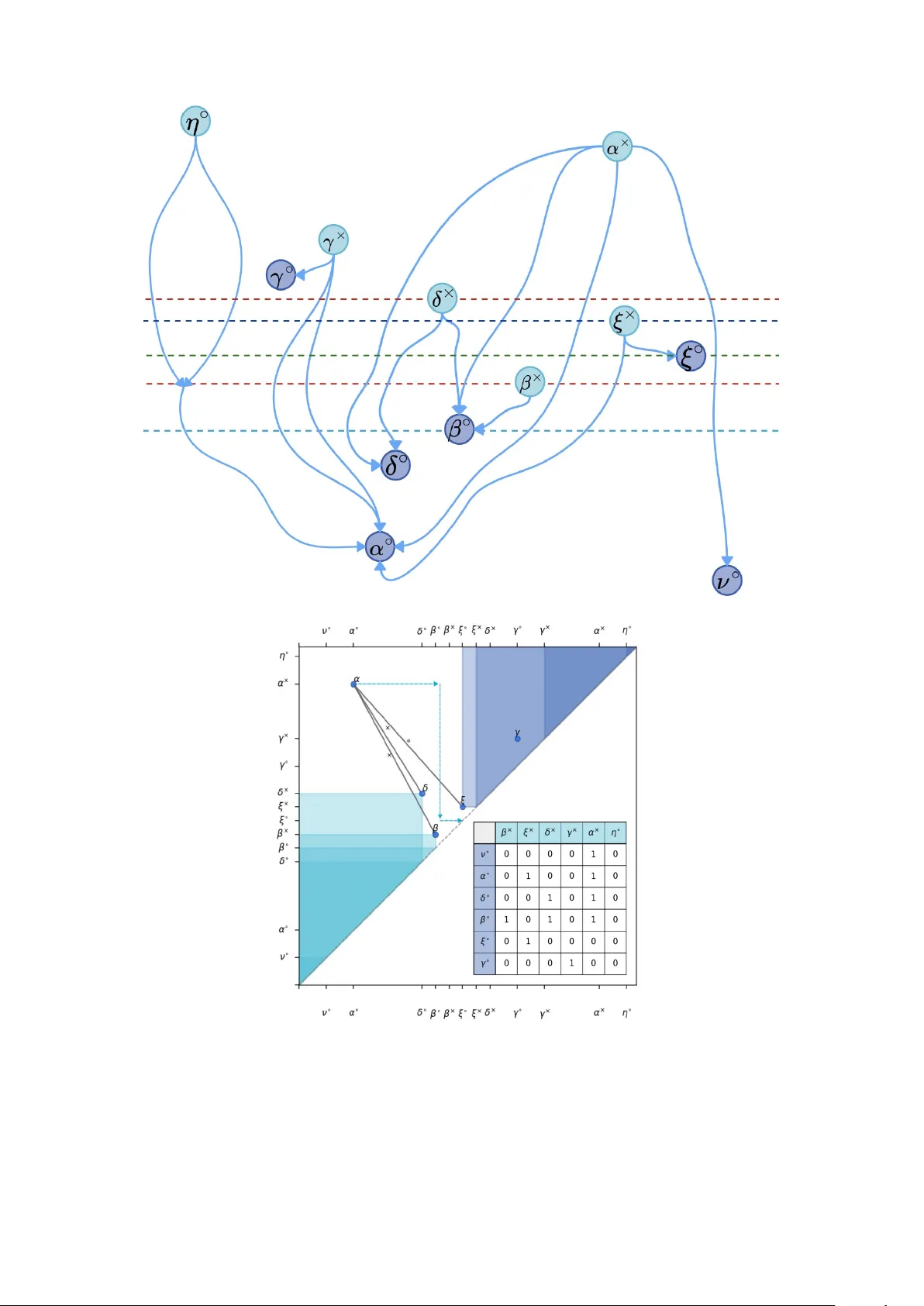
T op ological simplification guided b y forbidden regions Jakub Leśkiewicz, Bartosz F urmanek, Mic hał Lipiński, Dmitriy Morozov Marc h 18, 2026 Abstract T op olo gic al simplific ation is the process of reducing complexity of a function while main- taining its essen tial features. Its goal is to find a new filter function, which reorders cells of the input complex in a wa y whic h eliminates some persistent homological features, without affecting the rest. W e presen t a new approach to simplification based on the concept of forbidden r e gions and com binatorial dynamics. It allows us to reorder and cancel critical v alues, whose cancellation is not p ossible using existing metho ds b ecause they are not consecutiv e in the total order. Each suc h cancellation takes O ( c · n ) time in the worst case, where c is the num b er of birth-death pairs and n is the size of the input complex. 1 In tro duction Simplification of real-v alued functions is one of the cen tral topics in Morse theory . In the classical (smo oth) setting, one of the most notable examples of suc h simplifications is p erformed throughout the pro of of the h-cob ordism theorem [24, 23]. In the discrete setting, F orman’s theory [19, 18] studies the reversal of a unique com binatorial path b et ween t wo critical p oin ts as a w ay of reducing the total n umber of critical p oin ts and, therefore, simplifying the Morse complex. More recen tly , simplification has b een studied in the con text of p ersisten t homology . The authors of [15] in tro duced the problem of p ersistence-sensitiv e simplification—asking to simplify all pairs with p ersistence below a giv en threshold—and ga ve an algorithm for 2-manifolds. Their solution was later improv ed to linear time [1]. Another approac h, based on F orman’s com binatorial v ector fields, was presented in [3]. This work drew connection to the cancellation pro cedure by observing that whenever the unique path connects t wo critical p oints with lo cally lo west difference in function v alues, their cancellation do es not affect the remaining part of the 0 Key wor ds and phr ases. Persisten t homology , top ological simplification, depth p osets. Jakub L eśkiewicz : The research w as partially funded by the Polish National Science Center under Opus Grant No. 2019/35/B/ST1/00874 and Opus Grant 2025/57/B/ST1/00550. Bartosz F urmanek : The research was partially funded b y the Polish National Science Cen ter under Opus Gran t No. 2019/35/B/ST1/00874 and Opus Grant 2025/57/B/ST1/00550. Michał Lipiński : This p ro ject has received funding from the Europ ean Union’s Horizon 2020 research and inno v ation programme under the Marie Skłodowsk a-Curie Grant Agreement No. 101034413. Dmitriy Mor ozov : This work was supp orted in part b y the U.S. Department of Energy , Office of Science, Office of Adv anced Scien tific Computing Researc h, under Contract No. DE-AC02- 05CH11231. 1 p ersistence diagram [3]. These app ar ent p airs hav e also b een called close p airs [10] and shal low p airs [16]. This observ ation further help ed in optimization of (p ersisten t) homology computation [2] and shap e reconstruction [4]. The idea of pruning pairs of critical cells, follo wing F orman’s ap- proac h, has b een extensiv ely studied in data visualization [7, 8, 11, 17, 21, 22, 26]. Recen t w orks on top ological optimization [5, 25] offer an alternativ e, alb eit less con trolled approach to simplification. But there remains a critical gap. The w orks that are able to rigorously control the changes in p ersistent homology [15, 1, 3] are only able to simplify 0-dimensional p ersistent homology (as w ell as co dimension-1, b y dualit y). Meanwhile, the middle dimensions—e.g., 1-dimensional homology on 3-manifolds—are imp ortant in practice. In this w ork, we study ho w relations b etw een p ersistence pairs calculated b y the standard lazy reduction algorithm [12, 6] can guide us in simplifying a discrete Morse function h , while con trolling the c hanges in its p ersistence diagram in any dimension and the ov erall gradient structure. These relations organize persistence pairs in a hierarc hical structure called a depth p oset [13]. As observ ed in [14, 25], these relations describ e the obstacles to mo difying a function without c hanging its p ersistence diagram. Concretely , for a given p ersistence pair α , we define forbidden r e gions for its death and birth cells, whic h describ e the parts of the persistence diagram that α cannot mov e to without c hanging the persistence pairing. Con versely , when the forbidden regions lea ve a gap—a path from α to the diagonal—we can construct a homotopy that brings α to the diagonal without c hanging the rest of the p ersistence pairs and the gradient structure. This allo ws us to identify a broader family of p ersistence pairs, p ossibly with high p ersistence, that can b e safely and selectiv ely remo ved. W e summarize our main contribution in the following theorem, where BD( h ) denotes the set of birth-death pairs induced by a discrete Morse function h , and Crit( V h ) , the set of critical cells for h . Theorem 1. L et h b e a discr ete Morse function on a L efschetz c omplex X . If α ∈ BD( h ) is a p ersistenc e p air such that forbidden r e gions of its de ath and birth c el ls do not interse ct, and ther e exists exactly one gr adient p ath b etwe en the p air e d critic al c el ls, then ther e exists a discr ete Morse function h ′ on X such that BD( h ′ ) = BD( h ) \ { α } and h ( x ) = h ′ ( x ) for al l x ∈ Crit( V h ′ ) . W e present a constructiv e pro of to this theorem, which provides an algorithm explicitly trac k- ing all c hanges in relations throughout the homotopy and the final path reversal. As a result, w e obtain already computed relations betw een pairs in BD( h ′ ) , whic h enables iterative simpli- fication. 2 Preliminaries Definition 2. A Lefschetz complex is a triplet ( X , dim , D ) , wher e X is a finite set of elements c al le d c el ls, dim : X → N is a map assigning a dimension to e ach c el l, and D : X × X → Z 2 is the b oundary c o efficient such that D ( x, y ) = 0 implies dim x + 1 = dim y , in which c ase we say x is a facet of y . A dditional ly, we r e quir e that for any x, y ∈ X we have P z ∈ X D ( x, z ) · D ( z , y ) = 0 . W e also define the c ob oundary c o efficient as D ⊥ ( y , x ) : = D ( x, y ) . Lefsc hetz complexes generalize simplicial, cubical, and cellular complexes while remaining con- 2 crete enough to define p ersisten t homology . When it do es not lead to confusion, w e shorten the notation and refer to the set of cells, X , as the Lefschetz complex. W e often interpret D and D ⊥ as a matrix, in whic h case w e put the arguments in the square brac k ets for emphasis, e.g., D [ x, y ] . W e write X n for the set of n -dimensional cells of X , and D n , D ⊥ n for the n -th b oundary and cob oundary matrix, respectively . Definition 3. (Discr ete Morse function) L et X b e a L efschetz c omplex. A map h : X → R is c al le d a discrete Morse function (dMf, for short) if the fol lowing c onditions ar e satisfie d for al l x, y ∈ X . (i) if D ( x, y ) = 1 then h ( x ) ≤ h ( y ) (we ak monotonicity), (ii) if h ( x ) = h ( y ) then either D ( x, y ) = 1 or D ( y , x ) = 1 (p airing), (iii) for every y ∈ R , we have # h − 1 ( y ) ≤ 2 (almost inje ctive). In particular, w e sa y that X is filter e d by h . It also induces an h -order on X : x < h y ⇐ ⇒ h ( x ) < h ( y ) or h ( x ) = h ( y ) and dim x < dim y . If X is filtered b y a dMf h , then w e alwa ys assume that ro ws and columns of D n are ordered b y the h -order, and those of D ⊥ n b y the rev ersed h -order. T o calculate p ersis ten t homology , we use the original version of the p ersistence algorithm [12], called lazy r e duction algorithm , describ ed in the form w e need in [25]. The algorithm relies on an auxiliary function low , which, for a given column, returns the index of the ro w con taining the low est non-zero entry in that column. F or a giv en (co)b oundary matrix D n , Algorithm 1 p erforms successiv e column additions, which results in a decomp osition D n = R n U n with U n in vertible and upp er triangular. Moreo v er, if x = y and U n [ x, y ] = 0 , then column R n [: , x ] w as added to R n [: , y ] b y the algorithm. Observ e that in D n the ro ws are indexed by ( n − 1) - dimensional cells and the columns by n -dimensional cells. The same holds for R n ; how ev er, b oth the ro ws and columns of U n are indexed by n -dimensional cells. Similarly , w e obtain D ⊥ = R ⊥ U ⊥ decomp osition by applying D ⊥ to the algorithm. Algorithm 1: Lazy reduction of the matrix o v er Z 2 . 1 R n = D n , U n = I 2 for y over the c olumns of R n (left to right) do 3 while R n [: , y ] = 0 and there exists a preceding column x with lo w ( R n [: , x ]) = lo w ( R n [: , y ]) do 4 R n [: , y ] ← R n [: , y ] + R n [: , x ] 5 U n [ x, :] ← U n [ x, :] + U n [ y , :] W e say that α = ( α ◦ , α × ) is an ( n -dimensional) birth-de ath pair if α ◦ is a low of R n +1 [: , α × ] . α is an ( n -dimensional) birth-death pair if and only if α × is a low of R ⊥ n [: , α ◦ ] [9]. W e refer to α ◦ and α × as birth and de ath cells, resp ectiv ely . The dimension of a birth-death pair is the dimension of its birth cell. W e denote the set of all birth-death pairs b y BD( h ) and the set of all n -dimension al birth-death pairs by BD n ( h ) . The cells in dimension n that are not paired at all—their columns in R n are zero, and there are no columns in R n +1 that ha ve them as the lo west non-zero entry—are n -dimensional homolo gy gener ators . It is conv enien t to assume 3 that these generators also b elong to some birth-death pair, ev en if its second comp onen t is undefined. Let x, y ∈ X n . If U n [ x, y ] = 1 , we sa y that there is a homolo gic al r elation b etw een x and y and denote this fact by x × − → y . Dually , if U ⊥ n [ x, y ] = 1 , w e write x ◦ − → y to indicate a c ohomolo gic al r elation . If the relation type is not imp ortant, w e simply write x → y . If x and y are unrelated, w e write x ↛ y , adding a sup erscript to sp ecify the missing relation t yp e, e.g., x × − → y if U [ x, y ] = 0 . Observe that if x × − → y , then x m ust b e a death cell, whereas y may b e either a death cell or birth cell. Similarly if x ◦ − → y then x has to b e a birth cell, while the t yp e of y remains unsp ecified. W e extend these notions to birth-death pairs: β × − → α whenev er β × is homologically related to an y comp onent of α ; similarly for other kinds of arrows. As ro ws and columns of D n and D ⊥ n are ordered with resp ect to the h -order and the reversed h -order, so are R n , R ⊥ n , U n and U ⊥ n . W e emphasize that R ⊥ n and U ⊥ n are not transp osed matrices R n and U n , but comp onen ts of lazy decomp osition D ⊥ n = R ⊥ n U ⊥ n . The p ersistenc e diagr am is a set of tw o dimensional p oin ts ( h ( α ◦ ) , h ( α × )) for α ∈ BD( h ) . When w e visualize a persistence diagram (see Figure 2), it is conv enien t to add the diagonal , i.e., all p oin ts ( x, x ) for x ∈ R , and to annotate the arro ws with the type of the relation. Since a dMf is not injectiv e in general, it can generate birth-death pairs on the diagonal of the p ersistence diagram. W e denote the set of suc h diagonal pairs by BD( h ) and use notation ˆ BD( h ) for the pairs ab ov e the diagonal. Observ ation 4. If p airs α, β ∈ BD n ( h ) and β → α , then h ( β ◦ ) > h ( α ◦ ) and h ( β × ) < h ( α × ) . (se e [25, L emma 2.1]) The preceding observ ation means that if we depict ev ery relation b etw een the birth-death pairs of the same dimension as arrows in the p ersistence diagram, then every such arrow points up and to the left. Definition 5. L et X b e a L efschetz c omplex and let h : X → R b e a dMf. A top ological simplification of h is a discr ete Morse function h ′ such that ˆ BD( h ′ ) ⊂ ˆ BD( h ) and h ′ ( α ◦ ) = h ( α ◦ ) and h ′ ( α × ) = h ( α × ) , whenever α ∈ ˆ BD( h ′ ) . In words, a top ological simplification remov es some off-diagonal p ersistence pairs and preserves the rest. Definition 6. A combinatorial v ector field (or a ve ctor field, for short) on a L efschetz c omplex X is a p artition V of X into singletons, c al le d critical cells , and fac et–c ofac et p airs, c al le d v ectors . Crit( V ) denotes the family of al l critic al c el ls of V ; V ec( V ) , the family of al l ve ctors. W e use the c onvention that the dimension of a ve ctor is the smal ler dimension of its two c omp onents. A combinatorial vector field V induces a digraph G V = ( X , E ) . Every edge ( x, y ) ∈ E is either an explicit ar c when ( x, y ) ∈ V or an implicit ar c when D ( y , x ) = 1 and ( x, y ) ∈ V . A path ρ has dimension k if it consists only of cells of dimension k and k + 1 . In particular, any path from y to x , where x, y ∈ Crit( V ) and k = dim( x ) = dim( y ) − 1 is of dimension k and alternates b et w een k and k + 1 dimensional cells. A combinatorial v ector field V is called gr adient if G V is acyclic. If there is a path b etw een v ertices y and x , then w e write y V ⇝ x , omitting the superscript when the v ector field is 4 clear from the context. V k denotes the union of all k -dimensional vectors and critical cells of dimension k and k + 1 . Finally , note that for a giv en discrete Morse function h , the non-empty preimages V h : = { h − 1 ( a ) | a ∈ R , h − 1 ( a ) = ∅} form a combinatorial gradient vector field. The Morse c omplex connects homological and dynamical p ersp ectives on scalar functions. It is not required to carry out the reasoning w e need, but it will simplify it considerably . Definition 7 (Morse complex) . L et V b e a c ombinatorial gr adient ve ctor field on X . The Morse complex of V is a L efschetz c omplex, denote d by M ( V ) , c onsisting of the set of critic al c el ls of V along with the r estriction of dim . The b oundary c o efficient D M ( x, y ) is given by the numb er of p aths in G V fr om y to x (mod 2) , pr ovide d dim y = dim x + 1 and 0 otherwise. The most useful prop erties of Morse complexes for our work is that they describ e the off-diagonal birth-death pairs. Indeed, if V h is a gradient v ector field of some dMf h , its restriction to M ( V h ) , denoted b y h M , is an injective dMf. The next observ ation follows from [16, Theorem 4.3]. Corollary 8. L et X b e filter e d by dMf h . Then BD( h M ) = ˆ BD( h ) and U M , U ⊥ M ar e r estrictions of U and U ⊥ to the critic al c el ls. It follows that w e can iden tify the comp onen ts of the pairs in ˆ BD( h ) with elements of Crit( V h ) , while the v ectors are the diagonal pairs, V ec( V h ) = BD( h ) . This p ersp ectiv e enables us to apply the follo wing classical theorem. Theorem 9 ([20, Theorem 9.1] ) . L et x b e a k -dimensional critic al c el l and y b e a k + 1 dimensional critic al c el l of a gr adient ve ctor field V . If ther e exists a unique p ath ρ fr om y to x , then r eversing it in V pr o duc es another gr adient ve ctor field, which we denote V − ρ . The critic al c el ls of V − ρ ar e exactly the critic al c el ls of V ap art fr om x and y . W e say that α ∈ ˆ BD( h ) is r eversible if there exists exactly one path b et ween α × and α ◦ in V h . Ho wev er, the theorem alone giv es no guarantee that elimination of a pair of critical cells will not affect the remaining pairs in ˆ BD( h ) . Iden tifying those pairs that can be safely remov ed is therefore a k ey c hallenge. Definition 10. L et X b e a L efschetz c omplex filter e d by dMf h . A p air ( x, y ) ∈ X × X such that D ( x, y ) = 1 is a shallo w pair if h ( x ) is the maximum among fac ets of y and h ( y ) is the minimum among c ofac ets of x . Observ e that ev ery shallo w pair is a birth-death pair. Shallow pairs w ere in tro duced as apparent pairs in [2] and as close pairs in [10]. Since the theory b ehind them was later developed in the framew ork of the depth p osets [14], we adopt the name from that setting. Shallow pairs are closely related to an algebraic op eration called L efschetz c anc elation . Definition 11. L et ( s, t ) ∈ X × X b e a p air in a L efschetz c omplex such that s is a fac et of t . A cancellation of ( s, t ) pr o duc es a quotient , another L efschetz c omplex ( ˆ X , ˆ dim , ˆ D ) such that ˆ X = X \ { s, t } , ˆ dim is a r estriction of dim to ˆ X and ˆ D ( x, y ) = D ( x, y ) + D ( s, y ) · D ( x, t ) . The b oundary map in the quotient can b e written in matrix form: if dim t = n and ˆ D n is the n -th b oundary matrix of ˆ X , then ˆ D n [: , y ] = D n [: , y ] + D n [ s, y ] · D n [: , t ] , after erasing row s and column t . Throughout this pap er, w e often refer to small mo difications of matrices based on their previous state. In such cases, any matrix M after mo dification is denoted ˆ M . Theorem 12 ([13, Theorem 3.2]) . L et X b e filter e d by a dMf h . Fix a shal low p air α . Then birth-de ath p airs of quotient of X after L efschetz c anc elation of α ar e exactly BD( h ) \ { α } , and every shal low p air of h distinct fr om α r emains shal low in the quotient, which may in addition 5 c ontain new shal low p airs not pr esent in X . In other words, performing a Lefsc hetz cancellation on a shallo w pair do es not change the pairing b et ween the rest of the cells. It is con venien t to characterize shallo w pairs in terms of the relations b etw een cells. Observ ation 13. An n -dimensional birth-de ath p air α is shal low if and only if U n +1 [: , α × ] and U ⊥ n [: , α ◦ ] ar e zer o exc ept U n +1 [ α × , α × ] and U ⊥ n [ α ◦ , α ◦ ] . Equivalently, α is shal low iff β ↛ α for any birth-de ath p air β . It is imp ortan t to note that a Lefschetz cancellation lea ves intact not only the pairing, but also the relations b etw een cells. Theorem 14. L et D n b e a b oundary matrix, and ˆ D n , a b oundary matrix of the quotient after c anc el lation of the ( n − 1) -th dimensional shal low p air α . L et R n U n and ˆ R n ˆ U n b e their r esp e ctive de c omp ositions obtaine d via the lazy r e duction. Then, U n [ x, y ] = ˆ U n [ x, y ] for al l x, y differ ent than α × . Mor e over, symmetric al ly U ⊥ n − 1 [ x, y ] = ˆ U ⊥ n − 1 [ x, y ] for al l x, y differ ent than α ◦ . Pr o of may b e found in App endix. The ab ov e theorem can b e rephrased as follo ws. Observ ation 15. L et X b e filter e d by a dMf and α b e a shal low birth-de ath p air. If β → γ in X , then the same r elation holds in the quotient ˆ X obtaine d after the c anc el lation of α , for al l β = α . Due to Observ ation 13 ab o ve, we in tro duce critic al shal low p airs . An off-diagonal birth-death pair α is a critical shallo w pair if there do es not exist an off-diagonal birth-death pair β suc h that β → α . It is easy to see that critical shallow pairs are exactly the shallo w pairs of the Morse complex, although they need not b e shallo w pairs in the original complex. Equiv alently , a pair α is critically shallow if for ev ery β → α , the pair β is a vector in V h . Theorem 16. L et V b e a c ombinatorial ve ctor field on X and let s, t ∈ Crit( V ) b e such that dim s + 1 = dim t . Assume that ther e exists a unique p ath ρ fr om t to s . Then M ( V − ρ ) is isomorphic to the quotient of M ( V ) after c anc el ling the p air ( s, t ) . (Se e example in Figur e 1.) Pr o of may b e found in App endix. So to find a top ological simplification of h , one can find a critical shallow pair α that is rev ersible. Then, one has to inv ert the unique path ρ b etw een α × and α ◦ , and find h ′ with the prop erty that V − ρ = V h ′ and h | Crit( V − ρ ) = h ′ | Crit( V − ρ ) . Unfortunately , it may happ en that there is no pair that is b oth shallow and reversible. One of the goals of this pap er is to remedy this problem. 3 Homology and cohomology relations in the filter T o understand how birth-death pairs and the relationships b etw een them c hange during c hanges of the dMf, one must study how they change up on transp osition of tw o adjacent cells in the b oundary matrix. This problem is well-studied; see [6] and [14]. Observing that the depth p oset can b e constructed from the union of homological and cohomological relations b et ween 6 Figure 1: T w o v ector fields differing by a reversal of the path b et ween comp onen ts of a birth- death pair α . Critical cells are sho wn with colored no des, and arrows b etw een them symbolize paths created by v ectors. Ab o ve eac h vector field is the b oundary matrix of the corresp onding Morse complex. Rev ersing the path b etw een comp onen ts of α gives the same b oundary matrix as p erforming the Lefschetz cancelation. birth-death pairs (see Theorem 4.8 in [13]), we reformulate the results from [14] in the language of this pap er. First, w e introduce tw o additional ob jects. Lemma 17. [14, L emma 3.2] Fix a birth-de ath p air α ∈ BD( h ) . If we r emove al l birth-de ath p airs b elow and to the right of α —in the r e gion ( h ( α ◦ ) , + ∞ ] × [ −∞ , h ( α × )] —by iter atively c anc eling shal low p airs, we get the same b oundary matrix r e gar d less of the or der of c anc el lations. Lemma 17 pro v es that the following definition is unambiguous. Definition 18. Fix α , β ∈ BD n ( h ) such that the c omp onents of these p airs ar e c onse cutive c olumns in D n +1 or in D ⊥ n . Define D α,β n +1 to b e the matrix obtaine d by p erforming L efschetz c anc el lations, always c anc eling shal low p airs, for al l p airs lying in the b ottom-right quadr ant of α (excluding β if it eventual ly lies in this r e gion) and for al l p airs lying in the b ottom-right quadr ant of β (excluding α if it eventual ly lies in this r e gion). Note that in the ab o ve definition, we can cancel all pairs in the b ottom-right quadran ts b ecause, from Observ ation 4, there is no γ ∈ BD n ( h ) such that β → γ → α . After the cancellations, w e ha ve either (i) b oth α and β are shallo w, or (ii) β → α and β is shallo w, or (iii) α → β and α is shallo w. No w we are ready to utilize results from [14] in a series of theorems. Theorem 19 (Result of death-cells transp osition [14, Lemma 3.4]) . L et α, β b e n -dimensional birth-de ath p airs such that h ( α ◦ ) < h ( β ◦ ) . Then the tr ansp osition of α × and β × do es not change 7 Figure 2: Left: ( n − 1) -st dimensional p ersistence diagram of some complex X , with D n in the b ottom-righ t corner. In the diagram, w e denote by × homological relations b etw een pairs, and b y ⊗ relations which are homological and cohomological at the same time. T o decide if mo ving β ◦ past α ◦ c hanges the relations b etw een cells, as determined by eq. (1) in theorem 20, w e need to calculate D α,β n . Righ t: The p ersistence diagram with the up dated relation after the transp osition of α ◦ and β ◦ . In the b ottom-right corner, w e show D α,β n b efore the transp osition. The cells deleted by the Lefschetz cancellations are crossed out. the values in U n +1 , while the changes in U ⊥ n fol low these rules: (1) If β × − → α and β ◦ − → α or D α,β n +1 [ α ◦ , β × ] = 1 , then the p airing is unaffe cte d and the r ow β ◦ of the matrix U ⊥ n changes ac c or ding to the formula: ˆ U ⊥ n [ β ◦ , :] = U ⊥ n [ β ◦ , :] + U ⊥ n [ α ◦ , :] , (1) (2) If β × − → α , then the p airs ( α ◦ , α × ) , ( β ◦ , β × ) turn into ( α ◦ , β × ) and ( β ◦ , α × ) and U ⊥ n changes as in (1) . (3) Otherwise, U ⊥ n and the p airing r emain unchange d. Theorem 20 (Result of birth-cells transp osition [14, Lemma 3.3]) . L et α and β b e n -dimensional birth-de ath p airs such that h ( β × ) < h ( α × ) . Then the tr ansp osition of α ◦ and β ◦ do es not change the values in U ⊥ n , while the changes in U n +1 fol low these rules: (1) If β ◦ − → α and β × − → α or D α,β n +1 [ β ◦ , α × ] = 1 , then the p airing is unaffe cte d and the r ow β × of the matrix U n +1 changes ac c or ding to the formula: ˆ U n +1 [ β × , :] = U n +1 [ β × , :] + U n +1 [ α × , :] (2) (2) If β ◦ − → α , then U n +1 changes as in (2) , and p airs ( α ◦ , α × ) , ( β ◦ , β × ) turn into ( β ◦ , α × ) and ( α ◦ , β × ) . 8 (3) Otherwise U n +1 and the p airing r emain unchange d. Theorem 21 (Result of birth-death transp osition [14, Lemma 3.5]) . A tr ansp osition b etwe en a birth and a de ath c el l, which is a r esult of incr e asing birth, or de cr e asing de ath do es not affe ct p airing or r elations b etwe en birth-de ath p airs. Figure 2 presents an example of how a transposition affects the relationship b etw een birth-death pairs. Now we introduce our own prop ositions, whic h will b e useful later. Prop osition 22. Fix a p air α ∈ BD ( n − 1) ( h ) . A tr ansp osition that incr e ases the value of α ◦ or de cr e ases the value of α × and do es not c ause a switch c annot cr e ate a r elation β → α for any p air β . Note that a transp osition may inv olv e skipping t wo columns and ro ws when b ypassing a com- binatorial v ector. The follo wing prop osition helps decrease complexity of the final algorithm. Prop osition 23. L et h, h ′ b e two dMfs such that V h = V h ′ and the differ enc e b etwe en h -or der and h ′ -or der is a tr ansp osition b etwe en a critic al c el l and a ve ctor. Then h and h ′ gener ate the same off-diagonal birth-de ath p airs and r elations b etwe en them. Pr o of. As this pro cess do es not change the (co)b oundary matrix of M ( V h ) , it cannot change the pairing or relations b etw een critical cells. Finally , the following tw o corollaries giv e us an opp ortunity to fo cus only on sp ecific cases during the construction of the homotopy b elo w. Corollary 24. T ake a p air α ∈ BD n ( h ) . If x is a c el l such that α ◦ < h x and also x ◦ − → α ◦ , then x is an n -dimensional birth c el l. Analo gously, if y < h α × and y × − → α × , then y is an ( n + 1) -dimensional de ath c el l. Pr o of. Because y × − → α × , the column indexed by y w as added to column α × during the lazy reduction of matrix D n +1 . Because lazy reduction nev er adds zero columns, column y in R n +1 has a unique lo w, so it is a death cell. Analogously , if x ◦ − → α ◦ , then column x was added to column α ◦ in D ⊥ n , so x is a birth cell. 4 Constructing the homotop y 4.1 Homotop y Recall that a linear homotopy b et ween t wo maps f 0 and f 1 is a family of maps f t ( x ) := H ( t, x ) = (1 − t ) f 0 ( x ) + tf 1 ( x ) for t ∈ [0 , 1] . W e sa y that A ⊂ X is c onne cte d if it Hasse diagram—the graph whose vertices are the cells of A with an edge for every b oundary relation—is connected. An f - induc e d p artition is a partition A of X in to maximal, with resp ect to inclusion, sets A , such that f is constant on A , and ev ery A is connected. 9 Theorem 25. L et f 0 and f 1 b e two dMfs define d on X such that V f 0 = V f 1 . L et f t ( x ) := H ( t, x ) b e the line ar homotopy b etwe en f 0 and f 1 . L et V f t denote the f t -induc e d p artition of X . Then, V f t = V f 0 for every t ∈ [0 , 1] . Pr o of may b e found in App endix. Using this theorem, w e can represent our homotopy as a finite series of transp ositions, allo wing us to analyze only a finite num b er of time steps. Indeed, along a homotopy ( f t ) t ∈ [0 , 1] there are only finitely many parameters t at whic h f t fails to b e a dMf. On each op en in terv al betw een t wo suc h parameters, the induced f t -order is w ell-defined and remains constant (in particular, it do es not dep end on t ). Consequently , for a sufficiently fine discretization of [0 , 1] , consecutiv e f t -orders differ b y exactly one transp osition. 4.2 Journey to the diagonal Consider an example in Figure 3 and assume that our goal is to reduce the lifetime of the pair α to b e arbitrarily small, without c hanging the pairing or the v ector field. T o reduce the lifetime, w e ma y increase the v alue of α ◦ and decrease the v alue of α × , along with a set of vectors. W e ma y implement this as a series of “mo ves” of the birth-death pair to the righ t and do wn in the p ersistence diagram. Unfortunately , our mo ves are constrained: if w e wan t to preserve the original v ector field, then w e cannot decrease α × b elo w β ◦ as α × ⇝ β ◦ , and similarly , α ◦ cannot increase ab o ve γ × . Moreo ver, as β × × − → α × and γ × × − → α × , we also cannot decrease α × b elo w these levels, without switc hes in pairing. Even w orse, b ecause ξ ◦ ◦ − → α ◦ , α ◦ cannot increase ab ov e ξ ◦ without another switc h. This app ears to b e a serious obstacle. Ho w ever, when we examine the p ersistence diagram (see b ottom part of the Figure 3), w e notice, follo wing Observ ation 4, that increasing α ◦ ab o v e β ◦ breaks b oth homological relations of α × without c hanging the pairing. Afterw ards, w e are able to decrease α × as close to α ◦ as w e w ant. This motiv ates our central notion of forbidden regions, whic h describe the allo wed “mov es” in the p ersistence diagram. Definition 26 (F orbidden regions) . F or an off-diagonal p air α ∈ ˆ BD( h ) , we say that: (1) F orbidden region for α × is define d as R ⌝ h ( α ) := [ β × − → α β ∈ ˆ BD n ( h ) [ −∞ , h ( β ◦ )] × [ −∞ , h ( β × )] ∪ [ α × ⇝ x x ∈ Crit( V h ) [ −∞ , h ( x )] × [ −∞ , h ( x )] . (2) F orbidden region for α ◦ is define d as R ⌞ h ( α ) := [ β ◦ − → α β ∈ ˆ BD n ( h ) [ h ( β ◦ ) , + ∞ ] × [ h ( β × ) , + ∞ ] ∪ [ y ⇝ α ◦ y ∈ Crit( V h ) [ h ( y ) , + ∞ ] × [ h ( y ) , + ∞ ] . Once we ha ve the notion of forbidden regions, we can define a set of safe transformations, which w e call al lowe d moves . 10 Definition 27 (Allow ed mo ves) . L et h b e a dMf, α ∈ ˆ BD( h ) and c ∈ α . A pre-allo wed mov e of α is a new dMf h ′ such that: (1) V h = V h ′ and for al l x ∈ Crit( V h ) \ { c } we have h ( x ) = h ′ ( x ) , (2) If c is a birth c el l, then h ′ ( c ) > h ( c ) ; if c is a de ath c el l, then h ′ ( c ) < h ( c ) , (3) h -or der and h ′ -or der r estricte d to Crit( V h ) differ by a single tr ansp osition at most. If a pr e-al lowe d move h ′ is such that BD( h ) = BD( h ′ ) , then we say that h ′ is an allo wed mov e . A pre-allow ed mov e pushes the pair α con taining c to ward the diagonal either b y increasing birth or decreasing death without affecting the vector field. A single pre-allow ed mov e bypasses at most one other critical cell. W e note that m ultiple vectors can c hange their v alue and p osition in the h ′ -order—as long as the gradien t structure is preserv ed. W e will use the allo wed mo ves to construct the homotopy bringing a p ersisten t pair to the diagonal. Corollary 28. If h ′ is a pr e-al lowe d move for h , then the change in p ersistenc e p airing c an only r esult fr om tr ansp ositions of critic al c el ls. Pr o of. The linear homotop y from h to h ′ ma y b e expressed as a series of transp ositions in h -order, given by sp ecific times t ∈ [0 , 1] and h t -orders. By Theorem 25, the transp ositions do not c hange the vector field, and thus, the diagonal pairs. Therefore, b y Prop osition 23, the c hange in persistence pairing can only result from transp ositions of critical cells. Observ e that for an X filtered b y dMf h , for ev ery cell x and in terv al [ a, b ] such that h ( x ) ∈ [ a, b ] , w e can find t ∈ [0 , 1] such that h ( x ) = at + (1 − t ) b . W e call it the line ar c o efficient of x on [ a, b ] . W e no w sho w that, for a fixed h , one can construct a pre-allo wed mov e that pushes the c hosen birth-death pair to the righ t, and another one that pushes it down ward. Prop osition 29 (Increasing birth – moving right) . L et X b e filter e d by a dMf h . L et α ∈ ˆ BD( h ) k b e an off-diagonal p air, and δ, ξ b e r e al values such that h ( α ◦ ) < δ < ξ < h ( α × ) , and ther e is at most one e ∈ Crit( V h ) such that h ( e ) ∈ ( h ( α ◦ ) , δ ) . A dditional ly, assume that e ⇝ α ◦ and h − 1 ([ δ, ξ ]) = ∅ . Define h ′ ( x ) = ( t x δ + (1 − t x ) ξ when h ( x ) ∈ [ h ( α ◦ ) , ξ ] and x V h ⇝ α ◦ and x ∈ Crit( V h ) \ { α ◦ } , h ( x ) otherwise, wher e t x is the line ar c o efficient of x on the interval [ h ( α ◦ ) , ξ ] . Then h ′ is a pr e-al lowe d move of α with r esp e ct to h . Pr o of may b e found in App endix. 11 Figure 3: T op: Schematic picture of V k h . No de heigh ts enco de v alues of dMf, critical cells are lab eled b y Greek letters with sup erscripts. Sev eral imp ortant sublevels are highlighted with dashed lines. Bottom: Boundary matrix and the p ersistence diagram of the Morse complex induced by V k h with the tw o kinds of forbidden regions highlighted, and relations in volving the birth-death pair α shown as edges. The forbidden regions for α × are shown in ligh t blue; those for α ◦ , in darker blue. The dashed arrows illustrate a p ossible homotop y , whic h mo ves the p oin t to the diagonal. 12 Prop osition 30 (Decreasing death – moving down) . L et X b e filter e d by dMf h . L et α ∈ ˆ BD( h ) k b e an off-diagonal p air, and ξ , δ b e r e al values such that h ( α ◦ ) < ξ < δ < h ( α × ) , and ther e is at most one e ∈ Crit( V h ) such that h ( e ) ∈ ( δ, h ( α × )) . A dditional ly, assume α × ⇝ e and at the same time h − 1 ([ ξ , δ ]) = ∅ . Define h ′ ( x ) = ( t x ξ + (1 − t x ) δ when h ( x ) ∈ [ ξ , h ( α × )] and α × V h ⇝ x and x ∈ Crit( V h ) \ { α × } , h ( x ) otherwise, wher e t x is the line ar c o efficient of x on the interval [ ξ , h ( α × )] . Then h ′ is a pr e-al lowe d move of α with r esp e ct to h . Pr o of may b e found in App endix. No w observe that an allow ed mov e of α do es not introduce new forbidden regions. Lemma 31. L et h ′ b e an al lowe d move of α ∈ ˆ BD( h ) . Then R ⌝ h ′ ( α ) ⊂ R ⌝ h ( α ) and R ⌞ h ′ ( α ) ⊂ R ⌞ h ( α ) . Pr o of. The statement follows directly from Prop osition 22 and the fact that V h = V h ′ , and we are c hanging the v alue of only one comp onen t of α . It follows that if we know the initial forbidden regions, we can design a sequence of allow ed mo ves that brings α arbitrarily close to the diagonal. Theorem 32. L et X b e filter e d by a dMf h 1 and α ∈ ˆ BD k ( h ) b e such that R ⌞ h 1 ( α ) ∩ R ⌝ h 1 ( α ) = ∅ , then ther e exists a se quenc e of dMfs h 1 , h 2 , . . . , h n such that h i +1 is an al lowe d move of α ∈ BD( h i ) , and h n ( α × ) − h n ( α ◦ ) is arbitr arily smal l. Pr o of. W e b egin b y sho wing that we are able to construct from h i an allow ed mo ve h i +1 suc h that α ◦ and α × are closer in h i +1 -order than in h i -order, where b oth orders are restricted to the critical cells. Due to Corollary 28, to show that BD( h i ) = BD( h i +1 ) , we can focus only on transp ositions b etw een critical cells. Define x and y as critical cells such that in h i -order, we ha ve α ◦ < h i x < h i ... < h i y < h i α × . If x ⇝ α ◦ , then if x is a death cell or x ◦ − → α ◦ , w e use Prop osition 29 to construct h i +1 , whic h increases the v alue of α ◦ with the v alues of δ and ξ in the prop osition larger than h i ( x ) . Analogously , if α × ⇝ y , then if y is a birth cell or y × − → α × , then use Prop osition 30 to construct h i +1 , which decreases the v alue of α × to bypass y . F rom Theorems 19, 20 and 21, we get that these are indeed allow ed mo ves. If x ⇝ α ◦ and α × ⇝ y , then x generates forbidden regions b ounded b y a v ertical line and y generates forbidden region b ounded b y a horizontal line. Because x < h i y , they in tersect. W e get the same argument if x ⇝ α ◦ and y × − → α × , or α × ⇝ y and x ◦ − → α ◦ . If x ◦ − → α ◦ and y × − → α × , then due to Corollary 24, there has to exist ( x, β × ) , ( γ ◦ , y ) ∈ BD k ( h i ) . It follo ws from Observ ation 4 that they are in the b ottom-right quadrant of the pair α . Therefore, they generate forbidden α × and α ◦ regions, whic h in tersect. It follo ws from Lemma 31 that if R ⌝ h i ( α ) ∩ R ⌞ h i ( α ) = ∅ , then R ⌝ h 1 ( α ) ∩ R ⌞ h 1 ( α ) = ∅ . 13 A ccordingly , we can construct a series of allow ed mo ves, such that h j is the last one, and α ◦ and α × are consecutive in the h j -order restricted to the critical cells. Then, by Prop osition 29, w e construct a final pre-allow ed mov e suc h that the v alue gap b et ween the cells of α can b e made arbitrarily small. Since no critical cell is bypassed during this deformation, the mo ve is allo wed. 4.3 Rev ersing the path In the previous subsection, w e show ed that if the forbidden regions of the birth and the death cell of a (reversible) pair α do not intersect, then we can redu ce its lifetime arbitrarily close to zero. In particular, w e can mak e it a critical shallo w pair. It follows from Theorem 16 that we can safely—that is, without introducing changes in the pairing or in the relations—reverse the path b etw een the comp onents of α . The reversal is the final step of the construction, whic h corresp onds to α entering the diagonal. T o make the homotopy fully explicit we construct the final dMf inducing the vector field with reversed path. Prop osition 33. L et α ∈ BD n ( h ) b e a r eversible p air such that the unique p ath b etwe en α × and α ◦ is ρ . If h − 1 ([ h ( α ◦ ) , h ( α × )]) = ρ = ( α ◦ = x 0 , x 1 , x 2 , . . . , x m = α × ) , then the function h ′ , define d as h ′ ( x ) = ( h ( x m − 2 ⌊ i/ 2 ⌋ ) when x ∈ ρ and x = x i , h ( x ) otherwise, is a dMf which gener ates V − ρ and do es not change the value of the critic al c el ls other than the c omp onents of α . 5 Final algorithm and summary 5.1 Final algorithm W e summarize the en tire construction in the form of an algorithm that pro duces a top ological simplification of a given dMf. Input: A Lefsc hetz complex X filtered by a dMf h ; the com binatorial v ector field V h ; the set BD( h ) of birth–death pairs; all homology/cohomology relations among the off-diagonal pairs; and a rev ersible, k -dimensional birth-death pair α , suc h that R ⌝ h ( α ) ∩ R ⌞ h ( α ) = ∅ . (1) F ollowing the pro cedure describ ed in Theorem 32, mo ve α so close to the diagonal that h − 1 (( h ( α ◦ ) , h ( α × )) = ρ , where ρ is a unique path b etw een the comp onen ts of α . During this pro cess, up date the relations b et ween the critical cells of V h using Theorems 19, 20. (2) Rev erse the path ρ b etw een α × and α ◦ in the v ector field, constructing a new dMf as describ ed in Prop osition 33. Output: A Lefsc hetz complex X filtered by a dMf h ′ ; the combinatorial v ector field V h ′ ; the set BD( h ′ ) of birth-death pairs; all homology/cohomology relations among the off-diagonal pairs. 14 Figure 4 illustrates an example of a top ological simplification obtained by this pro cedure. Theorem 34. The algorithm ab ove r eturns a top olo gic al simplific ation h ′ for a dMf h . Mor e- over, the output of the algorithm c ontains the up date d ve ctor field and homolo gy/c ohomolo gy r elations for h ′ . Pr o of. W e start b y sho wing that ˆ BD( h ′ ) = ˆ BD( h ) \ { α } . Step (1) do es not cause an y c hanges in the pairing b y Theorem 32. A dMf constructed in Step (2) has the same off-diagonal pairs as the previous one, except α , due to Theorem 16 and Theorem 12. Prop osition 23 and Theorem 16 imply that it suffices to apply the up date pattern and c heck its conditions only during transp ositions of critical cells in Step (1). This results in the up dated relations among critical cells at the end of the algorithm. After the up date, the new vector field V h ′ = V − ρ , where ρ is a unique path. W e know the birth-death pairs BD( h ′ ) , as w ell as all relations b et ween critical cells after the application of the up date patterns. The proof of Theorem 34 also pro ves Theorem 1. F or an iterative execution of the algorithm, w e can use its output as an input for the next run; one only needs to pro vide the next eligible pair. Finally , w e consider how muc h the new constructed dMf h ′ differs from the original one. Prop osition 35. L et X b e filter e d by a dMf h , and h ′ b e its top olo gic al simplific ation c onstructe d by our algorithm, which r emoves p air α . Then, the differ enc e b etwe en h ′ and h is b ounde d by the lifetime of α , that is max x ∈ X | h ( x ) − h ′ ( x ) | ≤ ( h ( α × ) − h ( α ◦ )) . Pr o of. It follo w directly from the fact that in Prop ositions 29, 30 and 33, w e change only the v alues of the cells betw een h ( α ◦ ) and h ( α × ) , and if the v alue of the dMf is c hanged on x , then the resulting v alue also lies betw een h ( α ◦ ) and h ( α × ) . 5.2 Complexit y W e note that c hecking if a pair α can serv e as an input to the algorithm tak es O ( n log n ) time, see App endix B; there are at most c suc h pairs to c heck. The complexity of the algorithm is dominated b y the cost of chec king if mo ving pair α past pair β requires up dating relations b et w een birth-death pairs, whenever β ↛ α . Computing D α,β n +1 can clearly b e done in O ( n 2 ) time; ho wev er, in the App endix B we sho w that it can b e reduced to O ( n ) . Therefore, the w orst case running time is O ( c · n ) , where c is the num b er of birth-death pairs, and n is the n umber of cells in the complex. 5.3 Summary W e presen ted a new criterion for removing a fixed birth-death pair. W e ha ve also sho wn that for ev ery pair that satisfies this criterion, it is p ossible to construct a homotop y , which mov es this pair in to the diagonal. The pap er op ens a num b er of questions. 15 (1) Ho w do es the order of cancellations affect the p ossibility of canceling the remaining pairs? Is there an optimal order? Can w e find a hierarch y of cancellations using this order? (2) Is the criterion exhaustive? That is, are there other remov able pairs that are not captured b y the criterion? (3) Is it possible to weak en the criterion b y prop er manipulation of the pairs generating the forbidden regions? F or example, if forbidden region of α ◦ and forbidden region of α × in tersect, is it p ossible to manipulate other cells to clear a path to the diagonal for α , and restore their v alues after the cancellation? (4) Is it p ossible to parallelize the cancellation pro cess? If so, for which pairs? Figure 4: P ersistence diagram of the 10-simplex, filtered by a random injective dMf suc h that ev ery birth-death pair of dimension n is separated from pairs of dimensions n + 1 and n − 1 . W e apply a pro cedure that first simplifies dMf by the standard metho d, i.e., path reversing b et w een shallow pairs. When there is no reversible shallow pair left, w e contin ue using the algorithm describ ed in this pap er. W e made multiple passes canceling an y pair that met the algorithm’s assumptions. W e stopp ed when there w as no reversible pair with a path betw een forbidden regions. P airs of different types (canceled by the standard metho d, canceled using forbidden regions, not cancelable) are denoted b y different colors. Figure 5 zo oms-in on the pairs in dimension 4. 16 Figure 5: Birth-death pairs in dimension 4 from Figure 4. 5.4 A c kno wledgements Jakub Leśkiewicz wan ts to thank his sup ervisor, Prof. Marian Mrozek, for scien tific guidance, patience, and opp ortunity to dela y the rest of his duties while writing this w ork. The author also extends thanks to his en tire family , to Zuzanna Świątek, and to Mikoła j Kardyś, BEng, MSc, for pro viding meals during the most intensiv e p erio ds of work. References [1] Dominique A ttali, Marc Glisse, Sam uel Hornus, F rancis Lazarus, and Dmitriy Morozov. P ersistence-sensitive simplification of functions on surfaces in linear time. Manuscript, pr esente d at TOPOINVIS , 9:23–24, 2009. 17 [2] Ulric h Bauer. Ripser: efficient computation of Vietoris–Rips p ersistence barcodes. Journal of Applie d and Computational T op olo gy , 5(3):391–423, 2021. doi:10.1007/ s41468- 021- 00071- 5 . [3] Ulric h Bauer, Carsten Lange, and Max W ardetzky . Optimal top ological simplification of discrete functions on surfaces. Discr ete & Computational Ge ometry , 47(2):347–377, 2012. doi:10.1007/s00454- 011- 9350- z . [4] Ulric h Bauer and F abian Roll. W rapping Cycles in Delaunay Complexes: Bridging Per- sisten t Homology and Discrete Morse Theory . In W olfgang Mulzer and Jeff M. Phillips, editors, 40th International Symp osium on Computational Ge ometry (SoCG 2024) , vol- ume 293 of L eibniz International Pr o c e e dings in Informatics (LIPIcs) , pages 15:1–15:16, Dagstuhl, German y , 2024. Schloss Dagstuhl – Leibniz-Zentrum für Informatik. [5] Ric k ard Brüel-Gabrielsson, Vignesh Ganapathi-Subramanian, Primoz Skraba, and Leonidas J. Guibas. T op ology-a w are surface reconstruction for p oint clouds. Computer Gr aphics F orum , 39(5):197–207, 2020. doi:10.1111/cgf.14079 . [6] Da vid Cohen-Steiner, Herb ert Edelsbrunner, and Dmitriy Morozo v. Vines and vine- y ards by up dating p ersistence in linear time. In Pr o c e e dings of the Twenty-Se c ond An- nual Symp osium on Computational Ge ometry (SoCG’06) , pages 119–126. ACM, 2006. doi:10.1145/1137856.1137877 . [7] Lidija Čomić and Leila De Floriani. Cancellation of critical p oin ts in 2D and 3D Morse and Morse-Smale complexes. In Da vid Co eurjolly , Isab elle Sivignon, Laure T ougne, and Floren t Dup ont, editors, Discr ete Ge ometry for Computer Imagery , pages 117–128, Berlin, Heidelb erg, 2008. Springer Berlin Heidelb erg. [8] Lidija Čomić, Leila De Floriani, F ederico Iuricich, and Paola Magillo. Computing a discrete Morse gradien t from a watershed d ecomp osition. Computers & Gr aphics , 58:43–52, 2016. doi:10.1016/j.cag.2016.05.020 . [9] Vin de Silv a, Dmitriy Morozov, and Mik ael V ejdemo-Johansson. Dualities in p er- sisten t (co)homology . Inverse pr oblems , 27(12):124003, No vem b er 2011. URL: http://iopscience.iop.org/article/10.1088/0266- 5611/27/12/124003/meta , doi: 10.1088/0266- 5611/27/12/124003 . [10] Olaf Delgado-F riedrichs, V anessa Robins, and A drian Sheppard. Skeletonization and par- titioning of digital images using discrete Morse theory . IEEE T r ans Pattern Anal Mach Intel l , 37(3):654–666, Mar 2015. doi:10.1109/TPAMI.2014.2346172 . [11] T amal K. Dey , Jia yuan W ang, and Y usu W ang. Impro ved road netw ork reconstruction using discrete Morse theory . In Pr o c e e dings of the 25th ACM SIGSP A TIAL International Confer enc e on A dvanc es in Ge o gr aphic Information Systems (SIGSP A TIAL ’17) , pages 58:1–58:4, New Y ork, NY, USA, 2017. A CM. doi:10.1145/3139958.3140031 . [12] Herb ert Edelsbrunner, Da vid Letsc her, and Afra Zomoro dian. T op ological p ersistence and simplification. Discr ete & Computational Ge ometry , 28(4):511–533, 2002. doi:10.1007/ s00454- 002- 2885- 2 . [13] Herb ert Edelsbrunner, Mic hał Lipiński, Marian Mrozek, and Man uel Soriano T rigueros. The p oset of cancellations in a filtered complex. arXiv:2311.14364v3, 2024. arXiv:2311. 14364 . 18 [14] Herb ert Edelsbrunner, Michał Lipiński, Marian Mrozek, Manuel Soriano T rigueros, and F edor Zimin. The depth p oset under transp ositions in the filter. arXiv:2511.21961, 2025. URL: , . [15] Herb ert Edelsbrunner, Dmitriy Morozo v, and V alerio P ascucci. P ersistence-sensitive sim- plification functions on 2-manifolds. In Pr o c e e dings of the Twenty-se c ond Annual Symp o- sium on Computational Ge ometry , SCG ’06, pages 127–134, New Y ork, NY, USA, 2006. A CM. URL: http://doi.acm.org/10.1145/1137856.1137878 , doi:10.1145/1137856. 1137878 . [16] Herb ert Edelsbrunner and Marian Mrozek. The depth p oset of a filtered Lefschetz complex. arXiv:2311.14364v2, 2023. URL: , arXiv:2311. 14364 . [17] Riccardo F ellegara, F ederico luricich, Leila De Floriani, and Kenneth W eiss. Efficient computation and simplification of discrete Morse decomp ositions on triangulated terrains. In Pr o c e e dings of the 22nd A CM SIGSP A TIAL International Confer enc e on A dvanc es in Ge o gr aphic Information Systems , SIGSP A TIAL ’14, pages 223–232, New Y ork, NY, USA, 2014. Asso ciation for Computing Machinery . [18] Robin F orman. Com binatorial v ector fields and dynamical systems. Mathematische Zeitschrift , 228(4):629–681, 1998. doi:10.1007/PL00004638 . [19] Robin F orman. Morse theory for cell complexes. A dvanc es in Mathematics , 134(1):90–145, 1998. doi:10.1006/aima.1997.1650 . [20] Robin F orman. A user’s guide to discrete Morse theory . Séminair e L otharingien de Combi- natoir e [ele ctr onic only] , 48:B48c, 35 p., electronic only–B48c, 35 p., electronic only , 2002. URL: http://eudml.org/doc/123837 . [21] Da vid Gün ther, Jan Reininghaus, Hub ert W agner, and Ingrid Hotz. Efficient computation of 3D Morse–Smale complexes and persistent homology using discrete Morse theory . The Visual Computer , 28(10):959–969, 2012. doi:10.1007/s00371- 012- 0726- 8 . [22] A ttila Gyulassy , Peer-Timo Bremer, Bernd Hamann, and V alerio Pascucci. A practi- cal approac h to Morse-Smale complex computation: Scalabilit y and generalit y . IEEE T r ansactions on Visualization and Computer Gr aphics , 14(6):1619–1626, 2008. doi: 10.1109/TVCG.2008.110 . [23] John Milnor. Morse The ory . Princeton Univ ersity Press, 1963. [24] John Milnor. L e ctur es on the h-Cob or dism The or em . Princeton Universit y Press, 1965. [25] Arn ur Nigmetov and Dmitriy Morozov. T op ological optimization with big steps. Discr ete & Computational Ge ometry , 72:310–344, 2024. doi:10.1007/s00454- 023- 00613- x . [26] V anessa Robins, P eter John W o o d, and A drian P . Sheppard. Theory and algorithms for constructing discrete Morse complexes from grayscale digital images. IEEE T r ans- actions on Pattern Analysis and Machine Intel ligenc e , 33(8):1646–1658, 2011. doi: 10.1109/TPAMI.2011.95 . 19 A T ec hnical pro ofs Theorem 14. L et D n b e a b oundary matrix, and ˆ D n , a b oundary matrix of the quotient after c anc el lation of the ( n − 1) -th dimensional shal low p air α . L et R n U n and ˆ R n ˆ U n b e their r esp e ctive de c omp ositions obtaine d via the lazy r e duction. Then, U n [ x, y ] = ˆ U n [ x, y ] for al l x, y differ ent than α × . Mor e over, symmetric al ly U ⊥ n − 1 [ x, y ] = ˆ U ⊥ n − 1 [ x, y ] for al l x, y differ ent than α ◦ . Observ ation 36. Every c olumn R n [: , z ] (and ˆ R n [: , z ] , r esp e ctively) is a sum of c olumn D n [: , z ] and c olumns to the left of z , which ar e alr e ady r e duc e d at the moment of addition. Mor e over, ther e exist c olumns that do not ne e d any r e duction, that is, D n [: , x ] = R n [: , x ] . R e cursively, every c olumn R n [: , z ] c an b e expr esse d as a sum of c olumns in D n in an unambiguous way. In p articular, it is dir e ctly given by matrix V n = U − 1 n , which c an also b e c ompute d during the lazy r e duction (se e [6, 25]). Pr o of of The or em 14. During this pro of, w e assume that the Lefschetz cancellation of the pair γ do es not remo ve the row γ ◦ or the column γ × from the matrix D . This assumption simplifies the calculations, and as after the cancellation, γ ◦ and γ × corresp ond to a zero ro w and a zero column, resp ectively , and therefore do not affect the argumen t. W e will pro ve only the part for the b oundary matrix, as the pro of for the cob oundary matrix is analogous. Supp ose the claim is not true, and let y b e the first column of ˆ U n suc h that U n [: , y ] = ˆ U n [: , y ] . Since U n [: , y ] describ es a series of column additions, the statemen t that U n [: , y ] = ˆ U n [: , y ] means that there is a difference b etw een columns added to D n [: , y ] and to ˆ D n [: , y ] during the lazy reduction. Let x 1 , x 2 , x 3 ...x n b e a series of indexes of columns added to D n [: , y ] , and ˆ x 1 , ˆ x 2 , ˆ x 3 ... ˆ x k , a series of indexes of columns added to ˆ D n [: , y ] , b oth arranged in the order of addition, that is, from the latest birth to earliest. Our goal is sho w, that b oth series hav e to b e iden tical, except fact that α × ma y shown in ( x i ) n i =0 . Hence b y contradiction assume that they are differ and j is the greatest index suc h that for all i ≤ j w e hav e that x i = ˆ x i . Consider the state of the y -th column at the stage when the tw o series diverge. In particular, denote p := low j P i =1 R n [: , x i ] + D n [: , y ] and q := lo w j P i =1 ˆ R n [: , ˆ x i ] + ˆ D n [: , y ] . Case 1. If x j +1 = α × , then ˆ x j +1 cannot b e equal α × as this column is zero column in ˆ D n . Ho w ever, this implies that p = α ◦ . By Observ ation 36 we can find a set A suc h that P x ∈ A D n [: , x ] = j P i =1 R n [: , x i ] + D n [: , y ] . Therefore p = low P x ∈ A D n [: , x ] = α ◦ , whic h implies that P x ∈ A D n [ α ◦ , x ] = 1 . Ho wev er, since x i = ˆ x i for i ≤ j , q is describ ed b y the same set of indexes, i.e., q = lo w P x ∈ A ˆ D n [: , x ] . Since ˆ D n [: , x ] = D n [: , x ] + D n [ α ◦ , x ] · D n [: , α × ] , this yields that: 20 q = low X x ∈ A D n [: , x ] + D n [: , α × ] X x ∈ A D n [ α ◦ , x ] ! = lo w X x ∈ A D n [: , x ] + D n [: , α × ] ! = lo w j X i =1 R n [: , x i ] + D n [: , y ] + D n [: , α × ] ! = lo w j +1 X i =1 R n [: , x i ] + D n [: , y ] ! , where the last equality holds b ecause the shallowness of α implies that D n [: , α × ] = R n [: , α × ] . In other words, ˆ x j +1 = x j +2 . In fact, k + 1 = n and ˆ x i = x j +1 for all i ∈ { j + 1 , . . . , k } . This will follow from an adaptation of Case 2. . In particular, since the series differ only by α × it follo ws that columns U [: , y ] and ˆ U [: , y ] also differ exactly by the en try corresp onding to α × . T o a void confusion when analyzing Case 2 under the assumption that Case 1 holds, we insert a zero column b etw een ˆ x j and ˆ x j +1 , shifting the indices so that ˆ x j +1 = 0 and the original ˆ x j +1 b ecomes ˆ x j +2 . Case 2. Supp ose that x j +1 = ˆ x j +1 and x j +1 is different from α × . By Theorem 12, the pairings in R n and ˆ R n remain the same, but x j +1 = ˆ x j +1 implies that p = q . Observ e that the cancellation of α do es not change any row which lies below α ◦ . Thus, all additions caused b y conflicts in ro ws b elow α ◦ m ust remain unc hanged. This means p and q are rows ab o ve α ◦ , b ecause p = α ◦ and q cannot b e equal α ◦ . Using the canonical represen tation to construct the set of indexes A such that p = low P x ∈ A D n [: , x ] . As b oth series of columns additions are the same, q = low P x ∈ A ˆ D n [: , x ] . Moreov er, as: ˆ D n [: , x ] = D n [: , x ] + D n [ α ◦ , x ] · D n [: , α × ] , w e ha ve q = low P x ∈ A D n [: , x ] + D [: , α × ] P x ∈ A D n [ α ◦ , x ] . Ho wev er, as p is ab o ve α ◦ , we hav e P x ∈ A D n [ α ◦ , x ] = 0 , so q = lo w P x ∈ A D n [: , x ] = p , a contradiction. Theorem 16. L et V b e a c ombinatorial ve ctor field on X and let s, t ∈ Crit( V ) b e such that dim s + 1 = dim t . Assume that ther e exists a unique p ath ρ fr om t to s . Then M ( V − ρ ) is isomorphic to the quotient of M ( V ) after c anc el ling the p air ( s, t ) . (Se e example in Figur e 1.) Before presen ting the pro of of the Theorem 16 let us fix some notation. F or a path ρ in G V w e will denote its startp oint as ρ ⊏ and its endp oin t as ρ ⊐ . If x, y ∈ ρ , by ρ [ x, y ] we define a subpath ξ of ρ suc h that ξ ⊏ = x and ξ ⊐ = y . If η and ζ are paths such that η ⊐ = ζ ⊏ , we define their c omp osition as the path η · ζ := η ∪ ζ . Finally , if y , x ∈ X , by P ath ( y , x ) w e denote the set of paths θ ∈ G V suc h that θ ⊏ = y and θ ⊐ = x . Pr o of of The or em 16. By Definition 7, the b oundary co efficients of b oth M ( V ) and M ( V − ρ ) are determined by the num b er of paths joining the critical cells. Thus, w e prov e the theorem by 21 comparing the set of paths b etw een x, y ∈ M ( V ) \ { t, s } b efore and after rev ersing ρ . Note that the form ula for ˆ D ( x, y ) (Definition 11) is nontrivial only when dim y − dim x = 1 , dim y = dim t and dim x = dim s . Hence, fix k := dim s . Let C = P ath V ( y , x ) , C ′ := P ath V − ρ ( y , x ) and let E := C ∩ C ′ , that is, the set of paths unaffected b y the rev ersal of ϱ . Notice that every ξ ∈ C is a k -path. W e claim that ξ ∈ E if and only if ξ ∩ ρ = ∅ . It is straigh tforward that if ξ ∩ ρ = ∅ then ξ ∈ E . T o see the other implication, assume the contrary , that is, that there exists p ∈ ξ ∩ ρ . W e necessarily ha ve p = s . Indeed, if p = s , since x = s , there exist a cell on ξ after p . As p = s is a critical cell, su c h cell m ust b e a ( k − 1) -dimensional, contradicting the fact that ξ is a k -path. Similarly , if p = t , there exists a cell on ρ preceding p , as t = y . Suc h cell w ould ha ve to b e ( k + 2) -dimensional, con tradicting the fact that ξ is a k -path. Therefore, p b elongs to a v ector v ∈ V , which also implies that p = x, y . Let q b e the second comp onent of the vector v . W e claim that q ∈ ξ . If dim p = k , then the successor of p on ρ must b e q and if dim p = k + 1 , then q m ust b e the predecessor of p on ξ . Ho w ev er, since v ⊂ ρ , this vector no longer exists in V ′ . Thus ξ ∈ C ′ . Consider another collection of paths, A , consisting of all paths α suc h that α ⊏ = y and α ∩ ρ = { α ⊐ } , that is, the only elemen t of α in ρ is its endpoint. Analogously , let B denote the collection of all paths β starting on ρ , that is β ⊐ = x and β ∩ ρ = { β ⊏ } . W e necessarily ha ve dim α ⊐ = dim s for any α ∈ A and dim β ⊏ = dim t for every β ∈ B . This implies that the set of endp oints of paths in A and startp oin ts of paths in B are disjoint. Define r : A → N as r ( α ) := # { β ∈ B | α ⊐ V ⇝ β ⊏ } , that is, the num b er of paths in B with the starting p oint further along ρ than α ⊐ . W e claim that # C = # E + X α ∈ A r ( α ) . (3) Indeed, we can asso ciate every c hoice of α ∈ A and β ∈ B suc h that α ⊐ V ⇝ β ⊏ with the unique path ξ from y to x constructed as a concatenation of α , the segmen t of ρ from α ⊐ to β ⊏ , and β . Since ξ ∩ ρ = ∅ , we hav e ξ ∈ E . This sho ws “ ≥ ” for (3). T o see the other inequalit y , it is is enough to observe that ev ery ξ ∈ C is either in E or decomp oses in to α ∈ A , β ∈ B and the segmen t ρ [ α ⊐ , β ⊏ ] , that is, ξ is coun ted in r ( α ) in (3). Define analogously r ′ : A → N as r ′ ( α ) := # { β ∈ B | α ⊐ V ′ ⇝ β ⊏ } . With a similar argument as b efore, we get # C ′ = # E + X α ∈ A r ′ ( α ) . (4) Since for an y α ∈ A and β ∈ B w e hav e α ⊐ = β ⊏ and either α ⊐ V ⇝ β ⊏ or α ⊐ V ′ ⇝ β ⊏ , it follo ws that r ( α ) + r ′ ( α ) = # B . Hence, we hav e X α ∈ A r ( α ) + X α ∈ A r ′ ( α ) = X α ∈ A # B = # A · # B . This implies that # C + # C ′ = 2 · # E + # A · # B . The last thing to observ e is that ev ery path α ∈ A can b e extended to a path from y to s . Even more, these extensions of α ’s generate all paths from y to s . Th us, we hav e # A = # P ath V ( y , s ) . 22 Analogously , # B = # P ath V ( t, x ) . Since 2 · # E = 0 (mo d 2) , the ab ov e equation translates in to the follo wing congruence # P ath V − ρ ( y , x ) = # P ath V ( y , x ) + # P ath V ( y , s ) · # P ath V ( t, x ) (mod 2) , whic h directly translates into the form ula for ˆ D ( x, y ) (Definition 11). This concludes the pro of. Prop osition 22. Fix a p air α ∈ BD ( n − 1) ( h ) . A tr ansp osition that incr e ases the value of α ◦ or de cr e ases the value of α × and do es not c ause a switch c annot cr e ate a r elation β → α for any p air β . Pr o of. Assume that w e p erform a transposition with a comp onen t of β . Because of Theorem 21, w e consider only birth–birth and death–death transp ositions. Consider birth–birth transp osition. Because the incoming relation arrows of α dep end only on U [: , α × ] , it suffices to chec k ho w transp osition affects the column U [: , α × ] . If α × < β × , then the up date is adding row β × to α × . How ev er, since U n is upp er-triangular, U n [ β × , α × ] = 0 , so we do not mo dify U n [: , α × ] . If β × < α × , as we do not switc h pairing, we can assume that we are in case (1) of Theorem 20. Ho wev er, b ecause β × < α × , D α,β n [ β ◦ , α × ] = 1 implies, by Observ ation 15, that β × − → α , so the up date pattern yields: ˆ U n [ β × , α × ] = U n [ β × , α × ] + U n [ α × , α × ] = 1 + 1 = 0 . The pro of for the death–death transp osition case is similar. Theorem 25. L et f 0 and f 1 b e two dMfs define d on X such that V f 0 = V f 1 . L et f t ( x ) := H ( t, x ) b e the line ar homotopy b etwe en f 0 and f 1 . L et V f t denote the f t -induc e d p artition of X . Then, V f t = V f 0 for every t ∈ [0 , 1] . Pr o of o The or em 25. Let t ∈ (0 , 1) . W e first pro v e that for every v 0 ∈ V f 0 , there exists v t ∈ V f t suc h that v 0 ⊆ v t . Fix v 0 ∈ V f 0 and a, b ∈ v 0 . If v 0 ∈ Crit( V f 0 ) , then a is equal b , otherwise one is facet of another. In b oth cases f 0 ( a ) = f 0 ( b ) and f 1 ( a ) = f 1 ( b ) , since V f 0 = V f 1 . Hence, f t ( a ) = f t ( b ) , whic h implies that a, b ∈ v t for some v t ∈ V f t . Notice that suc h v t is unique, since V f t is a partition. This defines a function Λ : V f 0 → V f t , assigning v 0 to v t . Next, w e prov e that Λ is injectiv e. Let v 0 , v ′ 0 ∈ V f 0 b e distinct, and let a ∈ v 0 and a ′ ∈ v ′ 0 . W e assume wlog that f 0 ( a ) < f 0 ( a ′ ) . If f 1 ( a ) < f 1 ( a ′ ) , then f t ( a ) < f t ( a ′ ) , thus v t = v ′ t . Otherwise f 0 ( a ) < f 0 ( a ′ ) and f 1 ( a ) > f 1 ( a ′ ) . This implies that a ′ and a are incomparable in the face relation. Note that this implies that an y b ∈ v 0 is incomparable with an y b ′ ∈ v ′ 0 . Since elements of V f t are connected, it follo ws that v t = v ′ t . Finally , since v 0 ⊆ Λ( v 0 ) , # X = # [ V f 0 = X v 0 ∈V f 0 # v 0 ≤ X v 0 ∈V f 0 #Λ( v 0 ) ≤ X v t ∈V f t # v t = # [ V f t = # X . It follo ws that P v 0 ∈V f 0 # v 0 = P v 0 ∈V f 0 #Λ( v 0 ) . This is p ossible only if # v 0 = #Λ( v 0 ) for v 0 ∈ V f 0 and, consequen tly , v 0 = Λ( v 0 ) . Prop osition 29 (Increasing birth – moving right) . L et X b e filter e d by a dMf h . L et α ∈ ˆ BD( h ) k b e an off-diagonal p air, and δ, ξ b e r e al values such that h ( α ◦ ) < δ < ξ < h ( α × ) , and ther e is at most one e ∈ Crit( V h ) such that h ( e ) ∈ ( h ( α ◦ ) , δ ) . A dditional ly, assume that e ⇝ α ◦ and h − 1 ([ δ, ξ ]) = ∅ . Define h ′ ( x ) = ( t x δ + (1 − t x ) ξ when h ( x ) ∈ [ h ( α ◦ ) , ξ ] and x V h ⇝ α ◦ and x ∈ Crit( V h ) \ { α ◦ } , h ( x ) otherwise, 23 wher e t x is the line ar c o efficient of x on the interval [ h ( α ◦ ) , ξ ] . Then h ′ is a pr e-al lowe d move of α with r esp e ct to h . Pr o of of Pr op osition 29. Directly from the construction w e get that for ev ery x ∈ X : h ( x ) ≤ h ′ ( x ) and whenever h ( x ) = h ′ ( x ) , then h ( x ) < δ < h ′ ( x ) < ξ . Finally , h ′ ( x ) b elongs to the in terv al [ δ, ξ ] exactly when h ′ ( x ) = h ( x ) , and h ′ ( x ) / ∈ [ δ, ξ ] exactly when h ′ ( x ) = h ( x ) . If h ( x ) = h ( y ) , then ( x, y ) is a vector and x V h ⇝ a iff y V h ⇝ a . This guarantees that the v alue of x and y is mo dified in the same w ay , which yields that h ′ ( x ) = h ′ ( y ) . F rom the other side if h ′ ( x ) = h ′ ( y ) , then we hav e tw o cases. If h ′ ( x ) ∈ [ δ, ξ ] , then b oth v alues w ere mo dified in the same wa y , and their equality is equiv alent to the fact that t x = t y . Hence, h ( x ) = h ( y ) . Otherwise if h ′ ( x ) ∈ [ δ, ξ ] then h ( x ) = h ′ ( x ) = h ′ ( y ) = h ( y ) . So we get that h ( x ) = h ( y ) iff h ′ ( x ) = h ′ ( y ) . Now let us prov e that h ′ is a dMf. If D ( x, y ) = 1 , then consider three cases. (1) If b oth v alues of x and y were either mo dified, or not mo dified, then inequalit y holds. (2) If v alue of x w as not mo dified, while the v alue of y w as mo dified, then w e get h ′ ( x ) ≤ h ′ ( y ) from the fact that h ( y ) ≤ h ′ ( y ) . (3) If the v alue of x was mo dified while y was not, then D ( x, y ) = 1 implies y ⇝ x ⇝ α ◦ . Because y w as not mo dified, then from the assumption ξ < h ( y ) , and b ecause h ′ ( x ) < ξ , we get the desired inequality . P airing prop ert y and almost injectivit y follo ws directly from the fact that h ( x ) = h ( y ) iff h ′ ( x ) = h ′ ( y ) . So h ′ is indeed a dMf and V h = V h ′ . Also from the construction w e see that h ′ is equal h on critical cells, except α ◦ . So h ′ is pre-allo wed mov e. Prop osition 30 (Decreasing death – moving down) . L et X b e filter e d by dMf h . L et α ∈ ˆ BD( h ) k b e an off-diagonal p air, and ξ , δ b e r e al values such that h ( α ◦ ) < ξ < δ < h ( α × ) , and ther e is at most one e ∈ Crit( V h ) such that h ( e ) ∈ ( δ, h ( α × )) . A dditional ly, assume α × ⇝ e and at the same time h − 1 ([ ξ , δ ]) = ∅ . Define h ′ ( x ) = ( t x ξ + (1 − t x ) δ when h ( x ) ∈ [ ξ , h ( α × )] and α × V h ⇝ x and x ∈ Crit( V h ) \ { α × } , h ( x ) otherwise, wher e t x is the line ar c o efficient of x on the interval [ ξ , h ( α × )] . Then h ′ is a pr e-al lowe d move of α with r esp e ct to h . Pr o of of Pr op osition 30. Pro of is dual to pro of of Prop osition 29 Prop osition 33. L et α ∈ BD n ( h ) b e a r eversible p air such that the unique p ath b etwe en α × and α ◦ is ρ . If h − 1 ([ h ( α ◦ ) , h ( α × )]) = ρ = ( α ◦ = x 0 , x 1 , x 2 , . . . , x m = α × ) , then the function h ′ , define d as h ′ ( x ) = ( h ( x m − 2 ⌊ i/ 2 ⌋ ) when x ∈ ρ and x = x i , h ( x ) otherwise, is a dMf which gener ates V − ρ and do es not change the value of the critic al c el ls other than the c omp onents of α . Pr o of. W e only need to pro ve that h ′ is a dMf; the rest is immediate. The pairing prop erty and the almost injective prop ert y follo w directly from the construction, as do es the fact that 24 h − 1 ([ h ( α ◦ ) , h ( α × )]) = ρ . T o show w eak monotonicity , take x, y ∈ X such that D ( x, y ) = 1 and consider three cases. (1) If b oth cells are on the path or outside the path, then w eak monotonicit y follo ws from the construction. (2) If x is on the path, and y is not, then h ′ ( y ) = h ( y ) > h ( α × ) from the assumption and as h ′ ( x ) ∈ [ h ( α ◦ ) , h ( α × )] , then we get the desired inequalit y . (3) Similarly , if y is on the path and x is not, then h ( y ) , h ′ ( y ) ∈ [ h ( α ◦ ) , h ( α × )] and h ′ ( x ) = h ( x ) < h ( α ◦ ) B Complexit y B.1 Optimization Before we calculate total complexity of the algorithm, let us sho w that one can chec k condition D α,β n +1 [ β ◦ , α × ] = 1 from Theorem 20 in linear time. In this subsection, we assume that α, β are n -dimensional birth-death pairs and whenever w e refer to matrices D , R, U the reader should assume that we mean the n + 1 dimensional matrices. Let V = U − 1 , so D V = R . Dually matrices D ⊥ , R ⊥ , V ⊥ , U ⊥ are n -dimensional dual counterparts of D , R, U, V . Observ ation 37. If h ( β × ) < h ( α × ) , h ( α ◦ ) < h ( β ◦ ) and D α,β [ β ◦ , α × ] = 1 then β ◦ ◦ − → α ◦ . Because column β ◦ will be added to column α ◦ during the lazy reduction of D ⊥ ,α,β , the same holds for D ⊥ , from Theorem 14. This guaran ties that the only moment when we need to calculate D α,β [ β ◦ , α × ] = 1 is when β is in the b ottom-left quadran t of α and passes by α when mo ving to the right. Prop osition 38. If h ( β × ) < h ( α × ) , h ( β ◦ ) < h ( α ◦ ) and β ◦ and α ◦ ar e c onse cutive in the h -or der then D α,β [ β ◦ , α × ] = R [ β ◦ , α × ] . Pr o of. During this pro of, w e adopt the same conv en tion regarding Lefschetz cancellation as in the pro of of Theorem 14. By D γ w e denote the matrix D after Lefschetz cancellation of a birth- death pair γ . Observ e that it follows from the lazy reduction that R [: , α × ] = P V [ ξ × ,α × ]=1 D [: , ξ × ] . Since V is p ositive on the diagonal, we can define A := { ξ | V [ ξ × , α × ] = 1 } \ { α } . Note that all pairs in A lie in the b ottom-righ t quadrant of α . Then R [: , α × ] = D [: , α × ] + X ξ ∈ A D [: , ξ × ] . Hence we ha v e D [: , α × ] = P ξ ∈ A D [: , ξ × ] + R [: , α × ] . Let γ b e an arbitrary shallow pair of D lying in the b ottom-right quadrant of α . Then, after the Lefschetz cancellation of γ we get: 25 D γ [: , α × ] = D [: , α × ] + D [ γ ◦ , α × ] · D [: , γ × ] = R [: , α × ] + X ξ ∈ A D [: , ξ × ] ! + R [ γ ◦ , α × ] + X ξ ∈ A D [ γ ◦ , ξ ] ! · D [: , γ × ] = R [: , α × ] + X ξ ∈ A D [: , ξ × ] ! + R [ γ ◦ , α × ] · D [: , γ × ] + X ξ ∈ A D [ γ ◦ , ξ ] · D [: , γ × ] = R [: , α × ] + X ξ ∈ A D [: , ξ × ] ! + 0 + X ξ ∈ A D [ γ ◦ , ξ ] · D [: , γ × ] = R [: , α × ] + X ξ ∈ A D [: , ξ × ] + D [ γ ◦ , ξ ] · D [: , γ × ] = R [: , α × ] + X ξ ∈ A D γ [: , ξ × ] where R [ γ ◦ , α × ] = 0 is a consequence of γ lying in the b ottom-right quadrant of α in the p ersistence diagram. Now, observe, that whenever a canceled pair γ is in A , w e get: R [: , α × ] + X ξ ∈ A ˆ D γ [: , ξ × ] = R [: , α × ] + ˆ D γ [: , γ × ] + X ξ ∈ A \{ γ } ˆ D γ [: , ξ × ] = R [: , α × ] + X ξ ∈ A \{ γ } ˆ D γ [: , ξ × ] , The term ˆ D γ [: , γ × ] v anishes b ecause: ˆ D γ [: , γ × ] = ˆ D [: , γ × ] + ˆ D [ γ ◦ , γ × ] · ˆ D [: , γ × ] = ˆ D [: , γ × ] + ˆ D [: , γ × ] = 0 , where ˆ D [ γ ◦ , γ × ] = 1 follo ws from the shallowness of γ in ˆ D . Hence, canceling a shallow pair from the b ottom-right quadrant of α reduces the size of A by one (if it is a pair from A ) or k eeps it unc hanged. W e can apply the ab o ve reasoning to cancel pairs from the b ottom-righ t quadrant of α iter- ativ ely . Denote by D α the b oundary matrix after erasing all the pairs in the b ottom-righ t quadran t of α . In particular, ev ery pair in A is canceled. Therefore, even tually , w e ha ve D α [: , α × ] = R [: , α × ] . Finally , observe that since β ◦ and α ◦ are consecutiv e in the h -order all pairs that lie in the b ottom-righ t quadran t of β form a subset of the set of pairs that lies in the b ottom-right quadran t of α . This giv es us that D α,β [: , α × ] = D α [: , α × ] = R [: , α × ] . Of course, the fact that it is enough to chec k an entry in R do es not solve all difficulties. During the journey to the diagonal w e up date only the matrix U , but we still need an efficient approac h to quickly compute R [ β ◦ , α × ] without p erforming the lazy reduction on the up dated b oundary matrix. Thus, we pro v e that the previously known up date pattern for U induces an up date pattern for V . 26 Prop osition 39. Assume that α ◦ , β ◦ ar e c onse cutive r ows in D and h ( β × ) < h ( α × ) . Then the tr ansp osition b etwe en β ◦ and α ◦ c auses an up date of V only if U demands the up date. The up date p attern is given by formula: ˆ V [: , α × ] = V [: , α × ] − V [: , β × ] Pr o of. Let U denote the matrix of homological relations b efore transp osition and ˆ U —the matrix of homological relations after transp osition. Similarly , denote V = U − 1 and ˆ V = ˆ U − 1 . Clearly , if U = ˆ U then V = ˆ V . By Theorem 20 whenev er U = ˆ U then ˆ U [ β × , :] = U [ β × , :] + U [ α × , :] . Ho wev er, this means that ˆ U = A β ,α U where A β ,α is an elementary matrix which adds ro w α to β . Then ˆ U − 1 = ( A β ,α U ) − 1 = U − 1 A − 1 β ,α = V A − 1 β ,α . Note that the in verse of the elemen tary matrix A β ,α is another elemen tary matrix. In particular, when m ultipl ied from left, the result is subtraction of column β from column α . Since w e w ork ov er Z 2 , the subtraction is equiv alen t to an addition. Therefore, after each mov e w e are able to up date (in linear time!) not only the matrix U but also V . This gives us the opp ortunit y to utilize the follo wing theorem. Prop osition 40. The value of the up date d entry R [ β ◦ , α × ] c an b e c alculate d in line ar time if matrix V is known. Pr o of. As R [: , α × ] = P V [ x,α × ]=1 D [: , x ] then R [ β ◦ , α × ] = P V [ x,α × ]=1 D [ β ◦ , x ] . Determining whether the entry of V non-empty tak es O (1) time, as it is enough to iterate through the ro w D [ β ◦ , :] . This indeed gives us technique to decide ab out update of U and V from Theorem 20 in linear time. Moreov er, w e can formulate dual propositions for the Theorem 19. Prop osition 41. The de cision whether the up date given by The or em 19 is r e quir e d c an b e r esolve d in line ar time assuming information fr om the matrix V ⊥ . Pr o of. F ollows dually to proofs of Propositions 38, 39, 40. No w we are ready to estimate the complexity of the algorithm. B.2 Estimation Denote by n, c resp ectiv ely the num b er of cells in V k h and the n um b er of pairs in BD k ( h ) . Assume that V k h is given by graph G k : = ( X k , E k ) , that is a restriction of graph G V . Moreo ver, for a fixed birth-death pair α , define m ( α ) as the n umber of birth-death pairs in area [ h ( α ◦ ) , h ( α × )] × [ −∞ , ∞ ] ∪ [ −∞ , h ( α ◦ )] × [ −∞ , h ( α × )] of p ersistence diagram. No w note that: (1) T op ological sort of the graph takes O ( n + # E k ) , and the complexit y of finding the num b er of paths b etw een one pair is O ( n + # E k ) . Therefore, finding a rev ersible pair tak es O ( c · ( n + # E k )) in the worst case. 27 (2) Ev ery pair α has at most m ( α ) p oin ts generating forbidden regions; therefore, sorting these regions along corresp onding axis costs O ( m ( α ) log m ( α )) ; once sorted, testing for in tersections b et ween the t w o t yp es takes O ( m ( α )) time. (3) F or a fixed birth-death pair α w e p erform at most m ( α ) allow ed mov es. (4) Ev ery allow ed mov e is follo wed by computation of new filtration v alues whic h tak es O ( n ) ; this follo ws b y Prop ositions 29 and 30. (5) An allow ed mov e requires chec king the criterion for the up date giv en by Theorems 20 and 19; this tak es at O ( n ) (see Prop ositions 38 and 41). (6) Ev ery up date of U, V , U ⊥ , V ⊥ demands O ( c ) time as adding appropriate columns or rows. (7) Due to (4),(5) and (6) the complexity of Step (1) is O ( m ( α ) · n ) (8) Rev ersing a path ρ , from Step (2) tak es O (# ρ ) time The final worst case scenario is O ( c · n ) as m ( α ) ma y b e equal to ( c − 1) . How ev er, in many cases, the observed complexity ma y b e significantly smaller (when w e need to pass o ver only a few pairs) and close to linear. 28
Original Paper
Loading high-quality paper...
Comments & Academic Discussion
Loading comments...
Leave a Comment