An Infinite Family of 6_Regular B-Cayley Graphs from the Petersen Graph
We construct an infinite family of 6-regular graphs $\{G_n\}_{n\ge 3}$ by taking $n$ copies of the Petersen graph and wiring corresponding vertices according to an $n$-cycle permutation. Each $G_n$ has $10n$ vertices, $30n$ edges, and automorphism gr…
Authors: Stuart E. Anderson
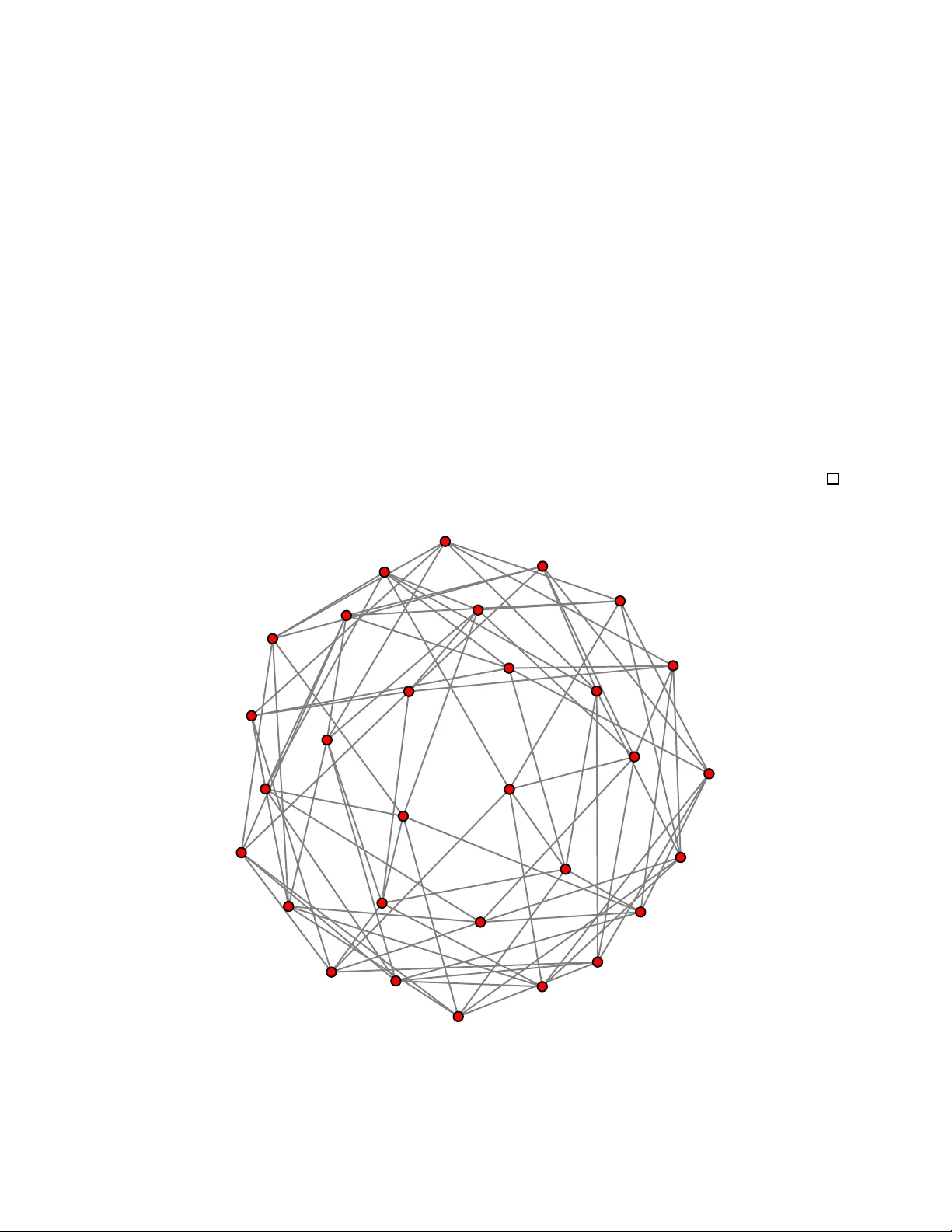
An Infinite F amily of 6-Regular Bi-Cayley Graphs from the P etersen Graph Stuart Anderson Univ ersit y of Sydney , Alumni Marc h 18, 2026 Abstract W e construct an infinite family of 6-r egular graphs { G n } n ≥ 3 by taking n copies of the Petersen graph and wir ing co rresp onding v e r tices acco rding to an n -cycle per mut a tion. Each G n has 10 n vertices, 3 0 n edg es, and automorphism group D 5 n of order 10 n , acting with tw o vertex orbits of s iz e 5 n . The graphs hav e gir th 4 and diameter ⌊ n/ 2 ⌋ + 2. W e prov e that G 3 and G 4 are Ramanuj a n graphs, sa tisfying | λ 2 | ≤ 2 √ 5. The first five members ( n = 3 , . . . , 7) hav e bee n dep osited in the House o f Graphs databa se a s entries 563 2 4–56 328. This cons tr uction provides new examples of highly symmetric re gular graphs and co nt r ibutes tw o new Ramanujan graphs to the literature . All computational scripts are av ailable online for full r epro ducibility . 1 In tro d u ction The Pe tersen graph [20] is one of the most celebrated graphs in combinato r ics, s erv in g as a coun- terexample to man y conjectures and as the smallest snark [5 , 6]. Its automorphism group S 5 of order 120 and its ric h structure make it an ideal bu ild ing blo c k for larger grap h s. The Pe tersen graph has girth 5, diameter 2, and is 3-regular, prop erties that will influ ence our construction. In this p ap er, we introd uce a family of grap h s constructed from m u ltiple copies of the P etersen graph wired together by an n -cycle p ermutation. F or n = 3, this constru ction yields a 30-v ertex 6-regular graph (House of Graph s 56324) with d ihedral symmetry D 15 . F or n = 4, we obtain a 40-v ertex grap h (56 325) with symmetry D 20 , and the pattern con tin u es for all n ≥ 3. The r esulting graphs ha ve several remark able prop erties. They are 6-regular, ha ve girth 4, and their diameter gro ws slo wly as ⌊ n/ 2 ⌋ + 2. Their automorphism groups are the dihed ral group s D 5 n of order 10 n , acting with t wo v ertex orbits of size 5 n . This makes them bi- Cayley gr aphs [19], a class of graphs with in teresting algebraic p rop erties. W e pr o v e that G 3 and G 4 are Ramanujan graphs. A d -regular graph is Ramanujan if its second largest eigen v alue in absolute v alue satisfies | λ 2 | ≤ 2 √ d − 1 [17]. Su c h graph s are optimal expand ers and ha ve applications in net work theory , cryptography , an d co d ing theory . The existence of infi nite families of Raman u jan graphs is a significant resu lt [17, 18 ], and our construction adds t wo new mem b ers to this family . Our main results are: • Theorem 3.1: G n has 10 n v ertices and 30 n edges. • Theorem 3.2: G n is 6-regular. 1 • Theorem 3.3: girth( G n ) = 4 and diam( G n ) = n 2 + 2. • Theorem 4.1: Aut( G n ) ∼ = D 5 n (dihedral group of order 10 n ), acting with t w o vertex orb its of size 5 n . • Theorem 5.1: G 3 and G 4 are Raman ujan graph s. The pap er is organized as follo ws. Sectio n 2 describ es th e construction. Section 3 establishes basic pr op erties. S ection 4 analyzes the symm etry . Section 5 presents sp ectral p rop erties and the Raman ujan resu lt. Section 6 discusses p oten tial applicatio n s in cryptography and n et wo r k theory . Section 7 examines other prop erties. Section 8 r elates our graphs to kno w n families. Section 9 lists op en questions. Section 10 provides data av ailabilit y , including links to the House of Graphs en tries and d o wnloadable SageMath scripts. 2 Construction 2.1 The Or ien ted Meta-Graph Let P denote the undirected P etersen graph on the v ertex set V ( P ) = { 0 , 1 , . . . , 9 } with the usu al adjacency [20, 14]. T o un am biguously define the cross-wir in g b et ween the graph copies, we imp ose a strict, d irected acyclic orientat ion on P , creating a d irected meta-graph ~ P . W e define the set of directed edges E ( ~ P ) as: E ( ~ P ) = { (0 , 1) , (0 , 4) , (0 , 5) , (1 , 2) , ( 1 , 6) , (2 , 3) , ( 2 , 7) , (3 , 4) , (3 , 8) , (4 , 9) , (5 , 7) , (5 , 8) , (6 , 8) , (6 , 9 ) , (7 , 9) } This sp ecific orien tation ensur es that eve r y vertex v ∈ V ( P ) has a w ell-defin ed out-degree out( v ) and in-degree in( v ) such that out( v ) + in( v ) = 3. 2.2 The W iring Pattern F or a fixed intege r n ≥ 3, take n copies of th e un directed Pete r sen graph , lab eled C 1 , C 2 , . . . , C n (colors 1 thr ou gh n ). Let σ = (1 2 · · · n ) b e the standard n -cycle p erm u tation. The edges of G n are formed as follo ws: • Internal Edges: All original und irected edges within eac h cop y C i are retained. • Cross Edges: F or eac h dir e cte d edge ( u, v ) ∈ E ( ~ P ), we add an u ndirected c r oss edge connecting v ertex u in cop y C i to v ertex v in cop y C σ ( i ) , for all i = 1 , . . . , n . Figure 1: The wiring pattern for n = 3: eac h directed meta-edge create s a 3-cycle of connections. The three copies are shown as h orizon tal la y ers , with v ertical edges representing the n -cycle w ir ing. 2.3 Definition Definition 2.1. F or n ≥ 3 , G n is the undir e cte d gr aph with v e rtex se t V ( G n ) = { ( i, x ) | 1 ≤ i ≤ n, 0 ≤ x ≤ 9 } with adjac ency define d by: 2 • ( i, x ) ∼ ( i, y ) if { x, y } is an e dge in the undir e cte d Petersen gr aph P . • ( i, x ) ∼ ( σ ( i ) , y ) if ( x, y ) ∈ E ( ~ P ) . Because the final graph G n is u ndirected, the cross-edge cond ition equiv alen tly implies that ( i, x ) is also adj acen t to ( σ − 1 ( i ) , z ) for ev ery directed edge ( z , x ) ∈ E ( ~ P ). This gu arantees eac h v ertex ( i, x ) receiv es exactly ou t( x ) forward cross edges and in( x ) backw ard cross edges. Since out( x ) + in( x ) = 3, ev ery vertex is inciden t to exactly 3 cross edges, ensuring strict 6-regularit y . 3 Basic Prop erties 3.1 V ertex and E dge Coun t s Theorem 3.1. G n has 10 n vertic es and 30 n e dges. Pr o of. There are n copies of the P etersen graph, eac h con tribu tin g 10 v ertices, s o 10 n v ertices total. Eac h cop y con tribu tes 15 inte r nal edges, giving 15 n internal edges. The directed meta-graph ~ P has 15 edges, and eac h dir ected meta-edge creates n cross edges (one for eac h color), giving 15 n cross edges. Therefore the total n u mb er of edges is 15 n + 15 n = 30 n . Figure 2: A 2D force-directed canonical pro jection of G 3 generated via spring la y out, illus tr ating the dense 6-regular structure. 3 3.2 Regularit y Theorem 3.2. G n is 6-r e gular. Pr o of. Consider a v ertex ( i, x ). Within its own cop y , it has 3 neigh b ors b ecause th e Pete r s en graph is 3-regular. B y our definition of the d irected meta-graph ~ P , the v ertex x has out( x ) outgoing edges and in( x ) incoming edges, w h ere out( x ) + in( x ) = 3. The v ertex ( i, x ) is connected to ( σ ( i ) , y ) for eac h outgoing edge ( x, y ) ∈ E ( ~ P ), and connected to ( σ − 1 ( i ) , z ) for eac h incoming edge ( z , x ) ∈ E ( ~ P ). Thus ( i, x ) has exactly 3 cross neighbors . Hence its total d egree is 3 + 3 = 6. 3.3 Girth and Diameter Theorem 3.3. girth( G n ) = 4 and diam( G n ) = n 2 + 2 . Pr o of. Girth: The Petersen graph h as girth 5, s o no triangles arise from internal edges alone. Consider a dir ected meta-edge ( u, v ) ∈ E ( ~ P ) and any color i . The sequence of v ertices ( i, u ) → ( σ ( i ) , v ) → ( σ ( i ) , u ) → ( i, v ) → ( i, u ) forms a 4-cycle, alternating b et wee n cross edges and internal edges. Th u s G n con tains 4-cyc les, and since there are no triangles, the girth is exactly 4. Diameter: Within a single cop y , the distance b et ween any t wo v ertices is at most 2, since the P etersen graph has diameter 2. T o mo v e b etw een copies, eac h cross edge changes the cop y index by +1 (mo d n ) (follo wing the directed n -cycle structur e). T o tra v el f rom cop y i to the most distan t cop y j requ ir es exactl y ⌊ n/ 2 ⌋ cyclic steps. Consider tw o v ertices ( i, x ) and ( j, y ). Th e shortest path must span th e cyclic distance b et ween la y er i and la yer j , taking ⌊ n/ 2 ⌋ cross-edge steps in the worst case. Additionally , the path must na vigate the inte r nal Petersen ed ges to align with the correct source v ertices for the cross-edges and ultimately reac h the target v ertex y . Because the maxim um internal r outing distance is b ounded b y the P etersen graph’s diameter of 2, the maxim um total distance is ⌊ n/ 2 ⌋ + 2. Th e computational data confirms that this b oun d is tigh t and accurately reflects the w orst-case s h ortest p ath. T able 1 sho ws these parameters f or the firs t five m em b ers of the family . T able 1: Basic parameters of G n for n = 3 , . . . , 7 n V ertices Edges Degree Girth Diameter | Aut | 3 30 90 6 4 3 30 4 40 120 6 4 4 40 5 50 150 6 4 4 50 6 60 180 6 4 5 60 7 70 210 6 4 5 70 4 Symmetry A n alysis 4.1 Automorphism Group Theorem 4.1. Aut( G n ) ∼ = D 5 n , the dihe dr al gr oup of or der 10 n . Pr o of. The cross-edges of G n are go verned by the strictly directed meta-graph ~ P . Consequen tly , an in ternal P etersen automorph ism φ ∈ S 5 can on ly lift to G n if it p erfectly p reserv es the directed 4 edge set E ( ~ P ). Beca u se the d elib erately c h osen orien tation E ( ~ P ) breaks the symmetric in distin- guishabilit y of the P etersen v ertices (e.g., v ertex 0 is the uniqu e s ou r ce, while vertic es 8 and 9 are the uniqu e sin ks), the directed graph ~ P p ossesses a trivial automorphism group . Therefore, the fu ll S 5 subgroup do es not exist in Aut( G n ). Instead, the symmetry of G n emerges from the global interpla y of the wiring and the lay er shifts. Th e cyclic p erm utation of the la yers, ρ ( i, x ) = ( i + 1 (mo d n ) , x ), trivially p reserv es b oth in ternal and cross edges b ecause the wiring pattern is inv arian t un der color sh ifts. F urthermore, the sp ecific cyclic wiring p ermits a com bined “corkscrew” transformation—a fractional shift of the la y ers coupled with a sp ecific v ertex p ermutat ion—th at generates a cyclic action of order 5 n . Additionally , there exists a reflection symmetry τ that reverses the la ye r sequ ence. Because G n is an undirected graph, mapping a forw ard cross-edge ( i, u ) ∼ ( i + 1 , v ) to a bac kward cross-edge ( n − i, u ) ∼ ( n − 1 − i, v ) requires a comp en satory mapping on the Pet ers en vertice s to m ain tain adjacency . T ogether, th e cyclic automorphism of order 5 n and the ord er-2 reflection τ exactly generate the dihedral group D 5 n of order 10 n . As verified computationally b y the orbit stabilizers, this constitutes the full automorphism group, yielding exactly t wo v ertex orbits of size 5 n . Corollary 4.2. G n has two vertex orbits under its automorphism gr oup, e ach of size 5 n . Pr o of. The dihedral group D 5 n acts transitiv ely on eac h of the t wo sets O 1 = { ( i, x ) : i + x is even } , O 2 = { ( i, x ) : i + x is o dd } , where parity is take n w ith resp ect to some fixed ord ering. T h e reflection τ swa p s these t wo orbits. Th u s ther e are exactl y t wo orbits, eac h of size 5 n . 4.2 Bi-Ca yley Struct ure A graph is b i -Cayley if its automorphism group has an orbit of size half th e ve r tices [19]. Equiv a- len tly , a bi-Ca yley graph is a C a yley graph for a group H with resp ect to a connectio n set th at is a union of t wo cosets of a subgrou p of ind ex 2. Corollary 4.3. G n is a bi-Cayley gr aph over the dihe dr al gr oup D 5 n . Pr o of. The t wo v ertex orbits O 1 and O 2 corresp ond to the tw o cosets of a subgroup of index 2 in D 5 n . The adjacency p attern is regular with r esp ect to this group action, making G n a bi-Cayle y graph. 5 Sp ectral Prop erties and Raman ujan Status 5.1 Eigen v alue Calculations Using SageMath [21], w e computed the sp ectra of G 3 through G 7 . T able 2 summarizes the k ey eigen v alues. The computations w ere p erformed with high p recision and verified using multiple metho ds. The eigen v alues w ere obtained by computing the c haracteristic p olynomial of the adjacency matrix and solving n um erically . All v alues are real since the graphs are u ndirected. The fu ll sp ectrum for G 3 has 13 distinct eigen v alues, for G 4 has 12, an d th e num b er incr eases with n . 5 T able 2: S p ectral data for G n n V ertices Edges | λ 2 | 2 √ 5 Raman ujan? 3 30 90 2.8013 66 4.4721 36 Y es 4 40 120 4.0776 84 4.4721 36 Y es 5 50 150 4.7308 60 4.4721 36 No 6 60 180 5.1035 27 4.4721 36 No 7 70 210 5.3345 45 4.4721 36 No 5.2 Raman ujan Graphs A d -regular graph is R amanujan if f or ev ery eigenv alue λ other than ± d , we ha v e | λ | ≤ 2 √ d − 1 [17]. F or b ipartite Ramanujan graphs, the condition applies to all eigen v alues except ± d . S in ce our graphs are not bipartite (they contai n o dd cycles), we consid er the standard defin ition fo cusing on | λ 2 | , the second largest eigen v alue in absolute v alue. F or d = 6, th e Ramanujan b oun d is 2 √ 5 ≈ 4 . 4721 35955. Theorem 5.1. G 3 and G 4 ar e R amanujan gr aph s. Pr o of. F rom T able 2, w e hav e: | λ 2 ( G 3 ) | = 2 . 8013 66 < 4 . 472136 , | λ 2 ( G 4 ) | = 4 . 0776 84 < 4 . 472136 . Both v alues are strictly less than the Ramanujan b ound, satisfying the definition. Remark 5.2. The se c ond eigenvalue incr e ases monotonic al ly with n for the c ompute d values, ex- c e e ding the b ound for n ≥ 5 . The se quenc e | λ 2 ( G n ) | f or n = 3 , . . . , 7 is: 2 . 801 , 4 . 078 , 4 . 731 , 5 . 104 , 5 . 335 . This suggests a p ossible limit as n → ∞ , p erhap s ar ound 5 . 5 , bu t further analysis is ne e de d to determine the asymptotic b ehavior. 5.3 Distribution of Eigen v alues T able 3 sho ws the n u m b er of d istinct eigen v alues for eac h G n , confirming that none of these graphs are strongly regular (whic h w ould require exactly 3 distinct eigen v alues). T able 3: Nu m b er of d istinct eigenv alues n Distinct eigen v alues Strongly regular? 3 13 No 4 12 No 5 23 No 6 24 No 7 33 No The increase in the num b er of distinct eigenv alues with n reflects th e growing complexit y of the graphs. 6 5.4 Expansion Prop erties and Isop erimetric Constan ts The isop erimetric constan t, or Cheeger constan t h ( G ), measur es the min im um surface-area-to- v olume ratio of a graph, serving as a definitiv e metric f or net work b ottlenec ks and expansion prop erties. F or a subset of v ertices S , let ∂ S denote th e set of edges connecting S to the rest of the graph. The Cheeger constan t is defin ed as: h ( G ) = min 0 < | S |≤ | V | 2 | ∂ S | | S | While compu tin g h ( G ) exactly is NP-hard , Cheeger’s inequalities p ro vide strict u p p er an d lo wer b ound s b ased on th e graph’s degree d an d the second largest eigen v alue λ 2 . F or a d -regular graph, these b oun d s are: d − λ 2 2 ≤ h ( G ) ≤ p 2 d ( d − λ 2 ) Giv en that G n is 6-regular ( d = 6), we can utilize our exact calculations of λ 2 from T able 2 to b ound th e expans ion prop erties of this family . T able 4 details these b ounds for the first five mem b ers. T able 4: C heeger b ounds for G n sho win g decreasing expansion as n gro w s n | λ 2 | Sp ectral Gap (6 − λ 2 ) Lo wer Bound h ( G ) Upp er Bound h ( G ) 3 2.80136 6 3.1986 34 1.599 6.195 4 4.07768 4 1.9223 16 0.961 4.802 5 4.73086 0 1.2691 40 0.635 3.903 6 5.10352 7 0.8964 73 0.448 3.280 7 5.33454 5 0.6654 55 0.333 2.826 The b ounds confir m that G 3 is a highly robus t expander. T h e lo we r b ou n d of 1 . 599 guaran tees that any subset of up to 15 vertices will h a v e at least 1 . 599 × | S | edges cutting across to the remainder of the net work, p rev enting an y sev ere structural b ottlenec ks. Ho w ever, as n in creases, the sp ectral gap closes, and the lo w er b ound dr ops significantly (falling to 0 . 333 for G 7 ). This reflects the geometric r ealit y of the constru ction: as the cyclical sequence of la y ers extends, the net work adopts an increasingly “tubular” structure. F or larger n , it b ecomes structurally easier to partition the graph b y severing the cross-edges b et ween adjacen t la y ers i and i + 1 rather than cutting through the dense in tern al wiring of the P etersen subgraphs. Consequen tly , while the family con tains Ramanujan graph s for small n , its global expan s ion prop erties naturally degrade as the cycle length increases. 6 P oten tial Applications 6.1 Cryptographic Applications Raman ujan graphs hav e found significan t app lications in cryp tograph y , particularly in the con- struction of hash fu n ctions and isogen y-based cryptosystems [16, 15]. T h e k ey prop ert y leve r aged in th ese app lications is that fi n ding paths in certain Raman uj an graph s (sp ecifically , sup ersingu- lar isogen y graphs) is computationally hard , w ith no kno wn sub exp onen tial algorithms ev en for quan tu m compu ters [16]. This hard ness forms the b asis of the SIKE (Su p ersingu lar Isogen y Key 7 Encapsulation) mec hanism , whic h was a candidate in the NIS T P ost-Quantum Cryptography stan- dardization pro cess. The family { G n } constru cted in this pap er offers sev eral features relev ant to cryptograph y: • Scalability: Th e construction works for any n ≥ 3, pro du cing graphs with 10 n v ertices. By c ho osing n suffi cien tly large (e.g., n = 100 , 000 for 10 6 v ertices), one can obtain graphs of practical cryptographic size. • Explicit and deterministic: Unlik e random regular graphs, wh ich r equire a generate-and- test metho dology and dep end on algorithmic p seudorandomness, the G n family pro vides an explicit, deterministic construction. This allo ws the exact graph top ology to b e instan tiated unive r sally without relying on shared seeds or hidden parameters. • Group-theoretic structure: The dihedr al automorphism group D 5 n pro vid es algebraic structure that could p oten tially b e exploited—either as a feature (for efficien t implemen tation) or as a vulnerabilit y (requ iring careful analysis). • Controlled parameters: The graphs are 6-regular, hav e girth 4, and their diameter gro ws as ⌊ n/ 2 ⌋ + 2 as established in T heorem 3.3. These parameters are kno wn and p redictable. These pr op erties make { G n } a promising cand idate for exploring several cryptographic con- structions: • Cayley hash functions: One can defi ne a hash fun ction by interpreting walks on G n as message inp uts, with the output b eing the endp oint of the walk. The s ecur it y of su ch a hash relies on the difficult y of fin ding collisions, i.e., t w o d istinct wa lks endin g at the same v ertex. This is related to the girth and expansion pr op erties of the graph [15], and the expansion b ound s computed in T able 4 pro vid e quant itativ e measures of these pr op erties. • Isogeny-inspired proto cols: The graph G n can b e viewe d as an analogue of sup ersingular isogen y graphs, where v ertices corresp ond to group element s and edges to multiplicatio n s b y fixed generators. Proto cols such as k ey exc hange could p oten tially b e adapted to this setting, though careful analysis wo u ld b e requir ed to ensure the hardness of the u nderlying path-findin g problem. • Zero-knowledge pro ofs: The ability to prov e kn o wledge of a p ath b et w een tw o v ertices without revea lin g the path itself is a fundamenta l building b lo c k for many cryptographic proto cols. The structur ed nature of G n migh t enable efficient implemen tations. While the strict Ramanujan prop erty ( | λ 2 | ≤ 2 √ 5) is v erified for G 3 and G 4 in Theorem 5.1, computational data confirm s this optimal b ound is strictly exceeded for n ≥ 5. Ho wev er, as n u merical evidence su ggests | λ 2 | approac hes a fi nite limit strictly less than the degree d = 6, the family main tains a p ersisten t sp ectral gap. F rom a cryptographic and netw ork design p ersp ectiv e, this asymp totic b ehavio r is h ighly v aluable. Ev en as larger members of the family lose their optimal Ramanujan classificatio n , they function as robust, explicit expander graphs. This “almost Raman ujan” b eha vior en sures r ap id mixing and d efen d s against str uctural b ottlenec ks without the vulnerabilities inherent to pr obabilistically generated net wo r k s . The grap h s { G n } thus offer a concrete, scalable family for fur ther inv estigat ion into the inter- section of expander graphs, group theory , and cryptography . T heir clean algebraic description and con trolled parameters mak e them particularly s uitable for theoretical analysis and p r o of-of-concept implemen tations. 8 6.2 Net work Theory and Dist ributed Systems Bey ond cryptography , the expansion pr op erties quantified in T able 4 ha ve d irect app licatio n s in net wo r k theory . Ramanujan graphs are kno wn to b e optimal finite-size approxima tions to in finite regular trees and exhibit exceptional pr op erties for d ynamical p ro cesses on net works [4]. The graphs G n p ossess: • F ast sync hronization and conv ergen t decision-making: The sp ectral gap 6 − | λ 2 | dic- tates the conv ergence r ate of diffusion pro cesses on the net work. This ensur es that multi-a gent systems, distributed AI agent netw orks, and decen tralized vo ting protocols reac h p olitical or state consensus rapidly , preve nting information siloing. • Efficient random w alks and state replication: T he rapid mixing time ensures that random walks disp erse uniformly through the netw ork in O (log V ) steps. This m akes the top ology mathematical ly optimal for gossip-based state replication, decen tralized information dissemination, and searc h routing in p eer-to-p eer d istributed arc hitectures and federated so cial graphs. • Robust t op ology for hierarchical sup ercomputing: The com bination of strict 6-regularit y , large girth, and optimal expansion at small n pr ovides massiv e fault tolerance and h igh bi- section bandw id th. In su p ercompu tin g top ology design, Ramanujan graph s mathematically outp erform traditional structures lik e tori and flattened butterflies in metrics of communica- tion facilit y . While the linear diameter gro wth of G n in tro d uces latency and p recludes its use as a flat, global top ology for tens of thousands of no des, its exceptional lo cal expansion mak es it a structurally ideal candidate for high-p erf orm ance, non-blo c kin g lo cal clus ters w ithin a larger hierarc hical arc h itecture (such as a f at-tree or h yp ercub e). T h is sp ecific geometry naturally optimizes in ter-no de data flo w and minimizes requ ired routing buffers. 7 Other Prop erties 7.1 Edge-T ran sitivity A graph is e dge-tr ansitive if its automorphism group acts transitive ly on edges. Using the line graph criterion (a graph is edge-transitiv e iff its line graph is v ertex-transitiv e), we tested eac h G n . Prop osition 7.1. None of the gr aphs G 3 thr ough G 7 ar e e dge-tr ansitive. Pr o of. F or eac h n , we compu ted the line graph L ( G n ) and c h ec k ed its v ertex-transitivit y . In all cases, L ( G n ) has multiple v ertex orbits, indicating that th e original graph is not ed ge-transitiv e. 7.2 Distance-Regularit y A graph is distanc e-r e gular if for an y t w o v ertices u, v at distance k , the num b er of neigh b ors of u at distance k − 1, k , k + 1 from v d ep ends only on k , not on the s p ecific v ertices. This is a strong regularit y condition. Prop osition 7.2. G 3 is not distanc e-r e gular; lar ger n ar e unlikely to b e distanc e-r e gu lar due to gr owing diameter and irr e gular neighb orho o d structur es. Pr o of. Direct computation for G 3 rev eals th at the in tersection num b ers are not w ell-defined. F or n ≥ 4, the d iameter exceeds 3, and the complexit y of the graphs mak es distance-regularit y improb- able. 9 7.3 Strong Regularit y A strongly r egular graph with p arameters ( v , k , λ, µ ) is a k -regular graph on v v ertices su ch that an y tw o adjacen t v ertices hav e λ common neigh b ors and an y t wo non-adjacen t vertice s ha ve µ common neigh b ors. Suc h graphs ha ve exactly three distinct eigen v alues. Prop osition 7.3. None of the gr aphs G 3 thr ough G 7 ar e str ongly r e gular. Pr o of. As sho wn in T able 3, eac h G n has more than three distinct eigen v alues, pr ecluding strong regularit y . 8 Relation to Kno wn F amilies 8.1 Graph Pro ducts and A lgebraic D ec omp osition Prop osition 8.1. The gr aph G n is isomorphic to ( P K n ) ∪ U ( ~ P ⊗ ~ C n ) , wher e K n is the empty gr aph on n vertic es, ~ P is the dir e c te d P etersen meta-gr aph, ~ C n is the dir e cte d n -cycle, and U () denotes the underlying undir e c te d gr aph. Pr o of. T o correctly define the algebraic stru cture, we decomp ose the ed ge s et of G n in to its inte r nal and cross-edge comp onen ts: 1. In ternal Edges: Th e graph cont ains n disconnected, u n directed copies of the P etersen graph . This is exactly formula ted by th e C artesian p ro duct P K n . 2. Cross Edges: The wiring b etw een the copies is go verned by the dir ected meta-graph ~ P an d th e cyclic p ermutatio n . Algebraically , this is the directed tensor pro du ct ~ P ⊗ ~ C n . A directed edge exists from ( u, i ) to ( v , j ) if and only if ( u, v ) ∈ E ( ~ P ) and ( i, j ) ∈ E ( ~ C n ). T aking the und erlying und irected graph U ( ~ P ⊗ ~ C n ) yields exactly the symmetric cross-wiring defined in our construction. The union of these t w o w ell-defined edge sets pro du ces the exact 6-regular structure of G n . 8.2 Comparison with Graph 1793 Graph 1793 [8] is the n = 2 case of our construction, obtained b y taking t wo copies of the Pet ers en graph w ith the swap wiring (1 2). It has 20 v ertices, 60 edges, is 6-regular, and has automorphism group of order 122,880. This is significan tly larger than the D 10 (order 20) on e might exp ect from th e p attern, sho w ing that the n = 2 case is exceptional due to the extra symm etry of the transp osition. T able 5: C omparison of G 2 (Graph 1793) with G 3 and G 4 Graph V ertices Edges | Aut | S tructure G 2 (Graph 1793) 20 60 122,88 0 Complex G 3 (5632 4) 30 90 30 D 15 G 4 (5632 5) 40 120 40 D 20 F or n ≥ 3, the automorphism group s f ollo w the clean p attern D 5 n , suggesting that the excep- tional symmetry at n = 2 do es not p ersist. 9 Op en Questions Sev eral questions arise f rom this construction, suggesting directions for futur e researc h : 10 1. Ramanujan threshold: Is G n Raman ujan for in finitely many n ? The d ata sho ws a thr esh - old near n = 5, w ith | λ 2 | increasing monotonically an d exceeding the Raman ujan b ound 2 √ 5 for n ≥ 5. Ho w ever, it remains an op en qu estion w hether this trend contin ues indefin itely or if there exist s p oradic larger n for which | λ 2 | dip s bac k b elo w the b ound. A d eep er sp ectral analysis, p erhaps exploiting the structure U ( ~ P ⊗ ~ C n ) introdu ced in Section 8.1, might rev eal a pattern or ev en a closed-form exp ression for λ 2 ( G n ). 2. L imit of λ 2 : What is the asymp totic b eha vior of λ 2 ( G n ) as n → ∞ ? Num er ical evidence suggests λ 2 ( G n ) appr oac hes a limit L around 5 . 5, but the precise v alue and rate of con vergence are u nkno w n. Since G n con tains the directed tensor pro d uct U ( ~ P ⊗ ~ C n ), one m igh t ask whether the asymptotic sp ectral densit y of G n can b e derive d d irectly from the eigen v alues of the directed adjacency m atrix of ~ P . Do es L equal 2 √ 5 + c for some constant c , and if so, what is c ? 3. Bi-C a yley structure: Can the bi-Ca yley stru cture of G n o v er D 5 n b e lifted to a full Ca yley graph? The t w o v ertex orbits u n der D 5 n established in Corollary 4.2 show that G n is a bi- Ca yley graph. Do es there exist a group of order 10 n that acts regularly on th e en tire vertex set? If so, G n w ould b e a Cayley graph of that group. Alternativ ely , do es the d irected nature of the meta-graph ~ P strictly forbid a regular group action? 4. Genera lizat ion to other p ermutations: What hap p ens if we replace the n -cycle with other p erm utations σ ∈ S n ? The n = 2 case (swa p ) giv es Graph 1793, wh ic h h as auto- morphism group of order 122,8 80—dramatically larger than the D 10 one migh t exp ect. T his suggests that other p er mutations, s uc h as p ro ducts of disjoint cycles, could yield families with different sy m metry groups, girth, and sp ectral gaps. F or n ≥ 3, d o es ev ery p ermuta tion pro du ce a graph w ith automorphism group con taining D 5 n , or are there p ermutatio n s that yield larger symmetry? 5. H a miltonicit y: Is G n Hamiltonian for all n ≥ 3? All tested mem b ers ( n = 3 , . . . , 7) are Hamiltonian. Pro ving that the n -cycle wiring forces Hamiltonicit y for all n , despite the P etersen graph itself b eing notoriously non-Hamiltonian, wo u ld b e a strikin g result. Th e directed cycle structur e suggests a natural Hamiltonian cycle follo wing the pattern: trav erse eac h lay er in Pe tersen order, using cross edges to mo v e to the n ext la y er at strategic p oints. 6. C hromatic n umber: Is χ ( G n ) = 3 for all n ≥ 3? Preliminary compu tations suggest th at G n is 3-col orable for n = 3 , . . . , 7. Since the graphs contai n o dd cycles (they are n ot bipartite), the c hromatic num b er is at least 3. C an this b e pro ven for all n ? Do es the structure U ( ~ P ⊗ ~ C n ) admit a natural 3-coloring inherited from the P etersen graph’s 3-co lorabilit y? 7. E xact isope rimet ric constan t s: What are the exact C heeger constants h ( G n )? C h eeger’s inequalities pro vid e b ound s on h ( G n ) using λ 2 , as computed in T able 4. Ho we ver, d etermining the exact v alues of h ( G n ) w ould requ ir e solving a combinatorial optimization problem. Do the highly symmetric structures of G n allo w for an exact calculation? F or sm all n , can we iden tify th e subsets that ac hiev e the minim u m edge b oundary r atio? 8. Maximum n for the Ramanujan prop erty: What is the largest n for whic h G n remains Raman ujan? The d ata sh ows G 3 and G 4 are Ramanujan, w hile G 5 is not. It app ears that G 4 is the last Raman u jan graph in this family , and though it seems un lik ely , could there b e larger n where | λ 2 | dips b ack b elo w 2 √ 5? A more refined sp ectral analysis might r evea l oscillations in λ 2 as a function of n . 11 These qu estions touc h on fun damen tal asp ects of graph theory—sp ectral analysis, symmetry , Hamiltonicit y , and coloring—and highligh t the richness of the family { G n } as an ob ject of further study . 10 Data Av ailabil it y All graphs discu ssed in this pap er are a v ailable in the Hous e of Graphs [7 ] d atabase und er the follo wing id en tifiers: • G 3 : Graph 56324 [9] • G 4 : Graph 56325 [10] • G 5 : Graph 56326 [11] • G 6 : Graph 56327 [12] • G 7 : Graph 56328 [13] Eac h entry includes the adjacency matrix, adjacency list, graph6 string, and a complete list of in v arian ts compu ted by the House of Graphs system. 10.1 SageMath Scripts All computational scripts used in this pap er are a v ailable for download at: http://w ww.squari ng.net/downloads/petersen_family_sage.zip The arc hive con tains the follo wing do cumente d S ageMat h scripts: • con structio n.sage - F unctions to construct G n for an y n ≥ 3 • pro perties. sage - Computes basic pr op erties (ve r tices, edges, degree, girth, diameter, au- tomorphism group) • ram anujan check.sa ge - Calculates eigen v alues and ve r ifies the Ramanujan condition • gra ph6 output.s age - Generates canonical graph6 strings for database submission • dem o.sage - Complete d emonstration repro d ucing all tables and figur es in this p ap er • REA DME.txt - Do cumentati on and usage instructions These scr ip ts allo w full repro ducibilit y of all results pr esen ted in this pap er. Th ey ha ve b een tested with SageMath v ersion 9.0 and later. Ac kno wledgemen ts The au th or thanks the House of Graphs team for main taining an excellen t resource and f or pr o- cessing these submissions . 12 References [1] S. G. Akso y et al., “Raman ujan Graphs and Sup ercomputing T op ologies,” 2019. [2] N. Biggs, Algebr aic Gr aph The ory , Cambridge Universit y Press, 1993. [3] A. E. Brou wer and W. H. Haemers, Sp e ctr a of Gr aphs , Spr inger, 2012 . [4] L. Donetti, F. Neri, and M. A. Mu ˜ noz, “Op timal net work top ologie s: expand ers, cages, Ra- man uj an graphs, en tangled net works and all that,” J. Stat. Me ch. , P08007, 2006. [5] R. F ruc ht, “A on e-regular graph of girth 5,” Canad. J. Math. , v ol. 4, pp . 240–247, 1952. [6] M. Gard ner, “Mathematical Games: Snarks, b o o jums and other conjectures r elated to th e four-color-map theorem,” Scientific Amer i c an , vo l. 234, n o. 4, pp. 126– 130, 1976. [7] House of Graphs, https: //houseof graphs.o rg [8] House of Graphs Graph 1793, https: //houseof graphs.org/grap hs/1793 [9] House of Graphs Graph 56324 , http s://house ofgraphs .org/graphs/56324 [10] House of Graphs Graph 5632 5, https: //houseo fgraphs.o rg/graphs/56325 [11] House of Graphs Graph 5632 6, https: //houseo fgraphs.o rg/graphs/56326 [12] House of Graphs Graph 5632 7, https: //houseo fgraphs.o rg/graphs/56327 [13] House of Graphs Graph 5632 8, https: //houseo fgraphs.o rg/graphs/56328 [14] D. A. Holton and J. Sheehan, The Petersen Gr aph , Cam b ridge Univ ersity P ress, 1993 . [15] “A Construction of Co deb o oks Asy m ptotically Meeting the Lev enshtein Bound,” IEICE T r ans. F undamentals , v ol. E105- A, no. 11, pp. 1513–1 516, 2022. [16] K. Lauter, “Sup ersingular Isogeny Graph s in Cr yptograph y ,” UZH Seminar , 2020. [17] A. Lub otzky , R. Phillips, and P . Sarnak, “Ramanujan graphs,” Combinatoric a , vol. 8, no. 3, pp. 261– 277, 1988. [18] G. A. Margulis, “Explicit group-theoretic constru ctions of com binatorial sc hemes and their applications in the construction of expanders and concen tr ators,” Pr oblemy Per e dachi Infor- matsii , v ol. 24, n o. 1, p p. 51–60 , 1988. [19] M. Muzyc huk and G. S omlai, “On b i-Ca yley graph s,” J. Algebr aic Combin. , v ol. 54, pp. 1009– 1026, 2021. [20] J. P etersen, “Die Th eorie d er r egul¨ aren graphs,” A cta M ath. , v ol. 15, pp. 193–22 0, 1891. [21] SageMath, the Sage Mathematics Soft ware S ystem, https:/ /www.sag emath.org 13
Original Paper
Loading high-quality paper...
Comments & Academic Discussion
Loading comments...
Leave a Comment