Polytopes with large transversal ratio
The transversal ratio of a polytope $P$ is the minimum proportion of vertices of $P$ required to intersect each facet of $P$. The weak chromatic number of $P$ is the minimum number of colors required to color the vertices of $P$ so that no facet is m…
Authors: Michael Gene Dobbins, Seunghun Lee
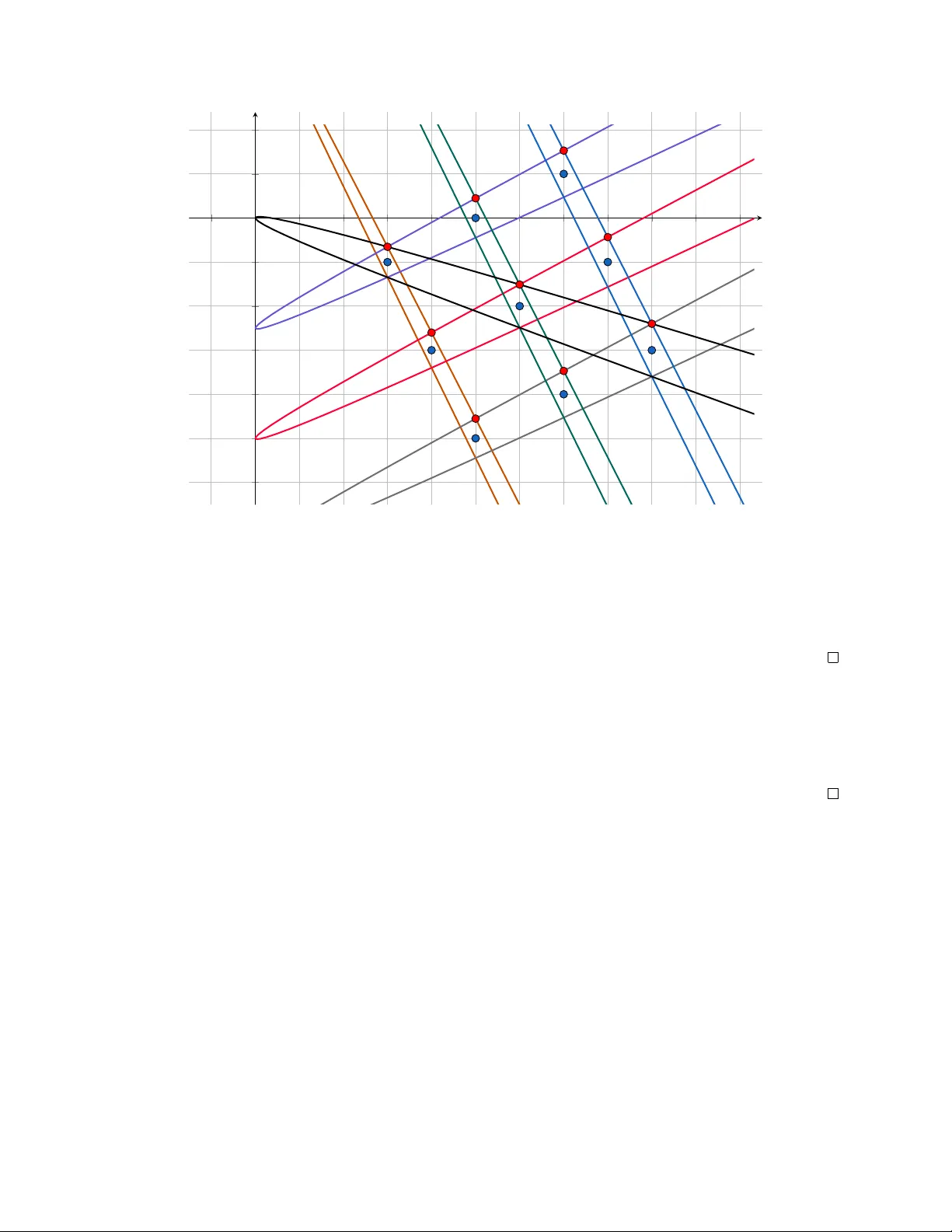
P olytop es with large transv ersal ratio Mic hael Gene Dobbins ∗ and Seungh un Lee † Abstract The transversal ratio of a polytop e P is the minim um prop ortion of v ertices of P required to intersect eac h facet of P . The w eak c hromatic n umber of P is the minim um n umber of colors required to color the v ertices of P so that no facet is mono c hromatic. W e will construct an infinite family of d -p olytopes for each d ≥ 5 whose transversal ratio approac hes 1 as the num b er of vertices gro ws. In particular, this implies that the weak chromatic num b er for d -p olytopes is unbounded for each d ≥ 5. The previous b est kno wn lo wer b ounds on the supremum of the transversal ratio for d -polytop es for d ≥ 5 w ere 2/5 for o dd d by Novik and Zheng, and 1/2 for ev en d b y Holmsen, P ach, and Tverberg. In the case of simplicial ( d − 1)-spheres, the b est known low er b ounds w ere 1/2 for d = 5 and 6 / 11 for d = 6 by Novik and Zheng. 1 In tro duction 1.1 Statemen t of the main result F or a hypergraph H = ( V , E ), a tr ansversal is a subset of V whic h intersects all the hyperedges in E . The tr ansversal numb er of H , denoted b y τ ( H ), is the minimum size of a transv ersal of H . The tr ansversal r atio of H is the ratio ρ ( H ) = τ ( H ) / | V | . Giv en a d -p olytope P on vertex set V , the h yp ergraph H ( P ) asso ciated to P is H ( P ) = { f ⊆ V : f is the vertex set of a facet of P } . Our main result is the following. The pro of is given in Section 2 . Theorem 1.1. F or d ≥ 5 and 0 ≤ r < 1 , ther e is a simplicial d -p olytop e P with ρ ( H ( P )) ≥ r . This p olytope is very large, with a n umber of vertices that grows roughly lik e the Ack ermann function. F or a hypergraph H = ( V , E ), a (we ak) k -c oloring of H is a coloring c : V → [ k ] so that every hyperedge in E attains at least t wo colors, where [ k ] = { 1 , 2 , . . . , k } . The (we ak) chr omatic numb er , denoted by χ ( H ), is the minimum integer k suc h that H is k -colorable. Throughout the rest of the pap er w e omit the word “w eak” when referring to coloring. Note that when χ ( H ) ≤ k , we hav e ρ ( H ) ≤ k − 1 k b y c ho osing k − 1 color classes of smaller size. Th us Theorem 1.1 implies: Corollary 1.2. F or d ≥ 5 and a p ositive inte ger N , ther e is a simplicial d -p olytop e P with χ ( H ( P )) ≥ N . 1.2 Ingredien ts The main ingredients of our construction are t wo-fold. One is the celebrated density Hales-Jewett the or em b y F urstenberg and Katznelson (see Theorem 2.1 ). This is a fundamen tal result in Ramsey Theory which sa ys that a large enough subset of a com binatorial cub e must contain a combinatorial line [ 15 ] (see also ∗ Department of Mathematics and Statistics, Binghamton Univ ersity , NY, USA. mdobbins@binghamton.edu . † Department of Mathematics, Keim yung Univ ersity , Daegu, South Korea. Partially supported b y the Institute for Basic Science (IBS-R029-C1). seunghun.math@gmail.com . 1 [ 30 , 5 , 12 , 8 ]). The other is the construction of a 5-p olytope with a facet corresp onding to eac h com binatorial line. The classical Hales-Jewett theorem [ 16 ] was used b y Lee and Nev o in a similar wa y to show that the c hromatic num b er of PL em b eddable h yp ergraphs is un b ounded [ 22 ]. A limitation of their approach w as that it inv olv ed extending a PL-embedding of a system of combinatorial lines to a PL sphere. This can b e done using the extension theorem by Adiprasito and P at´ ak ov´ a [ 2 ], 1 ho wev er, the extension requires additional v ertices whose n umber cannot b e controlled effectively . Consequen tly , the main result of [ 22 ] has no immediate implication for the transversal ratios of p olytop es, or ev en for that of simplicial spheres. Here w e embed the combinatorial lines as facets of a 5-p olytope without any additional vertices. Our p olytop e construction in v olves embedding com binatorial lines on conics. Conics hav e also b een used in other polytop e constructions. F or example, J¨ urgen Rich ter-Geb ert gav e a new pro of using conics that a 5-p olytop e constructed by G ¨ un ter Ziegler has a non-prescribable 2-face [ 34 , 6.5.(c)], and obtained a non-Steinitz the or em in dimension 5 [ 31 , Example 3.4.3 and Chapter 15]. 1.3 Bac kground T ransv ersal n umber and c hromatic n um b er are fundamen tal concepts in com binatorics. Not only for abstract graphs and h yp ergraphs, those concepts hav e b een also studied in connection to geometry; the examples include, but are not restricted to, ( p, q )-theorems of com binatorial conv exit y (see [ 25 , 6 , 18 , 4 , 7 ] and references therein), stable sets and chromatic num b ers of the graph of a flag sphere [ 11 , 26 ], indep endence ratio of a graph with b ounded gen us [ 3 ], coloring and choosability results for the face-hypergraph of a graph em b edded in a surface [ 21 , 14 , 13 , 33 ], chromatic n umber of a triangulable d -dimensional manifold [ 23 ], uniform h yp ergraphs em b eddable in R d [ 17 , 22 ] and transversal ratio of stack ed spheres [ 10 ]. T o the best of our kno wledge, the earliest direct motiv ation to inv estigate transversal n umber of p olytopes comes from the surr ounding pr op erty b y Holmsen, P ach and Tverberg [ 19 ]. Given a finite p oin t set P ⊆ R d in general p osition with resp ect to the origin O , we say P satisfies property S ( k ), if any k -element subset of P can b e extended to a ( d + 1)-element subset of P so that O ∈ conv( P ). Applying the Gale transform to P , w e obtain a dual p oin t set P ∗ in R n − d − 1 . There is an equiv alent dual property S ∗ ( k ) for P ∗ : among any n − k p oin ts of P ∗ , there are some n − d − 1 that form a facet of conv( P ∗ ). When P ∗ is in conv ex p osition, it means that the hypergraph H (conv( P ∗ )) do es not hav e a transv ersal of size k . By using the duality and considering transversal num b er of cyclic d ∗ -p olytopes which is ⌈ ( n − d ∗ ) / 2 ⌉ + 1 for ev en d ∗ = n − d − 1, they obtained infinitely man y p oint sets with S ( ⌊ d/ 2 ⌋ + 1). This motiv ates studies of transversal ratio of p olytopes, or simplicial spheres ev en more generally . The follo wing question was originally asked b y Andreas Holmsen in a p ersonal communication. Isab ella No vik and Hailun Zheng [ 28 ] also asked a similar, likely equiv alent, question, see Subsection 1.4 . Let H (∆) b e the h yp ergraph consisting of the facets of a p olytopal complex ∆. Question 1.3. F or d ≥ 3 , let ρ P d := sup { ρ ( H ( Q )) : Q is a simplicial d -p olytop e } , and ρ S d := sup { ρ ( H (∆)) : ∆ is a simplicial ( d − 1) -spher e } . What ar e the values of ρ P d and ρ S d ? In [ 9 ], it was shown that ρ P 3 = ρ S 3 = 1 / 2, and that ρ S 4 ≥ 11 / 21 where the constructions w ere obtained exp erimen tally , and hav e larger transversal ratio than 1 / 2, whic h is an upp er b ound for cyclic p olytop es. Later, Novik and Zheng introduced nov el constructions for Question 1.3 which replaced the previous records for d ≥ 4 [ 28 , 27 ]. They sho wed ρ S 4 ≥ 4 / 7, ρ S 5 ≥ 1 / 2, ρ S 6 ≥ 6 / 11, and ρ P d ≥ 2 / 5 for every o dd d ≥ 5. 1 W e also learned a pro of of this from Lorenzo V enturello and Gev a Y ashfe (p ersonal communication). 2 1.4 Implications and future directions On Question 1.3 . Theorem 1.1 implies that ρ P d = ρ S d = 1 for d ≥ 5. This is rather surprising when w e compare this with previous constructions for Question 1.3 ; many of them w ere obtained b y utilizing the momen t curv e. This choice lo oks natural; on one hand neighborly p olytop es, including cyclic p olytopes, ha ve the largest n umber of facets so it is reasonable to exp ect to require more vertices to pierce all the facets. On the other hand, geometry on the moment curve can b e describ ed in a purely com binatorial w ay which is easy to handle. When we use the moment curve how ever, as seen from the list of facets of a cyclic p olytop e, some parit y issue on dimensions appears. Hence it w as relatively easier to obtain constructions of large transv ersal ratio for ev en dimensional p olytopes (or o dd dimensional simplicial spheres) than for the others. Since the smallest dimension of our constructed polytop es is 5, this looks quite differen t from the previous ones in this asp ect, and migh t suggest another wa y of constructing p olytopes with large face num b ers. An ob vious open question remains for d = 4 in Question 1.3 . Our result and 3-dimensional spheres having un b ounded c hromatic num b er [ 22 ] suggests the follo wing conjecture. Conjecture 1.4. Ther e ar e 4-p olytop es r e quiring al l but a vanishingly smal l p ortion of vertic es for a tr ansver- sal, i.e., ρ P 4 = ρ S 4 = 1 . Remark 1.5. Our construction can b e sligh tly mo dified to give the following conclusion: F or k and d with k ≥ d and a given d -p olytop e P , let ρ k ( P ) b e the pr op ortion of vertic es of P ne e de d to pier c e al l fac ets of P with at le ast k vertic es e ach. F or any 0 ≤ r < 1 , ther e is a d -p olytop e P with ρ k ( P ) ≥ r . This motiv ates the follo wing question. Question 1.6. Is ther e a d -p olytop e with no simplic al fac ets and lar ge tr ansversal r atio? Note that the chromatic num b er of such a p olytop e must b e unbounded, so the chromatic num b er of the graph of the p olytope must also be unbounded. Chromatic n umber of geometrically embeddable hypergraphs and simplicial manifolds. W e sa y that a k -uniform hypergraph H = ( V , E ) for k ≤ d + 1 is ge ometric al ly emb e ddable in R d if there is a n injection ι : V → R d suc h that for ev ery hyperedge h of H , conv( ι ( h )) is a ( k − 1)-simplex, and for tw o distinct h yp eredges h 1 and h 2 , con v ( ι ( h 1 )) ∩ conv( ι ( h 1 )) = con v ( ι ( h 1 ) ∩ ι ( h 1 )) . In [ 17 ], the authors inv estigated the (w eak) c hromatic n umber of k -uniform h yp ergraphs geometrically em- b eddable in R d where k and d v ary . This was an attempt for a generalization of the four color theorem in higher dimensions. A particular question is whether the chromatic num b er is unbounded when the n umber of v ertices grows to infinity , esp ecially when k = d + 1, see [ 17 , Section 4]. In [ 22 ], utilizing the hypergraphs by Ac kerman, Keszegh and P´ alv¨ olgyi [ 1 ] extended from earlier constructions in [ 29 , 20 ], it was shown that when k ≤ d , the c hromatic num b er is unbounded. Also in the same pap er, when k = d + 1, a family of geometrically em b eddable h yp ergraphs with chromatic num b er at least 3 w ere constructed for odd d . Here, a similar parit y issue app ears since the constructions w ere based on the moment curve. By using Sc hlegel diagrams of our constructions, we obtain the follo wing corollary . Corollary 1.7. F or d ≥ 4 , ther e is an infinite family of ( d + 1) -uniform hyp er gr aphs, which ar e ge ometric al ly emb e ddable in R d , with unb ounde d (we ak) chr omatic numb er. Ho wev er our tec hnique shows limitation for R 3 . In fact, it do es not lo ok v ery clear if we can em b ed the com binatorial lines of a large com binatorial cub e in R 3 . Thus we propose the following question (see the Hales-Jew ett hypergraph in Subsection 2.1 ). Question 1.8. Can we ge ometric al ly emb e d the Hales-Jewett hyp er gr aph HJ(4 , n ) into R 3 for every p ositive inte ger n ? 3 Our construction also giv es a simpler construction of simplicial d -manifolds with unbounded chromatic n umbers than the one given in [ 22 ] as an extension of the previous study by Lutz and Møller [ 23 ]: one simply tak e the connected sum via facets of a giv en simplicial manifold and our construction. Asymptotics of chromatic num b er and transversal ratio of simplicial spheres. Since we can ha ve arbitrarily large c hromatic num b er and transversal ratio for d -polytop es for d ≥ 5, it is reasonable to ask the follo wing question: Question 1.9. F or d ≥ 4 , let ρ P d ( n ) := max { ρ ( H ( Q )) : Q is a simplicial d -p olytop e on n vertic es } , and ρ S d ( n ) := max { ρ ( H (∆)) : ∆ is a simplicial ( d − 1) -spher e on n vertic es } . What is the asymptotic b ehavior of the functions ρ P d ( n ) and ρ S d ( n ) ? In p articular, for d ≥ 5 , how quickly do ρ P d ( n ) and ρ S d ( n ) appr o ach 1? No vik and Zheng asked, what are the v alues of lim sup n →∞ ρ P d ( n ) and lim sup n →∞ ρ S d ( n ) [ 28 ]. Their question is resolv ed for d ≥ 5 b y Theorem 1.1 , and remains open for d = 4. Question 1.9 is analogous to the question ask ed in [ 17 ] for geometrically embeddable h yp ergraphs; they not only ask ed for the asymptotic b eha vior, but asked also for the actual chromatic num b er as a function on n . Aside from the case of d = 4, this lo oks like the natural next step to consider for higher dimensions. In [ 9 ], an upper b ound O ( n ( ⌊ d/ 2 ⌋− 1) / ( d − 1) ) for a chromatic num b er of a simplicial ( d − 1)-sphere on n v ertices was obtained. Later in [ 27 ], Novik and Zheng obtained an upp er b ound of n + 1 − 1 e nm − 1 /d on transv ersal num b er generally for pure ( d − 1)-dimensional complexes for d ≥ 2 and n sufficien tly large where m is the n umber of facets [ 27 , Theorem 3.1] as w ell as, a lo w er b ound construction of pure ( d − 1)-dimensional complexes with n vertices and Θ( m ) facets whose transv ersal num b er is n − Θ( n d/ ( d − 1) m − 1 / ( d − 1) ) for n and m such that 1 ≪ n ≪ m ≪ n ( d +1) / 2 . In fact, the argument in [ 9 , Lemma 6.3] used to obtain the upp er bound on chromatic n umber can b e slightly modified to obtain a tight upp er bound which matc hes the low er b ound b y Novik and Zheng. In particular for simplicial spheres, this gives an upp er b ound of n − Ω( n ⌈ d/ 2 ⌉ / ( d − 1) ) on the transveral num b er, which gives an upper bound of 1 − 1 /O ( n ( ⌊ d/ 2 ⌋− 1) / ( d − 1) ) on ρ P d ( n ) and ρ S d ( n ), by the upp er b ound theorems for polytop es and simplicial spheres by McMullen [ 24 ] and Stanley [ 32 ], resp ectively . This upp er bound is v ery far from the lo wer b ound that we exp ect from our construction. F or d = 5, we exp ect our construction to giv e a low er b ound similar to 1 − 1 / Ω(log ∗∗∗ 2 ( n )) 2 compared to the upper b ound of 1 − 1 /O ( n 1 / 4 ). Sp ecifically , w e ha ve ρ P d ( n ) ≥ 1 − dhj − 1 d (log d ( n )) where dhj − 1 d ( y ) = inf { ε > 0 : dhj( d, ε ) ≤ y } and dhj( d, ε ) is the minimum quan tity satisfying the conclusion of the densit y Hales-Jewett theorem (see Theorem 2.1 ). As b oth d and n gro w, dhj − 1 d ( n ) is kno wn to tend to 0 roughly at least as fast as the reciprocal of the inv erse Ack ermann function, but precise b ounds for the density Hales-Jew ett theorem ha ve not b een giv en [ 30 , Theorem 1.5]. On surrounding prop ert y . Holmsen, Pac h, and Tverberg asked for an arbitrarily large p oint set P in R d in general p osition with resp ect to the origin that satisfies the surrounding prop ert y S ( k ) for large v alues of k when the dimension d is fixed. Equiv alen tly , they asked for a p oin t set P ∗ in R d ∗ = R n − d − 1 in general p osition with conv ex hull having transversal n umber more than k [ 19 , Problems 3 and 7]. Theorem 1.1 giv es a partial answ er for this question. Corollary 1.10. F or any 0 ≤ r < 1 , ther e is a sufficiently lar ge dimension d and a p oint set P in gener al p osition with r esp e ct to the origin in R d satisfying S ( r d ) . Ev en though Theorem 1.1 sheds some ligh t on the problem on surrounding prop ert y , in fact our setting do es not exactly fit into the problem since the primal dimension d is fixed in [ 19 , Problems 3 and 7] not the dual dimension d ∗ for the space for transversal ratio. Rather, it is more ab out polytop es with “small” n umber of vertices in the following sense. The follo wing problem seems to ha ve a different flav or and has in teresting features on its own righ t. 2 log ∗ b ( n ) is the num ber of times log b must b e applied to n to obtain a v alue that is at most 1 and log ∗∗ b ( n ) is defined analogously for log ∗ b et cetera. 4 Question 1.11. F or a fixe d p ositive inte ger d , what is the maximum tr ansversal numb er of H ( P ) for a simplicial d ∗ -p olytop e P on d ∗ + d + 1 vertic es? 2 Pro of of Theorem 1.1 2.1 Densit y Hales-Jewett theorem F or p ositiv e in tegers d and n , w e define the hypergraph HJ( d, n ) as follo ws. A c ombinatorial line is a set of n words in [ d ] n where the v alue at each p osition is either the same for eac h word or ranges ov er [ d ] in a fixed order. That is, using an additional auxiliary element ∗ , let τ = ( τ 1 , . . . , τ n ) ∈ ([ d ] ∪ {∗} ) n b e a sequence where ∗ appears at least once, or equiv alently τ ∈ ([ d ] ∪ {∗} ) n \ [ d ] n . F or k ∈ R , let σ ( τ , k ) b e the word obtained b y substituting each instance of ∗ in τ with the v alue k , that is, σ ( τ , k ) = ( σ 1 , . . . , σ n ) where σ i = ( k if τ i = ∗ , and τ i otherwise. The c ombinatorial line L τ is the set of all words obtained in this wa y for k ∈ [ d ] from the sequence τ , that is, L τ = { σ ( τ , k ) : k ∈ [ d ] } . The Hales-Jewett hyp er gr aph , HJ( d, n ), is the hypergraph on ground set [ d ] n consisting of all com binatorial lines. That is, HJ( d, n ) = ([ d ] n , { L τ : τ ∈ ([ d ] ∪ {∗} ) n \ [ d ] n } ) . W e state the density Hales-Jewett the or em using HJ( d, n ) and transversal ratio ρ ( · ). This celebrated theorem is a fundamen tal result of Ramsey Theory due to F urstenberg and Katznelson [ 15 ], and has several different pro ofs [ 30 , 5 , 12 ]. Theorem 2.1 (Density Hales-Jewett Theorem [ 15 ]) . The tr ansversal r atio of HJ( d, n ) appr o aches 1 as n gr ows. That is, for every inte ger d ≥ 2 and every ε > 0 , ther e is an inte ger dhj( d, ε ) such that ρ (HJ( d, n )) > 1 − ε for n ≥ dhj( d, ε ) . By Theorem 2.1 , it is sufficient to prov e the following theorem in order to obtain Theorem 1.1 . Theorem 2.2. F or every p ositive inte gers d ≥ 5 and n , ther e is a d -dimensional simplicial p olytop e Q and a bije ction φ : [ d ] n → V ( Q ) such that for any c ombinatorial line L in HJ( d, n ) , the image φ ( L ) is the vertex set of some fac et of Q . 2.2 Pro of of Theorem 2.2 W e prov e Theorem 2.2 in several steps. 1. Drawing HJ( d, n ) in the plane. Cho ose v ectors v 1 , . . . , v n in R 2 . W e may assume that (a) the x -comp onen t of v i is p ositiv e for every i ∈ [ n ]. F or every σ = ( σ 1 , . . . , σ n ) ∈ R n , define a p oin t p σ = n X i =1 σ i v i . By perturbation of the vectors v 1 , . . . , v n if necessary , we ma y assume that p σ are all distinct for σ ∈ [ d ] n . Let P = { p σ : σ ∈ [ d ] n } . 5 By (a) , the x -comp onen t of p σ is p ositiv e for every σ ∈ [ d ] n . F or a combinatorial line L = L τ , let P L = { p σ : σ ∈ L } , and let S L b e the affine span of P L . Equiv alently , S L = p σ ( τ,t ) : t ∈ R with σ ( τ , t ) ∈ R n as in the definition of combinatorial line ab o ve. By (a) , S L has a finite slop e. Let y = a L x + b L b e the equation defining S L . By p erturbation of v 1 , . . . , v n , we may further assume that no other p oin ts of P are collinear with the p oin ts of P L ; that is (b) S L ∩ P = P L . 2. V eronese embedding. Define the affine version of the V er onese emb e dding ν : R 2 → R 5 as ν ( x, y ) = ( x 2 , xy , y 2 , x, y ) . Lemma 2.3. ν ( P ) is in c onvex p osition. Pr o of. F or p ∈ P , let g p denote the affine function from R 5 to R with constan t term ∥ p ∥ 2 and the same co efficien ts as the p olynomial defined by the squared distance from p . That is, g p ( x 2 , xy , y 2 , x, y ) = ∥ ( x, y ) − p ∥ 2 . Then, g p v anishes on ν ( p ) and is p ositiv e on the rest of ν ( P ). Hence, p is a v ertex of conv( ν ( P )). Lemma 2.4. F or e ach c ombinatorial line L of HJ( d, n ) , we c an find an affine function g L fr om R 5 to R that vanishes on ν ( P L ) and is p ositive on ν ( P \ P L ) . Henc e, con v ( ν ( P L )) is a fac e of conv( ν ( P )) . Pr o of. Let f L ( x, y ) = ( y − a L x − b L ) 2 , and let g L b e the affine function with the same co efficien ts and constan t as f L . That is, g L ( x 2 , xy , y 2 , x, y ) = f L ( x, y ). Then, g L ( ν ( p )) = f L ( p ) = 0 for every p oin t p ∈ P L , and g L ( ν ( p )) = f L ( p ) > 0 for every p ∈ P \ P L b y our assumption (b) . 3. Making com binatorial lines into facets in R 5 . W e mak e a suitable p erturbation P ϵ of P so that con v ( ν ( P ϵ L )) is a facet. F or ϵ > 0, let P ϵ b e the result of translating each p oin t of P upw ard by a distance prop orational to the square ro ot of the x -co ordinate, P ϵ = { ϕ ϵ ( p ) : p ∈ P } with ϕ ϵ ( x, y ) = ( x, y + √ ϵx ) . An imp ortant consequence of this perturbation, is that p oints P ϵ L = { ϕ ϵ ( p ) : p ∈ P L } now lie on a unique conic for eac h combinatorial line L ; see Figure 1 . Sp ecifically , let f ϵ L ( x, y ) := f L ( x, y ) − ϵx = ( y − a L x − b L ) 2 − ϵx, and let Z ϵ L = [ f ϵ L ] − 1 (0) b e the zero set of f ϵ L . Observ e that Z ϵ L is a parab ola, and appears only in the region x ≥ 0. Lemma 2.5. P ϵ L ⊂ Z ϵ L . Pr o of. If p = ( x, y ) ∈ P ϵ L , then y = a L x + b L + √ ϵx and x > 0 b y (a) , so f ϵ L ( p ) = √ ϵx 2 − ϵx = 0. Let g ϵ L b e the affine function with the same co efficien ts and constan t as f ϵ L so that g ϵ L ( x 2 , xy , y 2 , x, y ) = f ϵ L ( x, y ), and let us c ho ose ϵ according to the follo wing lemma. Lemma 2.6. We c an find a sufficiently smal l ϵ > 0 so that the affine function g ϵ L vanishes on ν ( P ϵ L ) and is p ositive on ν ( P ϵ \ P ϵ L ) . 6 − 1 1 2 3 4 5 6 7 8 9 10 11 − 6 − 5 − 4 − 3 − 2 − 1 1 2 Figure 1: A dra wing of the vertices of HJ(3 , 2) and the curve Z ϵ L for each combinatorial line L of HJ(3 , 2). The blue dots are p oin ts of P and the red dots are p oin ts of P ϵ . Pr o of. Observe that g ϵ L v anishes on ν ( Z ϵ L ) by definition, so in particular g ϵ L v anishes on ν ( P ϵ L ) by Lemma 2.5 . Since P is finite, the largest x -co ordinate of P is b ounded, so w e can mak e ν ( P ϵ ) arbitrarily close to ν ( P ) by choosing ϵ small enough, and w e can make f ϵ L arbitrarily close to f L = f 0 L . Hence, g ϵ L is p ositiv e on the rest of P ϵ for ϵ sufficien tly small by Lemma 2.4 . Lemma 2.7. F or e ach c ombinatorial line L , any 5 p oints of ν ( P ϵ L ) ar e affinely indep endent. Henc e, con v ( ν ( P ϵ L )) is a fac et of conv( ν ( P ϵ )) . Pr o of. Since P ϵ L lies on the parab ola Z ϵ L , no 3 points of P ϵ L are collinear. Hence, any 5 p oin ts of P ϵ L determine a unique conic, which is Z ϵ L . This implies that the image of these 5 p oin ts b y ν lie on a unique hyperplane h ϵ L = [ g ϵ L ] − 1 (0), and so the affine span of the 5 p oin ts must b e the hyperplane h ϵ L . Th us, the 5 p oin ts are affinely indep enden t. The second part of the lemma now follows b y Lemma 2.6 . 4. Making combinatorial lines in to facets in R d . Supp ose d > 5. W e will p erturb points orthogo- nally to R 5 as a subspace of R d . F or each p ϵ σ = ϕ ϵ ( p σ ) ∈ P ϵ , let p z σ = ( ν ( p ϵ σ ) , z σ, 1 , . . . , z σ,d − 5 ) ∈ R d , P z = { p z σ : σ ∈ [ d ] n } , P z L = { p z σ : σ ∈ L } where the z σ,j are c hosen according to the following lemma. Lemma 2.8. We c an cho ose z σ,j such that the p oints of P z L ar e affinely indep endent for e ach c ombinatorial line L . Mor e over, conv( P z L ) is a fac et of conv( P z ) with this choic e. Pr o of. F or each com binatorial line L = { σ 1 , . . . , σ d } , let A L = 1 1 · · · 1 p z σ 1 p z σ 2 · · · p z σ d ∈ R ( d +1) × d . 7 Since the points ν ( p ϵ σ 1 ) , . . . , ν ( p ϵ σ d ) are con tained in the unique hyperplane h ϵ L , the first 6 rows of A L form a submatrix of rank 5, so the remaining entries of A L can be chosen so that A L has full rank, which gives det( A T L A L ) = 0. Hence, det( A T L A L ) is a non-zero p olynomial in v ariables z σ,j , so the zero set of det( A T L A L ) has measure zero in R d n ( d − 5) . Therefore, w e may c ho ose v alues for the z σ,j where these p olynomials are non-zero for all combinatorial lines. Thus, P z L is affinely indep enden t for each combinatorial line L . F or the second part of the lemma, let us extend g ϵ L to an affine function g z L : R d → R by co ordinate pro jection. That is, g z L = g ϵ L ◦ π where π : R d → R 5 is the pro jection to the first 5 co ordinates. Since the first 5 co ordinates of p z σ are ν ( p ϵ σ ), w e ha ve g z L ( p z σ ) = g ϵ L ( ν ( p ϵ σ )), so g z L v anishes on P z L and is p ositiv e on the rest of P z . 5. A generic p erturbation. Let P s b e a small enough generic p erturbation of the p oin t set P z (with P z = ν ( P ϵ ) in the case of d = 5) for the following three conditions. Observ e that the p oin ts of ν ( P ϵ ) = π ( P z ) are in conv ex p osition where π : R d → R 5 is the pro jection to the first 5 coordinates b y the same argumen t as Lemma 2.3 , so P z is in con vex p osition. First, choose a small enough p erturbation so that P s is in con vex p osition. Second, the set of p oin ts P s L corresp onding to a combinatorial line L ⊂ [ d ] n remain affinely indep enden t with the corresp ondence inherited from P z . Third, an affine function g L that is slightly p erturb ed from g z L v anishes on P s L and is p ositiv e on the rest of P s . Hence, Q L = conv( P s L ) is a simplicial facet of Q = conv( P s ). F urthermore, since the perturbation is chosen generically , Q is simplicial. This completes the pro of of Theorem 2.2 . Ac kno wledgemen t W e thank Andreas Holmsen for introducing Question 1.3 and the surrounding prop ert y , Eran Nevo for his suggestion to consider embedding linear hypergraphs into R d and noticing Remark 1.5 and Question 1.6 , Isab ella No vik and V arun Shah for discussion on Question 1.6 , and Seonghyuk Im and Hong Liu for pro viding references regarding b ounds on the densit y Hales-Jewett function. References [1] Eyal Ack erman, Bal´ azs Keszegh, and D¨ om¨ ot¨ or P´ alv¨ olgyi. Coloring hypergraphs defined b y stabb ed pseudo-disks and ABAB-free hypergraphs. SIAM J. Discr ete Math. , 34(4):2250–2269, 2020. [2] Karim Adiprasito and Zuzana Pat´ ak o v´ a. A higher dimensional version of F´ ary’s theorem. Bul l. L ond. Math. So c. , 57(5):1409–1414, 2025. [3] Michael O. Alb ertson and Joan P . Hutchinson. On the indep endence ratio of a graph. Journal of Gr aph The ory , 2(1):1–8, 1978. [4] Nina Amenta, Jes ´ us A. De Lo era, and Pablo Sob er´ on. Helly’s theorem: new v ariations and applica- tions. In Algebr aic and ge ometric metho ds in discr ete mathematics. AMS sp e cial session on algebr aic and ge ometric metho ds in applie d discr ete mathematics, San Antonio, TX, USA, January 11, 2015. Pr o c e e dings , pages 55–95. Providence, RI: American Mathematical So ciet y (AMS), 2017. [5] Tim Austin. Deducing the densit y Hales-Jewett theorem from an infinitary remov al lemma. J. The or. Pr ob ab. , 24(3):615–633, 2011. [6] Imre B´ ar´ an y . Combinatorial c onvexity , volume 77 of Univ. L e ct. Ser. Pro vidence, RI: American Math- ematical So ciet y (AMS), 2021. [7] Imre B´ ar´ an y and Gil Kalai. Helly-type problems. Bul l. A m. Math. So c., New Ser. , 59(4):471–502, 2022. [8] Amey Bhangale, Subhash Khot, Y ang P . Liu, and Dor Minzer. Reasonable Bounds for Combinatorial Lines of Length Three. Preprint, arXiv:2411.15137 [math.CO] (2024), 2024. 8 [9] Joseph Briggs, Michael Gene Dobbins, and Seunghun Lee. T ransversals and colorings of simplicial spheres. Discr ete Comput. Ge om. , 71(2):738–763, 2024, [10] Minho Cho and Jinha Kim. T ransversal num b ers of stac ked spheres. Discr ete Math. , 347(7):11, 2024. Id/No 114061. [11] Maria Chudno vsky and Eran Nevo. Stable sets in flag spheres. Eur op e an J. Combin. , 110:P ap er No. 103699, 9, 2023. [12] Pandelis Dodos, V assilis Kanellop oulos, and Konstantinos Tyros. A simple pro of of the densit y Hales- Jew ett theorem. Int. Math. R es. Not. , 2014(12):3340–3352, 2014. [13] Zdenˇ ek Dvo ˇ r´ ak, Daniel Kr´ al, and Riste ˇ Skrek ovski. Coloring face hypergraphs on surfaces. Eur op e an J. Combin. , 26(1):95–110, 2005. [14] Kengo Enami and Kenta Noguchi. Embeddings of a graph into a surface with differen t weak chromatic n umbers. Gr aphs Combin. , 37(2):435–444, 2021. [15] Hillel F urstenberg and Yitzhak Katznelson. A density v ersion of the Hales-Jewett theorem. J. Anal. Math. , 57:64–119, 1991. [16] Alfred W. Hales and Rob ert I. Jew ett. Regularit y and p ositional games. T r ans. Amer. Math. So c. , 106:222–229, 1963. [17] Carl Georg Heise, Konstantinos P anagiotou, Oleg Pikhurk o, and Anusc h T araz. Coloring d -embeddable k -uniform hypergraphs. Discr ete Comput. Ge om. , 52(4):663–679, 2014. [18] Andreas Holmsen and Rephael W enger. Helly-type theorems and geometric transversals. In Handb o ok of Discr ete and Computational Ge ometry (Thir d e dition) , pages 91–123. CRC Press, 2018. [19] Andreas F. Holmsen, J´ anos Pac h, and Helge Tverberg. Poin ts surrounding the origin. Combinatoric a , 28(6):633–644, 2008. [20] Bal´ azs Keszegh and D¨ om¨ ot¨ or P´ alv¨ olgyi. An abstract approach to p olychromatic coloring: shallow hitting sets in ABA-free hypergraphs and pseudohalfplanes. J. Comput. Ge om. , 10(1):1–26, 2019. [21] Andr´ e K ¨ undgen and Radhik a Ramam urthi. Coloring face-hypergraphs of graphs on surfaces. J. Combin. The ory Ser. B , 85(2):307–337, 2002. [22] Seunghun Lee and Eran Nev o. On colorings of hypergraphs em b eddable in R d , 2023, [23] F rank H. Lutz and Jesper M. Møller. Chromatic num bers of simplicial manifolds. Beitr. Algebr a Ge om. , 61(3):419–453, 2020. [24] Percy A. MacMahon. Combinatory analysis. Vol. I, II (b ound in one volume) . Dov er Pho enix Editions. Do ver Publications, Inc., Mineola, NY, 2004. Reprint of ıt An introduction to com binatory analysis (1920) and ıt Combinatory analysis. V ol. I, I I (1915, 1916). [25] Ji ˇ r ´ ı Matou ˇ sek. L e ctur es on discr ete ge ometry , volume 212 of Gr ad. T exts Math. New Y ork, NY: Springer, 2002. [26] Andrew Newman. Chromatic num b ers of flag 3-spheres, 2023, [27] Isab ella Novik and Hailun Zheng. T ransversal num b ers of simplicial p olytopes, spheres, and pure complexes, 2024, 9 [28] Isab ella No vik and Hailun Zheng. Neighborly spheres and transversal num b ers. In Op en pr oblems in algebr aic c ombinatorics , volume 110 of Pr o c. Symp os. Pur e Math. , pages 113–128. Amer. Math. Soc., Pro vidence, RI, [2024] © 2024. http://www.samuelfhopkins.com/OPAC/files/proceedings/novik_ zheng.pdf . [29] J´ anos Pac h, G´ ab or T ardos, and G´ eza T´ oth. Indecomp osable cov erings. Canad. Math. Bul l. , 52(3):451– 463, 2009. [30] D. H. J. Polymath. A new pro of of the density Hales-Jewett theorem. A nn. of Math. (2) , 175(3):1283– 1327, 2012. [31] J ¨ urgen Rich ter-Geb ert. R e alization sp ac es of p olytop es , volume 1643 of L e ctur e Notes in Mathematics . Springer-V erlag, Berlin, 1996. [32] Richard P . Stanley . The upp er b ound conjecture and Cohen-Macaula y rings. Studies in Appl. Math. , 54(2):135–142, 1975. [33] Carsten Thomassen. 2-list-coloring planar graphs without mono c hromatic triangles. J. Combin. The ory Ser. B , 98(6):1337–1348, 2008. [34] G ¨ unter M. Ziegler. L e ctur es on p olytop es , volume 152 of Gr aduate T exts in Mathematics . Springer- V erlag, New Y ork, 1995. 10
Original Paper
Loading high-quality paper...
Comments & Academic Discussion
Loading comments...
Leave a Comment