Results of the analysis of a survey for young scientists on training quality in HEP instrumentation software and machine learning
A 2021 study by the ECFA Early-Career Researchers Panel revealed that 71% of 334 respondents used open-source software tools in their instrumentation work, yet 70% reported receiving no training for these tools. In response, the Software and Machine …
Authors: Cecilia Borca, Javier Jiménez Peña, David Marckx
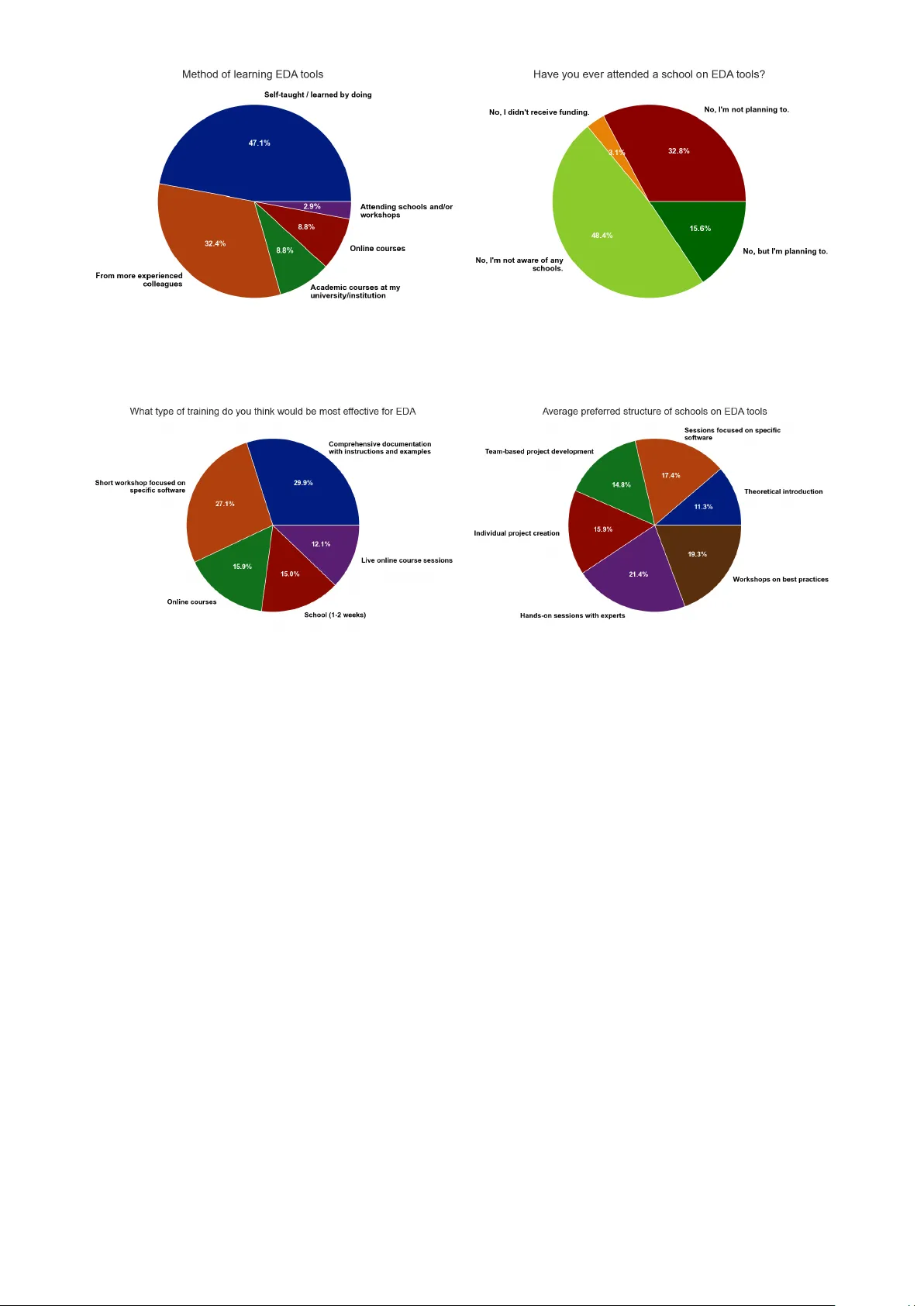
Results of the analysis of surv ey for y oung scien tists on training qualit y in HEP instrumen tation soft w are and mac hine learning The ECF A Early-Career Researc hers (ECR) Panel Marc h 18, 2026 A 2021 study b y the ECF A Early-Career Researchers P anel (arXiv:2107.05739) revealed that 71% of 334 resp onden ts used op en-source softw are to ols in their instrumentation work, y et 70% rep orted receiving no training for these tools. In resp onse, the Soft w are and Mac hine Learning for Instrumentation group was formed in the ECF A Early-Career Re- searc hers P anel to assess the accessibility and qualit y of training programs in mac hine learning and softw are for early-career researchers in exp erimen tal and applied physics. This group launched a new surv ey , reaching 174 participants. This report summarises the survey results in detail, and is intended to serve as a guiding do cumen t to impro v e the training programs that are av ailable to early-career researc hers. The ECF A Early-Career Researc hers (ECR) Panel: ecfa-ecr-organisers@cern.ch Cecilia Borca *,1 , Javier Jim´ enez Pe˜ na *,2 , David Marckx *,3 , Ma lgorzata Niemiec *,4 , Elisab etta Spadaro Norella *,5 , and Marta Urbaniak *,6 * Editor 1 Univ ersit y of T orino and INFN, T urin; Italy 2 Institut de F ´ ısica d’Altes Energies, Barcelona; Spain 3 Ghen t Universit y , Ghen t; Belgium 4 Henryk Niewodniczanski Institute of Nuclear Physics Polish Academy of Sciences, Krak´ ow; Poland 5 Univ ersit y of Genoa and INFN, Genoa; Italy 6 Univ ersit y of Silesia in Kato wice, Katowice; Poland 1 1 In tro duction A 2021 study b y the ECF A Early-Career Researchers Panel (arXiv:2107.05739) revealed that 71% of 334 re- sp onden ts used open-source softw are to ols in their instrumen tation work, y et 70% reported receiving no training for these to ols. In resp onse, the Soft w are and Mac hine Learning for Instrumen tation group w as formed to assess the accessibility and qualit y of training programs in mac hine learning and softw are for early-career researc hers in exp erimental and applied physics. A new surv ey w as published by the Softw are and Machine Learning for Instrumen tation group in 2025 to gain new insights and guide future decision-making around training programs. This surv ey is the focus of this do cumen t and was structured as follo ws. At the outset, we aimed to gai n a general understanding of the respon- den ts; therefore, the first section consisted of broad, general questions designed to characterize the survey ed comm unit y . The subsequent section, also general in nature, focused on whether participan ts were aw are of the educational offerings provided by the schools and whether they made use of them. The remaining sections w ere completed only b y participan ts who expressed interest in sp ecific topics, such as machine learning, detector sim ulation, DA Q and DCS systems, and detector electronics. The survey included 174 participan ts, around 86% of them work in Europ e, the remaining 14% came from n umerous other nations across Asia, the Americas, and Africa. Regarding career stage, participants included p ostdoctoral researc hers, master’s degree holders, senior researchers, univ ersity professors, and tec hnical or en- gineering staff. The p ercen tage distribution of the resp ondents’ scien tific career stages can b e seen in Figure 1a . Since the survey w as primarily targeted at Early Career Researc hers (ECRs), p ostdoctoral researchers and studen ts make up the ma jority of the sample. The ma jorit y of the survey ed comm unit y is inv olved in large collab orations at the Large Hadron Collider (LHC), each comprising more than 1,000 members, as sho wn in Figure 1b . The next largest group, representing 6.5% of the resp onses, consists of participants in fixed-target exp erimen ts at CERN’s SPS accelerator, such as NA61/SHINE, COMP ASS, AMBER, and NA62. Resp ondents affiliated with research groups or exp erimen ts outside CERN constitute 8.9% of the sample. These primarily include neutrino exp erimen ts suc h as DUNE, T2K, ENUBET, and Hyp er-Kamiok ande (HK). A smaller category includes participan ts inv olved in Soft ware and Computing initiativ es (e.g. GEANT4, ICSC Sp ok e 3). Responses lab eled as Other (single entries) correspond to div erse pro jects suc h as Belle II, P ADME, CT A, HESS, ePIC, and AL TO/CoMET. Finally , 4.1% of the resp onden ts rep orted participation in pro jects or exp erimen ts currently under preparation, including FCC, HI-BEAM, CODEX-b, QUAR T&T, LUXE, and ILD. The resp ondents’ fields of research are shown in Figure 2a . The ma jority indicated w orking in data analysis. Other frequently mentioned areas included softw are and detector design and developmen t. This distribution reflects the strong computational and analytical fo cus of the survey ed research comm unity . In the last part of the general questions, w e aimed to identify whic h skills are currently of greatest interest to ECRs; the results can b e found in the Figure 2b . T aking into accoun t the gro wing popularity of mac hine learning tec hniques and the m ultitude of possibilities of their application, as well as the fact that the respondents mainly work in data analysis, the most p opular topics to learn are mac hine learning and adv anced statistical techniques used in data analysis. (a) (b) Figure 1: The resp onden ts’ career stage distribution (a). Name of the exp erimen t in which the resp ondents tak e part (b). 2 (a) (b) Figure 2: The respondents’ fields of research distribution (a). Hot topics indicated b y resp onden ts (b). 2 Accessibilit y and qualit y of sc ho ols In the first part of the surv ey , we examined participan ts’ aw areness of the av ailable training courses and their accessibilit y , as well as the quality of the existing sc ho ols. W e also sought to identify gaps in the programs and other obstacles that migh t hinder participation in the schools or workshops. In Figure 3a w e can see that access to information ab out training and schools remains a significan t challenge. More than half of the resp ondents are unaw are of the a v ailable training opp ortunities. Additionally , 7% of resp ondents indicated that, although they are a w are of school offerings, the programs do not meet their expectations. The lac k of knowledge may stem from the fact that there are no accessible websites that allow users to easily bro wse schools and filter them b y category or required lev el of kno wle dge. Only 28.7% of respo nden ts hav e participated in such a school, as shown in Figure 3b . Among those who at- tended a sc hool, more than half participated in a machine learning school (56.9%). The second largest group attended Detector Simulation workshops (20.8%), follow ed by participan ts in Data Acquisition (DA Q) work- shops (11.1%). Satisfaction with the sc ho ols is sho wn in Figure 4b , with ov er 72% of resp onden ts rep orting a satisfaction level ab ov e 70%. W e also provided resp onden ts with an op en-ended question, giving them the opp ortunity to describ e what they felt w as missing in the school they attended, as well as what they considered to b e the main c hallenges in participating in such training. Although we receiv ed only 21 responses out of 174 participants, several recurring themes emerged. Respondents noted that some courses could feel to o adv anced or fast-paced, with material often assuming prior knowledge that b eginners did not alwa ys hav e. A need for more practical, hands-on exp e- rience was also frequently men tioned. Several participants felt that the schools were sometimes to o theoretical, 3 offering limited examples directly relev ant to HEP analyses or pro viding short and demanding hands-on sessions. (a) (b) Figure 3: Knowledge of a v ailable training programs (a). Hav e participan ts attended suc h programs? (b) P articipan ts additionally expressed in terest in more structured learning paths that gradually progress from basic to adv anced topics, supp orted by shorter but more frequent lessons, homework assignments, and more HEP-fo cused examples. Finally , sev eral participants p ointed to time-zone problems and restricted access to computing resources for practice after the course as factors that further limited their ability to fully b enefit from the training. While the programs w ere generally appreciated for the expertise of the instructors and the usefulness of the con tent, respondents indicated that slo w er pacing, more complete tutorials, and con ten t tailored to the audience w ould further enhance the learning exp erience. (a) (b) Figure 4: Cov erage of topics in attended programs (a). Participan t satisfaction with training programs (p er- cen tage) (b). 3 Mac hine Learning Mac hine learning (ML) techniques hav e b ecome increasingly imp ortan t in research across numerous scientific domains, ev en more so in High Energy Physics (HEP). As the complexity and v olume of data contin ue to gro w, the HEP communit y is turning to ML to enhance data analysis, sim ulation, and interpretation. Ho w ev er, the path w a ys through which these scientists acquire ML skills—and their p erspectives on the most effective mo des of learning—remain underexplored. Understanding ho w young researc hers currently engage with ML, including the resources they use and the c hallenges they face, is crucial for tailoring educational programs that meet their evolving needs. The insights gained are in tended to inform the organizers of future schools and w orkshops, helping to design targeted, effectiv e training programs that better supp ort the next generation of HEP scientists in mastering machine learning. This section is organized as follows: first, w e review the current use cases of 4 mac hine learning within the communit y , along with the softw are to ols commonly employ ed. The second sub- section explores the preferences and learning approaches of young researchers regarding ML education. Finally , w e discuss ho w y oung researc hers w ould organize a w ell-balanced curriculum for future mac hine learning sc ho ols. As can b e seen in Figure 5 , a large ma jorit y of survey respondents are activ ely using ML or sho w interest in the field. Only 2% of p eople claim to not need an y ML to ols in their w ork, highlighting the importance of ML in the field of HEP . More than 90% of resp ondents would how ever like to learn more of the sub ject, while only 6% are satisfied with their current kno wledge of the sub ject. Figure 6a highlights the main use cases for ML in our field. W e see the v ast ma jority of use cases are focused on Classification tasks, both on the ev ent level as well as on the ob ject level (e.g. jet tagging). ML is often also applied on reconstruction tasks suc h as clustering or trac king but also including other regression tasks. F ew resp onden ts use machine learning for other goals. The survey also asked what ML tools w e emplo y in our work. Figure 6b sho ws that mainly Python-based ML libraries are used. While most resp onden ts use PyT orch, the survey shows that the tw o other w ell-kno wn framew orks Keras and its base library , T ensorFlow, are also often employ ed. T raining for all three libraries will hence remain of use to the comm unity in the near future. W e see that R OOT-TMV A, the mac hine learning library in the R OOT soft w are framew ork developed at CERN is also used. ML pack ages that do not include neural net w ork func- tionalities are less emplo yed. Scikit-Learn and X GBo ost are the libraries that are most often used for those cases. (a) (b) Figure 5: Usage of ML soft ware (a) and knowledge level (b). (a) (b) Figure 6: The main use cases for ML (a). The ML libraries that are most often used by resp onden ts (b). Roughly t w o thirds of resp ondents learned their ML techniques either indep enden tly or by getting help from more experienced colleagues. W e see that roughly 13% tak e courses at their univ ersity , while another 13% refined their ML knowledge via online courses. The remaining 9% of respondents hav e learned via participation to a ML sc ho ol. While the n um b er of p eople learning via participation to dedicated schools is quite low, it is higher than for any of the other tools in v estigated in the survey . These n umbers are highlighted in Figure 7 . When ask ed what t yp e of training would b e more effective for ML, the answers app ear very ev enly distributed. The most prominent answ er, given by 25% of resp onden ts, is having a comprehensive do cumentation a v ailable 5 Figure 7: Metho d of learning ML. with instructions and examples. Both organizing schools and organizing shorter w orkshops receive roughly 21% of the votes eac h. The remaining 32% of resp ondents w ould prefer to ha v e online courses, where 40% of those resp onden ts wan t to ha v e these courses live. When ask ed what asp ects of the training they would w ant to receive or what part was missing, most resp onses w ere application and hands-on oriented, while the math- ematical bac kground and specific integration on to hardw are scored lo w er. These n umbers are sho wn in Figure 8 . (a) (b) Figure 8: The type of training considered most effective for ML (a). Sub jects that are of interest to respondents or were underexplored in previous sc ho ols (b). Surv ey participants w ere ask ed to comp ose their preferred structure for a ML sc ho ol. They could select 6 topics and attribute a p ercentage of time to attribute to one sub ject. All resp onses w ere gathered and the a v erage score p er topic is shown in Figure 9 . Respondents attributed less time to the theoretical foundations of ML and time to work on team-based pro jects. Instead, hands-on sessions with exp erts and workshops on b est practices receiv ed more priorit y . Figure 9: The a verage preferred composition of a course on ML. 6 4 Detector sim ulation Mo ving to the second HEP to ols discussed in the survey , the exp erience of the resp ondents in using detector sim ulation to ols was inv estigated. Resp onden ts with detector sim ulation experience w as notably low er at 56%, as shown in Figure 10a . Notable is how ever that p eople with prior exp erience in detector sim ulation hav e a higher probability of b eing satisfied with their curren t lev el of kno wledge on the to ols, as shown in Figure 10b . Roughly 6% of resp ondents rep ort that they do not need these to ols. (a) (b) Figure 10: Usage of detector sim ulation soft w are to ols (a) and kno wledge lev el (b). When ask ed ho w people acquired their kno wledge on detector sim ulation tools, we see that roughly 80%, notably more than is the case for ML, is trained b y themselv es or by experienced cow orkers. Less p eople take courses from their institute, from organised schools or online, as shown in Figure 11a . Figure 11b shows that when ask ed if p eople hav e attended a training program or w orkshop fo cused on detector simulation before, a large ma jority hav e not done so, while 20% has. Another 20% is still planning to, while a large fraction of 42% is not a w are of an y schools on these sub jects. (a) (b) Figure 11: Metho d of learning detector simulation softw are to ols (a). Previous participation to a training program for detector simulation. 7 When ask ed what type of training w ould be beneficial for learning to w ork with detector sim ulation tools, 30% of resp onden ts highligh t comprehensiv e documentation with instructions and examples as the most effectiv e tool. This is notably more than w as the case for ML to ols. Short workshops also get identified as an effective metho d 24% of the time, while longer schools get selected as most effective 15% of the time. This seems to indicate that teac hing to ols for detector sim ulation softw are are often preferred to b e shorter compared to ML teac hing meth- o ds. A similar amoun t (32%) of respondents select online sc ho ols as an effective to ol to teac h detector simulation to ols. Less resp ondents ho w ev er see the need for these courses to be given live. These n um b ers are shown in Figure 12a . When ask ed whic h tools resp onden ts w ould lik e to learn more ab out, Geant4 clearly stands out as the most requested soft ware, while other less requested detector sim ulation to ols are also rep orted in Figure 12b . (a) (b) Figure 12: The type of training considered most effective for detector simulation (a). Simulation to ols that are of interest to respondents or w ere underexplored in previous schools (b). Surv ey participants were ask ed to comp ose their preferred structure for a detector sim ulation softw are training sc ho ol. They could select 6 topics and attribute a p ercentage of time to attribute to one sub ject. All resp onses w ere gathered and the av erage score p er topic is shown in Figure 13 . Resp onden ts attributed less time to the theoretical foundations of detector simulation and time to work on team-based pro jects. Instead, hands-on ses- sions with exp erts, w orkshops on best practices and sessions fo cused on sp ecific softw are receiv ed more priority . Figure 13: The a verage preferred composition of a course on detector simulation. 8 5 Data Acquisition and detector con trol systems High energy ph ysics exp erimen ts produce enormous amounts of data when particles collide or interact with detectors. The Data Acquisition (DA Q) system is the chain of hardw are and softw are comp onen ts that selects, records, and prepares this information for later analysis. Detector Control Systems (DCS) are the other half of running a high-energy physics exp eriment, complementing the D A Q. While the DA Q handles physics data, the DCS handles detector safet y , stabilit y , and op eration. F or simplicit y , b oth systems are going to b e referred to as DA Q in the follo wing. This section presents the surv ey results concerning ho w young researchers currently acquire knowledge ab out D A Q, their training needs, and their persp ectives on the organization of DA Q courses or schools. The analysis is structured in the same wa y as for the previous sub jects. First, we review the current use cases of DA Q within the comm unit y , together with the asso ciated soft w are to ols. Second, we explore the preferences and learning approac hes of young researchers regarding DA Q education. Finally , we consider ho w young researc hers w ould organize a w ell-balanced curriculum for future detector DA Q sc hools. Figure 14a sho ws that 43% of the surv ey respondents are curren tly inv olved in or interested in DA Q pro jects. The next questions of the surv ey are only answ ered b y resp ondents that iden tified themselves as currently in v olv ed or in terested in DA Q. Figure 14b shows the detailed results ab out the usage of commercial, open- source or custom to ols for DA Q. The most common answer, with 44%, is that ECRs use such soft w are but they w ould like to increase their kno wledge. Another 40% of the resp onden ts indicate their interest in learning ab out D A Q soft ware, although they curren tly do not employ it. The fraction of respondents indicating that they do not need or employ such softw are is 12%, and only 4% of the resp ondents indicate their satisfaction with their curren t DA Q soft w are knowledge. A follow-up question attempted to identify the most commonly used D A Q soft w are to ols, but receiv ed only a handful of resp onses. Graf ana , Viv ado , and LabView are the to ols more commonly quoted b y the resp onden ts. (a) (b) Figure 14: Inv olvemen t in DA Q related pro jects (a). Usage of DA Q soft ware and kno wledge lev el (b). The next questions of the survey targeted those resp onden ts already using or interested in D AQ and DCS soft w are. Figure 15a sho ws how the resp onden ts acquired their current knowledge: roughly three quarters of the resp onden ts did it by themselves (37% ) or from more exp erienced colleagues (36%). Only the remaining quarter acquired it from some kind of organized course, either at their institutions (13%), through online courses (7%) or at a school/workshop (6%). The second question of this block aims to identify if the resp ondents know the existence of DA Q soft w are schools and their degree of participation. Figure 15b sho ws that half are not a w are of an y related sc ho ol (47%). Of the other half which is aw are of D AQ soft ware schools, half hav e either already attended a sc ho ol (12%), or are planning to attend one (16%). The remaining quarter is split betw een resp onden ts who cannot attend a school due to the lack of funding (14%) and those who are not planning to attend any school (11%). The last section of the survey targets the design of DA Q softw are training. When ask ed ab out their training preferences, the tw o most common answ ers (around 27% eac h) are through comprehensive do cumen tation and short fo cused workshops. Online courses and schools are seen each as the b est option by around 17% of the resp onden ts and only 11% prefer liv e online sessions. Detailed results are shown in Figure 16a . Figure 16b shows the relative weigh t that the resp onden ts would assign to sp ecific sections in a D AQ softw are sc ho ol. There is a slight preference for hands-on sessions with experts and workshops on b est practices, with around 20% eac h. Sessions fo cused on sp ecific softw are, individual and team-based developmen t pro jects follow with roughly 15% eac h. Finally , the theoretical introduction is the section with a smaller preferred weigh t (10%). W e find that 9 these p ercentages can be used as guidelines when designing a sc ho ol or course in DA Q soft ware. (a) (b) Figure 15: F ormation in DA Q (a) and D AQ school attendance (b). (a) (b) Figure 16: DA Q soft ware training preferences (a) and preferred sc ho ol structure (b). 6 Detector electronics Detector electronics are an essen tial ingredien t of modern high-energy ph ysics exp eriments. These exp erimen ts t ypically in volv e particle detectors, whic h measure properties such as the energy , momen tum, p osition or time of flight of particles pro duced in high-energy collisions or in rare processes. Detector electronics bridge the gap b et ween the ph ysical detector and the digital domain, con verting the w eak analog signals generated b y particle in teractions into digital signals that can be pro cessed, stored and analyzed. Current HEP exp erimen ts emplo y detector electronics in m ultiple steps, including signal generation, amplification, digitization and triggering, noise filtering and monitoring and sync hronization tasks. In addition, the contin uous need for detector elec- tronic impro v emen ts of HEP exp eriments drives contin uous innov ation in analog and digital electronics such as custom ASICs, high-sp eed data links, and adv anced FPGA-based systems. This part of the surv ey provides insight into how y oung researchers engage with detector electronics and is structured in the same w ay as for the previous sub jects. Ho w do students curren tly acquire knowledge in this area, what training they consider most needed, and how they b elieve future courses or sc ho ols on detector electronics should b e structured? T o address these questions, we first outline the main use cases of detector electronics within the communit y and the softw are to ols t ypically employ ed. W e then examine the preferred learning approac hes and educational exp ectations of young researchers in this field. The section concludes with a discussion of how resp ondents w ould design a balanced curriculum for future detector electronics schools. Figure 17a sho ws that only one third of the surv ey respondents are currently in v olv ed or interested in detector electronics pro jects. The following questions of the survey referring to electronics w ere answered only b y a subset of the resp onden ts. When ask ed ab out the usage of Electronic Design Automation (ED A) softw are, only half of the resp ondents provided an answ er. The detailed results are shown in Figure 17b . A third of the resp onden ts indicated that they do not need or emplo y suc h soft w are. Of the remaining resp onden ts, tw o 10 thirds indicate that they would like to learn ab out the related softw are despite they do not use it curren tly . Only around a fifth of the respondents currently emplo y EDA softw are, of whic h the v ast ma jority w ould like to further increase their knowledge on the topic. A follo w-up question attempted to identify the most commonly used EDA softw are tools, but received only limited resp onses. Results are sho wn in Figure 18 . (a) (b) Figure 17: In volv ement in detector electronics related pro jects (a). Usage of detector electronics softw are and kno wledge level (b). Figure 18: Detector electronic softw are tools used by the surv ey resp onden ts. The next questions of the surv ey targeted those resp ondents already using or in terested in EDA soft ware. Fig- ure 19a shows ho w the resp ondents acquired their curren t kno wledge: half of them b y themselves, a third from more exp erienced colleagues, and only a fifth from dedicated courses or sc ho ols. Figure 19b sho ws that half are not aw are of any school related to ED A softw are. Of the other half, tw o thirds of the respondents declares that they are not planning to attend any of the av ailable schools. Only 15% of the respondents indicate that they are planning to attend a sc hool on the topic. The fraction of resp onden ts indicating lack of funding as the reason to not participate in a school is only 3%. Here it is worth mentioning that Detector electronics is the only blo ck in whic h none of the resp onden ts has attended a related school. When ask ed about their training preferences, the t w o most common answ ers (around 30% each) are through comprehensiv e do cumentation and short focused workshops. Online courses and schools are seen eac h as the b est option by around 15% of the respondents and only 12% prefer live online sessions. Detailed results are shown in Figure 20a . Figure 20b sho ws the relativ e w eight that the resp onden ts w ould assign to sp ecific sections in a ED A soft w are sc ho ol. There is a slight preference for hands-on sessions with experts and workshops on best practices, with around 20% each. Ses sions fo cused on specific softw are, individual and team-based developmen t pro jects follo w with roughly 15% each. Finally , the theoretical in tro duction is the section with a smaller preferred w eight (10%). W e find that these p ercen tages can b e used as guidelines when designing a school or course in ED A soft w are. 7 Summary and conclusions This rep ort summarizes the results of a survey carried out among europ ean ECRs ab out training qualit y in instrumen tation softw are and machine learning for HEP carried by the Soft ware and Mac hine Learning for In- 11 (a) (b) Figure 19: F ormation in detector electronics (a) and EDA softw are sc ho ol attendance (b). (a) (b) Figure 20: Detector electronics training preferences (a) and preferred sc ho ol structure (b). strumen tation group of the ECF A ECRs panel. The survey targeted the training quality , preferences and needs in HEP , first with a general section ab out HEP soft w are training, follow ed by four differen t blo c ks on specific topics: Machine learning; Detector simulation; Data Acquisition and detector control systems; and Detector electronics. A total of 174 resp onses were received, with v aried participation in each of the blo c ks, Machine learning b eing the blo ck receiving the largest n um b er of resp onses and detector electronics the one with least participation. The resp onses, which v ary from blo c k to blo ck, are detailed in each of the corresp onding sections, but some general patterns are observed and highlighted in this section. The first one is that in all blo cks, the resp onden ts that are eager to deep en their knowledge ab out the corresponding softw are to olsf of each category are the large ma jority . Another one is that the most common training metho d is self-taught, follo wed b y learning from more exp erienced colleagues. Respondents taking part in dedicated sc ho ols, courses or w orkshops for HEP soft ware training represen t a minorit y in all blo cks. Comprehensive do cumentation and short workshops on sp ecific soft w are are seen as the most effectiv e t yp e of training in all blo c ks. Finally , a similar pattern among blocks is observ ed among the resp ondents when ask ed ab out their preferred comp osition of a softw are sc ho ol. There is a slight preference for hands-on sessions with experts and workshops on b est practices, with around 20% eac h. Sessions fo cused on sp ecific softw are, individual and team-based developmen t pro jects follow with roughly 15% eac h. Finally , the theoretical in tro duction is the section with a smaller preferred weigh t (10%). W e find these p ercen tages could b e used as a reference when designing suc h training programs. Giv en the generally low participation in dedicated schools and workshops, another recommendation from the authors is to mak e the training do cumen tation of existing and future sc ho ols publicly av ailable, so that it can b e used by the communit y for offline and self-paced training. Resp ondents also p oin t out that it is often difficult to find clear information ab out existing schools. Therefore, the authors suggest impro ving the visibility and accessibility of suc h initiatives, for example b y creating a cen tralized website listing av ailable courses with w ell-designed filters—including the lev el of each sc ho ol—and by explicitly stating the exp ected lev el of prior kno wledge in the school descriptions. 12
Original Paper
Loading high-quality paper...
Comments & Academic Discussion
Loading comments...
Leave a Comment