Laya: A LeJEPA Approach to EEG via Latent Prediction over Reconstruction
Electroencephalography (EEG) is a widely used tool for studying brain function, with applications in clinical neuroscience, diagnosis, and brain-computer interfaces (BCIs). Recent EEG foundation models trained on large unlabeled corpora aim to learn …
Authors: Saarang Panchavati, Uddhav Panchavati, Corey Arnold
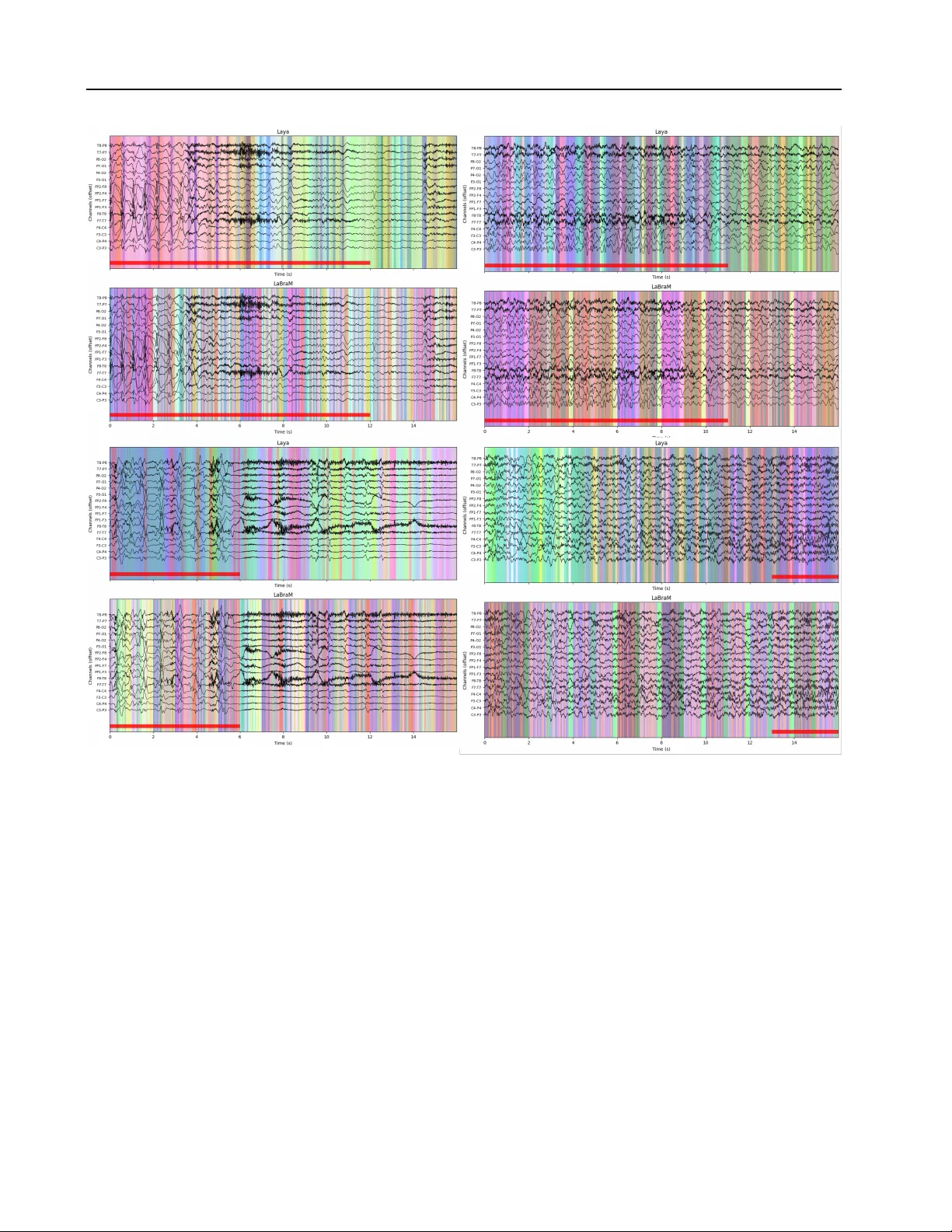
Laya: A LeJEP A A ppr oach to EEG via Latent Prediction o ver Reconstruction Saarang Pancha vati 1 Uddhav P anchav ati 2 Corey Ar nold 1 William Speier 1 Abstract Electroencephalography (EEG) is a widely used tool for studying brain function, with applications in clinical neuroscience, diagnosis, and brain- computer interfaces (BCIs). Recent EEG foun- dation models trained on large unlabeled corpora aim to learn transferable representations, but their effecti v eness remains unclear; reported improv e- ments ov er smaller task-specific models are often modest, sensitiv e to downstream adaptation and fine-tuning strategies, and limited under linear probing. W e hypothesize that one contrib uting factor is the reliance on signal reconstruction as the primary self-supervised learning (SSL) objec- tiv e, which biases representations to ward high- variance artifacts rather than task-relev ant neu- ral structure. T o address this limitation, we ex- plore an SSL paradigm based on Joint Embedding Predictiv e Architectures (JEP A), which learn by predicting latent representations instead of recon- structing raw signals. While earlier JEP A-style methods often rely on additional heuristics to en- sure training stability , recent advances such as LeJEP A provide a more principled and stable for- mulation. W e introduce Laya , the first EEG foun- dation model based on LeJEP A. Across a range of EEG benchmarks, Laya demonstrates improv ed performance under linear probing compared to reconstruction-based baselines, suggesting that latent predictiv e objectiv es offer a promising di- rection for learning transferable, high-le vel EEG representations. 1. Introduction Electroencephalography (EEG) is a non-in vasi v e method of recording electrical activity in the brain with good temporal resolution. Due to its low cost and ease of accessibility , it is a critical tool for both clinical neurology and brain-computer 1 Department of Medical Informatics, UCLA, Los Angeles, USA 2 Department of Cognitiv e Science, UCSD, San Diego, USA. Correspondence to: Saarang Pancha vati < saarang@ucla.edu > . Pr eprint. Mar ch 18, 2026. interfaces (BCIs). EEG analysis remains challenging due to low signal-to-noise ratio and significant inter -subject vari- ability which hinder generalization and limit the discov ery of robust, interpretable biomarkers. Recently , deep learning has emerged as an exciting alternati ve to manual visualiza- tion or hand-crafted pipelines ( Roy et al. , 2019 ; Craik et al. , 2019 ). Supervised approaches hav e achie ved strong perfor - mance on task-specific datasets, but still fail to generalize to new subjects or recording setups. Recent years have seen growing interest in EEG founda- tion models — large neural networks pretrained on large EEG corpora to learn transferable representations across tasks and datasets ( Kuruppu et al. , 2025 ). Motiv ated by successes in vision and language foundation models, these approaches lev erage large scale pretraining to learn transfer- able representations that can be used across datasets, tasks, and subjects. Models such as LaBraM ( Jiang et al. , 2024 ), LUN A ( Doner et al. , 2025 ), CBraMod ( W ang et al. , 2025a ), and REVE ( El Ouahidi et al. , 2025 ) hav e demonstrated state-of-the-art capabilities in both clinical applications and BCI tasks like motor imagery decoding. By leveraging lar ge, cross-subject EEG corpora, these approaches highlight the potential of EEG foundation models to learn reusable neural representa- tions that generalize across both long-duration, state-le v el clinical tasks, and short-horizon, ev ent-dri ven BCI tasks. Despite these successes, howe ver , recent benchmarking stud- ies such as EEG-Bench ( Kastrati et al. , 2025 ) indicate that EEG foundation models do not consistently outperform simpler baselines. Reported gains are often modest and highly task-dependent. Frozen linear probing often yields near-chance performance, indicating weak intrinsic repre- sentations that require extensi ve adaptation and finetuning to be competiti ve. This raises questions about the useful- ness of these models in the real world, particularly given the substantial computational cost of pretraining ( Y ang et al. , 2026 ; Kastrati et al. , 2025 ; Zhang et al. , 2024 ). Sev eral recurring limitations help explain these mixed re- sults. Generalization across tasks and datasets remains lim- ited, with pretrained representations often failing to transfer beyond the pretraining distrib ution. Moreover , scaling laws in EEG are not yet well-established; larger models do not consistently yield better transfer performance, especially 1 Laya, a LeJEP A-based EEG Foundation Model under frozen ev aluation protocols ( Y ang et al. , 2026 ; Ku- ruppu et al. , 2025 ). Almost all e xisting approaches rely on reconstruction-based pretraining objectiv es applied directly to raw EEG signals. Because EEG is inherently noisy and dominated by non-task-rele vant v ariability , optimizing for signal-space reconstruction may encourage models to learn nuisance variables rather than semantic structure ( Littwin et al. , 2024 ), resulting in weak linear-probe performance and heavy reliance on do wnstream fine-tuning. These observ ations suggest that while EEG foundation mod- els are a promising direction, current approaches leav e sig- nificant room for impro vement. In particular, there is a need for representation learning objecti ves that better align with downstream discriminati ve tasks, improv e data efficiency , and generalize across heterogeneous EEG domains without extensi ve task-specific adaptation. 1.1. JEP A and LeJEP A Joint Embedding Predicti ve Architectures (JEP As) ( LeCun , 2022 ) are a class of self-supervised learning models that learn representations by predicting latent embeddings across views (augmentations, masks, etc.), rather than reconstruct- ing raw inputs. This objectiv e aims to force the model to encode only the information necessary for prediction, capturing useful semantic structure, while discarding unpre- dictable, noisy and task-irrelev ant v ariation in the raw input space. Theoretical results ( Assel et al. , 2025 ; Balestriero & LeCun , 2024 ; Littwin et al. , 2024 ) and empirical results in vision ( Bardes et al. , 2024 ; Assran et al. , 2025 ; Chen et al. , 2025 ) support this approach, indicating that latent prediction encourages the learning of more semantically rich features than reconstruction-based objectiv es. Despite these successes, latent prediction alone cannot guar- antee non-degenerate representations, representation col- lapse, or anisotropy . In practice, e xisting implementations address these issues using architectural heuristics such as stop-gradient operations and momentum-updated target en- coders, which complicate optimization and obscure repre- sentation geometry . LeJEP A ( Balestriero & LeCun , 2025 ) addresses these lim- itations by explicitly regularizing the geometry of the la- tent space. By constraining representations to be well- conditioned and isotropic, LeJEP A both reduces empirical risk across do wnstream tasks and remo ves the need for ar- chitectural heuristics yielding a simpler and more principled predictiv e frame work. Prioritizing predictable structures over signal reconstruc- tion is particularly rele vant for EEG, where high-v ariance artifacts often dominate the signal. W e hypothesize that latent prediction objectiv es are better for learning EEG rep- resentations, naturally filtering out irrele v ant noise. While emerging works hav e begun to explore JEP A-style objec- tiv es for EEG ( Hojjati et al. , 2025 ; Guetschel et al. , 2024b ), they typically rely on standard architectural heuristics to pre- vent collapse, and ha ve not yet demonstrated their findings at foundation model scale. By adapting LeJEP A, we use explicit geometric regulariza- tion to prev ent representation collapse, eliminating the need for asymmetric encoders or student/teacher frameworks. W e extend this frame work to a masked modeling paradigm (analogous to V -JEP A2) where the model learns by predict- ing temporally masked representations ( Bardes et al. , 2024 ; Assran et al. , 2025 ). Our results suggest that latent predic- tion objectives are a promising direction for large-scale EEG representation learning. 1.2. Our Contributions • W e introduce Laya , the first application of LeJEP A to EEG representation learning. • W e demonstrate that latent prediction outperforms reconstruction-based pretraining on clinical tasks, achie ving the best mean accuracy with only 10% of the pretraining data on EEG-Bench. • W e extend EEG-Bench with noise rob ustness e valua- tion, linear probing protocols, and LUN A as an addi- tional baseline. • W e show that Laya learns representations that are resilient to noise—maintaining performance at SNR le vels where reconstruction-based models degrade sub- stantially . • W e provide qualitative evidence that Laya captures clinically meaningful temporal structure, with embed- dings that align with seizure onset. 2. Related W orks 2.1. JEP As I-JEP A applies the JEP A architecture to images by train- ing a predictor to infer the latent embeddings of masked image blocks from a visible context block using an en- coder–predictor architecture with an EMA tar get network, enabling semantic prediction without pixel-le vel reconstruc- tion ( Assran et al. , 2023 ). V -JEP A extends JEP A to video by tokenizing clips into spatiotemporal blocks and training a predictor to infer masked block embeddings from visible ones using an en- coder–predictor with an EMA target, operating entirely in representation space rather than reconstructing pix- els ( Bardes et al. , 2024 ). LeJEP A augments the JEP A latent-prediction objectiv e with Sketched Isotropic Gaussian Regularization (SIGRe g), 2 Laya, a LeJEP A-based EEG Foundation Model which encourages encoder embeddings to match an isotropic Gaussian — a distribution shown to minimize expected downstream risk. SIGReg uses random 1D projections to enforce this distrib ution with linear complexity , removing reliance on heuristics like stop-gradients or teacher–student networks. The combined objectiv e yields stable, collapse- free pretraining with a single trade-off h yperparame- ter and robust performance across architectures and do- mains ( Balestriero & LeCun , 2025 ). 2.2. EEG Foundation Models LaBraM was among the first large-scale EEG foundation models, pretraining a transformer on over 2,500 hours of data using masked token prediction. The model discretizes EEG patches via a neural tokenizer trained to reconstruct Fourier spectra, then predicts masked tokens ov er a flattened channel–time sequence ( Jiang et al. , 2024 ). LUNA introduces an efficient, topology-agnostic EEG foundation model that handles variable electrode configu- rations by compressing channel-wise patch features into a fixed-size latent space via learned queries and cross- attention, enabling linear scaling with channel count. Pre- trained on ov er 21,000 hours of EEG using masked patch reconstruction, LUN A achie ves strong transfer performance while reducing computational cost by orders of magni- tude ( Doner et al. , 2025 ). 2.3. JEP A-inspired EEG F oundation models Recent work has e xplored JEP A-style training at scale and across modalities. S-JEP A employs spatial block masking o ver EEG channels, masking contiguous scalp regions to encourage learning of spatial dependencies and dynamic channel attention. Experi- ments across multiple BCI paradigms demonstrate improved cross-dataset transfer relati ve to reconstruction-based SSL ( Guetschel et al. , 2024a ). Brain-JEP A is an fMRI foundation model that predicts latent representations of masked spatiotemporal regions. The model introduces functional gradient–based positional encodings and structured spatiotemporal masking to address the lack of a natural spatial ordering in brain data ( Dong et al. , 2024 ). EEG-VJEP A adapts V ideo-JEP A to EEG by treating multi- channel recordings as video-like spatiotemporal sequences and performing large contiguous spatiotemporal block mask- ing with latent-space prediction. The model employs a V iT backbone with EMA-stabilized tar get encoders to learn long- range temporal and cross-channel dependencies ( Y ang et al. , 2025 ). EEG-DINO is a large-scale EEG foundation model based on hierarchical self-distillation rather than masking-based prediction. The method aligns representations across multiple channel- and time-augmented views using a teacher–student framew ork with decoupled spatial and tem- poral positional embeddings ( W ang et al. , 2025b ). 3. Methods 3.1. LeJEP A Joint-Embedding Predicti ve Architectures (JEP A) are self- supervised objecti ves that learn representations by predict- ing latent embeddings of related views, rather than recon- structing raw inputs. By operating entirely in representa- tion space, JEP A aims to capture predictable, task-relev ant structure while av oiding the need to model high-variance or nuisance signal components. Formally , let x be an input split into a context x C and a target x T (e.g., masked or different views/augmentations of the input). Let f θ : X → R d be an encoder and g ϕ : R d → R d a latent predictor . The JEP A objectiv e minimizes a latent prediction loss, L JEP A = E x ∥ g ϕ ( f θ ( x C )) − f θ ( x T ) ∥ 2 2 . (1) Prev enting degenerate solutions such as representation col- lapse is a ke y challenge in training these models. Prior ap- proaches rely on stop-gradient operations with momentum- updated tar get encoders, which complicate optimization and muddle how pretraining translates to downstream perfor- mance. LeJEP A addresses this limitation by introducing Sketc hed Isotr opic Gaussian Re gularization (SIGReg). SIGReg stabi- lizes latent prediction without asymmetric encoders (EMA teachers) by encouraging embeddings within a batch to be div erse and approximately isotropic by av eraging a univ ari- ate Gaussianity test over random projections, promoting well-spread representations that utilize the full embedding dimension. LeJEP A considers multiple vie ws { v 1 , . . . , v N } of the same input, embeds each vie w using f θ , and applies a lightweight projector p ϕ to compute an in variance loss across views, while SIGReg re gularizes the batch-lev el embedding geom- etry . The resulting objectiv e combines latent prediction with explicit re gularization: L LeJEP A = L JEP A + λ L SIGReg , (2) where L SIGReg operates directly on batches of latent rep- resentations to prev ent collapse and enable stable repre- sentation learning that translates directly to downstream performance. 3 Laya, a LeJEP A-based EEG Foundation Model F igur e 1. Laya architecture over view . (T op) Raw EEG ( C × T ) is processed through a conv olutional patch embedder and channel mixer to produce latent brain states S ∈ R B × N × D , which are then encoded to produce representations Z . (Bottom) During pretraining, the encoder processes both the full sequence and a masked version (contiguous temporal mask m ). Solid arrows indicate the prediction path: masked context representations Z ctx are projected to P ctx and passed through the predictor . Dotted arrows indicate the tar get path: full representations Z are projected with stop-gradient to produce targets T . The predictor output is trained to match masked targets via L MSE . Dashed arrows indicate the re gularization path: Z is mean-pooled to z cls , projected to p cls , and regularized via L SIGReg to prev ent representation collapse. The channel mixer detail (middle left) shows ho w patches are added to electrode positions and combined with learned queries via cross-attention. 3.2. Laya 3 . 2 . 1 . P R E T R A I N I N G O B J E C T I V E Building on LeJEP A, we adapt the framework to a mask ed temporal prediction setting for EEG foundation model pre- training. Rather than the original LeJEP A approach through augmented vie ws, we break up each sequence into observed context and masked tar get segments, and train the model to predict latent representations of masked temporal regions from surrounding context. T o our knowledge, this formula- tion is the first to adapt JEP A-style temporal models, such as V -JEP A ( Bardes et al. , 2024 ) and S-JEP A ( Guetschel et al. , 2024b ), within the LeJEP A framework. Giv en EEG input x ∈ R B × C × T , we extract and embed non- ov erlapping temporal patches to obtain ˜ x ∈ R B × C × N × E , where N is the number of patches, and E is the latent dimen- sion of the patch embedder . W e then apply a learned channel mixer to produce a sequence S ∈ R B × N × D of latent brain states which we interpret as mixed-channel representations at each temporal position. W e mask contiguous blocks of time and task the model with predicting these masked re- Algorithm 1 Laya Pretraining Step Require: Latent brain states S ∈ R B × N × D 1: Sample contiguous temporal mask m ⊂ { 1 , . . . , N } 2: Z ← Encoder ( S ) 3: z cls ← Mean ( Z , dim = 1) 4: T ← Projector ( StopGrad ( Z )) 5: p cls ← Projector ( z cls ) 6: Z ctx ← Encoder ( S , m ) 7: P ctx ← Projector ( Z ctx ) 8: ˆ T ← Predictor ( P ctx , m ) 9: L ← MSE ( ˆ T , T [ m ]) + λ · SIGReg ( p cls ) gions in latent space. Algorithm 1 summarizes the mask ed latent prediction objectiv e and regularization used during pretraining. 3 . 2 . 2 . P A T C H E M B E D D E R W e use a 1D conv olution to con vert raw EEG time series x ∈ R B × C × T into patch-level embeddings p ∈ R B × C × N × E . A depthwise 1D conv olution is applied independently to 4 Laya, a LeJEP A-based EEG Foundation Model each channel, with kernel size and stride equal to the patch length P , producing non-o verlapping temporal patches. Each con volutional kernel maps P contiguous time sam- ples directly to an E -dimensional embedding. By treating channels independently at this stage, the patch embedder av oids imposing inducti ve biases tied to specific electrode montages. 3 . 2 . 3 . D Y N A M I C C H A N N E L M I X E R T o aggregate information across EEG channels, we adopt the channel-mixing mechanism introduced in LUN A( Doner et al. , 2025 ), which uses learned queries and cross-attention to compress multi-channel EEG into a compact latent rep- resentation. At each temporal position, learned query v ec- tors attend across channels, enabling the model to summa- rize spatially distributed activity into a fixed-dimensional embedding. T o make this operation spatially aware yet montage-agnostic, electrode coordinates are encoded and incorporated into the channel representations prior to at- tention, allo wing the mixer to e xploit spatial relationships without assuming a fixed electrode layout. Giv en patch embeddings p ∈ R B × C × N × E and electrode coordinates P ∈ R C × 3 , we incorporate spatial information by encoding electrode coordinates with fixed Fourier fea- tures and adding the resulting embeddings to the channel representations. Learned query vectors then attend over these spatially augmented channel embeddings at each tem- poral patch, producing A ∈ R B × N × N q × E , where N q is the number of queries. W e flatten the final two dimensions of A and apply a linear projection to obtain a channel-mixed latent brain-state sequence S ∈ R B × N × D . By explicitly encoding spatial information and using mul- tiple learned query outputs per patch, the channel mixer produces a rich, montage-agnostic representation that de- couples spatial aggregation from temporal modeling. Query Specialization Loss. Follo wing LUNA, we reg- ularize the query–channel affinity induced by the channel mixer to encourage specialization across learned queries. Let A ∈ R B × N q × C denote the query–channel af finity ma- trix obtained by av eraging attention weights across heads. W e penalize pairwise similarity between different query affinity vectors by minimizing the of f-diagonal entries of AA T . This loss discourages redundant queries while pre- serving soft spatial aggregation. 3 . 2 . 4 . P R E T R A I N I N G From the montage-agnostic sequence of latent brain states, we employ masked pretraining to learn rich semantic rep- resentations of the EEG signal. Belo w we outline the main components of the pretraining setup; hyperparameters and implementation details are provided in Appendix B . Masking Strategy . Consistent with pre vious EEG foun- dation model approaches, and other video modeling ( Jiang et al. , 2024 ; T ong et al. , 2022 ), we employ a block masking strategy that masks contiguous spans of time rather than random patch masking. Block masking forces the model to bridge longer temporal gaps, learning structural depen- dencies rather than autocorrelation. W e mask 60% of the sequence using randomly sampled blocks spanning 500ms to 1s. Encoder . The encoder is a standard transformer encoder implemented using the x-transformers library . W e use rotary positional embeddings (RoPE) ( Su et al. , 2023 ) and do not introduce additional absolute positional embeddings to av oid ov erfitting to fixed temporal locations under masking. The encoder is applied in two passes. In the first pass, the full latent sequence is processed to produce embeddings Z and a global summary representation z cls obtained via tem- poral av erage pooling; importantly we then apply StopGrad to Z . The use of StopGrad follows established JEP A/MAE training setups, where it helps stabilize latent prediction by decoupling target representations from the predictor , and is further motiv ated by recent work demonstrating that stop- gradient alone can suffice for stable representation learning ( Xu et al. , 2025 ) without requiring momentum-updated tar- get encoders. In the second pass, attention is masked at the tar get tempo- ral locations, and we obtain context embeddings Z ctx that encode only the observed portions of the sequence. Projector . F ollowing Balestriero & LeCun ( 2025 ), the pro- jector is a 3-layer MLP with batch normalization that ex- pands the representation dimension ( D up ≫ D ) before com- pressing them down to the projector dimension D proj < D . The projector is applied to the full embeddings Z , the global summary z cls , and the context embeddings Z ctx , giving tar - get representations T , projected summary embedding p cls , and bottlenecked context embeddings P ctx . Predictor . Following MAE and V -JEP A design principles, the predictor is a lightweight T ransformer encoder operating at dimension D proj . Giv en the bottlenecked context embed- dings P ctx , it predicts latent representations ˆ T at masked temporal positions. As in the encoder , RoPE is used to encode relativ e temporal structure. Objective. T o compute the LeJEP A loss, we minimize the mean-squared error between predicted mask ed embed- dings ˆ T and the corresponding stopped-gradient tar gets T at masked positions, and apply SIGReg to the projected global summary p cls . 5 Laya, a LeJEP A-based EEG Foundation Model 4. Experiments Pretraining datasets. Laya is pretrained on a div erse cor- pus of EEG recordings drawn from multiple large-scale and task-specific sources: the entire T emple Univ ersity Hospital EEG Corpus ( Obeid & Picone , 2016 ), NMT ( Khan et al. , 2022 ), , EEGDash (a filtered aggregation of OpenNeuro EEG datasets), the Healthy Brain Network (HBN) ( Shirazi et al. , 2024 ), and sev eral MO ABB BCI datasets ( Chev allier et al. , 2024 ). All datasets are conv erted into fixed-length chunks using a consistent preprocessing pipeline. After filtering and quality control, the final pretraining corpus contains 913,314 samples totaling 29,109 hours of EEG, spanning 20,940 subjects (summed across datasets) and 17 distinct channel topologies. This mixture spans a wide range of tasks, montages, and acquisition settings. Further details regarding preprocessing etc. are provided in Appendix Sec- tion C . T o enable a realistic e valuation of out-of-distrib ution generalization, we make sure to exclude datasets commonly used in downstream EEG benchmarks. Implementation Details. W e train the model for 100,000 steps with an effecti ve sample batch size of 512, distrib uted across two NVIDIA L40S GPUs. Input sequences are generated by random sampling 16-second crops from the av ailable 120-second recording se gments. Comprehensiv e hyperparameters and optimization details are provided in Section B . W e present two v ariants of Laya : Laya-S , and Laya-full . Laya-S was only trained on 10% (3K hours) of the total training dataset for 10K steps (sampled equally from all the datasets in the mix). Laya-full was trained on all 30K hours for 100K steps. 4.1. Downstr eam Evaluation with EEG-Bench Benchmark Framew ork and Baselines. W e e v aluate downstream performance using EEG-Bench ( Kastrati et al. , 2025 ), a standardized benchmarking framework spanning 14 di verse brain–computer interf ace (BCI) and clinical EEG tasks. W e compare Laya against a comprehensive suite of baselines, ranging from classical pipelines (e.g., CSP- LD A/SVM) to established EEG foundation models such as LaBraM ( Jiang et al. , 2024 ). T o ensure a comparison against the state-of-the-art, we further extend the benchmark to in- clude recent architectures lik e LUN A ( Doner et al. , 2025 ). Dataset details are provided in Section D.1 . Fine-tuning protocols. W e primarily assess representation quality under a linear probing protocol. The pretrained encoder parameters are frozen, and a task-specific linear classification head is trained on the embeddings. Metrics. W e report Balanced Accuracy from linear probing as the primary task-level metric to account for the significant class imbalance common in clinical EEG datasets. For multi- label tasks, metrics are computed on flattened predictions T able 1. Linear probe performance on motor imagery tasks (bal- anced accuracy). Bold : best, underline: second best. T ask LaBraM LUN A Laya-S Laya-full 5-Finger MI 0.213 0.196 0.205 0.213 LH vs RH MI 0.518 0.512 0.506 0.506 4-Class MI 0.297 0.259 0.266 0.278 RH vs Feet MI 0.573 0.570 0.585 0.577 Mean 0.400 0.384 0.390 0.393 T able 2. Linear probe performance on clinical tasks (balanced accuracy). Bold : best, underline: second best. T ask LaBraM LUN A Laya-S Laya-full Abnormal 0.800 0.759 0.779 0.755 Artifact (Binary) 0.697 0.739 0.690 0.604 Epilepsy 0.645 0.561 0.623 0.594 mTBI 0.561 0.500 0.602 0.532 Artifact (Multiclass) 0.307 0.312 0.368 0.241 OCD 0.817 0.800 0.833 0.800 Parkinson’ s 0.546 0.683 0.667 0.605 Schizophrenia 0.500 0.500 0.452 0.500 Seizure 0.675 0.565 0.783 0.726 Sleep Stages 0.183 0.184 0.175 0.172 Mean 0.573 0.560 0.597 0.553 across temporal segments. Comprehensi ve results including Macro-F1, R OC-A UC, and Cohen’ s κ are provided in the Appendix Section D.3 . 4.2. Downstr eam Results on EEG-Bench On motor imagery tasks, Laya performs comparably to reconstruction-based baselines. All models achiev e similar performance on binary classification tasks (LH vs RH, RH vs Feet), suggesting that some sensorimotor rhythm features are captured by both approaches. On clinical tasks, Laya-S achiev es the highest mean ac- curacy (0.597) despite using only 10% of pretraining data, outperforming LaBraM (0.573) and LUNA (0.560). The largest g ains appear on seizure detection (+10.8%), mTBI classification (+4.1%), and multiclass artifact classification (+5.6%), tasks where the relev ant neural patterns are subtle and may be obscured by high-variance artif acts. Reconstruction-based models outperform Laya on binary artifact detection (-4.9%), but Laya-S excels at multiclass artifact classification (+6.0%). This supports our theoretical motiv ation: detecting artifact presence benefits from sen- sitivity to high-v ariance components, while distinguishing artifact types requires more semantic understanding. 4.3. Laya pretraining is sample efficient T raining Laya on only 10% of the pretraining data ( Laya-S ) yields the highest mean balanced accuracy on 6 Laya, a LeJEP A-based EEG Foundation Model clinical tasks (0.597), outperforming LaBraM (0.573) and LUN A (0.560), both trained on larger corpora. This re- sult highlights the strong sample efficienc y of latent predic- tion–based pretraining. By focusing on predictable struc- ture in representation space rather than reconstructing high- variance input signals, Laya extracts transferable features more efficiently from limited data, which is a significant ad- vantage gi ven the cost of curating lar ge-scale clinical EEG corpora. F igur e 2. Laya is resilient to noise across clinical tasks. Perfor- mance sho wn under combined noise (Gaussian, 1/f, EMG, channel dropout) at varying SNR le vels. 4.4. Laya learns r obust r epresentations T o e valuate rob ustness to noise, we injected additi ve noise into the input EEG at inference time, keeping the trained linear probes fixed. Noise was generated channel-wise and scaled to the target SNR (e.g. 30, 20, 10, 0 dB) relative to the channel’ s RMS amplitude. W e tested Gaussian noise, 1/f band-limited noise, EMG-like high-frequency noise, and channel dropout, applied both individually and as a com- bined mixture. All other preprocessing steps and model parameters remained unchanged. Figure 2 shows degra- dation curves for four clinical tasks. Across tasks, Laya is more stable than LaBraM as noise increases. On ab- normal detection, Laya retains 91% of its clean accuracy at 10 dB SNR while LaBraM drops to 68%. This pattern aligns with our theoretical motiv ation that reconstruction- based models learn features correlated with high-variance input components, making them vulnerable when noise is introduced. Though Laya-full shows lo wer clean ac- curacy than Laya-S , it maintains similar stability under noise. Detailed robustness results can be found in Appendix Section D.4 . 4.5. Laya learns meaningful temporal structur e T o qualitativ ely assess learned representations, we visualize patch embeddings from a seizure recording using PCA, fol- lowi ng Oquab et al. ( 2024 ). W e project patch embeddings to three principal components and map them to RGB channels, ov erlaying the result on the raw EEG (Figure 12 ). Laya ’ s embeddings show clear temporal structure aligned with seizure onset and termination: at a state change, the col- ors shift distinctly . In contrast, LaBraM’ s embeddings fluc- tuate throughout the recording without clear correspondence to the clinical event. This suggests Laya learns features that capture meaningful state changes, while reconstruction- based models may encode higher-frequenc y v ariations tied to instantaneous signal characteristics rather than the un- derlying brain state. Further examples can be found in Appendix D.5 . 4.6. Ablations SIGReg is essential to pre vent collapse. W e found that SIGReg re gularization is essential for stable training. W ith λ < 0 . 02 the model collapses to a constant embedding across the batch, resulting in chance-le vel do wnstream per- formance. Similarly , removing the projector severely de- graded downstream performance, yielding a mean accuracy of 0.476. 5. Discussion W e introduce Laya , the first application of LeJEP A to EEG representation learning, and show that stable la- tent prediction enabled by LeJEP A and SIGReg provides a strong alternati ve to reconstruction-based pretraining. Across downstream benchmarks, Laya matches or exceeds reconstruction-based baselines. On BCI motor imagery tasks, Laya performs comparably , with only minor gaps; howe v er , both self-supervised approaches remain below su- pervised performance, highlighting the challenge of subject variability in fine-grained BCI settings. In contrast, Laya achiev es substantial gains on clinical tasks. Laya-S trained on only 10% of the pretraining data attains the highest mean balanced accuracy . Notably , Laya exhibits strong sample ef ficienc y and learns noise-resilient representations. Ablation results show that vanilla JEP A without SIGReg is unstable, underscoring the necessity of explicit geometric re gularization. While the pretraining objective plays a central role, these 7 Laya, a LeJEP A-based EEG Foundation Model F igur e 3. PCA visualization of patch embeddings on two seizure recordings. W e map three principal components to RGB. T op: Laya . Bottom: LaBraM. Red bar indicates seizure. Laya shows a clear representational shift at seizure onset, while LaBraM does not. results also emphasize the importance of architectural induc- ti ve biases for EEG, particularly channel mixing. Structured channel interactions are critical for enabling JEP A-style objectiv es to learn stable and transferable representations, suggesting that objectiv e and architecture must be designed jointly . Conclusion. These results indicate that reconstruction is not a necessary (and may be a suboptimal) objectiv e for EEG foundation models. By predicting in latent space, Laya achie ves greater sample efficienc y , robustness, and semantic organization, particularly in noisy clinical settings. Latent prediction therefore offers a principled path tow ard scalable and clinically relev ant EEG representation learning be yond signal reconstruction. 5.1. Limitations Laya-S was only trained on 10% of the ov erall curated data, and while this yielded strong results, scaling dynamics remain unclear . Notably , Laya-full was trained on the full dataset for much longer, but achie ved slightly worse performance than Laya-S . W e hypothesize that training time may not scale linearly with dataset size. This suggests that small div erse pretraining data trained with a good ob- jectiv e and regularization can lead to strong results, though we hope to fully explore scaling in future work. EEG-Bench focuses on classification tasks and does not extend to retrie val-style tasks lik e cognitiv e decoding, emo- tion recognition, or forecasting (e.g., seizure prediction rather than detection). Evaluating on other benchmarks like AdaBrain-Bench ( Zhang et al. , 2024 ) or EEG-FM-Bench ( Xiong et al. , 2025 ) is necessary to fully characterize repre- sentation quality . Additionally , linear probing may under- estimate the utility of learned representations for tasks re- quiring nonlinear adaptation or subject-specific calibration. BCI performance remains limited across all self-supervised methods, suggesting that subject-le vel adaptation may be essential for fine-grained motor decoding. Finally , although our model is channel-agnostic, Laya does not explicitly support bipolar montages (we take the mean between channels as the ”channel coordinate”). Extend- ing support to bipolar montages and intracranial electrodes could broaden practical applicability . 5.2. Future W ork Our work suggests that latent prediction can yield semanti- cally meaningful EEG representations, but they also raise sev eral open questions. A key direction is dev eloping a clearer understanding of what structure these representa- tions encode. Further analysis is needed to characterize how temporal, spectral, and spatial information are organized in LeJEP A embeddings, and how this or ganization differs from that induced by reconstruction-based objectiv es. Laya quantitativ e and qualitati ve results on seizure-related tasks suggest promising applications of JEP A-style architectures for seizure forecasting and interpretable clinical decision support, where robustness and semantic organization are critical. This naturally connects to the need for a stronger theoretical understanding of self-supervised learning for EEG. Our find- ings indicate that the choice of objective and re gularization can already lead to good results, suggesting that future work should focus on principled regularization and stability rather than architectural complexity alone. From a practical perspective, scaling LeJEP A pretraining to the full dataset is an important ne xt step. Although strong performance is achiev ed using only a subset of the data, the non-linear improv ements point to unclear scaling laws for latent prediction objectiv es in EEG. Related questions around context length and long-range temporal modeling also remain open. Progress in EEG foundation models also depends on more 8 Laya, a LeJEP A-based EEG Foundation Model extensi ve and standardized benchmarks, alongside improved data curation and shared pretraining pipelines. Greater agreement on task definitions, ev aluation protocols, and preprocessing would enable more meaningful comparisons and faster iteration across the field. Impact Statement This work aims to advance machine learning research for electroencephalography (EEG) by dev eloping scalable self- supervised representation learning methods ev aluated ex- clusiv ely on publicly av ailable datasets and standardized public benchmarks. By grounding our study in open data and reproducible ev aluation protocols, we aim to support transparent comparison, cumulati ve progress, and broader community engagement. The primary intended impact of this work is to enable more reliable and transferable EEG representations that can fa- cilitate scientific in vestigation into neural biomark ers, with potential do wnstream relev ance for clinical neuroscience and BCI research. Our contributions are methodological and do not constitute a clinical system or diagnostic tool; any real-world application would require extensi ve v alidation, regulatory o versight, and domain-specific expertise. Overall, we belie ve that adv ancing open, benchmark-driven EEG modeling infrastructure is a necessary step tow ard more robust and equitable progress in biomark er discovery and neural interface research. References Albrecht, M. A., W altz, J. A., Cav anagh, J. F ., Frank, M. J., and Gold, J. M. Increased conflict-induced slowing but no differences in prediction error learning in schizophrenia. Neur opsycholo gia , 123:131–140, 2019. Araya, C. V ., Mendez-Orellana, C., and Rodriguez- Fernandez, M. Lar ge spanish eeg. URL https:// openneuro.org/datasets/ds004279 . Funding: Doctoral scholarship N 21211883 (2021)383 by Agencia Nacional de In vestigacion y Desarrollo (ANID Chile). Assel, H. V ., Ibrahim, M., Biancalani, T ., Rege v , A., and Balestriero, R. Joint Embedding vs Reconstruction: Prov- able Benefits of Latent Space Prediction for Self Super - vised Learning, October 2025. URL http://arxiv. org/abs/2505.12477 . arXiv:2505.12477 [cs]. Assran, M., Duval, Q., Misra, I., Bojanowski, P ., V incent, P ., Rabbat, M., LeCun, Y ., and Ballas, N. Self-supervised learning from images with a joint-embedding predicti ve architecture. arXiv pr eprint arXiv:2301.08243 , 2023. URL . Assran, M., Bardes, A., Fan, D., et al. V -jepa 2: Self- supervised video models enable understanding, predic- tion and planning. arXiv preprint , 2025. Balestriero, R. and LeCun, Y . Learning by Reconstruction Produces Uninformativ e Features For Perception, Febru- ary 2024. URL 11337 . arXiv:2402.11337 [cs]. Balestriero, R. and LeCun, Y . Lejepa: Prov able and scalable self-supervised learning without heuristics. arXiv preprint arXiv:2511.08544 , 2025. Barachant, A., Bonnet, S., Congedo, M., and Jutten, C. Multiclass brain–computer interface classification by rie- mannian geometry . IEEE T ransactions on Biomedical Engineering , 59(4):920–928, 2011. Bardes, A., Garrido, Q., Assran, M., et al. V -jepa: Self- supervised learning of video representations by predict- ing latent embeddings. In International Confer ence on Learning Repr esentations (ICLR) , 2024. Bialas, O. and Schoewiesner , M. Evoked responses to elev ated sounds. URL https://openneuro.org/ datasets/ds005131 . Bialas, O., Schoenwiesner , M., and Maess, B. Encoding of sound source elev ation in human cortex. URL https: //openneuro.org/datasets/ds004256 . Brown, D. R., Richardson, S. P ., and Ca vanagh, J. F . An ee g marker of re ward processing is diminished in parkinson’ s disease. Brain Resear ch , 1727, 2020. Brunner , C. et al. Bci competition iv dataset 2b: T wo-class motor imagery eeg data. In BCI Competition IV , 2014. Campbell, E. and Cavanagh, J. F . Eeg: Rl task (3-armed bandit) with alcohol cues in hazardous drinkers and ctls. URL https://openneuro.org/datasets/ ds004595 . Cav anagh, J. F . Eeg: Probabilistic selection and depression, a. URL https://openneuro.org/datasets/ ds003474 . Cav anagh, J. F . Eeg: Depression rest, b. URL https: //openneuro.org/datasets/ds003478 . Cav anagh, J. F . Eeg: V isual w orking memory in acute tbi, c. URL https://openneuro.org/datasets/ ds003523 . Cav anagh, J. F . Eeg: Dpx cog ctl task in acute mild tbi, d. URL https://openneuro.org/datasets/ ds005114 . 9 Laya, a LeJEP A-based EEG Foundation Model Cav anagh, J. F . and Brown, D. Eeg: Reinforcement learning in parkinson’ s. URL https://openneuro.org/ datasets/ds003506 . Cav anagh, J. F . and Frank, M. J. Eeg: Simon conflict w/ reinforcement + cabergoline challenge, a. URL https: //openneuro.org/datasets/ds003518 . Cav anagh, J. F . and Frank, M. J. Eeg: Probabilistic selection task (pst) + pst with cabergoline challenge, b. URL https://openneuro.org/datasets/ ds004532 . Cav anagh, J. F . and Quinn, D. Eeg: Three-stim auditory oddball and rest in acute and chronic tbi. URL https: //openneuro.org/datasets/ds003522 . Cav anagh, J. F ., Light, G., Swerdlo w , N., Brigman, J., and Y oung, J. Eeg: Electrophysiological biomarkers of behavioral dimensions from cross-species paradigms, a. URL https://openneuro.org/datasets/ ds003638 . Cav anagh, J. F ., Singh, A., and Narayanan, K. Eeg: Simon conflict in parkinson’ s, b. URL https:// openneuro.org/datasets/ds003509 . Cav anagh, J. F ., Kumar , P ., Mueller, A. A., Richardson, S. P ., and Mueen, A. Diminished eeg habituation to no vel ev ents effecti v ely classifies parkinson’ s patients. Clinical Neur ophysiology , 129(2):409–418, 2018. Cav anagh, J. F ., W ilson, J. K., Rieger , R. E., et al. Erps pre- dict symptomatic distress and recovery in sub-acute mild traumatic brain injury . Neur opsycholo gia , 132, 2019. Chen, D., Shukor , M., Moutakanni, T ., Chung, W ., Y u, J., Kasarla, T ., Bolourchi, A., LeCun, Y ., and Fung, P . Vl- jepa: Joint embedding predicti ve architecture for vision– language. arXiv preprint , 2025. Chev allier , S., Carrara, I., Aristimunha, B., Guetschel, P ., Sedlar , S., Lopes, B., V elut, S., Khazem, S., and Moreau, T . The largest EEG-based BCI reproducibil- ity study for open science: the MO ABB benchmark, April 2024. URL 15319 . arXiv:2404.15319 [eess]. Cho, H., Ahn, M., Ahn, S.-W ., Kwon, M., and Jun, S. C. Eeg datasets for motor imagery brain–computer interface. GigaScience , 6(7):1–8, 2017. doi: 10.1093/gigascience/ gix034. Clayson, P . E. and Larson, M. J. Registered replica- tion report of ern/pe psychometrics, a. URL https: //openneuro.org/datasets/ds004602 . Clayson, P . E. and Larson, M. J. Registerd report of ern during three versions of a flanker task, b. URL https: //openneuro.org/datasets/ds004883 . Craik, A., He, Y ., and Contreras-V idal, J. L. Deep learning for electroencephalogram (EEG) classification tasks: a re view . J . Neural Eng. , 16(3):031001, June 2019. ISSN 1741-2560. doi: 10.1088/1741- 2552/ ab0ab5. URL http://dx.doi.org/10.1088/ 1741- 2552/ab0ab5 . D ´ efossez, A. et al. Hybrid transformers for music source separation. arXiv preprint , 2022. Doner , O. et al. Luna: Learning univ ersal neural repre- sentations from eeg. arXiv preprint , 2025. Dong, Z., Cheng, H., Liu, A., et al. Brain-jepa: Brain dy- namics foundation model for clinical applications. arXiv pr eprint arXiv:2409.19407 , 2024. El Ouahidi, Y ., L ys, J., Th ¨ olke, P ., Farrugia, N., Pasde- loup, B., Gripon, V ., Jerbi, K., and Lioi, G. Rev e: A foundation model for eeg – adapting to any setup with large-scale pretraining on 25,000 subjects. arXiv pr eprint arXiv:2510.21585 , 2025. Faller , J., B ¨ ocherer , M., Klaproth, F ., et al. A dataset for motor imagery decoding in brain–computer interf aces. In Pr oceedings of the International Brain-Computer Inter- face Meeting , 2012. Goldberger , A. L., Amaral, L. A. N., Glass, L., Haus- dorff, J. M., Ivanov , P . C., Mark, R. G., Mietus, J. E., Moody , G. B., Peng, C.-K., and Stanley , H. E. Phys- ioBank, PhysioT oolkit, and PhysioNet: Components of a new research resource for complex physiologic signals. Circulation , 101(23):e215–e220, 2000. doi: 10.1161/01.CIR.101.23.e215. Grosse-W entrup, M. et al. Motor imagery eeg dataset from munich. Journal of Neural Engineering , 2009. Gr ¨ undler , T . O., Cav anagh, J. F ., Figueroa, C. M., Frank, M. J., and Allen, J. J. T ask-related dissociation in ern am- plitude as a function of obsessive-compulsi v e symptoms. Neur opsycholo gia , 47(8–9):1978–1987, 2009. Guetschel, P ., Moreau, T ., and T angermann, M. S-JEP A: T ow ards Seamless Cross-Dataset T ransfer Through Dynamic Spatial Attention. arXiv pr eprint arXiv:2403.11772 , 2024a. URL https://arxiv. org/abs/2403.11772 . Guetschel, P ., Moreau, T ., and T angermann, M. S- JEP A: towards seamless cross-dataset transfer through dynamic spatial attention. 2024b. doi: 10.3217/ 10 Laya, a LeJEP A-based EEG Foundation Model 978- 3- 99161- 014- 4- 003. URL abs/2403.11772 . arXiv:2403.11772 [cs]. Hamid, A., Gagliano, K., Rahman, S., T ulin, N., Tchiong, V ., Obeid, I., and Picone, J. The temple uni versity artif act corpus: An annotated corpus of eeg artifacts. In IEEE Signal Pr ocessing in Medicine and Biolo gy Symposium , 2020. Hojjati, A., Li, L., Hameed, I., Y azidi, A., Lind, P . G., and Khadka, R. From video to eeg: Adapting joint embedding predicti ve architecture to uncov er visual concepts in brain signal analysis, 2025. URL abs/2507.03633 . Isbell, E., Peters, A. N., Richardson, D. M., and Le ´ on, N. E. R. D. Cognitiv e electrophysiology in socioeconomic context in adulthood. URL https://openneuro. org/datasets/ds005863 . Funding: research start- up funds awarded to Elif Isbell by Univ ersity of California Merced. Iwama, S., Morishige, M., T akahashi, Y ., Hirose, R., K odama, M., and Ushiba, J. The bmi-hdeeg dataset 4. URL https://openneuro.org/datasets/ ds004448 . Jiang, W .-B., Zhao, L.-M., and Lu, B.-L. Large brain model for learning generic representations with tremendous eeg data in bci. arXiv preprint , 2024. Kastrati, A. et al. Eeg-bench: A benchmark for ev aluating eeg foundation models. arXiv pr eprint arXiv:2512.08959 , 2025. Kaya, M., Binli, M. K., Ozbay , E., Y anar , H., and Mishchenko, Y . A large electroencephalographic motor imagery dataset for electroencephalographic brain com- puter interfaces. Scientific Data , 5:180211, 2018. doi: 10.1038/sdata.2018.211. Kek ecs, Z., Gir ´ an, K., V izkie vicz, V ., Lutoskin, A., and F arahzadi, Y . The effects of sham hypno- sis techniques. URL https://openneuro.org/ datasets/ds004572 . Funding: Hungarian National Research, De velopment and Inno vation Of fice (NKFIH, Grant No.: FK 132248). Khan, H. A., Ul Ain, R., Kamboh, A. M., Butt, H. T ., Shafait, S., Alamgir , W ., Stricker , D., and Shafait, F . The NMT Scalp EEG Dataset: An Open-Source Annotated Dataset of Healthy and Pathological EEG Recordings for Predictiv e Modeling. F r on- tiers in Neur oscience , 15, January 2022. ISSN 1662-453X. doi: 10.3389/fnins.2021.755817. URL https://www.frontiersin.org/journals/ neuroscience/articles/10.3389/fnins. 2021.755817/full . Kieff aber , P . and McGill, M. Spatialmemory . URL https: //openneuro.org/datasets/ds004942 . Kuo, C.-H. and Prat, C. S. Eeg/erp data from a python reading task. URL https://openneuro.org/ datasets/ds004771 . Funding: Office of Na val Re- search, Cognitiv e Science of Learning program (N00014- 20-1-2393). Kuruppu, G., W agh, N., Kremen, V ., Pati, S., W orrell, G., and V aratharajah, Y . EEG Foundation Models: A Crit- ical Review of Current Progress and Future Directions, December 2025. URL 2507.11783 . arXiv:2507.11783 [eess]. LeCun, Y . A path towards autonomous machine intelligence. arXiv pr eprint arXiv:2207.05375 , 2022. Lee, M. H. et al. Eeg dataset and openbmi toolbox for three bci paradigms. GigaScience , 8(5):giz002, 2019. Littwin, E., Saremi, O., Advani, M., Thilak, V ., Nakkiran, P ., Huang, C., and Susskind, J. Ho w JEP A A v oids Noisy Features: The Implicit Bias of Deep Linear Self Dis- tillation Networks, July 2024. URL http://arxiv. org/abs/2407.03475 . arXiv:2407.03475 [cs]. Liu, H., W ei, P ., W ang, H., Lv , X., Duan, W ., Li, M., et al. An EEG motor imagery dataset for brain computer inter- face in acute strok e patients. Scientific Data , 11(1):131, 2024. doi: 10.1038/s41597- 023- 02787- 8. Maka, S., Chrustowicz, M., and Okruszek, L. Can we dissociate hypervigilance to social threats from altered perceptual decision-making processes in lonely indi vid- uals? an exploration with drift diffusion modelling and ev ent-related potentials. URL https://openneuro. org/datasets/ds004626 . Momenian, M., Ma, Z., W u, S., W ang, C., and Li, J. Le petit prince hong kong: Naturalistic fmri and eeg dataset from older cantonese speakers. URL https: //openneuro.org/datasets/ds004718 . Mourtazaev , M. S., Kemp, B., Zwinderman, A. H., and Kamphuisen, H. A. Age and gender affect dif ferent char- acteristics of slow wav es in the sleep eeg. Sleep , 18: 557–564, 1995. Obeid, I. and Picone, J. The temple university hospital ee g data corpus. F r ontiers in Neur oscience , 10, 2016. Ofner , P . et al. Eeg dataset of imagined and ex ecuted move- ments from ofner et al. arXiv preprint arXiv:170x.xxxxx , 2017. Oquab, M., Darcet, T ., Moutakanni, T ., V o, H., Szafraniec, M., Khalidov , V ., Fernandez, P ., Haziza, D., Massa, F ., 11 Laya, a LeJEP A-based EEG Foundation Model El-Nouby , A., Assran, M., Ballas, N., Galuba, W ., Ho wes, R., Huang, P .-Y ., Li, S.-W ., Misra, I., Rabbat, M., Sharma, V ., Synnaev e, G., Xu, H., Je gou, H., Mairal, J., Labatut, P ., Joulin, A., and Bojano wski, P . DINOv2: Learn- ing Robust V isual Features without Supervision, Febru- ary 2024. URL 07193 . arXiv:2304.07193 [cs]. Pa vlov , Y . G. V erbalworkingmemory . URL https:// openneuro.org/datasets/ds003655 . Quentin, C., Caroline, H., Moritz, T ., Xavier , D. B., Nicolas, L., and S ´ ebastien, S. Eeg resting-state mi- crostates correlates of executi v e functions. URL https: //openneuro.org/datasets/ds005305 . Roy , Y ., Banville, H., Alb uquerque, I., Gramfort, A., Falk, T . H., and Faubert, J. Deep learning-based electroen- cephalography analysis: a systematic re view . Journal of neural engineering , 16(5):051001, 2019. Salisbury , D., Seebold, D., and Cof fman, B. Eeg: First episode psychosis vs. control resting task 1, a. URL https://openneuro.org/datasets/ ds003944 . Salisbury , D., Seebold, D., and Cof fman, B. Eeg: First episode psychosis vs. control resting task 2, b. URL https://openneuro.org/datasets/ ds003947 . Schalk, G., McFar land, D. J., Hinterberger , T ., Birbaumer , N., and W olpaw , J. R. BCI2000: A general-purpose brain- computer interface (BCI) system. IEEE T ransactions on Biomedical Engineering , 51(6):1034–1043, 2004. doi: 10.1109/TBME.2004.827072. Scherer , R. et al. Indi vidually adapted imagery improv es brain–computer interface performance in end-users with disability . PLoS ONE , 2015. Schirrmeister , R. T ., Springenberg, J. T ., Fiederer , L. D. J., Glasstetter , M., Eggensperger , K., T angermann, M., Hut- ter , F ., Burgard, W ., and Ball, T . Deep learning with con volutional neural netw orks for EEG decoding and vi- sualization. Human Brain Mapping , 38(11):5391–5420, 2017. doi: 10.1002/hbm.23730. Shin, H. et al. Eeg and nirs dataset for motor imagery brain–computer interface research. Data in Brief , 15: 670–674, 2017. Shirazi, S. et al. The healthy brain network eeg dataset. Scientific Data , 2024. Shoeb, A. H. Application of Machine Learning to Epilep- tic Seizur e Onset Detection and T r eatment . PhD thesis, Massachusetts Institute of T echnology , 2009. Singh, A., Cole, R., Espinoza, A., Cav anagh, J., and Narayanan, N. Rest eyes open, a. URL https: //openneuro.org/datasets/ds004584 . Singh, A., Cole, R., Espinoza, A., W essel, J. R., Ca- vanagh, J., and Narayanan, N. Interval timing task, b. URL https://openneuro.org/datasets/ ds004579 . Singh, A., Cole, R., Espinoza, A., W essel, J. R., Ca- vanagh, J., and Narayanan, N. Simon-conflict task., c. URL https://openneuro.org/datasets/ ds004580 . Funding: This dataset was supported by NIH P20NS123151 and R01NS100849 to NSN, and NRSA F32 A G069445-01 to RC. All research protocols were appro ved by the University of Io wa Human Subjects Revie w Board (IRB# 201707828). Singh, A., Richardson, S. P ., Narayanan, N. S., and Ca- vanagh, J. F . Mid-frontal theta acti vity is diminished during cognitiv e control in parkinson’ s disease. Neu- r opsycholo gia , 117:113–122, 2018. Singh, A., Cole, R. C., Espinoza, A. I., Brown, D., Ca- vanagh, J. F ., and Narayanan, N. S. Frontal theta and beta oscillations during lo wer-limb mo vement in parkin- son’ s disease. Clinical Neur ophysiology , 131(3):694–702, 2020. Singh, A., Cole, R. C., Espinoza, A. I., Ev ans, A., Cao, S., Cav anagh, J. F ., and Narayanan, N. S. T iming variability and midfrontal ∼ 4 hz rhythms correlate with cognition in parkinson’ s disease. NPJ P arkinson’s Disease , 7(1):14, 2021. Singh, G. and Cav anagh, J. F . Eeg: Alcohol im- agery reinforcement learning task with light and heavy drinker participants. URL https://openneuro. org/datasets/ds004515 . Stieger , J. et al. Motor imagery eeg dataset from stieger et al. Scientific Data , 2021. Su, J., Lu, Y ., Pan, S., Murtadha, A., W en, B., and Liu, Y . RoFormer: Enhanced Transformer with Rotary Position Embedding, November 2023. URL http://arxiv. org/abs/2104.09864 . arXiv:2104.09864 [cs]. T angermann, M., M ¨ uller , K.-R., Aertsen, A., Birbaumer, N., Braun, C., Brunner, C., Leeb, R., Mehring, C., Miller , K. J., Mueller-Putz, G., Nolte, G., Pfurtscheller , G., Preissl, H., Schalk, G., Schl ¨ ogl, A., V idaurre, C., W aldert, S., and Blankertz, B. Revie w of the BCI com- petition IV. F r ontiers in Neur oscience , 6, 2012. doi: 10.3389/fnins.2012.00055. 12 Laya, a LeJEP A-based EEG Foundation Model T ong, Z., Song, Y ., W ang, J., and W ang, L. V ideo- MAE: Masked Autoencoders are Data-Ef ficient Learn- ers for Self-Supervised V ideo Pre-T raining, Octo- ber 2022. URL 12602 . arXiv:2203.12602 [cs]. W ang, J., Zhao, S., Luo, Z., Zhou, Y ., Jiang, H., Li, S., Li, T ., and Pan, G. Cbramod: A criss-cross brain foundation model for eeg decoding. In International Conference on Learning Repr esentations (ICLR) , 2025a. URL https: //openreview.net/forum?id=NPNUHgHF2w . W ang, X., Liu, X., Liu, X., Si, Q., Xu, Z., Li, Y ., and Zhen, X. Eeg-dino: Learning eeg foundation models via hierar- chical self-distillation. In Medical Image Computing and Computer Assisted Intervention (MICCAI) , pp. 196–205, 2025b. W ascher , E., Schneider, D., Gajewski, P . D., and Getz- mann, S. Resting-state ee g data before and after cognitiv e activity across the adult lifespan and a 5-year follo w- up. URL https://openneuro.org/datasets/ ds005385 . Funding: The Dortmund V ital Study is funded by the institute’ s b udget (no grant number). Thus, the study design, collection, management, analysis, inter- pretation of data, writing of the report, and the decision to submit the report for publication is not influenced or biased by any sponsor . Xiang, C., Fan, X., Bai, D., Lv , K., and Lei, X. A resting- state eeg dataset for sleep depriv ation. URL https: //openneuro.org/datasets/ds004902 . Xiong, W ., Li, J., Li, J., and Zhu, K. EEG-FM- Bench: A Comprehensi ve Benchmark for the Sys- tematic Evaluation of EEG Foundation Models, Au- gust 2025. URL 17742 . arXiv:2508.17742 [eess]. Xu, S., Ma, Z., Chai, W ., Chen, X., Jin, W ., Chai, J., Xie, S., and Y u, S. X. Next-Embedding Prediction Makes Strong V ision Learners, December 2025. URL http:// . arXi v:2512.16922 [cs] version: 1. XU, X., SHEN, X., CHEN, X., ZHANG, Q., W ANG, S., LI, Y ., LI, Z., ZHANG, D., ZHANG, M., and LIU, Q. Emoeeg-mc: A multi-context emo- tional eeg dataset for cross-context emotion decod- ing. URL https://openneuro.org/datasets/ ds005540 . Funding: the National Ke y R&D Pro- gram of China (2021YFF1200804), Shenzhen Excel- lent Y outh Project (RCYX20231211090405003), Shen- zhen Science and T echnology Innov ation Committee (RCBS20231211090748082, KJZD20230923115221044, 2022410129, KCXFZ20201221173400001), SUST ech Undergraduate Inno vation and Entrepreneurship T raining Program(2024S07). Y ang, L., Sun, Q., Li, A., and Hulle, M. M. V . ARE EEG FOUND A TION MODELS WOR TH IT? COM- P ARA TIVE EV ALUA TION WITH TRADITIONAL DE- CODERS IN DIVERSE BCI T ASKS. 2026. Y ang, S., T ao, W ., Bonito, G., Lo, L., Y u, J., Li, S., Bri- atore, M., Bian, J., Y uille, A. L., Schwing, A. G., and Lin, H. From video to eeg: Adapting joint embedding predicti ve architecture for self-supervised learning in elec- troencephalography . arXiv preprint , 2025. Y i, W ., Qiu, S., W ang, K., Qi, H., He, F ., Zhou, P ., and Zhang, D. Evaluation of EEG oscillatory patterns and cognitiv e process during simple and compound limb mo- tor imagery . PLOS ONE , 9(12):e114853, 2014a. doi: 10.1371/journal.pone.0114853. Y i, W ., Qiu, S., W ang, K., Qi, H., Zhang, L., Zhou, P ., He, F ., and Ming, D. Evaluation of eeg oscillatory patterns and cognitiv e process during simple and compound limb motor imagery . volume 9, pp. e114853. Public Library of Science San Francisco, USA, 2014b. Zhang, Y . et al. Adabrain: Evaluating adaptation and gener- alization in ee g models. arXiv preprint , 2024. Zhou, Z., Y in, E., Liu, Y ., Jiang, J., and Hu, D. T owards accurate and high-speed spelling with a noninv asi ve brain- computer interface. IEEE T ransactions on Neural Sys- tems and Rehabilitation Engineering , 24(8):805–813, 2016. doi: 10.1109/TNSRE.2015.2469272. 13 Laya, a LeJEP A-based EEG Foundation Model A. A ppendix B. Pretraining Details T able 3. Pretraining details for Laya-S (10% data) and Laya-full (full data). Laya-S Laya-full Data T raining data fraction 10% 100% Max input duration 30 s (500 timesteps) 30 s (500 timesteps) Batch size 256 256 Model Encoder dim 384 384 Encoder depth / heads 12 / 6 12 / 6 Predictor depth / heads 4 / 4 4 / 4 Projection/Predictor dim 128 128 Patch size 25 samples 25 samples Channel Queries 16 16 Channel Mixer Dim 32 32 Masking and Objective Mask ratio 0.6 0.6 Mask block sizes 5–10 patches 5–10 patches Global crops 1 × 16 s 1 × 16 s Regularization SigReg weight 0.05 0.05 Query loss weight 1.0 1.0 Optimization Learning rate 1 × 10 − 4 1 × 10 − 4 W eight decay 0.05 0.05 LR schedule W armup + cosine W armup + cosine W armup 1K steps 1k steps Min LR 1 × 10 − 6 1 × 10 − 6 T raining Max steps 10k 100k Precision bf16-mixed bf16-mixed C. Pretraining Datasets TUH EEG. W e use the T emple University Hospital EEG corpus, a large-scale clinical dataset consisting of long-duration, multi-channel EEG recordings with substantial inter-subject and inter-session v ariability . W e ensured that no subjects appearing in the TUH-based downstream v alidation or test sets were included during pretraining. ( Obeid & Picone , 2016 ) HBN EEG. W e use EEG recordings from the Healthy Brain Network (HBN), a large-scale pediatric neurodev elopmental dataset comprising multimodal data collected from typically de veloping children and indi viduals with psychiatric or learning disorders under standardized experimental protocols ( Shirazi et al. , 2024 ). NMT . W e use the NMT Scalp EEG Dataset, a large-scale open-source corpus of clinically acquired EEG recordings labeled as normal or abnormal. The dataset comprises long-duration, multi-channel scalp EEG. ( Khan et al. , 2022 ) MO ABB. W e use the following MO ABB datasets for downstream e valuation: Shin2017A ( Shin et al. , 2017 ), BNCI2014 002 ( Brunner et al. , 2014 ), Ofner2017 ( Ofner et al. , 2017 ), GrosseW entrup2009 ( Grosse-W entrup et al. , 2009 ), Stieger2021 ( Stie ger et al. , 2021 ), and Lee2019 MI ( Lee et al. , 2019 ). EEGDash. W e query EEGDash and use a div erse selection of av ailable datasets ds003474 ds003478 ds003506 ds003509 ds003518 ds003522 ds003523 ds003638 ds003655 ds003690 ds003838 ds003944 ds003947 ds004256 ds004279 ds004448 14 Laya, a LeJEP A-based EEG Foundation Model ds004504 ds004515 ds004532 ds004572 ds004579 ds004580 ds004584 ds004595 ds004602 ds004626 ds004718 ds004771 ds004883 ds004902 ds004942 ds005114 ds005131 ds005305 ds005385 ds005410 ds005540 ds005863 . Prepr ocessing. All recordings are resampled to a sampling rate of 250 Hz, band-pass filtered between 0.5–100 Hz, and notch filtered at both 50 Hz and 60 Hz. Channel layouts are preserved in their nativ e montages (10–20, BioSemi128, or 10–05), with reference channels remov ed where applicable. T o exclude non-informati ve se gments, we apply leading-edge trimming based on signal statistics, discarding windo ws with near-zero v ariance or e xcessiv e clipping. Signals are rob ust scaled as in D ´ efossez et al. ( 2022 ). Preprocessed recordings are then segmented into non-ov erlapping 120-second chunks and stored as W ebDataset shards containing both signals and metadata. D. Further Description of Benchmarks T o ensure comparability , each model follo ws a preprocessing pipeline aligned with its original design, as implemented in EEG-Bench. Across models, channels are harmonized to standard 10–20 montages where required; missing channels are handled via zero-padding or interpolation according to the model implementation. Signals are se gmented into fixed-length windows, with windo w duration determined by each model architecture and task configuration. D.1. Do wnstream Datasets D . 1 . 1 . B C I T A S K S . BCI tasks operate on short, trial-based recordings (typically 2–10 s) collected under controlled experimental paradigms, primarily motor imagery and ev ent-related potential decoding. Left Hand vs Right Hand Motor Imagery (LH/RH MI). Binary classification of imagined left- versus right-hand mov ements. Evaluated on BCI Competition IV -2a and IV -2b ( T angermann et al. , 2012 ), PhysioNet Motor Imagery ( Schalk et al. , 2004 ; Goldberger et al. , 2000 ), and multiple motor imagery datasets including W eibo2014 ( Y i et al. , 2014a ), Cho2017 ( Cho et al. , 2017 ), Liu2022( Liu et al. , 2024 ), Schirrmeister2017( Schirrmeister et al. , 2017 ), Zhou2016( Zhou et al. , 2016 ), and Kaya2018 ( Kaya et al. , 2018 ). Right Hand vs Feet Motor Imagery (RH/Feet MI). Right-hand vs feet motor imagery (RH/Feet MI) is ev aluated on W eibo2014 ( Y i et al. , 2014b ), PhysioNet Motor Mov ement/Imagery ( Goldberger et al. , 2000 ), BCI Competition IV - 2a ( T angermann et al. , 2012 ), Barachant2012 ( Barachant et al. , 2011 ), Faller2012 ( Faller et al. , 2012 ), Scherer2015 ( Scherer et al. , 2015 ), Schirrmeister2017 ( Schirrmeister et al. , 2017 ), Zhou2016 ( Zhou et al. , 2016 ), and Kaya2018 ( Kaya et al. , 2018 ). Four -Class Motor Imagery (4-Class MI). Multi-class motor imagery classification across left hand, right hand, feet, and tongue. Ev aluated on BCI Competition IV -2a and Kaya2018. Five Fingers Motor Imagery . Fine-grained motor imagery classification of individual finger movements, e valuated on Kaya2018 ( Kaya et al. , 2018 ). D . 1 . 2 . C L I N I C A L T A S K S . Clinical tasks operate on long-duration EEG recordings (minutes to hours) collected in diagnostic or monitoring settings. T asks include both recording-le vel classification and segment-le vel e v ent detection. Abnormal EEG Detection. Binary classification of EEG recordings as normal or abnormal. Evaluated on the T emple Univ ersity Hospital Abnormal EEG Corpus (TU AB) ( Obeid & Picone , 2016 ). Epilepsy Detection. Binary classification of epileptic versus non-epileptic recordings. Evaluated on the T emple Univ ersity Hospital Epilepsy Corpus (TUEP) ( Obeid & Picone , 2016 ). Seizure Detection. Per-se gment seizure event detection in continuous EEG recordings. Evaluated on the CHB-MIT dataset ( Shoeb , 2009 ). Sleep Staging. Per-epoch sleep stage classification (W , N1, N2, N3/4, REM). Evaluated on Sleep-T elemetry (Sleep- EDF) ( Mourtazaev et al. , 1995 ). Artifact Detection. Binary and multi-class artifact classification tasks identifying EEG contamination (e.g., eye mo vement, 15 Laya, a LeJEP A-based EEG Foundation Model muscle, electrode artifacts). Evaluated on the T emple Univ ersity Artifact Corpus (TU AR) ( Hamid et al. , 2020 ). Neurological and Psychiatric Disorder Classification. Recording-le vel classification tasks distinguishing patients from healthy controls, including Parkinson’ s disease ( Cav anagh et al. , 2018 ; Brown et al. , 2020 ; Singh et al. , 2018 ; 2020 ; 2021 ), schizophrenia ( Albrecht et al. , 2019 ), mild traumatic brain injury ( Cav anagh et al. , 2019 ), and obsessiv e–compulsi ve disorder ( Gr ¨ undler et al. , 2009 ). These tasks are ev aluated on EEG datasets released via OpenNeuro and related repositories. Segment-Based and Multi-Label T asks. For seizure detection, sleep staging, and artifact detection, recordings are divided into 16-second windows. For each window , models predict 16 class labels (one per second), and F1 score is computed across all per-second predictions. D.2. Additional Experiments D . 2 . 1 . L A Y A D Y N A M I C C H A N N E L M I X E R As in LUN A, Laya learns to attend to dif ferent channels, each query attending to, and learning a rich latent brain state at each time step. In Figure 5 we sho w 8 queries and the channel weights the y learn for one sample in the TUH dataset. In Figure 4 we sho w 8 queries and channel weights the y learn for one sample in the HBN dataset during a mo vie watching task. F igur e 4. T opoplot of the channel weights for eight queries on the HBN dataset during movie watching task (DiaryOfA W impyKid). F igur e 5. T opoplot of the channel weights for eight queries on the TUH dataset. D.3. Detailed EEG-Bench Results W e also report weighted and macro F1, accuracy , and Cohen’ s κ across tasks in EEG-Bench. 16 Laya, a LeJEP A-based EEG Foundation Model T able 4. Linear probe performance on EEG-Bench (accuracy). LaBraM LUN A Laya-S Laya 5-Finger MI 0.205 0.194 0.202 0.210 LH vs RH MI 0.518 0.511 0.506 0.506 4-Class MI 0.299 0.265 0.266 0.279 RH vs Feet MI 0.582 0.536 0.584 0.573 Abnormal 0.804 0.764 0.783 0.764 Artifact (Binary) 0.688 0.735 0.693 0.608 Epilepsy 0.702 0.712 0.715 0.681 mTBI 0.643 0.679 0.500 0.643 Artifact (Multiclass) 0.460 0.500 0.486 0.234 OCD 0.818 0.818 0.818 0.818 Parkinson’ s 0.536 0.706 0.686 0.647 Schizophrenia 0.462 0.538 0.462 0.462 Seizure 0.945 0.960 0.865 0.793 Sleep Stages 0.232 0.243 0.238 0.236 Mean 0.564 0.583 0.557 0.532 T able 5. Linear probe performance on EEG-Bench (F1 weighted ). LaBraM LUN A Laya-S Laya 5-Finger MI 0.176 0.146 0.199 0.198 LH vs RH MI 0.518 0.426 0.495 0.505 4-Class MI 0.292 0.143 0.266 0.269 RH vs Feet MI 0.581 0.505 0.586 0.575 Abnormal 0.803 0.763 0.782 0.761 Artifact (Binary) 0.693 0.738 0.697 0.613 Epilepsy 0.699 0.643 0.696 0.666 mTBI 0.629 0.549 0.485 0.609 Artifact (Multiclass) 0.516 0.553 0.539 0.294 OCD 0.818 0.808 0.815 0.808 Parkinson’ s 0.545 0.706 0.689 0.642 Schizophrenia 0.291 0.377 0.455 0.291 Seizure 0.969 0.977 0.925 0.882 Sleep Stages 0.249 0.258 0.254 0.254 Mean 0.556 0.542 0.563 0.526 17 Laya, a LeJEP A-based EEG Foundation Model T able 6. Linear probe performance on EEG-Bench (F1 macro ). LaBraM LUN A Laya-S Laya 5-Finger MI 0.179 0.148 0.200 0.200 LH vs RH MI 0.518 0.427 0.495 0.505 4-Class MI 0.291 0.140 0.265 0.268 RH vs Feet MI 0.574 0.517 0.582 0.573 Abnormal 0.801 0.761 0.780 0.757 Artifact (Binary) 0.682 0.727 0.682 0.597 Epilepsy 0.647 0.537 0.630 0.598 mTBI 0.562 0.404 0.497 0.524 Artifact (Multiclass) 0.271 0.282 0.309 0.158 OCD 0.817 0.804 0.817 0.804 Parkinson’ s 0.529 0.682 0.664 0.607 Schizophrenia 0.316 0.350 0.448 0.316 Seizure 0.508 0.503 0.479 0.452 Sleep Stages 0.171 0.172 0.165 0.162 Mean 0.490 0.461 0.501 0.466 T able 7. Linear probe performance on EEG-Bench (Cohen’ s κ ). LaBraM LUN A Laya-S Laya 5-Finger MI 0.015 -0.005 0.007 0.015 LH vs RH MI 0.036 0.025 0.013 0.011 4-Class MI 0.063 0.012 0.022 0.037 RH vs Feet MI 0.147 0.128 0.167 0.152 Abnormal 0.603 0.522 0.560 0.518 Artifact (Binary) 0.372 0.459 0.367 0.200 Epilepsy 0.295 0.154 0.271 0.203 mTBI 0.130 0.000 0.152 0.073 Artifact (Multiclass) 0.235 0.263 0.280 0.051 OCD 0.633 0.621 0.645 0.621 Parkinson’ s 0.084 0.364 0.329 0.215 Schizophrenia 0.000 0.000 -0.096 0.000 Seizure 0.038 0.020 0.025 0.013 Sleep Stages 0.013 0.023 0.013 0.009 Mean 0.190 0.185 0.197 0.151 18 Laya, a LeJEP A-based EEG Foundation Model D.4. Detailed Noise Rob ustness Results F igur e 6. Noise robustness on Abnormal EEG detection. F igur e 7. Noise robustness on Epilepsy detection. 19 Laya, a LeJEP A-based EEG Foundation Model F igur e 8. Noise robustness on Multiclass Artif act classification. F igur e 9. Noise robustness on P arkinson’ s disease detection. 20 Laya, a LeJEP A-based EEG Foundation Model F igur e 10. Noise robustness on Schizophrenia detection. F igur e 11. Noise robustness on Sleep Staging. D.5. Further Examples of Laya Rich T emporal Embeddings on Seizure Recordings Further examples of Laya ability to distinguish semantic meaning from noisy EEG signals can be found in Figure 12 . 21 Laya, a LeJEP A-based EEG Foundation Model F igur e 12. PCA visualization of patch embeddings on several seizure recordings. W e map three principal components to RGB. T op: Laya . Bottom: LaBraM. Red bar indicates seizure. 22
Original Paper
Loading high-quality paper...
Comments & Academic Discussion
Loading comments...
Leave a Comment