Performance Analysis of Flexible Duplex Inter-Satellite Links in LEO Networks
This paper investigates energy-efficient inter-satellite communication in Low Earth Orbit (LEO) networks, where satellites exchange both buffered and newly generated data through half-duplex inter-satellite links (ISLs). Due to orbital motion and int…
Authors: Yomali Lokugama, Charith Dissanayake, Saman Atapattu
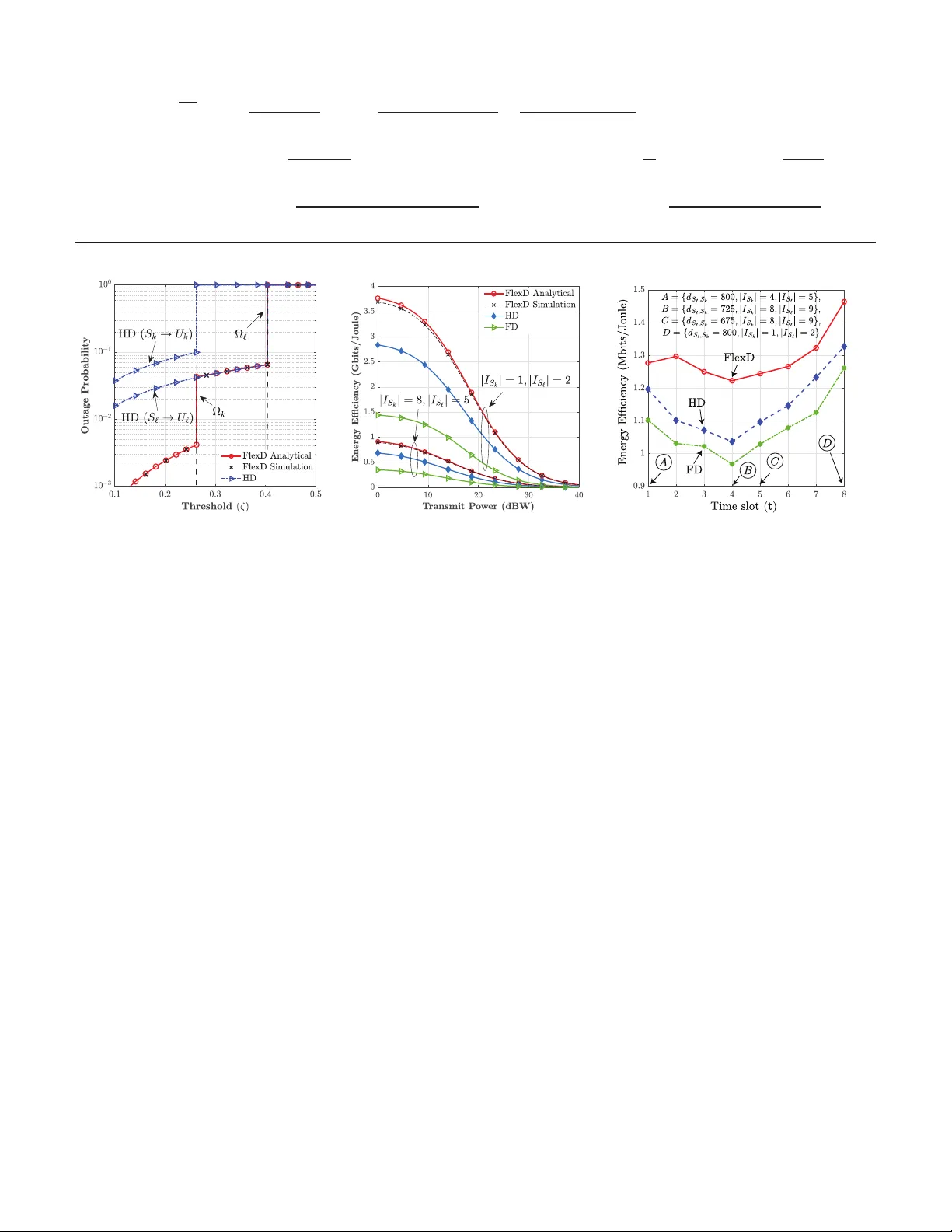
Performance Analysis of Fle xible Duple x Inter -Sat ellite Links in LEO Netw orks Y omali Lokugama , Charith Dissanay ake, Saman Atapattu, a nd Kandeep an Sithamparana than Departmen t of Electrical and Electronic Engineerin g, RMIT University , V ictoria, Australia Email: { yom ali.lokug a ma, charith.d issanayake, sama n.atapattu, kandeep an.sithampar anathan } @rmit.edu.au Abstract —This paper in vestigates energy -effi cient inter-sa tell ite communication in Low Earth Orbit (LEO) networks, where satel- lites exchange both buffered and newly generated data through half-dupl ex inter -satellite lin k s (ISLs). Due to orbital motion and i nterference-pro n e directional asymmetry , the achievable ISL capacities in opp osite d i rections var y dynamically , leading to inefficient utilization un der conv ention al fixed or alternating duplex modes. T o add ress this, we propose a Fl exible Du plex (FlexD) scheme that adaptively selects th e ISL transmission di- rection in each slot t o maximize instantaneous end-to-end sky-to- ground throughput, jointly accounting for ISL quality , downlink conditions, and queu e backlogs. A uni fi ed analytical framew ork is developed that transforms the bottleneck rate structure into an eq uiva l en t SINR domain, enabl ing closed-form derivations of throughput outage probability and en ergy effi ciency under deterministic ISLs and Rician satellite-to-ground fadin g. The analysis re veals distinct operating regions gover ned by ISL and backlog constraints and provides tractable bounds fo r erg odic rate and energy efficiency . Numerical results confirm that FlexD achiev es higher reliability and u p to 30% improv ement in energy efficiency compared with con ventional half- and full-du p lex schemes u nder realistic inter -satellite interference conditions. Index T erms —Flexible du plex, int er -satellite links, low Earth orbit satellites, energy efficiency , outage, Rician fadin g. I . I N T R O D U C T I O N As sixth- g eneration (6G) ne tworks evolve tow ard g lobal coverage, Low Earth Orbit ( LEO) satellite constellations ar e emerging as a critical enab ler for u biquitou s connectivity and low-latency backhau l [1]. Operating in large-scale for- mations, each satellite maintains an in depende n t footprin t and c ooperates with neigh boring satellites via inter-satellite links (I SLs) to sup port multi-hop ro uting, data relay ing, and service continuity [2], [3]. By leveraging ISLs, satellites can forward b u ffered or real-time data withou t immediate ground contact, thereby enh ancing spatial coverage and red ucing reliance on terre strial gateways. Howe ver , the perfor mance of ISLs is inherently dyn amic. Time-v ar y ing interferen ce, orbital motion, and prop agation geo m etry cause large fluctu ations in the signal- to-interfer ence-plus- noise ratio (SINR), lead ing to asymmetric link co nditions between neighbor ing satellites [4]. At the same time, onboar d en ergy remains a scarce resou r ce, making energy efficiency (EE) a fun damental design ob jectiv e in LEO networks. Despite extensive work on ISL scheduling and power optimization, the jo int impa c t of link asym metry , inter-satellite interfer ence (I SI), an d data availability on end - to-end perform ance has received limited analytica l attention . Existing studies ca n broad ly b e classified into two c a t- egories: system-level optimization an d analytical m odeling. System-level approac h es such as [5]–[1 0] aim to improve throug hput or EE through reso u rce allocation and I SL schedul- ing. For example, [5] optimizes ISL assignme nt for throug h- put enhan c e ment but n eglects ISI, while [ 6] considers ISI in the schedulin g design withou t analytical characterizatio n . Similarly , [7] an d [8] inv estigate E E an d power alloca tio n under Quality- of-service (QoS) an d satellite power constraints, but they disregard th e interactio n between ISLs and satellite- groun d lin ks (SGL s). T o bridge this gap, [9 ] inc o rporates cooper a tive ISL-SGL transmissions for E E max imization, whereas [10] applies multi-age n t reinfo rcement learn ing fo r ISL link plann ing. Y et, th ese framew o rks r e main o ptimization- centric, lackin g closed-form perform ance that can provide deeper p hysical insight. Analytical work s in [11 ]–[13] study ISL/LEO systems fro m a fundamen tal persp e cti ve: [11] ana- lyzes ISL und er d istance uncerta in ty withou t ISI, [12] mit- igates in terference via beamfor m ing in LEO n etworks but ignores ISI, and [13] models join t ISL-SGL thro ughpu t w ith static d uplexing. Across all these work s, both ISL and SGL links are constrained to o perate in either half-d uplex (HD) or full-du plex (FD) modes [14] , which are inefficient under dynamic directional asymmetry . In co ntrast, the co ncept of fl exible duplex (Fle xD) -recently explored in terrestrial multi-u ser systems-allows slot-wise adaptation of transmission direction accordin g to instanta- neous ch annel and inter ference con d itions, thereby imp r oving throug hput and EE in interf erence-limited ne twork s [ 15], [16]. Howe ver , its ap p lication to satellite systems, particularly to coupled ISL-SGL a r chitectures un der mobility and interfer- ence, rem ains unexplor ed. This wo rk pr esents the first an alyti- cal FlexD framework for LEO satellite networks incorporating ISL-SGL coupling and inter-satellite interfer en ce. The ma in contributions are summarized as follows: (i) A novel en d-to-en d communicatio n model is formu lated, w h ere deterministic ISLs collaborate with random fading SGLs to deliver backlog ged an d new data under dynamic mo bility . (ii) A FlexD strategy is introduc e d to d ynamically select the optimal ISL dire c tion p er slot, max im izing instantaneou s end- to-end throu ghput. (iii) Closed-form expressions are de r iv ed for throug hput ou tage p robability and EE, based on a unified SINR-domain of the ISL- d ownlink bottleneck . (iv) Numerical results v alida te the theory , demo nstrating that FlexD achieves significantly h igher reliab ility and up to 30% im provement in EE compared to conventional HD and FD system s u nder ISI. . . . . . . . . . . . . (a) Constella tion configuration at t “ τ . (b) Constella tion after hando ver at t “ T co v ` τ . (c) T emporal va riation of ISL for S k and S ℓ . Fig. 1: System ar chitecture and moti vation fo r the pr oposed FlexD scheme: (a) initial constellation configuration , (b) post- handover con figuration , an d (c) comparison of ISL cap acities C S k Ñ S ℓ and C S ℓ Ñ S k under FlexD an d conventional HD. I I . S Y S T E M M O D E L This section de scribes the LEO c o nstellation mo del, emph a- sizing th e co u pling between grou n d coverage and inter-satellite links (ISLs). W e first d efine the constellation g eometry an d temporal structure, then in troduce the two-hop data delivery induced by mobility and buffered traffic, f ollowed by the half- duplex ISL sched uling principle (FlexD). A. Constellation, Geographic P artition, and T ime Consider a LEO constellation co m prising M satellites, S “ t S 1 , S 2 , . . . , S M u , serving M non-overlapp in g r egion s: A “ t A 1 , A 2 , . . . , A M u , A i X A j “ H , @ i ‰ j, such th at Ť M i “ 1 A i spans th e entire service theater . Each region A i contains a representative ground user o r gateway U i that acts as the traffic en dpoint. As illustrated in Fig. 1a, satellites S k and S ℓ serve the corr e sponding regions A k and A ℓ , where the gr ound node s U k and U ℓ reside. A regio n rem ains continuo usly visible to one satellite for a coverage window o f duration T cov , during which the region-satellite associatio n is stable. Time is d ivided into discrete slots indexed by t P Z ě 0 , each o f duratio n T slot ! T cov such that geom etry , visibility , and channel gains remain quasi-static within a slot. Hence, multiple schedulin g slots fit within a single coverage window . At the start of a window ( t “ τ ), the regions A k and A ℓ are served by satellites S k and S ℓ , respectively . Due to orb ital motion , after appr oximately T cov seconds th ese satellites move out of visibility , and service is handed over to adjacent satellites entering the view of A k and A ℓ . This mutu al exchange is den oted by S k Ø S ℓ at t “ τ ` T cov , as sho wn in Fig. 1b. The ha n dover is not instantan eous: the departing satellites S k and S ℓ may still buffer un deliv er ed data for U k and U ℓ . Therefo re, an inter-satellite data transfer between p S k , S ℓ q is re quired to complete the p ending transmissions during or immediately after the handover . B. Communicatio n Flo ws and th e T wo-Hop Delivery Pr oblem During a sched uling time t “ τ , the prim ary d ownlinks ar e the one- hop transmissions S k Ñ U k and S ℓ Ñ U ℓ (see Fig. 1a), where D k p t q ě 0 and D ℓ p t q ě 0 denote their instantaneou s capacities (bits/slot) d etermined by the PHY -layer mode l in Sec. IV. At the end of a coverage window , satellites may exchange their servin g r egions. If S k and S ℓ subsequen tly serve U ℓ and U k , respectively , each may still hold undelivered d ata fr o m the previous wind ow . Th e se r esidual p ackets, of sizes Q S k Ñ U k ě 0 and Q S ℓ Ñ U ℓ ě 0 (bits), must be relayed over the inter-satellite link (ISL), giving rise to two-hop routes S k Ñ S ℓ Ñ U k , S ℓ Ñ S k Ñ U ℓ . For pr actical and analytical conv en ience, the bac k log ter m s Q S k Ñ U k and Q S ℓ Ñ U ℓ are mod eled as determ inistic quantities representin g the av ailable buffered data, wh ile their slower stochastic ev olution d ue to external arriv als is left ou tside the present scope. T wo-hop r elaying can also occur within a coverage wind ow due to persistent cross-satellite tran sf e r s, asymmetric link efficiencies, or new arriv als at non -serving satellites. Without loss of generality , we consid e r the represen- tati ve satellite pair p S k , S ℓ q exchan ging data within the same window and assume sufficient backlog in bo th directions. Let C S k Ñ S ℓ p t q ě 0 and C S ℓ Ñ S k p t q ě 0 denote the instan- taneous ISL cap acities ( bits/slot) in slot t . If p ackets for U ℓ are still buffered at S ℓ , the achievable end -to-end two-hop rate over S k Ñ S ℓ Ñ U k and S ℓ Ñ S k Ñ U ℓ are constrain e d by the bottleneck as R S k Ñ U k p t q “ min C S k Ñ S ℓ p t q , D k p t q , Q S k Ñ U k p t q ( , (1) R S ℓ Ñ U ℓ p t q “ min C S ℓ Ñ S k p t q , D ℓ p t q , Q S ℓ Ñ U ℓ p t q ( . (2) Each expression rep resents the instan ta n eous half- duplex end- to-end service rate achiev able throug h th e ISL-downlink ch ain in the respectiv e direction. Remark 1 (IS L A vaila bility): The ana ly sis presumes an activ e bidirectio nal ISL between S k and S ℓ during the con- sidered window . Practica l impairme n ts such as inter m ittent visibility or pointing loss are mitigate d by high er-layer rou ting and scheduling mec h anisms; the present study fo cuses on the instantaneou s PHY - la y er behavior when the ISL is av ailable. I I I . P R O P O S E D F L E X I B L E D U P L E X ( F L E X D ) F O R I S L S ISLs serve a s shar ed backh aul between n eighbor ing satel- lites an d o perate in half-du p lex m ode on a g i ven band; th at is, for any p air p S k , S ℓ q , o nly one tran smission direction ca n be activ e per slot. A. Dir ectiona l ISL Asymme try a n d Motivation The instantaneou s ISL capa city depends on direction- specific factors su c h as ante n na pointing , resid u al carrier frequen cy o ffset (CFO), relativ e distance, and interfere n ce at the r e ceiving satellite [4 ]. Let I p t q de note the set of satellites that are con currently tran smitting on the same resour ce blo ck in slot t and are visible to either S k or S ℓ . The subsets I S k p t q Ď I p t q and I S ℓ p t q Ď I p t q denote the sets o f interfering satellites observed by S k and S ℓ , resp ecti vely . Since I S k p t q ‰ I S ℓ p t q in general d ue to d iffering spatial geometry , field- of- view (FO V), and scheduling , the directional ISL capacities C S k Ñ S ℓ p t q and C S ℓ Ñ S k p t q are typically asymmetric a n d time - varying even within a single coverage win dow . Fig. 1c illustrates the tem poral v ariatio n of the two ISL capacities C S k Ñ S ℓ p t q and C S ℓ Ñ S k p t q . The for ward and r e- verse capacities sh ow stro ng slot-level asymmetry and distinct long-ter m trends. Conventional half- d uplex oper a tion, wh ich alternates dir ection in a fixed o r pre- assigned pattern slot- wise, cannot efficiently exploit these variations. This motiv ates an ad a p tiv e slot-b y-slot selection mechanism that alw ay s u ti- lizes the stro nger direction . Furthermore, because the end -to- end service rate a lso d epends on th e do wn link ca pacity an d av ailable backlog ( D k , D ℓ , Q S k Ñ U k , Q S ℓ Ñ U ℓ ), opportu n istic direction selection can substan tially enhan c e the overall two- hop thro ughpu t-formin g the basis o f the pr oposed Flexible Duplex (F lexD) scheme. B. FlexD Direction S election The instantaneous two-hop service rates (bits/slot) for the two flows S k Ñ U k and S ℓ Ñ U ℓ are g iv en by R S k Ñ U k p t q an d R S ℓ Ñ U ℓ p t q from ( 1 ) and (2 ), represen ting the effecti ve ISL- downlink rates in each d irection. FlexD dynamically selects the active h alf-duplex direction d ‹ p t q in each slot to maximize the instantaneo us end -to-end thr oughp ut: d ‹ p t q “ arg max d Pt S k Ñ U k , S ℓ Ñ U ℓ u R d p t q , (3) R ‹ p t q “ max t R S k Ñ U k p t q , R S ℓ Ñ U ℓ p t qu . (4) This per-slot ru le allocates the ISL to the direction offering the highest achiev ab le throughp ut. The network is coordinated b y a con tr o l center , possessing e n viro nment awareness, which ha s access to satellite and user locations. Remark 2 (Relatio n to SINR): I f C S k Ñ S ℓ p t q “ W isl log 2 p 1 ` γ S k Ñ S ℓ p t qq and C S ℓ Ñ S k p t q “ W isl log 2 p 1 ` γ S ℓ Ñ S k p t qq , maximizing R d p t q red uces to maximizin g γ d p t q only when the ISL link is the bottleneck, i.e., C p t q ď D, Q in ( 1)-(2). Otherwise, downlink or b acklog co nstraints d ominate, a n d th e full min-structu r e mu st be retained. The next section analyzes the SINR distributions and their effect o n the FlexD rate. I V . S I N R A NA L Y S I S A N D P H Y S I C A L - L AY E R M O D E L A. F r om B o ttleneck Rates to SINR Equiva le n ts For a satellite pair p S ℓ , S k q , the per-slot two-hop service rate in the directio n S ℓ Ñ U ℓ is given by ( 2) with C S ℓ Ñ S k p t q is the ISL capacity , D ℓ p t q the downlink capacity to u ser U ℓ , and Q S ℓ Ñ U ℓ p t q (bits) the backlog stored at S ℓ for U ℓ . The ISL an d d ownlink capacities ar e related to their instan- taneous SINRs by C S ℓ Ñ S k p t q “ W isl log 2 ` 1 ` γ S ℓ Ñ S k p t q ˘ , (5) D ℓ p t q “ W dl log 2 ` 1 ` γ S k Ñ U ℓ p t q ˘ , (6) where W isl and W dl are the re sp ectiv e bandwidth s. In general, (2) ca nnot b e wr itten d irectly as a “minimu m over SINRs” unless (i) a comm on ban dwidth is assumed an d (ii) the bac k log term is expressed as an equiv alen t rate. Assuming W isl “ W dl “ W , th e backlog- equiv alen t SINR is define d as γ p W q Q S ℓ Ñ U ℓ p t q fi 2 Q S ℓ Ñ U ℓ p t q{ W ´ 1 . (7) Then the rate in (2) can be equiv alently e x pressed as R S ℓ Ñ U ℓ p t q “ W log 2 ´ 1 ` γ S ℓ Ñ U ℓ p t q ¯ , with correspond ing SINR term γ S ℓ Ñ U ℓ p t q“ min t γ S ℓ Ñ S k p t q , γ S k Ñ U ℓ p t q , γ p W q Q S ℓ Ñ U ℓ p t qu . (8) The reverse direction rate R S k Ñ U k p t q f o llows by interchan ging k a n d ℓ . If W isl ‰ W dl , the rate- domain for ms in (1)-(2) should be used directly for analysis. Hencefor th , for notation a l simplicity , we define the large- scale gains and a verag e SNR between nod es i and j as α i,j p t q “ G i,j G j,i c 2 p 4 π f d i,j p t qq 2 , ¯ γ i,j p t q “ P i α i,j p t q σ 2 j (9) respectively . Here, G i,j denotes the directional antenna gain (e.g., UP A/ULA, includin g Doppler-compensated point- ing) [17], [18 ], d i,j p t q the euclidean distanc e between no de i and j , f the carrier frequ ency , c the speed of light, P i is the transmit p ower of node i and σ 2 j is the receiver noise power at node j mo d eled a s A WGN „ C N p 0 , σ 2 j q . B. Deterministic ISL Link SINR: S ℓ Ñ S k The receiv e d SINR at S k in slot t is γ S ℓ Ñ S k p t q “ ¯ γ S ℓ ,S k p t q ÿ S n P I S k p t q ¯ γ S n ,S k p t q ` 1 , (10 ) where ¯ γ S ℓ ,S k p t q and ¯ γ S n ,S k p t q obtained from (9) and I S k p t q is the co-chann el interfer e rs set v isib le to S k at slot t . C. Rand om Downlink SINR: S k Ñ U ℓ The receiv e d SINR at U ℓ in slot t is γ S k Ñ U ℓ p t q “ ¯ γ S k ,U ℓ p t q | h S k ,U ℓ p t q| 2 , (11) where ¯ γ S k ,U ℓ p t q ob ta in ed from (9) and h S k ,U ℓ p t q represents the small-scale Rician fading „ C N p µ, σ 2 g q wh ich accurately captures th e dir e ctional satellite-groun d propag ation [ 19]. Thus the CDF of γ S k Ñ U ℓ is gi ven by F X p ¯ γ S k ,U ℓ ; x q “ 1 ´ Q 1 ˆ | µ | ? σ 2 g { 2 , b 2 x ¯ γ S k ,U ℓ σ 2 g ˙ , (12) where Q 1 p¨ , ¨q den otes the first-ord er M arcum Q - function . Similarly the CDF of γ S ℓ Ñ U k can be written as F X p ¯ γ S ℓ ,U k ; x q . Correspon d ing SINR terms for the reverse direction S k Ñ U k follows analo gously b y index k and ℓ interch ange. V . F L E X D S Y S T E M P E R F O R M A N C E A NA L Y S I S The per f ormance is ev alu ated under two p rimary metrics (i) Throu g hput Outage Proba b ility , a n d (ii) Energy Efficiency . A. Thr ough put Outage Pr o b ability The throughpu t outage probability quan tifies the likelihood that the instantaneous two-ho p rate falls b elow a target δ . W ith a pre-log factor of 1 { 2 d u e to HD operation, it is defined as P o “ Pr ` W 2 log 2 p 1 ` Γ q ď δ ˘ , (13) where ζ fi 2 p 2 δ q{ W ´ 1 is the equivalent SINR threshold, and Γ “ max t γ S ℓ Ñ U ℓ p t q , γ S k Ñ U k p t qu , (14) with composite SINR terms γ S ℓ Ñ U ℓ p t q an d γ S k Ñ U k p t q can b e found using (8) and interchan g ing indexes k , ℓ respectively . Lemma 1 (Thr ough p ut Outage Pr oba bility): The system outage probability P o “ Pr p Γ ď ζ q is expressed as P o p ζ q“ $ ’ ’ ’ ’ & ’ ’ ’ ’ % F X p ¯ γ S k ,U ℓ ; ζ q F X p ¯ γ S ℓ ,U k ; ζ q , ζ ă Ω min , F X p ¯ γ S ℓ ,U k ; ζ q , Ω ℓ ď ζ ă Ω k , F X p ¯ γ S k ,U ℓ ; ζ q , Ω k ď ζ ă Ω ℓ , 1 , ζ ě Ω max , (15) where F X p¨ , ¨q den otes the Rician CDF defined in (12). Th e deterministic cut le vels are Ω ℓ “ min t γ S ℓ Ñ S k , γ p W q Q S ℓ Ñ U ℓ u , Ω k “ min t γ S k Ñ S ℓ , γ p W q Q S k Ñ U k u , and Ω min “ min p Ω ℓ , Ω k q , Ω max “ max p Ω ℓ , Ω k q . Pr oof Sketch: Let Y “ γ S ℓ Ñ U ℓ “ min t Ω ℓ , H ℓ u a nd Z “ γ S k Ñ U k “ min t Ω k , H k u , so that Γ “ max t Y , Z u . For any ζ ě 0 , P r p Γ ď ζ q “ Pr p Y ď ζ , Z ď ζ q “ F Y p ζ q F Z p ζ q , since Y and Z are independe n t. The CDF of Y is given as F Y p ζ q “ # F X p ¯ γ S k ,U ℓ ; ζ q , ζ ă Ω ℓ , 1 , ζ ě Ω ℓ , (16) Similarly , F Z p ζ q can b e found an d the pro duct of F Y p ζ q and F Z p ζ q yield s ( 15). Finally , substituting ζ “ 2 p 2 δ q{ W ´ 1 maps the through put threshold δ to the equiv alent SINR threshold . Remark 3 (In te rp r etation of Lemma 1 und e r No-Backlog Conditions): When both in ter-satellite exchange q u eues are empty , i.e. , Q S ℓ Ñ U ℓ “ Q S k Ñ U k “ 0 , no relay traffic exists between S k and S ℓ . In this case, R S ℓ Ñ U ℓ p t q “ R S k Ñ U k p t q “ 0 ð ñ γ S ℓ Ñ U ℓ p t q “ γ S k Ñ U k p t q “ 0 and the ISL remains idle. The system there f ore reduces to a pure ly dir ect down- link m ode, with instantaneo us o ne-hop capacities D k p t q “ W lo g 2 p 1 ` γ S ℓ Ñ U k p t qq , and D ℓ p t q “ W log 2 p 1 ` γ S k Ñ U ℓ p t qq . Substituting these into Lemma 1 yields decou pled per-user outage pr obabilities, P o ,k p ζ q “ F X p ¯ γ S ℓ ,U k ; ζ q , P o ,ℓ p ζ q “ F X p ¯ γ S k ,U ℓ ; ζ q . In practice, such links are exclud ed fr o m the FlexD set d uring no-back log slots, or equ i valently m odeled via an acti vation indicator R d p t q “ 1 t Q d p t q ą 0 u min t¨u to capture traffic-dependent ISL particip ation. B. Ener g y Efficiency (EE) Energy efficiency (EE) measure s how effectiv ely a system conv er ts power into transmitted info rmation, defined as th e ratio of ergodic thr oughp ut ¯ R to total power P T : EE “ ¯ R { P T , (17) which is given in closed form in the following lemma, wher e EE is approxim a ted as Lemma 2 (Ener gy Efficiency): Th e system en ergy efficiency (EE) is approxim ated by EE « W 2 P T log 2 ` 1 ` E r Γ s ˘ , (18) where the a verag e system SINR E r Γ s is E r Γ s “ # F ` G p A S k ,U ℓ , Ω min , Ω max q , Ω ℓ ě Ω k , F ` G p A S ℓ ,U k , Ω min , Ω max q , otherwise , (19) where F a n d G p¨q ar e gi ven in (22)-(2 4) and terms A S k ,U ℓ “ 1 { ¯ γ S k ,U ℓ σ 2 g , A S ℓ ,U k “ 1 { ¯ γ S ℓ ,U k σ 2 g . The slot-wise constants Ω ℓ , Ω k and Ω max , Ω min are as defined in Le mma 1. Substitutin g ( 19) into (1 8) yields a tight ana ly tical upper bound for EE (see Fig. 2b). Pr oof Sketch: Th e system’ s ergod ic thro ughpu t, deriv ed by taking the expectation E r ¨s over ( 4) with (14), as ¯ R “ E r R ‹ s“ E r W 2 log 2 p 1 ` Γ qs“ ż 8 0 W 2 log 2 p 1 ` x q f Γ p x q dx, (20 ) where f Γ p¨q is the PDF corr espondin g to the CDF of Γ in (15). Since a closed-fo rm evaluation of (20 ) is generally intractable, we employ Jensen’ s in e quality . Because log p 1 ` x q is concave, E “ W 2 log 2 p 1 ` Γ q ‰ ď W 2 log 2 ` 1 ` E r Γ s ˘ . (21) Let Y “ γ S ℓ Ñ U ℓ “ min t Ω ℓ , H ℓ u an d Z “ γ S k Ñ U k “ min t Ω k , H k u , so that Γ “ max t Y , Z u . Using the tail- sum repr esentation, E r max p Y , Z qs “ ş 8 0 Pr p max p Y , Z q ą l q dl “ ş Ω max 0 r 1 ´ F Y p l q F Z p l qs dl , wher e the limits truncate at Ω max “ max p Ω ℓ , Ω k q . Splitting th e in tegration domain into r 0 , Ω min s and r Ω min , Ω max s , substituting the Rician CDFs from Lemma 1, an d using th e Marcum- Q function serie s expansion in [20, Eq. (4.47)] yield expr essions in (19)-(24). F “ Ω min ´ e ´ 2 µ 2 σ 2 g M ÿ m “ 0 M ÿ n “ 0 p µ { σ g q 2 mn m ! n ! „ Ω min ´ Φ m p A S ℓ ,U k , Ω min q A S ℓ ,U k ´ Φ n p A S k ,U ℓ , Ω min q A S k ,U ℓ ` Ψ mn p A S ℓ ,U k , A S k ,U ℓ , Ω min q , (2 2) G p ǫ, Ω min , Ω max q“ e ´ µ 2 { σ 2 g M ÿ m “ 0 p µ { σ g q 2 m m ! ǫ “ Φ m p ǫ, Ω max q ´ Φ m p ǫ, Ω min q ‰ , Φ m p A, S q “ 1 A m ÿ i “ 0 « 1 ´ e ´ AS i ÿ r “ 0 p AS q r r ! ff , (23) Ψ mn p A S ℓ ,U k , A S k ,U ℓ , S q“ m ÿ i “ 0 n ÿ j “ 0 A i S ℓ ,U k A j S k ,U ℓ p i ` j q ! i ! j ! p A S ℓ ,U k ` A S k ,U ℓ q i ` j ` 1 « 1 ´ e ´p A S ℓ ,U k ` A S k ,U ℓ q S i ` j ÿ r “ 0 ` p A S ℓ ,U k ` A S k ,U ℓ q S ˘ r r ! ff . ( 24) (a) System outage probability versus threshold ζ . (b) Energy ef ficienc y ve rsus transmit po wer P . (c) T emporal va riation of EE ove r time slots t . Fig. 2: Per f ormance c o mparison o f FlexD with HD a nd FD ba selin es. (a) Lower outag e via adaptive direction selection , (b) higher energy e fficienc y per unit power , an d (c) robustness to dyn amic ch annel and interference variations across slots. C. Extension to NLoS, Multiuser , and Multihop Scena rios The pro posed a n alysis is n aturally extendable to non -line- of-sight (NLoS), multiuser, and multihop configura tio ns. In NLoS co nditions , the SGL m ay f ollow a Nakagami- m fading instead of Rician fading. Acco rdingly , the CDF F X p¨ , ¨q in Lemm a 1 and (20) is replaced by the Nakagam i- m form F X p x q “ 1 ´ exp p´ mx { ¯ γ q ř m ´ 1 r “ 0 p mx { ¯ γ q r { r ! , while all subsequen t deriv ation s remain structurally identical. For the multiuser case , let Γ mu fi max i P U Γ i denote the instantaneou s SINR of the best user link among the set of served users U . T h e corresp o nding ou tage p robability extends from ( 15) as P o,mu p ζ q “ Pr p Γ mu ď ζ q “ ś i P U F Γ u p ζ q , assuming indepen dent user links with CDF for each F Γ u p ζ q . For the multihop case , where a packet trav er ses H serial ISLs befor e reach ing its serving satellite, the end-to -end SINR becomes Γ mh “ min h Pt 1 ,...,H u Γ h , cap turing the bo ttleneck of the weakest ho p. Its CDF is g i ven b y F Γ mh p ζ q “ 1 ´ ś H h “ 1 ` 1 ´ F Γ h p ζ q ˘ , fro m which the correspondin g outage a nd ergodic- rate expressions follow directly . V I . N U M E R I C A L A N A L Y S I S Numerical simulations are cond ucted for LEO satellites operating at altitu d es of 50 0 - 120 0 k m [13] with orbital inclin a- tions of 50 ˝ - 98 ˝ . The inter-satellite distance is 600 - 12 00 km, correspo n ding to an gular sep arations of 4 . 5 ˝ - 10 ˝ for circular orbits [2 ]. The RF-ISL op e r ates at f “ 25 GHz ( K a -band) with a 500 MHz bandwidth. The SGL channe ls h S k ,U ℓ and h S ℓ ,U k follow Rician fading with | µ | “ 1 . 5 6 an d σ 2 g “ 1 . 3 . Receiv er noise p ower is set to ´ 11 5 d Bm, and antenna gains range from 35 to 40 dBi. 1) System Outage P erformance: Fig . 2a shows the system outage probability versus thr eshold ζ with p| I S k | , | I S ℓ |q “ p 5 , 8 q , highlig hting the r e liability gain of the proposed FlexD scheme over conventional HD op eration. The analy tical re- sults derived for FlexD in (1 5 ) closely match Mon te Carlo simulations, v alida ting the analysis. From a communication - theoretic pe rspectiv e , the FlexD outag e beh avior arises fr o m the composite bottlene ck structure γ S ℓ Ñ U ℓ in (8) and γ S k Ñ U k , where the instantan eous ISL SINRs γ S ℓ Ñ S k and γ S k Ñ S ℓ jointly interact with the backlog-lim ited terms γ p W q Q S ℓ Ñ U ℓ and γ p W q Q S k Ñ U k . The tw o transition threshold s Ω k and Ω ℓ partition the outag e curve into three regions correspon d ing to distinct dominan t con straints: ( i) ISL-limited, (ii) backlog-limited , and (iii) downlink-limited operation . These regions collecti vely characterize h ow link quality and data av ailab ility couple to determine th e end-to-end reliab ility . As o bserved, the FlexD curve exhibits con tinuous tran sitions across these regio n s, indicating adaptive rate balan c ing u nder moderate ch annel and buf fer variations. In contra st, the HD curves-fixed to either S k Ñ U k or S ℓ Ñ U ℓ per slot-show d istinct discontin uities at their respe c tive thr esholds, reflecting single-d irection bot- tlenecks. FlexD’ s consistent ou tage red uction high lights its adaptive chann el utilization, maximizing mutual inform a tion over the two-hop chain and ensuring higher reliability than non-ad aptive HD operatio n. 2) Energy Efficiency P erforman ce: Fig. 2b depicts the variation of energy efficiency (EE) , measur e d in Gbits/Joule, versus the total transmit power P (dBW). The analytically derived upper-bounde d EE from (18) with M ě 20 (trunc ation limit of the infinite series) clo sely m atch simulations, a nd the actual EE curve without Jensen’ s appr o ximation is used for FlexD simula tio ns. For fair comparison, both HD and FlexD modes o perate with id entical tran smit power P per slot, while FD employs 2 P d ue to simu ltaneous bidirection al transmission. The FD mod e further experien c es residua l self- interferen ce (RSI) fixed at ´ 120 dBm-n ear th e thermal noise floor-representing ideal FD con d itions. W e consider two in- terference configur ations at S k and S ℓ : p| I S k | , | I S ℓ |q “ p 1 , 2 q and p 8 , 5 q . At slot t , the configuratio n with fewer in terferers achieves higher EE du e to increased th rough put, and vice versa. The results d emonstrate that FlexD co nsistently achieves higher EE than both HD and FD. This g ain stems f r om its direction- adaptive transmission, which max imizes the in stan - taneous thro ughpu t per unit ene rgy . At P “ 1 0 dBW , with p| I S k | , | I S ℓ |q “ p 1 , 2 q the EE values for FlexD, H D , and FD are approx imately 3 . 2 , 2 . 4 , a n d 1 . 25 Gbits/Joule, r e spectiv ely , highligh ting that FlexD can substantially improve power ef fi- ciency under energy-limited LEO satellite operatio ns. 3) Impact of Satellite Mobility on Ene r gy Efficiency: Fig. 2c shows the evolution of EE across time slots under dynamic co n ditions induce d by satellite motion. Each slot experiences d istinct EE values due to time-varying path loss and interfere n ce. For exam ple, poin ts A and D exhibit identical inter-satellite d istances d S ℓ ,S k , yet point D achieves higher EE owing to reduced co- channel interferen c e, d emonstrating that inter f erence power dominates when geometric losses ar e similar . Con versely , point C yields higher EE th an point B despite equ a l interferen ce le vels, indica ting that sho rter d S ℓ ,S k (stronger LoS gain) dominates SINR performan ce. Remark 4 (Ener gy- Efficiency Adaptability of FlexD): Th e FlexD sche m e consistently a c hiev es high er EE acro ss all tim e slots com pared to HD and FD. Its ro bustness stems fr om slot-wise adaptatio n to instantaneo us chan nel an d interferen c e condition s, effecti vely maximizing mutual inform a tio n per joule under varying free-sp a ce p ath loss ( FSPL) and inter- satellite interference (ISI). V I I . C O N C L U S I O N This paper p resented a Flexible Du plex (FlexD) trans- mission framework f or low E arth orbit ( L EO) satellite net- works equip ped with inter-satellite links (ISLs). The pro- posed schem e addresses the directiona l asymme try inherent in half-du plex I SL s and the ba cklog-ind uced two-hop relay- ing prob lem arising from satellite mobility and fading . By formu latin g the ISL-downlink bo ttleneck in a u nified SINR domain, closed- form expressions for th rough put outage and energy efficiency wer e derived u nder deter ministic ISLs and Rician satellite-groun d ch annels. Analytical and Monte Carlo results sh owed clo se agreem ent, revealing distinct op erating regimes dr i ven by ISL q uality and qu eue backlogs. Comp ared with co n vention al half- an d full-d u plex modes, FlexD a c hiev es significantly lo wer outag e pro bability and up to 30% h igher energy e fficienc y , attributed to its slot-wise direction adap- tation under time-varying interferen ce and path loss condi- tions. Future extensions include expanding the fram ew ork to multi-hop con stellations with dy namic topolog y and utilizing learning- based method s to enable scalable dup lex manag ement in next-generation space n etworks. R E F E R E N C E S [1] I. T . Union, “Future technolog y trends of terrestria l internatio nal m obile telec omm unications systems to wards 2030 and beyond, ” 2022. [2] R. Radhakrishn an, W . W . Edmonson, F . Afghah et al. , “Survey of inter - satell ite communicat ion for small satelli te systems: Physical layer to netw ork layer view , ” IEE E Commun. Surve ys T uts. , vol. 18, pp. 2442– 2473, 2016. [3] B. Guo, Z. Z hang, S. Atapat tu et al. , “Enabling real- time computing and transmission service s in lar ge-scale LEO s atel lite net works, ” IE E E T rans. V eh. T ec hnol. , vol . 74, no. 8, pp. 12 813–12 828, 2025. [4] Q. Cao, R. W ang, R. Ma et al. , “On dense L EO constellati on desig n for intersa tellite inte rference mitigat ion, ” IEEE Inter . of Things Journ . , vol. 12, no. 14, pp. 28 136–28 152, 2025. [5] P . W ang, H. Li, B. Chen et al. , “Enhancin g earth observa tion throughput using inter-sate llite communicat ion, ” IEEE T rans. W irele ss Commun. , vol. 21, no. 10, pp. 7990–8006, 2022. [6] I. L eyva -Mayorga, B. Soret, and P . Popovski, “Inter-pl ane inter -satellite connec tivit y in dense LEO conste llations, ” IEEE T rans. W ireless Com- mun. , vol. 20, no. 6, pp. 3430–3443, 2021. [7] Y . Y ang, M. Xu, D. W ang et al. , “T ow ards ener gy-effic ient routing in satell ite networks, ” IEEE J. Select. A re as Commun. , vol. 34, no. 12, pp. 3869–3886, 2016. [8] X. Li, Y . W ang, J. Y ang et al. , “Power allocati on in inter -satellite ranging measurement of navi gation constellati on, ” IEE E Commun. Lett. , vol. 18, no. 5, pp. 801–804, 2014. [9] J. Li, K. Xue, D. S. W ei et al. , “Energy effic iency and traffic offload ing optimiza tion in inte grated satellite /terrestrial radio access netw orks, ” IEEE T rans. W ireless Commun. , vol. 19, no. 4, pp. 2367–2381 , 2020. [10] J. Pi, Y . Ran, H. W ang et al. , “Dynamic pla nning of inter-plan e inter - satell ite links in leo s atellite networks, ” in IEEE Int. Conf. Commun. (ICC) , 2022, pp. 3070–3075. [11] J. L yu, Y . L. Guan, X. Liu et al. , “Inter -orbital inter-sate llite communica- tion link performanc e analysis at THz band considering gravity-i nduced antenna pointi ng error , ” IEEE T rans. V eh. T echn ol. , v ol. 74, no. 6, pp. 10 000–10 005, 2025. [12] F . M. Caceres, A. Al-Hourani, S. Atapattu et al. , “Interfe rence mitigat ion in LEO constellati ons with limited radio en vironment information, ” in IEEE Int. Conf. Commun. (ICC) , 2024, pp. 5051–5056. [13] H. D. Le, P . V . Trinh , T . V . Pham et al. , “Throughput analysis for TCP ov er the FSO-based satelli te-assisted internet of ve hicles, ” IEEE T rans. V eh. T ec hnol. , vol. 71, pp. 1875–1890, 2022. [14] L. Lin, J. Ding, Z . Zhou et al. , “Power -effici ent full-duple x satell ite communicat ions ai ded by m ov able ante nnas, ” IEEE W irele ss Commun. Lett. , vol. 14, no. 3, pp. 656–660, 2025. [15] Y . Lokugama, C. Dissana yake, S. A tapattu et al. , “Fle xible duple xing with phased array antennas for interferenc e-aware multi-user networks, ” IEEE Commun. Lett. , vol. 29, no. 12, pp. 2914–29 18, 2025. [16] Y . Lokugama, S. Atapattu, N. Ross et al. , “Dynamic scheduling for enhanc ed performance in RIS-assi sted cooperati ve network with inter- ference , ” in IEE E V ehicular T echn. Conf. (VTC) , 2025. [17] C. A. Balanis, Antenna theory: Analysis and Design . John wiley & sons, 2016. [18] C. Dissanayake , S. Atapattu, P . Dharmawan sa et al. , “Uni form planar array based weighted cooperat ive s pectru m sensing for cogniti ve radio netw orks, ” IEEE V ehicular T ech n. Conf. (VTC) , 2025. [19] M. Zhao, H. Y u, J . Pan et al. , “Dynamic resource alloca tion for multi- satell ite cooperati on network s: A decent ralized scheme under stati stical CSI, ” IE EE Access , pp. 15 419– 15 437, 2024. [20] M.-S. A. MK Simon, Digital Communicati on ove r F ading Channels . John wiley & sons, 2004.
Original Paper
Loading high-quality paper...
Comments & Academic Discussion
Loading comments...
Leave a Comment