Dyadic Self-Similarity in a Perturbed Hofstadter $Q$-Recursion
We study a perturbed variant of Hofstadter's $Q$-recursion \[ Q(n)=Q(n-Q(n-1))+Q(n-Q(n-2))+(-1)^n, \qquad Q(1)=Q(2)=1 . \] Numerical experiments indicate that the sequence remains well defined for very large values of $n$ and exhibits an unexpectedly…
Authors: Marco Mantovanelli
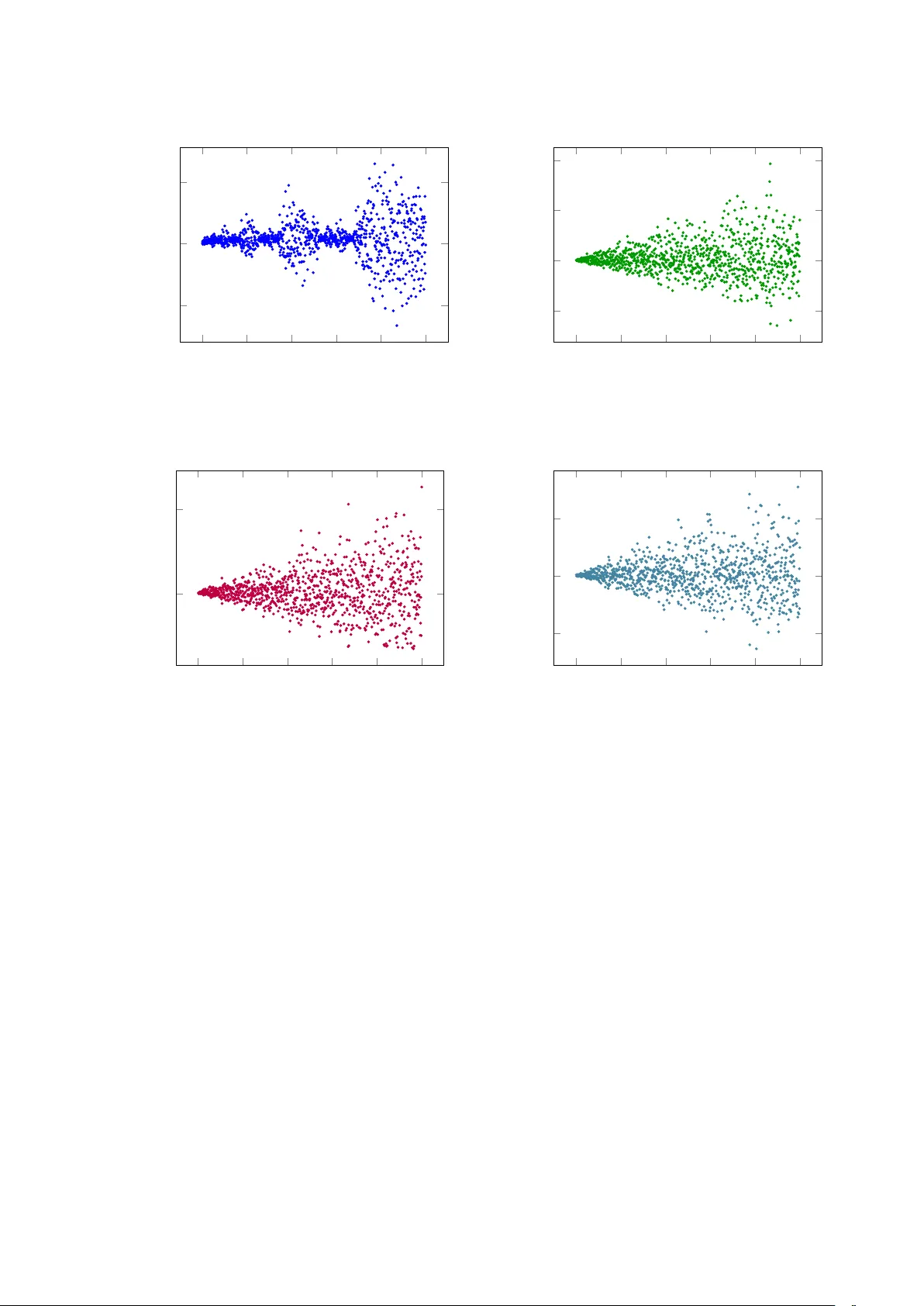
Dy adic Self-Similarit y in a P erturb ed Hofstadter Q -Recursion Marco Man tov anelli ∗ Abstract W e study a perturb ed v arian t of Hofstadter’s Q -recursion Q ( n ) = Q ( n − Q ( n − 1)) + Q ( n − Q ( n − 2)) + ( − 1) n , Q (1) = Q (2) = 1 . Numerical experiments indicate that the sequence remains well defined for very large v alues of n and exhibits a remarkably structured large-scale b eha viour. The data strongly suggest linear growth Q ( n ) ∼ n 2 . W riting Q ( n ) = n/ 2 + E ( n ) , the fluctuation term E ( n ) displa ys a pronounced dy adic self-similarit y: c haracteristic patterns recur across interv als related by p ow ers of t wo. A heuristic analysis of the recursion explains this phenomenon by showing that the dominant recursiv e indices typically lie close to n/ 2 , which naturally pro duces a dyadic renormalization mec hanism. The internal dynamics of the recursion are further analyzed via the index pro cesses t 1 ( n ) = n − Q ( n − 1) and t 2 ( n ) = n − Q ( n − 2) . This leads to a parity-split renormalization diagnostic based on the quantit y R ( n ) = Q (2 n ) − 2 Q ( n ) , whose b ehaviour pro vides additional evidence for a tw o-comp onen t dyadic clo c k structure. W e also in v estigate the distribution of v alues taken by the sequence. The asso ciated frequency sequence appears to ob ey a simple dyadic law: within blo cks B k = { 2 k , . . . , 2 k +1 − 1 } the multiplicities follow a geometric pattern, and the lo cations of the dominant frequency p eaks satisfy the empirical scaling relation m k ≈ 4 3 2 k . Finally , we study the dep endence of the dynamics on the initial conditions. Among the 27 triples ( Q (1) , Q (2) , Q (3)) ∈ { 1 , 2 , 3 } 3 most seeds lead to rapid termination of the recursion, while a small n umber generate long-liv ed sequences that fall into a few distinct dynamical classes. Despite differences in lo cal fluctuations, all long-lived cases observ ed numerically ob ey the same global gro wth law Q ( n ) ≈ n/ 2 . These results suggest that the recursion is go verned by a parity-split dyadic renormalization mec hanism whose precise mathematical formulation remains an op en problem. Keyw ords: meta-Fib onacci sequence, Hofstadter sequence, self-similarity , in teger sequences. MSC2020: 11B37, 11B83, 05A15. ∗ Indep endent Researc her. marco@mantovanelli.de 1 1 In tro duction Self-referen tial integer recursions provide some of the simplest examples of deterministic systems that generate unexp ectedly ric h and p o orly understo od dynamics [ 7 , 8 ]. One of the most famou s examples is Hofstadter’s Q -sequence [5], defined by Q ( n ) = Q ( n − Q ( n − 1)) + Q ( n − Q ( n − 2)) , Q (1) = Q (2) = 1 . Despite the simplicity of this definition, the long–term b eha viour of the sequence remains only partially understo od. Sequences of this type are commonly referred to as meta-Fib onac ci se quenc es . They ha ve b een studied extensiv ely in the literature [ 2 , 14 , 1 , 6 , 12 , 9 ]. Many such sequences displa y highly irregular lo cal b eha viour while still exhibiting surprising global regularities. Sev eral structural approaches hav e b een developed to analyze meta-Fib onacci recursions. In particular, the work of Conolly [ 2 ], T ann y [ 14 ], and Mallo ws [ 9 ] studied related recursions and their asymptotic prop erties. R usk ey and collab orators [ 6 , 12 ] explored further connections with combinatorial structures, while Balamohan, Kuznetsov, and T ann y [ 1 ] developed systematic tec hniques for analyzing the frequency structure of such sequences. In this pap er, we inv estigate the p erturbed recursion Q ( n ) = Q ( n − Q ( n − 1)) + Q ( n − Q ( n − 2)) + ( − 1) n , Q (1) = Q (2) = 1 . This sequence can b e viewed as a v arian t of Hofstadter’s original recursion with an alternating forcing term. Numerical exp erimen ts reveal several striking features. First, the sequence app ears to gro w approximately linearly , with Q ( n ) ≈ n 2 . Second, the fluctuations around this linear trend exhibit a remarkable hierarchical organization across dyadic scales. When the quantit y Q ( n ) − n/ 2 is plotted, patterns recur across interv als related by p o wers of t wo. This observ ation suggests the presence of a dyadic r enormalization structur e . A heuristic analysis of the recursion explains the origin of this b eha viour. Since the recursiv e indices n − Q ( n − 1) and n − Q ( n − 2) are typically close to n/ 2 , the recursion rep eatedly couples v alues at scale n with v alues at scale n/ 2 . This mechanism resembles a renormalization step and naturally pro duces logarithmically organized fluctuation patterns. Another p erspective arises from studying the index pro cesses t 1 ( n ) = n − Q ( n − 1) , t 2 ( n ) = n − Q ( n − 2) , whic h determine the recursive arguments. F ollowing an approach introduced by Pelesk o in the study of generalized Conw ay–Hofstadter sequences [ 11 ], these sequences ma y b e interpreted as clo ck se quenc es gov erning the in ternal dynamics of the recursion. In addition to the b eha viour of the sequence itself, w e also study the distribution of the v alues tak en by the sequence. Defining the frequency sequence F ( m ) = |{ n ≥ 1 : Q ( n ) = 2 m − 1 }| , n umerical exp erimen ts rev eal a highly regular dyadic structure. When the indices m are group ed in to blo c ks B k = { 2 k , . . . , 2 k +1 − 1 } , 2 the m ultiplicities of the frequency v alues app ear to follow a simple geometric law. Moreo v er, the p ositions of the largest frequencies inside these blo c ks seem to ob ey the scaling relation m k ≈ 4 3 2 k . Finally , w e inv estigate the dep endence of the dynamics on the initial conditions: while most initial seeds lead to rapid termination of the recursion, a small num ber generate long-liv ed sequences. These sequences app ear to share the same global gro wth b ehaviour while differing in their detailed fluctuation structure. The main con tributions of this pap er can b e summarized as follo ws. • Numerical evidence that the sequence satisfies Q ( n ) ∼ n 2 . • Empirical observ ation of dyadic self-similarity in the fluctuations of the sequence. • A heuristic renormalization argumen t explaining the origin of this dyadic structure. • Evidence for a dy adic frequency la w go verning the m ultiplicities of the v alues tak en b y the sequence. • Evidence for a parity-split dyadic renormalization mechanism arising from the asso ciated index dynamics. • A numerical classification of the b eha viour arising from different initial conditions. The pap er is organized as follows. section 2 introduces the sequence and presen ts basic n umerical properties, including parit y , the safety margin, the difference sequence, and the b eha viour of the o dd and even subsequences. section 3 dev elops a heuristic asymptotic picture and explains the origin of the dy adic renormalization structure. section 4 studies the asso ciated index dynamics and introduces a clo ck-based interpretation of the recursion together with a parity-split renormalization diagnostic. section 5 inv estigates the frequency structure of the sequence, including the empirical dy adic frequency la w and the scaling b ehaviour of the p eak lo cations. section 6 examines the dep endence of the dynamics on the initial conditions and classifies the b eha viour arising from admissible tw o- and three-term seeds. section 7 formulates conjectures and open problems, and section 8 summarizes the main conclusions. 2 Definition and basic b eha vior 2.1 Definition Definition 1. The p erturbed Hofstadter sequence ( Q ( n )) n ≥ 1 is defined b y Q ( n ) = Q ( n − Q ( n − 1)) + Q ( n − Q ( n − 2)) + ( − 1) n with initial conditions Q (1) = 1 , Q (2) = 1 . This recursion resem bles the classical Hofstadter Q -sequence but includes an alternating forcing term. 3 0 100 200 300 400 500 600 700 0 100 200 300 400 n Q ( n ) Q ( n ) for n ≤ 700 Figure 1: V alues of the sequence Q ( n ) . 2.2 Initial V alues and Visualization The first v alues are 1 , 1 , 1 , 3 , 3 , 3 , 5 , 5 , 5 , 7 , 5 , 9 , 7 , 9 , 7 , 11 , 9 , 11 , 11 , 11 , . . . More terms are listed in the OEIS, sequence A394051 [ 10 ]. Numerical computations indicate that the sequence remains defined for at least 3 × 10 10 terms. The computation was carried out using a dedicated C program that ev aluates the recursion sequentially and stops if an in v alid index o ccurs. The o verall growth and irregular lo cal structure of the sequence are illustrated in Figure 1. 2.2.1 P arit y Lemma 1. Al l values Q ( n ) ar e o dd. Pr o of. The initial v alues are o dd. If all previously defined v alues are o dd then Q ( n ) = o dd + o dd + ( − 1) n whic h is again o dd. Th us Q ( n ) ≡ 1 (mo d 2) . 2.3 Safet y Margin W e say that the recursion dies weakly at step n if at least one of the indices n − Q ( n − 1) or n − Q ( n − 2) b ecomes non-p ositiv e. W e say that it dies strongly if b oth indices are non-p ositive. Define S ( n ) = n − max( Q ( n − 1) , Q ( n − 2)) . Definition 2. S ( n ) is called the safety mar gin of the recursion. 4 0 100 200 300 400 500 600 700 0 100 200 300 n S ( n ) Safet y margin Figure 2: Safet y margin S ( n ) = n − max ( Q ( n − 1) , Q ( n − 2)) . Empirically S ( n ) ≈ n 2 whic h suggests that the recursion remains far from weakly dying. This b eha viour is clearly visible in Figure 2, where the safety margin remains large throughout the computed range. 2.4 Difference Sequence Definition 3. D ( n ) = Q ( n + 1) − Q ( n ) is the difference sequence. First v alues: 0 , 0 , 2 , 0 , 0 , 2 , 0 , 0 , 2 , − 2 , 4 , − 2 , 2 , − 2 , 4 , − 2 , . . . Prop osition 1. D ( n ) ≡ 0 (mo d 2) . Pr o of. Since Q ( n ) are o dd, their differences are ev en. The oscillatory b eha viour of the difference sequence is shown in Figure 3. 2.5 Log-scale self-similarity T o prob e the dy adic structure suggested by the recursion, w e consider the rescaled fluctuation profiles R k ( m ) = Q (2 k m ) − 2 k − 1 m. Since the main term is heuristically Q ( n ) ∼ n/ 2 , this quantit y isolates the sublinear fluctuation along dyadic subsequences. If the sequence exhibits renormalization-type self-similarity , then the shap es of the profiles R k ( m ) should remain qualitatively similar as k v aries. The resulting plot indeed suggests a non trivial dyadic p ersistence of the fluctuation structure. This dyadic p ersistence is illustrated in Figure 4. 5 0 100 200 300 400 500 600 700 − 60 − 40 − 20 0 20 40 60 n D ( n ) D ( n ) = Q ( n + 1) − Q ( n ) Figure 3: Difference sequence. − 20 0 20 Q ( m ) − m/ 2 k = 0 − 20 0 20 Q (2 k m ) − 2 k − 1 m Ov erlay k = 0 k = 1 k = 2 k = 3 k = 4 k = 5 − 20 0 20 Q (2 m ) − m k = 1 0 0 . 2 0 . 4 0 . 6 0 . 8 1 − 20 0 20 Q (8 m ) − 4 m k = 3 − 20 0 20 normalized p osition m/ ⌊ N / 2 k ⌋ Q (4 m ) − 2 m k = 2 0 0 . 2 0 . 4 0 . 6 0 . 8 1 − 20 0 20 normalized p osition m/ ⌊ N / 2 k ⌋ Q (2 k m ) − 2 k − 1 m k = 4 , 5 k = 4 k = 5 Figure 4: Dyadic fluctuation profiles shown b oth separately and in ov erla y form. F or each scale k , w e plot the normalized p oints m ⌊ N/ 2 k ⌋ , Q (2 k m ) − 2 k − 1 m . The individual panels displa y selected dy adic scales separately , while the ov erla y panel combines all scales k = 0 , . . . , 5 on the same axes. 6 2.6 Ev en and Odd Subsequences The dy adic structure of the sequence suggests studying the o dd and ev en subsequences. Define A ( k ) = Q (2 k − 1) , B ( k ) = Q (2 k ) . First v alues: A ( k ) = 1 , 1 , 3 , 5 , 5 , 5 , 7 , 7 , 9 , 11 , . . . B ( k ) = 1 , 3 , 3 , 5 , 7 , 9 , 9 , 11 , 11 , . . . These subsequences app ear considerably smo other than the full sequence. 2.6.1 Recursions for the Subsequences One obtains A ( k ) = B 2 k − 1 − B ( k − 1) 2 + B 2 k − 1 − A ( k − 1) 2 − 1 B ( k ) = A 2 k − A ( k ) + 1 2 + A 2 k − B ( k − 1) + 1 2 + 1 . These relations sho w that v alues at scale k are determined from v alues near scale k / 2 . 3 Heuristic Asymptotic Structure 3.1 Asymptotic Growth Numerical evidence suggests Q ( n ) ∼ n 2 . Consequen tly A ( k ) ∼ k , B ( k ) ∼ k . In tro duce A ( k ) = k + a ( k ) , B ( k ) = k + b ( k ) . The error terms satisfy approximate relations inv olving argumen ts near k / 2 , indicating a renormalization structure. 3.2 Odd/Ev en Decomp osition Define s ( k ) = a ( k ) + b ( k ) 2 , d ( k ) = b ( k ) − a ( k ) 2 . Then A ( k ) = k + s ( k ) − d ( k ) B ( k ) = k + s ( k ) + d ( k ) . 7 Heuristically s ( k ) ≈ s ( k / 2) , d ( k ) ≈ − d ( k / 2) . This suggests logarithmic oscillations. 3.3 Heuristic Origin of the Dy adic Renormalization Structure One of the most striking empirical features of the sequence is the app earance of a dy adic self–similar structure in the fluctuations of Q ( n ) around its main linear growth. In this section w e presen t a heuristic argument explaining why such a structure naturally arises from the recursion. 3.3.1 Fluctuation Ansatz Motiv ated b y the n umerical observ ation that Q ( n ) gro ws appro ximately linearly with slop e 1 / 2 , w e introduce the fluctuation term E ( n ) b y Q ( n ) = n 2 + E ( n ) . (1) The function E ( n ) measures the deviation of the sequence from its main linear trend. Substituting this expression in to the recursion Q ( n ) = Q ( n − Q ( n − 1)) + Q ( n − Q ( n − 2)) + ( − 1) n yields n 2 + E ( n ) = Q n − n − 1 2 − E ( n − 1) + Q n − n − 2 2 − E ( n − 2) + ( − 1) n . The recursiv e arguments therefore b ecome n − Q ( n − 1) = n 2 + 1 2 − E ( n − 1) , n − Q ( n − 2) = n 2 + 1 − E ( n − 2) . Th us b oth recursiv e indices lie close to n/ 2 , up to corrections go verned by the fluctuation terms. 3.3.2 Large-Scale Appro ximation If the fluctuation term gro ws muc h more slowly than n , the shifts in the arguments of E ma y b e neglected to first order. Using again the decomp osition (1) gives E ( n ) = 3 4 − E ( n − 1) + E ( n − 2) 2 + E n 2 + 1 2 − E ( n − 1) + E n 2 + 1 − E ( n − 2) + ( − 1) n . Since the argumen ts of the t wo fluctuation terms differ from n/ 2 only b y comparativ ely small corrections, a first approximation replaces them by E ( n/ 2) . Similarly , replacing E ( n − 1) and E ( n − 2) by E ( n ) yields the heuristic relation E ( n ) ≈ E n 2 + 1 2 ( − 1) n + 3 8 . Ignoring the smaller additiv e terms leads to the appro ximate renormalization relation E ( n ) ≈ E ( n/ 2) . 8 3.3.3 Logarithmic Organization Relations of the form E ( n ) ≈ E ( n/ 2) naturally pro duce structures that are approximately p erio dic on a logarithmic scale [13]. Setting x = log 2 n and defining G ( x ) = E (2 x ) , the ab o v e relation b ecomes approximately G ( x ) ≈ G ( x − 1) . Hence G ( x ) is exp ected to b e nearly p eriodic with p eriod 1 . This suggests that the fluctuation term dep ends primarily on the logarithmic scale of n . Consequen tly one may exp ect an asymptotic representation of the form Q ( n ) = n 2 + Φ(log 2 n ) + ρ ( n ) , where Φ is a b ounded or slowly v arying function and ρ ( n ) represents smaller correction terms. Suc h logarithmic fluctuation terms are reminiscent of phenomena that o ccur in analytic com binatorics and divide-and-conquer recurrences [3, 4]. 3.3.4 A Renormalization Diagnostic A useful w ay to prob e this dyadic mechanism numerically is to consider the quantit y R ( n ) = Q (2 n ) − 2 Q ( n ) . Substituting the fluctuation represen tation gives R ( n ) = E (2 n ) − 2 E ( n ) . If the heuristic relation E ( n ) ≈ E ( n/ 2) holds, then the fluctuations E ( n ) v ary slowly under dy adic rescaling, and the quantit y R ( n ) should remain comparatively small or structured. Numerical exp erimen ts indeed sho w that R ( n ) exhibits a striking dy adic pattern and a strong dep endence on the parity of n . This observ ation suggests that the renormalization mechanism of the sequence is not scalar but parity–split. 3.3.5 P arit y Effects The t wo recursive indices are not identical p erturbations of n/ 2 : n − Q ( n − 1) = n 2 + 1 2 − E ( n − 1) , n − Q ( n − 2) = n 2 + 1 − E ( n − 2) . T ogether with the forcing term ( − 1) n , this asymmetry in tro duces a natural parity dep endence in the dynamics. This b eha viour is consistent with the empirical structure of the o dd and ev en subsequences A ( k ) = Q (2 k − 1) , B ( k ) = Q (2 k ) , 9 whic h display noticeably different fluctuation patterns. The resulting renormalization mec h- anism therefore app ears to b e p arity-split : instead of a single scalar renormalization law, the dynamics couples t wo interlaced subsequences. 3.3.6 In terpretation The heuristic argument ab o v e explains why dyadic structures naturally arise in the sequence. Since the recursion rep eatedly references indices close to n/ 2 , information generated at scale n/ 2 propagates to scale n . This mechanism acts like a renormalization step and tends to repro duce similar fluctuation patterns across dyadic scales. The alternating forcing term ( − 1) n in tro duces small-scale oscillations which are transp orted to larger scales through this renormalization pro cess. As a result, the sequence exhibits appro ximate self-similarit y when viewed on logarithmic scales. This b eha viour is clearly visible in the dyadic fluctuation plots introduced in Figure 4, where the profiles corresp onding to differen t dyadic scales exhibit remarkably similar qualitative shap es. This heuristic picture is further supp orted in the next section, where the recursion is analyzed in terms of the dynamics of its index sequences. 4 Index Dynamics and Clo c k Structure A useful w ay to analyze meta-Fib onacci recursions is to study the indices that appear in the recursiv e calls. This viewpoint was introduced b y P elesko in his study of generalized Con wa y–Hofstadter sequences, where auxiliary clo ck se quenc es were used to describ e the internal dynamics of the recursion [11]. F or the recursion considered in this pap er it is natural to define the t wo index pro cesses t 1 ( n ) = n − Q ( n − 1) , t 2 ( n ) = n − Q ( n − 2) . The recursion ma y then b e written in the form Q ( n ) = Q ( t 1 ( n )) + Q ( t 2 ( n )) + ( − 1) n . The sequences t 1 ( n ) and t 2 ( n ) therefore determine whic h earlier entries of the sequence are used to construct the v alue of Q ( n ) . Studying these index pro cesses provides insight into the in ternal structure of the recursion. Using the fluctuation decomp osition (1), the index pro cesses b ecome t 1 ( n ) = n 2 + 1 2 − E ( n − 1) , t 2 ( n ) = n 2 + 1 − E ( n − 2) . Th us b oth recursive indices remain close to n/ 2 , up to corrections go verned b y the fluctuation term. In other w ords, the recursion rep eatedly couples v alues near scale n with v alues near scale n/ 2 . This observ ation provides a dynamical interpretation of the dy adic renormalization mec hanism discussed in the previous section. Each step of the recursion effectively transfers information from scale n/ 2 to scale n , pro ducing the logarithmic self-similarit y observ ed in the numerical data. Because the tw o indices differ slightly and the recursion contains the alternating forcing term ( − 1) n , the resulting clo ck dynamics is not p erfectly symmetric. Instead, the tw o index pro cesses form a p arity-split dyadic clo ck structur e that couples the o dd and ev en subsequences of the sequence. 10 P arity-Split Renormalization Diagnostic R ( n ) = Q (2 n ) − 2 Q ( n ) Figure 5: Renormalization diagnostic R ( n ) = Q (2 n ) − 2 Q ( n ) . The plot reveals a pronounced parit y dep endence: the v alues for o dd n remain comparatively small, whereas the v alues for even n exhibit larger oscillations. This b eha viour supp orts the in terpretation of the recursion as a parit y-split dyadic renormalization mechanism. 4.1 A Parit y-Split Renormalization Diagnostic A natural diagnostic for dyadic renormalization is R ( n ) = Q (2 n ) − 2 Q ( n ) . This quantit y measures ho w the sequence deviates from exact linear scaling under the dyadic transformation n 7→ 2 n . Numerically , this quantit y is strongly parity-dependent. Defining R odd ( k ) = Q (4 k − 2) − 2 Q (2 k − 1) , R even ( k ) = Q (4 k ) − 2 Q (2 k ) , one finds that R odd ( k ) remains substan tially more regular than R even ( k ) , as sho wn in Figure 5. This provides strong numerical evidence that the recursion is gov erned not by a scalar dy adic renormalization la w but by a parity-split tw o-comp onen t mec hanism. 5 F requency Structure of the Sequence In addition to the fluctuation structure of Q ( n ) , it is natural to study ho w often individual v alues o ccur in the sequence. T o this end we inv estigate the asso ciated frequency sequence, a concept that has pla yed an imp ortan t role in the analysis of meta-Fib onacci recursions [ 1 ]. F or an in teger v alu e v , define f ( v ) = |{ n ≥ 1 : Q ( n ) = v }| . Th us f ( v ) counts how many times the v alue v o ccurs in the sequence. 5.1 Odd V alues As sho wn in Lemma 1, all v alues of the sequence are o dd. Consequen tly , f ( v ) = 0 for all even integers v . 11 Figure 6: Empirical frequency sequence F ( m ) for the original p erturbed Hofstadter recursion, computed from the first N = 10 7 terms. Only o dd v alues o ccur, so F ( m ) counts the m ultiplicity of the o dd v alue 2 m − 1 . The dominant p eaks corresp ond to the maximal frequencies in the dy adic blo cks B k , while several smaller secondary p eaks reveal a nested dyadic hierarch y of lo cal maxima. It is therefore conv enien t to consider only the frequencies of the o dd v alues. W riting v = 2 m − 1 , w e define F ( m ) = f (2 m − 1) . Hence F ( m ) measures how often the m -th o dd integer o ccurs in the sequence. 5.2 Empirical Observ ations The frequency sequence F ( m ) w as computed for the first 10 7 v alues of the sequence. The resulting data rev eal a surprisingly regular structure. A global view of the frequency sequence is given in Figure 6. In particular, when the indices m are group ed in to dyadic blo c ks B k = { 2 k , 2 k + 1 , . . . , 2 k +1 − 1 } , the frequencies inside each blo ck exhibit a highly organized pattern. The normalized blo c k profiles sho wn in Figure 7 suggest that this organization p ersists across dyadic scales. F or the blo cks examined n umerically ( k ≤ 15 ), the frequencies observed in B k lie in the range 3 ≤ F ( m ) ≤ k + 3 . Moreo ver, the multiplicities of the differen t frequency v alues app ear to follo w a simple geometric la w. 12 Figure 7: Normalized dyadic blo c ks of the empirical frequency sequence. F or each k , the p oin ts in the blo c k B k = { 2 k , . . . , 2 k +1 − 1 } are plotted against their normalized p osition in the blo c k. The resulting p oin t clouds suggest a p ersisten t dyadic organization. 5.3 Example F or example, in the blo c k B 5 = { 32 , . . . , 63 } , the observ ed frequencies are distributed as 3 16 , 4 8 , 5 4 , 6 2 , 7 1 , 8 1 . Similarly , in the next blo c k B 6 = { 64 , . . . , 127 } , the frequencies app ear as 3 32 , 4 16 , 5 8 , 6 4 , 7 2 , 8 1 , 9 1 . These patterns suggest a striking dyadic regularit y . 5.4 Empirical Distribution La w The n umerical data suggest the following general pattern. Conjecture 1 (Dyadic frequency law) . L et B k = { 2 k , . . . , 2 k +1 − 1 } . Then the fr e quencies F ( m ) satisfy # { m ∈ B k : F ( m ) = r } = 2 k − r +2 (3 ≤ r ≤ k + 1) , to gether with # { m ∈ B k : F ( m ) = k + 2 } = 1 , # { m ∈ B k : F ( m ) = k + 3 } = 1 . In particular, the num b er of o ccurrences of the v arious frequencies decreases by a factor of t wo as the frequency increases. This agreemen t b etw een empirical and predicted m ultiplicities is sho wn in Figure 8. 13 Figure 8: Empirical and predicted multiplicities of the frequency v alues F ( m ) within a dyadic blo c k B k = { 2 k , . . . , 2 k +1 − 1 } . F or each frequency v alue r , the empirical count N k ( r ) = |{ m ∈ B k : F ( m ) = r }| is compared with the theoretical prediction N k ( r ) = 2 k − r +2 for 3 ≤ r ≤ k + 1 , with t wo final singleton v alues. The near-p erfect agreemen t illustrates the geometric structure of the frequency distribution inside the blo c ks. 5.5 A v erage F requency Summing the frequencies in a dyadic blo c k yields X m ∈ B k F ( m ) = 2 k +2 − 1 . Since | B k | = 2 k , the a verage frequency within the blo ck is therefore 1 2 k X m ∈ B k F ( m ) = 4 − 1 2 k . Th us the empirical av erage frequency of an o dd v alue approaches 4 as the index grows. 5.6 Lo cation of the F requency P eaks In addition to the distribution of the frequency v alues, the n umerical exp erimen ts reveal a striking regularit y in the p ositions where the largest frequencies o ccur. F or each dyadic blo ck B k = { 2 k , . . . , 2 k +1 − 1 } , the largest v alue of the frequency sequence F ( m ) o ccurs at a p osition m k that app ears to lie close to m k ≈ 4 3 2 k . Empirically observ ed p eak lo cations for the blo c ks examined in this w ork include 43 , 86 , 171 , 342 , 683 , 1366 , 2731 , . . . whic h are remarkably close to 4 3 2 5 = 42 . 7 , 4 3 2 6 = 85 . 3 , 4 3 2 7 = 170 . 7 , 4 3 2 8 = 341 . 3 , . . . . 14 Figure 9: Normalized lo cation of the maximal frequency in the dyadic blo c ks. F or each blo c k B k = { 2 k , . . . , 2 k +1 − 1 } , let m k denote the v alue of m at which the frequency sequence F ( m ) attains its maximum. The plot shows the ratios m k / 2 k together with the reference line 4 / 3 . The n umerical data suggest a conv ergence m k 2 k → 4 3 . This suggests that the dominan t p eaks of the frequency sequence follow an appro ximately geometric scaling la w. The corresp onding normalized p eak lo cations are display ed in Figure 9. Conjecture 2 (Peak lo cation la w) . L et m k denote the index in the blo ck B k = { 2 k , . . . , 2 k +1 − 1 } at which F ( m ) attains its maximum. Then m k = 4 3 2 k + O (1) . The app earance of the constan t 4 / 3 is in triguing and may reflect the underlying scaling relation Q ( n ) ≈ n/ 2 together with the self-referen tial structure of the recursion. A p ossible heuristic explanation is as follo ws. If the v alue 2 m − 1 occurs at index n , the relation Q ( n ) ≈ n/ 2 suggests n ≈ 4 m . Within a dy adic blo ck B k the recursion therefore distributes the o ccurrences of v alues in a window whose width is comparable to 2 k +2 . Balancing the gro wth of new v alues with the reuse of previously generated v alues leads to a maximal frequency at a p osition m k prop ortional to 2 k . Empirically this balance o ccurs near m k ≈ 4 3 2 k , whic h agrees closely with the numerical data. 5.7 In terpretation The frequency structure therefore provides further evidence of the dy adic organization of the sequence. Not only do the fluctuations of Q ( n ) around n/ 2 exhibit self-similar b eha viour, but the m ultiplicities of the v alues tak en by the sequence also appear to follo w a dy adic scaling la w. The simultaneous app earance of dyadic blo ck structure, geometric frequency m ultiplicities, and regularly spaced peak p ositions pro vides strong numerical evidence for an underlying renormalization mec hanism gov erning the sequence. Understanding the origin of this frequency distribution remains an in teresting op en problem. 15 6 Dep endence on Initial Conditions The b eha viour of the sequence dep ends on the chosen initial v alues. In this section we summarize the results obtained for sequences with tw o and three initial conditions. 6.1 T w o Initial Conditions Consider the recursion Q ( n ) = Q ( n − Q ( n − 1)) + Q ( n − Q ( n − 2)) + ( − 1) n with t wo initial v alues Q (1) = a, Q (2) = b. F or the recursion to remain defined at n = 3 w e must hav e a ≤ 2 , b ≤ 2 . Th us, for p ositiv e integers only the four cases (1 , 1) , (1 , 2) , (2 , 1) , (2 , 2) are p ossible. Numerical in vestigation shows the following b eha viour. • The cases (1 , 2) and (2 , 2) terminate quic kly b ecause one of the indices n − Q ( n − 1) or n − Q ( n − 2) b ecomes non–p ositive. • The case (1 , 1) pro duces the sequence studied in this pap er, whic h app ears to exist for all n and exhibits the dyadic self–similar structure describ ed ab ov e. • The case (2 , 1) also pro duces a long–lived sequence, although its lo cal fluctuation structure is significan tly more irregular. These observ ations suggest that the long–term b eha viour is highly sensitiv e to the initial configuration. 6.2 Three Initial Conditions W e also inv estigated sequences defined by three initial v alues Q (1) = a, Q (2) = b, Q (3) = c, with the recursion applied for n ≥ 4 . F or the recursion to remain defined at n = 4 the indices 4 − Q (2) and 4 − Q (3) must b e p ositiv e, whic h implies b ≤ 3 , c ≤ 3 . W e therefore examined all triples ( a, b, c ) ∈ { 1 , 2 , 3 } 3 . The results show that most initial triples lead to sequences th at terminate quickly , but sev eral cases remain defined for large v alues of n . 16 6.3 Classification of Examined T riples The initial triples examined in this work fall naturally in to a small num b er of dynamical classes. In particular, some seeds repro duce the original tra jectory up to a shift, one seed generates an explicit exceptional orbit, a small n umber yield genuinely new long-lived tra jectories, and the ma jorit y collapse after only a few iterations. In addition to the lifetime of the sequence, w e distinguish b et ween weakly and strongly dying recursions: a sequence dies weakly if at least one of the indices n − Q ( n − 1) or n − Q ( n − 2) b ecomes non-p ositiv e, and strongly if b oth indices b ecome non-p ositiv e. The results are summarized in T able 1. initial triple ( a, b, c ) behaviour remarks (1 , 1 , 1) surviv es original sequence (2 , 1 , 1) surviv es merges in to the original tra jectory (3 , 1 , 1) surviv es merges in to the original tra jectory (1 , 3 , 3) surviv es shift of the original sequence by t wo indices (1 , 1 , 2) surviv es explicit orbit: Q (2 m ) = 2 m , Q (2 m + 1) = 2 for m ≥ 2 (1 , 3 , 1) surviv es long-liv ed, irregular fluctuations (2 , 1 , 2) surviv es long-liv ed, irregular fluctuations (2 , 2 , 1) surviv es long-liv ed, irregular fluctuations (2 , 3 , 1) surviv es long-liv ed, irregular fluctuations (3 , 1 , 2) surviv es long-liv ed, irregular fluctuations (1 , 1 , 3) dies at n = 5 strongly dying (1 , 2 , 2) dies at n = 5 strongly dying (1 , 3 , 2) dies at n = 5 strongly dying (2 , 1 , 3) dies at n = 5 strongly dying (2 , 2 , 2) dies at n = 5 strongly dying (2 , 2 , 3) dies at n = 5 strongly dying (2 , 3 , 2) dies at n = 5 strongly dying (2 , 3 , 3) dies at n = 5 strongly dying (3 , 1 , 3) dies at n = 5 strongly dying (3 , 2 , 2) dies at n = 5 strongly dying (3 , 2 , 3) dies at n = 5 strongly dying (3 , 3 , 1) dies at n = 5 strongly dying (3 , 3 , 2) dies at n = 5 strongly dying (3 , 3 , 3) dies at n = 5 strongly dying (3 , 2 , 1) dies at n = 6 w eakly dying (1 , 2 , 3) dies at n = 7 w eakly dying (1 , 2 , 1) dies at n = 41 w eakly dying T able 1: Classification of all initial triples ( a, b, c ) ∈ { 1 , 2 , 3 } 3 examined in this w ork. The long-liv ed cases fall in to three t yp es: tra jectories equiv alen t to the original sequence, the explicit exceptional orbit (1 , 1 , 2) , and genuinely new long-lived irregular orbits. Most seeds terminate v ery early , typically through a strongly dying recursion. 6.4 Observ ations Sev eral patterns emerge from these exp erimen ts. Most initial triples terminate extremely early , often already at n = 5 . Only a small subset of seeds generates long-lived sequences, suggesting that the recursion admits only a few dynamically stable initial configurations. 17 0 200 400 600 800 1 , 000 − 50 0 50 n Q ( n ) − n/ 2 Seed (1 , 3 , 1) (a) Seed (1 , 3 , 1) 0 200 400 600 800 1 , 000 − 100 0 100 200 n Q ( n ) − n/ 2 Seed (2 , 1 , 2) (b) Seed (2 , 1 , 2) 0 200 400 600 800 1 , 000 0 200 n Q ( n ) − n/ 2 Seed (2 , 3 , 1) (c) Seed (2 , 3 , 1) 0 200 400 600 800 1 , 000 − 100 0 100 n Q ( n ) − n/ 2 Seed (3 , 1 , 2) (d) Seed (3 , 1 , 2) Figure 10: Fluctuation profiles Q ( n ) − n/ 2 for four represen tative long-lived initial triples. While all sequences exhibit the same global gro wth b eha viour Q ( n ) ≈ n/ 2 , the detailed fluctuation patterns v ary significantly b et ween seeds. • Man y initial conditions terminate quic kly b ecause the recursion pro duces an inv alid index. • Sev eral triples lead to sequences that even tually follo w the same tra jectory as the original sequence. • Other triples produce long–liv ed sequences with similar global growth b ehaviour but significan tly different lo cal fluctuation patterns. These observ ations suggest that the recursion p ossesses multiple dynamical regimes dep ending on the initial conditions, while the global growth la w Q ( n ) ≈ n/ 2 app ears to remain remarkably robust. As shown in Figure 10, different long-liv ed seeds pro duce noticeably differen t fluctuation structures ev en though the global linear growth law remains the same. 18 7 Op en Problems and Conjectures The numerical and heuristic analysis presen ted in this w ork raises several natural questions ab out the long-term b eha viour of the sequence. W e conclude by form ulating a num b er of conjectures and op en problems. 7.1 Linear Growth All n umerical exp erimen ts strongly indicate that the sequence gro ws linearly with slop e 1 / 2 . Conjecture 3 (Linear Growth) . The se quenc e satisfies lim n →∞ Q ( n ) n = 1 2 . Equiv alently , the main asymptotic term of Q ( n ) is n/ 2 . 7.2 Bounded or Slo wly Gro wing Fluctuations Let E ( n ) denote the fluctuation term from (1). Empirical evidence suggests that the fluctuations grow very slowly compared to n . Conjecture 4 (Sublinear Fluctuations) . The fluctuation term satisfies E ( n ) = o ( n ) . More precise b ounds on the growth rate of E ( n ) remain unkno wn. 7.3 Logarithmic Self-Similarity The plots of the fluctuation term suggest an approximate p erio dic b eha viour on a logarithmic scale. Conjecture 5 (Log-Periodic Mo dulation) . Ther e app e ars to exist a b ounde d or slow ly varying function Φ that is appr oximately p erio dic with p erio d 1 such that Q ( n ) = n 2 + Φ(log 2 n ) + ρ ( n ) , wher e ρ ( n ) is a smal ler c orr e ction term. Understanding the precise form of Φ is an op en problem. 7.4 Dy adic Renormalization The recursion rep eatedly couples indices near n with indices near n/ 2 . This suggests the existence of a renormalization structure. Conjecture 6 (Dy adic Renormalization Structure) . The fluctuation term appr oximately satisfies a r elation of the form E ( n ) ≈ E ( n/ 2) + ϵ ( n ) , wher e ϵ ( n ) is a b ounde d p erturb ation. This conjectural relation w ould explain the observed self-similarity across dyadic scales. 19 7.5 Dy adic Clo ck Structure The heuristic analysis of the previous sections suggests that the recursion rep eatedly references indices close to n/ 2 . This can b e formalized b y introducing the tw o index pro cesses t 1 ( n ) = n − Q ( n − 1) , t 2 ( n ) = n − Q ( n − 2) . These sequences describ e the p ositions in the sequence that are used to construct the v alue of Q ( n ) . In the terminology of P elesko [ 11 ], they pla y the role of clo ck se quenc es go verning the in ternal dynamics of the recursion. Numerical exp erimen ts indicate that b oth index pro cesses remain close to the scale n/ 2 and exhibit a strong dy adic organization. Conjecture 7 (Dyadic Clo c k Structure) . L et t 1 ( n ) = n − Q ( n − 1) , t 2 ( n ) = n − Q ( n − 2) . Then ther e app e ar to exist b ounde d or slow ly varying functions ϕ 1 , ϕ 2 such that t 1 ( n ) = n 2 + ϕ 1 (log 2 n ) + o ( n ) , t 2 ( n ) = n 2 + ϕ 2 (log 2 n ) + o ( n ) . In p articular, the r e cursive indic es r emain asymptotic al ly close to n/ 2 and exhibit fluctuations that dep end primarily on the lo garithmic sc ale of n . This conjecture pro vides a dynamical explanation for the dyadic self-similarity observed in the sequence. Since the recursion rep eatedly transfers information from scale n/ 2 to scale n , structures formed at smaller scales are naturally propagated to larger scales. 7.6 P arit y-Split Renormalization Problem 1. Determine whether the renormalization diagnostic R ( n ) = Q (2 n ) − 2 Q ( n ) admits distinct asymptotic descriptions along the o dd and even subsequences. In particular, explain the mark edly different b eha viour of R odd ( k ) = Q (4 k − 2) − 2 Q (2 k − 1) and R even ( k ) = Q (4 k ) − 2 Q (2 k ) . 7.7 Dep endence on Initial Conditions Exp erimen ts with alternativ e initial triples sho w that man y sequences share the same linear gro wth b eha viour, while the detailed fluctuation patterns v ary . Problem 2. Classify all initial conditions for which the sequence remains defined for all n . Problem 3. Determine whether all long-lived initial conditions lead to the same asymptotic gro wth rate n/ 2 . 7.8 Difference Sequence The b eha viour of the difference sequence D ( n ) = Q ( n + 1) − Q ( n ) remains p oorly understo o d. Problem 4. Determine whether the difference sequence is un b ounded and describ e its statistical distribution. Understanding the dynamics of D ( n ) ma y pro vide insigh t in to the structure of the fluctuations of Q ( n ) . 20 7.9 Rigorous Asymptotics The ultimate goal is to establish rigorous asymptotic results. Problem 5. Pro ve a precise asymptotic formula for Q ( n ) . In particular, determine whether a represen tation of the form Q ( n ) = n 2 + Φ(log 2 n ) + o (1) holds. Suc h a result w ould provide a mathematical explanation for the logarithmic self-similarity observ ed in the numerical exp erimen ts. 8 Conclusion W e hav e in vestigated a p erturb ed Hofstadter Q -recursion and found strong numerical evidence for a highly structured large-scale b eha viour, including a striking dy adic organization in b oth the fluctuation profiles and the frequency distribution of the sequence. The sequence app ears to grow linearly with slop e 1 / 2 , while its fluctuations exhibit dyadic self-similarity across logarithmic scales. In addition to the fluctuation structure, the associated frequency sequence displa ys a re- markably regular dyadic organization. The m ultiplicities inside dy adic blo cks app ear to follow a geometric la w, and the lo cations of the dominant p eaks suggest the scaling relation m k ≈ 4 3 2 k . The dependence on initial conditions rev eals that only a small n um b er of seeds lead to long-liv ed sequences, but all suc h examples app ear to share the same global growth law. T aken together, these phenomena suggest that the recursion is go v erned b y a parity-split dy adic renormalization mec hanism. A rigorous understanding of this mec hanism would likely illuminate both the fluctuation structure and the frequency law and would con tribute to a broader understanding of meta- Fib onacci recursions and related self-referential integer sequences [2, 14, 1]. References [1] B. Balamohan, A. Kuznetsov, and S. T anny . On the b eha viour of a v arian t of Hofstadter’s Q-sequence. Journal of Inte ger Se quenc es , 11:Article 08.2.8, 2008. [2] Brian W. Conolly . Meta-fib onacci sequences. Fib onac ci Quarterly , 27:298–302, 1989. [3] Philipp e Fla jolet and Andrew M. Odlyzk o. Singularit y analysis of generating functions. SIAM Journal on Discr ete Mathematics , 3(2):216–240, 1990. [4] Philipp e Fla jolet and Rob ert Sedgewick. A nalytic Combinatorics . Cam bridge Universit y Press, 2009. [5] Douglas R. Hofstadter. Gödel, Escher, Bach: A n Eternal Golden Br aid . Basic Bo oks, 1979. [6] Brad Jackson and F rank R usk ey . Meta-fib onacci sequences, binary trees and extremal compact co des. Ele ctr onic Journal of Combinatorics , 13(1):R26, 2006. [7] Donald E. Knuth. Mathematics and computer science: coping with finiteness. Scienc e , 194:1235–1242, 1976. [8] Jeffrey C. Lagarias. Num b er theory and dynamical systems. Pr o c e e dings of Symp osia in A pplie d Mathematics , 70:35–72, 2013. 21 [9] Colin L. Mallo ws. On some recurrence relations. Journal of Inte ger Se quenc es , 1:Article 98.1.4, 1998. [10] N. J. A. Sloane and The OEIS F oundation Inc. A394051: Hofstadter Q-sequence disturb ed b y ( − 1) n . https://oeis.org/A394051 , 2026. On-Line Encyclop edia of In teger Sequences. [11] James A. Pelesk o. Generalizing the Conw a y–Hofstadter 10 , 000 sequence. Journal of Inte ger Se quenc es , 7:Article 04.2.8, 2004. [12] F rank R uskey and Chris Deugau. The com binatorics of certain k-ary meta-fib onacci sequences. Journal of Inte ger Se quenc es , 12:Article 09.4.3, 2009. [13] Didier Sornette. Discrete-scale in v ariance and complex dimensions. Physics R ep orts , 297(5):239–270, 1998. [14] Stephen M. T ann y . A well-behav ed cousin of the Hofstadter sequence. Discr ete Mathematics , 105:227–239, 1992. 22
Original Paper
Loading high-quality paper...
Comments & Academic Discussion
Loading comments...
Leave a Comment