Transition path theory insights into hurricane rapid intensification
We explore hurricane and ocean reanalysis data to understand how rapid intensification (RI) of tropical cyclones is impacted by the upper ocean density structure, with an emphasis on barrier layer (BL) thickness and thermocline depth in the eastern C…
Authors: F. J. Beron-Vera, G. Bonner, M. J. Olascoaga
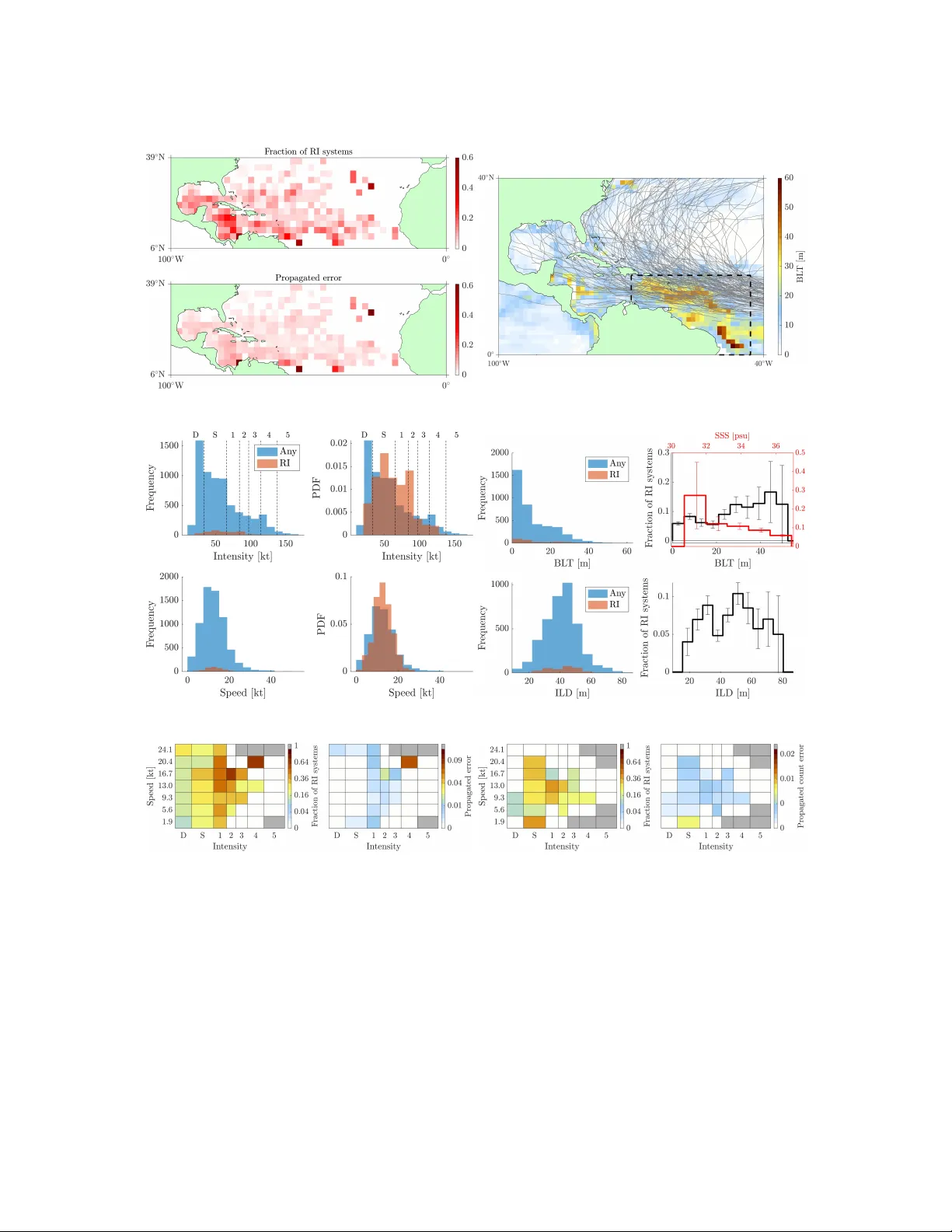
T ransition path theory insigh ts in to h urricane rapid in tensification F.J. Beron-V era ∗ Departmen t of A tmospheric Sciences Rosenstiel Sc ho ol of Marine, A tmospheric & Earth Science Univ ersit y of Miami Miami, Florida, USA fberon@miami.edu G. Bonner Morgridge Institute for Researc h Univ ersit y of Wisconsin Madison, Wisconsin, USA gbonner@morgridge.org M.J. Olascoaga Departmen t of Ocean Sciences Rosenstiel Sc ho ol of Marine, A tmospheric & Earth Science Univ ersit y of Miami Miami, Florida, USA jolascoaga@miami.edu S. Dong Ph ysical Oceanograph y Division A tlan tic Oceanic and Meteorological Lab oratory National Oceanic and A tmospheric A dministration Miami, Florida, USA Shenfu.Dong@noaa.gov 1 H. Lop ez Ph ysical Oceanograph y Division A tlan tic Oceanic and Meteorological Lab oratory National Oceanic and A tmospheric A dministration Miami, Florida, USA Hosmay.Lopez@noaa.gov Started: July 1, 2024; this v ersion: March 18, 2026. Abstract W e explore h urricane and o cean reanalysis data to understand how rapid in tensification (RI) of tropical cyclones is impacted b y the upp er o cean densit y structure, with an emphasis on barrier lay er (BL) thickness and thermo cline depth in the eastern Caribb ean Sea and adjacent w estern tropical North At- lan tic. This analysis lev erages transition path theory (TPT), supp orted b y basic statistical metho ds. In TPT, Mark ov chains are constructed by dis- cretizing data series related to weather system in tensity , c hanges in intensit y , translational sp eed, and BL thickness and thermo cline depth. These series are viewed as tra jectories in abstract state spaces, follo wing a memoryless sto c hastic pro cess. RI imminence is rigorously framed using a newly derived TPT statistic, which gives the time distribution to first reach a target—the RI state—from a source—for instance, the state determined by a certain BL range and system in tensity—conditional on connecting paths exhibiting mini- mal detours. Increased RI frequency is observ ed in the eastern Caribb ean and nearb y A tlantic, influenced b y riv er runoff, primarily in tropical storms and category 2 h urricanes. RI frequen tly correlates with a w ell-developed BL; ho w- ev er, increased translational sp eed is necessary for RI. TPT shows a stronger connection b et ween RI and thermo cline depth than BL presence, with RI like- liho od rising for hurricanes with a thin BL, esp ecially category 1. A cross all strength categories, a deep thermo cline consisten tly elev ates RI probabilit y , a factor missed b y basic statistical analysis. F urthermore, translational sp eed is crucial, with faster, stronger hurricanes more susceptible to RI, while slow er systems are less so. Keyw ords: Hurricane rapid intensification; Barrier la yer; Thermocline; T ransition path theory . ∗ Corresp onding author. 2 1 In tro duction The term b arrier layer (BL) refers to a la yer of comparativ ely lo w salinity w ater found b eneath a fresher surface lay er, primarily induced b y freshw ater influx from precipi- tation or riv er disc harge ( Go dfrey and Lindstrom , 1989 ). A BL induces pronounced and stable stratification, whic h effectiv ely imp edes vertical mixing pro cesses. In the eastern Caribb ean Sea and the adjacent w estern tropical north Atlan tic region, the o ccurrence of semip ermanen t BLs is largely attributed to freshw ater con tributions from the Orinoco and Amazon Rivers ( Muller-Karger et al. , 1988 ; Lentz , 1995 ; Corre- dor and Morell , 2001 ; Mignot et al. , 2007 ). This region is on the path of tropical cyclones, which often undergo r apid intensific ation (RI), defined as an increase in in tensity (maximum sustained winds) of 30 kt (1 kt = 1.8 km h − 1 ) within a day ( Gar- ner , 2023 ). The thermal structure of the ocean pla ys an essential role in the ev olution of these storms ( Shay et al. , 2000 ; Goni and T ri ˜ nanes , 2003 ; Halliwell et al. , 2015 ), and v arious studies ( Seroka et al. , 2017 ; Hlywiak and Nolan , 2019 ; Domingues et al. , 2021 ) suggest that the salinity structure, through the prop erties of BL, is exp ected to impact their RI. Strong stratification asso ciated with the BL may limit the co oling effect of up- w elled cold water ( Androulidakis et al. , 2016 ; Gro dsky et al. , 2012 ), potentially al- lo wing h urricanes to main tain or ev en increase their intensit y o ver time. This o ccurs b ecause the BL tends to trap warmer water, whic h can pro vide additional heat con- ten t to fuel h urricanes as they pass through. F ollowing this reasoning, the thickness of the BL should play an imp ortan t role in RI. A dditional factors like the depth of the thermo cline must not b e ignored, nor the intensit y and sp eed of the w eather systems. The hypothesis that the BL ma y influence the RI of tropical cyclones is not new and has b een explored in v arious studies, particularly in the tropical North P acific ( W ang et al. , 2011 ) and the Indian Ocean ( Neetu et al. , 2012 ). Some researc h ( Balaguru et al. , 2012 ) suggests that the BL is fa vorable to RI, while other studies ( Hern´ andez et al. , 2016 ) argue that it has minimal influence based on the analysis of a regional o cean n umerical sim ulation forced with realistic tropical cyclone winds. In the western tropical North Atlan tic, research fo cusing on individual cases ( Domingues et al. , 2015 ; R udzin et al. , 2019 ) also pro vides v aluable insigh t. Closer to our goal here, Balaguru et al. ( 2020 ), using an o cean reanalysis pro duct, demonstrate that b oth the upp er o cean thermal structure and sea surface salinit y play crucial roles in the RI pro cess. This pap er explores the impact of the density structure of the upp er ocean on RI using a combination of standard statistical metho ds and tr ansition p ath the ory 3 (TPT) ( V anden-Eijnden , 2006 ; E and V anden-Eijnden , 2006 ), all applied on historical h urricane and o cean reanalysis data in the eastern Caribb ean Sea and the nearby w estern tropical North A tlan tic. A practical framework for applying TPT is pro vided b y a Marko v c hain ( Metzner et al. , 2009 ), which is a sto c hastic mo del in which the next state of a dynamical system dep ends only on the current state, not the entire past. In our case, an appropriate Mark o v chain describ es ev olution in an abstract state space with coordinates c hosen to b e a cross section of relev ant data, namely , w eather system intensit y , intensit y c hange, translational sp eed, and along-system- path BL thickness and thermo cline depth. V arious c hains are constructed, each by discretizing trajectories in the corresp onding state space. A no v el TPT statistic is form ulated to rigorously c haracterize RI imminence. With a target represen ting the RI state, and a source defined by a giv en initial condition, for instance, characterized b y certain BL range or thermo cline depth and system intensit y , this newly developed TPT statistic pro vides the distribution of time required to first reach the target from the source, conditional on the connecting paths sho wing minimal detours. Our findings indicate that while RI often links with a w ell-developed BL, faster translational sp eed is needed for intensifying systems. TPT analysis highlights a stronger connection betw een RI and thermo cline depth than BL presence, with a thin BL increasing RI lik eliho o d. A deep thermo cline consisten tly b oosts RI probability across all strength categories, an asp ect o verlooked b y basic statistical methods. F aster, stronger hurricanes are more susceptible to RI, whereas slo wer ones are less so. Although RI t ypically ties to a thick BL and deep thermo cline, frequen t cases with a thin BL c hallenge initial assumptions. The remainder of the pap er is organized as follows. In Section 2 , we present the main datasets emplo yed in the study (Section 2.1 ) and define the time series on whic h the analysis will b e carried out, recalling definitions and establishing parame- ter settings (Section 2.2 ). The results of the analysis are presented in Section 3 , with Section 3.1 dev oted to a straightforw ard analysis using conv en tional statistical to ols, and Section 3.2 to the sp ecialized TPT analysis. A summary and conclusions are offered in Section 4 . App endix A reviews details of TPT, its main statistics including the remaining transition time, and the extension of TPT to op en dynamical systems. App endix B discusses ho w TPT is applied to the RI problem of interest here. Fi- nally , App endix C presents a deriv ation of a new TPT statistic, the distribution of transition times, which we use to c haracterize RI imminence. 4 2 Data 2.1 Main datasets The w eather system dataset used in this study is generated by the National Hurricane Cen ter (NHC) and is distributed b y the National Oceanic and A tmospheric A dmin- istration (NO AA) ( Landsea and F ranklin , 2013 ). The sp ecific dataset examined is the Atlan tic HURD A T2, which comprises 6-hour data on the lo cation, maximum winds, central pressure, and size of all documented tropical and subtropical w eather systems that even tually acquired hurricane classification. The data span the y ears 1851 to 2023, except for the size, whic h was recorded only starting in 2004. In this analysis, w e ha v e elected to consider data beginning in 1980, marking the onset of the satellite era. The temp erature and salinity fields used in our analyses are deriv ed from the Ocean Reanalysis System 5 (ORAS5) developed by the Europ ean Cen tre for Medium- Range W eather F orecasts (ECMWF). ECMWF ev aluates the state of the global o cean through its op erational system, OCEAN5 ( Zuo et al. , 2019 ). The OCEAN5 framew ork is a global eddy-p ermitting o cean-sea ice ensemble reanalysis–analysis system comprised of fiv e mem b ers. This system incorp orates a b ehind-real-time comp onen t that facilitates the pro duction of ORAS5. Building on its predecessor ORA5P ( Zuo et al. , 2015 ), ORAS5 offers a daily estimate of the historical state of the o cean from 1979 to the presen t, spanning 75 vertical lev els. F or the purp oses of this study , we ha ve c hosen to consider temp erature and salinit y fields within the spatial domain defined b y [100 ◦ W,40 ◦ W] × [0 ◦ ,40 ◦ N], corresp onding to the temp oral range 1980–2023, which aligns with the p erio d of the h urricane data. 2.2 Preliminary data preparation T o prepare for the v arious analyses, w e b egan by computing BL thickness (BL T) as ( de Bo y er Montegut et al. , 2007 ) BL T = ILD − MLD . (1) Here, ILD ( isothermal layer depth ) is the depth where the temp erature has decreased b y 0.5 ◦ C from a 5-m reference depth and MLD (mixed-lay er depth) is the depth where the density has increased by 0.125 kg m − 3 relativ e to surface density . Sp ecifics p ertaining to the selection of thresholds are detailed in Zhang et al. ( 2022 ). The densit y profiles are calculated from the temp erature and salinity profiles according to the In ternational Thermo dynamic Equation of Sea water - 2010 (TEOS10) ( Millero 5 W eather system A cronyms In tensity [kt] T ropical depression TD, D ≤ 33 T ropical storm TS, S 34–63 Category 1 hurricane Cat 1, 1 64–82 Category 2 hurricane Cat 2, 2 83–95 Category 3 hurricane Cat 3, 3 96–112 Category 4 hurricane Cat 4, 4 113–136 Category 5 hurricane Cat 5, 5 ≥ 137 T able 1. Classification of weather systems according to in tensity . et al. , 2008 ) as implemen ted in the Gibbs-SeaW ater (GSW) Oceanographic T o olb o x ( McDougall and Barker , 2011 ). The v arious hydrographic v ariables w ere subsequen tly linearly in terp olated along the trajectories of the w eather systems. F urthermore, w e computed time series of the v ariation of In tensity—maxim um wind sustained by a system along its track—o v er a 24-hour p eriod, whic h we lo osely term Acceleration. This resulted in five primary and distinct time series for examination: BL T( t ), IDL( t ), Intensit y( t ), Acceleration( t ), and Sp eed( t ), with the latter referring to the translational speed of the system. Each time series consists of data points sampled regularly at 6-hour interv als. Sea surface salinity (SSS) is excluded from the analysis b ecause it closely corre- lates with BL T( t ) concerning RI, as will b e demonstrated. Th us, it is unnecessary to consider this separately . RI is defined by the condition Acceleration > 30 kt/da y , whic h corresp onds to an increase in the intensit y of the weather system b y 30 kt within one da y , as p er the con ven tion ( Garner , 2023 ). Consequen tly , the Acceleration( t ) time series is trans- formed into a binary sequence comprising zeros during p eriods lacking RI and ones during phases of active RI. W e ha v e c hosen to prop ose the existence or significant formation of a BL when BL T > 5 m. This choice ensures that small measuremen t errors are unlikely to accum ulate and suggest the presence of a BL when none exists. V ariations around this threshold do not impact the results. In the follo wing sections, weather systems are classified according to the in tensit y ac hieved along their tra jectories, as indicated in T able 1 according to the con ven- tionally applied Saffir–Simpson scale ( Kan tha , 2006 ). 6 3 Results 3.1 Straigh tforw ard statistical analysis W e start by conducting a straightforw ard calculation of the ratio betw een the num b er of weather systems that hav e undergone RI at some point within a sp ecified 1 ◦ × 1 ◦ grid b o x and the total n um b er of weather systems that tra verse that grid. F or simplicit y , this ratio is referred to as fr action of RI systems . This is depicted in the upp er panel of Fig. 1 a, while the low er panel illustrates the uncertain ty asso ciated with this count, calculated b y error propagation. The uncertain ty for a coun t is often appro ximated as Poisson, δ n ≈ √ n . F or a quantit y of interest defined as the fraction f ( n, N ) = n/ N , where n is the n umber of samples b elonging to a given class out of a total of N samples, the uncertaint y is estimated using a binomial mo del. In this setting, n is a subset of N , so the t wo counts should not b e treated as indep enden t. The resulting uncertaint y in f is δ f = s f (1 − f ) N = s n ( N − n ) N 3 , (2) whic h we displa y for future reference. The computation of the fraction of RI systems pro vides evidence that the Caribb ean Sea and the adjacent tropical Atlan tic are regions where RI o ccurs. In the subsequen t analysis within this section and the sp ecialized probabilistic assessmen t in the following section, w e fo cus on the tra jectories of w eather systems that ha ve tra versed the region outlined b y the dashed line in Fig. 1 b. This particular area has b een selected due to its direct influence from freshw ater discharge from the Orino co and Amazon riv ers, making it especially prone to the formation of barrier la yers. The figure illustrates the system tracks that fulfill the stated condition, o verlaid on the BL T on a randomly c hosen day , 15 July 1999. Note the pronounced BL, which exhibits a thic kness of up to 60 m. It is systematically organized in a plume-lik e configuration, originating from the area near the mouth of the Amazon Riv er. Although not all systems adv ance in to the Caribb ean Sea, a significant n umber do so. By fo cusing on the weather systems with corresponding tracks depicted in Fig. 1 b, w e calculated histograms and probability density functions (PDF s) for along-track In tensity and Speed, irresp ectiv e of whether RI o ccurred or the timing of such even ts. These analyses are sho wn in the top and b ottom panels of Fig. 1 c. The lab el “Any” refers to scenarios regardless of whether RI o ccurs, while the lab el “RI” denotes the cases where RI o ccurs. The primary observ ation is that RI is observ ed in appro xi- mately 5% of the instances. This percentage ma y seem small, but it is imp ortan t to 7 (a) (b) (c) (d) (e) (f ) Figure 1. (a) F raction of weather systems exhibiting RI in the A tlantic Ocean (top) and prop- agated uncertain ty (b ottom). (b) Ov erlaid on BL thickness on 15 July 1999, a subset of system trac ks considered in this study . (c) Histogram (left) and PDF (right) of along-track intensit y (top) and translational sp eed (b ottom). (d) Histogram of along-trac k BL thickness (top left) and ther- mo cline depth (b ottom left) and fraction of systems exhibiting RI for given BL thickness and sea surface salinity (top right) and thermo cline depth (b ottom right). (e) F raction of systems exhibit- ing RI (left) and propagated error (righ t) as a function of sp eed and intensit y with BL present. (f ) Same as (e) , but with BL absent. 8 realize that it does not reflect the relativ e num b er of systems that experienced RI, whic h is appro ximately 40%, consistent with previous ev aluations ( Lee et al. , 2016 ). Rather, it reflects the relative times along a system trac k ov er the entire collection of trac ks that RI is experienced. With this clarification in mind, when fo cusing on in tensity , we group ed it b y system category , revealing that RI is detected more fre- quen tly in tropical storms (S) and up to category 2 h urricanes (2). With respect to sp eed, no significant differences are apparen t when fo cusing exclusively on systems exp eriencing RI. Regardless of the o ccurrence of RI, the PDF of Sp eed consisten tly displa ys a narro w distribution cen tered around 12.5 kt. Based on our earlier hypotheses, w e exp ect that analyzing along-trac k BL T and ILD data will b e particularly rev ealing. With this exp ectation, w e ha ve computed histograms for these v ariables that are depicted in the top and b ottom-left panels of Fig. 1 d. These are presen ted by categorizing scenarios where RI has o ccurred (“RI”) and all scenarios regardless of RI o ccurrence (“Any”). Giv en the rarity of RI, it is p erhaps unsurprising that these histograms highlight the ob vious conclusion: w eather systems t ypically sample o cean regions with an ILD ranging from 20 to 60 m, and a thin barrier la yer—a common scenario. More insigh tful, ho wev er, is the ratio of RI systems—the prop ortion of systems undergoing RI at an y given time relativ e to all systems—in relation to BL T and ILD. These plots suggest a connection b et w een RI even ts and the presence of a BL. A similar analysis of SSS suggests that RI even ts tend to o ccur at low SSS levels and when the barrier la yer is thick. This is demonstrated b y the prop ortion of RI systems peaking at BL T ≈ 50 m and SSS of ab out 32 psu. This supp orts earlier comments, indicating that low SSS serves as an indicator of a well-dev elop ed BL. In contrast, the relationship b et ween RI and ILD sho ws no discernible trend in the prop ortion of systems that undergo RI as a function of ILD. This con tradicts the exp ectation that a greater thermo cline depth, that is, a large ILD, would increase the lik eliho o d of RI b y providing more energy for w eather systems in the w ater column. How ev er, we ac knowledge that these findings ha ve significant uncertaint y , primarily due to limited data a v ailabilit y . W e ha v e p erformed an additional computation on the fraction of RI systems within the Intensit y vs. Sp eed space, b oth in the presence (BL T > 5 m; cf. Section 2.2) of a BL (Fig. 1 e) and its absence (Fig. 1 f ). In the presence of a BL, a seemingly linear relationship betw een Sp eed and Intensit y is observ ed, whic h aligns with the h yp othesis discussed in the Introduction. Our results indicate that for a strong w eather system to undergo RI, it must mo ve sufficien tly fast to minimize its impact on the BL. In other w ords, a strong system that remains stationary for an extended p eriod will ero de the BL by dra wing up co oler w ater, thereby hindering its c hances of intensification. In contrast, for a weak system, breaching the BL b ecomes more 9 difficult despite moving slo wly , preserving its p oten tial for RI. In scenarios where BL is absent or significan tly thin (BL T < 5 m), no clear relationship b et ween In tensity and Speed is observ ed. In summary , the statistical analysis of this section indicates a comparatively elev ated frequency of rapid RI in the Caribbean Sea and the nearb y tropical A tlantic, influenced by freshw ater from river runoff. It sho ws that RI o ccurs primarily in tropical storms and category 2 h urricanes. With a w ell-developed BL, RI is generally fa vored, alb eit with large uncertaint y . How ev er, as systems b ecome more intense, they must also mo ve more quickly to exp erience RI. Without a B L, there is no clear relationship b et ween strength and translational speed that pro vides fa v orable conditions for RI. Although limited b y data a v ailabilit y , the sp ecialized probabilistic analysis in the next section identifies a hidden link b et ween RI and thermo cline depth. This connection is not evident in the basic statistical analysis and pro ves to b e more critical than the presence of a BL, contrary to previous exp ectations. 3.2 T ransition path theory analysis Giv en that the incidence of RI along a system trac k is relatively infrequen t, compris- ing approximately 5% across the en tire ensem ble of tracks, RI can b e conceptualized as a r ar e event . This observ ation mak es it suitable for analysis using adv anced prob- abilit y theory to ols designed to manage its complexities. One such to ol is tr ansition p ath the ory (TPT), which comprises a set of statistics that can be calculated to in ves- tigate pr o ductive path w ays, generally sho wing minimal detouring, b et w een regions of in terest in state space ( E and V anden-Eijnden , 2006 ; V anden-Eijnden , 2006 ; Metzner et al. , 2006 ; Helfmann et al. , 2020 ). A conv enien t framew ork for implementing TPT is a Markov chain ( Norris , 1998 ; Br ´ emaud , 1999 ). A Marko v c hain is a stochastic pro cess in whic h the likelihoo d of the system b eing in a sp ecific state at the next time step is solely influenced by the current state and the giv en transition proba- bilities. T ransition path w ays are computed under the condition that the transition b et w een a given sour c e and tar get region is forthc oming . Hence, if we c ho ose a target region in an abstract space defined by a state characterized b y a particular range of in tensities of the weather system, as classified in T able 1 and considered in the preceding statistical analysis, we can study the transitions b et ween this state and the rare state characterized b y systems exp eriencing RI explicitly . The calculation pro ceeds in t wo main steps: 1. w e construct a Mark o v c hain on states corresponding to discretized b oxes cov- ering the phase space defined b y observ ations, and 10 2. w e define a set of source and target states in this Marko v chain and calculate the relev ant TPT statistics. Here w e giv e a high-lev el o v erview of these calculations—refer to App endices A – C for further details. Let us b egin b y recalling that a Marko v chain in discrete time and space is a sequence of random v ariables { X n } n ∈ Z defined on a space S ⊆ N suc h that Pr( X n +1 = j ) = X i ∈ S P ij Pr( X n = i ) , P ij := Pr( X n +1 = j | X n = i ) , (3) where Pr stands for probabilit y . W e call the matrix P = ( P ij ) i,j ∈ S a tr ansition matrix . W e will assume that there exists a probability vector π = ( π i ) i ∈ S , P i ∈ S π i = 1, called a stationary distribution , such that it is inv ariant, i.e., π = π P , and limiting, i.e., π = lim k →∞ v P k for any probabilit y v ector v . F urthermore, the Mark o v c hain will b e assumed to be in stationarit y , that is, Pr( X n = i ) = π i . T o construct P , we view our observ ational data, namely , the fiv e records of along- w eather-system-track BL T( t ), ILD( t ), Speed( t ), A cceleration( t ), and Intensit y( t ), as series of short-range tra jectories, eac h with a duration of 6 hours. F or each weather system, every pair of time-adjacen t observ ations defines the initial and final p oints for this tra jectory , and the totalit y of these ov er all w eather systems defines the main dataset. W e co v er the space of this dataset by rectilinear b oxes in the appropriate dimension with the understanding that each b o x corresp onds to a single state in the Mark ov chain. Then, P ij is constructed by straightforw ard mem b ership accounting: P ij ≈ n umber of tra jectories in b o x i that end up in b o x j n umber of tra jectories in b o x i . (4) W e take special care to define a privileged b o x that collects all tra jectories that happ en to tak e place during an RI ev ent. This naturally leads to the definition of a target B exactly equal to this RI state. If w e choose our partition of the observ a- tional data suc h that along the dimension corresp onding to Intensit y the b o xes hav e width aligning with weather systems of sp ecific class, then w e can choose our source A to intersect with the set of b o xes in a particular class of weather systems. There- fore, we have a Markov chain with tr ansition pr ob ability matrix P ij c ompute d dir e ctly fr om the data, i.e., the time series BL T( t ) , IDL( t ) , Sp eed( t ) , Acceleration( t ) , and In tensity( t ) , as wel l as definitions for a sour c e A , c orr esp onding to a given we ather system class, and a tar get B , c orr esp onding to RI. W e can no w apply TPT to calcu- late statistics on pro ductiv e tra jectories from A to B . W e are primarily interested in tr ansition times , that is, w e w ould like to construct a ranking of weather systems by class according to whic h systems hav e the highest 11 probabilit y of undergoing RI the most imminently . One wa y to build this ranking is b y calculating the expected v alue of a random v ariable equal to the first time that the target B —the RI state—is visited b y the Marko v c hain in b o x i , conditional on its tra jectory b eing pro ductiv e. This TPT statistic, denoted as t i B , w as introduced in Bonner et al. ( 2023 ); its computational formula is outlined in Eq. ( A.17 ). One limitation of t i B is that the distribution of the first visit time ma y hav e a very long tail—far longer than the lifetime of the w eather system—and hence lead to exp ected v alues that are unreasonably large. T o resolv e this limitation, we prop ose to compute the distribution of the time t taken by pr o ductive tr aje ctories flowing out fr om A to first visit B . W e denote the asso ciated cumulativ e distribution function (CDF) b y C AB ( t ). In this w ay , C AB ( t ) is a measure of the probabilit y that RI o ccurs (conditionally) in a time not greater than t . This is a new TPT statistic that w e in tro duce in this pap er. Its computational formula is provided in Eq. ( C.19 ), along with a formal definition and a detailed deriv ation ab o ve. Figure 2 sho ws C AB ( t ) for eac h weather system class, derived from Mark ov c hains using three tw o-dimensional data cross sections: (BL T, In tensity), (ILD, Intensit y), and (Sp eed, Intensit y). F or the (BL T, In tensity) section, we define the source set A as the union of the partition b o xes that corresp ond to a given Intensit y while co vering all BL T b o x v alues. This pro cess is done similarly for ILD and Sp eed. The shading surrounding the curves represents the uncertaint y that results from the propagation of the error in estimating the transition matrix of the c hain P by coun ting, as describ ed in Eq. ( 4 ), as follows. Let δ P ij represen t the propagated error of P ij = n ij /n i , whic h is calculated according to formula ( 2 ) utilizing n = n ij and N = n i . Subsequen tly , t wo matrices P ± δ P are derived. Let C AB ( t )[ P ] indicate that this TPT statistic is deriv ed from P . The corresp onding error is then determined as δ C AB ( t )[ P ] = 1 2 C AB ( t )[ P − δ P ] + C AB ( t )[ P + δ P ] . T o understand Fig. 2 , it is imp ortan t to ac kno wledge that C AB ( t ) is c onditional on RI o c curring . F or example, the left panel of Fig. 2 , whic h p ertains to the (BL T, In tensity) cross section of the data, do es not imply that approximately 40% of Cat 1 systems will undergo RI in a 6-hour window. Inste ad, this indic ates that for Cat 1 systems c ommitte d to exp erienc e RI in the futur e, ab out 40% achieve it within a 6-hour p erio d. T aking this in to account, it is feasible to establish a general ranking of RI imminenc e based on the heigh t of the corresp onding C AB ( t ). This implies that Category 1 systems are the most lik ely to imminen tly undergo RI. This finding is consistent with earlier rep orts based on different assessments ( Y an et al. , 2017 ), whic h found that mo derate-strength systems benefit the most from BL presence. In terms of the imminence of undergoing RI, the TPT analysis rev eals that Cat 1 systems are follo w ed by TS systems, then Cat 2 systems, and subsequently other classifications of w eather systems. This ranking is 12 Figure 2. (left panel) CDF s of conditional RI times in a three-day windo w for eac h weather system class from a Marko v c hain generated b y trajectory data in (BL T, Intensit y)-space. The v alue of the CDF on the vertical axis is the probability that conditional RI o ccurs on or b efore the corresp onding time on the horizon tal axis. (middle panel) As in the left panel, with a Marko v chain generated by tra jectory data in (ILD, In tensity)-space. (righ t panel) Similar to the left panel, but in (Speed, Intensit y)-space. The shaded areas around the curves represent the uncertaint y due to error propagation in estimating transition probabilities through coun ting, as explained in the text. quite consistent across the (BL T, Intensit y) and (ILD, In tensity) data cross-sections. Ho wev er, the (Sp eed, In tensity) cross section generally sho ws low er C AB ( t ) v alues. It is imp ortan t to note that eac h data cross section undergoes a distinct Mark ov chain reduction, resulting in v ariations in stationary distributions π ; th us, uniformity across C AB ( t ) distributions should not b e exp ected. Although the previous analysis offers new insigh ts in to the RI problem, it ov er- lo oks the in teraction with the densit y structure of the water column trav ersed b y a w eather system. T o examine the effects of BL T and ILD, we first consider them in- dep enden tly of the strength of the w eather system. Sp ecifically , we calculate C AB ( t ) where B is the rapid intensification state as before, but now A is the set of states cor- resp onding to all boxes with a giv en range of BL T in (BL T, In tensity)-space (Fig. 3 , left panel) and similarly for ILD in (ILD, Intensit y)-space (Fig. 3 , righ t panel). Large v alues of C AB ( t ) therefore correspond to imminent RI for w eather systems in a par- ticular range of BL T or ILD v alues a veraged ov er all intensities. Insp ection of Fig. 3 suggests that RI is more imminen t for larger v alues of ILD, consistent with exp ec- tations, but w e note it o ccurs when the BL is thin, contrary to initial exp ectations and the results of the previous section. 13 Figure 3. As in Fig. 2 , but for eac h BL T (left panel) and ILD (righ t panel) box v alues of the Marko v c hain constructed using tra jectory data in (BL T, Intensit y) and (ILD, Intensit y)-space, resp ectiv ely . T o better understand these results, we examine Pr( X 1 = RI | X 0 = i ), the probabilit y of undergoing RI in the first step of the Marko v chain, i.e., after 6 hours ha ve elapsed, with an initial state i corresp onding to a giv en b o x in (BL T, In tensity)- space (Fig. 4 , left panel) and (ILD, Intensit y)-space (Fig. 4 , right panel). Analyzing the left panel of Fig. 4 , Pr( X 1 = RI | X 0 = i ) generally maximizes along rows with low BL T v alues. Since the stationary distribution ( π ) of the Marko v chain for the BL T vs. Intensit y data cross section (Fig. 5 , left panel) maximizes when the BL is thin, lik ely due to the data concen tration there, maximization of Pr( X 1 = RI | X 0 = i ) for small BL T suggests high connectivit y of these states with the RI state. The definition of C AB ( t ) implies that X 1 / ∈ A , hence C AB ( t = 6 h) dep ends directly on Pr( X 1 = RI | X 0 = i ) weigh ted by π o ver i ∈ A . In tuitively , short-term imminence will of course b e largest for A with the highest connectivity to the RI state. This app ears to explain the tendency of C AB ( t ) to maximize for A corresp onding to lo w BL T. Similar reasoning can explain the tendency of C AB ( t ) to maximize for A corresp onding to high ILD. Note the tendency , though less pronounced, for Pr( X 1 = RI | X 0 = i ), in the right panel of Fig. 4 , to maximize often along ro ws with high ILD v alues, where the stationary distribution (Fig. 5 , right panel) also tends to maximize, lik ely due to data concentration there. In turn, the results when A = { Intensit y = const } , 14 as shown in Fig. 2 , find an analogous interpretation, in this case more eviden tly , with high connectivit y in the second and third columns of the left panel of Fig. 4 . Note that the tendency of C AB ( t ) to maximize for A corresp onding to Cat 1 weather systems is consisten t with Pr( X 1 = RI | X 0 = i ) typically maximizing along the column asso ciated with the In tensity of such systems. The inferences just made are not exempt from uncertaint y , which can b e large as sho wn in the b ottom panels of Fig. 4 . Computing imminence with source states A that av eraged out a particular v ari- able allo wed us to get a general picture of the factors that influence RI. How ever, this calculation strongly dep ends on ho w the initial distribution is c hosen and is less applicable to individual weather systems. In order to study the imminence b e- ha vior of an arbitrary system more closely , we restrict the size of A to a single b ox and compute the conditional transition time for RI. Figure 6 presents heatmaps of the C AB ( t ) v alues deriv ed from a (BL T, In tensity) cross section across 24- and 48- hour windows. These are accompanied by the corresp onding error metrics that arise from error propagation encoun tered during the estimation of transition probabilities through coun ting, as previously explained. In Fig. 6 a, w e see that the most imminen t transitions to RI tend to occur for low- to medium-in tensity systems, say TS to Cat 1–2 systems. This happ ens mostly indep enden t of the thic kness of the BL; how ev er, there is some preference for states with a thinner BL. These findings do not fully align—although they do not contradict either—with the an ticipated effect of BL presence and RI, whic h w as previously corrob orated through the statistical analysis of the preceding section, alb eit in an aggregated manner that did not differen tiate b y weather system class (Fig. 1 d, top-righ t panel). The curren t analysis, whic h dis- tinguishes b y system class, rev eals p oten tial deviations from the exp ected b eha vior, somewhat consisten t with the results sho wn in Fig. 3 obtained by av eraging across w eather system strength. This is evidenced b y the observed p eak in RI imminence cen tered around Cat 1 systems with a thin BL. Figure 7 presents a somewhat more consistent trend through a plot analogous to Fig. 6 , fo cusing instead on a (ILD, Intensit y) cross section. The analysis sho ws that, irresp ectiv e of the intensit y of the weather system ranging from TS to Cat 1–2, the imminence of RI tends to p eak in states characterized b y a generally deep IL. F urthermore, the imminence of RI is enhanced in states where the ILD is large compared to those c haracterized b y a thick BL T. This finding is significan t b ecause it w as not p ossible to discern any trends using the statistical analysis p erformed in the previous section (Fig. 1 d, bottom-right panel), th us demonstrating the significance of the TPT analysis used in the curren t section. An additional analysis on ho w translational sp eed affects the RI imminence of 15 Figure 4. The probability of undergoing RI in the initial step (i.e., after 6 hours) conditional on the Mark ov c hain starting in eac h b o x of (BL T, Intensit y)-space (top-left panel) and (ILD, In tensity)-space (top-right panel). Uncertain ties from error propagation in estimating transition probabilities are sho wn in the b ottom panels. w eather systems was conducted, resulting in the heatmaps sho wn in Fig. 8 a. These plots, similar to those in Fig. 6 , are based on a (Sp eed, Intensit y) cross section. The heatmaps illustrate that, with the exception of TS systems, a w eather system is most imminently sub ject to RI when it exhibits sufficient translational sp eed. This phenomenon is particularly pronounced in high-strength weather systems, sp ecifi- cally those classified as Cat 2 to 5. These TPT inference align quite well with the 16 Figure 5. Stationary distribution of the Marko v c hain in (BL T, Intensit y)-space (top-left panel) and (ILD, Intensit y)-space (top-righ t panel). exp ectation that a stationary strong system has more opp ortunit y to ero de the BL and even tually the thermo cline b elo w than one mo ving rapidly through the region. In order for RI to o ccur, it is essen tial that a weather system progresses rapidly to inhibit this erosion and the consequent decay , as evidenced by the TPT analysis. This also supp orts the statistical analysis from the previous section (Figs. 1 e). The TPT analysis further rev eals that the RI imminence is not negligible for slow-mo ving systems that are weak, sp ecifically for TS to Cat 1 systems. The results from the final analysis are presen ted in Fig. 9 , highlighting RI im- minence indep enden t of the strength and sp eed of w eather systems. Sp ecifically , this figure shows heatmaps of C AB ( t ) v alues derived from a (BL T, ILD) cross-section across 24- and 48-hour windows. It is observ ed that systems of an y category , regard- less of their sp eed, generally tend to exp erience RI when the BL is thick and the thermo cline is deep. How ev er, there is a significant probabilit y of imminen t RI when the BL is thin and the thermo cline is not to o deep, contrary to exp ectations. In summary , the TPT analysis shows that medium-intensit y weather systems, esp ecially Cat 1, ha ve the highest lik eliho od of RI regardless of the thic kness of the BL, thermocline depth, or translational sp eed. This aligns with assessmen ts reported earlier ( Y an et al. , 2017 ). The TPT analysis further highlights a tendency for RI to o ccur when the thermo cline is deep, a result not evident from basic statistical analysis. Surprisingly , a thin barrier lay er also maximizes RI imminence. This is 17 Figure 6. Heatmap showing the conditional RI probability ov er a 24-hour (top-left panel) and 48-hour (top-righ t panel) window, derived from a Marko v chain on a (BL T, Intensit y) cross sec- tion. Eac h b o x is treated as an independent source A . The b ottom panels depict the asso ciated uncertain ties, caused by error propagation in estimating transition probabilities through counting. explained by a stronger link b et ween deep thermo clines and thin BLs to the RI state in the Marko v chain. F ast-moving systems (Cat 2 to 5) are more prone to RI, aligning with expectations that they disturb the w ater column less. Slow-mo ving systems (TS to Cat 1) ha ve a low er RI lik eliho o d. Generally , RI happ ens with a thick BL and deep thermocline, though it can o ccur with a thin BL, con trary to expectations. 18 Figure 7. Similar to Fig. 6 , but the Marko v c hain is constructed on a (ILD, In tensity) cross section. 4 Summary and conclusions In this pap er, w e applied tw o t yp es of analyses on hurricane and reanalyzed hydro- graphic data to explore the relationship b et ween rapid intensification (RI) and upper o cean density structure, as characterized by the thickness of the barrier lay er (BL) and the depth of the thermo cline. One analysis inv olv ed a straightforw ard statisti- cal examination of v arious time series that represen t the weather system’s strength, translational speed, and rate of change of strength, con trasted with BL thic kness and 19 Figure 8. As in Fig. 6 , but for a Marko v chain constructed on a (Sp eed, Intensit y) cross section. thermo cline depth interpolated along system paths. The other analysis w as a sp ecial- ized probabilistic approach based on transition path theory (TPT), whic h frames RI imminence by reducing the time series view ed as tra jectories in differen t state spaces (cross sections of the data) in to Marko v c hains. RI imminence is characterized by a newly deriv ed TPT statistic, whic h represents the probability distribution of the time tak en to first visit a target, corresp onding to the RI state, from a source, as defined b y a specific state in a given data cross section, conditional on the connecting paths being pro ductiv e, i.e., sho wing minimal detours. The direct statistical analysis highlighted a comparatively elev ated frequency 20 Figure 9. As in Fig. 6 , but for a Marko v chain constructed on a (BL T, ILD) cross section. of RI in the Caribb ean Sea and nearb y tropical Atlan tic, influenced by fresh w ater from river runoff. It shows that RI o ccurs primarily in tropical storms and cate- gory 2 hurricanes. With a w ell-developed BL, RI is generally fav ored, alb eit with large uncertaint y . Ho w ever, as systems b ecome more intense, they m ust also mo ve more quic kly to experience RI. Without a BL, there is no clear relationship b et ween strength and translational sp eed that provides fa vorable conditions for RI. Although limited b y data av ailability , the TPT analysis iden tifies a hidden link b et w een RI and thermo cline depth. This connection pro ved to b e more critical than the presence of a BL, contrary to previous exp ectations. 21 Sp ecifically , the TPT analysis has rev ealed that regardless of the thickness of the BL, thermocline depth, or translational sp eed of the w eather system, medium- in tensity w eather systems—dominated b y category 1 hurricanes, follo wed b y tropical storms and category 2 hurricanes—ha v e the highest probabilit y of undergoing RI when they are committed to it. F or w eather systems av eraged across strength cate- gories, RI is most lik ely to occur imminen tly when the thermo cline is deep. Although this result aligns with exp ectations, it w as not discernible through the basic statis- tical analysis conducted in the previous section. Contrary to exp ectations, it was found that the likelihoo d of RI is maximized when the BL is thin. These findings are explained by the stronger direct connection of deep thermo cline and thin BL regions to the RI state in the Mark ov c hain. After narrowing the initial distribution to a single b o x in the chain, we again observ ed the largest 24- and 48-hour imminence v alues when the thermo cline is deep. Computing RI imminence with initial distribu- tions not spanning multiple states rev ealed a tendency for RI to o ccur imminently when the BL is thic ker, aligning with exp ectations. How ev er, category 1 hurricanes sho wed a strong tendency to imminen tly undergo RI when the BL is quite thin. The TPT analysis iden tified translational speed as a significan t discriminativ e parameter. It sho wed that fast-moving weather systems, particularly the stronger ones (category 2 to 5 h urricanes), are more likely to undergo RI, aligning with exp ectations that these systems cause minimal disturbance to the w ater column, thereby reducing the c hances of strength decay . The analysis also indicated that slo w-moving, w eaker systems (tropical storms to category 1 hurricanes) can experience RI, but it is m uc h less lik ely . Finally , regardless of the system’s strength and translational sp eed, RI t ypically o ccurs with a thick BL and deep thermo cline. How ev er, RI can often o ccur ev en with a thin BL. Con trary to initial exp ectations ( Balaguru et al. , 2020 ), our results corresp ond with mo deling studies that suggest the BL plays a limited role in RI ( Hern´ andez et al. , 2016 ). Nonetheless, our results are p ossibly constrained by the scarcity of in-situ ob- serv ations, whic h affects the ORAS5 o cean reanalysis data used here. Comparisons of temp erature and salinit y v ertical profiles from ORAS5 with those collected by the Global Ocean Ship-Based Hydrographic Inv estigations Program (GO-SHIP) ( Slo yan et al. , 2019 ) show reasonable agreemen t in the western tropical North A tlantic near the eastern Caribb ean. Still, significant discrepancies in surface and subsurface salin- ities are apparen t in the eastern Caribb ean. This reveals p oten tial limitations of the reanalysis pro ducts in this region and highlights the necessit y for more in-situ obser- v ations. 22 A c kno wledgmen ts W e sincerely thank Gusta v o Jorge Goni for his constan t supp ort and commitment to fundamental researc h. FJBV, GB, and MJO received financial supp ort from the Univ ersity of Miami’s Co op erativ e Institute for Marine and Atmospheric Studies. HL and SD w ere supported b y NOAA’s A tlantic Oceanographic and Meteorological Lab oratory (AOML) and the Global Ocean Monitoring and Observing (GOMO) Program. A v ailabilit y a v ailabilit y statemen t The NO AA’s NHC HURD A T2 hurricane intensit y and sp eed records are av ailable from https://www.nhc.noaa.go v/data/ . The ECMWF’s ORAS5 reanalysis data are distributed via https://www.ecm wf.in t/en/forecasts/dataset/o cean-reanalysis- system-5/ . The GWS Oceanographic T o olb o x resides at http://www.teos-10.org/ soft ware.h tm . The transition path theory analysis was carried out using the Julia pac kages UlamMetho d.jl and T ransitionPathTheory .jl developed by GB with supp ort from NSF under grant OCE2148499. A T ransition P ath Theory (TPT) A.1 Reduction of the dynamics in to a Mark o v c hain W e consider data sets consisting of disconnected trajectories { x 1 ( t ) , x 2 ( t ) , . . . , x M ( t ) } in X ⊂ R n . Each tra jectory is sampled at regular time in terv als ∆ t . W e assume that each tra jectory is produced b y the same underlying stationary r andom pr o c ess . W e can then think of the existence of an autonomous dynamical system Φ, non- deterministic in nature, which acts on the phase space X , representing a measure space equipp ed with normalized Leb esgue measure m , such that Φ( x ) is an X -v alued r andom variable ov er some implicitly given probability space, with probabilit y mea- sure P ( Sc h ¨ utte et al. , 2016 ). Let f ∈ L 1 ( X ) b e (almost-ev erywhere) nonnegative and normalized such that R X f ( x ) m ( dx ) = 1. W e call such a function a density . Let K ( x, y ) : X × X → R + , suc h that R X K ( x, y ) m ( dy ) = 1 for all x ∈ X , be the sto chastic kernel of Φ. That is, P (Φ( x ) ∈ A ) = R A K ( x, y ) m ( dy ), where A is a subset of (the σ -algebra of ) X . This means, in other w ords, that Φ( x ) is distributed as K ( x, · ) or Φ( x ) ∼ K ( x, · ). Then w e can define the Perr on–F r ob enius op er ator , broadly known as a tr ansfer op er ator , P : L 1 ( X ) → L 1 ( X ) as ( Lasota and Mac key , 23 1994 ) P f ( y ) = Z X f ( x ) K ( x, y ) m ( dx ) . (A.1) This op erator describ es ho w an initial densit y is pushed forward by the underlying sto c hastic dynamics. W e can study the action of Φ numerically b y discretizing P using the known tra jectory data. The most widely used discretization scheme is Ulam’s metho d ( ? ). Consider a partition X of X given b y the disjoin t union of connected b o xes { B 1 , B 2 , . . . , B N } and let 1 S ( x ) b e the indicator function on the set S , which giv es 1 when x ∈ S and 0 otherwise. Ulam’s metho d can b e interpreted as a Galerkin pro jection of P onto the subspace spanned b y { 1 B 1 , 1 B 2 , . . . , 1 B N } . By c ho osing basis functions { m ( B i ) − 1 1 B i ( x ) } , w e ha ve that the discretization of P is an N -dimensional linear op erator P given b y a matrix ( P ij ) ∈ R N × N suc h that P ij is the conditional proba- bilit y of transitioning from B i to B j . Since P acts on { m ( B i ) − 1 1 B i ( x ) } , by Eq. ( A.1 ) w e ha ve ( Miron et al. , 2019a , b ) P ij = Z B j P 1 B i ( x ) m ( B i ) m ( dx ) = 1 m ( B i ) Z B i Z B j K ( x, y ) m ( dx ) m ( dy ) . (A.2) The matrix P is a row-stochastic tr ansition matrix whic h is the discretized analogue of K ( x, y ). Note that the factor m ( B i ) − 1 in the choice of basis functions is what ensures that P is (row) sto c hastic. F or computational purp oses, we appro ximate Eq. ( A.2 ) in terms of the tra jectory data as ( Miron et al. , 2019a , b ) P ij ≈ P M m =1 P t 1 B i ( x m ( t )) 1 B j ( x m ( t + T )) P M m =1 P t 1 B i ( x m ( t )) , (A.3) where T is some multiple of ∆ t . The transition probability matrix P defines a Markov chain on N b o xes representing its states . More sp ecifically , the i th state is thought of as a delta distribution of (probability) mass lo cated at the cen ter of box B i . A.2 The main ob jects of TPT Here we presen t the cen tral results of TPT; additional details can b e found in ( E and V anden-Eijnden , 2006 ; V anden-Eijnden , 2006 ; Metzner et al. , 2006 ; Helfmann et al. , 2020 ). T o b egin, let S = { 1 , 2 , . . . , N } represent a finite state space. Let in addition X n represen t, at discrete time n , an S -v alued random v ariable o v er an implicitly given probability space, with probability measure giv en b y Pr. Consider the discrete Mark o v chain { X n } n ∈ Z with ro w-sto c hastic transition probabilit y matrix 24 P = ( P ij ) i,j ∈ S . It is assumed that the Mark ov chain is b oth ergo dic (irreducible) and mixing (ap erio dic), and homogeneous in time. It follows that there exists a unique stationary distribution π whic h is inv arian t, π = π P , and limiting, π = lim k →∞ v P k for an y probability v ector v . W e take X 0 ∼ π so that our Marko v chain is stationary , that is, we ha ve X n ∼ π P n = π for al l n ∈ Z . W e define the first entr anc e time to a set D ⊂ S as τ + D ( n ) := inf { k ≥ 0 : X n + k ∈ D } , (A.4) and the last exit time from D as τ − D ( n ) := inf { k ≥ 0 : X n − k ∈ D } . (A.5) The last exit time is a stopping time with resp ect to the time-rev ersed pro cess { X − n } n ∈ Z , namely , the Mark ov c hain on S with transition probabilit y matrix P − = ( P − ij ) i,j ∈ S whose en tries are giv en b y P − ij := π j π i P j i . (A.6) Let A , B b e t w o nonin tersecting subsets of S suc h that neither is reachable in one step starting from the other. F ollo wing the nomenclature used in ph ysical chemistry literature, at time n w e sa y that the pro cess is forwar d-r e active R + ( n ) (resp ectiv ely , b ackwar d-r e active , R − ( n )) according to the realization of the ev ents R ± ( n ) := { τ ± B ( n ) < τ ± A ( n ) } . (A.7) Then, the pro cess is r e active (referred to as “pro ductiv e” in the more informal terms used in the main text) at time n according to the realization of the ev en t R ( n ), where R ( n ) := n R − ( n ) ∪ R + ( n ) o . (A.8) In summary , a tra jectory is reactiv e at time n if its most recent visit to A ∪ B was to A , it is curren tly outside of A ∪ B , and its next visit to A ∪ B will be to B (Fig. 10 . One can generally think of A as a sour c e and B as a tar get for some pro cess. Asso ciated to the forward and backw ard reactivities are the forwar d and b ackwar d c ommittors q ± i ( n ) defined for i ∈ S b y q ± i ( n ) := Pr( R ± ( n ) | X n = i ) . (A.9) W e comment briefly on the intuition b ehind the committors. Note that it is not decidable at time n whether a pro cess is forw ard reactive at time n . If an ensem ble 25 A B S R n Figure 10. Give n a Marko v chain taking v alues on S , the cartoon sho ws in red the reactiv e pieces of a tra jectory connecting disjoint target A and source B subsets of S . of trajectories eac h ha ve X n = i , then only some fraction of trajectories will hit B b efore A ; this fraction is exactly q + i ( n ). States with large v alues of q + i ( n ) tend to b e close to B in the sense that there is a short path from i to B but in general this need not b e the case. A similar intuition for q − i ( n ) holds for the time-reversed Mark o v c hain. The committors are the fundamen tal quan tities of TPT since they con tain all of the information ab out the (infinite) past and future. One can show ( Helfmann et al. , 2020 ) that in the case of a homogeneous and stationary Marko v c hain, the committors are indep enden t of n and satisfy linear matrix equations q + i = P j ∈ S P ij q + j if i / ∈ A ∪ B , 0 if i ∈ A , 1 if i ∈ B , and q − i = P j ∈ S P − ij q − j if i / ∈ A ∪ B , 1 if i ∈ A , 0 if i ∈ B . (A.10) Using the committors, a num b er of statistics can be computed for reactive tra jecto- ries. First, w e ha ve the r e active density µ AB i ( n ) := Pr( X n = i, R ( n )) = q − i π i q + i , i / ∈ A ∪ B . (A.11) States with large reactive densities relativ e to their neigh b ors are in terpreted as b ottlenec ks for reactive tra jectories. W e also define the r e active curr ent f AB ij ( n ) := Pr( X n = i, R − ( n ) , X n +1 = j, R + ( n + 1)) = q − i π i P ij q + j , i, j ∈ S , (A.12) as w ell as the effe ctive r e active curr ent f + ij := max { f AB ij − f AB j i , 0 } . (A.13) 26 The effective reactiv e current is a B -facing gradient of the reactive densit y; it identifies pairs of states with a large net flow of probabilit y . Finally , w e hav e the tr ansition time t AB . In its original definition ( V anden-Eijnden , 2006 ), t AB is given b y the limiting ratio of the time sp en t during reactiv e transitions from A to B to the rate of reactiv e transitions lea ving A . In Helfmann ( 2020 ), the follo wing expression is provided in the discrete case t AB := Pr( R ( n )) Pr( R + ( n + 1) , X n ∈ A ) = P i ∈ S µ AB i P i ∈ A ,j ∈ S f AB ij . (A.14) In Bonner et al. ( 2023 ) we in tro duced a generalization of the transition time whic h allo ws one to express Eq. ( A.14 ) as a straightforw ard exp ectation, which w e describ e next. A.3 Remaining transition time The aim of this generalization introduced in Bonner et al. ( 2023 ) is to provide lo cal information, that is, information ab out reactiv e trajectories at a particular state that ha ve already left the source A . Let C + = i / ∈ B : X ℓ ∈ S P iℓ q + ℓ > 0 . (A.15) W e define the r emaining tr ansition time t i B for all n ∈ Z as t i B := Ex h τ + B ( n + 1) | X n = i, R + ( n + 1) i if i / ∈ B , 0 if i ∈ B . (A.16) A similar formula is referred to as the lead time in Finkel et al. ( 2021 ). In Bonner et al. ( 2023 ) it is shown that Eq. ( A.16 ) satisfies the following set of linear equations: t i B = 1 + P j ∈ C + P ij q + j P ℓ ∈ S P iℓ q + ℓ t j B if i ∈ C + , 0 if i ∈ B . (A.17) When A contains only one state, we also hav e that t i B i = A = t AB + 1 , (A.18) where t AB is defined in Eq. ( A.14 ). 27 A.4 Op en systems and connectivit y In many problems, the tra jectory data are given on an op en domain, and further pro cessing is required to obtain a suitable Marko v chain. W e follo w Miron et al. ( 2021 ) and subsequen t w orks, and introduce a two-way nirvana state , ω , to create a closed system. Supp ose that all trajectory data are con tained inside a domain Y ⊂ X . W e partition Y as Y = Y O ∪ ω such that ∂ Y ⊂ ω and | ω | ≪ | Y O | . W e then construct a cov ering b y N b o xes of Y O with one additional b o x app ended corresp onding to the whole of ω . Applying Eq. ( A.3 ), w e obtain a row-stochastic transition matrix of the form P = P O → O P O → ω P ω → O 0 ! , (A.19) where P O → O is N × N , P O → ω is N × 1 and P ω → O is 1 × N . Note that tra jectories whic h b egin and end in the nirv ana state are ignored. In general, we are only in terested in reactiv e trajectories which do not visit this extra nirv ana state. This requiremen t is equiv alent to making the replacemen ts A → A ∪ ω and B → B ∪ ω in the computation of q + and q − , resp ectiv ely . One can sho w ( Miron et al. , 2021 ) that this is also equiv alen t to lea ving A and B unchanged, but replacing P with the ro w-substo c hastic matrix P O → O and π by restriction of the stationary distribution of Eq. ( A.19 ) to O . Dep ending on the s ha p e of the data, P O → O ma y not an irreducible, ap erio dic matrix. T o remedy this, w e can apply T arjan’s algorithm ( T arjan , 1972 ) to extract the largest strongly connected comp onen t of P O → O . Then, P O → O is mo dified to remo ve all other states including con tributions from tra jectories which pass through the remo ved states. The final result is that we hav e an irreducible ap eriodic transition matrix which av oids the nirv ana state and is suitable for use in the form ulation of TPT abov e. B Application of TPT to the RI problem Consider time series BL T( t ) (barrier lay er thickness), ILD( t ) (thermo cline depth), In tensity( t ) (maximum sustained wind), and Speed( t ) (of translation), all measured at interv als ∆ t = 6 h along the trac k of each w eather system passing through the region indicated in Fig. 1 b, as explained in the main text. Let ws b e a generic w eather system and consider the observ ation times t of that system to b e t ws i = t ws 0 + i ∆ t for i ∈ { 0 , 1 , . . . , N ws } , where t ws 0 is the initial time and N ws + 1 is the total num b er of observ ations. Our data defines a tra jectory in the four-dimensional space composed 28 of the time-ordered collection of points { x ws 1 , x ws 2 , . . . , x ws N ws } where x ws i = BL T ws i , IDL ws i , In tensity ws i , Sp eed ws i (B.1) with BL T ws i := BL T ws ( t ws i ) and similarly for the other v ariables. W e note that the follo wing analysis applies equally well to low er-dimensional subsets of these data, e.g., x ws i = (BL T ws i , In tensity ws i ), with minimal mo difications. In order to study RI, for eac h ws w e construct a new set of tra jectories R ws = n ( x ws 1 , r ws 1 ) , ( x ws 2 , r ws 2 ) , . . . , ( x ws N ws , r ws N ws ) o , (B.2) where the additional element r ws i is computed as follows. Let A denote the threshold minim um A cceleration—av erage daily increase in In tensity—necessary for a w eather system to b e classified as exp eriencing RI (rapid in tensification). Then, r ws i = 1 if Acceleration ws i > A , 0 otherwise . (B.3) In tuitively , r ws i is a flag that indicates when observ ation x ws i o ccurs during a p e- rio d of RI. Each R ws can b e decomp osed in to a set of one-step tra jectories; for eac h i ∈ { 0 , 1 , . . . , N ws } w e hav e the tra jectory with initial and final p oin ts ( x ws i , r ws i ) → ( x ws i +1 , r ws i +1 ). F or future reference, let R 0 b e the ordered set of all initial p oin ts ( x , r ) 0 of all one-step tra jectories ov er all R ws . Let R ∆ t b e the ordered set of all the corre- sp onding final p oin ts ( x , r ) ∆ t . W e can now apply Ulam’s metho d of tra jectory discretization. First, let A = B × { 0 , 1 } where B ⊂ R 4 is the minimal volume h yp errectangle such that each mem b er of R 0 ∪ R ∆ t is contained in A . 1 Let ϵ ∈ (0 , 1] and let B ϵ ⊂ B b e the b o x obtained by uniform scaling of B b y ϵ . Defining ω := B \ B ϵ , w e then ha ve A = B ϵ ∪ ω × { 0 , 1 } , where ω represents the nirv ana state. W e tessellate B ϵ using a rectilinear grid so that B ϵ = S N i =1 B i suc h that B i ∩ B j = ∅ for all i = j . In particular, the tesselation in the dimension corresp onding to In tensity is constructed suc h that the grid p oin ts fall within weather system class b oundaries as defined in T able 1 . Our final partition is therefore A = S N i =1 B i ∪ ω × { 0 , 1 } . W e assign an index to eac h p oin t ( x , r ) ∈ R 0 ∪ R ∆ t , according to its mem b ership via I [( x , r )] = i if r = 0 , x ∈ B i , i = 1 , 2 , . . . , N , N + 1 if r = 0 , x ∈ ω , N + 2 if r = 1 . (B.4) 1 This hyperrectangle is unique. F or a giv en set of data in R , there is a unique closed interv al of R of minimal length containing the data whose endp oin ts are equal to the extrema of the dataset. This argumen t generalizes to higher dimensions. 29 No w w e can construct a row-stochastic transition probabilit y matrix P ∈ R ( N +2) × ( N +2) whose en tries are giv en b y P ij = P ℓ 1 i ( I [( x ℓ , r ℓ ) 0 )]) 1 j ( I [( x ℓ , r ℓ ) ∆ t )]) P ℓ 1 i ( I [( x ℓ , r ℓ ) 0 )]) . (B.5) Finally , we define the discrete-time Mark ov chain { X n } n ≥ 0 in the set { 1 , 2 , . . . , N + 2 } with transition probabilities P ( X n +1 = j | X n = i ) = P ij . By construction, this is an ergo dic Mark ov c hain with a unique stationary distribution π that satisfies π = π P and hence the standard results of stationary TPT apply . W e asso ciate the states indexed by N + 1 and N + 2 with ω and ρ , where the latter refers to the RI state. T o apply TPT, a natural choice for the target is B = { ρ } . F or an y source ( A ) under consideration, we app end ω to A (resp., B ) when we com- pute the forw ard (resp., backw ard) committor, thereb y restricting our atten tion to tra jectories that a void nirv ana. C Computation of C AB ( t ) In order to study transitions from A to B more precisely , we compute the distribution of a conditional first passage time measuring the time tak en for trajectories initialized inside A to reach B in a reactive sense. Let A ⋆ = A \ ( A ∩ B ) represen t the set of states that are in A but not part of the set that is av oided (including nirv ana)—note that this set is nonempty by the construction of A and B . Similarly , let B ⋆ = B \ ( A ∩ B ). W e compute the follo wing generating function T ( n ; λ ) = Ex [ λ τ + B ( n ) | R + ( n + 1) , X n ∼ π A ⋆ ] (C.1) = ∞ X ℓ =0 Pr( τ + B ( n ) = ℓ ∆ t | R + ( n + 1) , X n ∼ π A ⋆ ) λ ℓ , (C.2) =: ∞ X ℓ =0 C AB ( ℓ ∆ t ) λ ℓ , (C.3) where τ + D ( n ) is defined in Eq. ( A.4 ), R + ( n ) is defined in Eq. ( A.7 ), and X n ∼ π A ⋆ means Pr( X n = i | X n ∼ π A ⋆ ) = π i P j ∈ A ⋆ π j if i ∈ A ⋆ 0 otherwise , (C.4) 30 where π is the stationary distribution of the Marko v c hain. Before pro ceeding with Eq. ( C.1 ), we define t wo conditional probabilities, first P + ij := Pr( X n +1 = j | R + ( n + 1) , X n = i ) (C.5) = Pr( X n = j | X n = i ) Pr( R + ( n + 1) | X n = i, X n +1 = j ) Pr( R + ( n + 1) | X n = i ) (C.6) = P ij q + j P i ∈ S P ij q + j , (C.7) where w e ha ve used Ba yes’ rule, the Marko v prop ert y , and Eq. ( A.9 ). Similarly , w e define Q + i := Pr( X n = i | R + ( n + 1) , X n ∼ π A ⋆ ) (C.8) = π A ⋆ ( i ) P ℓ ∈ S P iℓ q + ℓ P m ∈ A ⋆ π A ⋆ ( m ) P ℓ ∈ S P mℓ q + ℓ . (C.9) No w, Eq. ( C.1 ) implies by conditioning on the v alue of X n and then conditioning on the v alue of X n +1 and applying the Marko v prop ert y that T ( n ; λ ) = X i ∈ A ⋆ Q i Ex[ λ τ + B ( n ) | R + ( n + 1) , X n = i ] (C.10) = λ X i ∈ A ⋆ X j ∈ S Q i P + ij Ex[ λ τ + B ( n +1) | R + ( n + 1) , X n +1 = j ] (C.11) W e define the following auxiliary generating function that will enable us to obtain an explicit formula for T ( n ; λ ): V i ( n ; λ ) = Ex [ λ τ + B ( n ) | R + ( n ) , X n = i ] , i ∈ S . (C.12) W e first compute a system of equations satisfied by V i ( n ; λ ). By definition, w e take V i ( n ; λ ) = 0 when i ∈ A and V i ( n ; λ ) = 1 when i ∈ B ⋆ . By conditioning on the v alue of X n +1 , w e ha ve for i / ∈ A V i ( n ; λ ) = X j ∈ S Pr( X n +1 = j | R + ( n ) , X n = i ) Ex[ λ τ + B ( n ) | R + ( n ) , X n = i, X n +1 = j ] . (C.13) When X n +1 ∈ B ⋆ , w e ha v e τ + B ( n ) = 1. Otherwise, τ + B ( n ) = 1 + τ + B ( n + 1) and the Mark ov prop ert y pro vide together that V i ( n ; λ ) = λ X j ∈ B ⋆ P + i,j + X j ∈ S \ B ⋆ P + ij Ex[ λ τ + B ( n +1) | R + ( n + 1) , X n +1 = j ] . (C.14) 31 Note that here we hav e used the fact that i / ∈ A to write Pr( X n +1 = j | R + ( n ) , X n = i ) = P + ij . A final application of the Marko v prop ert y giv es V i ( n ; λ ) = V i ( n + 1; λ ) and hence V i ( n ; λ ) = λ X j ∈ B ⋆ P + ij + X j ∈ S \ B ⋆ P + ij V j ( n ; λ ) . (C.15) Defining the vectors V ( λ ) = ( V i ( n ; λ )) i ∈ C and p = P j ∈ B ⋆ P + i,j i ∈ C , as well as the restricted matrix P + XY = ( P + ij ) i ∈ X ,j ∈ Y , Eq. ( C.15 ) can b e written as V ( λ ) = λ p + P + CC V ( λ ) . (C.16) It follo ws b y iteration of Eq. ( C.16 ) com bined with Eq. ( C.12 ) that V ( λ ) = ∞ X ℓ =1 λ ℓ P + CC ℓ − 1 p . (C.17) Returning to Eq. ( C.11 ), w e ha ve T ( n ; λ ) = λ X i ∈ A ⋆ X j ∈ S Q i P + ij V j ( n ; λ ) . (C.18) Let Q = ( Q i ) i ∈ A ⋆ and b ⋆ = (1) i ∈ B ⋆ . Collecting p o wers of λ in Eq. ( C.18 ), referring to Eq. ( C.1 ), and applying Eq. ( C.17 ) giv es the desired distribution: C AB ( ℓ ∆ t ) = Q ⊤ P + A ⋆ B ⋆ b ⋆ ℓ = 1 Q ⊤ P + A ⋆ C P + CC ℓ − 2 P + CB ⋆ b ⋆ ℓ ≥ 2 , (C.19) where we hav e used the fact that V i ( n ; λ ) = 1 when i ∈ B ⋆ to identify the ℓ = 1 case. References Androulidakis, Y., Kourafalou, V., Halliw ell, G., Henaff, M. L., Kang, H., Mehari, M. and A tlas, R. (2016). Hurricane interaction with the upper o cean in the Amazon– Orino co plume region. Oc e an Dynamics 66, 1559–1588. Balaguru, K., Chang, P ., Sarav anan, R., Leung, L. R., Xu, Z., Li, M. and Hsieh, J.-S. (2012). Ocean barrier la yers’ effect on tropical cyclone intensification. Pr o c e e dings of the National A c ademy of Scienc es 109 (36), 14343–14347. Balaguru, K., F oltz, G. R., Leung, L. R., Kaplan, J., Xu, W., Reul, N. and Chapron, B. (2020). Pronounced impact of salinit y on rapidly intensifying tropical cyclones. Bul letin of the A meric an Mete or olo gic al So ciety 101 (9), E1497 – E1511. 32 Bonner, G., Beron-V era, F. J. and Olascoaga, M. J. (2023). Improving the stabilit y of temp oral statistics in transition path theory with sparse data. Chaos 33, 063141. de Bo yer Mon tegut, C., Mignot, J., Lazar, A. and Crav atte, S. (2007). Con trol of salinit y on the mixed lay er depth in the world o cean: 1. General description. Journal of Ge ophysic al R ese ar ch: Oc e ans 112, C06011. Br ´ emaud, P . (1999). Markov chains , v ol. 31 of Gibbs Fields Monte Carlo Simulation Queues, T exts in A pplie d Mathematics . New Y ork: Springer. Corredor, J. E. and Morell, J. M. (2001). Seasonal v ariation of physical and bio- geo c hemical features in eastern Caribbean Surface W ater. Journal of Ge ophysic al R ese ar ch 106(C3), 4517–4525. Domingues, R., Goni, G., Bringas, F., Lee, S.-K., Kim, H.-S., Halliwell, G., Dong, J., Morell, J. and Pomales, L. (2015). Upp er o cean resp onse to hurricane gon- zalo (2014): Salinity effects revealed by targeted and sustained underwater glider observ ations. Ge ophysic al R ese ar ch L etters 42 (17), 7131–7138. Domingues, R., Le H ´ enaff, M., Halliwell, G., Zhang, J. A., Bringas, F., Chardon, P ., Kim, H.-S., Morell, J. and Goni, G. (2021). Ocean conditions and the intensifica- tion of three ma jor atlantic hurricanes in 2017. Monthly W e ather R eview 149 (5), 1265 – 1286. E, W. and V anden-Eijnden, E. (2006). T ow ards a theory of transition paths. J. Stat. Phys. 123, 503–623. Fink el, J., W ebb er, R. J., Gerb er, E. P ., Abb ot, D. S. and W eare, J. (2021). Learning forecasts of rare stratospheric transitions from short simulations. Monthly W e ather R eview 149, 3647–3669. Garner, A. J. (2023). Observed increases in North Atlan tic tropical cyclone p eak in tensification rates. Scientific R ep orts 13 (1), 16299. Go dfrey , J. S. and Lindstrom, E. J. (1989). The heat budget of the equatorial western P acific surface mixed la yer. Journal of Ge ophysic al R ese ar ch: Oc e ans 94 (C6), 8007–8017. Goni, G. J. and T ri ˜ nanes, J. A. (2003). Ocean thermal structure monitoring could aid in the intensit y forecast of tropical cyclones. EOS, T r ansactions, A meric an Ge ophysic al Union 84, 573–578. Gro dsky , S. A., Reul, N., Lagerlo ef, G., Reverdin, G., Carton, J. A., Chapron, B., Quilfen, Y., Kudrya vtsev, V. N. and Kao, H. Y. (2012). Haline hurricane w ake in the Amazon/Orino co plume:A QUARIUS/SACD and SMOS observ ations. Ge ophysic al R ese ar ch L etters 39. Halliw ell, G. R., Gopalakrishnan, S., Marks, F. and Willey , D. (2015). Idealized study of o cean impacts on tropical cyclone intensit y forecasts. Monthly W e ather R eview 143 (4), 1142–1165. 33 Helfmann, L. (2020). Extending transition path theory for time-dependent dynamics. PhD thesis, F ree Univ ersity of Berlin. Helfmann, L., Borrell, E. R., Sch¨ utte, C. and Koltai, P . (2020). Extending transition path theory: Perio dically driv en and finite-time dynamics. J. Nonline ar Sci. 30, 3321–3366. Hern´ andez, O., Jouanno, J. and Durand, F. (2016). Do the Amazon and Orino co fresh water plumes really matter for hurricane-induced o cean surface co oling? Jour- nal of Ge ophysic al R ese ar ch: Oc e ans 121, 2119–2141. Hlywiak, J. and Nolan, D. S. (2019). The influence of o ceanic barrier lay ers on tropical cyclone intensit y as determined through idealized, coupled numerical sim ulations. Journal of Physic al Oc e ano gr aphy 49 (7), 1723–1745. Kan tha, L. (2006). Time to replace the Saffir–Simpson hurricane scale? Eos, T r ans- actions A meric an Ge ophysic al Union 87, 3–6. Landsea, W. C. and F ranklin, J. L. (2013). A tlantic hurricane database uncertaint y and presen tation of a new database format. Mon. W e a. R ev. 141, 3576–3592. Lasota, A. and Mac key , M. C. (1994). Chaos, F r actals and Noise: Sto chastic A s- p e cts of Dynamics , 2nd edn., vol. 97 of Applie d Mathematic al Scienc es . New Y ork: Springer. Lee, C. Y., Tippett, M. K., Sob el, A. H. and Camargo, S. (2016). Rapid intensifica- tion and the bimo dal distribution of tropical cyclone in tensity . Nat. Commun. 7, 10625. Len tz, S. J. (1995). Seasonal v ariations in the horizontal structure of the Amazon Plume inferred from historical hydrographic data. Journal of Ge ophysic al R ese ar ch 100(C2), 2391–2400. McDougall, P . J. and Bark er, P . M. (2011). Getting started with teos-10 and the gibbs seaw ater (gsw) o ceanographic to olb o x. 28pp., SCOR/IAPSO WG127, ISBN 978-0-646-55621-5. Metzner, P ., Sch¨ utte, C. and V anden-Eijnden, E. (2006). Illustration of transition path theory on a collection of simple examples. J. Chem. Phys. 125, 084110. Metzner, P ., Sc h ¨ utte, C. and V anden-Eijnden, E. (2009). T ransition path theory for Mark ov jump pro cesses. Multisc ale Mo deling & Simulation 7, 1192–1219. Mignot, J., de Boy er Mon t´ egut, C., Lazar, A. and Crav atte, S. (2007). Con trol of salinit y on the mixed lay er depth in the w orld ocean: 2. T ropical areas. J. Ge ophys. R es. Oc e ans 112. Millero, F. J., F eistel, R., W right, D. G. and McDougall, T. J. (2008). The comp osi- tion of standard sea water and the definition of the reference-comp osition salinity scale. De ep-Se a R es. 55, 50–72. Miron, P ., Beron-V era, F. J., Helfmann, L. and K oltai, P . (2021). T ransition paths 34 of marine debris and the stabilit y of the garbage patc hes. Chaos 31, 033101. Miron, P ., Beron-V era, F. J., Olascoaga, M. J., F royland, G., P ´ erez-Brunius, P . and Shein baum, J. (2019a). Lagrangian geograph y of the deep Gulf of Mexico. J. Phys. Oc e ano gr. 49, 269–290. Miron, P ., Beron-V era, F. J., Olascoaga, M. J. and K oltai, P . (2019b). Mark ov- c hain-inspired search for MH370. Chaos: A n Inter disciplinary Journal of Nonline ar Scienc e 29, 041105. Muller-Karger, F. E., McClain, C. R. and Richardson, P . (1988). The disp ersal of Amazon’s w ater. Natur e 333, 56–59. Neetu, S., Lengaigne, M., Vincent, E., Vialard, J., Madec, G., Samson, G., Kumar, M. R. R. and Durand, F. (2012). Influence of upp er-ocean stratification on trop- ical cyclone-induced surface co oling in the ba y of b engal. Journal of Ge ophysic al R ese ar ch: Oc e ans 117 (C12). Norris, J. (1998). Markov Chains . Cam bridge Univ ersity Press. R udzin, J. E., Shay , L. K. and Jaimes, B. (2019). UThe Impact Of The Ama- zon–Orino co River Plume On Enthalp y Flux And Air–Sea In teraction Within Caribb ean Sea T ropical Cyclones. Monthly W e ather R eview 147. Sc h ¨ utte, C., Koltai, P . and Klus, S. (2016). On the n umerical approximation of the P erron–F rob enius and Koopman op erator. Journal of Computational Dynamics 3 (1), 1–12. Seroka, G., Miles, T., Xu, Y., K ohut, J., Sc hofield, O. and Glenn, S. (2017). Rapid shelf-wide co oling resp onse of a stratified coastal o cean to hurricanes. Journal of Ge ophysic al R ese ar ch: Oc e ans 122 (6), 4845–4867. Sha y , L. K., Goni, G. J. and Black, P . G. (2000). Effects of a warm o ceanic feature on h urricane opal. Mon. W e ather R ev. 128, 1366–1383. Slo yan, B. M., W anninkhof, R., Kramp, M., Johnson, G. C., T alley , L. D., T anhua, T., McDonagh, E., Cusac k, C., O’Rourk e, E., McGo vern, E., Katsumata, K., Diggs, S., Hummon, J., Ishii, M., Azetsu-Scott, K., Boss, E., Ansorge, I., P erez, F. F., Mercier, H., Williams, M. J. M., Anderson, L., Lee, J. H., Murata, A., K ouketsu, S., Jeansson, E., Hopp ema, M. and Camp os, E. (2019). The global o cean ship-based h ydrographic inv estigations program (go-ship): A platform for in tegrated m ultidisciplinary o cean science. F r ontiers in Marine Scienc e 6. T arjan, R. (1972). Depth-first search and linear graph algorithms. SIAM J. Comput. 1, 146–160. V anden-Eijnden, E. (2006). T r ansition Path The ory , p. 453–493. Springer Berlin Heidelb erg. W ang, X. D., Han, G. J., Qi, Y. Q. and Li, W. (2011). Impact of barrier la y er on t ypho on-induced sea surface cooling. Dynamics of A tmospher es and Oc e ans 52 (3), 35 367–385. Y an, Y., Li, L. and W ang, C. (2017). The effects of oceanic barrier la yer on the upp er o cean resp onse to tropical cyclones. Journal of Ge ophysic al R ese ar ch: Oc e ans 122, 4829–4844. Zhang, Z., Ma, Z., F ei, J., Zheng, Y. and Huang, J. (2022). The effects of tropical cyclones on characteristics of barrier la yer thic kness. F r ontiers in Earth Scienc e 10, 962232. Zuo, H., Balmaseda, M. A. and Mogensen, K. (2015). The new eddy-p ermitting ORAP5 o cean reanalysis: description, ev aluation and uncertainties in climate sig- nals. Climate Dynamics 49, 791–811. Zuo, H., Balmaseda, M. A., Tietsche, S., Mogensen, K. and Ma yer, M. (2019). The ECMWF operational ensemble reanalysis–analysis system for ocean and sea ice: a description of the system and assessment. Oc e an Scienc e 15, 779–808. 36
Original Paper
Loading high-quality paper...
Comments & Academic Discussion
Loading comments...
Leave a Comment