Regular $K_3$-regular graphs
We study graphs that are simultaneously regular with respect to the ordinary vertex degree and regular with respect to the triangle degree, that is, the number of triangles containing a given vertex. We call such graphs regular $K_3$-regular. We inve…
Authors: Artem Hak, Sergiy Kozerenko, Denys Lohvynov
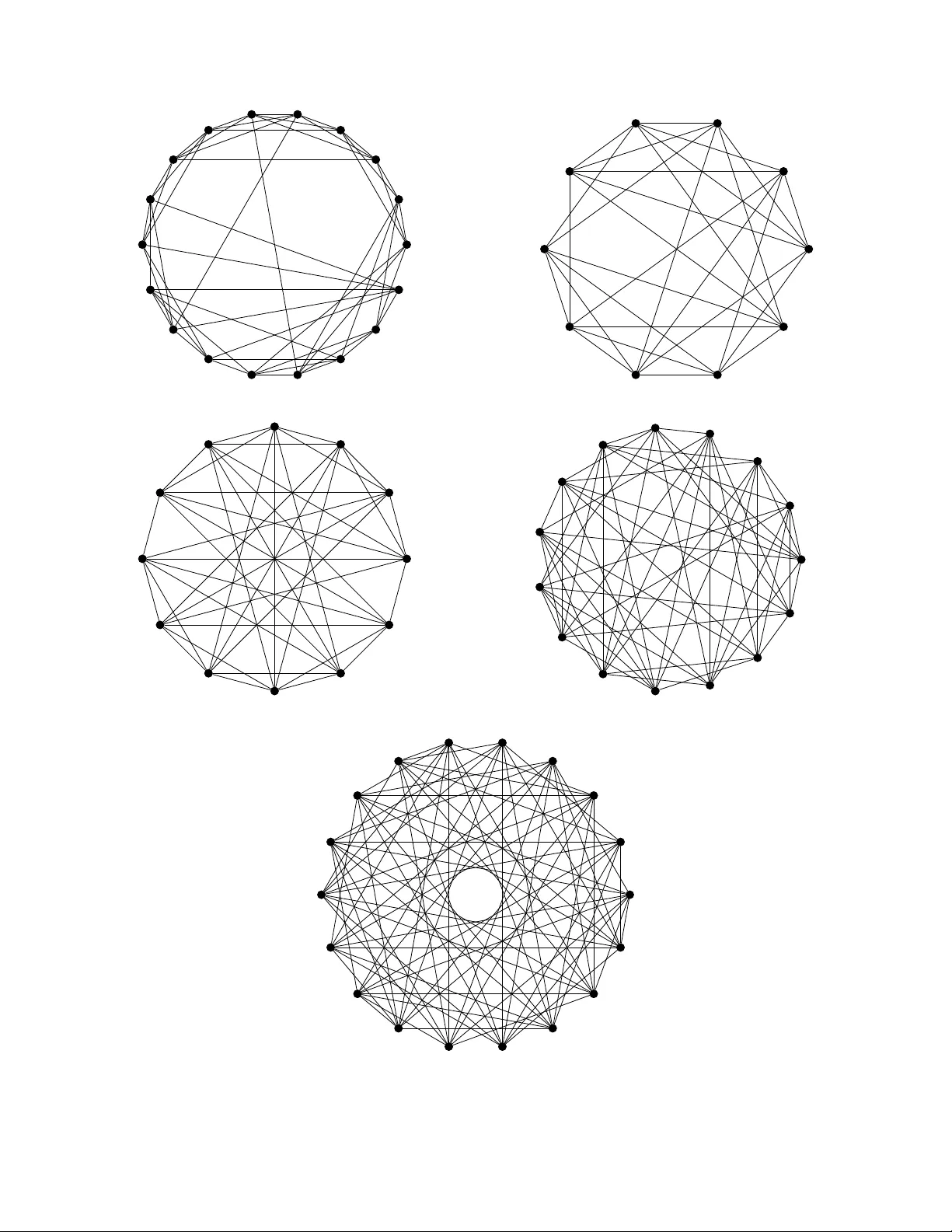
Regular 𝐾 3 -regular graphs Artem Hak ∗ 1, 2 , Sergiy Kozerenk o 2 , Den ys Loh vyno v 3 , and Y urii Y arosh 2, 4 1 National Univ ersity of Kyiv-Moh yla Academ y , 2 Sk ov orody Str., 04070 Kyiv, Ukraine 2 Kyiv Sc ho ol of Economics, 3 Myk oly Shpak a Str., 03113 Kyiv, Ukraine 3 National T ec hnical Universit y of Ukraine “Igor Sik orsky Kyiv P olytechnic Institute”, 37 Beresteiskyi Av e., 03056 Kyiv, Ukraine 4 Kyiv Academic Univ ersity , 36 V ernadsky Blvd., 03142 Kyiv, Ukraine Abstract W e study graphs that are sim ultaneously regular with respect to the ordinary v ertex degree and regular with resp ect to the triangle degree, that is, the n um b er of triangles con taining a giv en v ertex. W e call such graphs regular 𝐾 3 -regular. W e inv estigate the (non-)existence of regular 𝐾 3 -regular graphs with prescrib ed parameters ( 𝑟 2 , 𝑟 3 ), where 𝑟 2 is the vertex degree and 𝑟 3 is the triangle degree. General b ounds relating v ertex and edge triangle degrees are derived, and non-existence results are established for broad ranges of these parameters. Sp ecial atten tion is paid to T ur´ an graphs, for whic h w e establish uniqueness results for certain parameters. The paper concludes with a summary of admissible parameters and sev eral open problems. Keyw ords: vertex degree; triangle degree; regular graph; T ur´ an graph. MSC 2020: 05C07, 05C35, 05C99. 1 In tro duction A graph is called regular if its v ertices ha v e the same degree. A simple application of the pigeonhole principle implies that any graph with at least tw o v ertices has t w o vertices with the same degree. Th us, there are no “irregular” graphs. Nev ertheless, in order to approac h a sensible definition of irregularit y for graphs, Chartrand, Erd˝ os, and Oellermann [ 6 ] prop osed to use the notion of 𝐹 -degree defined in the w ork [ 7 ]. There, for a fixed graph 𝐹 , the 𝐹 -degree of a v ertex 𝑢 from a graph 𝐺 is the n um b er of subgraphs of 𝐺 isomorphic to 𝐹 to whic h 𝑢 b elongs. This w a y , the standard v ertex degree is just the 𝐾 2 -degree. ∗ Corresp onding author: artikgak@ukr.net 1 2 In con trast, for other graphs 𝐹 = 𝐾 2 , there can exist 𝐹 -irregular graphs (i.e., graphs 𝐺 with all v ertices having pairwise distinct 𝐹 -degrees). F or the smallest p ossible 𝐾 3 -irregular graph, see the w ork [ 1 ]. In [ 6 ], the question of whether there exists a regular 𝐾 3 -irregular graph w as p osed. This problem remained op en for sev eral decades until, in 2024, Stev ano vi ´ c et al. [ 10 ] found a 10-regular 𝐾 3 -irregular graph. More recently , the preprin t [ 8 ] gives an example of a 9-regular 𝐾 3 -irregular graph obtained using genetic algorithm tec hniques. It is also shown that there are no suc h graphs for regularities at most 7, with the case of regularity 8 constituting the most in teresting y et op en case (again, see [ 8 ] for the details). F or other asp ects of irregularit y in graphs, w e refer to [ 5 ]. In this paper, w e consider regular 𝐾 3 -regular graphs. Our motiv ation is to further develop the understanding of different regularities a graph can exhibit. The main fo cus is on the (non-)existence of regular 𝐾 3 -regular graphs for the giv en parameters of regularit y . A related framew ork w as in tro duced in [ 9 ], where the authors study v ertex- girth-regular graphs, namely vgr( 𝑛 ; 𝑘 ; 𝑔 ; 𝜆 )-graph is a 𝑘 -regular graph of order 𝑛 and girth 𝑔 in whic h ev ery vertex b elongs to exactly 𝜆 cycles of length 𝑔 . Th us, the graph is regular not only with resp ect to v ertex degrees but also with resp ect to the n um b er of shortest cycles containing eac h vertex. Sev eral non-existence results w ere pro ved for odd 𝑔 ≥ 7 and ev en 𝑔 ≥ 4 (see [ 9 , Theorems 17, 18]). F or the cases 𝑔 = 3 and 𝑔 = 5, the authors form ulate op en questions asking whether the non-existence results from the men tioned theorems hold for these v alues of girth as well. The presen t pap er fo cuses on regular 𝐾 3 -regular graphs, whic h corresp onds precisely to the case 𝑔 = 3. This class of graphs has also already app eared in the literature under a differen t name. In [ 4 ], regular 𝐾 3 -regular graphs with parameters ( 𝑟 2 , 𝑟 3 ) are called ( 𝑟 2 , 𝑟 3 )-constan t graphs. Non-existence result for 𝑟 3 = 𝑟 2 2 − 𝑘 with 𝑘 ∈ N and 3 𝑘 ≤ 𝑟 2 w as pro v en (see [ 4 , Theorem 14]). In [ 3 ], the existence of planar ( 𝑟 2 , 𝑟 3 )-constan t graphs and circulan t ( 𝑟 2 , 𝑟 3 )-constan t graphs is stud- ied. In addition, the authors completely answer the question of the existence of ( 𝑟 2 , 𝑟 3 )-constan t graphs for 𝑟 2 ≤ 6, 𝑟 3 ≤ 𝑟 2 2 . Therefore, some basic constrain ts and structural properties of suc h graphs 3 are already kno wn; one of them is the follo wing. Observ ation 1.1. F or every 𝑟 3 ∈ N ∪ { 0 } , ther e exists an inte ger 𝑟 * 2 ∈ N ∪ { 0 } such that (1) for al l 𝑟 2 ≥ 𝑟 * 2 , ther e exists a gr aph with p ar ameters ( 𝑟 2 , 𝑟 3 ) ; (2) for al l 𝑟 2 < 𝑟 * 2 , no gr aph with p ar ameters ( 𝑟 2 , 𝑟 3 ) exists. This observ ation is a simple corollary of a trivial fact that 𝐾 2 and 𝐾 3 are regular 𝐾 3 -regular, and the well-kno wn fact that the degree and 𝐾 3 -degree of a vertex are b oth additiv e under the Cartesian pro duct. As such, w e see that 𝑟 * 2 ≤ 𝑂 ( √ 𝑟 3 ) (consider 𝐾 𝑛 □ 𝐾 3 □ . . . □ 𝐾 3 ). Also, it is w orth men tioning that authors in [ 4 ] impro v ed this b ound to 𝑟 * 2 ≤ 𝑓 − 1 ( 𝑟 3 ), where 𝑓 ( 𝑥 ) = 𝑥 2 2 − 5 𝑥 3 2 (see [ 4 , Theorem 14]). The pap er is organised as follows. In Section 2 , we give all the necessary definitions that will b e used in the pap er. Section 3 is devoted to establishing main tec hnical b ounds for v ertex and edge 𝐾 3 -degrees in regular 𝐾 3 -regular graphs. The imp ortan t results on the non-existence of suc h graphs are pro- vided b y Prop osition 3.5 and Theorem 3.6 . Section 4 con tains results on a w ell-kno wn family of T ur´ an graphs, whic h are pro v ed to b e an imp ortan t class of regular 𝐾 3 -regular graphs. In particular, w e presen t a characterisation of T ur´ an graphs for certain parameters in Theorem 4.1 and in Theorem 4.2 (whic h also demonstrates non-existence). W e conclude the pap er with Sec- tion 5 , presen ting several op en questions and research directions on regular 𝐾 3 -regular graphs. Finally , App endix A contains some examples of regular 𝐾 3 -regular graphs for small regularities, and a table which summarises our results on the existence of these graphs. 2 Main definitions A graph is an ordered pair 𝐺 = ( 𝑉 , 𝐸 ), where 𝑉 = 𝑉 ( 𝐺 ) is the set of its vertic es and 𝐸 = 𝐸 ( 𝐺 ) ⊂ 𝑉 2 is the set of its e dges . All the graphs considered in this pap er are undirected, simple and finite. Also, for a pair of vertices 𝑢, 𝑣 ∈ 𝑉 ( 𝐺 ), the edge { 𝑢, 𝑣 } will b e denoted as 𝑢𝑣 . By 𝐺 , w e denote the 4 c omplement of a graph 𝐺 . The complete graph with 𝑛 v ertices is denoted b y 𝐾 𝑛 . The op en neighb ourho o d of a v ertex 𝑣 in a graph 𝐺 is the set of all its adjacen t v ertices: 𝑁 ( 𝑣 ) = { 𝑢 ∈ 𝑉 ( 𝐺 ) : 𝑢𝑣 ∈ 𝐸 ( 𝐺 ) } . The close d neigh- b ourho o d of 𝑣 is the set 𝑁 [ 𝑣 ] = 𝑁 ( 𝑣 ) ∪ { 𝑣 } . The de gr e e of 𝑣 in 𝐺 is the n um b er deg ( 𝑣 ) = | 𝑁 ( 𝑣 ) | . A v ertex 𝑣 ∈ 𝑉 ( 𝐺 ) is an isolate d vertex provided deg( 𝑣 ) = 0. The graph 𝐺 is said to b e r e gular if all its vertices ha v e the same degree, whic h is called the r e gularity of 𝐺 . Tw o graphs 𝐺 and 𝐻 are called isomorphic if there is an isomorphism b et w een them, that is, a bijection 𝑓 : 𝑉 ( 𝐺 ) → 𝑉 ( 𝐻 ) suc h that 𝑢𝑣 ∈ 𝐸 ( 𝐺 ) if and only if 𝑓 ( 𝑢 ) 𝑓 ( 𝑣 ) ∈ 𝐸 ( 𝐺 ). Giv en v ertices 𝑣 1 , . . . , 𝑣 𝑘 ∈ 𝑉 ( 𝐺 ), b y 𝐺 [ 𝑣 1 , . . . , 𝑣 𝑘 ] w e denote the sub- graph induced by the union of their closed neighbourho o ds 𝑘 𝑖 =1 𝑁 [ 𝑣 𝑖 ], and b y 𝐺 ( 𝑣 1 , . . . , 𝑣 𝑘 ) we denote the subgraph induced by the union of their op en neigh b ourho ods 𝑘 𝑖 =1 𝑁 ( 𝑣 𝑖 ). The Cartesian pr o duct of tw o graphs 𝐺 1 and 𝐺 2 is the graph 𝐺 1 □ 𝐺 2 with 𝑉 ( 𝐺 1 □ 𝐺 2 ) = 𝑉 ( 𝐺 1 ) × 𝑉 ( 𝐺 2 ), and tw o v ertices ( 𝑢, 𝑣 ) and ( 𝑢 ′ , 𝑣 ′ ) b eing adjacen t if and only if either 𝑢 = 𝑢 ′ and 𝑣 𝑣 ′ ∈ 𝐸 ( 𝐺 2 ), or 𝑣 = 𝑣 ′ and 𝑢𝑢 ′ ∈ 𝐸 ( 𝐺 1 ). Definition 2.1 ([ 6 , 7 ]) . F or a given graph 𝐹 , the 𝐹 -de gr e e of a v ertex 𝑣 in 𝐺 is the n um b er 𝐹 deg( 𝑣 ) of subgraphs of 𝐺 , isomorphic to 𝐹 , to which 𝑣 b elongs. Note that the ordinary degree of a vertex is exactly its 𝐾 2 -degree. Also, it is readily seen that 𝐾 3 deg( 𝑣 ) = | 𝑁 ( 𝑣 ) 2 ∩ 𝐸 ( 𝐺 ) | . Definition 2.2. F or a giv en graph 𝐹 , the 𝐹 -de gr e e of an edge 𝑒 ∈ 𝐸 ( 𝐺 ) is the num b er 𝐹 deg ( 𝑒 ) of subgraphs of 𝐺 , isomorphic to 𝐹 , to which 𝑒 b elongs. Note that 𝐾 3 deg( 𝑢𝑣 ) = | 𝑁 ( 𝑢 ) ∩ 𝑁 ( 𝑣 ) | for any edge 𝑢𝑣 ∈ 𝐸 ( 𝐺 ). Definition 2.3. A graph is called 𝐾 3 -regular if all its vertices ha v e the same 𝐾 3 -degree. Throughout the pap er, w e fo cus on graphs that are b oth regular and 𝐾 3 -regular. If 𝐺 is such a graph, we denote by 𝑟 2 the common 𝐾 2 -degree 5 (i.e., the ordinary degree) of all its v ertices, and by 𝑟 3 the common 𝐾 3 -degree of all its v ertices. W e sa y that 𝐺 has p ar ameters ( 𝑟 2 , 𝑟 3 ) if 𝐺 is regular with degree 𝑟 2 and 𝐾 3 -regular with 𝐾 3 -degree 𝑟 3 . Definition 2.4. T ur´ an graphs are complete multipartite graphs built b y par- titioning a set of 𝑛 vertices in to 𝑟 subsets as equally as p ossible and connecting ev ery pair of v ertices that lie in differen t parts. In this pap er, w e restrict ourselv es to the case where 𝑟 | 𝑛 , so that all parts ha v e equal size (also known as complete m ultipartite graphs). These graphs were in tro duced in T ur´ an’s classical 1941 pap er [ 12 ]. W e shall denote these graphs b y T uran( 𝑛, 𝑟 ). Assume that 𝑟 | 𝑛 , then T ur´ an graphs are regular and, moreo v er, 𝐾 3 - regular. F or 𝑟 ≥ 3, we can explicitly calculate the regularity parameters 𝑟 2 = 𝑛 𝑟 ( 𝑟 − 1) , 𝑟 3 = 𝑟 − 1 2 · 𝑛 𝑟 2 . 3 Establishing b ounds In this section, w e establish fundamental b ounds on the parameters of 𝐾 3 - regular graphs. W e deriv e several direct estimates and dev elop key technical lemmas relating edge 𝐾 3 -degrees to v ertex degrees. These results form the main to ols for the non-existence theorems prov ed in the subsequen t sections. The follo wing lemma giv es a trivial but useful upper b ound on the param- eter 𝑟 3 in terms of 𝑟 2 . Lemma 3.1. F or every gr aph with p ar ameters ( 𝑟 2 , 𝑟 3 ) , the fol lowing upp er b ound holds: 𝑟 3 ≤ 𝑟 2 2 . 3.1 Edge degree statemen ts The following Lemmas 3.2 , 3.3 and 3.4 are considered instrumen tal since what they pro vide is sev eral relations b et w een the edge 𝐾 3 -degree and v ertex degrees without giving an y tangible constrain ts on the parameters righ t a w a y . 6 Nev ertheless, they will pla y a crucial role in subsequen t existence and non- existence argumen ts. The following lemma follo ws directly from the handshaking lemma, and it will b e used several times throughout the article. Lemma 3.2. F or any gr aph 𝐺 and any vertex 𝑣 , we have 𝐾 3 deg( 𝑣 ) = 1 2 𝑢 ∈ 𝑁 ( 𝑣 ) 𝐾 3 deg( 𝑢𝑣 ) . Pr o of. Consider the induced subgraph 𝐻 = 𝐺 ( 𝑣 ). Eac h triangle of 𝐺 con tain- ing 𝑣 corresp onds to an edge of 𝐻 , therefore 𝐾 3 deg 𝐺 ( 𝑣 ) = | 𝐸 ( 𝐻 ) | . Moreo v er, for ev ery 𝑢 ∈ 𝑉 ( 𝐻 ), w e ha v e 𝐾 3 deg 𝐺 ( 𝑢𝑣 ) = deg 𝐻 ( 𝑢 ) . Applying the handshaking lemma to 𝐻 yields 1 2 𝑢 ∈ 𝑉 ( 𝐻 ) 𝐾 3 deg 𝐺 ( 𝑢𝑣 ) = 1 2 𝑢 ∈ 𝑉 ( 𝐻 ) deg 𝐻 ( 𝑢 ) = | 𝐸 ( 𝐻 ) | = 𝐾 3 deg 𝐺 ( 𝑣 ) , whic h completes the pro of. The next lemma giv es an upp er b ound for the 𝐾 3 -degrees of edges in regular 𝐾 3 -regular graphs. Lemma 3.3. L et 𝐺 b e a gr aph with p ar ameters ( 𝑟 2 , 𝑟 3 ) . Then, for any e dge 𝑒 ∈ 𝐸 ( 𝐺 ) , the fol lowing upp er b ound holds: 𝐾 3 deg( 𝑒 ) ≤ min { 𝑟 3 , 𝑟 2 − 1 } . Pr o of. Fix an edge 𝑒 = 𝑢𝑤 ∈ 𝐸 ( 𝐺 ). By definition, 𝐾 3 deg( 𝑒 ) = | 𝑁 ( 𝑢 ) ∩ 𝑁 ( 𝑤 ) | . Since, 𝑁 ( 𝑢 ) ∩ 𝑁 ( 𝑤 ) ⊆ 𝑁 ( 𝑢 ) ∩ ( 𝑁 ( 𝑤 ) ∖ { 𝑢 } ), we obtain 𝐾 3 deg( 𝑒 ) ≤ | 𝑁 ( 𝑤 ) ∖ { 𝑢 }| ≤ 𝑟 2 − 1 . On the other hand, eac h v ertex 𝑣 ∈ 𝑁 ( 𝑢 ) ∩ 𝑁 ( 𝑤 ) determines a triangle { 𝑢, 𝑤 , 𝑣 } con taining 𝑢 . Hence, 𝐾 3 deg( 𝑒 ) ≤ 𝐾 3 deg( 𝑢 ) = 𝑟 3 , and the claim follo ws. 7 The follo wing lemma complements the previous result by relating edge 𝐾 3 -degrees to the regularit y parameters. Lemma 3.4. L et 𝐺 b e a gr aph with p ar ameters ( 𝑟 2 , 𝑟 3 ) and let 𝑒 ∈ 𝐸 ( 𝐺 ) b e an e dge with 𝐾 3 deg( 𝑒 ) = 𝑘 . Then the fol lowing ine quality holds: 2 𝑟 3 ≤ ( 𝑟 2 − 𝑘 − 1)( 𝑟 2 − 2) + 𝑘 ( 𝑘 + 1) . Pr o of. Let 𝐺 b e a graph with parameters ( 𝑟 2 , 𝑟 3 ) and let 𝑢𝑣 ∈ 𝐸 ( 𝐺 ). Set 𝐾 3 deg( 𝑢𝑣 ) = | 𝑁 ( 𝑢 ) ∩ 𝑁 ( 𝑣 ) | = 𝑘 . F or a v ertex 𝑥 ∈ 𝑉 ( 𝐺 ), denote b y △ ( 𝑥 ) the set of all triangles containing 𝑥 . Our first step is to estimate the size of the set △ ( 𝑢 ) ∪ △ ( 𝑣 ). Define 𝐶 = 𝑁 ( 𝑢 ) ∩ 𝑁 ( 𝑣 ) = { 𝑤 1 , . . . , 𝑤 𝑘 } , 𝐼 1 = 𝑁 ( 𝑢 ) ∖ 𝑁 [ 𝑣 ] , 𝐼 2 = 𝑁 ( 𝑣 ) ∖ 𝑁 [ 𝑢 ] , put 𝑖 = | 𝐼 1 | = | 𝐼 2 | = 𝑟 2 − 𝑘 − 1. Let 𝐺 ′ b e a subgraph induced b y 𝐶 , and for eac h 𝑤 𝑗 ∈ 𝐶 set 𝑑 𝑗 = deg 𝐺 ′ ( 𝑤 𝑗 ). Note that 0 ≤ 𝑑 𝑗 ≤ 𝑘 − 1. No w, ha ving tak en care of the prerequisites, we shall pro ceed b y calculat- ing |△ ( 𝑢 ) ∪ △ ( 𝑣 ) | . On the one hand, |△ ( 𝑢 ) ∪ △ ( 𝑣 ) | = |△ ( 𝑢 ) | + |△ ( 𝑣 ) | − |△ ( 𝑢 ) ∩ △ ( 𝑣 ) | = 𝑟 3 + 𝑟 3 − | 𝐶 | = 2 𝑟 3 − 𝑘 . On the other hand, let △ 𝐴𝐵 𝐶 denote the set of triangles ha ving one v ertex in each of 𝐴 , 𝐵 , and 𝐶 (where single v ertices are iden tified with singleton sets). W e decomp ose the set △ ( 𝑢 ) ∪ △ ( 𝑣 ) in to the follo wing disjoin t subsets: △ ( 𝑢 ) ∪ △ ( 𝑣 ) = ( △ 𝐼 1 𝐼 1 𝑢 ⊔ △ 𝐼 2 𝐼 2 𝑣 ) ⊔ △ 𝐶 𝑢𝑣 ⊔ ( △ 𝐶 𝐶 𝑢 ∪ △ 𝐶 𝐶 𝑣 ) ⊔ ( △ 𝐶 𝐼 1 𝑢 ∪ △ 𝐶 𝐼 2 𝑣 ) . W e estimate the cardinalities of these sets separately: • Clearly , |△ 𝐼 1 𝐼 1 𝑢 ⊔ △ 𝐼 2 𝐼 2 𝑣 | ≤ 2 𝑖 2 . • The num b er of triangles con taining 𝑢 , 𝑣 and one v ertex of 𝐶 is exactly |△ 𝐶 𝑢𝑣 | = | 𝐶 | = 𝑘 . 8 • Each edge of 𝐺 ′ con tributes to exactly t w o triangles, one con taining 𝑢 and one con taining 𝑣 , therefore |△ 𝐶 𝐶 𝑢 ∪ △ 𝐶 𝐶 𝑣 | = 2 | 𝐸 ( 𝐺 ′ ) | = 𝑘 𝑗 =1 𝑑 𝑗 . • Finally , consider the term |△ 𝐶 𝐼 1 𝑢 ∪ △ 𝐶 𝐼 2 𝑣 | . Each v ertex 𝑤 𝑗 is adjacent to 𝑑 𝑗 v ertices from 𝐶 and to 𝑢 and 𝑣 . Hence, 𝑤 𝑗 cannot con tribute more than 𝑟 2 − 𝑑 𝑗 − 2 triangles of the aforementioned t yp e. Th us, |△ 𝐶 𝐼 1 𝑢 ∪ △ 𝐶 𝐼 2 𝑣 | ≤ 𝑘 𝑗 =1 ( 𝑟 2 − 𝑑 𝑗 − 2) . Summing it all up, w e obtain 2 𝑟 3 − 𝑘 = |△ ( 𝑢 ) ∪ △ ( 𝑣 ) | ≤ 2 𝑖 2 + 𝑘 + 𝑘 𝑗 =1 𝑑 𝑗 + 𝑘 𝑗 =1 ( 𝑟 2 − 𝑑 𝑗 − 2) = 2 𝑖 2 + ( 𝑟 2 − 1) 𝑘 . Substituting 𝑖 = 𝑟 2 − 𝑘 − 1 and rearranging yields the stated inequality . 3.2 Non-trivial b ounds on the parameters The following t w o statements pro vide some non-trivial restrictions on the pa- rameters ( 𝑟 2 , 𝑟 3 ) for whic h there exists a regular 𝐾 3 -regular graph. It is w orth noting that [ 3 , Prop osition 14] states the non-existence of graphs with param- eters (5 , 7) , (5 , 8) and (6 , 11) b y lo oking sp ecifically at their inner structure. Our next results v astly generalise this fact. The next prop osition is pro v ed b y virtue of com bining the three lemmas from the previous subsection. Prop osition 3.5. Ther e ar e no gr aphs with p ar ameters ( 𝑟 2 , 𝑟 3 ) such that 𝑟 3 = 𝑟 2 − 1 2 + 𝑐 for 𝑟 2 > 4 and 0 < 𝑐 < 𝑟 2 − 2 2 . 9 Pr o of. Supp ose that 𝐺 is a regular 𝐾 3 -regular graph with 𝑟 3 = 𝑟 2 − 1 2 + 𝑐 . Fix an arbitrary edge 𝑒 ∈ 𝐸 ( 𝐺 ) and put 𝑘 = 𝐾 3 deg( 𝑒 ). By virtue of Lemma 3.3 , w e ha v e 𝑘 ≤ 𝑟 2 − 1. Moreov er, Lemma 3.4 yields 2 𝑟 2 − 1 2 + 𝑐 = 2 𝑟 3 ≤ ( 𝑟 2 − 1 − 𝑘 )( 𝑟 2 − 2) + 𝑘 ( 𝑘 + 1) . Solving the quadratic inequalit y in 𝑘 , w e obtain 𝑘 ≥ 𝑟 2 − 3 2 + 2 𝑐 + 𝑟 2 − 3 2 2 > 𝑟 2 − 3 or 𝑘 ≤ 𝑟 2 − 3 2 − 2 𝑐 + 𝑟 2 − 3 2 2 < 0 . Since 𝑘 ≥ 0, the latter case is imp ossible and, therefore, 𝑘 ∈ { 𝑟 2 − 2 , 𝑟 2 − 1 } . Fix an arbitrary v ertex 𝑣 ∈ 𝑉 ( 𝐺 ). Among the 𝑟 2 edges incident to 𝑣 , let 𝑎 and 𝑏 denote the n um b ers of edges 𝑣 𝑢 of 𝐾 3 -degree 𝑟 2 − 2 and 𝑟 2 − 1, resp ectiv ely . Then 𝑎 + 𝑏 = 𝑟 2 . By Lemma 3.2 , w e obtain 2 𝐾 3 deg( 𝑣 ) = 𝑢 ∈ 𝑁 ( 𝑣 ) 𝐾 3 deg( 𝑢𝑣 ) , 2 𝑟 3 = 2 𝑟 2 − 1 2 + 𝑐 = ( 𝑟 2 − 2) 𝑎 + ( 𝑟 2 − 1) 𝑏, 𝑎 + 𝑏 = 𝑟 2 , 𝑎, 𝑏 ≥ 0 . Using 𝑐 < 𝑟 2 − 2 2 , w e ha v e ( 𝑟 2 − 2) 𝑎 + ( 𝑟 2 − 1) 𝑏 = 2 𝑟 2 − 1 2 + 𝑐 < 𝑟 2 2 − 2 𝑟 2 , 𝑟 2 ( 𝑎 + 𝑏 ) − ( 𝑎 + 𝑏 ) − 𝑎 < 𝑟 2 2 − 2 𝑟 2 , 𝑟 2 < 𝑎. This leads to a con tradiction. Hence, there are no suc h graphs. The follo wing theorem establishes the non-existence result for a range of regularit y parameters. In particular, it excludes such pairs of parameters 10 ( 𝑟 2 , 𝑟 3 ) as (4 , 5) and (5 , 9), whic h app ear in T able 1 in Appendix A (see Corol- laries 3.7 and 3.8 ). Our theorem improv es up on [ 11 , Theorem 2]; in particular, w e exclude one more parameter for every o dd 𝑟 2 b y using a differen t pro of tec hnique. Moreo v er, this result affirmativ ely answers the question p osed in [ 9 ] regarding the existence of vgr( 𝑛, 𝑟 2 , 3 , 𝑟 3 )-graphs (see Theorems 17, 18 and the discussion afterw ards therein). Theorem 3.6. Ther e exists no gr aph with p ar ameters ( 𝑟 2 , 𝑟 3 ) such that 𝑟 3 = 𝑟 2 2 − 𝑐 , pr ovide d 𝑟 2 ≥ 3 and 1 ≤ 𝑐 ≤ 𝑟 2 − 1 2 . Pr o of. Supp ose, for the sake of con tradiction, that such a graph 𝐺 exists. Let 𝑣 ∈ 𝑉 ( 𝐺 ) b e an arbitrary v ertex and let 𝐺 [ 𝑣 ] b e the subgraph induced by the closed neigh b ourhoo d of 𝑣 . Note that the 𝐾 3 -degree of 𝑣 equals the num b er of edges in its op en neighbourho o d, namely , | 𝐸 ( 𝐺 ( 𝑣 )) | = 𝐾 3 deg( 𝑣 ) = 𝑟 2 2 − 𝑐. Therefore, the minimum degree in 𝐺 [ 𝑣 ] is at least 𝑟 2 − 𝑐 . Fix a v ertex 𝑢 ∈ 𝑁 [ 𝑣 ] of suc h degree in 𝐺 [ 𝑣 ]. Hence, deg 𝐺 [ 𝑣 ] ( 𝑢 ) = 𝑟 2 − 𝑑 , where 1 ≤ 𝑑 ≤ 𝑐 . Since deg 𝐺 [ 𝑣 ] ( 𝑢 ) < 𝑟 2 , there exists a v ertex 𝑤 ∈ 𝑉 ( 𝐺 ) ∖ 𝑁 [ 𝑣 ] suc h that 𝑤 𝑢 ∈ 𝐸 ( 𝐺 ). F or 𝑘 ∈ { 𝑟 2 − 𝑑, . . . , 𝑟 2 − 1 } , define 𝐵 𝑘 = { 𝑣 ′ ∈ 𝑁 ( 𝑣 ) : deg 𝐺 [ 𝑣 ] ( 𝑣 ′ ) = 𝑘 } , 𝐵 ′ 𝑘 = { 𝑣 ′ ∈ 𝐵 𝑘 : 𝑣 ′ 𝑤 ∈ 𝐸 } . Note that 𝑢 ∈ 𝐵 ′ 𝑟 2 − 𝑑 b y construction (see Figure 1a ). Also, denote their unions as 𝐵 = 𝑟 2 − 1 𝑘 = 𝑟 2 − 𝑑 𝐵 𝑘 and 𝐵 ′ = 𝑟 2 − 1 𝑘 = 𝑟 2 − 𝑑 𝐵 ′ 𝑘 . The handshaking lemma applied to the complemen t of 𝐺 [ 𝑣 ] yields 𝑟 2 − 1 𝑗 = 𝑟 2 − 𝑑 ( 𝑟 2 − 𝑗 ) | 𝐵 𝑗 | = 2 𝑐. (1) In order to reac h the contradiction, w e will find an upp er b ound for the 𝐾 3 -degree of 𝑤 . F or 𝑏 𝑘 = | 𝐵 ′ 𝑘 | , w e ha v e the follo wing constrain ts: 𝑏 𝑘 ≥ 0 , 𝑏 𝑟 2 − 𝑑 ≥ 1 , 𝑏 𝑟 2 − 1 + 2 𝑏 𝑟 2 − 2 + . . . + 𝑑𝑏 𝑟 2 − 𝑑 ≤ 2 𝑐. 11 Denote 𝐼 = 𝑁 ( 𝑤 ) ∖ 𝑁 [ 𝑣 ], and observ e the follo wing: | 𝐼 | + 𝑏 𝑟 2 − 1 + . . . + 𝑏 𝑟 2 − 𝑑 = deg 𝐺 ( 𝑤 ) = 𝑟 2 . (2) 𝑣 𝑤 𝑁 ( 𝑣 ) 𝐵 𝑟 2 − 𝑑 . . . 𝐵 𝑟 2 − 1 rest of 𝑁 ( 𝑣 ) 𝑢 (a) Schematic illustration of the sets 𝐵 𝑖 . 𝑁 ( 𝑣 ) 𝐼 𝑣 𝑢 𝑤 Δ 𝐼 𝑤 𝐼 Δ 𝐵 ′ 𝑤 𝐼 Δ 𝐵 ′ 𝑤 𝐵 ′ (b) The three t ypes of triangles. Figure 1. Constructions in Theorem 3.6 . No w w e split the triangles con taining 𝑤 in to three t yp es (see Figure 1b ) and coun t the size of eac h t yp e. T yp e 1: △ 𝐼 𝑤 𝐼 . These are triangles with t w o vertices in 𝐼 and one v ertex 𝑤 . Clearly , |△ 𝐼 𝑤 𝐼 | ≤ | 𝐼 | 2 . (3) T yp e 2: △ 𝐵 ′ 𝑤 𝐼 . These are triangles with one v ertex in 𝐼 , one in 𝐵 ′ and the v ertex 𝑤 . If 𝑥 ∈ 𝐵 ′ 𝑟 2 − 𝑖 , then 𝑥 has exactly 𝑖 non-neigh b ours in 𝐺 [ 𝑣 ]. Also, 𝑥 is adjacent to 𝑤 . Hence, 𝑥 can b e adjacen t to at most 𝑖 − 1 v ertices of 𝐼 . Therefore, |△ 𝐵 ′ 𝑤 𝐼 | ≤ 𝑑 𝑖 =1 ( 𝑖 − 1) 𝑏 𝑟 2 − 𝑖 = 𝑏 𝑟 2 − 2 + 2 𝑏 𝑟 2 − 3 + . . . + ( 𝑑 − 1) 𝑏 𝑟 2 − 𝑑 . (4) T yp e 3: △ 𝐵 ′ 𝑤 𝐵 ′ . These are triangles with t w o vertices in 𝐵 ′ and the v ertex 𝑤 . W e hav e |△ 𝐵 ′ 𝑤 𝐵 ′ | = 𝐵 ′ 2 ∩ 𝐸 ( 𝐺 ) = 𝐵 ′ 2 − 𝐵 ′ 2 ∖ 𝐸 ( 𝐺 ) . 12 W e shall mak e use of the follo wing set equalit y: 𝑌 2 = 𝑋 2 ⊔ 𝑌 ∖ 𝑋 2 ⊔ ( 𝑋 ^ × 𝑌 ) , where 𝑋 ⊆ 𝑌 and 𝑋 ^ × 𝑌 = {{ 𝑥, 𝑦 } : 𝑥 ∈ 𝑋 , 𝑦 ∈ 𝑌 ∖ 𝑋 } . Apply this set equalit y to 𝐵 ′ ⊆ 𝐵 and express 𝐵 ′ 2 from it 𝐵 ′ 2 = 𝐵 2 ∖ 𝐵 ∖ 𝐵 ′ 2 ⊔ ( 𝐵 ′ ^ × 𝐵 ) . As a result, b y virtue of straightforw ard set-theoretic manipulations, we ha v e that 𝐵 ′ 2 ∖ 𝐸 ( 𝐺 ) = 𝐵 2 ∖ 𝐸 ( 𝐺 ) ∖ 𝐵 ∖ 𝐵 ′ 2 ⊔ ( 𝐵 ′ ^ × 𝐵 ) ∖ 𝐸 ( 𝐺 ) . Th us, using ( 2 ) w e obtain |△ 𝐵 ′ 𝑤 𝐵 ′ | = 𝑏 𝑟 2 − 1 + . . . + 𝑏 𝑟 2 − 𝑑 2 − − 𝐵 2 ∖ 𝐸 ( 𝐺 ) ∖ 𝐵 ∖ 𝐵 ′ 2 ⊔ ( 𝐵 ′ ^ × 𝐵 ) ∖ 𝐸 ( 𝐺 ) = 𝑟 2 − | 𝐼 | 2 − 𝐵 2 ∖ 𝐸 ( 𝐺 ) + 𝐵 ∖ 𝐵 ′ 2 ⊔ ( 𝐵 ′ ^ × 𝐵 ) ∖ 𝐸 ( 𝐺 ) = 𝑟 2 − | 𝐼 | 2 − 𝑐 + 𝐵 ∖ 𝐵 ′ 2 ⊔ ( 𝐵 ′ ^ × 𝐵 ) ∖ 𝐸 ( 𝐺 ) . (5) W e no w estimate the last term. First of all, it is readily seen that 𝐵 ∖ 𝐵 ′ 2 ⊔ ( 𝐵 ′ ^ × 𝐵 ) = 𝑥 ∈ 𝐵 ∖ 𝐵 ′ {{ 𝑥, 𝑦 } : 𝑦 ∈ 𝐵 ∖ { 𝑥 }} . Recalling definitions of 𝐵 and 𝐵 ′ , we obtain that 𝐵 ∖ 𝐵 ′ = 𝑟 2 − 1 𝑖 = 𝑟 2 − 𝑑 ( 𝐵 𝑖 ∖ 𝐵 ′ 𝑖 ). Th us, 𝐵 ∖ 𝐵 ′ 2 ⊔ ( 𝐵 ′ ^ × 𝐵 ) = 𝑟 2 − 1 𝑖 = 𝑟 2 − 𝑑 𝑥 ∈ 𝐵 𝑖 ∖ 𝐵 ′ 𝑖 {{ 𝑥, 𝑦 } : 𝑦 ∈ 𝐵 ∖ { 𝑥 }} . Hence, w e obtain that 𝐵 ∖ 𝐵 ′ 2 ⊔ ( 𝐵 ′ ^ × 𝐵 ) ∖ 𝐸 ( 𝐺 ) ≤ 𝑟 2 − 1 𝑖 = 𝑟 2 − 𝑑 𝑥 ∈ 𝐵 𝑖 ∖ 𝐵 ′ 𝑖 |{{ 𝑥, 𝑦 } : 𝑦 ∈ 𝐵 ∖ { 𝑥 }}∖ 𝐸 ( 𝐺 ) | . 13 Also, for 𝑥 ∈ 𝐵 𝑖 ∖ 𝐵 ′ 𝑖 , w e ha v e deg 𝑁 [ 𝑣 ] ( 𝑥 ) = 𝑖 . Hence, |{{ 𝑥, 𝑦 } : 𝑦 ∈ 𝐵 ∖ { 𝑥 }} ∖ 𝐸 ( 𝐺 ) | = |{ 𝑦 ∈ 𝐵 ∖ { 𝑥 } : 𝑥𝑦 / ∈ 𝐸 ( 𝐺 ) }| ≤ |{ 𝑦 ∈ 𝑁 [ 𝑣 ] ∖ { 𝑥 } : 𝑥𝑦 / ∈ 𝐸 ( 𝐺 ) }| = deg 𝑁 [ 𝑣 ] ( 𝑥 ) = 𝑟 2 − deg 𝑁 [ 𝑣 ] ( 𝑥 ) = 𝑟 2 − 𝑖. Th us, w e finish the calculations using ( 1 ) and ( 4 ) 𝐵 ∖ 𝐵 ′ 2 ⊔ ( 𝐵 ′ ^ × 𝐵 ) ∖ 𝐸 ( 𝐺 ) ≤ 𝑟 2 − 1 𝑖 = 𝑟 2 − 𝑑 ( 𝑟 2 − 𝑖 ) | 𝐵 𝑖 ∖ 𝐵 ′ 𝑖 | = 𝑟 2 − 1 𝑖 = 𝑟 2 − 𝑑 ( 𝑟 2 − 𝑖 ) | 𝐵 𝑖 | − 𝑟 2 − 1 𝑖 = 𝑟 2 − 𝑑 ( 𝑟 2 − 𝑖 ) | 𝐵 ′ 𝑖 | = 2 𝑐 − ( 𝑏 𝑟 2 − 1 + 2 𝑏 𝑟 2 − 2 + . . . + 𝑑𝑏 𝑟 2 − 𝑑 ) . (6) Therefore, substituting ( 6 ) in to ( 5 ), w e get |△ 𝐵 ′ 𝑤 𝐵 ′ | ≤ 𝑟 2 − | 𝐼 | 2 + 𝑐 − ( 𝑏 𝑟 2 − 1 + 2 𝑏 𝑟 2 − 2 + . . . + 𝑑𝑏 𝑟 2 − 𝑑 ) . (7) Th us, w e ha v e estimated all three triangle t yp es. Summing up inequali- ties ( 3 ), ( 4 ) and ( 7 ), w e get an upp er b ound 𝐾 3 deg( 𝑤 ) = |△ 𝐼 𝑤 𝐼 | + |△ 𝐵 ′ 𝑤 𝐼 | + |△ 𝐵 ′ 𝑤 𝐵 ′ | ≤ | 𝐼 | 2 + 𝑏 𝑟 2 − 2 + 2 𝑏 𝑟 2 − 3 + . . . + ( 𝑑 − 1) 𝑏 𝑟 2 − 𝑑 + 𝑟 2 − | 𝐼 | 2 + 𝑐 − ( 𝑏 𝑟 2 − 1 + 2 𝑏 𝑟 2 − 2 + . . . + 𝑑𝑏 𝑟 2 − 𝑑 ) . Simplifying, w e get 𝐾 3 deg( 𝑤 ) ≤ | 𝐼 | 2 + 𝑟 2 − | 𝐼 | 2 + 𝑐 − ( 𝑏 𝑟 2 − 1 + 𝑏 𝑟 2 − 2 + . . . + 𝑏 𝑟 2 − 𝑑 this equals 𝑟 2 −| 𝐼 | b y ( 2 ) ) = | 𝐼 | 2 + 𝑟 2 − | 𝐼 | 2 + 𝑐 − 𝑟 2 + | 𝐼 | . Define the function 𝐹 ( 𝑥 ) = 𝑥 2 + 𝑟 2 − 𝑥 2 + 𝑐 − 𝑟 2 + 𝑥 = 𝑥 2 − 𝑥 ( 𝑟 2 − 1) + 𝑐 + 𝑟 2 2 − 3 𝑟 2 2 . 14 No w, let us deriv e stricter constraints on 𝑥 := | 𝐼 | . Starting with an upp er b ound 𝑥 ≤ | 𝐼 | + 𝑏 𝑟 2 − 1 + . . . + 𝑏 𝑟 2 − 𝑑 − 1 = 𝑟 2 − 1 . And in a similar manner, w e deriv e a lo w er b ound 𝑥 ≥ | 𝐼 | − ( 𝑏 𝑟 2 − 2 + 2 𝑏 𝑟 2 − 3 + . . . + ( 𝑑 − 1) 𝑏 𝑟 2 − 𝑑 ) = 𝑟 2 − ( 𝑏 𝑟 2 − 1 + 2 𝑏 𝑟 2 − 2 + . . . + 𝑑𝑏 𝑟 2 − 𝑑 ) ≥ 𝑟 2 − 2 𝑐. Hence, w e see that max 𝐾 3 deg( 𝑤 ) ≤ max 𝐹 ( 𝑥 ) : 𝑟 2 − 2 𝑐 ≤ 𝑥 ≤ 𝑟 2 − 1 . W e no w determine the maxim um of 𝐹 on this in terv al. First of all, 𝐹 is a quadratic function with a p ositiv e leading co efficien t. Therefore, the maxim um is attained at one of the endp oin ts, namely either 𝑥 = 𝑟 2 − 1 or 𝑥 = 𝑟 2 − 2 𝑐 𝐹 ( 𝑟 2 − 1) − 𝐹 ( 𝑟 2 − 2 𝑐 ) = ( 𝑟 2 − 2 𝑐 )(2 𝑐 − 1) ≥ 1 . Th us, the maximum v alue is 𝐹 ( 𝑟 2 − 1) = 𝑟 2 − 1 2 + 𝑐 − 1. F or 1 ≤ 𝑐 ≤ 𝑟 2 − 1 2 , w e ha v e 𝐹 ( 𝑟 2 − 1) < 𝑟 2 2 − 𝑐, whic h yields the con tradiction 𝐾 3 deg( 𝑤 ) ≤ 𝐹 ( 𝑟 2 − 1) < 𝑟 2 2 − 𝑐 = 𝑟 3 . W e can summarise the findings of this subsection in the follo wing tw o corollaries. Corollary 3.7. L et 𝑟 2 ≥ 4 b e an even inte ger. Then ther e ar e no gr aphs with p ar ameters ( 𝑟 2 , 𝑟 3 ) , wher e 4 0 . 5 𝑟 2 2 < 𝑟 3 < 𝑟 2 2 or 𝑟 2 − 1 2 < 𝑟 3 < 4 0 . 5 𝑟 2 2 . Mor e over, one example of a gr aph that c orr esp onds to 𝑟 3 = 𝑟 2 2 is 𝐾 𝑟 2 +1 , an example that c orr esp onds to 𝑟 3 = 4 0 . 5 𝑟 2 2 is T uran( 𝑟 2 + 2 , 0 . 5 𝑟 2 + 1) , and an example that c orr esp onds to 𝑟 3 = 𝑟 2 − 1 2 is 𝐾 𝑟 2 □ 𝐾 2 . 15 Pr o of. First of all, it is easy to verify that 𝐾 𝑟 2 +1 , T uran( 𝑟 2 + 2 , 0 . 5 𝑟 2 + 1) and 𝐾 𝑟 2 □ 𝐾 2 are the aforemen tioned examples. No w, assume the pair ( 𝑟 2 , 𝑟 3 ) satisfies the first inequality . In this case, w e use Theorem 3.6 . Indeed, we can represent 𝑟 3 that satisfies the inequalit y as 𝑟 2 2 − 𝑐 , where 𝑐 ∈ { 1 , . . . , 𝑟 2 2 − 4 0 . 5 𝑟 2 2 − 1 } . Let us simplify the v alue 𝑟 2 2 − 4 0 . 5 𝑟 2 2 − 1 = 𝑟 2 − 2 2 . So, we see that 𝑐 ≥ 1 and 𝑟 2 ≥ 2 𝑐 + 2 > 2 𝑐 + 1. Th us, the aforemen tioned theorem applies. No w, let ( 𝑟 2 , 𝑟 3 ) satisfy the second inequalit y . Observ e that in this case 𝑟 2 > 4. Hence, using Prop osition 3.5 , w e see that there are no graphs with 𝑟 3 = 𝑟 2 − 1 2 + 𝑐 , 𝑐 ∈ { 1 , . . . , 0 . 5 𝑟 2 − 2 } . But 4 0 . 5 𝑟 2 2 − 1 − 𝑟 2 − 1 2 = 0 . 5 𝑟 2 − 2, so w e get that there are no graphs with 𝑟 2 − 1 2 < 𝑟 3 < 4 0 . 5 𝑟 2 2 . Corollary 3.8. L et 𝑟 2 ≥ 3 b e an o dd inte ger. Then ther e ar e no gr aphs with p ar ameters ( 𝑟 2 , 𝑟 3 ) , wher e 𝑟 2 − 1 2 < 𝑟 3 < 𝑟 2 2 . Mor e over, one example of a gr aph that c orr esp onds to 𝑟 3 = 𝑟 2 2 is 𝐾 𝑟 2 +1 and an example that c orr esp onds to 𝑟 3 = 𝑟 2 − 1 2 is 𝐾 𝑟 2 □ 𝐾 2 . Pr o of. It is easy to verify that graphs 𝐾 𝑟 2 +1 and 𝐾 𝑟 2 □ 𝐾 2 are the aforemen- tioned examples. Using Theorem 3.6 , w e see that there are no graphs with 𝑟 3 = 𝑟 2 2 − 𝑐, 𝑐 ∈ { 1 , . . . , 𝑟 2 − 1 2 } . In particular, this works for 𝑟 2 = 3 (in whic h case 𝑟 3 = 2 = 𝑟 2 2 − 1). And if 𝑟 2 ≥ 5, by virtue of Prop osition 3.5 , we see that there are no graphs with 𝑟 3 = 𝑟 2 − 1 2 + 𝑐, 𝑐 ∈ { 1 , . . . , 𝑟 2 − 3 2 } . Observing that 𝑟 2 2 − 1 − 𝑟 2 − 1 2 = 𝑟 2 − 2 = 𝑟 2 − 1 2 + 𝑟 2 − 3 2 , finishes the pro of. 4 T ur´ an graphs In this section, w e pro v e t w o results sho wing that the graphs T uran(2 𝑚 + 2 , 𝑚 + 1) and T uran(3 𝑚 + 3 , 𝑚 + 1) are uniquely determined b y their regularit y parameters. W e also sho w that some parameter pairs are not admissible. Theorem 4.1. The gr aph T uran(2 𝑚 + 2 , 𝑚 + 1) is the unique c onne cte d gr aph with p ar ameters 2 𝑚, 4 𝑚 2 , wher e 𝑚 ≥ 2 . 16 Pr o of. Let 𝐺 b e a graph with the required parameters. W e determine all p ossible v alues of 𝑑 = 𝐾 3 deg( 𝑒 ) for 𝑒 ∈ 𝐸 ( 𝐺 ) using Lemmas 3.3 and 3.4 8 𝑚 2 ≤ (2 𝑚 − 1 − 𝑑 )(2 𝑚 − 2) + 𝑑 ( 𝑑 + 1) , 𝑑 ≤ 2 𝑚 − 1 , 𝑑 ∈ N ∪ { 0 } . Th us, 𝐾 3 deg( 𝑒 ) = 𝑑 ∈ { 2 𝑚 − 2 , 2 𝑚 − 1 } . T o determine whic h v alue actually o ccurs, we apply Lemma 3.2 and get 8 𝑚 2 = (2 𝑚 − 2) 𝑎 + (2 𝑚 − 1) 𝑏, 𝑎 + 𝑏 = 2 𝑚, for some non-negative in teger 𝑎 and 𝑏 . Observe that (2 𝑚 − 2) 𝑎 + (2 𝑚 − 1) 𝑏 ≥ (2 𝑚 − 2)2 𝑚 = 8 𝑚 2 , th us 𝐾 3 deg( 𝑒 ) = 2 𝑚 − 2 for all 𝑒 ∈ 𝐸 ( 𝐺 ). Fix an arbitrary vertex 𝑣 ∈ 𝑉 ( 𝐺 ) and consider 𝐺 ( 𝑣 ). W e know that deg 𝐺 ( 𝑣 ) ( 𝑢 ) = 𝐾 3 deg( 𝑢𝑣 ) for all 𝑢 ∈ 𝑁 ( 𝑣 ). Th us 𝐺 ( 𝑣 ) is a (2 𝑚 − 2)-regular graph with 2 𝑚 v ertices. Hence 𝐺 m ust b e T uran(2 𝑚 + 2 , 𝑚 + 1). Using a similar, but more inv olved, technique w e pro v e the follo wing result. Theorem 4.2. L et 𝑟 2 ≥ 7 . If 3 | 𝑟 2 , then ther e exists a unique c onne cte d gr aph with p ar ameters 𝑟 2 , 𝑟 2 ( 𝑟 2 − 3) 2 , namely T uran( 𝑟 2 + 3 , 𝑟 2 3 + 1) . If 3 ∤ 𝑟 2 , no gr aph with p ar ameters 𝑟 2 , 𝑟 2 ( 𝑟 2 − 3) 2 exists. The pro of of this theorem pro ceeds in sev eral steps. W e start b y deter- mining all p ossible edge 𝐾 3 -degrees for graphs with these parameters. Next w e analyse the lo cal structure of the graph b y studying the neighbourho o ds 𝐺 ( 𝑣 ) of v ertices. This analysis leads to a characterisation of the corresp onding T ur´ an graphs. Lemma 4.3. L et 𝐺 b e a gr aph with p ar ameters 𝑟 2 , 𝑟 2 ( 𝑟 2 − 3) 2 , 𝑟 2 ≥ 7 . Then for every e dge 𝑒 ∈ 𝐸 ( 𝐺 ) , we have 𝐾 3 deg( 𝑒 ) ∈ { 0 , 𝑟 2 − 3 , 𝑟 2 − 2 , 𝑟 2 − 1 } . 17 Pr o of. Put 𝑘 = 𝐾 3 deg( 𝑒 ) for some edge 𝑒 . By virtue of Lemmas 3.3 and 3.4 , w e ha v e 0 ≤ 𝑘 ≤ 𝑟 2 − 1 , 𝑟 2 ( 𝑟 2 − 3) ≤ ( 𝑟 2 − 𝑘 − 1)( 𝑟 2 − 2) + 𝑘 ( 𝑘 + 1) . Solving the inequality with resp ect to 𝑘 , we get 𝑘 ∈ { 0 , 𝑟 2 − 3 , 𝑟 2 − 2 , 𝑟 2 − 1 } . Next we analyse considering the p ossible structure of the neigh b ourho od 𝐺 ( 𝑣 ). Lemma 4.4. L et 𝐺 b e a gr aph with p ar ameters 𝑟 2 , 𝑟 2 ( 𝑟 2 − 3) 2 , 𝑟 2 ≥ 7 . Then for every vertex 𝑣 ∈ 𝑉 ( 𝐺 ) , the gr aph 𝐺 ( 𝑣 ) is either ( 𝑟 2 − 3) -r e gular or isomorphic to ( 𝐾 𝑟 2 − 1 − 𝑒 ) ∪ 𝐾 1 . Pr o of. W e fix a v ertex 𝑣 and apply Lemma 3.2 to decomp ose edges inciden t to 𝑣 in to four t yp es according to Lemma 4.3 . Namely , let 𝑎 , 𝑏 , and 𝑐 denote the n um b ers of edges inciden t to 𝑣 ha ving 𝐾 3 -degrees 𝑟 2 − 3, 𝑟 2 − 2, 𝑟 2 − 1, resp ectiv ely . This w a y the other 𝑟 2 − 𝑎 − 𝑏 − 𝑐 edges inciden t to 𝑣 hav e zero 𝐾 3 -degrees. W e ha v e the follo wing constrain ts: 𝑟 2 ( 𝑟 2 − 3) = ( 𝑟 2 − 3) 𝑎 + ( 𝑟 2 − 2) 𝑏 + ( 𝑟 2 − 1) 𝑐, 𝑎 + 𝑏 + 𝑐 ≤ 𝑟 2 , 𝑎, 𝑏, 𝑐 ∈ N ∪ { 0 } . Assume there are no edges of zero 𝐾 3 -degree, i.e. 𝑎 + 𝑏 + 𝑐 = 𝑟 2 . Then ( 𝑟 2 − 3) 𝑎 + ( 𝑟 2 − 2) 𝑏 + ( 𝑟 2 − 1) 𝑐 ≥ ( 𝑎 + 𝑏 + 𝑐 )( 𝑟 2 − 3) = 𝑟 2 ( 𝑟 2 − 3), with attaining equality only when 𝑎 = 𝑟 2 , 𝑏 = 𝑐 = 0. This is the case when 𝐺 ( 𝑣 ) is ( 𝑟 2 − 3)-regular (note that the 𝐾 3 -degree of an edge 𝑣 𝑥 in 𝐺 equals the usual degree of a v ertex 𝑥 in 𝐺 ( 𝑣 )). Assume there are edges of zero 𝐾 3 -degree, i.e. 𝑎 + 𝑏 + 𝑐 < 𝑟 2 . Then the subgraph 𝐺 ( 𝑣 ) has an isolated v ertex. Hence, 𝐺 ( 𝑣 ) do es not ha v e univ ersal v ertices, implying that 𝑐 = 0. If w e assume that 𝑎 + 𝑏 ≤ 𝑟 2 − 2, then ( 𝑟 2 − 3) 𝑎 + ( 𝑟 2 − 2) 𝑏 ≤ ( 𝑟 2 − 2) 2 < 𝑟 2 ( 𝑟 2 − 3) . 18 This con tradiction asserts that 𝑎 + 𝑏 = 𝑟 2 − 1. Hence, w e obtain the follo wing system 𝑟 2 − 1 = 𝑎 + 𝑏, 𝑟 2 ( 𝑟 2 − 3) = ( 𝑟 2 − 3) 𝑎 + ( 𝑟 2 − 2) 𝑏. F rom it w e find that 𝑎 = 2, 𝑏 = 𝑟 2 − 3. Th us, summing it up, w e see that we hav e t w o options so far, either there are no isolated v ertices in 𝐺 ( 𝑣 ) and ev ery v ertex is of degree 𝑟 2 − 3; or there are 2 v ertices of degree 𝑟 2 − 3, one isolated v ertex, and 𝑟 2 − 3 v ertices of degree 𝑟 2 − 2, which is equiv alen t of sa ying that 𝐺 ( 𝑣 ) ∼ = ( 𝐾 𝑟 2 − 1 − 𝑒 ) ∪ 𝐾 1 . In the next step we sho w that only one of the p ossibilities from the previous lemma can o ccur. Lemma 4.5. L et 𝐺 b e a gr aph with p ar ameters 𝑟 2 , 𝑟 2 ( 𝑟 2 − 3) 2 , 𝑟 2 ≥ 7 . Then for every vertex 𝑣 ∈ 𝑉 ( 𝐺 ) , the sub gr aph 𝐺 ( 𝑣 ) is ( 𝑟 2 − 3) -r e gular. Pr o of. Keeping in mind the previous lemma, let us assume that there is 𝑣 ∈ 𝑉 ( 𝐺 ) suc h that 𝐺 ( 𝑣 ) ∼ = ( 𝐾 𝑟 2 − 1 − 𝑒 ) ∪ 𝐾 1 . Without loss of generalit y , w e ma y assume that 𝑉 ( 𝐺 ( 𝑣 )) = { 𝑢, 𝑤 1 , 𝑤 2 , 𝑔 1 , . . . , 𝑔 𝑟 2 − 3 } , where 𝑢 is the isolated v ertex, 𝑔 1 , . . . , 𝑔 𝑟 2 − 3 are vertices from 𝐾 𝑟 2 − 1 − 𝑒 , and 𝑤 1 and 𝑤 2 are also from 𝐾 𝑟 2 − 1 − 𝑒 but they are not adjacent. No w, w e should c hange our p ersp ectiv e to 𝐺 ( 𝑤 1 ). W e kno w that 𝑉 ( 𝐺 ( 𝑤 1 )) ∩ 𝑉 ( 𝐺 [ 𝑣 ]) = { 𝑣 , 𝑔 1 , . . . , 𝑔 𝑟 2 − 3 } , as w ell as that deg 𝐺 ( 𝑤 1 ) ( 𝑔 𝑗 ) = | 𝑁 ( 𝑔 𝑗 ) ∩ 𝑉 ( 𝐺 ( 𝑤 1 )) | ≥ |{ 𝑣 , 𝑔 1 , . . . , 𝑔 𝑟 2 − 3 }| − 1 = 𝑟 2 − 3 . Whic h means that we need to in tro duce t w o new vertices, let us call them 𝑎 ∈ 𝐺 ( 𝑤 1 ) and 𝑏 ∈ 𝐺 ( 𝑤 1 ). No w there are t w o p ossibilities. The first one, is that neither 𝑎 nor 𝑏 are adjacent to an y of 𝑔 𝑗 , it would mean that deg 𝐺 ( 𝑤 1 ) ( 𝑎 ) and deg 𝐺 ( 𝑤 1 ) ( 𝑏 ) are sim ultaneously either 0 or 1, but according to Lemma 4.4 neither options are p ossible. 19 The second option is that either 𝑎 or 𝑏 (or b oth) are adjacent to some 𝑔 𝑘 . But it w ould mean that deg 𝐺 ( 𝑤 1 ) ( 𝑔 𝑘 ) > 𝑟 2 − 3. Th us, 𝐺 ( 𝑤 1 ) ∼ = ( 𝐾 𝑟 2 − 1 − 𝑒 ) ∪ 𝐾 1 b y Lemma 4.4 . Without loss of generality , w e shall assume that 𝑏 is isolated in 𝐺 ( 𝑤 1 ), and therefore, 𝑎 is adjacen t to ev ery v ertex 𝑔 𝑗 . Finally , let us shift our atten tion once again to 𝐺 ( 𝑔 1 ), w e can see that { 𝑎, 𝑣 , 𝑤 1 , 𝑤 2 , 𝑔 2 , . . . , 𝑔 𝑟 2 − 3 } = 𝑉 ( 𝐺 ( 𝑔 1 )) and that deg 𝐺 ( 𝑔 1 ) ( 𝑔 2 ) = 𝑟 2 − 1, but it is not p ossible according to Lemma 4.4 . Ha ving established the regularit y of 𝐺 ( 𝑣 ), w e no w determine its precise structure. Lemma 4.6. L et 𝐺 b e a gr aph with p ar ameters 𝑟 2 , 𝑟 2 ( 𝑟 2 − 3) 2 , 𝑟 2 ≥ 7 . Then for every vertex 𝑣 ∈ 𝑉 ( 𝐺 ) , the sub gr aph 𝐺 ( 𝑣 ) is the c omplement of a disjoint union of triangles. Pr o of. By Lemma 4.5 , the graph 𝐺 ( 𝑣 ) is ( 𝑟 2 − 3)-regular. Hence, its comple- men t is 2-regular and therefore is a disjoint union of cycles. Hence, 𝐺 ( 𝑣 ) = 𝐶 𝑛 1 ∪ . . . ∪ 𝐶 𝑛 𝑘 , where 𝑛 𝑖 ≥ 3 and 𝑛 1 + . . . + 𝑛 𝑘 = 𝑟 2 . Th us, we need to prov e that there cannot b e any index 𝑖 with 𝑛 𝑖 > 3. By w a y of con tradiction, without loss of generalit y , assume that 𝑛 1 > 3. Let us denote the v ertices in 𝐺 ( 𝑣 ) as follo ws 𝑉 ( 𝐺 ( 𝑣 )) = { 𝑔 1 1 , . . . , 𝑔 1 𝑛 1 ; . . . ; 𝑔 𝑘 1 , . . . , 𝑔 𝑘 𝑛 𝑘 } , in a wa y so that 𝑔 𝑠 𝑖 , 1 ≤ 𝑖 ≤ 𝑛 𝑠 constitute a cycle 𝐶 𝑛 𝑠 in 𝐺 ( 𝑣 ) for a fixed 1 ≤ 𝑠 ≤ 𝑘 . As b efore, let us shift our p ersp ectiv e to 𝐺 ( 𝑔 1 2 ), w e can see that 𝑉 ( 𝐺 ( 𝑔 1 2 )) ∩ 𝑉 ( 𝐺 [ 𝑣 ]) = { 𝑣 , 𝑔 1 4 , . . . , 𝑔 1 𝑛 1 , . . . , 𝑔 𝑘 𝑛 𝑘 } . Whic h means that w e need to in tro duce exactly t w o new vertices 𝑎 and 𝑏 . W e note that 𝐶 𝑛 2 , . . . , 𝐶 𝑛 𝑘 remain cycles in 𝐺 ( 𝑔 1 2 ), as suc h 𝑎 and 𝑏 m ust b e adjacen t to ev ery 𝑔 𝑠 𝑖 , 𝑠 > 1. W e also note that { 𝑎𝑣 , 𝑏𝑣 } ∩ 𝐸 ( 𝐺 ) = ∅ . By w a y 20 of con tradiction, let us assume that 𝑎 and 𝑏 are not adjacen t in 𝐺 , it would mean that 𝑎, 𝑏, 𝑣 constitute a cycle in 𝐺 ( 𝑔 1 2 ), whic h w ould mean that deg 𝐺 ( 𝑔 1 2 ) ( 𝑔 1 4 ) ≥ |{ 𝑎, 𝑏, 𝑣 , 𝑔 1 6 , . . . , 𝑔 1 𝑛 1 , . . . , 𝑔 𝑘 𝑛 𝑘 }| = 3 + 𝑟 2 − 5 = 𝑟 2 − 2 , 𝑛 1 ≥ 6 , |{ 𝑎, 𝑏, 𝑣 , 𝑔 2 1 , . . . , 𝑔 2 𝑛 2 , . . . , 𝑔 𝑘 𝑛 𝑘 }| ≥ 3 + 𝑟 2 − 5 = 𝑟 2 − 2 , 𝑛 1 ≤ 5 , th us 𝐺 ( 𝑔 1 2 ) w ould not b e regular. Th us, 𝑎 and 𝑏 are adjacen t in 𝐺 , which leads to the conclusion, without loss of generality , that 𝑎 and 𝑔 1 4 are adjacen t in 𝐺 ( 𝑔 1 2 ), and 𝑏 and 𝑔 1 𝑛 1 are adjacen t in 𝐺 ( 𝑔 1 2 ) (note 𝑛 1 migh t b e 4). W e need to consider t w o separate cases based on if there are more than one cycle in 𝐺 ( 𝑣 ). Assume that there are at least t w o cycles in 𝐺 ( 𝑣 ), then we can consider 𝐺 ( 𝑔 2 1 ). W e kno w that deg 𝐺 ( 𝑔 2 1 ) ( 𝑔 1 4 ) ≤ 𝑟 2 − 1 − |{ 𝑎, 𝑏, 𝑔 1 1 , 𝑔 1 3 }| = 𝑟 2 − 5 , 𝑛 1 = 4 , ≤ 𝑟 2 − 1 − |{ 𝑎, 𝑔 1 5 , 𝑔 1 3 }| = 𝑟 2 − 4 , 𝑛 1 ≥ 5 , th us deg 𝐺 ( 𝑔 2 1 ) ( 𝑔 1 4 ) < 𝑟 2 − 3, which fails to mak e 𝐺 ( 𝑔 2 1 ) ( 𝑟 2 − 3)-regular. Assume that there is only one cycle in 𝐺 ( 𝑣 ), it means that 𝐺 ( 𝑣 ) = 𝐶 𝑛 1 with 𝑛 1 ≥ 7, it means that we can consider 𝐺 ( 𝑔 1 7 ). W e see that deg 𝐺 ( 𝑔 1 7 ) ( 𝑔 1 4 ) ≤ 𝑟 2 − 1 − |{ 𝑎, 𝑔 1 3 , 𝑔 1 5 }| = 𝑟 2 − 4 , whic h means that 𝐺 ( 𝑔 1 7 ) cannot b e ( 𝑟 2 − 3)-regular. T o complete the pro of of Theorem 4.2 , w e use a c haracterisation of T ur´ an graphs determined b y their lo cal structure. Prop osition 4.7 ([ 2 , Prop osition 1.1.5]) . L et 𝐺 b e a c onne cte d gr aph that is lo c al ly c omplete multip artite. Then 𝐺 is either triangle-fr e e or c omplete multip artite. In p articular, if 𝐺 is lo c al ly 𝐾 𝑚 1 ,...,𝑚 𝑘 then al l 𝑚 𝑖 ar e e qual (to 𝑚 , say), and 𝐺 ∼ = 𝐾 ( 𝑘 +1) × 𝑚 . W e no w form ulate the final step needed to complete the pro of. Lemma 4.8. L et 𝐺 b e a c onne cte d gr aph such that the neighb ourho o d of every vertex of 𝐺 is isomorphic to 𝑘 𝐶 3 , for some 𝑘 ∈ N . Then 𝐺 ∼ = T uran(3 𝑘 + 3 , 𝑘 + 1) . 21 Pr o of. Using Prop osition 4.7 , w e readily see that 𝐺 ∼ = 𝐾 ( 𝑘 +1) × 3 whic h is T uran(3 𝑘 + 3 , 𝑘 + 1). Com bining Lemmas 4.6 and 4.8 completes the pro of of Theorem 4.2 . This immediately implies the follo wing corollary . Com bining Lemmas 4.6 and 4.8 directly concludes the pro of of Theo- rem 4.2 , whic h in turn implies the follo wing corollary . Corollary 4.9. T uran(3( 𝑚 + 1) , 𝑚 + 1) , 𝑚 ≥ 3 is the unique c onne cte d gr aph with p ar ameters 𝑚, 𝑚 ( 𝑚 − 3) 2 . Finally , it is w orth mentioning an interesting conjecture from [ 11 ] stating whenev er a graph with parameters ( 𝑟 2 , 𝑟 3 ) exists, there also exists an ab elian Ca yley graph with the same parameters ( 𝑟 2 , 𝑟 3 ). The results obtained in this section are consistent with this conjecture, since the T ur´ an graphs considered ab o v e are ab elian Ca yley graphs. 5 Op en questions In this section, we present several op en questions ab out regular 𝐾 3 -regular graphs for further researc h. Note that the b ounds from Corollaries 3.7 and 3.8 are insufficien t for the complete characterisation of the parameters for the existence of regular 𝐾 3 - regular graphs. F or example, the case 𝑟 2 = 7, 𝑟 3 = 14 is not co v ered by Corollaries 3.7 and 3.8 , y et there are no suc h graphs (b y Theorem 4.2 ). The cases (8 , 17), (9 , 17), (9 , 23), (10 , 23) are the smallest pairs for whic h w e do not kno w whether suc h graphs exist. This b egs the first t w o questions. Question 1. Pro vide a complete list of the v alues of parameters for whic h there exist regular 𝐾 3 -regular graphs. Question 2. F or an admissible pair ( 𝑟 2 , 𝑟 3 ), c haracterize all connected regular 𝐾 3 -regular graphs with these parameters. No w recall that Theorems 4.1 and 4.9 give a criterion for T uran(2 𝑚 + 2 , 𝑚 + 1) and T uran(3 𝑚 + 3 , 𝑚 + 1) . Question 3. Can one c haracterize graphs T uran( 𝑛, 𝑟 ) in a similar manner as it presen ted in Corollary 4.1 for particular T ur´ an graphs? 22 Ac kno wledgmen ts The authors are deeply grateful to the Ukrainian Armed F orces for keeping Leliukhivk a, Kyiv, Kharkiv, and Khmeln ytskyi safe, whic h ga ve us the oppor- tunit y to w ork on this paper. W e are grateful to Helm ut Ruhland for inspiring discussions that motiv ated this w ork. W e also thank Vyac heslav Bo yk o for helpful comments that improv ed the presentation, and Andrii Serdiuk for a careful reading and insigh tful remarks on the mathematical conten t. Artem Hak has b een supp orted b y EDUFI (TFK programme, 12/221/2023). References [1] Berikkyzy Z., Bjorkman B., Blake H.S., Jahan b ek am S., Keough L., Moss K., Rorabaugh D., Shan S., T riangle-degree and triangle-distinct graphs, Discr ete Math. 347 (2024), article 113695. [2] Brouw er A.E., Cohen A.M., Neumaier A., Distance-Regular Graphs, Er gebnisse der Mathematik und ihr er Gr enzgebiete (3) , v ol. 18, Springer-V erlag , Berlin, 1989. [3] Caro Y., Mifsud X., On ( 𝑟, 𝑐 )-constant, planar and circulant graphs, Discuss. Math. Gr aph The ory 45 (2025), 707–723. [4] Caro Y., Lauri J., Mifsud X., Y uster R., Zarb C., Flip colouring of graphs, Gr aphs Combin. 40 (2024), article no. 110, 24 pages. [5] Chartrand G., Highly irregular, in Graph theory—fav orite conjectures and op en problems. 1, Pr obl. Bo oks in Math. , Springer , Cham, 2016, 1–16. [6] Chartrand G., Erd˝ os P ., Oellermann O.R., How to define an irregular graph, Col le ge Math. J. 19 (1988), 36–42. [7] Chartrand G., Holb ert K.S., Oellermann O.R., Swart H.C., 𝐹 -degrees in graphs, Ars Combin. 24 (1987), 133–148. [8] Hak A., Kozerenko S., Serdiuk A., Regular 𝐾 3 -irregular graphs, accepted for publication in Discr ete Appl. Math. , 2026, . [9] Ja jca y R., Jo ok en J., P orups´ anszki I., On vertex-girth-regular graphs: (non-)existence, bounds and en umeration, Ele ctr on. J. Combin. 32 (2025), pap er no. P4.51, 27 pages. [10] Stev anovi ´ c D., Ghebleh M., Cap orossi G., Vija yakumar A., Stev anovi ´ c S., On regular triangle-distinct graphs, Comput. Appl. Math. 43 (2024), article no. 336, 19 pages. [11] Sheffield N.S., Xi Z., Graphs with the same edge count in each neighborho o d, . [12] T ur´ an P ., Eine Extremalaufgab e aus der Graphentheorie, Mat. Fiz. L ap ok 48 (1941), 436–452 (in Hungarian). 23 App endix A T able 1. Admissible parameters for regular 𝐾 3 -regular graphs. The table is split into tw o parts for readability . The left part of the second blo c k is omitted since all corresp onding en tries are No(1). 𝑟 3 ∖ 𝑟 2 2 3 4 5 6 7 8 1 𝐾 3 → → → → → → 2 No(1) No(3) 𝐾 3 □ 𝐾 3 → → → → 3 No(1) 𝐾 4 → → → → → 4 No(1) No(1) T uran(6 , 3) → → → → 5 No(1) No(1) No(2) 𝐺 1 T uran(6 , 3) □ 𝐾 3 → → 6 No(1) No(1) 𝐾 5 → → → → 7 No(1) No(1) No(1) No(3) 𝐾 5 □ 𝐾 3 → → 8 No(1) No(1) No(1) No(3) 𝐺 2 → 𝐾 5 □ 𝐾 3 □ 𝐾 3 9 No(1) No(1) No(1) No(3) 𝐺 3 𝐾 5 □ 𝐾 4 → 10 No(1) No(1) No(1) 𝐾 6 → → → 11 No(1) No(1) No(1) No(1) No(2) 𝐾 6 □ 𝐾 3 → 12 No(1) No(1) No(1) No(1) T uran(8 , 4) → → 13 No(1) No(1) No(1) No(1) No(2) 𝐺 4 𝐾 6 □ 𝐾 4 14 No(1) No(1) No(1) No(1) No(2) No(4) 𝐺 5 15 No(1) No(1) No(1) No(1) 𝐾 7 → → 𝑟 3 ∖ 𝑟 2 6 7 8 9 10 11 12 15 𝐾 7 → → → → → → 16 No(1) No(3) T uran(12 , 3) → → → → 17 No(1) No(3) Unknown Unknown T uran(12 , 3) □ 𝐾 3 → → 18 No(1) No(3) 𝐶 1 , 2 , 3 , 4 13 → → → → 19 No(1) No(3) 𝐶 1 , 2 , 3 , 4 12 → → → → 20 No(1) No(3) No(4) 𝐺 6 → → → 21 No(1) 𝐾 8 → → → → → 22 No(1) No(1) No(2) → → → → 23 No(1) No(1) No(2) Unknown Unknown → → 24 No(1) No(1) T uran(10 , 5) → → → → 25 No(1) No(1) No(2) Unknown → → → 26 No(1) No(1) No(2) Unknown Unknown Unknown T uran(15 , 3) □ 𝐾 3 27 No(1) No(1) No(2) T uran(12 , 4) → → → 28 No(1) No(1) 𝐾 9 → → → → 24 Legend for T able 1 . • No(1): Lemma 3.1 ; • No(2): Corollary 3.7 ; • No(3): Corollary 3.8 ; • No(4): Theorem 4.2 ; • 𝐶 𝑠 1 ,...,𝑠 𝑘 𝑛 denotes a circulan t graph with jumps 𝑠 1 , . . . , 𝑠 𝑘 on 𝑛 v ertices; • → : blo w-up construction, i.e., 𝐺 □ 𝐾 2 applied to the graph immediately to the left. The graph 𝐺 1 is an icosahedron, and 𝐺 2 , 𝐺 3 , 𝐺 4 , 𝐺 5 and 𝐺 6 are depicted in Figure 2 . Moreov er, one can find adjacency data for these graphs in this GitHub rep ository . W e use the heuristic search framework introduced in [ 8 ]. In the presen t w ork, w e rely on the same code. The search starts from an arbitrary 𝑟 2 -regular graph and applies a standard 2-switc h m utation, whic h preserv es regularit y . T o guide the search to w ards 𝐾 3 -regularit y , w e use the following fitness function. Let 𝐺 b e an 𝑟 2 -regular graph on 𝑛 v ertices. F or a prescrib ed v alue 𝑟 3 , w e define fitness( 𝐺 ) = 1 𝑛 𝑣 ∈ 𝑉 ( 𝐺 ) 1 ( | 𝐾 3 deg( 𝑣 ) − 𝑟 3 | + 1) 2 . Th us, graphs whose v ertex 𝐾 3 -degrees are closer to 𝑟 3 receiv e higher fitness v alues; the maxim um is attained precisely when 𝐺 is 𝐾 3 -regular. 25 (a) The graph 𝐺 2 with parameters (6 , 8). (b) The graph 𝐺 3 with parameters (6 , 9). (c) The graph 𝐺 4 with parameters (7 , 13). (d) The graph 𝐺 5 with parameters (8 , 14). (e) The graph 𝐺 6 with parameters (9 , 20). Figure 2. The graphs 𝐺 2 , 𝐺 3 , 𝐺 4 and 𝐺 5 from T able 1 .
Original Paper
Loading high-quality paper...
Comments & Academic Discussion
Loading comments...
Leave a Comment