Graphical configuration spaces, Contractads and Formality
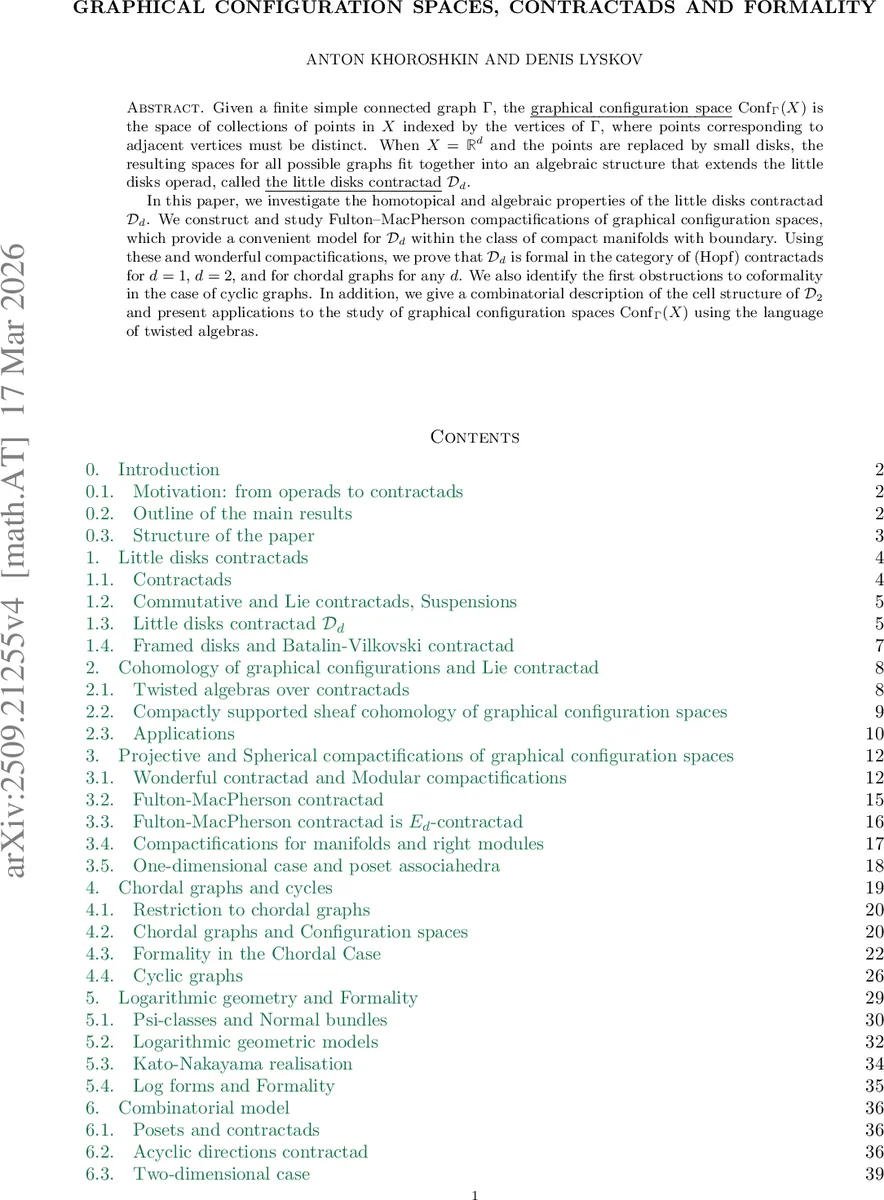
Given a finite simple connected graph $Γ$, the graphical configuration space $\mathrm{Conf}_Γ(X)$ is the space of collections of points in $X$ indexed by the vertices of $Γ$, where points corresponding to adjacent vertices must be distinct. When $X=\mathbb{R}^d$ and the points are replaced by small disks, the resulting spaces for all possible graphs fit together into an algebraic structure that extends the little disks operad, called the little disks contractad $\mathcal{D}_d$. In this paper, we investigate the homotopical and algebraic properties of the little disks contractad $\mathcal{D}_d$. We construct and study Fulton-MacPherson compactifications of graphical configuration spaces, which provide a convenient model for $\mathcal{D}_d$ within the class of compact manifolds with boundary. Using these and wonderful compactifications, we prove that $\mathcal{D}_d$ is formal in the category of (Hopf) contractads for $d=1$, $d=2$, and for chordal graphs for any $d$. We also identify the first obstructions to coformality in the case of cyclic graphs. In addition, we give a combinatorial description of the cell structure of $\mathcal{D}_2$ and present applications to the study of graphical configuration spaces $\mathrm{Conf}_Γ(X)$ using the language of twisted algebras.
💡 Research Summary
The paper introduces a new algebraic–topological framework that extends the classical little disks operad by allowing the indexing of operations by finite simple connected graphs rather than by finite sets. For a graph Γ, the authors define the graphical configuration space Conf_Γ(X) as the space of points in a topological space X indexed by the vertices of Γ, with the condition that points attached to adjacent vertices are distinct. When X=ℝ^d and points are replaced by small d‑dimensional disks, the collection of all such spaces for all graphs assembles into a contractad, the “little disks contractad” 𝔇_d. A contractad is a monoid in the monoidal category of graphical collections, where composition is given by contracting subgraphs.
The first part of the paper (Section 1) reviews the definition of contractads, introduces the commutative contractad gcCom and its Koszul dual Lie contractad gcLie, and explains the suspension operation needed for later homological constructions.
In Section 2 the authors develop the notion of twisted algebras over a contractad. They prove Theorem A (Theorem 2.7), which states that for a paracompact locally compact Hausdorff space X, the rational compactly supported cochains A_c^*(X) together with the twisted Lie contractad gcLie give a model for the rational cohomology of graphical configuration spaces: \
Comments & Academic Discussion
Loading comments...
Leave a Comment