The Midas Touch in Gaze vs. Hand Pointing: Modality-Specific Failure Modes and Implications for XR Interfaces
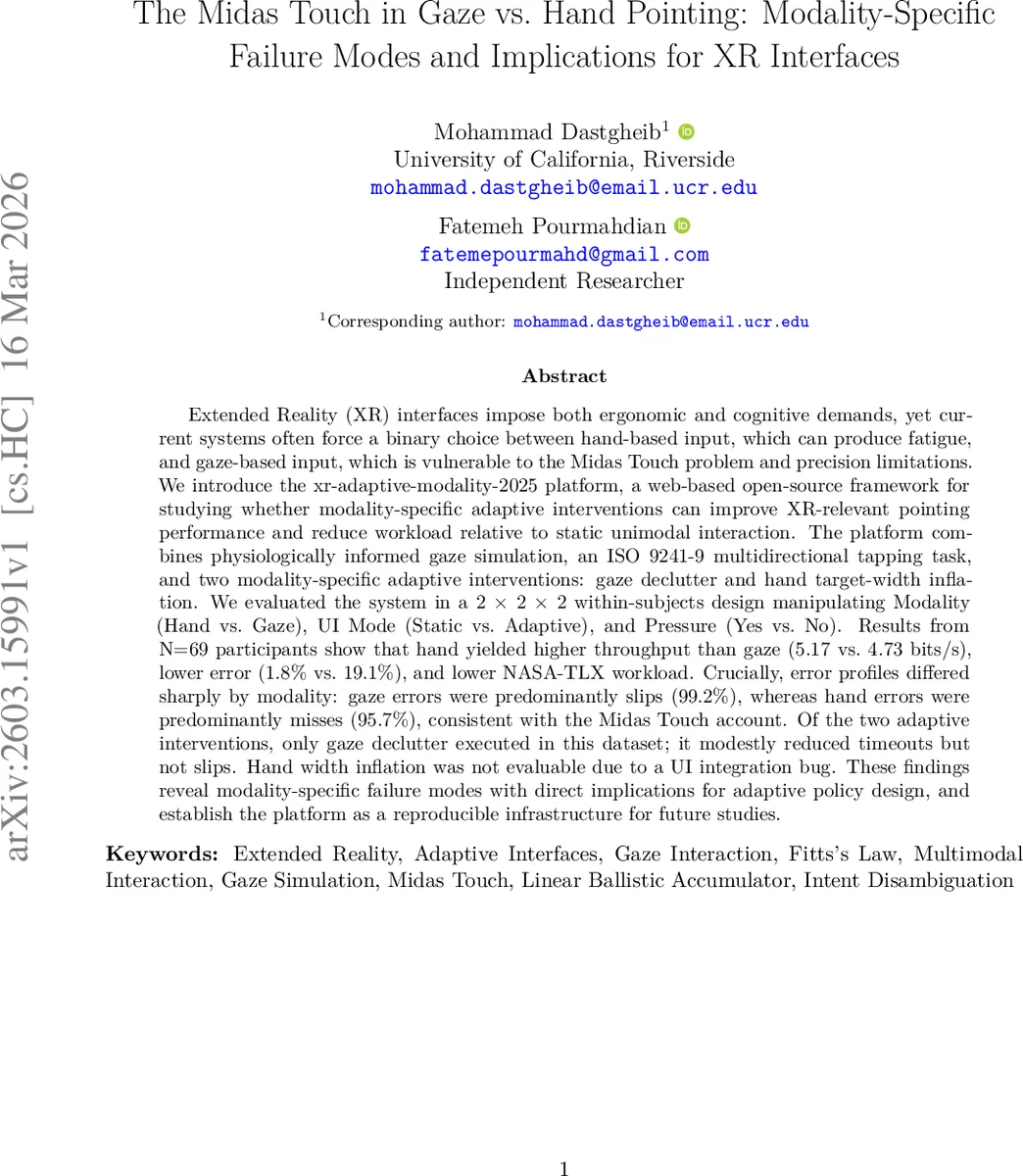
Extended Reality (XR) interfaces impose both ergonomic and cognitive demands, yet current systems often force a binary choice between hand-based input, which can produce fatigue, and gaze-based input, which is vulnerable to the Midas Touch problem and precision limitations. We introduce the xr-adaptive-modality-2025 platform, a web-based open-source framework for studying whether modality-specific adaptive interventions can improve XR-relevant pointing performance and reduce workload relative to static unimodal interaction. The platform combines physiologically informed gaze simulation, an ISO 9241-9 multidirectional tapping task, and two modality-specific adaptive interventions: gaze declutter and hand target-width inflation. We evaluated the system in a 2 x 2 x 2 within-subjects design manipulating Modality (Hand vs. Gaze), UI Mode (Static vs. Adaptive), and Pressure (Yes vs. No). Results from N=69 participants show that hand yielded higher throughput than gaze (5.17 vs. 4.73 bits/s), lower error (1.8% vs. 19.1%), and lower NASA-TLX workload. Crucially, error profiles differed sharply by modality: gaze errors were predominantly slips (99.2%), whereas hand errors were predominantly misses (95.7%), consistent with the Midas Touch account. Of the two adaptive interventions, only gaze declutter executed in this dataset; it modestly reduced timeouts but not slips. Hand width inflation was not evaluable due to a UI integration bug. These findings reveal modality-specific failure modes with direct implications for adaptive policy design, and establish the platform as a reproducible infrastructure for future studies.
💡 Research Summary
This paper investigates the ergonomic and cognitive trade‑offs between hand and gaze input in extended reality (XR) environments and evaluates whether modality‑specific adaptive interventions can improve performance and reduce workload compared with static unimodal interaction. The authors introduce the open‑source “xr‑adaptive‑modality‑2025” platform, a web‑based framework that (1) simulates gaze behavior using physiologically grounded parameters (sensor lag, saccadic suppression, fixation jitter), (2) implements an ISO 9241‑9 multidirectional tapping task to measure Fitts’s Law throughput and error rates, and (3) provides two adaptive policies: “gaze declutter” (temporarily hides non‑essential HUD elements when performance degrades) and “hand width inflation” (dynamically expands target width under similar conditions).
A within‑subjects 2 × 2 × 2 experiment (Modality: Hand vs. Gaze; UI Mode: Static vs. Adaptive; Pressure: Yes vs. No) was conducted with 69 participants using their own computers. Hand input was realized with a standard mouse click, while gaze input was generated by the simulation that transformed mouse movements into a gaze cursor subject to latency, velocity‑based freezing, and Gaussian jitter (σ≈0.12°). Throughput, error rate, and NASA‑TLX sub‑scales (Physical Demand, Frustration) were recorded for each condition.
Results show that hand input outperforms gaze across the board: average throughput of 5.17 bits/s versus 4.73 bits/s for gaze, and error rates of 1.8 % versus 19.1 %. Error type analysis reveals a striking modality‑specific pattern: 99.2 % of gaze errors are “slips” (unintended activations), confirming the classic Midas Touch problem, whereas 95.7 % of hand errors are “misses” (failure to acquire the target). Adaptive interventions produced mixed outcomes. The gaze declutter policy modestly reduced timeout occurrences but did not lower slip frequency, indicating that simply reducing visual clutter does not address the underlying attentional ambiguity of gaze selection. The hand width‑inflation policy could not be evaluated because a UI integration bug prevented its activation during the study.
Workload findings align with performance data: hand participants reported lower Physical Demand and Frustration scores than gaze participants, and adaptive UI modes yielded only marginal, non‑significant improvements. The authors argue that these findings highlight the necessity of designing adaptive policies that target the specific failure mode of each modality. For gaze, mechanisms that add a secondary confirmation step (e.g., dwell + click, double‑tap) or that dynamically adjust dwell time may be required to curb slips. For hand, dynamic target enlargement remains promising, provided implementation issues are resolved, as it directly mitigates tremor‑induced misses caused by fatigue.
The paper also contributes a reproducible research infrastructure. By using a web‑based simulation rather than actual eye‑tracking hardware, the platform enables remote, hardware‑agnostic studies of XR‑like pointing dynamics, facilitating systematic comparisons across devices and populations. The authors suggest future work should integrate real head‑mounted eye trackers and hand‑tracking sensors, explore multimodal switching policies, and test the adaptive mechanisms in more complex, task‑rich XR scenarios. Overall, the study provides empirical evidence of modality‑specific failure modes, demonstrates the limited efficacy of a simple declutter adaptation, and offers a solid foundation for developing more sophisticated, context‑aware adaptive XR interfaces.
Comments & Academic Discussion
Loading comments...
Leave a Comment