Two-Phase Cell Switching in 6G vHetNets: Sleeping-Cell Load Estimation and Renewable-Aware Switching Toward NES
This paper proposes a two phase framework to improve the sustainability in vertical heterogeneous networks that integrate various types of base stations~(BSs), including terrestrial macro BSs~(MBSs), small BSs~(SBSs), and a high altitude platform sta…
Authors: Maryam Salamatmoghadasi, Metin Ozturk, Halim Yanikomeroglu
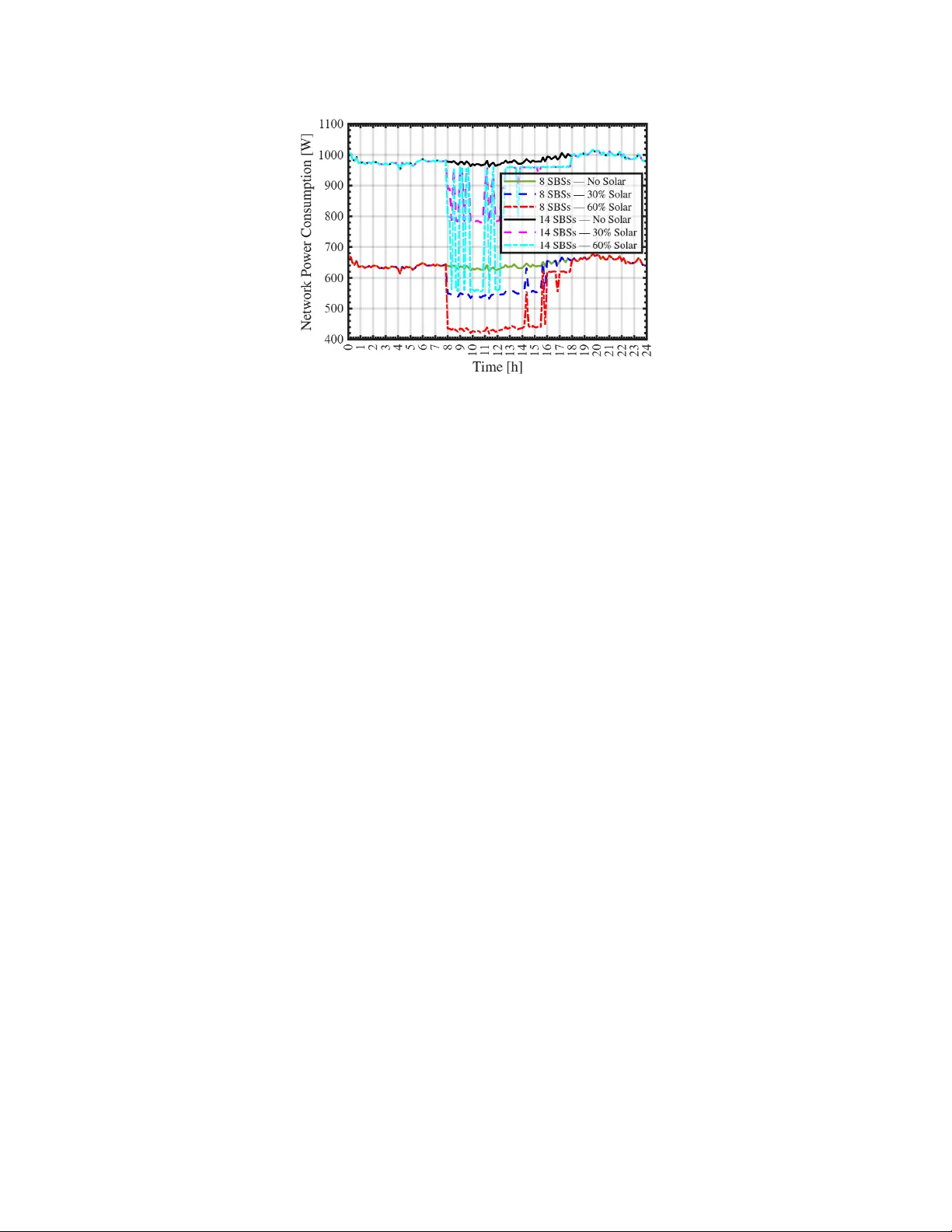
1 T w o-Phase Cell Switc hing in 6G vHetN ets: Sleeping-Cell Load Es timation and R ene w able- A w are Switching T o w ard NES Mar y am Salamatmoghadasi, Metin Ozturk, Halim Y anik omeroglu Abstract This paper proposes a tw o-phase frame w ork to improv e the sustainability in vertical heterogeneous netw orks (vHetN ets) that integrate v arious types of base s tations (BSs), including ter restrial macro BSs (MBSs), small BSs (SBSs), and a high-altitude platf orm station–super MBS (HAPS-SMBS). In Phase I, w e address the cr itical and often-o v erlook ed challenge of estimating the traffic load of sleeping SBSs, a prerequisite f or practical cell switching, by introducing three methods with varying data dependencies: (i) a distance-based estimator (no historical data), (ii) a multi-lev el clus tering (MLC) estimator (limited his torical data), and (iii) a long shor t-ter m memory (LSTM)-based temporal predictor (full historical data). In Phase II, w e incor porate the most accurate es timation results from Phase I into a rene wable energy–a ware cell switching strategy , explicitl y modeling solar -po w ered SBSs in three operational scenarios that reflect realistic hybrid gr id–rene wable deplo yments. This flexible design allo w s the framew ork to adapt switching strategies based on renew able a vailability and s torage conditions, making it more practical and robust f or real-wor ld networks. Using a real call detail record dataset from Milan, simulation results sho w that the LSTM method achiev es a mean absolute percentage er ror (MAPE) belo w 1% in Phase I, while in Phase II, the threshold-based solar integration scenar io achiev es up to 23% netw ork energy saving (NES) relativ e to con v entional cell switching. Ov erall, the proposed frame w ork bridges the gap betw een theoretical cell switching models and practical, sustainable 6G radio This research has been sponsored in par t by the NSER C Create program entitled T rustC A V and in part by The Scientific and T echnological Research Council of T ürkiy e (TUBIT AK). Maryam Salamatmoghadasi and Halim Y anikomeroglu are with Non- T er restrial N etworks Lab, Department of Sys tems and Computer Engineering, Car leton Univ ersity , Otta wa, ON K1S5B6, Canada. Metin Ozturk is with Electrical and Electronics Engineering, Ankara Yildirim Bey azit Univ ersity , Ankara, 06010, T urkiye. emails: maryamsalamatmoghad@cmail.carleton.ca, metin.ozturk@aybu.edu.tr, halim@sce.carleton.ca . 2 access netw ork (RAN) operation, enabling significant energy saving without compromising quality of service. Index T erms HAPS, vHetNet, traffic load estimation, cell switching, po w er consumption, sus tainability , 6G, NES I. Intr oduction The sixth-generation (6G) cellular netw orks are envisioned to suppor t hyperconnectivity with up to 10 million de vices per square kilometer , which is rapidl y approaching reality [1]. While this e v olution promises ubiquitous connectivity and advanced ser vices, it also raises ser ious sustainability concerns, par ticularl y in ter ms of escalating energy consumption across radio access netw orks (RANs). Base stations (BSs), especially dense deplo yments of small BSs (SBSs), are responsible f or appro ximatel y 60–80% of a netw ork’ s total pow er use [1]. If not manag ed effectiv el y , the ener gy demand of 6G netw orks could e xceed that of fifth-generation (5G) b y more than an order of magnitude [2], posing a threat to both environmental and economic sustainability . A ddressing this challeng e is pivotal f or meeting sustainability targ ets. Reports from the In- ternational T elecommunication U nion (ITU) and the European Commission note that future inf ormation and communication technology (ICT) sy stems must support global connectivity while reducing carbon intensity and absolute energy use [3]. Ac hie ving net-zero trajectories f or mobile operators b y 2040 requires inno v ations in energy -efficient RAN design and operation [4]. In parallel, Netw ork Energy Sa ving (NES) has been f or malized in the 3rd Generation Partnership Project (3GPP) frame w ork as a cross-RAN objective, standardizing energy -control functions such as BS sleep states, po w er scaling, cell/beam muting, and on-demand broadcas t signaling [5]. Among energy-sa ving approaches, dynamically switching off idle or under utilized BSs— commonl y ref er red to as cell switching or BS sleep mode —has emerg ed as a ke y strategy [6]. By deactivating SBSs dur ing lo w traffic periods and redistributing the load across activ e BSs, netw orks can reduce unnecessary energy usag e without significantl y compromising the user 3 quality of ser vice (QoS). Ho w e v er , a fundamental bottleneck is the lack of accurate traffic load inf ormation f or sleeping SBSs. Since deactivated BSs are disconnected from the network sched- uler , their potential traffic demand, a cr itical inf ormation f or the optimization process, is inherentl y unkno wn. Most studies in the literature assume per f ect know ledge of traffic loads—e v en f or SBSs in sleep mode—which is unrealistic in operational environments [7]–[11]. This disconnect limits the real-w orld applicability of ev en the most advanced switching algor ithms and optimization frame w orks. Br idging this g ap requires accurate estimation of traffic loads at sleeping SBSs f or the ne xt time slot, a problem that is often o ver look ed but cr iticall y impor tant. Without reliable estimates, decisions reg arding which SBSs to activate/deactiv ate ma y lead to performance degradation, including conges tion, suboptimal energy savings, or deg raded QoS. Thus, the load estimation problem is a significant obstacle betw een theoretical framew orks and the practical deplo yment of cell switching policies in real-w orld netw orks. In parallel, integ rating rene wable energy—par ticularl y solar—into RAN infrastructure offers an additional path to sustainability . P o w er ing SBSs with on-site photo v oltaics and storag e can reduce gr id dependence and emissions. Ho w ev er , renew able energy sources are intermittent and unpredictable, motivating energy -a w are optimization under uncer tain supply [12]. Deactiv ating a solar -po w ered SBS with sufficient stored energy ma y result in increased g r id energy usage, counteracting energy -sa ving goals. Theref ore, effective energy management must jointly consider traffic demand and energy a v ailability . T ogether , these tw o challeng es—estimating the loads of sleeping SBSs and making renew able- a w are switching decisions—are central to realizing energy-efficient and sustainable 6G mobile netw orks. Theref ore, w e tac kle both c halleng es with a two-phase approach that estimates sleeping- cell loads and enables renew able-a w are cell switching. A. Relat ed W ork Extensiv e research has targ eted RAN energy reduction via cell switching in heterog eneous deplo yments [7]–[11], [13], [14]. In [7], a decentralized control mechanism was proposed to dynamicall y adjust BS sleep depth based on activity le v els, enabling scalable cell switching implementations in dense deplo yments. Similarl y , the authors in [8] explored energy sa vings 4 through a control-data separation architecture (CDS A), optimizing user association and BS on/off decisions using g enetic algor ithms. More recently , reinf orcement lear ning (RL) was applied in [9], where a v alue function appro ximation (VF A)-based RL method achiev ed significant energy savings in ultra-dense heterogeneous netw orks (HetNets). In [15], the authors inv estigated a BS switching-off strategy based on traffic prediction, consider ing environmental variability across heterogeneous BS types. Other w orks include traffic-a w are par tial activation [10], strategy f amilies that reduce operational energy while preser ving co v erag e [11], and po w er -adjustable cell switching where SBSs are selectiv el y switched off while macro BSs (MBSs) maintain control plane co v erage [13]. A beamf or ming-aw are cell switching strategy f or multi-in put single-output netw orks was proposed in [14], which cooperativ ely utilizes beamf orming and roaming cost inf ormation to increase ener gy efficiency . Ho w e v er , a common limitation across these studies is the unrealis tic assumption that the traffic loads of all SBSs, including those in sleep mode, are per fectl y kno wn at eac h time slot. Some studies ha v e used traffic prediction f or BS operation and energy management. For instance, a traffic-prediction-based BS switching strategy w as ex amined in [15] that accounts f or en vironmental v ar iability across heterog eneous BS types to minimize total po w er consumption, y et it still assumes perf ect load know ledge f or all SBSs, including those in sleep mode. Se v eral prior w orks hav e applied traffic prediction methods using statis tical modeling and deep lear ning, such as [16], but these approaches are limited to active BSs and fail to handle the unique con- straints posed b y sleeping SBSs. Broader o v erview s of machine lear ning–based traffic prediction methods are a v ailable in [17], offering valuable conte xt but still not tailored f or sleeping SBS scenarios. A clustering-dr iv en method f or traffic load prediction that groups BSs and applies deep recur rent neural networks (RNNs) sho ws impro v ed accuracy but remains f ocused on activ e load forecas ting [18]. Ov erall, a cr itical gap persists: sleeping-SBS load-estimation er rors are not accounted f or in cell-switching optimization. Parallel to cell switching literature, a gro wing body of w ork has f ocused on integrating rene w- able energy sources into wireless netw orks to promote sustainability in 6G sy stems. Specifically , le v eraging solar -po w ered SBSs has the potential to significantl y reduce g r id energy consumption 5 and carbon emissions. Sev eral w orks e xplored ener gy harves ting and storag e-a w are management of BSs, proposing adaptive resource allocation strategies based on solar a v ailability . F or in- stance, [19] modeled a joint planning of solar installations and dynamic operation of BSs (sleep- mode scheduling), demonstrating the impor tance of co-optimizing renew able deplo yment and dynamic switching in cellular netw orks. In [20], the authors proposed an innov ativ e framew ork f or energy cooperation betw een rene wable-po wered BSs, where BSs with e x cess harves ted energy can share it with others facing energy shor tages. While these effor ts address renew able-a w are resource manag ement at the BS lev el, most treat cell switching and rene w able dynamics as loosel y coupled problems rather than a unified decision process. Non-terrestrial elements, notabl y high-altitude platf orm stations (HAPS) as a super MBS (SMBS), ha v e been adv ocated to complement ter restrial infrastructure and impro v e energy sus- tainability by enabling v er tical offloading and wide area co v erage [21], [22]. Y et pr ior non- ter restrial networks (NTN) studies do not couple per -slot cell switching decisions with e xplicit estimation of sleeping-SBS loads and renew able-a w are switc hing rules tailored to solar -capable SBSs. T o the best of our know ledge, the cur rent literature lacks a comprehensiv e frame w ork that jointl y considers the dual challeng es of traffic load estimation f or sleeping SBSs and intellig ent cell switching with rene w able energy -a ware decision-making. Br idging this gap is essential for enabling realistic, sustainable ener gy management strategies in 6G vertical HetN ets (vHetNets), where multiple tiers of ter restrial and aer ial BSs coe xist with div erse energy capabilities. This paper fills this cr itical gap b y proposing a tw o-phase frame w ork that first estimates the load of sleeping SBSs and then optimizes cell switching decisions with explicit consideration of solar energy av ailability across SBSs. B. Contributions W e propose a tw o-phase framew ork f or energy -efficient cell switching in future sustainable vHetNets, comprising MBSs, SBSs, and HAPS-SMBS. Phase I estimates the loads of sleeping SBSs, enabling a feasible and practical implementation of cell switching operations; Phase II 6 performs r enew able-aw ar e switc hing using the most accurate Phase I estimates. The main con- tributions of this w ork are summar ized as f ollo w s: • Problem f ormulation under unobserv ability : W e consider cell switching when loads of sleeping SBSs are unobserved at the decision hor izon and der iv e a cor responding anal ytical model f or e xpected po w er consumption, capturing the impact of estimation errors. W e pro v e that misestimation can flip the optimal ON/OFF decisions and increase total po w er , quantifying the r isk pathw a ys that under mine energy savings or degrade user QoS. • Phase I-Load estimation portf olio and analy sis: W e dev elop three estimators spanning different lev els of data av ailability : (i) a distance-based spatial estimator (no histor ical data), (ii) a multi-le v el clustering (MLC) es timator using repeated 𝑘 -means with elbo w-based cluster selection (limited historical data), and (iii) a long shor t-ter m memory (LSTM)- based temporal es timator (full his tor ical data). This portf olio offers s trategic fle xibility : depending on the richness of a v ailable data, the frame w ork can dynamicall y switc h to the most suitable estimator . Such adaptability ensures practical applicability across div erse deplo yment scenar ios, from data-scarce en vironments to data-r ich netw orks, thereb y making the frame w ork more po w er ful and resilient. • Phase II-Rene wable-a w are cell switching with solar-capable SBSs: Using the most accurate Phase I estimates, we optimize SBS ON/OFF decisions while e xplicitl y modeling photo v oltaic har v esting and storag e. W e design three operational scenarios (full inclusion, e x clusion, and threshold-based inclusion) that reflect realistic h ybrid gr id–rene w able policies. This multi-scenar io design provides strategic fle xibility , enabling the frame w ork to adapt its switching strategy to v arying le v els of solar penetration and s torage av ailability , thereb y reducing the effectiv e search space while maintaining energy efficiency . • HAPS-assisted vHetNet conte xt: W e integrate a HAPS-SMBS tier to enable v er tical offloading and wide-area cov erage, e x amining interactions betw een aerial-ter restrial lay er ing, sleeping-SBS estimation, and rene w able-a ware switching. • Quantitativ e results on real data: Using a Milan call detail record (CDR) dataset, Phase I’ s LSTM estimator achie v es <1% mean absolute percentage er ror (MAPE). In Phase II, the 7 threshold-based solar integration scenar io achiev es up to ∼ 23% NES relative to conv entional cell switching under comparable conditions. II. S y stem Model A. N etw or k Model W e consider a vHetNet compr ising a total of 𝑏 ∈ N BSs, inde x ed by 𝑖 ∈ I , where I = { 1 , 2 , . . . , 𝑏 } . Specifically , w e study a macro cell (MC) with one MBS and 𝑠 ∈ N SBSs, index ed b y 𝑗 ∈ J = { 1 , 2 , . . . , 𝑠 } . Additionall y , a HAPS-SMBS is integrated, potentiall y ser ving multiple MCs, into the netw ork. The pr imar y function of SBSs is to deliv er data ser vices and address user -specific requirements, while MBS and HAPS-SMBS ensure consistent netw ork cov erage and manag e control signals. A ke y role of HAPS-SMBS is to efficiently manage traffic offloading from SBSs dur ing lo w -traffic per iods, utilizing its e xtensiv e line-of-sight (LoS) and larg e capacity [23]. This capability not only enhances netw ork flexibility and optimizes capacity utilization but also offers a cost-effectiv e alter nativ e to multiple ter restrial BSs, par ticularl y in fluctuating and high- demand scenarios. B. Motiv ation for a HAPS Tier Operating in the stratosphere at altitudes of 20–50 km, HAPS nodes are quasi-s tationar y and typicall y confined to a defined cy lindr ical region [23]. According to ITU recommendations, a HAPS can pro vide a wide f ootprint of up to 500 km in radius [24], enabling broad cov erage and reinf orcing its role as an SMBS f or vHetNets. Le v eraging this high-altitude position, HAPS- SMBS pro vides predominantly LoS links and can f orm dynamic spot beams ov er a large co v erag e area, reducing blockag e and hando v ers and making the platf or m effectiv e f or traffic offloading and co v erag e extension. In addition, HAPS-SMBS can suppor t backhauling (RF/FSO) and operate in higher -frequency bands (e.g., mmW a v e/THz) where wide bandwidths are a vailable. Fig. 1 illustrates the capacity headroom using Shannon ’ s law 𝐶 = 𝑚 𝐵 log 2 ( 1 + 𝛾 ) , where 𝐶 is the channel capacity , 𝐵 is the sy stem bandwidth, 𝛾 is the signal-to-inter ference-plus-noise ratio (SINR), and 𝑚 is a scaling factor representing the effectiv e bandwidth allocation relativ e 8 Fig. 1. Capacity via 𝐶 = 𝑚 𝐵 log 2 ( 1 + 𝛾 ) v ersus SINR degradation relative to a ter restrial baseline (dashed); 𝐵 = 20 MHz, baseline 𝛾 0 = 20 dB. Cur ves f or 𝑚 ∈ { 1 , 1 . 5 , 2 , 3 , 4 } (interpreted as bandwidth scaling). Larg er 𝑚 offsets SINR loss, providing additional capacity for HAPS offloading. to the baseline. The dashed curve is a ter restrial baseline with 𝑚 = 1 at the ref erence SINR; the x-axis show s SINR degradation to reflect the longer HAPS link distance; the f actor 𝑚 > 1 represents additional bandwidth that a HAPS-SMBS can allocate [23]. Because capacity scales appro ximatel y linearl y with 𝑚 and 𝐵 but only logarithmicall y with SINR, modest increases in 𝑚 keep HAPS throughput at or abo v e the ter restrial baseline ev en under notable SINR loss. In practice, a HAPS-SMBS can emplo y larg er values of 𝐵 , fur ther increasing offloading headroom. This is a phy sics-based illustration to motiv ate including a HAPS tier in the vHetN et. C. N etw or k P ow er Consumption The po w er consumption of each BS in the network is calculated based on the energy -a w are radio and netw ork technologies (EAR TH) po w er consumption model [25]. For the 𝑖 -th BS, the po w er consumption at time slot 𝑡 is e xpressed as [26] 𝑃 𝑖 ( 𝑡 ) = 𝑃 o ,𝑖 + 𝜂 𝑖 𝜆 𝑖 ,𝑡 𝑃 t ,𝑖 , 0 < 𝜆 𝑖 ,𝑡 ≤ 1 , 𝑃 s ,𝑖 , 𝜆 𝑖 ,𝑡 = 0 , (1) where 𝑃 o ,𝑖 represents the operational circuit pow er consumption, 𝜂 𝑖 is the po w er amplifier efficiency , 𝜆 𝑖 ,𝑡 is the load f actor (i.e., the nor malized traffic load), 𝑃 t ,𝑖 is the transmit po w er , 9 and 𝑃 s ,𝑖 is the po w er consumption in sleep mode. The total instantaneous po w er consumption of vHetNet, denoted as 𝑃 T , is giv en by 𝑃 T ( 𝑡 ) = 𝑏 𝑖 = 1 𝑃 𝑖 ( 𝑡 ) = 𝑃 H ( 𝑡 ) + 𝑃 M ( 𝑡 ) + 𝑠 𝑗 = 1 𝑃 𝑗 ( 𝑡 ) , (2) where 𝑃 H ( 𝑡 ) and 𝑃 M ( 𝑡 ) denote the po w er consumption of HAPS-SMBS and MBS at an y giv en moment, respectiv el y , which are calculated based on the ( 0 < 𝜆 𝑖 ,𝑡 < 1 ) case in (1) as HAPS- SMBS and MBS are alwa y s activ e in our modeling. Mean while, 𝑃 𝑗 ( 𝑡 ) represents the po w er consumption of the 𝑗 -th SBS and 𝑠 signifies the total number of SBSs within the netw ork. D. Renew able Energy Model W e incor porate a subset of SBSs that har v est solar energy and store it in a local batter y . Since storag e operates on energy , we model all har v ested/used/s tored quantities on a per -time-slot basis. Let Δ 𝑡 ℎ = Δ 𝑡 / 60 denote the slot duration in hours. For SBS 𝑗 in slot 𝑡 , the SBS’ s energy demand is 𝐸 𝑗 ( 𝑡 ) = 𝑃 𝑗 ( 𝑡 ) Δ 𝑡 ℎ , where 𝑃 𝑗 ( 𝑡 ) comes from (1). The harv ested solar energy is 𝐸 𝐻 , 𝑗 ( 𝑡 ) = 𝜁 𝐶 𝑠 Δ 𝑡 ℎ 𝛼 ( 𝑡 ) , 𝑡 p , 1 ≤ 𝑡 ≤ 𝑡 𝑝 , 2 , 0 , otherwise , (3) where 𝜁 is solar con v ersion efficiency , 𝐶 𝑠 (k Wh/h) is the solar capacity (maximum har v estable energy per hour under peak clear -sky conditions). The factor 𝛼 ( 𝑡 ) ∈ [ 0 , 1 ] captures time-varying solar av ailability (e.g., cloud co v er , seasonal effects, and intrada y ir radiance variations), with 𝛼 ( 𝑡 ) ≈ 1 under clear -sky peak conditions and smaller values under reduced ir radiance. The parameters 𝑡 p , 1 and 𝑡 p , 2 denote the s tar t and end times of the peak solar period, respectiv el y . Let 𝑆 𝑗 ( 𝑡 ) be the batter y state (stored energy) at the end of slot 𝑡 , with capacity 𝑆 max , 𝑗 . The rene w able energy actually used in slot 𝑡 is 𝐸 R , 𝑗 ( 𝑡 ) = min 𝐸 𝑗 ( 𝑡 ) , 𝑆 𝑗 ( 𝑡 − 1 ) + 𝐸 H , 𝑗 ( 𝑡 ) , (4) 10 Phase I T raffic Load Estima tion Estimates the load of sleeping SBSs using spatia l and tempora l traf fic data. Phase II Solar-A war e Cell Switching Optimizes SBS ON/OFF decisions based on load estimates and solar a vaila bility . HAPS MBS Active SBS Inactive SBS Solar Panel Fig. 2. The proposed two-phase optimization framew ork for a vHetNet. Phase I estimates the traffic load of sleeping SBSs using spatial and temporal data. Phase II uses these estimates along with solar a vailability to optimize SBS ON/OFF switching, minimizing network pow er consumption. The sys tem model show s the vHetNet topology with an MBS, multiple SBSs (some solar -po w ered), and a HAPS enabling v ertical offloading. and the corresponding gr id energy dra w is 𝐸 G , 𝑗 ( 𝑡 ) = 𝐸 𝑗 ( 𝑡 ) − 𝐸 R , 𝑗 ( 𝑡 ) . (5) The storag e dynamics f ollo w 𝑆 𝑗 ( 𝑡 ) = min n 𝑆 max , 𝑗 , 𝑆 𝑗 ( 𝑡 − 1 ) + 𝐸 H , 𝑗 ( 𝑡 ) − 𝐸 R , 𝑗 ( 𝑡 ) o , 0 ≤ 𝑆 𝑗 ( 𝑡 ) ≤ 𝑆 max , 𝑗 . (6) With this f ormulation, reductions in solar av ailability directl y reduce 𝐸 H , 𝑗 ( 𝑡 ) , and an y unmet demand is automatically supplied by the gr id via (5), while the battery state adapts through (6), which also enf orces the storag e bounds 0 ≤ 𝑆 𝑗 ( 𝑡 ) ≤ 𝑆 max , 𝑗 (saturation at 𝑆 max , 𝑗 and possible depletion to ward 0 ). F or non-solar SBSs, 𝐸 H , 𝑗 ( 𝑡 ) = 0 and 𝑆 max , 𝑗 = 0 , which implies 𝐸 R , 𝑗 ( 𝑡 ) = 0 and 𝐸 G , 𝑗 ( 𝑡 ) = 𝐸 𝑗 ( 𝑡 ) . III. Two-Phase Framework for Po wer Consumption Optimiza tion In this section, w e introduce a two-phase framew ork designed to minimize po w er consumption in vHetNets b y dynamicall y managing the operational states of SBSs. The frame w ork incor po- 11 rates both intelligent traffic load estimation and rene wable energy aw areness to suppor t energy - efficient decision-making across the netw ork. A. T w o-Phase F ramew or k Ov er view The first phase estimates the traffic load of sleeping SBSs using both spatial and temporal methods. These estimations are then utilized in the second phase, which deter mines the optimal switching states of SBSs to minimize ov erall po w er consumption. A ke y feature of the second phase—representing a major contr ibution of this w ork—is the integration of solar -po wered SBSs equipped with energy s torage. By jointl y consider ing the estimated traffic load and the av ailability of harves ted solar ener gy , this phase enables more sustainable and adaptiv e cell switching decisions. This impro v es energy efficiency not onl y through intellig ent traffic estimation but also b y utilizing renew able energy sources to reduce dependency on the po w er g r id. Fig. 2 illustrates the complete frame w ork, combining the vHetN et architecture (including MBS, SBSs, and HAPS-SMBS) with the tw o-phase optimization process. While the phases are interdependent, the y remain modular: Phase I pro vides the required traffic estimates, and Phase II builds on these to achie v e renew able-a w are, ener gy -efficient operation. B. Cell Switc hing Pr oblem F ormulation under Imper fect Load Estimation Our objective is to minimize the total po w er consumption of the vHetNet, 𝑃 T , by selecting the most energy -efficient switching state. Let 𝚫 𝑡 = [ 𝛿 1 ,𝑡 , 𝛿 2 ,𝑡 , . . . , 𝛿 𝑠, 𝑡 ] ⊤ denote the SBS ON/OFF v ector at time slot 𝑡 , where 𝛿 𝑗 ,𝑡 ∈ { 0 , 1 } is the s tate of the 𝑗 -th SBS (0: OFF , 1: ON). The MBS and HAPS-SMBS are alw a y s activ e, i.e., 𝛿 M ,𝑡 = 𝛿 H ,𝑡 = 1 ∀ 𝑡 . If the 𝑗 -th SBS is switched OFF at time slot 𝑡 (i.e., 𝛿 𝑗 ,𝑡 − 1 = 1 and 𝛿 𝑗 ,𝑡 = 0 ), its load becomes zero, 𝜆 𝑗 ,𝑡 = 0 , and its previous-slot load is offloaded to the macro-tier BSs 𝑘 ∈ { M , H } according to 𝜆 𝑘 ,𝑡 = 𝜆 𝑘 , ( 𝑡 − 1 ) + 𝜙 𝑗 , 𝑘 𝜆 𝑗 , ( 𝑡 − 1 ) , 𝑘 = { M , H } , (7) where 𝜆 𝑘 ,𝑡 is the load factor of the MBS ( 𝑘 = M) or HAPS-SMBS ( 𝑘 = H), and 𝜙 𝑗 , 𝑘 = 𝐶 𝑗 𝐶 𝑘 is the relativ e capacity ratio betw een the 𝑗 -th SBS and macro-tier 𝑘 . 12 Con v ersel y , if the 𝑗 -th SBS is switched on at time slot 𝑡 (i.e., 𝛿 𝑗 ,𝑡 − 1 = 0 and 𝛿 𝑗 ,𝑡 = 1 ), it receiv es normalized load 𝜆 𝑗 ,𝑡 = 𝜏 𝑗 , 𝑡 𝐶 𝑗 , where 𝜏 𝑗 ,𝑡 is its (non-nor malized) traffic load 1 , and the macro-tier offload accordingl y 𝜆 𝑘 ,𝑡 = 𝜆 𝑘 ,𝑡 − 1 − 𝜙 𝑗 , 𝑘 𝜆 𝑗 ,𝑡 , 𝑘 ∈ { M , H } . (8) A ccordingl y , the g ener ic cell switc hing optimization problem can be f ormulated as minimize 𝚫 t 𝑃 T ( 𝚫 t ) (9a) s.t. 𝜆 M ,𝑡 ≤ 1 , (9b) 𝜆 H ,𝑡 ≤ 1 , (9c) 𝛿 𝑗 ,𝑡 ∈ { 0 , 1 } , 𝑗 = 1 , . . . , 𝑠 , (9d) (7) , (8) . (9e) Problem (9) is a mix ed-integ er linear program (MILP), since it optimizes o v er binar y SBS switching v ar iables 𝛿 𝑗 ,𝑡 ∈ { 0 , 1 } under linear constraints. This generic cell switching optimization model will be customized with the renew able ener gy integration later in the paper . Substituting (1) into (2) and rearranging, w e obtain the closed-f orm e xpression belo w . In par ticular , f or each SBS 𝑗 , the contr ibution is written as 𝑃 o , 𝑗 + 𝜂 𝑗 𝜆 𝑗 ,𝑡 𝑃 t , 𝑗 𝛿 𝑗 ,𝑡 + 𝑃 s , 𝑗 ( 1 − 𝛿 𝑗 ,𝑡 ) , so that 𝛿 𝑗 ,𝑡 = 1 selects the active-mode pow er and 𝛿 𝑗 ,𝑡 = 0 selects the sleep-mode pow er . Since the MBS and HAPS-SMBS are alwa y s active (i.e., 𝛿 M ,𝑡 = 𝛿 H ,𝑡 = 1 f or all 𝑡 ), their e xpressions reduce to the active-mode ter m in (1). 𝑃 T ( 𝚫 t ) = ( 𝑃 o,H + 𝜂 H 𝜆 H ,𝑡 𝑃 t,H ) + ( 𝑃 o,M + 𝜂 M 𝜆 M,t 𝑃 t,M ) + 𝑠 𝑗 = 1 ( 𝑃 o , 𝑗 + 𝜂 𝑗 𝜆 𝑗 ,𝑡 𝑃 t , 𝑗 ) 𝛿 𝑗 ,𝑡 + 𝑃 s , 𝑗 ( 1 − 𝛿 𝑗 ,𝑡 ) ! . (10) In the constraints (9c) and (9e), 𝜆 M = [ 0 , 1 ] and 𝜆 H = [ 0 , 1 ] are defined as positiv e real numbers, R + , ensuring that the operational capacities of both the MBS and HAPS-SMBS are 1 T raffic load, 𝜏 , represents the load of a BS, i.e., the amount of bandwidth occupied, while load f actor , 𝜆 , denotes the normalized traffic load, which is computed b y dividing the traffic load, 𝜏 , to the capacity of the BS, 𝐶 . Since one can be computed from another, the y can be used interchang eably . 13 ne v er e x ceeded, thereb y upholding the QoS requirements. Impor tantl y , the optimal state v ector , 𝚫 opt , minimizes 𝑃 T ( 𝚫 ) , which is a function of the load factors, 𝜆 , of SBSs. It should be noted that the optimization model in (9) presumes complete kno w ledg e of all BSs ’ traffic loads, including those in sleep mode. This presumption, common in the literature [7]–[9], [27]–[29], poses a piv otal ques tion: Ho w can we accurately deter mine the traffic load f or a sleeping SBS to decide its ne xt state? The lack of precise kno w ledg e about 𝜆 f or these SBSs necessitates a reliable estimation method. A ddressing this estimation challeng e is essential f or refining our optimization strategy , which w e will e xplore in the subsequent section. 1) P ow er Consumption with the Erroneous Load Estimations: Due to the unav ailability of real-time traffic load data f or the sleeping SBSs, we consider an estimated load, ˆ 𝜆 , introducing a la y er of uncertainty in the optimization process. Consequently , we redefine the netw ork’ s total po w er consumption given in (10) with the es timated load f actors, ˆ 𝜆 , as 𝑃 est ( 𝚫 ) = ( 𝑃 o,H + 𝜂 H ˆ 𝜆 H 𝑃 t,H ) + ( 𝑃 o,M + 𝜂 M ˆ 𝜆 M 𝑃 t,M ) + 𝑠 𝑗 = 1 ( 𝑃 o , 𝑗 + 𝜂 𝑗 ˆ 𝜆 𝑗 𝑃 t , 𝑗 ) 𝛿 𝑗 + 𝑃 s , 𝑗 ( 1 − 𝛿 𝑗 ) ! . (11) Depending on the accuracy of our estimation, this could be either per f ect or imperfect estimation. In the case of per f ect estimation, where 𝜆 𝑗 = ˆ 𝜆 𝑗 , ∀ 𝑗 , the estimated po w er consumption, 𝑃 est , accuratel y captures the ground tr uth, 𝑃 T . A chie ving per f ect estimation is the goal of our w ork and should be the goal of an y other w ork emplo ying a cell switching scheme. In the case of imper f ect estimation, where ∃ 𝑗 such that 𝜆 𝑗 ≠ ˆ 𝜆 𝑗 , there would be a probability of er ror , 𝑝 err , and w e can define an expected v alue f or the total po w er consumption of the netw ork as 𝐸 [ 𝑃 ] = 𝑃 est . 𝑝 err + 𝑃 T . ( 1 − 𝑝 err ) . (12) Theorem III.1. Error s in estimating the traffic load of SBSs in a vHe tN et can lead to chang es in the optimal stat e v ector , ther eby affecting the to tal pow er consumption of the netw or k . Pr oof. W e analyze the impact of traffic load estimation er rors on netw ork po w er consumption through tw o pr imar y scenar ios related to the operational dynamics of SBSs. 14 • Ov erestimation Scenar io: If the estimated load ˆ 𝜆 𝑗 at time 𝑡 1 f or a sleeping SBS is more than the actual load and a set threshold 𝜆 th , it might mistakenl y tr igger the SBS’ s transition to an activ e state, leading to unnecessar y po w er consumption. The probability of this er roneous transition, 𝑝 off → on err , is defined as 𝑝 off → on err = Pr { ˆ 𝜆 𝑗 > 𝜆 th | 𝜆 𝑗 ≤ 𝜆 th } . (13) Note that 𝑝 off → on err ∈ [ 0 , 1 ] is a conditional probability (a real-v alued scalar) deter mined b y the joint statis tics of the tr ue and estimated loads ( 𝜆 𝑗 , ˆ 𝜆 𝑗 ) . The e xpected value of the associated po w er consumption er ror , 𝑃 err , due to this transition is calculated as 𝐸 [ 𝑃 err ] = ( 𝜂 H 𝜙 𝑗 , H 𝜆 𝑗 𝑃 t,H + 𝑃 s , 𝑗 ) − ( 𝑃 o , 𝑗 + 𝜂 𝑗 ˆ 𝜆 𝑗 𝑃 t , 𝑗 ) × 𝑝 off → on err . (14) • U nderestimation Scenar io: Con v ersel y , if the actual load of an SBS at time 𝑡 1 is higher than the estimated and it mistak enl y remains in sleep mode, this can lead to insufficient traffic manag ement. The probability of such underestimation, 𝑝 on → off err , is defined as 𝑝 on → off err = Pr { ˆ 𝜆 𝑗 < 𝜆 th | 𝜆 𝑗 ≥ 𝜆 th } . (15) Similarl y , 𝑝 on → off err ∈ [ 0 , 1 ] is a conditional probability captur ing the likelihood of missed activ ation when the true load e x ceeds 𝜆 th but the estimate f alls belo w it. The expected value of the er ror in the total po w er consumption of the network, 𝑃 err , f or this underestimation scenario is giv en b y 𝐸 [ 𝑃 err ] = ( 𝑃 o , 𝑗 + 𝜂 𝑗 ˆ 𝜆 𝑗 𝑃 t , 𝑗 ) − ( 𝜂 H 𝜙 𝑗 , H 𝜆 𝑗 𝑃 t,H + 𝑃 s , 𝑗 ) × 𝑝 on → off err . (16) These scenar ios illustrate the significant impact that accurate load estimation of sleeping SBSs has on the efficient optimization of netw ork po w er consumption, affir ming the core asser tion of the Theorem. 15 Fig. 3. T ax onom y of Phase I traffic load estimation methods, categorized b y historical-data dependency (no/light/hea vy) and the associated input, storag e, and computational requirements. Any of the three can be used depending on data av ailability and deplo yment constraints. C. Phase I: Multi-Dimensional T r affic Load Estimation-Spatial and T emporal P erspectiv es A ccurate estimation of the traffic load f or sleeping SBSs is cr itical f or effectiv e and scalable cell switching in vHetNets. The choice of estimation method depends heavil y on the a v ailability of historical data and the trade-offs between estimation accuracy and implementation comple xity . In this w ork, we propose and classify traffic load estimation methods into three distinct categor ies based on their le v el of dependency on historical data, as illustrated in Fig. 3. Impor tantl y , Fig. 3 pro vides a categor ization of candidate estimators rather than a selection rule: depending on the deplo yment ’ s data a v ailability and comple xity cons traints, Phase I can emplo y an y one of these methods. In Section IV, w e e valuate all three estimators under the same dataset and repor t their comparativ e accuracy and impact on Phase II switching. This classification highlights the trade- off betw een data av ailability , computational comple xity , and estimation accuracy , and ser v es as a practical guide f or different deplo yment scenar ios: • No Historic Data Dependency – Dist ance-Based Method: A spatial method that does not require an y historical data. It estimates the traffic load of a sleeping SBS based on the real-time traffic loads of its activ e neighboring SBSs. • Light Historic Dat a Dependency – Clustering-Based Method: Also spatial, this method utilizes spatial cor relations and uses only summar y s tatistics (e.g., av erag e traffic load o v er 16 time) from neighbor ing SBSs. It requires limited historical data and offers a balance betw een comple xity and per f or mance. • Hea vy Historic Dat a Dependency – LSTM-Based Method: A temporal approach that utilizes the full historical traffic sequence f or each SBS to train a predictiv e model. It is designed f or high-accuracy estimation when abundant historical data is a v ailable. This categor ization reflects a no v el contr ibution of our work b y bridging the gap between estimation accuracy and practical f easibility in real-w orld vHetNet deplo yments. 1) Geogr aphical Distance-Based T raffic Load Estimation: This method estimates the traffic load of a sleeping SBS based on the pro ximity of its neighbor ing cells. By appl ying a distance- based w eighting scheme, the influence of eac h neighboring cell is adjusted according to its g eographical pro ximity , pr ioritizing nearby cells in the estimation process. Since this approach onl y uses cur rent inf ormation from neighbor ing activ e cells and does not require historical traffic data, it belongs to the no dependency category descr ibed ear lier . The estimated traffic load of the 𝑗 -th sleeping SBS, ˆ 𝜆 𝑗 , is computed as ˆ 𝜆 𝑗 = 𝑁 𝑎 = 1 𝜆 𝑎 × 𝑤 𝑗 ,𝑎 . 𝑁 𝑎 = 1 𝑤 𝑗 ,𝑎 , (17) where 𝜆 𝑎 denotes the traffic load of the 𝑎 -th neighbor ing SBS, and 𝑤 𝑗 ,𝑎 is the cor responding w eighting factor . The number of neighboring SBSs included in the estimation is denoted b y 𝑁 . Note that usually 𝑁 ≫ 𝑠 , as 𝑁 encompasses all the cells a v ailable f or the estimation process, while 𝑠 is the number of SBSs within a single VHetNet with a single MC. The w eighting f actor 𝑤 𝑗 ,𝑎 is defined as 𝑤 𝑗 ,𝑎 = 𝑑 max 𝑑 𝑛 𝑗 ,𝑎 , 𝑛 ∈ R + , (18) where 𝑑 max is the maximum distance betw een the sleeping SBS and its neighbor ing cells included in the estimation, and 𝑑 𝑗 ,𝑎 is the distance between the sleeping SBS 𝑗 and the neighbor ing SBS 𝑎 . 17 Algorithm 1: T w o-Phase Cell Switc hing Frame w ork Input : 𝜏 𝑗 ,𝑡 , 𝐶 𝑗 , Δ 𝑡 , estimator choice E ∈ { Dist , MLC , LSTM } , 𝑆 r ⊆ J and rene w able-model parameters, po w er -model parameters in (1)–(2); scenario/threshold parameter 𝛾 (if applicable) Output: 𝚫 𝑡 , 𝑃 T ( 𝑡 ) 1 Initialize loads 𝜆 𝑗 ,𝑡 = 𝜏 𝑗 ,𝑡 / 𝐶 𝑗 and rene w able s torage states 2 f or eac h time inter val Δ 𝑡 do 3 Phase I (Sleeping-cell load estimation): 4 Construct ˆ 𝜆 𝑗 ,𝑡 f or sleeping SBSs using the selected es timator E : 5 if E = Dist then 6 Obtain ˆ 𝜆 𝑗 ,𝑡 from (17)-(18) eq uations in Sec. III-C1 7 else if E = MLC then 8 Obtain ˆ 𝜆 𝑗 ,𝑡 via multi-le v el clus ter ing using Algorithm 15 9 else if E = LSTM then 10 Obtain ˆ 𝜆 𝑗 ,𝑡 b y f orward inf erence of the trained LSTM (Sec. III-C3) 11 Phase II (Rene w able-a w are switching optimization): 12 Form the per -slot optimization (Problem (9), later extended with rene wables) using measured/estimated loads (i.e., use 𝜆 𝑗 ,𝑡 f or active SBSs and ˆ 𝜆 𝑗 ,𝑡 f or sleeping SBSs) 13 Sol v e f or the SBS state vector 𝚫 𝑡 = [ 𝛿 1 ,𝑡 , . . . , 𝛿 𝑠, 𝑡 ] ⊤ using the selected switching policy (e.g., e xhaus tiv e searc h benchmark with the chosen renew able scenario/threshold 𝛾 ) 14 U pdate macro-tier loads using (7)–(8) 15 U pdate rene w able s tates f or 𝑗 ∈ 𝑆 r using (3)–(6) 16 Compute and record 𝑃 T ( 𝑡 ) (e.g., via the closed f orm in (10) / its rene wable-a w are counter par t) 17 end 2) Clust ering-Based T raffic Load Estimation: This method relies on clus ter ing SBSs according to their traffic patter ns and estimating the traffic load of a sleeping SBS based on the av erage load 18 of activ e SBSs within the same cluster . Since it requires only summar y statistics of historical data—such as the mean traffic load o v er a giv en per iod—it falls under the light dependency category in our data classification framew ork. This makes it suitable f or scenar ios where full- time series data is una v ailable, y et basic statistical profiles of traffic are retained. W e emplo y the 𝑘 -means algor ithm, an unsuper vised machine lear ning technique, to cluster the SBSs. The 𝑘 -means algor ithm par titions the SBSs into 𝐺 clusters (i.e., 𝑘 = 𝐺 ) b y iterativ ely minimizing the within-cluster sum of squared distances to the cluster centroids. Starting from an initial set of centroids, it alter nates between (i) assigning each SBS to the nearest centroid (assignment step) and (ii) updating each centroid as the mean of the SBSs assigned to that cluster (update step), until conv erg ence. This yields clusters whose members hav e similar traffic-profile f eatures (in the Euclidean sense) and provides a simple, scalable wa y to f orm behaviorall y similar SBS groups f or load estimation. In practice, 𝑘 -means can be sensitive to centroid initialization; thus, clustering can be repeated with multiple random initializations, retaining the run with the smallest SSE. The number of clusters, a ke y h yper parameter in the 𝑘 -means algor ithm, is determined using the elbow method [30], which ev aluates different cluster counts b y calculating the sum of squared er rors (SSE) betw een data points and their assigned centroids. The SSE is giv en b y 𝑆 𝑆 𝐸 = 𝐺 𝑔 = 1 𝑥 𝑚 ∈ 𝜅 𝑔 𝑥 𝑚 − 𝜘 𝑔 2 , (19) where 𝐺 represents the optimal number of clusters, 𝜘 𝑔 the centroid of each cluster 𝜅 𝑔 , and 𝑥 𝑚 each sample in 𝜅 𝑔 . The optimal cluster number is identified at the point where the SSE cur v e f orms an "elbo w" bef ore flattening. a) Multi-lev el Clustering-Based T raffic Load Estimation: The MLC approach in v ol v es re- peated clustering of SBSs based on their traffic patterns to estimate the traffic load of offloaded SBSs. At each le v el, the traffic load of a sleeping SBS is estimated based on the a v erag e load of activ e SBSs in the same cluster . This iterativ e approach, as outlined in Algor ithm ?? , progressiv ely refines clustering with each la y er , leading to more precise traffic load estimations f or sleeping SBSs. W e pro vide pseudocode f or MLC since it e xplicitl y iterates across clustering 19 le v els, whereas the distance-based estimator is giv en in closed f orm, and the LSTM estimator f ollo w s a standard train–inf er pipeline descr ibed in the LSTM subsection. Unlik e the distance- based es timator that implicitl y equates g eographic pro ximity with correlation, MLC clusters SBSs by traffic-profile similar ity (based on their historical/aggregate beha vior), which can better capture shar p spatial heterog eneities (e.g., SBSs located on different sides of a traffic boundar y , such as a dense do wnto wn edge versus a nearby low -demand suburban/r ural area, or hotspot cells near stadiums/e v ents) where nearb y SBSs may be w eakl y cor related. Moreov er , since MLC is learned from long er -term traffic profiles (light his tor ical dependency), it is g enerally less sensitiv e to transient slot-le v el variations than purely instantaneous distance-based inter polation; in dynamic en vironments, clusters can be refreshed per iodically using recent summar y statistics, with f allback to alter nativ e es timators if traffic dr ifts fas ter than the refresh inter val. 3) T emporal T r affic Load Prediction Using L STM: T o enhance the accuracy of traffic load estimation, w e incor porate LS TM networks f or temporal load prediction. As this approach relies on full historical traffic sequences to train a predictiv e model, it f alls under the heavy dependency category of our data dependency frame w ork. LSTM networks, a v ar iant of RNN, are par ticularl y w ell-suited f or captur ing long-ter m dependencies in sequential data. The LSTM cell structure consists of three gates (f org et, input, and output) and a cell s tate that acts as memory . The go v erning equations of an LSTM cell are 𝑓 𝑡 = 𝜎 𝑊 𝑓 [ ℎ 𝑡 − 1 , 𝑥 𝑡 ] + 𝛽 𝑓 , (20a) 𝜄 𝑡 = 𝜎 𝑊 𝜄 [ ℎ 𝑡 − 1 , 𝑥 𝑡 ] + 𝛽 𝜄 , (20b) ˜ 𝑐 𝑡 = tanh 𝑊 𝑐 [ ℎ 𝑡 − 1 , 𝑥 𝑡 ] + 𝛽 𝑐 , (20c) 𝑐 𝑡 = 𝑓 𝑡 ⊙ 𝑐 𝑡 − 1 + 𝜄 𝑡 ⊙ ˜ 𝑐 𝑡 , (20d) 𝑜 𝑡 = 𝜎 𝑊 𝑜 [ ℎ 𝑡 − 1 , 𝑥 𝑡 ] + 𝛽 𝑜 , (20e) ℎ 𝑡 = 𝑜 𝑡 ⊙ tanh ( 𝑐 𝑡 ) , (20f ) where 𝑓 𝑡 , 𝜄 𝑡 , 𝑜 𝑡 , and 𝑐 𝑡 denote the f or get gate, input g ate, output g ate, and cell state, respectiv el y . 20 The weights 𝑊 and biases 𝛽 are trainable parameters, 𝜎 is the sigmoid activ ation function, and ⊙ denotes element-wise multiplication. In these equations, 𝑓 𝑡 represents the for g et g ate, which deter mines the inf or mation to discard from the pre vious cell state. The input gate, denoted as 𝜄 𝑡 , decides what ne w inf ormation to store in the cell state, while ˜ 𝑐 𝑡 represents the candidate cell state that introduces this new inf or mation. The updated cell state, 𝑐 𝑡 , combines the retained memor y from the f org et gate with the ne w inf ormation from the input g ate. The output g ate, 𝑜 𝑡 , decides the final output of the cell, which is represented by the hidden state ℎ 𝑡 . The parameters 𝑊 and 𝛽 are the trainable w eights and biases of the model, respectiv el y . The sigmoid activation function, 𝜎 , is used in the gates to limit their outputs between 0 and 1, effectiv el y acting as a gating mechanism. Algorithm 2: Clustering-based traffic load estimation via Multi-Lev el Clustering (MLC) using 𝑘 -means Data: T raffic loads of SBSs 𝜆 𝑎 , maximum number of lev els 𝐿 Result : Clustered SBSs with estimated traffic loads 1 Procedur e MLC_k_means( 𝜆 , 𝐿 ) : 2 Determine the optimal number of clus ters 𝐺 using the elbo w method 3 Initialize le v el inde x 𝑙 = 1 4 while 𝑙 ≤ 𝐿 do 5 P er f orm 𝑘 -means clustering on 𝜆 to f orm 𝐺 clusters 6 f or clust er 𝜅 𝑔 do 7 Calculate the mean traffic load 𝜇 m 8 f or sleeping SBS in 𝜅 𝑔 do 9 Estimate the traffic load as 𝜇 m 10 end 11 end 12 U pdate 𝜆 with estimated ones f or sleeping SBSs 13 Increment the le v el count 𝑙 b y 1 14 end 15 return The final clusters with estimated traffic loads a) Application of LSTM to T raffic Load Estimation: In this study , LS TM netw orks are emplo y ed to predict the future traffic loads of SBSs using historical traffic data. The dataset, consisting of traffic loads collected o v er 30 day s with 144 time slots per day , is preprocessed to remo v e outliers using z-score filtering with a threshold of 2.5. Subsequentl y , the dataset is shuffled to impro v e generalization dur ing training. The preprocessed data is divided into tw o subsets: 60% 21 of the data is used f or training the model, while the remaining 40% is reserved f or testing. A sliding windo w mec hanism is applied to the data, with a windo w size of 8 time steps, to create sequences of input-output pairs. Each sequence compr ises 8 previous time steps as input and the ne xt time step as the targ et output. The look -back window length and the number of LSTM units are the tw o ke y capacity hyperparameters of the predictor . W e selected these values based on an empir ical sensitivity analy sis (Fig. 5), which ev aluates multiple window/unit configurations and suppor ts the final c hoice as a practical accuracy–comple xity trade-off. The LSTM model is configured with the parameters summar ized in T able I. These include a lear ning rate of 0.001, one LSTM lay er with 10 units, and a dense lay er f or output. The model is trained o v er 50 epochs using the mean absolute er ror (MAE) loss function and the A dam optimizer , with a batch size of 32. After training, the model is e v aluated on the test dataset, and the predicted traffic loads are compared with the actual values. These parameters are chosen f ollo wing standard time-ser ies practices and preliminary tuning; in particular , the learning rate ensured stable con v erg ence, the number of units balanced accuracy and ov er fitting, and the epoch/batc h settings pro vided good generalization at reasonable cost. From a deplo yment perspectiv e, the main computational burden of the LSTM-based estimator ar ises during training, which can be per f or med offline using historical traffic traces. In contrast, real-time operation onl y requires lightweight f orward inference to predict the next-slot load [31]. T o accommodate ev olving traffic patter ns in highly dynamic netw orks, the model can be retrained per iodicall y at slo w er time scales (e.g., dail y/w eekly) while preserving low -latency inf erence in operation. Moreov er, if a new l y deplo y ed SBS lacks sufficient historical data, the frame w ork can temporar ily fall back to spatial estimators (distance-based or MLC) until adeq uate data are collected, ensur ing robust operation dur ing netw ork e v olution. D. Phase II: R enew able Energy-A war e Cell Switc hing Optimization The second phase of our framew ork f ocuses on optimizing the switching states of SBSs to minimize total netw ork po w er consumption, with an emphasis on integ rating renew able ener gy contributions from solar -po wered SBSs. This phase is interdependent on Phase I, as it relies on the traffic load estimates generated earlier to deter mine which SBSs should remain activ e and whic h can be saf el y (i.e., without causing QoS deg radations) switched off to conser v e energy . Since 22 Phase II operates on per -SBS estimated load f actors from Phase I, spatially heterogeneous traffic demand (e.g., hotspots v ersus lo w -demand areas) is naturall y handled through these inputs and the associated capacity constraints. In par ticular , SBSs ser ving persistent hotspots tend to remain activ e because switching them off would either violate macro-tier capacity constraints or yield limited net po w er reduction after offloading. T o fur ther enhance sustainability and reduce reliance on g r id pow er, w e e xtend the network model by equipping a subset of SBSs with solar panels and batteries. These solar -capable SBSs can har v est and store solar energy f or their operations, contributing to a more ener gy -efficient and en vironmentall y sus tainable vHetNet design—an impor tant objectiv e in the conte xt of future 6G netw orks. Since the renew able model in Section II-D is expressed in per -slot energy , we use the a v erag e- po w er con v ersions ¯ 𝑃 𝑋 , 𝑗 ( 𝑡 ) ≜ 𝐸 𝑋 , 𝑗 ( 𝑡 ) Δ 𝑡 ℎ , Δ 𝑡 ℎ = Δ 𝑡 60 (hours) , (21) f or 𝑋 ∈ { H , R , G } . Note that 𝐸 𝑗 ( 𝑡 ) = 𝑃 𝑗 ( 𝑡 ) Δ 𝑡 ℎ implies ¯ 𝑃 𝑗 ( 𝑡 ) = 𝑃 𝑗 ( 𝑡 ) . Let 𝑆 r ⊆ J denote the solar -capable SBSs. Based on the e xtended model incor porating rene w able energy , the po w er consumption optimization problem f or Phase II is f ormulated as minimize 𝚫 𝑡 𝑃 T ( 𝑡 ) (22a) s.t. 𝜆 M ,𝑡 ≤ 1 , (22b) 𝜆 H ,𝑡 ≤ 1 , (22c) 𝛿 𝑗 ,𝑡 ∈ { 0 , 1 } , 𝑗 = 1 , 2 , . . . , 𝑠 , (22d) (7) , (8) , (22e) 𝑃 G , 𝑗 ( 𝑡 ) = 𝑃 𝑗 ( 𝑡 ) , ∀ 𝑗 ∉ 𝑆 r (22f ) (3) − (6) , ∀ 𝑗 ∈ 𝑆 r . (22g) The objectiv e function (22a) aims to minimize the total network po w er consumption based on the switching vector 𝚫 𝒕 . Constraints (22c)-(22e) ensure macro-tier f easibility and binar y SBS decisions via the offloading relations. These f easibility constraints also mak e the frame work 23 robust to extreme traffic peaks: when traffic demand increases, switching additional SBSs to sleep w ould increase the offloaded load and may violate 𝜆 M ,𝑡 ≤ 1 and/or 𝜆 H ,𝑡 ≤ 1 , and thus such decisions are automatically e x cluded. Consequentl y , the optimizer naturally keeps more SBSs activ e during peak inter vals to preser ve QoS. For non-solar SBSs, (22f) enf orces that their entire demand is supplied by the gr id. For solar -capable SBSs, har v esting, renew able usage, gr id dra w , and storag e f ollo w the Renew able Energy Model in Section II-D; we apply (3)–(6) and obtain the cor responding pow ers via (21). In par ticular , the rene w able usage is bounded by the av ailable harves ted-plus-stored energy via (4), and any unmet demand is supplied by the g r id through (5), ensur ing f easibility ev en under rene wable shor tage. Since this renew able model is defined per SBS and per time slot, heterogeneous solar av ailability across the ser vice area and o v er time is directly reflected through 𝐸 H , 𝑗 ( 𝑡 ) and the resulting storag e ev olution 𝑆 𝑗 ( 𝑡 ) , while any rene w able shor tfall is automaticall y compensated via the gr id-draw relation in (5). Theref ore, when storag e is depleted and har v esting is low (e.g., 𝑆 𝑗 ( 𝑡 − 1 ) ≈ 0 and 𝐸 H , 𝑗 ( 𝑡 ) ≈ 0 ), the model yields 𝐸 R , 𝑗 ( 𝑡 ) → 0 and the SBS demand is naturall y met b y the gr id through (5). Problem (22) can be cast as an MILP in 𝛿 𝑗 ,𝑡 ∈ { 0 , 1 } , since the objective and constraints are linear/affine in 𝚫 𝑡 and the rene wable-ener gy relations (3)–(6) are piece wise-linear and admit standard linear ref ormulations. T o address the challeng es of minimizing netw ork po w er consumption while integrating renew - able energy , we propose a modified cell switching algorithm that dynamically accounts for the contributions of solar -capable SBSs. T o sho w case the proof-of-concept (PoC) f or our no v el two- phase frame w ork and demons trate its effectiv eness, w e implement an optimal algor ithm f or the cell switching component to a v oid div erting the f ocus from the frame w ork itself to the algor ithmic beha vior . A ccordingl y , we emplo y an e xhaustiv e search (ES) algorithm, which guarantees finding the optimal solution b y e v aluating all possible ON/OFF s tate combinations of SBSs. F or a netw ork with 𝑠 SBSs, the algor ithm e xplores 2 𝑠 configurations, where 𝛿 𝑗 ∈ 0 , 1 indicates whether the 𝑗 -th SBS is OFF or ON. W e emphasize that ES is used in this paper as an optimal benchmark to validate the proposed tw o-phase framew ork and quantify the per f ormance limits of rene w able- a w are switching under accurate load estimation. In par ticular , using ES enables us to isolate the 24 impact of Phase I estimation accuracy and renew able-a w areness in Phase II without conflating the results with solv er -dependent suboptimality , tuning, or con v erg ence behavior . F or a netw ork with 𝑠 candidate SBS decision v ar iables, ES e valuates all ON/OFF configurations and has e xponential comple xity 𝑂 ( 2 𝑠 ) , whic h becomes prohibitiv e in lar g e-scale deplo yments. Similar scalability challeng es are common in larg e-scale ener gy -a ware optimization systems (e.g., [32]). Impor tantl y , the proposed tw o-phase frame w ork does not depend on a specific optimization solv er: Phase I pro vides the required sleeping-cell load es timates, and Phase II can be implemented using alternative lo w -comple xity methods with scalable beha vior (e.g., greedy sor ting or lear ning-based policies). Such approaches are generall y suboptimal compared to ES, but they offer significantl y impro v ed scalability f or lar g e-scale deplo yments (e.g., [9], [27]). A detailed integration and benchmarking of these scalable sol v ers is bey ond the scope of this paper and is left f or future w ork. In this paper , w e adopt ES to a v oid conf ounding the analy sis with solv er suboptimality and to isolate the incremental impact of renew able integration on switching decisions and energy sa vings. Accordingl y , the non-rene wable baseline repor ted in Section IV uses the same ES-based switching engine with the rene wable model disabled (i.e., all SBS demand is supplied by the gr id). The proposed approach selectivel y includes or ex cludes solar -capable SBSs from the search space based on their stored ener gy le v els, dynamically adjusting their contr ibution to the optimiza- tion process. A dditionally , the algorithm calculates gr id po w er consumption b y accounting f or the rene w able energy contributions of solar -capable SBSs. Specific adjustments, such as threshold- based e x clusion, are introduced to tailor the approach to v arying operational conditions. T o e valuate the proposed solution, we consider three distinct scenar ios based on different strategies f or utilizing renew able energy , which are descr ibed in detail in the f ollo wing paragraphs. IV . Performance Ev alu a tion This section presents the per f ormance e valuation of our proposed two-phase frame w ork. W e assess (i) the accuracy and efficiency of the traffic load estimation methods in Phase I and (ii) the effectiv eness of the rene wable energy -a w are cell switching strategies in Phase II. All simulations 25 are conducted using the Milan dataset described in Section IV - A. Rele v ant simulation parameters are summarized in T able I and T able II. A. Simulation Setup and Dataset T o assess po w er consumption as defined in (1), we require the load factor 𝜆 𝑖 f or each SBS. Thus, w e emplo y a real CDR data set from T elecom Italia [33] that captures user activity in Milan, par titioned into 10,000 gr id cells of 235 × 235 meters. This activity includes calls, te xts, and Inter net usage recorded ev ery 10 minutes ov er No v ember and December 2013. W e consolidate these activities into a single measure of traffic load per gr id. In our simulations, each SBS is mapped to a specific Milan gr id cell; theref ore, its geographic location and traffic load are fixed b y the CDR gr id measurements. The neighbor set used b y spatial estimators is defined deter ministicall y from the g rid geometry (e.g., adjacent/nearb y cells), which preser v es the dataset’ s inherent spatial traffic cor relation. The only randomness is the selection of the SBS whose load is treated as unobser v ed (sleeping) in each tr ial; w e repeat this process o v er 300 Monte Carlo realizations and repor t av erag ed results. The Milan CDR dataset provides ter restrial gr id-lev el traffic measurements that are used to assign SBS traffic loads. The HAPS tier is not par t of the dataset; it is modeled analyticall y in the sys tem model and used in the ev aluation through the offloading and capacity constraints. B. Phase I: Ev aluation of T r affic Load Estimation Accur acy and Impact Fig. 4 compares spatial estimation perf or mance in ter ms of load-estimation er ror measured b y MAPE. For the distance-based approac h, MAPE is plotted v ersus the number of neighbor ing cells 𝑁 f or tw o e xponents ( 𝑛 = 3 and 𝑛 = 5 ). Consistent with pr ior obser v ations in [34], increasing 𝑁 g enerally raises er ror because more distant cells contr ibute weak er inf or mation, whereas larg er 𝑛 reduces er ror b y emphasizing pro ximity in the w eights. For the MLC approach, MAPE is plotted v ersus the number of clustering lev els 𝐿 ; error decreases with 𝐿 as clusters become more homog eneous. Fig. 5 presents MAPE results f or the LS TM-based temporal estimation method under various configurations of windo w size (i.e., number of past time steps) and number of LSTM units. 26 T ABLE I Simula tion Settings for Phase I Estima tion Methods Parameter V alue Spatial Estimation N umber of SBSs 5000 N umber of time slots 144 Time slot duration 10 m N umber of da y s 30 N umber of iterations 300 Optimal 𝐺 using elbo w method 3 T emporal Estimation Learning rate 0.001 Prediction sequence length 8 N umber of LS TM la y eres 1 Loss Function MAE Optimizer A dam N umber of Epoc hs 50 Batch Size 32 Numb er o f Ne ighb orin g S BSs 25 48 80 12 0 16 8 22 4 MA PE [%] 12 13 14 15 16 17 18 Numb er o f k -m ean s L ay ers 1 2 3 4 5 6 7 MA PE [% ] 0 50 10 0 15 0 20 0 M L C D is ta n c e- b as e d( n = 3 ) D is ta n c e- b as e d( n = 5 ) Fig. 4. Estimation er ror compar ison of spatial methods. T w o 𝑥 - and two 𝑦 -axes are used: the blue axis corresponds to the clustering-based method, and the black axis corresponds to the distance-based method. As shown in the figure, increasing the windo w size improv es prediction accuracy , par ticularl y when paired with a sufficient number of LSTM units. For instance, with 5 LSTM units, MAPE decreases from 4.17% at a windo w size of 4 to 1.22% at a windo w size of 12. This trend becomes more consistent with 10 and 20 LSTM units, where MAPE reaches as lo w as 0.68% and 0.64%, respectivel y . These results confir m that LSTM-based temporal modeling is effectiv e in capturing sequential patterns in SBS traffic and highlight the impor tance of tuning ke y 27 Fig. 5. MAPE of LSTM-based traffic load estimation f or different window sizes and LSTM units. h yper parameters (e.g., input windo w size and LSTM capacity) to balance prediction accuracy and real-time f easibility . In par ticular , larg er window s and higher -capacity LSTMs typicall y impro v e accuracy but increase inf erence workload, motivating lightw eight configurations when strict real- time constraints apply . Fig. 6 plots total netw ork pow er v ersus the number of SBSs, 𝑠 , under perfect load know ledge and under estimated loads (b y three methods configured as indicated in the leg end). For all 𝑠 , total po w er increases with network size. A cross the rang e, the LSTM-based cur v e tracks the per f ect- kno w ledg e baseline most closel y , the MLC cur v e lies slightly abov e it, and the distance-based curve sho w s the larg est gap, especially at higher 𝑠 . Each method is run with a single, represen- tativ e h yperparameter setting selected from pr ior tuning to yield s trong perf or mance; the figure thus compares methods at reasonable operating points rather than presenting h yper parameter sw eeps. Fig. 7 repor ts the decision-chang e r ate —the percentage of ON/OFF decisions that differ from the per f ect-kno w ledg e solution—versus the number of SBSs. Each estimator is run with a single, tuned configuration (as in Fig. 6). The rate increases with network size f or all methods. The distance-based approach sho w s the larg est diver g ence (e.g., from 5% at 𝑠 = 10 to 52% at 𝑠 = 70 ), MLC is inter mediate (0–31%), and LSTM yields the lo w est chang es (0–18%). These trends reflect ho w e v en modest load-estimation er rors can tr igg er more state flips as the combinator ial decision space gro w s, consistent with our anal ysis of o v er/underes timation effects. 28 Fig. 6. T otal network pow er vs. number of SBSs under per f ect load know ledg e and under estimated loads. Fig. 7. Decision-chang e rate between ground tr uth and estimated switching decisions vs. number of SBSs. It is impor tant to note that while the results are based on the Milan dataset, w e belie v e these findings offer generic insights applicable across v ar ious netw ork scenar ios, despite po- tential dataset-specific limitations. This underscores the broad rele vance of our methodologies. Moreo v er , Phase I estimation is per f ormed on a per -SBS basis and is inherentl y local; thus, the per -tar g et runtime of the distance-based, MLC, and LSTM estimators does not directly scale with the total number of SBSs in the netw ork (netw ork growth mainly increases the number of SBS instances to be supported, not the per -SBS estimation cost). 29 C. Phase II: Ev aluation of Renew able Energy-A war e Cell Switc hing This par t of the e valuation f ocuses on the per f or mance of the proposed rene w able energy - a w are cell switching framew ork. The simulation anal yzes ho w solar energy integ ration affects the o v erall network po w er consumption. Solar -capable SBSs are modeled with photo v oltaic energy har v esting and batter y storag e, and the switching optimization accounts f or both gr id and rene w able energy sources. W e e xamine three operational scenar ios, representing a different strategy f or incor porating solar -capable SBSs into the optimization process: 1) Scenario 1: All SBSs Included in ES: In this baseline scenar io, all SBSs, including solar - capable SBSs, are included in the ES. The algor ithm e v aluates all possible ON/OFF states, considering only the g r id po w er contributions of solar -capable SBSs. The stored solar energy in the batter ies of solar -capable SBSs is not considered or utilized when calculating their pow er consumption. 2) Scenario 2: Solar -Capable SBSs Excluded fr om ES: In this scenar io, solar -capable SBSs are ex cluded from ES. The optimization process considers only the g rid po w er contr ibutions of non-solar SBSs. After the optimization algorithm deter mines the optimal state f or non-solar SBSs, the gr id po w er contr ibutions of solar -capable SBSs are added to the total netw ork pow er consumption. This approach reduces the comple xity of the optimization process b y reducing the search space while utilizing the s tored solar ener gy in solar -capable SBSs. 3) Scenario 3: Thr eshold-Based Inclusion of Solar -Capable SBSs: For eac h solar -capable SBS 𝑗 ∈ 𝑆 r , a state-of-char g e ratio 𝜌 𝑗 ( 𝑡 ) = 𝑆 𝑗 ( 𝑡 ) / 𝑆 max , 𝑗 is defined. A tunable threshold 𝛾 ∈ [ 0 , 1 ] go v erns whether 𝑗 is included in the search space: include 𝑗 ⇐ ⇒ 𝜌 𝑗 ( 𝑡 ) ≤ 𝛾 (otherwise e x clude 𝑗 ). Ex cluded solar SBSs are treated as fixed ON and po w ered according to the Rene wable Energy Model in Section II-D (i.e., first b y 𝐸 R , 𝑗 ( 𝑡 ) , with an y deficit drawn from the g r id via 𝐸 G , 𝑗 ( 𝑡 ) ). Solar SBSs par ticipate in the ON/OFF optimization together with non-solar SBSs. This threshold policy prior itizes using harves ted ener gy while limiting the search space. By definition, Scenar ios 1 and 2 are special cases of Scenar io 3: Scenar io 1 cor responds to 30 T ABLE II Simula tion Settings for Phase II Renew able Ener gy -A w are Switchin g Parameters V alue 𝑃 MAX , 𝑗 10 k W 𝐶 𝑠 0.5 k Wh 𝜁 95% P eak solar hours 08:00 to 18:00 N umber of time slots 144 N umber of da y s 1 𝛾 = 1 (ES o v er all SBSs), and Scenar io 2 cor responds to 𝛾 = 0 (all solar SBSs f orced ON, ES onl y o v er non-solar SBSs). From a computational standpoint, the dominant cost is go v erned b y the size of the ON/OFF decision set. Scenar io 2 ex cludes solar -capable SBSs from the search, and Scenar io 3 ma y e x clude a subset of them depending on the state-of-char g e threshold, thereb y reducing 𝑛 and significantly shr inking the search space; this search-space reduction pr inciple can also be combined with other optimization engines bey ond ES. Rene w able-a w areness does not chang e the combinator ial structure of the ON/OFF decision problem; it only adds lightw eight per -configuration accounting f or the renew able-v ersus-grid split and storag e updates. The total netw ork po w er consumption as a function of the solar percentag e f or different numbers of SBSs (i.e., 10, 12, and 14) is illustrated in Fig. 8. The results compare Scenar io 1 (with solar energy) to the network without solar integ ration. Both curves use the same ES-based switching engine; the baseline disables har v esting/s torag e so that all SBS energy demand is supplied b y the gr id, thereb y isolating the net g ain due solely to rene w able aw areness. The netw ork po w er consumption decreases with increasing solar percentages, demonstrating the effectiv eness of rene w able energy in reducing gr id dependency . Larg er netw orks, such as those with 14 SBSs, e xhibit higher total po w er consumption ov erall due to their g reater aggregate traffic demand and hardware operation. Ho w ev er , the y also benefit more significantly from increased solar integration because the absolute amount of har v ested renew able energy scales with the number of solar -capable SBSs. As more SBSs are equipped with solar panels, the relativ e contr ibution of rene w ables offsets a lar ger por tion of the gr id demand, amplifying the gains in lar g er configurations. This highlights both the scalability and the compounding 31 Fig. 8. Netw ork po wer consumption v s. solar percentage f or 10, 12, and 14 SBSs, compar ing Scenar io 1 and the netw ork without solar integration. benefits of rene w able energy -a w are solutions in dense deplo yments. Netw orks without solar energy maintain constant po w er consumption regardless of the solar percentag e, providing a ref erence f or comparison. In contrast, networks with solar energy achie v e consistentl y low er po w er consumption, underscor ing the potential of solar energy to enhance netw ork sustainability and efficiency . Fig. 9 presents the hourl y pow er consumption of the netw ork o v er a 24-hour period f or tw o configurations, with 8 and 14 SBSs, consider ing Scenar io 1. The solar percentages analyzed are 30% and 60%, compared agains t the network without solar energy integration. Dur ing the peak solar hours, the netw orks with solar ener gy e xhibit significantl y lo w er po w er consumption compared to netw orks without solar energy . This reduction is more pronounced with a higher solar percentage (60%) due to the increased a vailability of renew able energy . Outside of peak solar hours, when har ves ting is low , and stored energy ma y be depleted, the solar -enabled cur v es con v erg e to the no-solar baseline, meaning that the achiev able NES is reduced rather than causing inf easibility . The number of SBSs fur ther impacts po w er consumption trends. Netw orks with 14 SBSs sho w consistentl y higher po w er consumption than those with 8 SBSs, as expected due to the greater traffic load. Ho w e v er , the relativ e reduction in po w er consumption during solar hours is more noticeable in larg er netw orks because the absolute amount of har v ested rene wable energy also scales with the number of solar -capable SBSs. As more SBSs contr ibute to solar ener gy , a greater share of the gr id demand is offset, making the rene w able benefits appear more significant 32 Fig. 9. Hourl y netw ork po wer consumption ov er 24 hours, comparing different solar percentages and SBS configurations under Scenario 1 with a network without solar . in larg er configurations. This scalability effect is consistent with the trends obser ved earlier in Fig. 8, where larg er networks benefited more strongl y from increasing solar penetration. The a v erag e gr id po w er v ersus the fraction of solar -capable SBSs is demonstrated in Fig. 10 f or the f our solution scenar ios. As solar penetration increases, all policies increase NES as solar penetration r ises; the separation among cur v es stems from the different search spaces. Scenar io 1 ( 𝛾 = 1 ) searches o v er all SBSs and thus achie v es the highest NES (lo w er g r id po w er) at ev ery penetration le v el (the lo w er bound f or this f amil y). Scenario 2 ( 𝛾 = 0 ) f orces all solar SBSs ON and r uns ES onl y o v er the non-solar subset; it offers the smallest search space but the highest g rid po w er (upper bound). The threshold policy (Scenar io 3) with 𝛾 ∈ { 0 . 7 , 0 . 3 } inter polates between these extremes: a larg er threshold ( 𝛾 = 0 . 7 ) includes more solar SBSs in ES, closel y tracking Scenario 1 while already reducing the number of ES variables; a smaller threshold ( 𝛾 = 0 . 3 ) fur ther reduces the search dimension at a visible cost in g r id po w er . Let V be the set of SBSs that remain decision variables in the ES (i.e., those not f orced ON). Since ES comple xity scales as 2 | V | , lo w ering 𝛾 trades optimality f or exponential sa vings in computation. V . Concl usion This study addresses tw o cr itical challeng es f or optimizing po w er consumption in vHetNets: estimating traffic loads f or SBSs in sleep mode and integrating rene wable energy into cell switch- ing s trategies. For traffic load es timation in Phase I, we dev eloped mathematical frame w orks to 33 Fig. 10. T otal network pow er consumption as a function of solar percentage under three different cell switching scenar ios. e xplain the behaviors of spatial inter polation methods and designed a por tf olio of estimators with different lev els of data dependency . This fle xible design enables the frame w ork to adapt to v ar ious deplo yment conditions, from data-scarce en vironments to data-r ich netw orks, ensuring practical applicability . V alidated with the real Milan dataset, these methods ha v e prov en effectiv e in accuratel y es timating traffic loads, enabling the implementation of more efficient energy - sa ving strategies. In Phase II, w e proposed rene w able ener gy–a ware cell switching s trategies to fur ther enhance network sustainability . w e proposed rene w able-a ware cell switching with three operational scenarios that capture hybrid gr id-rene wable policies. This scenar io-based fle xibility allo w s the frame w ork to adapt its optimization strategy to different lev els of solar penetration and storag e a v ailability . Simulation results sho w ed significant reductions in po w er consumption, par ticularl y in scenarios le v eraging s tored solar energy and selectiv e SBS inclusion in the optimization process. Ov erall, combining accurate sleeping-cell load estimation with rene wable- a w are switching yields substantial NES, providing a practical pathw a y to sus tainable vHetNets. References [1] M. Feng, S. Mao, and T . Jiang, “Base station on-off switching in 5G wireless networks: Approaches and challenges, ” IEEE Wir eless Communications , v ol. 24, no. 4, pp. 46–54, Aug. 2017. [2] C.-L. I., S. Han, and S. Bian, “Energy -efficient 5G for a g reener future, ” Natur e Electronics , vol. 3, pp. 182–184, Apr . 2020. [3] “The ITU-R Framew ork f or IMT -2030, ” ITU-R W orking Par ty 5D, Inter national T elecommunication Union (ITU), T ech. Rep., Jul. 2023. 34 [4] L. Belkhir and A. Elmeligi, “ Assessing ICT global emissions f ootprint: T rends to 2040 & recommendations, ” Journal of Cleaner Production , vol. 177, pp. 448–463, 2018. [5] 3rd Generation Partnership Project (3GPP), “S tudy on netw ork ener gy sa vings for NR, ” 3GPP, 3GPP T echnical R eport TR 38.864, 2023. [6] J. B. Rao and A. O. F apojuw o, “ A surv ey of ener gy efficient resource manag ement techniq ues f or multicell cellular netw orks, ” IEEE Communications Sur veys and T ut orials , v ol. 16, no. 1, pp. 154–180, May 2014. [7] A. E. Amine, J.-P . Chaiban, H. A. H. Hassan, P . Dini, L. Nua ymi, and R. Ac hkar , “Energy optimization with multi- sleeping control in 5G heterogeneous netw orks using reinf orcement learning, ” IEEE T ransactions on N etw ork and Ser vice Manag ement , vol. 19, no. 4, pp. 4310–4322, Mar. 2022. [8] M. W . Kang and Y . W . Chung, “ An efficient energy saving scheme for base stations in 5G networks with separated data and control planes using particle swarm optimization, ” Energies , vol. 10, no. 9, Sep. 2017. [9] M. Ozturk, A. I. Abubakar , J. P . B. Nadas, R. N. B. Rais, S. Hussain, and M. A. Imran, “Energy optimization in ultra- dense radio access netw orks via traffic-a ware cell switching, ” IEEE T r ansactions on Gr een Communications and N etw orking , v ol. 5, no. 2, pp. 832–845, Feb. 2021. [10] J. Y e and Y .-J. A. Zhang, “DRA G: Deep reinf orcement learning based base station activ ation in heterog eneous networks, ” IEEE T r ansactions on Mobile Computing , vol. 19, no. 9, pp. 2076–2087, Dec. 2020. [11] M. Marsan and M. Meo, “Energy efficient manag ement of tw o cellular access netw orks, ” SIGMETRICS P er formance Evaluation Review , v ol. 37, pp. 69–73, Mar . 2010. [12] J. Alotaibi, O. S. Oubbati, M. Atiquzzaman, F . Alromith y , and M. R. Altimania, “Optimizing disas ter response with U A V- mounted RIS and HAP-enabled edge computing in 6G networks, ” Jour nal of Netw ork and Computer Applications , v ol. 241, Sep. 2025. [13] M. F eng, S. Mao, and T . Jiang, “BOOS T: Base station on-off switching strategy f or g reen massiv e MIMO HetNets, ” IEEE T ransactions on Wir eless Communications , v ol. 16, no. 11, pp. 7319–7332, No v . 2017. [14] X. T an, K. Xiong, B. Gao, P . F an, and K. B. Letaief, “Energy -efficient base station switching-off with guaranteed cooperativ e profit gain of mobile netw ork operators, ” IEEE T ransactions on Gr een Communications and Netw orking , vol. 7, no. 3, pp. 1250–1266, Sep. 2023. [15] J. Lin, Y . Chen, H. Zheng, M. Ding, P . Cheng, and L. Hanzo, “ A data-driven base s tation sleeping strategy based on traffic prediction, ” IEEE T ransactions on N etw ork Science and Engineering , vol. 11, no. 6, pp. 5627–5643, No v .-Dec. 2024. [16] H. Nashaat, N. H. Mohammed, S. M. Abdel-Mag eid, and R. Y . Rizk, “Machine learning-based cellular traffic prediction using data reduction techniques, ” IEEE Access , v ol. 12, pp. 58 927–58 939, 2024. [17] W . Jiang, “Cellular traffic prediction with machine lear ning: A surve y , ” Exper t Syst. Appl. , v ol. 201, no. C, Sep. 2022. [Online]. A v ailable: https:// doi.org/10.1016/j.eswa.2022.117163 [18] B. Mahdy , H. Abbas, H. S. Hassanein, A. N oureldin, and H. A bou-zeid, “ A clustering-driven approach to predict the traffic load of mobile netw orks f or the analysis of base stations deplo yment, ” Journal of Sensor and Actuator Netw or ks , v ol. 9, no. 4, No v . 2020. [Online]. A vailable: https:// www .mdpi.com/ 2224- 2708/ 9/4/53 [19] M. D’ Amours, A. Girard, and B. Sansò, “Planning solar in energy-manag ed cellular networks, ” IEEE Access , vol. 6, pp. 65 212–65 226, Oct. 2018. 35 [20] Y .-K. Chia, S. Sun, and R. Zhang, “Energy cooperation in cellular networks with renew able po wered base stations, ” IEEE T ransactions on Wir eless Communications , v ol. 13, no. 12, pp. 6996–7010, Aug. 2014. [21] D. Reng a and M. Meo, “Can high altitude platf or m stations make 6G sustainable?” IEEE Communications Mag azine , v ol. 60, no. 9, pp. 75–80, May 2022. [22] M. Ozturk, M. Salamatmoghadasi, and H. Y anik omeroglu, “Integ rating ter restrial and non-terrestr ial networks for sustainable 6G operations: A latency-a w are multi-tier cell-switching approach, ” IEEE Ne twor k (Early Access) , pp. 1–1, 2025. [Online]. A vailable: https:// arxiv .or g/abs/2508.10849 [23] G. Karabulut Kurt, M. G. Khoshkholgh, S. Alfattani, A. Ibrahim, T . S. J. Darwish, M. S. Alam, H. Y anikomeroglu, and A. Y ongacoglu, “ A vision and framew ork for the high altitude platform station (HAPS) networks of the future, ” IEEE Communications Sur veys & T utorials , vol. 23, no. 2, pp. 729–779, 1st Quar t., 2021. [24] “Pref er red characteristics of sy stems in the fixed ser vice using high altitude platf orms operating in the bands 47.2-47.5 GHz and 47.9- 48.2 GHz,, ” Int. T elecommun. Union, Switzerland, ITU-Recommendation F .1500, T ec h. Rep., Jan. 2000. [25] G. A uer , V . Giannini, C. Desset, I. Godor , P . Skillermark, M. Olsson, M. A. Imran, D. Sabella, M. J. Gonzalez, O. Blume, and A. Fehske, “How much energy is needed to r un a wireless network?” IEEE Wir eless Communications , v ol. 18, no. 5, pp. 40–49, Oct. 2011. [26] H. W u, X. X u, Y . Sun, and A. Li, “Energy efficient base station on/off with user association under C/U split, ” 2017 IEEE Wir eless Communications and Netw orking Conf erence , pp. 1–6, May 2017. [27] M. Salamatmoghadasi, A. Mehrabian, and H. Y anikomeroglu, “Energy sustainability in dense radio access networks via high altitude platform stations, ” IEEE Ne tw orking Letter s , v ol. 6, no. 1, pp. 21–25, Mar . 2024. [28] T . Song, D. Lopez, M. Meo, N. Piov esan, and D. Renga, “High altitude platform stations: the new network energy efficiency enabler in the 6G era, ” 2024 IEEE Wir eless Communications and Ne twor king Conf erence (W CNC) , pp. 1–6, Jul. 2024. [29] M. Salamatmoghadasi, A. Mehrabian, H. Y anik omeroglu, and G. Kaddoum, “Sustainable v ertical heterogeneous networks: A cell switching approach with high altitude platf orm station, ” IEEE T ransactions on Green Communications and N etw orking , vol. 10, pp. 1951–1966, Jan. 2026. [30] H. Zhao, “Researc h on improv ement and parallelization of k -means clustering algorithm, ” IEEE 3rd International Conf erence on Fr ontiers T echnology of Information and Computer , pp. 57–61, Dec. 2021. [31] O. S. Oubbati, N. Chaib, A. Lakas, and S. Bitam, “On-demand routing f or urban V ANETs using cooperating U A Vs, ” 2018 International Confer ence on Smart Communications in N etw ork T echnologies (SaCoNeT) , pp. 108–113, Oct. 2018. [32] O. S. Oubbati, J. Alotaibi, F . Alromith y , M. A tiquzzaman, and M. R. Altimania, “ A U A V-UGV cooperativ e sy stem: Patrolling and ener gy management f or urban monitoring, ” IEEE T ransactions on V ehicular T echnology , v ol. 74, no. 9, pp. 13 521–13 536, Apr . 2025. [33] T . Italia, “T elecommunications - SMS, Call, Internet - MI, ” 2015. [Online]. A v ailable: https:// doi.org/10.7910/D VN/ EGZHFV [34] M. Salamatmoghadasi, M. Ozturk, and H. Y anik omeroglu, “Enhancing sustainability in HAPS-assisted 6G netw orks: Load estimation a ware cell switching, ” IEEE International Symposium on P er sonal, Indoor and Mobile Radio Communications (PIMRC) , pp. 1–6, Sep. 2025.
Original Paper
Loading high-quality paper...
Comments & Academic Discussion
Loading comments...
Leave a Comment