Self-supervised Disentanglement of Disease Effects from Aging in 3D Medical Shapes
Disentangling pathological changes from physiological aging in 3D medical shapes is crucial for developing interpretable biomarkers and patient stratification. However, this separation is challenging when diagnosis labels are limited or unavailable, …
Authors: Jakaria Rabbi, Nilanjan Ray, Dana Cobzas
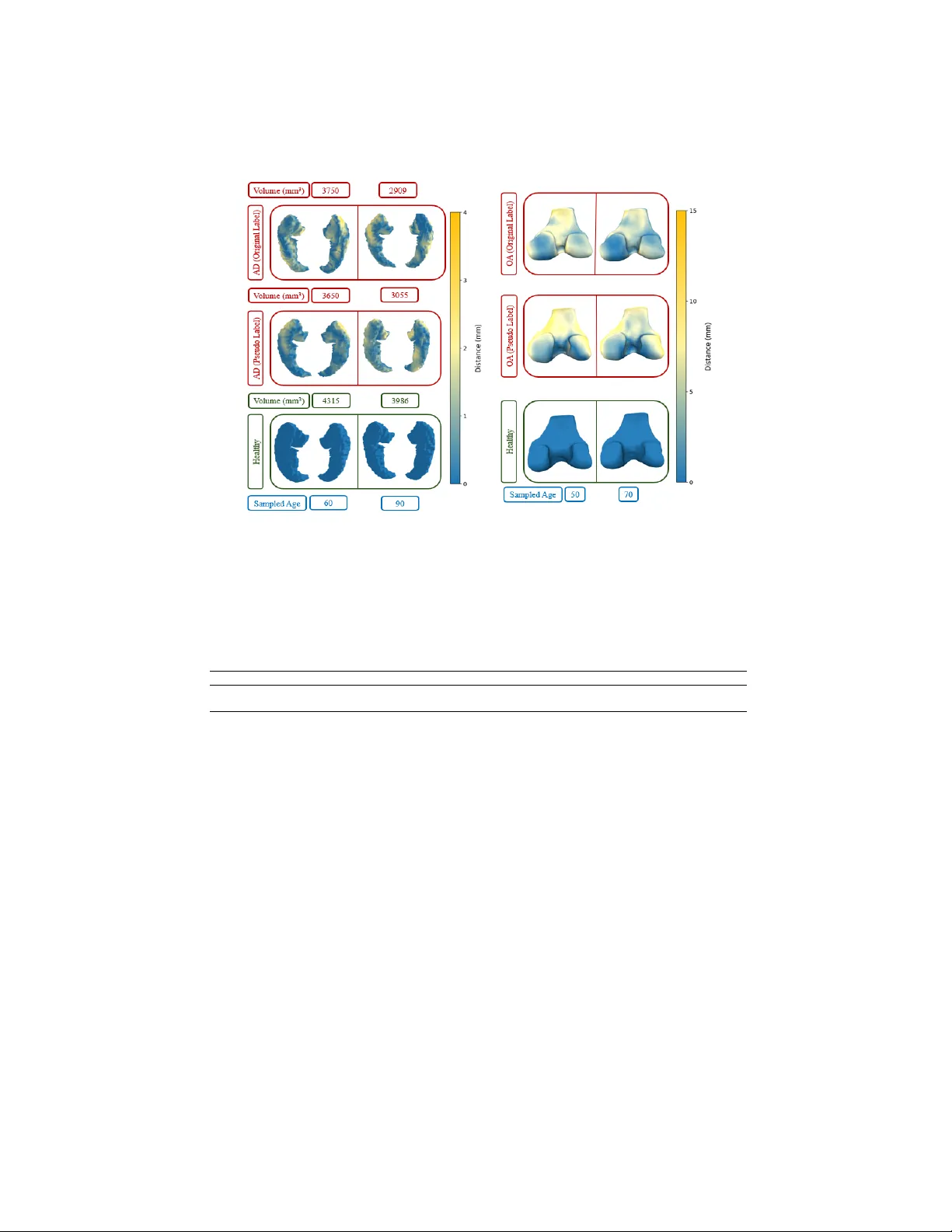
Self-sup ervised Disen tanglemen t of Disease Effects from Aging in 3D Medical Shap es Jak aria Rabbi 1 , Nilanjan Ray 1 , Dana Cobzas 2 1 Departmen t of Computing Science, Univ ersity of Alberta, Edmonton, Canada 2 Departmen t of Computer Science, MacEw an Universit y , Edmonton, Canada jakaria@ualberta.ca, nray1@ualberta.ca, cobzasd@macewan.ca Abstract. Disen tangling pathological c hanges from physiological aging in 3D medical shap es is crucial for developing in terpretable biomark ers and patient stratification. Ho wev er, this separation is c hallenging when diagnosis lab els are limited or unav ailable, since disease and aging often pro duce ov erlapping effects on shape changes, obscuring clinically rele- v an t shape patterns. T o address this c hallenge, w e propose a tw o-stage framew ork com bining unsup ervised disease discov ery with self-sup ervised disen tanglement of implicit shape r epresen tations. In the first stage, we train an implicit neural mo del with signed distance functions to learn stable shap e embeddings. W e then apply clustering on the shap e latent space, whic h yields pseudo disease labels without using ground-truth di- agnosis during discov ery . In the second stage, we disentangle factors in a compact v ariational sp ace using pseudo disease lab els disco vered in the first stage and the ground truth age lab els av ailable for all sub jects. W e enforce separation and controllabilit y with a m ulti-ob jective disen- tanglemen t loss com bining cov ariance and a sup ervised contrastiv e loss. On ADNI hippo campus and OAI distal femur shap es, we ac hieve near- sup ervised p erformance, improving disen tanglement and reconstruction o ver state-of-the-art unsup ervised baselines, while enabling high-fidelity reconstruction, controllable syn thesis, and factor-based explainabilit y . Co de and chec kp oin ts are av ailable at GitHub . Keyw ords: Disentanglemen t · Implicit Neural Representation · Inter- pretabilit y · V ariational Autoenco der · Self-supervised mac hine learning 1 In tro duction Ev aluating morphological v ariation in anatomical shapes is a crucial ob jective in computational medicine, where subtle changes can serve as imaging biomark- ers for diagnosis, prognosis, and patient stratification [6,10]. In neuro degenera- tion, hipp o campal atrophy patterns are widely studied in cohorts such as the Alzheimer’s Disease Neuroimaging Initiativ e (ADNI) [25]. Disease-related effects are strongly entangled b y physiological aging, as they may pro duce ov erlapping shap e c hanges, making it challenging to isolate clinically meaningful disease- asso ciated v ariations, esp ecially when diagnosis lab els are limited, noisy , or un- a v ailable [11]. Moreov er, separating disease effects from healthy controls is also crucial in diseases like osteoarthritis, where aging effects are less pronounced [2]. 2 Rabbi et al. Fig. 1: Stage 1: Learns p er-shap e co des ( z i ) and a INR-nased SDF deco der ( G θ ). Unsup ervised clustering is applied on the learned co des to create pseudo-lab els. Stage 2: A v ariational auto encoder (V AE) mo dels the distribution of shap e co des and learns latents ( z v i ). Pseudo-labels and age lab els are used for disentangling sp ecific laten t v ariables, while frozen G θ is used for reconstruction. Represen tation learning has shifted medical shape mo deling from hand-crafted descriptors and statistical mo dels to ward deep generative approac hes [22,9]. Im- plicit neural represen tations (INR) based on signed distance functions (SDF) pro- vide high-fidelit y con tinuous geometry and ha ve enabled strong reconstruction, in terp olation, and completion p erformance [3,24,21], but most implicit mo dels fo cus on reconstruction quality and do not directly address factor separation or lab el scarcit y . In parallel, disen tanglement in generative mo dels has b een ex- tensiv ely studied using v ariational ob jectiv es and indep endence-promoting regu- larizers [5,7,16], yet purely unsup ervised disentanglemen t is fundamentally am- biguous without additional inductiv e biases or sup ervision [18]. Within medical imaging, weak or structured sup ervision has b een used to disen tangle disease [28,23], and supervised shap e disentanglemen t has been explored when lab els are av ailable [15,26]. Still, there remains a gap for shape frameworks that simul- taneously provide unsupervised/self-sup ervised disease disco very and disentan- glemen t within a single pip eline compatible with implicit representations. T o address these challenges, we introduce a t wo-stage framework that couples unsup ervised disease discov ery with self-sup ervised disen tanglement in implicit shap e represen tations. In the first stage, we train an INR model to learn stable laten t shap e embeddings and encourage a clustering organization of the shap e laten t space through a Gaussian mixture prior, yielding pseudo disease labels. Self-sup ervised Disentanglemen t of Disease Effects in 3D Medical Shap es 3 In the second stage, w e map learned shape codes in to a compact v ariational laten t space and disentangle disease and age using pseudo disease sup ervision and contin uous age lab els, with a m ulti-ob jectiv e loss [26]. W e v alidate our mo del on hippo campus meshes from ADNI [25] and OAI [2], sho wing that pseudo- lab els improv e disen tanglement in unlab eled and low-label settings and supp ort in terpretable tra v ersals that con trol disease and age-asso ciated morphology . Con tributions: (i) W e present the first INR-based self-supervised disease disen tanglement framew ork for 3D medical shap es. (ii) W e disentangle disease and age using a multi-ob jectiv e disentanglemen t loss. ( iii ) On ADNI hipp o cam- pus shapes, our metho d outp erforms unsup ervised baselines and also generalizes w ell to an osteoarthritis (OAI) dataset. 2 Metho d 2.1 Ov erview and Problem Setup W e prop ose a tw o-stage pip eline (Fig. 1) that first learns implicit shap e co des with an INR to disco ver healthy and diseased clusters, then trains a pseudo and age lab el-guided V AE on these co des while freezing the INR as a shap e renderer to preserve output shap e consistency from reconstructed shap e codes. W e represent each surface S i b y samples of a signed distance field. F or shap e i , let Ω i = { ( p ij , s ij ) } m j =1 denote m query p oin ts p ij ∈ R 3 with ground-truth signed distances s ij ∈ R . Stage-1 learns d dimensional co des, z i ∈ R d using an INR mo del [24]. Stage-2 learns a k ( k << d ) dimensional latents z v i ∈ R k o ver the shap e co des using a V AE. 2.2 Stage-1: Implicit Representation Learning W e represent each shap e as the zero lev el s et of a con tinuous SDF. Let G θ : R 3 × R d → R b e an implicit deco der that predicts the signed distance at a query p oin t p ∈ R 3 conditioned on a shap e code z i ∈ R d . Giv en SDF samples Ω i for shap e i , we learn θ and p er-shape codes b y minimizing L INR ( Z ; θ ) , Z ≡ { z i } N i =1 : L INR ( Z , θ ) = L SDF ( Z , θ ) | {z } SDF Loss + λ eik L eik ( Z , θ ) | {z } eikonal + λ gmm L GMM ( Z ) | {z } mixture prior . (1) F ollo wing DeepSDF [24], we use the same architecture for our INR mo del and fit the SDF v alues b y a point wise distance penalty for reconstruction: L SDF ( Z ; θ ) = 1 | Ω | X ( p ,s ) ∈ Ω ρ ( G θ ( p , Z ) − s ) + λ reg L SDF-reg ( Z ) , (2) where ρ ( · ) is a simple per-sample loss. W e keep a small ℓ 2 p enalt y , L SDF-reg ( Z ) on co des to preven t un b ounded growth and to stabilize optimization. W e also add Eikonal [12] loss that encourages the deco der to act lik e a distance field: L eik ( Z ; θ ) = 1 | Ω | X p ∈ Ω ( ∥∇ p G θ ( p , Z ) ∥ 2 − 1) 2 . (3) 4 Rabbi et al. Stage-1 shap e co des exhibit a bimo dal structure; therefore, we make this separa- tion stronger and improv e pseudo-lab el purity b y in tro ducing a tw o-comp onen t Gaussian mixture prior (GMM) ov er the co des: L GMM ( Z ) = − log 2 X m =1 π m N Z | µ m , diag( σ 2 m ) ! . (4) Here, π m are mixture w eights ( P m π m = 1 ), and eac h comp onen t m has a learn- able mean µ m and diagonal cov ariance diag ( σ 2 m ) . Minimizing L GMM increases the likelihoo d of co des aligning with differen t clusters. Pseudo-lab el Disco v ery in Shap e Code: W e fit a 2-comp onen t GMM on the learned shap e co des ( z i ) and assign ˜ y i = arg max m p ( m | z i ) . 2.3 Stage-2: Self-sup ervised Disen tanglement and INR Stage-2 mo dels the distribution of stage-1 shap e codes with a V AE, learning a lo w-dimensional latent co de. The enco der E ϕ outputs Z v ≡ { z v i } N i =1 , and the deco der D ψ reconstructs the shape co de as ˆ Z ≡ { ˆ z i } N i =1 . W e use residual MLP stac ks for b oth enco der and deco der. Enco der contains hidden widths 256 and 128 that maps the input to V AE latent code. The detector consisting of hidden widths 128, 256, and 256 maps the laten t co de to the reconstructed input. Each stage con tains one residual blo ck with GeLU activ ations and La yerNorm. W e pass ˆ Z through the pretrained implicit deco der G θ with θ fixed. T raining ob jectiv e: Stage-2 optimizes a weigh ted sum of fiv e terms: L disentangle ( ϕ, ψ ) = L V AE q ϕ ( Z v | Z ) , ˆ Z | {z } V AE loss + λ snnl L SNNL ( Z v , ˜ y , c ) | {z } supervised loss + λ cov L cov ( Z v ) | {z } decorrelation + λ dis_sen L dis_sen ( Z v , ψ, c ) | {z } dist. & sens. + λ SDF L SDF ( ˆ Z ) | {z } SDF loss. . (5) Here, c are the designated co ordinates for sup ervised disentanglemen t. W e group co de reconstruction and KL regularization in to a single term, L V AE q ϕ ( Z v | Z ) , ˆ Z consisting of reconstruction loss, L code ( Z , ˆ Z ) and KL loss, L KL q ϕ ( Z v | Z ) . The reconstruction part recov ers the shap e co de and is multiplied b y λ code , while the KL term regularizes the p osterior to w ard the unit Gaussian prior, m ultiplied b y β . W e apply a soft nearest-neigh b or loss (SNNL) [26] on Z v c : L SNNL ( Z v , ˜ y ; c, T h ) = X c − 1 b b X i =1 log P j ∈P i ( T h ) α c ij λ 1 P k = i α c ik + λ 2 P j ∈P i ( T h ) α ¬ c ij ! . (6) Here, ˜ y is the label (for classification threshold T h = 0 ), P i ( T h ) = { j = i : | ˜ y j − ˜ y i | ≤ T h } . W e define the affinit y α c ij = exp − ∥ z v i,c − z v j,c ∥ 2 /T and α ¬ c ij = exp − [1 / ( |D ¬ t | T )] P d ∈D ¬ t ∥ z v i,d − z v j,d ∥ 2 , where T > 0 is an adaptive temp erature estimated from batch distances (low v ariance → small T ) and D ¬ t = Self-sup ervised Disentanglemen t of Disease Effects in 3D Medical Shap es 5 { 1 , . . . , k } \ { t } . The w eights λ 1 , λ 2 ≥ 0 balance (i) repulsion among all samples in the target co ordinate and (ii ) discouraging pseudo-lab el similarity leaking into non-target co ordinates. W e also penalize the off-diagonal entries (equation 7) for disen tanglement where C v = Co v ( Z v ) is the batc h cov ariance of Z v . L cov ( Z v ) = ∥ C v − diag( C v ) ∥ 2 F . (7) When SNNL is applied for disease disentanglemen t, we empirically observ ed tw o failure modes: v ariance collapse of Z v c to ward 0 [4], and co ordinate inactivity , where c hanging Z v c yields negligible change in the reconstructed co de [20]). W e therefore add a compact regularizer on the designated co ordinate in equation 8 inspired by isometric representation learning. [17]. L dis _ sen = ( s c − ¯ s ¬ c ) 2 + max(0 , η − α c ) /η 2 . (8) Here s c = Std B ( Z v c ) , ¯ s ¬ c = 1 k − 1 P d = c Std B ( Z v d ) , and α c = 1 b P b i =1 D ψ ( z v i + ε e c ) − D ψ ( z v i − ε e c ) 2 is the av erage finite-difference effect of p erturbing only Z v c (with e c the c -th basis vector). W e reuse one of the INR losses ( L shape ( ˆ Z ; G θ ) ) from stage-1 on ˆ Z with θ fixed. 3 Exp erimen ts 3.1 Datasets W e use tw o datasets: hipp ocampal shap es from the ADNI-1 3T MRI dataset [25] (1 mm isotropic), including left/right segmen tation masks with ground-truth v ol- umes, and distal femur shapes from the Osteoarthritis Initiativ e (O AI) dataset (with fem ur segmentation) [2] for cross-disease ev aluation. F or ADNI, we gen- erate 3D meshes using marc hing cub es [19] follo wed by smoothing. W e v alidate 819 ADNI (AD and cognitive normal - CN) and 191 (h ealth y and O A) O AI scans with patient-disjoin t, stratified splits of 80%/10%/10% (train/v al/test), preserving age, sex, and diagnosis ratios. All scans are used for representation learning, and unsupervised/self-sup ervised disentanglemen t following Horan et al. [13], while the splits are used for sup ervised ablation. 3.2 Implemen tation Details and Metrics W e train a t wo-stage pip eline on three NVIDIA Titan R TX (24 GB) GPUs. Stage-1 is trained for 2000 ep o c hs on SDF samples (16 shapes/batch, 16,384 samples/shap e; clamping=0.1; grad-clip=1.0) with λ eik = λ reg = 10 − 4 , λ g mm = 10 − 3 ( K =2 ), and step LR decay (lr=0.001). Stage-2 trains a V AE with the shap e co des as input/output while keeping the SDF deco der frozen as a renderer; it runs for 2000 ep ochs (32 shap es/batc h, 16,384 samples/shap e) with λ reg = 10 − 4 , λ code = 0 . 44 , β = 0 . 008 , λ snnl = 0 . 77 , ( λ 1 = λ 2 = 0 . 5) , T h = . 05 , λ cov = 0 . 007 , and λ dis _ sen = 0 . 56 ( ε = 0 . 02 , η = 0 . 02 ). 6 Rabbi et al. T able 1: Stage-1 ablation: purity (Pur (%) ↑ ), and mean-v olume gap ( ∆V ↑ , mm 3 ) for shap es b et ween the t wo clusters. A verage volume of AD is lo wer compared to CN which is clearly represen ted by stage-1 clusters. Losses Pur (%) ↑ ∆V ( mm 3 ) ↑ Recon. ↓ Rec + ℓ 2 72.43 1154 0.0014 + Eikonal 80.19 1317 0.0013 + GMM prior 82.37 1401 0.0015 Fig. 2: V olume distribution of shap es in stage-1 cluslters. W e find the best parameters by using the Optuna framework [1] and for Stage-2 ablations, run eac h setting with three random seeds, reporting a v er- age p erformance. W e ev aluate disentanglemen t using SAP [18] and correlations b et w een laten t dimensions and co v ariates (age, diagnosis), with diagnosis clas- sification, age regression, and shape reconstruction. All metho ds use the laten t co des from our stage-1 because most unsupervised disen tanglement methods p erform p o orly on the shap e space. W e rep ort all comparisons and ablations on ADNI, and include OAI results for our method only in the last row of T able 2 due to space constrain ts. 4 Results 4.1 Clustering quality , V olume analysis and Disentanglemen t W e ev aluate stage-1 INR training in T able 1. Cluster purit y ( Pur ) is com- puted with AD/CN lab els only for ev aluation b y a veraging the ma jorit y-class fraction per cluster. A dding Eik onal impro ves Pur (72.43 → 80.19) and recon- struction (0.0014 → 0.0013), indicating smo other SDF geometry . A dding a GMM prior giv es the b est purity (82.37) and largest mean volume difference of shap es ( ∆V = 1401 mm 3 ) b et ween tw o clusters with a small reconstruction error us- ing the chamfer distance (CD) increase (0.0015). Fig. 2 sho ws that the mean v olumes differ and the distributions ov erlap, implying clustering is not based on v olume. Cluster 1 represen ts CN and cluster 2 represen ts AD, as CN co- horts ha v e higher hippo campal volumes [8]. Similar process is follo w ed for O AI dataset. Shap e-space clustering and HLLE+ICA [13], do es not pro duce mean- ingful disentanglemen t; therefore, we adopt our Stage-1 metho d. In stage-2 , w e report disen tanglement and do wnstream prediction in T a- ble 2 using an 8D V AE latent co de for ADNI dataset. W e sup ervise z v i, 0 with pseudo disease lab els and z v i, 1 with av ailable ages for our mo del. F or β -V AE/ β - TCV AE/DIP-V AE [18], we rep ort disease metrics on the latent dimension with the strongest disease association and k eep age sup ervision fixed to z v i, 1 . F or PCA/ICA and HLLE+ICA [13], we do the same as for the V AEs, although it is not p ossible to em bed age lab els there. Our method impro ves disease and Self-sup ervised Disentanglemen t of Disease Effects in 3D Medical Shap es 7 T able 2: Comparison of representation methods, unsup ervised disentanglemen t mo dels, and our metho d. ↑ / ↓ indicates higher / low er is b etter, resp ectiv ely . All rows except the last one show the results of the ADNI dataset. The last row sho ws the results from the OAI dataset with the p ercen tage increase or decrease from the second-b est or best method. Method Disease Age Recon. ↓ SAP ↑ Correlation ↑ Accuracy ↑ SAP ↑ Correlation ↑ RMSE ↓ PCA 0.14 0.57 67.38 0.03 0.22 0.162 0.0020 ICA 0.14 0.61 63.15 0.02 0.20 0.162 0.0021 HLLE+ICA 0.18 0.67 71.76 0.02 0.18 0.161 N/A β -V AE 0.15 0.47 51.27 0.61 0.79 0.065 0.0016 β -TCV AE 0.16 0.49 51.94 0.64 0.82 0.068 0.0017 DIP-V AE 0.18 0.48 53.61 0.63 0.86 0.062 0.0017 w/ fixed T 0.30 0.69 76.31 0.63 0.82 0.065 0.0018 w/o cov 0.34 0.73 76.55 0.63 0.83 0.068 0.0018 Ours 0.38 0.73 78.67 0.67 0.86 0.061 0.0019 Ours (OAI ) 0.25 (+32%) 0.55 (+1%) 63.67 (+2%) 0.41 (+5%) 0.52 (+7%) 0.091 (+5%) 0.0016 (-10%) age separation (SAP) while maintaining reconstruction quality (CD) compara- ble to other V AEs. W e report P earson correlation, disease accuracy , and age RMSE from the designated disease and age latent dimensions using original la- b els, with a simple kNN [14] classifier and regressor ev aluated on train and test splits. Ablations show that an adaptiv e SNNL temp erature impro v es SAP o v er a fixed temp erature and that co v ariance regularization improv es factor separa- tion. The last row rep orts O AI results for our metho d only , with p ercen tages indicating improv emen t o v er the second-b est model or reduction relative to the b est model. Our mo del p erforms strongly on all metrics except reconstruction, whic h is exp ected under additional latent-space constraints [26]. 4.2 Shap e Generation through Latent T ra v ersal and Lab el Mixing Fig. 3 illustrate the mo del’s generative control. W e sample multiple v alues along the age axis ( z v i, 1 ) and, for each fixed z v i, 1 , generate tw o shap es by setting z v i, 0 to its minimum and maxim um v alues. This yields paired AD/CN shap es at matched ages, demonstrating controllable synthesis along both factors. Qualitativ ely , the generated pairs show volume ( ∼ 30% shrink age due to AD) and disease-asso ciated morphological differences aligning with known anatomical progression patterns rep orted in prior clinical shap e studies [10]. Our self-sup ervised mo del closely follo ws the sup ervised mo del in terms of volume and shap e changes [10]. In OAI, distal femur shap e sho w limited c hange o ver time [27], which is consisten t with our observ ation that age-related femoral deformation is not clearly separated in this cohort. W e v ary the fraction of real disease labels in Stage-2 (T able 3) for the ADNI dataset. Compared to leaving the remaining samples unlab eled, pseudo lab els pro vide the largest b enefit in lo w-lab el settings (0–30% real lab els: SAP 0.29– 0.32 vs. 0.17–0.21). As real sup ervision increases ( ∼ 80%), the gain from pseudo- lab els diminishes, and the results are rep orted on the test split. Here, our mo del 8 Rabbi et al. Fig. 3: Rendering healthy and diseased shap es at different ages b y laten t tra versal (trained b y both real pseudo lab els) sho ws consisten t v olume changes in ADNI (left) and deformation in OAI (righ t) that reflect the original dataset. T able 3: Disease SAP across v arying fractions of real AD labels used in Stage-2 training (first ro w). In the Real+No Lab el setting, the remaining samples are unlab eled, whereas in the Real+Pseudo setting, they are assigned pseudo-lab els. Real lab els (%) 0 10 20 30 40 50 60 70 80 90 100 SAP (Real + No lab el) - 0.19 0.21 0.21 0.25 0.29 0.32 0.35 0.38 0.39 0.40 SAP (Real + Pseudo) 0.29 0.29 0.30 0.32 0.32 0.34 0.35 0.37 0.37 0.38 - sup ervised with 100% real lab els gives the upp er-bound as we improv e sup ervised disen tanglement b y incorporating recen t metho ds. 5 Conclusion W e prop ose a tw o-stage, lab el-efficient framework for 3D shap e disen tanglement with limited or no diagnosis lab els. Stage-1 INR learns clusterable implicit co des and yields pseudo disease lab els through tw o-cluster dis co v ery , and a stage-2 V AE separates disease and age into fixed laten t dimensions while freezing the INR deco der as a renderer to preserve reconstruction. On ADNI hipp ocampus and OAI distal fem ur shap es, we outp erform unsup ervised baselines, enable con- trollable healthy and diseased shap e generation across ages, and show pseudo lab els help most in low-label settings but fade as real sup ervision increases in ADNI. In future work, w e will study different diseases across diverse anatomical shap es. Self-sup ervised Disentanglemen t of Disease Effects in 3D Medical Shap es 9 References 1. Akiba, T., Sano, S., Y anase, T., Ohta, T., Ko y ama, M.: Optuna: A next- generation hyperparameter optimization framework. In: Pro ceedings of the 25th A CM SIGKDD international conference on knowledge disco very & data mining. pp. 2623–2631 (2019) 2. Am b ellan, F., T ac k, A., Ehlke, M., Zacho w, S.: Automated segmen tation of knee b one and cartilage combining statistical shap e knowledge and conv olutional neural net works: Data from the osteoarthritis initiative. Medical image analysis 52 , 109– 118 (2019) 3. Amiranash vili, T., Lüdke, D., Li, H.B., Zacho w, S., Menze, B.H.: Learning con tin- uous shap e priors from sparse data with neural implicit functions. Medical image analysis 94 , 103099 (2024) 4. Bardes, A., P once, J., LeCun, Y.: Vicreg: V ariance-in v ariance-co v ariance regular- ization for self-sup ervised learning. arXiv preprint arXiv:2105.04906 (2021) 5. Burgess, C.P ., Higgins, I., Pal, A., Matthey , L., W atters, N., Desjardins, G., Ler- c hner, A.: Understanding disentangling in β -v ae. arXiv preprint (2018) 6. Cerrolaza, J.J., Picazo, M.L., Humbert, L., Sato, Y., Rueck ert, D., Ballester, M.Á.G., Linguraru, M.G.: Computational anatom y for multi-organ analysis in medical imaging: A review. Medical image analysis 56 , 44–67 (2019) 7. Chen, R.T., Li, X., Grosse, R.B., Duvenaud, D.K.: Isolating sources of disentan- glemen t in v ariational auto encoders. A dv ances in neural information processing systems 31 (2018) 8. Ch upin, M., Gérardin, E., Cuingnet, R., Boutet, C., Lemieux, L., Lehéricy , S., Benali, H., Garnero, L., Colliot, O.: F ully automatic hipp ocampus segmentation and classification in alzheimer’s disease and mild cognitiv e impairmen t applied on data from adni. Hippo campus 19 (6), 579–587 (2009) 9. Dannec ker, M., Kyriak op oulou, V., Cordero-Grande, L., Price, A.N., Ha jnal, J.V., Ruec kert, D.: Cina: Conditional implicit neural atlas for spatio-temp oral represen- tation of fetal brains. In: International Conference on Medical Image Computing and Computer-Assisted Interv en tion. pp. 181–191. Springer (2024) 10. F rankó, E., Joly , O., Initiative, A.D.N.: Ev aluating alzheimer’s disease progression using rate of regional hipp ocampal atrophy . PloS one 8 (8), e71354 (2013) 11. Gerardin, E., Chételat, G., Chupin, M., Cuingnet, R., Desgranges, B., Kim, H.S., Niethammer, M., Dub ois, B., Lehéricy , S., Garnero, L., et al.: Multidimen- sional classification of hipp ocampal shap e features discriminates alzheimer’s disease and mild cognitive impairment from normal aging. Neuroimage 47 (4), 1476–1486 (2009) 12. Gropp, A., Y ariv, L., Haim, N., A tzmon, M., Lipman, Y.: Implicit geometric reg- ularization for learning shapes. arXiv preprin t arXiv:2002.10099 (2020) 13. Horan, D., Richardson, E., W eiss, Y.: When is unsupervised disen tanglement p os- sible? Adv ances in Neural Information Pro cessing Systems 34 , 5150–5161 (2021) 14. Imandoust, S.B., Bolandraftar, M., et al.: Application of k-nearest neigh b or (knn) approac h for predicting economic even ts: Theoretical background. International journal of engineering researc h and applications 3 (5), 605–610 (2013) 15. Kiec hle, J., Miller, D., Slessor, J., Pietrosanu, M., K ong, L., Beaulieu, C., Cobzas, D.: Explaining anatomical shape v ariabilit y: sup ervised disentangling with a v ari- ational graph autoenco der. In: 2023 IEEE 20th International Symp osium on Biomedical Imaging (ISBI). pp. 1–5. IEEE (2023) 10 Rabbi et al. 16. Kumar, A., Sattigeri, P ., Balakrishnan, A.: V ariational inference of disentangled la- ten t concepts from unlab eled observ ations. arXiv preprint arXiv:1711.00848 (2017) 17. Lee, Y., Y o on, S., Son, M., Park, F.C.: Regularized auto encoders for isometric represen tation learning. In: In ternational Conference on Learning Represen tations (2022) 18. Lo catello, F., Bauer, S., Lucic, M., Raetsc h, G., Gelly , S., Schölk opf, B., Bachem, O.: Challenging common assumptions in the unsup ervised learning of disentangled represen tations. In: international conference on machine learning. pp. 4114–4124. PMLR (2019) 19. Lorensen, W.E., Cline, H.E.: Marching cubes: A high resolution 3d surface con- struction algorithm. In: Seminal graphics: pioneering efforts that shap ed the field, pp. 347–353 (1998) 20. Lucas, J., T uck er, G., Grosse, R., Norouzi, M.: Understanding p osterior collapse in generativ e laten t v ariable mo dels; 2019. In: URL https://openreview. net/forum (2019) 21. Mesc heder, L., Oec hsle, M., Niemeyer, M., Now ozin, S., Geiger, A.: Occupancy net works: Learning 3d reconstruction in function space. In: Proceedings of the IEEE/CVF conference on computer vision and pattern recognition. pp. 4460–4470 (2019) 22. Molaei, A., Aminimehr, A., T av akoli, A., Kazerouni, A., Azad, B., Azad, R., Mer- hof, D.: Implicit neural representation in medical imaging: A comparative survey . In: Pro ceedings of the IEEE/CVF International Conference on Computer Vision. pp. 2381–2391 (2023) 23. Ouy ang, J., Zhao, Q., Adeli, E., Zaharch uk, G., P ohl, K.M.: Disentangling normal aging from sev erit y of disease via w eak sup ervision on longitudinal mri. IEEE transactions on medical imaging 41 (10), 2558–2569 (2022) 24. P ark, J.J., Florence, P ., Straub, J., New combe, R., Lov egrov e, S.: Deepsdf: Learning con tinuous signed distance functions for shap e representation. In: Pro ceedings of the IEEE/CVF conference on computer vision and pattern recognition. pp. 165– 174 (2019) 25. P etersen, R.C., Aisen, P .S., Beck ett, L.A., Donoh ue, M.C., Gamst, A.C., Harvey , D.J., Jac k Jr, C.R., Jagust, W.J., Shaw, L.M., T oga, A.W., et al.: Alzheimer’s disease neuroimaging initiative (adni) clinical c haracterization. Neurology 74 (3), 201–209 (2010) 26. Rabbi, J., Kiechle, J., Beaulieu, C., Ray , N., Cobzas, D.: Disen tangling hipp ocam- pal shape v ariations: A study of neurological disorders using mesh v ariational au- to encoder with contrastiv e learning. arXiv preprint arXiv:2404.00785 (2024) 27. Wise, B.L., Niu, J., Zhang, Y., Liu, F., Pang, J., Lync h, J.A., Lane, N.E.: Pat- terns of c hange o v er time in knee b one shap e are associated with sex. Clinical Orthopaedics and Related Researc h ® 478 (7), 1491–1502 (2020) 28. Zhang, J., Shi, Y.: Surface-based m ulti-axis longitudinal disentanglemen t using con trastive learning for alzheimer’s disease. In: International Conference on Medi- cal Image Computing and Computer-Assisted Interv en tion. pp. 585–594. Springer (2025)
Original Paper
Loading high-quality paper...
Comments & Academic Discussion
Loading comments...
Leave a Comment