You've Got a Golden Ticket: Improving Generative Robot Policies With A Single Noise Vector
What happens when a pretrained generative robot policy is provided a constant initial noise as input, rather than repeatedly sampling it from a Gaussian? We demonstrate that the performance of a pretrained, frozen diffusion or flow matching policy ca…
Authors: Omkar Patil, Ondrej Biza, Thomas Weng
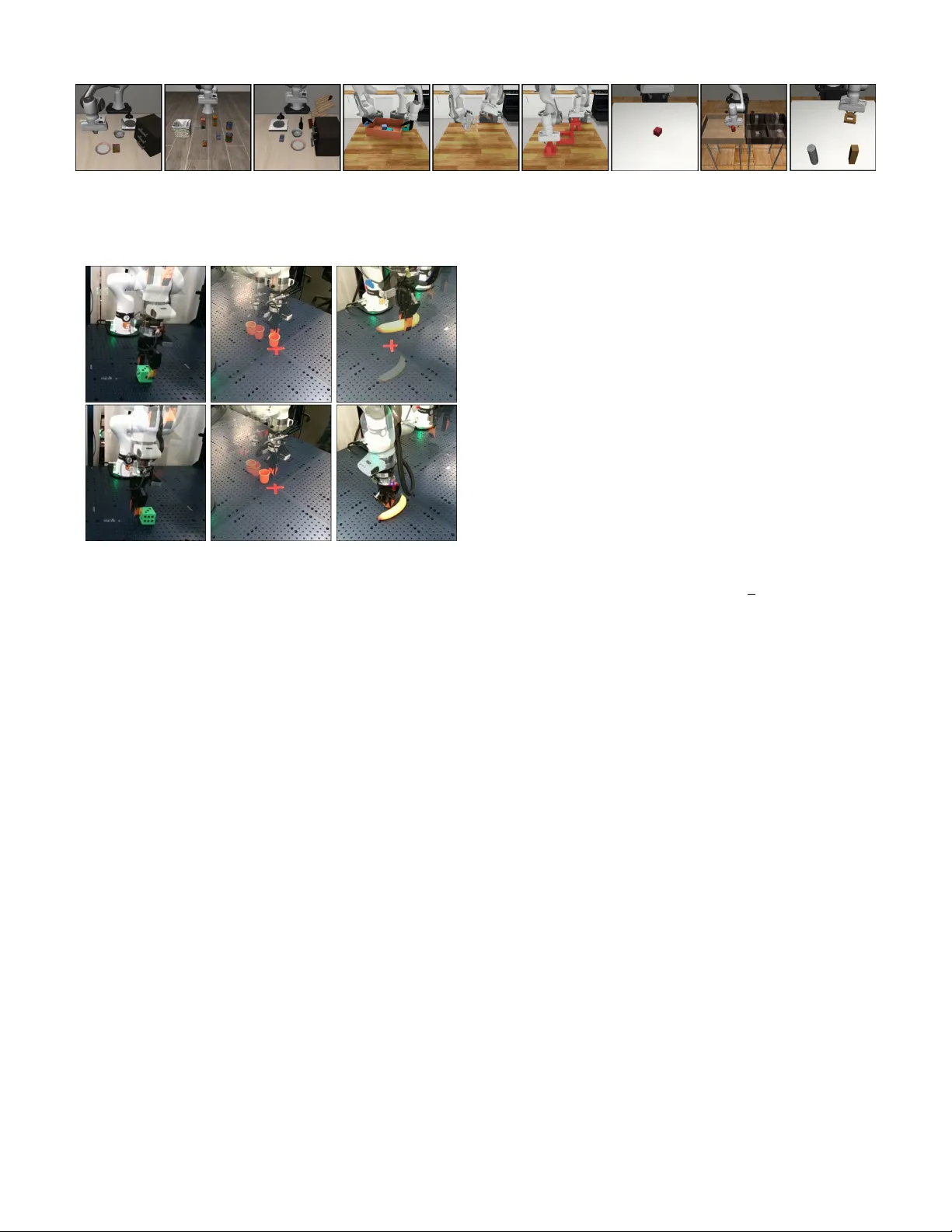
Y ou’ v e Got a Golden T icket: Impro ving Generati v e Robot Policies W ith A Single Noise V ector Omkar Patil 1,2 , Ondrej Biza 1 , Thomas W eng 1 , Karl Schmeckpeper 1 , W il Thomason 1 Xiaohan Zhang 1 , Robin W alters 1,3 , Nakul Gopalan 2 , Sebastian Castro 1 , Eric Rosen 1 1 Robotics and AI Institute (RAI) 2 Arizona State Univ ersity (ASU) 3 Northeastern Univ ersity Abstract —What happens when a pretrained generative robot policy is provided a constant initial noise as input, rather than repeatedly sampling it from a Gaussian? W e demonstrate that the performance of a pretrained, frozen diffusion or flow matching policy can be impro ved with respect to a do wnstream reward by swapping the sampling of initial noise from the prior distribution (typically isotropic Gaussian) with a well-chosen, constant initial noise input—a golden tick et . W e propose a search method to find golden tickets using Monte-Carlo policy ev aluation that keeps the pretrained policy frozen, does not train any new networks, and is applicable to all diffusion/flow matching policies (and theref ore many VLAs). Our approach to policy improvement makes no assumptions bey ond being able to inject initial noise into the policy and calculate (sparse) task rewards of episode rollouts, making it deployable with no additional infrastructure or models. Our method improves the performance of policies in 38 out of 43 tasks across simulated and real-world robot manipulation benchmarks, with relative improv ements in success rate by up to 58% for some simulated tasks, and 60% within 50 search episodes for real-world tasks. W e also show unique benefits of golden tickets for multi-task settings: the diversity of behaviors from different tickets naturally defines a Par eto frontier for balancing different objectives (e.g., speed, success rates); in VLAs, we find that a golden ticket optimized f or one task can also boost performance in other related tasks. W e release a codebase with pretrained policies and golden tickets for simulation benchmarks using VLAs, diffusion policies, and flow matching policies: https://bdaiinstitute.github .io/lottery tickets/ I . I N T RO D U C T I O N Conditional diffusion [8] and flow matching models [14] are popular approaches for learning robot control policies. Their ability to represent high-dimensional, multimodal action distributions hav e made them popular in both single-task policies and large-scale multi-task V ision-Language-Action (VLA) models. Howe ver , improving their out-of-the-box per- formance on downstream tasks currently introduces many computational and model design challenges. Existing policy improv ement methods in v olve either 1) updating the pretrained model weights [26] (which is computationally hard for large models like VLAs), 2) training an additional network [32, 36] (requiring complex model design choices), or 3) assuming access to external critic networks [37] or specific training regime [10] (limiting the scenarios they can be applied in). Instead, we propose a new method that 1) keeps the pre- trained policy weights frozen, 2) does not train an additional network, and 3) can be applied to any diffusion or flow matching framework without additional training or test-time assumptions. Our approach is motiv ated by a simple question: (a) (Gauss. Ep 1) (b) (Gauss. Ep 2) (c) (Gauss. Ep 3) (d) (G.T . Ep 1) (e) (G.T . Ep 2) (f) (G.T . Ep 3) Fig. 1: (a-c) A diffusion policy trained to pick a banana across the table, with three different failure spots sho wn. Every time it produces an action chunk, random initial noise is sampled from an isotropic Gaussian. (d-f) With the same network and weights , we can adapt this policy to successfully pick the banana from all locations, by instead using a constant initial noise vector called a golden ticket (G.T .) . W e optimize initial noise vectors to steer pretrained policies to maximize downstream rew ards. What happens when a pretrained generative robot policy is provided a constant initial noise as input, rather than repeatedly sampling from a Gaussian? W e demonstrate that the performance of a pretrained, frozen diffusion or flow matching policy can be improved by sim- ply replacing the sampling of initial noise from the prior distribution with a well-chosen, constant initial noise input, which we call a golden ticket (Figure 1). This approach is related to the emerging class of latent steering approaches [36], but benefits from only requiring a rew ard function for a downstream task, without any additional model training. Gi ven a pretrained policy and a rew ard function and an en vironment for a new downstream task, we pose finding golden tickets as a search problem, where candidate initial noise vectors, which we call lottery tickets, are optimized to find the ticket that maximizes cumulati ve discounted expected rewards on the downstream task. W e show that golden tickets can be compet- itiv e with state-of-the-art Reinforcement Learning (RL)-based latent steering methods [36], in some cases outperforming Fig. 2: Overview of standard diffusion policy inference (left) versus our proposed approach of using golden tickets (right). Giv en a frozen, pretrained diffusion or flo w matching policy π pre , rather than sampling from a Gaussian every time an action needs to be computed, we use a constant, well-chosen initial noise vector w , called a golden ticket. W e find golden tickets improv e policy performance across a range of observation inputs, model architectures, and embodiments. them in terms of impro ved success, despite requiring less computational effort and fewer model design choices. Further , we show that golden tickets can exhibit properties fav or- able to skill learning, such cross-task generalization in goal- conditioned policies like VLAs, and that single-task policies can also be steered to balance competing objectives like speed and success rate. Our experiments show an improvement in policy perfor- mance in 38 out of 43 tasks across four simulated manipulation benchmarks and 3 real-world tasks with a v ariety of pretrained policy classes. When we apply our approach on hardware, we increase the relative success rate of an object picking task by 18% , and an object pushing policy by 60% , with the ticket search taking less than 150 episodes per task. Our contributions are: 1) A formulated lottery ticket hypothesis for improving pretrained robot policies by using a single initial noise vector —a golden tic ket —to adapt robot beha vior for downstream rew ard functions (Figure 2). 2) A search method to finding golden tickets that maximize rew ards in a giv en robot en vironment. 3) Demonstrating that golden tickets improve polic y perfor- mance across several model architectures, observation input modalities, and embodiments, in four simulated benchmarks and three real-world picking and pushing tasks. 4) Experiments demonstrating that golden tickets can match, and e ven outperform, existing state-of-the-art methods for latent steering in fiv e simulated tasks, and evidence of cross-task generalization for goal- conditioned policies in three task suites comprising 30 related tasks. 5) Open-source code with golden tickets (and ticket search implementations) for pretrained VLA, diffusion, and flow matching policies in three simulated manipulation benchmarks. I I . B A C K G RO U N D A. Markov Decision Pr ocess W e model robot manipulation as a Markov Decision Pro- cess (MDP). An MDP comprises a tuple { S, A, T , R , p 0 , γ } , where S and A are sets of states and actions (respectiv ely), T ( s ′ | s, a ) = Pr ( s ′ | s, a ) is the transition dynamics, R ( s, a ) is the reward function, p 0 ∈ △ S is the initial state distribution ov er S , and γ is the discount factor . A policy π rolls out episodes from an initial state s 0 ∼ p 0 by iterativ ely sampling an action a t = π ( ∗| s t ) to execute at each time step t to get the next state s t +1 ∼ T ( ∗| s t , a t ) and reward r t = R ( s t , a t ) . The Q -function Q π ( s, a ) for π gi ves the cumulative discounted expected rewards of π rolled out from a state s with initial action a , following π for all subsequent actions. That is, Q π ( s, a ) = E P π,T ( ∗ ) [ P t> 0 γ t R ( s t , a t ) | s 0 = s, a 0 = a ] . B. Diffusion and flow matching Diffusion and flow matching models are generati ve methods that iterativ ely refine a sample from a source distrib ution into a desired target data distribution. W e focus on the flo w matching framew ork with a Gaussian source distribution for simplicity , but our work is also applicable to diffusion models and more broadly latent variable generati ve models (e.g., conditional variational auto-encoders (CV AEs) [41]). In flow matching, given a dataset D = { x i ∼ p data } n i =1 , the forward process gradually corrupts a datapoint x ∈ D ov er time τ 1 by linearly interpolating it with a sample from an isotropic Gaussian: z τ +1 = (1 − τ ) x + τ ϵ where ϵ ∼ N (0 , I ) (1) where z τ represents the partially noised datapoint x at time τ . At time τ = 0 , z τ = z 0 = x is uncorrupted, while at time τ = 1 , z τ = z 1 = ϵ is fully corrupted noise. Generating ne w samples from the data distrib ution p data requires rev ersing the forward process. Specifically , a 1 Note that we use τ for the forward/rev erse process time index to distin- guish it from the MDP time index t , introduced in Section II-A. denoising model ˆ u = ˆ u ( z τ , τ ) is trained to undo the forward process, and ne w samples from p data can be generated by iterativ ely denoising a sample z τ with z 1 ∼ N (0 , I ) , treating the denoising model ˆ u as a velocity field and solving the ODE: z j = z k + ˆ u · ( j − k ) (2) While dif fusion and other flow variants differ in how they define the forward and reverse processes, our method is agnostic to these variations; it focuses only on making z 1 , the initial noise vector used for inference, a constant vector rather than repeatedly sampling it from a Gaussian distribution. A conditional denoising model ˆ u = ˆ u ( z k , s t , τ ) takes in auxiliary state information s t to adjust the denoising process (the process abov e can be tri vially extended to this setting). When ˆ u is trained to denoise actions (or action chunks [41]) conditioned on a state s t , the samples generated from the rev erse process are interpreted as actions sampled from a policy π parameterized by the conditional denoising model ˆ u and the source noise distribution. I I I . R E L A T E D W O R K W e revie w existing approaches to policy improv ement via latent steering, as well as related lottery ticket hypotheses from the computer vision community on optimizing initial noise vectors to improve performance of diffusion models. A. Impro ving Robot P olicies via Latent Steering While there is a div erse range of policy impro vement methods (see Appendix A for more details), we focus on those that use latent steering, since the y most closely relate to our ap- proach. Latent steering was pioneered by diffusion steering via reinforcement learning (DSRL) [36], which swaps the source noise distribution with an observ ation-conditioned noise policy trained via reinforcement learning (RL). DSRL freezes the weights of the pretrained diffusion policy , providing a strong regularization towards the behaviors already encoded in the pretrained model, and can be applied to any dif fusion or flow matching policy . Ho we ver , DSRL presents tw o major challenges in practice: 1) it trains an additional neural network, which inv olves modeling decisions to ensure sufficient model capacity , and 2) it integrates with an RL framew ork to train the noise policy , which requires hyperparameter tuning [36]. DSRL has inspired a wav e of ne w approaches that inv es- tigate latent steering for policy improvement [13], but these all use observation-conditioned noise policies. W e introduce observation-independent noise policies (i.e., using a single initial noise vector to perform latent steering), which: 1) do not require designing and training a separate network from the original policy , and 2) are not impacted by shifting observation distributions since they are by design inv ariant to observ ation. B. Lottery T ick et Hypothesis for Diffusion/Flow Models Our work is moti vated by a “lottery ticket hypothesis” proposed by Mao et al. [20] in the context of image gen- eration 2 : “randomly initialized Gaussian noise images contain 2 The term “lottery ticket hypothesis” was first introduced by Frankle and Carbin [4] in the context of finding sparse subnetworks within denser networks, though this does not relate to our work. special pixel blocks (winning tickets) that naturally tend to be denoised into specific content independently . ” Followup works hav e in vestigated how these “winning tickets” (also referred to as “golden noises” [42, 1, 21], or “golden tickets” in our work) can be optimized to achie ve higher text-image alignment and higher human preference when they are used instead of sampling from isotropic Gaussian noise. Methods to find golden tickets for image generation have used a variety of metrics, such as noise in v ersion [29] and stability [25], semantic and natural appearance consistency [30], 3D geometry [27], and re gularization to the original Gaussian distribution [35]. I V . L OT T E RY T I C K E T H Y P OT H E S I S F O R R O B O T C O N T RO L T o our knowledge, we are the first to make a connection between lottery ticket hypotheses for impro ving text-to- image diffusion models and latent steering for impro ving robot diffusion/flow matching policies . There are important differences between the robot control and image generation settings that require the development of new methods to optimize initial noise vectors (see Appendix B for details). These include 1) a robot policy interacts with an environment where previous decisions impact future states, 2) collecting samples from the en vironment can be costly , and 3) the rew ard function may not be differentiable. T o overcome these challenges, we propose a unique lottery ticket hypothesis for improving robot policies that is based in reinforcement learning, along with a search method that addresses the three aforementioned challenges to find golden tickets that optimize rew ards in a downstream en vironment. A. Problem setting W e assume we are given a pretrained, frozen diffusion or flow matching robot control policy π . W e treat this policy as a black box and do not assume we can access any intermediate steps of the denoising process. W e also assume we are giv en an MDP representing a downstream task from which we can sample transitions (i.e., we can simulate the MDP but do not hav e access to the underlying model). Our goal is to adapt the policy π behavior to maximize rew ards while keeping the parameters frozen. While we do not make any assumptions about the pretrained polic y , our method only works if the policy is steerable [36], which is not guaranteed. B. Lottery T ick et Hypothesis The lottery ticket hypothesis for r obot control proposes that the performance of a pretrained, frozen diffusion or flow matching policy can be improved by replacing the sampling of initial noise from a prior distribution with a well-chosen, constant initial noise input, called a golden tick et . W ell-chosen means the ticket is optimized to steer the pretrained policy to maximize rew ards for a downstream task. Algorithm 1 Random Search for Optimizing Initial Noise 1: Input: Pretrained policy π , set of environments E , re ward function R , number of tickets n 2: Output: Optimized initial noise vector w ⋆ 3: Sample n initial noise vectors { w i } n i =1 , w i ∼ N (0 , I ) 4: Initialize best reward ¯ R best ← −∞ 5: for i = 1 to n do 6: Initialize cumulativ e re ward S i ← 0 7: for all e ∈ E do 8: Roll out π in en vironment e with fixed noise w i 9: Obtain episode return R e 10: S i ← S i + R e 11: Compute av erage episodic returns ¯ R i ← 1 | E | S i 12: if ¯ R i > ¯ R best then 13: ¯ R best ← ¯ R i 14: w ⋆ ← w i 15: return w ⋆ C. Golden ticket sear ch T o improve the policy , we must find a ticket that has better performance than repeatedly sampling from the Gaussian prior . W e propose a variant of random searc h (Algorithm 1) that estimates Monte-Carlo returns on policy rollouts to find golden tickets. Our approach only assumes that initial noise can be injected into the pretrained policy , and that (sparse) task rew ards can be calculated for rollouts. This approach has man y appreciable benefits: 1) it does not require setting up any additional infrastructure or running/training models, and 2) it is applicable to all dif fusion and flow matching policies that can be ran as black-box systems, which includes many VLAs. In this paper , we therefore focus on (and now describe) our approach to demonstrate one way to search for golden tickets, and discuss future work improvements in Section VII. Algorithm 1 shows our random search method for finding golden tickets. The algorithm first samples n initial noise vectors (this is the main hyperparameter of our method), which we refer to as lottery tickets, and then ev aluates each lottery ticket in a set of search en vironments E by performing policy rollouts. Each search en vironment is formulated as a single MDP; for single-task policies, only the starting state distribution may dif fer between search environments, whereas for multi-task policies, the reward function may also differ between en vironments. For each ticket, we run the policy in each en vironment, fixing the initial noise vector fed into the policy . W e then cal- culate the av erage cumulativ e discounted rew ards, providing an empirical estimate (i.e., Monte-Carlo estimate) of the v alue function for the ticket. After all tickets hav e been ev aluated, we select and return the best performing ticket. Note that this algorithm does not guarantee that the ticket returned is a golden ticket (i.e., that it has higher average performance than sampling from the Gaussian prior). T o determine if the returned ticket is “golden”, we assume there is a held-out set of initial states or en vironments which we use to ev aluate the performance of both the best ticket and the base policy . W e do this to avoid test/train contamination, because it is possible that the tickets we find during search are ov erfit to the particular en vironments they were searched in. If a ticket has good performance on the search en vironments, but worse performance on the held-out environments, we are ov erfitting and not meaningfully able to fix the initial noise to control the performance of the policy . For a fixed compute budget, there exists a trade-off between number of tickets n and number of search en vironments E on which to ev aluate those tickets. More tickets result in better cov erage and potentially better search performance, but risk not generalizing to held-out en vironments. Con versely , more search en vironments increase the likelihood a ticket keeps its search performance on a held-out en vironment, but overall performance may degrade since fewer tickets are assessed. V . E X P E R I M E N T S Our experimental ev aluation assesses the hypothesis that fixing the initial noise vector can improve the performance of latent variable generativ e models. W e first present the 4 simulated manipulation benchmarks (constituting 40 different tasks) and 3 real-world tasks that we use for our hardware experiments, and then detail our experimental questions. A. Experimental benchmarks W e in vestig ate a wide range of model architectures, ob- servation inputs, and environments. W e consider 4 simulation benchmarks (Figure 3) and three real-world hardware bench- marks (Figure 4). More details are Appendix C and D. 1) Flow matching policy in franka sim: W e use the franka sim MuJoCo en vironment that was originally released in Luo et al. [17]. The task inv olves a single-arm Franka robot picking a cube, which randomly spawns in a 1 2 square meter region in front of the robot. W e train a flow matching policy that takes as input the low-dimensional state of the cube and robot. W e use a task-and-motion planning heuristic to generate expert demonstrations to train the policy via beha vior cloning. This benchmark lets us examine golden tickets in a regime where we hav e the ability to easily generate v aried datasets. 2) SmolVLA in L I B E RO : W e use the L I B E R O benchmark [15], which contains multiple manipulation task suites related to v arying object layouts, object types, and goals. W e use SmolVLA [31], an open-source VLA from HuggingFace, which operates on images, robot state, and language. (Specif- ically , the publicly released L I B E RO -finetuned checkpoint). W e e valuate on 3 task suites, each of which consists of 10 tasks: L I B E RO - O B J E C T , L I B E RO - G O A L , and L I B E RO - S PA T I A L . This benchmark lets us ev aluate whether golden tickets exist in VLAs and multi-task policies. 3) DPPO in r obomimic: W e use the same robomimic benchmark [19] and set of pretrained policies that were used in the original DSRL w ork [36]. Specifically , we ev aluate diffusion policies that were trained using DPPO [26] on 4 separate tasks: lift , can , square , and transport . These policies take as input low-dimensional state information about Fig. 3: Sample images from some of our simulated benchmarks: (1-3) L I B E R O - O B J E C T , L I B E RO - S PA T I A L , and L I B E RO - G OA L task suites, (4-6) DexMimicGen Tray Lift , Threading , and Piece Assembly tasks, and (7-9) robomimic lift , can and square tasks. (a) Pick cube (b) Push cup (c) Pick banana Fig. 4: Rollouts from diffusion policies sampling with Gaus- sian noise that we use in our hardware experiments. (top) An example successful rollout (bottom) An example failed rollout. the state of the objects and the robot. This benchmark lets us ev aluate whether diffusion policies trained via RL (not just behavior cloning) have golden tickets. 4) RGB diffusion policy in DexMimicGen: W e use the DexMimicGen benchmark [11] which in v olves fiv e bimanual tasks with Franka arms: Dra wer Cleanup, Lift T ray , Threading, Box Cleanup, and Piece Assembly . W e train diffusion policies that take as input RGB images and robot state. This bench- mark lets us systematically test whether golden tickets exist for bimanual visuomotor diffusion policies. 5) F ranka har dwar e - RGB diffusion policy: W e use Franka hardware to conduct real-world experiments. W e train RGB diffusion policies (one wrist camera, two static external cam- eras, and proprioception data) via behavior cloning on a block picking task (Figure 4a). W e use a binary success signal, giv en at the end of the episode if the robot picks the cube, as the re ward function to optimize. This benchmark lets us determine if golden tickets exist for RGB policies on r eal hardwar e. 6) F ranka har dwar e - P ointcloud diffusion policy: W e use the same Franka hardware described abov e, b ut use two pointcloud policies (using tw o static external cameras) for two separate tasks: 1) picking a banana (Figure 4c), and 2) pushing a cup to the center of table (Figure 4b). W e again use a binary success signal as the re ward function to optimize. This benchmark lets us determine if golden tickets exist for pointcloud policies on real hardware. B. Experimental questions W e conduct experiments to answer four questions: 1) How do golden tickets compare against using standard Gaussian noise? : This lets us understand whether golden tickets exist at all, and what their best possible performance is regardless of computational or sampling cost. If the best lottery tickets are often worse than sampling from a Gaussian on held- out test en vironments, then the lottery ticket hypothesis cannot reliably be used to improve robot control policies. Due to the continuous and high-dimensional nature of the noise vectors, it is infeasible to test all possible tickets, but we attempt to search for as many tickets as possible to get an approximate upper bound. More experimental details are included in the supplementary material, but to giv e a sense of the search budgets: our smallest runs are in franka sim which inv olve only ≈ 100 tickets with 50 search environments each, and our largest runs are in robomimic, where we search for 5000 tickets per task with 100 search environments each. 2) How competitive is finding golden tickets via random search to state-of-the-art latent steering methods? : This asks ho w competitiv e our approach is compared to other current state-of-the-art latent steering methods that use RL. For these experiments, we compare our random search method proposed in Section IV -C against DSRL ’ s open-source imple- mentation in 5 tasks in DexMimicGen ( Drawer Cleanup , Tray Lift , Threading , Box Cleanup , and Piece Assembly ). W e report the av erage success rate performance (and standard de viation) of golden tickets and the trained DSRL policy at various lev els of episode budgets ( 5 , 000 and 10 , 000 ) and different number of DDIM steps ( 2 and 8 ). 3) Do golden tick ets optimized for one task act as golden tick ets for other tasks? : This is specifically targeted at multi- task policies like VLAs, and lets us understand if golden tickets optimized for one task can be repurposed for others. W e in vestigate this question in L I B E RO with SmolVLA, using three task suites: L I B E RO - O B J E C T , L I B E R O - G OA L , and L I B E RO - S PA T I A L , each containing 10 related tasks. W e search for golden tickets in all 3 task families (totaling 30 tasks) by calculating success rates in each task, and then test their performance in other tasks within the task suite. W e use the same number of search tickets and en vironments for golden ticket search as the experiments in our first question. T o answer our question, we test whether golden tickets on one task also exhibit higher performance than the base policy on other tasks. P ick Cube 0 25 50 75 100 Success Rate (%) F ranka Lif t Can Squar e T ransport Robomimic Base P olicy Golden T ick et Spatial Goal Object Libero Drawer Lif t T ray Thr eading Bo x Clean Assembly DexMimicGen Fig. 5: Comparison of task performance of the base policy (blue, left) and our approach using golden tickets (gold, right) on simulated benchmarks. W e report mean and standard de viation of success rates (details in Section V -B). Our open-source repository contains code and golden tickets for the first three benchmarks: franka sim, robomimic, and L I B E RO . T ABLE I: Success rates for base policy and lottery tickets for hardware cube picking task. The base policy was ev aluated ov er 50 episodes. W e searched 6 tickets, each for 25 episodes, and then two took the two most extreme results (Tick ets 5 and 6) and additionally ev aluated over 50 episodes. Policy Search Success Rate Eval Success Rate Base Policy – 40/50 (80%) T icket 1 11/25 (44%) – T icket 2 24/25 (96%) – T icket 3 10/25 (40%) – T icket 4 10/25 (40%) – T icket 5 25/25 (100%) 49/50 (98%) T icket 6 1/25 (4%) 2/48 (4%) 4) Do lottery tickets define a Pareto frontier when given multiple objectives to optimize? : This seeks to understand how many different ways a single-task pretrained model can be steered via lottery tickets. W e inv estigate this question in franka sim with a block picking task, where we present two objectiv es: maximizing success rate, and maximizing speed of successful episodes. Balancing these objectives requires a tradeoff: the faster the robot mov es, the harder it becomes to successfully pick up the block. While RL methods would require designing various re ward functions that weight these objectiv es differently , our approach eschews that entirely: W e run 400 tickets in 50 dif ferent start states, and then ev aluate each ticket’ s performance on the two separate objectiv es afterwards. W e hypothesize that if there is sufficient variation between the behaviors induced by different lottery tickets, then when we plot lottery ticket’ s performance on these two objectiv es, a Pareto frontier should become apparent where tickets satisfy these objectives to different extents. V I . R E S U L T S W e now discuss our results and their implications on the experimental questions described in Section V -B. A. How do golden tickets compar e against Gaussian noise? Golden tickets outperf orm Gaussian noise in 38 out of 43 tasks, and at least match it in 41: The results comparing the best tickets we found versus using standard Gaussian noise on held-out en vironments can be found in Figure 5. Overall, our results demonstrate that the lottery ticket hypothesis is often true, in the sense that golden tickets can likely be found that improv e over the base policy performance. 1) franka sim: franka sim is the most extreme example, where the base policy performance for cube picking hav e an av erage success rate of 38 . 5% , whereas the best golden tickets hav e an av erage success rate of 96% . 2) robomimic: Golden tickets were found for 3 out of 4 of the tasks ( lift , can , and transport ), whereas there is only one task ( square ) for which we did not find a ticket that outperformed the base policy . The most extreme performance improv ements are in can , where av erage base policy success rate is 42 . 8% , and is improved to 80 . 8% with golden tickets, resulting in a 38% improv ement. 3) L I B E R O : For each task suite, we report the average performance of the best performing tickets for each of the tasks in the task suite, emulating a setting where we optimize tickets in a per-task setting (See T able II and III for details). W e ev aluate golden tickets and the base policy on 50 episodes. 3 In this setting, we are able to find golden tickets that boost the performance of the base policy in all three task suites: 13% increase for L I B E RO - S PA T I A L , 12 . 8% for L I B E R O - G OA L , and 8% for L I B E R O - O B J E C T . 4) DexMimicGen: Golden tickets were found in 4 out of 5 tasks ( Drawer Cleanup , Tray Lift , Box Cleanup , and Piece Assembly ). Overall, the performance gains of the best golden ticket are milder, with the biggest gap coming from Box Cleanup where the average success rate of the base policy and best golden tickets perform at 87 . 6% and 97 . 8% respecti vely . The one task for which we did not find a golden ticket, Threading , has relativ ely similar av erage success rate between the base policy ( 62% ) and the best lottery ticket ( 60% ). 5) Hardwar e experiments: Complete results for our block picking RGB policy can be found in T able I. When using standard Gaussian noise, our block-picking policy successfully picks up the cube 80% of the time ( 40 out of 50 ). After searching for 6 tickets, each with 25 episode rollouts, 150 episodes in total, we find a golden ticket (Ticket 5) that succeeded 25 out of 25 times, and also a ticket (Tick et 6) that 3 Our reported numbers on SmolVLA ’ s success rate for the publicly released checkpoint differs by ≈ 5% from the original paper’s [31] reported results. This is because Shukor et al. [31] evaluates on 10 episodes for each L I B ER O task suite, whereas we do 50 since 10 was not sufficiently reliable. T ABLE II: Success rates (%) for base policy and lottery tickets on L I B E R O - G OA L and L I B E RO - O B J E C T with SmolVLA. T0 - T9 represent different tasks. T op-1 ticket per task shown (unique set) plus best av erage ticket ( ⋆ ). LIBERO-Goal LIBERO-Object #Ticket T0 T1 T2 T3 T4 T5 T6 T7 T8 T9 A vg #Ticket T0 T1 T2 T3 T4 T5 T6 T7 T8 T9 A vg Base Policy 72 94 86 52 92 78 80 100 94 68 81.6 Base Policy 82 98 98 98 76 82 100 90 96 100 92.0 #03c2 ⋆ 84 100 92 40 100 64 94 100 98 18 79.0 #015a ⋆ 36 62 100 100 16 92 100 94 100 100 80.0 #2cee 78 84 100 2 98 76 22 100 86 0 64.6 #5159 20 86 100 100 60 100 94 36 92 100 78.8 #1ff8 98 64 86 14 100 0 38 96 100 2 59.8 #184f 98 0 94 86 100 0 78 100 86 44 68.6 #4d97 2 96 16 68 98 92 30 54 100 4 56.0 #1944 100 38 72 94 94 4 30 90 72 0 59.4 #672f 0 12 88 0 72 4 38 100 2 90 40.6 #14e7 14 100 0 0 0 32 56 64 56 0 32.2 #0f3f 100 2 0 0 68 56 0 76 38 0 34.0 #096d 50 0 0 4 0 0 0 100 0 0 15.4 #0310 0 12 0 0 100 100 10 4 42 0 26.8 T ABLE III: Success rates (%) for base policy and lottery tick- ets on L I B E RO - S PA T I A L with SmolVLA. T0 - T9 represent different tasks. T op-1 ticket per task shown (unique set) plus best av erage ticket ( ⋆ ). LIBERO-Spatial #Ticket T0 T1 T2 T3 T4 T5 T6 T7 T8 T9 A vg Base Policy 78 94 84 62 84 58 90 90 78 86 80.4 #60c0 ⋆ 82 82 88 100 74 24 98 80 82 68 77.8 #a68f 76 72 92 50 92 90 56 70 90 82 77.0 #ecf0 68 96 80 76 12 30 98 96 82 68 70.6 #0e0c 80 60 86 100 10 24 90 92 84 74 70.0 #05c7 70 92 88 72 52 0 100 64 44 78 66.0 #517b 72 84 92 78 2 20 66 92 62 52 62.0 #6a21 64 98 90 30 92 30 30 74 58 44 61.0 #7c0e 64 68 64 4 22 60 6 88 44 92 51.2 #3b9d 84 36 46 94 14 6 88 22 16 0 40.6 succeeded only 1 out of 25 times). When we then ev aluate those two tickets an additional 50 times, T icket 5 successfully picked the cube 98% of the time ( 49 out of 50 ), where Ticket 6 only succeeded 2 out of 50 times. W e therefore show we can drive success rate from 80% to 98% , an 18% increase, using just 150 search episodes, or conv ersely steer the policy to miss with extreme reliability . For the banana picking pointcloud policy , we initially ev al- uate the base policy at a single location 10 times, where it successfully picks the banana 30% of the time. After searching for 10 tickets in the same location for 5 episodes each, we found a ticket that performed 100% . W e then evaluated that golden ticket and the base policy at 4 other locations on the table, 10 episodes each. The base policy has an average success rate of 50% whereas the golden ticket performs at 68% . This results in a 18% improvement across the table after only 50 episodes. For the cup pushing pointcloud policy , we ev aluated the base policy 10 times and observed an average success rate of 40% . W e searched for 10 tickets, with 5 rollouts, and found a ticket that achieved 100% success rate. When ev aluated an additional 10 times, we found that it continued to achiev e a 100% success rate. This constitutes our largest improvements on hardware, where the average success rate was increased by 60% . B. How competitive is finding golden tickets via random sear ch to state-of-the-art latent steering methods? Golden tickets found with random search can be com- petitive with DSRL across 5 tasks. Our results comparing our search method to DSRL for DexMimicGen can be found DSRL Golden T ick et 0.0 0.2 0.4 0.6 0.8 1.0 DDIM-2 Success R ate 5K Episodes DSRL Golden T ick et 0.0 0.2 0.4 0.6 0.8 1.0 10K Episodes Base P olicy DSRL Golden T ick et 0.0 0.2 0.4 0.6 0.8 1.0 DDIM-8 Success R ate DSRL Golden T ick et 0.0 0.2 0.4 0.6 0.8 1.0 Fig. 6: Comparison of DSRL vs. our proposed method in DexMimicGen (we report average success rate and standard deviation across all 5 tasks). T op/bottom row sho w varying numbers of DDIM steps (2 vs. 8), and left/right column show results at 5k and 10k episodes. Golden tickets are on-par with DSRL, and require less computation and model design. in Figure 6. Our approach outperforms DSRL when using 8 DDIM steps, which does not e ven match the base policy per- formance. Howe v er , we note that when using a lower number of DDIM steps ( 2 ), DSRL slightly outperforms our approach, although we do still find golden tickets that outperform the base polic y . Despite our method not requiring ne w neural networks to be trained (thereby having lower computation cost and complexity), it is competitiv e with state-of-the-art RL methods for latent steering. C. Do golden tickets optimized for one task act as golden tick ets for other tasks? Golden tickets for one task can be golden tickets for other tasks: W e show the results of various golden tickets we found for three task suites in L I B E R O in Figure T able II and III. Across all 30 tasks, golden tickets at least match the base policy’ s performance, and the 3 tasks where performance is matched ( L I B E RO - G OA L T7 , and L I B E RO - O B J E C T T6 , T9 ) is when both achieve 100% success rate. More inter - estingly , we see that certain golden tickets do not perform better than the base policy in only one task, but in multiple tasks. For example, in L I B E RO - G O A L , we find a ticket (ID: #03c2 ) that achieves 100% success rate in 3 separate tasks ( T1 , T4 , T7 ), whereas the base policy only achieves 100% success in T7 . For L I B E R O - O BJ E C T , we find a golden ticket (ID: #015a ) that achieves 100% in 5 tasks ( T2 , T3 , T6 , T8 , T9 ), where the base policy only achie ves 100% success rate in 2 tasks ( T6 , T9 ). For L I B E R O - S P A T I A L , we find a golden ticket (ID: #a68f ) that outperforms the base policy in three tasks ( T4 , T5 , T8 ), where it achiev es at least 90% success rate. Fig. 7: V arious tickets (pink) for the franka sim pick policy , ev aluated according to success rate and speed (determined by length of successful episodes). Higher is better success rate, left is faster time to success. Because lottery tick ets exhibit extreme differences in policy performance, a Pareto frontier is defined by tickets that are further left/up than others (represented with golden ticket icons). W e note that we did not find any golden tickets with better performance than using Gaussian noise when averaged across the entire task suite. The smallest gap was in L I B E R O - S PA T I A L ( 80 . 4% and 77 . 8% for the base policy and ticket #60c0 respecti vely), and the most dramatic gap was in L I B E RO - O B J E C T ( 92% and 80% for the base policy and ticket #015a ). W e hypothesize that this is because some tasks benefit from distinct behaviors (e.g., grasping from the top vs. the side), and so the useful motions that are emphasized by a golden ticket for one task may be counterproductive for others. D. Do lottery tickets define a P areto fr ontier when ther e ar e multiple objectives to optimize? Golden tickets are sufficiently varied to define a Pareto frontier that balances success rate and speed for an object picking task . Our results showing the performance of various tickets on success rate for picking vs. speed of successful picks can be seen in Figure 7. W e see a large variation in ticket performance on both metrics, with ticket success rates varying from ≈ 5% to nearly 100% , and speeds varying from taking ≈ 180 steps to 220 steps. This div ersity results in a small subset of golden tickets that define a Pareto frontier , meaning that they outperform all other regular tickets to the right and below them, and represent a balance between the two objectives. This is a unique property of golden tickets compared to other RL methods: rather than designing multiple rew ard functions that balance these objectiv es dif ferently , we naturally find tickets that balance them without any reward tuning. This suggests a simple way to alter a robot’ s behavior to adapt between objectiv es online: collect the golden tickets on the Pareto frontier, and switch between them as desired. V I I . L I M I T A T I O N S A N D F U T U R E W O R K There are important limitations to golden tickets that are addressable in future work. First, by replacing the initial noise distrib ution with a single input, the resulting policy is deterministic (unless a stochastic rev erse sampling process is used). Adding stochasticity back into the policy (either by sometimes injecting Gaussian noise along with the golden ticket, or randomly sampling n golden tickets instead of just using one) may help mitigate this. Secondly , in vestig ating how to identify golden tickets using of fline metrics may signifi- cantly improve the sample efficienc y and search performance. Lastly , using other RL techniques to optimize a golden ticket in a manner similar to DSRL is also promising, potentially lev eraging approaches like vector quantization [5]. V I I I . C O N C L U S I O N In this work, we propose an approach to improving pre- trained diffusion or flow matching policies that av oids 1) adjusting the original policy weights, 2) training additional neural networks, and 3) making training or test time as- sumptions on the base model. Our method is based on a proposed lottery ticket hypothesis for robot control: that the performance of a pretrained, frozen dif fusion or flo w matching policy can be improv ed by swapping the sampling of initial noise from the prior distribution (typically isotropic Gaussian) with a well-chosen, constant initial noise input, called a golden ticket. Through our experiments, we demonstrate that 1) golden tickets often exist and outperform using Gaussian noise, 2) golden tickets can be competitiv e with state-of-the- art latent steering methods trained with RL, and 3) golden tickets optimized on one task can also act as golden tickets for different tasks. W e also release an open-source codebase with models, en vironments and golden tickets for VLAs, diffusion policies, and flow matching policies. A C K N O W L E D G M E N T S W e thank Stefanie T ellex for providing valuable feedback on the manuscript. R E F E R E N C E S [1] Changgu Chen, Libing Y ang, Xiaoyan Y ang, Liang- gangxu Chen, Gaoqi He, Changbo W ang, and Y ang Li. Find: Fine-tuning initial noise distribution with policy optimization for diffusion models. In Pr oceedings of the 32nd ACM International Confer ence on Multimedia , pages 6735–6744, 2024. [2] Cheng Chi, Zhenjia Xu, Siyuan Feng, Eric Cousineau, Y ilun Du, Benjamin Burchfiel, Russ T edrake, and Shuran Song. Diffusion policy: V isuomotor policy learning via action diffusion. The International Journal of Robotics Resear ch , page 02783649241273668, 2023. [3] Maximilian Du and Shuran Song. Dynaguide: Steering diffusion polices with active dynamic guidance. arXiv pr eprint arXiv:2506.13922 , 2025. [4] Jonathan Frankle and Michael Carbin. The lottery ticket hypothesis: Finding sparse, trainable neural networks, 2019. URL https://arxiv .org/abs/1803.03635. [5] Robert Gray . V ector quantization. IEEE Assp Magazine , 1(2):4–29, 1984. [6] D Hendrycks. Gaussian error linear units (gelus). arXiv pr eprint arXiv:1606.08415 , 2016. [7] Jonathan Ho, Ajay Jain, and Pieter Abbeel. Denoising diffusion probabilistic models. Advances in neural infor- mation pr ocessing systems , 33:6840–6851, 2020. [8] Jonathan Ho, Ajay Jain, and Pieter Abbeel. Denoising diffusion probabilistic models, 2020. URL https://arxiv . org/abs/2006.11239. [9] Edward J. Hu, Y elong Shen, Phillip W allis, Zeyuan Allen-Zhu, Y uanzhi Li, Shean W ang, and W eizhu Chen. Lora: Lo w-rank adaptation of lar ge language models. CoRR , abs/2106.09685, 2021. URL https://arxiv .org/abs/ 2106.09685. [10] Physical Intelligence, Ali Amin, Raichelle Aniceto, Ash- win Balakrishna, K evin Black, Ken Conley , Grace Con- nors, James Darpinian, Karan Dhabalia, Jared DiCarlo, Danny Driess, Michael Equi, Adnan Esmail, Y unhao Fang, Chelsea Finn, Catherine Glossop, Thomas God- den, Ivan Goryachev , Lachy Groom, Hunter Hancock, Karol Hausman, Gashon Hussein, Brian Ichter, Szy- mon Jakubczak, Ro wan Jen, Tim Jones, Ben Katz, Liyiming Ke, Chandra Kuchi, Marinda Lamb, De vin LeBlanc, Serge y Levine, Adrian Li-Bell, Y ao Lu, V ishnu Mano, Mohith Mothukuri, Suraj Nair , Karl Pertsch, Allen Z. Ren, Charvi Sharma, Lucy Xiaoyang Shi, Laura Smith, Jost T obias Springenberg, Kyle Stachowicz, Will Stoeckle, Alex Swerdlow , James T anner , Marcel T orne, Quan V uong, Anna W alling, Haohuan W ang, Blake W illiams, Sukwon Y oo, Lili Y u, Ury Zhilinsky , and Zhiyuan Zhou. π ∗ 0 . 6 : a vla that learns from experience, 2025. URL https://arxiv .org/abs/2511.14759. [11] Zhenyu Jiang, Y uqi Xie, K evin Lin, Zhenjia Xu, W eikang W an, Ajay Mandlekar , Linxi Jim Fan, and Y uke Zhu. Dexmimicgen: Automated data generation for bimanual dexterous manipulation via imitation learning. In 2025 IEEE International Confer ence on Robotics and Automa- tion (ICRA) , pages 16923–16930. IEEE, 2025. [12] Diederik P Kingma. Adam: A method for stochastic optimization. arXiv pr eprint arXiv:1412.6980 , 2014. [13] Y unfei Li, Xiao Ma, Jiafeng Xu, Y u Cui, Zhongren Cui, Zhigang Han, Liqun Huang, T ao Kong, Y uxiao Liu, Hao Niu, et al. Gr-rl: Going dexterous and precise for long-horizon robotic manipulation. arXiv pr eprint arXiv:2512.01801 , 2025. [14] Y aron Lipman, Ricky T . Q. Chen, Heli Ben-Hamu, Maxi- milian Nick el, and Matt Le. Flow matching for generati ve modeling, 2023. URL https://arxiv .org/abs/2210.02747. [15] Bo Liu, Y ifeng Zhu, Chongkai Gao, Y ihao Feng, Qiang Liu, Y uke Zhu, and Peter Stone. Libero: Benchmarking knowledge transfer for lifelong robot learning. Advances in Neural Information Pr ocessing Systems , 36:44776– 44791, 2023. [16] Guanxing Lu, W enkai Guo, Chubin Zhang, Y uheng Zhou, Haonan Jiang, Zifeng Gao, Y ansong T ang, and Zi- wei W ang. Vla-rl: T o wards masterful and general robotic manipulation with scalable reinforcement learning. arXiv pr eprint arXiv:2505.18719 , 2025. [17] Jianlan Luo, Zheyuan Hu, Charles Xu, Y ou Liang T an, Jacob Berg, Archit Sharma, Stefan Schaal, Chelsea Finn, Abhishek Gupta, and Serge y Levine. Serl: A software suite for sample-efficient robotic reinforcement learning, 2024. [18] Y un Luo, Zhen Y ang, Fandong Meng, Y afu Li, Jie Zhou, and Y ue Zhang. An empirical study of catastrophic forgetting in large language models during continual fine- tuning, 2025. URL https://arxiv .org/abs/2308.08747. [19] Ajay Mandlekar, Danfei Xu, Josiah W ong, Soroush Nasiriany , Chen W ang, Rohun Kulkarni, Li Fei-Fei, Silvio Sav arese, Y uke Zhu, and Roberto Mart ´ ın-Mart ´ ın. What matters in learning from offline human demon- strations for robot manipulation. arXiv preprint arXiv:2108.03298 , 2021. [20] Jiafeng Mao, Xueting W ang, and Kiyoharu Aizawa. The lottery ticket hypothesis in denoising: T owards semantic- driv en initialization. In Eur opean Confer ence on Com- puter V ision , pages 93–109. Springer , 2024. [21] Y anting Miao, W illiam Loh, Pacal Poupart, and Suraj Kotha wade. A minimalist method for fine- tuning text-to-image dif fusion models. arXiv pr eprint arXiv:2506.12036 , 2025. [22] Mitsuhiko Nakamoto, Oier Mees, A viral Kumar , and Serge y Levine. Steering your generalists: Improving robotic foundation models via value guidance. arXiv pr eprint arXiv:2410.13816 , 2024. [23] Aaditya Prasad, K evin Lin, Jimmy W u, Linqi Zhou, and Jeannette Bohg. Consistency policy: Accelerated visuomotor policies via consistency distillation. arXiv pr eprint arXiv:2405.07503 , 2024. [24] Charles R Qi, Hao Su, Kaichun Mo, and Leonidas J Guibas. Pointnet: Deep learning on point sets for 3d classification and segmentation. In Pr oceedings of the IEEE confer ence on computer vision and pattern reco g- nition , pages 652–660, 2017. [25] Zipeng Qi, Lichen Bai, Haoyi Xiong, and Zeke Xie. Not all noises are created equally: Diffusion noise selection and optimization. arXiv preprint , 2024. [26] Allen Z Ren, Justin Lidard, Lars L Ankile, Anthony Simeonov , Pulkit Agrawal, Anirudha Majumdar , Ben- jamin Burchfiel, Hongkai Dai, and Max Simchowitz. Diffusion policy policy optimization. arXiv pr eprint arXiv:2409.00588 , 2024. [27] Roey Ron, Guy T ev et, Haim Sa wdayee, and Amit H Bermano. Hoidini: Human-object interaction through diffusion noise optimization. arXiv pr eprint arXiv:2506.15625 , 2025. [28] Olaf Ronneberger , Philipp Fischer , and Thomas Brox. U- net: Con volutional networks for biomedical image seg- mentation. In Medical image computing and computer- assisted intervention–MICCAI 2015: 18th international confer ence, Munich, Germany , October 5-9, 2015, pr o- ceedings, part III 18 , pages 234–241. Springer , 2015. [29] Dvir Samuel, Barak Meiri, Haggai Maron, Y oad T e wel, Nir Darshan, Shai A vidan, Gal Chechik, and Rami Ben-Ari. Lightning-fast image inv ersion and editing for text-to-image diffusion models. arXiv pr eprint arXiv:2312.12540 , 2023. [30] Dvir Samuel, Rami Ben-Ari, Simon Ravi v , Nir Darshan, and Gal Chechik. Generating images of rare concepts using pre-trained diffusion models. In Pr oceedings of the AAAI Confer ence on Artificial Intelligence , volume 38, pages 4695–4703, 2024. [31] Mustafa Shukor , Dana Aubakirov a, Francesco Ca- puano, Pepijn Kooijmans, Steven Palma, Adil Zouitine, Michel Aractingi, Caroline Pascal, Martino Russi, An- dres Marafioti, et al. Smolvla: A vision-language-action model for affordable and efficient robotics. arXiv preprint arXiv:2506.01844 , 2025. [32] T om Silver , Kelse y Allen, Josh T enenbaum, and Leslie Kaelbling. Residual policy learning. arXiv pr eprint arXiv:1812.06298 , 2018. [33] Jiaming Song, Chenlin Meng, and Stefano Ermon. De- noising dif fusion implicit models, 2022. URL https: //arxiv .org/abs/2010.02502. [34] Mingxing T an and Quoc Le. Efficientnet: Rethinking model scaling for con v olutional neural networks. In International confer ence on machine learning , pages 6105–6114. PMLR, 2019. [35] Zhiwei T ang, Jiangweizhi Peng, Jiasheng T ang, Mingyi Hong, F an W ang, and Tsung-Hui Chang. Inference- time alignment of diffusion models with direct noise optimization. arXiv pr eprint arXiv:2405.18881 , 2024. [36] Andrew W agenmaker , Mitsuhiko Nakamoto, Y unchu Zhang, Seohong Park, W aleed Y agoub, Anusha Naga- bandi, Abhishek Gupta, and Ser gey Levine. Steering your diffusion policy with latent space reinforcement learning. arXiv pr eprint arXiv:2506.15799 , 2025. [37] Y anwei W ang, Lirui W ang, Y ilun Du, Balakumar Sun- daralingam, Xuning Y ang, Y u-W ei Chao, Claudia Perez- D’Arpino, Dieter Fox, and Julie Shah. Inference-time policy steering through human interactions, 2025. URL https://arxiv .org/abs/2411.16627. [38] Y anwei W ang, Lirui W ang, Y ilun Du, Balakumar Sun- daralingam, Xuning Y ang, Y u-W ei Chao, Claudia P ´ erez- D’Arpino, Dieter Fox, and Julie Shah. Inference-time policy steering through human interactions. In 2025 IEEE International Confer ence on Robotics and Automa- tion (ICRA) , pages 15626–15633. IEEE, 2025. [39] Zhendong W ang, Zhaoshuo Li, Ajay Mandlekar, Zhenjia Xu, Jiaojiao Fan, Y ashraj Narang, Linxi Fan, Y uke Zhu, Y ogesh Balaji, Mingyuan Zhou, et al. One-step diffusion policy: Fast visuomotor policies via diffusion distillation. arXiv pr eprint arXiv:2410.21257 , 2024. [40] Ronald J W illiams. Simple statistical gradient-follo wing algorithms for connectionist reinforcement learning. Ma- chine learning , 8(3):229–256, 1992. [41] T on y Z Zhao, V ikash Kumar , Serge y Levine, and Chelsea Finn. Learning fine-grained bimanual manipulation with low-cost hardware. arXiv pr eprint arXiv:2304.13705 , 2023. [42] Zikai Zhou, Shitong Shao, Lichen Bai, Shufei Zhang, Zhiqiang Xu, Bo Han, and Zeke Xie. Golden noise for diffusion models: A learning framew ork. In Pr oceedings of the IEEE/CVF International Conference on Computer V ision , pages 17688–17697, 2025. A P P E N D I X A R E L A T E D W O R K A. Robot P olicy Impr ovement Methods One class of approaches to improving pretrained policies in volv es directly finetuning the model parameters (or ap- plying model adaption methods like Low-Rank Adaptation (LoRA) [9]), using either supervised [2] or reinforcement learning (RL) losses [16]. These approaches apply the same pretraining techniques to improv e policies, but can be chal- lenging to use, since adjusting policy weights can lead to catastrophic forgetting [18] and is computationally hard for large models like VLAs. Another class of approaches learns a new model that adjusts policy output, such as residual policy learning [32] and latent steering [36]. These methods avoid adjusting pretrained policy weights, which helps preserve the original behavior , but require carefully designing/training ne w neural modules with sufficient model capacity to a void acting as bottlenecks [34]. A last class of approaches in volv es making additional training/inference-time assumptions (e.g., inference- time steering [38], classifier-free guidance [10], world models [3], value-guidance [22]). These methods avoid adjusting the pretrained policy weights or learning additional neural modules for policy improvement, but they do not apply to all pretrained models (e.g., classifier-free guidance assumes a particular training regime) or assume extra models are av ailable (e.g., access to a world model to use dynamics for guidance, or a user to provide corrective behaviors). A P P E N D I X B L OT T E RY T I C K E T H Y P OT H E S I S F O R R O B O T C O N T RO L W e provide a detailed list of additional differences between the image generation setting, and the robot control setting. 1) Dimensionality of denoising object : In image gener- ation, the object being denoised is an image, which typically contains 2 spatial dimensions and 3 channel dimensions for RGB color . For denoising an image, the dimensionality of the noise vector could be 128 × 128 × 3 = 49152 . In robotics, the object being denoised is an action chunk, whose dimensionality is equal to the product of the size of the one-step action and the chunk horizon length. An example of a particularly large action chunk is SmolVLA [31], which has a one-step action size of 32 and an action chunk horizon of 50 , making the total dimensionality of the denoised object 50 × 32 = 1600 . Therefore, the dimensionality of the denoising object in image generation can be orders of magnitude larger than the denoising object in robotics. For images, not all pixels are equally important, in the sense that some pixels will contain the foreground, target object, whereas the background pixels may be less important to capture for the target query . Ho wev er , in robotics, there is no equiv alent notion of “background” and “foreground” actions; instead, any action produced in the action chunk and executed by the robot may impact performance. 2) Dimensionality of conditioning object : In image gen- eration, the object used for conditioning is typically a language description, which is either projected to a single vector or processed by a transformer into a sequence of discrete tokens. In robotics, the ob- jects used for conditioning are typically visual data (e.g: images), proprioception data (e.g., joint positions, velocities, forces), and language (for task-conditioned policies like VLAs). Therefore, the dimensionality of the conditioning object can be orders of magnitude larger than the denoising object in image generation, and typically requires specialized encoders for the various conditioning objects. This makes designing observation- conditioned noise policies particularly challenging since they may need to handle a variety of robot sensor data. 3) T emporal Decision Making : Image generation tasks do not in v olve temporal decision making: once an image is generated, the next image to be generated is com- pletely independent of the previous one. Additionally , for image generation, we may only need to optimize a noise for a single conditioning vector (i.e., just make good images of dogs). In robotics, we are addressing tasks that in v olve temporal decision making due to interacting in an en vironment, which means that the action chunk produced by the pre vious noise vector has large impact on distribution of next conditioning vectors we encounter . Unlike image generation where we may get similar prompts over time, in robotics, we may never get the same exact robot state to condition on again. Since the performance of the policy is not solely determined by an y single action chunk, b ut instead depends on the performance throughout the entire task, ev aluating tickets in robotics in volv es having a testing en vironment. Evaluating with an en vironment introduces unique complexities since much of the computational cost can come from the en vironment instead of running the policy , especially when the policy executes a large fraction of the action chunk before recomputing a new one. 4) Cost of evaluating tickets : In image generation, the metric to ev aluate tickets is typically Fr ´ echet Inception Distance (FID), which requires doing one full pass through the re verse process with the noise, making the model inference the most computationally expen- siv e component. In robotics, we want to optimize the cumulativ e discounted expected rewards of the policy , which requires running the policy in an en vironment. For simulation, this causes e v aluation to take more time and compute, but for hardware experiments, this is especially challenging and costly , potentially requiring human effort to deal with resets. 5) Data manifold complexity : For image generation tasks, the implicit data manifold that represents the space of desired images to be generated is high-dimensional, ev en when the text prompt is fixed. This is because there is typically a target concept to be generated in the foreground, which can be spatially placed in many locations, and the rest of the image is filled in with a background. This results in a combinatorially large num- ber of ways to compose concepts in images. In robotics, the action chunk manifold is typically relativ ely lo w- dimensional (sometimes collapsing to just single actions depends on the conditioning vector and data). Therefore, many noises may map to the same action chunk for conditioning vectors, which makes it harder to get a differentiating signal on tickets. Some algorithms (like DSRL-N A [36]) exploit this aliasing property directly . 6) Evaluation Metric Differentiability : In image gener- ation, differentiable metrics exists, such as FID score, which makes it possible to optimize the initial noise by calculating gradients through the model. In robotics, the rew ards functions are typically not differentiable, there- fore making it more challenging to implement gradient- based optimization techniques. Howe ver , methods like policy gradients [40], which av oid calculating gradients through the re ward function, and transition dynamics can be le veraged to optimize cumulati ve discounted expected rew ards. A P P E N D I X C E X P E R I M E N T A L B E N C H M A R K S W e provide more details on our experimental benchmarks. 1) Flow matching policy in franka sim: W e use a 4 layer MLP with GELU activ ations [6] as the non-linearities, and each layer has 256 hidden dimension. W e collect 1000 demon- strations from our task-and-motion planning heuristic, and train 4 model checkpoints for 100 epochs, using a batch size of 20 . W e use the Adam [12] optimizer with a learning rate of 0 . 001 . The policy outputs an 8 step action chunk, with each step containing the 3D position of the end-ef fector , and a 1D gripper state, culminating in a total action chunk size of 8 ∗ 4 = 32 . The cube spawns randomly inside bounds of [0 . 25 − 0 . 25] (x-bounds, meters) and [0 . 55 , 0 . 25] (y-bounds, meters) on the ground. The goal is to lift the cube off the ground. For each of the 4 model checkpoints, we search for ≈ 250 lottery tickets in 25 starting block poses, and ev aluate in 25 held-out ev aluation block poses. 2) SmolVLA in L I B E RO : W e use the publicly re- leased SmolVLA model checkpoint that was finetuned for L I B E RO https://huggingface.co/HuggingFaceVLA/smolvla libero, where all model and training details can be found. W e use all default configurations for inference included with the model card. The policy takes in 2 RGB images, the lo w- dimensional state of the robot, and a language description of the task. SmolVLA outputs a one-step action of dimension 32 , with a 50 chunk horizon, resulting in a total action chunk size of dimension 1600 . For our experiments, we searched for 1416 tickets in L I B E RO - O B J E C T , 1338 tickets in L I B E R O - G OA L , and 1081 tickets ib L I B E R O - S P A T I A L . For L I B E RO - O B J E C T , we ev aluated 5 search en vironments for each ticket, whereas for T ABLE IV: Success rates for base policy and lottery tickets for hardware cup pushing task. Policy Search Success Rate Eval Success Rate Base Policy – 4/10 (40%) T icket 1 1/5 (20%) – T icket 2 5/5 (100%) 10/10 (100%) T icket 3 0/5 (0%) – T icket 4 5/5 (100%) – T icket 5 0/5 (0%) – T icket 6 0/5 (0%) – T icket 7 1/5 (25%) – T icket 8 5/5 (100%) – T icket 9 5/5 (100%) – T icket 10 5/5 (100%) – T ABLE V: Success rates for base policy and lottery tickets for banana picking task. Policy Location Search Success Rate Eval Success Rate Base Policy #1 – 3/10 (30%) Base Policy #2 – 8/10 (80%) Base Policy #3 – 5/10 (50%) Base Policy #4 – 1/10 (10%) Base Policy #5 – 8/10 (80%) T icket 1 #1 5/5 (100%) 5/5 (100%) T icket 1 #2 – 4/10 (40%) T icket 1 #3 – 0/10 (0%) T icket 1 #4 – 10/10 (100%) T icket 1 #5 8/10 (80%) T icket 2 #1 1/5 (20%) – T icket 3 #1 1/5 (20%) – T icket 4 #1 0/5 (0%) – T icket 5 #1 0/5 (0%) – T icket 6 #1 0/5 (0%) – T icket 7 #1 0/5 (0%) – T icket 8 #1 0/5 (0%) – T icket 9 #1 0/5 (0%) – T icket 10 #1 0/5 (0%) – the other two task suites we varied between 3 and 5 search episodes for different tickets. W e test tickets on 50 e valuation initial states for each task. 3) DPPO in r obomimic: W e use the publicly released checkpoints released from the original DPPO codebase (which were also used in the original DSRL experiments): https: //github .com/irom- princeton/dppo. W e search for 5000 tickets, for 100 environments each. W e ev aluate on 100 episodes across 5 random seeds. 4) RGB diffusion policy in DexMimicGen: W e use a diffu- sion policy with a U-Net backbone [28], which has a ResNet- 18 encoder for the RGB images, and an MLP for the robot proprioception data. The policy takes in 3 RGB images and the end ef fector position, quaternion and gripper state for both arms. W e train a separate policy for each of the 5 tasks. W e search for 500 tickets in 50 en vironments each. W e then ev aluate on 100 environments across 5 random seeds. 5) F ranka har dwar e - RGB diffusion policy: W e use Re- alSense D435 cameras for our static, external cameras, and D405 for the wrist camera. The Franka Research 3 arm is equipped with a Robotiq 2F-85 gripper . For the RGB policies, we use a standard diffusion policy architecture with a U-Net backbone and ResNet-18 architecture for the image encoders. 6) F ranka har dwar e - P ointcloud dif fusion policy: For the pointcloud policies, we use the same U-Net backbone but instead use a PointNet encoder [24] for the pointcloud. W e use 2 calibrated extrinsic cameras to generate a single fused pointcloud, and remov e all points that are at or below the surface of the table. A P P E N D I X D R E S U L T S A. Real W orld Results W e present complete experimental results (the number of tickets searched and ev aluated) for the banana picking task and cup pushing task in T ables V and IV respectiv ely . For cup pushing, the base policy was ev aluated over 10 episodes. W e searched 10 tickets, each for 5 episodes, and then the best performing ticket (Ticket 2) and ev aluated an additional 10 episodes. For banana picking, the base policy was ev aluated in 5 locations, 10 episodes each. W e searched 10 tickets, each for 5 episodes, in one location, then took the best performing ticket and ev aluated it in 4 other locations for 10 episodes each. W e note that Tick et #1 performs worse than the base policy in two locations (#2 and #3), these two locations are significantly further to the right side of the table than locations #1, #4, and #5. While this suggests that golden tickets can generalize within some con ve x hull of spatial locations, complete cov erage of the table may require the use of multiple tickets across the space. B. Effect of DDIM Steps on Lottery T ic ket Hypothesis When using diffusion models, our proposed lottery ticket search, along with latent steering approaches like DSRL [36] assume DDIM sampling [33] since it is deterministic and therefore takes less samples to estimate the cumulative discounted expected re wards induced by an initial noise vector . DDIM sampling has been widely adopted in robotics as an alternativ e to DDPM [7] as it requires fewer sampling steps, although other techniques such as distillation [39, 23] have additionally been proposed. Since our work only uses DDIM, we specifically in vestig ate how changing the number of de- noising steps in DDIM impacts performance of the base policy and golden tickets. Howe ver , we suspect these results hav e implications on the other aforementioned sampling techniques. Figure 8 and 9 for robomimic and DexMimicGen respec- tiv ely compare the average performance of top-3 golden tickets with the base policy for 2 and 8 DDIM sampling steps. W e see that golden tickets found for DDIM-2 match or outperform the base polic y (using DDIM-2) for all tasks across both benchmarks. Note that the golden tickets for 2 and 8 DDIM steps are searched separately and with a budget of 5000 and 500 tickets for robomimic and DexMimicGen, respectiv ely . W e find that DDIM-2 golden tickets close the performance gap with the base policy using DDIM-8 in several tasks such as Lift , Can and Box Cleanup . Interestingly , across Figures 8 and 9, we see that golden tickets yield bigger performance improv ements as compared Lif t Can Squar e T ransport T ask 0 20 40 60 80 100 Success Rate (%) Robomimic: DDIM-2 vs DDIM-8 DDIM-2 Base DDIM-2 A vg T op-3 L T s DDIM-8 Base DDIM-8 A vg T op-3 L T s Fig. 8: Base policy and golden ticket performance with 2 and 8 DDIM steps for 4 tasks in robomimic. Golden tickets found for lift and can at DDIM-2 e ven outperform the base policy performance with 8 DDIM steps. Drawer Cleanup Lif t T ray Thr eading Bo x Cleanup Thr ee P iece Assembly T ask 0 20 40 60 80 100 Success Rate (%) DexMimicGen: DDIM-2 vs DDIM-8 Fig. 9: Base policy and golden tick et performance with 2 and 8 DDIM steps for 5 tasks in DexMimicGen. W e see a greater performance increase from golden tickets at DDIM-2 as compared to DDIM-8. The golden tickets for both DDIM- steps were found with the equal search budgets. to the base policy at 2 DDIM steps than at 8 DDIM steps. Mechanistic explanations for golden tickets are complicated by the temporal nature of policy rollouts, which we leav e for future work to inv estigate further .
Original Paper
Loading high-quality paper...
Comments & Academic Discussion
Loading comments...
Leave a Comment