A Recognizable Substitution Rule for a 10-fold Symmetric Rhomb Tiling
We present a substitution rule for a rhomb tiling with 10-fold rotational symmetry. The tiling is closely related to the Penrose rhomb tilings and can be obtained from the pentagrid construction. We introduce a finite set of marked prototiles and des…
Authors: Miki Imura
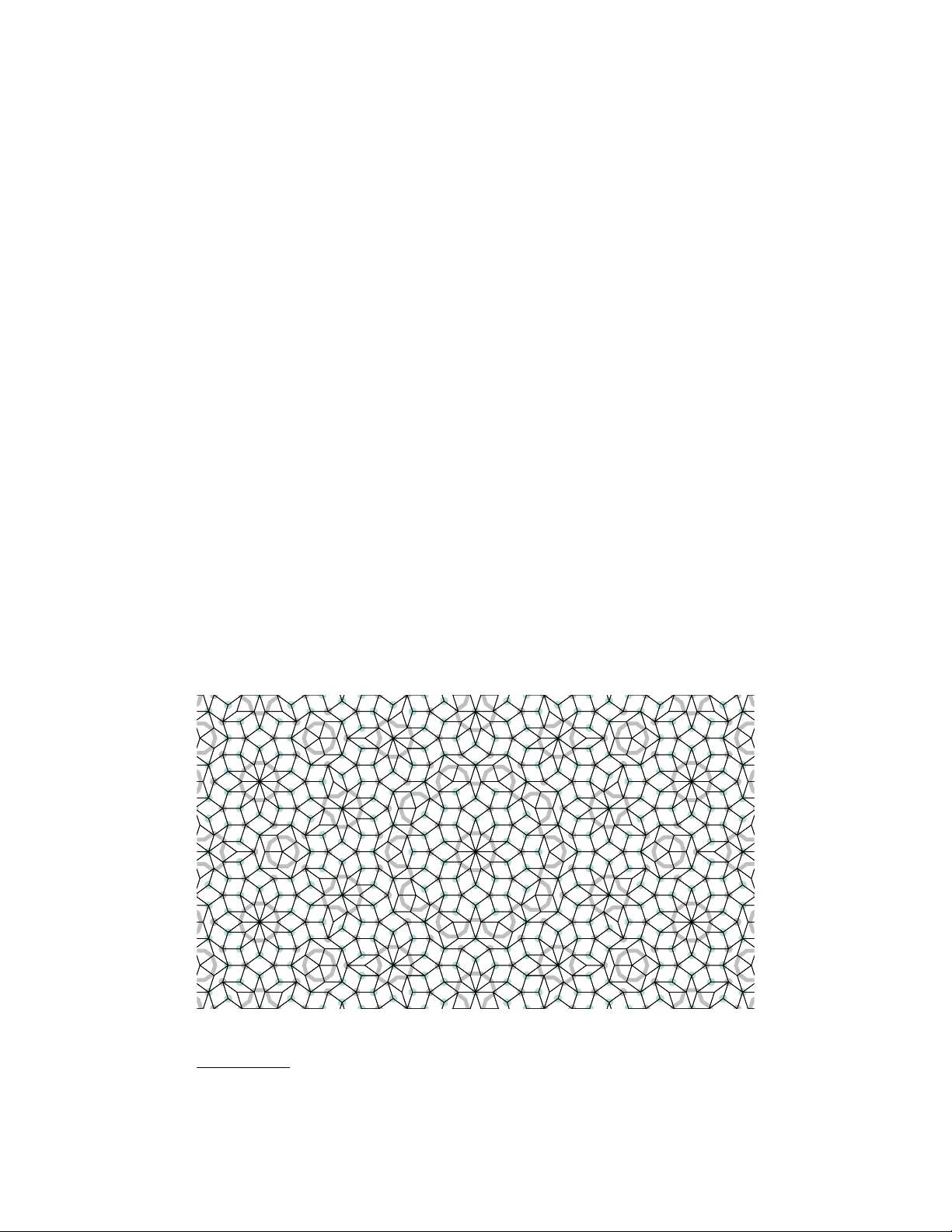
A RECOGNIZABLE SUBSTITUTION R ULE F OR A 10-F OLD SYMMETRIC RHOMB TILING MIKI IMURA Abstract. W e present a substitution rule for a rhomb tiling with 10- fold rotational symmetry . The tiling is closely related to the P enrose rhom b tilings and can b e obtained from the p en tagrid construction. W e in tro duce a finite set of mark ed prototiles and describ e an explicit substitution rule with inflation factor φ 3 . Our main result is that the substitution is recognizable, so that the hierarc hical structure of the tiling can be uniquely recov ered from lo cal configurations. Finally , w e describ e the relation b et w een the tiling and the p en tagrid construction. 1. Introduction Substitution tilings pro vide a natural framework for describing hierar- c hical structure in non-p eriodic tilings. A classical example is the P enrose tiling [1], whic h exhibits 5-fold symmetry and can b e generated either by substitution rules or by pro jection methods such as the pentagrid construc- tion. Figure 1. A patch of the Seab ed tiling. Date : March 15, 2026. 1 2 MIKI IMURA In this pap er w e study the rhom b tiling shown in Figure 1, whic h exhibits 10-fold rotational symmetry and is closely related to the Penrose rhomb tilings. Motiv ated by its visual app earance, we call this tiling the Se ab e d tiling . Our main result is an explicit substitution rule for this tiling with infla- tion factor φ 3 . W e prov e that the substitution is recognizable, so that the hierarc hical structure of the tiling can b e uniquely recov ered from lo cal con- figurations. As a consequence , the tiling space can b e enforced b y a finite set of lo cal matching rules. The pap er is organized as follows. Section 2 introduces the prototiles and their markings, and Section 3 presents the substitution rule. Section 4 pro v es recognizabilit y of the substitution, and Section 5 sho ws that the tiling space can b e enforced b y finite lo cal matc hing rules. Section 6 describ es the relation b et w een the tiling and the p en tagrid construction. Section 7 concludes the pap er. 2. Prototiles The tiling considered in this pap er is constructed from a finite set of rhom b prototiles. There are six prototiles in total: three thin rhombs and three thick rhom bs. (a) Thin-I (b) Thin-I I (c) Thin-I I I (d) Thick-I (e) Thick-II (f ) Thick-II I Figure 2. The six rhomb prototiles with edge markings. Figure 2 sho ws the prototiles together with their edge markings. W e refer to these tiles as Thin-I , Thin-II , Thin-III , and Thick-I , Thick-II , Thick-III . Tiles meet edge-to-edge, and t wo edges ma y meet only if both the edge type and the orientation of the markings agree. F or visualization it is conv enien t to represen t the edge t yp es using graph- ical markings on the tiles. Figure 3 shows an equiv alen t represen tation in whic h the edge t yp es are indicated by suc h markings. A SUBSTITUTION F OR A 10-FOLD SYMMETRIC RHOMB TILING 3 (a) Thin-I (b) Thin-I I (c) Thin-I I I (d) Thick-I (e) Thick-II (f ) Thick-II I Figure 3. An equiv alen t represen tation of the prototiles with graphical markings. In the remainder of the pap er w e use this graphical representation, as it mak es the lo cal configurations inv olved in the recognizabilit y argument easier to visualize. 3. The Substitution R ule W e no w describ e the substitution rule defined on the prototiles in troduced in the previous section. The substitution inflates eac h tile by the factor φ 3 , where φ = 1+ √ 5 2 is the golden ratio, and sub divides the inflated tile into smaller copies of the prototiles. It is p ossible that substitutions with smaller inflation factors exist, but we do not inv estigate this question here. Figure 4 sho ws the substitu tion rule. Each prototile is replaced by a finite patc h of prototiles whose b oundary coincides with that of the inflated tile. The sub division resp ects the markings on the tiles, so that adjacent tiles agree along their edges. The substitution acts on the six prototiles in tro duced in Section 2 and is completely determined b y the sub divisions together with the orientation and edge markings of the prototiles. 4. Recognizability of the Substitution A substitution is called r e c o gnizable if every tiling admitted by the sub- stitution can b e uniquely decomp osed in to sup ertiles. Recognizabilit y pla ys an imp ortan t role in the study of substitution tilings, as it ensures that the hierarc hical structure of the tiling can b e recov ered from local configurations. In this section w e pro v e that the substitution rule in tro duced in Section 3 is recognizable. The k ey observ ation is that the markings on the tiles imp ose strong lo cal constraints, whic h allo w the position of sup ertile b oundaries to b e determined uniquely . Theorem 1. The substitution define d in Se ction 3 is r e c o gnizable. 4 MIKI IMURA ↓ (a) Thin-I ↓ (b) Thin-I I ↓ (c) Thin-I I I ↓ (d) Thick-I ↓ (e) Thick-II ↓ (f ) Thick-II I Figure 4. Substitution rule for the six prototiles. Eac h pro- totile (top) is replaced b y the corresp onding patch (b ottom). T o analyze lo cal configurations w e distinguish several t yp es of v ertices determined b y the graphical markings on the tiles. V ertices surrounded by ligh t v ertex markings will be called light vertic es , and those surrounded by dark vertex markings will b e called dark vertic es . V ertices whose incident tiles carry no v ertex marking will b e called unmarke d vertic es . All remaining v ertices will b e called strip e vertic es . Lemma 1. A vertex is a light vertex of a sup ertile if and only if it is a light vertex adjac ent only to strip e vertic es. Pr o of. Insp ection of the substitution rule shows that ev ery light vertex ad- jacen t only to strip e vertices o ccurs exactly as a ligh t v ertex of a sup ertile. Con v ersely , ev ery ligh t vertex of a sup ertile has this lo cal configuration. □ Lemma 2. A vertex is a dark vertex of a sup ertile if and only if it is an unmarke d vertex surr ounde d by five tiles of typ e Thick-III. A SUBSTITUTION F OR A 10-FOLD SYMMETRIC RHOMB TILING 5 Pr o of. Insp ection of the substitution rule shows that ev ery unmarked ver- tex surrounded by fiv e Thick-II I tiles o ccurs exactly as a dark vertex of a sup ertile. Conv ersely , every dark v ertex of a sup ertile has this lo cal config- uration. □ Lemma 3. A vertex is an unmarke d vertex of a sup ertile if and only if it is a dark vertex surr ounde d by five tiles of typ e Thick-I and adjac ent via marke d e dges to five light vertic es. Pr o of. Insp ection of the substitution rule sho ws that ev ery dark vertex sur- rounded b y five Thick-I tiles and adjacent via marked edges to fiv e ligh t v ertices o ccurs exactly as an unmarked vertex of a sup ertile. Con versely , ev ery unmarked v ertex of a sup ertile has this lo cal configuration. □ Lemma 4. A vertex is a strip e vertex of a sup ertile if and only if it is an unmarke d vertex that is not a dark vertex of a sup ertile and such that no sup ertile vertex identifie d in L emmas 1 – 3 o c curs within gr aph distanc e at most 3. Pr o of. Consider the unmark ed v ertices of the tiling. By Lemma 2, some of them are exactly the dark vertices of sup ertiles. Among the remaining un- mark ed v ertices, insp ection of the substitution rule sho ws that ev ery v ertex that is not a v ertex of a supertile lies within graph distance at most 3 of a supertile vertex identified in Lemmas 1 – 3. Therefore, after excluding the unmark ed vertices iden tified in Lemma 2 and all unmark ed vertices lying within graph distance at most 3 of the sup ertile v ertices iden tified in Lem- mas 1 – 3, the remaining v ertices are exactly the strip e v ertices of supertiles. Con v ersely , ev ery strip e v ertex of a sup ertile satisfies these conditions. □ T ogether, Lemmas 1 – 4 iden tify all supertile v ertices from lo cal configura- tions. Pr o of of The or em. By Lemmas 1 – 4, every vertex of every sup ertile can b e iden tified from lo cal configurations. Since the edges of eac h sup ertile con- nect these vertices in a fixed combinatorial pattern, the b oundary of ev ery sup ertile is uniquely determined. Therefore ev ery tiling admitted by the substitution admits a unique decomp osition in to sup ertiles, and the substi- tution is recognizable. □ 5. Finite Ma tching R ules W e now show that the tiling space generated b y the substitution can b e enforced by a finite set of lo cal matc hing rules. Lemma 5. The substitution define d in Se ction 3 is primitive. Pr o of. Insp ection of the substitution rule shows that ev ery prototile ap- p ears in sufficien tly high iterates of the substitution of ev ery other prototile. Equiv alently , the substitution matrix is primitive. □ 6 MIKI IMURA Theorem 2. The tiling sp ac e gener ate d by the substitution c an b e enfor c e d by a finite set of lo c al matching rules. Pr o of. By Lemma 5 the substitution is primitiv e, and by Theorem 1 it is recognizable. A theorem of Goo dman–Strauss [2] therefore implies that the tiling space can b e enforced b y a finite set of lo cal matching rules. □ 6. Rela tion to the Pent agrid Construction The tiling considered in this pap er is closely related to the pentagrid construction introduced by de Bruijn [3], a metho d for constructing Penrose rhom b tilings. In the p en tagrid construction the plane is intersected b y fiv e families of equally spaced parallel lines. The directions of the families differ by angles of 72 ◦ . The intersections of these line families determine rhomb tiles that together form a tiling of the plane by thin and thick rhom bs. (a) A p en tagrid. (b) The corresp onding rhomb tiling. Figure 5. The p en tagrid construction. Figure 5a sho ws the p en tagrid. Each in tersection of tw o lines corresp onds to a rhomb tile, pro ducing the rhomb tiling sho wn in Figure 5b. Different c hoices of offsets for the line families pro duce different tilings. In particular, suitable choices of offsets pro duce the Penrose rhom b tilings (P3 tilings). The tiling considered in this pap er arises from the p en tagrid construction for other suitable c hoices of offsets. F or suc h offsets the resulting tilings ha v e lo cal configurations that agree with the mark ed prototiles in troduced in Section 2. In this wa y the Seab ed tiling arises naturally within the pentagrid framew ork. Th us the substitution tiling studied in this pap er may b e viewed as a substitution realization of tilings arising from the p en tagrid construction. A SUBSTITUTION F OR A 10-FOLD SYMMETRIC RHOMB TILING 7 7. Conclusion In this pap er we introduced a substitution rule for a rhomb tiling with 10-fold rotational symmetry , which we refer to as the Seab ed tiling. The substitution acts on a finite set of mark ed prototiles and has inflation factor φ 3 . Our main result is that the substitution is recognizable. As a consequence, the hierarchical structure of the tiling can b e uniquely recov ered from lo cal configurations. T ogether with the primitivity of the substitution, this result implies that the asso ciated tiling space can b e enforced by a finite set of lo cal matc hing rules. W e also describ ed the relation b et w een the Seab ed tiling and the p en ta- grid construction of de Bruijn. Different c hoices of offsets in the p en tagrid construction lead to different rhomb tilings. F or suitable c hoices of offsets the resulting tilings hav e lo cal configurations that agree with the marked prototiles introduced in this pap er. References [1] Roger Penrose. The role of aesthetics in pure and applied mathematical research. Bul letin of the Institute of Mathematics and its Applic ations , 10(2):266–271, 1974. [2] Chaim Go odman-Strauss. Matching rules and substitution tilings. Annals of Mathe- matics , 147(1):181–223, 1998. [3] N. G. de Bruijn. Algebraic theory of P enrose’s non-p eriodic tilings of the plane. I, II. Indagationes Mathematic ae (Pr o c e e dings) , 84(1):39–66, 1981.
Original Paper
Loading high-quality paper...
Comments & Academic Discussion
Loading comments...
Leave a Comment