PMAx: An Agentic Framework for AI-Driven Process Mining
Process mining provides powerful insights into organizational workflows, but extracting these insights typically requires expertise in specialized query languages and data science tools. Large Language Models (LLMs) offer the potential to democratize…
Authors: Anton Antonov, Humam Kourani, Aless
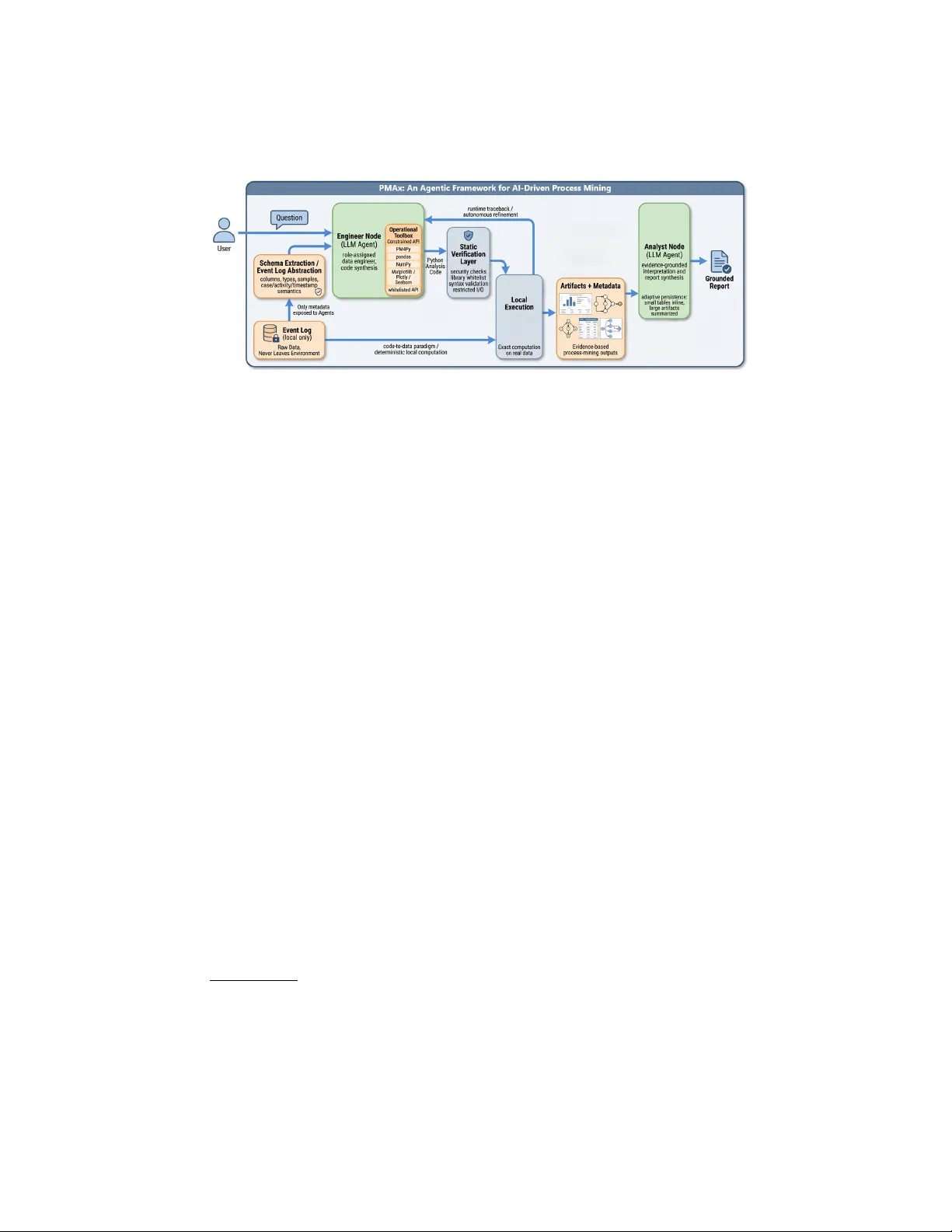
PMAx: An Agen tic F ramew ork for AI-Driv en Pro cess Mining ⋆ An ton An tonov 1 , 2 [0009 − 0004 − 1044 − 4884] , Humam K ourani 1 , 2 [0000 − 0003 − 2375 − 2152] , Alessandro Berti 2 [0000 − 0002 − 3279 − 4795] , Gyunam P ark 1 [0000 − 0001 − 9394 − 6513] , and Wil M.P . v an der Aalst 2 , 1 [0000 − 0002 − 0955 − 6940] 1 F raunhofer Institute for Applied Information T echnology FIT, Schloss Birlingho ven, 53757 Sankt Augustin, Germany {anton.antonov,humam.kourani,gyunam.park}@fit.fraunhofer.de 2 R WTH Aachen Universit y , Ahornstraße 55, 52074 Aachen, Germany {a.berti,wvdaalst}@pads.rwth-aachen.de Abstract. Pro cess mining provides p o werful insights into organi- zational w orkflows, but extracting these insigh ts typically requires exp ertise in sp ecialized query languages and data science to ols. Large Language Models (LLMs) offer the p otential to democratize pro cess mining by enabling business users to interact with pro cess data through natural language. How ev er, using LLMs as direct analytical engines o ver ra w even t logs in tro duces fundamental challenges: LLMs struggle with deterministic reasoning and ma y hallucinate metrics, while sending large, sensitive logs to external AI services raises serious data-priv acy concerns. T o address these limitations, w e present PMAx, an au- tonomous agentic framework that functions as a virtual pro cess analyst. Rather than relying on LLMs to generate pro cess mo dels or compute analytical results, PMAx emplo ys a priv acy-preserving m ulti-agent arc hitecture. An Engineer agent analyzes even t-log metadata and autonomously generates local scripts to run established pro cess mining algorithms, compute exact metrics, and pro duce artifacts suc h as pro cess mo dels, summary tables, and visualizations. An Analyst agent then in terprets these insigh ts and artifacts to compile comprehensive rep orts. By separating computation from interpretation and executing analysis lo cally , PMAx ensures mathematical accuracy and data priv acy while enabling non-technical users to transform high-lev el business questions in to reliable pro cess insights. Keyw ords: Agen tic AI · Pro cess Mining · Large Language Models · Multi-Agen t Systems 1 In tro duction Pro cess Mining [1] bridges the gap b et w een model-based pro cess managemen t and data-oriented analysis. While the extraction of digital fo otprints from even t ⋆ Preprin t version submitted to EMMSAD 2026 (T o ol Demonstration). This version has not undergone p eer review. 2 A. Antono v et al. Fig. 1: Overview of the prop osed architecture. logs provides immense op erational transparency , conducting exploratory pro cess mining, suc h as disco vering complex process mo dels, iden tifying bottlenecks, and chec king conformance, remains a significant hurdle for non-tec hnical domain exp erts. These tasks traditionally demand a high degree of proficiency in data manipulation and sp ecialized mining frameworks like PM4Py [7] or PQL [24]. Recen t adv ancements in Artificial Intelligence (AI), particularly Large Lan- guage Models (LLMs), hav e spark ed strong interest in democratizing pro cess mining. Recognizing this potential, ma jor commercial v endors (e.g., Celonis 3 , SAP Signavio 4 , and Apromore 5 ) hav e recently introduced AI copilots in to their platforms, allo wing users to query pro cesses via natural language. While these commercial solutions effectively lo wer the barrier to en try for business users, a researc h gap exists for open, transparen t, and lo cally deploy able framew orks. F or academic research and custom analytical pip elines, there is a distinct need for systems where the underlying analytical logic is inspectable, data handling is kept within the lo cal environmen t, and the architecture is extensible. Dev eloping an autonomous AI system for pro cess mining presents sev eral tec hnical and op erational challenges. First, when prompted to directly compute throughput times or identify pro cess v ariants, LLMs may hallucinate metrics or fabricate algorithmic outcomes [30,5] due to their probabilistic nature. Second, real-w orld ev ent logs are massive and t ypically con tain highly sensitive organi- zational data. T ransmitting this ra w information to external APIs not only risks exceeding context window limits but also violates strict corp orate data go ver- nance p olicies. T o harness con versational AI without compromising accuracy or confiden tiality , the system m ust shift from guessing to deterministic com- putation. This requires a paradigm where the agent autonomously syn thesizes executable co de to analyze the data [8]. How ev er, such an approach introduces a new vulnerabilit y , as executing unv erified generated scripts p oses sev ere security risks [22]. 3 https://www.celonis.com . 4 https://www.signavio.com . 5 https://apromore.com . PMAx: An Agentic F ramework for AI-Driven Pro cess Mining 3 T o this end, w e propose PMAx 6 (illustrated in Figure 1), an autonomous, agen tic framew ork that orchestrates a secure, end-to-end pro cess mining work- flo w. Our contribution is an orchestration framew ork defined by four pillars: 1. Secure Data Handling: The framework extracts only ligh tw eigh t struc- tural metadata to provide the AI with context. The ra w even t data never lea ves the user’s lo cal environmen t since only a static “snapshot” of the data in form of present columns with their corresp onding type is provided. 2. Pro cess Mining Multi-Agent W orkflow: W e employ a “divide-and- conquer” arc hitecture to shift from probabilistic guessing to deterministic computation. An Engine er A gent , grounded with specific pro cess mining domain kno wledge and library APIs, syn thesizes executable co de to create pro cess mining artifacts (e.g., pro cess mo dels, summary tables, statistical c harts). An Analyst A gent then interprets these artifacts to compile comprehensiv e rep orts that combine textual insights with rich visual evidence. 3. Reliable Execution: The framew ork employs a con trolled en vironment with a static verification lay er to ensure system integrit y . Within this en- vironmen t, an autonomous self-correction lo op captures runtime errors and automatically feeds them back to the agents for iterative refinemen t, ensur- ing reliability without human interv en tion. 4. Op en-Source and Extensible Design: Built on a standard Python ecosystem using established libraries like [7] and Pandas [23], PMAx is fully op en-source. This provides a transparen t and mo dular platform that can b e easily deploy ed locally . Its architecture is designed for extensibility , allowing for integrating new pro cess mining tasks or custom exp erimen tal pip elines without b eing tied to a proprietary ecosystem. PMAx is implemented as an extension within the op en-source ProMoAI to ol suite ( https://github.com/fit- process- mining/ProMoAI ). The w orkflow be- gins with a configuration step where the user selects their preferred AI provider, c ho oses a sp ecific LLM mo del, and provides the necessary API key . Upon upload- ing an even t log to start the session, the system transitions to a conv ersational in terface (cf. Figure 2). T o ensure complete transparency and auditability , the UI features a dedicated panel that allows users to monitor the real-time Python co de synthesis p erformed b y the Engineer No de (Figure 2a). F ollowing the lo cal execution of the generated code, the Analyst No de p opulates the view with a comprehensiv e, data-grounded report (Figure 2b), seamlessly combining narra- tiv e insigh ts with the extracted visual evidence. 2 Related W ork The application of LLMs in pro cess mining has ev olv ed rapidly . Early efforts fo cused on translating textual descriptions into formal process mo dels, suc h as 6 https://github.com/fit- process- mining/ProMoAI 4 A. Antono v et al. (a) Co de generation pro cess. (b) An excerpt from the generated analy- sis rep ort. Fig. 2: PMAx con versational interface showing (a) real-time co de syn thesis and (b) the generated rep ort. BPMN or Petri nets [15,17,21]. Recen t research has explored the direct reasoning capabilities of LLMs for a wider range of analytical tasks. F or instance, Rebmann et al. [19] systematically ev aluated the p oten tial of LLMs to p erform seman tic tasks like activity prediction and anomaly detection b y reasoning o ver textual pro cess descriptions. Building on the reasoning capabilities of LLMs, a significan t researc h trac k has focused on creating conv ersational in terfaces for pro cess analysis. The pri- mary goal of these systems is to translate a user’s natural language question in to a direct answer, often by conv erting the query into a formal language, e.g., SQL, or by having the LLM reason directly ov er abstracted data. Key examples include frameworks for enhanced pro cess mo del comprehension through seman- tic querying [16], conv ersational analysis of complex Ob ject-Centric Ev ent Logs (OCEL) to av oid manual query form ulation [9]. While p o werful, these systems t ypically act as “translators”, providing answers without exp osing the underlying data manipulation and co de generation steps. The domain is shifting tow ard autonomous agentic frameworks, a paradigm maturing in broader data science. Systems lik e AutoGen [27] and LID A [10] automate exploration and visualization, while self-correcting agents no w au- tonomously write and debug code to solve complex analytical tasks [29]. This agen tic approac h is nascent in pro cess mining. Berti et al. [6] introduced a con- ceptual framework for re-thinking pro cess mining tasks as multi-agen t workflo ws. F urthermore, V u et al. [25] confirmed strong practitioner interest in agentic BPM but also highligh ted significan t go vernance c hallenges, suc h as the risk of LLM hallucinations and the need for reliable, v erifiable outputs. PMAx: An Agentic F ramework for AI-Driven Pro cess Mining 5 3 System Arc hitecture The system arc hitecture is illustrated in Figure 1. The workflo w begins when the user pro vides an even t log, which undergoes a schema extraction pro cess. This step pro duces an even t log abstraction, ensuring that the agents receiv e a structural ov erview (e.g., column names, data t yp es, and attribute samples) rather than the raw data. This approac h addresses t w o critical requiremen ts: it ov ercomes LLM con text windo w constrain ts while simultaneously mitigating data priv acy concerns b y relying on data minimization. Concurrently , the user submits a natural language query , whic h is forwarded to the Engineer No de. As a sp ecialized code-generation agent, the Engineer Nod e synthesizes the necessary Python scripts. Before execution, the co de is sub jected to static analy- sis to verify adherence to pre-defined security and syn tax constraints. F ollowing execution, the Analyst No de receiv es the textual context and metadata of the generated artifacts. Based on this data-driven evidence, the Analyst No de gen- erates a comprehensive rep ort that addresses the user’s initial question through a com bination of natural language in terpretation and visual evidence. W e no w describ e eac h of the main comp onen ts in detail. 3.1 Collab orativ e Memory State T o facilitate seamless collab oration b et ween the Engineer and Analyst no des, we implemen t a shared memory state, similar to the arc hitecture described in [20], ensuring that pertinent information is synchronized across the different no des. A core design philosophy of the metho d is the divide-and-conquer principle. W e decomp ose the traditionally monolithic and complex task of pro cess mining anal- ysis into tw o sp ecialized subtasks: (i) tec hnical code synthesis and (ii) semantic result interpretation. By isolating the con versation histories with each no de within the state, w e adhere to a strict separation of concerns. This ensures that the Analyst node is not influenced b y co de technicalities, which could otherwise exhaust the context windo w or lead to reasoning errors. Instead, the shared state acts as a filtered conduit, exchanging only the essential con text and allowing eac h no de to fo cus exclusiv ely on its domain-sp ecific exp ertise. 3.2 Data Abstraction and Processing Real-w orld even t logs frequently comprise thousands of traces and millions of ev ents [1], presenting a significan t challenge for LLMs due to curren t context windo w constrain ts [5]. Additionally , many organizations do not wish to expose sensitiv e information. This is the main reason why agen tic co de generation can- not be applied directly to ra w en terprise datasets. T o mitigate these priv acy and scalability concerns, w e implement a metadata-driven abstraction lay er that summarizes the log’s structural schema and attribute types rather than provid- ing the ra w data. F urthermore, to ensure the agen ts are semantically grounded in process mining conv entions, we provide sp ecialized domain knowledge. This 6 A. Antono v et al. includes identifying the mandatory subset of attributes—namely case iden tifiers, timestamps, and activity names—and common naming conv entions in the XES standard [3]. 3.3 The Engineer Node The Engineer No de is a sp ecialized LLM agen t designed to bridge the gap b e- t ween high-level natural language queries and the technical sp ecificities of pro- cess mining algorithms. Its primary ob jective is to synthesize executable Python scripts that leverage a pre-defined to olkit of PM4Py and standard data science libraries. Con text Injection T o mitigate the risk of co de hallucinations and ensure rig- orous API alignmen t, the Engineer No de is initialized following the principle of role assignment [28], i.e., by explicitly defining the agent as a sp ecialized Data Engineer. Bey ond this role-based prompting, the framew ork injects a tec hni- cal sp ecification that establishes the op erational environmen t and data-access proto cols through four foundational preconditions: 1. Data A ccess La yer: The agent is informed that the target even t log is accessible via a p ersisten t Python ob ject. This enables a code-to-data paradigm; rather than sending the full ev ent log to the LLM, the agent gen- erates code to b e executed lo cally . This ensures the scalabilit y of the metho d. 2. Meta-Sc hema Exp osure: The Event L o g Abstr action is injected into the prompt, pro viding the agen t with the precise column structure, data t yp es, and attribute samples of the currently loaded log. 3. Domain Kno wledge: The system iden tifies core pro cess attributes (case IDs, activities, and timestamps) in a format-independent manner. This en- sures compatibility with b oth XES and CSV files, providing structural con- text regardless of the file type. 4. Op erational T o olb o x and API Constraints: T o ensure secure and v alid co de, an API ob ject encapsulates core PM4Py functionalities [7] within a whitelisted environmen t. As detailed in Listing 1, the agent is restricted to standard data (P andas [23], NumPy [12]) and visualization libraries (Mat- plotlib [13], Plotly [14], Seab orn [26]). By com bining these four la yers, the framework creates a constrained y et expressiv e environmen t where the agent can reason ab out pro cess mining tasks without the common pitfalls of unconstrained LLM co de generation. Co de Generation Synthesized co de is statically v erified for library compli- ance and securit y , restricting I/O to the framework’s API to ensure system in tegrity . V alidated scripts execute in-memory; an y runtime exception triggers a self-correction lo op where the captured tracebac k guides iterative refinement un til successful execution or a maximal iteration threshold is reac hed. PMAx: An Agentic F ramework for AI-Driven Pro cess Mining 7 Listing 1: API Sp ecification and Op erational Rules for the Engineer Agen t. [CATEGORY: FILTERING] - api . filter_time_range (start: str, end: str) # Temporal subsetting - api . filter_attribute (column: str, value: str) # Attribute-based filtering - api . filter_pandas_query (query: str) # Complex logic (e.g., "amount > 500") [CATEGORY: ABSTRACTION & SUMMARIZATION] - api . get_dfg_summary () # Markovian/DFG abstraction - api . get_model_summary () # Petri net/Process model abstraction - api . get_variant_summary () # Unique sequence analysis - api . get_case_summary () # Pattern and outlier detection [CATEGORY: MINING & CONFORMANCE] - api . discover_process_model () # Updates state with discovered Petri net - api . cc_alignments () # Returns (fitness, precision, F1) - api . cc_token_based_replay () # Returns (fitness, precision, F1) [CATEGORY: VISUALIZATION & PERSISTENCE] - api . save_pnet () # Exports Petri net - api . save_visualization (fig, desc, data) # Persists Matplotlib/Plotly/Seaborn - api . save_dataframe (df, desc) # Persists results/intermediate tables [OPERATIONAL RULES] 1. LIBRARY RESTRICTION: Use only whitelisted libraries (pm4py, pandas, numpy, plotly). 2. PERSISTENCE: Always use api . save_visualization /dataframe; built-in I/O is disabled. 3. EFFICIENCY: Generate visualizations sparsely to minimize computational overhead. 4. SELF-CONTAINED: Include all necessary import statements for non-API libraries. 3.4 The Analyst Node Rep ort Syn thesis The Analyst No de translates tec hnical artifacts in to in- sigh ts while remaining isolated from the code. It emplo ys an adaptive p ersis- tence proto col to stay within context limits: small dataframes are serialized as Markdo wn, while larger ones are summarized via statistics. T o optimize tokens, the framew ork transmits ra w data sources instead of high-ov erhead images for visualization interpretation. Multi-turn in teractions are handled through incre- men tal up dates, transferring only new artifacts p er iteration. Finally , the agent reconciles this evidence with the user query to pro duce a domain-sp ecific rep ort Error Handling T o mitigate hallucinations, a strict output sc hema—a list of t yp ed dictionaries (text or artifact)—enforces deterministic artifact referencing. Structural non-conformance or in v alid references trigger an automated error- handling cycle, ensuring the rep ort is strictly grounded in the execution results. The v alidation error is fed bac k to the LLM, triggering a self-correction loop that forces the agent to reconcile its rep ort with the empirical evidence stored in the shared state. 4 T o ol Demonstration: Loan Application Pro cess Analysis T o demonstrate the practical utility of PMAx, we used the framework to analyze the BPI Challenge 2017 dataset [11], a real-world loan application log from a 8 A. Antono v et al. Dutc h financial institution. W e framed our in vestigation around the business- driv en questions addressed b y [4], fo cusing on: (Q1) typical workflo w disco very , (Q2) throughput time distribution, (Q3) waiting time and b ottlenec k identifi- cation, (Q4) the impact of information requests on offer acceptance, and (Q5) success rates for single vs. multiple offers. The report w as generated using OpenAI’s GPT-5.4 [18]. In all scenarios, the Engineer No de successfully synthesized executable Python code, which w e man ually v erified for technical correctness. While the Analyst No de’s rep orts w ere o ccasionally verbose, they provided accurate data-grounded insights that directly addressed the imp osed questions. Notably , complex comparative tasks (e.g., Q5) were resolved autonomously , confirming that PMAx can transform high-lev el business queries in to precise, domain-specific code. The generated ar- tifacts and rep ort are av ailable online. 7 5 Conclusion In this pap er, w e presented PMAx, a framework that shifts the fo cus of process mining from algorithmic developmen t to agen tic system design. By implemen ting a closed-lo op orchestration sp ecifically tailored to bridge the gap b et ween process seman tics and technical implemen tation, the framew ork effectively decouples tec hnical co de syn thesis from semantic interpretation, thereb y o vercoming the limitations of LLM hallucinations, constrained con text windo ws, and priv acy concerns. Our tool demonstration using a real-w orld dataset sho ws that the system autonomously generates data-grounded insigh ts from natural language cues, marking a significan t step to ward democratizing process mining through “no-co de” analytical in terfaces. F uture work will fo cus on extending this paradigm to Ob ject-Cen tric Pro- cess Mining (OCPM) [2]. W e envision a transition where agen tic workflo ws are utilized to manage OC ev ent data, translating user questions in to sophisticated relational or graph-based queries to handle the increasing complexity of mo dern organizational pro cesses. Additionally , we intend to mov e b ey ond linear work- flo ws tow ard autonomous inter-agen t dialogue, enabling the framework to dy- namically resolve analytical ambiguities while further compressing the shared state context References 1. v an der Aalst, W.M.P .: Pro cess Mining - Data Science in Action, Second Edition. Springer (2016) 2. v an der Aalst, W.M.P .: Ob ject-centric process mining: Unrav eling the fabric of real pro cesses. Mathematics 11 (12) (2023). https://doi.org/10.3390/math11122691 3. A camp ora, G., Vitiello, A., Stefano, B.N.D., v an der Aalst, W.M.P ., Gün ther, C.W., V erb eek, E.: IEEE 1849: The XES standard: The second IEEE standard sp onsored by IEEE computational intelligence so ciet y [so ciety briefs]. IEEE Com- put. Intell. Mag. 12 (2), 4–8 (2017) 7 https://github.com/fit- process- mining/PMAx- evaluation PMAx: An Agentic F ramework for AI-Driven Pro cess Mining 9 4. Badakhshan, P ., Maciel, J.C., W urm, B.: Pro cess mining in the financial industry: A case study . T ech. rep., Univ ersity of Liec htenstein and Vienna Univ ersity of Economics and Business (2017), bPI Challenge 2017 – Studen t Category Rep ort 5. Berti, A.: Pm4py .llm: a comprehensive module for implementing PM on llms. CoRR abs/2404.06035 (2024) 6. Berti, A., Maatallah, M., Jessen, U., Srok a, M., Ghannouc hi, S.A.: Re-thinking pro cess mining in the ai-based agents era. CoRR abs/2408.07720 (2024) 7. Berti, A., v an Zelst, S.J., Sch uster, D.: Pm4p y: A pro cess mining library for p ython. Soft w. Impacts 17 , 100556 (2023) 8. Bistarelli, S., Fiore, M., Mercan ti, I., Mongiello, M.: Usage of Large Language Mo del for Code Generation T asks: A Review. SN Comput. Sci. 6 (6), 673 (2025) 9. Casciani, A., Bernardi, M.L., Cimitile, M., Marrella, A.: Enabling natural language analysis for ob ject-centric even t logs. Process Science 3 (1), 5 (2026) 10. Dibia, V.: LID A: A tool for automatic generation of grammar-agnostic visual- izations and infographics using large language mo dels. In: Bollegala, D., Huang, R., Ritter, A. (eds.) Pro ceedings of the 61st Annual Meeting of the Asso ciation for Computational Linguistics (V olume 3: System Demonstrations), A CL 2023, T oron to, Canada, July 10-12, 2023. pp. 113–126. Asso ciation for Computational Linguistics (2023) 11. v an Dongen, B.: Bpi challenge 2017 (2017) 12. Harris, C.R., Millman, K.J., v an der W alt, S.J., Gommers, R., Virtanen, P ., Cour- nap eau, D., Wieser, E., T aylor, J., Berg, S., Smith, N.J., Kern, R., Picus, M., Ho yer, S., v an Kerkwijk, M.H., Brett, M., Haldane, A., del Río, J.F., Wiebe, M., P eterson, P ., Gérard-Marchan t, P ., Sheppard, K., Reddy , T., W eck esser, W., Ab- basi, H., Gohlke, C., Oliphan t, T.E.: Arra y programming with NumPy. Nature 585 (7825), 357–362 (Sep 2020) 13. Hun ter, J.D.: Matplotlib: A 2d graphics environmen t. Computing in Science & Engineering 9 (3), 90–95 (2007) 14. Inc., P .T.: Collab orativ e data science (2015), https://plot.ly 15. Iv anc hikj, A., Serb out, S., P autasso, C.: F rom text to visual BPMN pro cess models: design and ev aluation. In: MoDELS ’20: A CM/IEEE 23rd International Conference on Mo del Driven Engineering Languages and Systems, Virtual Even t, Canada, 18- 23 Octob er, 2020. pp. 229–239 (2020) 16. K ourani, H., Berti, A., Hennric h, J., Kratsc h, W., W eidlich, R., Li, C., Arslan, A., v an der Aalst, W.M.P ., Sch uster, D.: Leveraging large language mo dels for enhanced pro cess model comprehension. Decis. Support Syst. 200 , 114563 (2026) 17. K ourani, H., Berti, A., Sc huster, D., v an der Aalst, W.M.P .: Pro cess mo deling with large language mo dels. In: v an der Aa, H., Bork, D., Sc hmidt, R., Sturm, A. (eds.) En terprise, Business-Process and Information Systems Modeling - 25th In terna- tional Conference, BPMDS 2024, and 29th In ternational Conference, EMMSAD 2024, Limassol, Cyprus, June 3-4, 2024, Pro ceedings. Lecture Notes in Business Information Pro cessing, v ol. 511, pp. 229–244. Springer (2024) 18. Op enAI: Op enai GPT-5 system card. CoRR abs/2601.03267 (2026) 19. Rebmann, A., Schmidt, F.D., Glav as, G., v an der Aa, H.: On the p oten tial of large language mo dels to solv e semantics-a ware pro cess mining tasks. Pro cess Sci. 2 (1) (2025) 20. Rezazadeh, A., Li, Z., Lou, A., Zhao, Y., W ei, W., Bao, Y.: Collab orativ e memory: Multi-user memory sharing in LLM agents with dynamic access con trol. CoRR abs/2505.18279 (2025) 21. Safan, A., Köpke, J.: BPMN-Chatbot++: LLM-Based Mo deling of Collaboration Diagrams with Data. In: Pro ceedings of the BPM (2025) 10 A. Antono v et al. 22. Sprac klen, J., Wijewickrama, R., Sakib, A.H.M.N., Maiti, A., Viswanath, B., Jadli- w ala, M.: W e hav e a pack age for you! A comprehensive analysis of pack age halluci- nations by co de generating llms. In: Bauer, L., Pellegrino, G. (eds.) 34th USENIX Securit y Symposium, USENIX Securit y 2025, Seattle, W A, USA, August 13-15, 2025. pp. 3687–3706. USENIX Association (2025) 23. pandas developmen t team, T.: pandas-dev/pandas: Pandas (F eb 2020) 24. V ogelgesang, T., Ambrosy , J., Becher, D., Seilb ec k, R., Gey er-Klingeb erg, J., Klenk, M.: Celonis PQL: A query language for pro cess mining. In: P olyvyan yy , A. (ed.) Pro cess Querying Metho ds, pp. 377–408. Springer (2022) 25. V u, H., Klievtsov a, N., Leopold, H., Rinderle-Ma, S., Kampik, T.: Agentic business pro cess management: Practitioner p erspectives on agent gov ernance in business pro cesses. In: Mahendraw athi, E.R., Gal, A., Grisold, T., Santoro, F.M., W eske, M., Dijkman, R.M., Karasto yano v a, D., A ysolmaz, B., Bandara, W., Revoredo, K. (eds.) Business Pro cess Management: Resp onsible BPM F orum, Pro cess T ech- nology F orum, Educators F orum - BPM 2025 RBPM, PT, and Educators F orum, Seville, Spain, August 31 - September 5, 2025, Pro ceedings. Lecture Notes in Busi- ness Information Pro cessing, vol. 565, pp. 29–43. Sprin ger (2025) 26. W ask om, M.L.: seab orn: statistical data visualization. Journal of Op en Source Soft ware 6 (60), 3021 (2021) 27. W u, Q., Bansal, G., Zhang, J., W u, Y., Zhang, S., Zhu, E., Li, B., Jiang, L., Zhang, X., W ang, C.: Autogen: Enabling next-gen LLM applications via multi- agen t conv ersation framew ork. CoRR abs/2308.08155 (2023) 28. Xu, B., Y ang, A., Lin, J., W ang, Q., Zhou, C., Zhang, Y., Mao, Z.: Exp ertPrompt- ing: Instructing Large Language Mo dels to b e Distinguished Exp erts. CoRR abs/2305.14688 (2023) 29. Zhang, S., F an, J., F an, M., Li, G., Du, X.: Deepanalyze: Agentic large language mo dels for autonomous data science. CoRR abs/2510.16872 (2025) 30. Zhang, Z., W ang, C., W ang, Y., Shi, E., Ma, Y., Zhong, W., Chen, J., Mao, M., Zheng, Z.: LLM hallucinations in practical code generation: Phenomena, mecha- nism, and mitigation. Pro c. ACM Softw. Eng. 2 (ISST A), 481–503 (2025)
Original Paper
Loading high-quality paper...
Comments & Academic Discussion
Loading comments...
Leave a Comment