Strategic Partitioning and Manipulability in Two-Round Elections
We consider a two-round election model involving $m$ voters and $n$ candidates. Each voter is endowed with a strict preference list ranking the candidates. In the first round, the candidates are partitioned into two subsets, $A$ and $B$, and voters s…
Authors: Emilio De Santis, Antonio Di Crescenzo, Verdiana Mustaro
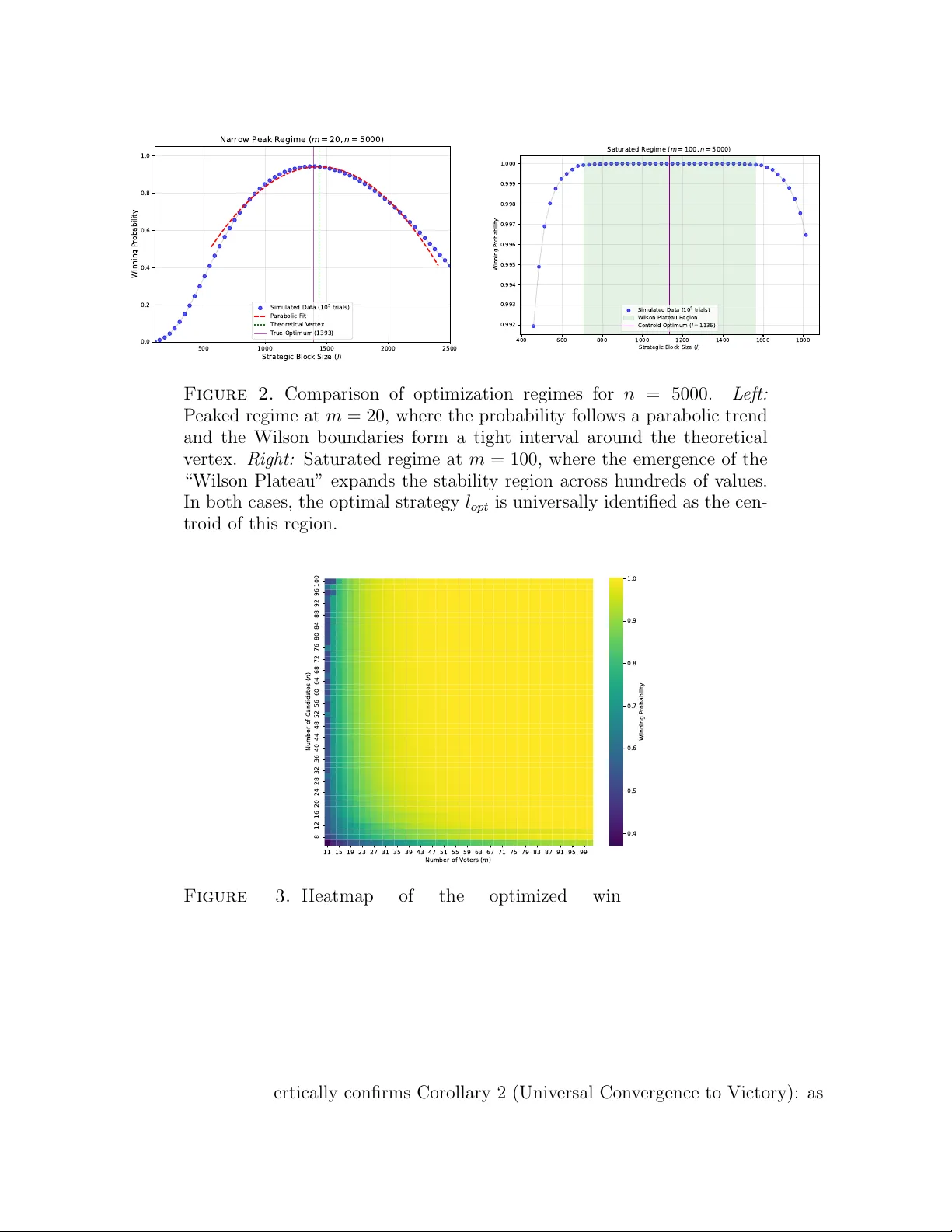
STRA TEGIC P AR TITIONING AND MANIPULABILITY IN TW O-R OUND ELECTIONS EMILIO DE SANTIS , ANTONIO DI CRESCENZO , AND VERDIANA MUST ARO Abstract. W e consider a tw o-round election model in v olving m v oters and n candi- dates. Each v oter is endo w ed with a strict preference list ranking the candidates. In the first round, the candidates are partitioned in to t w o subsets, A and B , and v oters select their preferred candidate from each. Pro vided there are no ties, the tw o resp ec- tiv e winners adv ance to a second round, where voters c ho ose betw een them according to their initial preference lists. W e analyze this scenario using a probabilistic frame- w ork based on a spatial v oting mo del with cyclically constructed preference lists and uniformly distributed ideal p oints. Our ob jectiv e is to determine the optimal initial partition of A and B that maximizes a target candidate’s probabilit y of winning. W e analytically ev aluate this success probability and derive its asymptotic b ehavior as the n umber of candidates n → ∞ . A key finding is that the asymptotically optimal relativ e width of the main discrete cluster con v erges precisely to one-fifth of the total num b er of candidates. Finally , w e provide computational results and confidence in terv als de- riv ed from sim ulation algorithms that v alidate the analytical framework. Sp ecifically , w e demonstrate that the probability of the universal victory even t rapidly approaches 1 as the electorate size increases. Keywor ds: Agenda control, Manipulation, V oting pattern, V oting sim ulation, Winning probabilit y . AMS MSC 2010: 91B12, 91B14. 1. Intr oduction Decision-making mec hanisms concerning voting procedures play a fundamen tal role in p olitical science, economics, and op erations research. Within this con text, a recurring theme is the analysis of voting rules under uncertaint y , esp ecially when v oters’ prefer- ences are sub ject to random fluctuations. While man y v oting systems are designed with the aim of ensuring fair outcomes, they often exhibit vulnerabilities to structural manip- ulation. In this pap er, w e analyze a widely adopted tw o-round voting scheme under the lens of agenda c ontr ol : we in v estigate ho w the initial partition of candidates into subsets can predetermine the final winner. In our mo del, an election in v olves m voters and n candidates. Eac h voter is endow ed with a strict preference list, classically represented as a p erm utation of all candidates. The voting mechanism op erates as follo ws: whenev er voters are required to choose from a giv en subset of candidates, they assign their vote to the candidate in that subset who app ears highest in their individual preference list. Initially , the entire set of candidates is divided in to tw o mutually exclusive groups, A and B . In the first round, applying the aforemen tioned rule, the voters select a fa v orite candidate from A and one from B . In Date : Marc h 17, 2026. 1 2 EMILIO DE SANTIS , ANTONIO DI CRESCENZO , AND VERDIANA MUST ARO the second round, all voters express a preference b etw een the tw o winners of the first round. It is imp ortant to emphasize a strict rule regarding ties in our model: if a tie o ccurs among the top candidates in either the primary elections (within A or B ) or in the final ballot, the election is considered void and no candidate is declared the winner. Consequen tly , the sum of the winning probabilities of all individual candidates is strictly less than 1, reflecting the strictly p ositive probability of such unresolv ed draws. In a deterministic setting, the p ow er of the agenda setter is highly dep enden t on the sp ecific preference profiles of the v oters. While trivial scenarios (suc h as unanimous v oters) preclude any manipulation, there exist strategically vulnerable profiles where the agenda setter can completely dictate the outcome, steering the victory to w ard any desired candidate simply by tailoring the subsets A and B . The vulnerabilit y of aggregation systems to such strategic manipulation is a central theme in social choice theory . In the con text of kno ck out tournamen ts, foundational w orks and the extensiv e literature on the T ournament Fixing Pr oblem ha v e demonstrated ho w the final outcome can b e decisively manipulated simply by acting on the initial seeding. The question of ho w muc h preference profiles can b e structured to generate arbitrary rankings migh t seem analytically intractable. How ev er, recent studies ha v e sho wn that the problem can b e formally addressed by exploiting an isomorphism with load-sharing mo dels from reliability theory [4, 5]. In these w orks, it was constructiv ely pro v en that it is alwa ys p ossible to generate a voter p opulation capable of realizing an y arbitrary family of rankings. Building on this constructiv e approach, a recen t pap er [3] quantified this fragilit y in single-elimination tournaments: for a tournamen t with 2 n candidates ( n ≥ 3), a specific profile of merely 4 n − 3 v oters is sufficien t to guaran tee that any candidate can win, simply by c ho osing a prop er initial b oard order. F urthermore, in the same work, a probabilistic scenario was explored, demonstrating that universal manipulabilit y could b e ac hiev ed with a n um b er of v oters prop ortional to (log n ) 3 . While our previous work fo cused on the sequential nature of single-elimination tour- namen ts (where the manipulator can exploit the depth of the tournament tree), the presen t pap er tac kles the intrinsically different and “flatter” dynamics of a tw o-round v oting system. In the tournamen t setting, manipulabilit y is achiev ed with a relativ ely small electorate (p olylogarithmic in n ). In con trast, for the t w o-round system analyzed here, we establish a different asymptotic guaran tee: the probabilit y of universal manip- ulation con verges to 1 as the num ber of v oters m → ∞ . T o understand the vulnerability of this tw o-round system, we frame the manipulation as an adversarial mec hanism design problem. First, the agenda setter (acting as the ma- nipulator) designs an “urn” containing a sp ecific distribution of preference lists. Since the adv ersary will announce the target candidate after the urn is fixed, the manipulator cannot simply bias the urn tow ard a sp ecific individual; doing so w ould allow the ad- v ersary to trivially win the challenge b y c ho osing a disadv an taged candidate. Once the urn is established, the adversary randomly draws an electorate of m voters from it (with replacemen t). A t this stage, the agenda setter operates in an op en-lo op control regime: they are en tirely blind to the actual preference lists drawn b y the m v oters, kno wing only their STRA TEGIC P AR TITIONING AND MANIPULABILITY IN TWO-R OUND ELECTIONS 3 initial urn design. The adv ersarial c hallenge can then unfold at t w o distinct lev els. In the standard challenge, the adversary rev eals a single target candidate, and the manipulator m ust ensure their victory b y choosing an appropriate initial partition of candidates into subsets A and B . W e denote this individual winning guar ante e as even t F 1 . In the second, more extreme version of the challenge, the adv ersary is allo w ed to rep eatedly c hange the target candidate after the single electorate has b een drawn. T o win, the manipulator must be able to guaran tee the victory of any sequentially requested candidate using that exact same electorate, adapting the outcome solely b y mo difying the initial subsets A and B . W e denote this universal victory event as F (2) . The fundamen tal researc h question is: do es there exist a symmetric comp osition of the urn that grants the manipulator this op en-lo op con trol, guaran teeing b oth the individual and the universal victory , with high probabilit y , regardless of the sp ecific electorate realization? In this pap er, we answer affirmativ ely by demonstrating that an urn consisting of cyclically constructed preference lists provides exactly this lev el of con trol. It is crucial to emphasize that these strictly cyclic preferences are not prop osed as a realistic so ciological or b eha vioral mo del of the electorate. Rather, they represen t the mathematical solution to the adv ersary’s challenge. They act as an extreme theoretical environmen t—an upper b ound for manipulability—that effectively masks pairwise defeats and unequiv o cally pro v es the structural fragilit y of the v oting system under blind manipulation. In terestingly , we sho w that increasing the num ber of candidates n do es not hinder the agenda setter; rather, it facilitates the manipulation. A larger candidate p o ol allows the manipulator to exploit the disp ersion of votes among the target’s opp onents, making it easier to isolate and eliminate dangerous comp etitors in the first round. By emplo ying a probabilistic analysis, w e analytically show that P ( F (2) ) → 1 as m → ∞ , irresp ective of n . Bey ond this asymptotic limit, we demonstrate that the prac- tical size of the electorate required to obtain suc h a universal guaran tee is surprisingly lo w. T o ac hieve this manipulation, w e deriv e a k ey geometric prop ert y: the asymptot- ically optimal relative width of the main clusters in the partitions A and B con v erges precisely to 1 / 5 of the total n um b er of candidates. Our numerical simulations confirm that univ ersal manipulability is reached rapidly: for an electorate of just m = 51 v oters (and n = 30 candidates), the probabilit y of the univ ersal ev en t F (2) already exceeds 91%. This confirms the severe structural vulnerability of the system, showing that near-total con trol can b e established ev en in small-scale scenarios. T o study the regime where the num b er of candidates is large relative to the electorate, w e introduce a c ontinuous limit mo del . By mapping the discrete cyclic preferences onto the con tinuous domain [0 , 1), v oters are treated as indep endent uniform random v ari- ables. W e show that, provided the n um b er of voters gro ws as m = o ( √ n ), the discrete winning probabilities con verge to this contin uous limit. This form ulation yields closed- form p olynomial expressions for the victory probabilities and justifies the conv ergence of the discrete optimal cluster width to its contin uous coun terpart. Finally , this framework allo ws us to extend our asymptotic results to the universal victory even t. The exploration of such parado xes and probabilistic b ounds is well-rooted in the broader literature. The c hoice of a t w o-round voting system is w ell established; see, for example, [1]. A broader p ersp ective on v oting paradoxes and group coherence can 4 EMILIO DE SANTIS , ANTONIO DI CRESCENZO , AND VERDIANA MUST ARO b e found in [7]. In [8], the authors discuss the phenomenon of intransitivit y in differ- en t mo dels. In transitivit y in dice tournaments is also assessed in [10], whic h prov es a series of asymptotic results ab out their distribution. A subsequen t study [11] presents a random ma jorit y dynamics scenario to calculate the asymptotical winning probability of one opinion o v er another. The issue of predetermining victory through structural c hoices is also tackled in [9], which pro ves sufficien t conditions to assure that each play er can b e fa v ored to win b y means of a prop er initial seeding. The plan of the pap er is as follows. In Section 2, we introduce the voting system and the related notation. Section 3 is devoted to the main results, with sp ecial emphasis on the asymptotic optimal ratio disclosed in Theorem 2. Section 4 formalizes the con tin uous limit and the universal victory even t. Finally , in Section 5 we illustrate the effectiv eness of the analysis through computational results, leading to n umerical estimates of the optimal cluster length and demonstrating the rapid onset of univ ersal manipulability . 2. Preliminar y resul ts In order to describ e the voting system, w e giv e few preliminary definitions. F or sim- plicit y , the set of all p ossible candidates will b e denoted as [ n ] = { 1 , 2 , . . . , n } and the set of voters as V = { v 1 , v 2 , . . . , v m } , where m, n ∈ N . F or any j ∈ [ m ], we define the pr efer enc e list r j = ( r j, 1 , r j, 2 , . . . , r j,n ) of voter v j as a p erm utation of the elements in [ n ]. In the preference list r j , all the candidates are listed, from left to right, in order of preference of v oter v j (no ties are allo w ed). Ev ery voter expresses one vote in any election. W e consider elections where a set A ⊆ [ n ] of candidates p articip ates , i.e. only candidates b elonging to set A can b e v oted for by voters. Therefore, for any j ∈ [ m ] v oter v j prefers the candidate r j,h o v er the candidate r j,k , for all h < k , where h, k ∈ [ n ]. Hence, if a v oting round only contains a set of candidates A ⊆ [ n ] then the preferred candidate of v oter v j is r j,ℓ , where ℓ = min { i ∈ [ n ] : r j,i ∈ A } . Eac h voter will alwa ys cast their vote in each election, expressing a preference. Definition 1. In a vote with fixed sets of candidates [ n ] and voters V = { v 1 , v 2 , . . . , v m } w e define the v oting profile R (or preference matrix) as an m × n matrix suc h that R = || r j i || = r 1 . . . r m , (1) where r j represen ts the preference list of voter v j . In the follo wing, w e will fo cus on sp ecific c hoices for the v oting preferences. Indeed, we shall restrict our in vestigation to v oting preferences in which the candidates are orien ted clo c kwise. Definition 2. Given m v oters and n candidates, for any k ∈ [ n ], the preference list ( k , k + 1 , . . . , n − 1 , n, 1 , . . . , k − 1) is said to b e oriented clo c kwise. Let S n denote the set of the n clo ckwise orien ted preference lists. W e define O m,n as the set of v oting profiles in whic h each ro w of the v oting profile is a clo c kwise oriented preference list, according to S n . STRA TEGIC P AR TITIONING AND MANIPULABILITY IN TWO-R OUND ELECTIONS 5 F or R ∈ O m,n , it will b e useful to consider the graph G n = ( V n , E n ), in which (see Figure 1) V n := [ n ] , E n := {{ i, i + 1 } 1 ≤ i ≤ n − 1 , { n, 1 }} . F or eac h giv en subset A ⊆ [ n ], w e sa y that an edge { i, i ′ } ∈ E n is A -op en if and only if i, i ′ ∈ A or i, i ′ ∈ A c , where A c = [ n ] \ A. F urthermore, we sa y that t wo no des i, i ′ ∈ [ n ] are connected if and only if there exists a path of A -op en edges from i to i ′ . Th us, we partition all no des into maximal connected comp onen ts, which are called clusters . Given A ⊆ [ n ], we denote b y C n,A the collection of clusters of G n generated by A . W e notice that C n,A = C n,A c . F or eac h i ∈ [ n ], w e also define C A ∗ ( i ) := ( ∅ if i / ∈ A ∗ , C ∈ C n,A : i ∈ C if i ∈ A ∗ , (2) where A ∗ ∈ { A, A c } . 1 2 3 4 11 12 13 14 5 6 7 8 9 10 14 Figure 1. Graph G 14 , with A = { 1 , 2 , 3 , 4 , 6 , 8 , 10 } and A-op en (non A- op en) edges drawn with con tin uous (dashed) lines. Definition 3. F or A ⊆ [ n ] and i ∈ A , we define the r e cruitment cluster C − A ( i ) as: C − A ( i ) := ( C A c ( i − 1) if i > 1 , C A c ( n ) if i = 1 , (3) where C A c ( i ) is defined as in Equation (2). The cluster C − A c ( i ) is obtained from Equation (3) b y exchanging A with A c . Note that the sets A and { C − A ( k ) } k ∈ A form a partition of [ n ]. Definition 4. Let R = || r j i || ∈ O m,n b e a voting profile. W e define the se e d element s j = r j 1 , j = 1 , . . . , m, 6 EMILIO DE SANTIS , ANTONIO DI CRESCENZO , AND VERDIANA MUST ARO and the se e d ve ctor s = ( r 11 , r 21 , . . . , r m 1 ) . Definition 5. Let A ⊆ [ n ] b e non-empty , and let i ∈ A . Assuming that an election is held among the elemen ts of A , we define ξ A ( i ) as the n um b er of votes cast for i in this election. Note that, recalling that there are no abstentions, one has X i ∈ A ξ A ( i ) = m, and ξ A ( i ) = 0 if i / ∈ A. Lemma 1. L et m, n ∈ N . F or any R ∈ O m,n and for any non-empty A ⊆ [ n ] , if i ∈ A , then ξ A ( i ) = m X j =1 I C − A ( i ) ∪{ i } ( s j ) . (4) Pr o of. Let i ∈ A . If s j = i , the v ote is assigned to i b eing the preferred candidate. Otherwise, if s j ∈ C − A ( i ) , b y Definition 3 w e ha ve s j ∈ A c . Hence, the elements of the j -th ro w of R preceding i are in A c , therefore the first element eligible for a v ote for A is i . □ Assumption 1. F or m, n ∈ N , the voting pr ofile R ∈ O m,n is r andomly c onstructe d such that e ach of the m voters, indep endently fr om the others, cho oses the se e d uniformly over [ n ] . Under Assumption 1, ξ A ( i ) is a random v ariable, denoted as Ξ A ( i ). Its joint distribu- tion is multinomial: P \ i ∈ A { Ξ A ( i ) = k i } ! = m ! · Y i ∈ A " 1 k i ! | C − A ( i ) | + 1 n k i # , (5) where k i ∈ N 0 for i ∈ A , and X i ∈ A k i = m . 3. Optimal A genda Setting and Asymptotic Winning Probabilities In the following, we shall describ e a voting scenario where the set of candidates is [ n ], n ∈ 2 N . Assume that the candidates’ set is partitioned into t w o sets A and A c , with | A | = | A c | . Two rounds of voting are held: in the first, all voters giv e a preference for t w o candidates, one b elonging to A and one to A c , based on their preference list. An elemen t i ∈ A is declared winner of the first round if Ξ A ( i ) > Ξ A ( i ′ ) for any i ′ ∈ A with i ′ = i . Subsequently , if t w o winners, say i and ℓ , emerge from the first round, a second and final v oting round is held betw een them, using the same v oting profile of the first round. The candidate i will b e the winner of the final round if Ξ { i,ℓ } ( i ) > Ξ { i,ℓ } ( ℓ ) . So, the probability that a candidate wins the election dep ends only on n, m and the structure of A . Before formally defining the partition subsets, it is instructiv e to highlight STRA TEGIC P AR TITIONING AND MANIPULABILITY IN TWO-R OUND ELECTIONS 7 the p o w er of the agenda setter. F rom an optimization standp oin t, the selection of the candidate partition can be view ed as a constrained stochastic program. Since the agenda setter must divide the candidates b efore observing the actual realization of the random v oting profile R ∈ O m,n , the strategy is strictly op en-lo op. Our analytical deriv ation of the optimal cluster width pro vides the exact solution to this problem in the asymptotic regime. T o intuitiv ely grasp the implications of this mathematical framew ork, supp ose an adv ersary is allo w ed to observe the en tire realized preference matrix R . The adv ersary c hallenges us to ensure the victory of one sp ecific candidate, betting on an y of the others. W e are en tirely blind to the voters’ actual preferences, but w e are gran ted the ability to design the partition structure. Remark ably , our results demonstrate that this single degree of freedom is decisiv e. By optimally choosing the partition, the probability of our designated candidate winning conv erges to 1 as m → ∞ , see Corollary 1. F or an ev en num b er of candidates n and for an in teger l with 2 ≤ l < n/ 2, we sp ecify the t wo sets A and B := A c as A := A (1 ,n,l ) = { 1 , . . . , l } ∪ C, where C := C ( n,l ) = n − 2 l 2 [ i =1 { l + 2 i } , (6) see Figure 1, where n = 14 and l = 4. Moreo v er, B := B (1 ,n,l ) = [ n ] \ A (1 ,n,l ) = { n − l + 1 , n − l + 2 . . . , n } ∪ C ′ , where C ′ := n − 2 l 2 [ i =1 { l + 2 i − 1 } . (7) W e also define, for i = 2 , . . . , n , the set A ( i,n,l ) := { [ ( a + i − 2) mo d ( n ) ] + 1 : a ∈ A (1 ,n,l ) } (8) and B ( i,n,l ) := [ n ] \ A ( i,n,l ) . W e can think of A ( i,n,l ) as a prop er rotation of the set A (1 ,n,l ) . W e will study the probability p i ( n, m, l ) := P ( F i,n,m,l ) , (9) where F i,n,m,l := { i wins the t w o voting rounds with v oting profile R ∈ O m,n and initial round A ( i,n,l ) } . In addition, we denote b y F (2) n,m,l := T n i =1 F i,n,m,l the universal victory even t for all can- didates, i.e. F (2) n,m,l represen ts the sim ultaneous victory condition for all candidates, pro- vided that the sets A ( i,n,l ) and B ( i,n,l ) are c hosen according to (6), (7) and (8). The winning ev ent for candidate i after the t wo voting rounds where the candidates are partitioned in A ( i,n,l ) , B ( i,n,l ) = [ n ] \ A ( i,n,l ) and there are m voters. Note that, giv en Assumption 1, w e see that p i ( n, m, l ) does not dep end on the index i . Then, by the union b ound, we can conclude that P F (2) n,m,l ≥ 1 − n X i =1 (1 − p i ( n, m, l )) = 1 − n (1 − p 1 ( n, m, l )) . (10) In order to simplify the notation of the ev en ts, in the following w e will suppress the dep endence on the indices i, n, m, l . Moreov er, as a reference case, from no w on w e 8 EMILIO DE SANTIS , ANTONIO DI CRESCENZO , AND VERDIANA MUST ARO assume i = 1. F or obtaining upp er and lo w er b ounds for p 1 ( n, m, l ), we define some relev ant even ts. W e first consider E 1 , 1 := { Candidate 1 wins the v oting in A } ∩ { Candidate ( l + 1) wins the v oting in B } = \ i ∈ A \{ 1 } Ξ A ( i ) < Ξ A (1) ∩ \ i ∈ B \{ l +1 } Ξ B ( i ) < Ξ B ( l + 1) = R c A, 1 ∩ R c B , 1 , where R A, 1 := [ i ∈ A \{ 1 } Ξ A ( i ) ≥ Ξ A (1) , R B , 1 := [ i ∈ B \{ l +1 } Ξ B ( i ) ≥ Ξ B ( l + 1) . (11) Sp ecifically , R A, 1 o ccurs when candidate 1 is not winning among the candidates in A , and similarly R B , 1 o ccurs when candidate l + 1 is not winning among the candidates in B . Moreo v er, w e consider E 1 , 2 := { Candidate 1 wins the v oting in A }∩{ Candidate ( l + 1) wins the voting in B } c , E 2 := { Candidate 1 wins against the winner of B } , E 3 := { Candidate 1 wins against candidate ( l + 1) } = Ξ { 1 ,l +1 } ( l + 1) < Ξ { 1 ,l +1 } (1) . (12) F rom now on w e assume i = 1 and define F := F 1 ,n,m,l . The even t F can b e expressed as F = ( E 1 , 1 ∪ E 1 , 2 ) ∩ E 2 = ( E 1 , 1 ∩ E 3 ) ∪ ( E 1 , 2 ∩ E 2 ) , (13) since E 1 , 1 ∩ E 2 = E 1 , 1 ∩ E 3 . In the next lemma w e fo cus on the ev ent F c . Lemma 2. R e c al ling (11) and (13) , for any voting pr ofile in O m,n the fol lowing inclu- sions hold: F c ⊂ R A, 1 ∪ R B , 1 ∪ E c 3 ; (14) F c ⊃ Ξ A ( i ) ≥ Ξ A (1) , ∀ i ∈ A \ { 1 } ; (15) F c ⊃ E c 3 \ R B , 1 . (16) Pr o of. W e start by proving (14). Recalling (11), (12) and (13), we ha v e F c = ( E 1 , 1 ∩ E 3 ) ∪ ( E 1 , 2 ∩ E 2 ) c = ( E 1 , 1 ∩ E 3 ) c ∩ ( E 1 , 2 ∩ E 2 ) c ⊂ ( E 1 , 1 ∩ E 3 ) c = E c 1 , 1 ∪ E c 3 = R A, 1 ∪ R B , 1 ∪ E c 3 . In order to pro ve the inclusion in (15) it is enough to observe that if Ξ A ( i ) ≥ Ξ A (1) then the candidate 1 do es not win the first round. In conclusion, let us no w pro v e (16). W e ha v e E c 3 \ R B , 1 = E c 3 ∩ R c B , 1 . Therefore, for any ω ∈ E c 3 ∩ R c B , 1 , candidate ( l + 1) is the winner of the first round in B . Since ω ∈ E c 3 , candidate 1 do es not win o v er candidate ( l + 1) when voting among the set { 1 , l + 1 } . Hence, candidate 1 cannot b e the winner of the tw o rounds, th us ω ∈ F c . This ends the pro of. □ F or the reader’s conv enience, we start b y presenting a particular application of the Chernoff inequalit y and Cram ´ er’s theorem (cf. [6]) to our framework. STRA TEGIC P AR TITIONING AND MANIPULABILITY IN TWO-R OUND ELECTIONS 9 Lemma 3. L et m ∈ N and Y ( m ) b e a r andom variable define d as Y ( m ) := m X j =1 Y j , (17) wher e { Y 1 , Y 2 , . . . , Y m } r epr esents a family of i.i.d. r andom variables such that p − 1 := P ( Y j = − 1); p 0 := P ( Y j = 0); p 1 := P ( Y j = 1); p − 1 < p 1 , p − 1 + p 0 + p 1 = 1 . (18) Then, P ( Y ( m ) ≤ 0) ≤ exp { m log (1 − ( √ p 1 − √ p − 1 ) 2 ) } . (19) F urthermor e, lim m →∞ log( P ( Y ( m ) ≤ 0)) m = log (1 − ( √ p 1 − √ p − 1 ) 2 ) . (20) Pr o of. W e recall from large deviations theory that the rate function, i.e. the Legendre transform of the moment generating function of Y 1 , is I ( x ) = sup t ∈ R { tx − log E [exp { t Y 1 } ] } . In order to obtain the expressions in (19) and (20), w e tak e x = 0 in the previous definition. Th us, we obtain I (0) = sup t ∈ R {− log E [exp { t Y 1 } ] } = sup t< 0 {− log E [exp { t Y 1 } ] } , (21) where t is restricted to negativ e v alues since E [ Y 1 ] = p 1 − p − 1 > 0 (see (18)). Since d d t {− log E [exp { t Y 1 } ] } = 0 ⇔ t = t max := log r p − 1 p 1 < 0 , and E [exp { t Y 1 } ] = e t p 1 + e − t p − 1 + p 0 , w e get I (0) = − log E [ t max Y 1 ] = − log (1 − ( √ p 1 − √ p − 1 ) 2 ) . F rom Chernoff b ound we get P ( Y ( m ) ≤ 0) ≤ exp n − m I (0) o , (22) whic h leads to (19). F urthermore, from Cram ´ er’s theorem we get (20). □ In the follo wing lemma, given tw o random v ariables Y ( m ) and e Y ( m ) defined as in (17), w e provide a sufficient condition for the usual sto chastic order. Lemma 4. F or m ∈ N , let Y ( m ) and e Y ( m ) b e two r andom variables define d as Y ( m ) := m X j =1 Y j , e Y ( m ) := m X j =1 e Y j , 10 EMILIO DE SANTIS , ANTONIO DI CRESCENZO , AND VERDIANA MUST ARO wher e ( Y j ) j ∈ N and ( e Y j ) j ∈ N ar e two families of i.i.d. r andom variables. Supp ose that Y 1 is sto chastic al ly lar ger than e Y 1 , i.e. p − 1 := P ( Y 1 = − 1) ≤ P ( e Y 1 = − 1) =: e p − 1 ; p 0 := P ( Y 1 = 0); p 1 := P ( Y 1 = 1) ≥ P ( e Y 1 = 1) =: e p 1 ; e p 0 := P ( e Y 1 = 0); p − 1 + p 0 + p 1 = e p − 1 + e p 0 + e p 1 = 1 . Then, Y ( m ) is lar ger than e Y ( m ) in the usual sto chastic or der, i.e. P ( Y ( m ) ≤ y ) ≤ P ( e Y ( m ) ≤ y ) , ∀ y ∈ R . Pr o of. The result is a particular case of Theorem 1.A.3 of [12]. □ The following lemma establishes an upp er b ound for the probability that candidate 1 do es not win ov er candidate i , with 1 , i ∈ A . Lemma 5. L et n ≥ 6 , n ∈ 2 N , b e the numb er of c andidates, l the inte ger use d in (6) to define A and m the numb er of voters. Then, under Assumption 1, for any i ∈ A \ { 1 } one has P Ξ A (1) ≤ Ξ A ( i ) ≤ exp m log 1 − 1 n √ l + 1 − √ 2 2 . Pr o of. Let us start by observing that C − A (1) = { n − l + 1 , n − l + 2 , . . . , n } , due to Definition 3 and Equation (7). Therefore, by Lemma 1, the probability that a generic v oter assigns the v ote to candidate 1 is | C − A (1) | + 1 n = l + 1 n , (23) regardless of the b ehavior of all other voters. F or an y i ∈ A \ { 1 } there are tw o p ossible cases determined by Lemma 1, where assumption n ≥ 6 ensures that C is not empty , due to (6). (i) If i ∈ { 2 , 3 , . . . , l } then C − A (1) = ∅ and the probabilit y that a generic voter assigns the v ote to candidate i is 1 /n ; (ii) if i ∈ C then C − A (1) = { i − 1 } and the probability that a generic voter assigns the v ote to candidate i is 2 /n . Hence, for any i ∈ A \ { 1 } and j ∈ [ m ] we define the random v ariable X i,j := 1 , if v j v otes for candidate 1; − 1 , if v j v otes for candidate i ; 0 , otherwise. (24) F rom Lemma 1, Equation (23) and the ab o ve items (i) and (ii) we hav e P ( X i,j = 1) = l + 1 n , P ( X i,j = − 1) = 1 n , i ∈ { 2 , . . . , l } 2 n , i ∈ C. (25) STRA TEGIC P AR TITIONING AND MANIPULABILITY IN TWO-R OUND ELECTIONS 11 By Assumption 1, for any fixed i ∈ A \ { 1 } , the random v ariables ( X i,j ) j ∈ [ m ] are inde- p enden t and identically distributed. F urthermore, one has Ξ A (1) − Ξ A ( i ) = m X j =1 X i,j . (26) F rom Lemma 3, one obtains P m X j =1 X i,j ≤ 0 ! ≤ exp m log 1 − 1 n √ l + 1 − 1 2 , i ∈ { 2 , . . . , l } , and P m X j =1 X i,j ≤ 0 ! ≤ exp m log 1 − 1 n √ l + 1 − √ 2 2 , i ∈ C. Therefore, for any i ∈ A \ { 1 } we hav e P Ξ A (1) − Ξ A ( i ) ≤ 0 = P m X j =1 X i,j ≤ 0 ! ≤ exp m log 1 − 1 n √ l + 1 − √ 2 2 , since exp m log 1 − 1 n √ l + 1 − 1 2 ≤ exp m log 1 − 1 n √ l + 1 − √ 2 2 . This completes the pro of. □ No w, w e presen t a similar result for the candidate ( l + 1) ∈ B . The technical details are omitted b ecause of the similarity to the steps presen ted in Lemma 5. Lemma 6. L et n ≥ 6 , n ∈ 2 N , r epr esent the numb er of c andidates, l the inte ger use d in (7) to define B and m the numb er of voters. Then, under Assumption 1, for any i ∈ B \ { l + 1 } , we have P Ξ B ( l + 1) ≤ Ξ B ( i ) ≤ exp m log 1 − 1 n √ l + 1 − √ 2 2 . Pr o of. The pro of follo ws analogously to Lemma 5 b y making use of the sets C − B ( i ), with i ∈ B , and noting from Lemma 1 that | C − B ( l + 1) | = | C − A (1) | = l . □ Lemma 7. L et n ≥ 6 , n ∈ 2 N , r epr esent the numb er of c andidates and let m b e the numb er of voters. Then, under Assumption 1, for any k ∈ { 2 , . . . , n/ 2 } , we have P Ξ { 1 ,k } (1) ≤ Ξ { 1 ,k } ( k ) ≤ exp m log 1 − 1 n √ n + 1 − k − √ k − 1 2 . Pr o of. The pro of follows analogously to Lemma 5 b y making use of the sets C − { 1 ,k } ( i ), with i ∈ B , and noting from Lemma 1 that | C − { 1 ,k } ( k ) | = k − 2 . □ W e are now able to study the b eha vior of the winning probability of candidate 1 when the n umber of v oters m grows. 12 EMILIO DE SANTIS , ANTONIO DI CRESCENZO , AND VERDIANA MUST ARO Theorem 1. Under Assumption 1, if n ≥ 6 is an even inte ger and 2 ≤ l ≤ n 2 − 1 , then lim sup m →∞ log(1 − p 1 ( n, m, l )) m =: c < 0 . (27) Pr o of. By Eq. (14) of Lemma 2, from Lemmas 5–7, making use of (11) and (12), one has 1 − p 1 ( n, m, l ) ≤ P ( R A, 1 ∪ R B , 1 ∪ E c 3 ) ≤ P ( R A, 1 ) + P ( R B , 1 ) + P ( E c 3 ) ≤ X i ∈ A \{ 1 } P (Ξ A ( i ) ≥ Ξ A (1)) + X i ∈ B \{ l +1 } P (Ξ B ( i ) ≥ Ξ B ( l + 1)) + P Ξ { 1 ,l +1 } ( l + 1) ≥ Ξ { 1 ,l +1 } (1) ≤ ( n − 2) exp m log 1 − 1 n √ l + 1 − √ 2 2 + exp m log 1 − 1 n √ n − l − √ l 2 ≤ ( n − 1) exp m log max 1 − 1 n √ l + 1 − √ 2 2 , 1 − 1 n √ n − l − √ l 2 = exp m log( n − 1) m + log max 1 − 1 n √ l + 1 − √ 2 2 , 1 − 1 n √ n − l − √ l 2 . (28) Since lim m →∞ log( n − 1) m = 0, we hav e lim sup m →∞ log(1 − p 1 ( n, m, l )) m ≤ log max 1 − 1 n √ l + 1 − √ 2 2 , 1 − 1 n √ n − l − √ l 2 . (29) Since 2 ≤ l ≤ n 2 − 1, we see that the logarithm on the right-hand side of (29) is negativ e, pro ving the result. □ F rom Theorem 1, we obtain that the winning probabilit y for candidate 1 after the tw o v oting rounds tends to 1 exp onentially fast in the n umber of v oters m . Corollary 1. L et c ′ ∈ ( c, 0) , with c define d in (27). Under the assumptions of The or em 1, for any m ∈ N and some c onstant K > 1 non dep endent on n , we have p 1 ( n, m, l ) ≥ 1 − K e c ′ m . (30) F urthermor e, P n \ i =1 F i,n,m,l ≥ 1 − nK e c ′ m . (31) Pr o of. Eq. (30) is equiv alen t to log( K ) m + c ′ ≥ log(1 − p 1 ( n, m, l )) m . F rom Theorem 1 we kno w that there exists an integer m = m ( c ′ ) such that, for all m ≥ m , c ′ ≥ log(1 − p 1 ( n, m, l )) m . STRA TEGIC P AR TITIONING AND MANIPULABILITY IN TWO-R OUND ELECTIONS 13 No w, taking K = e − c ′ m > 1 w e obtain that for an y m ∈ N the inequalit y in (30) holds. Finally , the relation in (31) follows from Eqs. (10) and (30). □ F or given integers n and m , we define the optimal values of the width l as L opt ( n, m ) := arg max l ∈{ 2 ,..., n 2 − 1 } p 1 ( n, m, l ) . (32) Clearly , the set L opt ( n, m ) can con tain multiple v alues. Hence, for an y l n,m in L opt ( n, m ), w e shall also in v estigate the r elative optimal width l n,m n . The follo wing theorem, whic h is the main result of the pap er, yields an asymptoti- cal expression concerning the relative optimal width. Sp ecifically , we assume that the n um b er of voters m is a function of the num ber of candidates n such that its growth to infinit y is m uc h faster than log n . Under this assumption, we find that the relative optimal width has a sp ecific constan t limit, this b eing useful to maximize the winning probabilit y for each candidate. Theorem 2. L et M : N → N b e a function such that lim n →∞ M ( n ) log n = ∞ . (33) Supp ose that Assumption 1 holds, and c onsider a se quenc e ( l n,M ( n ) ) n ∈ N eventual ly satis- fying l n,M ( n ) ∈ L opt ( n, M ( n )) . Then, one has lim n →∞ l n,M ( n ) n = 1 5 . (34) Mor e over, the fol lowing upp er b ound for the exp onential de c ay holds: lim sup n →∞ 1 M ( n ) log 1 − p 1 n, M ( n ) , l n,M ( n ) ≤ log 4 5 . (35) Pr o of. The pro of pro ceeds by contradiction. F rom Equation (32) one gets L opt ( n, m ) := 1 m arg min l ∈{ 2 ,..., n 2 − 1 } log [1 − p 1 ( n, m, l )] . No w we b egin by finding an upp er b ound of 1 M ( n ) log 1 − p 1 n, M ( n ) , l n,M ( n ) b y means of the Chernoff b ound. F or the reader’s con v enience, we recall Equation (28), i.e. 1 − p 1 ( n, m, l ) ≤ exp m log( n − 1) m + log max 1 − 1 n √ l + 1 − √ 2 2 , 1 − 1 n √ n − l − √ l 2 . 14 EMILIO DE SANTIS , ANTONIO DI CRESCENZO , AND VERDIANA MUST ARO Hence, b y choosing m = M ( n ), where M ( n ) satisfies assumption (33), and l = b l n where ( b l n ) n ∈ N is a sequence such that lim n →∞ b l n n = 1 5 , one has lim sup n →∞ 1 M ( n ) log h 1 − p 1 n, M ( n ) , b l n i ≤ lim sup n →∞ " log( n − 1) M ( n ) + log max ( 1 − 1 n q b l n + 1 − √ 2 2 , 1 − 1 n q n − b l n − q b l n 2 )!# = log lim sup n →∞ max ( 1 − 1 n r n 5 + o ( n ) − √ 2 2 , 1 − 1 n r n − n 5 + o ( n ) − r n 5 + o ( n ) 2 )! = log 1 − min lim n →∞ 1 n r n 5 + o ( n ) − √ 2 2 , lim n →∞ 1 n r 4 5 n + o ( n ) − r n 5 + o ( n ) ! 2 = log 4 5 . (36) If the thesis of the theorem w ere false, then there w ould exist a sequence ( e l n ) n ∈ N with e l n ∈ L opt ( n, M ( n )) suc h that ( i ) lim inf n →∞ e l n n < 1 5 ∨ ( ii ) lim sup n →∞ e l n n > 1 5 . Let us analyze case ( i ). Then, up to a subsequence, one has lim k →∞ e l n k n k = lim inf n →∞ e l n n =: p < 1 5 . (37) Ho w ever, we will show that an y suc h sequence ( e l n k ) satisfies lim inf k →∞ 1 M ( n k ) log h 1 − p 1 n k , M ( n k ) , e l n k i > log 4 5 . This inequalit y , together with (36), implies that there exist infinite v alues of n ∈ N suc h that e l n / ∈ L opt ( n, M ( n )). This is in contradiction with the hypothesis of the sequence ( l n,M ( n ) ) n ∈ N ev en tually satisfying l n,M ( n ) ∈ L opt ( n, M ( n )). • By Equation (15) of Lemma 2, with i = 2 ∈ A , one has 1 − p 1 ( n k , M ( n k ) , e l n k ) ≥ P Ξ A (2) ≥ Ξ A (1) . F urthermore, lim inf k →∞ 1 M ( n k ) log[1 − p 1 ( n k , M ( n k ) , e l n k )] ≥ lim inf k →∞ 1 M ( n k ) log[ P ( Ξ A (2) ≥ Ξ A (1) )] = lim inf k →∞ 1 M ( n k ) log " P M ( n k ) X j =1 X 2 ,j ≤ 0 # , where random v ariables ( X 2 ,j : j ∈ [ M ( n k )]) are defined in the pro of of Lemma 5, cf. Eq. (26). STRA TEGIC P AR TITIONING AND MANIPULABILITY IN TWO-R OUND ELECTIONS 15 By Equations (24) and (25), we recall that, for any j ∈ [ M ( n k )], the random v ariable X 2 ,j satisfies P ( X 2 ,j = 1) = e l n k + 1 n k , P ( X 2 ,j = − 1) = 1 n k . Next, consider another sequence of i.i.d. random v ariables ( X ′ j ) j ∈ N satisfying P ( X ′ j = 1) = p ′ 1 ∈ p, 1 5 , P ( X ′ j = 0) = 1 − p ′ 1 . Then, there exists k 0 ∈ N such that for all k ≥ k 0 , it holds that e l n k + 1 n k < p ′ 1 . Notice that X 2 ,j is smaller than X ′ j in the usual stochastic order. Then, applying Lemma 4, w e obtain lim inf k →∞ 1 M ( n k ) log " P M ( n k ) X j =1 X 2 ,j ≤ 0 !# ≥ lim inf k →∞ 1 M ( n k ) log " P M ( n k ) X j =1 X ′ j ≤ 0 !# = log (1 − p ′ 1 ) > log 4 5 , where the equality follows from large deviation theory (see (20) of Lemma 5), while the last inequalit y follows from p ′ 1 ∈ p, 1 5 . Let us analyze case ( ii ) e p := lim sup n →∞ e l n n > 1 5 . Then, up to a subsequence, one has lim k →∞ e l m k m k = e p > 1 5 . (38) Again, w e will sho w that under condition (38) one has lim inf k →∞ 1 M ( m k ) log h 1 − p 1 m k , M ( m k ) , e l m k i > log 4 5 . By Equation (16) of Lemma 2, one has 1 − p 1 ( m k , M ( m k ) , e l m k ) ≥ P Ξ { 1 , e l m k +1 } ( e l m k + 1) ≥ Ξ { 1 , e l m k +1 } (1) − P [ i ∈ B \{ e l m k +1 } Ξ B ( i ) ≥ Ξ B ( e l m k + 1) ! . (39) F or the union b ound, we get that P [ i ∈ B \{ e l m k +1 } Ξ B ( i ) ≥ Ξ B ( e l m k + 1) ! ≤ X i ∈ B \{ e l m k +1 } P Ξ B ( i ) ≥ Ξ B ( e l m k + 1) ≤ X i ∈ B \{ e l m k +1 } exp M ( m k ) · log 1 − 1 m k q e l m k + 1 − √ 2 2 16 EMILIO DE SANTIS , ANTONIO DI CRESCENZO , AND VERDIANA MUST ARO b y Lemma 6. Hence, the left-hand side of Eq. (28) is larger or equal than P Ξ { 1 , e l m k +1 } ( e l m k + 1) ≥ Ξ { 1 , e l m k +1 } (1) − m k 2 exp n M ( m k ) · log 1 − 1 m k q e l m k + 1 − √ 2 2 o ≥ P Ξ { 1 , e l m k +1 } ( e l m k + 1) ≥ Ξ { 1 , e l m k +1 } (1) − 4 5 M ( m k ) , where the last inequality follows from Lemma 6 and inequality (38). F urthermore, lim inf k →∞ 1 M ( m k ) log[1 − p 1 ( m k , M ( m k ) , e l m k )] ≥ lim inf k →∞ 1 M ( m k ) log h P Ξ { 1 , e l m k +1 } ( e l m k + 1) ≥ Ξ { 1 , e l m k +1 } (1) − 4 5 M ( m k ) i = lim inf k →∞ 1 M ( m k ) log " P M ( m k ) X j =1 X e l m k +1 ,j ≤ 0 ! − 4 5 M ( m k ) # , (40) where the random v ariables ( X e l m k +1 ,j : j ∈ [ M ( m k )]) are defined in the pro of of Lemma 3. By making use of Equations (24) and (25), w e recall that, for any j ∈ [ M ( m k )], the random v ariable X e l m k +1 ,j = 1 , if v j v otes for candidate 1; − 1 , if v j v otes for candidate e l m k + 1; 0 , otherwise is suc h that P X e l m k +1 ,j = 1 = m k − e l m k m k , P X e l m k +1 ,j = − 1 = e l m k m k . Let us now consider a sequence of i.i.d. random v ariables ( e X j ) j ∈ N satisfying P ( e X j = − 1) = e p − 1 ∈ 1 5 , min 4 5 , e p , P ( e X j = 1) = 1 − e p − 1 . Notice that X e l m k +1 ,j is smaller than e X j in the usual sto chastic order for a sufficiently large k . Hence, recalling Eq. (40) and b y means of Lemma 4, we get that lim inf k →∞ 1 M ( m k ) log " P M ( m k ) X j =1 X e l m k +1 ,j ≤ 0 ! − 4 5 M ( m k ) # ≥ lim inf k →∞ 1 M ( m k ) log " P M ( m k ) X j =1 e X j ≤ 0 ! − 4 5 M ( m k ) # ≥ lim inf r →∞ 1 r log " P r X j =1 e X j ≤ 0 ! − 4 5 r # . (41) STRA TEGIC P AR TITIONING AND MANIPULABILITY IN TWO-R OUND ELECTIONS 17 F rom Eq. (20), one has that P r X j =1 e X j ≤ 0 ! = 1 − p 1 − e p − 1 − p e p − 1 2 r + o ( r ) . Then, w e notice that 1 − p 1 − e p − 1 − p e p − 1 2 > 4 5 , (42) or equiv alen tly e p 2 − 1 − e p − 1 + 4 25 < 0 , holds true for an y e p − 1 ∈ 1 5 , min 4 5 , e p . Thus, from Eq. (42), the last expression of (41) b ecomes lim inf r →∞ 1 r log " P r X j =1 e X j ≤ 0 !# = lim inf r →∞ r + o ( r ) r log 1 − p 1 − e p − 1 − p e p − 1 2 = log 1 − p 1 − e p − 1 − p e p − 1 2 > log 4 5 . This pro ves the result. □ The result presen ted in Theorem 2 is particularly useful, as it pro vides the v alue of the optimal width of the main cluster. Indeed, it b ecomes evident that, in a v oting round with a sufficiently large n um b er of candidates n , c ho osing l n,M ( n ) = 1 5 n will increase the winning probabilit y for the preferred candidate. In addition, this can b e achiev ed without inv olving an excessively large num ber of voters m = M ( n ), as condition (33) guaran tees that the result holds as long as M ( n ) grows asymptotically faster than log n . It is worth emphasizing that it is not necessary for the n um b er of voters m to b e greater than or equal to n to attain the preferred candidate’s success. 4. A Continuous Limit of the Discrete Model While Theorem 2 c haracterizes the asymptotic regime M ( n ) ≫ log n , we no w examine the system under the low-densit y condition M ( n ) = o ( √ n ). T o this end, we introduce a con tin uous framew ork that corresp onds—in a precise probabilistic sense detailed b elo w— to the exact limit of the discrete mo del as n → ∞ . 4.1. F ormalization of the Con tin uous Mo del. Let U 1 , U 2 , . . . , U m b e indep enden t and iden tically distributed (i.i.d.) random v ariables strictly uniformly distributed on [0 , 1). F or a given width η ∈ (0 , 1 / 2), we define t w o disjoint op en in terv als representing the con tinuous counterparts of the discrete recruitmen t clusters: • ˜ B = (1 − η, 1), • ˜ A = (0 , η ). 18 EMILIO DE SANTIS , ANTONIO DI CRESCENZO , AND VERDIANA MUST ARO F or any generic op en arc ( a, b ) mo dulo 1 on the circular domain, let N ( a,b ) denote the random v ariable counting the num b er of p oints falling into this in terv al: N ( a,b ) = m X j =1 I ( a,b ) ( U j ) . (43) By definition, the random vector ( N ˜ B , N ˜ A , m − N ˜ B − N ˜ A ) follo ws a m ultinomial distri- bution with parameters m and ( η , η , 1 − 2 η ). Since the probabilit y of an y U j falling exactly on the b oundaries is zero, w e can neglect b oundary ties almost surely . Thus, w e define the con tin uous decisiv e ev en t F ∞ ,m,η simply as the simultaneous o ccurrence of the following conditions: N (1 − η , 1) ≥ 2 , N (0 ,η ) ≥ 2 , and N (0 ,η ) < m 2 . (44) This even t arises naturally as the contin uous limit of the rules gov erning the discrete v oting pro cess. Sp ecifically , it identifies the winning threshold for candidates asso ciated with non-negligible recruitment clusters, effectively precluding ties—scenarios that, in the discrete mo del, would arbitrarily in terrupt the v oting pro cess. The probability of victory p ( ∞ , m, η ) := P ( F ∞ ,m,η ) for the target candidate can b e directly computed. By expressing this probabilit y through the multinomial mass function and setting s = N (0 ,η ) and t = N (1 − η , 1) , w e obtain: p ( ∞ , m, η ) = ⌊ m − 1 2 ⌋ X s =2 m − s X t =2 m ! s ! t ! ( m − s − t )! η s η t (1 − 2 η ) m − s − t . (45) The summations iterate ov er all realizations ( s, t ) satisfying the conditions defined in (44), ensuring that b oth the target candidate and the primary challenger receiv e at least 2 votes, while strictly prev en ting the c hallenger from reaching the winning threshold of m/ 2. This p olynomial expression in η establishes a direct link b etw een the geometric con- figuration of the contin uous interv als and the electoral outcome. As we establish in Theorem 3, these constraints are necessary and sufficien t to characterize the asymptotic b eha vior of the system. Ho w ever, justifying this contin uous appro ximation requires pro ving that the discrete mo del b ehav es regularly as n → ∞ . Sp ecifically , we m ust show that the probability of structural anomalies—suc h as multiple voters colliding on the exact same candidate— v anishes. Returning to the discrete mo del with n candidates, m v oters, and R ∈ O m,n , w e define the collision-free ev ent: H m,n = \ i ∈ A \{ 1 } { Ξ A ( i ) ≤ 1 } ∩ \ j ∈ B \{ l +1 } { Ξ B ( j ) ≤ 1 } . (46) The following lemma demonstrates that the probabilit y of H m,n tends to 1 as n → ∞ . This result follows directly from the generalized birthday problem [2]; a brief pro of is pro vided for completeness. STRA TEGIC P AR TITIONING AND MANIPULABILITY IN TWO-R OUND ELECTIONS 19 Lemma 8 (Asymptotic Absence of V oter Collisions) . L et n ∈ N denote the numb er of c andidates and m = m ( n ) the numb er of voters. Under Assumption 1, if m ( n ) = o ( √ n ) , then lim n →∞ P ( H m ( n ) ,n ) = 1 . Pr o of. Let V i := C − A ( i ) ∪ { i } denote the v oter selection set for candidate i ∈ A \ { 1 } . By definition, | V i | ≤ 2. F or each i ∈ A \ { 1 } , the probability that Ξ A ( i ) > 1 is b ounded by the union b ound ov er all pairs of v oters: P (Ξ A ( i ) > 1) ≤ m 2 | V i | n 2 ≤ m ( m − 1) 2 · 4 n 2 ≤ 2 m 2 n 2 . (47) T aking the union b ound ov er all i ∈ A \ { 1 } , where | A \ { 1 }| = n/ 2 − 1, the probability of a collision in A is b ounded by: P [ i ∈ A \{ 1 } { Ξ A ( i ) > 1 } ≤ n 2 · 2 m 2 n 2 = m 2 n . (48) By symmetry , the exact same b ound applies to the set B \ { l + 1 } : P [ j ∈ B \{ l +1 } { Ξ B ( j ) > 1 } ≤ m 2 n . (49) Applying the union b ound to the complement even t H c m,n : P ( H c m,n ) ≤ P [ i ∈ A \{ 1 } { Ξ A ( i ) > 1 } + P [ j ∈ B \{ l +1 } { Ξ B ( j ) > 1 } ≤ 2 m 2 n . (50) Since m ( n ) = o ( √ n ), it follows that 2 m ( n ) 2 /n → 0 as n → ∞ . This confirms that P ( H m ( n ) ,n ) → 1, completing the pro of. □ The result abov e ensures that, as n → ∞ , the lik elihoo d of local collisions or adjacency in terferences v anishes asymptotically . This absence of collisions allo ws us to establish that the discrete winning probability con v erges, in the limit, to the probability defined b y the contin uous mo del, as formalized in the following theorem. Theorem 3. L et { m ( n ) } n ∈ N b e a se quenc e of the numb er of voters such that m ( n ) = o ( √ n ) . L et η ∈ 0 , 1 2 b e fixe d, and let l n b e a se quenc e of inte gers r epr esenting the discr ete cluster size such that l n = η n + o ( √ n ) . The fol lowing implic ations hold: (i) If lim n →∞ m ( n ) = m 0 ∈ N , then lim n →∞ p 1 ( n, m ( n ) , l n ) = p ( ∞ , m 0 , η ) . (ii) If lim n →∞ m ( n ) = ∞ , then lim n →∞ p 1 ( n, m ( n ) , l n ) = lim m →∞ p ( ∞ , m, η ) = 1 . Pr o of. The conv ergence relies on a coupling argument defined on a common proba- bilit y space. Let U 1 , U 2 , . . . b e a sequence of indep enden t and iden tically distributed (i.i.d.) random v ariables following a uniform distribution on [0 , 1). W e couple the con- tin uous preferences with the discrete seeds b y mapping s ( n ) j = ⌈ nU j ⌉ for each voter j ∈ { 1 , . . . , m ( n ) } and for an y num ber of candidates n ∈ N . 20 EMILIO DE SANTIS , ANTONIO DI CRESCENZO , AND VERDIANA MUST ARO Pr o of of (i). Assume lim n →∞ m ( n ) = m 0 ∈ N . Since m ( n ) is a sequence of integers, there exists n 0 ∈ N such that m ( n ) = m 0 for all n ≥ n 0 . Let U = ( U 1 , . . . , U m 0 ). Under this coupling, the discrete winning ev en t F 1 ,n,m 0 ,l n and the contin uous even t F ∞ ,m 0 ,η can differ only if either a collision o ccurs in the discrete mo del (meaning the ev en t H m 0 ,n do es not hold) or at least one v ariable U j falls in to a region where the con- tin uous and discrete classifications do not coincide. Given the mapping s ( n ) j = ⌈ nU j ⌉ , this misclassification o ccurs if U j falls in the symmetric difference betw een the contin uous cluster in terv als (defined b y η ) and their discrete coun terparts (defined b y the normalized b oundary l n /n ). Th us, the discrepancy is induced by the b oundary shift l n /n − η com- bined with the discretization error, which has a maxim um size of 1 /n . Consequently , the difference b etw een the discrete winning even t F 1 ,n,m 0 ,l n and the contin uous ev ent F ∞ ,m 0 ,η is contained within the union of the collision even t H c m 0 ,n and the ev en t where at least one v ariable U j falls into these discretization-sensitive regions. Let ϵ n = l n n − η + 1 n represen t the maximum error margin, given by the sum of the absolute b oundary shift and the maximum discretization error. W e define the b oundary zones as the following neigh b orho o ds around the critical p oints: B n = [ x ∈{ 0 ,η , 1 − η } ( x − ϵ n , x + ϵ n ) (mo d 1) . If U j / ∈ B n for all j = 1 , . . . , m 0 and the ev en t H m 0 ,n o ccurs, the tw o even ts coincide. Therefore, applying the union b ound: | P ( F 1 ,n,m 0 ,l n ) − P ( F ∞ ,m 0 ,η ) | ≤ P H c m 0 ,n ∪ m 0 [ j =1 { U j ∈ B n } ! ≤ P ( H c m 0 ,n ) + m 0 X j =1 P ( U j ∈ B n ) ≤ 2 m 2 0 n + m 0 · λ ( B n ) ≤ 2 m 2 0 n + 6 m 0 l n n − η + 1 n , where λ ( B n ) ≤ 3 · 2 ϵ n = 6 ϵ n is the Leb esgue measure of the three boundary neighbor- ho o ds. Since m 0 is constant, lim n →∞ 1 n = 0, and lim n →∞ l n n = η , the right-hand side of the inequalit y explicitly v anishes as n → ∞ . This prov es that: lim n →∞ p 1 ( n, m ( n ) , l n ) = p ( ∞ , m 0 , η ) . Pr o of of (ii). Assume lim n →∞ m ( n ) = ∞ with the gro wth rate constraint m ( n ) = o ( √ n ). Recall that l n = η n + o ( √ n ), whic h implies that the b oundary shift is l n n − η = o ( n − 1 / 2 ). STRA TEGIC P AR TITIONING AND MANIPULABILITY IN TWO-R OUND ELECTIONS 21 W e apply the exact same coupling b ound derived in Part 1, substituting the constant m 0 with the sequence m ( n ): | p 1 ( n, m ( n ) , l n ) − p ( ∞ , m ( n ) , η ) | ≤ 2 m ( n ) 2 n + 6 m ( n ) l n n − η + 1 n . Let us analyze the asymptotic b ehavior of the right-hand side as n → ∞ : • Since m ( n ) = o ( √ n ), the collision term 2 m ( n ) 2 n → 0. • The discretization error term 6 m ( n ) n → 0. • By the b oundary shift condition, the cross term satisfies 6 m ( n ) l n n − η = o ( √ n ) · o ( n − 1 / 2 ) = o (1) . Therefore, the distance b et w een the discrete and contin uous probabilities asymptoti- cally v anishes: lim n →∞ | p 1 ( n, m ( n ) , l n ) − p ( ∞ , m ( n ) , η ) | = 0 . (51) Finally , we analyze the con tinu ous probabilit y p ( ∞ , m ( n ) , η ) as m ( n ) → ∞ . In the con tin uous limit, the v otes are assigned to the recruitment clusters indep endently with fixed probabilit y η . By the La w of Large Numbers, the prop ortion of uniform random v ariables falling into the in terv al ˜ A conv erges to its measure η < 1 / 2. Thus, the prob- abilit y that the required quotas are met approaches 1 as the n umber of v ariables m ( n ) go es to infinity . Th us lim m →∞ p ( ∞ , m, η ) = 1 . (52) Com bining the tw o limits (51) and (52), we obtain the desired result: lim n →∞ p 1 ( n, m ( n ) , l n ) = 1 . □ The result of Theorem 3 establishes the asymptotic equiv alence b etw een the discrete and con tin uous mo dels in the regime where the n umber of candidates n grows muc h faster than the num ber of voters m (sp ecifically , m = o ( √ n )). On the other hand, the results of the previous sections (e.g., Theorem 1 and Theorem 2) gov ern the regime where m gro ws significantly faster than log n . Since these tw o regimes o verlap, combining these complemen tary approac hes allo ws us to establish a universal conv ergence result. The follo wing corollary demonstrates that the probabilit y of the preferred candidate winning con v erges to 1 whenev er the v oter p opulation m go es to infinit y , regardless of the sp ecific b ehavior of the sequence of candidates n . Corollary 2 (Univ ersal Con v ergence to Victory) . L et [ η min , η max ] ⊂ 0 , 1 2 b e a fixe d c omp act interval. L et ( m k ) k ∈ N b e a se quenc e of voters such that lim k →∞ m k = ∞ , and let ( n k ) k ∈ N b e an arbitr ary se quenc e of c andidates ( n k ≥ 6 ). If ( l k ) k ∈ N is a se quenc e of discr ete cluster sizes such that their r elative width satisfies l k n k ∈ [ η min , η max ] for al l k , 22 EMILIO DE SANTIS , ANTONIO DI CRESCENZO , AND VERDIANA MUST ARO then the pr ob ability of the pr eferr e d c andidate winning c onver ges to 1 . That is, lim k →∞ p 1 ( n k , m k , l k ) = 1 . Pr o of. T o prov e the result for an arbitrary sequence of pairs ( n k , m k ) k ∈ N , we partition the sequence into tw o complementary subsequences based on their relative gro wth rates. W e fix a threshold exp onent, for instance α = 1 / 3, and define: • R e gime 1: The subsequence of indices k where m k ≤ n 1 / 3 k . • R e gime 2: The subsequence of indices k where m k > n 1 / 3 k . A nalysis of R e gime 1. F or this subsequence, since m k ≤ n 1 / 3 k , it strictly holds that m k = o ( √ n k ). W e couple the k -th discrete mo del directly with a contin uous mo del ha ving b oundary η k = l k /n k . Because η k matc hes the normalized discrete boundary exactly , the b oundary shift is iden tically zero. F ollo wing the coupling argumen t from Theorem 3, the error betw een the probabilities is b ounded solely by the collision and discretization terms: | p 1 ( n k , m k , l k ) − p ( ∞ , m k , η k ) | ≤ 2 m 2 k n k + 6 m k n k . Since m k ≤ n 1 / 3 k , this coupling error strictly v anishes as k → ∞ . T o show that the con tin uous probability p ( ∞ , m k , η k ) approaches 1, w e analyze the complemen t of the winning even t. The contin uous ev ent fails if N ˜ B < 2, N ˜ A < 2, or N ˜ A ≥ m k / 2. Since η k ∈ [ η min , η max ] ⊂ 0 , 1 2 , the probabilities of these failure modes are uniformly b ounded: the probabilit y of an y candidate receiving fewer than tw o votes is b ounded by the case η = η min > 0, while the probability of the c hallenger reac hing the threshold ( N ˜ A ≥ m k / 2) is bounded b y the case η = η max < 1 / 2. As m k → ∞ , these uniform upper b ounds v anish exp onen tially . Consequen tly , p ( ∞ , m k , η k ) → 1, whic h implies that p 1 ( n k , m k , l k ) → 1 along this subsequence. A nalysis of R e gime 2. F or this subsequence, w e hav e m k > n 1 / 3 k . This implies n k < m 3 k , and therefore: lim k →∞ log( n k − 1) m k ≤ lim k →∞ 3 log m k m k = 0 . This condition allo ws us to apply the Chernoff upp er b ound established in Equation (28). F or the failure probability , substituting n = n k , m = m k , and l = l k , w e hav e: 1 − p 1 ( n k , m k , l k ) ≤ exp ( m k " log( n k − 1) m k + log max ( 1 − √ l k + 1 − √ 2 2 n k , 1 − √ n k − l k − √ l k 2 n k )!#) . As k → ∞ , the arguments inside the maximum are asymptotically equiv alent to 1 − l k n k and 2 r l k n k 1 − l k n k . By hypothesis, the ratio l k n k is strictly confined within the compact in terv al [ η min , η max ] ⊂ 0 , 1 2 . Ov er this compact domain, b oth of these contin uous func- tions are strictly b ounded ab ov e b y a v alue less than 1 (since η min > 0 ensures 1 − η < 1, STRA TEGIC P AR TITIONING AND MANIPULABILITY IN TWO-R OUND ELECTIONS 23 and η max < 1 / 2 ensures 2 p η (1 − η ) < 1). Consequently , their maximum is also strictly b ounded aw a y from 1, meaning its logarithm is b ounded ab ov e b y some strictly negative constan t c ∗ < 0. Since log( n k − 1) m k → 0, the argumen t of the exp onential is asymptotically dominated by this strictly negativ e constan t. Thus, the failure probability is b ounded b y e m k c ∗ , whic h exp onen tially v anishes as m k → ∞ , implying p 1 ( n k , m k , l k ) → 1. Since the probability p 1 ( n k , m k , l k ) con verges to 1 along b oth complementary subse- quences, the limit lim k →∞ p 1 ( n k , m k , l k ) = 1 holds for the entire sequence. □ Remark 1 (Boundary Beha vior of the Success Probabilit y) . The restriction of the rela- tiv e cluster width to a compact in terv al [ η min , η max ] ⊂ 0 , 1 2 in Corollary 2 is not merely a technical artifact needed for uniform con v ergence, but reflects the intrinsic limitations of the voting mechanism at the extremes. Indeed, examining the con tinuous probabilit y as η approaches the b oundaries clarifies wh y successful configurations m ust av oid them: • As η → 0, the target candidate’s cov erage area shrinks to zero. Consequen tly , they receiv e almost no v otes, leading to lim η → 0 p ( ∞ , m, η ) = 0. • As η → 1 / 2, the in terv als for the target candidate and the p oten tial c hallenger ev enly partition the entire circle. The election degenerates in to a symmetric t w o-wa y race where voters act as indep endent coin tosses. Thus, the probabil- it y of the target candidate strictly winning is b ounded by symmetry , yielding lim η → 1 / 2 p ( ∞ , m, η ) ≤ 1 2 . Therefore, ac hieving a winning probability that conv erges to 1 fundamentally requires the parameter η to b e strictly separated from b oth 0 and 1 / 2. Ha ving established the asymptotic equiv alence b etw een the discrete and contin uous success probabilities, a natural question arises from a mechanism design p ersp ective: ho w should the election organizer c ho ose the discrete cluster size l to maximize the target candidate’s c hances? The follo wing theorem demonstrates that optimizing the discrete mo del is asymptoti- cally equiv alen t to optimizing its con tin uous coun terpart. Sp ecifically , for a fixed num b er of v oters m , as the p o ol of candidates n grows arbitrarily large, the optimal normalized width of the discrete cluster naturally conv erges to the optimal contin uous parameter η . Theorem 4 (Asymptotic Conv ergence of the Optimal Cluster Width) . L et m ∈ N b e a fixe d numb er of voters. L et E ∗ ( m ) ⊂ 0 , 1 2 b e the set of glob al maximizers for the c ontinuous suc c ess pr ob ability: E ∗ ( m ) = arg max η ∈ (0 , 1 / 2) p ( ∞ , m, η ) . F or e ach n ∈ N , let l opt ( n, m ) ∈ arg max l p 1 ( n, m, l ) b e an optimal discr ete cluster width. Then, as the numb er of c andidates n → ∞ , the se quenc e of normalize d optimal widths appr o aches the set of c ontinuous maximizers: lim n →∞ inf η ∗ ∈E ∗ ( m ) l opt ( n, m ) n − η ∗ = 0 . 24 EMILIO DE SANTIS , ANTONIO DI CRESCENZO , AND VERDIANA MUST ARO F urthermor e, if the c ontinuous pr ob ability p ( ∞ , m, η ) admits a unique glob al maximum η opt ( m ) over 0 , 1 2 , the se quenc e str ongly c onver ges: lim n →∞ l opt ( n, m ) n = η opt ( m ) . Pr o of. By the coupling argument established in Theorem 3, for a fixed num ber of voters m , the absolute difference b et w een the discrete and contin uous probabilities satisfies: p 1 ( n, m, l ) − p ∞ , m, l n ≤ 2 m 2 n + 6 m n . Crucially , this upp er b ound dep ends only on m and n , and is completely indep enden t of l . Therefore, as n → ∞ , the discrete probability uniformly conv erges to the contin uous probabilit y across the en tire domain l /n ∈ 0 , 1 2 . Let x n = l opt ( n,m ) n b e the sequence of normalized optimal discrete widths, where we suppress the explicit dep endence on the fixed parameter m for notational simplicit y . Since x n ∈ 0 , 1 2 for all n , by the Bolzano-W eierstrass theorem, the sequence m ust hav e at least one limit p oin t. Let ¯ η b e any limit p oin t of the sequence ( x n ) n ∈ N , and let ( x n k ) k ∈ N b e a subsequence con v erging to ¯ η . W e wan t to sho w that ¯ η ∈ E ∗ ( m ). Let η ∗ ∈ E ∗ ( m ) b e a true contin uous global maximizer. By the definition of l opt as the discrete maximizer, for any k w e ha ve the inequalit y: p 1 ( n k , m, x n k n k ) ≥ p 1 ( n k , m, ⌊ η ∗ n k ⌋ ) . W e now tak e the limit as k → ∞ on b oth sides. F or the right-hand side, since ⌊ η ∗ n k ⌋ n k → η ∗ , the uniform con v ergence yields lim k →∞ p 1 ( n k , m, ⌊ η ∗ n k ⌋ ) = p ( ∞ , m, η ∗ ). F or the left- hand side, by the uniform conv ergence and the contin uit y of the con tin uous probability function p ( ∞ , m, · ), we obtain lim k →∞ p 1 ( n k , m, x n k n k ) = p ( ∞ , m, ¯ η ). Preserving the inequality in the limit yields: p ( ∞ , m, ¯ η ) ≥ p ( ∞ , m, η ∗ ) . Since η ∗ is, b y definition, a global maximum of p ( ∞ , m, · ), it must also hold that p ( ∞ , m, η ∗ ) ≥ p ( ∞ , m, ¯ η ). Therefore, p ( ∞ , m, ¯ η ) = p ( ∞ , m, η ∗ ), whic h implies ¯ η ∈ E ∗ ( m ). Th us, all limit p oin ts of x n b elong to the optimal set E ∗ ( m ), pro ving the first statemen t. The second statement follows immediately from the first: if E ∗ ( m ) is a singleton { η opt ( m ) } , the infimum simplifies to | x n − η opt ( m ) | . Since the limit of this distance is 0, the sequence strongly conv erges to η opt ( m ). □ Remark 2. While an analytical pro of of the uniqueness of the global maximum η opt ( m ) for the p olynomial p ( ∞ , m, η ) remains elusiv e due to the algebraic complexit y of the m ultinomial sums, n umerical ev aluations consistently demonstrate a single, well-defined p eak in the in terv al 0 , 1 2 for all tested v alues of m . Consequen tly , assuming this unique- ness, the sequence of discrete optimal cluster prop ortions con verges to this unique con- tin uous maximum. STRA TEGIC P AR TITIONING AND MANIPULABILITY IN TWO-R OUND ELECTIONS 25 4.2. Asymptotic Beha vior of the Univ ersal Victory Even t. The results estab- lished so far c haracterize the asymptotic b ehavior of p 1 ( n, m, l ), the success probabilit y for a sp ecific target candidate under a fixed initial partition. How ev er, as in tro duced in Section 3, a significan tly stronger condition from a mec hanism design p ersp ective is the Universal Victory Event , denoted as F (2) n,m,l . Recall that F (2) n,m,l = T n i =1 F i,n,m,l represen ts the ev en t where a single, fixed voting profile R ∈ O m,n guaran tees that every candidate i ∈ [ n ] can b e made to win, pro vided the initial sets A ( i,n,l ) and B ( i,n,l ) are c hosen according to the corresp onding rotational shift. T o extend our asymptotic analysis to this universal ev ent, we first define its con tin u- ous coun terpart. Let θ ∈ [0 , 1) represent an arbitrary contin uous rotational shift of the cluster. The con tinuous universal even t requires the victory conditions to hold simulta- neously for all p ossible rotations. Let F θ, ∞ ,m,η b e the contin uous victory ev en t when the target candidate is shifted b y θ . W e define F (2) ∞ ,m,η as: F (2) ∞ ,m,η := \ θ ∈ [0 , 1) F θ, ∞ ,m,η = \ θ ∈ [0 , 1) n N ( θ,θ + η ) ≥ 2 , N ( θ − η ,θ ) ≥ 2 , and N ( θ,θ + η ) < m 2 o . (53) Notice that by imp osing N ( θ,θ + η ) ≥ 2 for all θ ∈ [0 , 1), the requirement for the adjacent bac kw ard interv al is inherently satisfied b y symmetry . This allows us to express the con tin uous universal ev en t elegantly in terms of the global minimum and maxim um v oter counts ov er any sliding windo w of length η F (2) ∞ ,m,η = min θ ∈ [0 , 1) N ( θ,θ + η ) ≥ 2 and max θ ∈ [0 , 1) N ( θ,θ + η ) < m 2 . (54) Since the univ ersal ev en t F (2) implies the standard resolution ev en t F 1 , it imposes stricter structural constrain ts on the uniformit y of the underlying voter distribution. Nev ertheless, the probability of this universal even t exhibits similar asymptotic conv er- gence prop erties. Remark 3 (Univ ersal Victory in Randomized Mec hanisms) . It is w orth noting that uni- v ersal asymptotic b ehaviors of a similar nature hav e b een in v estigated in other random- ized voting framew orks. F or instance, in the con text of single-elimination tournaments (see De Baets and De Santis [3]), it has b een shown that a structural manipulation of the tournament brac k et can guaran tee the victory of any target candidate, provided the num ber of v oters m gro ws at a sp ecific rate relativ e to the n um b er of candidates n (sp ecifically , requiring m to grow as (log n ) 3 ). While the underlying mec hanics and the structural rules of our spatial mo del differ, b oth approac hes formally illustrate ho w a sufficiently balanced v oter distribution allows the mec hanism designer to universally determine the outcome b y adjusting the initial configuration (either the brac k et seeding or the geometric partition) as the electorate size expands. Prop osition 1 (Asymptotic Beha vior of the Univ ersal Ev en t) . Under the same assump- tions as The or em 3 and Cor ol lary 2, the pr ob ability of the universal event satisfies: 26 EMILIO DE SANTIS , ANTONIO DI CRESCENZO , AND VERDIANA MUST ARO (i) Pathwise discr ete-c ontinuous c oupling: F or any fixe d m , lim n →∞ p (2) ( n, m, l n ) = p (2) ( ∞ , m, η ) . (ii) Universal sur e victory: lim m →∞ p (2) ( ∞ , m, η ) = 1 . Conse quently, as m → ∞ , the discr ete universal pr ob ability c onver ges to 1 . Pr o of. W e highlight the differences from the pro ofs of Theorem 3 and Corollary 2, fo- cusing on the uniformity ov er the rotational shift θ . Pr o of of (i). In the fixed m regime, the contin uous-to-discrete coupling m ust hold sim ultaneously for all θ ∈ [0 , 1). Since the m voters U 1 , . . . , U m are i.i.d. uniform random v ariables on the unit circle, almost surely no t wo voters coincide, and no t w o voters are separated b y an arc of exact length η or 1 − η . Let d ( x, y ) = min( | x − y | , 1 − | x − y | ) denote the circular distance. W e can define a minimum strictly p ositive gap δ > 0 b etw een an y v oter U i and the critical b oundaries generated by any other voter U j : δ = min i = j min n d ( U i , U j ) , d ( U i , U j ) − η o > 0 a.s. The maxim um b oundary shift b etw een the discrete and con tin uous grids is ϵ n = l n n − η + 1 n , whic h v anishes as n → ∞ . Th us, there almost surely exists an N 0 suc h that for all n > N 0 , ϵ n < δ / 2. Once this threshold is crossed, the discrete grid resolution is fine enough that the discrete and con tin uous b oundaries cannot ”jump o v er” any voter U j , re- gardless of the rotation θ . This implies that the contin uous and discrete universal ev en ts coincide almost surely (pathwise) for sufficien tly large n , pro ving the first statement. Pr o of of (ii). As m → ∞ , we ev aluate the contin uous ev en t. By the Glivenk o-Can telli theorem, the empirical cum ulativ e distribution function of the uniform v oters con v erges uniformly to the true distribution (which is F ( x ) = x for the uniform distribution on [0 , 1)). This implies that the empirical measure of any arc of length η conv erges uniformly to η : lim m →∞ sup θ ∈ [0 , 1) 1 m N ( θ,θ + η ) − η = 0 a.s. Since η ∈ 0 , 1 2 , the asymptotic maximum concentration in any such interv al is strictly b ounded a w a y from 1 / 2 (specifically , mη < m/ 2) and strictly b ounded aw a y from 0. Th us, for sufficien tly large m , the interv al coun t N ( θ,θ + η ) will almost surely concentrate around mη . Because mη even tually strictly exceeds 2 and remains strictly b elow m/ 2, the conditions min θ N ( θ,θ + η ) ≥ 2 and max θ N ( θ,θ + η ) < m 2 are sim ultaneously satisfied for all θ ∈ [0 , 1) with probability approaching 1 as m → ∞ . □ Corollary 3 (Asymptotic Optimalit y for the Univ ersal Even t) . L et m ∈ N b e a fixe d numb er of voters. L et E (2) ∗ ( m ) ⊂ 0 , 1 2 b e the set of glob al maximizers for the c ontinuous universal pr ob ability p (2) ( ∞ , m, η ) . F or e ach n ∈ N , let l (2) opt ( n, m ) ∈ arg max l p (2) ( n, m, l ) b e an optimal discr ete cluster width for the universal event. Then, as n → ∞ , the se quenc e of normalize d optimal widths appr o aches the set of c ontinuous maximizers: lim n →∞ inf η ∗ ∈E (2) ∗ ( m ) l (2) opt ( n, m ) n − η ∗ = 0 . STRA TEGIC P AR TITIONING AND MANIPULABILITY IN TWO-R OUND ELECTIONS 27 Pr o of. The result follo ws directly from the same argumen ts used in the proof of Theorem 4. The pathwise coupling established in Prop osition 1 ensures that the absolute differ- ence b etw een the discrete and contin uous universal probabilities is uniformly b ounded b y a term that v anishes as n → ∞ , indep endently of the cluster width. Therefore, apply- ing the exact same Bolzano-W eierstrass argumen t to the sequence of discrete univ ersal maximizers yields the claim. □ Remark 4 (On Uniqueness and Analyticity) . The assumption of a unique maximizer η opt ( m ) is supp orted by b oth the algebraic structure of the problem and n umerical evi- dence. Since the probability of victory is giv en b y a non-constant p olynomial, its max- ima are isolated, precluding any “flat” regions. F urthermore, n umerical ev aluations for m ∈ { 11 , . . . , 101 } consistently exhibit a strictly unimo dal profile, with a single well- defined p eak shifting monotonically tow ards 1 5 as m increases. This regularity ensures the w ell-b eha ved con v ergence of the normalized discrete optima l opt ( n,m ) n , confirming that the ratio 1 5 is an intrinsic geometric prop erty of the tw o-round cyclic mechanism, dictat- ing the optimal strategy ev en for small electorates. 5. Numerical Anal ysis of the T ar get Candida te’s Victor y In this section, w e present a numerical analysis to v alidate the theoretical framework dev elop ed previously . Sp ecifically , we in vestigate the winning probabilit y of a desig- nated candidate, p 1 ( n, m, l ), to determine the optimal strategic blo ck size l opt ( n, m ) that maximizes this probability for a giv en num ber of candidates n and voters m . Our inv estigation cov ers a parameter grid where n ∈ { 30 , 34 , . . . , 100 } and m ∈ { 21 , 25 , . . . , 101 } . W e restricted the electorate size m strictly to o dd integers to elimi- nate structural parity effects; an ev en num ber of voters increases the probability of a tie, whic h in our mo del results in the defeat of all candidates, thereb y artificially deflating the winning probabilities and in tro ducing oscillations in the trends. Preliminary exploration rev ealed a critical prop erty: for any fixed n and m , p 1 ( n, m, l ) is strictly unimodal with resp ect to the partition parameter l . T o efficien tly pinpoint this maxim um across v astly different scales, we implemen ted a unified geometric approac h based on the Wilson score interv al: the Wilson Centr oid Metho d . While for small m the probabilit y distribution ˆ p 1 ( l ) exhibits a w ell-defined peak, as m increases, the system undergo es a phase transition where the p eak saturates into a wide ”Wilson Plateau” of statistical certain t y ( ˆ p 1 ≈ 1). Instead of emplo ying differen t heuristics for differ- en t regimes, the algorithm dynamically iden tifies the optimum using a single universal principle: (1) High-R esolution Sc an: W e ev aluate ˆ p 1 ( n, m, l ) across a fine grid to identify the empirical maxim um probability ˆ p max . (2) Wilson Boundary Extr action (Edge-T r acking): Using a 95% Wilson lo wer confi- dence b ound asso ciated with ˆ p max , the algorithm tracks the left and righ t b ound- aries ( l lef t , l rig ht ) of the region that is statistically indistinguishable from the max- im um. F or small m , this region forms a tight confidence in terv al around the p eak; for large m , it p erfectly maps the saturated plateau. 28 EMILIO DE SANTIS , ANTONIO DI CRESCENZO , AND VERDIANA MUST ARO (3) Ge ometric Centr oid: The exact discrete optim um is robustly estimated as the geometric midp oint of this stability region, maximizing the distance from failure on b oth sides: l opt = l lef t + l rig ht 2 (55) T o minimize v ariance when comparing different cluster sizes, the preliminary stages utilized Common Random Num b ers (CRN), applying identical random seeds across all l v alues for a fixed ( n, m ) pair. T o prev en t selection bias, the optimization concludes with a high-precision v alidation phase: an independent set of 100 , 000 sim ulations is generated to ev aluate the candidates and pinp oin t l opt ( n, m ), ensuring an unbiased estimate of the true probabilit y . Figure 2 illustrates this metho dology applied to discrete simulation data. It contrasts a p eaked regime at m = 20 — where the plateau reduces to a narrow confidence interv al near the vertex of a pseudo-parab olic p eak — with a saturated regime at m = 100, c haracterized b y a v ast stabilit y region. Crucially , the Wilson score interv al serv es a dual purp ose: it is actively emplo y ed within the algorithm to dynamically trac k the b oundaries of the optimum, and it is subsequen tly used to establish a rigorous low er b ound for the final error estimation. Figure 3 maps the resulting macroscopic dynamics across the parameter space, rev eal- ing tw o primary trends. First, for a fixed candidate p o ol n , increasing turnout m driv es a rapid, monotonic conv ergence of p 1 to w ard absolute certain t y . As the voting p opu- lation grows, the structural adv an tage of the strategic blo ck o verwhelmingly suppresses sto c hastic noise; for m ≥ 41 and n ≥ 52, the winning probability systematically exceeds 0 . 99. Second, expanding the candidate p ool n exerts a positive, albeit more gradual, effect on p 1 b y fragmen ting non-aligned v otes, thereby lo w ering the threshold required to surviv e the first round. T o verify the asymptotic b ehavior, the sim ulation was scaled to a candidate p o ol of n = 20 , 000 against an electorate of m = 71. Since increasing n fragments non- aligned votes and low ers the winning threshold, this configuration yields an empirical winning probabilit y saturated at ˆ p 1 = 1 across a plateau of l ∈ [4333 , 4666]. Con tin uing with our unified Wilson methodology , the absence of observed failures across the 10 5 indep enden t trials yields a 95% Wilson upp er b ound for the true failure probabilit y (1 − p 1 ) of 3 . 8 × 10 − 5 . Corresp ondingly , the normalized optimal blo c k size η = l opt /n is in trinsically b ounded b et ween 0 . 217 and 0 . 233, confirming the conv ergence tow ard the predicted asymptotic limit. 5.1. Con tin uous Limit and Empirical V alidation. T o analytically ground these observ ations, w e n umerically ev aluated the con tin uous limit established in Eq. (45). T o prev en t o v erflow errors from large factorials, the algorithm pro cesses all multinomial co efficien ts in logarithmic space. W e determined the optimal contin uous density η ∞ ( m ) via a grid searc h with step size ∆ η = 0 . 0007 o v er the interv al [0 . 1 , 0 . 45]. This b ounds the n umerical uncertaint y on the con tin uous optimum to ± 0 . 00035. By computing all com binatorial terms in logarithmic space, numerical accum ulation errors in the analytic probabilities ( p 1 ) are strictly negligible at the rep orted four-decimal precision. T able 2 STRA TEGIC P AR TITIONING AND MANIPULABILITY IN TWO-R OUND ELECTIONS 29 500 1000 1500 2000 2500 S t r a t e g i c B l o c k S i z e ( l ) 0.0 0.2 0.4 0.6 0.8 1.0 W inning P r obability N a r r o w P e a k R e g i m e ( m = 2 0 , n = 5 0 0 0 ) S i m u l a t e d D a t a ( 1 0 5 t r i a l s ) P arabolic F it Theor etical V erte x T rue Optimum (1393) 400 600 800 1000 1200 1400 1600 1800 S t r a t e g i c B l o c k S i z e ( l ) 0.992 0.993 0.994 0.995 0.996 0.997 0.998 0.999 1.000 W inning P r obability S a t u r a t e d R e g i m e ( m = 1 0 0 , n = 5 0 0 0 ) S i m u l a t e d D a t a ( 1 0 5 t r i a l s ) W ilson Plateau R egion C e n t r o i d O p t i m u m ( l = 1 1 3 6 ) Figure 2. Comparison of optimization regimes for n = 5000. L eft: P eak ed regime at m = 20, where the probability follo ws a parab olic trend and the Wilson boundaries form a tigh t interv al around the theoretical v ertex. Right: Saturated regime at m = 100, where the emergence of the “Wilson Plateau” expands the stabilit y region across h undreds of v alues. In b oth cases, the optimal strategy l opt is univ ersally iden tified as the cen- troid of this region. 11 15 19 23 27 31 35 39 43 47 51 55 59 63 67 71 75 79 83 87 91 95 99 N u m b e r o f V o t e r s ( m ) 100 96 92 88 84 80 76 72 68 64 60 56 52 48 44 40 36 32 28 24 20 16 12 8 N u m b e r o f C a n d i d a t e s ( n ) 0.4 0.5 0.6 0.7 0.8 0.9 1.0 W inning P r obability Figure 3. Heatmap of the optimized winning probabilit y ˆ p 1 ( n, m, l opt ( n, m )). compares these analytical results with our discrete simulations, providing direct empirical v alidation for Theorem 4 and Corollary 2. Reading the table horizontally confirms Theorem 4 (Asymptotic Con v ergence of the Optimal Cluster): while finite-size effects exist at n = 98, scaling the system to n = 10 , 000 forces the empirical densit y η 10 k ( m ) to con v erge to w ard the con tin uous maximizer η ∞ ( m ). Reading v ertically confirms Corollary 2 (Universal Conv ergence to Victory): as 30 EMILIO DE SANTIS , ANTONIO DI CRESCENZO , AND VERDIANA MUST ARO Choices ( m ) Optimal Cutoff ( l opt ) Ratio ( η = l opt /n ) Plateau Range ˆ p 1 ± SE W Narr ow Pe ak R e gime 10 16 98 0.3396 [1618, 1777] 0.6311 ± 0.0015 20 13 93 0.2786 [1347, 1439] 0.9438 ± 0.0007 30 12 97 0.2594 [1240, 1354] 0.9913 ± 0.0003 40 12 48 0.2496 [1187, 1308] 0.9987 ± 0.0001 50 12 13 0.2426 [1123, 1303] 0.9998 ± 0.0001 60 12 29 0.2458 [1081, 1377] 0.9999 ± 0.0001 Satur ate d Plate au R e gime 70 12 19 0.2438 [1044, 1394] 1.0000 80 11 40 0.2280 [909, 1372] 1.0000 90 11 31 0.2262 [801, 1461] 1.0000 100 1136 0.2272 [708, 1563] 1.0000 110 1146 0.2292 [718, 1575] 1.0000 120 1111 0.2222 [656, 1566] 1.0000 130 1116 0.2232 [582, 1650] 1.0000 140 1116 0.2232 [535, 1696] 1.0000 150 1134 0.2268 [550, 1719] 1.0000 160 1104 0.2208 [473, 1735] 1.0000 T able 1. Empirical results for the contin uous limit sim ulation with n = 5000, based on 10 5 indep enden t trials p er configuration. T o maintain rigorous statistical consistency across all probability regimes, uncertain- ties (SE W ) are derived en tirely from the 95% Wilson score in terv al. F or b ounded p eaks, this symmetrically aligns with standard error margins. F or the saturated regime ( m ≥ 70, where ˆ p 1 = 1 . 0000), the asymmet- ric Wilson interv al naturally pro vides a strict lo wer confidence b ound of p 1 ≥ 0 . 99996, correctly mo deling the exp onential decay of the true failure probabilit y without metho dological switching. The uncertaint y on the op- timal ratio η can b e derived from the rep orted Plateau Range [ l lef t , l rig ht ] as ∆ η ≤ ( l rig ht − l lef t ) / (2 n ). m gro ws, statistical noise collapses, and the targeted coalition strategy asymptotically guaran tees victory (lim m →∞ p 1 = 1). 5.2. The La w of Exp onen tial Decay: The 4/5 Constan t. The con tin uous mo del exhibits a constant deca y rate for the failure probability . As demonstrated in T able 3, the risk drops linearly on a logarithmic scale, yielding an asymptotic deca y law of the STRA TEGIC P AR TITIONING AND MANIPULABILITY IN TWO-R OUND ELECTIONS 31 T able 2. Empirical V alidation: Conv ergence of Discrete Optima to the Con tin uous Limit. F or empirical probabilities reac hing unit y (e.g., m = 51 at n = 10 , 000), the absence of observ ed failures corresponds to a 95% Wilson upp er confidence b ound of approximately 3 . 8 × 10 − 5 for the failure rate. m n = 98 (Discrete) n = 10 , 000 (Discrete) Con tin uous Limit (Analytic) η 98 ( m ) ˆ p 1 ± SE W η 10 k ( m ) ˆ p 1 ± SE W η ∞ ( m ) p 1 11 0.3673 0.6662 ± 0.0015 0.3488 0.7608 ± 0.0013 0.3458 0.7606 31 0.3061 0.9787 ± 0.0005 0.2636 0.9954 ± 0.0002 0.2586 0.9959 51 0.2755 0.9988 ± 0.0001 0.2395 1.0000 0.2385 0.9999 m η ∞ log 10 (1 − p 1 ) m η ∞ log 10 (1 − p 1 ) 11 0.3455 − 0 . 62 41 0.2460 − 3 . 31 15 0.3100 − 0 . 95 45 0.2425 − 3 . 69 21 0.2815 − 1 . 48 51 0.2385 − 4 . 25 25 0.2700 − 1 . 84 55 0.2360 − 4 . 63 31 0.2585 − 2 . 39 61 0.2330 − 5 . 19 35 0.2525 − 2 . 76 69 0.2300 − 5 . 95 T able 3. Exponential decay of risk in the con tinuous mo del. The failure probabilit y scales linearly on the logarithmic axis, while η ∞ approac hes the theoretical 0 . 20 limit. form: 1 − p 1 ≈ C · 4 5 m (56) This dictates that eac h additional voter recruited into the pro cess yields a constant 20% reduction in the remaining strategic risk. By m = 69, the failure probabilit y falls to 10 − 5 . 95 . This decay is link ed to Theorem 4, which established η = 1 / 5 as the optimal as- ymptotic partition densit y . The failure rate scales with the complemen t of this density (1 − 1 / 5 = 4 / 5), indicating that the institutional geometry acts as a high-pass filter. By shifting to preserve this exp onential slop e across v arying m , the optimal η ∞ ( m ) pro ves that the 4/5 constan t is a structural in v ariant, dissipating electoral noise at a predictable rate. 5.3. High-Precision V alidation in the Extreme Asymptotic Regime. Ev aluat- ing the contin uous optim um η ∞ requires resolving marginal probability differences as small as 10 − 30 during the optimization pro cess. Because these v ariations fall far b elo w standard 64-bit floating-p oint precision limits (mac hine epsilon ≈ 2 . 2 × 10 − 16 ), the en- tire optimization routine was implemen ted using arbitrary-precision arithmetic via the Python mpmath library . This mitigates n umerical flattening around the maxim um and 32 EMILIO DE SANTIS , ANTONIO DI CRESCENZO , AND VERDIANA MUST ARO allo ws us to verify the exp onential deca y deep into the asymptotic regime, ev aluating electorates up to m = 501. T able 4. Exact Optimal η ∞ and Distance from Certain t y via Arbitrary- Precision Arithmetic. V oters ( m ) Optimal η ∞ Distance from Certain t y ( 1 − p 1 ) 51 0.238478 5 . 61 × 10 − 5 151 0.215680 1 . 71 × 10 − 14 251 0.210277 4 . 27 × 10 − 24 351 0.207762 9 . 95 × 10 − 34 501 0.206350 2 . 65 × 10 − 48 100 200 300 400 500 Number of V oters (m) 1 0 4 5 1 0 3 9 1 0 3 3 1 0 2 7 1 0 2 1 1 0 1 5 1 0 9 1 0 3 Distance fr om Certainty (1 - P) Exponential Decay of Risk in the Extr eme Asymptotic R egime Computed Risk (Arbitrary P r ecision) T h e o r e t i c a l L a w ( 4 / 5 ) m Figure 4. Semi-log plot of the distance from certain t y (1 − p 1 ). The n umerical v alues (blue dots) align with the theoretical (4 / 5) m la w (red dashed line) across 43 orders of magnitude. As shown in T able 4 (condensed for brevity) and Figure 4, the data confirms our framew ork. The optimal densit y η ∞ steadily approaches 0 . 206 at m = 501, conv erging to w ard the 0 . 20 asymptote. Concurrently , across an increment of ∆ m = 450 v oters, the empirical drop in risk — from 10 − 4 . 25 to exactly 10 − 47 . 57 — matches the theoretical prediction of ∆ m · log 10 (0 . 8) ≈ − 43 . 6. The results indicate that the failure probability of the prop osed strategy follows an exp onen tial decay law. The dominance of the partition is a structural prop erty of the system: as v oter turnout increases within the ev aluated bounds, the probabilit y of failure v anishes, reaching scales as low as 10 − 48 . This confirms that the strategic partitioning of the electorate effectiv ely suppresses sto chastic noise, leading to asymptotic certaint y of the desired outcome. 5.4. Observ ational T rends and Heuristic Considerations. The transition from discrete simulations to the contin uous limit reveals consisten t trends that can guide the STRA TEGIC P AR TITIONING AND MANIPULABILITY IN TWO-R OUND ELECTIONS 33 selection of the optimal partition. Although the presence of the “Wilson Plateau” for large m and the parity effects preclude a strictly monotonic characterization of l opt , tw o general tendencies emerge from the n umerical data: • Sc ale Conver genc e: As the candidate po ol n increases, the empirical optimal ratio η n = l opt /n tends to stabilize, approaching the analytical predictions of the con tin uous mo del η ∞ ( m ). • Asymptotic Flo or: Across the ev aluated parameter space, the optimal density η consisten tly remains ab ov e the theoretical limit of 1 / 5, with a general down w ard trend as the electorate m gro ws. These observ ations suggest that the con tin uous limit η ∞ ( m ) serv es as a reliable bench- mark for the discrete case. Even in high-dimensional scenarios where an exhaustive searc h is impractical, the analytical results provide a lo calized region where the strategic efficiency of the partition is optimized. 6. Numerical Anal ysis of the Universal Victor y Event F ollowing the theoretical framework established in Section 4 for the standard victory , w e now extend our numerical in v estigation to the univ ersal victory ev en t. W e first an- alyze the discrete mo del b y estimating the probability p (2) ( n, m, l ) = P ( F (2) n,m,l ), whic h represen ts the likelihoo d of the target candidate securing victory under the strict F (2) condition—namely , prev ailing against all p ossible cyclic rotations of the electoral pref- erences. Subsequen tly , w e ev aluate its contin uous coun terpart F (2) ∞ ,m,η . Our primary ob jectiv e in the discrete framework is to treat the partition size l as a con trol v ariable to iden tify the optimal configuration l opt that maximizes this probabilit y , ultimately yielding the optimized v alue p (2) ( n, m, l opt ). 6.1. Discrete Structural Constraints and High-Resolution Optimization. Be- fore identifying the optimal partition, it is crucial to outline the structural b oundaries of the univ ersal ev en t. T o main tain the top ological adv antage required for victory across all n p ossible rotations, the cluster size m ust strictly satisfy 2 ≤ l < n/ 2. If w e apply a naiv e partition where l = 1 or exactly l = n/ 2, the candidate space is divided into p erfectly balanced sets, inevitably generating a structural tie in at least one rotation. Consequen tly , the strict universal condition is violated, and P ( F (2) n,m,l ) collapses to 0. T o rigorously pinp oint l opt within these viable b oundaries, w e conducted high-resolution Mon te Carlo sim ulations (10 6 indep enden t trials per configuration) for n ∈ { 14 , 16 } . Op- erating at this scale strictly b ounds the sto chastic noise: uncertain ties are formally con- strained using the 95% Wilson score interv al (SE W < 0 . 0010). Crucially , this precision ensures that the iden tification of l opt is statistically absolute, as the empirical probability gaps b etw een adjacent configurations strictly exceed the maximum confidence margin. T able 5 compares the exact optimal partition sizes ( l opt ) and the maximum empirical probabilities for a standard victory ( ˆ p 1 ) against the universal condition ( ˆ p (2) ). The severit y of the structural constraints (2 ≤ l < n/ 2) becomes immediately apparen t under extreme discretization, such as n = 6. In this microscopic regime, the b oundaries restrict the viable partition to a single exact option: l = 2. As shown in T able 6, although con v ergence is significantly slow er compared to macroscopic systems due to the heavy 34 EMILIO DE SANTIS , ANTONIO DI CRESCENZO , AND VERDIANA MUST ARO T able 5. Comparison of optimal partition sizes ( l opt ) and maxim um em- pirical probabilities. Given N = 10 6 , the 95% Wilson margin of error is b ounded by ± 0 . 0010. Probabilities are rep orted to four decimal places. Candidates ( n ) V oters ( m ) Standard Victory F (2) Condition Optimal l opt Max ˆ p 1 Optimal l opt Max ˆ p (2) 14 11 6 0.5901 5 0.0450 14 21 5 0.7852 5 0.2915 14 31 5 0.8970 5 0.5281 14 41 5 0.9479 5 0.6997 16 11 6 0.5877 6 0.0558 16 21 6 0.8229 6 0.2506 16 31 6 0.9063 5 0.4917 16 41 6 0.9443 5 0.6995 30 51 9 0.9924 9 0.9183 impact of discrete noise, the empirical probability systematically scales up w ards as m increases, confirming its tra jectory tow ards the theoretical contin uous limit. T able 6. Empirical probabilities for extreme discretization ( n = 6, l = 2). The table contrasts the standard victory ( ˆ p 1 ) with the univ er- sal victory ( ˆ p (2) ). Results are based on 10 6 Mon te Carlo sim ulations p er ro w, with a 95% Wilson margin of error b ounded by ± 0 . 0010. As theoret- ically exp ected, partitions with l ≥ 3 yield ˆ p (2) = 0 . 0000 due to the strict constrain t l < n/ 2. V oters ( m ) Standard Victory Max ˆ p 1 Univ ersal Victory Max ˆ p (2) 11 0.6010 0.3091 21 0.8381 0.6395 31 0.9334 0.8206 41 0.9716 0.9105 51 0.9878 0.9553 61 0.9944 0.9773 6.2. Con v ergence to the Con tin uous Limit and Computational Ev aluation. As theoretically prov en in Section 4, as the system size n increases, the discrete mo del smo othly transitions tow ard the con tin uous framew ork F (2) ∞ ,m,η , where the ratio l /n is replaced b y the in terv al width η . Ev aluating the con tin uous universal even t nativ ely p oses a c hallenge, as it requires v erifying the victory condition ov er an infinite con tin uous domain of rotations θ ∈ [0 , 1). Ho w ever, the piecewise constant nature of the underlying counting pro cess provides a useful simplification. STRA TEGIC P AR TITIONING AND MANIPULABILITY IN TWO-R OUND ELECTIONS 35 T able 7. Numerical estimation of the optimal contin uous width ˆ η ∗ and the maximum probabilit y of the universal ev en t ˆ P ( F (2) ∞ ,m, ˆ η ∗ ). Results are a v eraged o v er 64 indep enden t optimizations, aggregating N = 6 . 4 × 10 6 Mon te Carlo simulations p er ro w. The 95% Wilson score interv als are pro vided for the exact victory probability . V oters ( m ) Estimated Optimal Width ( ˆ η ∗ ± σ ˆ η ∗ ) Max Probabilit y ˆ P ( F (2) ∞ ) with 95% CI 11 0.3192 ± 0.0023 0.1013 [0 . 1009 , 0 . 1014] 21 0.2725 ± 0.0021 0.6399 [0 . 6396 , 0 . 6403] 31 0.2518 ± 0.0016 0.9181 [0 . 9179 , 0 . 9183] 41 0.2408 ± 0.0021 0.9857 [0 . 9856 , 0 . 9858] 51 0.2335 ± 0.0025 0.9978 [0 . 9978 , 0 . 9979] 61 0.2286 ± 0.0048 0.9997 [0 . 9996 , 0 . 9998] 101 0.2169 ± 0.0042 0.9999 [0 . 9999 , 1 . 0000] The following prop osition demonstrates that this contin uous v erification can b e rig- orously reduced to a finite set of discrete chec ks anc hored exclusiv ely to the random p ositions generated by the v oters’ preferences. Prop osition 2 (Computational Characterization of the Univ ersal Even t) . The c ontin- uous universal victory event F (2) ∞ ,m,η o c curs if and only if min j ∈ [ m ] N ( U j ,U j + η ) ≥ 2 and max j ∈ [ m ] N [ U j ,U j + η ) < m 2 . (57) Pr o of. Since the discrete conditions in (57) represent a subset of all p ossible rotations θ ∈ [0 , 1), their satisfaction is trivially necessary for the contin uous ev en t F (2) ∞ ,m,η to hold. T o prov e sufficiency , supp ose by contraposition that F (2) ∞ ,m,η do es not o ccur. This implies that there exists some rotation θ such that either N ( θ,θ + η ) ≤ 1 or N ( θ,θ + η ) ≥ m/ 2. In the first case, we can contin uously rotate the in terv al ( θ , θ + η ) until its left b oundary just passes a voter p osition U j , leaving U j sligh tly outside. This rotation realizes a lo cal minim um, yielding N ( U j ,U j + η ) ≤ 1 for some j ∈ [ m ], violating the first condition. In the second case, if N ( θ,θ + η ) ≥ m/ 2, we can slide the window until its left b oundary exactly captures a v oter p osition U j . This realizes a lo cal maximum, ensuring that the half-closed interv al coun t satisfies N [ U j ,U j + η ) ≥ m/ 2 for some j ∈ [ m ], which violates the second condition. This concludes the pro of. □ Exploiting Proposition 2, our algorithmic implemen tation esc hews any con tin uous grid appro ximation. Instead, it ev aluates the in terv al constraints strictly at the m discrete b oundaries defined by U j , ensuring an exact and computationally efficient realization of the con tinuous even t. T able 7 summarizes the optimization of the relativ e cluster width η ∗ and the cor- resp onding maximum victory probabilities. The Mon te Carlo results robustly confirm the theoretical framew ork: as m grows, the optimal in terv al width dynamically nar- ro ws, and the probabilit y of the univ ersal even t sharply con verges to 1. Remark ably , for 36 EMILIO DE SANTIS , ANTONIO DI CRESCENZO , AND VERDIANA MUST ARO an electorate of just m = 51 v oters, the univ ersal victory configuration is structurally guaran teed with a probabilit y exceeding 0.9970. 7. Conclusions In this pap er, w e hav e explored the emergence of top ological robustness in t w o-round elections under cyclic preference profiles. Our analytical and n umerical results demon- strate that an agenda-setter’s ability to ensure a specific candidate’s victory is not merely a probabilistic adv antage, but a structural certain ty that crystallizes as the dimensions of the electoral space expand. 7.1. The Cost of Gran ularit y: Exact Optimization vs. Naiv e Partitioning. While the contin uous limit suggests that the optimal cluster width conv erges to approx- imately 1 / 5 of the candidate space, applying a naive, unoptimized partition l = ⌊ n/ 5 ⌋ in highly discrete environmen ts (small n and m ) leads to significantly sub optimal winning probabilities. This gap b etw een the idealized con tin uous mo del and the discrete reality is driven b y t w o main factors: • Numeric al F riction: The Agenda Setter is restricted to in teger v alues of l . F or small n , the lack of candidate densit y forces the optimal discrete width to stay strictly ab ov e the contin uous limit η ∗ . The cluster must b e sligh tly o v er-sized to absorb rounding errors and tie-breaking mec hanics. • V oter-Candidate Col lisions: When m is not negligible compared to √ n , the prob- abilit y of m ultiple voters sharing the exact same preferred candidate increases (violating the collision-free assumption of the con tinuous limit). This introduces correlations that heavily p enalize the generalized cluster strategy . Consequen tly , for small p opulations, exact parameter optimization is strictly required. Relying solely on the unoptimized asymptotic fraction fails to accoun t for structural discretizations, drastically reducing the strategy’s effectiv eness. 7.2. Theoretical Implications and Mec hanism Design. Bey ond the computational asp ects, the v alidation of the Univ ersal Victory Ev en t ( F (2) ) carries profound implica- tions for mechanism design. W e hav e rigorously established that a single, fixed distribu- tion of voter preferences can b e mathematically manipulated to guaran tee the victory of any arbitrary candidate, provided the organizer con trols the initial geometric partition of the ballot. This absolute agenda con trol relies on the conv ergence of the optimal con tin uous width η ∗ to w ards a stable intrinsic constan t ( ≈ 0 . 20) for large m , revealing a fundamen tal geometric prop ert y of the tw o-round cyclic mechanism. P arado xically , the transition from a sto chastic regime to a deterministic one follo ws a strict sigmoidal phase transition, confirming that “candidate atomization” in high- resolution spaces ( n → ∞ ) does not demo cratize the outcome. Instead, it acts as a fundamen tal mec hanism for consolidating institutional con trol: the denser the candidate space, the smo other the transition to the con tinu ous limit, allo wing the agenda-setter to p erfectly exploit the symmetrical vulnerabilities of the voting rule. STRA TEGIC P AR TITIONING AND MANIPULABILITY IN TWO-R OUND ELECTIONS 37 Declaration of generativ e AI and AI-assisted tec hnologies in the man uscript preparation pro cess. During the preparation of this work the author(s) used Gemini (Go ogle) in order to refine the man uscript’s English language, improv e the structural flo w of the in tro duction, and assist in the statistical pro cessing of simulation data. After using this to ol, the author(s) review ed and edited the conten t as needed and take(s) full resp onsibilit y for the con ten t of the published article. References [1] D. Y. Charcon and L. H. A. Monteiro. A m ulti-agent system to predict the outcome of a tw o-round election. Appl. Math. Comput. , 386:125481, 6, 2020. [2] Anirban DasGupta. The matching, birthday and the strong birthda y problem: a con temp orary review. J. Statist. Plann. Infer enc e , 130(1-2):377–389, 2005. [3] Bernard De Baets and Emilio De Santis. V oting profiles admitting all candidates as kno ck out winners. Discr ete Applie d Mathematics (to app e ar) , 2026. [4] Emilio De Santis and F abio Spizzichino. Construction of v oting situations concordant with ranking patterns. De cis. Ec on. Financ e , 46(1):129–156, 2023. [5] Emilio De Santis and F abio Spizzichino. Construction of v oting situations concordant with ranking patterns. De cis. Ec on. Financ e , 46(1):129–156, 2023. [6] Amir Dembo and Ofer Zeitouni. L ar ge Deviations T e chniques and Applic ations . Springer, 1998. [7] William V. Gehrlein and Dominique Lep elley . V oting p ar adoxes and gr oup c oher enc e . Studies in Choice and W elfare. Springer, Heidelb erg, 2011. The Condorcet efficiency of v oting rules. [8] Jan Ha , z la, Elchanan Mossel, Nathan Ross, and Guangqu Zheng. The probabilit y of intransitivit y in dice and close elections. Pr ob ab. The ory R elate d Fields , 178(3-4):951–1009, 2020. [9] Michael P . Kim, W arut Suksomp ong, and Virginia V assilevsk a Williams. Who can win a single- elimination tournamen t? SIAM J. Discr ete Math. , 31(3):1751–1764, 2017. [10] Ashwin Sah and Meh taab Sawhney . The intransitiv e dice kernel: 1 x ≥ y − 1 x ≤ y 4 − 3( x − y )(1+ xy ) 8 . Pr ob ab. The ory R elate d Fields , 189(3-4):1073–1128, 2024. [11] Ashwin Sah and Meh taab Sa whney . Ma jority dynamics: The p ow er of one. Isr ael J. Math. , 267(1):85–133, 2025. [12] Moshe Shaked and J. George Shanthikumar. Sto chastic or ders . Springer Series in Statistics. Springer, New Y ork, 2007. Universit ` a di R oma La Sapienza, Dip ar timento di Ma tema tica Guido Castelnuov o, Piazzale Aldo Moro, 5, 00185, Rome, It al y – ORCID: 0000-0001-9563-7685 Email addr ess : desantis@mat.uniroma1.it Universit ` a degli Studi di Salerno, Dip ar timento di Ma tema tica, Via Giov anni P aolo I I, 132, 84084, Fisciano (SA), It al y – ORCID: 0000-0003-4751-7341 Email addr ess : adicrescenzo@unisa.it Universit ` a degli Studi di Salerno, Dip ar timento di Ma tema tica, Via Giov anni P aolo I I, 132, 84084, Fisciano (SA), It al y – ORCID: 0000-0003-4583-2612 Email addr ess : vmustaro@unisa.it
Original Paper
Loading high-quality paper...
Comments & Academic Discussion
Loading comments...
Leave a Comment