Affordable Precision Agriculture: A Deployment-Oriented Review of Low-Cost, Low-Power Edge AI and TinyML for Resource-Constrained Farming Systems
Precision agriculture increasingly integrates artificial intelligence to enhance crop monitoring, irrigation management, and resource efficiency. Nevertheless, the vast majority of the current systems are still mostly cloud-based and require reliable…
Authors: Riya Samanta, Bidyut Saha
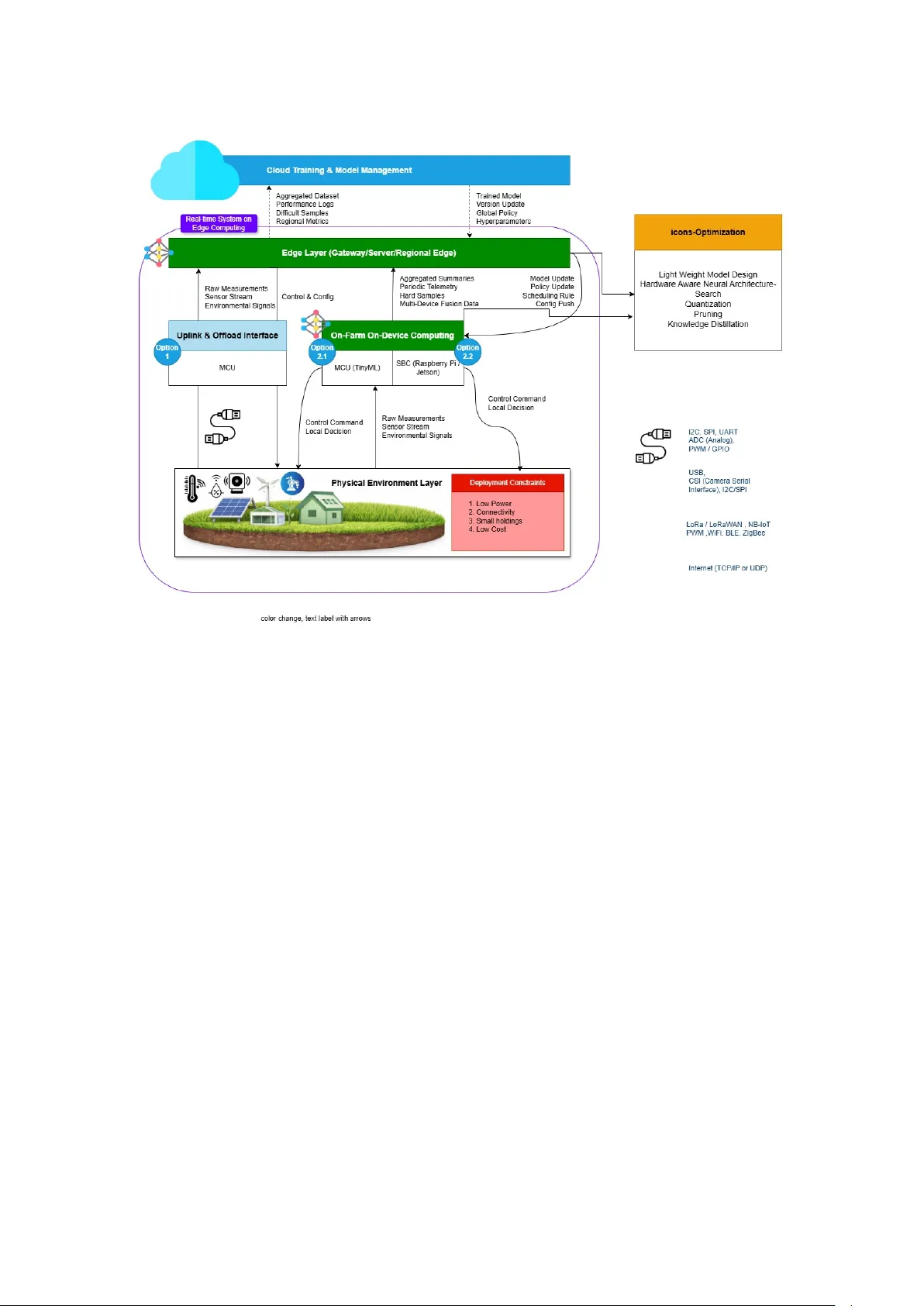
A ff ordable Precision Agriculture: A Deployment-Oriented Re vie w of Low-Cost, Lo w-Power Edge AI and T in yML for Resource-Constrained Farming Systems Riya Samanta a , Bidyut Saha b a T ec hno India University , Salt Lake, W est Bengal, India b Sister Nivedita University , Newtown, W est Bengal, India Abstract Precision agriculture increasingly inte grates artificial intelligence to enhance crop monitoring, irrigation management, and resource e ffi ciency . Nev ertheless, the vast majority of the current systems are still mostly cloud-based and require reliable connecti vity , which hampers the adoption to smaller scale, smallholder farming and underdev eloped country systems. Using recent literature revie ws (ranging from 2023–2026), this re view co vers deployments of Edge AI, focused on the e volution and acceptance of T iny Machine Learning (T inyML), in lo w-cost and low-po wered agriculture. A hardw are-targeted deployment-oriented study has sho wn pronounced v ariation in architecture with microcontroller -class platforms (i.e. ESP32, STM32, A TMega) dominating the inference options, in parallel with single-board computers and U A V -assisted solutions. Quantitativ e synthesis shows quantization is the dominant optimization strategy (the approach in many w orks identified: around 50% of such works are quantized), while structured pruning, multi-objectiv e compression and hardware aw are neural architecture search are relativ ely under-researched. Also, resource profiling practices are not uniform: while model size is occasionally reported, explicit flash, RAM, MA C, latency and millijoule lev el energy metrics are not well documented, hampering reproducibility and cross-system comparison. Moreoev er , to bridge the gap between research prototypes and deployment-ready systems, the revie w also presents a literature-informed deployment perspectiv e in the form of a priv acy-preserving layered Edge AI architecture for agriculture, synthesizing the key system-lev el design insights emer ging from the surve yed w orks. Overall, the findings demonstrate a clear architectural shift tow ard localized inference with centralized training asymmetry . K eywor ds: Precision agriculture, Edge AI, T inyML, Resource-constrained systems, Energy-e ffi cient inference, Lo w-cost smart farming. 1. Intr oduction Precision agriculture (P A) has transitioned from a concept- driv en paradigm to a data-centric operational frame work aimed at enhancing crop productivity , input-use e ffi ciency , and en- vironmental sustainability . By integrating distributed sensing, machine learning (ML), geospatial analytics, and automated decision-support systems, P A enables site-specific crop mon- itoring, irrigation scheduling, pest and disease detection, and micro-climate assessment. These capabilities are increasingly critical in the conte xt of climate v ariability , w ater scarcity , and rising input costs (Ahmed and Shakoor (2025)). Howe ver , despite rapid technological progress in digital agri- culture, large-scale adoption remains unev en, particularly in smallholder and resource-constrained farming systems. The Food and Agriculture Or ganization (F A O) highlights the cen- tral role of smallholders in global food production. In India, this structural constraint is especially pronounced: small and mar ginal operational holdings (belo w 2 hectares) constitute ap- proximately ∼ 86% of all operational holdings (Press Informa- tion Bureau (PIB), Government of India (2023)), with the Agri- culture Census 2015–16 reporting 86 . 21% holdings in this cate- gory and only 47 . 34% share in operated area (The Hindu Centre / Department of Agriculture, Cooperation & F armers W elfare (2018)). In parallel, the a verage holding size has steadily de- clined, reaching ∼ 1 . 08 hectares by 2015–16 (Press Information Bureau (PIB), Government of India (2020)). Such fragmenta- tion constrains mechanization, capital-intensi ve sensing infras- tructure, and the feasibility of alw ays-connected data pipelines. Digital access limitations further exacerbate this gap: rural in- ternet penetration remains significantly lower than urban le vels (The Hindu Centre / Department of Agriculture, Cooperation & Farmers W elfare (2018)), while recent assessments indicate that fewer than 20% of Indian f armers activ ely use digital technolo- gies, reflecting a persistent “last-mile adoption” deficit (Fortune India (2025)). Moreov er, intermittent and unpredictable power supply con- tinues to plague the rural areas, leading to a decreased realistic performance of continuous cloud-based computational work- loads. Consequently , cloud-centric smart farming architectures based on the principles of continuous connecti vity and central- ized computation remain infeasible to apply in many Indian deployment scenarios, dri ving resilient edge and near -edge ap- proaches that are designed to be in lo w-cost, lo w-power opera- tion in the context of intermittent infrastructure. Many traditional AI-driv en agricultural pipelines rely on cen- tralized cloud infrastructures that transfer sensor data and data from the field to servers that are remote to enable model in- ference. Scalable in well-connected geographical areas, such architectures introduce communication latenc y , recurrent band- width prices, pri vacy danger , and operational exposure to net- work outages (Kabala et al. (2023)). The edge comput- ing perspecti ve described in foundational literature (Shi et al. (2016)) and further consolidated in recent smart agriculture surve ys (Gauttam et al. (2026a)) states that latency-sensitiv e and bandwidth-demanding applications perform computation locally in close proximity to the source data. W ith crucial decision-making functions (irrigation, pest alerts, and anomaly detection) in agricultural systems, this ar- chitectural change w ould hold great rele vance for the future. In addition, the rural connectivity gaps identified in recent reports on digital infrastructure (GSMA (2024)), highlight the impor- tance of resilient, intermittency-resistant computational frame- works. Recent precision f arming research suggests a definitiv e mo ve tow ard Edg e AI-based agricultural intelligence . For example, the proposed layered architectures have included distributed sensing nodes implementing localized inference and commu- nication with an edge gate way to minimize cloud dependence and boost irrigation responsi veness (T aueatsoala et al. (2026)). In the same way , quantized / light-weight deep learning models hav e been shown to allo w near real time anomaly detection in the field using resource constrained platforms (Hernandez- Hidalgo et al. (2026)). Another high-impact application domain is crop health mon- itoring. The surv eys sho w both the potential of deep learning to detect plant disease on the one hand, and the challenges on the other by considering the generalisation, the dataset bias and the infrastructure constraints in real field condition (Madiwal et al. (2025); Paul et al. (2025)). T o o vercome these limitations, the LeafSense (refer Fig. 1) system presents portable, lo w-cost on-device plant disease diagnosis through T inyML based in- ference, which reduces latency , communication overhead and the dependence on infrastructure (Samanta et al. (2025a)). Fur- thermore, complementary comparativ e analyses also shows that deployment feasibility is significantly a ff ected by hardware choice, toolchain maturity , and model compression strategies (Arthur et al. (2024)). In addition to terrestrial sensing, there is increasing interest in use of UA V -assisted precision agriculture with edge intelli- gence. In onboard or near -edge inference processes, commu- nication overhead is minimized and adapti ve flight strategies are made to optimize coverage e ffi ciency and energy usage (an essential consideration in a large-scale or resource-limited sys- tem) according to studies (Liu et al. (2021); Annadata et al. (2025)). Another basic research direction in smart farming systems is energy-e ffi cient model design and architecture / hardware aware optimization. Attention-e ffi cient architectures and compression-aware design allow for operation under tight memory and po wer b udgets (Kadhum et al. (2025)). Similarly , there hav e been claims related to the architectural simplifica- tion and quantization approaches for long term sustainable op- eration in low po wer agriculture areas (K oli et al. (2025)). As such, these work together suggest that Edge Artificial Intelligence (Edge AI) is an aspect of a structural shift in precision agriculture , especially in ecosystems dominated by smallholders. On this wider stage, Tiny Machine Learning (TinyML) appears as a crucial specialization on ultra-low- power microcontrollers and memory-limited devices where in- ference needs to take place autonomously , continuously , and o ffl ine. 1.1. P ositioning Against Existing Reviews Although several recent revie w articles hav e explored the con vergence of Edge AI and agriculture, most either adopt a broad surve y-oriented vie wpoint or emphasize algorithmic ac- curacy without systematically e xamining deplo yment feasibil- ity . T able 1 positions the present re view with respect to rep- resentativ e prior studies and highlights its distinct scope and contribution. As shown in T able 1, earlier revie ws generally fall into three categories. Some works discuss the broader integration of Edge AI and IoT in agriculture b ut do not analyze deployment con- straints at the hardw are le vel (Ahmed and Shakoor, 2025; Gaut- tam et al., 2026b). Another cluster focuses mainly on predic- tiv e performance of v arious AI-centric algorithms while gi ving limited attention to resource profiling and deployment practi- cality (P aul et al., 2025; Madiwal et al., 2025). A third group of surve ys incorporates T inyML-based methodologies in a generic context, but lacks a dedicated focus on deployment architecture for f arming sectors (He ydari and Mahmoud, 2025a; Singh and Gill, 2023a). In contrast, this revie w advances the literature in four key ways. First, it o ff ers a systematic, deployment-oriented analysis of Edge AI and T inyML specifically for resource-constrained precision agriculture, with emphasis on hardware div ersity rather than algorithmic accuracy alone. Second, it provides a quantitativ e synthesis of optimization strategies reported across the reviewed studies. Third, it presents, to the best of our knowledge, the first systematic identification of resource pro- filing gaps across Edge AI and Tin yML studies for agricul- tural sectors, including status in reporting flash memory , RAM, MA C count, latency , and energy per inference. This exposes an important methodological dra wback in the current literature corpus. Fourth, our revie w highlights a recurring inference- training asymmetry in existing architectures, where it has been observed that inference is mainly performed locally at the edge while training continues to remain largely centralized. Col- lectiv ely , these contributions pro vide a deployment-centric per - spectiv e to our revie w , which remained largely missing from previous re views in the precision agriculture domain. Motiv ated by the aforementioned con vergence of agronomic necessity and architectural innov ation, this re view consoli- dates recent adv ances across sensing, perception, control, and aerial intelligence systems through a deployment-oriented lens. Rather than focusing solely on algorithmic accurac y , the study emphasizes hardware heterogeneity , model compression, en- ergy e ffi ciency , latency minimization, communication reduc- tion, and a ff ordability in resource-constrained agricultural en- vironments. 2 T able 1: Comparative positioning relati ve to existing revie ws Review Scope TinyML F ocus Hardware Pro- filing Energy / Resource Metrics Deployment Orien- tation Time Range Ahmed & Shakoor (2025) IoT , Big Data, AI in agriculture No Limited No Survey-le vel Broad Gauttam et al. (2026b) Edge computing in smart agriculture P artial Partial No Architectural 2020–2025 Heydari & Mahmoud (2025a) Tin yML applications survey Y es General Limited Application-le vel Broad Paul et al. (2025) Deep learning for plant stress detection No No No Algorithm-centric Broad Madiwal et al. (2025) Edge AI and IoT for crop disease Partial Limited No Survey-le vel Recent Singh & Gill (2023a) General survey on Edge AI No General No T axonomic Broad Al-Qudah et al. (2025a) AI for smart greenhouses No Limited Partial Application-lev el Recent This Review Edge AI + TinyML in precision agri- culture Y es Systematic Y es Deployment- oriented 2023–2026 T able 2: Application-wise Summary of TinyML and Edge AI Implementations in Precision Agriculture Application References Hardware Model Optimization Key Metric O ffl ine Plant Disease Detection Samanta et al. (2025a) ESP32-CAM CNN Quantization 92% Acc. Y es Koli et al. (2025) Edge Device DS-CNN Lightweight Arch. 96% Acc. Y es Gookyi et al. (2024) Arduino BLE 33 CNN Augmentation + T uning 94.6%, 7.6 ms Y es Annadata et al. (2025) ESP-EYE 32 CNN Path Optimization 90% Acc. Y es T ao et al. (2025) LoRa + Edge CNN Adaptiv e O ffl oading – Partial Kouzinopoulos and Manna (2025) STM32U575 YOLOv8n Pruning + INT8 51.8 mJ / inf. Y es Madiwal et al. (2025) Edge Device MobileNet / E ffi cientNet Quantization – Partial T asci (2026) NVIDIA Jetson Nano DBLA-MobileNetV2 FP16 + T ensorR T 97.90% Prec., 12.40 FPS Y es Precision Irrigation T aueatsoala et al. (2025) ESP32 Gradient Boosting Model Conversion MAPE < 1% Y es Hernandez-Hidalgo et al. (2026) MCU Quantized NN 8-bit Quantization 6.2 KB Model Y es Thirumalaiah et al. (2025) LoRa + Edge CNN + Analytics Arch. Design W ater Savings Y es Soil Monitoring Bhattacharya and Pandey (2024) MCU + Blockchain Tin yML DVFS + GA Scheduling 8.5% Energy ↓ Y es Crop Recommendation Baishya and Dutta (2025) A TMega328P Random Forest Model Compression 99% Size Reduction Y es U A V / Distributed Soltani et al. (2025) U A V + Edge Split Learning Energy-aw are Training 86% Energy ↓ No Annadata et al. (2025) ESP-EYE 32 CNN Path Optimization 90% Acc. Y es Hayajneh et al. (2024) U A V + Edge MCU CNN (Transfer Learning) Transfer Learning + Quantization Improved Inference E ffi ciency Y es 2. Edge Artificial Intelligence and TinyML Edge Artificial Intelligence (Edge AI) and T iny Machine Learning (Tin yML) represent a shift from centralized, cloud- based machine learning toward decentralized, on-de vice intelli- gence. By performing inference locally rather than transmitting raw data to remote serv ers, these paradigms reduce dependence on persistent connectivity and centralized infrastructure (Singh and Gill (2023b); Heydari and Mahmoud (2025b)) which is par- ticularly relev ant in distrib uted and resource-constrained en vi- ronments. 2.1. Edge AI Edge AI is the deployment of machine learning (ML) mod- els on computing platforms at the edge of the network ( em- bedded processor s, edge gate ways, and single-boar d systems ) (Singh and Gill (2023b)). In time-critical and geographically distributed applications, Edge AI reduces communication o ver- head and latency , improves data pri vacy , and enhances system responsiv eness by placing computation closer to the data source (Abou Ali and Dornaika (2025)). Edge AI enables localized decision-making for irrig ation control, anomaly detection, crop health monitoring, and other tasks in agricultural fields with- out continuous cloud interaction. This approach impro ves op- erational resilience under intermittent connectivity and reduces bandwidth requirements associated with high-v olume sensory or imaging data. Figure 1: V isual representation of the proposed system uti- lizing EPS32-CAM, TFT display , and real-time interpreting tomato plant disease classes (Source: Samanta et al. (2025a)). 2.2. T inyML T inyML or T iny Machine Learning is an Edge AI paradigm subset, which focuses on ultra low-po wer and memory- limited devices usually microcontrollers (Heydari and Mah- moud (2025b)). In contrast to con ventional machine learning systems built on CPUs and GPUs, T inyML models are opti- mized for small resource footprints, real-time inference, and tight power consumption under resource-constrained hardware 3 budgets (Saha et al. (2024); Samanta et al. (2025b)). These can be attrib uted to techniques including model compression, quantization, architectural simplification, and hardware-aware optimization (Saha et al. (2025b,a,c)). Although all Tin yML systems fall within the broader Edge AI ecosystem, Edge AI may in volv e comparativ ely capable processors or gate way devices, whereas Tin yML explicitly emphasizes deployment on microcontr oller-class har dware with stringent memory and power constraints (Abou Ali and Dornaika (2025)). 3. Review Methodology This study presents a systematic analysis of research at the ov erlap of precision agriculture, resource-constrained edge in- telligence, T inyML, and energy-e ffi cient computing. Studies were sourced from leading academic databases, namely Google Scholar , IEEE Xplor e, ScienceDir ect, SpringerLink, A CM Dig- ital Library , and Scopus , to ensure extensi ve cov erage of peer- revie wed journal and conference articles. A structured search strate gy in volved structured Boolean search queries such as “Precision agriculture” AND “T inyML” AND “Energy e ffi ciency , ” “Low-cost precision farming” AND (“Edge AI” OR “Machine learning”) AND “Resource- constrained devices, ” “Smart farming” AND “Lo w-power com- puting” AND “Model optimization techniques, ” and “ A ff ord- able precision farming” AND “Hardware-aw are model op- timization” AND (“Ener gy-aware systems” OR “Sensor fu- sion”). The revie w primarily focuses on literature published between 2023 and 2026 to capture recent developments in Edge AI and T inyML deployment for constrained computing en vironments. Earlier foundational works were included selectiv ely when nec- essary to contextualize architectural paradigms (e.g., edge com- puting foundations). Criteria of inclusion : (i) studies demonstrating on-device or near -edge inference in agricultural applications; (ii) ex- plicit address of resource constraints such as flash memory , RAM, latency , energy used, model footprint; (iii) implemen- tation on embedded, microcontroller , edge gateway , or U A V platforms; and (iv) peer-re viewed journal publications, refereed conference proceedings, and credible archiv al technical reports demonstrating implemented systems and experimentally vali- dated results Exclusion criteria : (i) only cloud-based agricultural AI sys- tems without the use of edge; (ii) simulations limited to the hardware-le vel with no hardware ev aluation and / or ev aluation; (iii) work with algorithmic correctness b ut no discussion of de- ployment feasibility , and (iv) non-peer-re viewed opinion arti- cles or short abstracts without methodological details. The initial search yielded approximately 45 candidate arti- cles. Follo wing duplicate remov al and abstract-lev el screening for deployment relev ance, 34 papers underwent full-text ev alu- ation. Ultimately , 28 studies satisfied the inclusion criteria and were selected for detailed qualitative and comparativ e analysis. 4. Application Landscape of Edge AI and TinyML in Pre- cision Agriculture Previous comprehensiv e surve ys hav e classified smart agri- culture applications according to pre-harvest, during-harvest, Figure 2: Overvie w of the methodology , illustrating the training phase with DBLA-MobileNetV2 and the deployment phase on Jetson Nano for real-time rice leaf disease classifi- cation (Source: T asci (2026)). and post-harvest operational stages, providing a macro-le vel understanding of IoT and AI integration across the agricultural lifecycle (Ahmed and Shakoor (2025)). In contrast, this re- view organizes applications from a deployment-oriented and resource-constrained T inyML perspectiv e, emphasizing hard- ware feasibility and ener gy-aware inference. The deployment of Edge AI and T inyML in precision agri- culture has accelerated in response to the need for lo w-cost, low-po wer , and connectivity-resilient intelligent systems (Saha et al. (2024, 2025a); Samanta et al. (2025b)). As summarized in T able 2, current research conv erges around fi ve primary do- mains: disease detection, precision irrigation, soil monitor- ing, crop recommendation, and U A V -assisted distributed intel- ligence. 4.1. Plant Disease Detection Plant disease detection in volves identifying plant health is- sues caused by pathogens (fungi, bacteria, viruses) using meth- ods ranging from traditional visual inspection to adv anced tech- nology . Plant diseases remain a major challenge to global food security , with F A O estimates indicating that they account for roughly 20–40% of crop losses each year worldwide (Sav ary et al. (2019)). The impact is especially se vere in smallholder farming systems, where access to trained plant pathologists and laboratory-based diagnostic facilities is often scarce. Un- der such conditions, disease outbreaks may spread unchecked and destroy entire harvests before any correctiv e action can be taken. As a result, rapid in-field detection is not just a techno- logical advantage but a critical agricultural requirement, since the time av ailable for e ff ectiv e treatment with fungicides or bactericides is often limited to only a fe w hours. Staple and high-value crops such as rice, wheat, maize, tomato, and potato are particularly vulnerable to foliar infections caused by fun- gal pathogens, such as Magnaporthe oryzae in rice blast and Phytophthora infestans in late blight, as well as other bacterial diseases. In these cases, delayed diagnosis can lead directly to 4 substantial yield reduction, poorer market quality , and signifi- cant financial losses for farmers with limited resources. Plant diseases represents the most mature application of T inyML in the agriculture sector . Con volutional neural net- works (CNNs) hav e been deployed on microcontroller -class platforms including ESP32-CAM (Samanta et al. (2025a)), Ar- duino Nano BLE 33 (Gookyi et al. (2024)), ESP-EYE (An- nadata et al. (2025)), and STM32U575 (K ouzinopoulos and Manna (2025)), as well as higher-resource edge de vices such as Jetson Nano using optimized MobileNet v ariants with attention mechanisms (T asci (2026), refer Fig. 2). Reported classification accuracies range from 90% to 97%, with selected works pro- viding hardw are-level metrics such as 7.6 ms latenc y (Gookyi et al. (2024)) and 51.8 mJ ener gy per inference (K ouzinopou- los and Manna (2025)). Most systems rely on post-training quantization and lightweight architectural design, while adap- tiv e o ffl oading strategies hav e been explored to balance edge and cloud workloads under constrained connectivity (T ao et al. (2025)). Despite strong predictiv e performance, comprehensi ve reporting of flash, RAM, and energy consumption remains in- consistent. Sev eral publicly accessible benchmark datasets have played a central role in the de velopment and e valuation of plant dis- ease detection models. Among them, the PlantV illage dataset Hughes et al. (2015), which contains more than 54,000 leaf images spanning 38 disease categories and 14 crop species, remains the most extensiv ely used benchmark and has been adopted in studies such as Gookyi et al. (2024), and Anna- data et al. (2025). T o address more realistic conditions, the PlantDoc dataset Singh et al. (2020) o ff ers field-acquired im- ages with substantially greater variation in background, illumi- nation, and scene complexity , thereby posing a more challeng- ing e valuation setting. For rice-focused disease detection, the Rice Leaf Disease Dataset used in T asci (2026) includes field images corresponding to blast, brown spot, and bacterial blight classes. Although these datasets hav e significantly accelerated model de velopment and benchmarking, an important limitation remains: many of them are deriv ed from controlled laboratory or greenhouse en vironments, raising concerns about ho w well they generalize to the heterogeneous and unpredictable con- ditions of smallholder agricultural fields in real-world deploy- ment scenarios. 4.2. Precision Irrigation W ater scarcity is one of the most critical factors limiting agri- cultural productivity , particularly in arid and semi-arid regions. Globally , agriculture is responsible for nearly 70% of freshwa- ter withdrawals (V elasco-Muñoz et al. (2023)), yet irrigation e ffi ciency in many smallholder farming systems remains under 50%, largely because of flood-based and fixed-schedule irriga- tion practices (Aziz et al. (2024)). Precision irrigation aims to address this ine ffi ciency by supplying water in amounts and at times aligned with actual crop ev apotranspiration needs, soil moisture conditions, and local weather dynamics. In water - stressed re gions such as South Asia, Sub-Saharan Africa, and the Mediterranean, moving from con ventional rule-based irri- gation to data-driv en scheduling has important consequences Figure 3: System Prototype: TinyML-Enabled IoT for Sustainable Precision Irrigation (Source: T aueatsoala et al. (2026)). not only for maintaining crop yield stability but also for pre- serving groundwater resources (Nhamo et al. (2024)). Precision irrigation employs regression models or compact neural networks on ESP32-class microcontrollers (T aueatsoala et al. (2025), refer Fig. 3). Quantized neural networks hav e achiev ed highly compact deployments, including a 6.2 KB model footprint (Hernandez-Hidalgo et al. (2026)), enabling fully on-de vice anomaly detection. Distrib uted architectures using LoRa communication facilitate coordinated sensing and actuation across spatially dispersed nodes (Thirumalaiah et al. (2025)). Although performance metrics such as MAPE and re- ported water savings demonstrate operational feasibility , sys- tematic energy profiling and long-term deployment ev aluation remain limited. Benchmark datasets for precision irrig ation remain compara- tiv ely limited, and standardized open-access resources for train- ing and ev aluating irrigation scheduling models are still emer g- ing. One important resource is the OpenET ev apotranspiration platform, which provides satellite-derived estimates of crop wa- ter demand at field scale with 30 m spatial resolution and can be used as reference data for irrigation scheduling models (Melton et al. (2022); V olk et al. (2024)). The International Soil Mois- ture Netw ork (ISMN) (Dorigo et al. (2021)) is another v aluable source, o ff ering globally distrib uted multi-depth soil moisture measurements from more than 2,800 stations, making it suitable for training and v alidating lightweight regression models. For regions where field-le vel datasets are limited, regional agrom- eteorological reanalysis products such as the Indian Monsoon Data Assimilation and Analysis (IMDAA) (Rani et al. (2021)) provide high-temporal-resolution gridded en vironmental v ari- ables, including temperature, humidity , precipitation, and soil moisture. In addition, Hernandez-Hidalgo et al. (2026) utilizes ND VI anomaly data derived from satellite imagery for model dev elopment, representing one of the relati vely fe w studies that explicitly reports the prov enance of input data in the context of irrigation-focused edge deployment. 5 4.3. Soil Monitoring and Nutrient Analysis Soil health is a fundamental driver of agricultural productiv- ity , yet in many smallholder farming settings, laboratory-based soil testing remains too costly and impractical to access re gu- larly (Dattatreya et al., 2024). Key soil attrib utes such as ni- trogen, phosphorus, and potassium (NPK) lev els, pH, electrical conductivity , and organic carbon content can vary considerably across both space and time, ev en within the same field, mak- ing frequent and spatially distributed measurements essential for site-specific nutrient management (Ros et al., 2023). In the absence of precise guidance, excessi ve fertilizer application of- ten leads to nutrient runo ff and groundwater pollution, whereas insu ffi cient application can directly reduce crop yields. For this reason, continuous, low-cost, and energy-e ffi cient soil monitor- ing is increasingly important not only for improving agronomic performance but also for supporting en vironmentally sustain- able farming practices (Naw ar et al., 2024). Soil Monitoring and Nutrient Analysis refers to the system- atic measurement and ev aluation of soil properties to assess soil health, fertility status, and crop suitability . Integration of T inyML models with dynamic voltage and frequency scaling (D VFS) and scheduling mechanisms has demonstrated measur - able energy savings, including an 8.5% reduction in consump- tion (Bhattacharya and Pandey (2024)). These implementations illustrate the importance of cross-layer optimization linking sensing, computation, and po wer management in long-duration agricultural deployments. Standardized benchmark datasets for soil property estimation and nutrient management are still limited in both scope and geo- graphic representativeness when compared with the wide div er- sity of agricultural conditions worldwide. Among the av ailable resources, the LUCAS (Land Use / Cover Area frame Survey) topsoil database, maintained by the European Soil Data Centre, is one of the largest harmonized open-access soil datasets in Europe. It includes nearly 45,000 geo-referenced topsoil sam- ples collected across multiple survey cycles from 2009 to 2022, with standardized measurements covering pH, organic carbon, NPK, cation exchange capacity , particle size distribution, and, from 2018 onward, soil biodiv ersity and pesticide residues (Or- giazzi et al., 2022; Fernández-Ugalde et al., 2022). Owing to its consistency and scale, LUCAS has been widely used for continental-scale digital soil mapping through machine learning approaches such as Random Forest and pedotransfer-function- based modeling (Chen et al., 2024). At the global le vel, the W orld Soil Information Service (W oSIS), curated by Interna- tional Soil Reference and Information Centre (ISRIC), provides standardized and quality-controlled soil profile data from more than 228,000 geo-referenced sites across 174 countries ((Bat- jes et al., 2024)). In India, the Indian Council of Agricultural Research (ICAR) Soil Health Card scheme has also produced a large v olume of geo-referenced soil nutrient records, with more than 23.5 crore cards issued by 2023; howe ver , its utility for machine learning research is still limited by challenges in data standardization, accessibility , and interoperability . Bhat- tacharya and P andey (2024) incorporate sensor -level soil obser- vations within a blockchain-enabled monitoring pipeline, but the prov enance of the training data is not publicly reported. This lack of transparency is a common reproducibility issue in soil monitoring research and highlights the urgent need for open, standardized soil datasets that are better suited for dev el- oping and benchmarking edge-deployable models. 4.4. Cr op Recommendation Crop selection is a critical agronomic decision with direct consequences for both seasonal farm income and household food security (Sengxua et al., 2024). Determining the most suit- able crop requires considering a complex combination of fac- tors, including soil properties, re gional climate patterns, w ater av ailability , access to quality seeds, market demand, and go v- ernment support policies (Mupaso et al., 2023). In smallholder farming systems, where an inappropriate crop choice can lead to sev ere economic losses for an entire season, data-driven rec- ommendation systems can provide v aluable support for more informed and evidence-based decision-making alongside tra- ditional farming knowledge (Baishya and Dutta, 2025). De- ploying such systems on a ff ordable, o ffl ine-capable hardware is especially important in areas where agricultural e xtension ser- vices are limited and mobile network connectivity is inconsis- tent (Foster et al., 2023). A crop recommendation system is essentially a decision- making tool for farmers. It helps them select the best crops to gro w based on factors such as soil type, climate, avail- able resources and market demand. This field remains com- parativ ely underexplored within T inyML-focused deployments. Classical machine learning models, including Random For - est implementations on ultra-lo w-cost microcontrollers such as A TMega328P (Baishya and Dutta (2025)), hav e demon- strated substantial model size reduction (up to 99%). Ho wev er, most systems operate with static inference pipelines and lack adaptiv e learning, distributed coordination, or communication- aware scaling mechanisms. The Kaggle Crop Recommendation Dataset, which includes soil nutrient attributes (N, P , K), temperature, humidity , pH, and rainfall information across 22 crop categories, has become the most commonly used benchmark for this task (Dey et al., 2024) and is also adopted by Baishya and Dutta (2025). More re- cently , the Ethiopian Crop Recommendation Dataset has ex- panded the scope of av ailable resources by combining geo- referenced soil properties, such as pH, electrical conducti vity , and macro- and micronutrient lev els, with NASA-deri ved sea- sonal climate variables for cereal crops, thereby o ff ering a mul- timodal dataset rooted in Sub-Saharan African agro-ecological conditions (Demisse (2024)). Similarly , Munir et al. (2025) reports the use of an enriched soil fertility dataset containing macro-nutrients, micronutrients, and soil physical characteris- tics for machine-learning-based crop suitability prediction in South Asian settings. Although these datasets have improved the av ailability of training data for crop recommendation re- search, most remain geographically limited and do not ade- quately reflect important real-world factors such as changing market demand, fluctuations in input costs, and government policy influences, all of which play a significant role in crop selection across div erse agro-ecological en vironments (Islam et al. (2023); Jha et al. (2025)). 6 4.5. UA V -Assisted and Distributed Intelligence U A V -based aerial monitoring helps overcome a key limita- tion of ground-based sensing, namely its inability to rapidly and e ffi ciently cover large, dispersed, or fragmented agricul- tural fields within practical operational timeframes (Rejeb et al., 2024). In smallholder farming landscapes, where plots are often scattered and di ffi cult to access through conv entional road net- works, drone-based imaging o ff ers a cost-e ff ective solution for tasks such as canopy health monitoring, weed detection, and crop stand assessment (Shamambo and Chirwa, 2023; Anam et al., 2024). Its agronomic importance becomes especially ev- ident during sensitive crop gro wth stages, such as tillering in rice or flo wering in wheat, when spatially detailed anomaly de- tection can enable timely and targeted intervention before dam- age spreads and begins to significantly a ff ect yield (Rejeb et al., 2024). In U A V -Assisted and Distrib uted Intelligence for precision farming, unmanned aerial vehicles (U A Vs or drones) are used as mobile sensing platforms that collect high-resolution aerial data and collaborate with ground-based edge devices to enable localized, intelligent decision-making. UA V -assisted precision agriculture introduces additional constraints related to mobility , payload capacity , and onboard energy av ailability . Lightweight CNNs adapted through transfer learning hav e been deployed for drone-based inference to impro ve operational e ffi ciency (Haya- jneh et al. (2024)). Distrib uted learning approaches, including split learning, aim to reduce centralized training overhead and hav e reported up to 86% energy reduction in distributed settings (Soltani et al. (2025), refer Fig. 4). Nev ertheless, these strate- gies introduce communication dependencies that may limit ap- plicability in connectivity-constrained rural en vironments. Sev eral U A V -based agricultural datasets have been intro- duced to facilitate aerial crop analysis. Among the most promi- nent, the Agriculture-V ision dataset o ff ers large-scale aerial farmland imagery consisting of about 94,986 RGB-NIR im- ages captured over U.S. farmlands at a spatial resolution of 10 cm / pixel, together with pixel-le vel semantic segmentation labels for eight agricultural conditions, including weeds, nu- trient deficiency , and drydo wn (Chiu et al., 2020). The Ex- tended Agriculture-V ision dataset further expands this resource by adding 3,600 full-field images and benchmarks for self- supervised pre-training (W u et al., 2023). For weed-focused ap- plications, the CoFly-W eedDB dataset contains U A V -acquired RGB images captured at an altitude of 5 m over cotton fields in Greece, annotated for three major weed species (Shahi et al., 2023). Similarly , the DR ONEWEED dataset includes more than 67,000 labeled UA V images collected at 11 m altitude across maize and tomato fields in Spain, covering ten weed species at two di ff erent phenological stages (Mesías-Ruiz et al., 2025). For crop health assessment, Jadhav et al. (2025) present an Indian UA V and leaf image dataset for soybean, spanning multiple growth stages and including annotations for both dis- eases and pests across two growing seasons (Jadhav et al., 2025). Hayajneh et al. (2024) also demonstrate the use of trans- fer learning from ImageNet-pretrained models to adapt learned visual features for aerial crop imagery . Despite these con- tributions, the literature still lacks standardized UA V -specific benchmark datasets with consistent resolution, flight altitude, and ground-truth annotation protocols designed specifically for e valuating lightweight, edge-deployable models, which re- mains a major challenge for resource-constrained agricultural deployment scenarios (Anam et al., 2024; Zhu et al., 2024). Figure 4: The left sub-figure depicts a single f arm with an example of the U A V trajectory for exchanging data with the cluster head devices (red-colored sen- sors). The right sub-figure illustrates the communication between a cluster head (client / edge device), a U A V , and a server .(Source: Soltani et al. (2025)). 5. System-Level Deployment Patter ns T able 3 or ganizes intelligence placement in Edge AI and T inyML-based precision agriculture into three dominant ar- chitectural paradigms: fully on-de vice , edge-assisted , and dis- tributed collaborative systems. These configurations di ff er in computational locality , communication dependency , and inference–training separation, directly shaping latenc y , ener gy e ffi ciency , and operational resilience in resource-constrained en vironments. 5.1. Fully On-Device Ar chitectur es Fully on-device systems perform inference entirely on em- bedded or microcontroller-class hardware without runtime cloud dependency . This specification is illustrated in T able 3. Hernandez-Hidalgo et al. (2026) implements an 8-bit quantized neural network for irrigation anomaly detection with a com- pact 6.2 KB model footprint, thus establishing strict memory feasibility for microcontroller-class deployment. Similarly , An- nadata et al. (2025) deplo ys CNN-based inference using ESP- EYE hardware for U A V -assisted crop monitoring, attaining 90% classification accuracy and embedding perception within the drone’ s control loop. (Samanta et al., 2025a) deployed CNN model occupying 103.9 KB RAM size on ESP32-CAM for tomato leaf disease detection on fully on-de vice inference mode. These architectures mitigate communication / transmission- related latency and bandwidth burden, which allows robust field operation. Howe ver , localized inference does not lead to end- to-end cloud deployment of training and model updates, expos- ing an enduring inference-training asymmetry . 5.2. Edge-Assisted Ar chitectur es Edge-assisted systems inference locally; optional cloud in- teraction for both training and coordination is retained. This trend is repeated in T ao et al. (2025), Thirumalaiah et al. (2025), Bhattacharya and Pandey (2024), Madiwal et al. (2025), and T aueatsoala et al. (2025), exploiting LoRa, W iFi, or IoT net- works for distrib uted sensing. 7 T able 3: System-Level Deployment P atterns in Edge AI and TinyML-Based Precision Agriculture References Intelligence Distribution Edge–Cloud Dependency Communication Layer Inference / T raining Tier Samanta et al. (2025a) Fully On-Device None Not Specified On-Device Inference / Cloud Training T ao et al. (2025) Edge-Assisted Optional LoRa + IoT Netw ork Hybrid Inference / Cloud Training Thirumalaiah et al. (2025) Edge-Coordinated Optional LoRa Edge Inference / Cloud T raining Soltani et al. (2025) Distributed Collaborati ve Required Wireless Edge Link Edge Inference / Distributed T raining Bhattacharya and Pandey (2024) Edge-Assisted Optional IoT Network Node Inference / Cloud T raining Annadata et al. (2025) Fully On-Device None UA V Internal Control On-Device Inference / Cloud Training Madiwal et al. (2025) Edge-Assisted Optional W iFi / IoT Edge Inference / Cloud T raining T aueatsoala et al. (2025) Edge-Assisted Optional IoT Network Edge Inference / Cloud T raining Hernandez-Hidalgo et al. (2026) Fully On-Device None Not Specified On-Device Inference / Cloud Training T ao et al. (2025) introduce adaptive o ffl oading over LoRa to dynamically balance edge and cloud workloads. Bhat- tacharya and Pandey (2024) combine Tin yML inference with D VFS-based po wer management, achie ving an 8.5% energy re- duction, while Thirumalaiah et al. (2025) demonstrate LoRa- coordinated irrigation control with measurable water sa vings. While these architectures o ff er scalability and centralized manageability , optional edge–cloud dependenc y brings sensi- tivity to netw ork instability . Howe ver , latenc y-critical inference is still localized. 5.3. Distributed Collaborative Ar chitectur es Distributed collaborativ e systems share intelligence across multiple nodes and partition learning responsibilities. Soltani et al. (2025) realize split learning via edge inference and dis- tributed training, yielding up to 86% energy reduction in con- trast to centralized techniques. Such frame works need con- stant communication to synchronize models in contrast to edge- assisted systems. Although good for e ffi cient training and dis- tributed computation, compulsory connectivity can be a con- straint for rural deployments that ha ve intermittent infrastruc- ture. 5.4. Implications Across all configurations in T able 3, a consistent structural pattern emerges: inference is increasingly localized, whereas training remains predominantly centralized. Quantitativ e find- ings such as the 6.2 KB model in Hernandez-Hidalgo et al. (2026), 92% classification accuracy in Samanta et al. (2025a), 8.5% ener gy reduction in Bhattacharya and Pandey (2024), 90% U A V accuracy in Annadata et al. (2025), and 86% dis- tributed energy savings in Soltani et al. (2025), show that localized inference is technically feasible e ven under con- strained resource budgets. From a deployment perspectiv e, lo- calized inference paired with optional cloud interaction pro- vides the most pragmatic approach to providing smallholder and infrastructure-constrained agricultural ecosystems auton- omy , scalability and resilience. 6. Optimization Strategies and Resource Profiling The optimization in agricultural Edge AI and Tin yML sys- tems goes beyond model performance; it also considers de- ployment feasibility under strict flash, RAM, latency , and millijoule-lev el energy constraints. T ables 4 and 5 sho w that although compression algorithms are commonly used, the sys- tematic hardware-aware profiling and multi-lev el co-design process is still limited. 6.1. Dominant Optimization P atterns Among the 13 presented works in T able 4, quantization stands out as the most common optimization method used in ov er 50% of the mentioned deployments. For instance, Samanta et al. (2025a), Koli et al. (2025), K ouzinopoulos and Manna (2025), Madiwal et al. (2025), Hernandez-Hidalgo et al. (2026), and Hayajneh et al. (2024) use INT8 or reduced-precision infer - ence to shrink ov erall model footprint and compute overhead. Quantitativ e evidence demonstrates the e ff ecti veness of this approach. Hernandez-Hidalgo et al. (2026) report an 8-bit quantized neural network with a compact 6.2 KB model size, enabling microcontroller-le vel irrigation anomaly detection. K ouzinopoulos and Manna (2025) deploy INT8 YOLOv8n on STM32U5 hardw are with flash usage 850.97 KB, RAM 677.30 KB and energy consumption of 51.8 mJ per inference. Simi- larly , Gookyi et al. (2024) demonstrate real-time inference with 7.6 ms latency using a CNN-MDD model occupying 344.7 KB Flash and 726.6 KB RAM. Lightweight architectural design ac- companies nearly all deployments (T able 3), indicating that ar- chitectural simplification rather than post hoc compression is often the primary design philosophy . 6.2. Underutilization of Structured Compr ession Despite the dominance of quantization, structured pruning appears explicitly in only one deployment (refer to Fig. 5) (K ouzinopoulos and Manna (2025)). This work demon- strates that hardware-aware pruning enables YOLO compres- sion within kilobytes of flash constraints, directly addressing microcontroller memory limitations. Classical model com- pression techniques are reported in Baishya and Dutta (2025), achieving up to 99% model size reduction for crop recommen- dation on A TMega328P hardware. Ho wever , systematic multi- objectiv e pruning framew orks and hardware-aware neural ar- chitecture search remain absent in most agricultural T inyML pipelines. This imbalance suggests that current optimization e ff orts pri- oritize precision scaling (e.g., INT8) ov er structural reconfigu- ration, leaving computational complexity and MA C reduction comparativ ely underexplored. 8 T able 4: Optimization Strategies Adopted in Tin yML and Edge AI-Based Precision Agriculture Systems References Quant. Pruning Model Comp. T ransfer Learning Split Learning D VFS Adaptive O ffl oading Lightweight Arch. Samanta et al. (2025a) Y es – – – – – – Y es K oli et al. (2025) Y es – Y es – – – – Y es Gookyi et al. (2024) – – – – – – – Y es T ao et al. (2025) – – – – – – Y es Y es K ouzinopoulos and Manna (2025) Y es Y es – – – – – Y es Madiwal et al. (2025) Y es – – – – – – Y es T aueatsoala et al. (2025) – – – – – – – Y es Hernandez-Hidalgo et al. (2026) Y es – Y es – – – – Y es Thirumalaiah et al. (2025) – – – – – – – Y es Bhattacharya and Pandey (2024) – – – – – Y es – – Baishya and Dutta (2025) – – Y es – – – – Y es Soltani et al. (2025) – – – – Y es – – – Hayajneh et al. (2024) Y es – – Y es – – – Y es T able 5: Energy and Resource Profiling of Tin yML and Edge AI Systems in Precision Agriculture References Flash / R OM RAM Model Size Latency Energy / Inference Gookyi et al. (2024) 344.7 KB 726.6 KB CNN-MDD 7.6 ms – K ouzinopoulos and Manna (2025) < 100 KB – INT8 YOLOv8n – 51.8 mJ Hernandez-Hidalgo et al. (2026) – – 6.2 KB Model – – Baishya and Dutta (2025) – – 99% Size Reduction – – Bhattacharya and Pande y (2024) – – – – 8.5% Energy ↓ Soltani et al. (2025) – – – – 86% Energy ↓ Hayajneh et al. (2024) – – TL-based CNN – – Samanta et al. (2025a) 323 KB 103.9 KB Quantized CNN 850 ms – Madiwal et al. (2025) – – Quantized MobileNet – – T asci (2026) – – DBLA-MobileNetV2 (FP16) 12.40 FPS (T ensorR T) – Figure 5: E ff ect of pruning inference complexity , for YOLOv8n, YOLOv10n and YOLOv11n (Source: Kouzinopoulos and Manna (2025)). 6.3. Distributed and System-Level Optimization Optimization strategies extend beyond model compression in distributed settings. Soltani et al. (2025) apply split learn- ing which results in up to 86% lower energy consumption than that of centralized training. These methods, which are gen- erally e ff ecti ve for distributed training e ffi ciency , introduce a mandatory communication overhead that may o ff set gains in connectivity-constrained rural deployments. Adaptiv e o ffl oad- ing in T ao et al. (2025) also adjusts inference w orkload through LoRa networks dynamically to conv ey communication-aware optimization rather than direct model compression. These ap- proaches suggest the direction tow ards system-le vel workload management, but are still netw ork dependent. 6.4. Hardwar e-A ware Co-Design Explicit hardware–algorithm co-optimization remains rare. Bhattacharya and Pande y (2024) combine T inyML inference with dynamic voltage and frequenc y scaling (DVFS) to achie ve an 8.5% energy reduction. This method exemplifies cross-layer optimization, jointly addressing computation and power man- agement. Howe ver , beyond isolated cases, few studies report coordinated optimization across sensing rate, model structure, clock scaling, and energy profiling. Most deployments treat compression and hardware constraints sequentially rather than holistically . 6.5. Resource Pr ofiling Gaps T able 5 uncovers a critical limitation in current literature: in- consistent hardware-le vel reporting. While some papers furnish metrics (e.g. 51.8 mJ per inference (K ouzinopoulos and Manna (2025)), 7.6 ms latency (Gookyi et al. (2024)), or explicit model size reductions (Baishya and Dutta (2025))), RAM usage, MAC operations and energy-per -inference are frequently missing. 9 Notably , only a small minority of quantized deployments re- port explicit energy consumption, suggesting that compression strategy is not reflected in an energy ev aluation. In addition, MA C counts or computational complexity metrics are usually not reported despite their impact on inference ener gy usage and battery durability . Since microcontroller -controlled agricultural systems frequently work from memory depth lev els less than a megabyte with extremely demanding millijoule energy en- velopes, the lack of consistent profiling metrics hampers com- parison between studies and also distorts its real-world deploy- ment. 6.6. Implications Recent advances in precision agriculture optimization are based on quantization and lightweight architectures, while structured pruning, multi-objective compression, and hardware- aware neural architecture search remain limited. On the other hand, distributed strate gies like split learning and adaptiv e o ffl oading enhance computation distribution, they introduce communication dependencies that may inhibit deployment in connectivity-limited rural settings. From a perspective of de- ploying edge AI, particularly T inyML systems for agricul- tural settings, future applications need to shift to wards holis- tic, resource-aware co-design, optimizing model precision, ar - chitecture, sensing rate, and hardware configuration together . Standardized reporting of flash, RAM, MACs, latency , and en- ergy per inference is necessary for reproducible comparison and feasibility assessment. This kind of integrated optimization is essential for enabling sustainable, long-duration operation in infrastructure-constrained farming ecosystems. 7. Proposed Deployment Perspective for Edge AI–Enabled Precision Agricultur e Based on insights gathered from the revie wed literature, we propose a generic privacy-pr eserving layered Edge AI deploy- ment ar chitectur e for agricultur e that determines where sensor data should be processed by balancing deployment cost, com- putational capacity , energy consumption, latency , and data pri- vac y . As illustrated in Fig. 6, the architecture or ganizes sens- ing, inference, edge-level analytics, and cloud-based training into four coordinated layers. The frame work considers both on- device intelligence and computational o ffl oading to edge layers, while clearly defining the responsibilities of each layer and the communication technologies used between them. 7.1. Layer 1: Physical Sensing Layer The Physical Sensing Layer forms the interface with the agri- cultural en vironment and is responsible for sensing, actuation, local signal interfacing, and power control. It connects diverse sensing devices such as temperature, humidity , wind, soil mois- ture sensors,and many other environmental sensors, along with imaging platforms such as U A Vs equipped with multispectral cameras. It also interfaces with actuators such as fans, motors, relays, and pumps to support automated responses. In addition, this layer manages ra w data acquisition, temporary storage, sig- nal transfer to upper layers, and lo w-level hardware control. Communication within this layer typically relies on hardware- lev el protocols such as I2C, SPI, U ART , ADC, PWM, GPIO, and USB . 7.2. Layer 2: Infer ence Execution Layer The Inference Execution Layer is responsible for ex ecuting analytics close to the data source and supports two alternativ e modes: (i) computational o ffl oading and (ii) on-device comput- ing . 7.2.1. Computational O ffl oading In the computational o ffl oading mode, the device primar- ily acts as a relay node, forwarding sensed data to the next edge layer for analysis and receiving the inference results back. Based on the returned decisions, the local controller triggers the relev ant actuators. This mode is suitable when the sensing device lacks su ffi cient computational capability for running an- alytics locally . 7.2.2. On-Device Computing In the on-de vice computing mode, inference is performed di- rectly at the node where the sensors are connected, thereby min- imizing latency and improving priv acy . T wo practical forms of on-device computing can be considered. T inyML-Based Infer ence. In this case, machine learning mod- els are deployed directly on ultra-lo w-power microcontrollers. Sensor readings are acquired and processed locally , and in- ference is performed on highly resource-constrained hardware, typically with RAM on the order of a fe w hundred kilobytes and flash memory often belo w 2 MB. Such deployment requires strong model optimization and highly compact model design. T inyML is highly attractiv e for real-time and low-po wer agri- cultural monitoring; ho wev er , only a subset of AI applications can be supported under these strict memory and compute con- straints. SBC-Based On-De vice AI. This option uses single-board com- puters such as Raspberry Pi or Jetson-class devices. These plat- forms o ff er greater flexibility , lar ger memory capacity , operat- ing system support, and in some cases GPU or AI accelerator support, making them suitable for applications that cannot be accommodated within Tin yML environments. Howe ver , this increased capability comes at the cost of higher deployment e x- pense and power consumption. In both cases, model optimization remains crucial. Devel- opers may employ lightweight neural architectures, hardware- aware neural architecture search, knowledge distillation, prun- ing, and quantization to achiev e e ffi cient deployment. Once in- ference is completed in this layer , the corresponding actuator can be triggered locally , ensuring very lo w response latency . In addition, the inference result or compressed metadata may be transmitted to the upper edge layer for logging, coordination, and historical record maintenance. Communication from this 10 Figure 6: Priv acy-preserving layered Edge AI deployment architecture for agriculture. layer to higher layers may use LoRa, LoRaW AN, NB-IoT , W i- F i, BLE, or Zigbee , depending on coverage, power b udget, and bandwidth requirements. 7.3. Layer 3: Edg e Processing Layer The Edge Processing Layer provides more po werful local- ized computation than the lower layers and is designed to sup- port advanced analytics that exceed the capability of end de- vices. It can ex ecute relatively larger models, perform multi- sensor fusion, support split learning or collaborative inference, and make local area-level decisions without always depend- ing on the cloud. This layer is particularly useful when mul- tiple sensing nodes must be coordinated or when aggregated re- gional analysis is required for more reliable decision-making. It also serves as an intermediate processing and control node that reduces cloud dependency and supports faster response than purely cloud-based systems. Communication from this layer to the cloud or other upper services may use cellular networks, satellite communication, W i-F i, or Ethernet , depending on the deployment context. 7.4. Layer 4: Cloud T raining and Manag ement Layer The Cloud T raining and Management Layer serves as the centralized intelligence, training, and lifecycle management component of the architecture. It receiv es telemetry data, sum- marized observ ations, performance logs, and analytical meta- data from the lo wer layers, enabling long-term storage, large- scale analysis, and dataset aggregation. It is also responsible for centralized model training, retraining, model version con- trol, configuration management, threshold tuning, and overall system orchestration. In the reverse direction, this layer sends model updates, optimized parameters, configuration changes, and decision thresholds back to the edge layers for deploy- ment. Thus, the cloud supports the full AI model lifecycle while the lo wer layers ensure e ffi cient, priv acy-aw are, and latency- sensitiv e execution in the field. Overall, the proposed layered architecture provides a flexi- ble deployment strategy for agricultural Edge AI systems by enabling intelligent distribution of sensing, inference, control, aggregation, and model management tasks across physical de- vices, edge nodes, and the cloud. It supports priv acy-preserving and resource-aw are operation while allowing the system de- signer to choose between local intelligence and hierarchical of- floading based on the specific requirements of the agricultural application. 8. Open Challenges and Research Directions Although Edge AI and T inyML have demonstrated techni- cal feasibility across multiple agricultural applications, sev- eral structural challenges must be addressed to enable scal- 11 able and sustainable deployment in resource-constrained farm- ing ecosystems. 8.1. Standardization and Resour ce-A ware Design A lack of standardized resource reporting is an important limitation across current studies. Although some deployments report metrics, perhaps in other domains such as Saha et al. (2024); Samanta et al. (2025b,a,b) (e.g., latency , ener gy per inference), consistent reporting of flash usage, RAM foot- print, MAC operations, and energy consumption is rare. The lack of standard benchmarking hampers cross-system compar- ison and reproducibility . Many studies fail to report memory usage, po wer consumption, and real-world deployment con- straints consistently . For instance, in greenhouse-oriented AI systems, challenges such as sensor calibration, en vironmental variability , and data heterogeneity remain significant barriers to scalable deployment (Al-Qudah et al. (2025b)). Future research must establish standardized profiling frame- works that integrate computational complexity , memory usage, latency , and energy as mandatory ev aluation criteria. Addi- tionally , optimization strategies are still based on quantization and lightweight architectural selection, with limited adoption of structured pruning, multi-objecti ve compression, or hardware- aware neural architecture search (Saha et al., 2025c). Edge AI systems and Tin yML systems for precision agricul- ture need to e volv e to holistic resource-aw are co-design, jointly ensuring the tuning of model precision, structure, and hardware constraints, rather than merely treating compression as a post hoc endeav or . 8.2. T raining–Infer ence Decoupling and Distributed Intelli- gence A common structure in today’ s deployments is inference localization combined with centralized training. Because of asymmetries in inference and training, the model is limited in adaptability under time-dependent farming conditions that ev olve. Lightweight decentralized learning, communication- e ffi cient federated T inyML, and adaptiv e on-device fine-tuning show great opportunities for research, in order to reduce re- liance on persistent cloud connectivity . On the other hand, distributed and edge-assisted architec- tures improve workload distribution but impose communi- cation dependencies, making them di ffi cult to implement in connectivity-constrained rural settings. Communication-aware model scaling, adaptiv e workload partitioning, and bandwidth- aware compression strategies are needed to balance autonomy and scalability . 8.3. Cr oss-Layer Co-Design and Lifecycle Sustainability Model architectures are mostly optimized independently of sensing strategies and hardware scheduling in most av ailable systems. But sensing rate, data acquisition frequency , and ev ent-driv en sampling all modulate computational load and en- ergy consumption. The next generation of systems should embed sensing–computation co-design principles, with adap- tiv e sampling, dynamic voltage and frequency scaling, and scheduling of workloads in a unified deployment frame work. Lastly , the lifecycle and economic analyses are lar gely unex- plored. Long-term ener gy sustainability , maintenance ov erhead and hardware durability , as well as cost–benefit analysis, will be critical for real-world deployment, especially in smallholder- dominated agricultural settings. This marks an important re- search frontier for scaling from prototype-le vel v alidation to economically viable, multi-season deployment frame works. 8.4. F ield V alidation and Agr onomic Impact Assessment A major gap still e xists between laboratory-reported model performance and demonstrated agronomic benefit under real- world field conditions. Most of the re viewed systems are v al- idated on curated datasets and in controlled settings, whereas their practical e ff ects on crop yield, water -use e ffi ciency , pes- ticide reduction, or input-cost sa vings are rarely measured di- rectly . In actual agricultural deployments, system performance is influenced by many additional factors, including changing il- lumination, dust or moisture on lenses and sensors, long-term sensor drift, heterogeneous field backgrounds, and the reali- ties of farmer interaction with devices in the field. Future re- search should therefore move be yond benchmark accuracy and prioritize multi-season field trials across representati ve agro- ecological regions. Evaluation should include not only techni- cal metrics b ut also agronomically meaningful outcomes such as yield gain per hectare, volumetric water savings, reduced pesticide application frequenc y , and earlier detection compared to con ventional scouting. Such v alidation is necessary to bridge the gap between technical feasibility and deployment-ready ev- idence. 9. Conclusion This revie w examined the ev olution of Edge Artificial In- telligence and Tin y Machine Learning in precision agriculture through a deployment-oriented perspective. The approach fo- cused on hardware av ailability , energy e ffi ciency , transmission capability , and intelligence positioning under resource a vail- ability in real-world applications, moving beyond a reliance on solely predictiv e accuracy metrics. As illustrated in Fig. 7a, reviewed literature reflects signifi- cant hardware ecosystem heterogeneity , with microcontroller - class platforms (e.g., ESP32, STM32, A TMega) as primary de- ployment targets. This distribution mirrors a pronounced ar- chitectural shift to localized inference away from cloud-centric pipeline techniques in connectivity-limited and smallholder- dominated agricultural contexts. The optimization analysis (Fig. 7b) and the pre vious w orks demonstrate that existing implementations are primarily light architectural design and quantization, which allows for small- scale deployments in sub-100 KB flash space and kilobyte- scale model footprints. Structured pruning, multi-objective model compression, and hardware-aw are neural architecture search (NAS) remain open research challenges in the context of resource-constrained intelligent systems. Recent methodologi- cal advancements hav e introduced specialized tools addressing these aspects: GenCPruneX Saha et al. (2025b) enables multi- objectiv e channel-wise pruning; e ffi cienc y-aware data acquisi- tion frame works Saha et al. (2025a) in vestigate the impact of 12 (a) Hardware Platform Distribution (b) Dominant Optimization Patterns (c) Resource Reporting Gap Figure 7: Summary of deployment-related characteristics: (a) hardware platform distribution, (b) optimization strategies adopted, and (c) reporting frequency of resource-related metrics. reduced sampling rates on computational and memory foot- prints; and T inyTN AS Saha et al. (2025c) proposes a CPU- e ffi cient, hardware-aw are NAS strategy tailored for Tin yML de- ployments. Despite these adv ances, their application in precision farm- ing systems remains significantly undere xplored. Most e xisting agricultural AI deployments primarily emphasize accuracy im- prov ements and precision scaling, often overlooking structural reconfiguration and holistic resource optimization. This imbal- ance highlights a critical research gap: the need for hardware- aware co-design strategies that jointly optimize model architec- ture, data acquisition, and deployment constraints to achiev e sustainable, lo w-power , and scalable precision agriculture solu- tions More importantly , the resource reporting revie w (Fig. 7c) re- veals an important methodological hole. The model size may be reported but there is no published explicit data for the flash or RAM size, latency , MAC consumption, and millijoule level energy consumption across all studies. Fragmented profiling of this nature impedes reproducibility , inter-study comparison and real deployment feasibility in ultra lo w-power agricultural en vi- ronments. Standardized resource-a ware benchmarking frame- works should be designed accordingly for further research. An- other common structural asymmetry we notice in these data is: inference is more and more spread out while training mostly stays centralized. While localized inference leads to less laten- cies and autonomous operations, it remains dependent on model updates that are maintained in the cloud. This means that future systems need to move to ward communication-e ffi cient distributed learning, on-de vice adap- tiv e fine-tuning and integrated sensing–computation–hardware co-design to achieve durable, cost-e ff ecti ve deployment. Cu- mulativ ely , these findings suggest that Edge AI and Tin yML are not simply incremental improvements in agricultural an- alytics, but are in fact a structural redefinition of intelligent farming systems. Standardized resource reporting, cross-layer optimization, and communication-informed intelligence distri- bution will be crucial to conv ert prototype demonstrations into a scalable and a ff ordable scalable and infrastructure-resilient precision agriculture solutions in resource-constrained en viron- ment. From an agricultural perspective, this revie w shows that the importance of Edge AI and T inyML extends beyond compu- tational e ffi ciency to real agronomic benefit. Their true v alue lies in enabling timely disease intervention, improving irriga- tion e ffi ciency under water scarcity , and supporting evidence- based crop selection for farmers with limited access to advi- sory services. Ultimately , their success should be judged not only by technical metrics such as latency or model size, but by their ability to improv e livelihoods, strengthen food security , and promote sustainable farming. References Abou Ali, M., Dornaika, F ., 2025. Edge artificial intelligence: A systematic re view of e volution, taxonomic frameworks, and future horizons. arXiv preprint arXi v:2510.01439 . Ahmed, N., Shakoor , N., 2025. Advancing agriculture through iot, big data, and ai: A re view of smart technologies enabling sustainability . doi:10.1016 / j.atech.2025.100848. Al-Qudah, R., Almuhajri, M., Suen, C.Y ., 2025a. Un veiling the potential of sustainable agriculture: A comprehensiv e sur - ve y on the adv ancement of AI and sensory data for smart greenhouses. Computers and Electronics in Agriculture 229, 109721. Al-Qudah, R., Almuhajri, M., Suen, C.Y ., 2025b . Un veiling the potential of sustainable agriculture: A comprehensiv e sur - ve y on the advancement of ai and sensory data for smart greenhouses. Computers and Electronics in Agriculture 229, 109721. Anam, I., Arafat, N., Hafiz, M.S., Jim, J.R., Kabir , M.M., Mridha, M.F ., 2024. A systematic re view of U A V and AI in- tegration for targeted disease detection, weed management, and pest control in precision agriculture. Smart Agricultural T echnology 9, 100647. doi:10.1016 / j.atech.2024.100647. Annadata, Y .S., Thazhathethil, A., Moganarengam, V ., Nikoubin, T ., 2025. Enhancing drone-based precision agri- culture: Performance optimization of tinyml models on edge devices and adapti ve path planning. SN Computer Science 6. doi:10.1007 / s42979-024-03641-3. Arthur , E.A.E., W ulnye, F .A., Gookyi, D.A.N., Agyekum, K.O.B.O., Danquah, P ., Gyaang, R., 2024. Edge impulse vs tensorflow: A comparative analysis of tinyml platforms for maize leaf disease identification, in: 13 2024 Conference on Information Communication T ech- nology and Society , ICT AS 2024 - Proceedings, Insti- tute of Electrical and Electronics Engineers Inc.. pp. 1–6. doi:10.1109 / ICT AS59620.2024.10507119. Aziz, N.S.M., Y uso ff , I.N.R., Hamizan, N.S., Ahmad, A.H.M.K., 2024. A systematic literature revie w on adoption and impact of micro-irrigation. Journal of W ater and Climate Change 15, 4035–4068. doi:10.2166 / wcc.2024.108. Baishya, M., Dutta, L., 2025. T iny ml based crop recommenda- tion system for precision agriculture 5.0. Smart Agricultural T echnology 12. doi:10.1016 / j.atech.2025.101247. Batjes, N.H., Calisto, L., de Sousa, L.M., 2024. Providing quality-assessed and standardised soil data to support global mapping and modelling (W oSIS snapshot 2023). Earth Sys- tem Science Data 16, 4735–4765. doi:10.5194 / essd-16- 4735-2024. Bhattacharya, S., Pandey , M., 2024. Deploying an en- ergy e ffi cient, secure & high-speed sidechain-based tinyml model for soil quality monitoring and management in agriculture. Expert Systems with Applications 242. doi:10.1016 / j.eswa.2023.122735. Chen, S., Arrouays, D., Mulder, V .L., Poggio, L., Minasny , B., Roudier , P ., Libohov a, Z., Lagacherie, P ., Shi, Z., Hannam, J., et al., 2024. European topsoil bulk density and or ganic carbon stock database (0–20 cm) using machine-learning- based pedotransfer functions. Earth System Science Data 16, 2367–2383. doi:10.5194 / essd-16-2367-2024. Chiu, M.T ., Xu, X., W ei, Y ., Huang, Z., Schwing, A.G., Brunber , R., Khachatrian, H., Karapetyan, H., Dozier , I., Rose, G., Wilson, D., T udor , A., Hov akimyan, N., Huang, T .S., Shi, H., 2020. Agriculture-vision: A large aerial image database for agricultural pattern analysis, in: Proceedings of the IEEE / CVF Conference on Computer V ision and P attern Recognition (CVPR), pp. 2828–2838. doi:10.1109 / CVPR42600.2020.00290. Dattatreya, S., Khan, A., Jena, K., Chatterjee, G., 2024. Con ventional to modern methods of soil NPK sens- ing: A revie w . IEEE Sensors Journal 24, 2367–2380. doi:10.1109 / JSEN.2023.3340093. Demisse, G.B., 2024. Crop recommendation us- ing soil properties and weather prediction dataset. doi:10.17632 / 8v757rr4st.1. Dey , B., Ferdous, J., Ahmed, R., 2024. Machine learn- ing based recommendation of agricultural and horticul- tural crop farming in India under the regime of NPK, soil pH and three climatic variables. Heliyon 10, e25112. doi:10.1016 / j.heliyon.2024.e25112. Dorigo, W ., Himmelbauer , I., Aberer , D., Schremmer , L., Pe- trakovic, I., Zappa, L., Preimesberger , W ., Xaver , A., Annor , F ., Ardö, J., et al., 2021. The international soil moisture net- work: serving earth system science for over a decade. Hy- drology and Earth System Sciences Discussions 2021, 1–83. Fernández-Ugalde, O., Scarpa, S., Orgiazzi, A., Panagos, P ., V an Liedekerke, M., Maréchal, A., Jones, A., 2022. LU- CAS 2018 Soil Module: Presentation of dataset and results. T echnical Report EUR 31144 EN. Publications O ffi ce of the European Union. Luxembour g. doi:10.2760 / 215013. Fortune India, 2025. Ai could boost agricultural sector’ s contribution to india’ s gdp: W ef report. https://url-shortener.me/D3GB . Cites WEF con- sultations: fewer than 20% of Indian farmers use digital technologies. Foster , L., Hanes, S., McLeod, K., 2023. Smart farming and artificial intelligence in East Africa: Addressing indigene- ity , plants, and gender . Smart Agricultural T echnology 3, 100132. doi:10.1016 / j.atech.2022.100132. Gauttam, H., Chauhan, V ., Pattanaik, K., Tri vedi, A., Ghosh, H., et al., 2026a. A comprehensiv e revie w of edge comput- ing empowered smart agriculture: T rends, opportunities and future directions. Computers and Electronics in Agriculture 241, 111252. Gauttam, H., Chauhan, V ., Pattanaik, K., Tri vedi, A., Ghosh, H., et al., 2026b . A comprehensiv e revie w of edge comput- ing empowered smart agriculture: T rends, opportunities and future directions. Computers and Electronics in Agriculture 241, 111252. Gookyi, D.A.N., W ulnye, F .A., Arthur , E.A.E., Ahiadormey , R.K., Agyemang, J.O., Agyekum, K.O.B.O., Gyaang, R., 2024. T inyml for smart agriculture: Comparati ve analy- sis of tin yml platforms and practical deployment for maize leaf disease identification. Smart Agricultural T echnology 8. doi:10.1016 / j.atech.2024.100490. GSMA, 2024. The state of mobile internet connectivity report 2024. https://www.gsma.com/r/somic/ . Hayajneh, A.M., Aldalahmeh, S.A., Alasali, F ., Al-Obiedollah, H., Zaidi, S.A., McLernon, D., 2024. T iny machine learning on the edge: A framework for transfer learning empowered unmanned aerial vehicle assisted smart farming. IET Smart Cities 6, 10–26. doi:10.1049 / smc2.12072. Hernandez-Hidalgo, C., González-V idal, A., Skarmeta, A.F ., 2026. Enhancing precision irrigation with tin yml: Advanced ndvi anomaly detection and model opti- mization. Internet of Things (The Netherlands) 35. doi:10.1016 / j.iot.2025.101839. Heydari, S., Mahmoud, Q.H., 2025a. T iny machine learn- ing and on-device inference: A survey of applications, chal- lenges, and future directions. Sensors 25, 3191. 14 Heydari, S., Mahmoud, Q.H., 2025b . Tin y machine learn- ing and on-device inference: A survey of applications, chal- lenges, and future directions. Sensors 25, 3191. Hughes, D., Salathé, M., et al., 2015. An open access reposi- tory of images on plant health to enable the development of mobile disease diagnostics. arXiv preprint arXi v:1511.08060 . Islam, M.R., Oliullah, K., Kabir , M.M., Alom, M.M., Mridha, M.F ., 2023. Machine learning enabled IoT sys- tem for soil nutrients monitoring and crop recommenda- tion. Journal of Agriculture and Food Research 14, 100880. doi:10.1016 / j.jafr .2023.100880. Jadhav , S., Deshpande, M., Patil, S., et al., 2025. An In- dian U A V and leaf image dataset for integrated crop health assessment of soybean crop. Data in Brief 59, 111450. doi:10.1016 / j.dib .2025.111450. Jha, A., Dutta, S., Ali, S., Kumar , S., 2025. AIoT based soil nutrient analysis and recommendation system for crops us- ing machine learning. Smart Agricultural T echnology 11, 100740. doi:10.1016 / j.atech.2025.100740. Kabala, D.M., Hafiane, A., Bobelin, L., Canals, R., 2023. Image-based crop disease detection with federated learning doi:10.21203 / rs.3.rs-3135700 / v1. Kadhum, J.H., Radhi, A.D., Ismail, L.S., W aheed, M.G., Alza- mily , H., Mohammad, I.A., Hashim, W .A., 2025. Ultra- low power sensor data processing in smart agriculture using attention-optimized tinyml models for edge microcontrollers, Institute of Electrical and Electronics Engineers (IEEE). pp. 1–8. doi:10.1109 / iccr67387.2025.11292028. K oli, S., Gehlot, A., Singh, R., Al-Y arimi, F .A.M., Bha- rany , S., Din, S., Rehman, A.U., 2025. Sustainable edge ai for precision agriculture: A lightweight cnn model for aloe vera leaf disease diagnosis. Expert Systems 42. doi:10.1111 / exsy .70154. K ouzinopoulos, C.S., Manna, Y ., 2025. Hardware- aware yolo compression for low-po wer edge ai on stm32u5 for weeds detection in digital agriculture URL: http://arxiv.org/abs/2511.07990 . Liu, J., Xiang, J., Jin, Y ., Liu, R., Y an, J., W ang, L., 2021. Boost precision agriculture with unmanned aerial vehicle remote sensing and edge intelligence: A surv ey . Remote Sensing 13. doi:10.3390 / rs13214387. Madiwal, A.S., Jha, R.B., Barthakur , P ., 2025. Edge ai and iot for real-time crop disease detection: A surve y of trends, architectures, and challenges URL: www.rsisinternational.org , doi:10.51584 / IJRIAS. Melton, F .S., Huntington, J., Grimm, R., Herring, J., Hall, M., Rollison, D., Erickson, T ., Allen, R., Anderson, M., Fisher , J.B., Kilic, A., Senay , G.B., V olk, J., Hain, C., Johnson, L., Ruho ff , A., et al., 2022. OpenET: Filling a critical data gap in water management for the western United States. Journal of the American W ater Resources Association 58, 971–994. doi:10.1111 / 1752-1688.12956. Mesías-Ruiz, G.A., Peña, J.M., de Castro, A.I., Dorado, J., 2025. Drone imagery dataset for early-season weed classifi- cation in maize and tomato crops. Data in Brief 58, 111149. doi:10.1016 / j.dib .2024.111149. Munir , K., Raza, A., Qadri, S.A.A., Gracia V illar , S., Dzul Lopez, L.A., 2025. Incorporating soil information with machine learning for crop recommendation to im- prov e agricultural output. Scientific Reports 15, 8560. doi:10.1038 / s41598-025-88676-z. Mupaso, N., Mak ombe, G., Mugandani, R., 2023. Smallholder irrigation and po verty reduction in de- veloping countries: a revie w . Heliyon 9, e13341. doi:10.1016 / j.heliyon.2023.e13341. Nawar , S., Munnaf, M.A., et al., 2024. Adv anced tech- nologies of soil moisture monitoring in precision agricul- ture: A re view . Smart Agricultural T echnology 9, 100578. doi:10.1016 / j.atech.2024.100578. Nhamo, L., Ndlela, B., Mpandeli, S., Nhemachena, C.a.., 2024. A systematic re view of fourth industrial re volution technolo- gies in smart irrigation: Constraints, opportunities, and fu- ture prospects for sub-Saharan Africa. Smart Agricultural T echnology 7, 100412. doi:10.1016 / j.atech.2024.100412. Orgiazzi, A., Panagos, P ., Fernández-Ugalde, O., W ojda, P ., Labouyrie, M., Ballabio, C., Franco, A., Pistocchi, A., Mon- tanarella, L., Jones, A., 2022. LUCAS Soil Biodiv ersity and LUCAS Soil Pesticides, new tools for research and policy dev elopment. European Journal of Soil Science 73, e13299. doi:10.1111 / ejss.13299. Paul, N., Sunil, G.C., Horvath, D., Sun, X., 2025. Deep learning for plant stress detection: A comprehensiv e re- view of technologies, challenges, and future directions. doi:10.1016 / j.compag.2024.109734. Press Information Bureau (PIB), Go vernment of In- dia, 2020. Decrease in agricultural holdings. https://url-shortener.me/D3GL . States average operational holding size declined to 1.08 ha in 2015–16. Press Information Bureau (PIB), Gov ernment of India, 2023. Liv elihood of farmers. https://url-shortener.me/D3GL . Ministry of Agricul- ture & Farmers W elfare; cites Agriculture Census 2015–16: small and marginal operational holders constitute about 86%. Rani, S.I., Arulalan, T ., George, J.P ., Rajagopal, E., Renshaw , R., Maycock, A., Barker , D.M., Rajeev an, M., 2021. Imdaa: High-resolution satellite-era reanalysis for the indian mon- soon region. Journal of Climate 34, 5109–5133. 15 Rejeb, A., Rejeb, K., Zailani, S., Abdollahi, A., 2024. Drones in precision agriculture: A comprehensive revie w of ap- plications, technologies, and challenges. Drones 8, 686. doi:10.3390 / drones8110686. Ros, G.H.a.a., et al., 2023. Global mean nitrogen recov ery ef- ficiency in croplands can be enhanced by optimal nutrient, crop and soil management practices. Nature Communica- tions 14, 5747. doi:10.1038 / s41467-023-41504-2. Saha, B., Samanta, R., Ghosh, S.K., Roy , R.B., 2024. Tin yml- powered gesture wizardry: Lo w-cost, low-po wer two-stage cnn for static hand gesture classification on mcu in appliance control, in: Proceedings of the 4th International Conference on AI-ML Systems, pp. 1–9. Saha, B., Samanta, R., Ghosh, S.K., Roy , R.B., 2025a. Ef- ficiency redefined: Impact of reducing data acquisition rate for optimized tinyml in resource-constrained iot devices, in: 2025 17th International Conference on COMmunication Sys- tems and NET works (COMSNETS), IEEE. pp. 842–846. Saha, B., Samanta, R., Ghosh, S.K., Roy , R.B., 2025b . Gencprunex: Adaptiv e channel-wise pruning for e ffi cient tinyml deployment with genetic multi-objectiv e optimiza- tion, in: 2025 17th International Conference on COMmu- nication Systems and NET works (COMSNETS), IEEE. pp. 871–875. Saha, B., Samanta, R., Roy , R.B., Ghosh, S.K., 2025c. Tin yt- nas: Time-bound, gpu-independent hardware-a ware neural architecture search for tinyml time series classification. IEEE Embedded Systems Letters . Samanta, R., Saha, B., Ghosh, S.K., 2025a. Leafsense: A portable, low-cost, low-po wer plant disease diagnos- tic device using tinyml, in: Proceedings of 4th In- ternational Conference on AI-ML Systems, AIMLSys- tems 2024, Association for Computing Machinery , Inc. doi:10.1145 / 3703412.3703438. Samanta, R., Saha, B., Ghosh, S.K., 2025b . A low-po wer low- cost system for disaster locations detection using esp32 cam and tinyml, in: 2025 17th International Conference on COM- munication Systems and NET works (COMSNETS), IEEE. pp. 907–910. Sav ary , S., W illocquet, L., Pethybridge, S.J., Esker , P ., McRoberts, N., Nelson, A., 2019. The global burden of pathogens and pests on major food crops. Nature ecology & ev olution 3, 430–439. Sengxua, P ., Y adav , S., Sott, M., de Vries, W .T ., 2024. Small- holder farmers’ challenges and opportunities: Implications for agricultural production, environment and food secu- rity . Journal of Environmental Management 370, 122750. doi:10.1016 / j.jen vman.2024.122750. Shahi, T .B., Dahal, S., Sitaula, C., Neupane, A., Guo, W ., 2023. Deep learning-based weed detection using U A V images: A comparati ve study . Drones 7, 624. doi:10.3390 / drones7100624. Shamambo, D.C., Chirwa, P .W .a.., 2023. Crop monitor- ing in smallholder farms using unmanned aerial vehicles to facilitate precision agriculture practices: A scoping re- view and bibliometric analysis. Sustainability 15, 3557. doi:10.3390 / su15043557. Shi, W ., Cao, J., Zhang, Q., Li, Y ., Xu, L., 2016. Edge comput- ing: V ision and challenges. IEEE Internet of Things Journal 3, 637–646. doi:10.1109 / JIO T .2016.2579198. Singh, D., Jain, N., Jain, P ., Kayal, P ., Kumaw at, S., Batra, N., 2020. PlantDoc: A dataset for visual plant disease detection, in: Proceedings of the 7th ACM IKDD CoDS and 25th CO- MAD, Association for Computing Machinery . pp. 249–253. doi:10.1145 / 3371158.3371196. Singh, R., Gill, S.S., 2023a. Edge AI: A surv ey . Internet of Things and Cyber-Physical Systems 3, 71–92. Singh, R., Gill, S.S., 2023b . Edge ai: a surve y . Internet of Things and Cyber-Physical Systems 3, 71–92. Soltani, K., T anwar , V .K., Gupta, A., Das, S.K., 2025. Energy-e ffi cient split learning for resource-constrained en vironments: A smart farming solution URL: http://arxiv.org/abs/2509.02549 . T ao, X., Butcher, J., Silvestri, S., Esposito, F ., Das, S.K., 2025. icrop + : On-device ai for crop disease detection with adaptive o ffl oading over lora. ACM Transactions on Cyber-Physical Systems . T asci, M., 2026. Dbla-mobilenetv2: Real-time rice leaf dis- ease detection on edge devices with dual-branch lightweight attention. IEEE Access . T aueatsoala, K., Daniels, C., Ramsunar, A.J., Bronkhorst, P ., Ezugwu, A.E., 2025. T inyML-Enabled IoT for Sustainable Precision Irrigation. T echnical Report. T aueatsoala, K., Daniels, C., Ramsunar, A.J., Bronkhorst, P ., Ezugwu, A.E., 2026. T inyml-enabled iot for sustainable pre- cision irrigation. The Hindu Centre / Department of Agriculture, Coopera- tion & Farmers W elfare, 2018. Agriculture census 2015– 16: Number and area of operational holdings (provi- sional / report pdf). https://url-shortener.me/D3IO . Reports 86.21% small & marginal holdings (0–2 ha) and 47.34% operated area share. Thirumalaiah, G., Jiang, W ., Gupta, S.K., 2025. Smart Farming Using Edge AI for W ater-E ffi cient and Resilient Agriculture. T echnical Report. URL: https://spast.org/index.php/techrep/index . 16 V elasco-Muñoz, J.F ., Aznar-Sánchez, J.A., Gallego-V alero, L., T apia-Padilla, F .J., 2023. W ater scarcity in agri- culture: An ov erview of causes, impacts and ap- proaches for reducing the risks. Heliyon 9, e18507. doi:10.1016 / j.heliyon.2023.e18507. V olk, J.M., Huntington, J.L., Melton, F .S., Allen, R., Anderson, M., Fisher , J.B., Kilic, A., Ruho ff , A., Senay , G.B., Minor , B., et al., 2024. Assessing the accuracy of openet satellite- based ev apotranspiration data to support water resource and land management applications. Nature W ater 2, 193–205. W u, J., Pichler , D., Marber , D., McNeil, G., Hov akimyan, N., Shi, H., 2023. Extended Agriculture-V ision: An extension of a large aerial image dataset for agricultural pattern anal- ysis. T ransactions on Machine Learning Research URL: https://openreview.net/forum?id=v5jwDLqfQo . Zhu, W ., Lin, S., Liu, S., W ang, Y ., Qin, Z., Li, G., Xu, Z., He, L., 2024. Intelligent agriculture: deep learning in U A V-based remote sensing imagery for crop diseases and pests detection. Frontiers in Plant Science 15, 1435016. doi:10.3389 / fpls.2024.1435016. 17
Original Paper
Loading high-quality paper...
Comments & Academic Discussion
Loading comments...
Leave a Comment