Hyper-learning and Unlearning: A Narrative Speculation on Urbanism in Media Ecologies
Hyper-learning and Unlearning is a speculative animation that reflect how learning is reconfigured within digital media ecologies. Using architectural education as a microcosm, the work reframes the city as a hyper-learning apparatus where urban spac…
Authors: Anqi Wang, Yue Hua, Xinyue Zhang
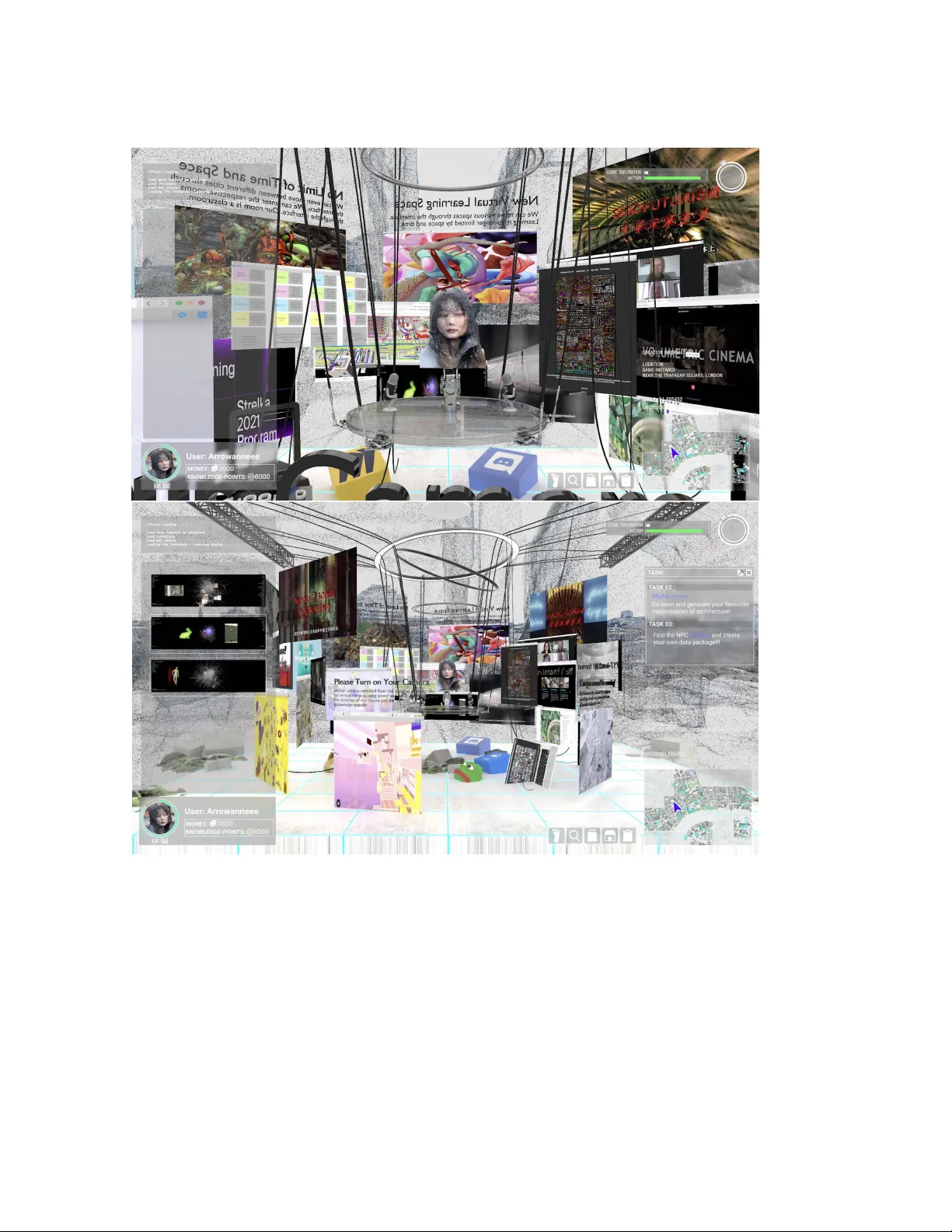
Hyper–learning and Unlearning: A Narrative Speculation on Urbanism in Media Ecologies ANQI W ANG, HKUST, Hong Kong SAR and University College London, UK Y UE H U A, Shanghai Jiaotong University, China and University College London, UK XIN Y UE ZHANG, University College London, UK JINDI JIA, University College London, UK CORNEEL CANNAERTS, KU Leuven, Belgium and University College London, UK MICHIEL HELBIG, KU Leuven, Belgium and University College London, UK P AN H UI, HKUST (Guangzhou), China and HK UST, Hong Kong SAR Fig. 1. A speculative XR learning environment in which urban ruins, photogrammetric city fragments, and platform interfaces collapse into a single compressed spatial field. Floating screens, point clouds, and archival media assemble into an unstable “urban learning space, ” visualizing hyper-learning and unlearning as distribute d, algorithmically mediate d processes embe dded within the city’s media ecology . Authors’ Contact Information: Anqi W ang, awangan@connect.ust.hk, HKUST, Hong K ong SAR and University College London, London, UK; Y ue Hua, Shanghai Jiaotong University, Shanghai, China and University College London, London, UK, yue.hua.20@alumni.ucl.ac.uk; Xinyue Zhang, Univ ersity College London, London, UK, xinyue_zhang.20@alumni.ucl.ac.uk; Jindi Jia, Univ ersity College London, London, UK, jindijia97@gmail.com; Corneel Cannaerts, KU Leuven, Brussels, Belgium and University College London, London, UK, corneel.cannaerts@kuleuven.be; Michiel Helbig, KU Leuven, Brussels, Belgium and University College London, London, UK, michiel.helbig@kuleuven.be; Pan Hui, HKUST (Guangzhou), Guangzhou, China and HKUST, Hong Kong SAR, panhui@ust.hk. Permission to make digital or hard copies of all or part of this w ork for personal or classroom use is granted without fee provided that copies are not made or distributed for prot or commercial advantage and that copies bear this notice and the full citation on the rst page. Copyrights for components Manuscript submitted to ACM 1 2 Anqi W ang et al. Hyper–Learning and Unlearning is a sp eculative animation that reect how learning is recongured within digital media ecologies. Using architectural education as a microcosm, the work r eframes the city as a hyper-learning apparatus wher e urban space, algorithmic systems, and platform infrastructures condition cognition and agency . By staging both hyper-learning and the unlearning induced by machine-supp orted cognition, the work critiques institutional gatekeeping while revealing how platforms reshape expertise, memory , and spatial experience. This project invites viewers to reconsider how urban space becomes pedagogical infrastructure in a posthumanism era. CCS Concepts: • Applied computing → Media arts ; Architecture (buildings) . Additional K ey W ords and Phrases: Speculation, Agency , Posthumanism, Media Ecology , Extende d Reality , Urbanism, Narrative A CM Reference Format: Anqi W ang, Yue Hua, Xinyue Zhang, Jindi Jia, Corneel Cannaerts, Michiel Helbig, and Pan Hui. 2018. Hyper–learning and Unlearning: A Narrative Speculation on Urbanism in Media Ecologies. In Pr oceedings of Make sure to enter the correct conference title from your rights conrmation email (Conference acronym ’XX). A CM, New Y ork, N Y , USA, 16 pages. https://doi.org/XXXXXXX.XXXXXXX 1 Introduction Hyper-Learning & Unlearning (Figure 1 ) is a speculative extended-reality (XR) art project that interrogates how digital media ecologies [ Cinque , 2024 , Fuller , 2005 , T ael , 2019 ] are reshaping the conditions under which knowledge is produced, transmitted, and embodied [ Braidotti , 2013 , 2016 , McLuhan , 1964 ]. As digital platforms increasingly permeate urban and educational life, the project interrogates how learning is transformed when information be comes ubiquitous, attention is fragmented across layered infrastructures, and the city itself operates as a condense d interface of physical, virtual, and algorithmic forces [ Bratton , 2015 , Kitchin , 2014 ]. Positioning architecture as a posthuman learning infras- tructure emerging after the Digital Second Turn [ Carpo , 2017 ], Hyper-Learning & Unlearning reconceptualizes space not as a passive container of education but as an active system that algorithmically pr oduces subjectivity through media saturation, platform logics, and infrastructural compression [ Foucault , 1984 ]. The city is thus treated as a distributed interface—one that continuously learns, forgets, and recomposes subjects through spatialized computation [ Latour , 2005 , Suchman , 2007 ]. Building on Marshall McLuhan’s proposition that me dia extend and recongure human capacities [ McLuhan , 1964 ], digital media ecologies have evolved into dense assemblages of platforms, sensors, databases, and machine-learning systems that increasingly learn about subjects as much as subjects learn through them. As media ecology undergoes a posthumanist turn, it not only reveals how technological environments shape perception but also raises a critical question: whether the notion of the “subject” itself is an eect of these systems [ Bratton , 2015 , Hayles , 1999 ]. Drawing on posthumanist frameworks [ Braidotti , 2013 , Forlano , 2017 ], this project reconceptualizes subjectivity not as a pre-given condition but as one constituted through educational and technological infrastructures. By embedding learning within a network of hybrid spaces—physical streets, virtual classrooms, and machine-curated archives—the project renders visible the compression of educational environments into algorithmically modulated ows of images, tasks, and behaviors. It foregr ounds a future in which pedagogical authority is redistributed among humans, machines, and urban infrastructures, raising critical questions about which forms of knowledge must be of this work owned by others than the author(s) must be honored. Abstracting with credit is permitte d. T o copy other wise, or republish, to post on servers or to redistribute to lists, requires prior specic permission and /or a fee. Request permissions from permissions@acm.org. © 2018 Copyright held by the owner/author(s). Publication rights licensed to ACM. Manuscript submitted to ACM Manuscript submitted to ACM Hyper–learning and Unlearning: A Narrative Speculation on Urbanism in Media Ecologies 3 learned, unlearned, or delegated [ Forlano , 2017 , Latour , 2005 ]. Through this immersive and sp eculative reconguration of architectural education, the project invites viewers to reconsider the r ole of media technologies in shaping knowledge production, agency , and participation within increasingly compressed urban and cognitive landscapes. This study translates theoretical debates spanning media ecology and posthumanism into artistic practice through material and computational engagement. Contributing to computational art and spe culative design, it demonstrates how point cloud rendering [ Ivsic et al . , 2022 ], photogrammetric scraping [ Sholarin and A wange , 2015 ], and XR game environments operate as forms of media-archaeological methodology [ Huhtamo and Parikka , 2011 , Parikka , 2012 ]. By framing learning systems as spatially distributed and algorithmically generative elds of posthuman subjectivity , the project advances an aesthetic and critical lens for understanding the compression dynamics of networked society . 2 Related W ork 2.1 Transformativ e City in Media Ecology Media ecologies force to reorganize perception, cognition, and social relations of city [ Cinque , 2024 , Fuller , 2005 , McLuhan , 1964 , Postman , 1970 , T ael , 2019 ]. Urban space thus features a mediated milieu in which learning, authority , and knowledge circulation are continuously restructured [ Meyrowitz , 1985 ]. With the rise of digital networks, scholars argue that cities undergo a simultaneous collapse of distance and intensication of place, producing hybrid spatialities governed by informational ows rather than xed geographies [ Castells , 1996 , Graham , 1998 ]. Media archaeology deepens this account by tracing how historical urban and educational media persist as recom- pressed residues within contemporar y technical systems [ Huhtamo and Parikka , 2011 , Parikka , 2012 ]. Rather than disappearing, architectural pedagogies, diagrams, and institutional spaces are decomposed and reassembled as databases, interfaces, and computational images [ Manovich , 2002 , 2013 ]. This recompression aligns with broader theories of time– space condensation, where acceleration and abstraction destabilize embodied learning and spatial memor y [ Harvey , 1989 ]. 2.2 Speculation as a Narrative Urbanism Speculative imagination frames future-making as a narrative and critical practice rather than a predictive exer- cise [ Slaughter , 1998 ]. Within design research, speculative design has developed as a means of interrogating dominant technological agendas by foregrounding what remains absent, marginalized, or unarticulated [ Bratteteig et al . , 2012 , Lindley and Coulton , 2015 ]. Such futuring practices operate as critical interventions that can recongure existing social orders through narrative displacement and imaginativ e reconstruction [ Sönmez , 2023 ]. In urban discourse, speculation functions as narrativ e urbanism, where storytelling and computational mediation become spatial practices [ Cannaerts and Michiel , 2025 ]. For example, narrative that is fragmented and staged to surface latent political and infrastructural assumptions [ Banham , 1960 , Cannaerts and Michiel , 2025 ]. Liam Y oung employ cinematic storytelling and ctional urban worlds as critical instruments for interrogating planetar y-scale urbaniza- tion [ Y oung , 2021 ]. Recent Siggraph art practices extend this lineage by operationalizing speculative narratives through computational media, immersive environments, and performative systems. W orks such as Drift of the Uncharte d [ Huang et al . , 2025 ], W ater City [ Y oshida and W akita , 2024 ], Abutting T okyo [ Zhong et al . , 2024 ], and Algorithmic Miner [ Sun et al . , 2025 ] employ r obotics, generative imagery , and virtual reality to render climate change, data bias, and hidden labor as experiential urban narratives. Manuscript submitted to ACM 4 Anqi W ang et al. 3 Conceptual Framework: A Speculative Narrative Building on these reection on theories and social phenomenons, we explore the concept framework of Hyper-learning and Unlearning in positioning (Section 3.1 ) and narrative (Section 3.2 ) aspe cts. Fig. 2. The central avatar operates as a distribute d interface, mediating and connecting multiple urban environments. 3.1 Positioning This approach builds on recent intersections of digital media and design research: STS and P latform Studies : Bogost and Montfort’s “platform studies” [ Montfort and Bogost , 2009 ] demonstrate how technical constraints shape expressive possibilities; we extend this to pedagogical platforms, treating gamication and XR as historically contingent rather than inevitable infrastructures. Computational Aesthetics : Manovich’s analysis of “software takes command” [ Manovich , 2013 ] provides a frame work for understanding how algorithmic operations become aesthetic conventions; our point- cloud rendering makes these operations visible as media-archaeological evidence. Critical Making : Ratto’s “ critical making” [ Ratto , 2011 ] and Sayers’ work on “prototyping the past” [ Sayers , 2015 ] inform our use of 3D scanning and photogrammetry [ Sholarin and A wange , 2015 ] not as neutral documentation tools but as ar chaeologically inected making practices that generate critical insight through technical manipulation. 3.2 Speculative Narrative Apparatus Grounding on the positioning, we crafted the core experimental narrative of this project (Figure 2 ). The narrative structure comprise of two parts, as shown in Figur e 3 and Figure 4 . 3.2.1 Metaphor: Pedagogical Ruins–Me dia A rchaeology in Point Clouds. Canonical pe dagogical schema has not vanished, but persists in the form of ruins—constantly dismantled, compressed, and reassembled by technology . As Figure 3 , the animation’s successive dissolving layers of 3D point cloud suggest this transformation: the School of Athens [ Raphael , 1511 ] staged knowledge as embodie d dialogue within a shared architectural frame. Ledoux’s Manuscript submitted to ACM Hyper–learning and Unlearning: A Narrative Speculation on Urbanism in Media Ecologies 5 Fig. 3. Conceptual framework illustrating the Metaphor part of the animation structure, in which learning milestones are translated into point-cloud representations through a media-archaeological lens. theater [ Ledoux , 1784 ] formalized pedagogy as collective attention discipline d by spatial design. Lissitzky’s self- portrait [ Lissitzky , 1924 ] recongured vision itself as an epistemic instrument, anticipating modernist b eliefs in human–machine alignment. Sketchpad 1 [ BiM+ , 2020 , Sutherland , 1963 , 1998 ] marke d a de cisive shift to ward interactiv e computation, where drawing and reasoning converged through direct manipulation [ Myers , 1998 ]. Amidst these overlapping screenage, these forms are rendered unstable , their didactic logics reduced to data points that no longer sustain institutional authority . The subsequent emergence of networked and platform-base d systems—the W orld Wide W eb as hypertextual in- frastructure [ Berners-Lee , 1989 ], algorithmic search as epistemic interface [ Brin and Page , 1998 ], multi-touch mobile devices [ Han , 2005 ], and online learning environments that exceed the classroom [ et al. , 2017 , Moore , 2011 ]–is not framed as technological advancement, but as a process of p edagogical compression. These systems accelerate access to 1 It pioneered human–computer interaction (HCI), and is considered the ancestor of modern computer-aided design (CAD) programs and as a major breakthrough in the development of computer graphics in general. Sour ce: https://en.wikipedia.org/wiki/Sketchpad Manuscript submitted to ACM 6 Anqi W ang et al. knowledge while simultaneously dissolving the spatial, temporal, and institutional frames that once stabilized learning practices. The point-cloud aesthetic operates as a form of media-ecological archaeology [ Parikka , 2012 ]. By leveraging the discreteness and transience of point-based representation, the work extracts pedagogical me dia from their historically continuous and stable material substrates, reconstructing a cognitiv e trajectory that extends from Renaissance idealized spaces to contemporar y XR interfaces [ Manovich , 2002 ]. What is rendered is not a seamless visual object, but a eld of computational fragments. This mode of representation aligns with what Grosoli terms “non-gestalt rendering, ” [] in which images refuse immediate perceptual closure and instead remain partially unresolv ed, contingent, and computationally legible. Such refusal interrupts the image’s function as a terminal site of meaning and repositions it as an operable artifact [ Manovich , 2013 ]—one that can be decomposed, recompute d, and reorganized within technical systems. This disassembly of pedagogical form resonates with Vilém Flusser’s account of the recursive natur e of technical images, whereby new media emerge through the ingestion and reprogramming of prior representational regimes [ Flusser , 2011 ]. When the architectural arcades of The School of Athens collapse into algorithmically generated p oint clouds, the work exposes a critical metaphorical shift: e ducational ideals grounded in emb odied co-presence and spatial continuity are recongured as distributed, transmissible data ows within netw orked interfaces. This transformation signals a broader media-historical migration of cultural memory—from continuous narratives to discr ete, modular structures [ Flusser , 2011 , Hayles , 2005 , Manovich , 2010 ]. In this sense , the point cloud functions simultaneously as a technical apparatus and a critical metaphor: it endows classical pe dagogical images with a digital bo dy while revealing how any pedagogical framework, under conditions of technological iteration, persists only as a provisional and contingent media construct [ Kittler , 1999 , Stiegler , 1998 ]. 3.2.2 Prologue: Entering an Gamified XR W orld. The fragility revealed through the visual motif of “pedagogical ruins” (Section 3.2.1 ) functions as a ritualized threshold into a gamied mixed-reality city . A gradually unfolding XR system interface signals the reconguration of cognitive frameworks within a blurred physical–virtual continuum (Figure 4 ). Within this emergent gamied environment, a player avatar named Arr owanneee appears, establishing the experiential lens through which the city is navigated. The ensuing urban traversal unfolds fr om this perspective, positioning gameplay as both a perceptual interface and an epistemic mediator . This animated sequence signals the entry into a world in which educational forms and te chnological interfaces can b e systematically traced, de constructed, and recongured. Here, the “ruins” of historical pedagogy are reframed as productive r esources for future creation. In this context, the project advances a foundational ontological claim: every p edagogical landscape is constituted by specic technological preconditions [ Kittler , 1999 ]. These preconditions inevitably surface through media-archaeological processes, exposing the historical and material substrates that structure contemporary knowledge systems [ Benjamin , 1999 , Chun , 2011 , Huhtamo and Parikka , 2011 , Parikka , 2012 ]. This rev elation further engages with ontological inquir y by addressing how the XR game world is constructed and go verned by its underlying rules, thereby r esonating with established perspectives in game ontology . It establishes the philosophical and narrative foundation for subsequent gameplay experiences, in which players actively assemble new learning scenarios fr om fragments of historical media. 3.2.3 Mediatization Square: Learning as Infrastructure in the A rchive–Urbanism. The player transition from photogram- metrically rendered street scenes into a city that progressively dissolves into grids and point clouds (Figure 4 ). As architectural facades are algorithmically stripped away , urban space is no longer perceived as a stable environment but exposed as “computable residue” —a substrate shaped by data op erations rather than human-scale materiality (Figure 5 ). Simultaneously , heads-up display (HUD) elements—task bars, energy meters, and mini-maps—overlay the city , recoding Manuscript submitted to ACM Hyper–learning and Unlearning: A Narrative Speculation on Urbanism in Media Ecologies 7 Fig. 4. Narrative structure of the spe culative XR world experience, outlining the progression of speculative scenarios and conceptual lenses. Manuscript submitted to ACM 8 Anqi W ang et al. Fig. 5. Dissolved city streets rendered as fragmented and reconfigured urban infrastructures. it as an operable interface. Within this mediated regime , learning is recongured as a sequence of calculable actions: exploration is reduced to task completion, understanding is displaced by mechanisms of collection and unlocking, and knowledge is quantied as p oints, scores, and re wards. Rather than residing within the learner , educational processes are externalized and governed through interface logic and system feedback. As the avatar roams, a media archival cluster situated at Trafalgar Squar e– “Mediatization Square” came into view (Figure 4 1). Composed of image assemblages, radiating key words, and density-based relational links, the cluster forms a “relational knowledge topography” that renders distribute d, networked media traces spatially legible. Although the underlying data originates from decentralized and heterogeneous sources, its concentration within a historically centralized urban site foregrounds the infrastructural me chanisms through which media e cologies momentarily re-center dispersed information in order to be perceived, navigated, and acte d upon. In this sense, Mediatization Square does not function as a locus of authority , but as an apparatus of appearance that exposes how learning, under posthuman conditions, is increasingly produced by archival systems, algorithmic associations, and interface-driven me diation rather than by individual cognition alone [ Chun , 2011 , Kittler , 1999 , Parikka , 2012 ]. 3.2.4 A vatar as A pparatus: Scanned Bodies in Posthuman Learning Systems. The scene contracts from the urban and archival scale to a singular , centralized gure: a three-dimensionally scanned avatar positioned at the visual cor e of the system (Figure 4 2; detail in Figur e 6 ). Rendered with reective surfaces, fragmented low-resolution te xtures, and visible computational noise, the avatar evokes the cold, machinic aesthetics characteristic of contemporar y post-digital portraiture. Surrounding the gure, innumerable screens and interfaces proliferate, enclosing the avatar within a dense eld of operational mediation. Manuscript submitted to ACM Hyper–learning and Unlearning: A Narrative Speculation on Urbanism in Media Ecologies 9 Fig. 6. An avatar as a posthuman learning agent situated between embodie d perception, platform mediation, and urban infrastructur e. Within this conguration, the avatar functions not as a character or representational proxy , but as an infrastructural interface through which learning processes are enacted. The subje ct is no longer the origin or agent of knowledge acquisition; instead, it is reconstructed as a data object—scanned, modeled, and continuously processed by the learning system. Educational activity unfolds around and through this digitized body , positioning it as a node within a broader Manuscript submitted to ACM 10 Anqi W ang et al. assemblage of data ows, interfaces, and algorithmic operations. Crucially , the scanned avatar stages a delib erate dislocation of subjectivity . Although it preserves the volumetric presence and surface details of a human portrait, it simultaneously exposes its technical condition through mesh fractures, uneven r esolution, and residual scan artifacts. What confronts the viewer is not a reection of the self, but an operationalized image—a body rendered legible to the system rather than expressive of interiority . In this sense , the centralized avatar mirrors the logic of Mediatization Squar e: it does not r eassert human subjectivity , but renders visible the mechanisms through which p osthuman learning systems re-center cognition, identity , and agency as computable, inspectable, and infrastructural processes. 3.2.5 The Dissipation of Institutional Space and Algorithmic Remnants. Educational institutions are no longer regarded as vessels for knowledge, but re vealed as technical constructs that can be instantly invoked and revoked. Universities, museums and classical architecture appear as photogrammetric models, then dissolve into data, fragments, and other residual forms (Figure 4 3). This concept comprises three visual narratives: (1) Online virtual avatars congregating within a campus; (2) Fragmente d and dissipated the traditional institutional mo dels; (3) Classical column orders showcase iconic architectural models in the digital age. Their photogrammetric models derive from image scraping of specic landmarks on so cial media platforms, resulting in highly uneven resolution across the same object: frequently photographed perspe ctives appear exceptionally sharp, while under-cover ed facets degrade into noise and gaps. This incompleteness re veals an algorithmic sacredness—classical forms no longer sustained by history , proportion, or symbolic systems, but shaped by platform attention, viewing fr equency , and data density . Here, the sacred is recoded as the “probability of being seen” . By harnessing the digital technology of 3D mo deling, the work embeds learning activities within a fracturable, dissipating geometric structure. It rejects the notion of p osthuman learning as a “decentralized state of fr eedom”, instead exposing it as a conditional reality shaped by computability , visibility , and the logic of interfaces. 3.2.6 The Compressed City as Hyper-Learning Engine. As learning detaches from institutional walls, the city itself becomes a memory palace—an expanded cognitive architecture wher e photogrammetric fragments, user-generated traces, and algorithmic overlays assemble into a distributed archive (Figure 4 F; details in Figure 7 ). Moving through London becomes a form of hyper-reading; each street corner is a kno wledge node, each NPC a mediator of machine- curated wisdom, and each AR task a gesture of inscription into the collective memory of the compressed city . 4 Content Generation Pipeline Based on this conceptual grounding, we produce this mock-up XR prototype using integrating multiple workows to procedural animation, 3D modeling, materializing and rendering, and post-production eect. Narrative and Scenarios. At the early stage of scenario production, w e created storyboards to reect the narrative structure. Through iterative discussions, we articulated core concept and elements (as Figure 8 ), metaphors, and philosophical reections associated with each lens. In parallel, we collected and developed visual aesthetic boards to guide the overall visual language and atmosphere of the mock-up XR experience. Media Collection and Scrapism. Social media images were incorporated as a primar y data source reecting the platform-mediated infrastructure of urban learning. Publicly available Instagram photographs were collected using scenario-driven keywords and expanded through a snowball sampling strategy [ Biernacki and W aldorf , 1981 ]. First, images were processed through creative coding workows in Processing, where they were transformed into 3D semantic Manuscript submitted to ACM Hyper–learning and Unlearning: A Narrative Speculation on Urbanism in Media Ecologies 11 Fig. 7. City street scenarios within the XR environment, depicting situated encounters across layered media ecologies. cloud structures. Second, a subset of images was employed as input for the further photogrammetric reconstruction, as described below . Spatial Reconstruction: Environment as A rchive. W e constructed urban spaces, architectural elements, and situated objects that supp ort narrativ e concepts and scenarios. Multiple acquisition strategies were combined to capture dierent Manuscript submitted to ACM 12 Anqi W ang et al. Fig. 8. One part of our narrative concept: Learning typology diagram juxtaposing distinct learning modalities in architectural education, reframed through a posthumanist perspective and curated as narrative components of the project. spatial scales and levels of delity . (1) Large-scale urban contexts were reconstructed through 3D city data extracted Manuscript submitted to ACM Hyper–learning and Unlearning: A Narrative Speculation on Urbanism in Media Ecologies 13 from Google Maps using RenderDoc 1.9, (2) lo calized architectural and object-level details were generated through 3D scanning and photogrammetry . Mesh renement, retopology , and material calibration were conducted in Blender , enabling photogrammetric models to be seamlessly integrated into the reconstructed environment. Camera placement and spatial framing were iteratively adjusted to align reconstructed environments with narrative viewpoints and intended user trajectories. The nal environment assembly and spatial composition wer e completed using Blender , Houdini, and Rhino, enabling precise control over geometry , scale, and spatial relations across heterogeneous data sources. Media-driven Procedural Transformation. T o support diverse narrative requirements and speculative representations, we developed a set of procedure-driven animation workows that transform reconstructed models into dynamic visual artifacts. Using Pr ocessing and node-based visual programming in Houdini, w e implemented proce dural transformations including the conversion of 2D images into 3D point-cloud objects and the algorithmic manipulation of geometry and motion. By decoupling animation logic from manual keyframing, procedure-driven animation serves as a generativ e layer that mediates between captured reality and speculative narrative expression. 5 Discussion This discussion situates the artwork across media ecology , p osthuman theory , and planetary computation, examining how learning is recongured across institutional, technological, and planetary scales. 5.1 Ref lecting on Posthuman Agency and T echnological Conditioning This project examines posthuman agency in learning systems thought with a weak form of te chnological determinism. Learning is framed not as an intentional human act, but as a conditioned process emerging fr om interactions among humans, platforms, architectures, and algorithmic operations [ Winner , 1980 ]. Agency is therefore r edistributed across heterogeneous actors, operating through platform logics that structure attention, memory , and action without fully determining outcomes. Drawing on posthumanism’s critique of human exceptionalism, the work foregrounds agency as relational and situational rather than autonomous [ Braidotti , 2013 ]. Unlike accounts that celebrate seamless human–machine symbiosis, this project emphasizes moments of negotiation, opacity , and partial loss of control. Learning unfolds through frictions between human intentions and computational procedures, revealing how algorithmic systems both enable and constrain epistemic agency [ Manovich , 2013 ]. By visualizing br eakdowns, misalignments, and unresolved feedback loops, the project resists deterministic narratives in which technological systems appear as coherent or benevolent drivers of progress. Instead, technological conditioning is presented as uneven and contingent, producing shifting zones of dependence and uncertainty [ McLuhan , 1964 ]. Posthuman agency thus emerges not as empowerment alone, but as an ongoing negotiation within platform-governed learning environments, where cognition is continuously shaped, redirected, and destabilized by algorithmic mediation. 5.2 From Anthropocene to Planetary Epistemologies This work unveils that urban agency has already become planetar y , while humanity is b eing forced to unlearn how to understand the systems within which we exist. Hyper-learning belongs to cities, platforms, and models. Unlearning Manuscript submitted to ACM 14 Anqi W ang et al. indicates that human agency remains terrestrially emb odied, epistemically outsourced, and structurally late. The tension between the two is not a future speculation—it is the present condition of learning in the compressed city . By doing this, the project reframes the concept of learning as a planetary process that exceeds human-centered epistemologies [ Chakrabarty , 2009 ]. It rejects anthropocentric master y by situating cognition within planetary me dia ecologies [ Latour , 2017 ]. The artwork constructs a XR city as a planetar y learning interface. Urban datasets, algorithms, and architectural systems co-perform cognition across human and nonhuman agents [ Bratton , 2015 ]. Learning emerges as an eect of infrastructural, e cological, and computational entanglements. Human knowledge is rendered contingent within geophysical, technical, and temporal scales [ Crutzen , 2002 ]. Unlike Anthropocene narratives that emphasize human geological dominance, planetary thinking suspends human centrality [ Chakrabarty , 2021 ]. In contrast to Earth-system visualizations, this work stages lived epistemic disorientation within planetary computation. The project renders planetary abstraction experientially legible through architectural and media-based aesthetics. It shifts planetar y theory from representational frameworks towar d embodie d epistemic negotiation [ Latour , 2017 ]. For the Siggraph and broader art communities, the work expands computation beyond human-scale interaction. It positions planetary-scale media as a critical site for reimagining futur e learning imaginaries. 6 Conclusion Hyper-Learning & Unlearning reframes learning as a media-ecological condition shap ed by the entanglement of urban space, computational systems, and posthuman infrastructures. Through a spe culative XR city , the project exposes how learning is compressed across platforms, interfaces, and algorithmic processes that reorganize cognition, memor y , and agency . Rather than advancing pedagogical optimization, the work foregrounds learning as an infrastructural phenomenon embedded within software sovereignty . Educational institutions appear as recomposed residues—persisting through data circulation and computational visibility rather than institutional authority . In this context, Hyper-learning and Unlearning operate together: accelerated access to knowledge coincides with the erosion of coherence and autonomy . By situating agency within stacked relations among human bodies, machine intelligence, and urban environments, the project positions the city as a hyp er-learning apparatus where action and understanding are conditioned by computational mediation. As an artistic intervention, Hyper-Learning & Unlearning oers an experiential critique of how learning and agency are recongured under planetary-scale computation. 7 Acknowledgment This project was developed as part of the graduation work for the UCL Bartlett B-Pro Urban Design Programme . The full project is available here . The authors w ould like to thank RC19 for their support throughout the project, and extend my sincere gratitude to the project tutors from Fieldstation Studio — Corneel Cannaerts and Michiel Helbig — for their guidance. Special thanks also to the tutor Joris Putteneers, the theory tutor Provides Ng, and the workshop tutors James Melsom and Sam Lavigne for their valuable support and insights. Additionally , the authors would like to acknowledge the use of the generative AI tool in this work. Spe cically , ChatGPT -5.2 by Op enAI was utilized to assist in language renement, including grammar and style corrections of existing manuscript text. All interpretations, conclusions, and nal content r emain the responsibility of the authors. References Reyner Banham. 1960. Mega-Structure. New Statesman (1960). Manuscript submitted to ACM Hyper–learning and Unlearning: A Narrative Speculation on Urbanism in Media Ecologies 15 W alter Benjamin. 1999. The A rcades Project . Harvard University Press, Cambridge, MA. Tim Berners-Lee. 1989. Information Management: A Proposal. In CERN . Patrick Biernacki and Dan W aldorf. 1981. Snowball Sampling—Problems and T e chniques of Chain Referral Sampling. Sociological Methods & Research 10, 2 (1981), 141–163. doi:10.1177/004912418101000205 BiM+. 2020. The V ery Beginning of the Digital Representation: Ivan Sutherland’s Sketchpad . https://bimaplus.org/news/the- very- beginning- of- the- digital- representation- ivan- sutherland- sketchpad/ Includes historical images of Sketchpad. Rosi Braidotti. 2013. The Posthuman . Polity Press, Cambridge. Rosi Braidotti. 2016. Posthuman Critical The ory . Springer India, New Delhi, 13–32. doi:10.1007/978- 81- 322- 3637- 5_2 T one Bratteteig, Keld Bødker , Y vonne Dittrich, Preben Holst Mogensen, and Jesper Simonsen. 2012. Metho ds: Organising principles and general guidelines for Participatory Design projects . Routledge, 117–144. Benjamin Bratton. 2015. The Stack: On Software and Sovereignty . MI T Press, Cambridge, MA. Sergey Brin and Lawrence Page. 1998. The Anatomy of a Large-Scale Hypertextual W eb Search Engine. In WW W . Corneel Cannaerts and Helbig Michiel. 2025. Mundos de diseño entrelazados: transformaciones en los medios arquitectónicos. Materia A rquitectura 28 (Sept. 2025), 106–121. doi:10.56255/ma.vi28.613 Mario Carpo. 2017. The Second Digital Turn: Design Beyond Intelligence . The MI T Press, Cambridge, MA. Manuel Castells. 1996. The Rise of the Network Society . The Information Age: Economy , Society and Culture, V ol. 1. Blackwell, Oxford. Dipesh Chakrabarty . 2009. The climate of history: Four theses. Critical Inquir y 35, 2 (2009), 197–222. Dipesh Chakrabarty . 2021. The Climate of History in a P lanetary Age . University of Chicago Press. W endy Hui K yong Chun. 2011. Programmed Visions: Software and Memory . MI T Press, Cambridge, MA. doi:10.7551/mitpress/9780262015424.001.0001 T oija Cinque. 2024. Emerging Digital Media Ecologies: The Concept of Medialogy (1st ed.). Routledge, London, UK. doi:10.4324/9781003178149 Paul J. Crutzen. 2002. Geology of mankind. Nature 415, 6867 (2002), 23. René Kizilcec et al. 2017. Closing global achievement gaps in MOOCs. Science (2017). Vilém Flusser . 2011. Into the Universe of T echnical Images . University of Minnesota Press, Minneapolis. Laura Forlano. 2017. Posthumanism and Design. She Ji 3, 1 (2017), 16–29. Michel Foucault. 1984. The Foucault Reader . Panthe on Books, New Y ork. Matthew Fuller . 2005. Media Ecologies: Materialist Energies in Art and T echnoculture . The MI T Press, Cambridge, MA, USA. Stephen Graham. 1998. The end of geography or the explosion of place? Conceptualizing space, place and information technology . Progress in Human Geography 22, 2 (1998), 165–185. arXiv: https://doi.org/10.1191/030913298671334137 doi:10.1191/030913298671334137 Je Han. 2005. Low-Cost Multi- Touch Sensing thr ough Frustrated T otal Internal Reection. In UIST . David Harvey . 1989. The Condition of Postmodernity . Blackwell, Oxford. N. Katherine Hayles. 1999. How W e Be came Posthuman . University of Chicago Press, Chicago. N. Katherine Hayles. 2005. My Mother W as a Computer: Digital Subjects and Literary T exts . University of Chicago Press, Chicago. Ary-Y ue Huang, Qing Qin, W enzong Ma, Bingyuan Wang, and Clea von Chamier- W aite. 2025. Drift of the Uncharted: A Spe culative Fiction Ab out Rising Sea-Level Landscapes through Robotic Performance. In Proceedings of the SIGGRAPH Asia 2025 Art Papers (SA A rt Pap ers ’25) . Association for Computing Machinery , New Y ork, N Y, USA, Article 7, 8 pages. doi:10.1145/3757369.3767598 Erkki Huhtamo and Jussi Parikka. 2011. Introduction: An Archaeology of Media Archaeology . In Media A rchaeology: A pproaches, Applications, and Implications , Erkki Huhtamo and Jussi Parikka (Eds.). University of California Press, Berkeley , 1–21. Lucija Ivsic, Nina Rajcic, Jon McCormack, and Vince Dziekan. 2022. The Art of Point Clouds: 3D LiDAR Scanning and Photogrammetr y in Science & Art. In Proceedings of the 10th International Conference on Digital and Interactive Arts (A veiro, Portugal, Portugal) (ARTECH ’21) . Association for Computing Machinery , New Y ork, N Y, USA, Article 55, 8 pages. doi:10.1145/3483529.3483702 Rob Kitchin. 2014. The Data Revolution: Big Data, Op en Data, Data Infrastructures and Their Consequences . SAGE. Friedrich A. Kittler . 1999. Gramophone, Film, Typewriter . Stanford University Press, Stanford. Bruno Latour . 2005. Reassembling the Social . Oxford University Press, Oxford. Bruno Latour . 2017. Facing Gaia: Eight Lectures on the New Climatic Regime . Polity Press. Claude Nicolas Ledoux. 1784. Théâtre de Besançon. [Architectural Drawing / Artwork]. https://passerelles.essentiels.bnf.fr/fr/image/94d4b26c- feb7- 449e- 9a- dd3007016a9d- theatre- besancon- par- claude- nicolas- ledoux Collection Passerelles, Bibliothèque nationale de France. Joseph Lindley and Paul Coulton. 2015. Back to the future: 10 years of design ction. In Proceedings of the 2015 British HCI conference . 210–211. El Lissitzky. 1924. The Constructor . Photomontage self-portrait. https://www.goldmarkart.com/pr oducts/photo- eye- el- lissitzky Reproduced via Goldmark Gallery . Lev Manovich. 2002. The Language of New Media . MI T Press, Cambridge, MA. Lev Manovich. 2010. Database as Symbolic Form. In Museums in a Digital Age (1 ed.), Ross Parry (Ed.). Routledge, London, 8–15. Lev Manovich. 2013. Software T akes Command . Bloomsbury Academic, New Y ork, N Y, USA. Marshall McLuhan. 1964. Understanding Media: The Extensions of Man . McGraw-Hill, New Y ork. Joshua Meyrowitz. 1985. No Sense of P lace: The Impact of Electronic Media on Social Behavior . O xford University Press, New Y ork. Nick Montfort and Ian Bogost. 2009. Racing the Beam: The Atari Video Computer System . The MIT Press, Cambridge, MA, USA. Michael G. Moore. 2011. Handb ook of Distance Education . Routledge. Manuscript submitted to ACM 16 Anqi W ang et al. Brad A. Myers. 1998. A brief histor y of human-computer interaction technology . Interactions 5, 2 (March 1998), 44–54. doi:10.1145/274430.274436 Jussi Parikka. 2012. What Is Me dia Archaeology? Polity Press, Cambridge. Neil Postman. 1970. The Reformed English Curriculum. High School Journal 54, 3 (1970), 89–96. Raphael. 1509–1511. The School of Athens. Fresco. Apostolic Palace, V atican City . Matt Ratto. 2011. Critical Making: Conceptual and Material Studies in Technology and Social Life. The Information Society 27, 4 (2011), 252–260. doi:10.1080/01972243.2011.583819 Jentery Sayers. 2015. Prototyping the Past: The Critical Making of History . University of Illinois Press, Urbana, IL, USA. Ebenezer A. Sholarin and Joseph L. A wange. 2015. Photogrammetr y . Springer International Publishing, Cham, 213–230. doi:10.1007/978- 3- 319- 27651- 9_10 Richard A Slaughter . 1998. Futures beyond dystopia. Futures 30, 10 (1998), 993–1002. doi:10.1016/S0016- 3287(98)00101- 3 Ozan Sönmez. 2023. Context Before Technology: The Possible Utopian/D ystopian Elements of the Metaverse with Examples from Great Literature . Springer Nature Singapore, Singapore, 297–316. doi:10.1007/978- 981- 99- 0252- 1_15 Bernard Stiegler . 1998. T echnics and Time, 1: The Fault of Epimetheus . Stanford University Press, Stanfor d, CA. Lucy Suchman. 2007. Human–Machine Recongurations . Cambridge University Press, Cambridge. Jia Sun, Zheng W ei, and Pan Hui. 2025. Algorithmic Miner: Humanity in Service - An AI-Driven VR Journey into Machine Logic. Proceedings of the ACM on Computer Graphics and Interactive T echniques 8, 3 (Aug. 2025), 1–11. doi:10.1145/3736784 Ivan E. Sutherland. 1963. Sketchpad: A Man-Machine Graphical Communication System . P h. D . Dissertation. Massachusetts Institute of Technology , Cambridge, MA. Ivan E. Sutherland. 1998. Sketchpad—a man-machine graphical communication system . Association for Computing Machinery, New Y ork, N Y, USA, 391–408. https://doi.org/10.1145/280811.281031 Sy Tael. 2019. Digital Media Ecologies: Entanglements of Content, Code and Hardware (1st ed.). Bloomsbury Academic, London, UK. doi:10.5040/ 9781501349270 Langdon Winner . 1980. Do Artifacts Have Politics? Daedalus 109, 1 (1980), 121–136. Y uki Y oshida and Akira Wakita. 2024. Speculative Future Imagined Through Satellite Imageries with Generative AI. In SIGGRAPH Asia 2024 Art Papers (SA ’24) . Association for Computing Machinery, New Y ork, N Y, USA, Article 6, 6 pages. doi:10.1145/3680530.3695454 Liam Y oung. 2021. Planet City. A rchitecture Image Studies 2, 1 (Dec. 2021), 30–43. https://journals.ap2.pt/index.php/ais/article/view/39 Xiaoyun Zhong, Xuanyang Huang, Rui Hu, and Shuang Wu. 2024. Abutting Toky o: AI-Driven Cognitive Distortion in VR Urban Visualization. In SIGGRAPH Asia 2024 A rt Pap ers (SA ’24) . Association for Computing Machiner y , New Y ork, N Y, USA, Article 4, 5 pages. doi:10.1145/3680530.3695437 Received 20 February 2007; revised 12 March 2009; accepted 5 June 2009 Manuscript submitted to ACM
Original Paper
Loading high-quality paper...
Comments & Academic Discussion
Loading comments...
Leave a Comment