Robust Building Damage Detection in Cross-Disaster Settings Using Domain Adaptation
Rapid structural damage assessment from remote sensing imagery is essential for timely disaster response. Within human-machine systems (HMS) for disaster management, automated damage detection provides decision-makers with actionable situational awar…
Authors: Asmae Mouradi, Shruti Kshirsagar
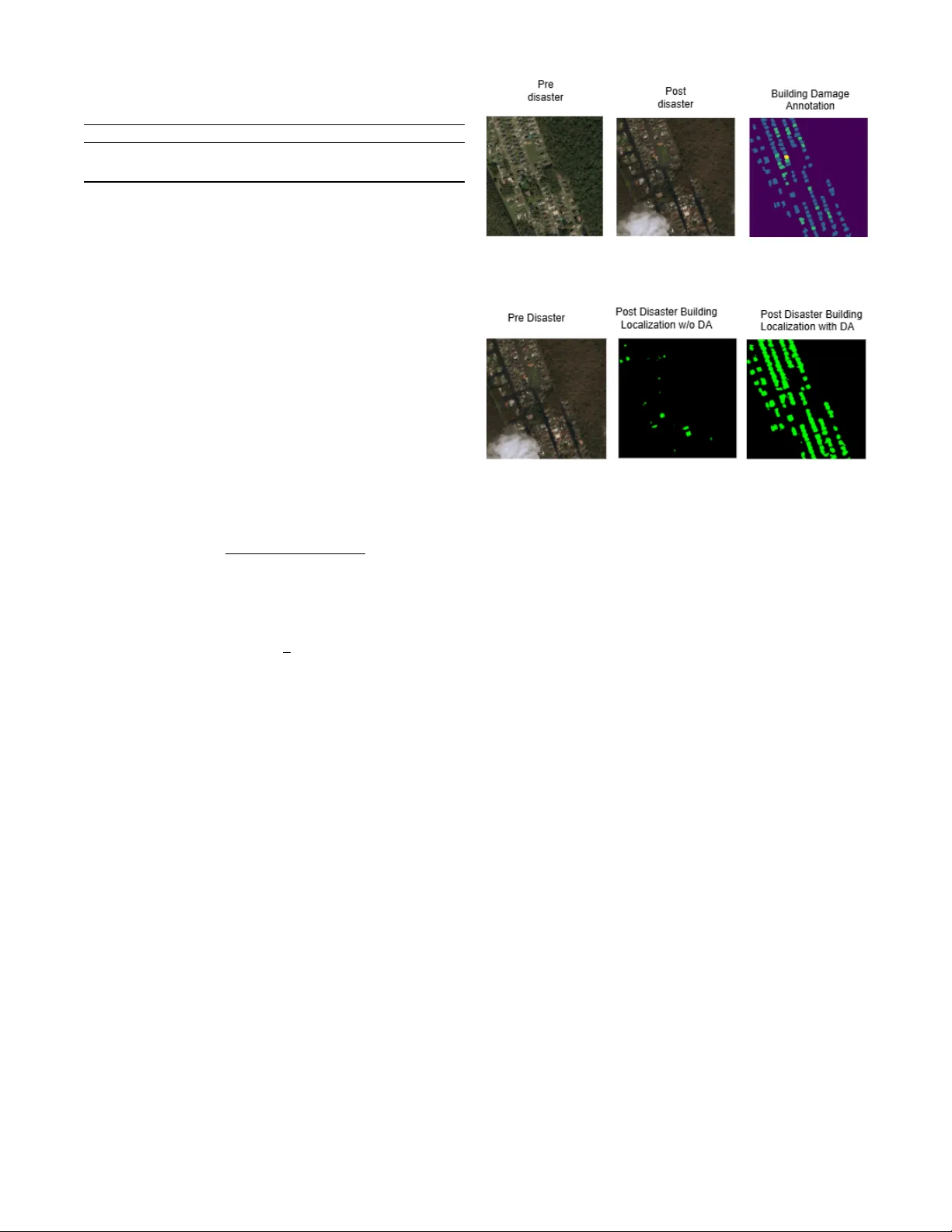
Rob ust Building Damage Detection in Cr oss-Disaster Settings Using Domain Adaptation Asmae Mouradi School of Computing W ichita State University W ichita, Kansas, USA axmouradi@shockers.wichita.edu Shruti Kshirsagar School of Computing W ichita State University W ichita, Kansas, USA shruti.kshirsagar@wichita.edu Abstract — Rapid structural damage assessment from r emote sensing imagery is essential for timely disaster response. Within human–machine systems (HMS) f or disaster management, auto- mated damage detection pro vides decision-makers with action- able situational awareness. Howev er , models trained on multi- disaster benchmarks often underperf orm in unseen geographic regions due to domain shift—a distributional mismatch between training and deployment data that undermines human trust in automated assessments. W e explor e a two-stage ensemble ap- proach using supervised domain adaptation (SD A) for building damage classification acr oss four severity classes. The pipeline adapts the xV iew2 first-place method to the Ida-BD dataset using SD A and systematically inv estigates the effect of indi- vidual augmentation components on classification performance. Comprehensi ve ablation experiments on the unseen Ida-BD test split demonstrate that SD A is indispensable: removing it causes damage detection to fail entirely . Our pipeline achieves the most rob ust performance using SDA with unsharp-enhanced RGB input, attaining a Macro-F1 of 0.5552. These results underscore the critical r ole of domain adaptation in building trustworthy automated damage assessment modules for HMS-integrated disaster response. Index T erms— Building damage detection, domain adapta- tion, human–machine systems, deep learning, remote sens- ing, satellite imagery , ensemble learning, disaster response. I . I N T R O D U C T I O N Human–machine systems (HMS) combine human decision-making with automated tools to aid disaster response and management. Climate change has increased disaster frequency and intensity , leading to increased demands on these systems [1]. HMS frame works assist emergenc y responders in assessing situations and manage resources during hurricanes, earthquakes, and floods. In the past, satellite-based building damage assessment relied on manual comparison of pre- and post-disaster imagery , leading to a significant response time bottleneck [2]. Automation is needed to inspect large re gions with numerous damage lev els, which takes time. Although remote sensing imagery is commonly utilized for wildfire detection [3], land-use analysis [4], and disaster management [5], the human role in analyzing this data has not altered significantly . Automating structural damage detection speeds up and scales disaster response, allowing human operators to focus on higher-le v el decision-making and supervision activities in HMS processes. Deep learning has streamlined the building damage detec- tion task and generated standardized damage mapping solu- tions for human decision-makers quickly . Encoder-decoder architectures such as U-Net [6] hav e been widely adopted for pixel-wise semantic labeling of b uilding footprints and damaged regions. Prior work has explored both post-disaster - only approaches such as support vector machine-based meth- ods applied to high-resolution QuickBird imagery [7]— and combined pre- and post-disaster strategies that lev erage texture-based and shape-based features to improv e assess- ment accuracy [8]. More recent adv ances include atten- tion mechanisms for capturing long-range spatial dependen- cies [9], cross-directional feature fusion networks [10], and Siamese architectures for change detection [11]. Howe v er , a fundamental challenge arises when these models trained on multi-disaster benchmark datasets are deployed in unseen geographic regions or disaster scenarios not represented in the training distribution. This phenomenon is kno wn as domain shift [12]. Domain shift causes significant degrada- tion in classification accuracy and consistency . V ariations in imaging sensors, geographic en vironments, atmospheric con- ditions, and catastrophic ev ent types create a distributional misalignment between training and inference data. Using domain adaptation (D A) approaches, models can transfer learned information across div erse data distrib utions [13]. D A techniques can be supervised (annotations in both source and target domains), unsupervised (labels exclusiv ely in source domain), or semi-supervised (limited tar get labels and unlabeled data) based on label av ailability [14]. Selecting unlabeled source domains for remote sensing adaptation has been studied [15]. In building damage assessment, Parupati et al. [16] found that supervised fine-tuning on target-domain data enhances generalization compared to pretrained-only and unsupervised D A baselines. Robust domain adaptation ensures that automated damage assessment models remain reliable in pre viously unseen disaster events, maintaining the integrity of machine perception and human decision-making in human-machine disaster management systems. T o promote research in automated post-event damage ev aluation, the xV iew2 Challenge [17] created a competitive benchmark on the xBD dataset [18]. The top-ranked solutions [19]–[21] in the challenge represent the current state-of-the-art methods. Augmentation methods along with domain adaptation have been widely utilized to improve model generalizability [16], [22]–[24]. Howe ver , the robustness of these algorithms and the effect of different augmentation components on overall performance remain largely unexplored. In this work, we proposed to use a two-stage ensemble supervised domain adaptation strategy using transfer learning from the xBD source dataset [18] to the Ida-BD target dataset [25]. In summary , our contributions are as follows: • W e e xplore a two-stage ensemble pipeline combining building segmentation (Stage 1) and damage classifi- cation (Stage 2) with fusion augmentation techniques, achieving state-of-the-art performance across multiple damage severity classes on Ida-BD, surpassing the re- sults reported in [16]. • W e perform ablation experiments with domain adapta- tion and fusion augmentation methods. These insights provide actionable guidance for designing reliable au- tomated damage assessment modules within broader human-machine disaster management systems. The remainder of this paper is organized as follo ws. Section II details the proposed two-stage method. Section III presents the experimental setup. Section IV discusses the results and ablation analysis. Finally , Section V concludes the paper . I I . P R O P O S E D M E T H O D The proposed method is based on a two-stage end-to- end pipeline from pre-event and post-e vent satellite imagery . Here, we explore the benefits of implementing a two-stage pipeline with and without data augmentation approaches in a cross-data setting to improve the generalization capacity of human-machine interfaces. In this section, we start by de- scribing the steps followed to obtain the tw o-stage pipeline, then describe the data augmentation approach. W e test the approach on an unseen dataset. A. T wo-stage classification appr oac h The two-stage classification approach has been described in detail in Figure 1 This figure shows the framew ork’ s two-stage training pipeline. The pipeline uses pre-disaster satellite imagery in Stage 1 (Binary Building Localization) to increase training variations. The 12 localization encoder models, pretrained on the xBD dataset using the xV iew2 first- place solution, are fine-tuned using the augmented images. The supervised domain adaptation stage of fine-tuning aligns models to the Ida-BD target domain. Stage 1 generates a binary localization mask that distinguishes images as building or background. The connecting arrow sho ws that this mask feeds into Stage 2 (Damage Classification). Stage 2 generates the six-channel input representation from pre- and post-disaster images. Fusion augmentation—edge detec- tion, contrast enhancement (CLAHE), and unsharp mask- ing—prepares these images for damage classification models, which are fine-tuned from xBD-pretrained weights onto Ida- BD. Particularly , Stage 1’ s binary localization mask gates Stage 2, assuring damage categorization only over b uilding pixels. A four-class damage prediction map is generated, labeling building images as No-Damage, Minor , Major , or Destroyed. This proposed two-stage ensemble approach shows how sequential gating decreases background f alse positives and improv es damage estimates for human operators. Transfer learning is used to initialize models with xBD-pretrained weights (source domain) and fine-tune them on annotated Ida-BD data (target domain). This technique immediately ov ercomes the sensor , geographic, and disaster-type domain gap between xBD and Ida-BD. W e compare this to a no- D A baseline where pretrained xBD checkpoints are applied straight to Ida-BD without fine-tuning to measure how domain adaptation affects generalization performance. This comparison directly analyzes ho w much adaptation is needed to provide outputs that human operators can trust for unique disaster scenarios from an HMS perspecti ve. B. Augmentation Methods Post-disaster satellite imagery can be highly variable due to atmospheric conditions, sensor angle variations, and debris-induced texture changes. W e study se veral types of image-lev el augmentation strategies, employed singly and in combination, which increase complementary visual cues essential to damage assessment to improve model rob ustness against these appearance differences. Based on the fusion augmentation strategy described in [26], these methods are explained below . 1) Edge Detection: Edge detection utilizes visualization gradients to emphasize satellite imagery’ s structural bound- aries. Edges indicate roof, wall, and debris field boundaries that may indicate structural damage. Injecting edge cues into the model input helps the network detect transitions between intact and damaged regions, especially partial roof collapse or w all fragmentation that has significant boundary discontinuities. An edge map E is a single-channel fea- ture map that emphasizes object boundaries obtained from grayscale conv ersion of the original picture using gradient- based operators (e.g., Sobel or Canny). 2) Contrast Enhancement (CLAHE): Contrast Limited Adaptiv e Histogram Equalization (CLAHE) increases lo- cal contrast and highlights subtle damage-related patterns. CLAHE is better for satellite imaging with variable lighting conditions than global histogram equalization because it limits contrast amplification on local image tiles to avoid noise enhancement. Contrast-enhanced image C shows low- contrast damage signatures, including discolored roofs, wet regions, and partially co vered debris that may be missed in raw RGB. This improvement helps distinguish No-Damage buildings from ones with minimal surface damage. 3) Unsharp Masking: Unsharp masking enhances high- frequency details by subtracting a Gaussian-blurred image and reinjecting the amplified residual back into the original: U = I + λ ( I − G σ ∗ I ) , (1) where G σ ∗ I denotes the Gaussian-blurred image with kernel width σ , and λ controls the sharpening strength. This Fig. 1: Overvie w of the proposed two-stage pipeline for damage classification. Both stages incorporate fusion augmentation and supervised domain adaptation operation accentuates fine-grained structural details including cracks, splintered roofing materials, scattered debris fields, and deformed structural elements that are characteristic of sev ere damage categories such as Major and Destroyed. Among the augmentation components inv estigated in this work, unsharp masking proves most effecti ve for recogniz- ing heavily damaged structures, as it amplifies the high- frequency textural disruptions that distinguish destroyed buildings from those with only minor damage. 4) Fusion Augmentation: The fusion augmentation strat- egy combines all three enhancement methods with the orig- inal image through a weighted linear combination: I fuse = α I + β E + γ C + δ U, (2) where the weights ( α, β , γ , δ ) control the relati ve contribu- tion of each component and typically satisfy α + β + γ + δ = 1 . The fusion output integrates boundary cues (edges), locally enhanced contrast (CLAHE), and sharpened fine details (un- sharp masking) into a single enriched representation. How- ev er , as our ablation experiments reveal in Section IV, com- bining all components simultaneously does not always yield the best performance; the interactions between enhancement methods can introduce conflicting cues that de grade the classification of minority damage classes. This moti vates our systematic e valuation of individual components and pairwise combinations alongside the full fusion method. Each configuration is ev aluated both with supervised domain adaptation to isolate the individual and combined effects of augmentation and SD A on damage classification performance. I I I . E X P E R I M E N TA L S E T U P In this section, we describe the datasets, benchmark sys- tem, and performance metric used in these experiments. A. Datasets 1) xBD Dataset (Source Domain): The xBD dataset [18] is a large-scale remote sensing imagery dataset for structural damage assessment resulting from various natural disas- ters, including hurricanes, tornadoes, wildfires, earthquak es, flooding e vents, and volcanic events. The dataset comprises very-high-resolution image pairs (organized as tiles of size 1024 × 1024 pixels) captured in pre-ev ent and post-ev ent conditions for 19 natural disaster , totaling 850,736 b uilding annotations recorded across se v eral geographic regions. The xBD dataset in volv es two analytical tasks: (1) building localization and (2) damage classification across four sev erity classes. The dataset is divided into four subsets: train, tier3, test, and holdout. The training, testing, and v alidation sets include data corresponding to identical disaster occurrences, while the tier3 set includes data related to supplementary disaster events not represented in the remaining subsets. In our frame work, we utilize xBD exclusiv ely as the source domain for initializing model weights. 2) Ida-BD Dataset (T ar get Domain): Ida-BD dataset [25] includes 87 pre- and post-disaster image pairs from the W orldV ie w-2 satellite, captured in Louisiana, USA, before and after Hurricane Ida in 2021. Unlike most xBD events, this dataset has a discrete geographic region, disaster kind, and imaging sensor , making it an ideal target domain for cross-disaster generalization. Our supervised adaptation technique addresses the domain change caused by sensor features, regional building types, ve getation patterns, and hurricane-specific damage signatures between xBD and Ida- BD. W e di vide the Ida-BD dataset into training (80%), validation (10%), and test (10%) splits for our studies. The training split fine-tunes, the v alidation split selects models and optimizes model parameters, and the held-out test split ev aluates the pipeline. Figure 2 illustrates a representative sample from the Ida-BD dataset [25], sho wing the pre- disaster image, the corresponding post-disaster image, and the ground-truth building damage annotation mask. The annotation mask color-codes each building according to its assigned damage se verity lev el, providing pixel-lev el super - vision for both localization and classification tasks. B. Benchmark System: xV iew2 Challenge The xV iew2 competition [17] is a competiti ve benchmark based on the xBD dataset designed to promote research in au- T ABLE I: F1 scores of the top-three xV ie w2 Challenge solutions e v aluated on the xBD test set. Method Loc. No-Dmg Minor Major Dest. 1st (ResNet34 + SE-ResNeXt50) [19] 0.862 0.915 0.639 0.782 0.854 2nd (DPN92 + DenseNet161) [20] 0.853 0.902 0.618 0.770 0.849 3rd (ResNet + DenseNet + EffNet) [21] 0.847 0.907 0.617 0.765 0.846 tomatic post-ev ent damage ev aluation using remote sensing imagery . The three winning solutions [19]–[21] as described in T able I represent the current state of the art in auto- mated b uilding damage assessment from satellite imagery . W e also used a benchmark from [16], where they utilized the same cross-data setting. T able I presents the F1 scores of the top three solutions on the official xBD test set. Our pipeline initializes from the first-place solution’ s pretrained weights, which employ an ensemble of four U-Net-based architectures, including DPN92, ResNet34, SE-ResNeXt50, and SENet154 backbones, each trained with three distinct random seeds, resulting in 12 models altogether . C. P erformance Measur es W e ev aluate the proposed framework using the F1 score, defined as the harmonic mean of precision and recall for each class c : F 1 c = 2 · Precision c · Recall c Precision c + Recall c . (3) Macro-F1 score: The macro-average across the four dam- age classes, computed as : Macro-F1 = 1 4 4 X c =1 F 1 c , (4) where c indexes the damage classes c ∈ { 1 , 2 , 3 , 4 } . The Macro-F1 provides a single summary metric for HMS- integrated disaster response that shows whether the auto- mated system makes balanced, trustworthy predictions across the damage spectrum. I V . R E S U L T S A N D D I S C U S S I O N In this section, we present the experimental results for building damage detection in a cross-data setting and discuss our findings. A. Effect of supervised domain adaptation In our first experiment, we in vestigate the effect of super- vised domain adaptation (SD A) in a cross-data setting. The model is fine-tuned using the two-stage ensemble approach on the xBD dataset before being trained on the Ida-BD dataset and reporting F1 scores on the unseen Ida-BD test split. W e examine the fusion augmentation approach with SD A, with results in T able II. Using fusion augmentation without supervised domain adaptation results in reasonable localization F1 (0.8661) but a significant drop in the other three classifications: Minor F1 drops to 0.0039, Major to 0.0480, and Destroyed to 0.0000, resulting in a damage Macro-F1 of only 0.1736. Differences in image sensors, geographic conte xts, building designs, Fig. 2: Example from the Ida-BD dataset: pre-disaster image, post-disaster image, and b uilding damage annotation mask. Fig. 3: Qualitative comparison of Stage-1 building localiza- tion: (a) pre-disaster image, (b) localization result without domain adaptation, and (c) localization result with supervised domain adaptation and hurricane-specific damage signatures make the domain gap between xBD and Ida-BD too significant for xV ie w2- pretrained models to overcome without target-domain fine- tuning. T o further illustrate the impact of SDA, Figure 3 exhibits a qualitativ e comparison of Stage-1 building local- ization on a post-disaster image. Without domain adaptation, the localization model makes inaccurate and noisy build- ing area projections. SD A enhances localization accuracy , creating cleaner , more comprehensiv e building masks that match real structures. The illustrated comparison confirms the quantitativ e findings in T able II, proving the need for domain adaptation for accurate building detection across disasters. This result is particularly important for HMS: models without domain adaptation fail to identify sev erely damaged b uildings and misclassify most minor and major damage, making them unreliable for human decision-making in unseen disaster scenarios. B. Ablation study: Effect of Individual Augmentation Com- ponents In this experiment, we aim to determine which element of fusion augmentation and SD A is more important for damage detection. T able III reports the performance of each augmentation component combined with SDA. T able III shows that unsharp masking + DA yields the highest Destroyed F1 ( 0 . 5156 ) and total damage Macro-F1 ( 0 . 5552 ), slightly beating the RGB-only baseline ( 0 . 5516 ). Sharpening highlights fine-grained structural characteristics, including cracks, debris edges, and roof fragmentation, that indicate serious damage. This configuration is best for HMS- T ABLE II: Ef fect of supervised domain adaptation (SD A) on building damage detection across the Ida-BD test set (F1 scores). Bold values indicate best performance per column. Methods Localization No-Damage Minor Major Destr oyed Macr o F1 T wo-Stage Ensemble + RGB only (baseline) + DA 0.8494 0.7108 0.4463 0.5420 0.5073 0.5516 T wo-Stage Ensemble + Fusion Aug. + D A 0.8493 0.7312 0.4508 0.5271 0.3877 0.5242 T wo-Stage Ensemble + w/o Fusion Aug. + DA 0.8493 0.7336 0.4671 0.5302 0.2321 0.4908 T wo-Stage Ensemble + Fusion Aug. + w/o DA 0.8661 0.6424 0.0039 0.0480 0.0000 0.1736 T ABLE III: Ablation study of individual and combined augmentation components with SDA on the Ida-BD test set (F1 scores). Bold values indicate best performance per column Methods Localization No-Damage Minor Major Destroyed Macr o F1 T wo-Stage Ensemble + RGB + Contrast + DA 0.8494 0.7334 0.4475 0.5374 0.0412 0.4399 T wo-Stage Ensemble + RGB + Unsharp + DA 0.8494 0.7182 0.4313 0.5558 0.5156 0.5552 T wo-Stage Ensemble + RGB + Edges + DA 0.8494 0.7225 0.4309 0.5541 0.4362 0.5359 T wo-Stage Ensemble + RGB + Contrast + Edges + D A 0.8877 0.7338 0.4236 0.5231 0.1957 0.4690 T wo-Stage Ensemble + RGB + Unsharp + Edges + D A 0.8789 0.7011 0.4261 0.5161 0.4652 0.5271 T wo-Stage Ensemble + RGB + Unsharp + Contrast + D A 0.8867 0.7304 0.4279 0.5602 0.3653 0.5210 T wo-Stage Ensemble + Fusion Aug. + D A 0.8493 0.7312 0.4508 0.5271 0.3877 0.5242 T wo-Stage Ensemble + RGB + Fusion Aug. + DA 0.8494 0.7160 0.4310 0.4875 0.0000 0.4086 T ABLE IV: Comparison with benchmark systems on the Ida- BD dataset in terms of F1 score. Method Loc. No-Dmg Minor Major Dest. Pretrained only [16] 0.806 0.667 0.211 0.154 0.041 + Augmentation [16] 0.815 0.663 0.235 0.173 0.052 + Supervised DA [16] 0.842 0.672 0.292 0.184 0.095 + Supervised DA + Aug. [16] 0.849 0.696 0.315 0.192 0.117 + Unsupervised DA-CORAL [16] 0.815 0.658 0.275 0.135 0.059 Ours (RGB + Unsharp + DA) 0.849 0.718 0.431 0.556 0.516 Ours (best per-class) 0.888 0.734 0.467 0.560 0.516 Fig. 4: Qualitativ e damage detection result using RGB + Unsharp + SD A: (a) pre-disaster image, (b) post-disaster image, and (c) predicted damage mask (green: no damage, yellow: minor , orange: major , red: destroyed). integrated deployment, where accurate sev erity lev el detec- tion is needed because of its balanced and robust perfor- mance across the damage spectrum. Figure 4 displays the qualitativ e result of our top-performing combination (RGB + Unsharp + D A). The predicted damage mask shows that the model distinguishes between the four se verity classes—no damage (green), minor (yello w), major (orange), and de- stroyed (red)—producing geographically consistent predic- tions that closely match the post-disaster damage distribution. This shows how unsharp masking and supervised domain adaptation allow the model to capture fine-grained struc- tural damage cues for reliable HMS-integrated ev aluation. Next, Contrast enhancement + DA improves No-Damage classification ( 0 . 7334 ) but considerably decreases Destroyed performance ( 0 . 0412 ). Strong contrast changes may enhance dominating class features while masking sev erely harmed structures’ tiny , scattered damage indications. In operational HMS settings, this class-dependent sensitivity could hav e life-safety consequences, as failing to detect severely dam- aged b uildings directly impacts rescue prioritization. Interest- ingly , Edge detection + D A achiev es moderate Destroyed F1 ( 0 . 4362 ) and competitive Macro-F1 ( 0 . 5359 ), demonstrating that boundary information helps damage assessment but cannot match unsharp masking for severe damage recog- nition. Furthermore, Contrast + Edges + DA results in the greatest localization F1 ( 0 . 8877 ) and No-Damage F1 ( 0 . 7338 ), but the damage Macro-F1 lowers to 0 . 4690 due to lacking Destroyed detection ( 0 . 1957 ) In light of their varied optimal feature requirements, building detection and damage recognition do not necessarily improv e each other . Similarly , Unsharp + Contrast + D A achiev es the highest Major-Damage F1 ( 0 . 5602 ) and strong localization 0 . 8867 , but Destroyed F1 decreases to 0 . 3653 , likely due to the contrast component counteracting the benefit of unsharp masking for sev ere damage. Finally , full fusion augmentation (all components) + D A shows that stacking all augmentation channels is ineffecti ve. The combination appears to introduce conflicting feature cues that confuse the classifier on minority classes, effecti v ely drowning out the damage-specific signals that indi vidual components successfully capture. C. Comparison with benchmark systems T able IV compares our results against benchmark systems described in [16] since identical pretrained models and fusion augmentation approaches were utilized on Ida-BD. Our two- stage ensemble pipeline with supervised D A improves F1 scores across all damage categories. The most significant gains are seen in Major-Damage from 0 . 192 to 0 . 556 , a 190% increase and Destroyed from 0 . 117 to 0 . 516 , a 341% increase. Our ensemble strategy (averaging 12 models), optimized probability thresholding, building-pixel-restricted loss, and destroyed-aware crop sampling improv e balance and reliability , especially for rare b ut operationally critical damage cate gories. V . C O N C L U S I O N In this study , we apply data augmentation and domain adaptation to building damage detection from satellite im- agery , focusing on cross-disaster generalization under do- main shift for the building damage detection task. Our experimental results sho w that domain adaptation is the most crucial factor in damage detection in a cross-data setting. Unsharp-enhanced RGB input with supervised D A performs best, with a Macro-F1 of 0.5552. These findings support domain-adaptiv e techniques for integrating automated dam- age assessment into practical disaster response processes, as accurate model outputs are necessary for human-machine teaming. Future research will explore semi-supervised and unsupervised domain adaptation strategies to reduce anno- tation requirements and ensure the dependability of HMS- integrated deployment outputs. The code to reproduce our experiments is publicly av ailable at ht tps :// gith ub. com /asm aemou/xview2 1st place solution. A C K N O W L E D G M E N T The authors ackno wledge funding support for this work from Kansas NSF EPSCoR First aw ard grant and the Re- search and Education Inno vation grant. R E F E R E N C E S [1] IPCC, Managing the Risks of Extreme Events and Disasters to Advance Climate Change Adaptation . Cambridge, UK and New Y ork, NY , USA: Cambridge Uni versity Press, 2012. [2] L. Dong and J. Shan, “ A comprehensive review of earthquake-induced building damage detection with remote sensing techniques, ” ISPRS Journal of Photogrammetry and Remote Sensing , vol. 84, pp. 85–99, 2013. [3] F . Filipponi, “Exploitation of Sentinel-2 time series to map burned areas at the national lev el: A case study on the 2017 Italy wildfires, ” Remote Sensing , vol. 11, no. 6, p. 622, 2019. [4] G. M. Foody , “Remote sensing of tropical forest en vironments: T owards the monitoring of en vironmental resources for sustainable dev elopment, ” International Journal of Remote Sensing , vol. 24, no. 20, pp. 4035–4046, 2003. [5] G. J. Schumann, G. R. Brakenridge, A. J. Kettner , R. Kashif, and E. Niebuhr , “ Assisting flood disaster response with earth observation data and products: A critical assessment, ” Remote Sensing , vol. 10, no. 8, p. 1230, 2018. [6] O. Ronneberger , P . Fischer, and T . Brox, “U-Net: Conv olutional networks for biomedical image segmentation, ” in Pr oc. Int. Conf. Med- ical Image Computing and Computer-Assisted Intervention (MICCAI) . Springer , 2015, pp. 234–241. [7] P . Li, H. Xu, S. Liu, and J. Guo, “Urban building damage detection from very high resolution imagery using one-class SVM and spatial relations, ” in Pr oc. IEEE Int. Geoscience and Remote Sensing Sym- posium (IGARSS) , vol. 5. IEEE, 2009, pp. V –112. [8] A. J. Cooner , Y . Shao, and J. B. Campbell, “Detection of urban damage using remote sensing and machine learning algorithms: Revisiting the 2010 Haiti earthquake, ” Remote Sensing , vol. 8, no. 10, p. 868, 2016. [9] H. Hao, S. Baireddy , E. R. Bartusiak, L. Konz, K. LaT ourette, M. Gribbons, M. Chan, E. J. Delp, and M. L. Comer, “ An attention- based system for damage assessment using satellite imagery , ” in Proc. IEEE Int. Geoscience and Remote Sensing Symposium (IGARSS) . IEEE, 2021, pp. 4396–4399. [10] Y . Shen, S. Zhu, T . Y ang, C. Chen, D. Pan, J. Chen, L. Xiao, and Q. Du, “BD ANet: Multiscale conv olutional neural network with cross- directional attention for building damage assessment from satellite images, ” IEEE T rans. Geoscience and Remote Sensing , vol. 60, pp. 1–14, 2021. [11] E. Khvedchenya and T . Gabruseva, “Fully conv olutional Siamese neu- ral networks for buildings damage assessment from satellite images, ” arXiv pr eprint arXiv:2111.00508 , 2021. [12] V . Hertel, C. Geiß, M. Wieland, and H. T aubenb ¨ ock, “Rapid domain adaptation for disaster impact assessment: Remote sensing of building damage after the 2021 Germany floods, ” Science of Remote Sensing , p. 100287, 2025. [13] S. Hafner , Y . Ban, and A. Nascetti, “Unsupervised domain adaptation for global urban extraction using Sentinel-1 SAR and Sentinel-2 MSI data, ” Remote Sensing of En vironment , vol. 280, p. 113192, 2022. [14] D. T uia, C. Persello, and L. Bruzzone, “Domain adaptation for the classification of remote sensing data: An o vervie w of recent advances, ” IEEE Geoscience and Remote Sensing Magazine , vol. 4, no. 2, pp. 41– 57, 2016. [15] C. Geiß, A. Rabuske, P . A. Pelizari, S. Bauer , and T . T aubenb ¨ ock, “Selection of unlabeled source domains for domain adaptation in remote sensing, ” Array , vol. 15, p. 100233, 2022. [16] B. C. R. Parupati, S. Kshirsagar, R. Bagai, and A. Dutta, “T owards ro- bust building damage detection: Leveraging augmentation and domain adaptation, ” in Pr oc. IEEE Gr een T echnologies Conf. (GreenT ech) . IEEE, 2025, pp. 163–167. [17] S. Gerard, P . Borne-Pons, and J. Sulli van, “ A simple, strong baseline for building damage detection on the xBD dataset, ” arXiv preprint arXiv:2401.17271 , 2024. [18] R. Gupta, R. Hosfelt, S. Sajeev , N. Patel, B. Goodman, J. Doshi, E. Heim, H. Choset, and M. Gaston, “xBD: A dataset for as- sessing building damage from satellite imagery , ” arXiv pr eprint arXiv:1911.09296 , 2019. [19] V . Durnov , “xV iew2 first place: 1st place solution for xV iew2: As- sess building damage challenge, ” GitHub repository , 2020, [Online]. A vailable: https://github.com/DIUx- xV iew/xV iew2 first place. [20] S. Seferbekov , “xV iew2 solution: 2nd place solution for xV iew2 challenge, ” GitHub repository , 2020, [Online]. A vailable: h tt p s: / / gi thub.com/selimsef/xview2 solution. [21] E. Khvedchen ya, “xV iew2 third place: 3rd place solution for xV iew2 damage assessment challenge, ” GitHub repository , 2020, [Online]. A vailable: https://github.com/DIUx- xV iew/xV iew2 third place. [22] S. R. Kshirsagar and T . H. Falk, “Quality-aware bag of modulation spectrum features for robust speech emotion recognition, ” IEEE T rans- actions on Affective Computing , no. 4, pp. 1892–1905, 2022. [23] S. Kshirsagar, A. Pendyala, and T . H. Falk, “T ask-specific speech enhancement and data augmentation for improv ed multimodal emotion recognition under noisy conditions. ” [24] S. Kshirsagar and T . H. Falk, “Cross-language speech emotion recog- nition using bag-of-word representations, domain adaptation, and data augmentation, ” Sensors , vol. 22, no. 17, p. 6445, 2022. [25] C. Lee, N. Kaur , A. Mahdavi-Amiri, and A. Mostafavi, “Ida-BD: Pre- and post-disaster high-resolution satellite imagery for building damage assessment from Hurricane Ida, ” DesignSafe-CI, 2022. [26] M. Ghaf far , A. McKinstry , T . Maul, and T . V u, “Data augmentation approaches for satellite image super -resolution, ” ISPRS Annals of the Photogrammetry , Remote Sensing and Spatial Information Sciences , vol. 4, pp. 47–54, 2019.
Original Paper
Loading high-quality paper...
Comments & Academic Discussion
Loading comments...
Leave a Comment