An Elementary Proof of the Lovász Local Lemma Without Conditional Probabilities and a Tightened Lower Bound on Diagonal Ramsey Numbers
The Lovász Local Lemma is a powerful tool in probabilistic combinatorics, providing a criterion under which a collection of undesirable events with limited dependencies can be avoided simultaneously with positive probability. Standard presentations o…
Authors: Igal Sason
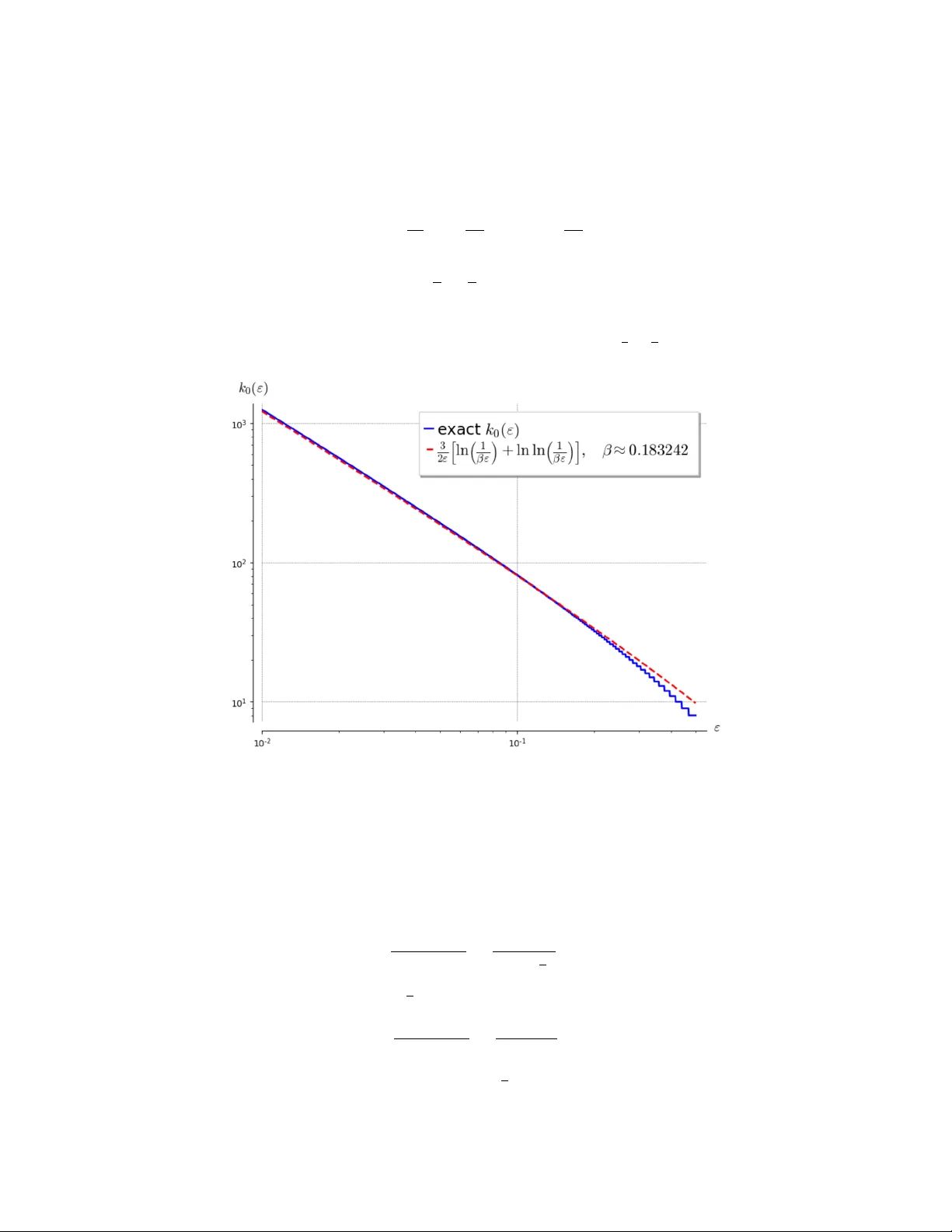
AN ELEMENT AR Y PR OOF OF THE LO V ´ ASZ LOCAL LEMMA WITHOUT CONDITIONAL PR OBABILITIES AND A TIGHTENED LO WER BOUND ON DIA GONAL RAMSEY NUMBERS IGAL SASON TECHNION – ISRAEL INSTITUTE OF TECHNOLOGY, HAIF A 3200003, ISRAEL. Abstract. The Lov´ asz Lo cal Lemma is a p ow erful to ol in probabilistic com binatorics, pro viding a criterion under which a collection of unde- sirable ev ents with limited dependencies can b e av oided sim ultaneously with p ositive probability . Standard presentations of the Lov´ asz Local Lemma t ypically use conditional probabilities in intermediate steps. In this pap er, we presen t a proof that a voids conditional probabilities al- together and instead w orks with unconditional probabilit y inequalities. This form ulation yields a fully self-con tained argument in which every step is v alid without requiring the p ositivity of intermediate conditioning ev ents. The resulting pro of is elemen tary and provides a transparent presen tation of the Lo v´ asz Local Lemma. W e also consider the symmetric case in detail, and provide a tightened version of the b est known low er b ound on diagonal Ramsey num b ers. 1. Introduction In many applications of the probabilistic metho d, one considers a finite collection of undesirable ev ents { A i } n i =1 and seeks to sho w that with p ositiv e probabilit y none of them o ccurs. F or mutually independent ev en ts, the probabilit y that none of them occurs equals the product of the probabilities of their complemen ts, i.e., P n \ i =1 A i ! = n Y i =1 1 − P ( A i ) . In typical com binatorial settings, ho w ev er, the ev en ts are not indep enden t, and direct probabilistic estimates become more in volv ed. Nev ertheless, it is often the case that eac h ev en t depends only on a limited n um b er of other even ts and that the ev ent probabilities are sufficiently small. Under such conditions, it is still possible to guaran tee that none of the ev en ts o ccurs with p ositive probabilit y . A pow erful result that formalizes this Key wor ds and phr ases. Lov´ asz Lo cal Lemma; probabilistic methods in com binatorics; Ramsey n umbers. Mathematics Sub ject Classification: 05C15, 05D40, 60C05, 97K20. 1 2 Elementary Pro of of the Lov´ asz Local Lemma and Diagonal Ramsey Numbers principle is the L ov´ asz L o c al L emma , in tro duced b y P aul Erd˝ os and L´ aszl´ o Lo v´ asz [1]. The lemma provides a general criterion under whic h a collection of even ts with restricted dependencies can be a v oided simultaneously with p ositiv e probabilit y . The Lo v´ asz Local Lemma has n umerous applications in probabilistic combinatorics, graph theory , and theoretical computer science (see, e.g., [1 – 16]). T o prepare for the statement of the Lo v´ asz Local Lemma and its modified pro of in the next section, w e begin with the following tw o definitions. Definition 1 (Mutual independence) . Let (Ω , F , P ) b e a probability space, and let A 1 , . . . , A n ∈ F b e even ts. F or i ∈ [ n ], the ev en t A i is indep endent of the σ -algebra σ { A j : j ∈ [ n ] \ { i }} (i.e., the σ -algebra generated b y the remaining even ts A 1 , . . . , A i − 1 , A i +1 , . . . , A n ) if P ( A i ∩ B ) = P ( A i ) P ( B ) , for all B ∈ σ ( A 1 , . . . , A i − 1 , A i +1 , . . . , A n ) . If this holds for all i ∈ [ n ], then the even ts A 1 , . . . , A n are said to b e mutual ly indep endent . Definition 2 (Dep endency digraph) . Let A 1 , . . . , A n b e even ts in an arbitrary probabilit y space. A directed graph (digraph) D = ([ n ] , E ) is called a dep endency digr aph for the even ts { A i } n i =1 if for all i ∈ [ n ], the even t A i is indep endent of the σ -algebra generated by the ev en ts { A j : ( i, j ) ∈ E } . Recall that ( i, j ) denotes the arc i → j . Remark 1. In Definition 2, it is not simply required that A i is indep endent of A j if ( i, j ) ∈ E , since in that case one could consider an undirected graph (as pairwise indep endence is symmetric). The prop ert y that is chec ked in Definition 2 is stronger, and so it is not sufficien t to consider an undirected graph and to put an edge b etw een every pair of dep enden t even ts. Remark 2 (Non-uniqueness of the dep endency digraph) . In general, the dep endency digraph asso ciated with a collection of even ts { A i } n i =1 is not unique. Indeed, if D = ([ n ] , E ) is a dep endency digraph for these even ts, then any digraph obtained by adding additional arcs to D is also a v alid dep endency digraph. This is because the definition only requires that A i b e indep enden t of the σ -algebra generated b y the even ts { A j : ( i, j ) / ∈ E } , so enlarging E can only w eaken this requirement. In particular, if the even ts A 1 , . . . , A n are mutually independent, then the empty digraph on [ n ] is a dep endency digraph, but any digraph on [ n ] also satisfies the definition. Standard presen tations of the Lov´ asz Local Lemma rely on conditional probabilities in in termediate steps [1 – 12]. In this pap er, we present a pro of that a v oids conditional probabilities altogether and instead relies only on unconditional probability inequalities. This yields a fully self-contained argumen t in whic h ev ery step remains v alid without requiring the p ositivit y of intermediate conditioning even ts. The resulting proof is elemen tary and pro vides a transparent deriv ation of the Lov´ asz Lo cal Lemma. The motiv ation for this form ulation is discussed further after the pro of (see Remark 3). Igal Sason 3 This pap er suggests a supplemen t to the presen tation of the Lo v´ asz Lo cal Lemma found in classical textb o oks on the probabilistic method in com binatorics, suc h as [2], with potential p edagogical v alue. It also examines the symmetric case in detail, and pro vides a tigh tened v ersion of the best kno wn low er b ound on diagonal Ramsey n um b ers (see Definition 3) in [10]. The pap er originated from lectures on this topic given b y the author. 2. The Lov ´ asz Local Lemma and Its New Proof without Conditional Probabilities This section presents the Lov´ asz Lo cal Lemma, a mo dified pro of that a v oids conditional probabilities, and the motiv ation for that proof. F or n ∈ N , w e use the standard notation [ n ] := { 1 , . . . , n } . Theorem 1 (The Lo v´ asz Lo cal Lemma) . Let A 1 , . . . , A n b e ev en ts in an arbitrary probability space (Ω , F , P ), and let D = ([ n ] , E ) b e a dep endency digraph for the ev en ts { A i } n i =1 . Supp ose that there exist x 1 , . . . , x n ∈ [0 , 1) suc h that P ( A i ) ≤ x i Y j :( i,j ) ∈ E (1 − x j ) , ∀ i ∈ [ n ] . (1) Then, P n \ i =1 A i ! ≥ n Y i =1 (1 − x i ) . (2) In particular, none of the ev ents o ccurs with positive probability . Pr o of. W e presen t a pro of that a voids an y use of conditional probabilities. In particular, no step requires assuming that a conditioning ev en t has positive probabilit y (this issue is discussed in Remark 3). Step 1: A lemma with unconditional probabilities. F or S ⊆ [ n ], define F ( S ) := \ j ∈ S A j . Lemma 1. Assume that the conditions of Theorem 1 hold. Then, for every S ⊂ [ n ] and every i ∈ [ n ] \ S , P A i ∩ F ( S ) ≤ x i P F ( S ) . (3) Pr o of of L emma 1. W e prov e (3) b y induction on | S | . Base c ase. If S = ∅ , then F ( S ) = Ω, and (3) reduces to P ( A i ) ≤ x i . Indeed, b y (1) P ( A i ) ≤ x i Y j :( i,j ) ∈ E (1 − x j ) ≤ x i , where the last inequality holds since eac h factor satisfies 1 − x j ∈ [0 , 1]. Induction hyp othesis. Fix an integer m ≥ 1 and assume that (3) holds for ev ery S ′ ⊂ [ n ] with | S ′ | < m and every i ′ ∈ [ n ] \ S ′ . 4 Elementary Pro of of the Lov´ asz Local Lemma and Diagonal Ramsey Numbers Induction step. Let S ⊂ [ n ] b e an arbitrary set with | S | = m , and let i ∈ [ n ] \ S . Define S 1 := { j ∈ S : ( i, j ) ∈ E } , S 2 := S \ S 1 . (4) If S 1 = ∅ , then ( i, j ) / ∈ E for all j ∈ S . By Definition 2, the ev ent A i is indep enden t of the σ -algebra generated b y { A j : j ∈ S } , and in particular it is indep endent of F ( S ) = T j ∈ S A j . Therefore, P A i ∩ F ( S ) = P ( A i ) P F ( S ) ≤ x i P F ( S ) , and (3) follo ws. Assume now that S 1 = ∅ . Since S 2 ⊆ { j : ( i, j ) / ∈ E } , Definition 2 implies that A i is indep endent of the σ -algebra generated by { A j : j ∈ S 2 } ; in particular, A i is indep endent of F ( S 2 ). As S 2 ⊆ S , we hav e F ( S ) ⊆ F ( S 2 ) so P A i ∩ F ( S ) ≤ P A i ∩ F ( S 2 ) = P ( A i ) P F ( S 2 ) ≤ x i Y j :( i,j ) ∈ E (1 − x j ) P F ( S 2 ) , (5) where the last inequality holds by (1) . W e next low er b ound P ( F ( S )) in terms of P ( F ( S 2 )). Let S 1 = { j 1 , . . . , j r } and, for t ∈ [ r ], let T t := S 2 ∪ { j 1 , . . . , j t − 1 } . Note that | T t | = | S 2 | + t − 1 ≤ | S | − 1, hence | T t | < | S | . Define, for t = 0 , 1 , . . . , r , the even ts G t := F ( S 2 ) ∩ t \ s =1 A j s , so that G 0 = F ( S 2 ) and G r = F ( S ) (recall that S = S 1 ˙ ∪ S 2 is a disjoint union of S 1 and S 2 ). Then, P ( G t ) = P ( G t − 1 ) − P ( A j t ∩ G t − 1 ) , t ∈ [ r ] . (6) Since G t − 1 = F ( T t ), the induction h yp othesis applied to the pair ( i ′ , S ′ ) = ( j t , T t ) gives P ( A j t ∩ G t − 1 ) = P A j t ∩ F ( T t ) ≤ x j t P F ( T t ) = x j t P ( G t − 1 ) . Substituting into (6) yields P ( G t ) ≥ (1 − x j t ) P ( G t − 1 ) , t ∈ [ r ] . Iterating ov er t = 1 , 2 , . . . , r , w e obtain P F ( S ) = P ( G r ) ≥ r Y t =1 (1 − x j t ) P ( G 0 ) = Y j ∈ S 1 (1 − x j ) P F ( S 2 ) . (7) Igal Sason 5 Since S 1 ⊆ { j : ( i, j ) ∈ E } and eac h factor satisfies 1 − x j ∈ [0 , 1], w e hav e Y j ∈ S 1 (1 − x j ) ≥ Y j :( i,j ) ∈ E (1 − x j ) . (8) Com bining (5), (7), and (8) gives P A i ∩ F ( S ) ≤ x i Y j :( i,j ) ∈ E (1 − x j ) P F ( S 2 ) ≤ x i P F ( S ) , whic h is (3). This completes the induction and prov es Lemma 1. ■ Step 2: Concluding the Lov´ asz Lo cal Lemma. F or k = 0 , 1 , . . . , n , define F k := k \ j =1 A j , with F 0 = Ω . Applying Lemma 1 with S = { 1 , . . . , k − 1 } and i = k yields P ( A k ∩ F k − 1 ) ≤ x k P ( F k − 1 ) . Hence, P ( F k ) = P ( F k − 1 ) − P ( A k ∩ F k − 1 ) ≥ (1 − x k ) P ( F k − 1 ) . Iterating for k = 1 , 2 , . . . , n giv es P n \ i =1 A i ! = P ( F n ) ≥ n Y i =1 (1 − x i ) , whic h is (2) . In particular, P ( T n i =1 A i ) > 0 since x i ∈ [0 , 1) for all i ∈ [ n ]. □ Remark 3 (On a voiding conditioning assumptions) . A common presen tation of the Lo v´ asz Local Lemma pro ves a v ariation of Lemma 1, giv en b y P A i \ j ∈ S A j ≤ x i , ∀ S ⊂ [ n ] , i ∈ [ n ] \ S, b y manipulating these conditional probabilities via the iden tit y P ( A | B ∩ C ) = P ( A ∩ B | C ) P ( B | C ) , and expressing them in terms of conditional probabilities of the form P A i ∩ \ j ∈ S \ S ′ A j \ j ∈ S ′ A j and P A i \ j ∈ S ′ A j , S ′ ⊂ S. See, e.g., [1, pp. 616–617], [2, pp. 70–72], [3, pp. 21–23], [4, pp. 100–103], [5, pp. 280–282], [6, pp. 111–114], [7, pp. 30–31], [8, pp. 147–150], [9, pp. 226– 228], [10], [11], and [12, p. 266]. Ho w ev er, this approac h relies on conditional 6 Elementary Pro of of the Lov´ asz Local Lemma and Diagonal Ramsey Numbers probabilities whose definition requires that the conditioning ev ents hav e p osi- tiv e probability . In particular, conditional probabilities like P A i | T j ∈ S A j are defined only if P T j ∈ S A j > 0. The goal of the Lo v´ asz Local Lemma, ho wev er, is precisely to pro ve that P n \ i =1 A i ! > 0 . Consequen tly , when conditional probabilities are used in intermediate steps, one m ust ensure that the relev ant conditioning even ts hav e p ositiv e probabilit y . In all ab ov e presentations, this p ositivity is implicitly assumed when manipulating suc h conditional expressions, even though establishing the p ositivity of the intersection P T n i =1 A i > 0 is precisely the ob jectiv e of the Lov´ asz Local Lemma. F or this reason, w e av oid conditional probabilities altogether in the state- men t of Lemma 1 and the inductive argument in its pro of, and instead w ork with unconditional inequalities such as P A i ∩ \ j ∈ S A j ≤ x i P \ j ∈ S A j . These inequalities remain meaningful ev en if P T j ∈ S A j = 0, and the p ositivit y of P T n i =1 A i then follo ws directly from (2) , where b y assumption x i ∈ [0 , 1) for every i ∈ [ n ]. Symmetric Case: Often in applications, the even ts { A i } n i =1 satisfy certain symmetry conditions, allo wing one to simplify the conditions in Theorem 1. The motiv ation for in tro ducing the next tw o theorems is later explained in Remark 4. Theorem 2 (The Lo v´ asz Local Lemma: Symmetric Case) . Let A 1 , . . . , A n b e even ts in an arbitrary probability space. Suppose that, for every i ∈ [ n ], the even t A i is indep endent of the σ -algebra generated b y all the remaining ev ents, except for at most d of them, and that P ( A i ) ≤ p for all i ∈ [ n ]. If pe ( d + 1) ≤ 1, then P n \ i =1 A i ! ≥ d d + 1 n > e − n d . (9) In particular, none of the ev ents o ccurs with positive probability . Pr o of. If d = 0, then the ev ents { A i } n i =1 are indep endent, so P T n i =1 A i = Q n i =1 P ( A i ) ≥ (1 − p ) n > 0. Otherwise, if d ≥ 1, let x j := 1 d +1 for all j ∈ [ n ]. By the assumption of Theorem 2, there exists a dependency digraph D = ([ n ] , E ) in whic h ev ery Igal Sason 7 v ertex has outdegree at most d (see Definition 2). Fix such a dependency digraph D . Then, for all i ∈ [ n ], P ( A i ) ≤ 1 ( d + 1) e (10) ≤ 1 d + 1 1 + 1 d − d (11) = 1 d + 1 1 − 1 d + 1 d (12) ≤ x i Y j :( i,j ) ∈ E (1 − x j ) , (13) where (10) holds by the assumption of the theorem; (11) follo ws from the fact that the sequence 1 + 1 k k k ∈ N is monotonically increasing and con v erges to e as k → ∞ ; (12) follo ws by straightforw ard algebra; finally , (13) holds b y the c hoice x i = 1 d +1 for all i ∈ [ n ] and since the outdegrees of the considered dep endency digraph are at most d . It then follo ws from Theorem 1 that P n \ i =1 A i ! ≥ n Y i =1 (1 − x i ) = d d + 1 n > e − n d , where the last inequality holds since 1 + 1 d d < e . □ By moving directly to (11) , the next slightly sharp er symmetric criterion is obtained. Corollary 1 (Sp encer’s b ound) . Let A 1 , . . . , A n b e even ts in an arbitrary probabilit y space. Supp ose that, for ev ery i ∈ [ n ], the ev en t A i is independent of the σ -algebra generated b y all the remaining even ts, except for at most d of them, and that P ( A i ) ≤ p for all i ∈ [ n ]. If p ≤ d d ( d + 1) d +1 , (14) then P n \ i =1 A i ! ≥ d d + 1 n > e − n d . (15) Corollary 2. If ep d + 1 2 ≤ 1, then (15) holds. Pr o of. The condition ep d + 1 2 ≤ 1 implies that (14) is satisfied, from which (15) holds by Corollary 1. A justification of the statement is provided in App endix A. □ Remark 4. The Lo v´ asz Local Lemma was introduced b y Erd˝ os and Lo v´ asz in [1]. Their original symmetric result sho ws that none of the ev ents o ccurs with p ositive probability if p ≤ 1 4 d , where p upp er-b ounds the probabilit y of eac h even t and d upp er-b ounds the num b er of dep endencies of each ev en t. A 8 Elementary Pro of of the Lov´ asz Local Lemma and Diagonal Ramsey Numbers standard sharp ened formulation of the symmetric lo cal lemma establishes the condition ep ( d + 1) ≤ 1, which guaran tees that P T n i =1 A i > 0. A further refinemen t due to Sp encer [11, Theorem 1.4] sho ws that the same conclusion holds under the slightly w eak er condition (14) . Theorem 2 and Corollary 1 also provide the explicit lo w er b ound d d +1 n on the probabilit y that none of the ev en ts { A i } n i =1 o ccurs, strengthening the classical assertion that this probabilit y is merely p ositive. By Corollary 2, the low er b ound in (15) holds, in particular, if pe d + 1 2 ≤ 1. In [11], Sp encer defined f ( d ) as the suprem um of all x ∈ [0 , 1) suc h that, under the assumptions of Theorem 2 or Corollary 1, the condition p ≤ x guaran tees that P T n i =1 A i > 0. He further ask ed whether the limit lim d →∞ d f ( d ) exists, and if so, what its v alue is. This question w as addressed b y Shearer [17]. W e conclude this section by recalling the following result in [17, Theorem 2]. Theorem 3 (Shearer) . The follo wing holds: f ( d ) = 1 2 , if d = 1 , ( d − 1) d − 1 d d , if d ≥ 2 . (16) Hence, lim d →∞ d f ( d ) = 1 e , so the b ounds on p in Theorem 2 and Corollary 1 are tigh t as d → ∞ . Corollary 3. Let A 1 , . . . , A n b e ev ents in an arbitrary probabilit y space. Supp ose that, for e v ery i ∈ [ n ], the ev en t A i is indep enden t of the σ -algebra generated b y all the remaining ev ents, except for at most d of them, and that P ( A i ) ≤ p for all i ∈ [ n ]. If ped ≤ 1, then P T n i =1 A i > 0. Pr o of. F or ev ery d ∈ N , one has 1 de < f ( d ). Indeed, if d = 1, then 1 e < 1 2 = f (1), and if d ≥ 2, then 1 ed < 1 d 1 + 1 d − 1 − ( d − 1) = ( d − 1) d − 1 d d = f ( d ) . Hence, the condition p ≤ 1 ed guaran tees that p < f ( d ), and the result follo ws from Theorem 3. □ Remark 5. Corollary 3 is provided in Problem 319 of [12, Section 7.2.2.2] (see also [12, p. 266]). 3. Lower bounds on the diagonal Ramsey numbers This section studies a tigh tened version of the best kno wn low er b ound on the diagonal Ramsey n umbers obtained in [10], relying on the symmetric v ersion of the Lo v´ asz Local Lemma. Theorem 4 restates [10, Theorem 2]. A tigh tened v ersion, whic h relies on the pro of of Theorem 4, is presen ted in Igal Sason 9 Theorem 5, and the identical asymptotic b ehavior of b oth lo w er b ounds is analyzed in Proposition 1, which refines [10, Corollary 1]. Definition 3 (Ramsey num bers) . Let k , ℓ ∈ N . The R amsey numb er R ( k , ℓ ) is the smallest integer n ∈ N suc h that for ev ery coloring of the edges of the complete graph K n with tw o colors, there exists a mono c hromatic copy of K k or K ℓ . The diagonal R amsey numb ers correspond to the sp ecial case where k = ℓ . Equiv alen tly , R ( k , k ) is the smallest n ∈ N suc h that every graph G on n v ertices con tains either an independent set or a clique of size k . Theorem 4. Let k ∈ N . If e k 2 n − 2 k − 2 2 1 − ( k 2 ) ≤ 1, for some n ∈ N , then R ( k , k ) > n . Pr o of. Color the edges of the complete graph K n using t wo colors, uniformly at random and independently . F or a set S of k v ertices, let A S b e the ev ent that all edges with both endpoints in S are mono chromatic. Then, P ( A S ) = 2 · 2 − ( k 2 ) = 2 1 − ( k 2 ) . Moreo v er, A S is indep endent of the σ -algebra generated b y the collection of ev ent s A T : T ⊆ [ n ] , | T | = k , | T ∩ S | ≤ 1 , since whenever | T ∩ S | ≤ 1, the ev ents A S and A T dep end on disjoin t sets of indep enden t edge-color v ariables. The collection of k -subsets T ⊆ [ n ] with | T ∩ S | ≤ 1 con tains all k -subsets except those satisfying T = S and | T ∩ S | ≥ 2. The num ber of such subsets is therefore at most k 2 n − 2 k − 2 − 1 . Indeed, let { i, j } ⊆ S and F { i,j } := T ⊆ [ n ] : | T | = k , { i, j } ⊆ T . Then, | F { i,j } | = n − 2 k − 2 . Clearly , T ⊆ [ n ] , | T | = k , | T ∩ S | ≥ 2 , T = S = [ { i,j }⊆ S F { i,j } \ { S } , so, by the union b ound, T ⊆ [ n ] , | T | = k , | T ∩ S | ≥ 2 , T = S ≤ X { i,j }⊆ S | F { i,j } | − 1 = k 2 n − 2 k − 2 − 1 . Finally , b y the Lo v´ asz Local Lemma (symmetric case in Theorem 2) with p = 2 1 − ( k 2 ) , d = k 2 n − 2 k − 2 − 1 , 10 Elementary Pro of of the Lov´ asz Lo cal Lemma and Diagonal Ramsey Num b ers it follows that if pe ( d + 1) ≤ 1, then P \ S ⊆ [ n ]: | S | = k A S > 0 . In other w ords, with p ositiv e probability , the random coloring of K n do es not con tain an y mono chromatic copy of K k . Hence R ( k , k ) > n , whic h pro ves Theorem 4. □ A v ariation of Theorem 4, whic h gives a sligh tly b etter lo w er b ound on the diagonal Ramsey num b ers is given as follows. Theorem 5. Let k ∈ N . If, for some n ∈ N , e " n k − n − k k − k n − k k − 1 # 2 1 − ( k 2 ) ≤ 1 , then R ( k , k ) > n . Pr o of. The pro of follo ws the same argumen t as Theorem 4, except that we coun t the n um b er of dependent ev en ts exactly instead of b ounding it via the union b ound. F or a fixed k -subset S ⊆ [ n ], the ev en t A S is indep endent of all ev en ts A T with | T ∩ S | ≤ 1. Hence, the even ts A T that dep end on A S are precisely those for whic h T = S and | T ∩ S | ≥ 2. The total num b er of k -subsets T ⊆ [ n ] is n k . Among them, exactly n − k k satisfy | T ∩ S | = 0, and exactly k n − k k − 1 satisfy | T ∩ S | = 1. Hence, the n um b er of k -subsets T satisfying | T ∩ S | ≥ 2 is n k − n − k k − k n − k k − 1 . Since this coun t includes T = S , the n um b er of ev en ts A T with T = S that dep end on A S is d = n k − n − k k − k n − k k − 1 − 1 . Th us, in the application of the symmetric Lo v´ asz Local Lemma, we keep p = 2 1 − ( k 2 ) , but replace the previous upper bound on d by its exact v alue. Hence, if e p ( d + 1) ≤ 1 , i.e., if e " n k − n − k k − k n − k k − 1 # 2 1 − ( k 2 ) ≤ 1 , Igal Sason 11 then P \ S ⊆ [ n ]: | S | = k A S > 0 . Therefore, with p ositiv e probability , the random coloring of K n con tains no mono c hromatic cop y of K k , and so R ( k , k ) > n . □ T able 1 compares the lo wer b ounds on the diagonal Ramsey num bers R ( k , k ) given in Theorems 4 and 5. The table illustrates n umerically that the fractional impro vemen t pro vided b y the tightened lo w er b ound in Theorem 5 diminishes as k increases. Lo w er bounds on R ( k , k ) k Theorem 4 Theorem 5 10 99 105 15 948 956 20 7,742 7,754 25 57,725 57,740 30 406,672 406,691 35 2,758,419 2,758,441 40 18,213,023 18,213,048 T able 1. Comparison of the low er bounds on the diagonal Ramsey num b ers R ( k , k ) in Theorems 4 and 5. The following result, which follo ws from Theorem 4, refines the asymptotic lo w er bound on the diagonal Ramsey num bers in [10, Corollary 1]. Prop osition 1. F or every ε ∈ (0 , 1), there exists k 0 = k 0 ( ε ) ∈ N suc h that R ( k , k ) > (1 − ε ) √ 2 e k 2 k 2 , ∀ k ≥ k 0 . (17) A closed-form expression for a v alid k 0 = k 0 ( ε ) will be deriv ed later, follo wing the pro of of this prop osition, and its behavior will b e analyzed as ε → 0 + . Pr o of. Let c ε := (1 − ε ) √ 2 e . W e sho w that there exists k 0 = k 0 ( ε ) ∈ N suc h that R ( k , k ) > c ε k 2 k/ 2 , ∀ k ≥ k 0 . Fix n := c ε k 2 k/ 2 . By Theorem 4, it suffices to show that e k 2 n − 2 k − 2 2 1 − ( k 2 ) ≤ 1 12 Elementary Pro of of the Lov´ asz Lo cal Lemma and Diagonal Ramsey Num b ers for all sufficien tly large k . Since n ≤ c ε k 2 k/ 2 and n − 2 k − 2 ≤ n k − 2 ( k − 2)! , w e get e k 2 n − 2 k − 2 2 1 − ( k 2 ) ≤ e k 2 ( c ε k 2 k/ 2 ) k − 2 ( k − 2)! 2 1 − ( k 2 ) = e k 2 ( c ε k ) k − 2 ( k − 2)! 2 1 − k/ 2 , where we used the iden tity k ( k − 2) 2 + 1 − k 2 = 1 − k 2 . By Stirling’s inequalit y , ( k − 2)! ≥ p 2 π ( k − 2) k − 2 e k − 2 , ∀ k ≥ 2 , w e get, for all k ≥ 3, e k 2 ( c ε k ) k − 2 ( k − 2)! 2 1 − k/ 2 ≤ e k 2 p 2 π ( k − 2) c ε e k k − 2 k − 2 2 1 − k/ 2 . Since c ε e = (1 − ε ) √ 2 , the middle term on the righ t-hand side of the last inequality simplifies to c ε e k k − 2 k − 2 2 1 − k/ 2 = (1 − ε ) √ 2 k k − 2 k − 2 2 1 − k/ 2 = 2 k − 2 2 (1 − ε ) k − 2 k k − 2 k − 2 2 1 − k/ 2 = (1 − ε ) k − 2 k k − 2 k − 2 . Hence, for all k ≥ 3, e k 2 n − 2 k − 2 2 1 − ( k 2 ) ≤ e k 2 p 2 π ( k − 2) · (1 − ε ) k − 2 k k − 2 k − 2 ≤ e 3 k 2 p 2 π ( k − 2) · (1 − ε ) k − 2 , where the last inequality follo ws from the b ound k k − 2 k − 2 = 1 + 2 k − 2 k − 2 ≤ e 2 , ∀ k ≥ 3 , since the sequence n 1 + 2 k − 2 k − 2 o k ≥ 3 is increasing and conv erges to e 2 . Also, for all k ≥ 3, e 3 k 2 p 2 π ( k − 2) = e 3 2 √ 2 π k ( k − 1) √ k − 2 Igal Sason 13 ≤ e 3 √ 8 π k 2 q k 1 − 2 k ≤ r 3 8 π e 3 k 3 2 , where the last inequality holds since 1 − 2 k ≥ 1 3 for all k ≥ 3. Therefore, e k 2 n − 2 k − 2 2 1 − ( k 2 ) ≤ r 3 8 π e 3 k 3 / 2 (1 − ε ) k − 2 , ∀ k ≥ 3 . (18) Since 0 < 1 − ε < 1, the righ t-hand side tends to zero as k → ∞ . Consequen tly , there exists k 0 = k 0 ( ε ) ∈ N suc h that e k 2 n − 2 k − 2 2 1 − ( k 2 ) ≤ 1 , ∀ k ≥ k 0 . (19) By Theorem 4, this implies that R ( k , k ) > n = c ε k 2 k/ 2 , ∀ k ≥ k 0 . Hence, R ( k , k ) ≥ c ε k 2 k/ 2 + 1 > c ε k 2 k/ 2 = (1 − ε ) √ 2 e k 2 k/ 2 , ∀ k ≥ k 0 , whic h pro ves (17). □ The pro of of Prop osition 1 enables one to get an e xplicit closed-form expression for a v alid selection of k 0 = k 0 ( ε ). Let ε ∈ (0 , 1). It follo ws from (18) and (19) that k 0 can b e selected to be the smallest in teger k ≥ 3 that satisfies the inequalit y r 3 8 π e 3 k 3 / 2 (1 − ε ) k − 2 ≤ 1 . (20) A v alid choice of k 0 = k 0 ( ε ) is therefore given b y (see App endix B) k 0 = max ( 3 , & 3 W − 1 β ln(1 − ε ) (1 − ε ) 4 / 3 2 ln(1 − ε ) ') , (21) where W − 1 ( · ) denotes the secondary branc h of the Lam b ert W -function, and β = 4 3 e 2 3 r π 3 ≈ 0 . 183242 . (22) W e ha v e W − 1 ( x ) = ln( − x ) − ln − ln( − x ) + o (1) as x → 0 − , and ln(1 − x ) = − x + O ( x 2 ) as x → 0 . 14 Elementary Pro of of the Lov´ asz Lo cal Lemma and Diagonal Ramsey Num b ers These approximations yield k 0 ( ε ) ≈ 3 2 ε ln 1 β ε + ln ln 1 β ε (23) = O 1 ε ln 1 ε . (24) Figure 1 depicts the exact v alue of k 0 , giv en in (21) , together with the appro ximation in (23). It sho ws that k 0 indeed scales as 1 ε ln 1 ε as ε → 0. Figure 1. k 0 = k 0 ( ε ): exact (21), and approximation (23). Appendix A. Fur ther det ails for the Proof of Corollar y 2 The completion of the proof of Corollary 2 relies on the next lemm a. Lemma 2. F or every d ∈ N , d d ( d + 1) d +1 ≥ 1 e d + 1 2 . Mor e over, the c onstant α = 1 2 is b est p ossible in the sense that, if d d ( d + 1) d +1 ≥ 1 e ( d + α ) holds for al l d ∈ N , then ne c essarily α ≥ 1 2 . Igal Sason 15 Pr o of. Define, for x > 0, ϕ ( x ) := x log x − ( x + 1) log ( x + 1) + 1 + log x + 1 2 , where logarithms are on natural base. Then, ϕ ( x ) ≥ 0 is equiv alent to x x ( x + 1) x +1 ≥ 1 e x + 1 2 . Hence, it suffices to sho w that ϕ ( x ) ≥ 0 for all x > 0. Differentiating giv es ϕ ′ ( x ) = − log 1 + 1 x + 2 2 x + 1 . Let t := 1 x > 0. Then, ϕ ′ ( x ) = − log(1 + t ) + 2 t 2 + t . By the inequality log (1 + t ) ≥ 2 t 2+ t , which holds for t > 0, it follows that ϕ ′ ( x ) ≤ 0 for all x > 0. Therefore, ϕ is decreasing on (0 , ∞ ). On the other hand, lim x →∞ ϕ ( x ) = lim x →∞ log 1 + 1 2 x − ( x + 1) log 1 + 1 x + 1 = 0 . Hence, as ϕ is decreasing and tends to 0 at infinity , one has ϕ ( x ) ≥ 0 for all x > 0. In particular, for ev ery d ∈ N , d d ( d + 1) d +1 ≥ 1 e d + 1 2 . It remains to prov e that the constan t α = 1 2 is b est possible. Suppose that, for some α > 0, d d ( d + 1) d +1 ≥ 1 e ( d + α ) , ∀ d ∈ N . Then, α ≥ ( d + 1) d +1 e d d − d = d + 1 e 1 + 1 d d − d, ∀ d ∈ N . Using the asymptotic expansion 1 + 1 d d = e 1 − 1 2 d + O 1 d 2 , d → ∞ , implies that α ≥ 1 2 , thus proving the optimality of the constan t α = 1 2 . □ 16 Elementary Pro of of the Lov´ asz Lo cal Lemma and Diagonal Ramsey Num b ers Appendix B. Appendix: Deriv a tion of (21) Let a := − ln(1 − ε ) > 0 , C := r 3 8 π e 3 . (25) Then inequality (20) can b e rewritten as C k 3 / 2 (1 − ε ) k − 2 ≤ 1 , whic h is equiv alent to C k 3 / 2 e − a ( k − 2) ≤ 1 , i.e., k 3 / 2 e − ak ≤ e − 2 a C . Raising b oth sides to the p o w er 2 3 and then multiplying b y − 2 a 3 , we obtain − 2 a 3 k e − 2 a 3 k ≥ − 2 a 3 e − 2 a C 2 / 3 . Hence, using the branch W − 1 of the Lam b ert W function, w e obtain k ≥ − 3 2 a W − 1 − 2 a 3 e − 2 a C 2 / 3 ! . The branch W − 1 is used rather than the principal branc h W 0 since the argumen t of the Lam bert W function is negativ e and tends to 0 as ε → 0. The branch W 0 w ould yield a b ounded solution for k , whereas the desired solution corresp onds to the large- k regime; this is captured by the branc h W − 1 , for whic h W − 1 ( x ) → −∞ as x → 0 − . By (25) , substituting a and C in to the righ t-hand side of the last inequalit y giv es k ≥ 3 2 ln(1 − ε ) W − 1 4 3 e 2 3 r π 3 ln(1 − ε )(1 − ε ) 4 / 3 . Com bining the last inequality with the requirement k ≥ 3 in (18) finally giv es, together with (22), the v alid selection of the in teger k 0 in (21). Ac kno wledgmen t. The author wishes to ackno wledge Ugo V accaro for p oin ting out reference [12], and for raising a question that led to Corollary 2. References [1] P . Erd˝ os and L. Lov´ asz, Problems and results on 3-chromatic hypergraphs and some related questions, in Infinite and Finite Sets , Collo q. Math. Soc. J´ anos Bolyai, V ol. 10, North-Holland, Amsterdam, 1975, pp. 609–627. https://www.renyi.hu/ ~ p_erdos/ 1975- 34.pdf [2] N. Alon and J. H. Sp encer, The Pr ob abilistic Metho d , 4th ed., John Wiley & Sons, Hob ok en, NJ, 2016. [3] B. Bollob´ as, R andom Gr aphs , 2nd ed., Cambridge Studies in Adv anced Mathematics, v ol. 73, Cambridge Universit y Press, Cambridge, 2001. [4] P . Br´ emaud, Discr ete Prob ability Mo dels and Metho ds: Pr ob ability on Graphs and T r e es, Markov Chains and R andom Fields, Entr opy and Co ding , Probability Theory and Sto c hastic Mo delling, v ol. 78. Springer International Publishing, Cham, 2017. Igal Sason 17 [5] S. Jukna, Extr emal Combinatorics with Applic ations in Computer Scienc e , 2nd ed., Springer, Berlin, 2011. [6] Y. Li and Q. Lin, Elementary Metho ds of Gr aph R amsey The ory , Springer Monographs in Mathematics, vol. 211, Springer, Cham, 2022. [7] J. H. v an Lint and R. M. Wilson, A Course in Combinatorics , 2nd ed., Cam bridge Univ ersity Press, Cambridge, 2001. [8] M. Mitzenmacher and E. Upfal, Pr ob ability and Computing: R andomization and Pr ob abilistic T e chniques in Algorithms and Data Analysis , 2nd ed., Cambridge Univ ersity Press, Cambridge, 2017. [9] M. Mollo y and B. Reed, Gr aph Colouring and the Pr ob abilistic Metho d , Algorithms and Com binatorics, vol. 23, Springer, Berlin, 2002. [10] J. Sp encer, Ramsey’s theorem—a new low er b ound, J. Combin. The ory Ser. A 18 (1975), no. 1, 108–115. https://doi.org/10.1016/0097- 3165(75)90071- 0 [11] J. Spencer, Asymptotic low er b ounds for Ramsey functions, Discr ete Math. 20 (1977), 69–76. https://doi.org/10.1016/0012- 365X(77)90044- 9 [12] D. E. Kn uth, The Art of Computer Pr o gr amming, V ol. 4B: Combinatorial A lgorithms, Part 2 , Addison-W esley Professional, Boston, MA, 2022. [13] N. Alon and N. Linial, Cycles of length 0 ( mo d k ) in directed graphs, J. Combin. The ory Ser. B 47 (1989), no. 1, 114–119. https://doi.org/10.1016/0095- 8956(89) 90071- 3 [14] A. F arag´ o, A meeting p oint of probability , graphs, and algorithms: the Lov´ asz lo cal lemma and related results—a survey , Algorithms 14 (2021), no. 12, 355. https: //doi.org/10.3390/a14120355 [15] R. Con, A. Shpilk a, and I. T amo, Reed–Solomon co des against adversarial insertions and deletions, IEEE T r ans. Inform. The ory 69 (2023), no. 5, 2991–3000. https: //doi.org/10.1109/TIT.2023.3237711 Correction in IEEE T r ans. Inform. Theory 71 (2025), no. 4, 3250–3251. https://doi.org/10.1109/TIT.2025.3538114 [16] L. J. Sch ulman, Deterministic co ding for interactiv e communication, in Pr o c. 25th Annu. ACM Symp os. Theory Comput. (STOC 1993) , ACM, New Y ork, 1993, pp. 747– 756. https://doi.org/10.1145/167088.167279 [17] J. B. Shearer, On a problem of Spencer, Combinatoric a 5 (1985), no. 3, 241–245. https://doi.org/10.1007/BF02579368
Original Paper
Loading high-quality paper...
Comments & Academic Discussion
Loading comments...
Leave a Comment