Active Sampling Sample-based Quantum Diagonalization from Finite-Shot Measurements
Near-term quantum devices provide only finite-shot measurements and prepare imperfect, contaminated states. This motivates algorithms that convert samples into reliable low-energy estimates without full tomography or exhaustive measurements. We propo…
Authors: Rinka Miura
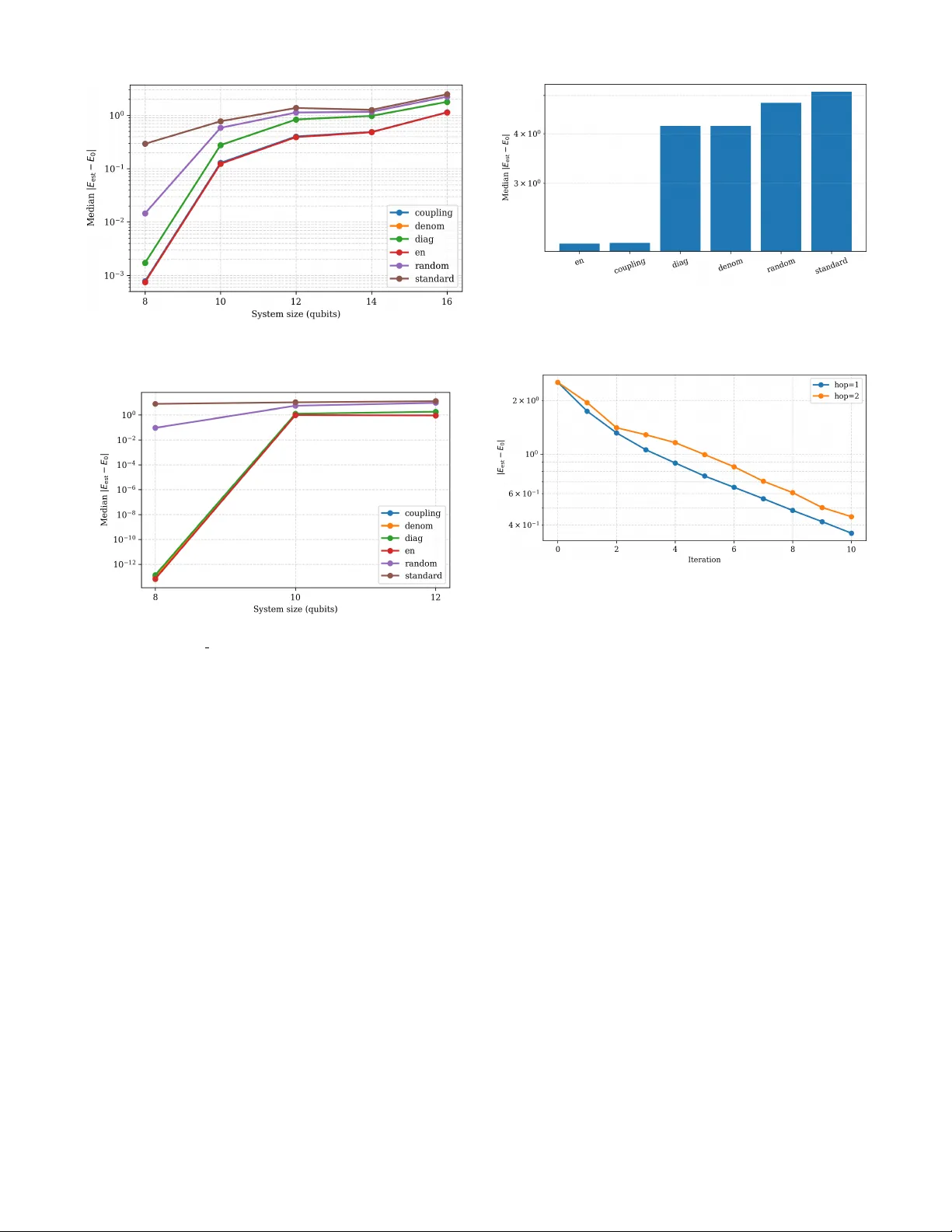
Active Sampling Sample-based Quantum Diagonalization from Finite-Shot Measur ements Rinka Miura 1 , ∗ 1 Department of Applied Chemistry , Kobe City Colle ge of T echnology , J apan (Dated: March 17, 2026) Near-term quantum devices provide only finite-shot computational-basis measurement outcomes and typi- cally prepare imperfect, contaminated states rather than exact ground states. This practical constraint motiv ates algorithms that can con vert samples into reliable estimates of low-energy properties without full state tomogra- phy or exhausti ve Hamiltonian measurement. In this work we propose Activ e Sampling Sample-based Quantum Diagonalization (AS-SQD), an approach that frames Sample-based Quantum Diagonalization (SQD) as an ac- tiv e learning problem: gi ven a finite multiset of measured bitstrings, which additional basis states should be included in the e ff ectiv e subspace to most e ffi ciently recover the true ground-state ener gy? SQD constructs an e ff ecti ve low-dimensional eigenv alue problem by restricting the Hamiltonian to the span of a selected set of computational basis states and then classically diagonalizing the restricted matrix. Howe ver , naiv e SQD that only uses the sampled subspace often su ff ers from severe bias under finite-shot sampling and excited-state contamination, while blind subspace e xpansion (e.g., random exploration of connected basis states) is ine ffi - cient and unstable as system size grows. W e introduce a perturbation-theoretic acquisition function based on Epstein–Nesbet second-order energy corrections to rank candidate basis states that are connected to the current subspace by the Hamiltonian. At each iteration, AS-SQD (i) diagonalizes the restricted Hamiltonian to obtain an approximate ground state, (ii) generates a candidate set of connected basis states, and (iii) adds the most valuable candidates according to a scoring function deriv ed from perturbation theory . W e e valuate AS-SQD on disordered Heisenberg and T ransverse-Field Ising (TFIM) spin chains up to 16 qubits under a realistic prepa- ration model that mixes 80% ground state and 20% first excited state. Furthermore, we validate the inherent robustness of our approach against real-w orld state preparation and measurement (SP AM) errors using physical samples directly from an IBM Quantum processor . Across both simulated and physical ev aluations, AS-SQD consistently achiev es substantially lower median absolute energy errors than standard SQD and random expan- sion. Detailed ablation studies isolate the driving mechanisms of the perturbation score, demonstrating that physics-guided basis acquisition e ff ectively concentrates computation on ener getically relev ant directions and bypasses exponential combinatorial bottlenecks. I. INTR ODUCTION Noisy intermediate-scale quantum (NISQ) devices promise access to quantum dynamics and many-body properties be- yond the reach of exact classical simulation, yet they impose stringent limitations: (i) measurements yield only finite-shot samples in a chosen basis, (ii) prepared states are imperfect and often contain excited-state contamination, and (iii) full Hamiltonian matrix access is unav ailable [ 1 , 2 ]. As a result, many practical quantum algorithms reduce to the question of how to best con v ert limited measurement data into accurate physical predictions. A core target task is estimating the ground-state ener gy E 0 of a Hamiltonian H expressed as a sum of P auli strings, H = P ℓ c ℓ P ℓ , where each P ℓ is a tensor product of single- qubit Pauli operators. The variational quantum eigensolver (VQE) is a standard approach: prepare a parametrized quan- tum state and estimate energy by measuring each term of H [ 3 , 4 ]. Ho wev er, VQE can be limited by shot complexity , op- timization di ffi culties, and errors in state preparation and mea- surement (SP AM)[ 5 ]. Moreov er , e ven if a quantum device produces a state close to the ground state, we do not directly obtain its amplitude vector ψ ; we only observe samples from its measurement distribution in a basis. This motiv ates a complementary family of subspace ap- ∗ acdccit5@gmail.com proaches that use a restricted basis to represent and diagonal- ize an e ff ective Hamiltonian. One classical analogue is se- lected configuration interaction (selected CI), where a small set of determinants is iterati vely e xpanded using perturba- tiv e importance measures (e.g., CIPSI, ASCI) [ 6 – 8 ]. On the quantum side, the Quantum Subspace Expansion (QSE) e x- pands around a reference state using excitation operators and measures matrix elements in that subspace [ 9 ]. These meth- ods suggest that adaptive, ph ysics-motiv ated subspace selec- tion can o vercome the combinatorial dimension of the Hilbert space. In this paper , we focus on a particularly constrained regime: we assume the solver has access to (a) the Hamiltonian in P auli-string form and (b) only computational-basis measur e- ment outcomes (bitstrings) sampled fr om an imperfectly pr e- par ed quantum state. From these bitstrings alone, we b uild a low-dimensional subspace spanned by the observed ba- sis states and then classically diagonalize the Hamiltonian restricted to that subspace. W e refer to this procedure as Sample-based Quantum Diagonalization (SQD) : E ( S ) = min | ψ ⟩∈ span( S ) ⟨ ψ | H | ψ ⟩ ⟨ ψ | ψ ⟩ , (1) where S is a selected set of computational basis states (bit- strings). While SQD is conceptually simple, it re veals a central al- gorithmic problem: Given an initial sample-derived subspace S , whic h additional basis state k should be added to most impr ove E ( S ) toward the true gr ound energy E 0 ? A purely 2 sample-defined subspace can be too small or biased (espe- cially under contamination), leading to large errors. On the other hand, blindly expanding the subspace by exploring ba- sis states connected by H (e.g., random additions) can require many iterations and can waste compute on irrele vant direc- tions. Recent advances hav e further expanded the scope of sample-based quantum diagonalization (SQD) beyond its ini- tial formulation. Symmetry-adapted variants exploit con- served quantities to restrict the e ff ective Hilbert space and im- prov e numerical stability [ 10 ]. Krylov-inspired sample-based constructions hav e been proposed to systematically gener- ate subspaces from measurement data [ 11 ], while partitioned quantum subspace expansion techniques address finite-shot noise through structured matrix decompositions [ 12 ]. Ex- tensions toward quantum chemistry and periodic solid-state systems demonstrate the applicability of SQD-type frame- works beyond small lattice benchmarks [ 13 , 14 ]. In parallel, adaptiv e and neural-network-assisted basis selection strate- gies hav e begun to explore data-dri ven subspace optimization [ 15 ]. These developments collectively highlight a gro wing in- terest in subspace construction strategies under realistic sam- pling constraints. Ho wev er , a principled acquisition rule that directly targets ground-state energy improvement under finite- shot contamination remains largely une xplored. T o address this challenge, we propose Active Sampling Sample-based Quantum Diagonalization (AS-SQD) , an adap- tiv e basis acquisition strategy grounded in perturbation theory . AS-SQD casts the subspace growth of SQD as a sequential decision-making problem under finite-shot constraints, select- ing the most valuable basis states to add next. W e score can- didate basis states using an Epstein–Nesbet partition of the Hilbert space, approximating their expected second-order en- ergy improv ement. The method is e valuated on disordered Heisenberg and Transv erse-Field Ising Models (TFIM) up to 16 qubits, as well as on IBM Quantum hardware. Our re- sults confirm that AS-SQD achieves higher predicti ve accu- racy than standard SQD and random e xpansion. II. B A CKGROUND W e consider n -qubit Hamiltonians expressed as H = L X ℓ = 1 c ℓ P ℓ , P ℓ ∈ { I , X , Y , Z } ⊗ n , c ℓ ∈ R . (2) A P auli string P ℓ maps computational basis states to (possibly di ff erent) basis states up to phases. This implies that matrix elements ⟨ b | H | b ′ ⟩ can be computed e ffi ciently given the Pauli decomposition, without materializing the full 2 n × 2 n matrix, by applying each P auli term to a bitstring and accumulating contributions. In the conte xt of quantum simulation, a quantum de vice prepares a state | ψ ⟩ (possibly noisy) and returns bitstrings b ∈ { 0 , 1 } n sampled from p ( b ) = |⟨ b | ψ ⟩| 2 . W ith N shots shots, the observed counts define an empirical distribution ˆ p , which may miss important basis states if their probability is small. Furthermore, prepared states may contain excited-state com- ponents. A simple but practically relev ant model is a mixture of low-ener gy eigenstates: p ( b ) = (1 − η ) |⟨ b | ψ 0 ⟩| 2 + η |⟨ b | ψ 1 ⟩| 2 , (3) where η is the contamination rate and | ψ 0 ⟩ , | ψ 1 ⟩ are the ground and first excited eigenstates. T o extract low-ener gy properties from these samples, Sample-based Quantum Diagonalization (SQD) utilizes a se- lected set S of observed basis states. SQD forms the restricted Hamiltonian H S = h ⟨ s i | H | s j ⟩ i | S | i , j = 1 , (4) and solves the eigen v alue problem H S c = E S c , (5) where E S approximates the true ground-state energy E 0 and | ψ S ⟩ = P s ∈ S c s | s ⟩ is the approximate ground vector in span( S ). This is equiv alent to minimizing the Rayleigh quotient in ( 1 ). The primary degree of freedom in this approach is how to choose and expand the subspace S . III. PR OBLEM ST A TEMENT W e assume access to: • Hamiltonian H = P ℓ c ℓ P ℓ as a list of Pauli terms. • Finite-shot computational-basis measurement counts from an (imperfect) state preparation. W e aim to estimate the true ground-state ener gy E 0 with min- imal classical computation and without requiring additional quantum measurements beyond the initial samples (in the ba- sic version studied here). Let S 0 be the initial set of basis states obtained from mea- surement outcomes, e.g., the top- K most frequent bitstrings. Standard SQD solves the restricted eigenproblem only on S 0 and returns E ( S 0 ). Howe ver , if the sample omits important basis states (common under finite shots and contamination), E ( S 0 ) can be a poor estimate. A natural extension is to expand the subspace via Hamilto- nian connecti vity . Let N ( s ) denote basis states connected to s by at least one term in H , i.e., ⟨ k | H | s ⟩ , 0. From current S , we can generate a candidate set C ( S ) = [ s ∈ S N ( s ) \ S . (6) The key challenge is: How should we choose a subset of can- didates fr om C ( S ) to add to S in order to maximize impr ove- ment in the gr ound-energy estimate per added basis state? Random selection pro vides a baseline b ut wastes steps on can- didates with ne gligible energy contribution. W e seek a prin- cipled, computable acquisition function using only quantities accessible from ( H , S , | ψ S ⟩ ). 3 IV . A CTIVE SQD VIA EPSTEIN–NESBET PER TURBA TION THEORY T o formalize the subspace expansion, let the full Hilbert space be decomposed into a direct sum H = S ⊕ C , (7) where S = span( S ) is the current subspace and C is its com- plement spanned by computational basis vectors not in S (or , in practice, the finite candidate pool C ( S )). Let | ψ S ⟩ be the normalized lowest-ener gy eigen v ector of H S with eigen value E S . W e consider adding a basis state | k ⟩ ∈ C and ask how much E S would improv e. Epstein–Nesbet (EN) perturbation theory is commonly used in selected CI to estimate the second-order energy cor - rection from external determinants [ 16 ]. F or a single external basis state | k ⟩ , the EN-inspired contribution takes the form ∆ E (2) k ≈ | ⟨ k | H | ψ S ⟩ | 2 E S − H kk , (8) where H kk = ⟨ k | H | k ⟩ . For ground states, typically E S < H kk for many k , making the denominator negati ve; thus ∆ E (2) k is often negati ve, indicating an energy lo wering (improv ement). Because we aim to rank candidates by their expected impact, we use the magnitude-based acquisition function a ( k ) = | ⟨ k | H | ψ S ⟩ | 2 | E S − H kk | . (9) If the full candidate space were included without taking ab- solute values, the signed sum would correspond to the stan- dard Epstein–Nesbet second-order correction. Our acquisi- tion function instead uses a magnitude-based surrogate to rank candidates by expected impact. Selecting candidates with the largest a ( k ) therefore constitutes a greedy approximation to the optimal subspace expansion that maximally lo wers the en- ergy at second order . A small regularization is introduced only to av oid numerical instabilities when E S ≈ H kk . T o compute this score e ffi ciently from the restricted solu- tion | ψ S ⟩ = P j ∈ S c j | j ⟩ , we e valuate the numerator as ⟨ k | H | ψ S ⟩ = X j ∈ S c j ⟨ k | H | j ⟩ . (10) Crucially , for Pauli-string Hamiltonians, ⟨ k | H | j ⟩ is sparse: each Pauli term maps a basis state j to exactly one basis state (with a phase and coe ffi cient). Therefore, only a small fraction of pairs ( k , j ) contribute nonzero values. In practice, we re- strict the sum in ( 10 ) to dominant components with | c j | 2 abov e a threshold, which reduces cost and aligns with the intuition that only important configurations should driv e exploration. V . ALGORITHM A. Overview AS-SQD proceeds iterativ ely: 1. Initialize S from the top- K most frequent measured bit- strings. 2. Solv e the restricted eigenproblem on S to obtain ( E S , | ψ S ⟩ ). 3. Generate candidate basis states C ( S ) connected by H . 4. Compute acquisition scores a ( k ) for k ∈ C ( S ). 5. Add the top- B candidates by score to S and repeat. B. Pseudocode The procedure is formalized in Algorithm 1 . Algorithm 1 Activ e Sampling Sample-based Quantum Diag- onalization (AS-SQD) Require: Pauli Hamiltonian H , measurement counts { ( b , n b ) } , pa- rameters K , B , T , thresholds τ , ϵ 1: S ← top- K bitstrings by count 2: f or t = 1 to T do 3: Build restricted matrix H S = [ ⟨ s i | H | s j ⟩ ] 4: Solve H S c = E S c for lowest eigenpair; form | ψ S ⟩ = P s ∈ S c s | s ⟩ 5: D ← { s ∈ S : | c s | 2 > τ } { dominant support } 6: C ← S s ∈ D N ( s ) \ S { connected candidates } 7: for all k ∈ C do 8: H kk ← ⟨ k | H | k ⟩ 9: ν k ← P s ∈ D c s ⟨ k | H | s ⟩ 10: a ( k ) ← | ν k | 2 / max( | E S − H kk | , ϵ ) 11: end for 12: Add to S the top- B candidates by a ( k ) 13: end for 14: r eturn E S C. Baselines W e compare three methods: • Standard SQD: use only S 0 from samples; no expan- sion. • Random SQD: iterativ ely expand by adding a random subset of candidates from C ( S ) each step. • AS-SQD (pr oposed): expand using the perturbation- guided acquisition function (2). T o isolate the components of our acquisition function, we additionally introduce three heuristic ablation baselines: • Coupling-only: score candidates by the numerator magnitude |⟨ k | H | ψ S ⟩| 2 . • Denom-only: score candidates by the in v erse denomi- nator 1 / | E S − H kk | . • Diag-only: score candidates purely by the lowest diag- onal energy − H kk . 4 VI. EXPERIMENT AL SETUP A. Model: Disordered Heisenberg Chain W e ev aluate on a 1D Heisenberg model with periodic boundary conditions: H = J n X i = 1 ( X i X i + 1 + Y i Y i + 1 + Z i Z i + 1 ) + n X i = 1 h i Z i , (11) with J = 1 and random longitudinal fields h i ∼ N (0 , h 2 ) (we use h = 0 . 5). This Hamiltonian is a standard bench- mark for many-body algorithms and is naturally expressed in Pauli terms. For classical contamination experiments, we test n ∈ { 8 , 10 , 12 , 16 } qubits, where the Hilbert dimension is 2 n (up to 65,536 at n = 16). For hardware experiments, system size is limited to n ≤ 12 due to device constraints. W e also extend our v alidation to the 1D Transv erse-Field Ising Model (TFIM) to ensure generality across Hamiltonian structures: H = − J n X i = 1 Z i Z i + 1 − h x n X i = 1 X i + n X i = 1 g i Z i , (12) with J = 1, h x = 1, and longitudinal disorder g i ∼ N (0 , 0 . 5 2 ). B. Imperfect Preparation and Finite Shots T o simulate realistic NISQ limitations, we compute (for benchmarking only) the ground and first excited eigenstates ( E 0 , | ψ 0 ⟩ ) and ( E 1 , | ψ 1 ⟩ ) of the full Hamiltonian and then gen- erate measurement outcomes from the contaminated distribu- tion ( 3 ) with η = 0 . 2 (i.e., 80% ground state and 20% first excited state). W e use N shots = 2000 (or 3000 for scaled mod- els) samples to form the initial subspace. Importantly , the solver does not use the eigen vectors; it only receiv es the sampled bitstrings and the Pauli-term description of H . Furthermore, to test the algorithm against real physical er- rors, we generated samples directly from an actual IBM Quan- tum backend ( ibmq pittsburgh )[ 17 ]. W e applied Trot- terized state evolution circuits which inherently su ff er from SP AM errors, gate infidelities, and decoherence, resulting in highly distorted empirical bitstring distributions. C. Protocol and Metrics For each system size n , we generate 5 random field in- stances (seeds) and report the median absolute energy error: Err = | E est − E 0 | . (13) Initialization chooses the top K = 50 observed bitstrings. Ex- pansion runs for T = 10 iterations, adding up to B = 20 basis states per iteration for Random SQD and AS-SQD. Thus the final subspace size is at most 50 + 10 × 20 = 250 (often less due to duplicates and limited candidates). FIG. 1. Energy error vs. system size for the Heisenberg model under exact contaminated sampling (median o ver 5 disorder instances). VII. RESUL TS A. Perf ormance and Scaling under Contaminated Sampling T o e valuate the algorithmic performance and scalability , we first tested the models under the exact contamination sampling regime using 3000 measurement shots. Fig. 1 and Fig. 2 illus- trate the median absolute ener gy error as a function of system size n for the Heisenberg and TFIM models, respecti vely . For small systems like n = 8 (Hilbert space dimension 256), random expansion e ff ectiv ely reaches a su ffi ciently expressi ve subspace within the iteration b udget; both Random SQD and AS-SQD attain near machine-precision agreement with the exact ground-state ener gy E 0 . Howe ver , as the system size increases to n = 10 and beyond, the performance gap between approaches becomes highly pronounced. Standard SQD er- rors increase rapidly with n because the empirical samples increasingly miss important o ff -diagonal support. Random expansion exhibits limited improvement at lar ger n within a small iteration budget, indicating poor sample e ffi ciency in exploring the combinatorially gro wing connected basis graph. Con versely , AS-SQD consistently achie ves the best accu- racy across all ev aluated sizes. Both the full Epstein–Nesbet score (denoted as ‘en’) and the coupling-only heuristic ef- ficiently navigate the basis graph, identifying high-impact states and maintaining remarkably low median errors even at n = 16 (a Hilbert space dimension of 65,536). This confirms that perturbation-guided basis acquisition e ff ectively concen- trates computation on energetically rele vant directions, suc- cessfully bypassing the exponential bottleneck of blind sub- space expansion. B. Real Hardwar e V alidation on IBM Quantum T o test the method ag ainst se vere physical errors, we ev aluated AS-SQD using bitstrings sampled from the ibmq pittsburgh quantum processor . Fig. 3 illustrates the median errors across di ff erent system sizes for the Heisenber g model. Despite extreme SP AM and gate noise populating ir - 5 FIG. 2. Energy error vs. system size for the TFIM model under exact contaminated sampling (median ov er 5 disorder instances). FIG. 3. Energy error vs. system size using physical samples from IBM Quantum ( ibmq pittsburgh ). Note the remarkable recovery at n = 8 where AS-SQD successfully filters hardware noise to iden- tify the exact ground state subspace. relev ant computational basis states in the initial distrib ution, AS-SQD at n = 8 identified and conv erged precisely to the true ground state (error ∼ 10 − 14 ). Across all tested hardware sizes, AS-SQD outperforms the standard baselines by a sub- stantial margin, demonstrating strong robustness against phys- ical noise. C. Ablation Study T o dissect the mechanics of the acquisition function, we compared AS-SQD (‘en’) to the isolated heuristic scores at n = 16 (Fig. 4 ). Scoring solely by diagonal ener gies (‘diag’) or energetic proximity (‘denom’) performs poorly compared to the full score. In contrast, the ‘coupling-only’ heuristic matches the performance of the full Epstein-Nesbet score. This demonstrates that the matrix element magnitude |⟨ k | H | ψ S ⟩| 2 acts as the dominant physical compass in Hilbert space, and the full EN score optimally balances it with ener - getic proximity . FIG. 4. Ablation study of acquisition functions at n = 16 (Heisenberg model under exact contaminated sampling). The full perturbation score (en) and coupling-only significantly outperform energy-based heuristics (denom, diag) and standard baselines. FIG. 5. Representativ e error trace ( n = 12 Heisenberg model) demonstrating that extending candidate proposals to 2-hops slo ws down conv ergence compared to the standard 1-hop approach. The 1-hop connectivity e ff ecti vely acts as a strong inductiv e bias under a fixed addition b udget. D. E ff ect of Candidate Proposal Horizon T o explore the limits of Hamiltonian connectivity , we tested generating candidates up to 2-hops aw ay from the subspace support using a multi-step heuristic score. Interestingly , as shown in Fig. 5 , expanding the search horizon to 2-hops actu- ally slo wed do wn conv ergence under a fix ed addition budget ( B = 20). This rev eals that the strict 1-hop restriction acts as a highly beneficial inductive bias, pre venting the candidate pool from growing excessi vely and forcing the algorithm to greedily exploit the most immediate and energetically rele vant neighborhood. VIII. DISCUSSION Standard SQD fails under finite shots because the empir - ical sample often omits basis states with small probability , while excited-state contamination further displaces important ground-state components from the initial subspace. Expand- ing this subspace via random connected states is highly in- e ffi cient; as system size and interaction complexity increase, an uninformed random selection quickly w astes its limited budget on lo w-impact states. AS-SQD overcomes these is- 6 sues by using an acquisition score that simultaneously e val- uates coupling strength ( |⟨ k | H | ψ S ⟩| 2 ) and energetic proximity ( | E S − H kk | ). As confirmed by our ablation study , prioritizing strongly connected candidates is vital for e ffi ciently navigat- ing the combinatorial basis graph. This perturbation-guided approach also provides inherent robustness to real-world hard- ware noise. Physical measurement errors and bit-flips yield observed bitstrings with near -zero o ff -diagonal couplings to the true lo w-energy manifold and very high diagonal ener - gies. Consequently , the acquisition function naturally assigns near-zero scores to bitstrings a ff ected by SP AM or gate errors, intrinsically filtering out noise without requiring classical er - ror mitig ation techniques such as zero-noise extrapolation or probabilistic error cancellation [ 18 – 20 ]. Regarding computational comple xity , building and diag- onalizing the restricted matrix H S takes O ( m 3 ) classically , where m = | S | is the subspace size. Because m is entirely decoupled from the full Hilbert space dimension 2 n and kept deliberately small, the algorithm is highly scalable. Candidate scoring scales linearly with the number of Pauli strings rather than exponentially , successfully bypassing combinatorial bot- tlenecks. While AS-SQD demonstrates significant advantages, we note certain limitations: our current benchmarking relies on classical e xact diagonalization for data generation, and nu- merical instabilities when E S ≈ H kk require small regular - izations. Looking forward, framing AS-SQD as a physics- informed acti ve learning loop [ 21 ] in Hilbert space naturally suggests sev eral promising extensions. Because perturba- tion theory supplies a computationally cheap proxy objective aligned with energy minimization, future work could explore adaptiv e quantum measurement allocation or bandit-style ex- pansion budgets to further optimize sample e ffi ciency under strict hardware constraints. IX. CONCLUSION W e presented Active Sampling Sample-based Quantum Di- agonalization (AS-SQD) , a perturbation-guided method for selecting which computational basis states to add to a sample- deriv ed subspace in order to e ffi ciently estimate ground-state energies from finite-shot quantum measurements. AS-SQD reframes SQD as an acti ve learning problem under NISQ con- straints and introduces a practical acquisition function based on Epstein–Nesbet second-order energy corrections. In experiments on Heisenberg and TFIM chains (up to 16 qubits) as well as IBM Quantum hardw are, AS-SQD outper- formed standard SQD and random expansion, demonstrating improv ed sample e ffi ciency and robustness against SP AM and gate errors. Future work includes adapti ve measurement al- location, enhanced acquisition functions, and ev aluation on molecular electronic structure Hamiltonians. More broadly , AS-SQD illustrates a general principle for quantum AI in the NISQ era: use physics-derived acquisition functions to decide what information to incorporate ne xt under strict sampling constraints . A CKNO WLEDGMENT Part of the results of this research were obtained with sup- port from the “NEDO Challenge, Quantum Computing Solve Social Issues ! ” by Ne w Energy and Industrial T echnology Dev elopment Organization (NEDO). D A T A A V AILABILITY All parameters used in the simulations are described in the Methods section and are also av ailable in the provided code. All program code is freely a vailable on GitHub at h t t p s : / / g i t h u b . c o m / G 0 w O z 1 P V / S Q D . The software supports systems running Python 3.7 or later . REFERENCES [1] J. Preskill, Quantum computing in the nisq era and beyond, Quantum 2 , 79 (2018) . [2] M. Cerezo, A. Arrasmith, R. Babbush, S. C. Benjamin, S. Endo, K. Fujii, J. R. McClean, K. Mitarai, X. Y uan, L. Cincio, and P . J. Coles, V ariational quantum algorithms, Nat. Rev . Phys. 3 , 625 (2021) . [3] A. Peruzzo, J. R. McClean, P . Shadbolt, M.-H. Y ung, X.-Q. Zhou, P . J. Love, A. Aspuru-Guzik, and J. L. O’Brien, A varia- tional eigen value solver on a photonic quantum processor , Nat. Commun. 5 , 4213 (2014) . [4] A. Kandala, A. Mezzacapo, K. T emme, M. T akita, M. Brink, J. M. Chow , and J. M. Gambetta, Hardware-e ffi cient variational quantum eigensolv er for small molecules and quantum mag- nets, Nature 549 , 242 (2017) . [5] J. R. McClean, S. Boixo, V . N. Smelyanskiy , R. Babbush, and H. Nev en, Barren plateaus in quantum neural network training landscapes, Nat. Commun. 9 , 4812 (2018) . [6] B. Huron, J. P . Malrieu, and P . Rancurel, Iterative perturbation calculations of ground and excited state energies from multi- configurational zeroth-order wa vefunctions, J. Chem. Phys. 58 , 5745 (1973) . [7] N. M. Tubman, J. Lee, T . Y . T akeshita, M. Head-Gordon, and K. B. Whaley , A deterministic alternativ e to the full configura- tion interaction quantum monte carlo method, J. Chem. Phys. 145 , 044112 (2016) . [8] A. A. Holmes, N. M. T ubman, and C. J. Umrigar , Heat-bath configuration interaction: An e ffi cient selected configuration interaction algorithm inspired by heat-bath sampling, J. Chem. Theory Comput. 12 , 3674 (2016) . [9] J. R. McClean, M. E. Kimchi-Schw artz, J. Carter , and W . A. de Jong, Hybrid quantum-classical hierarchy for mitigation of decoherence and determination of excited states, Phys. Rev . A 95 , 042308 (2017) . [10] K. Nogaki, S. Backes, T . Shiraka wa, S. Y unoki, and R. Arita, Symmetry-adapted sample-based quantum diagonalization: Application to lattice model (2025), arXiv:2505.00914 [quant- ph] . [11] E. O. Rosanowski, J. Eisinger, L. Funcke, U. Poschinger , and F . Schmidt-Kaler , Sample-based krylov quantum diagonaliza- tion for the schwinger model on trapped-ion and superconduct- ing quantum processors (2025), arXiv:2510.26951 [quant-ph] . 7 [12] T . O’Leary , L. W . Anderson, D. Jaksch, and M. Ki ff ner, Parti- tioned quantum subspace expansion, Quantum 9 , 1726 (2025) . [13] A. Duriez, P . C. Carvalho, M. A. Barroca, F . Zipoli, B. Jader- berg, R. N. B. Ferreira, K. Sharma, A. Mezzacapo, B. W un- sch, and M. Steiner , Computing band gaps of periodic materials via sample-based quantum diagonalization (2025), arXiv:2503.10901 [quant-ph] . [14] S. Piccinelli, A. Baiardi, S. Barison, M. Rossmannek, A. Car- rera V azquez, F . T acchino, S. Mensa, E. Altamura, A. Alavi, M. Motta, J. Robledo-Moreno, W . Kirby , K. Sharma, A. Mezza- capo, and I. T a vernelli, Quantum chemistry with prov able con- ver gence via randomized sample-based krylov quantum diago- nalization (2025), arXiv:2508.02578 [quant-ph] . [15] S. Cantori, L. Brodoloni, E. Recchi, E. Costa, B. Juli ´ a-D ´ ıaz, and S. Pilati, Adaptive-basis sample-based neural diagonalization for quantum many-body systems (2025), [quant-ph] . [16] P . S. Epstein, The stark e ff ect from the point of view of schroedinger’ s quantum theory , Ph ys. Rev . 28 , 695 (1926) . [17] J. Bierman et al. , T o wards utility-scale electronic structure with sample-based methods on real quantum hardware, ChemRxiv preprint 10.26434 / chemrxiv-2025-l wj7d (2025), experiments ex ecuted on the IBM Quantum Pittsbur gh (Heron r3) proces- sor . [18] A. Kandala, K. T emme, A. D. C ´ orcoles, and et al., Error miti- gation extends the computational reach of a noisy quantum pro- cessor , Nature 567 , 491 (2019) . [19] K. T emme, S. Bra vyi, and J. M. Gambetta, Error mitigation for short-depth quantum circuits, Phys. Rev . Lett. 119 , 180509 (2017) . [20] S. Endo, S. C. Benjamin, and Y . Li, Practical quantum error mitigation for near-future applications, Phys. Re v . X 8 , 031027 (2018) . [21] B. Settles, Active learning literatur e survey , T ech. Rep. TR1648 (Univ ersity of W isconsin–Madison, Department of Computer Sciences, 2009).
Original Paper
Loading high-quality paper...
Comments & Academic Discussion
Loading comments...
Leave a Comment