Turbo Receiver Design for Differentially Encoded PSK in Bursty Impulsive Noise Channels
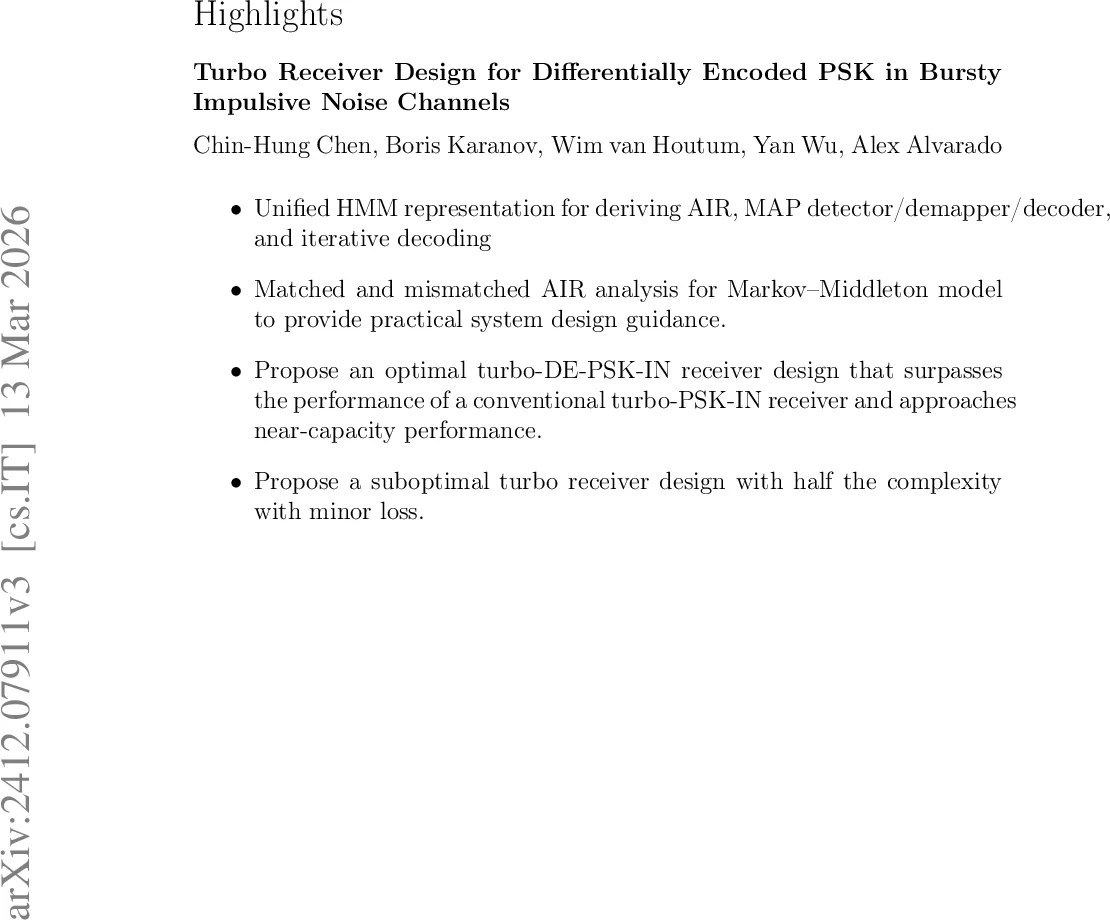
It has been recognized that the impulsive noise (IN) generated by power devices poses significant challenges to wireless receivers. In this paper, we comprehensively assess the achievable information rate (AIR) for the well-established Markov-Middleton IN model with a phase-shift keying (PSK) input sequence across various channel conditions, including matched and mismatched decoding scenarios. Upon determining information-theoretic bounds, we propose an optimal turbo-differentially encoded (DE)-PSK-IN receiver design based on a commonly used commercial transmission setup consisting of a convolutional encoder, bit-level interleaver, and a DE-PSK symbol mapper. We show that by incorporating the differential decoder into the maximum a-posteriori-based (MAP) IN detector, we can significantly enhance the receiver performance with a 4.5 dB gain compared to the conventional MAP-based turbo-PSK-IN receiver and a gap of around 1 dB to the theoretical bounds. We also propose a suboptimal separate receiver design that can be implemented with half the complexity of the joint design and near-optimal performance. We have evaluated the performance of the proposed receiver designs through extensive simulations, demonstrating their effectiveness in real-world scenarios with limited interleaver depth and mismatched state implementation.
💡 Research Summary
This paper addresses the severe challenge posed by impulsive noise (IN) generated by power devices to wireless receivers, focusing on bursty IN modeled by a finite‑state Markov‑Middleton hidden Markov model (HMM). The authors first derive a unified HMM representation that captures the statistical behavior of the Markov‑Middleton channel, including the background noise variance, impulsive index, impulsive‑to‑background power ratio, and temporal correlation parameter. Using this model, they compute the achievable information rate (AIR) for M‑ary phase‑shift keying (PSK) inputs under both matched and mismatched decoding assumptions. The AIR analysis reveals how the four noise parameters degrade capacity and provides practical guidelines for selecting coding rates and interleaver depths.
Building on the information‑theoretic results, the paper proposes two receiver architectures for a commercial transmission chain consisting of a convolutional encoder, bit‑level interleaver, and differential‑encoded PSK (DE‑PSK) mapper. The optimal design integrates a differential demapper directly into the MAP‑based IN detector, modifying the BCJR branch metric to include the differential likelihood. This joint DE‑PSK‑IN detector retains the same computational order as a conventional MAP‑PSK‑IN detector but yields a 4.5 dB signal‑to‑noise ratio (SNR) gain over the state‑of‑the‑art MAP‑turbo‑PSK‑IN receiver. Simulation results show that the gap to the AIR bound is only about 1 dB, indicating near‑capacity performance.
To address implementation constraints, a sub‑optimal separate receiver is also introduced. It performs MAP IN detection and differential demapping sequentially, halving the overall complexity while incurring less than 0.2 dB performance loss compared with the joint design. Both designs are evaluated under realistic conditions: limited interleaver depth, mismatched state models (e.g., fewer states assumed at the receiver than present in the channel), and imperfect knowledge of noise parameters. The proposed receivers remain robust, demonstrating only modest degradation in these adverse scenarios.
The authors emphasize that the presented results assume perfect knowledge of the Markov‑Middleton parameters at the receiver; they acknowledge that parameter estimation errors can significantly affect MAP detector reliability and suggest that future work should integrate advanced estimation techniques.
In summary, the paper makes four key contributions: (1) a comprehensive HMM‑based statistical model for bursty impulsive noise, (2) an AIR analysis that quantifies the theoretical limits for PSK over such channels, (3) an optimal joint turbo‑DE‑PSK‑IN receiver that approaches these limits within 1 dB, and (4) a low‑complexity near‑optimal alternative. The findings are directly applicable to wireless communication systems operating in power‑dense environments such as electric vehicles, substations, and industrial IoT, offering a practical pathway to achieve reliable, high‑rate links despite severe impulsive interference.
Comments & Academic Discussion
Loading comments...
Leave a Comment