On obstructions to the Euler system method for Rankin-Selberg convolutions
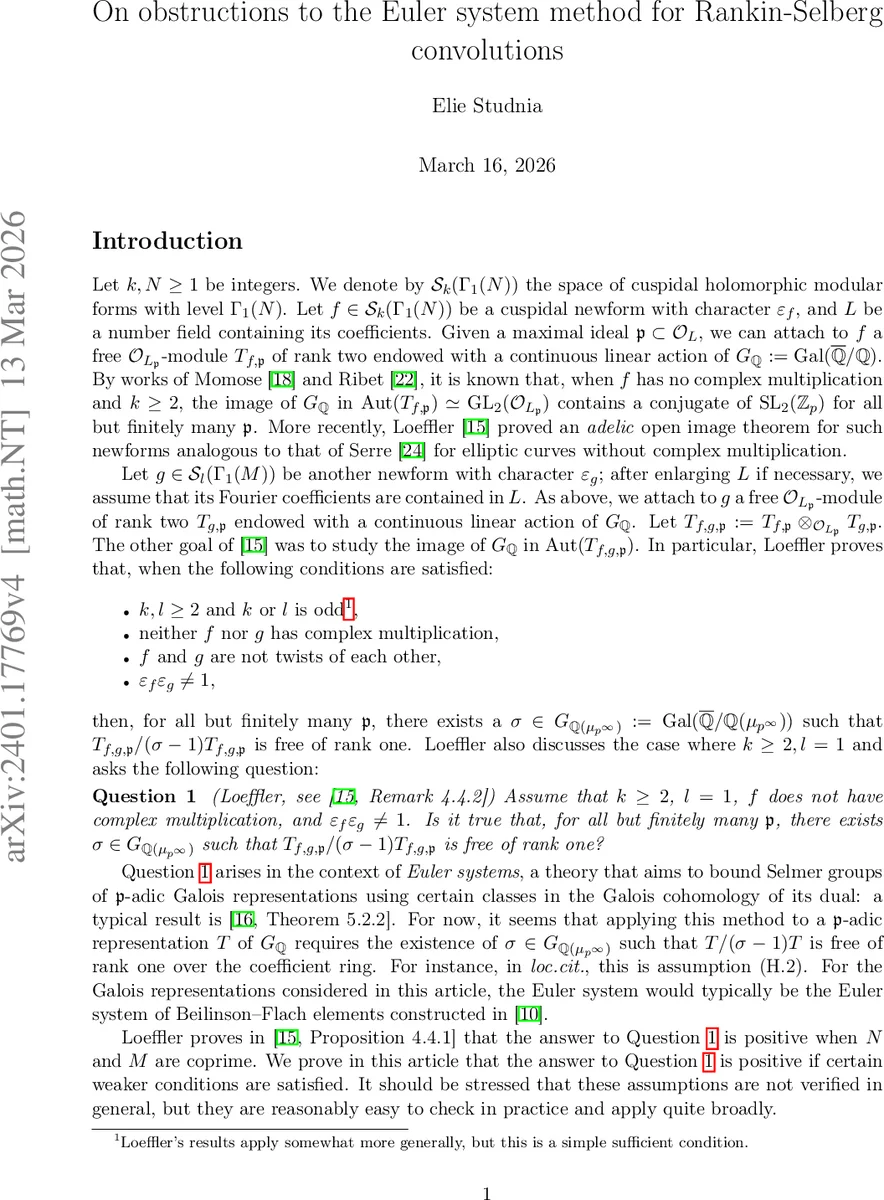
To apply the Euler system method to a $p$-adic Galois representation $T$, one needs the existence of a $σ\in G_{\mathbb{Q}(μ_{p^{\infty}})}$ such that $V/(σ-1)V$ is free of rank one over the coefficient ring: we say that such a $σ$ is an Euler-suitable element for $V$. Given a non-CM classical newform $f$ of weight $k \geq 2$ and character $χ$, a classical newform $g$ of weight $1$ and character $ψ$, and a prime ideal $\mathfrak{p}$ of residue characteristic $p$ of a sufficiently large number field, we consider the situation where $V=V_{f,g,\mathfrak{p}}$ is the tensor product of the $\mathfrak{p}$-adic representations attached to $f$ and $g$. D. Loeffler asked the following question: is is true that if $χψ\neq 1$, then there is an Euler-suitable element for $V_{f,g,\mathfrak{p}}$ for all but finitely many $\mathfrak{p}$? He gave a positive answer when $f,g$ had coprime conductors. We give several weaker sufficient conditions to answer this question in the affirmative. As an application, we remove some of the technical assumptions in the version of the Bloch-Kato Conjecture proved in arXiv:1503.02888. We also show that the general answer to the question is negative, by constructing a family of counter-examples, and giving additional counter-examples that do not fit in this family.
💡 Research Summary
The paper investigates a subtle but crucial condition required for the application of Euler‑system techniques to the Rankin–Selberg convolution of two modular forms. Let f be a non‑CM newform of weight k ≥ 2 with character ε_f and let g be a weight‑1 newform with character ε_g. For a prime 𝔭 of a sufficiently large coefficient field L, denote by V_{f,g,𝔭}=T_{f,𝔭}⊗{O_L}T{g,𝔭} the tensor product of the associated p‑adic Galois representations. The Euler‑system machinery (as in
Comments & Academic Discussion
Loading comments...
Leave a Comment